EP3601209B1 - Neue esterverbindungen, verfahren zu ihrer herstellung sowie ihre verwendung - Google Patents
Neue esterverbindungen, verfahren zu ihrer herstellung sowie ihre verwendung Download PDFInfo
- Publication number
- EP3601209B1 EP3601209B1 EP18724128.6A EP18724128A EP3601209B1 EP 3601209 B1 EP3601209 B1 EP 3601209B1 EP 18724128 A EP18724128 A EP 18724128A EP 3601209 B1 EP3601209 B1 EP 3601209B1
- Authority
- EP
- European Patent Office
- Prior art keywords
- acid
- group
- lubricating
- integer
- radicals
- Prior art date
- Legal status (The legal status is an assumption and is not a legal conclusion. Google has not performed a legal analysis and makes no representation as to the accuracy of the status listed.)
- Active
Links
Classifications
-
- C—CHEMISTRY; METALLURGY
- C07—ORGANIC CHEMISTRY
- C07C—ACYCLIC OR CARBOCYCLIC COMPOUNDS
- C07C69/00—Esters of carboxylic acids; Esters of carbonic or haloformic acids
- C07C69/608—Esters of carboxylic acids having a carboxyl group bound to an acyclic carbon atom and having a ring other than a six-membered aromatic ring in the acid moiety
-
- C—CHEMISTRY; METALLURGY
- C07—ORGANIC CHEMISTRY
- C07C—ACYCLIC OR CARBOCYCLIC COMPOUNDS
- C07C69/00—Esters of carboxylic acids; Esters of carbonic or haloformic acids
- C07C69/66—Esters of carboxylic acids having esterified carboxylic groups bound to acyclic carbon atoms and having any of the groups OH, O—metal, —CHO, keto, ether, acyloxy, groups, groups, or in the acid moiety
- C07C69/67—Esters of carboxylic acids having esterified carboxylic groups bound to acyclic carbon atoms and having any of the groups OH, O—metal, —CHO, keto, ether, acyloxy, groups, groups, or in the acid moiety of saturated acids
-
- C—CHEMISTRY; METALLURGY
- C07—ORGANIC CHEMISTRY
- C07C—ACYCLIC OR CARBOCYCLIC COMPOUNDS
- C07C323/00—Thiols, sulfides, hydropolysulfides or polysulfides substituted by halogen, oxygen or nitrogen atoms, or by sulfur atoms not being part of thio groups
- C07C323/50—Thiols, sulfides, hydropolysulfides or polysulfides substituted by halogen, oxygen or nitrogen atoms, or by sulfur atoms not being part of thio groups containing thio groups and carboxyl groups bound to the same carbon skeleton
- C07C323/51—Thiols, sulfides, hydropolysulfides or polysulfides substituted by halogen, oxygen or nitrogen atoms, or by sulfur atoms not being part of thio groups containing thio groups and carboxyl groups bound to the same carbon skeleton having the sulfur atoms of the thio groups bound to acyclic carbon atoms of the carbon skeleton
- C07C323/52—Thiols, sulfides, hydropolysulfides or polysulfides substituted by halogen, oxygen or nitrogen atoms, or by sulfur atoms not being part of thio groups containing thio groups and carboxyl groups bound to the same carbon skeleton having the sulfur atoms of the thio groups bound to acyclic carbon atoms of the carbon skeleton the carbon skeleton being acyclic and saturated
-
- C—CHEMISTRY; METALLURGY
- C07—ORGANIC CHEMISTRY
- C07C—ACYCLIC OR CARBOCYCLIC COMPOUNDS
- C07C67/00—Preparation of carboxylic acid esters
- C07C67/04—Preparation of carboxylic acid esters by reacting carboxylic acids or symmetrical anhydrides onto unsaturated carbon-to-carbon bonds
- C07C67/05—Preparation of carboxylic acid esters by reacting carboxylic acids or symmetrical anhydrides onto unsaturated carbon-to-carbon bonds with oxidation
-
- C—CHEMISTRY; METALLURGY
- C07—ORGANIC CHEMISTRY
- C07C—ACYCLIC OR CARBOCYCLIC COMPOUNDS
- C07C67/00—Preparation of carboxylic acid esters
- C07C67/08—Preparation of carboxylic acid esters by reacting carboxylic acids or symmetrical anhydrides with the hydroxy or O-metal group of organic compounds
-
- C—CHEMISTRY; METALLURGY
- C07—ORGANIC CHEMISTRY
- C07C—ACYCLIC OR CARBOCYCLIC COMPOUNDS
- C07C69/00—Esters of carboxylic acids; Esters of carbonic or haloformic acids
- C07C69/66—Esters of carboxylic acids having esterified carboxylic groups bound to acyclic carbon atoms and having any of the groups OH, O—metal, —CHO, keto, ether, acyloxy, groups, groups, or in the acid moiety
- C07C69/67—Esters of carboxylic acids having esterified carboxylic groups bound to acyclic carbon atoms and having any of the groups OH, O—metal, —CHO, keto, ether, acyloxy, groups, groups, or in the acid moiety of saturated acids
- C07C69/708—Ethers
-
- C—CHEMISTRY; METALLURGY
- C07—ORGANIC CHEMISTRY
- C07C—ACYCLIC OR CARBOCYCLIC COMPOUNDS
- C07C69/00—Esters of carboxylic acids; Esters of carbonic or haloformic acids
- C07C69/66—Esters of carboxylic acids having esterified carboxylic groups bound to acyclic carbon atoms and having any of the groups OH, O—metal, —CHO, keto, ether, acyloxy, groups, groups, or in the acid moiety
- C07C69/73—Esters of carboxylic acids having esterified carboxylic groups bound to acyclic carbon atoms and having any of the groups OH, O—metal, —CHO, keto, ether, acyloxy, groups, groups, or in the acid moiety of unsaturated acids
-
- C—CHEMISTRY; METALLURGY
- C07—ORGANIC CHEMISTRY
- C07C—ACYCLIC OR CARBOCYCLIC COMPOUNDS
- C07C69/00—Esters of carboxylic acids; Esters of carbonic or haloformic acids
- C07C69/74—Esters of carboxylic acids having an esterified carboxyl group bound to a carbon atom of a ring other than a six-membered aromatic ring
- C07C69/75—Esters of carboxylic acids having an esterified carboxyl group bound to a carbon atom of a ring other than a six-membered aromatic ring of acids with a six-membered ring
-
- C—CHEMISTRY; METALLURGY
- C07—ORGANIC CHEMISTRY
- C07C—ACYCLIC OR CARBOCYCLIC COMPOUNDS
- C07C69/00—Esters of carboxylic acids; Esters of carbonic or haloformic acids
- C07C69/76—Esters of carboxylic acids having a carboxyl group bound to a carbon atom of a six-membered aromatic ring
- C07C69/80—Phthalic acid esters
-
- C—CHEMISTRY; METALLURGY
- C10—PETROLEUM, GAS OR COKE INDUSTRIES; TECHNICAL GASES CONTAINING CARBON MONOXIDE; FUELS; LUBRICANTS; PEAT
- C10M—LUBRICATING COMPOSITIONS; USE OF CHEMICAL SUBSTANCES EITHER ALONE OR AS LUBRICATING INGREDIENTS IN A LUBRICATING COMPOSITION
- C10M105/00—Lubricating compositions characterised by the base-material being a non-macromolecular organic compound
- C10M105/08—Lubricating compositions characterised by the base-material being a non-macromolecular organic compound containing oxygen
- C10M105/32—Esters
- C10M105/42—Complex esters, i.e. compounds containing at least three esterified carboxyl groups and derived from the combination of at least three different types of the following five types of compound: monohydroxy compounds, polyhydroxy compounds, monocarboxylic acids, polycarboxylic acids and hydroxy carboxylic acids
-
- C—CHEMISTRY; METALLURGY
- C07—ORGANIC CHEMISTRY
- C07C—ACYCLIC OR CARBOCYCLIC COMPOUNDS
- C07C2601/00—Systems containing only non-condensed rings
- C07C2601/12—Systems containing only non-condensed rings with a six-membered ring
- C07C2601/14—The ring being saturated
-
- C—CHEMISTRY; METALLURGY
- C07—ORGANIC CHEMISTRY
- C07C—ACYCLIC OR CARBOCYCLIC COMPOUNDS
- C07C2601/00—Systems containing only non-condensed rings
- C07C2601/12—Systems containing only non-condensed rings with a six-membered ring
- C07C2601/16—Systems containing only non-condensed rings with a six-membered ring the ring being unsaturated
-
- C—CHEMISTRY; METALLURGY
- C10—PETROLEUM, GAS OR COKE INDUSTRIES; TECHNICAL GASES CONTAINING CARBON MONOXIDE; FUELS; LUBRICANTS; PEAT
- C10M—LUBRICATING COMPOSITIONS; USE OF CHEMICAL SUBSTANCES EITHER ALONE OR AS LUBRICATING INGREDIENTS IN A LUBRICATING COMPOSITION
- C10M2207/00—Organic non-macromolecular hydrocarbon compounds containing hydrogen, carbon and oxygen as ingredients in lubricant compositions
- C10M2207/28—Esters
- C10M2207/30—Complex esters, i.e. compounds containing at leasst three esterified carboxyl groups and derived from the combination of at least three different types of the following five types of compounds: monohydroxyl compounds, polyhydroxy xompounds, monocarboxylic acids, polycarboxylic acids or hydroxy carboxylic acids
-
- C—CHEMISTRY; METALLURGY
- C10—PETROLEUM, GAS OR COKE INDUSTRIES; TECHNICAL GASES CONTAINING CARBON MONOXIDE; FUELS; LUBRICANTS; PEAT
- C10M—LUBRICATING COMPOSITIONS; USE OF CHEMICAL SUBSTANCES EITHER ALONE OR AS LUBRICATING INGREDIENTS IN A LUBRICATING COMPOSITION
- C10M2207/00—Organic non-macromolecular hydrocarbon compounds containing hydrogen, carbon and oxygen as ingredients in lubricant compositions
- C10M2207/28—Esters
- C10M2207/30—Complex esters, i.e. compounds containing at leasst three esterified carboxyl groups and derived from the combination of at least three different types of the following five types of compounds: monohydroxyl compounds, polyhydroxy xompounds, monocarboxylic acids, polycarboxylic acids or hydroxy carboxylic acids
- C10M2207/301—Complex esters, i.e. compounds containing at leasst three esterified carboxyl groups and derived from the combination of at least three different types of the following five types of compounds: monohydroxyl compounds, polyhydroxy xompounds, monocarboxylic acids, polycarboxylic acids or hydroxy carboxylic acids used as base material
-
- C—CHEMISTRY; METALLURGY
- C10—PETROLEUM, GAS OR COKE INDUSTRIES; TECHNICAL GASES CONTAINING CARBON MONOXIDE; FUELS; LUBRICANTS; PEAT
- C10N—INDEXING SCHEME ASSOCIATED WITH SUBCLASS C10M RELATING TO LUBRICATING COMPOSITIONS
- C10N2020/00—Specified physical or chemical properties or characteristics, i.e. function, of component of lubricating compositions
- C10N2020/01—Physico-chemical properties
- C10N2020/02—Viscosity; Viscosity index
-
- C—CHEMISTRY; METALLURGY
- C10—PETROLEUM, GAS OR COKE INDUSTRIES; TECHNICAL GASES CONTAINING CARBON MONOXIDE; FUELS; LUBRICANTS; PEAT
- C10N—INDEXING SCHEME ASSOCIATED WITH SUBCLASS C10M RELATING TO LUBRICATING COMPOSITIONS
- C10N2020/00—Specified physical or chemical properties or characteristics, i.e. function, of component of lubricating compositions
- C10N2020/01—Physico-chemical properties
- C10N2020/081—Biodegradable compounds
-
- C—CHEMISTRY; METALLURGY
- C10—PETROLEUM, GAS OR COKE INDUSTRIES; TECHNICAL GASES CONTAINING CARBON MONOXIDE; FUELS; LUBRICANTS; PEAT
- C10N—INDEXING SCHEME ASSOCIATED WITH SUBCLASS C10M RELATING TO LUBRICATING COMPOSITIONS
- C10N2030/00—Specified physical or chemical properties which is improved by the additive characterising the lubricating composition, e.g. multifunctional additives
- C10N2030/02—Pour-point; Viscosity index
-
- C—CHEMISTRY; METALLURGY
- C10—PETROLEUM, GAS OR COKE INDUSTRIES; TECHNICAL GASES CONTAINING CARBON MONOXIDE; FUELS; LUBRICANTS; PEAT
- C10N—INDEXING SCHEME ASSOCIATED WITH SUBCLASS C10M RELATING TO LUBRICATING COMPOSITIONS
- C10N2030/00—Specified physical or chemical properties which is improved by the additive characterising the lubricating composition, e.g. multifunctional additives
- C10N2030/12—Inhibition of corrosion, e.g. anti-rust agents or anti-corrosives
-
- C—CHEMISTRY; METALLURGY
- C10—PETROLEUM, GAS OR COKE INDUSTRIES; TECHNICAL GASES CONTAINING CARBON MONOXIDE; FUELS; LUBRICANTS; PEAT
- C10N—INDEXING SCHEME ASSOCIATED WITH SUBCLASS C10M RELATING TO LUBRICATING COMPOSITIONS
- C10N2030/00—Specified physical or chemical properties which is improved by the additive characterising the lubricating composition, e.g. multifunctional additives
- C10N2030/62—Food grade properties
-
- C—CHEMISTRY; METALLURGY
- C10—PETROLEUM, GAS OR COKE INDUSTRIES; TECHNICAL GASES CONTAINING CARBON MONOXIDE; FUELS; LUBRICANTS; PEAT
- C10N—INDEXING SCHEME ASSOCIATED WITH SUBCLASS C10M RELATING TO LUBRICATING COMPOSITIONS
- C10N2030/00—Specified physical or chemical properties which is improved by the additive characterising the lubricating composition, e.g. multifunctional additives
- C10N2030/64—Environmental friendly compositions
-
- C—CHEMISTRY; METALLURGY
- C10—PETROLEUM, GAS OR COKE INDUSTRIES; TECHNICAL GASES CONTAINING CARBON MONOXIDE; FUELS; LUBRICANTS; PEAT
- C10N—INDEXING SCHEME ASSOCIATED WITH SUBCLASS C10M RELATING TO LUBRICATING COMPOSITIONS
- C10N2030/00—Specified physical or chemical properties which is improved by the additive characterising the lubricating composition, e.g. multifunctional additives
- C10N2030/66—Hydrolytic stability
-
- C—CHEMISTRY; METALLURGY
- C10—PETROLEUM, GAS OR COKE INDUSTRIES; TECHNICAL GASES CONTAINING CARBON MONOXIDE; FUELS; LUBRICANTS; PEAT
- C10N—INDEXING SCHEME ASSOCIATED WITH SUBCLASS C10M RELATING TO LUBRICATING COMPOSITIONS
- C10N2030/00—Specified physical or chemical properties which is improved by the additive characterising the lubricating composition, e.g. multifunctional additives
- C10N2030/68—Shear stability
-
- C—CHEMISTRY; METALLURGY
- C10—PETROLEUM, GAS OR COKE INDUSTRIES; TECHNICAL GASES CONTAINING CARBON MONOXIDE; FUELS; LUBRICANTS; PEAT
- C10N—INDEXING SCHEME ASSOCIATED WITH SUBCLASS C10M RELATING TO LUBRICATING COMPOSITIONS
- C10N2030/00—Specified physical or chemical properties which is improved by the additive characterising the lubricating composition, e.g. multifunctional additives
- C10N2030/74—Noack Volatility
-
- C—CHEMISTRY; METALLURGY
- C10—PETROLEUM, GAS OR COKE INDUSTRIES; TECHNICAL GASES CONTAINING CARBON MONOXIDE; FUELS; LUBRICANTS; PEAT
- C10N—INDEXING SCHEME ASSOCIATED WITH SUBCLASS C10M RELATING TO LUBRICATING COMPOSITIONS
- C10N2040/00—Specified use or application for which the lubricating composition is intended
- C10N2040/02—Bearings
-
- C—CHEMISTRY; METALLURGY
- C10—PETROLEUM, GAS OR COKE INDUSTRIES; TECHNICAL GASES CONTAINING CARBON MONOXIDE; FUELS; LUBRICANTS; PEAT
- C10N—INDEXING SCHEME ASSOCIATED WITH SUBCLASS C10M RELATING TO LUBRICATING COMPOSITIONS
- C10N2040/00—Specified use or application for which the lubricating composition is intended
- C10N2040/04—Oil-bath; Gear-boxes; Automatic transmissions; Traction drives
-
- C—CHEMISTRY; METALLURGY
- C10—PETROLEUM, GAS OR COKE INDUSTRIES; TECHNICAL GASES CONTAINING CARBON MONOXIDE; FUELS; LUBRICANTS; PEAT
- C10N—INDEXING SCHEME ASSOCIATED WITH SUBCLASS C10M RELATING TO LUBRICATING COMPOSITIONS
- C10N2040/00—Specified use or application for which the lubricating composition is intended
- C10N2040/38—Conveyors or chain belts
Definitions
- the invention relates to novel ester compounds based on di-, tri- and higher functional carboxylic acids according to the general formula (I)
- Ester compounds have been used more and more frequently in lubricant preparations in recent years.
- the ester when the lubricant is used in the presence of water, the ester is split into the fatty acid and the alcohol. This reaction can be catalyzed by acids, bases or copper, for example. This results in the destruction of the molecules.
- the lubricants therefore lose their lubricating effect. There is therefore a high demand for hydrolysis-stable esters.
- conventional lubricants are not suitable for high-temperature applications, for example, because they can be destroyed at high temperatures by oxidation and/or thermal decomposition processes as well as by polymerization, thereby severely limiting their lubricating properties and effects.
- the lubricant is split into low-molecular volatile components. The evaporation of these volatile components leads to undesirable changes in viscosity, oil loss and excessive steam formation. This also results in a loss of lubricating effect.
- Polymerization also causes the lubricants to lose their lubricating properties due to the The formation of insoluble polymerization products reduces their lubricating effect. This contamination must be removed, which increases maintenance work. Chemical waste is also produced, which must be disposed of at great expense.
- lubricants In order to meet the diverse requirements, lubricants must, among other things, have high stability, low friction coefficients and high wear resistance.
- High processing temperatures often occur during food processing, such as cooking, baking, boiling, roasting, braising, sterilizing, frying and steaming.
- Various tools are used in these processes.
- High-temperature-resistant lubricants are required to lubricate these tools.
- Base oils used to lubricate equipment for processing foodstuffs are subject to special requirements in terms of their environmental compatibility and toxicity.
- a food-grade lubricant should be H1 if the lubricant can come into direct or indirect contact with foodstuffs, beverages and foodstuffs.
- the preferred areas of application in the food industry include chains in ovens and other high-temperature applications, as well as transport slings, particularly trolleys and their bearings.
- estolides that are used in lubricants. These estolides are produced in non-oligomeric form, with only di- and higher carboxylic acids being used as linker compounds.
- the lubricants obtained have low hydrolysis resistance and a low viscosity index.
- Esters that contain higher functional carboxylic acids as the central molecule, such as dimer acid, are known. However, these compounds are generally not biodegradable. The advantage of these compounds is their technically excellent properties. It is also known that esters can be produced from oleic acid oligomers and/or 12-hydroxystearic acid oligomers. These substances are biodegradable, stable to hydrolysis and can be produced from renewable raw materials.
- the present invention was therefore based on the object of providing new ester compounds which satisfy the above-mentioned requirements, ie they must be usable in lubricants and be producible from simple and easily accessible starting materials.
- a synthesis process for producing these ester compounds should be provided, which achieves high yield and high selectivity and enables easy purification.
- radical Z polyvalent carboxylic acids selected from the group consisting of hydrogenated or non-hydrogenated dimer acid, hydrogenated or non-hydrogenated trimer acid are used.
- residue Z polyvalent carboxylic acids selected from the group consisting of hydrogenated or non-hydrogenated dimer acid are used.
- ester compounds of the general formula (I) and (II) according to the invention can be synthesized using the reference methods A, B and C described below.
- di-, tri- or higher functional carboxylic acids are reacted with unsaturated fatty acids under the influence of catalysts such as perchloric acid and then esterified with alcohol.
- the unsaturated fatty acid is preferably selected from the group consisting of oleic acid and/or erucic acid.
- the alcohol is preferably selected from the group consisting of 2-ethyl-hexan-1-ol and/or 2-propyl-heptan-1-ol and/or 2-hexyl-decan-1-ol and/or 2-octyldodecan-1-ol and/or iso-amyl alcohol.
- Perchloric acid is preferably used as catalyst in reaction step (A) and p -toluenesulfonic acid is preferably used in reaction step (D).
- the long-chain fatty acid with hydroxy groups is preferably selected from 12-hydroxystearic acid and/or ricinoleic acid.
- the alcohol is preferably selected from the group consisting of 2-ethyl-hexan-1-ol and/or 2-propyl-heptan-1-ol and/or 2-hexyl-decan-1-ol and/or 2-octyldodecan-1-ol and/or iso-amyl alcohol.
- p-Toluenesulfonic acid is preferably used as catalyst in reaction step (A).
- process C Another preferred synthesis process is process C, in which a long-chain fatty acid with a hydroxy group is reacted with an alcohol under the action of catalysts and the intermediate product thus obtained is esterified with a di-, tri- or higher functional carboxylic acid.
- the long-chain fatty acid with hydroxy groups is preferably selected from 12-hydroxystearic acid and/or ricinoleic acid.
- the alcohol is preferably selected from the group consisting of 2-ethyl-hexan-1-ol and/or 2-propyl-heptan-1-ol and/or 2-hexyl-decan-1-ol and/or 2-octyldodecan-1-ol and/or iso-amyl alcohol.
- reaction steps (A) and (E) are preferably used as catalyst in reaction steps (A) and (E).
- All processes can be partially or completely converted to alternative catalysts, e.g. enzyme-based catalysts.
- dimer acid and oleic acid Use of dimer acid and oleic acid
- the dimer acid is represented by the following structural formula in Method A.
- This synthesis scheme is a synthesis of a compound or oligomeric mixture using perchloric acid as a catalyst.
- the reaction is not regioselective, so that linkage can occur at both olefinic C atoms (C9 or C10; represented by the circles in the figure below). Furthermore, linkage can also occur at other C atoms through rearrangement reactions, which is not shown in the structural formula below.
- a di, tri or higher functional carboxylic acid is used as the polyvalent carboxylic acid, which is preferably selected from the group consisting of hydrogenated and non-hydrogenated dimer acid, trimer acid, 3,3'-thiodipropionic acid, 2,2'-thiodiacetic acid, diglycolic acid, itaconic acid, phenylsuccinic acid, phthalic anhydride, cyclohexane-1,2-dicarboxylic anhydride, cyclohexane-1,4-dicarboxylic acid.
- 2-ethylhexan-1-ol (as R 1 OH in the figures above) is used for esterification.
- Other alcohols can also be used.
- iso-amyl alcohol and Guerbet alcohol such as 2-hexyldecan-1-ol or 2-octyldodecan-1-ol, and 2-propylheptan-1-ol can be used.
- R 1 OH is an alcohol selected from the group consisting of i-amyl alcohol, 2-ethylhexan-1-ol, 2-propylheptan-1-ol, 2-hexyldecan-1-ol, 2-octyldodecan-1-ol.
- the polyvalent carboxylic acid is a di-, tri-, or higher functional carboxylic acid, which is preferably selected from the group consisting of hydrogenated or non-hydrogenated dimer acid.
- ricinoleic acid is also used.
- the new ester compounds prepared by the process according to the invention are used in lubricant compositions.
- the ester compound according to the invention can be used to provide lubricants that are used in the high-temperature range, in the marine sector and in the food sector.
- the lubricant compositions according to the invention can contain other base oil components based on natural glyceride esters, preferably sunflower oil, rapeseed oil or rapeseed oil, linseed oil, corn oil or corn germ oil, safflower oil, soybean oil, linseed oil, peanut oil, "Lesqueralle” oil, palm oil, olive oil, in the monomeric, oligomeric and/or polymerized form or mixtures of the oils mentioned.
- natural glyceride esters preferably sunflower oil, rapeseed oil or rapeseed oil, linseed oil, corn oil or corn germ oil, safflower oil, soybean oil, linseed oil, peanut oil, "Lesqueralle” oil, palm oil, olive oil, in the monomeric, oligomeric and/or polymerized form or mixtures of the oils mentioned.
- Esters such as trimethylolpropane and pentaerythritol esters, as well as TMP complex esters, can also be fully or partially esterified with saturated and/or mono- or polyunsaturated carboxylic acids with a chain length of 6 to 36 carbon atoms. These can be linear or branched.
- complex esters of dimer acids dimer acid esters such as ethylhexyl dimerate, aliphatic carboxylic acid and dicarboxylic acid esters as well as phosphate esters, trimellitic and pyromellitic acid esters, ethers, polyether polyols, as well as perfluoropolyethers, alkyl diphenyl ethers and polyphenyl ethers, silicone oils, polyglycols consisting of statistically distributed polyoxyethylene and/or polyoxypropylene units and/or other polyoxyalkylene building blocks as well as other glycol derivatives.
- the use of polyalphaolefins and metallocene-catalyzed polyalphaolefins as well as alphaolefin copolymers is also possible.
- polymeric systems such as non-hydrogenated, partially hydrogenated or fully hydrogenated polyisobutylene or a mixture thereof, styrene and polystyrene and their derivatives and/or polymeric systems based on acrylates, acetate polymers and amides, polyethylenes, polypropylenes, halogenated polypropylenes and/or cycloalkanes is also possible.
- mineral oils such as white oil, alkylated diphenyl ethers, alkylated naphthalenes as well as perfluoropolyethers and silicone oils can be used.
- the lubricant containing the ester compound of the general formula (I) according to the invention can be used both in the form of a lubricating oil and as a lubricating grease.
- the lubricant further comprises additives which are used individually or in combination and are selected from the group consisting of anti-corrosion additives, antioxidants, anti-wear additives, UV stabilizers, inorganic or organic solid lubricants, pour point and VI improvers, polymers, adhesion additives, dyes, emulsifiers, defoamers and solid lubricants and are typical for the formulation of a lubricating oil or lubricating grease.
- additives which are used individually or in combination and are selected from the group consisting of anti-corrosion additives, antioxidants, anti-wear additives, UV stabilizers, inorganic or organic solid lubricants, pour point and VI improvers, polymers, adhesion additives, dyes, emulsifiers, defoamers and solid lubricants and are typical for the formulation of a lubricating oil or lubricating grease.
- Lubricating greases can be produced with different thickeners.
- One possible group of thickeners are ureas, which are obtained from the reaction product of a diisocyanate, preferably 2,4-diisocyanatotoluene, 2,6-diisocyanatotoluene, 4,4'-diisocyanatodiphenylmethane, 2,4'-diisocyanatophenylmethane, 4,4'-diisocyanatodiphenyl, 4,4'-diisocyanato-3-3'-dimethylphenyl, 4,4'-diisocyanato-3,3'-dimethylphenylmethane, which can be used individually or in combination, with an amine of the general formula R' 2 -NR, or a diamine of the general formula R' 2 -NR-NR' 2 , where R is an aryl, alkyl or alkylene radical having 2 to 22 carbon atoms and R' is identical
- thickeners can be Al complex soaps, metal simple soaps of the elements of the first and second main groups of the periodic table, metal complex soaps of the elements of the first and second main groups of the periodic table, bentonites, sulfonates, silicates, aerosil, polyimides or PTFE or a mixture of the aforementioned thickeners.
- antioxidants can reduce or even prevent the oxidation of the oil or fat according to the invention, especially during its use.
- the antioxidants are selected from the group consisting of aromatic diarylamines, phenols, thiophenols, phosphites, butylated hydroxytoluene, butylated hydroxyanisole, phenyl-alpha-naphthylamines, phenyl-betanaphthylamines, octylated/butylated diphenylamines, di-alpha-tocopherol, benzenepropanoic acid and mixtures of these components.
- the lubricant according to the invention can contain anti-corrosive additives, metal deactivators or ion complexing agents. These include triazoles, imidazolines, N-methylglycine (sarcosine), benzotriazole derivatives, N,N-bis(2-ethylhexyl)-ar-methyl-1H-benzotriazole-1-methanamine; n-methyl-N(1-oxo-9-octadecenyl)glycine, mixture of phosphoric acid and its mono- and diisooctyl esters reacted with (C11-14)-alkylamines, mixture of phosphoric acid and mono- and diisooctyl esters reacted with tert-alkylamine and primary (C12-14)-amines, dodecanoic acid, triphenylphosphorothionate and amine phosphates.
- metal deactivators or ion complexing agents include triazoles, imidazolines, N-
- Such additives are commercially available under the names: IRGAMET ® 39, IRGACOR ® DSS G, Amin O; SARKOSYL ® O (Ciba), COBRATEC ® 122, CUVAN ® 303, VANLUBE ® 9123, CI-426, CI-426EP, CI-429 and Cl-498 available.
- the lubricant according to the invention can contain anti-wear additives, anti-wear additives and friction modifiers.
- Wear protection additives are amines, amine phosphates, phosphates, thiophosphates, phosphothionates, aryl phosphate, alkylated polysulfides, sulfurized amine compounds, sulfurized fatty acid methyl esters, naphthenic acids, nanoparticles selected from the group Al 2 O 3 , SiO 2 , TiO 2 , ZrO 2 , WOs, Ta 2 O 5 , V 2 O 5 , CeO 2 , aluminum titanate, BN, MoSi2, SiC, Si 3 N 4 , TiC, TiN, ZrB 2 , clay minerals and/or mixtures thereof as well as thermally stable carbonates and/or sulfates, and mixtures of these components.
- anti-wear additives include IRGALUBE ® TPPT, IRGALUBE ® 232, IRGALUBE ® 349, IRGALUBE ® 211 and ADDITIN ® RC3760 Liq 3960, FIRC-SHUN ® FG 1505 and FG 1506, NA-LUBE ® KR-015FG, LUBEBOND ® , FLUORO ® FG, SYNALOX ® 40-D, ACHESON ® FGA 1820 and ACHESON ® FGA 1810.
- the lubricant according to the invention can also contain pour point and viscosity improvers and adhesion additives.
- Pour point and viscosity improvers are selected from the group consisting of linear and/or branched alkylated, acrylated and aliphatic polymers and copolymers as well as polymerized fatty acid esters, as well as from the group PlB (polyisobutylene) and PB (polybutene), which are used partially or fully hydrogenated.
- the lubricant according to the invention can contain UV stabilizers.
- UV stabilizers are selected from the group consisting of nitrogen heterocycles, substituted nitrogen heterocycles, linear and branched alkylated, acylated, aliphatic nitrogen heterocycles, and their derivatives.
- the lubricant according to the invention can contain solid lubricants.
- Solid lubricants include, for example, PTFE, BN, pyrophosphate, Zn oxide, Mg oxide, pyrophosphates, thiosulfates, Mg carbonate, Ca carbonate, Ca stearate, Zn sulfide, molybdenum sulfide, W sulfide, Sn sulfide, graphite, graphene, nanotubes, SiO 2 modifications or a mixture thereof.
- the lubricant according to the invention may contain emulsifiers.
- Emulsifiers are selected from the groups of branched and/or linear ethoxylated and/or propoxylated alcohols and their salts such as alcohols, C16-C18, ethoxylated, propoxylated, polyglycols, fatty acid esters, silicates, ionic surfactants such as sodium salts of alkylsulfonic acids, where the chains contain C14-17 carbons.
- the lubricant according to the invention may contain defoamers.
- Defoamers are selected from the group consisting of ethoxylated and/or propoxylated alcohols of chain lengths C10-C18, mono- and diglycerides of edible fats, acrylates, propoxylated and/or ethoxylated alkyl ethers (polyglycols), alcohols, siloxanes.
- the lubricant compositions according to the invention based on the ester compound of the general formulas (I) or (II) are used in the marine sector, in the inland waters sector and in offshore installations, i.e. for lubricating chains, plain bearings, propeller rudders, propeller shafts, machine components and systems that come into contact with salt water in the marine sector or with water and aqueous media in inland waters. They are also used for lubricating work equipment in the food processing industry, as hydraulic oil in the food processing industry, for transport and control chains, for devices for processing grain, flour and animal feed, and in ovens.
- They are also used for lubricating rolling and plain bearings, transport and control chains in vehicle technology, conveyor technology, mechanical engineering, office technology and in industrial systems and machines, in the areas of household appliances and consumer electronics.
- they are used for the lubrication of bevel and spur gears of track roller bearings in continuous casting plants and transport roller bearings in continuous furnaces and for open tooth lubrication on rotary kilns, tube mills, drums and mixers, as used especially in the cement, lime, gypsum, mining and chemical industries.
- ester compounds according to the invention and their preparation as well as their use in a lubricant composition are now explained with reference to the following examples.
- Dimer acid (100 g, Pripol 1013, CRODA) was mixed with HClO 4 solution (70% in water, 60 g) and heated to 60°C for 30 min.
- Oleic acid 500 g, Radiacid 0137, OLEON
- the reaction mixture was then stirred at 60 °C for 13 h.
- the product was diluted with toluene (300 ml) and diethyl ether (100 ml) and washed with water (7 x 600 ml).
- Erucic acid can be used instead of oleic acid.
- Dimer acid (90 g, Pripol 1013, CRODA) was mixed with 12-hydroxystearic acid (90 g, 12-HSA) and p -toluenesulfonic acid monohydrate (12.0 g) and heated to 135 °C. To accelerate the distillation process, the pressure was reduced and 12-HSA (90 g) was added 5 times after 1.5 hours each. The reaction mixture was stirred at 135 °C under reduced pressure and the resulting amount of water (27.4 ml) was removed via a water separator. After adding the last portion of 12-HSA, the reaction mixture was stirred at 135 °C under reduced pressure for 10 h.
- Ricinoleic acid can be used instead of 12-hydroxystearic acid.
- Ricinoleic acid can be used instead of 12-hydroxystearic acid.
- the crude products obtained were purified, as already described, using a short-path evaporator (model VKL 70-4 FDRR-SKR-T from VTA) while applying a suitable vacuum and the distillation conditions were optimized using GPC analysis.
- a short-path evaporator model VKL 70-4 FDRR-SKR-T from VTA
- the distillation conditions were optimized using GPC analysis.
- the first distillation step at 200°C, solvent and unreacted alcohol were removed.
- the temperature was not allowed to exceed 300°C, as ester pyrolysis begins at this temperature.
- Compound (1) is the reaction product of dimer acid/oleic acid/2-ethylhexan-1-ol
- compound (2) is the reaction product of dimer acid/oleic acid/ISOFOL 16
- compound (3) is the reaction product of dimer acid/oleic acid/ISOFOL 20
- compound (4) is the reaction product of dimer acid/12-HSA/2-ethylhexan-1-ol
- compound (5) is the reaction product of 12-HSA/2-ethylhexan-1-ol/dimer acid
- the Beverage Bottle Test is used to determine the hydrolysis resistance of lubricants or base oils.
- Table 3 shows that the products (1), (3) and (4) according to the invention are very hydrolysis stable compared to the reference ester. The acid number and the kinematic viscosity change significantly less.
- Alcohols R 1 OH i -amyl alcohol (A1) 2-ethylhexan-1-ol (A2) 2-propylheptan-1-ol (A3) 2-Hexyldecan-1-ol ( A4 , ISOFOL 16) 2-Octyldodecan-1-ol ( A5 , ISOFOL 20)
- dimer acid (52) (9) trimeric acid (S3) (10) 3,3'-thiodipropionic acid (S4) (11) 2,2'-thiodiacetic acid (S4) (11) 2,2'-thiodiacetic acid (55) (12) diglycolic acid (S6) (13) itaconic acid (S7) (14) phenylsuccinic acid (S8) (15) phthalic anhydride (S9) (16) cyclohexane-1,2-dicarboxylic anhydride (S10) (17) Cyclohexene-4,5-dicarboxylic anhydride (S11) (18) * For compounds (19), (20) and (21) ricinoleic acid was used instead of 12-HSA.
- A1 iso -amyl alcohol
- A2 2-ethylhexan-1-ol
- A3 2-propylheptan-1-ol
- A4 2-hexyldecan-1-ol
- A5 2-octyldodecan-1-ol
- Ester compounds according to process C with 12-HSA as polymer unit alcohols R 1 OH see Figure 2)
- the table shows that excellent low-temperature properties (see PP) can be achieved.
- the compounds (6), (7), (8), (9) and (10), (19) to (22) and (28) are dimer acids, the compounds (10 and (29) are trimer acids.
- Compounds 19 to 21 are particularly noteworthy, as they show very low pour points at 40°C despite their high viscosity.
- the consistently high viscosity indices (VI) are also worth mentioning.
- the lubricating grease is manufactured using a procedure known to those skilled in the art: the thickener is produced by an in situ reaction of the reactants used in the base oil. The mixture is then heated to 150°C to 210°C, stirred for several hours and cooled again. During the cooling process, the necessary additives are added at around 60°C. A homogeneous mixture of the grease is obtained by the final homogenization step using a roller, colloid mill or Gaulin.
- the resulting grease was tested for its chemical and physical properties, the results are shown in Table 8. It has the properties of a typical Li-complex grease, eg a dropping point of >300 °C. The results of the corrosion effect on copper, water resistance and noise test are very good. The oil separation at high temperatures is also very good/low.
Landscapes
- Chemical & Material Sciences (AREA)
- Organic Chemistry (AREA)
- Health & Medical Sciences (AREA)
- Emergency Medicine (AREA)
- Chemical Kinetics & Catalysis (AREA)
- General Chemical & Material Sciences (AREA)
- Oil, Petroleum & Natural Gas (AREA)
- Organic Low-Molecular-Weight Compounds And Preparation Thereof (AREA)
- Lubricants (AREA)
Description
- Die Erfindung betrifft neue Esterverbindungen auf der Basis von Di-, Tri- und höher funktionellen Carbonsäuren gemäß der allgemeinen Formel (I)

- Verfahren zu ihrer Herstellung sowie ihre Verwendung in Schmierstoffen.
- Esterverbindungen sind in den letzten Jahren immer häufiger in Schmiermittelzubereitungen eingesetzt worden. Bei den bekannten Esterverbindungen werden bei Anwendung des Schmiermittels in Gegenwart von Wasser der Ester in die Fettsäure und den Alkohol gespalten. Diese Reaktion kann beispielsweise durch Säuren, Basen oder durch Kupfer katalysiert werden. Das hat die Zerstörung der Moleküle zur Folge. Dementsprechend verlieren die Schmierstoffe an Schmierwirkung. Daher besteht ein hoher Bedarf an hydrolysestabilen Estern.
- Des weiteren sind herkömmliche Schmierstoffe beispielsweise für Hochtemperaturanwendungen nicht geeignet, da sie bei hohen Temperaturen durch Oxidations- und/oder thermische Zersetzungsvorgänge sowie durch Polymerisationen zerstört werden können und dadurch ihre schmierenden Eigenschaften und Wirkungen stark eingeschränkt werden. Bei Zersetzungsreaktionen wird der Schmierstoff in niedermolekulare flüchtige Komponenten gespalten. Das Verdampfen dieser flüchtigen Komponenten führt zu unerwünschten Viskositätsänderungen, Ölverlust und zur übermäßigen Dampfbildung. Hieraus resultiert ebenfalls ein Verlust der Schmierwirkung. Auch durch Polymerisation verlieren die Schmierstoffe aufgrund der Bildung unlöslicher Polymerisationsprodukte ihre Schmierwirkung. Diese Verschmutzungen müssen entfernt werden, wodurch sich die Wartungsarbeiten erhöhen. Es werden darüber hinaus chemische Abfallstoffe produziert, die aufwendig entsorgt werden müssen. Aufgrund der vermehrten Reinigungs- und Wartungsarbeiten erhöhen sich die Ausfallzeiten der zu schmierenden Vorrichtungen. Insgesamt führt die Verwendung von ungeeigneten Schmierstoffen bei Hochtemperaturanwendungen zu höheren Kosten, da die Arbeitsgeräte verschmutzen und ein höherer Bedarf an Schmierstoffen besteht. Darüber hinaus sinkt die Produktqualität.
- Um den vielfältigen Anforderungen gerecht zu werden, müssen Schmierstoffe unter anderem eine hohe Stabilität, niedrige Reibungsbeiwerte und hohe Verschleißfestigkeiten aufweisen.
- Hohe Temperaturen treten oftmals bei der Verwendung in Ketten, Wälz- und Gleitlagern, in der Fahrzeugtechnik, der Fördertechnik, dem Maschinenbau, der Bürotechnik sowie in industriellen Anlagen und Maschinen, aber auch in den Bereichen der Haushaltsmaschinen und der Unterhaltungselektronik, auf.
- Hohe Verarbeitungstemperaturen treten oftmals bei der Lebensmittelverarbeitung auf, wie beim Kochen, Backen, Sieden, Rösten, Schmoren, Sterilisieren, Braten und Dämpfen. Bei diesen Vorgängen kommen diverse Arbeitsgeräte zum Einsatz. Zur Schmierung dieser Arbeitsgeräte sind hochtemperaturbeständige Schmierstoffe notwendig.
- An die Basisöle zum Schmieren von Arbeitsgeräten für die Verarbeitung von Lebensmitteln werden besondere Anforderungen in Bezug auf ihre Umweltverträglichkeit und Toxizität gestellt. Grundsätzlich sollte ein lebensmittelverträglicher Schmierstoff H1 tauglich sein, wenn der Schmierstoff mittelbar oder unmittelbar mit Nahrungs-, Genuss- und Lebensmitteln in Kontakt kommen kann. Zu den bevorzugten Anwendungsbereichen in der Lebensmittelindustrie gehören Ketten in Backöfen und anderen Hochtemperaturanwendungen, sowie Transportgehänge, insbesondere Trolleys und deren Lager.
- Diese Schmierstoffe unterliegen gesetzlichen Vorschriften, wie der Zertifizierung nach NSF/H1 oder NSF/H2.
- Bei Anwendungen von Schmierstoffen im Marinebereich, die sich zumeist unterhalb der Wasserlinie befinden, besteht das Risiko, die Meeres- bzw. Gewässerumwelt durch Austritt von Schmierstoffen zu kontaminieren. Obwohl versucht wird, bei diesen Anwendungen die Wasserseite bestmöglich abzudichten, sind Schmierstoffverluste alltäglich. Laut einer Quelle der "United States Environmental Protection Agency" im Jahre 2011 verlieren unterschiedliche Schiffsbauten von weniger als einen Liter Schmierstoff bis hin zu 20 Liter pro Tag und Schiff.
- Die
US 2016/108343 A1 beschreibt bespielsweise Estolide, die in Schmiermitteln eingesetzt werden. Diese Estolide werden in nicht-oligomerer Form hergestellt, wobei als Linkerverbindungen nur Di- und höhere Carbonsäuren eingesetzt werden. Die erhaltenen Schmiermittel weisen geringe Hydrolyseständigkeiten und einen geringen Viskositätsindex auf. - Die bisher bekannten Schmierstoffe, können aber allen diesen Anforderungen nicht genügen.
- Ester, die höher funktionelle Carbonsäuren als zentrales Molekül enthalten, wie z.B. Dimersäure sind bekannt. Diese Verbindungen sind aber in der Regel nicht biologisch abbaubar. Vorteil dieser Verbindungen sind ihre technischhervorragenden Eigenschaften. Es ist des weiteren bekannt, Ester aus Ölsäureoligomeren und/oder 12-Hydroxystearinsäure-oligomeren herzustellen. Diese Substanzen sind biologisch abbaubar, hydrolysestabil und können aus nachwachsenden Rohstoffen hergestellt werden.
- Der vorliegenden Erfindung lag daher die Aufgabe zu Grunde, neue Esterverbindungen bereitzustellen, die den oben genannten Anforderungen genügen, d.h. sie müssen in Schmierstoffen einsetzbar sein und aus einfachen und leicht zugänglichen Ausgangsmaterialien herstellbar sein. Darüber hinaus sollte ein Syntheseverfahren zur Herstellung dieser Esterverbindungen bereitgestellt werden, mit dem eine hohe Ausbeute und eine hohe Selektivität erzielt werden, sowie eine einfache Aufreinigung möglich ist.
- Diese Aufgabe wurde durch die Bereitstellung neuer Verfahren zur Herstellung von Esterverbindungen gelöst.
- Die erfindungsgemäße Esterverbindung hat die nachfolgend gezeigte allgemeine Formel (I):

- der Rest Z ausgewählt wird aus dem Strukturelement einer Carbonsäure ohne Carboxyleinheiten, die mindestens ein sp3-hybridisiertes C-Atom mit einem oder keinem H-Atom, oder mindestens ein sp2-hybridisiertes C-Atom ohne H-Atome, oder mindestens ein Heteroatom in der Kette/Ring oder als Substituent enthält, ausgewählt aus der Gruppe bestehend aus hydrierter oder nicht hydrierter Dimersäure, hydrierter oder nicht hydrierter Trimersäure,
- der Rest R1 ausgewählt wird aus der Gruppe bestehend aus Wasserstoff, verzweigten oder unverzweigten C1- bis C30-Alkylresten, verzweigten oder unverzweigten C1- bis C30-Alkenylresten, C7- bis C30-Arylalkylresten und/oder C1- bis C30-Heteroarylalkylresten und C4- bis C30-Arylreste,
- der Rest W ausgewählt wird aus der Gruppe bestehend aus -CH2-und/oder -CH=CH-,
- x ist eine ganze Zahl von 1 bis 20, vorzugsweise 1 bis 10,
- y ist eine ganze Zahl von 1 bis 20, vorzugsweise 1 bis 10,
- m ist eine ganze Zahl von 1 bis 10, vorzugsweise 1 bis 5,
- k ist eine ganze Zahl von 2 bis 5.
- Als Rest Z werden mehrwertige Carbonsäuren ausgewählt aus der Gruppe bestehend aus hydrierter oder nicht hydrierter Dimersäure, hydrierter oder nicht hydrierter Trimersäure eingesetzt.
- Eine bevorzugte erfindungsgemäße Esterverbindung hat die nachfolgend gezeigte allgemeine Formel (II):

- der Rest Z ausgewählt wird aus dem Strukturelement einer Carbonsäure ohne Carboxyleinheiten, die mindestens ein sp3-hybridisiertes C-Atom mit einem oder keinem H-Atom, oder mindestens ein sp2-hybridisiertes C-Atom ohne H-Atome, oder mindestens ein Heteroatom in der Kette/Ring oder als Substituent enthält, ausgewählt aus der Gruppe bestehend aus hydrierter oder nicht hydrierter Dimersäure,
- der Rest R1 ausgewählt wird aus der Gruppe bestehend aus Wasserstoff, verzweigten oder unverzweigten C1- bis C30-Alkylresten, verzweigten oder unverzweigten C1- bis C30-Alkenylresten, C7- bis C30-Arylalkylresten und/oder C1- bis C30-Heteroarylalkylresten und C4- bis C30-Arylreste,
- der Rest W ausgewählt wird aus der Gruppe bestehend aus -CH2-und/oder -CH=CH-,
- x ist eine ganze Zahl von 1 bis 20, vorzugsweise 1 bis 10,
- y ist eine ganze Zahl von 1 bis 20, vorzugsweise 1 bis 10,
- m ist eine ganze Zahl von 1 bis 10, vorzugsweise 1 bis 5,
- n ist eine ganze Zahl von 1 bis 10, vorzugsweise 1 bis 5.
- Als Rest Z werden mehrwertige Carbonsäuren ausgewählt aus der Gruppe bestehend aus hydrierter oder nicht hydrierter Dimersäure eingesetzt.
- Die erfindungsgemäßen Esterverbindungen der allgemeinen Formel (I) und (II) können mit den nachfolgend beschriebenen Referenzverfahren A, Verfahren B sowie C synthetisiert werden.
- Bei dem Referenzverfahren A werden Di-, Tri- oder höher funktionelle Carbonsäuren unter Einwirkung von Katalysatoren, wie Perchlorsäure mit ungesättigten Fettsäuren umgesetzt und anschließend mit Alkohol verestert.
- Das Verfahren A zur Herstellung der erfindungsgemäßen Esterverbindung umfasst die Schritte:
- (A) Zugabe eines Katalysators zu einer Di-, Tri- oder höher funktionellen Carbonsäure bei 50 bis 70°C für einen Zeitraum von 30 Minuten,
- (B) Zugabe einer ungesättigten Fettsäure zu dem Gemisch über einen Zeitraum von 4 bis 8 Stunden, anschließend wird das Reaktionsgemisch bei 50 bis 70°C für 10 bis 14 Stunden gerührt,
- (C) das erhaltene Zwischenprodukt wird mit Toluol/Ether verdünnt und mit Wasser mehrfach gewaschen,
- (D) Veresterung des Zwischenprodukts mit einem Alkohol in Anwesenheit eines Katalysator bei 120 bis 150°C für 3 bis 5 Stunden unter Rühren, wobei entstehendes Wasser und das Restwasser/Ether in der organischen Phase z.B. mittels eines Wasserabscheiders unter reduziertem Druck entfernt werden,
- (E) Waschen des Rohprodukts mit aq. NaHCOs-Lösung und Wasser,
- (F) Trocknen über Na2SO4,
- (G) Reinigung des Rohprodukts mittels eines Kurzwegverdampfers unter reduziertem Druck bei 190 bis 300°C.
- Die ungesättigte Fettsäure wird bevorzugt ausgewählt aus der Gruppe bestehend aus Ölsäure und/oder Erucasäure.
- Der Alkohol wird bevorzugt ausgewählt aus der Gruppe bestehend aus 2-Ethyl-hexan-1-ol und/oder 2-Propyl-heptan-1-ol und/oder 2-Hexyl-decan-1-ol und/oder 2-Octyldodecan-1-ol und/oder iso-Amylalkohol.
- Als Katalysator wird in Reaktionsschritt (A) bevorzugt Perchlorsäure und in Reaktionsschritt (D) bevorzugt p-Toluolsulfonsäure eingesetzt.
- Es sei noch angemerkt, dass die weiteren in den Verbindungen der Formeln (I) und (II) vorhandenen Doppelbindungen mit Carbonsäuren reagieren können.
- Als alternative Syntheseroute werden gemäß Verfahren B langkettige Fettsäuren mit Hydroxygruppen unter Einwirkung von Katalysatoren, mit Di-, Tri oder höher funktionellen Carbonsäuren umgesetzt und anschließend verestert.
- Dieses Verfahren B umfasst die Schritte:
- (A) Umsetzung einer Di-, Tri- oder höher funktionellen Carbonsäure mit einer langkettigen Fettsäure mit Hydroxygruppe in Anwesenheit eines Katalysators bei 120 bis 150°C,
- (B) Reduzierung des Drucks,
- (C) Portionsweise oder kontinuierliche Zugabe der langkettigen Fettsäure mit Hydroxygruppe über einen Zeitraum von 5 bis 20 Stunden,
- (D) Rühren des erhaltenen Reaktionsgemisches über 5 bis 20 Stunden unter reduziertem Druck und Entfernung des erhaltenen Wassers z.B. mittels eines Wasserabscheiders,
- (E) Veresterung des Zwischenprodukts mit einem Alkohol bei 120 bis 150°C für 3 bis 5 Stunden unter Rühren,
- (F) Waschen des Rohprodukts mit aq. NaHCOs-Lösung und Wasser,
- (G) Trocknen über Na2SO4,
- (H) Reinigung des Rohprodukts mittels eines Kurzwegverdampfers unter reduziertem Druck bei 190 bis 300°C.
- Die langkettige Fettsäure mit Hydroxygruppen wird bevorzugt ausgewählt aus 12-Hydroxystearinsäure und/oder Ricinolsäure.
- Der Alkohol wird bevorzugt ausgewählt aus der Gruppe bestehend aus 2-Ethyl-hexan-1-ol und/oder 2-Propyl-heptan-1-ol und/oder 2-Hexyl-decan-1-ol und/oder 2-Octyldodecan-1-ol und/oder iso-Amylalkohol.
- Als Katalysator wird bevorzugt in Reaktionsschritt (A) p-Toluolsulfonsäure eingesetzt.
- Ein weiteres bevorzugtes Syntheseverfahren ist das Verfahren C, bei dem eine langkettigen Fettsäure mit Hydroxygruppe unter Einwirkung von Katalysatoren mit einem Alkohol umgesetzt wird und das so erhaltene Zwischenprodukt mit einer Di-, Tri- oder höher funktionellen Carbonsäure verestert wird.
- Das Verfahren C umfasst die Schritte:
- (A) Umsetzung einer langkettigen Fettsäure mit Hydroxygruppe mit einem Alkohol in Anwesenheit eines Katalysators bei 60 bis 90°C,
- (B) Reduzierung des Drucks,
- (C) Rühren des erhaltenen Reaktionsgemisches über 6 bis 10 Stunden unter reduziertem Druck und Entfernung des erhaltenen Wassers,
- (D) Entfernung des Lösungsmittels und überschüssigem Alkohol unter Vakuum,
- (E) Umsetzung des Zwischenprodukts mit einer Di-, Tri- oder höher funktionellen Carbonsäure in Anwesenheit eines Katalysators bei 120 bis 160°C für 6 bis 10 Stunden unter Rühren und Entfernung des erhaltenen Wassers.
- (F) Entfernen des Katalysators durch (Säure)-Waschen des Rohprodukts mit aq. NaHCOs-Lösung und Wasser oder durch Abfiltrieren von Träger gestützten Katalysatoren oder durch Verdampfen von flüchtigen Katalysatoren durch Anlegen eines Vakuums,
- (G) Trocknen über geeigneten Trockenmitteln, wie beispielsweise Na2SO4,
- (H) Reinigung des Rohprodukts unter reduziertem Druck bei 190 bis 300°C, beispielsweise mittels eines Kurzwegverdampfers.
- Die langkettige Fettsäure mit Hydroxygruppen wird bevorzugt ausgewählt aus 12-Hydroxystearinsäure und/oder Ricinolsäure.
- Der Alkohol wird bevorzugt ausgewählt aus der Gruppe bestehend aus 2-Ethyl-hexan-1-ol und/oder 2-Propyl-heptan-1-ol und/oder 2-Hexyl-decan-1-ol und/oder 2-Octyldodecan-1-ol und/oder iso-Amylalkohol.
- Als Katalysator wird bevorzugt in Reaktionsschritt (A) und (E) p-Toluolsulfonsäure eingesetzt.
- Alle Verfahren können teilweise oder komplett auch auf alternative Katalysatoren, z.B. Katalysatoren auf Enzymbasis umgestellt werden.
- Beispiele für die Synthese nach Verfahren A, B und C:
- Die Dimersäure wird durch nachfolgende Strukturformel in Verfahren A dargestellt.
- Bei diesem Syntheseschema handelt es sich um eine Synthese einer Verbindung bzw. oligomeren Gemisches, bei der Perchlorsäure als Katalysator eingesetzt wird.
- Die Reaktion ist nicht regioselektiv, so dass eine Verknüpfung an beiden olefinischen C-Atomen erfolgen kann (C9 oder C10; dargestellt durch die Kreise in der nachstehenden Abbildung). Des weiteren kann die Verknüpfung durch Umlagerungsreaktionen auch an anderen C-Atomen erfolgen, was in der nachstehenden Strukturformel nicht dargestellt ist.

- Verwendung einer mehrwertigen Carbonsäure und 12-Hydroxystearinsäure und p-Toluolsulfonsäure-monohydrat (p-TsOH·H2O) als Katalysator.
- Umlagerungsreaktionen spielen in diesem Verfahren keine Rolle, da die OH-Gruppe am C12-Kohlenstoff fixiert ist.

- Bei dem Verfahren B wird als mehrwertige Carbonsäure eine Di,- Tri- oder höher funktionelle Carbonsäure eingesetzt, die bevorzugt ausgewählt wird aus der Gruppe bestehend aus hydrierter und nicht hydrierter Dimersäure, Trimersäure, 3,3'-Thiodipropionsäure, 2,2'-Thiodiessigsäure, Diglycolsäure, Itaconsäure, Phenylbernsteinsäure, Phthalsäureanhydrid, Cyclohexan-1,2-dicarbonsäureanhydrid, Cyclohexan-1,4-dicarbonsäure.
- Bevorzugt wird 2-Ethylhexan-1-ol (als R1OH in den obigen Abbildungen) zur Veresterung eingesetzt. Es können auch andere Alkohole eingesetzt werden.
- So können iso-Amylalkohol und Guerbetalkolhol, wie beispielsweise 2-Hexyldecan-1-ol oder 2-Octyldodecan-1-ol, und 2-Propylheptan-1-ol verwendet werden.
- Verwendung von 12-Hydroxystearinsäure und p-Toluolsulfonsäure-monohydrat (p-TsOH·H2O) als Katalysator.

- Bevorzugt wird als R1OH ein Alkohol ausgewählt aus der Gruppe bestehend aus i-Amylalkohol, 2-Ethylhexan-1-ol, 2-Propylheptan-1-ol, 2-Hexyldecan-1-ol, 2-Octyldodecan-1-ol eingesetzt.
- Die mehrwertige Carbonsäure ist eine Di-, Tri-, bzw. höher funktionelle Carbonsäure, die wird vorzugsweise ausgewählt wird aus der Gruppe bestehend aus hydrierter oder nicht hydrierter Dimersäure.
- Neben 12-Hydroxystearinsäure als langkettige Fettsäure mit Hydroxygruppen wird auch Ricinolsäure verwendet.
- Die nach dem erfindungsgemäßen Verfahren hergestellten neuen Esterverbindungen werden in Schmierstoffzusammensetzungen eingesetzt.
- Mit der erfindungsgemäßen Esterverbindung können Schmierstoffe bereitgestellt werden, die sowohl im Hochtemperaturbereich, im Marinebereich als auch im Lebensmittelbereich verwendet werden.
- Neben der neuen Esterverbindung können die erfindungsgemäßen Schmiermittelzusammensetzungen weitere Grundölkomponenten auf der Basis von natürlichen Glyceridestern enthalten, vorzugsweise Sonnenblumenöl, Rapsöl oder Rüböl, Leinöl, Maisöl oder Maiskeimöl, Distelöl, Sojabohnenöl, Leinsamenöl, Erdnussöl, "Lesqueralle"-Öl, Palmöl, Olivenöl, in der monomeren, oligomeren und/oder polymerisierten Form oder Mischungen aus den genannten Ölen.
- Auch können Ester, wie Trimethylolpropan- und Pentaerytritolester, sowie TMP-Komplexester, vollständig oder teilweise mit gesättigten und/oder einfach oder mehrfach ungesättigten Carbonsäuren der Kettenlänge von 6 bis 36 Kohlenstoffatomen verestert sind. Diese können linear oder verzweigt sein.
- Des weiteren können Komplexester aus Dimersäuren, Dimersäureester, wie Ethylhexyldimerat, aliphatischen Carbonsäure- und Dicarbonsäureester sowie Phosphatester, Trimellith- und Pyromellithsäureester, Ether, Polyetherpolyole, sowie Perfluorpolyether, Alkyldiphenylether und Polyphenylether, Silikonöle, Polyglycole bestehend aus statistisch verteilten Polyoxyethylen- und/oder Polyoxypropyleneinheiten und/oder anderen Polyoxyalkylenbausteinen sowie weitere Glycolderivate, verwendet werden. Auch ist der Einsatz von Polyalphaolefinen und Metallocen katalysiert hergestellten Polyalphaolefinen sowie Alphaolefin-Copolymeren möglich.
- Ebenso ist die Verwendung von polymeren Systemen, wie beispielsweise nicht hydrierte, teilhydrierte oder vollhydrierte Polyisobutylen oder einer Mischung daraus, Styrol- und Polystyrol sowie deren Derivate und/oder polymere Systeme basierend auf Acrylaten, Acetatpolymeren und Amiden, Polyethylenen, Polypropylenen, halogenierten Polypropylenen und/ oder Cycloalkanen, möglich.
- Des weiteren können Mineralöle, wie z.B. Weißöl, alkylierte Diphenylether, alkylierte Naphthaline sowie Perfluoropolyether und Silikonöle eingesetzt werden.
- Das Schmiermittel, das die erfindungsgemäße Esterverbindung der allgemeinen Formel (I) enthält, kann sowohl in Form eines Schmieröls als auch als Schmierfett eingesetzt werden.
- Das Schmiermittel umfasst des weiteren Additive, die einzeln oder in Kombination eingesetzt werden und aus der Gruppe bestehend aus Korrosionsschutzadditiven, Antioxidanten, Verschleißschutzadditiven, UV-Stabilisatoren, anorganischen oder organischen Feststoffschmierstoffen, Pourpoint- und VI-Verbesserer, Polymere, Haftzusätze, Farbstoffe, Emulgatoren, Entschäumer und Festschmierstoffe ausgewählt werden und für die Formulierung eines Schmieröles bzw. Schmierfettes typisch sind.
- Schmierfette können mit unterschiedlichen Verdickungsmitteln hergestellt werden. Eine mögliche Gruppe an Verdickungsmitteln sind Harnstoffe, die aus dem Reaktionsprodukt aus einem Diisocyanat, vorzugsweise 2,4-Diisocyanatotoluol, 2,6-Diisocyanatotoluol, 4,4`-Diisocyanatodiphenylmethan, 2,4'-Diisocyanatophenylmethan, 4,4'-Diisocyanatodi-phenyl, 4,4'-Diisocyanato-3-3'-dimethylphenyl, 4,4'-Diisocyanato-3,3'-dimethylphenylmethan, die einzeln oder in Kombination verwendet werden können, mit einem Amin der allgemeinen Formel R'2-N-R, oder einem Diamin der allgemeinen Formel R'2-N-R-NR'2, wobei R ein Aryl-, Alkyl- oder Alkylenrest mit 2 bis 22 Kohlenstoffatomen ist und R' identisch oder verschieden ein Wasserstoff, ein Alkyl-, Alkylen- oder Arylrest ist, oder mit Gemischen aus Aminen und Diaminen, bestehen.
- Weitere mögliche Verdickungsmittel können Al-Komplexseifen, Metall-Einfachseifen der Elemente der ersten und zweiten Hauptgruppe des Periodensystems, Metall-Komplexseifen der Elemente der ersten und zweiten Hauptgruppe des Periodensystems, Bentonite, Sulfonate, Silikate, Aerosil, Polyimide oder PTFE oder eine Mischung der vorgenannten Verdickungsmittel sein.
- Um den gesetzlichen Bestimmungen bezüglich der Verwendung von Schmierstoffen zum Schmieren von Arbeitsgeräten für die Verarbeitung von Lebensmitteln zu entsprechen, ist es zweckmäßig, wenn die eingesetzten Additive und Verdickungsmittel eine H1-Klassifikation aufweisen.
- Der Zusatz von Antioxidantien kann die Oxidation des erfindungsgemäßen Öls oder Fetts, insbesondere bei seinem Einsatz, verringern oder gar verhindern.
- Die Antioxidantien werden ausgewählt aus der Gruppe bestehend aus aromatischen Diarylaminen, Phenolen, Thiophenolen, Phosphiten, butyliertem Hydroxytoluol, butyliertem Hydroxyanisol, Phenyl-alpha-naphthylaminen, Phenyl-betanaphthylaminen, octylierten/butylierten Diphenylaminen, di-alpha-Tocopherol, Benzolpropansäure und Mischungen dieser Komponenten.
- Der erfindungsgemäße Schmierstoff kann Korrosionsschutzadditive, Metalldesaktivatoren oder lonen-Komplexbildner enthalten. Hierzu zählen Triazole, Imidazoline, N-Methylglycin (Sarcosin), Benzotriazolderivate, N,N-Bis(2-ethylhexyl)-ar-methyl-1 H-benzotriazol-1-methanamin; n-Methyl-N(1-oxo-9-octadecenyl)glycin, Gemisch aus Phosphorsäure und deren Mono-und Diisooctylester umgesetzt mit (C11-14)-Alkylaminen, Gemisch aus Phosphorsäure und Mono-und Diisooctylester umgesetzt mit tert.-Alkylamin und primären (C12-14)-Aminen, Dodekansäure, Triphenylphosphorthionat und Aminphosphate. Kommerziell sind derartige Additive unter den Namen: IRGAMET® 39, IRGACOR® DSS G, Amin O; SARKOSYL® O (Ciba), COBRATEC® 122, CUVAN® 303, VANLUBE® 9123, CI-426, CI-426EP, CI-429 und Cl-498 erhältlich.
- Der erfindungsgemäße Schmierstoff kann Verschleißschutzadditive, Anti-Wear-Additive und Frictionmodifier enthalten.
- Verschleißschutzadditive sind Amine, Aminphosphate, Phosphate, Thiophosphate, Phosphorthionate, Arylphosphat, Alkylierte Polysulfide, geschwefelte Aminverbindungen, geschwefelte Fettsäuremethylester, Naphthensäuren, Nanopartikel ausgewählt aus der Gruppe Al2O3, SiO2, TiO2, ZrO2, WOs, Ta2O5, V2O5, CeO2, Aluminiumtitanat, BN, MoSi2, SiC, Si3N4, TiC, TiN, ZrB2, Tonminerale und/oder deren Gemische sowie thermisch stabile Carbonate und/oder Sulfate, und Mischungen dieser Komponenten. Zu den kommerziell erhältlichen Verschleißschutzadditiven gehören IRGALUBE® TPPT, IRGALUBE® 232, IRGALUBE® 349, IRGALUBE® 211 und ADDITIN® RC3760 Liq 3960, FIRC-SHUN® FG 1505 und FG 1506, NA-LUBE® KR-015FG, LUBEBOND®, FLUORO® FG, SYNALOX® 40-D, ACHESON® FGA 1820 und ACHESON® FGA 1810.
- Der erfindungsgemäße Schmierstoff kann darüber hinaus Pourpoint- und Viskositätsverbesser und Haftzusätze enthalten.
- Pourpoint- und Viskositätsverbesser werden ausgewählt aus der Gruppe bestehend aus linearen und/oder verzweigten alkylierten, acrylierten und aliphatischen Polymeren und Copolymeren sowie polymerisierten Fettsäureestern, sowie aus der Gruppe PlB (Polyisobutylene) und PB (Polybutene), die teilhydriert oder vollhydriert verwendet werden.
- Der erfindungsgemäße Schmierstoff kann UV-Stabilisatoren enthalten.
- UV-Stabilisatoren werden ausgewählt aus der Gruppe bestehend aus Stickstoffheterocyclen, substituierten Stickstoffheterocyclen, linear und verzweigten alkylierten, acylierten, aliphatischen Stickstoffheterocyclen, sowie deren Derivate.
- Der erfindungsgemäße Schmierstoff kann Festschmierstoffe enthalten.
- Festschmierstoffe sind z.B. PTFE, BN, Pyrophosphat, Zn-Oxid, Mg-Oxid, Pyrophosphate, Thiosulfate, Mg-Carbonat, Ca-Carbonat, Ca-Stearat, Zn-Sulfid, Mosulfid, W-sulfid, Sn-Sulfid, Graphite, Graphen, Nano-Tubes, SiO2-Modifikationen oder eine Mischung daraus enthalten.
- Der erfindungsgemäße Schmierstoff kann Emulgatoren enthalten.
- Emulgatoren sind ausgewählt aus den Gruppen der verzweigten und/oder linearen ethoxylierten und/oder propoxylierten Alkohole und deren Salze wie beispielsweise Alkohole, C16-C18, ethoxyliert, propoxyliert, Polyglykole, Fettsäureester, Silikate, ionische Tenside wie z. B. Natriumsalze von Alkylsulfonsäuren, wobei die Ketten C14-17-Kohlenstoffe enthalten.
- Der erfindungsgemäße Schmierstoff kann Entschäumer enthalten.
- Entschäumer werden ausgewählt aus der Gruppe bestehend aus ethoxylierten und/oder propoxylierten Alkohole der Kettenlängen C10-C18, Mono- und Diglyceride von Speisefetten, Acrylate, propoxylierte und/oder ethoxylierte Alkylether (Polyglycole), Alkohole, Siloxane.
- Die erfindungsgemäßen Schmiermittelzusammensetzungen auf Basis der Esterverbindung der allgemeinen Formeln (I) oder (II) werden im Marinebereich, im Bereich der Binnengewässer und bei Offshore-Anlagen, d.h. zur Schmierung von Ketten, Gleitlagern, Propellerrudern, Propellerwellen, Maschinenbauteilen und Anlagen, die im Marinebereich mit Salzwasser oder in Binnengewässern mit Wasser und wässrigen Medien in Berührung kommen, eingesetzt. Des weiteren finden sie Anwendung bei der Schmierung von Arbeitsgeräten in der lebensmittelverarbeitenden Industrie, als Hydrauliköl in der lebensmittelverarbeitenden Industrie, für Transportund Steuerketten, für Vorrichtungen für die Verarbeitung von Getreide, Mehl und Tierfutter, sowie in Backöfen. Außerdem werden sie zur Schmierung von Wälz- und Gleitlagern, Transport- und Steuerketten in der Fahrzeugtechnik, der Fördertechnik, dem Maschinenbau, der Bürotechnik sowie in industriellen Anlagen und Maschinen, in den Bereichen der Haushaltsmaschinen und der Unterhaltungselektronik eingesetzt. Darüber hinaus werden sie zur Schmierung von Kegelrad- und Stirnradgetrieben von Laufrollenlagern in Stranggießanlagen und Transportrollenlagern in Durchlauföfen und zur offenen Zahnkrankschmierung an Drehrohröfen, Rohrmühlen, Trommeln und Mischern, wie sie speziell in der Zement-, Kalk-, Gips-, Minen- und Chemieindustrie, eingesetzt.
- Die erfindungsgemäßen Esterverbindungen und ihre Herstellung sowie ihre Verwendung in einer Schmierstoffzusammensetzung werden nun anhand der folgenden Beispiele erläutert.
-

- Dimersäure (100 g, Pripol 1013, CRODA) wurden mit HClO4-Lösung (70% in Wasser, 60 g) versetzt und auf 60°C für 30 min erhitzt. Ölsäure (500 g, Radiacid 0137, OLEON) wurden bei 60 °C über einen Zeitraum von 4,5 Stunden zugetropft. Anschließend wurde das Reaktionsgemisch bei 60 °C für 13 h gerührt. Nach Abkühlung wurde das Produkt mit Toluol (300 ml) und Diethylether (100 ml) verdünnt und mit Wasser (7 x 600 ml) gewaschen. Zu der organischen Phase wurden 2-Ethylhexan-1-ol (250 g) und p-Toluolsulfonsäure-monohydrat (3 g) zugegeben und die Lösung bei 125°C für 5 h gerührt. Die entstehende Menge Wasser und das restliche Wasser/Ether in der organischen Phase wurden über einen Wasserabscheider entfernt. Es wurde reduzierter Druck angelegt, um den Destillationsprozess zu beschleunigen. Anschließend wurde das Reaktionsgemisch mit 4%-iger aq. NaHCOs-Lösung (2 x 400 ml) und Wasser (300 ml) gewaschen, über Na2SO4 getrocknet und unter reduziertem Druck eingeengt. Das Rohprodukt wurde mittels Kurzwegverdampfer fraktioniert destilliert.
- Anstelle von 2-Ethylhexan-1-ol wurde auch 2-Propylheptan-1-ol, 2-Hexyldecan-1-ol (ISOFOL 16), 2-Octyldodecan-1-ol (ISOFOL 20) sowie iso-Amylalkohol verwendet.
- Anstelle der Ölsäure kann Erucasäure eingesetzt werden.
-

- Dimersäure (90 g, Pripol 1013, CRODA) wurden mit 12-Hydroxystearinsäure (90 g, 12-HSA) und p-Toluolsulfonsäure-monohydrat (12,0 g) versetzt und auf 135 °C erhitzt. Zur Beschleunigung des Destillationsprozesses wurde der Druck reduziert und 5 mal nach jeweils 1,5 Stunden 12-HSA (90 g) zugegeben. Die Reaktionsmischung wurde bei 135 °C unter reduziertem Druck gerührt und die entstehende Menge Wasser (27,4 ml) über einen Wasserabscheider entfernt. Nach Zugabe letzter Portion von 12-HSA wurde die Reaktionsmischung bei 135 °C unter reduziertem Druck für 10 h gerührt. Anschließend wurde 2-Ethylhexan-1-ol (150 g) zugegeben und das Reaktionsgemisch bei 135 °C für 5 h gerührt. Die Reaktionsmischung wurde nach Abkühlung mit 4%-iger aq. NaHCOs-Lösung (500 ml) und Wasser (3 x 500 ml) gewaschen, über Na2SO4 getrocknet und unter reduziertem Druck eingeengt. Das Rohprodukt wurde mittels Kurzwegverdampfer fraktioniert destilliert.
- Anstelle von 2-Ethylhexan-1-ol wurde auch 2-Propylheptan-1-ol, 2-Hexyldecan-1-ol (ISOFOL 16), 2-Octyldodecan-1-ol (ISOFOL 20) sowie iso-Amylalkohol verwendet.
- Anstelle der 12-Hydroxystearinsäure kann Ricinolsäure eingesetzt werden.
-

- Eine Mischung von 12-Hydroxystearinsäure (500 g, 1,66 mol, 1,00 Äq.), 2-Ethylhexanol (542 g, 4,16 mol, 2,50 Äq.) und p-TsOH·H2O (6,33 g, 33,3 mmol, 2 mol%) in Cyclohexan (600 ml) wurde bei 85 °C Ölbadtemperatur mit Dean-Stark-App. für 7,5 h gerührt. Leichtes Vakuum wurde angelegtund das durch Veresterung entstandene Wasser (insgesamt 30 ml) schneller überdestilliert wurde. Das Reaktionsgemisch wurde über Filterpapier filtriert, mit wässriger NaHCOs-Lösung (6 Gew.-%, 300ml) und Wasser (2 x 300 mL) gewaschen, über Na2SO4 getrocknet und unter reduziertem Druck eingeengt. Das Rohprodukt wurde unter Vakuum bei 0,1 mbar, TÖlbad=110 °C abdestilliert und der Rückstand (670 g) wurde als Intermediat für nächsten Schritt aufbewahren.
- Eine Mischung von Dimersäure (Pripol1013, Croda, 50 g), Intermediat von erstem Schritt (12-HSA-Ester, 104 g) und p-TsOH Monohydrat (2,5 g) in Toluol (150 ml) wurde bei 150 °C Ölbadtemperatur mit Dean-Stark-App. für 8 h gerührt. Das entstandene Wasser (insgesamt 3,6 ml) wurde überdestilliert. Das Reaktionsgemisch wurde mit Diethylether (50 ml) verdünnt, mit wässriger NaHCOs-Lösung (5 Gew.-%, 2 x 100 ml) und Wasser (2 x 100 ml) gewaschen, über Na2SO4 getrocknet und unter reduziertem Druck eingeengt. Das Rohprodukt wurde mittels Kurzwegverdampfer fraktioniert destilliert.
- Anstelle von 2-Ethylhexan-1-ol wurde auch 2-Propylheptan-1-ol, 2-Hexyldecan-1-ol (ISOFOL 16), 2-Octyldodecan-1-ol (ISOFOL 20) sowie iso-Amylalkohol verwendet.
- Anstelle der 12-Hydroxystearinsäure kann Ricinolsäure eingesetzt werden.
- Die erhaltenen Rohprodukte wurden, wie bereits beschrieben, mit einem Kurzwegverdampfer (Modell VKL 70-4 FDRR-SKR-T der Firma VTA) unter Anlegen eines geeigneten Vakuums gereinigt und die Destillationsbedingungen mittels einer GPC-Analyse optimiert. Bei 1. Destillationsschritt bei 200°C wurde Lösungsmittel und nicht reagierter Alkohol entfernt. Bei der anschließenden 2. Destillation durfte die Temperatur 300°C nicht übersteigen, da bei dieser Temperatur die Esterpyrolyse einsetzt.
- Für die folgenden neuen Esterverbindungen wurden die chemischen und physikalischen Eigenschaften geprüft, diese sind in Tabelle 1 gezeigt.
- Verbindung (1) ist das Reaktionsprodukt aus Dimersäure/Ölsäure/2-Ethylhexan-1-ol, Verbindung (2) ist das Reaktionsprodukt aus Dimersäure/Ölsäure/ISOFOL 16, Verbindung (3) ist das Reaktionsprodukt aus Dimersäure/Ölsäure/ISOFOL 20, Verbindung (4) ist das Reaktionsprodukt aus Dimersäure/12-HSA/2-Ethylhexan-1-ol, Verbindung (5) ist das Reaktionsprodukt aus 12-HSA/2-Ethylhexan-1-ol/Dimersäure, wobei die Verbindungen (1) bis (3) nach Referenzverfahren A, die Verbindung (4) nach Verfahren B und die Verbindung (5) nach Verfahren C hergestellt wurden.
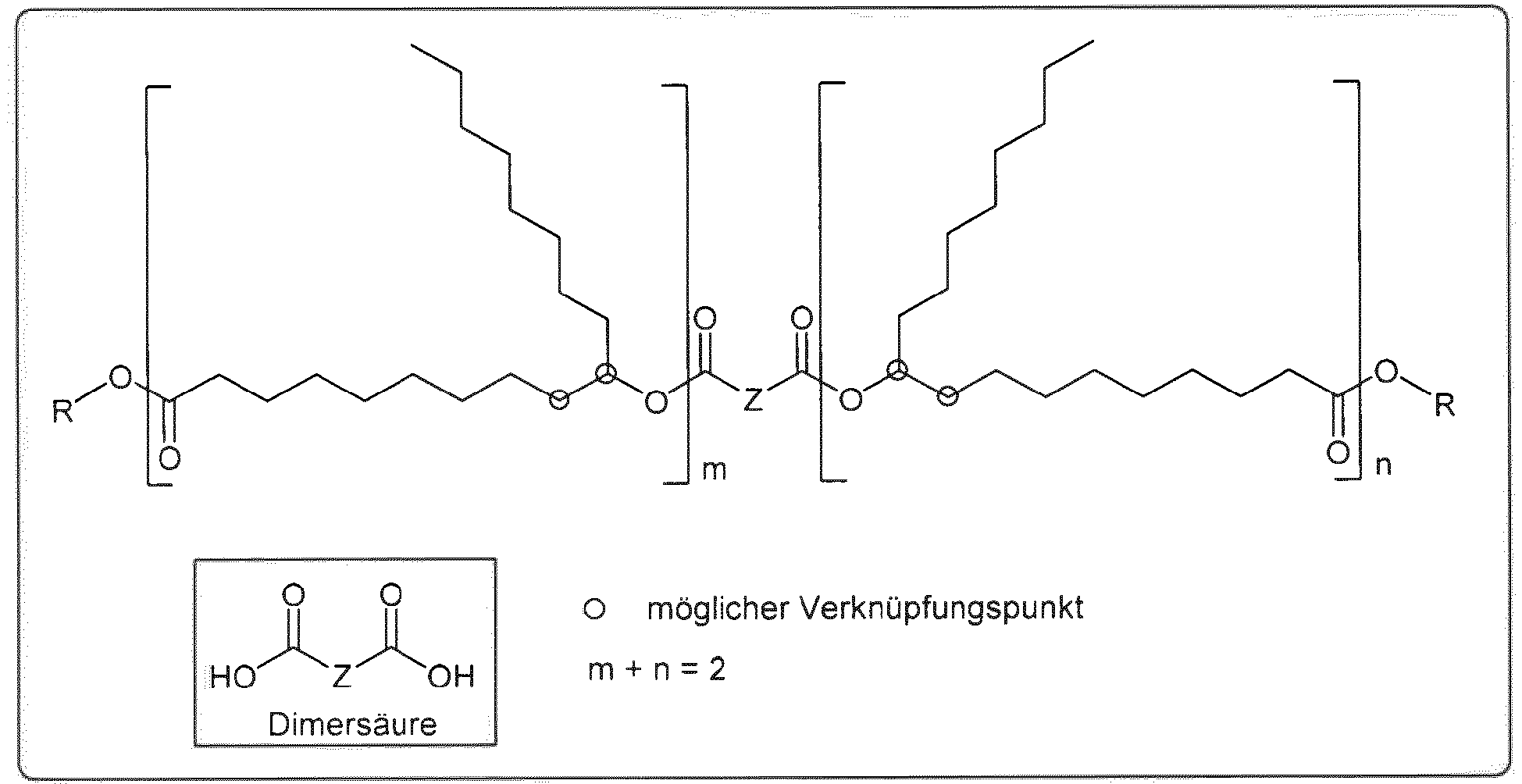


Tabelle 1 Chemische und physikalische Eigenschaften der Verbindungen (1) bis (5) Parameter Methode Einheit (1) (2) (3) (4) (5) Aussehen flüssig flüssig flüssig flüssig flüssig klar klar klar klar klar braun braun braun braun braun Kin. Vis. 40°C ASTM mm2/s 202 300 261 497 275 Kin. Vis. 100°C D 7042 25 35 32 54 32 VI 157 160 163 174 159 Neutralisationszahl DIN 51558 mg KOH/g 1,3 1,6 1,1 0,65 0,55 Pourpoint DIN ISO 3016 °C -30 -45 -39 -24 -42 biologische Abbaubarkeit OECD 301 F % 50,9 50,2 60 66,8 45,6 Tabelle 2 Vergleichsbeispiele der Verbindungen (A) bis (C) Parameter Methode Einheit Ester A Ester B Ester C biologische Abbaubarkeit OECD 301 F % 30,2 25,0 34,2 Ester A: Diester aus Dimersäure/2-Ethylhexan-1-ol,
Ester B: Diester aus Dimersäure/iAmylalkohol,
Ester C: Diester aus Dimersäure/ISOFOL 16. - Der Vergleich der Verbindungen (1) bis (3) zeigt, dass eine bessere biologische Abbaubarkeit erreicht wird, je größer der molekulare Anteil des Alkohols ist. Darüber hinaus wird aus Tabelle 2 deutlich, dass reine Diester (= Verbindungen A bis C) aus Dimersäure und den verwendeten Alkoholen nach OECD 301 F nicht biologisch abbaubar sind. Die biologische Abbaubarkeit des Esters kann durch entsprechende Modifikation mit Ölsäure bzw. 12-HSA (= Verbindungen (1) bis (4)) deutlich erhöht werden (Vergleich Tabelle 1 und 2).
- Darüber hinaus hat sich gezeigt, dass die Verbindung (4), die gemäß dem Verfahren B hergestellt wurde, die besten chemischen und physikalischen Eigenschaften aufwies.
Tabelle 3 Beverage Bottle Test ASTM D 2619 (Einheit: TAN [mg KOH/g], kin. Visk. [mm2/s]) Produkt TAN wäss. Phase TAN Öl vorher TAN Öl nachher Δ TAN Öl Visk. Öl 40°C vorher Visk. Öl 40°C nachher Δ Visk. Ö140°C (1) 1,32 1,3 4,3 3 201 196 -5 (3) 0,59 1,1 2,3 1,2 261 254 -7 (4) 1,1 0,65 1,56 0,91 497 473 -24 Referenzester 3 0,2 12,9 12,7 963,1 650,8 -312,3 - Referenzester: 1,1,1-Trimethylolpropan (TMP)-Ester gesättigt; biologisch abbaubar; ISO VG 1000,
- Der Beverage Bottle Test wird verwendet um die Hydrolysebeständigkeit von Schmierstoffen bzw. Grundölen zu bestimmen. Tabelle 3 zeigt, dass die erfindungsgemäßen Produkte (1), (3) und (4) im Vergleich zum Referenzester sehr hydrolysestabil sind. Die Säurezahl und die kinematische Viskosität verändern sich deutlich weniger.
- Weitere Esterverbindungen wurden synthetisiert aus unterschiedlichen mehrwertigen Carbonsäuren (s. Abbildung 1), Alkoholen R1OH (s. Abbildung 2) und zwei Polymereinheiten (s. Abbildung 3), diese sind in Tabelle 4 (Verfahren B) und Tabelle 5 (Verfahren C) gezeigt. Die chemischen und physikalischen Eigenschaften sind in Tabelle 6 gezeigt.
mehrwertige Carbonsäure: Dimersäure (S1) 
hyd. Dimersäure (S2) 
Trimersäure (S3, Struktur zu kompliziert) 


3,3'-Thiodipropionsäure (S4) 2,2'-Thiodiessigsäure (S5) Diglycolsäure (S6) 


Itaconsäure (S7) Phenylbernsteinsäure (S8) Phthalsäureanhydrid (S9) 

Cyclohexan-1,2-dicarbonsäureanhydrid (S10) Cyclohexen-4,5-dicarbonsäureanhydrid (S11) -
Alkohole R1OH: 


i-Amylalkohol (A1) 2-Ethylhexan-1-ol (A2) 2-Propylheptan-1-ol (A3) 

2-Hexyldecan-1-ol (A4, ISOFOL 16) 2-Octyldodecan-1-ol (A5, ISOFOL 20) -
Polymereinheit im Klammer: 

-
Tabelle 4 Esterverbindungen nach Verfahren B mit 12-HSA als Polymereinheit Alkohole R1OH (s. Abbildung 2) A1 A2 A3 A4 A5 Dimersäure (S1) (6) (4) / (19)* (20)* (7) / (21)* (8) hyd. Dimersäure (52) (9) Trimersaure (S3) (10) 3,3'-Thiodipropionsäure (S4) (11) 2,2'-Thiodiessigsäure (55) (12) Diglycolsäure (S6) (13) Itaconsäure (S7) (14) Phenylbernsteinsäure (S8) (15) Phthalsäureanhydrid (S9) (16) Cyclohexan-1,2-dibarbonsäureanhydrid (S10) (17) Cyclohexen-4,5-dicarbonsaureanhydrid (S11) (18) * Bei Verbindung (19), (20) und (21) wurde Ricinolsäure statt 12-HSA verwendet. A1=iso-Amylalkohol, A2=2-Ethylhxan-1-ol, A3=2-Propylheptan-1-ol, A4=2-Hexyldecan-1-ol, A5=2-Octyldodecan-1 -ol Tabelle 5 Esterverbindungen nach Verfahren C mit 12-HSA als Polymereinheit Alkohole R1OH (s. Abbildung 2) A1 A2 A3 A4 A5 Dimersäure (S1) (5) / (28)* (22) hyd. Dimersäure (52) Trimersäure (53) (23) / (29)* 3,3'-Thiodipropionsäure (54) (24) / (30)* (25) 2,2'-Thiodiessigsäure (S5) (26) / (31)* (27) Diglycolsaure (S6) * Bei Verbindung (28), (29), (30) und (31) wurde Ricinolsäure statt 12-HSA verwendet. A1=iso-Amylalkohol, A2=2-Ethylhxan-1-ol, A3=2-Propylheptan-1-ol, A4=2-Hexyldecan-1-ol, A5=2-Octyldodecan-1 -ol
Das Mol-Verhältnis bleibt wie im Bespiel 1 nach Verfahren A, B und C.Tabelle 6 Chemische und physikalische Eigenschaften der Verbindungen (6) bis (31) Parameter Kin. Vis. bei 40°C Kin. Vis. bei 100°C VI Neutralisationszahl Pourpoint Methode ASTM D7042 DIN 51558 DIN ISO 3016 Einheit mm2/s mm2/s mg KOH/g °C Verbindung (6) 473 53 177 0,2 -21 Verbindung (7) 516 56 176 0,4 -30 Verbindung (8) 578 63 181 0,7 -30 Verbindung (9) 507 56 177 0,2 -27 Verbindung (10) 568 61 178 0,6 -24 Verbindung (11) 349 42 175 0,4 -27 Verbindung (12) 322 38 170 0,3 -24 Verbindung (13) 305 36 168 0,4 -21 Verbindung (14) 318 33 169 0,4 -24 Verbindung (15) 387 44 170 0,5 -27 Verbindung (16) 452 50 173 0,5 -24 Verbindung (17) 390 44 171 0,4 -24 Verbindung (18) 403 46 172 0,4 -24 Verbindung (19) 337 43 183 0,3 -51 Verbindung (20) 376 46 181 0,5 -51 Verbindung (21) 395 48 183 0,4 -51 Verbindung (22) 306 34 155 1,0 -48 Verbindung (23) 500 51 162 1,4 -45 Verbindung (24) 108 16 158 1,0 -42 Verbindung (25) 142 19 154 0,6 -39 Verbindung (26) 107 16 153 1,5 -42 Verbindung (27) 141 19 150 0,6 -54 Verbindung (28) 230 29 164 0,5 -51 Verbindung (29) 404 45 167 1,1 -48 Verbindung (30) 106 16 167 0,7 -60 Verbindung (31) 103 16 162 0,7 -60 - Die Tabelle zeigt, dass hervorragende Tieftemperatureigenschaften (siehe PP) erreicht werden können. Bei den Verbindungen (6), (7), (8), (9) und (10), (19) bis (22) sowie (28) handelt es sich um Dimersäuren, die Verbindungen (10 und (29) sind Trimersäuren. Hervorzuheben sind Verbindungen 19 bis 21, die trotz hoher Viskosität bei 40°C sehr niedrigen Pour Points zeigen. Erwähnenswert sind auch die durchgehend hohen Viskositäts indices (VI).
- Des weiteren wurde der neue Ester (Verbindung 1) mit 15% Li-Komplex-Verdicker verdickt und 4% Antioxidans zugegeben. Die genaue Zusammensetzung ist in Tabelle 7 angegeben.
- Die Herstellung des Schmierfettes erfolgt nach dem Fachmann bekannten Vorgehen: Das Verdickungsmittel entsteht durch eine in situ-Reaktion der eingesetzten Reaktanten im Grundöl. Anschließend wird das Gemisch auf 150°C bis 210°C erhitzt, mehrere Stunden gerührt und wieder abgekühlt. Während des Abkühlprozesses werden bei ca. 60°C die notwendigen Additive hinzugegeben. Eine homogene Mischung des Fettes erhält man durch den abschließenden Homogenisierungsschritt über Walze, Kolloidmühle oder die Gaulin.
- Die besondere Hydrolysestabilität des Grundöls ermöglicht die In situ Herstellung des Seifenverdickers.
Tabelle 7 Komponente Verbindung (1) 12-HSA Azelainsäure LiOH·H2O Antioxidans Anteil 80,99% 9,55% 2,87% 2,59% 4,00% - Das erhaltene Fett wurde auf seine chemischen und physikalischen Eigenschaften untersucht, die Ergebnisse sind in Tabelle 8 dargestellt. Es besitzt die Eigenschaften vom typischen Li-Komplex-Fett z.B. einen Tropfpunkt von>300 °C. Ergebnisse von Korrosionswirkung auf Kupfer, Wasserbeständigkeit und Geräuschtest sind sehr gut. Sehr gut/niedrig ist auch die Ölabscheidung bei hohen Temperaturen.
Tabelle 8 Chemische und physikalische Eigenschaften des Schmierfetts aus Bsp. 2 Methodenname Norm Bedingungen Parameter Schmierfett Bsp. 2 Fließdruck DIN 51805 Temperatur: -30 °C Fließdruck (mbar) 650 Temperatur: -35 °C 1525 Konuspenetration DIN ISO 2137 Anzahl Doppeltakte: 60 Eindringtiefe (0,1 mm) 283 Temperatur: 25 °C Konus: Standardkonus Korrosionswirkung auf Kupfer DIN 51811 Zeit: 24 h Korrosionsgrad 1a Temperatur: 150 °C Neutralisationszahl DIN 51558 Messzeitpunkt: nach Verseifung von 12-HSA und Azelainsäure Neutralisationszahl (mg KOH/g) 0,9630 Ölabscheidung ASTM D 6184 Zeit: 30 h Ölabscheidung (%) 3,02 Temperatur: 150 °C 2,83 3,13 Ölabscheidung ASTM D 6184 Zeit: 30 h Ölabscheidung (%) 4,60 Temperatur: 180 °C 3,91 Ölabscheidung DIN 51817 Zeit: 168 h Ölabscheidung (%) 1,91 Temperatur: 40 °C 1,87 Tropfpunkt DIN ISO 2176 Tropfpunkt (°C) 344,7 Verdampfungsverlust DIN 58397 T1 Zeit: 24 h Verdampfungsverlust (%) 1,25 Temperatur: 150 °C 1,40 Wasserbeständigkeit DIN 51807 Teil 1 Zeit: 3 h Bewertungsstufe 0-90 Temperatur: 90 °C Scherviskosität original (mPa·s) 4991 Nach Lagerung bei 150 °C, 24 h 4310 4270 BeQuiet+ (SKF-Fettgeräuschprüfung) GN 4
Claims (11)
- Esterverbindung der allgemeinen Formel (I):
 der Rest Z ausgewählt wird aus dem Strukturelement einer Carbonsäure ohne Carboxyleinheiten, die mindestens ein sp3-hybridisiertes C-Atom mit einem oder keinem H-Atom, oder mindestens ein sp2-hybridisiertes C-Atom ohne H-Atome, oder mindestens ein Heteroatom in der Kette/Ring oder als Substituent enthält, ausgewählt aus der Gruppe bestehend aus hydrierter oder nicht hydrierter Dimersäure, hydrierter oder nicht hydrierter Trimersäure,der Rest R1 ausgewählt wird aus der Gruppe bestehend aus verzweigten oder unverzweigten C1- bis C30-Alkylresten, verzweigten oder unverzweigten C1- bis C30-Alkenylresten, C7- bis C30-Arylalkylresten und/oder C1- bis C30-Heteroarylalkylresten und C4- bis C30-Arylreste,der Rest W ausgewählt wird aus der Gruppe bestehend aus -CH2-und/oder - CH=CH-,x ist eine ganze Zahl von 1 bis 20, vorzugsweise 1 bis 10,y ist eine ganze Zahl von 1 bis 20, vorzugsweise 1 bis 10,m ist eine ganze Zahl von 1 bis 10, vorzugsweise 1 bis 5,k ist eine ganze Zahl von 2 bis 5.
 - Esterverbindung nach Anspruch 1 mit der allgemeinen Formel (II)
 der Rest Z ausgewählt wird aus dem Strukturelement einer Carbonsäure ohne Carboxyleinheiten, die mindestens ein sp3-hybridisiertes C-Atom mit einem oder keinem H-Atom, oder mindestens ein sp2-hybridisiertes C-Atom ohne H-Atome, oder mindestens ein Heteroatom in der Kette/Ring oder als Substituent enthält, ausgewählt aus der Gruppe bestehend aus hydrierter oder nicht hydrierter Dimersäure,der Rest R1 ausgewählt wird aus der Gruppe bestehend aus verzweigten oder unverzweigten C1- bis C30-Alkylresten, verzweigten oder unverzweigten C1- bis C30-Alkenylresten, C7- bis C30-Arylalkylresten und/oder C1- bis C30-Heteroarylalkylresten und C4- bis C30-Arylreste,der Rest W ausgewählt wird aus der Gruppe bestehend aus -CH2-und/oder - CH=CH-,x ist eine ganze Zahl von 1 bis 20, vorzugsweise 1 bis 10,y ist eine ganze Zahl von 1 bis 20, vorzugsweise 1 bis 10,m ist eine ganze Zahl von 1 bis 10, vorzugsweise 1 bis 5,n ist eine ganze Zahl von 1 bis 10, vorzugsweise 1 bis 5.
 - Verfahren zur Herstellung der Esterverbindung der allgemeinen Formeln (I)
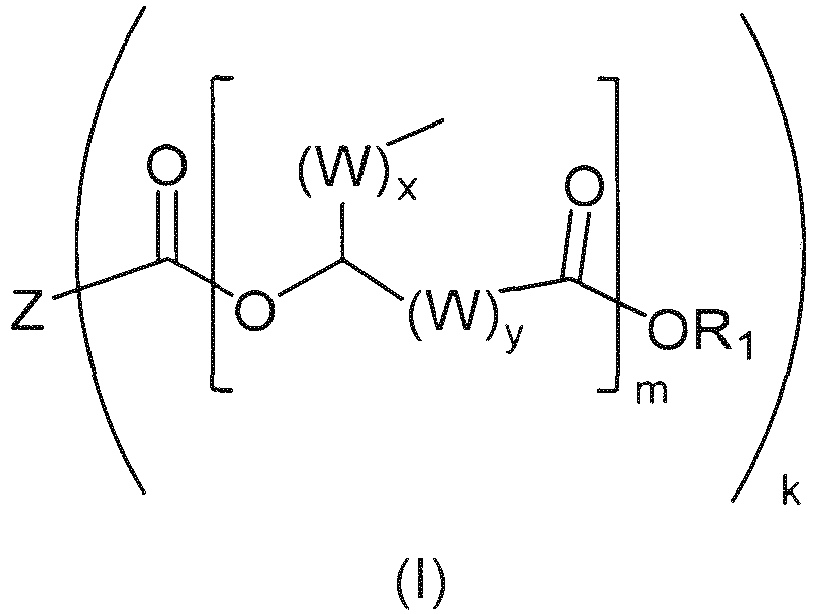

umfassend die Schritte:(A) Umsetzung einer Di-, Tri- oder höher funktionellen Carbonsäure mit einer langkettigen Fettsäure mit Hydroxygruppe in Anwesenheit eines Katalysators bei 120 bis 150°C,(B) Reduzierung des Drucks,(C) Portionsweise oder kontinuierliche Zugabe der langkettigen Fettsäure mit Hydroxygruppe über einen Zeitraum 5 bis 20 Stunden,(D) Rühren des erhaltenen Reaktionsgemisches über 5 bis 20 Stunden unter reduziertem Druck und Entfernung des erhaltenen Wassers,(E) Veresterung des Zwischenprodukts mit einem Alkohol bei 120 bis 150°C für 3 bis 5 Stunden unter Rühren,(F) Waschen des Rohprodukts mit aq. NaHCOs-Lösung und Wasser,(G) Trocknen über Na2SO4,(H) Reinigung des Rohprodukts mittels eines Kurzwegverdampfers unter reduziertem Druck bei 190 bis 300°C. - Verfahren zur Herstellung von Esterverbindungen der allgemeinen Formeln (I) oder (II) nach Anspruch 3, bei dem die langkettige Fettsäure mit Hydroxygruppen ausgewählt wird aus 12-Hydroxystearinsäure und/oder Ricinolsäure; der Alkohol wird ausgewählt aus der Gruppe bestehend aus 2-Ethylhexan-1-ol und/oder 2-Propyl-heptan-1-ol und/oder 2-Hexyl-decan-1-ol und/oder2 -Octyldodecan-1-ol und/oder iso-Amylalkohol; der Katalysator in Reaktionsschritt (A) ist p-Toluolsulfonsäure.
- Verfahren zur Herstellung von Esterverbindungen der allgemeinen Formeln (I)


umfassend die Schritte:(A) Umsetzung einer langkettigen Fettsäure mit Hydroxygruppe mit einem Alkohol in Anwesenheit eines Katalysators bei 60 bis 90°C,(B) Reduzierung des Drucks,(C) Rühren des erhaltenen Reaktionsgemisches über 6 bis 10 Stunden unter reduziertem Druck und Entfernung des erhaltenen Wassers,(D) Entfernung des Lösungsmittels und überschüssigem Alkohol unter Vakuum,(E) Umsetzung des Zwischenprodukts mit einer Di-, Tri- oder höher funktionellen Carbonsäure in Anwesenheit eines Katalysators bei 120 bis 160°C für 6 bis 10 Stunden unter Rühren und Entfernung des erhaltenen Wassers.(F) Entfernen des Katalysators durch (Säure)-Waschen des Rohprodukts mit aq. NaHCOs-Lösung und Wasser oder durch Abfiltrieren von Träger gestützten Katalysatoren oder durch Verdampfen von flüchtigen Katalysatoren durch Anlegen eines Vakuums,(G) Trocknen über geeigneten Trockenmitteln, wie beispielsweise Na2SO4,(H) Reinigung des Rohprodukts unter reduziertem Druck bei 190 bis 300°C, beispielsweise mittels eines Kurzwegverdampfers. - Verfahren zur Herstellung von Esterverbindungen der allgemeinen Formeln (I) oder (II) nach Anspruch 5 bei dem die langkettige Fettsäure mit Hydroxygruppen ausgewählt wird aus 12-Hydroxystearinsäure und/oder Ricinolsäure; der Alkohol wird ausgewählt aus der Gruppe bestehend aus 2-Ethylhexan-1-ol und/oder 2-Propyl-heptan-1-ol und/oder 2-Hexyl-decan-1-ol und/oder 2 - Octyldodecan-1-ol und/oder iso-Amylalkohol; der Katalysator in Reaktionsschritt (A) und (E) ist p-Toluolsulfonsäure.
- Verwendung der Esterverbindung der allgemeinen Formeln (I)


in einer Schmiermittelzusammensetzung. - Verwendung der Esterverbindung der allgemeinen Formeln (I) oder (II) in einer Schmiermittelzusammensetzung nach Anspruch 7 im Marinebereich, zur Schmierung von Arbeitsgeräten in der lebensmittelverarbeitenden Industrie, zur Schmierung von Wälz- und Gleitlagern, Transport- und Steuerketten in der Fahrzeugtechnik, der Fördertechnik, dem Maschinenbau, der Bürotechnik zur Schmierung von Kegelrad- und Stirnradgetrieben von Laufrollenlagern in Stranggießanlagen und Transportrollenlagern in Durchlauföfen und zur offenen Zahnkrankschmierung an Drehrohröfen, Rohrmühlen, Trommeln und Mischern, wie sie speziell in der Zement-, Kalk-, Gips-, Minen- und Chemieindustrie.
- Verwendung der Esterverbindung der allgemeinen Formeln (I)


in einer Schmiermittelzusammensetzung, die Schmiermittelzusammensetzung umfasst ein Grundöl, die Esterverbindung der allgemeinen Formeln (I) oder (II), Festschmierstoffe und Additive. - Verwendung nach Anspruch 9, wobei die Schmiermittelzusammensetzung des weiteren ein Verdickungsmittel umfasst.
- Verwendung von Schmiermittelzusammensetzungen auf Basis der Esterverbindungen der allgemeinen Formeln (I)


im Marinebereich, zur Schmierung von Arbeitsgeräten in der lebensmittelverarbeitenden Industrie, zur Schmierung von Wälz- und Gleitlagern, Transport- und Steuerketten in der Fahrzeugtechnik, der Fördertechnik, dem Maschinenbau, der Bürotechnik zur Schmierung von Kegelrad- und Stirnradgetrieben von Laufrollenlagern in Stranggießanlagen und Transportrollenlagern in Durchlauföfen und zur offenen Zahnkrankschmierung an Drehrohröfen, Rohrmühlen, Trommeln und Mischern, wie sie speziell in der Zement-, Kalk-, Gips-, Minen- und Chemieindustrie.
Applications Claiming Priority (3)
| Application Number | Priority Date | Filing Date | Title |
|---|---|---|---|
| DE102017003040 | 2017-03-29 | ||
| DE102018002041.0A DE102018002041A1 (de) | 2017-03-29 | 2018-03-14 | Neue Esterverbindungen, Verfahren zu ihrer Herstellung sowie ihre Verwendung |
| PCT/EP2018/000117 WO2018177588A1 (de) | 2017-03-29 | 2018-03-26 | Neue esterverbindungen, verfahren zu ihrer herstellung sowie ihre verwendung |
Publications (2)
| Publication Number | Publication Date |
|---|---|
| EP3601209A1 EP3601209A1 (de) | 2020-02-05 |
| EP3601209B1 true EP3601209B1 (de) | 2024-11-27 |
Family
ID=63524453
Family Applications (1)
| Application Number | Title | Priority Date | Filing Date |
|---|---|---|---|
| EP18724128.6A Active EP3601209B1 (de) | 2017-03-29 | 2018-03-26 | Neue esterverbindungen, verfahren zu ihrer herstellung sowie ihre verwendung |
Country Status (13)
| Country | Link |
|---|---|
| US (1) | US11117854B2 (de) |
| EP (1) | EP3601209B1 (de) |
| JP (1) | JP6980026B2 (de) |
| KR (1) | KR102270356B1 (de) |
| CN (1) | CN110382456A (de) |
| AU (1) | AU2018241897B2 (de) |
| BR (1) | BR112019019911A2 (de) |
| CA (1) | CA3054968C (de) |
| DE (1) | DE102018002041A1 (de) |
| PH (1) | PH12019502041A1 (de) |
| SG (1) | SG11201907296UA (de) |
| WO (1) | WO2018177588A1 (de) |
| ZA (1) | ZA201905065B (de) |
Families Citing this family (8)
| Publication number | Priority date | Publication date | Assignee | Title |
|---|---|---|---|---|
| WO2020152286A2 (de) * | 2019-01-23 | 2020-07-30 | Peter Greven GmbH & Co. KG | Estolidester und ihre verwendung als basisöl in schmierstoffen |
| CN110724054A (zh) * | 2019-10-29 | 2020-01-24 | 中国科学院兰州化学物理研究所 | 一种链条油用耐高温合成酯 |
| DE102020112993A1 (de) | 2020-05-13 | 2021-11-18 | Klüber Lubrication München Se & Co. Kg | Lithiumkomplexhybridfett |
| CN114478289A (zh) * | 2020-10-26 | 2022-05-13 | 中国石油化工股份有限公司 | 酯类化合物及其制备方法、用途和抗氧剂组合物 |
| CN114150525B (zh) * | 2021-11-26 | 2022-12-27 | 上海东升新材料有限公司 | 一种纳米改性造纸用润滑剂 |
| CN114713249B (zh) * | 2022-04-20 | 2023-11-03 | 中国石油大学(华东) | 一种制备二聚酸和三聚酸的催化剂及其使用方法 |
| CN115651743B (zh) * | 2022-10-27 | 2023-09-22 | 中国科学院兰州化学物理研究所 | 一种可原位形成石墨烯的润滑组合物及其制备方法和应用 |
| CN118813311A (zh) * | 2024-06-19 | 2024-10-22 | 中国石油大学(华东) | 一种酯类的用途及其制备方法 |
Family Cites Families (10)
| Publication number | Priority date | Publication date | Assignee | Title |
|---|---|---|---|---|
| JPS53126397A (en) * | 1977-04-13 | 1978-11-04 | Teijin Ltd | Fiber treating oil agent |
| US5045586A (en) * | 1988-08-04 | 1991-09-03 | Lenick Jr Anthony J O | Lubricants for thermoplastic resins |
| EP0952142B1 (de) * | 1998-04-20 | 2006-10-18 | Givaudan SA | Verbindungen mit geschützten Hydroxylgruppen |
| FI120684B (fi) * | 2005-10-21 | 2010-01-29 | Valtion Teknillinen | Menetelmä oligo-/polyestereiden valmistamiseksi suberiinin ja/tai kutiinin karboksyylihapposeoksesta |
| CA2839174A1 (en) * | 2011-06-17 | 2012-12-20 | Lubrigreen Biosynthetics, Llc | Grease compositions comprising estolide base oils |
| US8404867B2 (en) * | 2011-06-17 | 2013-03-26 | Biosynthetic Technologies, Llc | Sulfurized estolides and methods of making and using the same |
| US9018406B2 (en) * | 2012-03-27 | 2015-04-28 | Biosynthetic Technologies, Llc | Dicarboxylate-capped estolide compounds and methods of making and using the same |
| CN102719013B (zh) * | 2012-07-01 | 2013-11-27 | 桂林理工大学 | 含柔性链的反应型增溶剂改性Lignin/PP木塑复合材料的方法 |
| CN107267272A (zh) * | 2012-11-19 | 2017-10-20 | 生物合成技术有限责任公司 | 基于第尔斯‑阿尔德的交内酯和润滑剂组合物 |
| KR20160046660A (ko) * | 2014-10-21 | 2016-04-29 | 에스케이이노베이션 주식회사 | 결합제를 이용한 에스톨라이드의 제조 방법 |
-
2018
- 2018-03-14 DE DE102018002041.0A patent/DE102018002041A1/de not_active Withdrawn
- 2018-03-26 CN CN201880017153.3A patent/CN110382456A/zh active Pending
- 2018-03-26 KR KR1020197025878A patent/KR102270356B1/ko active Active
- 2018-03-26 AU AU2018241897A patent/AU2018241897B2/en active Active
- 2018-03-26 WO PCT/EP2018/000117 patent/WO2018177588A1/de not_active Ceased
- 2018-03-26 BR BR112019019911A patent/BR112019019911A2/pt not_active Application Discontinuation
- 2018-03-26 CA CA3054968A patent/CA3054968C/en active Active
- 2018-03-26 EP EP18724128.6A patent/EP3601209B1/de active Active
- 2018-03-26 SG SG11201907296U patent/SG11201907296UA/en unknown
- 2018-03-26 JP JP2019549479A patent/JP6980026B2/ja active Active
- 2018-03-26 US US16/492,751 patent/US11117854B2/en active Active
-
2019
- 2019-07-31 ZA ZA2019/05065A patent/ZA201905065B/en unknown
- 2019-09-09 PH PH12019502041A patent/PH12019502041A1/en unknown
Also Published As
| Publication number | Publication date |
|---|---|
| KR102270356B1 (ko) | 2021-07-01 |
| PH12019502041A1 (en) | 2020-03-16 |
| US11117854B2 (en) | 2021-09-14 |
| JP2020510048A (ja) | 2020-04-02 |
| DE102018002041A1 (de) | 2018-10-04 |
| CN110382456A (zh) | 2019-10-25 |
| AU2018241897B2 (en) | 2021-02-25 |
| JP6980026B2 (ja) | 2021-12-15 |
| EP3601209A1 (de) | 2020-02-05 |
| AU2018241897A1 (en) | 2019-10-03 |
| SG11201907296UA (en) | 2019-10-30 |
| CA3054968C (en) | 2022-10-04 |
| KR20190115459A (ko) | 2019-10-11 |
| ZA201905065B (en) | 2021-06-30 |
| WO2018177588A1 (de) | 2018-10-04 |
| US20200071256A1 (en) | 2020-03-05 |
| BR112019019911A2 (pt) | 2020-04-22 |
| CA3054968A1 (en) | 2018-10-04 |
Similar Documents
| Publication | Publication Date | Title |
|---|---|---|
| DE102018002041A1 (de) | Neue Esterverbindungen, Verfahren zu ihrer Herstellung sowie ihre Verwendung | |
| EP3375850B1 (de) | Hochtemperaturschmierstoff für die lebensmittelindustrie | |
| EP3913039B1 (de) | Mischung aus esterverbindungen | |
| EP3372660B1 (de) | Hochtemperaturschmierstoffe | |
| DE69525657T2 (de) | Verwendung von biologisch abbaubarem synthetischen verzweigten ester in einem zwei-takt motor öl um die herstellung von rauch in einem zwei-takt motor zu reduzieren | |
| DE112009005504B4 (de) | Verwendung einer fluorhaltigen Diamid-Verbindung als Rostschutzzusatz einer Schmiermittelzusammensetzung | |
| EP4143281B1 (de) | Schmierstoffzusammensetzung und deren verwendung | |
| EP4090723A1 (de) | Lithiumkomplexhybridfett | |
| EP2796447B1 (de) | Neue schwefelbrückenhaltige Verbindungen, Verfahren zu deren Herstellung und deren Verwendung | |
| EP3902896B1 (de) | Mineralölfreies schmiermittel und verfahren zur herstellung eines mineralölfreien schmiermittels | |
| EP4491699A1 (de) | Phthalimidverbindungen als basisöl für schmierstoffzusammensetzungen | |
| HK40009514A (en) | Novel ester compounds, method for the production thereof and use thereof | |
| WO2025233106A1 (de) | Polyolester als basisöl für schmierstoffzusammensetzungen | |
| EP2192105A1 (de) | Schmiermittel und Verfahren zu dessen Herstellung |
Legal Events
| Date | Code | Title | Description |
|---|---|---|---|
| STAA | Information on the status of an ep patent application or granted ep patent |
Free format text: STATUS: UNKNOWN |
|
| STAA | Information on the status of an ep patent application or granted ep patent |
Free format text: STATUS: THE INTERNATIONAL PUBLICATION HAS BEEN MADE |
|
| PUAI | Public reference made under article 153(3) epc to a published international application that has entered the european phase |
Free format text: ORIGINAL CODE: 0009012 |
|
| STAA | Information on the status of an ep patent application or granted ep patent |
Free format text: STATUS: REQUEST FOR EXAMINATION WAS MADE |
|
| 17P | Request for examination filed |
Effective date: 20190909 |
|
| AK | Designated contracting states |
Kind code of ref document: A1 Designated state(s): AL AT BE BG CH CY CZ DE DK EE ES FI FR GB GR HR HU IE IS IT LI LT LU LV MC MK MT NL NO PL PT RO RS SE SI SK SM TR |
|
| AX | Request for extension of the european patent |
Extension state: BA ME |
|
| DAV | Request for validation of the european patent (deleted) | ||
| DAX | Request for extension of the european patent (deleted) | ||
| STAA | Information on the status of an ep patent application or granted ep patent |
Free format text: STATUS: EXAMINATION IS IN PROGRESS |
|
| 17Q | First examination report despatched |
Effective date: 20211011 |
|
| 17Q | First examination report despatched |
Effective date: 20211021 |
|
| GRAP | Despatch of communication of intention to grant a patent |
Free format text: ORIGINAL CODE: EPIDOSNIGR1 |
|
| STAA | Information on the status of an ep patent application or granted ep patent |
Free format text: STATUS: GRANT OF PATENT IS INTENDED |
|
| INTG | Intention to grant announced |
Effective date: 20240620 |
|
| P01 | Opt-out of the competence of the unified patent court (upc) registered |
Free format text: CASE NUMBER: APP_48661/2024 Effective date: 20240826 |
|
| GRAS | Grant fee paid |
Free format text: ORIGINAL CODE: EPIDOSNIGR3 |
|
| GRAA | (expected) grant |
Free format text: ORIGINAL CODE: 0009210 |
|
| STAA | Information on the status of an ep patent application or granted ep patent |
Free format text: STATUS: THE PATENT HAS BEEN GRANTED |
|
| RAP3 | Party data changed (applicant data changed or rights of an application transferred) |
Owner name: KLUEBER LUBRICATION MUENCHEN GMBH & CO. KG |
|
| AK | Designated contracting states |
Kind code of ref document: B1 Designated state(s): AL AT BE BG CH CY CZ DE DK EE ES FI FR GB GR HR HU IE IS IT LI LT LU LV MC MK MT NL NO PL PT RO RS SE SI SK SM TR |
|
| REG | Reference to a national code |
Ref country code: GB Ref legal event code: FG4D Free format text: NOT ENGLISH |
|
| REG | Reference to a national code |
Ref country code: CH Ref legal event code: EP |
|
| REG | Reference to a national code |
Ref country code: DE Ref legal event code: R096 Ref document number: 502018015362 Country of ref document: DE |
|
| REG | Reference to a national code |
Ref country code: IE Ref legal event code: FG4D Free format text: LANGUAGE OF EP DOCUMENT: GERMAN |
|
| REG | Reference to a national code |
Ref country code: LT Ref legal event code: MG9D |
|
| REG | Reference to a national code |
Ref country code: NL Ref legal event code: MP Effective date: 20241127 |
|
| PG25 | Lapsed in a contracting state [announced via postgrant information from national office to epo] |
Ref country code: PT Free format text: LAPSE BECAUSE OF FAILURE TO SUBMIT A TRANSLATION OF THE DESCRIPTION OR TO PAY THE FEE WITHIN THE PRESCRIBED TIME-LIMIT Effective date: 20250327 Ref country code: IS Free format text: LAPSE BECAUSE OF FAILURE TO SUBMIT A TRANSLATION OF THE DESCRIPTION OR TO PAY THE FEE WITHIN THE PRESCRIBED TIME-LIMIT Effective date: 20250327 Ref country code: HR Free format text: LAPSE BECAUSE OF FAILURE TO SUBMIT A TRANSLATION OF THE DESCRIPTION OR TO PAY THE FEE WITHIN THE PRESCRIBED TIME-LIMIT Effective date: 20241127 |
|
| PG25 | Lapsed in a contracting state [announced via postgrant information from national office to epo] |
Ref country code: FI Free format text: LAPSE BECAUSE OF FAILURE TO SUBMIT A TRANSLATION OF THE DESCRIPTION OR TO PAY THE FEE WITHIN THE PRESCRIBED TIME-LIMIT Effective date: 20241127 Ref country code: NL Free format text: LAPSE BECAUSE OF FAILURE TO SUBMIT A TRANSLATION OF THE DESCRIPTION OR TO PAY THE FEE WITHIN THE PRESCRIBED TIME-LIMIT Effective date: 20241127 |
|
| PG25 | Lapsed in a contracting state [announced via postgrant information from national office to epo] |
Ref country code: BG Free format text: LAPSE BECAUSE OF FAILURE TO SUBMIT A TRANSLATION OF THE DESCRIPTION OR TO PAY THE FEE WITHIN THE PRESCRIBED TIME-LIMIT Effective date: 20241127 |
|
| PG25 | Lapsed in a contracting state [announced via postgrant information from national office to epo] |
Ref country code: ES Free format text: LAPSE BECAUSE OF FAILURE TO SUBMIT A TRANSLATION OF THE DESCRIPTION OR TO PAY THE FEE WITHIN THE PRESCRIBED TIME-LIMIT Effective date: 20241127 |
|
| PG25 | Lapsed in a contracting state [announced via postgrant information from national office to epo] |
Ref country code: NO Free format text: LAPSE BECAUSE OF FAILURE TO SUBMIT A TRANSLATION OF THE DESCRIPTION OR TO PAY THE FEE WITHIN THE PRESCRIBED TIME-LIMIT Effective date: 20250227 |
|
| PG25 | Lapsed in a contracting state [announced via postgrant information from national office to epo] |
Ref country code: LV Free format text: LAPSE BECAUSE OF FAILURE TO SUBMIT A TRANSLATION OF THE DESCRIPTION OR TO PAY THE FEE WITHIN THE PRESCRIBED TIME-LIMIT Effective date: 20241127 Ref country code: GR Free format text: LAPSE BECAUSE OF FAILURE TO SUBMIT A TRANSLATION OF THE DESCRIPTION OR TO PAY THE FEE WITHIN THE PRESCRIBED TIME-LIMIT Effective date: 20250228 |
|
| PG25 | Lapsed in a contracting state [announced via postgrant information from national office to epo] |
Ref country code: PL Free format text: LAPSE BECAUSE OF FAILURE TO SUBMIT A TRANSLATION OF THE DESCRIPTION OR TO PAY THE FEE WITHIN THE PRESCRIBED TIME-LIMIT Effective date: 20241127 |
|
| PG25 | Lapsed in a contracting state [announced via postgrant information from national office to epo] |
Ref country code: RS Free format text: LAPSE BECAUSE OF FAILURE TO SUBMIT A TRANSLATION OF THE DESCRIPTION OR TO PAY THE FEE WITHIN THE PRESCRIBED TIME-LIMIT Effective date: 20250227 |
|
| PG25 | Lapsed in a contracting state [announced via postgrant information from national office to epo] |
Ref country code: SM Free format text: LAPSE BECAUSE OF FAILURE TO SUBMIT A TRANSLATION OF THE DESCRIPTION OR TO PAY THE FEE WITHIN THE PRESCRIBED TIME-LIMIT Effective date: 20241127 |
|
| PG25 | Lapsed in a contracting state [announced via postgrant information from national office to epo] |
Ref country code: DK Free format text: LAPSE BECAUSE OF FAILURE TO SUBMIT A TRANSLATION OF THE DESCRIPTION OR TO PAY THE FEE WITHIN THE PRESCRIBED TIME-LIMIT Effective date: 20241127 |
|
| PG25 | Lapsed in a contracting state [announced via postgrant information from national office to epo] |
Ref country code: EE Free format text: LAPSE BECAUSE OF FAILURE TO SUBMIT A TRANSLATION OF THE DESCRIPTION OR TO PAY THE FEE WITHIN THE PRESCRIBED TIME-LIMIT Effective date: 20241127 |
|
| PG25 | Lapsed in a contracting state [announced via postgrant information from national office to epo] |
Ref country code: RO Free format text: LAPSE BECAUSE OF FAILURE TO SUBMIT A TRANSLATION OF THE DESCRIPTION OR TO PAY THE FEE WITHIN THE PRESCRIBED TIME-LIMIT Effective date: 20241127 |
|
| PG25 | Lapsed in a contracting state [announced via postgrant information from national office to epo] |
Ref country code: SK Free format text: LAPSE BECAUSE OF FAILURE TO SUBMIT A TRANSLATION OF THE DESCRIPTION OR TO PAY THE FEE WITHIN THE PRESCRIBED TIME-LIMIT Effective date: 20241127 |
|
| PG25 | Lapsed in a contracting state [announced via postgrant information from national office to epo] |
Ref country code: CZ Free format text: LAPSE BECAUSE OF FAILURE TO SUBMIT A TRANSLATION OF THE DESCRIPTION OR TO PAY THE FEE WITHIN THE PRESCRIBED TIME-LIMIT Effective date: 20241127 |
|
| PG25 | Lapsed in a contracting state [announced via postgrant information from national office to epo] |
Ref country code: IT Free format text: LAPSE BECAUSE OF FAILURE TO SUBMIT A TRANSLATION OF THE DESCRIPTION OR TO PAY THE FEE WITHIN THE PRESCRIBED TIME-LIMIT Effective date: 20241127 |
|
| REG | Reference to a national code |
Ref country code: DE Ref legal event code: R097 Ref document number: 502018015362 Country of ref document: DE |
|
| PG25 | Lapsed in a contracting state [announced via postgrant information from national office to epo] |
Ref country code: SE Free format text: LAPSE BECAUSE OF FAILURE TO SUBMIT A TRANSLATION OF THE DESCRIPTION OR TO PAY THE FEE WITHIN THE PRESCRIBED TIME-LIMIT Effective date: 20241127 |
|
| PLBE | No opposition filed within time limit |
Free format text: ORIGINAL CODE: 0009261 |
|
| STAA | Information on the status of an ep patent application or granted ep patent |
Free format text: STATUS: NO OPPOSITION FILED WITHIN TIME LIMIT |
|
| REG | Reference to a national code |
Ref country code: CH Ref legal event code: L10 Free format text: ST27 STATUS EVENT CODE: U-0-0-L10-L00 (AS PROVIDED BY THE NATIONAL OFFICE) Effective date: 20251008 |
|
| PG25 | Lapsed in a contracting state [announced via postgrant information from national office to epo] |
Ref country code: MC Free format text: LAPSE BECAUSE OF FAILURE TO SUBMIT A TRANSLATION OF THE DESCRIPTION OR TO PAY THE FEE WITHIN THE PRESCRIBED TIME-LIMIT Effective date: 20241127 |
|
| REG | Reference to a national code |
Ref country code: CH Ref legal event code: H13 Free format text: ST27 STATUS EVENT CODE: U-0-0-H10-H13 (AS PROVIDED BY THE NATIONAL OFFICE) Effective date: 20251023 |
|
| 26N | No opposition filed |
Effective date: 20250828 |
|
| PG25 | Lapsed in a contracting state [announced via postgrant information from national office to epo] |
Ref country code: LU Free format text: LAPSE BECAUSE OF NON-PAYMENT OF DUE FEES Effective date: 20250326 |
|
| GBPC | Gb: european patent ceased through non-payment of renewal fee |
Effective date: 20250326 |
|
| REG | Reference to a national code |
Ref country code: BE Ref legal event code: MM Effective date: 20250331 |
|
| PG25 | Lapsed in a contracting state [announced via postgrant information from national office to epo] |
Ref country code: GB Free format text: LAPSE BECAUSE OF NON-PAYMENT OF DUE FEES Effective date: 20250326 |
|
| PG25 | Lapsed in a contracting state [announced via postgrant information from national office to epo] |
Ref country code: FR Free format text: LAPSE BECAUSE OF NON-PAYMENT OF DUE FEES Effective date: 20250331 |
|
| PG25 | Lapsed in a contracting state [announced via postgrant information from national office to epo] |
Ref country code: BE Free format text: LAPSE BECAUSE OF NON-PAYMENT OF DUE FEES Effective date: 20250331 |
|
| PG25 | Lapsed in a contracting state [announced via postgrant information from national office to epo] |
Ref country code: CH Free format text: LAPSE BECAUSE OF NON-PAYMENT OF DUE FEES Effective date: 20250331 |
|
| PG25 | Lapsed in a contracting state [announced via postgrant information from national office to epo] |
Ref country code: IE Free format text: LAPSE BECAUSE OF NON-PAYMENT OF DUE FEES Effective date: 20250326 |
|
| PGFP | Annual fee paid to national office [announced via postgrant information from national office to epo] |
Ref country code: DE Payment date: 20260320 Year of fee payment: 9 |