EP3873140A1 - Verfahren zur verwaltung einer benutzergerätevorrichtung - Google Patents
Verfahren zur verwaltung einer benutzergerätevorrichtung Download PDFInfo
- Publication number
- EP3873140A1 EP3873140A1 EP21155576.8A EP21155576A EP3873140A1 EP 3873140 A1 EP3873140 A1 EP 3873140A1 EP 21155576 A EP21155576 A EP 21155576A EP 3873140 A1 EP3873140 A1 EP 3873140A1
- Authority
- EP
- European Patent Office
- Prior art keywords
- instruction
- user equipment
- network
- context
- energy saving
- Prior art date
- Legal status (The legal status is an assumption and is not a legal conclusion. Google has not performed a legal analysis and makes no representation as to the accuracy of the status listed.)
- Granted
Links
Images




Classifications
-
- H—ELECTRICITY
- H04—ELECTRIC COMMUNICATION TECHNIQUE
- H04W—WIRELESS COMMUNICATION NETWORKS
- H04W52/00—Power management, e.g. Transmission Power Control [TPC] or power classes
- H04W52/02—Power saving arrangements
- H04W52/0209—Power saving arrangements in terminal devices
-
- H—ELECTRICITY
- H04—ELECTRIC COMMUNICATION TECHNIQUE
- H04W—WIRELESS COMMUNICATION NETWORKS
- H04W4/00—Services specially adapted for wireless communication networks; Facilities therefor
- H04W4/70—Services for machine-to-machine communication [M2M] or machine type communication [MTC]
-
- H—ELECTRICITY
- H04—ELECTRIC COMMUNICATION TECHNIQUE
- H04W—WIRELESS COMMUNICATION NETWORKS
- H04W52/00—Power management, e.g. Transmission Power Control [TPC] or power classes
- H04W52/02—Power saving arrangements
- H04W52/0209—Power saving arrangements in terminal devices
- H04W52/0212—Power saving arrangements in terminal devices managed by the network, e.g. network or access point is leader and terminal is follower
-
- H—ELECTRICITY
- H04—ELECTRIC COMMUNICATION TECHNIQUE
- H04W—WIRELESS COMMUNICATION NETWORKS
- H04W76/00—Connection management
- H04W76/30—Connection release
-
- Y—GENERAL TAGGING OF NEW TECHNOLOGICAL DEVELOPMENTS; GENERAL TAGGING OF CROSS-SECTIONAL TECHNOLOGIES SPANNING OVER SEVERAL SECTIONS OF THE IPC; TECHNICAL SUBJECTS COVERED BY FORMER USPC CROSS-REFERENCE ART COLLECTIONS [XRACs] AND DIGESTS
- Y02—TECHNOLOGIES OR APPLICATIONS FOR MITIGATION OR ADAPTATION AGAINST CLIMATE CHANGE
- Y02D—CLIMATE CHANGE MITIGATION TECHNOLOGIES IN INFORMATION AND COMMUNICATION TECHNOLOGIES [ICT], I.E. INFORMATION AND COMMUNICATION TECHNOLOGIES AIMING AT THE REDUCTION OF THEIR OWN ENERGY USE
- Y02D30/00—Reducing energy consumption in communication networks
- Y02D30/70—Reducing energy consumption in communication networks in wireless communication networks
Definitions
- the present invention relates to a network node and to a method, in a network node, for managing a user equipment device.
- the present invention also relates to a user equipment device and to a method in a user equipment device.
- Cellular communications networks are increasingly being used to support machine to machine (M2M) communication, in which a machine device (MD) communicates with an application server, allowing the server to receive information from the device and to configure the device.
- M2M machine to machine
- Cellular networks may enable such communication between device and application server, regardless of whether or not the server is comprised within the cellular network. It is envisaged that future development of cellular communications networks will include large numbers of such autonomous machine devices, often very small and associated with equipment or apparatus as opposed to a human user. Such devices will typically access the cellular network more or less infrequently, transmitting and receiving very small amounts of data, or being polled for data.
- MTC Machine Type Communication
- UEs User Equipment devices
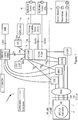
- Figure 1 shows a reference network architecture 2 used to allow MTC devices to connect to a 3GPP network (UTRAN, E-UTRAN etc).
- Figure 1 is reproduced from 3GPP TS 23.682 V11.3.0, "3rd Generation Partnership Project; Technical Specification Group Services and System Aspects; Architecture enhancements to facilitate communications with packet data networks and applications (Release 11)", December 2012 . Additional shading of elements relating to MTC devices has been introduced to the Figure.
- the UE in this case an MTC device, can be seen to include an MTC UE application 6.
- the MTC device communicates over the radio access network (RAN) to access application servers via the core network of its home public land mobile network (HPLMN).
- HPLMN home public land mobile network
- various network entities may be introduced according to the particular model envisaged for MTC traffic.
- Figure 1 illustrates a direct model, in which an application server (AS) 8 connects directly to a 3GPP operator network to perform direct communications with the MTC device.
- Figure 1 also illustrates an indirect model, in which an application server (AS) 10 connects indirectly to an operator network via a Services Capability Server (SCS) 12.
- SCS Services Capability Server
- An MTC Inter Working Function (MTC-IWF) 14 acts as an interface enabling interworking of the 3GPP core network and the MTC service capability.
- a hybrid model may use both direct and indirect models simultaneously.
- the network architecture may also include an MTC Authentication, Authorisation and Accounting (AAA) function 16 within the HPLMN.
- AAA MTC Authentication, Authorisation and Accounting
- MTC devices are often required to be highly energy efficient. External power sources for MTC devices will often not be available, meaning the device must operate using energy harvesting or battery power, with frequent replacing or recharging of batteries being neither practical nor economically feasible.
- Efforts to increase the energy efficiency of MTC devices have generally focused on increasing the efficiency of operation of such devices within cellular networks such as Evolved Packet System (EPS) networks. Many such methods seek to enable and enhance the possibility for MTC devices to spend time in energy efficient low power modes between communication events. One way of achieving this is to extend the maximum possible DRX cycle length in both idle and connected modes for EPS/LTE (Evolved Packet System/Long Term Evolution) networks.
- EPS Evolved Packet System
- Another possibility is to allow the MTC device to detach from the network after each communication event, and reattach when a need arises, for example when the device has uplink data to send or when it wants to poll a server for data or at predefined intervals agreed with the network.
- This "detach-reattach" method allows the MTC device to enter the "deepest sleep", or most low power state, with a large amount of the electrical circuitry in the device turned off. This deep sleep offers considerable advantages in energy saving.
- the network attach procedure is associated with a significant signalling overhead, and the need to perform such a procedure before each communication event reduces the overall energy efficiency of the detach-reattach method, owing both to the signalling overhead itself and to the time spent in non sleep modes while the attach or detach procedures are carried out.
- a method in a network node for managing a user equipment device comprises receiving at least one of an apply instruction or a withhold instruction concerning an energy saving process for the user equipment device, applying the energy saving process for the user equipment device if the instruction is an apply instruction, and withholding application of the energy saving process for the user equipment device if the instruction is a withhold instruction.
- the energy saving process of the method comprises retaining a context for the user equipment device after conducting a network detach procedure with the user equipment device.
- aspects of the present invention thus enable the targeted application of an energy saving procedure for a user equipment device, according to an instruction received concerning the application or otherwise of the energy saving process for that particular user equipment device.
- the energy saving process involves the retention of a context for the user equipment device following network detach, thus reducing the signalling load and time required for a potential subsequent network attach procedure, and so reducing the energy required to reattach the user equipment device to the network.
- the apply instruction and/or withhold instruction may be received from the user equipment device or may be received from another source.
- the apply instruction and/or withhold instruction may be contained within subscriber data received from another network entity.
- the apply instruction and withhold instruction may take the form of the presence or absence of a flag relating to the energy saving process.
- the network may be an Evolved Packet System (EPS)/Long Term Evolution (LTE) network
- the network node may comprise a Mobility Management Entity (MME).
- EPS Evolved Packet System
- LTE Long Term Evolution
- MME Mobility Management Entity
- the energy saving process may further comprise retaining, after conducting a network detach procedure with the user equipment device, at least some network resources reserved for the user equipment device. Such retention of network resources may further reduce the signalling load and time required for a potential subsequent network reattach procedure.
- the retained network resources may comprise bearers and may, in an EPS/LTE network, comprise serving gateway (SGW) and packet data network gateway (PGW) bearers.
- SGW serving gateway
- PGW packet data network gateway
- the network resources may be associated with network nodes at least partially serving machine type communication devices.
- network nodes at least partially serving machine type communication devices may comprise an MTC-IWF, and/or an SCS.
- retention of network resources may comprise not releasing network resources during or following a network detach procedure.
- retaining network resources may comprise explicitly instructing another network entity to retain the resources, for example for a specific period of time or until receipt of a further instruction indicating that the resources may be released.
- the method may further comprise receiving configuration data for the energy saving process, and applying the configuration data when applying the energy saving process.
- configuration data may afford additional flexibility, enabling the energy saving process to be tailored for a particular user equipment device or category of user equipment device.
- the configuration data may comprise a time period over which the user equipment device context is to be retained. Configuring the energy saving process such that the context is retained for a specified time period may enable the network node to retain the context only as long as is appropriate for the particular user equipment device. In this manner, wastage of resources through retaining a context longer than necessary may be avoided. In addition, energy saving advantages associated with retaining a context may be afforded for devices which may have an unusually long time period between a network detach and subsequent network reattach.
- the configuration data may comprise an indication concerning retention of network resources for the user equipment device following detach of the user equipment device.
- the indication may in some examples be a recommendation on retention of network resources, which recommendation may be followed by the network node but compliance with which is not required.
- the indication may be an instruction which the network node is obliged to comply with.
- the configuration data may comprise an indication of whether explicit or implicit detach procedures should be used for the user equipment device.
- the configuration data may comprise an indicated time limit for implicit detach procedure initiation.
- the indicated time limit may be a recommended time limit which the network node may voluntarily comply with, or may be an instructed time limit which the network node is required to apply.
- the configuration data may be comprised in at least one of: a message received from a user equipment device during a network attach session, user equipment attach signalling, user equipment detach signalling, user equipment capability and/or category signalling, or a message containing user subscriber data received from another network entity.
- the instruction may be comprised in at least one of: a message received from a user equipment device during a network attach session, user equipment attach signalling, user equipment detach signalling, user equipment capability and/or category signalling, or a message containing user subscriber data received from another network entity.
- the another network entity may for example be a subscriber database or subscription database such as for example a Home Subscriber Server in an EPS/LTE network.
- an apply or withhold instruction and optional configuration data may be received in the same or in different manners.
- configuration data may be contained in user subscription information with the instruction received directly from the user equipment device in attach signalling, detach signalling or in a message received during an attach session.
- both instruction and configuration data may be received in the same message, sent as part of attach, detach or other signalling.
- User equipment device originating messages may for example comprise Non-Access Stratum (NAS) messages in an EPS/LTE network.
- NAS Non-Access Stratum
- a method in a user equipment device in a network comprises sending at least one of an apply instruction or a withhold instruction to a network node concerning an energy saving process for the user equipment device.
- the energy saving process of the method comprises retaining a context for the user equipment device after conducting a network detach procedure with the user equipment device.
- aspects of the present invention enable a user equipment device to control whether or not the energy saving process is applied to it, thus enabling a user equipment device to tailor the application or otherwise of the energy saving process to its requirements, which requirements may evolve overtime.
- the method may further comprise sending configuration data concerning the energy saving process to the network node.
- configuration data may be included with the instruction.
- the configuration data may be sent separately from the instruction.
- sending configuration data may comprise sending at least one of a network attach session message, attach signalling, detach signalling, or user equipment capability and/or category signalling.
- sending at least one of an apply or a withhold instruction may comprise sending at least one of a network attach session message, attach signalling, detach signalling, or user equipment capability and/or category signalling.
- Messages sent by the user equipment device may for example comprise Non-Access Stratum (NAS) messages in an EPS/LTE network.
- NAS Non-Access Stratum
- the method may further comprise, if the instruction is an apply instruction, retaining a UE identifier for the user equipment device after conducting a network detach procedure with the network node.
- the UE identifier may contain a network node identifier.
- the identifier may be discarded at the end of a time period for retention of the user equipment device context in the network node. This time period may in some examples be standardised and may be programmed into both the user equipment device and the network node. In other examples, the time period may be specific to the user equipment device or category, and may be sent to the network node by the user equipment device or included in user equipment device subscriber data.
- the UE identifier may for example comprise a Globally Unique Temporary ID (GUTI) which contains a Globally Unique MME Identifier (GUMMEI).
- GUI Globally Unique Temporary ID
- GUMMEI Globally Unique MME Identifier
- the method may further comprise, if the instruction is an apply instruction, retaining, after conducting a network detach procedure with the network node, a bearer identity for each bearer associated with the user equipment device for which a context has been retained in the network node or other network entities.
- a computer program product configured when run on a computer to conduct a method according to either of the first or second aspects of the present invention.
- a network node comprising a receiving unit configured to receive an instruction concerning an energy saving process for a user equipment device, and an energy saving process unit configured to apply the energy saving process for the user equipment device in accordance with the received instruction.
- the energy saving process comprises retaining a context for the user equipment device after conducting a network detach procedure with the user equipment device.
- a user equipment device for use in a network, comprising an energy saving instruction unit, configured to instruct a network node concerning an energy saving process for the user equipment device.
- the energy saving process comprises retaining a context for the user equipment device in the network node after conducting a network detach procedure with the user equipment device.
- the present invention provides methods, a computer program product and apparatus enabling the selective application by a network node of an energy saving process for a user equipment device (UE), according to an instruction received at the network node.
- the energy saving process comprises retaining a context for the UE after conducting a network detach procedure with the UE.
- the energy saving process is applied or not for the UE according to an apply instruction or withhold instruction for the UE received at the network node.
- the energy saving process may in some embodiments further comprise retaining, after conducting a network detach procedure with the user equipment device, at least some network resources reserved for the user equipment device, which resources may for example include bearer contexts.
- UMTS Universal Mobile Telecommunications System
- WCDMA Wideband Code Division Multiple Access
- HSPA High Speed Packet Access
- FIGS. 2A and 2B illustrate the message sequence for a network attach procedure in LTE.
- the attach procedure comprises the following stages:
- NAS Non-Access Stratum
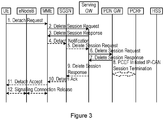
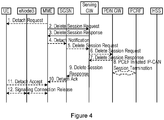
- Detach of a UE from the network may be initiated by the UE via a Detach Request (NAS) message, for example when the UE is switching off, or by the MME.
- Figure 3 illustrates the message sequence for a UE initiated detach procedure in EPS/LTE
- Figure 4 illustrates the message sequence for an MME initiated detach procedure.
- the MME initiated detach procedure illustrated in Figure 4 may be implicit or explicit.
- An implicit detach procedure is triggered by a timeout, for example following absence of a Tracking Area Update Request NAS message or other contact from a UE for a predetermined period of time.
- messages 1, 11 and 12 illustrated in Figure 4 are omitted.
- a UE context is a block of information associated with a UE attached to the network.
- the block of information contains the information required to maintain services towards the UE. This may for example include security information, UE capability information and connectivity information.
- the potential for context retention over longer time periods is therefore extremely limited.
- the time period for context retention is not specified in the standard and would be implementation dependent, but in order to be feasible for a blanket application to all UEs, it would need to be relatively short, targeting for example UEs subject to a detach and immediate reattach procedures.
- Such blanket application would be completely inappropriate for UEs having potentially very long time intervals between detach and subsequent reattach procedures.
- MTC devices for example, may connect to a network anywhere from once a minute to once a week or even less frequently. Consistently retaining contexts for all detached UEs over such extended time periods would be inefficient and would place an excessive burden on MME and network resources.
- the present invention applies a control mechanism in the form of an instruction received at the relevant network node, for example the MME, to apply or not apply the energy saving process of UE context retention.
- context retention may be specifically targeted to those UEs for which it is appropriate, enabling context retention for much longer periods of time for certain UEs.
- These may include but are not limited to UEs in the form of MTC devices.
- Embodiments of the present invention provide further enhancements in the form of configuration of the energy saving process and possible additional energy saving steps. Configuration of the process may include instructing a time period over which the UE context should be retained.
- Additional steps may include retention of network resources reserved for the UE for example in the SGW and PGW, and where appropriate in MTC specific network entities such as an MTC-IWF and SCS.
- the configuration and additional steps may provide enhanced variation in how the energy saving process may be applied to individual UEs or categories of UEs. Details of the configuration and additional steps may be received at the network node in the form of configuration data, as discussed in further detail below.
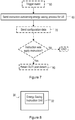
- Figure 5 is a flow chart illustrating process steps in a method according to an aspect of the present invention. The method is appropriate for conducting in a network node, and in the present illustrative example of an EPS/LTE network, is appropriate for conducting in the MME.
- the MME receives an instruction concerning an energy saving process for a particular UE.
- the instruction may be received from the UE itself or from another network node such as for example the Home Subscriber Server (HSS).
- HSS Home Subscriber Server
- the sending of the instruction is discussed in further detail below.
- the instruction may take various different forms depending upon the method by which the instruction is conveyed to the MME.
- the instruction may be in the form of a flag specific to the energy saving process, setting of the flag instructing application of the process and non setting of the flag instructing withholding of the process.
- Other instruction forms may also be envisaged.
- the MME assesses the type of instruction received at step 110. If the instruction is a withhold instruction, the MME withholds application of the energy saving process for the UE at step 120, performing a normal detach procedure at an appropriate time without applying any steps of the energy saving process. If the instruction received is an apply instruction, the MME applies the energy saving process for the UE at step 130. This may entail checking for configuration data and conducting various steps during and after detach of the UE. The steps involved in applying the energy saving process are discussed in further detail below with reference to Figures 9 and 10 .
- the energy saving process conducted at step 130 may be configured for application to suit individual UEs or classes of UEs, including for example specifying a time period for which the UE context for a particular UE should be retained. Configuration of the process may also include specifying additional steps to be included in the process. Details of the configuration, as well as information concerning any additional energy saving steps to be performed, may be received at the MME in the form of configuration data, allowing the MME to configure the energy saving process to the particular UE. This data may be received from the UE itself or from the HSS.
- the configuration data may comprise a time period over which the UE context is to be retained. This may comprise an explicit indication as to the length of time during which the context should be retained after detach, on expiry of which time period the context may be deleted.
- a context retention time period may be preconfigured into both the MME and the UE. The time period may be included in the subscriber information for the UE, downloaded to the MME from the Home Subscriber Server (HSS) and preloaded onto the Universal Subscriber Identity Module (USIM) of the UE. The time period may alternatively be conveyed to the UE via the system information broadcast in the cell of the UE. In another alternative, a standardised value for the time period may be hardcoded into both the UE and the MME.
- the context retention time period may be condition based, its expiry being triggered by the first to occur of a series of conditions.
- Such conditions may for example include:
- the context retention time period may be configured such that occurrence of any one of the above events may trigger its expiry, and hence deletion of the retained UE context.
- the configuration data may comprise information as to whether explicit or implicit detach procedures are to be employed for the UE. If implicit detach is to be used, the configuration data may also include a recommended or required timeout value for the MME to use for triggering the implicit detach.
- the configuration data may comprise an indication concerning retention of additional network resources reserved for the UE.
- the indication may be a recommendation as to whether the additional network resources should be a retained, leaving the option for the MME to comply or not with the recommendation.
- the indication may be an instruction with which the MME is obliged to comply.
- the resources may include bearer contexts in the SGW and PGW and the MME or contexts/resources in other entities, for example including an MTC-IWF or SCS or other proxy server associated with the UE.
- Configuration data received at the MME may comprise some, all or any combination of the above discussed types of information, as appropriate for the particular UE and network operator requirements. Configuration data may be chosen for a particular UE or class of UEs by a network operator according to operational priorities, or UEs may be programmed to select appropriate configuration data for their own operation according to their current functioning and network conditions.
- FIG. 6 is a diagram illustrating functional units of a network node suitable for carrying out the above described method, for example in accordance with instructions received from a computer program stored on a computer readable medium.
- the node 20 comprises a receiving unit 22, configured to receive an instruction concerning an energy saving process for a user equipment device, and an energy saving process unit 24, configured to apply the energy saving process for the user equipment device in accordance with the received instruction.
- the units of the illustrated network node are functional units, and may be realised in any appropriate combination of hardware and/or software. Additional functional units may also be present in the node.
- the instruction concerning application or withholding of the energy saving process, as well as possible configuration data provide control mechanisms allowing for the selective application of the energy saving process for a particular UE, and the possible configuration of that process.
- the instruction and possible configuration data may be conveyed to the MME in different ways, as discussed in detail below.
- the instruction and/or configuration data may be conveyed to the MME from the UE during a network attach procedure.
- the UE may indicate to the MME that the energy saving procedure should or should not be applied.
- This indication may be included in the Attach Request (NAS) message for example in the form of a new Information Element (IE) or as a new value of the EPS attach type IE.
- the indication may comprise only the instruction to apply or withhold the energy saving process, or the indication may also contain or be accompanied by configuration data as discussed above.
- a withhold instruction may comprise an absence of any indication concerning the energy saving procedure.
- a UE may be assumed not to support the energy saving process and thus not to anticipate its use.
- the instruction and/or configuration data may be conveyed to the MME from the UE during a network detach procedure.
- the UE may indicate in the Detach Request (NAS) message that that the energy saving procedure should or should not be applied.
- NAS Detach Request
- a withhold instruction may comprise an absence of any indication concerning the energy saving procedure.
- the indication may comprise only the instruction to apply or withhold the energy saving process, or the indication may also contain or be accompanied by configuration data as discussed above.
- the configuration data would not include an instruction as to the type of detach procedure to be used or a time limit for implicit detach, as the instruction may only be included in detach signalling if explicit detach is used.
- the use of detach signalling may therefore be less desirable than other alternatives for conveying the instruction, which alternatives could allow a UE to use implicit detach, and so avoid the sending of the Detach Request (NAS) message and save the energy associated with sending this message.
- NAS Detach Request
- the instruction and/or configuration data may be associated with a category or capability of the UE, and may therefore be included in any of the lEs in the Attach Request (NAS) message that indicate the various properties of the UE.
- This may include the UE network capability IE, the MS network capability IE, the Mobile station classmark 2 IE or the Device properties IE.
- the instruction and optional configuration data may be implicitly associated with UE category, such as a Mobile Station classmark, or a packet of capabilities with a certain label, including for example 'low-energy device'.
- each of them may be associated with a different set of configuration parameters, specifying a particular maximum context retention time period, whether bearer contexts and/or other allocated resources should be retained, whether explicit or implicit detach should be used, suitable timeout for implicit detach, etc.
- the instruction and/or configuration data may be associated with radio capability related parameters and the UE-EUTRA-Capability IE may be extended with the instruction concerning application of the energy saving process and if appropriate with additional configuration data.
- the UE-EUTRA-Capability IE is included in the ue-CapabilityRAT-Container IE, which in turn is included in the ue-CapabilityRAT-ContainerList IE in the UECapabilitylnformation message.
- the eNodeB requests capability information from the UE by sending the RRC message UECapabilityEnquiry to the UE (message 32 in Figure 2B ).
- the UE responds to the enquiry with the UECapabilityInformation (RRC) message (message 33 in Figure 2B ), which includes the capability information described above.
- RRC UECapabilityInformation
- This message is then forwarded by the eNodeB to the MME.
- the eNodeB includes the UECapabilityInformation (RRC) message in a ue-RadioAccessCapabilityInfo IE, which is then included in a UERadioAccessCapabilitylnformation message (which is specified as an RRC message).
- the UERadioAccessCapabilitylnformation message is in turn included in a UE Radio Capability IE, which the eNodeB sends to the MME in the UE Capability Info Indication (S1AP) message (message 34 in Figure 2B ).
- the MME stores the UE capability information in its UE context and keeps it for as long as the UE remains attached to the network.
- the UE context, including the capability information is retained by the MME post detach as part of the energy saving process. The context including capability information is then available for future reattach or for transfer to a new MME in the case of MME relocation.
- the MME transfers the UE capability information to the eNodeB in the UE Radio Capability IE in the Initial Context Setup Request (S1AP) message (message 31 in Figure 2B ).
- the UE Radio Capability IE is optional in the Initial Context Setup Request message and during the Attach procedure it is absent. This absence triggers the eNodeB to request the information from the UE and forward it to the MME, as described above.
- the UE capability information will still be stored in the MME as part of the UE context, and the UE Radio Capability IE will not therefore be absent in the Initial Context Setup Request message during the Attach procedure.
- the eNodeB will not therefore be prompted to request the capability information from the UE.
- the instruction and/or configuration information may be included with subscriber data associated with the UE.
- the instruction and/or configuration data are therefore stored as part of the subscriber data in the HSS and in the USIM of the UE.
- the instruction and/or configuration data is then downloaded from the HSS to the MME together with other subscriber data when the UE registers in the MME.
- the instruction and/or configuration data may be included in another NAS message.
- This may for example be a Tracking Area Update Request (NAS) message or any other uplink NAS message, and may for example be a new NAS message specified for this purpose.
- NAS Tracking Area Update Request
- the configuration data containing details of the process and any additional steps to be conducted may be stored in the user subscription information, while the instruction concerning application of the process is received directly from the user equipment device in attach signalling, detach signalling or in a message received during an attach session. If the instruction is sent during attach signalling it may be included in the Attach Request (NAS) message, for instance in the UE network capability IE, the MS network capability IE or as a new value of the EPS attach type IE. According to this arrangement all the information required to apply the process may be preconfigured and received at the MME from the HSS, with the UE only required to instruct the MME to apply or withhold the process.
- NAS Attach Request
- the UE may override a previous instruction sent by the UE or received as a default instruction in UE subscriber data. For example, if the UE has already instructed application of the process in the Attach Request (NAS) message, it may override this with a withhold instruction sent in a Detach Request (NAS) message (when using explicit detach) or in another NAS message, including for example a Tracking Area Update Request (NAS) message or other uplink NAS message.
- NAS Detach Request
- NAS Tracking Area Update Request
- Such an override message may also be sent in the case that instruction and configuration data are received from the HSS in the subscriber data but the UE decides to override this instruction for some reason.
- This "override" possibility may also be used to change some of the configuration data previously supplied to the MME including for example the time period for UE context retention or details of resources to be retained etc.
- FIG. 7 illustrates steps in an example of such a method.
- the UE sends an instruction concerning the energy saving process for the UE to the network node at step 60.
- the sending of the instruction by the UE may be preceded by different triggers, depending upon when and how the UE sends the instruction. For example in the case of an instruction sent as part of attach signalling, the sending may be triggered by the appropriate preceding step in the attach message sequence.
- the sending may be triggered by the appropriate preceding step in the detach message sequence or the event that triggered the detach, for example the expiry of a timer.
- the sending may be triggered by occurrence of an event changing the operating situation for the UE and so rendering the previously sent or default instruction obsolete.
- the method of figure 7 may further comprise sending configuration data concerning the energy saving process to the network node in a step 70.
- this configuration data may include a time period for UE context retention, recommendations for retention of network resources or recommendations concerning detach procedures.
- the instruction and configuration data may be sent using any of the signalling options discussed above, including but not limited to attach signalling, detach signalling, UE capability and or category signalling or uplink (NAS) messages.
- the method of Figure 7 may further comprise, if the instruction sent is an apply instruction, retaining a UE identifier, which may contain a network node identifier, after performing network detach in step 80.
- this UE identifier may be a Globally Unique Temporary Identifier (GUTI) which includes a Globally Unique MME Identifier (GUMMEI) and an MME Temporary Mobile Subscriber Identifier (M-TMSI).
- GUMMEI Globally Unique MME Identifier
- M-TMSI MME Temporary Mobile Subscriber Identifier
- the GUTI contains the GUMMEI and is an identifier used by the MME
- the GUTI will point to the correct MME and the correct UE context within the correct MME and will allow that MME to locate the retained UE context for use with the reattached UE.
- the UE may be configured to delete its GUTI after the maximum time period for retention of the UE context in the MME, as after this time the GUTI will not serve any useful purpose, the UE context in the MME having been deleted. Deleting the GUTI after this time period will also avoid any potential useless attempts to retrieve the deleted UE context from the old MME by a new MME in the event that the UE has moved to the coverage area of a new MME or MME pool.
- the method of Figure 7 may also comprise retaining the EPS bearer identity of bearers for which contexts have been retained in the SGW, PGW and MME, if the energy saving process is configured such that these contexts are retained.
- the UE may retain the EPS bearer identity for each bearer retained in the relevant network nodes and may also retain other bearer related information including Quality of Service parameters.
- the EPS bearer identity and other bearer related information may be retained for as long as the GUTI is retained. Retention of this information allows matching of the bearer contexts in the SGW, PGW and MME so that for example no EPS bearer identity has to be changed in the bearer contexts in the network.
- FIG. 8 illustrates a functional unit of a UE 30 which may perform the above described method for example in accordance with instruction received from a computer program stored on a computer readable medium.
- the functional unit comprises an energy saving instruction unit 32, configured to instruct a network node concerning an energy saving process for the UE. It will be appreciated that the functional unit 32 may be realised in any appropriate combination of hardware and/or software. Additional functional units may also be present in the UE.
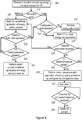
- Figure 9 is a flow chart illustrating one example way in which a network node such as an MME may manage the receipt and application of instructions according to aspects of the present invention.
- the flow chart of Figure 9 illustrates in further detail how the steps of Figure 5 may be broken down to achieve the desired functionality.
- a first step 200 the MME receives an instruction concerning an energy saving process for a UE.
- the instruction may be received from the UE or from another network entity such as the HSS.
- the MME assesses the type of the instruction, i.e. whether the instruction is a withhold instruction or an apply instruction. If the instruction is a withhold instruction, the MME marks the UE at step 221 to indicate that the energy saving process should not be applied. The MME then proceeds to check, at step 222, whether or not an override instruction has been received, indicating that the energy saving process should be applied for the UE. If such an instruction has been received (Yes at step 222), the MME proceeds to step 231 as discussed below.
- the MME proceeds to check, at step 223, whether or not detach procedure has been initiated (either by the MME itself or by the UE). If detach procedure has not been initiated (No at step 223), the MME continues to check for receipt of an override instruction at step 222. If detach has been initiated (Yes at step 223), the MME proceeds with the detach procedure without applying any steps of the energy saving process, i.e. without retention of the UE context or of any network resources reserved for the UE.
- step 231 the MME checks whether or not configuration data concerning the energy saving process for the UE has been received with the instruction at step 200. If such configuration data has been received (Yes at step 231), the MME proceeds to mark the UE to indicate that the energy saving procedure should be applied in step 233. If such configuration data has not been received with the instruction at step 200 (No at step 231), the MME proceeds to retrieve this data at step 232. This may for example involve retrieving configuration data including instructions about the correct detach procedure (explicit or implicit with suitable time limit).
- Retrieving configuration data in step 232 may involve retrieving preconfigured default configuration data from an internal memory in the MME or from subscriber data held in the HSS and conveyed to the MME. Following retrieval of configuration data at step 232 the MME proceeds to mark the UE as subject to application of the energy saving process in step 233. After marking the UE to indicate that the energy saving procedure should be applied in step 233, irrespective of whether the MME arrived at this step directly following the Yes branch from step 231 or indirectly following the No branch from step 231 via step 232, the MME then checks at step 234 whether or not an override instruction has been received, indicating that the energy saving procedure should not be applied for the UE.
- step 234 the MME proceeds to step 221 and follows the subsequent process as described above. If no override instruction has been received, the MME then checks at step 235 whether or not detach procedure with the UE has been initiated, either by the UE or by the MME. If detach procedure has not been initiated (No at step 235), the MME continues to check for receipt of an override instruction at step 234. If detach procedure has been initiated (Yes at step 235), the MME proceeds to step 236, performing the detach procedure with application of the energy saving process as configured by the configuration data, either received with the instruction in step 200 or retrieved in step 232. Details of what this may involve are discussed further below with reference to Figure 10 .
- the MME starts a timer at step 237 and checks for expiration of the time limit for UE context retention at step 238.
- the time limit may be preconfigured in the MME or may have been received or retrieved with the configuration data.
- the time limit may be an explicit limit or may be condition based, as discussed above.
- the MME proceeds to delete the UE context at step 239. If the UE attempts to reattach before expiry of the time limit, the stored UE context, as well as other network resources if retained, will be available to reduce the signalling required for the reattach procedure.
- FIG. 10 illustrates in further detail steps that may be comprised within the step 236 of performing the detach procedure with application of the energy saving process as configured by the configuration data.
- step 236 may involve:
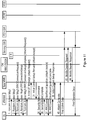
- Figure 11 illustrates the signalling flow in a streamlined attach procedure that may be followed on reattach of a UE whose context has been retained by the MME in accordance with aspects of the present invention.
- a significant portion of the messages in the attach procedure have been eliminated, greatly reducing the signalling overhead of the procedure.
- message exchanges associated with the Attach and Authentication and Default Radio Bearer Setup stages of the standard attach process may be eliminated.
- reduction in signalling reduces the energy associated with the process both through the reduction in number of messages to be transmitted and in the reduction in the amount of time during which the UE must be in a non sleep state.
- aspects of the present invention increase the efficiency of the detach-reattach method of energy saving.
- much longer context retention may be supported for particular UEs or classes of UEs, enabling the reduced attach procedure of Figure 11 to be performed before communication events.
- This streamlined attach procedure improves the efficiency of the detach-reattach method.
- this method may become energy efficient even for devices having shorter time periods between communication events.
- the reduced signalling overhead on reattach moves the breakeven point for detach-reattach in terms of the length of time a device must spend in deepest sleep in order to compensate in terms of energy requirements for the need to perform network reattach before each communication event.
- the present invention is not limited to such devices, being applicable to all forms of User Equipment.
- the invention has been described with reference to operation in an EPS/LTE network, the invention is equally applicable to other cellular network systems including UMTS, WCDMA and HSPA.
- the methods of the present invention may be implemented in hardware, or as software modules running on one or more processors. The methods may also be carried out according to the instructions of a computer program, and the present invention also provides a computer readable medium having stored thereon a program for carrying out any of the methods described herein.
- a computer program embodying the invention may be stored on a computer-readable medium, or it could, for example, be in the form of a signal such as a downloadable data signal provided from an Internet website, or it could be in any other form.
Landscapes
- Engineering & Computer Science (AREA)
- Computer Networks & Wireless Communication (AREA)
- Signal Processing (AREA)
- Mobile Radio Communication Systems (AREA)
Priority Applications (2)
| Application Number | Priority Date | Filing Date | Title |
|---|---|---|---|
| ES21155576T ES2988096T3 (es) | 2013-06-28 | 2013-06-28 | Método para gestionar un dispositivo de equipo de usuario |
| EP21155576.8A EP3873140B1 (de) | 2013-06-28 | 2013-06-28 | Verfahren zur verwaltung einer benutzergerätevorrichtung |
Applications Claiming Priority (3)
| Application Number | Priority Date | Filing Date | Title |
|---|---|---|---|
| EP13741869.5A EP3014932B1 (de) | 2013-06-28 | 2013-06-28 | Verfahren zur verwaltung einer benutzergerätevorrichtung |
| EP21155576.8A EP3873140B1 (de) | 2013-06-28 | 2013-06-28 | Verfahren zur verwaltung einer benutzergerätevorrichtung |
| PCT/SE2013/050831 WO2014209195A1 (en) | 2013-06-28 | 2013-06-28 | Method for managing a user equipment device |
Related Parent Applications (2)
| Application Number | Title | Priority Date | Filing Date |
|---|---|---|---|
| EP13741869.5A Division EP3014932B1 (de) | 2013-06-28 | 2013-06-28 | Verfahren zur verwaltung einer benutzergerätevorrichtung |
| EP13741869.5A Division-Into EP3014932B1 (de) | 2013-06-28 | 2013-06-28 | Verfahren zur verwaltung einer benutzergerätevorrichtung |
Publications (3)
| Publication Number | Publication Date |
|---|---|
| EP3873140A1 true EP3873140A1 (de) | 2021-09-01 |
| EP3873140B1 EP3873140B1 (de) | 2024-09-25 |
| EP3873140C0 EP3873140C0 (de) | 2024-09-25 |
Family
ID=48875127
Family Applications (2)
| Application Number | Title | Priority Date | Filing Date |
|---|---|---|---|
| EP21155576.8A Active EP3873140B1 (de) | 2013-06-28 | 2013-06-28 | Verfahren zur verwaltung einer benutzergerätevorrichtung |
| EP13741869.5A Active EP3014932B1 (de) | 2013-06-28 | 2013-06-28 | Verfahren zur verwaltung einer benutzergerätevorrichtung |
Family Applications After (1)
| Application Number | Title | Priority Date | Filing Date |
|---|---|---|---|
| EP13741869.5A Active EP3014932B1 (de) | 2013-06-28 | 2013-06-28 | Verfahren zur verwaltung einer benutzergerätevorrichtung |
Country Status (8)
| Country | Link |
|---|---|
| US (1) | US10602442B2 (de) |
| EP (2) | EP3873140B1 (de) |
| AU (1) | AU2013396368B2 (de) |
| DK (1) | DK3014932T3 (de) |
| ES (1) | ES2988096T3 (de) |
| IL (1) | IL242945B (de) |
| RU (1) | RU2645757C2 (de) |
| WO (1) | WO2014209195A1 (de) |
Families Citing this family (5)
| Publication number | Priority date | Publication date | Assignee | Title |
|---|---|---|---|---|
| EP3852469A1 (de) * | 2014-07-08 | 2021-07-21 | Nokia Solutions and Networks Oy | Vorrichtungen und verfahren zum einbringen flexibler träger für dienste |
| US11696250B2 (en) * | 2016-11-09 | 2023-07-04 | Intel Corporation | UE and devices for detach handling |
| CN110536380A (zh) | 2018-08-10 | 2019-12-03 | 中兴通讯股份有限公司 | 状态确定、指示方法、通信设备、系统及存储介质 |
| CN110536381B (zh) | 2018-08-10 | 2024-11-29 | 中兴通讯股份有限公司 | 接收配置和控制方法、装置、终端、基站及存储介质 |
| CN112333849B (zh) * | 2020-06-19 | 2023-05-02 | 深圳Tcl新技术有限公司 | 设备连接断线处理方法、装置、移动终端及存储介质 |
Citations (2)
| Publication number | Priority date | Publication date | Assignee | Title |
|---|---|---|---|---|
| EP2579671A2 (de) * | 2011-10-03 | 2013-04-10 | MediaTek, Inc | Verfahren für Benutzerausrüstung mit Anzeige von verkehrsbezogenen Informationen zum Netzwerk |
| GB2497073A (en) * | 2011-11-22 | 2013-06-05 | Sca Ipla Holdings Inc | A virtual mobility manager stores context information for an offline communications terminal |
Family Cites Families (4)
| Publication number | Priority date | Publication date | Assignee | Title |
|---|---|---|---|---|
| US20070036296A1 (en) * | 2005-07-22 | 2007-02-15 | Texas Instruments Incorporated | Methods and systems for securely providing and retaining phone numbers |
| US8477811B2 (en) * | 2008-02-02 | 2013-07-02 | Qualcomm Incorporated | Radio access network (RAN) level keep alive signaling |
| EP2385734A1 (de) | 2010-05-03 | 2011-11-09 | Alcatel Lucent | Verwaltung des Betriebs einer Maschinentyp-Kommunikationsvorrichtung in einem mobilen Kommunikationssystem |
| CN102996395B (zh) * | 2011-09-13 | 2016-12-21 | 精工爱普生株式会社 | 送液泵、液体循环装置、医疗设备和电子设备 |
-
2013
- 2013-06-28 WO PCT/SE2013/050831 patent/WO2014209195A1/en not_active Ceased
- 2013-06-28 EP EP21155576.8A patent/EP3873140B1/de active Active
- 2013-06-28 US US14/899,494 patent/US10602442B2/en active Active
- 2013-06-28 ES ES21155576T patent/ES2988096T3/es active Active
- 2013-06-28 DK DK13741869.5T patent/DK3014932T3/da active
- 2013-06-28 AU AU2013396368A patent/AU2013396368B2/en active Active
- 2013-06-28 RU RU2016102617A patent/RU2645757C2/ru active
- 2013-06-28 EP EP13741869.5A patent/EP3014932B1/de active Active
-
2015
- 2015-12-06 IL IL242945A patent/IL242945B/en active IP Right Grant
Patent Citations (2)
| Publication number | Priority date | Publication date | Assignee | Title |
|---|---|---|---|---|
| EP2579671A2 (de) * | 2011-10-03 | 2013-04-10 | MediaTek, Inc | Verfahren für Benutzerausrüstung mit Anzeige von verkehrsbezogenen Informationen zum Netzwerk |
| GB2497073A (en) * | 2011-11-22 | 2013-06-05 | Sca Ipla Holdings Inc | A virtual mobility manager stores context information for an offline communications terminal |
Non-Patent Citations (4)
Also Published As
| Publication number | Publication date |
|---|---|
| AU2013396368B2 (en) | 2017-02-02 |
| WO2014209195A1 (en) | 2014-12-31 |
| US20160142975A1 (en) | 2016-05-19 |
| IL242945B (en) | 2020-09-30 |
| ES2988096T3 (es) | 2024-11-19 |
| EP3014932A1 (de) | 2016-05-04 |
| EP3873140B1 (de) | 2024-09-25 |
| RU2016102617A (ru) | 2017-08-02 |
| EP3014932B1 (de) | 2021-03-17 |
| US10602442B2 (en) | 2020-03-24 |
| EP3873140C0 (de) | 2024-09-25 |
| RU2645757C2 (ru) | 2018-02-28 |
| DK3014932T3 (da) | 2021-05-03 |
| AU2013396368A1 (en) | 2016-01-21 |
Similar Documents
| Publication | Publication Date | Title |
|---|---|---|
| US10624004B2 (en) | Serving node relocating method in wireless communication system and device for same | |
| EP3716680B1 (de) | Verfahren zur erzeugung dedizierter träger und mobilitätsverwaltungseinheit | |
| EP3367735B1 (de) | Verfahren zur steuerung der signalisierungsreduktion eines endgeräts im ruhemodus in einem drahtloskommunikationssystem und vorrichtung für das verfahren | |
| US10645648B2 (en) | Method and device for transmitting data | |
| KR102412234B1 (ko) | Ue를 전용 코어 네트워크 노드에 리디렉트하기 위한 방법들 및 이동성 관리 엔티티(mme) | |
| EP2768251B1 (de) | Datenübertragungsverfahren, mobilitätsverwaltungseinrichtung und mobiles endgerät | |
| CN103686955B (zh) | 电能优化方法及系统 | |
| US10616850B2 (en) | Periodic timer synchronization logic for RRC inactive state | |
| EP2870819B1 (de) | Verfahren zur widerruflichen löschung einer pdn-verbindung | |
| EP3281366B1 (de) | Verfahren und vorrichtung zur handhabung des energieverbrauchs einer benutzervorrichtung | |
| KR102057229B1 (ko) | Edrx 인에이블드 이동 단말기들을 위한 mt sm 전달의 향상 | |
| AU2013396368B2 (en) | Method for managing a user equipment device | |
| CN102958194A (zh) | 一种维持大量连接的方法、用户设备及系统 | |
| US20140140282A1 (en) | Service response method, device and system | |
| RU2763777C2 (ru) | Способ для управления устройством пользовательского оборудования | |
| CN105744502A (zh) | 智能寻呼方法和系统、服务网关、移动管理实体 |
Legal Events
| Date | Code | Title | Description |
|---|---|---|---|
| PUAI | Public reference made under article 153(3) epc to a published international application that has entered the european phase |
Free format text: ORIGINAL CODE: 0009012 |
|
| STAA | Information on the status of an ep patent application or granted ep patent |
Free format text: STATUS: THE APPLICATION HAS BEEN PUBLISHED |
|
| AC | Divisional application: reference to earlier application |
Ref document number: 3014932 Country of ref document: EP Kind code of ref document: P |
|
| AK | Designated contracting states |
Kind code of ref document: A1 Designated state(s): AL AT BE BG CH CY CZ DE DK EE ES FI FR GB GR HR HU IE IS IT LI LT LU LV MC MK MT NL NO PL PT RO RS SE SI SK SM TR |
|
| STAA | Information on the status of an ep patent application or granted ep patent |
Free format text: STATUS: REQUEST FOR EXAMINATION WAS MADE |
|
| 17P | Request for examination filed |
Effective date: 20220518 |
|
| RBV | Designated contracting states (corrected) |
Designated state(s): AL AT BE BG CH CY CZ DE DK EE ES FI FR GB GR HR HU IE IS IT LI LT LU LV MC MK MT NL NO PL PT RO RS SE SI SK SM TR |
|
| GRAP | Despatch of communication of intention to grant a patent |
Free format text: ORIGINAL CODE: EPIDOSNIGR1 |
|
| STAA | Information on the status of an ep patent application or granted ep patent |
Free format text: STATUS: GRANT OF PATENT IS INTENDED |
|
| INTG | Intention to grant announced |
Effective date: 20240423 |
|
| GRAS | Grant fee paid |
Free format text: ORIGINAL CODE: EPIDOSNIGR3 |
|
| GRAA | (expected) grant |
Free format text: ORIGINAL CODE: 0009210 |
|
| STAA | Information on the status of an ep patent application or granted ep patent |
Free format text: STATUS: THE PATENT HAS BEEN GRANTED |
|
| AC | Divisional application: reference to earlier application |
Ref document number: 3014932 Country of ref document: EP Kind code of ref document: P |
|
| AK | Designated contracting states |
Kind code of ref document: B1 Designated state(s): AL AT BE BG CH CY CZ DE DK EE ES FI FR GB GR HR HU IE IS IT LI LT LU LV MC MK MT NL NO PL PT RO RS SE SI SK SM TR |
|
| REG | Reference to a national code |
Ref country code: GB Ref legal event code: FG4D |
|
| REG | Reference to a national code |
Ref country code: CH Ref legal event code: EP |
|
| REG | Reference to a national code |
Ref country code: DE Ref legal event code: R096 Ref document number: 602013086136 Country of ref document: DE |
|
| REG | Reference to a national code |
Ref country code: IE Ref legal event code: FG4D |
|
| REG | Reference to a national code |
Ref country code: ES Ref legal event code: FG2A Ref document number: 2988096 Country of ref document: ES Kind code of ref document: T3 Effective date: 20241119 |
|
| U01 | Request for unitary effect filed |
Effective date: 20241016 |
|
| U07 | Unitary effect registered |
Designated state(s): AT BE BG DE DK EE FI FR IT LT LU LV MT NL PT RO SE SI Effective date: 20241104 |
|
| PG25 | Lapsed in a contracting state [announced via postgrant information from national office to epo] |
Ref country code: NO Free format text: LAPSE BECAUSE OF FAILURE TO SUBMIT A TRANSLATION OF THE DESCRIPTION OR TO PAY THE FEE WITHIN THE PRESCRIBED TIME-LIMIT Effective date: 20241225 |
|
| PG25 | Lapsed in a contracting state [announced via postgrant information from national office to epo] |
Ref country code: GR Free format text: LAPSE BECAUSE OF FAILURE TO SUBMIT A TRANSLATION OF THE DESCRIPTION OR TO PAY THE FEE WITHIN THE PRESCRIBED TIME-LIMIT Effective date: 20241226 |
|
| PG25 | Lapsed in a contracting state [announced via postgrant information from national office to epo] |
Ref country code: RS Free format text: LAPSE BECAUSE OF FAILURE TO SUBMIT A TRANSLATION OF THE DESCRIPTION OR TO PAY THE FEE WITHIN THE PRESCRIBED TIME-LIMIT Effective date: 20241225 |
|
| PG25 | Lapsed in a contracting state [announced via postgrant information from national office to epo] |
Ref country code: RS Free format text: LAPSE BECAUSE OF FAILURE TO SUBMIT A TRANSLATION OF THE DESCRIPTION OR TO PAY THE FEE WITHIN THE PRESCRIBED TIME-LIMIT Effective date: 20241225 Ref country code: NO Free format text: LAPSE BECAUSE OF FAILURE TO SUBMIT A TRANSLATION OF THE DESCRIPTION OR TO PAY THE FEE WITHIN THE PRESCRIBED TIME-LIMIT Effective date: 20241225 Ref country code: GR Free format text: LAPSE BECAUSE OF FAILURE TO SUBMIT A TRANSLATION OF THE DESCRIPTION OR TO PAY THE FEE WITHIN THE PRESCRIBED TIME-LIMIT Effective date: 20241226 |
|
| PG25 | Lapsed in a contracting state [announced via postgrant information from national office to epo] |
Ref country code: IS Free format text: LAPSE BECAUSE OF FAILURE TO SUBMIT A TRANSLATION OF THE DESCRIPTION OR TO PAY THE FEE WITHIN THE PRESCRIBED TIME-LIMIT Effective date: 20250125 |
|
| PG25 | Lapsed in a contracting state [announced via postgrant information from national office to epo] |
Ref country code: SM Free format text: LAPSE BECAUSE OF FAILURE TO SUBMIT A TRANSLATION OF THE DESCRIPTION OR TO PAY THE FEE WITHIN THE PRESCRIBED TIME-LIMIT Effective date: 20240925 |
|
| PG25 | Lapsed in a contracting state [announced via postgrant information from national office to epo] |
Ref country code: PL Free format text: LAPSE BECAUSE OF FAILURE TO SUBMIT A TRANSLATION OF THE DESCRIPTION OR TO PAY THE FEE WITHIN THE PRESCRIBED TIME-LIMIT Effective date: 20240925 Ref country code: CZ Free format text: LAPSE BECAUSE OF FAILURE TO SUBMIT A TRANSLATION OF THE DESCRIPTION OR TO PAY THE FEE WITHIN THE PRESCRIBED TIME-LIMIT Effective date: 20240925 |
|
| PG25 | Lapsed in a contracting state [announced via postgrant information from national office to epo] |
Ref country code: SK Free format text: LAPSE BECAUSE OF FAILURE TO SUBMIT A TRANSLATION OF THE DESCRIPTION OR TO PAY THE FEE WITHIN THE PRESCRIBED TIME-LIMIT Effective date: 20240925 |
|
| PGFP | Annual fee paid to national office [announced via postgrant information from national office to epo] |
Ref country code: GB Payment date: 20250627 Year of fee payment: 13 |
|
| PLBE | No opposition filed within time limit |
Free format text: ORIGINAL CODE: 0009261 |
|
| STAA | Information on the status of an ep patent application or granted ep patent |
Free format text: STATUS: NO OPPOSITION FILED WITHIN TIME LIMIT |
|
| U20 | Renewal fee for the european patent with unitary effect paid |
Year of fee payment: 13 Effective date: 20250628 |
|
| 26N | No opposition filed |
Effective date: 20250626 |
|
| PGFP | Annual fee paid to national office [announced via postgrant information from national office to epo] |
Ref country code: ES Payment date: 20250701 Year of fee payment: 13 |
|
| PG25 | Lapsed in a contracting state [announced via postgrant information from national office to epo] |
Ref country code: HR Free format text: LAPSE BECAUSE OF FAILURE TO SUBMIT A TRANSLATION OF THE DESCRIPTION OR TO PAY THE FEE WITHIN THE PRESCRIBED TIME-LIMIT Effective date: 20240925 |
|
| REG | Reference to a national code |
Ref country code: CH Ref legal event code: H13 Free format text: ST27 STATUS EVENT CODE: U-0-0-H10-H13 (AS PROVIDED BY THE NATIONAL OFFICE) Effective date: 20260127 |
|
| PG25 | Lapsed in a contracting state [announced via postgrant information from national office to epo] |
Ref country code: MC Free format text: LAPSE BECAUSE OF FAILURE TO SUBMIT A TRANSLATION OF THE DESCRIPTION OR TO PAY THE FEE WITHIN THE PRESCRIBED TIME-LIMIT Effective date: 20240925 |
|
| PG25 | Lapsed in a contracting state [announced via postgrant information from national office to epo] |
Ref country code: IE Free format text: LAPSE BECAUSE OF NON-PAYMENT OF DUE FEES Effective date: 20250628 |
|
| PG25 | Lapsed in a contracting state [announced via postgrant information from national office to epo] |
Ref country code: CH Free format text: LAPSE BECAUSE OF NON-PAYMENT OF DUE FEES Effective date: 20250630 |