EP3875421A1 - Systèmes et procédés de commande d'un véhicule de manipulation de matériau pouvant être commandé à distance - Google Patents
Systèmes et procédés de commande d'un véhicule de manipulation de matériau pouvant être commandé à distance Download PDFInfo
- Publication number
- EP3875421A1 EP3875421A1 EP21161068.8A EP21161068A EP3875421A1 EP 3875421 A1 EP3875421 A1 EP 3875421A1 EP 21161068 A EP21161068 A EP 21161068A EP 3875421 A1 EP3875421 A1 EP 3875421A1
- Authority
- EP
- European Patent Office
- Prior art keywords
- material handling
- handling vehicle
- mode
- vehicle
- operator
- Prior art date
- Legal status (The legal status is an assumption and is not a legal conclusion. Google has not performed a legal analysis and makes no representation as to the accuracy of the status listed.)
- Pending
Links
Images



Classifications
-
- B—PERFORMING OPERATIONS; TRANSPORTING
- B66—HOISTING; LIFTING; HAULING
- B66F—HOISTING, LIFTING, HAULING OR PUSHING, NOT OTHERWISE PROVIDED FOR, e.g. DEVICES WHICH APPLY A LIFTING OR PUSHING FORCE DIRECTLY TO THE SURFACE OF A LOAD
- B66F9/00—Devices for lifting or lowering bulky or heavy goods for loading or unloading purposes
- B66F9/06—Devices for lifting or lowering bulky or heavy goods for loading or unloading purposes movable, with their loads, on wheels or the like, e.g. fork-lift trucks
- B66F9/075—Constructional features or details
-
- B—PERFORMING OPERATIONS; TRANSPORTING
- B66—HOISTING; LIFTING; HAULING
- B66F—HOISTING, LIFTING, HAULING OR PUSHING, NOT OTHERWISE PROVIDED FOR, e.g. DEVICES WHICH APPLY A LIFTING OR PUSHING FORCE DIRECTLY TO THE SURFACE OF A LOAD
- B66F17/00—Safety devices, e.g. for limiting or indicating lifting force
- B66F17/003—Safety devices, e.g. for limiting or indicating lifting force for fork-lift trucks
-
- B—PERFORMING OPERATIONS; TRANSPORTING
- B66—HOISTING; LIFTING; HAULING
- B66F—HOISTING, LIFTING, HAULING OR PUSHING, NOT OTHERWISE PROVIDED FOR, e.g. DEVICES WHICH APPLY A LIFTING OR PUSHING FORCE DIRECTLY TO THE SURFACE OF A LOAD
- B66F9/00—Devices for lifting or lowering bulky or heavy goods for loading or unloading purposes
- B66F9/06—Devices for lifting or lowering bulky or heavy goods for loading or unloading purposes movable, with their loads, on wheels or the like, e.g. fork-lift trucks
- B66F9/063—Automatically guided
-
- B—PERFORMING OPERATIONS; TRANSPORTING
- B66—HOISTING; LIFTING; HAULING
- B66F—HOISTING, LIFTING, HAULING OR PUSHING, NOT OTHERWISE PROVIDED FOR, e.g. DEVICES WHICH APPLY A LIFTING OR PUSHING FORCE DIRECTLY TO THE SURFACE OF A LOAD
- B66F9/00—Devices for lifting or lowering bulky or heavy goods for loading or unloading purposes
- B66F9/06—Devices for lifting or lowering bulky or heavy goods for loading or unloading purposes movable, with their loads, on wheels or the like, e.g. fork-lift trucks
- B66F9/075—Constructional features or details
- B66F9/07581—Remote controls
-
- B—PERFORMING OPERATIONS; TRANSPORTING
- B66—HOISTING; LIFTING; HAULING
- B66F—HOISTING, LIFTING, HAULING OR PUSHING, NOT OTHERWISE PROVIDED FOR, e.g. DEVICES WHICH APPLY A LIFTING OR PUSHING FORCE DIRECTLY TO THE SURFACE OF A LOAD
- B66F9/00—Devices for lifting or lowering bulky or heavy goods for loading or unloading purposes
- B66F9/06—Devices for lifting or lowering bulky or heavy goods for loading or unloading purposes movable, with their loads, on wheels or the like, e.g. fork-lift trucks
- B66F9/075—Constructional features or details
- B66F9/0759—Details of operating station, e.g. seats, levers, operator platforms, cabin suspension
-
- G—PHYSICS
- G05—CONTROLLING; REGULATING
- G05D—SYSTEMS FOR CONTROLLING OR REGULATING NON-ELECTRIC VARIABLES
- G05D1/00—Control of position, course, altitude or attitude of land, water, air or space vehicles, e.g. using automatic pilots
- G05D1/0011—Control of position, course, altitude or attitude of land, water, air or space vehicles, e.g. using automatic pilots associated with a remote control arrangement
-
- G—PHYSICS
- G05—CONTROLLING; REGULATING
- G05D—SYSTEMS FOR CONTROLLING OR REGULATING NON-ELECTRIC VARIABLES
- G05D1/00—Control of position, course, altitude or attitude of land, water, air or space vehicles, e.g. using automatic pilots
- G05D1/0055—Control of position, course, altitude or attitude of land, water, air or space vehicles, e.g. using automatic pilots with safety arrangements
- G05D1/0061—Control of position, course, altitude or attitude of land, water, air or space vehicles, e.g. using automatic pilots with safety arrangements for transition from automatic pilot to manual pilot and vice versa
-
- G—PHYSICS
- G05—CONTROLLING; REGULATING
- G05D—SYSTEMS FOR CONTROLLING OR REGULATING NON-ELECTRIC VARIABLES
- G05D1/00—Control of position, course, altitude or attitude of land, water, air or space vehicles, e.g. using automatic pilots
- G05D1/02—Control of position or course in two dimensions
- G05D1/021—Control of position or course in two dimensions specially adapted to land vehicles
- G05D1/0212—Control of position or course in two dimensions specially adapted to land vehicles with means for defining a desired trajectory
- G05D1/0223—Control of position or course in two dimensions specially adapted to land vehicles with means for defining a desired trajectory involving speed control of the vehicle
-
- G—PHYSICS
- G05—CONTROLLING; REGULATING
- G05D—SYSTEMS FOR CONTROLLING OR REGULATING NON-ELECTRIC VARIABLES
- G05D1/00—Control of position, course, altitude or attitude of land, water, air or space vehicles, e.g. using automatic pilots
- G05D1/20—Control system inputs
- G05D1/22—Command input arrangements
- G05D1/221—Remote-control arrangements
- G05D1/222—Remote-control arrangements operated by humans
- G05D1/223—Command input arrangements on the remote controller, e.g. joysticks or touch screens
-
- G—PHYSICS
- G05—CONTROLLING; REGULATING
- G05D—SYSTEMS FOR CONTROLLING OR REGULATING NON-ELECTRIC VARIABLES
- G05D1/00—Control of position, course, altitude or attitude of land, water, air or space vehicles, e.g. using automatic pilots
- G05D1/60—Intended control result
- G05D1/65—Following a desired speed profile
-
- G—PHYSICS
- G05—CONTROLLING; REGULATING
- G05D—SYSTEMS FOR CONTROLLING OR REGULATING NON-ELECTRIC VARIABLES
- G05D1/00—Control of position, course, altitude or attitude of land, water, air or space vehicles, e.g. using automatic pilots
- G05D1/80—Arrangements for reacting to or preventing system or operator failure
- G05D1/81—Handing over between on-board automatic and on-board manual control
-
- G—PHYSICS
- G01—MEASURING; TESTING
- G01S—RADIO DIRECTION-FINDING; RADIO NAVIGATION; DETERMINING DISTANCE OR VELOCITY BY USE OF RADIO WAVES; LOCATING OR PRESENCE-DETECTING BY USE OF THE REFLECTION OR RERADIATION OF RADIO WAVES; ANALOGOUS ARRANGEMENTS USING OTHER WAVES
- G01S17/00—Systems using the reflection or reradiation of electromagnetic waves other than radio waves, e.g. lidar systems
- G01S17/88—Lidar systems specially adapted for specific applications
- G01S17/93—Lidar systems specially adapted for specific applications for anti-collision purposes
- G01S17/931—Lidar systems specially adapted for specific applications for anti-collision purposes of land vehicles
-
- G—PHYSICS
- G05—CONTROLLING; REGULATING
- G05D—SYSTEMS FOR CONTROLLING OR REGULATING NON-ELECTRIC VARIABLES
- G05D1/00—Control of position, course, altitude or attitude of land, water, air or space vehicles, e.g. using automatic pilots
- G05D1/0088—Control of position, course, altitude or attitude of land, water, air or space vehicles, e.g. using automatic pilots characterized by the autonomous decision making process, e.g. artificial intelligence, predefined behaviours
-
- G—PHYSICS
- G05—CONTROLLING; REGULATING
- G05D—SYSTEMS FOR CONTROLLING OR REGULATING NON-ELECTRIC VARIABLES
- G05D1/00—Control of position, course, altitude or attitude of land, water, air or space vehicles, e.g. using automatic pilots
- G05D1/20—Control system inputs
- G05D1/22—Command input arrangements
- G05D1/228—Command input arrangements located on-board unmanned vehicles
Definitions
- Warehouses typically employ the use of material handling vehicles, specifically, operators may use a remote control device to control travel of a material handling vehicle within the warehouse.
- the present disclosure relates generally to material handling vehicles and, more specifically, to remotely controllable material handling vehicles that can be switched between a manual operation mode and a travel request mode.
- a system for a remotely controllable material handling vehicle can be switchable between a manual mode and a travel request mode.
- the system can include a control handle configured to at least control a speed and direction of the material handling vehicle when the material handling vehicle is in the manual mode.
- a remote control device can be provided, the remote control device can be in communication with the material handling vehicle and configured to provide a request to the material handling vehicle to move forward.
- the system can also include a mode switch configured to switch the material handling vehicle from the manual mode to the travel request mode.
- the system can include an operator compartment sensor configured to trigger a flag when a weight on a floor of an operator compartment of the material handling vehicle is greater than or equal to a predetermined weight, where when the material handling vehicle is in the travel request mode the operator compartment sensor can be removed from communication with the material handling vehicle.
- a system for a remotely controllable material handling vehicle operable in a manual mode where an operator can maneuver the material handling vehicle normally and a travel request mode where the operator can remotely request the material handling vehicle to move forward can include a control handle configured to at least control a speed and direction of the material handling vehicle when the material handling vehicle is in the manual mode, an operator compartment sensor configured to trigger a flag when a weight on a floor of an operator compartment of the material handling vehicle is greater than or equal to a predetermined weight, and a remote control device in communication with the material handling vehicle and including a travel control function configured to provide a first signal to the material handling vehicle to move forward.
- a manually-operable mode switch is provided for selecting an operation mode of the material handling vehicle and movable between a manual mode position and a travel request mode position. The manually-operable mode switch is configured to selectively bypass the operator compartment sensor.
- a method for switching the operation of a material handling vehicle from a manual mode to a travel request mode can include evaluating a state of a manually-operable mode switch to determine if the manually-operable mode switch is in a manual mode position or a travel request mode position. The method can also include interpreting at least one vehicle condition to determine if the at least one vehicle condition is appropriate for transitioning from the manual mode to the travel request mode. In some aspects, upon the determination that the mode switch is in the travel request position and the at least one vehicle condition is appropriate for transitioning from the manual mode to the travel request mode, enabling remote control operation of the material handling vehicle.
- any reference to an element herein using a designation such as “first,” “second,” and so forth does not limit the quantity or order of those elements, unless such limitation is explicitly stated. Rather, these designations may be used herein as a convenient method of distinguishing between two or more elements or instances of an element. Thus, a reference to first and second elements does not mean that only two elements may be employed there or that the first element must precede the second element in some manner.
- material handling vehicles are designed in a variety of configurations to perform a variety of tasks.
- the various configurations of material handling vehicles described herein are shown by way of example. It will be apparent to those of skill in the art that the present invention is not limited to vehicles of these types, and can also be provided in various other types of material handling vehicle configurations, including for example, order pickers, reach vehicles, counterbalanced vehicles, and any other material handling vehicles.
- the various aspects disclosed herein are suitable for all of driver controlled, pedestrian controlled, remotely controlled, and autonomously controlled material handling vehicles.
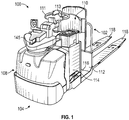
- Figs. 1 and 2 illustrate one non-limiting example of a material handling vehicle 100 according to the present disclosure.
- the material handling vehicle 100 may include a vehicle frame 102, a traction wheel 104, a power section 108, and an operator compartment 110.
- the power section 108 may be disposed within the vehicle frame 102 and may include a battery (not shown) configured to supply power to various components of the material handling vehicle 100.
- the battery may supply power to a motor (not shown) and/or transmission (not shown) disposed within the power section 108 and configured to drive the traction wheel 104.
- the traction wheel 104 is arranged under the power section 108.
- the traction wheel 104 may be arranged in another location under the vehicle frame 102.
- the operator compartment 110 may include a control handle 111 configured to provide a user interface for an operator and to allow the operator to control a speed and direction of travel of the material handling vehicle 100.
- the control handle 111 may be configured to manually steer and control power to the traction wheel 104.
- the material handling vehicle 100 includes the operator compartment 110 arranged rearward of the power section 108 and having an operator opening 112 that opens towards lateral sides 114 of the material handling vehicle 100.
- the operator compartment 110 can define a floor 116 on which an operator of the material handling vehicle 100 may stand.
- the material handling vehicle 100 may be designed with the operator compartment arranged differently, for example, with an operator opening 112 that opens rearward.
- the material handling vehicle 100 includes a pair of forks 118 that can be raised or lowered via actuators (not shown) in response to commands from the control handle 111.
- the material handling vehicle 100 may also include a holster 119.
- the holster 119 can, for example, be attached to a portion of the material handling vehicle 100. In the illustrated non-limiting example, the holster 119 is attached to a lateral side 114 of the material handling vehicle 100.
- the holster 119 can be configured to temporarily hold or store a remote control device 122 when the remote control device 122 is not being held by the operator.
- the holster 119 can include an integrated charger 121 for the remote control device 122 such that the remote control device 122 can be charged while being stored in the holster 119. In some non-limiting examples, when an operator places the remote control device 122 in the holster 119, the remote control device 122 is unpaired from the material handling vehicle 100.
- Fig. 3 illustrates one non-limiting example of a system 120 for a remotely controllable material handling vehicle, which may be implemented, for example, in the material handling vehicle 100 shown in Fig. 1 .
- the system 120 includes a remote control device 122 in communication with the material handling vehicle 100.
- the remote control device 122 is operable by an operator of the material handling vehicle 100 and can include a travel control function 124 and an I/O function 126.
- the travel control function 124 and the I/O function 126 can be configured as first and second manually-operable functions that can be operated by, for example, a button or a switch located on the remote control device 122.
- the travel control function 124 can be operated by a first button 125 on the remote control device 122 and the I/O function 126 can be operated by a second button 127 on the remote control device 122 (see Fig. 6 ).
- the travel control function 124 and the I/O function 126 can be in electrical communication with a transmitter 128 within the remote control device 122.
- the transmitter 128 on the remote control device 122 can wirelessly communicate with the material handling vehicle 100 via a receiver 130 located on the material handling vehicle 100, as represented by dashed line 132.
- the remote control device 122 may turn off after several minutes of inactivity.
- the travel control function 124 can be configured to send a first signal from the transmitter 128 to the receiver 130 located on the material handling vehicle 100.
- the first signal can be configured to instruct the material handling vehicle 100 to move forward from one location to the next within a warehouse while the operator is operating the travel control function 124 on the remote control device 122.
- the operator may desire the material handling vehicle 100 to move in an aisle along a rack within a warehouse from one picking location to the next picking location without the operator frequently entering/exiting the operator compartment 110 on the material handling vehicle 100.
- the operator can operate the travel control function 124 on the remote control device 122 from outside the operator compartment 110 to move the material handling vehicle 100.
- the travel control function 124 when actuated by the operator, provides a request to the material handling vehicle 100 to move forward.
- a duration of the forward movement of the material handling vehicle can be controllable by maintaining the travel control function 124 in an actuated state.
- the operator can control the duration of time the material handling vehicle 100 is moving by depressing and holding the travel control function 124.
- releasing the travel control function 124 after the travel control function 124 has been held can cause the material handling vehicle 100 to stop moving forward and/or coast to a stop.
- there may be a limited time duration on the holding of the travel control function 124 (e.g., after ten seconds, or more or less than ten seconds), after which travel of the material handling vehicle 100 may stop.
- a rapid "release-and-re-hold” e.g., within 2.5 seconds, or more or less than 2.5 seconds
- the travel control function 124 can "reset” the limited time duration without the material handling vehicle 100 coming to a stop.
- the I/O function 126 can be configured to send a second signal from the transmitter 128 to a receiver 130 located on the material handling vehicle 100.
- the second signal may cause a series of events to occur, such as unpairing the remote control device 122 from the material handling vehicle 100 and stopping the material handling vehicle 100 from moving forward.
- the I/O function 126 when actuated by the operator, unpairs the remote control device 122 from the material handling vehicle 100.
- the material handling vehicle 100 can also include a vehicle manager 134 ("VM").
- the vehicle manager can be in electrical communication with a steering control system 136 and a traction controller 138.
- the vehicle manager 134 can be configured to issue commands and control the steering control system 136.
- the vehicle manager 134 can send a signal to the steering control system 136 to perform a steering maneuver or issue steering commands.
- the steering control system 136 may then perform the issued steering commands based on the received signal.
- the vehicle manager 134 can be configured to issue commands and control the traction controller 138.
- the vehicle manager 134 can send a signal to the traction controller 138 to move, position, accelerate, slow, or otherwise change a speed of the material handling vehicle 100.
- the traction controller 138 may then communicate (e.g., via electrical communication) to a brake 140 or a power unit 142 to change the speed of the material handling vehicle.
- the vehicle manager 134 can be configured to evaluate vehicle conditions from the steer control system 136 and the traction controller 138.
- the steer control system 136 can sense (e.g., via a sensor) a steering angle of the material handling vehicle 100.
- the traction controller 138 can sense a speed (e.g., via a sensor) of the material handling vehicle 100. In either case, the sensed steering angle or speed of the material handling vehicle 100 can be communicated to the vehicle manager 134.
- the material handling vehicle 100 may also include a travel request controller 144 ("TRC").
- TRC travel request controller
- the travel request controller 144 can be in electrical communication with the receiver 130 such that the receiver 130 can receive the first and second signals from the transmitter 128 on the remote control device 122 and transmit the first and second signals to the travel request controller 144 to interpret them.
- the travel request controller 144 can also be in electrical communication with the vehicle manager 134 such that signals and commands can be sent between the travel request controller 144 and the vehicle manager 134.
- the material handling vehicle 100 can also have a sensor 145 (e.g., positioned at a front of the vehicle, see Figs. 1-2 ).
- the sensor 145 can be a time-of-flight camera or a 2D or 3D LIDAR scanner, however other obstacle detection capable sensors are also envisioned, such as any other obstacle detection sensor known in the art.
- the sensor 145 can be in electrical communication with the travel request controller 144 and can be configured to sense or detect obstacles located in or near a travel path of the vehicle.
- the sensor 145 may also be configured to detect a rack located along a lateral side 114 of the material handling vehicle 100.
- the material handling vehicle 100 can have a manually-operable mode switch 146 (e.g., a rocker switch) configured to transition the vehicle between a manual mode and a travel request mode.
- the mode switch 146 can be positioned within or near the operator compartment 110 for access by the operator of the material handling vehicle 100.
- the mode switch 146 can be positioned on the control handle 111, next to a display 115, or on a control panel 117 and accessible by the operator (see Fig. 2 ).
- the mode switch 146 can be positioned on the outside of the material handling vehicle 100.
- the mode switch 146 can be positioned on one or both of the lateral sides 114 or on the vehicle frame 102.
- the mode switch 146 can be in electrical communication with an operator compartment sensor 148.
- the operator compartment sensor 148 is configured to detect if an operator of the material handling vehicle 100 is within the operator compartment 110.
- the operator compartment sensor 148 can be located in, on, or under the floor 116.
- the operator compartment sensor 148 can be a pressure or force sensor positioned in a floor portion (e.g., included in the floor 116) of the material handling vehicle 100 such that the force or pressure sensor can detect when a weight on the floor 116 is equal to or above a predetermined weight threshold (see Fig. 2 ).
- the operator compartment sensor 148 can be configured to trigger a flag (e.g., an electrical indication or signal) when a weight on the floor 116 of the operator compartment 110 of the material handling vehicle 100 is greater than or equal to a predetermined weight.
- the operator compartment sensor 148 can include a set of parallel plates that, when unloaded, are separated by a gap. Upon the application of a weight greater than or equal to the predetermined weight onto the operator compartment sensor 148 (e.g., onto an upper plate), the set of parallel plates can touch to generate a flag indicating that an operator is in the operator compartment 110. The flag can be incorporated into a signal sent to the vehicle manager 134.
- the operator compartment sensor 148 when the operator compartment sensor 148 detects a weight greater than or equal to the predetermined weight, the operator compartment sensor 148 can generate an electrical signal in the form of a flag to indicate to the vehicle manager 134 that an operator is in the operator compartment 110 of the material handling vehicle 100.
- the mode switch 146 can be configured to selectively bypass the operator compartment sensor 148 depending on the selected mode.
- the mode switch 146 may be configured to allow signals from the operator compartment sensor 148 to communicate with the vehicle manager 134 when the mode switch 146 is in a manual mode position, as illustrated by solid line 150.
- the mode switch 146 is configured to bypass the operator compartment sensor 148, which prevents signals from the operator compartment sensor 148 from reaching the vehicle manager 134, or otherwise removes the operator compartment sensor 148 from communication with the vehicle manager 134, as illustrated by dashed line 152.
- the mode switch 146 can be a double-pole double-throw (DPDT) switch and be configured such that when the mode switch 146 is actuated from one position to another, the operator compartment sensor 148 can be taken in and out of communication with the vehicle manager 134.
- DPDT double-pole double-throw
- the material handling vehicle 100 can be operated normally by the operator.
- the operator can use the control handle 111 on the material handling vehicle 100 to accelerate, decelerate, steer, or otherwise maneuver the material handling vehicle 100 manually by using a throttle or brake button/lever located on the control handle 111.
- the control handle 111 may include one or more jog buttons 113 configured to, when engaged, cause the material handling vehicle 100 to travel at a walking speed. Upon release of the jog button 113, the material handling vehicle 100 may coast to a stop.
- the operator compartment sensor 148 When the mode switch 146 is in the manual mode position, the operator compartment sensor 148 is in communication with the vehicle manager 134 to enable the vehicle manager 134 to restrict operation of the material handling vehicle 100 dependent upon the operator compartment sensor 148 detecting the weight of an operator. For example, when the operator is standing in the operator compartment 110, the vehicle manager 134 can receive a signal in the form of a flag from the operator compartment sensor 148 indicating that an operator is in the operator compartment 110. While the operator is in the operator compartment 110, the material handling vehicle 100 can be enabled to provide full functionality to the operator such that the operator can operate the vehicle normally using the control handle 111 previously described above.
- the vehicle manager 134 can receive a signal (e.g., a flag) from the operator compartment sensor 148 indicating that an operator is not in the operator compartment 110. While the operator is outside of the operator compartment 110, the material handling vehicle 100 can be restricted in its operation. In one non-limiting example, the material handling vehicle 100 may be prevented from travelling, or only allowed to travel up to a walking speed when a weight is not sensed by the operator compartment sensor 148, for example, during use of the jog button 113 by the operator.
- a signal e.g., a flag
- the remote control device 122 can be paired, unpaired, or otherwise connected/disconnected to the material handling vehicle 100 when the mode switch 146 is in the manual mode.
- travel or I/O commands (e.g., the first and second signals, respectively) generated by the remote control device 122 may not be executed by the travel request controller 144 or communicated to the vehicle manager 134.
- I/O commands delivered by the remote control device 122 may still be sent to the travel request controller 144 to unpair the remote control device 122.
- travel or I/O signals (e.g., the first and second signals, respectively) generated by the remote control device 122 are communicated to the vehicle manager 134 via the travel request controller 144.
- the operator can cause the material handling vehicle 100 to move forward using the travel control function 124 and can cause the material handling vehicle 100 to unpair from the remote control device 122 using the I/O function 126 on the remote control device 122.
- the mode switch 146 is in the travel request mode, the operator is unable to maneuver the material handling vehicle 100 using the control handle 111.
- steering or throttle inputs including inputs from the jog buttons 113, from the control handle 111 may not be communicated to, or ignored by, the vehicle manager 134.
- the throttle on the control handle 111 can be prevented from controlling the speed of the material handling vehicle 100.
- the jog buttons 113 may remain functional. For example, when the mode switch 146 is in the travel request mode position, and the remote control device 122 is yet to be paired, the jog buttons 113 may remain functional. If a remote control device 122 is then paired to the material handling vehicle 100, the jog buttons 113 may no longer be functional.
- a horn button (not shown) may be located on the control handle 111, and the horn button may remain active and usable by the operator when the material handling vehicle 100 is in either of the manual mode or the travel request mode.
- the operator is also unable to manipulate the forks 118 using the control handle 111 when the material handling vehicle 100 is in the travel request mode.
- the forks 118 may not be maneuverable (e.g., raised or lowered) by the operator.
- the mode switch 146 when the mode switch 146 is placed in the travel request mode position, the mode switch 146 is configured to disable communication between the operator compartment sensor 148 and the vehicle manager 134.
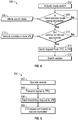
- the process may start at step 202, where an operator manually actuates the mode switch 146.
- the operator compartment sensor 148 is taken out of communication with the vehicle manager 134 (e.g., as indicated by dashed line 152 in Fig. 3 ).
- the travel request controller 144 can then evaluate the state of the mode switch 146 to check to determine if the mode switch 146 is in the manual mode position or the travel request mode position at step 204 to determine if the travel request mode is being requested, as illustrated by input block 206.
- the vehicle manager 134 can communicate the state of the mode switch 146 to the travel request controller 144.
- the travel request controller 144 determines that the mode switch 146 is not in the travel request mode position, then the travel request controller 144 takes no action and the process may return to the start. If the travel request controller 144 determined that the mode switch 146 is in the travel request mode position, the process proceeds to step 212.
- the travel request controller 144 then evaluates vehicle condition data received from the vehicle manager 134, as illustrated by input block 210.
- the vehicle condition data can include vehicle speed and/or vehicle steering angle, for example, as sensed by sensors included in the traction controller 138 and/or the steer control system 136, respectively.
- the travel request controller 144 evaluates the vehicle condition data to determine if the vehicle conditions are appropriate for switching from the manual mode to the travel request mode. For example, some vehicle conditions may not be considered an acceptable vehicle condition that would allow for transitioning between modes. According to one specific non-limiting example, the travel request controller 144 can evaluate the speed of the material handling vehicle 100.
- the travel request controller 144 may use the vehicle speed received from the vehicle manager 134 and compare the vehicle speed to a threshold value defined for a stopped vehicle (e.g., approximately 0 mph) to determine if the vehicle conditions are appropriate for switching modes.
- a threshold value can be zero mph. If the travel request controller 144 determines that the vehicle speed is greater than the threshold value, then the travel request controller 144 determines that the vehicle conditions are not appropriate for switching modes. Conversely, if the travel request controller 144 determines that the vehicle speed is at or less than the threshold value, then the travel request controller 144 determines that the vehicle conditions are appropriate for switching modes.
- the travel request controller 144 determines that the vehicle conditions are not appropriate for switching to the travel request mode, then the travel request controller 144 takes no action and the process may return to the start. If the travel request controller 144 determines that the vehicle conditions are appropriate for switching to the travel request mode, then the travel request controller 144 can send a signal to the vehicle manager 134 to request a transition from the manual mode to the travel request mode at step 214.
- the vehicle manager 134 can switch the material handling vehicle 100 into to the travel request mode at step 216.
- remote operation of the material handling vehicle 100 by the operator using the remote control device 122 is then enabled.
- signals from the remote control device 122 can be communicated to the travel request controller 144.
- the travel request controller 144 can then generate vehicle commands and then communicate those vehicle commands to the vehicle manager 134 for execution.
- the material handling vehicle 100 can be switched back to the manual mode from the travel request mode by the operator manually actuating the mode switch 146 from the travel request mode position to the manual mode position.
- the operator compartment sensor 148 is brought back into communication with the vehicle manager 134 (e.g., as indicated by line 150 in Fig. 3 ).
- the material handling vehicle can be switched back to the manual mode from the travel request mode by the vehicle manager 134, if the vehicle manager 134 detects vehicle conditions that result in switching back to the manual mode.
- a method 300 of remotely operating the material handling vehicle 100 using the remote control device 122 when the material handling vehicle 100 is in a travel request mode is illustrated.
- the example of an order picking operation will be described, where an operator of a material handling vehicle 100 may desire to move along an aisle within a warehouse from one picking location to the next picking location.
- an operator of a material handling vehicle 100 may desire to move along an aisle within a warehouse from one picking location to the next picking location.
- this is just one example of operation and is not intended to be limiting in any way.
- the method 300 may begin at step 302, where the operator can actuate one of the travel control function 124 or the I/O function 126 on the remote control device 122, thus generating a first signal or a second signal, respectively.
- the transmitter 128 may wirelessly communicate the first and/or second signal to the travel request controller 144 via the receiver 130 in communication with the transmitter 128.
- the travel request controller 144 may then send a request (e.g., a vehicle command) to the vehicle manager 134 based on the received signal at step 306. For example, if the operator actuates the travel control function 124 on the remote control device 122 (e.g., by depressing the first button 125 on the remote control device 122, see Fig.
- the travel request controller 144 can send a travel command to the vehicle manager 134 to instruct the material handling vehicle 100 to move, or otherwise travel forward.
- a travel command to the vehicle manager 134 to instruct the material handling vehicle 100 to move, or otherwise travel forward.
- an unpair command is sent to the travel request controller 144 to request that the material handling vehicle 100 be unpaired from the remote control device 122 and a stop command can be sent from the travel request controller 144 to the vehicle manager 134 to instruct the material handling vehicle 100 to come to a stop.
- the vehicle manager 134 can communicate to the traction controller 138 at step 308 to operate the power unit 142 to enable the material handling vehicle 100 to travel or stop (e.g., if a travel command or a stop command is received, respectively).
- the material handling vehicle 100 may be at a first picking location within an aisle of a warehouse and the operator may desire the material handling vehicle 100 to travel to a second picking location within that aisle.
- the travel command executed by the vehicle manager 134 can enable the material handling vehicle to travel forward from the first picking location to the second picking location.
- the travel request controller may monitor the sensor 145 to determine if the material handling vehicle 100 should steer or stop. In the case that the sensor 145 provides an indication that the material handling vehicle 100 should steer, the travel request controller 144 can send a steer command to the vehicle manager 134 to request a steering maneuver. In response to the received steering command, the vehicle manager 134 can communicate to the steer control system 136 to maneuver the material handling vehicle 100 (e.g., to steer the material handling vehicle 100 to travel alongside a rack structure).
- the travel request controller can send a stop command to the vehicle manager 134 to request that the material handling vehicle 100 come to a stop.
- the vehicle manager 134 can communicate to the traction controller 138 to stop the material handling vehicle 100 (e.g., to stop the material handling vehicle 100 if the sensor 145 detects an obstacle in a travel path of the material handling vehicle 100).
Landscapes
- Engineering & Computer Science (AREA)
- Structural Engineering (AREA)
- Transportation (AREA)
- Geology (AREA)
- Mechanical Engineering (AREA)
- Life Sciences & Earth Sciences (AREA)
- Civil Engineering (AREA)
- Radar, Positioning & Navigation (AREA)
- Physics & Mathematics (AREA)
- General Physics & Mathematics (AREA)
- Automation & Control Theory (AREA)
- Remote Sensing (AREA)
- Aviation & Aerospace Engineering (AREA)
- Control Of Position, Course, Altitude, Or Attitude Of Moving Bodies (AREA)
Applications Claiming Priority (1)
| Application Number | Priority Date | Filing Date | Title |
|---|---|---|---|
| US202062986293P | 2020-03-06 | 2020-03-06 |
Publications (1)
| Publication Number | Publication Date |
|---|---|
| EP3875421A1 true EP3875421A1 (fr) | 2021-09-08 |
Family
ID=74859366
Family Applications (1)
| Application Number | Title | Priority Date | Filing Date |
|---|---|---|---|
| EP21161068.8A Pending EP3875421A1 (fr) | 2020-03-06 | 2021-03-05 | Systèmes et procédés de commande d'un véhicule de manipulation de matériau pouvant être commandé à distance |
Country Status (6)
| Country | Link |
|---|---|
| US (2) | US11919760B2 (fr) |
| EP (1) | EP3875421A1 (fr) |
| CN (1) | CN113353848A (fr) |
| AU (1) | AU2021201426B2 (fr) |
| CA (1) | CA3111513A1 (fr) |
| MX (2) | MX2021002618A (fr) |
Families Citing this family (5)
| Publication number | Priority date | Publication date | Assignee | Title |
|---|---|---|---|---|
| US11827503B2 (en) | 2020-03-18 | 2023-11-28 | Crown Equipment Corporation | Adaptive acceleration for materials handling vehicle |
| WO2022098402A1 (fr) | 2020-11-03 | 2022-05-12 | Crown Equipment Corporation | Accélération adaptative pour véhicule de manipulation de matériaux |
| CN215642451U (zh) * | 2021-06-25 | 2022-01-25 | 浙江中力机械股份有限公司 | 手柄头及具有其的搬运车 |
| MX2023013171A (es) | 2022-11-08 | 2024-05-09 | Raymond Corp | Sistemas y metodos de transicion de modo de vehiculo de manejo de materiales. |
| CN119065401A (zh) * | 2024-11-06 | 2024-12-03 | 中国航空工业集团公司沈阳飞机设计研究所 | 一种飞行员生理失能触发飞机自主决策控制方法 |
Citations (4)
| Publication number | Priority date | Publication date | Assignee | Title |
|---|---|---|---|---|
| JP2010222108A (ja) * | 2009-03-24 | 2010-10-07 | Honda Motor Co Ltd | 作業用車輌 |
| WO2011002478A2 (fr) * | 2009-07-02 | 2011-01-06 | Crown Equipment Corporation | Appareil de télécommande d'un véhicule de manutention |
| CN107548209A (zh) * | 2016-06-24 | 2018-01-05 | 苏州聚元微电子股份有限公司 | 一种无线灯光控制系统的上电即对码方法 |
| WO2019181665A1 (fr) * | 2018-03-23 | 2019-09-26 | 株式会社豊田自動織機 | Système de commande à distance destiné à des véhicules industriels, véhicule industriel, dispositif de commande à distance, programme de commande à distance destiné à des véhicules industriels, et procédé de commande à distance destiné à des véhicules industriels |
Family Cites Families (22)
| Publication number | Priority date | Publication date | Assignee | Title |
|---|---|---|---|---|
| US5025614A (en) * | 1990-03-22 | 1991-06-25 | J. I. Case Company | Control system for a cotton harvester |
| DE19613386A1 (de) | 1996-04-03 | 1997-10-09 | Fiat Om Carrelli Elevatori | Flurförderzeug, das wahlweise manuell oder automatisch betreibbar ausgebildet ist |
| JP3775046B2 (ja) * | 1998-04-01 | 2006-05-17 | タカタ株式会社 | シートベルト装置及び車両 |
| US7740259B2 (en) * | 2006-02-03 | 2010-06-22 | Crown Equipment Corporation | Movable step for a materials handling vehicle |
| US9645968B2 (en) | 2006-09-14 | 2017-05-09 | Crown Equipment Corporation | Multiple zone sensing for materials handling vehicles |
| US8970363B2 (en) | 2006-09-14 | 2015-03-03 | Crown Equipment Corporation | Wrist/arm/hand mounted device for remotely controlling a materials handling vehicle |
| US8195366B2 (en) | 2007-09-13 | 2012-06-05 | The Raymond Corporation | Control system for a pallet truck |
| DE102008025632B4 (de) | 2008-05-26 | 2012-10-31 | Jungheinrich Aktiengesellschaft | System zur Fernbedienung eines Flurförderzeugs |
| US9522817B2 (en) | 2008-12-04 | 2016-12-20 | Crown Equipment Corporation | Sensor configuration for a materials handling vehicle |
| US9547945B2 (en) * | 2011-03-18 | 2017-01-17 | The Raymond Corporation | Integration of an autonomous industrial vehicle into an asset management system |
| AU2014277738B2 (en) * | 2013-12-19 | 2020-04-30 | The Raymond Corporation | Integrated touch screen display with multi-mode functionality |
| CN109328149A (zh) * | 2016-04-19 | 2019-02-12 | 马格特产品有限公司 | 节气门控制系统和方法 |
| JP6819490B2 (ja) * | 2017-02-02 | 2021-01-27 | 株式会社豊田自動織機 | 産業車両用遠隔操作システム、産業車両、遠隔操作装置、産業車両用遠隔操作プログラム及び産業車両用遠隔操作方法 |
| US20180364708A1 (en) * | 2017-06-16 | 2018-12-20 | GM Global Technology Operations LLC | Automated vehicle route traversal capability |
| FR3068344B1 (fr) | 2017-06-29 | 2019-08-23 | Compagnie Generale Des Etablissements Michelin | Systeme de commande d'un chariot elevateur a fourche autonome, et procede de pilotage d'un tel chariot. |
| CA3026399A1 (fr) * | 2017-12-05 | 2019-06-05 | The Raymond Corporation | Systemes et methodes destines a un vehicule deplacant du materiel ayant une structure modulaire |
| JP7011973B2 (ja) * | 2018-05-02 | 2022-01-27 | 本田技研工業株式会社 | 車両制御装置及びプログラム |
| AU2020202306B2 (en) | 2019-04-02 | 2025-05-15 | The Raymond Corporation | Systems and methods for an arbitration controller to arbitrate multiple automation requests on a material handling device |
| US12259724B2 (en) | 2019-08-27 | 2025-03-25 | Crown Equipment Corporation | Adaptive acceleration for materials handling vehicle |
| EP4103969B8 (fr) | 2020-02-12 | 2026-01-14 | Crown Equipment Corporation | Automatisation de commande d'un véhicule industriel |
| CA3163133C (fr) | 2020-02-21 | 2025-05-27 | Crown Equipment Corporation | Système d'aide au positionnement pour un véhicule de manutention de matériaux |
| US11827503B2 (en) | 2020-03-18 | 2023-11-28 | Crown Equipment Corporation | Adaptive acceleration for materials handling vehicle |
-
2021
- 2021-03-04 AU AU2021201426A patent/AU2021201426B2/en active Active
- 2021-03-05 EP EP21161068.8A patent/EP3875421A1/fr active Pending
- 2021-03-05 US US17/193,733 patent/US11919760B2/en active Active
- 2021-03-05 MX MX2021002618A patent/MX2021002618A/es unknown
- 2021-03-05 CA CA3111513A patent/CA3111513A1/fr active Pending
- 2021-03-05 MX MX2024005351A patent/MX2024005351A/es unknown
- 2021-03-08 CN CN202110251777.5A patent/CN113353848A/zh active Pending
-
2024
- 2024-03-04 US US18/594,636 patent/US12448265B2/en active Active
Patent Citations (4)
| Publication number | Priority date | Publication date | Assignee | Title |
|---|---|---|---|---|
| JP2010222108A (ja) * | 2009-03-24 | 2010-10-07 | Honda Motor Co Ltd | 作業用車輌 |
| WO2011002478A2 (fr) * | 2009-07-02 | 2011-01-06 | Crown Equipment Corporation | Appareil de télécommande d'un véhicule de manutention |
| CN107548209A (zh) * | 2016-06-24 | 2018-01-05 | 苏州聚元微电子股份有限公司 | 一种无线灯光控制系统的上电即对码方法 |
| WO2019181665A1 (fr) * | 2018-03-23 | 2019-09-26 | 株式会社豊田自動織機 | Système de commande à distance destiné à des véhicules industriels, véhicule industriel, dispositif de commande à distance, programme de commande à distance destiné à des véhicules industriels, et procédé de commande à distance destiné à des véhicules industriels |
Also Published As
| Publication number | Publication date |
|---|---|
| US20240199393A1 (en) | 2024-06-20 |
| AU2021201426B2 (en) | 2026-04-23 |
| AU2021201426A1 (en) | 2021-09-23 |
| US12448265B2 (en) | 2025-10-21 |
| US11919760B2 (en) | 2024-03-05 |
| MX2024005351A (es) | 2024-05-20 |
| CA3111513A1 (fr) | 2021-09-06 |
| US20210276843A1 (en) | 2021-09-09 |
| CN113353848A (zh) | 2021-09-07 |
| MX2021002618A (es) | 2022-07-11 |
Similar Documents
| Publication | Publication Date | Title |
|---|---|---|
| US12448265B2 (en) | Systems and methods for control of a remotely controllable material handling vehicle | |
| US12410045B2 (en) | Systems and methods for evaluation of vehicle parameters of a remotely controllable material handling vehicle | |
| KR101726209B1 (ko) | 물류 취급 차량을 원격으로 제어하기 위한 장치 | |
| JP5400442B2 (ja) | 作業用車輌 | |
| US8514055B2 (en) | Vehicle for cargo handling | |
| CN112141133B (zh) | 车辆控制装置 | |
| CN112140885B (zh) | 自动驾驶车辆的车速控制装置 | |
| JP4453683B2 (ja) | 遠隔操作装置 | |
| HK40061813A (en) | Systems and methods for control of a remotely controllable material handling vehicle | |
| HK40056930A (en) | Systems and methods for evaluation of vehicle parameters of a remotely controllable material handling vehicle | |
| KR102623421B1 (ko) | 물체감지센서를 통한 지게차 주행 제어 시스템 | |
| CN117389271A (zh) | 高空作业平台装卸控制方法和系统、控制器和存储介质 | |
| EP4369132B1 (fr) | Systèmes et procédés de transition de mode de véhicule de manipulation de matériau | |
| GB2102160A (en) | Control device for driverless guided vehicle | |
| HK40108748A (zh) | 物料搬运车辆模式转换系统和方法 | |
| US11492031B2 (en) | Motorized transpallet | |
| JPH07172799A (ja) | リーチ式フォークリフトのリーチ動作規制装置 | |
| KR20250093616A (ko) | 차량용 배터리 시스템과 배터리 충전기 연결에 대한 디스플레이 스크린 알림 | |
| JPH07205821A (ja) | 自走車 |
Legal Events
| Date | Code | Title | Description |
|---|---|---|---|
| PUAI | Public reference made under article 153(3) epc to a published international application that has entered the european phase |
Free format text: ORIGINAL CODE: 0009012 |
|
| STAA | Information on the status of an ep patent application or granted ep patent |
Free format text: STATUS: THE APPLICATION HAS BEEN PUBLISHED |
|
| AK | Designated contracting states |
Kind code of ref document: A1 Designated state(s): AL AT BE BG CH CY CZ DE DK EE ES FI FR GB GR HR HU IE IS IT LI LT LU LV MC MK MT NL NO PL PT RO RS SE SI SK SM TR |
|
| STAA | Information on the status of an ep patent application or granted ep patent |
Free format text: STATUS: REQUEST FOR EXAMINATION WAS MADE |
|
| 17P | Request for examination filed |
Effective date: 20220308 |
|
| RBV | Designated contracting states (corrected) |
Designated state(s): AL AT BE BG CH CY CZ DE DK EE ES FI FR GB GR HR HU IE IS IT LI LT LU LV MC MK MT NL NO PL PT RO RS SE SI SK SM TR |
|
| STAA | Information on the status of an ep patent application or granted ep patent |
Free format text: STATUS: EXAMINATION IS IN PROGRESS |
|
| 17Q | First examination report despatched |
Effective date: 20230323 |