EP3876182A1 - Vorrichtung zur bereitstellung von informationen und verfahren zur bereitstellung von informationen - Google Patents
Vorrichtung zur bereitstellung von informationen und verfahren zur bereitstellung von informationen Download PDFInfo
- Publication number
- EP3876182A1 EP3876182A1 EP19879492.7A EP19879492A EP3876182A1 EP 3876182 A1 EP3876182 A1 EP 3876182A1 EP 19879492 A EP19879492 A EP 19879492A EP 3876182 A1 EP3876182 A1 EP 3876182A1
- Authority
- EP
- European Patent Office
- Prior art keywords
- price
- information
- financial
- financial product
- financial products
- Prior art date
- Legal status (The legal status is an assumption and is not a legal conclusion. Google has not performed a legal analysis and makes no representation as to the accuracy of the status listed.)
- Withdrawn
Links
Images





Classifications
-
- G—PHYSICS
- G06—COMPUTING OR CALCULATING; COUNTING
- G06F—ELECTRIC DIGITAL DATA PROCESSING
- G06F17/00—Digital computing or data processing equipment or methods, specially adapted for specific functions
- G06F17/10—Complex mathematical operations
- G06F17/11—Complex mathematical operations for solving equations, e.g. nonlinear equations, general mathematical optimization problems
-
- G—PHYSICS
- G06—COMPUTING OR CALCULATING; COUNTING
- G06N—COMPUTING ARRANGEMENTS BASED ON SPECIFIC COMPUTATIONAL MODELS
- G06N10/00—Quantum computing, i.e. information processing based on quantum-mechanical phenomena
- G06N10/20—Models of quantum computing, e.g. quantum circuits or universal quantum computers
-
- G—PHYSICS
- G06—COMPUTING OR CALCULATING; COUNTING
- G06N—COMPUTING ARRANGEMENTS BASED ON SPECIFIC COMPUTATIONAL MODELS
- G06N10/00—Quantum computing, i.e. information processing based on quantum-mechanical phenomena
- G06N10/60—Quantum algorithms, e.g. based on quantum optimisation, quantum Fourier or Hadamard transforms
-
- G—PHYSICS
- G06—COMPUTING OR CALCULATING; COUNTING
- G06Q—INFORMATION AND COMMUNICATION TECHNOLOGY [ICT] SPECIALLY ADAPTED FOR ADMINISTRATIVE, COMMERCIAL, FINANCIAL, MANAGERIAL OR SUPERVISORY PURPOSES; SYSTEMS OR METHODS SPECIALLY ADAPTED FOR ADMINISTRATIVE, COMMERCIAL, FINANCIAL, MANAGERIAL OR SUPERVISORY PURPOSES, NOT OTHERWISE PROVIDED FOR
- G06Q30/00—Commerce
- G06Q30/02—Marketing; Price estimation or determination; Fundraising
- G06Q30/0201—Market modelling; Market analysis; Collecting market data
- G06Q30/0206—Price or cost determination based on market factors
-
- G—PHYSICS
- G06—COMPUTING OR CALCULATING; COUNTING
- G06Q—INFORMATION AND COMMUNICATION TECHNOLOGY [ICT] SPECIALLY ADAPTED FOR ADMINISTRATIVE, COMMERCIAL, FINANCIAL, MANAGERIAL OR SUPERVISORY PURPOSES; SYSTEMS OR METHODS SPECIALLY ADAPTED FOR ADMINISTRATIVE, COMMERCIAL, FINANCIAL, MANAGERIAL OR SUPERVISORY PURPOSES, NOT OTHERWISE PROVIDED FOR
- G06Q40/00—Finance; Insurance; Tax strategies; Processing of corporate or income taxes
- G06Q40/04—Trading; Exchange, e.g. stocks, commodities, derivatives or currency exchange
-
- G—PHYSICS
- G06—COMPUTING OR CALCULATING; COUNTING
- G06Q—INFORMATION AND COMMUNICATION TECHNOLOGY [ICT] SPECIALLY ADAPTED FOR ADMINISTRATIVE, COMMERCIAL, FINANCIAL, MANAGERIAL OR SUPERVISORY PURPOSES; SYSTEMS OR METHODS SPECIALLY ADAPTED FOR ADMINISTRATIVE, COMMERCIAL, FINANCIAL, MANAGERIAL OR SUPERVISORY PURPOSES, NOT OTHERWISE PROVIDED FOR
- G06Q40/00—Finance; Insurance; Tax strategies; Processing of corporate or income taxes
- G06Q40/06—Asset management; Financial planning or analysis
-
- B—PERFORMING OPERATIONS; TRANSPORTING
- B82—NANOTECHNOLOGY
- B82Y—SPECIFIC USES OR APPLICATIONS OF NANOSTRUCTURES; MEASUREMENT OR ANALYSIS OF NANOSTRUCTURES; MANUFACTURE OR TREATMENT OF NANOSTRUCTURES
- B82Y10/00—Nanotechnology for information processing, storage or transmission, e.g. quantum computing or single electron logic
Definitions
- the present invention relates to an information providing device and an information providing method and more specifically to a technique for estimating information on financial products efficiently and with favorable accuracy.
- an object of the present invention is to provide a technique for estimating information on financial products efficiently with favorable accuracy.
- an information providing device of this disclosure comprises a storage unit that stores price information on various financial products, and a calculation unit that performs calculation on an Ising model in which a price increase-decrease event of each financial product on an estimated price determined based on an actual price of the financial product indicated in the price information and a sensitivity of the financial product to another financial product is set as a spin, and in which sensitivities between prices of the financial products are set as the strengths of interactions between the spins, wherein the calculation unit outputs, to a specified device, information on a future price of at least one financial product of the financial products based on a result of the calculation.
- An information providing method of this disclosure comprises performing, in an information processing device including a storage unit that stores price information on various financial products, calculation on an Ising model in which a price increase-decrease event of each financial product on an estimated price determined based on an actual price of the financial product indicated in the price information and a sensitivity of the financial product to another financial product is set as a spin, and in which sensitivities between prices of the financial products are set as the strengths of interactions between the spins; and outputting, from the information processing device to a specified device, information on a future price of at least one financial product of the financial products based on a result of the calculation.
- the present invention makes it possible to estimate information on financial products efficiently with favorable accuracy.
- the applicant has developed quantum computing technologies to aim to solve various problems related to, for example, exhaustive search problems based on big data (including concepts of combinatorial optimization problems).
- Quantum computers are based on basic elements called qubits which express "0" and "1" simultaneously. Thus, all the solution candidates can be simultaneously calculated as initial values, and there is a possibility that quantum computers can perform exhaustive search. However, quantum computers need to maintain quantum coherence over the entire calculation time.
- H ⁇ p is a Hamiltonian of a physical system into which a problem is set.
- the Hamiltonian is not H ⁇ p but another Hamiltonian H ⁇ 0 the ground state of which is clear and easy to prepare.
- the Hamiltonian is shifted from H ⁇ 0 to H ⁇ p while taking a sufficient time. By taking a sufficient time, the system keeps remaining in the ground state, and it is possible to obtain the ground state of the Hamiltonian H ⁇ p.
- ⁇ is the computation time
- Adiabatic quantum computation is applicable to problems that require exhaustive search, and the solution can be reached in a one-way process. However, if the calculation process needs to follow the Schrodinger equation of Equation (2), the quantum coherence needs to be maintained as in the case of quantum computers.
- the quantum computer repeats gate operations for 1 qubit or between 2 qubits, while adiabatic quantum computation makes the entire qubit system interact simultaneously.
- the ideas for coherence are different.
- adiabatic quantum computation is effective for difficult problems such as ones that require exhaustive search.
- spins are used as variables in calculation, and a problem to be solved is set as interactions between spins and a local field acting on each spin.
- Each spin is time-evolved based on the assumption that the orientation of the spin is determined according to the effective magnetic field determined by the external magnetic field at each site and the interactions between the spins at time t.
- each spin is not completely aligned with the effective magnetic field, but each spin is oriented in a quantum-mechanically corrected direction so that the system can approximately maintain the ground state.
- the information providing device in the present embodiment is assumed to be an annealing machine that performs the aforementioned adiabatic quantum computation. However, it is, of course, not limited to only this configuration, but the present invention is applicable to any device capable of appropriately solving combinatorial optimization problems according to the information providing method of the present invention.
- applicable configurations include not only hardware including electronic circuits (digital circuits or the like) implemented according to an annealing method but also methods including superconducting circuits or the like.
- hardware that supports an Ising model in a method other than annealing methods is possible.
- the examples include laser network methods (optical parametric oscillation) and quantum neural networks.
- the present invention can be implemented also by using quantum gate methods in which the calculation performed with an Ising model is replaced with gates such as Hadamard gates, rotation gates, and control-not gates, although part of the idea is different as described earlier.
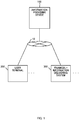
- Fig. 1 is a network configuration diagram including an information providing device 100 of the present embodiment.
- the information providing device 100 illustrated in Fig. 1 is a computer device that estimates information on financial products efficiently and with favorable accuracy, which is specifically assumed to be an annealing machine as an example. Since an overview of an annealing machine has been mentioned based on PTL 1, detailed descriptions of the concrete configuration, operations, and the like of the information providing device 100 will be omitted as appropriate (the same applies to the following descriptions).
- the information providing device 100 of the present embodiment is coupled to a user terminal 200 and a financial-information providing-distributing system 300 via an appropriate network 10 such as the Internet so that they can communicate data with one another.
- the user terminal 200 is a terminal that receives information on financial products provided from the information providing device 100.
- the users of this user terminal 200 can be assumed to be, specifically, people in charge of institutional investors, such as financial institutions and insurance companies, as well as general individual investors or the like.
- the information on financial products provided by the information providing device 100 is assumed to be information indicating whether there is a difference between the price of a specified financial product fixed at the present time and an estimated price of the product expected at a specified time in the future and information on the degree of the difference. If there is a difference between these prices, the larger the difference, the greater the significance of the opportunity for what is called "arbitration in stock". Thus, the aforementioned users who receive such information can recognize preferable investment opportunities with appropriate accuracy.
- the financial-information delivering system 300 is a system that delivers price information on various financial products to the information providing device 100.
- This financial-information delivering system 300 can be assumed to be a server device operated by organizations having price information on financial products, such as various financial institutions, securities companies, and government agencies.
- Examples of the aforementioned various financial products can be assumed to include stocks, products in future markets, foreign exchange.
- Examples of the price information can be assumed to include stock indexes, product future prices, foreign exchange rates, foreign exchange forward rates, long/short open position ratios, the volatilities of various indicators, and risk reversals.
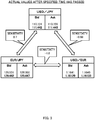
- FIGs. 2 and 3 illustrate a situation in which the rates of a currency pair at a certain time point (when they are in balance in a market) change according to the sensitivities between currency pairs after a specified time passes.
- the information providing device 100 detects the aforementioned difference in the prices of financial products, evaluates the imbalanced state (takes it that the larger the difference, the more imbalanced), and delivers the information to the user terminal 200.
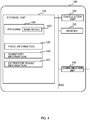
- the information providing device 100 includes a storage unit 101 including an appropriate nonvolatile storage device such as a solid state drive (SSD) or a hard disk drive, memory 103 including a volatile storage device such as RAM, a calculation unit 104 such as a CPU that, for example, reads a program 102 stored in the storage unit 101 into the memory 103 and executes it to perform overall control of the device itself as well as various determinations, calculations, and control processes, and a communication unit 105 that is coupled with the network 10 and performs communication processes with other devices.
- SSD solid state drive
- RAM volatile storage device
- calculation unit 104 such as a CPU that, for example, reads a program 102 stored in the storage unit 101 into the memory 103 and executes it to perform overall control of the device itself as well as various determinations, calculations, and control processes
- a communication unit 105 that is coupled with the network 10 and performs communication processes with other devices.
- the information providing device 100 is a stand-alone machine, it is preferable that the information providing device 100 further include an input unit for receiving key input or voice input from the user and an output device such as a display for displaying processing data.
- the storage unit 101 stores, in addition to the program 102 for implementing the functions necessary as the information providing device of the present embodiment, at least price information 125 on financial products and sensitivity information 126. Details of these pieces of information will be described later.
- the program 102 specifically, the algorithm for implementing the operation of the annealing machine, holds information on an Ising model 1021 which is a problem to be solved.
- This Ising model 1021 is set in advance by the administrator or the like based on various kinds of information on target financial products about which information is provided and other financial products that affect the target financial products.
- adiabatic quantum computation described in the overview of the annealing machine is also called quantum annealing, in which the classical annealing concept is applied to quantum mechanics.
- adiabatic quantum computation can be interpreted as a computation method that is originally capable of classical operation and to which quantum-mechanical effects are added to improve the performance in terms of high-speed operation and the correct rate of solutions.
- the present invention provides a calculation method and calculation device that are classical but include quantum-mechanical effects by using a calculation unit that itself is classical but introducing parameters determined quantum-mechanically in the calculation process.
- the following example illustrates a classical algorithm for obtaining the ground state as a solution and a device that implements the algorithm, while explaining the relationship with adiabatic quantum computation.
- the aforementioned variables S j z are made closer to -1 or 1.
- the coefficient g pinb is, for example, a value between 50% and 200% of the average value of
- a correction term ⁇ g j ' may be added to g j ' only for a site j' to increase the multitude of g j ' only for the site j'.
- the correction term ⁇ g j ' is, for example, a value between 10% and 100% of the average value of
- Equation (3) is an Ising spin system.
- the Ising spins in Equation (3) do not have to be spins literally but may be physically anything as long as the Hamiltonian is described by Equation (3).
- the increase and decrease in a financial product price may be associated with ⁇ 1
- the high and low of a logic circuit may be associated with ⁇ 1.
- the vertically polarized waves and horizontally polarized waves of light may be associated with ⁇ 1, or the phases of 0 and ⁇ may be associated with ⁇ 1.
- ⁇ is a constant of proportionality determined according to the strength of the external field acting uniformly on all the sites j
- ⁇ j x is the x component of the Pauli spin matrix.
- the external field means a magnetic field.
- Equation (4) corresponds to application of a transverse magnetic field, and all the spins are oriented in the x direction ( ⁇ > 0) in the ground state.
- Equation (4) includes the x component of the spin.
- the spin in the course of calculation is not of an Ising type but a vector type (Bloch vector).
- H ⁇ ⁇ B ⁇ ⁇ ⁇
- ⁇ expresses the three components of the Pauli spin matrix shown as a vector.
- Equation (4) the Hamiltonian is given by Equation (4).
- the z component is affected by the interactions between spins, and thus the effective magnetic field is expressed as Equation (6).
- the orientation of the spin can be defined as ⁇ z >/ ⁇ X >, and thus, if the orientation of the spin follows the effective magnetic field, the orientation of the spin is determined by Equation (7).
- Equation (7) is quantum-mechanically expressed, it includes expectation values.
- Equation (7) is a relational expression handling classical quantities unlike Equations (1) to (6).
- Equation (7) determines the behavior of a classical spin system. Since a quantum system has nonlocal correlation, Equation (7) will be modified, and this will be described later.
- the classical system determined by Equation (7) will be described to explain the basic configuration of the invention.
- the time t As the time t passes, a magnetic field in the Z-axis direction and the interactions between spins are gradually applied to the spins.
- the time t should ideally be continuous, but in an actual calculation process, the time t may be discrete to improve convenience. In the following description, the time t is discrete.
- the spins illustrated here as an example have not only z components but also x components; hence, they are vector spins. It is understood also from Fig. 5 that the spins have behavior as vectors.
- the spins in the calculation system are assumed to be tree-dimensional vectors having a magnitude of 1 (which are called Bloch vectors, and the state of the vector can be described by a point on a spherical surface).
- Bloch vectors tree-dimensional vectors having a magnitude of 1
- the state of the vector can be described by a point on a spherical surface.
- the axis setting in the example illustrated in Fig. 5 only two dimensions have to be considered (the state can be described by a point on a circle).
- the two-dimensional spin vector can be described by only a semicircle, and thus, if Sj z is specified with [-1,1], the two-dimensional spin vectors are determined by one variable S j z .
- the spin is a two-dimensional vector, the spin can be expressed as a one-dimensional continuous variable having a value range of [-1,1].
- Equation (8) is a classical quantity expression into which Equation (7) is rewritten, Equation (8) does not have symbols of ⁇ •>.
- Equation (9) the variable of B j x (t k ) is only t k , and ⁇ and ⁇ are constants.
- Fig. 6 illustrates a flowchart into which the aforementioned algorithm is organized.
- t m ⁇ .
- Equation (3) description has been made of how to solve the problem expressed as Equation (3).
- the Ising model 1021 is assumed to be a problem of estimating the prices of currency pairs among financial product.
- the local fields g j are the actual prices and estimated prices of financial products (examples: foreign exchange rates, foreign exchange forward rates, stock indexes, product future prices, long/short open position ratios, the volatilities of various indicators, risk reversals, and the like).
- the estimated price means a price determined based on the start point of the prices fixed at the present time (actual prices) and the sensitivity of a target currency pair to other financial products.
- ⁇ j z is considered to be a variable to make the price increase/decrease in a specified currency pair reflect the price increases/decreases in other financial products (which may include not only stock indexes or the like but also the concept of other currency pairs).
- the strength of the correlation between the rate of a currency pair and the price of another financial product, in other words, the sensitivity is expressed through the interactions between variables Jij.
- the sensitivity explained in the present invention is not only the strength of the correlation (which can be referred to as the degree of influence) between foreign exchanges and stocks.
- the interactions between variables J ij are concretely set, and the ground state of the Ising model 1021 expressed as Equation (3) is searched for, in other words, the ground state in which the aforementioned differences between the actual prices and the estimated prices smallest is searched for, to identify the balance point to which the rate change in each currency pair converges.
- the rate in this ground state is the estimated price estimated for the currency pair for a specified time in the future.
- Fig. 7 shows an example of price information 125 in the present embodiment.
- the price information 125 in the present embodiment is a table in which price information on various financial products is accumulated. This price information includes actual prices which are actual market prices delivered from the financial-information delivering system 300.
- the price information 125 may include estimated prices that the information providing device 100, as an annealing machine, estimated for a specified time in the future.
- the data structure of the price information 125 is composed of a group of records, each record including the name of a financial product, for example, USD/JPY, USD/EUR, NY Dow, or TOPIX, as a key, and data such as date and time of interest, and the actual price and estimated price and at the date and time of interest.
- a financial product for example, USD/JPY, USD/EUR, NY Dow, or TOPIX
- Fig. 8 shows an example of sensitivity information 126 in the present embodiment.
- the sensitivity information 126 in the present embodiment is a table in which information on the sensitivity of the price between financial products is accumulated. This information of the sensitivity is determined, for example, by performing correlation analysis on the price changes (the directions and degrees) in a specified period shown in the price information 125 in terms of the relationship between financial products.
- the data structure of the sensitivity information 126 is composed of a group of records, each record including a set of financial products of interest the sensitivity of which are to be considered, such as USD/JPY and EUR/JPY, USD/JPY and NY Dow, and USD/JPY and TOPIX, which are used as a key, and data such as the sensitivity obtained for the pair.
- Fig. 9 is a diagram illustrating a procedure example 1 of the information providing method in the present embodiment.
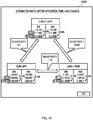
- Examples of financial products to be treated here are assumed to be three currency pairs which are shown in Fig. 10 .
- three currency pairs are described as examples to simplify the explanation, the financial products to be treated may include a greater number of currency pairs and other financial products in the actual case.
- the sensitivity between the rate of USD/JPY and the rate of EUR/JPY is 0.7.
- the rate of USD/JPY increases by 1%, the rate of EUR/JPY, responding to this change, tends to increase by 0.7%.
- This difference can be an investment opportunity. If a buy or sell order is placed for the currency pair in the direction (of the increase/decrease of the rate) in which the difference decreases, a trading profit can probably be obtained with a high probability.
- the information providing device 100 of the present embodiment detects information on such differences (price differences) and provides it to the user terminal 200.
- the information providing device 100 holds, as an Ising model 1021 to be processed, information on a model in which the aforementioned increase-decrease event in the rate of each currency pair is set as a spin, and the sensitivity of the rate between currency pairs is set as the strength of the interactions between the spins.
- information on the rates of currency pairs can be obtained from the price information 125.
- Information on the sensitivities can be obtained from the sensitivity information 126.
- the sensitivity "0.7” is set to the strength of the interaction between the spins of the currency pairs.
- the sensitivity "-1.8” is set to the strength of the interaction between the spins of the currency pairs.
- the sensitivity "-0.68" is set to the strength of the interaction between the spins of the currency pairs.
- the spin can express only the direction of increase or decrease in the rate.
- the set of spins can express the direction of increase or decrease in the rate as well as the degree of the increase or decrease.
- the directions (+ direction/ - direction) and multitudes of the vectors of the set of spins correspond to the directions of increase or decrease in the rates and the degrees of the increase or decrease.
- the information providing device 100 sets the Ising model 1021, in which the setting for the aforementioned three currency pairs has been made, as a problem and calculates the ground state in which the differences are smallest between the present rate (actual prices of each of the three currency pairs indicated in the price information 125 and the estimated rate (estimated price) determined based on the sensitivity of each of the three currency pairs to other financial products (s10).
- the search method itself for the ground state is the same as or similar to the process in existing techniques.
- the information providing device 100 calculates the degree of the difference between the actual rate and the estimated rate for each of the three currency pairs in the ground state obtained at s10 (s11).
- the estimated rate is divided by the present rate, in other words, the actual rate to calculate the change rate.
- the change rate of EUR/JPY is -0.1% for "Bid” and -0.1% for "Ask”
- the change rate of USD/EUR is +0.18% for "Bid” and +0.24% for "Ask” from the calculation.
- the information providing device 100 sorts information pieces on the currency pairs and the trade types according to the size of the difference (s12).
- a configuration may be possible in which the currency pair having the largest difference degree and the type of the trade are determined.
- the information providing device 100 transmits, to the user terminal 200, at least one of information pieces each including a currency pair detected at s12, the type of the trade, and the degree of the difference (s13) and then ends the process.
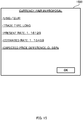
- the user terminal 200 receiving such information provided, displays an information display screen 1100 as illustrated in Fig. 11 on an output unit such as a display.
- this information display screen 1100 shows not only the currency pair and the type of the trade but also information on the present rate, estimated rate, and expected price difference (the degree of difference) of the currency pair.
- the operator of the user terminal 200 views this information display screen 1100 and recognizes that a preferable investment opportunity has come and the operator will place a buy or sell order for this currency pair in the direction in which the difference decreases (the direction of the increase/decrease in the rate).
- the information providing device 100 executes a process of estimating the rate of one of the currency pairs in the set affected by a rate change in the other currency pair, for each of the series of currency pairs serially linked via sensitivities.
- the information providing device 100 also performs calculation between EUR/JPY and USD/EUR in the same way.
- the information providing device 100 performs ground-state search on a specified Ising model 1021 to find what is the optimum order to perform the rate estimation among various currency pairs.
- the Ising model 1021 in this case is assumed to be a model in which the increase-decrease event of the rate in each currency pair of a set of currency pairs such as USD/JPY and EUR/JPY is set to be a spin, and in which the sensitivity between the currency pairs included in the set is set to the strength of the interaction between the spins.
- the information providing device 100 calculates the ground state of the Ising model 1021 in which, in each set of currency pairs, the difference is smallest between the actual rate of one currency pair in the aforementioned set indicated in the price information 125 and the estimated price determined based on the sensitivity of the one currency pair to the other currency pair (s20).
- the information providing device 100 performs optimum route search by searching for the ground state in which (the total of) each difference is smallest between the estimated rate obtained on each set of currency pairs having a sensitivity and the actual rate.
- the information providing device 100 outputs, for the aforementioned one currency pair, information on the difference between the actual rate and the estimated rate in the ground state obtained at s20 (the screen 1500 in Fig. 15 ) to the user terminal 200 (s21) and ends the process.
- the aforementioned processing method is an example.
- the aforementioned traveling salesman problem may be solved by obtaining the results for the case where estimated rates are calculated between a series of currency pairs in various routes (actual investment results based on the difference information), determining based on the results whether each route is good or bad, determining rules such as a rule that routes in which the total value of the sensitivities is large provide high information accuracy, for example, and solving the problem based on rules obtained.
- the present embodiment described above makes it possible to estimate information on financial products efficiently with favorable accuracy.
- the calculation unit may execute the calculation on, as the Ising model, a model that includes a plurality of the spins and in which the sensitivities between the prices of the financial products are set as the strengths of the interactions between the spins, and the calculation unit may output, to a specified device, information on the degree of the difference between the actual price and the estimated price of at least one financial product of the financial products.
- This configuration makes it possible to estimate not only the price increase-decrease direction estimated with one spin but also the degree of the price increase/decrease (the difference between the actual price and the price in the ground state). This in turn makes it possible to estimate information on financial products efficiently with more favorable accuracy.
- the calculation unit may perform calculation on, as the Ising model, an Ising model in which the price increase-decrease event of a financial product included in a set of financial products of the financial products is set as a spin and in which the sensitivity between the prices of the financial products in the set is set as the strength of the interaction between the spins, and the calculation unit may output, to a specified device, information on the difference between the actual price of one financial product in the set and the estimated price of the financial product determined based on the sensitivity of the one financial product to the other financial product.
- This configuration makes it possible to support, as appropriate, the situation in which an Ising model is used for what is called the traveling salesman problem and in turns makes it possible to estimate information on financial products efficiently and with further favorable accuracy.
- the information providing device of the present embodiment may be a CMOS annealing machine that solves a combinatorial optimization problem on the Ising model.
- CMOS complementary metal oxide semiconductors
- the information processing device may execute the calculation on, as the Ising model, a model which is the Ising model that includes a plurality of the spins and in which the sensitivities between the prices of the financial products are set as the strengths of the interactions between the spins, and the information processing device may output, to a specified device, information on the degree of the difference between the actual price and the estimated price of at least one financial product of the financial products.
- the information processing device may perform calculation on, as the Ising model, an Ising model in which the price increase-decrease event of a financial product included in a set of financial products of the financial products is set as a spin and in which the sensitivity between the prices of the financial products in the set is set as the strength of the interaction between the spins, and the information processing device may output, to a specified device, information on the difference between the actual price of one financial product in the set and the estimated price of the financial product determined based on the sensitivity of the one financial product to the other financial product.
- the information processing device may be an annealing machine that solves a combinatorial optimization problem on the Ising model.
Landscapes
- Engineering & Computer Science (AREA)
- Physics & Mathematics (AREA)
- Business, Economics & Management (AREA)
- General Physics & Mathematics (AREA)
- Theoretical Computer Science (AREA)
- Finance (AREA)
- Accounting & Taxation (AREA)
- Development Economics (AREA)
- Strategic Management (AREA)
- Data Mining & Analysis (AREA)
- Mathematical Physics (AREA)
- Mathematical Analysis (AREA)
- Pure & Applied Mathematics (AREA)
- Mathematical Optimization (AREA)
- Computational Mathematics (AREA)
- General Engineering & Computer Science (AREA)
- Marketing (AREA)
- Software Systems (AREA)
- Economics (AREA)
- General Business, Economics & Management (AREA)
- Entrepreneurship & Innovation (AREA)
- Condensed Matter Physics & Semiconductors (AREA)
- Artificial Intelligence (AREA)
- Evolutionary Computation (AREA)
- Computing Systems (AREA)
- Game Theory and Decision Science (AREA)
- Technology Law (AREA)
- Operations Research (AREA)
- Algebra (AREA)
- Databases & Information Systems (AREA)
- Human Resources & Organizations (AREA)
- Financial Or Insurance-Related Operations Such As Payment And Settlement (AREA)
- Management, Administration, Business Operations System, And Electronic Commerce (AREA)
Applications Claiming Priority (2)
| Application Number | Priority Date | Filing Date | Title |
|---|---|---|---|
| JP2018205045A JP7109337B2 (ja) | 2018-10-31 | 2018-10-31 | 情報提供装置および情報提供方法 |
| PCT/JP2019/041985 WO2020090674A1 (ja) | 2018-10-31 | 2019-10-25 | 情報提供装置および情報提供方法 |
Publications (2)
| Publication Number | Publication Date |
|---|---|
| EP3876182A1 true EP3876182A1 (de) | 2021-09-08 |
| EP3876182A4 EP3876182A4 (de) | 2022-05-18 |
Family
ID=70463690
Family Applications (1)
| Application Number | Title | Priority Date | Filing Date |
|---|---|---|---|
| EP19879492.7A Withdrawn EP3876182A4 (de) | 2018-10-31 | 2019-10-25 | Vorrichtung zur bereitstellung von informationen und verfahren zur bereitstellung von informationen |
Country Status (6)
| Country | Link |
|---|---|
| US (1) | US20210398156A1 (de) |
| EP (1) | EP3876182A4 (de) |
| JP (1) | JP7109337B2 (de) |
| CN (1) | CN112955922A (de) |
| SG (1) | SG11202104370UA (de) |
| WO (1) | WO2020090674A1 (de) |
Families Citing this family (5)
| Publication number | Priority date | Publication date | Assignee | Title |
|---|---|---|---|---|
| EP4158553A4 (de) * | 2020-05-29 | 2024-07-17 | Technologies Infinityq Inc. | Quantenanalogberechnung bei raumtemperatur unter verwendung konventioneller elektronischer schaltungen |
| JP7466147B2 (ja) * | 2020-06-23 | 2024-04-12 | 株式会社日立製作所 | 情報処理システムおよび情報処理方法 |
| JP2022012463A (ja) * | 2020-07-01 | 2022-01-17 | 株式会社日立製作所 | 裁定取引支援装置、裁定取引支援方法、及び裁定取引支援システム |
| JP2022105457A (ja) * | 2021-01-04 | 2022-07-14 | 三菱重工業株式会社 | 燃料評価システム及び燃料評価方法 |
| JP7005806B1 (ja) * | 2021-05-11 | 2022-01-24 | みずほリサーチ&テクノロジーズ株式会社 | 価格評価システム及び価格評価方法 |
Family Cites Families (11)
| Publication number | Priority date | Publication date | Assignee | Title |
|---|---|---|---|---|
| US20030135448A1 (en) * | 2002-01-10 | 2003-07-17 | Scott Aguias | System and methods for valuing and managing the risk of credit instrument portfolios |
| JP2003331128A (ja) * | 2002-05-15 | 2003-11-21 | Toshiba Corp | 派生証券の評価システムおよび派生証券の価格評価方法 |
| AU2006314882A1 (en) * | 2005-11-21 | 2007-05-24 | Saxo Bank A/S | A financial trading system |
| US20160209532A1 (en) * | 2014-11-17 | 2016-07-21 | Board Of Regents, The University Of Texas System | Applied interpolation techniques |
| WO2016157333A1 (ja) | 2015-03-27 | 2016-10-06 | 株式会社日立製作所 | 計算機、及び演算プログラム |
| EP4036708A1 (de) * | 2016-03-11 | 2022-08-03 | 1QB Information Technologies Inc. | Verfahren und systeme für quantenberechnung |
| US20220084120A1 (en) * | 2016-05-24 | 2022-03-17 | Wells Fargo Bank, N.A. | Trading platform for non-monetary digital assets |
| US9870273B2 (en) * | 2016-06-13 | 2018-01-16 | 1Qb Information Technologies Inc. | Methods and systems for quantum ready and quantum enabled computations |
| US20180218449A1 (en) * | 2017-01-31 | 2018-08-02 | Par Holmberg | Bundles for an efficient auction design |
| JP6892599B2 (ja) * | 2017-07-05 | 2021-06-23 | 富士通株式会社 | 最適化装置及び最適化装置の制御方法 |
| US20190122140A1 (en) * | 2017-10-20 | 2019-04-25 | STATGRAF Research LLP. | Data analysis and rendering |
-
2018
- 2018-10-31 JP JP2018205045A patent/JP7109337B2/ja active Active
-
2019
- 2019-10-25 SG SG11202104370UA patent/SG11202104370UA/en unknown
- 2019-10-25 EP EP19879492.7A patent/EP3876182A4/de not_active Withdrawn
- 2019-10-25 WO PCT/JP2019/041985 patent/WO2020090674A1/ja not_active Ceased
- 2019-10-25 US US17/289,473 patent/US20210398156A1/en not_active Abandoned
- 2019-10-25 CN CN201980071593.1A patent/CN112955922A/zh not_active Withdrawn
Also Published As
| Publication number | Publication date |
|---|---|
| SG11202104370UA (en) | 2021-05-28 |
| JP2020071657A (ja) | 2020-05-07 |
| EP3876182A4 (de) | 2022-05-18 |
| US20210398156A1 (en) | 2021-12-23 |
| JP7109337B2 (ja) | 2022-07-29 |
| WO2020090674A1 (ja) | 2020-05-07 |
| CN112955922A (zh) | 2021-06-11 |
Similar Documents
| Publication | Publication Date | Title |
|---|---|---|
| EP3876182A1 (de) | Vorrichtung zur bereitstellung von informationen und verfahren zur bereitstellung von informationen | |
| Puebla et al. | Kibble-Zurek scaling in quantum speed limits for shortcuts to adiabaticity | |
| US11868967B2 (en) | Schedule creation assisting device and schedule creation assisting method | |
| McClean et al. | Clock quantum Monte Carlo technique: An imaginary-time method for real-time quantum dynamics | |
| Guo et al. | Tight mutual information estimation with contrastive fenchel-legendre optimization | |
| Ohzeki | Quantum Monte Carlo simulation of a particular class of non-stoquastic Hamiltonians in quantum annealing | |
| Roy et al. | Forecasting bitcoin prices using deep learning for consumer-centric industrial applications | |
| Gillariose et al. | Lasso and Ridge regression: a comprehensive review of applications and developments in machine learning | |
| Coqueret | Forking paths in empirical studies | |
| Kumar et al. | Cryptocurrency price prediction using LSTM and recurrent neural networks | |
| Ledinauskas et al. | Universal performance gap of neural quantum states applied to the Hofstadter-Bose-Hubbard model | |
| Tóth et al. | Learning to forget: Bayesian time series forecasting using recurrent sparse spectrum signature gaussian processes | |
| Grass | Quantum annealing sampling with a bias field | |
| Dey et al. | Disordered Monomer-Dimer Model on Cylinder Graphs: PS Dey, K. Krishnan | |
| Chheda et al. | Automated Data Driven Preprocessing and Training of Classification Models | |
| Gómez-Lurbe | Efficient protocol to estimate the quantum Fisher information matrix for commuting-block circuits | |
| EP4113419B1 (de) | Vorrichtung zur unterstützung der erstellung von portfolios, verfahren zur unterstützung der erstellung von portfolios und system zur unterstützung der erstellung von portfolios | |
| US11669898B2 (en) | System for estimating distance-to-default credit risk | |
| Cantori et al. | Adaptive-basis sample-based neural diagonalization for quantum many-body systems | |
| EP3975101A1 (de) | Vorrichtung und verfahren zur unterstützung bei der erstellung von portfolios | |
| US20230259853A1 (en) | Quantum Rating Framework | |
| WO2022201580A1 (ja) | 要員策定支援装置及び要員策定支援方法 | |
| Saha et al. | Design and Development of Cryptocurrency Price Prediction (CPP) Using ARIMA-LSTM | |
| US12223544B1 (en) | Systems and methods for valuing an interest rate swap transaction | |
| Yang | A Deep Learning Method for Predicting Mergers and Acquisitions: Temporal Dynamic Industry Networks |
Legal Events
| Date | Code | Title | Description |
|---|---|---|---|
| STAA | Information on the status of an ep patent application or granted ep patent |
Free format text: STATUS: THE INTERNATIONAL PUBLICATION HAS BEEN MADE |
|
| PUAI | Public reference made under article 153(3) epc to a published international application that has entered the european phase |
Free format text: ORIGINAL CODE: 0009012 |
|
| STAA | Information on the status of an ep patent application or granted ep patent |
Free format text: STATUS: REQUEST FOR EXAMINATION WAS MADE |
|
| 17P | Request for examination filed |
Effective date: 20210531 |
|
| AK | Designated contracting states |
Kind code of ref document: A1 Designated state(s): AL AT BE BG CH CY CZ DE DK EE ES FI FR GB GR HR HU IE IS IT LI LT LU LV MC MK MT NL NO PL PT RO RS SE SI SK SM TR |
|
| DAV | Request for validation of the european patent (deleted) | ||
| DAX | Request for extension of the european patent (deleted) | ||
| REG | Reference to a national code |
Ref country code: DE Ref legal event code: R079 Free format text: PREVIOUS MAIN CLASS: G06Q0040060000 Ipc: G06Q0040040000 |
|
| A4 | Supplementary search report drawn up and despatched |
Effective date: 20220420 |
|
| RIC1 | Information provided on ipc code assigned before grant |
Ipc: G06N 10/60 20220101ALI20220412BHEP Ipc: G06Q 30/02 20120101ALI20220412BHEP Ipc: G06Q 40/06 20120101ALI20220412BHEP Ipc: G06Q 40/04 20120101AFI20220412BHEP |
|
| STAA | Information on the status of an ep patent application or granted ep patent |
Free format text: STATUS: THE APPLICATION HAS BEEN WITHDRAWN |
|
| 18W | Application withdrawn |
Effective date: 20241106 |