EP3876205B1 - Bilderzeugungssystem und -verfahren - Google Patents
Bilderzeugungssystem und -verfahren Download PDFInfo
- Publication number
- EP3876205B1 EP3876205B1 EP21155193.2A EP21155193A EP3876205B1 EP 3876205 B1 EP3876205 B1 EP 3876205B1 EP 21155193 A EP21155193 A EP 21155193A EP 3876205 B1 EP3876205 B1 EP 3876205B1
- Authority
- EP
- European Patent Office
- Prior art keywords
- vertex
- bvh
- triangles
- data
- shader
- Prior art date
- Legal status (The legal status is an assumption and is not a legal conclusion. Google has not performed a legal analysis and makes no representation as to the accuracy of the status listed.)
- Active
Links
Images



Classifications
-
- G—PHYSICS
- G06—COMPUTING OR CALCULATING; COUNTING
- G06T—IMAGE DATA PROCESSING OR GENERATION, IN GENERAL
- G06T15/00—Three-dimensional [3D] image rendering
-
- G—PHYSICS
- G06—COMPUTING OR CALCULATING; COUNTING
- G06T—IMAGE DATA PROCESSING OR GENERATION, IN GENERAL
- G06T17/00—Three-dimensional [3D] modelling for computer graphics
- G06T17/20—Finite element generation, e.g. wire-frame surface description, tesselation
- G06T17/205—Re-meshing
-
- G—PHYSICS
- G06—COMPUTING OR CALCULATING; COUNTING
- G06T—IMAGE DATA PROCESSING OR GENERATION, IN GENERAL
- G06T15/00—Three-dimensional [3D] image rendering
- G06T15/005—General purpose rendering architectures
-
- G—PHYSICS
- G06—COMPUTING OR CALCULATING; COUNTING
- G06T—IMAGE DATA PROCESSING OR GENERATION, IN GENERAL
- G06T15/00—Three-dimensional [3D] image rendering
- G06T15/08—Volume rendering
-
- G—PHYSICS
- G06—COMPUTING OR CALCULATING; COUNTING
- G06T—IMAGE DATA PROCESSING OR GENERATION, IN GENERAL
- G06T15/00—Three-dimensional [3D] image rendering
- G06T15/50—Lighting effects
- G06T15/80—Shading
-
- G—PHYSICS
- G06—COMPUTING OR CALCULATING; COUNTING
- G06T—IMAGE DATA PROCESSING OR GENERATION, IN GENERAL
- G06T17/00—Three-dimensional [3D] modelling for computer graphics
- G06T17/10—Constructive solid geometry [CSG] using solid primitives, e.g. cylinders, cubes
-
- G—PHYSICS
- G06—COMPUTING OR CALCULATING; COUNTING
- G06T—IMAGE DATA PROCESSING OR GENERATION, IN GENERAL
- G06T15/00—Three-dimensional [3D] image rendering
- G06T15/06—Ray-tracing
Definitions
- This disclosure relates to an image generation system and method.
- Raytracing is a rendering technique that has received widespread interest in recent years for its ability to generate a high degree of visual realism. Raytracing is often utilised in simulations of a number of optical effects within an image, such as reflections, shadows, and chromatic aberrations.
- bounding volumes are stored in a bounding volume hierarchy (BVH) which has a structure that is considered suitable for navigation as a part of a raytracing process.
- the use of bounding volumes is advantageous in that a group of objects may be tested for intersections by rays together, rather than on a per-object basis. This can mean that the number of intersection tests is reduced, as well as the calculations for each being simplified by the use of a simplified shape (such as a box or sphere) that is representative of the objects.
- the BVH represents a separate data structure that comprises information that is useful for generating images - which leads to a substantial increase in the amount of data storage and navigation that is required.
- a modification to the rasterization process is considered.
- Existing rasterization processes used to render images require the use of a vertex buffer with an associated set of indices (stored in an index buffer) for defining objects in a scene.
- the vertex buffer stores a list of vertex coordinates, while the index buffer identifies triplets of coordinates representing the vertices of a triangle to be rendered; this is performed so as to reduce the redundancy associated with listing each coordinate when defining each triangle (as a number of the vertices will share the same location, for example).
- Figure 1 schematically illustrates a typical vertex shading arrangement.
- the vertex buffer 10 stores information identifying a number of vertices and their three-dimensional location within a virtual environment to be rendered.
- the index buffer 20 stores the indices identifying the vertices, as stored in the vertex buffer 10, representing particular triangles (or other polygons) that may be rendered.
- the vertex buffer 10 is shown as storing three sets of vertex attribute data (a1, a2, a3) along with 'pos' data.
- the attribute data a1, a2, a3, comprises information about the respective vertices such as colour.
- the pos data comprises information about the positions of each of these vertices - this is generally in the form of a triplet of floating point numbers that describe a three-dimensional position. This position information is often stored in the vertex buffer in object space, which may be in the form of an array - this is considered to be a linear storage method.
- a fetch shader 30 is operable to collect information from each of the vertex buffer 10 and the index buffer 20 and provide the information to the vertex shader 40, which is operable to perform a vertex shading process.
- the collected information corresponds only to the information that is required by the vertex shader 40 for a particular operation, rather than necessarily comprising the entire contents of each of the buffers 10 and 20. This is illustrated in Figure 1 by the fetching only of pos, a3 and a2 by the fetch shader 30 - thereby omitting a1 (and the corresponding position data) from the selection and further processing.
- the fetch shader 30 may be operable to obtain a set of indices from the index buffer 20 that identify the vertices associated with that object.
- Corresponding vertex location data are also obtained by the fetch shader 30 from the vertex buffer 10.
- the fetch shader 30 is then operable to pass this data to the vertex shader 40 and a vertex shading operation is performed. Examples of the operation of a vertex shader may include one or more of converting a three-dimensional vertex location into a two-dimensional screen position, and/or manipulating the position or colour associated with one or more vertices. This output is then provided to a further stage in the rendering pipeline, such as a geometry shader or a rasterizer.
- Another part of the image rendering process may be that of raytracing, as described above.
- Raytracing often makes use of BVHs as an efficient data storage structure, the format of which is often bound to the hardware used to store and/or implement - and therefore it may be difficult to provide substantial improvements to the BVH structure itself.
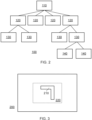
- the structure of an exemplary BVH is discussed below with reference to Figure 2 , while the use of bounding volumes as part of a simplified raytracing process is discussed with reference to Figures 3 and 4 .
- FIG. 2 schematically illustrates a simple example of a BVH; in this example, each box (bounding volume) represents one or more objects at a given level of detail.
- Each of the boxes is included in the box above it in the hierarchy - for example, the box 110 comprises information about all of objects in the environment, while each of the boxes 120 comprise a subset of the objects. These subsets may be determined in any suitable manner, although it is often considered that methods by which objects that are close to each other within an environment are grouped together and represented by the same bounding volume are preferable.
- the level of detail for each level can be determined in any suitable fashion, and the BVH may have a maximum level of detail that is defined.
- the BVH may terminate with bounding volumes representing groups of objects - this would lead to a coarse representation, but one that is reduced in size and may be traversed very quickly.
- the BVH may terminate with bounding volumes representing portions of objects - while this offers a finer approximation of the objects, of course this provides a BVH that is larger and may take longer to traverse.
- the BVH may be defined so as to comprise elements of both - such that some objects have a finer/coarser representation than others.
- BVHs can be generated in a number of ways, each with its own benefits and drawbacks. For example, a top-down approach can be taken in which the bounding volumes are defined beginning with the largest sets possible. That is, the input (such as the set of objects within an environment, or a representation of those objects) is divided into two or more subsets that are each then subdivided - that is, bounding volumes are generated beginning with box 110, and proceeding to boxes 120 and so on. While this represents a fast implementation, it often results in a BVH that is rather inefficient, which can result in a larger size overall or a reduced ease of navigation.
- bounding volumes 140 are defined beginning with the smallest volumes in the BVH. In the example of Figure 2 , this would mean that bounding volumes 140 are defined first, before progressing upwards to bounding volumes 130. While this can generally produce better (that is, more efficient) BVHs than the top-down approach, it can be more challenging to implement in an effective manner.
- a third approach that may be considered is that of insertion methods. These may be performed on-the-fly, and they are performed by inserting objects into the bounding volumes of a BVH on a per-object basis. This means that only information about that object is necessary at the time of insertion. Insertion approaches cover a wide range of related methods in which the placement of the object is determined in a manner that identifies an optimal or suitable placement. For example, a function may be defined that evaluates the impact (in terms of size or navigability or the like) of an insertion upon the BVH, with the insertion being performed in a manner that minimises or otherwise reduces the impact upon the BVH.
- Any suitable input data may be represented using a BVH and associated bounding volumes.
- video games may provide a suitable source of input data for generating such a structure - in this case, the input information may be data about the virtual objects that defines their respective dimensions and locations.
- information describing a real environment could be used as an information source - for example, information may be generated from images of a real environment and the objects within the environment, and this information can be used to generate a BVH that may be used to render images of that environment.
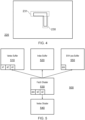
- Figures 3 and 4 schematically illustrate the use of bounding volumes in raytracing algorithms.
- Figure 3 schematically illustrates a viewport 200 in which rays are to be traced - this can be a camera view within a virtual environment to be presented to a viewer, for example.
- the scene comprises an object 210, which is enclosed by a bounding volume 220.
- intersections are only tested with respect to the bounding volume 220.
- any rays that do not intersect the bounding volume 220 will not intersect the polygons that form the object 210 - although of course rays may intersect the bounding volume 220 that will not intersect the polygons forming the object 210.
- Figure 4 shows an enlarged version of the bounding volume 220, with smaller bounding volumes 230 and 231 used to represent the object 210. Intersections of the bounding volumes 230 and 231 can be tested for each of the rays that were found to intersect the bounding volume 220, to obtain a finer approximation of the visual appearance of the object 210.
- this stage would require thirty tests (that is, a test for each ray with each bounding volume). This is again a very small amount relative to the testing of one hundred multiplied by the number of polygons making up the object 210 as noted above. It is therefore apparent that the falling number of rays to be considered for intersection is sufficient to offset the increasing number of bounding volumes to be considered, such that overall the total number of intersections to be tested is lower than the amount required if no bounding volumes are defined and no BVH is utilised.
- these volumes may be divided further until the surfaces of the object 210 are represented with a suitable level of precision for the application - such as when the bounding volumes and the polygons (primitives) representing the object occupy a similar display area, at which point the polygons may be used instead.
- the bounding volume 220 may be considered to be a higher level in the BVH than the bounding volumes 230, 231 - for instance, the bounding volume 220 may correspond to a volume such as 120 of Figure 2 , while the smaller bounding volumes 230, 231 may correspond to volumes such as 130 of Figure 2 .
Landscapes
- Engineering & Computer Science (AREA)
- Physics & Mathematics (AREA)
- Computer Graphics (AREA)
- General Physics & Mathematics (AREA)
- Theoretical Computer Science (AREA)
- Geometry (AREA)
- Software Systems (AREA)
- Image Generation (AREA)
Claims (11)
- Bilderzeugungssystem, umfassend:eine Begrenzungsvolumenhierarchie-Speichereinheit, BVH-Speichereinheit, (810), die konfiguriert ist, um eine BVH zu speichern, umfassend eine hierarchische Struktur aus einer Vielzahl von Dreiecken, die eine virtuelle Szene beschreiben;einen BVH-Positionspuffer (550, 820), der konfiguriert ist, um Daten zum Identifizieren der Lage eines oder mehrerer Dreiecke innerhalb der BVH zu speichern, wodurch ermöglicht wird, dass auf die Dreiecksdaten zugegriffen wird, die in der BHV gespeichert sind; undeinen Fetch-Shader (530, 830), der konfiguriert ist, um Vertexindizes zur Verwendung bei einem Darstellen von Bildern aus einem Indexpuffer (520) zu erhalten, der konfiguriert ist, um Daten zu speichern, die Vertexindizes zur Verwendung bei dem Darstellen von Bildern identifizieren, um jeweilige Lagen eines oder mehrerer Dreiecke innerhalb der BVH, die diesen Vertexindizes entsprechen, unter Verwendung der Positionsinformationen zu erhalten, die in dem BVH-Positionspuffer gespeichert sind, und um Vertexdaten, die diesen Dreiecken entsprechen, einem Vertex-Shader (540) bereitzustellen, der betriebsfähig ist, um einen Vertexschattierungsprozess durchzuführen,wobei die jeweiligen Lagen aller Dreiecke der Vielzahl von Dreiecken innerhalb der BVH durch eines angegeben werden, das aus der Liste ausgewählt ist, bestehend aus:i. einem jeweiligen Index, der einen ersten Vertex eines jeweiligen Dreiecks der Vielzahl von Dreiecken und einen jeweiligen Versatz für jeden anderen Vertex des jeweiligen Dreiecks identifiziert; undii. einem jeweiligen Index und einem jeweiligen Bitwert, die zusammen alle Vertices eines jeweiligen Dreiecks der Vielzahl von Dreiecken identifizieren.
- Bilderzeugungssystem nach einem der vorstehenden Ansprüche, umfassend einen Vertex-Shader (540), der konfiguriert ist, um den Vertexschattierungsprozess unter Verwendung von Daten durchzuführen, die von dem Fetch-Shader erhalten werden.
- Bilderzeugungssystem nach einem der vorstehenden Ansprüche, wobei der Vertexschattierungsprozess eines oder mehrere der Folgenden umfasst:• Ändern einer Position eines Vertex;• Ändern einer Farbe eines Vertex;• Ändern einer Ausrichtung eines Vertex; und• Umwandeln einer dreidimensionalen Vertexposition in eine zweidimensionale Bildschirmposition.
- Bilderzeugungssystem nach einem der vorstehenden Ansprüche, wobei der Fetch-Shader konfiguriert ist, um eine Transformation an den Lageinformationen für das eine oder die mehreren Dreiecke durchzuführen.
- Bilderzeugungssystem nach Anspruch 4, wobei der Fetch-Shader konfiguriert ist, um eine Transformation durchzuführen, um die Lageinformationen in Koordinaten in einem Objektraum umzuwandeln.
- Bilderzeugungssystem nach Anspruch 1, umfassend einen Vertexpuffer (510), der konfiguriert ist, um Attributdaten für einen oder mehrere Vertices zu speichern.
- Bilderzeugungssystem nach einem der Ansprüche 1 bis 5, wobei die BVH Attributdaten für die Dreiecke umfasst.
- Bilderzeugungssystem nach einem der vorstehenden Ansprüche, wobei der Fetch-Shader konfiguriert ist, um Attributdaten zu erhalten, und
wobei die erhaltenen Attributdaten verwendet werden, um den Vertexschattierungsprozess durchzuführen. - Bilderzeugungsverfahren, umfassend:Speichern (900) einer Begrenzungsvolumenhierarchie, BVH, umfassend eine hierarchische Struktur aus einer Vielzahl von Dreiecken, die eine virtuelle Szene beschreiben;Speichern (910) von Daten zum Identifizieren der Lage eines oder mehrerer Dreiecke innerhalb der BVH in einem BVH-Positionspuffer, wodurch ermöglicht wird, dass auf die Dreiecksdaten zugegriffen wird, die in der BVH gespeichert sind;Erhalten (600, 920) von Vertexindizes zur Verwendung bei dem Darstellen von Bildern aus einem Indexpuffer (520), der konfiguriert ist, um Daten zu speichern, die Vertexindizes zur Verwendung bei dem Darstellen von Bildern identifizieren;Erhalten (620, 630, 930) der jeweiligen Lagen eines oder mehrerer Dreiecke innerhalb der BVH, die diesen Vertexindizes entsprechen, unter Verwendung der Lageinformationen, die in der BVH gespeichert sind; undBereitstellen (640, 940) von Vertexdaten, die diesen Dreiecken entsprechen, an einen Vertex-Shader, der betriebsfähig ist, um einen Vertexschattierungsprozess (650) auszuführen; wobeidie jeweiligen Lagen aller Dreiecke der Vielzahl von Dreiecken innerhalb der BVH durch eines angegeben werden, das aus der Liste ausgewählt ist, bestehend aus:i. einem jeweiligen Index, der einen ersten Vertex eines jeweiligen Dreiecks der Vielzahl von Dreiecken und einen jeweiligen Versatz für jeden anderen Vertex des jeweiligen Dreiecks identifiziert; undii. einem jeweiligen Index und einem jeweiligen Bitwert, die zusammen alle Vertices eines jeweiligen Dreiecks der Vielzahl von Dreiecken identifizieren.
- Computersoftware, die, wenn sie durch einen Computer ausgeführt wird, den Computer veranlasst, das Verfahren nach Anspruch 9 vorzunehmen.
- Nichtflüchtiges maschinenlesbares Speichermedium, das Computersoftware nach Anspruch 10 speichert.
Applications Claiming Priority (1)
| Application Number | Priority Date | Filing Date | Title |
|---|---|---|---|
| GB2003031.8A GB2592604B (en) | 2020-03-03 | 2020-03-03 | Image generation system and method |
Publications (2)
| Publication Number | Publication Date |
|---|---|
| EP3876205A1 EP3876205A1 (de) | 2021-09-08 |
| EP3876205B1 true EP3876205B1 (de) | 2024-11-27 |
Family
ID=70278809
Family Applications (1)
| Application Number | Title | Priority Date | Filing Date |
|---|---|---|---|
| EP21155193.2A Active EP3876205B1 (de) | 2020-03-03 | 2021-02-04 | Bilderzeugungssystem und -verfahren |
Country Status (3)
| Country | Link |
|---|---|
| US (1) | US11423618B2 (de) |
| EP (1) | EP3876205B1 (de) |
| GB (1) | GB2592604B (de) |
Families Citing this family (2)
| Publication number | Priority date | Publication date | Assignee | Title |
|---|---|---|---|---|
| CN114241109B (zh) * | 2021-12-21 | 2025-03-14 | 南京华苏科技有限公司 | 一种基于webgl的三维热力云图的生成方法 |
| CN114494024B (zh) * | 2022-04-13 | 2022-08-02 | 腾讯科技(深圳)有限公司 | 图像渲染方法、装置、设备及存储介质 |
Family Cites Families (7)
| Publication number | Priority date | Publication date | Assignee | Title |
|---|---|---|---|---|
| US6172684B1 (en) * | 1997-06-12 | 2001-01-09 | Silicon Engineering, Inc. | Method and apparatus for storing display lists of 3D primitives |
| US7439983B2 (en) * | 2005-02-10 | 2008-10-21 | Sony Computer Entertainment Inc. | Method and apparatus for de-indexing geometry |
| GB201103698D0 (en) * | 2011-03-03 | 2011-04-20 | Advanced Risc Mach Ltd | Graphics processing |
| US9093006B2 (en) * | 2011-06-30 | 2015-07-28 | Google Inc. | Image shader using style attribute references |
| US9536278B2 (en) * | 2013-11-27 | 2017-01-03 | Intel Corporation | Graphics processing of a vertex buffer using a relative index buffer |
| US11379941B2 (en) * | 2016-09-22 | 2022-07-05 | Advanced Micro Devices, Inc. | Primitive shader |
| US10839475B2 (en) * | 2018-04-11 | 2020-11-17 | Intel IP Corporation | Apparatus and method for compressing leaf nodes of a bounding volume hierarchy (BVH) |
-
2020
- 2020-03-03 GB GB2003031.8A patent/GB2592604B/en active Active
-
2021
- 2021-02-04 EP EP21155193.2A patent/EP3876205B1/de active Active
- 2021-02-19 US US17/179,516 patent/US11423618B2/en active Active
Also Published As
| Publication number | Publication date |
|---|---|
| GB2592604B (en) | 2023-10-18 |
| GB202003031D0 (en) | 2020-04-15 |
| GB2592604A (en) | 2021-09-08 |
| EP3876205A1 (de) | 2021-09-08 |
| US11423618B2 (en) | 2022-08-23 |
| US20210279958A1 (en) | 2021-09-09 |
Similar Documents
| Publication | Publication Date | Title |
|---|---|---|
| US11069124B2 (en) | Systems and methods for reducing rendering latency | |
| US6903741B2 (en) | Method, computer program product and system for rendering soft shadows in a frame representing a 3D-scene | |
| KR100889602B1 (ko) | 광선 추적을 위한 광선-삼각형 충돌 처리 방법 및 장치 | |
| EP2831848B1 (de) | Verfahren zur schätzung des opazitätsgrades in einer szene sowie entsprechende vorrichtung | |
| US7812837B2 (en) | Reduced Z-buffer generating method, hidden surface removal method and occlusion culling method | |
| US7948487B2 (en) | Occlusion culling method and rendering processing apparatus | |
| US20110141112A1 (en) | Image processing techniques | |
| US11436797B2 (en) | Image generation system and method | |
| US6664971B1 (en) | Method, system, and computer program product for anisotropic filtering and applications thereof | |
| Lorenz et al. | Interactive multi-perspective views of virtual 3D landscape and city models | |
| US20210166462A1 (en) | Image generation system and method | |
| KR20180023856A (ko) | 그래픽 처리 시스템 및 그래픽 프로세서 | |
| EP3876205B1 (de) | Bilderzeugungssystem und -verfahren | |
| KR20160068204A (ko) | 메시 지오메트리를 위한 데이터 처리 방법 및 이를 기록한 컴퓨터 판독 가능 저장 매체 | |
| CN110874858B (zh) | 用于渲染反射的系统和方法 | |
| Chen et al. | Lod-sprite technique for accelerated terrain rendering | |
| US6664957B1 (en) | Apparatus and method for three-dimensional graphics drawing through occlusion culling | |
| KR101090660B1 (ko) | 포인트 프리미티브를 이용한 실시간 볼륨 렌더링 방법 | |
| JP2008282171A (ja) | グラフィックスプロセッサおよび描画処理方法 | |
| JP3629243B2 (ja) | モデリング時の距離成分を用いてレンダリング陰影処理を行う画像処理装置とその方法 | |
| JP4047421B2 (ja) | ユーザ定義によるルームおよびウィンドウを用いた効率的レンダリング方法および装置 | |
| Marrs et al. | View-warped Multi-view Soft Shadows for Local Area Lights | |
| JP3711273B2 (ja) | オクルージョンカリングを行う3次元グラフィックス描画装置 | |
| US20240249461A1 (en) | Vector graphic texture engine | |
| Sung | Efficient Shadow Generation of Massive Crowds Based on the Area of Screen Space |
Legal Events
| Date | Code | Title | Description |
|---|---|---|---|
| PUAI | Public reference made under article 153(3) epc to a published international application that has entered the european phase |
Free format text: ORIGINAL CODE: 0009012 |
|
| STAA | Information on the status of an ep patent application or granted ep patent |
Free format text: STATUS: REQUEST FOR EXAMINATION WAS MADE |
|
| 17P | Request for examination filed |
Effective date: 20210218 |
|
| AK | Designated contracting states |
Kind code of ref document: A1 Designated state(s): AL AT BE BG CH CY CZ DE DK EE ES FI FR GB GR HR HU IE IS IT LI LT LU LV MC MK MT NL NO PL PT RO RS SE SI SK SM TR |
|
| GRAP | Despatch of communication of intention to grant a patent |
Free format text: ORIGINAL CODE: EPIDOSNIGR1 |
|
| STAA | Information on the status of an ep patent application or granted ep patent |
Free format text: STATUS: GRANT OF PATENT IS INTENDED |
|
| INTG | Intention to grant announced |
Effective date: 20240705 |
|
| P01 | Opt-out of the competence of the unified patent court (upc) registered |
Free format text: CASE NUMBER: APP_50956/2024 Effective date: 20240909 |
|
| GRAS | Grant fee paid |
Free format text: ORIGINAL CODE: EPIDOSNIGR3 |
|
| GRAA | (expected) grant |
Free format text: ORIGINAL CODE: 0009210 |
|
| STAA | Information on the status of an ep patent application or granted ep patent |
Free format text: STATUS: THE PATENT HAS BEEN GRANTED |
|
| AK | Designated contracting states |
Kind code of ref document: B1 Designated state(s): AL AT BE BG CH CY CZ DE DK EE ES FI FR GB GR HR HU IE IS IT LI LT LU LV MC MK MT NL NO PL PT RO RS SE SI SK SM TR |
|
| REG | Reference to a national code |
Ref country code: GB Ref legal event code: FG4D |
|
| REG | Reference to a national code |
Ref country code: CH Ref legal event code: EP |
|
| REG | Reference to a national code |
Ref country code: IE Ref legal event code: FG4D |
|
| REG | Reference to a national code |
Ref country code: DE Ref legal event code: R096 Ref document number: 602021022262 Country of ref document: DE |
|
| REG | Reference to a national code |
Ref country code: NL Ref legal event code: FP |
|
| REG | Reference to a national code |
Ref country code: LT Ref legal event code: MG9D |
|
| PG25 | Lapsed in a contracting state [announced via postgrant information from national office to epo] |
Ref country code: PT Free format text: LAPSE BECAUSE OF FAILURE TO SUBMIT A TRANSLATION OF THE DESCRIPTION OR TO PAY THE FEE WITHIN THE PRESCRIBED TIME-LIMIT Effective date: 20250327 Ref country code: IS Free format text: LAPSE BECAUSE OF FAILURE TO SUBMIT A TRANSLATION OF THE DESCRIPTION OR TO PAY THE FEE WITHIN THE PRESCRIBED TIME-LIMIT Effective date: 20250327 Ref country code: HR Free format text: LAPSE BECAUSE OF FAILURE TO SUBMIT A TRANSLATION OF THE DESCRIPTION OR TO PAY THE FEE WITHIN THE PRESCRIBED TIME-LIMIT Effective date: 20241127 |
|
| PG25 | Lapsed in a contracting state [announced via postgrant information from national office to epo] |
Ref country code: FI Free format text: LAPSE BECAUSE OF FAILURE TO SUBMIT A TRANSLATION OF THE DESCRIPTION OR TO PAY THE FEE WITHIN THE PRESCRIBED TIME-LIMIT Effective date: 20241127 |
|
| REG | Reference to a national code |
Ref country code: AT Ref legal event code: MK05 Ref document number: 1746461 Country of ref document: AT Kind code of ref document: T Effective date: 20241127 |
|
| PG25 | Lapsed in a contracting state [announced via postgrant information from national office to epo] |
Ref country code: BG Free format text: LAPSE BECAUSE OF FAILURE TO SUBMIT A TRANSLATION OF THE DESCRIPTION OR TO PAY THE FEE WITHIN THE PRESCRIBED TIME-LIMIT Effective date: 20241127 |
|
| PG25 | Lapsed in a contracting state [announced via postgrant information from national office to epo] |
Ref country code: ES Free format text: LAPSE BECAUSE OF FAILURE TO SUBMIT A TRANSLATION OF THE DESCRIPTION OR TO PAY THE FEE WITHIN THE PRESCRIBED TIME-LIMIT Effective date: 20241127 |
|
| PG25 | Lapsed in a contracting state [announced via postgrant information from national office to epo] |
Ref country code: NO Free format text: LAPSE BECAUSE OF FAILURE TO SUBMIT A TRANSLATION OF THE DESCRIPTION OR TO PAY THE FEE WITHIN THE PRESCRIBED TIME-LIMIT Effective date: 20250227 |
|
| PG25 | Lapsed in a contracting state [announced via postgrant information from national office to epo] |
Ref country code: LV Free format text: LAPSE BECAUSE OF FAILURE TO SUBMIT A TRANSLATION OF THE DESCRIPTION OR TO PAY THE FEE WITHIN THE PRESCRIBED TIME-LIMIT Effective date: 20241127 Ref country code: GR Free format text: LAPSE BECAUSE OF FAILURE TO SUBMIT A TRANSLATION OF THE DESCRIPTION OR TO PAY THE FEE WITHIN THE PRESCRIBED TIME-LIMIT Effective date: 20250228 Ref country code: AT Free format text: LAPSE BECAUSE OF FAILURE TO SUBMIT A TRANSLATION OF THE DESCRIPTION OR TO PAY THE FEE WITHIN THE PRESCRIBED TIME-LIMIT Effective date: 20241127 |
|
| PG25 | Lapsed in a contracting state [announced via postgrant information from national office to epo] |
Ref country code: PL Free format text: LAPSE BECAUSE OF FAILURE TO SUBMIT A TRANSLATION OF THE DESCRIPTION OR TO PAY THE FEE WITHIN THE PRESCRIBED TIME-LIMIT Effective date: 20241127 |
|
| PG25 | Lapsed in a contracting state [announced via postgrant information from national office to epo] |
Ref country code: RS Free format text: LAPSE BECAUSE OF FAILURE TO SUBMIT A TRANSLATION OF THE DESCRIPTION OR TO PAY THE FEE WITHIN THE PRESCRIBED TIME-LIMIT Effective date: 20250227 |
|
| PG25 | Lapsed in a contracting state [announced via postgrant information from national office to epo] |
Ref country code: SM Free format text: LAPSE BECAUSE OF FAILURE TO SUBMIT A TRANSLATION OF THE DESCRIPTION OR TO PAY THE FEE WITHIN THE PRESCRIBED TIME-LIMIT Effective date: 20241127 |
|
| PG25 | Lapsed in a contracting state [announced via postgrant information from national office to epo] |
Ref country code: DK Free format text: LAPSE BECAUSE OF FAILURE TO SUBMIT A TRANSLATION OF THE DESCRIPTION OR TO PAY THE FEE WITHIN THE PRESCRIBED TIME-LIMIT Effective date: 20241127 |
|
| PG25 | Lapsed in a contracting state [announced via postgrant information from national office to epo] |
Ref country code: EE Free format text: LAPSE BECAUSE OF FAILURE TO SUBMIT A TRANSLATION OF THE DESCRIPTION OR TO PAY THE FEE WITHIN THE PRESCRIBED TIME-LIMIT Effective date: 20241127 |
|
| PG25 | Lapsed in a contracting state [announced via postgrant information from national office to epo] |
Ref country code: RO Free format text: LAPSE BECAUSE OF FAILURE TO SUBMIT A TRANSLATION OF THE DESCRIPTION OR TO PAY THE FEE WITHIN THE PRESCRIBED TIME-LIMIT Effective date: 20241127 |
|
| PG25 | Lapsed in a contracting state [announced via postgrant information from national office to epo] |
Ref country code: SK Free format text: LAPSE BECAUSE OF FAILURE TO SUBMIT A TRANSLATION OF THE DESCRIPTION OR TO PAY THE FEE WITHIN THE PRESCRIBED TIME-LIMIT Effective date: 20241127 |
|
| PG25 | Lapsed in a contracting state [announced via postgrant information from national office to epo] |
Ref country code: CZ Free format text: LAPSE BECAUSE OF FAILURE TO SUBMIT A TRANSLATION OF THE DESCRIPTION OR TO PAY THE FEE WITHIN THE PRESCRIBED TIME-LIMIT Effective date: 20241127 |
|
| PG25 | Lapsed in a contracting state [announced via postgrant information from national office to epo] |
Ref country code: IT Free format text: LAPSE BECAUSE OF FAILURE TO SUBMIT A TRANSLATION OF THE DESCRIPTION OR TO PAY THE FEE WITHIN THE PRESCRIBED TIME-LIMIT Effective date: 20241127 |
|
| REG | Reference to a national code |
Ref country code: DE Ref legal event code: R097 Ref document number: 602021022262 Country of ref document: DE |
|
| PG25 | Lapsed in a contracting state [announced via postgrant information from national office to epo] |
Ref country code: SE Free format text: LAPSE BECAUSE OF FAILURE TO SUBMIT A TRANSLATION OF THE DESCRIPTION OR TO PAY THE FEE WITHIN THE PRESCRIBED TIME-LIMIT Effective date: 20241127 |
|
| PG25 | Lapsed in a contracting state [announced via postgrant information from national office to epo] |
Ref country code: MC Free format text: LAPSE BECAUSE OF FAILURE TO SUBMIT A TRANSLATION OF THE DESCRIPTION OR TO PAY THE FEE WITHIN THE PRESCRIBED TIME-LIMIT Effective date: 20241127 |
|
| REG | Reference to a national code |
Ref country code: CH Ref legal event code: PL |
|
| PLBE | No opposition filed within time limit |
Free format text: ORIGINAL CODE: 0009261 |
|
| STAA | Information on the status of an ep patent application or granted ep patent |
Free format text: STATUS: NO OPPOSITION FILED WITHIN TIME LIMIT |
|
| PG25 | Lapsed in a contracting state [announced via postgrant information from national office to epo] |
Ref country code: LU Free format text: LAPSE BECAUSE OF NON-PAYMENT OF DUE FEES Effective date: 20250204 |
|
| PG25 | Lapsed in a contracting state [announced via postgrant information from national office to epo] |
Ref country code: CH Free format text: LAPSE BECAUSE OF NON-PAYMENT OF DUE FEES Effective date: 20250228 |
|
| 26N | No opposition filed |
Effective date: 20250828 |
|
| REG | Reference to a national code |
Ref country code: BE Ref legal event code: MM Effective date: 20250228 |
|
| PG25 | Lapsed in a contracting state [announced via postgrant information from national office to epo] |
Ref country code: BE Free format text: LAPSE BECAUSE OF NON-PAYMENT OF DUE FEES Effective date: 20250228 |
|
| PG25 | Lapsed in a contracting state [announced via postgrant information from national office to epo] |
Ref country code: IE Free format text: LAPSE BECAUSE OF NON-PAYMENT OF DUE FEES Effective date: 20250204 |
|
| PGFP | Annual fee paid to national office [announced via postgrant information from national office to epo] |
Ref country code: NL Payment date: 20260121 Year of fee payment: 6 |
|
| PGFP | Annual fee paid to national office [announced via postgrant information from national office to epo] |
Ref country code: GB Payment date: 20260122 Year of fee payment: 6 |
|
| PGFP | Annual fee paid to national office [announced via postgrant information from national office to epo] |
Ref country code: DE Payment date: 20260121 Year of fee payment: 6 |
|
| PGFP | Annual fee paid to national office [announced via postgrant information from national office to epo] |
Ref country code: FR Payment date: 20260121 Year of fee payment: 6 |