EP3876231A1 - Method and apparatus for recognizing speech - Google Patents
Method and apparatus for recognizing speech Download PDFInfo
- Publication number
- EP3876231A1 EP3876231A1 EP20195910.3A EP20195910A EP3876231A1 EP 3876231 A1 EP3876231 A1 EP 3876231A1 EP 20195910 A EP20195910 A EP 20195910A EP 3876231 A1 EP3876231 A1 EP 3876231A1
- Authority
- EP
- European Patent Office
- Prior art keywords
- text
- response
- speech
- parsing
- historical
- Prior art date
- Legal status (The legal status is an assumption and is not a legal conclusion. Google has not performed a legal analysis and makes no representation as to the accuracy of the status listed.)
- Ceased
Links
Images



Classifications
-
- G—PHYSICS
- G10—MUSICAL INSTRUMENTS; ACOUSTICS
- G10L—SPEECH ANALYSIS TECHNIQUES OR SPEECH SYNTHESIS; SPEECH RECOGNITION; SPEECH OR VOICE PROCESSING TECHNIQUES; SPEECH OR AUDIO CODING OR DECODING
- G10L25/00—Speech or voice analysis techniques not restricted to a single one of groups G10L15/00 - G10L21/00
- G10L25/78—Detection of presence or absence of voice signals
- G10L25/87—Detection of discrete points within a voice signal
-
- G—PHYSICS
- G06—COMPUTING OR CALCULATING; COUNTING
- G06F—ELECTRIC DIGITAL DATA PROCESSING
- G06F40/00—Handling natural language data
- G06F40/30—Semantic analysis
-
- G—PHYSICS
- G10—MUSICAL INSTRUMENTS; ACOUSTICS
- G10L—SPEECH ANALYSIS TECHNIQUES OR SPEECH SYNTHESIS; SPEECH RECOGNITION; SPEECH OR VOICE PROCESSING TECHNIQUES; SPEECH OR AUDIO CODING OR DECODING
- G10L15/00—Speech recognition
- G10L15/26—Speech to text systems
-
- G—PHYSICS
- G06—COMPUTING OR CALCULATING; COUNTING
- G06F—ELECTRIC DIGITAL DATA PROCESSING
- G06F40/00—Handling natural language data
- G06F40/20—Natural language analysis
- G06F40/205—Parsing
-
- G—PHYSICS
- G10—MUSICAL INSTRUMENTS; ACOUSTICS
- G10L—SPEECH ANALYSIS TECHNIQUES OR SPEECH SYNTHESIS; SPEECH RECOGNITION; SPEECH OR VOICE PROCESSING TECHNIQUES; SPEECH OR AUDIO CODING OR DECODING
- G10L15/00—Speech recognition
- G10L15/08—Speech classification or search
- G10L15/18—Speech classification or search using natural language modelling
- G10L15/1822—Parsing for meaning understanding
-
- G—PHYSICS
- G10—MUSICAL INSTRUMENTS; ACOUSTICS
- G10L—SPEECH ANALYSIS TECHNIQUES OR SPEECH SYNTHESIS; SPEECH RECOGNITION; SPEECH OR VOICE PROCESSING TECHNIQUES; SPEECH OR AUDIO CODING OR DECODING
- G10L15/00—Speech recognition
- G10L15/22—Procedures used during a speech recognition process, e.g. man-machine dialogue
-
- G—PHYSICS
- G10—MUSICAL INSTRUMENTS; ACOUSTICS
- G10L—SPEECH ANALYSIS TECHNIQUES OR SPEECH SYNTHESIS; SPEECH RECOGNITION; SPEECH OR VOICE PROCESSING TECHNIQUES; SPEECH OR AUDIO CODING OR DECODING
- G10L15/00—Speech recognition
- G10L15/22—Procedures used during a speech recognition process, e.g. man-machine dialogue
- G10L2015/223—Execution procedure of a spoken command
Definitions
- Embodiments of the present disclosure relate to the field of computer technology, and more particularly to a method and apparatus for recognizing speech.
- the speech recognition engine fails the recognition or the recognition is incomplete, resulting in a large difference in recognition results and affecting user experience on the speech recognition.
- the prior art generally detects whether the user has not continued to speak for a period of time at the speech flow level, and ends the endpoint. This manner of fixing the recognition time is too stiff and therefore lacks flexibility.
- Embodiments of the present disclosure provide a method and apparatus for recognizing speech.
- some embodiments of the present disclosure provides a method for recognizing speech, the method includes: in response to detecting a speech frame, converting the speech frame into a current text in real time; in response to there being no previously saved historical text, inputting the current text into a semantic parsing model to obtain a parsing result; in response to the parsing result including a valid intention slot, ending a speech endpoint detection to complete the recognition; and outputting an instruction corresponding to the valid intention slot.
- the method further includes: in response to the parsing result not including the valid intention slot, saving the current text as a historical text and continuing to detect a new speech frame, delaying a time of the speech endpoint detection.
- the method further includes: in response to there being a previously saved historical text, inputting the current text and the historical text into the semantic parsing model to obtain a new parsing result; in response to the new parsing result not including a valid intention slot, merging the current text into the historical text for saving, continuing to detect a new speech frame, and delaying the time of the speech endpoint detection; and in response to the new parsing result including a valid intention slot, ending the speech endpoint detection to complete the recognition, clearing the historical text, and outputting an instruction corresponding to the valid intention slot.
- the inputting the current text and the historical text into the semantic parsing model includes: splicing the current text and the historical text; and in response to the splicing being successful, inputting the spliced current text and the historical text into the semantic parsing model to obtain the new parsing result.
- the inputting the current text and the historical text into the semantic parsing model includes: in response to the splicing failing, resetting the historical text to be the current text, and inputting only the current text into the semantic parsing model.
- the method further includes: in response to the parsing result including a valid intention slot and being a fixed result, using the parsing result as a cache instruction, and storing a correspondence relationship table between the cache instruction and the current text; in response to acquiring a text to be parsed, matching the text to be parsed with the correspondence relationship table; and in response to the matching being successful, directly returning the cache instruction corresponding to the text to be parsed without using the semantic parsing model.
- some embodiments of the present disclosure provide an apparatus for recognizing speech, the apparatus includes: a conversion unit, configured to convert a speech frame into a current text in real time in response to detecting the speech frame; a parsing unit, configured to input the current text into a semantic parsing model to obtain a parsing result, in response to there being no previously saved historical text; a judging unit, configured to end a speech endpoint detection to complete the recognition, in response to the parsing result including a valid intention slot; and an output unit, configured to output an instruction corresponding to the valid intention slot.
- the apparatus further includes: a splicing unit, configured to in response to the parsing result not including the valid intention slot, save the current text as a historical text and continue to detect a new speech frame, delay a time of a speech endpoint detection.
- a splicing unit configured to in response to the parsing result not including the valid intention slot, save the current text as a historical text and continue to detect a new speech frame, delay a time of a speech endpoint detection.
- the splicing unit is further configured to: in response to there being a previously saved historical text, input the current text and the historical text into the semantic parsing model to obtain a new parsing result; in response to the new parsing result not including a valid intention slot, merge the current text into the historical text for saving, continue to detect a new speech frame, and delay the time of the speech endpoint detection; and in response to the new parsing result including a valid intention slot, ending the speech endpoint detection to complete the recognition, clearing the historical text, and outputting an instruction corresponding to the valid intention slot.
- the splicing unit is further configured to: splice the current text and the historical text; and in response to the splicing being successful, input the spliced current text and the historical text into the semantic parsing model to obtain the new parsing result.
- the splicing unit is further configured to: in response to the splicing failing, resetting the historical text to be the current text, and inputting only the current text into the semantic parsing model.
- the apparatus further includes a cache unit configured to: in response to the parsing result including a valid intention slot and being a fixed result, use the parsing result as a cache instruction, and store a correspondence relationship table between the cache instruction and the current text; in response to acquiring a text to be parsed, match the text to be parsed with the correspondence relationship table; and in response to the matching being successful, directly return the cache instruction corresponding to the text to be parsed without using the semantic parsing model.
- a cache unit configured to: in response to the parsing result including a valid intention slot and being a fixed result, use the parsing result as a cache instruction, and store a correspondence relationship table between the cache instruction and the current text; in response to acquiring a text to be parsed, match the text to be parsed with the correspondence relationship table; and in response to the matching being successful, directly return the cache instruction corresponding to the text to be parsed without using the semantic parsing model.
- some embodiments of the present disclosure provides an electronic device for recognizing speech, the electronic device includes: one or more processors; storage means on which one or more programs are stored, where when the one or more programs are executed by the one or more processors, causing the one or more processors to implement any one of the method described in the first aspect.
- some embodiments of the present disclosure provides a computer-readable medium having a computer program stored thereon, where the computer program, when executed by a processor, implements any one of the method described in the first aspect.
- the method and apparatus for recognizing speech by establishing a semantic parsing model, the intention is parsed at the same time as the speech recognition.
- the recognition and analysis process will be completed in advance, which greatly improves the speed of speech recognition analysis.
- the time for a speech endpoint detection is automatically extended and the recognition continues until a valid intent is recognized, which improves the accuracy of recognition.
- FIG. 1 illustrates an example system architecture 100 in which a method for recognizing speech or an apparatus for recognizing speech may be applied.
- the system architecture 100 may include a microphone 101, a controller 102, a speech recognition server 103, and a semantic understanding server 104.
- the network is a medium for providing a communication link between the controller 102, the speech recognition server 103, and the semantic understanding server 104.
- the network may include various types of connections, such as wired, wireless communication links, or fiber optic cables, and the like.
- the user may input voice to the controller 102 by using the microphone 101.
- the controller 102 then interacts with the speech recognition server 103 and the semantic understanding server 104 through the network, to receive or send messages, etc.
- the microphone 101 may be a voice input device mounted on a mobile device such as an unmanned vehicle, or may be a built-in device of a mobile phone or a computer etc.
- the controller may be an in-vehicle device or a built-in device of a mobile phone or a computer etc.
- the controller 102 has the function of receiving and transmitting information.
- the controller 102 also has the functions of offline speech recognition and semantic understanding. For example, the controller 102 may recognize a wake-up word or the like may be identified offline. If the voice recognition cannot be performed offline, the voice needs to be sent to the voice recognition server to perform voice recognition, to obtain text. And the text is sent to the semantic understanding server to obtain an instruction.
- the speech recognition server 103 is for receiving the speech transmitted by the controller 102 and converts the vocabulary content in the speech into a computer-readable input, such as a key, a binary code or a character sequence. Unlike speaker recognition and speaker confirmation, the latter attempts to recognize or confirm the speaker who makes the speech, rather than the lexical content contained therein.
- Speech recognition system is installed on the speech recognition server 102. Speech recognition systems are generally includes two phases: training and decoding. Training, i.e. training an acoustic model through a large number of labeled speech data. Decoding, i.e., recognizing speech data rather than the training set into text by the acoustic model and a language model. The quality of the trained acoustic model directly affects the accuracy of the recognition.
- the semantic understanding server 103 is configured to receive a text result sent by the controller 102 and perform semantic analysis on the basis of the text result.
- Semantic analysis refers to learning and understanding the semantic content represented by a piece of text by using various methods, and any understanding on language can be classified as a category of semantic analysis.
- a piece of text is usually composed of words, sentences, and paragraphs, and semantic analysis can be further decomposed into lexical-level semantic analysis, sentence-level semantic analysis, and textual-level semantic analysis, depending on the linguistic units of the comprehension object.
- lexical-level semantic analysis focuses on how to acquire or distinguish the semantics of words, while sentence-level semantic analysis attempts to analyze the semantics expressed by the entire sentence, while textual-level semantic analysis aims to study the internal structure of natural language text and to understand the semantic relationship between text units (which may be sentence clauses or paragraphs).
- textual-level semantic analysis aims to study the internal structure of natural language text and to understand the semantic relationship between text units (which may be sentence clauses or paragraphs).
- the goal of semantic analysis is to achieve automatic semantic analysis at various linguistic units, including words, sentences, texts, etc., by establishing an effective model and system, to achieve an understanding of the true semantics of the entire text expression.
- the speech recognition server 103 and the semantic understanding server 104 may be hardware or software.
- the server may be implemented as a distributed server cluster composed of multiple servers may be implemented, or as a single server.
- the server may be implemented as a plurality of software or software modules (e.g., a plurality of software or software modules for providing distributed services), or as a single software or software module. It is not specifically limited herein.
- the method for recognizing speech provided in embodiments of the present disclosure is generally performed by the controller 102, and accordingly, the apparatus for recognizing speech are generally provided in the controller 102.
- FIG. 1 the numbers of microphones, controllers, speech recognition servers, semantic understanding servers in FIG. 1 are merely illustrative. There may be any number of microphones, controllers, speech recognition servers, and semantic understanding servers as required for implementation.
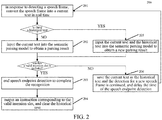
- the method for recognizing speech comprises the steps of:
- Step 201 in response to detecting a speech frame, convert the speech frame into a current text in real time.
- the execution body of the method for recognizing speech may acquire consecutive speech frames from the microphone in real time through a wired connection mode or a wireless connection mode.
- the average energy of a speech frame is calculated once the speech frame is acquired.
- the method for calculating the average energy may adopt a method in the prior art, and details are not described herein.
- the first speech frame and the speech frames following the first speech frame are converted into a current text in real time by an ASR (Automatic Speech Recognition) technique.
- ASR Automatic Speech Recognition
- step 202 in response to there being no previously saved historical text, input the current text into a semantic parsing model to obtain a parsing result.
- the speech recognition result is saved as a historical text. If the previous parsing is successful, there will be no historical text. If there is no historical text, the current text currently identified is directly inputted into the semantic parsing model.
- the semantic parsing model is used to determine and parse user intentions. For example, the semantic parsing model parses the speech such as "I warmtha listen to xxx ", "navigate to xxx", and then obtains corresponding intentions.
- the model covers common scenarios, including vehicle control commands, navigation commands, music commands, telephone commands, and the like.
- the semantic parsing model is realized by slot filling technology.
- the slot filling technique refers to a process of completing information, in order to convert an intention of a user into a specific instruction of the user. In current slot recognition methods, there are mainly two methods: Knowledge-based slot recognition and model-based slot recognition:
- step 203 in response to the parsing result including a valid intention slot, end speech endpoint detection to complete the recognition.
- a voice activity detection (VAD) technique is related, which is a technique for detecting, in a noise environment, a segment of speech from a user starts to speak until the user finishes speaking, that is, detecting a start point and an end point of the speech uttered by the user.
- VAD voice activity detection
- the average energy of a speech frame is calculated once the speech frame is acquired, and then the average energy of the speech frame is compared with a preset start threshold. If the average energy of the speech frame is greater than the preset start threshold, the speech frame is considered to be the start frame of the speech to be recognized.
- speech frames including the start frame and following frames are recognized in real time to obtain an intermediate recognition result of the speech recognition. It is not necessary to detect energy to judge whether the user has finished speaking, but once a complete semantic is obtained, it considers that the user has finished speaking an instruction, and the recognition result can be returned without waiting a silence period.
- the prior art needs to wait until the endpoint is detected before a segment of speech from the start point to the endpoint is recognized together.
- step 204 output an instruction corresponding to the valid intention slot, and clear the historical text.
- the spoken language input by the user may be converted into machine-executable instructions and then output to the corresponding execution module for execution.
- the user utters "I warmtha listen to 'me and my country'", and then it is converted into an instruction "play the song 'me and my country'” and then the instruction is outputted to a multimedia module for execution.
- the parsing is based on historical text, the historical text needs to be cleared after the parsing is successful.
- step 205 in response to there being previously saved historical text, input the current text and the historical text into the semantic parsing model to obtain a new parsing result.
- the intention of the user has not been successfully parsed out during the previous parsing.
- the user may haven't finished the speaking last time, and there is a pause.
- the currently received voice is a supplement to the last received voice. Therefore, it is necessary to input the current text and the historical text into the semantic parsing model together to obtain a new parsing result.
- Splicing is performed on the current text and the historical text. If the splicing is successful, the spliced current text and historical text are input into the semantic parsing model to obtain a new parsing result. If the splicing fails, the historical text is reset to be the current text, and only the current text is inputted into the semantic parsing model.
- the two texts may be spliced into “I warmtha go to Chaoyang Dayue City” for inputting into a semantic parsing model, to obtain the intention of the user is to navigate to Chaoyang Dayue City. If the historical text is "I warmtha go” and the current text is "I warmtha listen to”, then the historical text "I warmtha go” is abandoned, and the historical text is reset to be "I warmtha listen to”.
- step 206 if the parsing result does not include a valid intention slot, save the current text as the historical text and the detection for a new speech frame is continued, and delay the time of the speech endpoint detection.
- the current text that has been recognized can be saved as a historical text.
- the detection on new speech frames is continued, the detection for speech endpoint is automatically delayed. Instead, the endpoint is determined based on power and timeout.
- FIG. 3 is a schematic diagram of an application scenario of a method for recognizing speech according to the present embodiment.
- the average energy of this speech frame is calculated, and it is detected that the average energy of this speech frame is greater than the preset start threshold and is used as the first speech frame.
- Speech recognition is continuously performed on the first speech frame and the speech frames following the first speech frame to obtain the current text, and the current text is inputted into the semantic parsing model to obtain the parsing result. If the user pauses after uttering particular words "make a call to”, no valid intention slot is passed out at this time.
- the current text "make a call to” is saved as a historical text, and waiting for the user to continue to enter voice.
- the historical text "make a call to” and the current text "Dad” are spliced and then inputted into the semantic parsing model, to obtain a parsing result.
- the parsing result has a valid intention slot, and thus the voice recognition is ended and an instruction "dial the phone number of Dad" is outputted to the dialling module.
- Step 401 in response to detecting a speech frame, converts the speech frame into a current text in real time.
- step 401 is substantially the same as step 201, details are not described.
- Step 402 match the current text with a correspondence relationship table corresponding to cache instructions.
- some correspondence relationships between cache instructions and texts may be stored in advance, and a cache instruction is cached only if the obtained semantic parsing result is fixed, and dynamic results such as "navigate to xxx" cannot be cached.
- the cache instruction may cache generalized instructions such as "open that door”.
- instructions that have been recognized and parsed may be stored as cache instructions at any time during use.
- step 403 if the matching is successful, output a cache instruction matching the current text.
- the text is directly matched with the correspondence relationship table corresponding to cache instructions. If a cache instruction corresponding to the text is found, it is not necessary to input the text into the semantic parsing model for parsing the text, then the endpoint detection is ended in advance, and the instruction is returned in advance.
- step 404 if the match is unsuccessful and there is no previously saved historical text, input the current text into the semantic parsing model to obtain a parsing result.
- step 405 if the parsing result includes a valid intended slot, end the speech endpoint detection to complete the recognition.
- step 406 output an instruction corresponding to the valid intention slot, and clear the historical text.
- Step 407 If there is a previously saved historical text, input the current text and the historical text into the semantic parsing model to obtain a new parsing result.
- step 408 if the parsing result does not include a valid intention slot, save the current text as a historical text and continue to detect the new speech frame, delay the time of speech endpoint detection.
- Step 404- Step 408 is substantially the same as step 202-206, and therefore details are not described.
- the flow 400 of the method for recognizing speech in the present embodiment embodies a result optimization process in which the "non-dynamic result", that is, the semantic parsing result is fixed, for example, "open the window on the driver's side", so that the endpoint detection can be ended ahead of time, and the reaction speed can be improved.
- an embodiment of the present disclosure provides an apparatus for recognizing speech, which corresponds to the method embodiment shown in FIG. 2 , and which is particularly applicable to various electronic devices.
- the apparatus 500 for recognizing speech in the present embodiment includes a conversion unit 501, a parsing unit 502, a judging unit 503, and an output unit 504.
- the conversion unit 501 is configured to convert a speech frame into a current text in real time in response to detecting the speech frame.
- the parsing unit 502 is configured to input the current text into a semantic parsing model to obtain a parsing result, in response to there being no previously saved historical text.
- the judging unit 503 configured to end a speech endpoint to complete the recognition, in response to the parsing result including a valid intention slot.
- the output unit 504 is configured to output an instruction corresponding to the valid intention slot.
- step 201 specific processing of the conversion unit 501, the parsing unit 502, the judging unit 503, and the output unit 504 of the apparatus 500 for recognizing speech may refer to step 201, step 202, step 203, and step 204 in the corresponding embodiment of FIG. 2 .
- the apparatus 500 further includes a splicing unit (not shown in the drawings) configured to, in response to the parsing result not including the valid intention slot, save the current text as a historical text and continue to detect a new speech frame, delay a time of a speech endpoint detection.
- a splicing unit (not shown in the drawings) configured to, in response to the parsing result not including the valid intention slot, save the current text as a historical text and continue to detect a new speech frame, delay a time of a speech endpoint detection.
- the splicing unit is further configured to: in response to there being a previously saved historical text, input the current text and the historical text into the semantic parsing model to obtain a new parsing result; in response to the new parsing result not including a valid intention slot, merge the current text into the historical text for saving, continue to detect a new speech frame, and delay the time of the speech endpoint detection; and in response to the new parsing result including a valid intention slot, ending the speech endpoint detection to complete the recognition, clearing the historical text, and outputting an instruction corresponding to the valid intention slot.
- the splicing unit is further configured to: splice the current text and the historical text; and in response to the splicing being successful, input the spliced current text and the historical text into the semantic parsing model to obtain the new parsing result.
- the splicing unit is further configured to: in response to the splicing failing, resetting the historical text to be the current text, and inputting only the current text into the semantic parsing model.
- the apparatus 500 further includes a cache unit (not shown in the drawings) configured to: in response to the parsing result including a valid intention slot and being a fixed result, use the parsing result as a cache instruction, and store a correspondence relationship table between the cache instruction and the current text; in response to acquiring a text to be parsed, match the text to be parsed with the correspondence relationship table; and in response to the matching being successful, directly return the cache instruction corresponding to the text to be parsed without using the semantic parsing model.
- a cache unit (not shown in the drawings) configured to: in response to the parsing result including a valid intention slot and being a fixed result, use the parsing result as a cache instruction, and store a correspondence relationship table between the cache instruction and the current text; in response to acquiring a text to be parsed, match the text to be parsed with the correspondence relationship table; and in response to the matching being successful, directly return the cache instruction corresponding to the text to be parsed without using the semantic parsing model.
- FIG. 6 there is shown a schematic structural diagram of an electronic device (e.g., a controller in FIG. 1 ) 600 suitable for implementing embodiments of the present disclosure.
- the controller shown in FIG. 6 is merely an example and should not be construed as limiting the functionality and usage scope of the embodiments of the present disclosure.
- the electroic device 600 includes a processing unit 601, such as a central processing unit or a graphic processing unit, which may execute various appropriate actions and processes in accordance with a program stored in a read-only memory (ROM) 602 or a program loaded into a random access memory (RAM) 603 from a storage portion 608.
- the RAM 603 also stores various programs and data required by operations of the electroic device 600.
- the processing unit 601, the ROM 602 and the RAM 603 are connected to each other through a bus 604.
- An input/output (I/O) interface 605 is also connected to the bus 604.
- an input portion 606 including a touch screen, a touch pad, a keyboard, a mouse, a camera, a microphone, an accelerometer, a gyroscope, etc.
- an output portion 607 including a Liquid crystal display (LCD), a speaker, a vibrator, etc.
- a storage portion 608 including a tape, a hard disk and the like
- the communication device 609 can allow the electronic device 600 to perform wireless or wired communication with other devices to exchange data.
- FIG. 6 shows an electronic device 600 having various portions, it should be understood that it is not required to implement or have all the illustrated portions. It may alternatively be implemented or provided with more or fewer portions.
- Each block shown in Figure 6 can represent a portion or can represent multiple portions as needed.
- an embodiment of the present disclosure includes a computer program product, which comprises a computer program that is hosted in a machine-readable medium.
- the computer program comprises program codes for executing the method as illustrated in the flow chart.
- the computer program may be downloaded and installed from a network via the communication portion 609, or may be installed from the storgae portion 608, or may be installed from the ROM 602.
- the computer program when executed by the processing unit 601, implements the above mentioned functionalities as defined by the methods of the present disclosure.
- the computer readable medium in the present disclosure may be computer readable signal medium or computer readable storage medium or any combination of the above two.
- An example of the computer readable storage medium may include, but not limited to: electric, magnetic, optical, electromagnetic, infrared, or semiconductor systems, apparatus, elements, or a combination any of the above.
- a more specific example of the computer readable storage medium may include but is not limited to: electrical connection with one or more wire, a portable computer disk, a hard disk, a random access memory (RAM), a read only memory (ROM), an erasable programmable read only memory (EPROM or flash memory), a fibre, a portable compact disk read only memory (CD-ROM), an optical memory, a magnet memory or any suitable combination of the above.
- the computer readable storage medium may be any tangible medium containing or storing programs which can be used by a command execution system, apparatus or element or incorporated thereto.
- the computer readable signal medium may include data signal in the base band or propagating as parts of a carrier, in which computer readable program codes are carried. The propagating signal may take various forms, including but not limited to: an electromagnetic signal, an optical signal or any suitable combination of the above.
- the signal medium that can be read by computer may be any computer readable medium except for the computer readable storage medium.
- the computer readable medium is capable of transmitting, propagating or transferring programs for use by, or used in combination with, a command execution system, apparatus or element.
- the program codes contained on the computer readable medium may be transmitted with any suitable medium including but not limited to: wireless, wired, optical cable, RF medium etc., or any suitable combination of the above.
- the computer-readable storage medium may be the computer storage medium included in the electronic device in the above described embodiments, or a stand-alone computer-readable storage medium not assembled into the electronic device.
- the computer-readable storage medium stores one or more programs.
- the one or more programs when executed by the electronic device, cause electronic the device to: in response to detecting a speech frame, convert the speech frame into a current text in real time; in response to there being no previously saved historical text, input the current text into a semantic parsing model to obtain a parsing result; in response to the parsing result including a valid intention slot, end a speech endpoint to complete the recognition; and output an instruction corresponding to the valid intention slot.
- a computer program code for executing operations in some embodiments of the present disclosure may be compiled using one or more programming languages or combinations thereof.
- the programming languages include object-oriented programming languages, such as Java, Smalltalk or C++, and also include conventional procedural programming languages, such as "C" language or similar programming languages.
- the program code may be completely executed on a user's computer, partially executed on a user's computer, executed as a separate software package, partially executed on a user's computer and partially executed on a remote computer, or completely executed on a remote computer or server.
- the remote computer may be connected to a user's computer through any network, including local area network (LAN) or wide area network (WAN), or may be connected to an external computer (for example, connected through Internet using an Internet service provider).
- LAN local area network
- WAN wide area network
- Internet service provider for example, connected through Internet using an Internet service provider
- each of the blocks in the flow charts or block diagrams may represent a module, a program segment, or a code portion, said module, program segment, or code portion comprising one or more executable instructions for implementing specified logic functions.
- the functions denoted by the blocks may occur in a sequence different from the sequences shown in the figures. For example, any two blocks presented in succession may be executed, substantially in parallel, or they may sometimes be in a reverse sequence, depending on the function involved.
- each block in the block diagrams and/or flow charts as well as a combination of blocks may be implemented using a dedicated hardware-based system executing specified functions or operations, or by a combination of a dedicated hardware and computer instructions.
- the units or modules involved in the embodiments of the present disclosure may be implemented by means of software or hardware.
- the described units or modules may also be provided in a processor, for example, described as: a processor, comprising a conversion unit, a parsing unit, a judging unit and a an output unit, where the names of these units or modules do not in some cases constitute a limitation to such units or modules themselves.
- the conversion unit may also be described as "a unit for converting a speech frame into a current text in real time, in response to detecting the speech frame.”
Landscapes
- Engineering & Computer Science (AREA)
- Computational Linguistics (AREA)
- Health & Medical Sciences (AREA)
- Audiology, Speech & Language Pathology (AREA)
- Physics & Mathematics (AREA)
- Human Computer Interaction (AREA)
- Acoustics & Sound (AREA)
- Multimedia (AREA)
- Theoretical Computer Science (AREA)
- Artificial Intelligence (AREA)
- General Health & Medical Sciences (AREA)
- General Engineering & Computer Science (AREA)
- General Physics & Mathematics (AREA)
- Signal Processing (AREA)
- Machine Translation (AREA)
- User Interface Of Digital Computer (AREA)
- Telephonic Communication Services (AREA)
Applications Claiming Priority (1)
| Application Number | Priority Date | Filing Date | Title |
|---|---|---|---|
| CN202010143037.5A CN113362828B (zh) | 2020-03-04 | 2020-03-04 | 用于识别语音的方法和装置 |
Publications (1)
| Publication Number | Publication Date |
|---|---|
| EP3876231A1 true EP3876231A1 (en) | 2021-09-08 |
Family
ID=72474202
Family Applications (1)
| Application Number | Title | Priority Date | Filing Date |
|---|---|---|---|
| EP20195910.3A Ceased EP3876231A1 (en) | 2020-03-04 | 2020-09-14 | Method and apparatus for recognizing speech |
Country Status (4)
| Country | Link |
|---|---|
| US (1) | US11416687B2 (ja) |
| EP (1) | EP3876231A1 (ja) |
| JP (1) | JP7365985B2 (ja) |
| CN (1) | CN113362828B (ja) |
Cited By (3)
| Publication number | Priority date | Publication date | Assignee | Title |
|---|---|---|---|---|
| CN114171029A (zh) * | 2021-12-07 | 2022-03-11 | 广州虎牙科技有限公司 | 音频识别方法、装置、电子设备和可读存储介质 |
| CN114582333A (zh) * | 2022-02-21 | 2022-06-03 | 中国第一汽车股份有限公司 | 语音识别方法、装置、电子设备及存储介质 |
| US20230230578A1 (en) * | 2022-01-20 | 2023-07-20 | Google Llc | Personalized speech query endpointing based on prior interaction(s) |
Families Citing this family (12)
| Publication number | Priority date | Publication date | Assignee | Title |
|---|---|---|---|---|
| CN111667831B (zh) * | 2020-06-08 | 2022-04-26 | 中国民航大学 | 基于管制员指令语义识别的飞机地面引导系统及方法 |
| CN114021576A (zh) * | 2021-10-27 | 2022-02-08 | 四川启睿克科技有限公司 | 一种基于文本的自然语言理解的决策方法 |
| CN113903342B (zh) * | 2021-10-29 | 2022-09-13 | 镁佳(北京)科技有限公司 | 一种语音识别纠错方法及装置 |
| CN114078474A (zh) * | 2021-11-09 | 2022-02-22 | 京东科技信息技术有限公司 | 基于多模态特征的语音对话处理方法、装置和电子设备 |
| CN114299941B (zh) * | 2021-11-12 | 2024-08-06 | 北京百度网讯科技有限公司 | 语音交互的方法、装置、电子设备及存储介质 |
| CN114420096B (zh) * | 2022-01-17 | 2026-02-10 | 广州小鹏汽车科技有限公司 | 语音交互方法及其装置、车辆和存储介质 |
| CN114662500A (zh) * | 2022-03-18 | 2022-06-24 | 支付宝(杭州)信息技术有限公司 | 一种人机交互方法、装置及电子设备 |
| CN115101075B (zh) * | 2022-05-05 | 2024-09-27 | 腾讯科技(深圳)有限公司 | 一种语音识别的方法以及相关装置 |
| CN114898755B (zh) * | 2022-07-14 | 2023-01-17 | 科大讯飞股份有限公司 | 语音处理方法及相关装置、电子设备、存储介质 |
| CN115457959B (zh) * | 2022-11-08 | 2023-02-10 | 广州小鹏汽车科技有限公司 | 语音交互方法、服务器及计算机可读存储介质 |
| CN116312521A (zh) * | 2023-03-20 | 2023-06-23 | 长城汽车股份有限公司 | 语音识别方法、装置、语音识别设备及车辆 |
| CN119785791B (zh) * | 2025-03-10 | 2025-06-27 | 科大讯飞股份有限公司 | 语音交互方法及相关装置、设备、系统和存储介质 |
Citations (6)
| Publication number | Priority date | Publication date | Assignee | Title |
|---|---|---|---|---|
| US20020135618A1 (en) * | 2001-02-05 | 2002-09-26 | International Business Machines Corporation | System and method for multi-modal focus detection, referential ambiguity resolution and mood classification using multi-modal input |
| US9437186B1 (en) * | 2013-06-19 | 2016-09-06 | Amazon Technologies, Inc. | Enhanced endpoint detection for speech recognition |
| WO2018153273A1 (zh) * | 2017-02-23 | 2018-08-30 | 腾讯科技(深圳)有限公司 | 语义解析方法、装置及存储介质 |
| US20190295544A1 (en) * | 2018-03-26 | 2019-09-26 | Apple Inc. | Natural assistant interaction |
| US20190318759A1 (en) * | 2018-04-12 | 2019-10-17 | Qualcomm Incorporated | Context-based detection of end-point of utterance |
| US20190378493A1 (en) * | 2017-01-17 | 2019-12-12 | Samsung Electronics Co., Ltd. | Method for sensing end of speech, and electronic apparatus implementing same |
Family Cites Families (34)
| Publication number | Priority date | Publication date | Assignee | Title |
|---|---|---|---|---|
| US6138100A (en) * | 1998-04-14 | 2000-10-24 | At&T Corp. | Interface for a voice-activated connection system |
| US6813603B1 (en) * | 2000-01-26 | 2004-11-02 | Korteam International, Inc. | System and method for user controlled insertion of standardized text in user selected fields while dictating text entries for completing a form |
| US6865528B1 (en) * | 2000-06-01 | 2005-03-08 | Microsoft Corporation | Use of a unified language model |
| JP3795350B2 (ja) * | 2001-06-29 | 2006-07-12 | 株式会社東芝 | 音声対話装置、音声対話方法及び音声対話処理プログラム |
| JP3962904B2 (ja) * | 2002-01-24 | 2007-08-22 | 日本電気株式会社 | 音声認識システム |
| US9318108B2 (en) * | 2010-01-18 | 2016-04-19 | Apple Inc. | Intelligent automated assistant |
| US8296151B2 (en) * | 2010-06-18 | 2012-10-23 | Microsoft Corporation | Compound gesture-speech commands |
| US11068657B2 (en) * | 2010-06-28 | 2021-07-20 | Skyscanner Limited | Natural language question answering system and method based on deep semantics |
| JP2015099253A (ja) * | 2013-11-19 | 2015-05-28 | 東芝テック株式会社 | 音声認識装置、音声認識方法、音声認識プログラム |
| US10726831B2 (en) | 2014-05-20 | 2020-07-28 | Amazon Technologies, Inc. | Context interpretation in natural language processing using previous dialog acts |
| US10614799B2 (en) * | 2014-11-26 | 2020-04-07 | Voicebox Technologies Corporation | System and method of providing intent predictions for an utterance prior to a system detection of an end of the utterance |
| US20170069309A1 (en) | 2015-09-03 | 2017-03-09 | Google Inc. | Enhanced speech endpointing |
| US9818404B2 (en) * | 2015-12-22 | 2017-11-14 | Intel Corporation | Environmental noise detection for dialog systems |
| US10152965B2 (en) * | 2016-02-03 | 2018-12-11 | Google Llc | Learning personalized entity pronunciations |
| US10140988B2 (en) * | 2016-03-01 | 2018-11-27 | Microsoft Technology Licensing, Llc | Speech recognition |
| CN107665706B (zh) * | 2016-07-29 | 2021-05-04 | 科大讯飞股份有限公司 | 快速语音交互方法及系统 |
| KR101861006B1 (ko) | 2016-08-18 | 2018-05-28 | 주식회사 하이퍼커넥트 | 통역 장치 및 방법 |
| US10331791B2 (en) * | 2016-11-23 | 2019-06-25 | Amazon Technologies, Inc. | Service for developing dialog-driven applications |
| US10229683B2 (en) | 2017-03-10 | 2019-03-12 | Soundhound, Inc. | Speech-enabled system with domain disambiguation |
| KR102398649B1 (ko) * | 2017-03-28 | 2022-05-17 | 삼성전자주식회사 | 사용자 발화를 처리하는 전자 장치 및 그 동작 방법 |
| CN107146602B (zh) * | 2017-04-10 | 2020-10-02 | 北京猎户星空科技有限公司 | 一种语音识别方法、装置及电子设备 |
| CN107195303B (zh) * | 2017-06-16 | 2021-08-20 | 云知声智能科技股份有限公司 | 语音处理方法及装置 |
| WO2019031268A1 (ja) | 2017-08-09 | 2019-02-14 | ソニー株式会社 | 情報処理装置、及び情報処理方法 |
| CN107919130B (zh) * | 2017-11-06 | 2021-12-17 | 百度在线网络技术(北京)有限公司 | 基于云端的语音处理方法和装置 |
| CN107992587A (zh) * | 2017-12-08 | 2018-05-04 | 北京百度网讯科技有限公司 | 一种浏览器的语音交互方法、装置、终端和存储介质 |
| KR102096590B1 (ko) * | 2018-08-14 | 2020-04-06 | 주식회사 알티캐스트 | Gui 음성제어 장치 및 방법 |
| CN109447819A (zh) * | 2018-09-03 | 2019-03-08 | 中国平安人寿保险股份有限公司 | 一种智能话术提醒方法、系统及终端设备 |
| US10825450B2 (en) * | 2018-10-25 | 2020-11-03 | Motorola Solutions, Inc. | Methods and systems for providing a response to an audio query where the response is determined to have a public safety impact |
| CN109599130B (zh) * | 2018-12-10 | 2020-10-30 | 百度在线网络技术(北京)有限公司 | 收音方法、装置及存储介质 |
| CN109754809B (zh) * | 2019-01-29 | 2021-02-09 | 北京猎户星空科技有限公司 | 语音识别方法、装置、电子设备及存储介质 |
| CN109979437B (zh) * | 2019-03-01 | 2022-05-20 | 阿波罗智联(北京)科技有限公司 | 语音识别方法、装置、设备和存储介质 |
| CN110287303B (zh) * | 2019-06-28 | 2021-08-20 | 北京猎户星空科技有限公司 | 人机对话处理方法、装置、电子设备及存储介质 |
| US11551665B2 (en) * | 2019-09-12 | 2023-01-10 | Oracle International Corporation | Dynamic contextual dialog session extension |
| US11749265B2 (en) * | 2019-10-04 | 2023-09-05 | Disney Enterprises, Inc. | Techniques for incremental computer-based natural language understanding |
-
2020
- 2020-03-04 CN CN202010143037.5A patent/CN113362828B/zh active Active
- 2020-09-10 US US17/017,510 patent/US11416687B2/en active Active
- 2020-09-14 EP EP20195910.3A patent/EP3876231A1/en not_active Ceased
- 2020-09-18 JP JP2020157479A patent/JP7365985B2/ja active Active
Patent Citations (6)
| Publication number | Priority date | Publication date | Assignee | Title |
|---|---|---|---|---|
| US20020135618A1 (en) * | 2001-02-05 | 2002-09-26 | International Business Machines Corporation | System and method for multi-modal focus detection, referential ambiguity resolution and mood classification using multi-modal input |
| US9437186B1 (en) * | 2013-06-19 | 2016-09-06 | Amazon Technologies, Inc. | Enhanced endpoint detection for speech recognition |
| US20190378493A1 (en) * | 2017-01-17 | 2019-12-12 | Samsung Electronics Co., Ltd. | Method for sensing end of speech, and electronic apparatus implementing same |
| WO2018153273A1 (zh) * | 2017-02-23 | 2018-08-30 | 腾讯科技(深圳)有限公司 | 语义解析方法、装置及存储介质 |
| US20190295544A1 (en) * | 2018-03-26 | 2019-09-26 | Apple Inc. | Natural assistant interaction |
| US20190318759A1 (en) * | 2018-04-12 | 2019-10-17 | Qualcomm Incorporated | Context-based detection of end-point of utterance |
Cited By (4)
| Publication number | Priority date | Publication date | Assignee | Title |
|---|---|---|---|---|
| CN114171029A (zh) * | 2021-12-07 | 2022-03-11 | 广州虎牙科技有限公司 | 音频识别方法、装置、电子设备和可读存储介质 |
| US20230230578A1 (en) * | 2022-01-20 | 2023-07-20 | Google Llc | Personalized speech query endpointing based on prior interaction(s) |
| US12322376B2 (en) * | 2022-01-20 | 2025-06-03 | Google Llc | Personalized speech query endpointing based on prior interaction(s) involving a specific phrase preceding an endpoint |
| CN114582333A (zh) * | 2022-02-21 | 2022-06-03 | 中国第一汽车股份有限公司 | 语音识别方法、装置、电子设备及存储介质 |
Also Published As
| Publication number | Publication date |
|---|---|
| CN113362828A (zh) | 2021-09-07 |
| US20210279418A1 (en) | 2021-09-09 |
| JP7365985B2 (ja) | 2023-10-20 |
| JP2021140134A (ja) | 2021-09-16 |
| CN113362828B (zh) | 2022-07-05 |
| US11416687B2 (en) | 2022-08-16 |
Similar Documents
| Publication | Publication Date | Title |
|---|---|---|
| US11416687B2 (en) | Method and apparatus for recognizing speech | |
| CN113327609B (zh) | 用于语音识别的方法和装置 | |
| US12586563B2 (en) | Method, system and apparatus for understanding and generating human conversational cues | |
| CN110689877A (zh) | 一种语音结束端点检测方法及装置 | |
| US20140379334A1 (en) | Natural language understanding automatic speech recognition post processing | |
| CN111027291B (zh) | 文本中标点符号添加、模型训练方法、装置及电子设备 | |
| CN113611316A (zh) | 人机交互方法、装置、设备以及存储介质 | |
| CN111312231A (zh) | 音频检测方法、装置、电子设备及可读存储介质 | |
| CN112002325B (zh) | 多语种语音交互方法和装置 | |
| CN109712610A (zh) | 用于识别语音的方法和装置 | |
| CN111916088B (zh) | 一种语音语料的生成方法、设备及计算机可读存储介质 | |
| CN113555016A (zh) | 语音交互方法、电子设备及可读存储介质 | |
| CN118366458A (zh) | 一种全双工对话系统及方法、电子设备和存储介质 | |
| CN117809641A (zh) | 一种终端设备及基于查询文本改写的语音交互方法 | |
| CN120319229A (zh) | 语音语义解析方法、设备及存储介质 | |
| CN114936560B (zh) | 人机交互方法、智能机器人和存储介质 | |
| US7853451B1 (en) | System and method of exploiting human-human data for spoken language understanding systems | |
| CN115440220A (zh) | 一种话语权切换方法、装置、设备和存储介质 | |
| CN113763921B (zh) | 用于纠正文本的方法和装置 | |
| US7451086B2 (en) | Method and apparatus for voice recognition | |
| CN110534084B (zh) | 一种基于FreeSWITCH的智能语音控制方法及系统 | |
| EP2816553A1 (en) | Natural language understanding automatic speech recognition post processing | |
| KR101042499B1 (ko) | 음성인식 성능의 향상을 위한 음성인식 처리 장치 및 그 방법 | |
| KR102951853B1 (ko) | 음성 인식을 통한 실시간 통번역 및 대화 방법 | |
| CN120932644A (zh) | 一种数字人交互方法、系统、存储介质及程序产品 |
Legal Events
| Date | Code | Title | Description |
|---|---|---|---|
| PUAI | Public reference made under article 153(3) epc to a published international application that has entered the european phase |
Free format text: ORIGINAL CODE: 0009012 |
|
| STAA | Information on the status of an ep patent application or granted ep patent |
Free format text: STATUS: REQUEST FOR EXAMINATION WAS MADE |
|
| 17P | Request for examination filed |
Effective date: 20200914 |
|
| AK | Designated contracting states |
Kind code of ref document: A1 Designated state(s): AL AT BE BG CH CY CZ DE DK EE ES FI FR GB GR HR HU IE IS IT LI LT LU LV MC MK MT NL NO PL PT RO RS SE SI SK SM TR |
|
| RAP1 | Party data changed (applicant data changed or rights of an application transferred) |
Owner name: APOLLO INTELLIGENT CONNECTIVITY (BEIJING) TECHNOLOGY CO., LTD. |
|
| STAA | Information on the status of an ep patent application or granted ep patent |
Free format text: STATUS: EXAMINATION IS IN PROGRESS |
|
| 17Q | First examination report despatched |
Effective date: 20220502 |
|
| STAA | Information on the status of an ep patent application or granted ep patent |
Free format text: STATUS: THE APPLICATION HAS BEEN REFUSED |
|
| 18R | Application refused |
Effective date: 20230424 |