EP3879246B1 - Mécanisme de transport et appareil de pesée combiné - Google Patents
Mécanisme de transport et appareil de pesée combiné Download PDFInfo
- Publication number
- EP3879246B1 EP3879246B1 EP21160802.1A EP21160802A EP3879246B1 EP 3879246 B1 EP3879246 B1 EP 3879246B1 EP 21160802 A EP21160802 A EP 21160802A EP 3879246 B1 EP3879246 B1 EP 3879246B1
- Authority
- EP
- European Patent Office
- Prior art keywords
- face
- abutting
- abutting member
- wall
- long
- Prior art date
- Legal status (The legal status is an assumption and is not a legal conclusion. Google has not performed a legal analysis and makes no representation as to the accuracy of the status listed.)
- Active
Links
Images


Classifications
-
- G—PHYSICS
- G01—MEASURING; TESTING
- G01G—WEIGHING
- G01G13/00—Weighing apparatus with automatic feed or discharge for weighing-out batches of material
- G01G13/24—Weighing mechanism control arrangements for automatic feed or discharge
- G01G13/28—Weighing mechanism control arrangements for automatic feed or discharge involving variation of an electrical variable which is used to control loading or discharge of the receptacle
- G01G13/29—Weighing mechanism control arrangements for automatic feed or discharge involving variation of an electrical variable which is used to control loading or discharge of the receptacle involving digital counting
- G01G13/2906—Weighing mechanism control arrangements for automatic feed or discharge involving variation of an electrical variable which is used to control loading or discharge of the receptacle involving digital counting for controlling automatic loading of weigh-pans or other receptacles
- G01G13/2912—Weighing mechanism control arrangements for automatic feed or discharge involving variation of an electrical variable which is used to control loading or discharge of the receptacle involving digital counting for controlling automatic loading of weigh-pans or other receptacles involving dribble-feed means controlled by the weighing mechanism to top up the receptacle to the target weight
- G01G13/2918—Weighing mechanism control arrangements for automatic feed or discharge involving variation of an electrical variable which is used to control loading or discharge of the receptacle involving digital counting for controlling automatic loading of weigh-pans or other receptacles involving dribble-feed means controlled by the weighing mechanism to top up the receptacle to the target weight wherein the main feed is effected by gravity from a hopper or chute
-
- G—PHYSICS
- G01—MEASURING; TESTING
- G01G—WEIGHING
- G01G13/00—Weighing apparatus with automatic feed or discharge for weighing-out batches of material
- G01G13/02—Means for automatically loading weigh pans or other receptacles, e.g. disposable containers, under control of the weighing mechanism
- G01G13/022—Material feeding devices
- G01G13/026—Material feeding devices by mechanical conveying means, e.g. belt or vibratory conveyor
-
- B—PERFORMING OPERATIONS; TRANSPORTING
- B65—CONVEYING; PACKING; STORING; HANDLING THIN OR FILAMENTARY MATERIAL
- B65B—MACHINES, APPARATUS OR DEVICES FOR, OR METHODS OF, PACKAGING ARTICLES OR MATERIALS; UNPACKING
- B65B37/00—Supplying or feeding fluent-solid, plastic, or liquid material, or loose masses of small articles, to be packaged
- B65B37/04—Supplying or feeding fluent-solid, plastic, or liquid material, or loose masses of small articles, to be packaged by vibratory feeders
-
- B—PERFORMING OPERATIONS; TRANSPORTING
- B65—CONVEYING; PACKING; STORING; HANDLING THIN OR FILAMENTARY MATERIAL
- B65B—MACHINES, APPARATUS OR DEVICES FOR, OR METHODS OF, PACKAGING ARTICLES OR MATERIALS; UNPACKING
- B65B37/00—Supplying or feeding fluent-solid, plastic, or liquid material, or loose masses of small articles, to be packaged
- B65B37/16—Separating measured quantities from supply
- B65B37/18—Separating measured quantities from supply by weighing
-
- B—PERFORMING OPERATIONS; TRANSPORTING
- B65—CONVEYING; PACKING; STORING; HANDLING THIN OR FILAMENTARY MATERIAL
- B65D—CONTAINERS FOR STORAGE OR TRANSPORT OF ARTICLES OR MATERIALS, e.g. BAGS, BARRELS, BOTTLES, BOXES, CANS, CARTONS, CRATES, DRUMS, JARS, TANKS, HOPPERS, FORWARDING CONTAINERS; ACCESSORIES, CLOSURES, OR FITTINGS THEREFOR; PACKAGING ELEMENTS; PACKAGES
- B65D88/00—Large containers
- B65D88/26—Hoppers, i.e. containers having funnel-shaped discharge sections
-
- B—PERFORMING OPERATIONS; TRANSPORTING
- B65—CONVEYING; PACKING; STORING; HANDLING THIN OR FILAMENTARY MATERIAL
- B65D—CONTAINERS FOR STORAGE OR TRANSPORT OF ARTICLES OR MATERIALS, e.g. BAGS, BARRELS, BOTTLES, BOXES, CANS, CARTONS, CRATES, DRUMS, JARS, TANKS, HOPPERS, FORWARDING CONTAINERS; ACCESSORIES, CLOSURES, OR FITTINGS THEREFOR; PACKAGING ELEMENTS; PACKAGES
- B65D90/00—Component parts, details or accessories for large containers
- B65D90/48—Arrangements of indicating or measuring devices
-
- G—PHYSICS
- G01—MEASURING; TESTING
- G01G—WEIGHING
- G01G19/00—Weighing apparatus or methods adapted for special purposes not provided for in the preceding groups
- G01G19/387—Weighing apparatus or methods adapted for special purposes not provided for in the preceding groups for combinatorial weighing, i.e. selecting a combination of articles whose total weight or number is closest to a desired value
- G01G19/393—Weighing apparatus or methods adapted for special purposes not provided for in the preceding groups for combinatorial weighing, i.e. selecting a combination of articles whose total weight or number is closest to a desired value using two or more weighing units
Definitions
- the present invention relates to a conveyance mechanism of conveying an article, and relates particularly to a conveyance mechanism for use in a combination weighing apparatus including a plurality of weighing hoppers.
- JP 2017-26339 A discloses a conveyance mechanism including: a trough that conveys an article; and a support member to which the trough is detachably coupled, the support member including a vibrator that vibrates the trough.
- the conveyance mechanism in JP 2017-26339 A includes: a first plate provided at the trough; a second plate provided at the support member; and a fastening band laterally fastening the respective circumferential edges of the first plate and the second plate with the circumferential edges in vertical superposition, the fastening band pressurizing the circumferential edges from above and from below.
- the conveyance mechanism of conveying an article supplied to the trough the trough with which an article comes in contact is regularly cleansed.
- the trough is attachable to and detachable from the support member, easily.
- conveyance mechanisms may be found in EP 0677460 A2 , JP 2014085165 A and DE 4314660 A1 .
- the trough is cleansed and additionally the support member is cleansed with the trough detached therefrom.
- the support member kept installed in the conveyance mechanism is cleansed.
- the second plate of the support member is plate-shaped, extending planarly, and thus moisture due to cleansing remains easily thereon.
- Assembly with moisture remaining on the second plate causes unhygienic fears, such as moisture degradation and leakage.
- a conveyance mechanism of conveying a food as an article requires a hygienic guarantee with an enhancement in the drainage of the support member.
- an object of the present invention is to provide a plate-shaped abutting member enhanced in drainage in a support member that supports a trough that conveys an article.
- a conveyance mechanism includes: a trough (10) that conveys an article; a support member (20) to which the trough is detachably coupled, the support member including a vibrator that vibrates the trough; and a coupling member that couples the trough and the support member.
- the trough includes a first abutting member (11) that is located on a back side of a conveyance face for conveyance of the article and abuts on the support member.
- the support member includes a second abutting member (21) that is plate-shaped and has a second circumferential edge (22) vertically identical to a first circumferential edge (12) that is a circumferential edge of the first abutting member.
- the coupling member couples the trough and the support member by fastening the first abutting member and the second abutting member with the first circumferential edge and the second circumferential edge in superposition.
- the second abutting member (21) is provided with a through hole (23) passing through the second abutting member.
- the second abutting member includes, in a coupling state where the second abutting member is coupled to the first abutting member by the coupling member, an abutting face abutting on the first abutting member and a nonabutting face spaced apart from the first abutting member, and at least part of the through hole is provided at the non-abutting face.
- the second abutting member of the support member has the through hole, so that moisture on the second abutting member that is plate-shaped can be discharged through the through hole, resulting in an enhancement in the drainage of the second abutting member. Furthermore, according to the present aspect, in the coupling state, the non-abutting face of the second abutting member does not abut on the first abutting member, so that the first abutting member does not occlude the through hole of the non-abutting face. Thus, even in the coupling state, moisture on the second abutting member can be discharged through the through hole.
- the second abutting member includes a wall (27) extending from the abutting face to the non-abutting face, away from the first abutting member. At least part of the through hole is provided astride the wall and the non-abutting face.
- the wall functions as a reinforcing rib, resulting in a rise in the rigidity of the second abutting member, in comparison to a mode in which the entirety of the second abutting member is smoothly plate-shaped. Therefore, even with the through hole provided at the second abutting member, the second abutting member can be inhibited from deforming, so that the function of supporting the trough can be retained.
- the through hole is astride side faces facing in different directions (the wall and the non-abutting face), so that draining can be performed through the plurality of side faces, resulting in a further enhancement in drainage.
- the first abutting member and the second abutting member have an oval shape with a long-axis direction (LD) and a short-axis direction (SD). At least part of the through hole is provided at an end in the long-axis direction of the second abutting member.
- the first abutting member and the second abutting member are each oval in shape, mutual positioning is easier, resulting in an enhancement in operability at the time of coupling, in comparison to a configuration in which the first abutting member and the second abutting member are each perfectly circular in shape.
- the through hole is provided at the end in the long-axis direction of the oval shape, resulting in an easy enhancement in drainage over the entire region in the long-axis direction of the second abutting member.
- the second abutting member is disposed at a slant from a horizontal direction (HD). At least part of the through hole is disposed below a center in a vertical direction of the second abutting member. According to the present aspect, moisture on the second abutting member is guided to the lower portion of the second abutting member.
- the through hole is provided below the center in the vertical direction of the second abutting member, so that the moisture guided downward can be discharged through the through hole.
- the vibrator (28) is coupled to a face opposite to a face that the second abutting member has closer to the first abutting member.
- the support member includes a waterproof cover (29) covering a coupled portion between the vibrator and the second abutting member.
- the through hole is provided closer to the second circumferential edge than to a region overlapping the waterproof cover.
- a combination weighing apparatus includes: a plurality of the above conveyance mechanisms; a supply mechanism of supplying articles; a plurality of weighing hoppers that is provided downstream of the supply mechanism and each temporarily stores an article in order to measure a weight of the article; and a gathering chute that gathers the articles discharged from the plurality of weighing hoppers.
- the plurality of the conveyance mechanisms conveys the articles supplied from the supply mechanism, to the plurality of weighing hoppers.
- each trough hygienically conveys an article to be conveyed.
- acquired can be an aggregate of articles weighed as a predetermined value with a hygienic guarantee on articles.
- a conveyance mechanism 1 and a combination weighing apparatus 100 will be described below with reference to the drawings.
- the same or similar parts are denoted with the same or similar reference signs.
- the drawings are schematic and, for example, the ratio between each dimension is different from the real in some cases. Therefore, for example, specific dimensions should be understood in consideration of the following descriptions.
- parts between the drawings are different in the relationship or ratio between mutual dimensions.
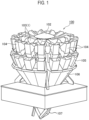
- FIG. 1 is an entire perspective view of the combination weighing apparatus 100.
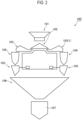
- FIG. 2 is a schematic view of the combination weighing apparatus 100.
- the combination weighing apparatus 100 may include a supply chute 101, a distribution table 102, a radial feeder 103, a pool hopper 104, a weighing hopper 105, a gathering chute 106, and a timing hopper 107.
- the combination weighing apparatus 100 weighs and conveys an article as a target to be weighed.
- the article is, for example, a food.
- Such articles are put into the supply chute 101, and then the articles put in the supply chute 101 are supplied to the distribution table 102.
- the distribution table 102 may convey the articles in a distributing manner.
- the distribution table 102 supplies the articles to a plurality of radial feeders 103 disposed around the distribution table 102.
- the radial feeders 103 each convey the article supplied from the distribution table 102, to the pool hopper 104 provided corresponding to the radial feeder 103.
- the "supply mechanism” according to the present invention may be adopted to at least either a supply chute 101 or a distribution table 102, and the “conveyance mechanism” according to the present invention may be adopted to a radial feeder 103.
- the conveyance mechanism according to the present embodiment is adopted to a radial feeder.
- the conveyance mechanism according to the present invention is not limited to a radial feeder and thus may be provided as a mechanism for a supply chute, a gathering chute, or a pool hopper in a combination weighing apparatus. The conveyance mechanism will be described in detail later.
- each pool hopper 104 may be received by the weighing hopper 105 disposed below the corresponding pool hopper 104.
- Each weighing hopper 105 is disposed downstream of the supply mechanism and temporarily stores the article in order to measure the weight of the article.
- a combination weighing operation may be performed on the basis of the weight value of the article weighted by each weighing hopper 105.
- a combination of articles may be selected such that the result of the combination weighing operation is in a predetermined allowable range and is closest to a target value.
- the articles in the weighing hoppers 105 included in the selected combination may be discharged to the gathering chute 106.
- the gathering chute 106 gathers the articles discharged from the plurality of weighing hoppers 105.
- the articles discharged to the gathering chute 106 may be supplied to the timing hopper 107.
- the timing hopper 107 may supply the articles to, for example, a packaging apparatus installed at the post stage of the conveyance mechanism 1.
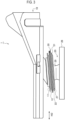
- FIG. 3 is an exploded side view of the conveyance mechanism 1.
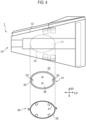
- FIG. 4 is an exploded plan view of the conveyance mechanism 1. Note that, for convenience of description, in FIG. 4 , only a second abutting member 21 is illustrated for a support member 20.
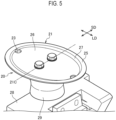
- FIG. 5 is a perspective view of the support member 20.
- the conveyance mechanism 1 according to the present embodiment is adopted to a radial feeder 103.
- the conveyance mechanism 1 may include a trough 10, the support member 20, and a coupling member 30.
- the trough 10 conveys an article.
- the trough 10 includes a conveyance face (conveyance member) 13 for conveyance of an article and a first abutting member 11 that is located on the back side of the conveyance face and abuts on the support member 20.
- the conveyance face 13 extends in the radial direction of the combination weighing apparatus 100 and guides an article to the weighing hopper 105 through the pool hopper 104.
- the first abutting member 11 may be plate-shaped and have an oval shape with a long-axis direction LD and a short-axis direction SD.
- the first abutting member 11 is not necessarily plate-shaped and thus may be columnar or rectangularly parallelepipedic.
- the bottom face of the first abutting member 11 that is columnar may abut on the second abutting member 21.
- the first abutting member 11 is not necessarily oval and thus may be perfectly circular or rectangular in shape.
- the trough 10 is detachably coupled to the support member 20.
- the support member 20 includes the second abutting member 21 that abuts on the trough 10.
- the second abutting member 21 has a second circumferential edge 22 vertically identical to a first circumferential edge 12 that is the circumferential edge of the first abutting member 11.
- the second abutting member 21 may be plate-shaped and have an oval shape with a long-axis direction LD and a short-axis direction SD.
- the first circumferential edge 12 may be identical in shape to the second circumferential edge 22.
- the second abutting member 21 may include an abutting face 25 that abuts on the first abutting member 11, a non-abutting face 26 spaced apart from the first abutting member 11, and a wall 27 extending from the abutting face 25 to the non-abutting face 26, away from the first abutting member 11.
- the abutting face 25 is provided along the second circumferential edge 22, ranging over the entirety of the second circumferential edge 22.
- the non-abutting face 26 is spaced apart from the second circumferential edge 22 and is provided, in plan view, inside the abutting face 25.
- the non-abutting face 26 is surrounded with the abutting face 25 and is recessed below the abutting face 25.
- the circumferential edge of the non-abutting face 26 is similar in shape to the second circumferential edge 22.
- the wall 27 is interposed between the abutting face 25 and the non-abutting face 26.
- the support member 20 includes a vibrator 28 that vibrates the trough 10.
- the vibrator 28 is coupled to the opposite face to a face that the second abutting member 21 has closer to the first abutting member 11.
- the vibrator 28 is coupled to the lower face of the second abutting member 21.
- the support member 20 includes a waterproof cover 29 covering the coupled portion between the vibrator 28 and the second abutting member 21.
- the coupling member (fastening band) 30 couples the trough 10 and the support member 20, detachably.
- the coupling member 30 may include a first frame 31 and a second frame 32.
- the first frame 31 and the second frame 32 each cover half of the first circumferential edge 12 (half of the second circumferential edge 22).
- One end of the first frame 31 and one end of the second frame 32 are coupled pivotably.
- the coupling member 30 fastens the first circumferential edge 12 of the first abutting member 11 and the second circumferential edge 22 of the second abutting member 21 in vertical superposition.
- the coupling member 30 laterally fastens the circumferential edges with the first frame 31 and the second frame 32 and pressurizes the circumferential edges from above and from below. In this manner, the coupling member 30 couples the trough 10 and the support member 20 together.
- a user detaches the trough 10 and the coupling member 30 from the support member 20 and regularly cleanses the trough 10, the support member 20, and the coupling member 30.
- the support member 20 kept installed in the conveyance mechanism 1 is cleansed.
- the second abutting member 21 of the support member 20 is plate-shaped, extending planarly, and thus moisture due to cleansing remains easily thereon.
- the conveyance mechanism 1 according to the present embodiment has the second abutting member 21 enhanced in drainage in the support member 20. Next, the configuration of the second abutting member 21 enhanced in drainage will be described.
- the second abutting member 21 is provided with a through hole 23 passing through the second abutting member 21. Because the second abutting member 21 has the through hole 23, moisture on the second abutting member 21 that is plate-shaped can be discharged through the through hole 23, resulting in an enhancement in the drainage of the second abutting member 21.
- two through holes 23 are provided apart in the long-axis direction LD. However, this configuration is not limitative, the number of through holes 23 may be one or three or more. The through holes 23 may be provided apart in the short-axis direction SD.
- At least part of the through holes 23 may be provided at the non-abutting face 26. Note that part of the plurality of through holes 23 (e.g., one through hole) may be provided at the non-abutting face 26 or part of each through hole 23 may be provided at the non-abutting face 26.
- the non-abutting face 26 of the second abutting member 21 does not abut on the first abutting member 11, so that the first abutting member 11 does not occlude the through holes 23 of the non-abutting face 26. Because of the through holes 23 at least partially provided at the non-abutting face 26, even in the coupling state, moisture on the second abutting member 21 can be discharged through the through holes 23.
- the through holes 23 may be each provided astride the wall 27 and the non-abutting face 26.
- the wall 27 of the second abutting member 21 enables a rise in the rigidity of the second abutting member 21 because the wall 27 functions as a reinforcing rib. Therefore, even with the through holes 23 provided at the second abutting member 21, the second abutting member 21 can be inhibited from deforming, so that the function of supporting the trough 10 can be retained.
- each through hole 23 is astride side faces facing in different directions (the wall 27 and the non-abutting face 26), so that draining can be performed through the plurality of side faces, resulting in a further enhancement in drainage.
- the first abutting member 11 and the second abutting member 21 may each have an oval shape with a long-axis direction LD and a short-axis direction SD.
- first abutting member 11 and the second abutting member 21 are each perfectly circular in shape, because the first abutting member 11 and the second abutting member 21 are each oval in shape, mutual positioning is easier, resulting in an enhancement in operability at the time of coupling.
- At least part of the through holes 23 may be provided at the ends in the long-axis direction LD.
- the length in the long-axis direction LD of the second abutting member 21 is longer than the length in the short-axis direction SD of the second abutting member 21, and thus draining is likely to be difficult to perform over the entire region in the long-axis direction.
- the through holes 23 are provided at the ends in the long-axis direction LD, resulting in an easy enhancement in drainage over the entire region in the long-axis direction LD of the second abutting member 21.
- the second abutting member 21 is disposed at a slant from the horizontal direction HD.
- at least part of the through holes 23 may be disposed below the center 21C in the vertical direction of the second abutting member 21.
- Moisture on the second abutting member 21 is guided by gravity to the lower portion of the second abutting member 21.
- a through hole 23 is provided below the center 21C in the vertical direction of the second abutting member 21, so that the moisture guided downward can be discharged through the through hole 23.
- one of the through holes 23 is disposed below the center 21C in the vertical direction of the second abutting member 21 and the other through hole 23 is disposed above the center 21C in the vertical direction of the second abutting member 21.
- the plurality of through holes 23 is disposed apart in the vertical direction across the center 21C in the vertical direction of the second abutting member 21, so that draining can be performed a plurality of times in the process of downward guiding of moisture on the second abutting member 21, resulting in a further enhancement in drainage.
- the through holes 23 may be provided closer to the second circumferential edge 22 than to the region overlapping the waterproof cover 29. That is, in plan view, the through holes 23 may be provided outside the waterproof cover 29. Moisture remaining on the second abutting member 21 can be discharged outside the waterproof cover 29 covering the vibrator 28 without being discharged in the waterproof cover 29. Thus, an enhancement can be made in drainage on the second abutting member 21 with a waterproof guarantee on the waterproof cover 29.
- Such conveyance mechanisms 1 are used in the combination weighing apparatus 100 and each causes an article supplied from the supply mechanism, to be conveyed to the corresponding weighing hopper 105.
- the second abutting member 21 enhanced in drainage in the support member 20 in each conveyance mechanism 1 enables the trough 10 to hygienically conveys an article to be conveyed.
- the combination weighing apparatus 100 including the conveyance mechanisms 1 can acquire an aggregate of articles weighed as a predetermined value with a hygienic guarantee on articles.
- FIG. 6 is an exploded plan view of the conveyance mechanism 1. Note that, in FIG. 6 , for convenience of description, only the second abutting member 21 is illustrated for the support member 20.
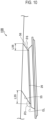
- FIG. 7 is a schematic side view of the trough 10.
- FIG. 8 is a perspective view of the coupling member 30.
- the conveyance face 13 and the first abutting plate member 11 are individually produced, and then the conveyance face 13 and the first abutting member 11 are coupled by the coupling member 30, so that the trough 10 can be produced.
- the coupled portion between each member is continuously welded in order to prevent moisture from coming inside the conveyance mechanism 1 at the time of cleansing of the conveyance mechanism 1.
- the conveyance mechanism 1 according to the present embodiment enables easily continuous welding of the coupling member 30 that couples the conveyance face 13 and the first abutting member 11 in the trough 10.
- the configuration of the coupling member 30 enhanced in operability at the time of welding will be described.
- the coupling member 30 is circular in section. That is the coupling member 30 may be columnar or cylindrical in shape. As illustrated in FIG. 8 , the coupling member 30 according to the present embodiment is cylindrical in shape, having an inner circumferential face and an outer circumferential face 34.
- the coupling member 30 includes a wall 33 extending in the axial direction of the coupling member 30 circular in section, an upper-end face 35 that is located at the upper end of the wall 33 and abuts on the conveyance face 13, and a lower-end face 36 that is located at the lower end of the wall 33 and abuts on the support member 20.
- At least either the upper-end face 35 or the lower-end face 36 is a non-perpendicular end face that has an oval shape with a long-axis direction LD and a short-axis direction SD and is non-perpendicular in angle to the outer circumferential face 34 of the wall 33.
- the angle to the outer circumferential face of the wall 33 may be the angle to the outer circumferential face in sectional view along the long-axis direction LD (section illustrated in FIG. 7 ) or may be the angle to the outer circumferential face in sectional view along the short-axis direction SD. That is the angle to any part of the outer circumferential face of the wall 33 is at least required.
- the upper-end face 35 and the lower-end face 36 each have an angle different from 90 degrees to the outer circumferential face.
- the upper-end face 35 and the lower-end face 36 are each a non-perpendicular end face.
- either the upper-end face 35 or the lower-end face 36 may be a non-perpendicular end face.
- the non-perpendicular end face is non-perpendicular in angle to the outer circumferential face of the wall 33, namely, has an angle different from 90 degrees.
- the non-perpendicular end face has an angle different from 90 degrees to the outer circumferential face, and has a larger sectional area, in comparison to a mode in which the angle to the outer circumferential face is 90 degrees.
- a larger sectional area of the non-perpendicular end face facilitates access to the juncture of the non-perpendicular end face, so that the juncture is continuously welded easily.
- a larger sectional area of the non-perpendicular end face enables securing of the juncture in length, so that a rise can be made in juncture strength.
- junctures 14 of the coupling member 30 are each surrounded and indicated with a dot-and-dash line.
- the length in the long-axis direction LD can be secured long.
- the long-axis direction LD is disposed corresponding to a portion to which it is difficult to put a welding torch, so that an enhancement can be made in the accessibility of the welding torch.
- the sectional shape of the coupling member 30 at 90 degrees to the outer circumferential face 34 of the wall 33 may be perfectly circular.
- FIG. 8 the sectional shape of the coupling member 30 at 90 degrees to the outer circumferential face 34 of the wall 33 is indicated with chain double dashed lines.
- diagonally cutting a cylinder perfectly circular in shape or a column perfectly circular in shape enables acquisition of a non-perpendicular end face oval in shape.
- An appropriate change in cutting angle enables appropriate setting of the aspect ratio of an oval shape, so that the coupling member 30 having a sectional shape having a desired aspect ratio can be acquired.
- the long-axis direction LD of the non-perpendicular end face may be non-perpendicular to the outer circumferential face 34 of the wall 33. Because the long-axis direction LD of the non-perpendicular end face is non-perpendicular to the outer circumferential face 34, the wall 33 extends at a slant from the long-axis direction LD instead of extending perpendicularly to the long-axis direction LD. Therefore, the position of the upper-end face 35 located at the upper end of the wall 33 and the position of the lower-end face 36 located at the lower end of the wall 33 are not identical in the long-axis direction LD. Thus, in comparison to a configuration in which the position of the upper-end face 35 and the position of the lower-end face 36 are identical, the leading end of the welding torch is inserted easier, so that the junctures are continuously welded easier.
- the upper-end face 35 and the lower-end face 36 are each a non-perpendicular end face.
- the upper-end face 35 in the long-axis direction LD and the lower-end face 36 in the long-axis direction LD are not parallel.
- the distance between the upper-end face 35 and the lower-end face 36 on one end side in the long-axis direction LD is different from the distance between the upper-end face 35 and the lower-end face 36 on the other end side in the long-axis direction LD. As illustrated in FIG.
- the wall 33 in a section along the long-axis direction LD and the vertical direction VD, the wall 33 includes a first wall 37 located on one side in the long-axis direction LD and a second wall 38 located on the other side in the long-axis direction LD.
- the length H27 in the vertical direction VD of the first wall 37 is longer than the length H28 in the vertical direction VD of the second wall 38.
- the length L28 in the long-axis direction LD of the second wall 38 is shorter than the length L27 in the long-axis direction LD of the first wall 37. Therefore, in FIG. 7 , the left wall located on the left is the first wall 37 and the right wall on the right is the second wall 38.
- a first upper angle ⁇ 11 between the outer circumferential face 34 of the first wall 37 and an upper-end imaginary line XL extending outward from the upper-end face 35 in the long-axis direction LD along the upper-end face 35 is acute.
- a second upper angle ⁇ 21 between the outer circumferential face 34 of the second wall 38 and the upper-end imaginary line XL is obtuse.
- a first lower angle ⁇ 12 between the outer circumferential face 34 of the first wall 37 and a lower-end imaginary line YL extending outward from the lower-end face 36 in the long-axis direction LD along the lower-end face 36 is obtuse.
- a second lower angle ⁇ 22 between the outer circumferential face 34 of the second wall 38 and the lower-end imaginary line YL is acute. Because the first upper angle ⁇ 11 between the outer circumferential face 34 of the first wall 37 and the upper-end imaginary line XL is acute, the angle between the first wall 37 and the conveyance face 13 is small.
- the upper-end face of the outer circumferential face 34 of the first wall 37 at the first upper angle ⁇ 11 is located, in the long-axis direction, inside the lower-end face of the outer circumferential face 34 of the first wall 37 at the first lower angle ⁇ 12, causing inconvenience in the accessibility of the welding torch.
- the length H27 in the vertical direction VD of the first wall 37 is long, causing a wide space between the members even with a small angle between the members.
- an enhancement can be made in the accessibility of the welding torch. Because the second lower angle ⁇ 22 between the outer circumferential face 34 of the second wall 38 and the lower-end imaginary line YL is acute, the angle between the second wall 38 and the first abutting member 11 is small.
- the lower-end face of the outer circumferential face 34 of the second wall 38 at the second lower angle ⁇ 22 is located, in the long-axis direction, inside the upper-end face of the outer circumferential face 34 of the second wall 38 at the second upper angle ⁇ 21, causing inconvenience in the accessibility of the welding torch.
- the length L28 in the long-axis direction LD of the second wall 38 is short, so that the length by which the juncture 14 is recessed inside in the long-axis direction LD is relatively short. That is the length by which the welding torch is inserted can be shortened. Thus, even with a small angle between the members and a narrow space between the members, the juncture is continuously welded easily with the leading end of the welding torch in contact with the juncture.
- the coupling member 30 is joined to both of the first abutting member 11 and the conveyance face 13.
- the coupling member 30 is not particularly limited in joining order. Preferably, a relatively large area of member is joined and then a relatively small area of member is joined. In comparison to a case where a large area of member is welded and then a small area of member is welded, an enhancement can be made in the accessibility of the welding torch in the latter half of welding work. According to the present embodiment, the area of the first abutting member 11 is smaller than the area of the conveyance face 13. Thus, the first abutting member 11 may be joined to the coupling member 30 after the conveyance face 13 is joined to the coupling member 30.
- Either the upper-end face 35 or the lower-end face 36 is required to be a non-perpendicular end face.
- troughs 10A and 10B in the following configurations are similar to that in the configuration described above.
- Each following configuration will be given with a third wall 53 and a fourth wall 54 or a fifth wall 55 and a sixth wall 56 instead of the first wall 37 and the second wall 38 in the configuration described above.
- FIG. 9 is a schematic side view of the trough 10A.
- a wall includes the third wall 53 and the fourth wall 54 shorter in length in the vertical direction VD than the third wall 53. That is the length H53 in the vertical direction VD of the third wall 53 is longer than the length H54 in the vertical direction VD of the fourth wall 54.
- the wall located on the left in FIG. 9 is the third wall 53 and the wall located on the right in FIG. 9 is the fourth wall 54.
- An upper-end face 35 is a non-perpendicular end face.
- a third angle ⁇ 3 between the outer circumferential face of the third wall 53 and a long-axis imaginary line EL extending outward from the non-perpendicular end face (upper-end face 35) in the long-axis direction LD along the non-perpendicular end face is acute.
- a fourth angle ⁇ 4 between the outer circumferential face of the fourth wall 54 and the long-axis imaginary line EL is obtuse. Because the third angle ⁇ 3 between the outer circumferential face of the third wall 53 and the long-axis imaginary line EL is acute, the angle between the members (the third wall 53 and the conveyance face 13) is small.
- the upper-end face of the outer circumferential face of the third wall 53 at the third angle ⁇ 3 is located, in the long-axis direction, inside the lower-end face of the outer circumferential face of the third wall 53, causing inconvenience in the accessibility of the welding torch.
- the length H53 in the vertical direction VD of the third wall 53 is long, causing a wide space between the members even with a small angle between the members.
- an enhancement can be made in the accessibility of the welding torch.
- a long length in the vertical direction of the wall (a long distance between the first abutting member 11 and the conveyance face 13) enables an enhancement in the accessibility of the welding torch.
- FIG. 10 is a schematic side view of the trough 10B.
- a wall includes the fifth wall 55 and the sixth wall 56 shorter in length in the long-axis direction LD than the fifth wall 55. That is the length L55 in the long-axis direction LD of the fifth wall 55 is longer than the length L56 in the long-axis direction LD of the sixth wall 56.
- the wall located on the left in FIG. 10 is the fifth wall 55 and the wall located on the right in FIG. 10 is the sixth wall 56.
- a lower-end face 36 is a non-perpendicular end face.
- a fifth angle ⁇ 5 between the outer circumferential face of the fifth wall 55 and a long-axis imaginary line EL extending outward from the non-perpendicular end face in the long-axis direction LD along the non-perpendicular end face is obtuse.
- a sixth angle ⁇ 6 between the outer circumferential face of the sixth wall 56 and the long-axis imaginary line EL is acute. Because the sixth angle ⁇ 6 between the outer circumferential face of the sixth wall 56 and the long-axis imaginary line EL is acute, the angle between the members (the sixth wall 56 and the first abutting member 11) is small.
- the lower-end face of the outer circumferential face of the sixth wall 56 at the sixth angle ⁇ 6 is located, in the long-axis direction LD, inside the upper-end face of the outer circumferential face of the sixth wall 56, causing inconvenience in the accessibility of the welding torch.
- the length L56 in the long-axis direction LD of the sixth wall 56 is short, so that the length by which the juncture 14 is recessed inside in the long-axis direction LD is relatively short. That is the length by which the welding torch is inserted can be shortened.
- the juncture 14 is continuously welded easily with the leading end of the welding torch in contact with the juncture 14.
- a short length in the long-axis direction LD of the wall allows the length by which the welding torch is inserted to be shortened, resulting in retention of the accessibility of the welding torch.
- Such conveyance mechanisms 1 are used in the combination weighing apparatus 100 and each causes an article supplied from the supply mechanism, to be conveyed to the corresponding weighing hopper 105.
- the junctures 14 in the troughs 10, 10A, and 10B are continuously welded in order to prevent moisture from coming inside from around, so that the troughs 10, 10A, and 10B can each hygienically convey an article to be conveyed.
- the combination weighing apparatus 100 including the conveyance mechanisms 1 can acquire an aggregate of articles weighed as a predetermined value with a hygienic guarantee on articles.
- a conveyance mechanism includes: a trough (10) that conveys an article; a support member (30) to which the trough is detachably coupled, the support member including a vibrator that vibrates the trough.
- the trough includes a conveyance member (12) that conveys the article; a plate member (11) that abuts on the support member; and a coupling member (20) that couples the conveyance member (12) and the plate member (11).
- the coupling member (20) has a circular shape in section and includes: a wall (23) extending in an axial direction of the circular shape; an upper-end face (25) that is located at an upper end of the wall and abuts on the conveyance member (12); and a lower-end face (26) that is located at a lower end of the wall and abuts on the support member (30).
- At least either the upper-end face or the lower-end face is a non-perpendicular end face that has an oval shape with a long-axis direction (LD) and a short-axis direction (SD) and is non-perpendicular in angle to an outer circumferential face of the wall.
- LD long-axis direction
- SD short-axis direction
- the non-perpendicular end face is non-perpendicular in angle to the outer circumferential face of the wall, namely, has an angle different from 90 degrees.
- the non-perpendicular end face has an angle different from 90 degrees to the outer circumferential face, and has a larger sectional area, in comparison to a mode in which the angle to the outer circumferential face is 90 degrees.
- a larger sectional area of the non-perpendicular end face facilitates access to the juncture of the non-perpendicular end face, so that the juncture is continuously welded easily.
- a larger sectional area of the non-perpendicular end face enables securing of the juncture in length, so that a rise can be made in juncture strength.
- the length in the long-axis direction can be secured long.
- a long-axis portion is disposed corresponding to a portion to which it is difficult to put the welding torch, so that an enhancement can be made in the accessibility of the welding torch.
- a sectional shape of the coupling member at 90 degrees to the outer circumferential face of the wall is perfectly circular, and the long-axis direction (LD) of the non-perpendicular end face is non-perpendicular to the outer circumferential face of the wall.
- the sectional shape at 90 degrees to the outer circumferential face of the wall is perfectly circular, and diagonally cutting a cylinder perfectly circular in shape or a column perfectly circular in shape enables acquisition of a non-perpendicular end face oval in shape.
- An appropriate change in cutting angle enables appropriate setting of the aspect ratio of an oval shape, so that the coupling member having a sectional shape having a desired aspect ratio can be acquired.
- the position of the upper-end face located at the upper end of the wall and the position of the lower-end face located at the lower end of the wall are not identical in the long-axis direction.
- the leading end of the welding torch is inserted easier, so that the junctions are continuously welded easier.
- the wall in a section along the long-axis direction and a vertical direction, includes a first wall (27) located on one side in the long-axis direction and a second wall (28) located on another side in the long-axis direction, the upper-end face and the lower-end face are each the non-perpendicular end face, a first upper angle ( ⁇ 11) between an outer circumferential face of the first wall and an upper-end imaginary line (XL) extending outward from the upper-end face in the long-axis direction along the upper-end face is acute, a second upper angle ( ⁇ 21) between an outer circumferential face of the second wall and the upper-end imaginary line is obtuse, a first lower angle ( ⁇ 12) between the outer circumferential face of the first wall and a lower-end imaginary line (YL) extending outward from the lower-end face in the long-axis direction along the lower-end face is obtuse, a second lower angle ( ⁇ 22) between the outer circumferential face
- the first upper angle between the outer circumferential face of the first wall and the upper-end imaginary line is acute, so that the angle between the first wall and the conveyance member is small.
- the length (H27) in the vertical direction of the first wall is long, causing a wide space between the members even with a small angle between the members.
- an enhancement can be made in the accessibility of the welding torch.
- the second lower angle between the outer circumferential face of the second wall and the lower-end imaginary line is acute, so that the angle between the second wall and the plate member is small.
- the length (L28) in the long-axis direction of the second wall is short, so that the length by which the juncture is recessed inside in the long-axis direction is relatively short.
- the length by which the welding torch is inserted can be shortened.
- the juncture is continuously welded easily with the leading end of the welding torch in contact with the juncture.
- the wall in a section along the long-axis direction and a vertical direction, includes a third wall (53) located on one side in the long-axis direction and a fourth wall (54) that is located on another side in the long-axis direction and is shorter in length in the vertical direction than the third wall.
- a third angle ( ⁇ 3) between an outer circumferential face of the third wall and a long-axis imaginary line (EL) extending outward from the non-perpendicular end face in the long-axis direction along the non-perpendicular end face is acute
- a fourth angle ( ⁇ 4) between an outer circumferential face of the fourth wall and the long-axis imaginary line (EL) is obtuse.
- the third angle between the outer circumferential face of the third wall and the long-axis imaginary line is acute, so that the angle between the members (the third wall and the conveyance member or the third wall and the plate member) is small.
- the length (H53) in the vertical direction of the third wall is long, causing a wide space between the members even with a small angle between the members.
- an enhancement can be made in the accessibility of the welding torch.
- the wall in a section along the long-axis direction and a vertical direction, includes a fifth wall (55) located on one side in the long-axis direction and a sixth wall (56) that is located on another side in the long-axis direction and is shorter in length in the long-axis direction than the fifth wall.
- a fifth angle ( ⁇ 5) between an outer circumferential face of the fifth wall and a long-axis imaginary line (EL) extending outward from the non-perpendicular end face in the long-axis direction along the non-perpendicular end face is obtuse
- a sixth angle ( ⁇ 6) between an outer circumferential face of the sixth wall and the long-axis imaginary line (EL) is acute.
- the sixth angle between the outer circumferential face of the sixth wall and the long-axis imaginary line is acute, so that the angle between the members (the sixth wall and the conveyance member or the sixth wall and the plate member) is small.
- the length (L56) in the long-axis direction of the sixth wall is short, so that the length by which the juncture is recessed inside in the long-axis direction is relatively short. That is the length by which the welding torch is inserted can be shortened.
- the juncture is continuously welded easily with the leading end of the welding torch in contact with the juncture.
- a combination weighing apparatus includes: a plurality of the above conveyance mechanisms (1); a supply mechanism of supplying articles; a plurality of weighing hoppers (105) that is provided downstream of the supply mechanism and each temporarily stores an article in order to measure a weight of the article; and a gathering chute (106) that gathers the articles discharged from the plurality of weighing hoppers.
- the plurality of the conveyance mechanisms conveys the articles supplied from the supply mechanism, to the plurality of weighing hoppers.
- the junctures in each trough are continuously welded in order to prevent moisture from coming inside from around, so that each trough can hygienically convey an article to be conveyed.
- acquired can be an aggregate of articles weighed as a predetermined value with a hygienic guarantee on articles.
Landscapes
- Engineering & Computer Science (AREA)
- Mechanical Engineering (AREA)
- Physics & Mathematics (AREA)
- General Physics & Mathematics (AREA)
- Jigging Conveyors (AREA)
- Feeding Of Articles To Conveyors (AREA)
- Filling Or Emptying Of Bunkers, Hoppers, And Tanks (AREA)
Claims (6)
- Mécanisme de transport (1) comprenant :un bac (10, 10A, 10B) transportant un article ;un élément de support (20) auquel le bac est couplé de façon amovible, l'élément de support comprenant un vibreur (28) faisant vibrer le bac ; etun élément de couplage (30) couplant le bac à élément de support,le bac comprenant un premier élément contigu (11) situé sur un côté postérieur d'une face de transport (13) pour le transport de l'article, et étant contigu à l'élément de support,l'élément de support comprenant un deuxième élément contigu (21) en forme de plaque et possédant un deuxième bord circonférentiel (22) identique verticalement à un premier bord circonférentiel (12), qui est un bord circonférentiel du premier élément contigu,l'élément de couplage couplant le bac à l'élément de support en fixant le premier élément contigu et le deuxième élément contigu avec le premier bord circonférentiel et le deuxième bord circonférentiel de façon superposée,le deuxième élément contigu étant doté d'un orifice traversant (23) qui traverse le deuxième élément contigucaractérisé en ce que le deuxième élément contigu comprend, dans un état d'accouplement où le deuxième élément contigu est couplé au premier élément contigu par l'élément de couplage, une face de butée (25) contigüe au premier élément contigu et une face non contigüe (26) espacée du premier élément contigu, etau moins une partie de l'orifice traversant étant pratiquée sur la face non contigüe.
- Mécanisme de transport selon la revendication 1,
le deuxième élément contigu comprenant une paroi (27) s'étendant de la face contigüe à la face non contigüe, éloigné du premier élément contigu, et au moins une partie de l'orifice traversant étant agencé de façon à chevaucher la paroi et la face non contigüe. - Mécanisme de transport selon la revendication 1 ou 2,le premier élément contigu et le deuxième élément contigu étant de forme ovale, avec une direction d'axe long (LD) et une direction d'axe court (SD), etau moins une partie de l'orifice traversant étant agencée à un bout dans la direction d'axe long du deuxième élément contigu.
- Mécanisme de transport selon la revendication 3,le deuxième élément contigu étant disposé de façon oblique depuis la direction horizontale (HD), etau moins une partie de l'orifice traversant étant disposée sous un centre dans une direction verticale (VD) du deuxième élément contigu.
- Mécanisme de transport selon une quelconque des revendications 1 à 4,le vibreur étant couplé à une face opposée à une face pour laquelle le deuxième élément contigu est plus proche du premier élément contigu,l'élément de support comprenant un couvercle étanche (29) couvrant une partie couplée entre le vibreur et le deuxième élément contigu, etl'orifice traversant étant agencé de façon plus rapprochée du deuxième bord circonférentiel qu'une zone chevauchant le couvercle étanche.
- Appareil de pesée combiné (100) comprenant :une pluralité de mécanismes de transport selon une quelconque des revendications 1 à 5 ;un mécanisme de distribution pour la distribution d'articles ;une pluralité de trémies de pesée (105) agencées en aval du mécanisme de distribution, chacune stockant provisoirement un article afin d'en mesurer le poids ; etune goulotte de collecte (106) recueillant les articles refoulés par la pluralité de trémies de pesée,la pluralité de mécanismes de transport transportant les articles distribués du mécanisme de distribution à la pluralité de trémies de pesée.
Applications Claiming Priority (2)
| Application Number | Priority Date | Filing Date | Title |
|---|---|---|---|
| JP2020040883A JP7474469B2 (ja) | 2020-03-10 | 2020-03-10 | 搬送機構及び組合せ計量機 |
| JP2020047425A JP7421796B2 (ja) | 2020-03-18 | 2020-03-18 | 搬送機構及び組合せ計量機 |
Publications (3)
| Publication Number | Publication Date |
|---|---|
| EP3879246A2 EP3879246A2 (fr) | 2021-09-15 |
| EP3879246A3 EP3879246A3 (fr) | 2021-11-17 |
| EP3879246B1 true EP3879246B1 (fr) | 2023-09-13 |
Family
ID=74859202
Family Applications (1)
| Application Number | Title | Priority Date | Filing Date |
|---|---|---|---|
| EP21160802.1A Active EP3879246B1 (fr) | 2020-03-10 | 2021-03-04 | Mécanisme de transport et appareil de pesée combiné |
Country Status (4)
| Country | Link |
|---|---|
| US (1) | US12038318B2 (fr) |
| EP (1) | EP3879246B1 (fr) |
| CN (1) | CN113371264B (fr) |
| DK (1) | DK3879246T3 (fr) |
Family Cites Families (19)
| Publication number | Priority date | Publication date | Assignee | Title |
|---|---|---|---|---|
| JPS622508Y2 (fr) * | 1980-09-01 | 1987-01-21 | ||
| JPS5962516U (ja) * | 1982-10-19 | 1984-04-24 | 株式会社石田衡品製作所 | 自動計量装置の分散供給装置 |
| DE3574407D1 (en) * | 1984-09-20 | 1989-12-28 | Ishida Scale Mfg Co Ltd | Weighing apparatus |
| DE4314660A1 (de) * | 1993-05-04 | 1994-11-10 | Bosch Gmbh Robert | Schnellspannvorrichtung für einen Schwingförderer |
| JP3485630B2 (ja) * | 1994-04-15 | 2004-01-13 | 株式会社イシダ | 加振式搬送装置のトラフ取り付け構造 |
| DE19617821C2 (de) * | 1996-05-03 | 1998-07-16 | Multipond Waegetechnik Gmbh | Kombinationswaage |
| US5946891A (en) * | 1996-07-22 | 1999-09-07 | Fmc Corporation | Controllable stop vibratory feeder |
| US6365845B1 (en) * | 1999-11-16 | 2002-04-02 | Triangle Package Machinery Company | Sanitary weighing machine |
| US20050126893A1 (en) * | 2002-04-19 | 2005-06-16 | Hermann Berger | Device for adjusting the inclination of a vibrating conveyor |
| JP6034652B2 (ja) * | 2012-10-22 | 2016-11-30 | 株式会社イシダ | 組合せ計量装置 |
| JP6052797B2 (ja) * | 2013-06-18 | 2016-12-27 | 大和製衡株式会社 | 振動フィーダ及びこれを備えた組合せ秤 |
| EP3196153A4 (fr) * | 2014-09-19 | 2017-10-25 | Ishida Co., Ltd. | Transporteur à secousses comportant un mécanisme de fixation/séparation d'auge, et dispositif de pesage combiné |
| CN204710824U (zh) * | 2015-05-04 | 2015-10-21 | 群光电子(苏州)有限公司 | 水洗机倾斜转盘 |
| CN204710842U (zh) | 2015-05-28 | 2015-10-21 | 姜颖利 | 一种垃圾处理系统 |
| JP2017026339A (ja) | 2015-07-16 | 2017-02-02 | 株式会社イシダ | 搬送装置とそれを備えた組合せ計量装置 |
| EP3251984B1 (fr) * | 2016-05-31 | 2018-10-31 | Multipond Wägetechnik GmbH | Dispositif de raccordement |
| JP6804764B2 (ja) * | 2017-03-17 | 2020-12-23 | 株式会社イシダ | 組合せ計量装置 |
| CN208912625U (zh) * | 2018-05-31 | 2019-05-31 | 蚌埠金光车轮有限公司 | 一种金属板翻转冲洗装置 |
| US12351395B2 (en) * | 2020-03-12 | 2025-07-08 | Yamato Scale Co., Ltd. | Seal structure and weighing machine comprising same |
-
2021
- 2021-03-04 EP EP21160802.1A patent/EP3879246B1/fr active Active
- 2021-03-04 DK DK21160802.1T patent/DK3879246T3/da active
- 2021-03-08 US US17/195,033 patent/US12038318B2/en active Active
- 2021-03-09 CN CN202110254544.0A patent/CN113371264B/zh active Active
Also Published As
| Publication number | Publication date |
|---|---|
| US12038318B2 (en) | 2024-07-16 |
| US20210285811A1 (en) | 2021-09-16 |
| EP3879246A2 (fr) | 2021-09-15 |
| DK3879246T3 (da) | 2023-10-02 |
| CN113371264A (zh) | 2021-09-10 |
| CN113371264B (zh) | 2023-09-12 |
| EP3879246A3 (fr) | 2021-11-17 |
Similar Documents
| Publication | Publication Date | Title |
|---|---|---|
| JP6599878B2 (ja) | 組合せ計量装置 | |
| CN107079598B (zh) | 物品处理装置 | |
| EP3879246A2 (fr) | Mécanisme de transport et appareil de pesée combiné | |
| US20090261230A1 (en) | Support frame for robots | |
| JPWO2015108117A1 (ja) | 組合せ計量装置 | |
| US9464931B2 (en) | Combination weigher | |
| JPWO2012057353A1 (ja) | 容器 | |
| EP3598085B1 (fr) | Dispositif de pesage combiné | |
| US11975923B2 (en) | Article retaining device and supporting body | |
| JP7421796B2 (ja) | 搬送機構及び組合せ計量機 | |
| JP6396983B2 (ja) | 組合せ計量装置 | |
| EP3517905A1 (fr) | Goulotte de collecte et dispositif de pesage combiné équipé de cette dernière | |
| JP7474469B2 (ja) | 搬送機構及び組合せ計量機 | |
| JP6631967B2 (ja) | 組合せ秤における搬送幅規制装置 | |
| US20170211967A1 (en) | Combination weighing device | |
| JP2015232518A (ja) | 物品規制装置及びこれを備える組合せ秤 | |
| JP5468417B2 (ja) | 組合せ計量装置 | |
| JP4072358B2 (ja) | 組合せ秤用物品供給装置 | |
| JP2014224709A (ja) | 物品搬送構造及びこれを備えた組合せ秤 | |
| JP2018155636A (ja) | 分散装置及び組合せ計量装置 | |
| JP2015001508A (ja) | 振動フィーダ及びこれを備えた組合せ秤 | |
| JP2015232516A (ja) | 物品供給調整装置及びこれを備える組合せ秤 | |
| JP2009019939A (ja) | 組合せ秤の集合ファンネル | |
| JP2021147052A (ja) | 包装機 | |
| ITVR20010068A1 (it) | Mangiatoia in particolare per avicoltura. |
Legal Events
| Date | Code | Title | Description |
|---|---|---|---|
| PUAI | Public reference made under article 153(3) epc to a published international application that has entered the european phase |
Free format text: ORIGINAL CODE: 0009012 |
|
| STAA | Information on the status of an ep patent application or granted ep patent |
Free format text: STATUS: REQUEST FOR EXAMINATION WAS MADE |
|
| 17P | Request for examination filed |
Effective date: 20210304 |
|
| AK | Designated contracting states |
Kind code of ref document: A2 Designated state(s): AL AT BE BG CH CY CZ DE DK EE ES FI FR GB GR HR HU IE IS IT LI LT LU LV MC MK MT NL NO PL PT RO RS SE SI SK SM TR |
|
| PUAL | Search report despatched |
Free format text: ORIGINAL CODE: 0009013 |
|
| AK | Designated contracting states |
Kind code of ref document: A3 Designated state(s): AL AT BE BG CH CY CZ DE DK EE ES FI FR GB GR HR HU IE IS IT LI LT LU LV MC MK MT NL NO PL PT RO RS SE SI SK SM TR |
|
| RIC1 | Information provided on ipc code assigned before grant |
Ipc: G01G 13/02 20060101ALI20211011BHEP Ipc: G01G 19/393 20060101AFI20211011BHEP |
|
| GRAP | Despatch of communication of intention to grant a patent |
Free format text: ORIGINAL CODE: EPIDOSNIGR1 |
|
| STAA | Information on the status of an ep patent application or granted ep patent |
Free format text: STATUS: GRANT OF PATENT IS INTENDED |
|
| INTG | Intention to grant announced |
Effective date: 20230418 |
|
| RAP3 | Party data changed (applicant data changed or rights of an application transferred) |
Owner name: ISHIDA CO., LTD. |
|
| GRAS | Grant fee paid |
Free format text: ORIGINAL CODE: EPIDOSNIGR3 |
|
| GRAA | (expected) grant |
Free format text: ORIGINAL CODE: 0009210 |
|
| STAA | Information on the status of an ep patent application or granted ep patent |
Free format text: STATUS: THE PATENT HAS BEEN GRANTED |
|
| AK | Designated contracting states |
Kind code of ref document: B1 Designated state(s): AL AT BE BG CH CY CZ DE DK EE ES FI FR GB GR HR HU IE IS IT LI LT LU LV MC MK MT NL NO PL PT RO RS SE SI SK SM TR |
|
| REG | Reference to a national code |
Ref country code: CH Ref legal event code: EP |
|
| REG | Reference to a national code |
Ref country code: DE Ref legal event code: R096 Ref document number: 602021005040 Country of ref document: DE |
|
| REG | Reference to a national code |
Ref country code: DK Ref legal event code: T3 Effective date: 20230926 |
|
| REG | Reference to a national code |
Ref country code: IE Ref legal event code: FG4D |
|
| REG | Reference to a national code |
Ref country code: LT Ref legal event code: MG9D |
|
| REG | Reference to a national code |
Ref country code: NL Ref legal event code: MP Effective date: 20230913 |
|
| PG25 | Lapsed in a contracting state [announced via postgrant information from national office to epo] |
Ref country code: GR Free format text: LAPSE BECAUSE OF FAILURE TO SUBMIT A TRANSLATION OF THE DESCRIPTION OR TO PAY THE FEE WITHIN THE PRESCRIBED TIME-LIMIT Effective date: 20231214 |
|
| PG25 | Lapsed in a contracting state [announced via postgrant information from national office to epo] |
Ref country code: SE Free format text: LAPSE BECAUSE OF FAILURE TO SUBMIT A TRANSLATION OF THE DESCRIPTION OR TO PAY THE FEE WITHIN THE PRESCRIBED TIME-LIMIT Effective date: 20230913 Ref country code: RS Free format text: LAPSE BECAUSE OF FAILURE TO SUBMIT A TRANSLATION OF THE DESCRIPTION OR TO PAY THE FEE WITHIN THE PRESCRIBED TIME-LIMIT Effective date: 20230913 Ref country code: NO Free format text: LAPSE BECAUSE OF FAILURE TO SUBMIT A TRANSLATION OF THE DESCRIPTION OR TO PAY THE FEE WITHIN THE PRESCRIBED TIME-LIMIT Effective date: 20231213 Ref country code: LV Free format text: LAPSE BECAUSE OF FAILURE TO SUBMIT A TRANSLATION OF THE DESCRIPTION OR TO PAY THE FEE WITHIN THE PRESCRIBED TIME-LIMIT Effective date: 20230913 Ref country code: LT Free format text: LAPSE BECAUSE OF FAILURE TO SUBMIT A TRANSLATION OF THE DESCRIPTION OR TO PAY THE FEE WITHIN THE PRESCRIBED TIME-LIMIT Effective date: 20230913 Ref country code: HR Free format text: LAPSE BECAUSE OF FAILURE TO SUBMIT A TRANSLATION OF THE DESCRIPTION OR TO PAY THE FEE WITHIN THE PRESCRIBED TIME-LIMIT Effective date: 20230913 Ref country code: GR Free format text: LAPSE BECAUSE OF FAILURE TO SUBMIT A TRANSLATION OF THE DESCRIPTION OR TO PAY THE FEE WITHIN THE PRESCRIBED TIME-LIMIT Effective date: 20231214 Ref country code: FI Free format text: LAPSE BECAUSE OF FAILURE TO SUBMIT A TRANSLATION OF THE DESCRIPTION OR TO PAY THE FEE WITHIN THE PRESCRIBED TIME-LIMIT Effective date: 20230913 |
|
| REG | Reference to a national code |
Ref country code: AT Ref legal event code: MK05 Ref document number: 1611726 Country of ref document: AT Kind code of ref document: T Effective date: 20230913 |
|
| PG25 | Lapsed in a contracting state [announced via postgrant information from national office to epo] |
Ref country code: NL Free format text: LAPSE BECAUSE OF FAILURE TO SUBMIT A TRANSLATION OF THE DESCRIPTION OR TO PAY THE FEE WITHIN THE PRESCRIBED TIME-LIMIT Effective date: 20230913 |
|
| PG25 | Lapsed in a contracting state [announced via postgrant information from national office to epo] |
Ref country code: IS Free format text: LAPSE BECAUSE OF FAILURE TO SUBMIT A TRANSLATION OF THE DESCRIPTION OR TO PAY THE FEE WITHIN THE PRESCRIBED TIME-LIMIT Effective date: 20240113 |
|
| PG25 | Lapsed in a contracting state [announced via postgrant information from national office to epo] |
Ref country code: AT Free format text: LAPSE BECAUSE OF FAILURE TO SUBMIT A TRANSLATION OF THE DESCRIPTION OR TO PAY THE FEE WITHIN THE PRESCRIBED TIME-LIMIT Effective date: 20230913 |
|
| PG25 | Lapsed in a contracting state [announced via postgrant information from national office to epo] |
Ref country code: ES Free format text: LAPSE BECAUSE OF FAILURE TO SUBMIT A TRANSLATION OF THE DESCRIPTION OR TO PAY THE FEE WITHIN THE PRESCRIBED TIME-LIMIT Effective date: 20230913 |
|
| PG25 | Lapsed in a contracting state [announced via postgrant information from national office to epo] |
Ref country code: SM Free format text: LAPSE BECAUSE OF FAILURE TO SUBMIT A TRANSLATION OF THE DESCRIPTION OR TO PAY THE FEE WITHIN THE PRESCRIBED TIME-LIMIT Effective date: 20230913 Ref country code: RO Free format text: LAPSE BECAUSE OF FAILURE TO SUBMIT A TRANSLATION OF THE DESCRIPTION OR TO PAY THE FEE WITHIN THE PRESCRIBED TIME-LIMIT Effective date: 20230913 Ref country code: IS Free format text: LAPSE BECAUSE OF FAILURE TO SUBMIT A TRANSLATION OF THE DESCRIPTION OR TO PAY THE FEE WITHIN THE PRESCRIBED TIME-LIMIT Effective date: 20240113 Ref country code: ES Free format text: LAPSE BECAUSE OF FAILURE TO SUBMIT A TRANSLATION OF THE DESCRIPTION OR TO PAY THE FEE WITHIN THE PRESCRIBED TIME-LIMIT Effective date: 20230913 Ref country code: EE Free format text: LAPSE BECAUSE OF FAILURE TO SUBMIT A TRANSLATION OF THE DESCRIPTION OR TO PAY THE FEE WITHIN THE PRESCRIBED TIME-LIMIT Effective date: 20230913 Ref country code: CZ Free format text: LAPSE BECAUSE OF FAILURE TO SUBMIT A TRANSLATION OF THE DESCRIPTION OR TO PAY THE FEE WITHIN THE PRESCRIBED TIME-LIMIT Effective date: 20230913 Ref country code: AT Free format text: LAPSE BECAUSE OF FAILURE TO SUBMIT A TRANSLATION OF THE DESCRIPTION OR TO PAY THE FEE WITHIN THE PRESCRIBED TIME-LIMIT Effective date: 20230913 Ref country code: PT Free format text: LAPSE BECAUSE OF FAILURE TO SUBMIT A TRANSLATION OF THE DESCRIPTION OR TO PAY THE FEE WITHIN THE PRESCRIBED TIME-LIMIT Effective date: 20240115 Ref country code: SK Free format text: LAPSE BECAUSE OF FAILURE TO SUBMIT A TRANSLATION OF THE DESCRIPTION OR TO PAY THE FEE WITHIN THE PRESCRIBED TIME-LIMIT Effective date: 20230913 |
|
| PG25 | Lapsed in a contracting state [announced via postgrant information from national office to epo] |
Ref country code: PL Free format text: LAPSE BECAUSE OF FAILURE TO SUBMIT A TRANSLATION OF THE DESCRIPTION OR TO PAY THE FEE WITHIN THE PRESCRIBED TIME-LIMIT Effective date: 20230913 Ref country code: IT Free format text: LAPSE BECAUSE OF FAILURE TO SUBMIT A TRANSLATION OF THE DESCRIPTION OR TO PAY THE FEE WITHIN THE PRESCRIBED TIME-LIMIT Effective date: 20230913 |
|
| REG | Reference to a national code |
Ref country code: DE Ref legal event code: R097 Ref document number: 602021005040 Country of ref document: DE |
|
| PLBE | No opposition filed within time limit |
Free format text: ORIGINAL CODE: 0009261 |
|
| STAA | Information on the status of an ep patent application or granted ep patent |
Free format text: STATUS: NO OPPOSITION FILED WITHIN TIME LIMIT |
|
| 26N | No opposition filed |
Effective date: 20240614 |
|
| PG25 | Lapsed in a contracting state [announced via postgrant information from national office to epo] |
Ref country code: SI Free format text: LAPSE BECAUSE OF FAILURE TO SUBMIT A TRANSLATION OF THE DESCRIPTION OR TO PAY THE FEE WITHIN THE PRESCRIBED TIME-LIMIT Effective date: 20230913 |
|
| PG25 | Lapsed in a contracting state [announced via postgrant information from national office to epo] |
Ref country code: SI Free format text: LAPSE BECAUSE OF FAILURE TO SUBMIT A TRANSLATION OF THE DESCRIPTION OR TO PAY THE FEE WITHIN THE PRESCRIBED TIME-LIMIT Effective date: 20230913 |
|
| REG | Reference to a national code |
Ref country code: CH Ref legal event code: PL |
|
| PG25 | Lapsed in a contracting state [announced via postgrant information from national office to epo] |
Ref country code: BG Free format text: LAPSE BECAUSE OF FAILURE TO SUBMIT A TRANSLATION OF THE DESCRIPTION OR TO PAY THE FEE WITHIN THE PRESCRIBED TIME-LIMIT Effective date: 20230913 |
|
| PG25 | Lapsed in a contracting state [announced via postgrant information from national office to epo] |
Ref country code: LU Free format text: LAPSE BECAUSE OF NON-PAYMENT OF DUE FEES Effective date: 20240304 |
|
| PG25 | Lapsed in a contracting state [announced via postgrant information from national office to epo] |
Ref country code: MC Free format text: LAPSE BECAUSE OF FAILURE TO SUBMIT A TRANSLATION OF THE DESCRIPTION OR TO PAY THE FEE WITHIN THE PRESCRIBED TIME-LIMIT Effective date: 20230913 |
|
| PG25 | Lapsed in a contracting state [announced via postgrant information from national office to epo] |
Ref country code: MC Free format text: LAPSE BECAUSE OF FAILURE TO SUBMIT A TRANSLATION OF THE DESCRIPTION OR TO PAY THE FEE WITHIN THE PRESCRIBED TIME-LIMIT Effective date: 20230913 Ref country code: LU Free format text: LAPSE BECAUSE OF NON-PAYMENT OF DUE FEES Effective date: 20240304 Ref country code: BG Free format text: LAPSE BECAUSE OF FAILURE TO SUBMIT A TRANSLATION OF THE DESCRIPTION OR TO PAY THE FEE WITHIN THE PRESCRIBED TIME-LIMIT Effective date: 20230913 |
|
| REG | Reference to a national code |
Ref country code: BE Ref legal event code: MM Effective date: 20240331 |
|
| PG25 | Lapsed in a contracting state [announced via postgrant information from national office to epo] |
Ref country code: BE Free format text: LAPSE BECAUSE OF NON-PAYMENT OF DUE FEES Effective date: 20240331 |
|
| PG25 | Lapsed in a contracting state [announced via postgrant information from national office to epo] |
Ref country code: FR Free format text: LAPSE BECAUSE OF NON-PAYMENT OF DUE FEES Effective date: 20240331 |
|
| PG25 | Lapsed in a contracting state [announced via postgrant information from national office to epo] |
Ref country code: IE Free format text: LAPSE BECAUSE OF NON-PAYMENT OF DUE FEES Effective date: 20240304 |
|
| PG25 | Lapsed in a contracting state [announced via postgrant information from national office to epo] |
Ref country code: IE Free format text: LAPSE BECAUSE OF NON-PAYMENT OF DUE FEES Effective date: 20240304 Ref country code: FR Free format text: LAPSE BECAUSE OF NON-PAYMENT OF DUE FEES Effective date: 20240331 Ref country code: BE Free format text: LAPSE BECAUSE OF NON-PAYMENT OF DUE FEES Effective date: 20240331 Ref country code: CH Free format text: LAPSE BECAUSE OF NON-PAYMENT OF DUE FEES Effective date: 20240331 |
|
| PG25 | Lapsed in a contracting state [announced via postgrant information from national office to epo] |
Ref country code: CY Free format text: LAPSE BECAUSE OF FAILURE TO SUBMIT A TRANSLATION OF THE DESCRIPTION OR TO PAY THE FEE WITHIN THE PRESCRIBED TIME-LIMIT; INVALID AB INITIO Effective date: 20210304 |
|
| PG25 | Lapsed in a contracting state [announced via postgrant information from national office to epo] |
Ref country code: HU Free format text: LAPSE BECAUSE OF FAILURE TO SUBMIT A TRANSLATION OF THE DESCRIPTION OR TO PAY THE FEE WITHIN THE PRESCRIBED TIME-LIMIT; INVALID AB INITIO Effective date: 20210304 |
|
| GBPC | Gb: european patent ceased through non-payment of renewal fee |
Effective date: 20250304 |
|
| PG25 | Lapsed in a contracting state [announced via postgrant information from national office to epo] |
Ref country code: TR Free format text: LAPSE BECAUSE OF FAILURE TO SUBMIT A TRANSLATION OF THE DESCRIPTION OR TO PAY THE FEE WITHIN THE PRESCRIBED TIME-LIMIT Effective date: 20230913 |
|
| PG25 | Lapsed in a contracting state [announced via postgrant information from national office to epo] |
Ref country code: GB Free format text: LAPSE BECAUSE OF NON-PAYMENT OF DUE FEES Effective date: 20250304 |
|
| PGFP | Annual fee paid to national office [announced via postgrant information from national office to epo] |
Ref country code: DK Payment date: 20260323 Year of fee payment: 6 Ref country code: DE Payment date: 20260320 Year of fee payment: 6 |