EP3879340A1 - Matériau de revêtement pour formation de couche de diffusion de lumière, film pour écran de projection, et écran de projection - Google Patents
Matériau de revêtement pour formation de couche de diffusion de lumière, film pour écran de projection, et écran de projection Download PDFInfo
- Publication number
- EP3879340A1 EP3879340A1 EP19881677.9A EP19881677A EP3879340A1 EP 3879340 A1 EP3879340 A1 EP 3879340A1 EP 19881677 A EP19881677 A EP 19881677A EP 3879340 A1 EP3879340 A1 EP 3879340A1
- Authority
- EP
- European Patent Office
- Prior art keywords
- mass
- parts
- projection screen
- coating material
- light
- Prior art date
- Legal status (The legal status is an assumption and is not a legal conclusion. Google has not performed a legal analysis and makes no representation as to the accuracy of the status listed.)
- Granted
Links
Images

Classifications
-
- C—CHEMISTRY; METALLURGY
- C08—ORGANIC MACROMOLECULAR COMPOUNDS; THEIR PREPARATION OR CHEMICAL WORKING-UP; COMPOSITIONS BASED THEREON
- C08G—MACROMOLECULAR COMPOUNDS OBTAINED OTHERWISE THAN BY REACTIONS ONLY INVOLVING UNSATURATED CARBON-TO-CARBON BONDS
- C08G18/00—Polymeric products of isocyanates or isothiocyanates
- C08G18/06—Polymeric products of isocyanates or isothiocyanates with compounds having active hydrogen
- C08G18/70—Polymeric products of isocyanates or isothiocyanates with compounds having active hydrogen characterised by the isocyanates or isothiocyanates used
- C08G18/72—Polyisocyanates or polyisothiocyanates
- C08G18/77—Polyisocyanates or polyisothiocyanates having heteroatoms in addition to the isocyanate or isothiocyanate nitrogen and oxygen or sulfur
- C08G18/78—Nitrogen
- C08G18/79—Nitrogen characterised by the polyisocyanates used, these having groups formed by oligomerisation of isocyanates or isothiocyanates
- C08G18/791—Nitrogen characterised by the polyisocyanates used, these having groups formed by oligomerisation of isocyanates or isothiocyanates containing isocyanurate groups
- C08G18/792—Nitrogen characterised by the polyisocyanates used, these having groups formed by oligomerisation of isocyanates or isothiocyanates containing isocyanurate groups formed by oligomerisation of aliphatic and/or cycloaliphatic isocyanates or isothiocyanates
-
- C—CHEMISTRY; METALLURGY
- C08—ORGANIC MACROMOLECULAR COMPOUNDS; THEIR PREPARATION OR CHEMICAL WORKING-UP; COMPOSITIONS BASED THEREON
- C08F—MACROMOLECULAR COMPOUNDS OBTAINED BY REACTIONS ONLY INVOLVING CARBON-TO-CARBON UNSATURATED BONDS
- C08F290/00—Macromolecular compounds obtained by polymerising monomers on to polymers modified by introduction of aliphatic unsaturated end or side groups
- C08F290/02—Macromolecular compounds obtained by polymerising monomers on to polymers modified by introduction of aliphatic unsaturated end or side groups on to polymers modified by introduction of unsaturated end groups
- C08F290/06—Polymers provided for in subclass C08G
- C08F290/067—Polyurethanes; Polyureas
-
- C—CHEMISTRY; METALLURGY
- C08—ORGANIC MACROMOLECULAR COMPOUNDS; THEIR PREPARATION OR CHEMICAL WORKING-UP; COMPOSITIONS BASED THEREON
- C08G—MACROMOLECULAR COMPOUNDS OBTAINED OTHERWISE THAN BY REACTIONS ONLY INVOLVING UNSATURATED CARBON-TO-CARBON BONDS
- C08G18/00—Polymeric products of isocyanates or isothiocyanates
- C08G18/06—Polymeric products of isocyanates or isothiocyanates with compounds having active hydrogen
- C08G18/28—Polymeric products of isocyanates or isothiocyanates with compounds having active hydrogen characterised by the compounds used containing active hydrogen
- C08G18/67—Unsaturated compounds having active hydrogen
- C08G18/671—Unsaturated compounds having only one group containing active hydrogen
- C08G18/672—Esters of acrylic or alkyl acrylic acid having only one group containing active hydrogen
- C08G18/673—Esters of acrylic or alkyl acrylic acid having only one group containing active hydrogen containing two or more acrylate or alkylacrylate ester groups
-
- C—CHEMISTRY; METALLURGY
- C08—ORGANIC MACROMOLECULAR COMPOUNDS; THEIR PREPARATION OR CHEMICAL WORKING-UP; COMPOSITIONS BASED THEREON
- C08G—MACROMOLECULAR COMPOUNDS OBTAINED OTHERWISE THAN BY REACTIONS ONLY INVOLVING UNSATURATED CARBON-TO-CARBON BONDS
- C08G18/00—Polymeric products of isocyanates or isothiocyanates
- C08G18/06—Polymeric products of isocyanates or isothiocyanates with compounds having active hydrogen
- C08G18/70—Polymeric products of isocyanates or isothiocyanates with compounds having active hydrogen characterised by the isocyanates or isothiocyanates used
- C08G18/81—Unsaturated isocyanates or isothiocyanates
- C08G18/8108—Unsaturated isocyanates or isothiocyanates having only one isocyanate or isothiocyanate group
- C08G18/8116—Unsaturated isocyanates or isothiocyanates having only one isocyanate or isothiocyanate group esters of acrylic or alkylacrylic acid having only one isocyanate or isothiocyanate group
-
- C—CHEMISTRY; METALLURGY
- C09—DYES; PAINTS; POLISHES; NATURAL RESINS; ADHESIVES; COMPOSITIONS NOT OTHERWISE PROVIDED FOR; APPLICATIONS OF MATERIALS NOT OTHERWISE PROVIDED FOR
- C09D—COATING COMPOSITIONS, e.g. PAINTS, VARNISHES OR LACQUERS; FILLING PASTES; CHEMICAL PAINT OR INK REMOVERS; INKS; CORRECTING FLUIDS; WOODSTAINS; PASTES OR SOLIDS FOR COLOURING OR PRINTING; USE OF MATERIALS THEREFOR
- C09D175/00—Coating compositions based on polyureas or polyurethanes; Coating compositions based on derivatives of such polymers
-
- C—CHEMISTRY; METALLURGY
- C09—DYES; PAINTS; POLISHES; NATURAL RESINS; ADHESIVES; COMPOSITIONS NOT OTHERWISE PROVIDED FOR; APPLICATIONS OF MATERIALS NOT OTHERWISE PROVIDED FOR
- C09D—COATING COMPOSITIONS, e.g. PAINTS, VARNISHES OR LACQUERS; FILLING PASTES; CHEMICAL PAINT OR INK REMOVERS; INKS; CORRECTING FLUIDS; WOODSTAINS; PASTES OR SOLIDS FOR COLOURING OR PRINTING; USE OF MATERIALS THEREFOR
- C09D175/00—Coating compositions based on polyureas or polyurethanes; Coating compositions based on derivatives of such polymers
- C09D175/04—Polyurethanes
- C09D175/14—Polyurethanes having carbon-to-carbon unsaturated bonds
- C09D175/16—Polyurethanes having carbon-to-carbon unsaturated bonds having terminal carbon-to-carbon unsaturated bonds
-
- C—CHEMISTRY; METALLURGY
- C09—DYES; PAINTS; POLISHES; NATURAL RESINS; ADHESIVES; COMPOSITIONS NOT OTHERWISE PROVIDED FOR; APPLICATIONS OF MATERIALS NOT OTHERWISE PROVIDED FOR
- C09D—COATING COMPOSITIONS, e.g. PAINTS, VARNISHES OR LACQUERS; FILLING PASTES; CHEMICAL PAINT OR INK REMOVERS; INKS; CORRECTING FLUIDS; WOODSTAINS; PASTES OR SOLIDS FOR COLOURING OR PRINTING; USE OF MATERIALS THEREFOR
- C09D201/00—Coating compositions based on unspecified macromolecular compounds
-
- C—CHEMISTRY; METALLURGY
- C09—DYES; PAINTS; POLISHES; NATURAL RESINS; ADHESIVES; COMPOSITIONS NOT OTHERWISE PROVIDED FOR; APPLICATIONS OF MATERIALS NOT OTHERWISE PROVIDED FOR
- C09D—COATING COMPOSITIONS, e.g. PAINTS, VARNISHES OR LACQUERS; FILLING PASTES; CHEMICAL PAINT OR INK REMOVERS; INKS; CORRECTING FLUIDS; WOODSTAINS; PASTES OR SOLIDS FOR COLOURING OR PRINTING; USE OF MATERIALS THEREFOR
- C09D5/00—Coating compositions, e.g. paints, varnishes or lacquers, characterised by their physical nature or the effects produced; Filling pastes
-
- C—CHEMISTRY; METALLURGY
- C09—DYES; PAINTS; POLISHES; NATURAL RESINS; ADHESIVES; COMPOSITIONS NOT OTHERWISE PROVIDED FOR; APPLICATIONS OF MATERIALS NOT OTHERWISE PROVIDED FOR
- C09D—COATING COMPOSITIONS, e.g. PAINTS, VARNISHES OR LACQUERS; FILLING PASTES; CHEMICAL PAINT OR INK REMOVERS; INKS; CORRECTING FLUIDS; WOODSTAINS; PASTES OR SOLIDS FOR COLOURING OR PRINTING; USE OF MATERIALS THEREFOR
- C09D7/00—Features of coating compositions, not provided for in group C09D5/00; Processes for incorporating ingredients in coating compositions
- C09D7/40—Additives
- C09D7/60—Additives non-macromolecular
- C09D7/61—Additives non-macromolecular inorganic
-
- C—CHEMISTRY; METALLURGY
- C09—DYES; PAINTS; POLISHES; NATURAL RESINS; ADHESIVES; COMPOSITIONS NOT OTHERWISE PROVIDED FOR; APPLICATIONS OF MATERIALS NOT OTHERWISE PROVIDED FOR
- C09D—COATING COMPOSITIONS, e.g. PAINTS, VARNISHES OR LACQUERS; FILLING PASTES; CHEMICAL PAINT OR INK REMOVERS; INKS; CORRECTING FLUIDS; WOODSTAINS; PASTES OR SOLIDS FOR COLOURING OR PRINTING; USE OF MATERIALS THEREFOR
- C09D7/00—Features of coating compositions, not provided for in group C09D5/00; Processes for incorporating ingredients in coating compositions
- C09D7/40—Additives
- C09D7/60—Additives non-macromolecular
- C09D7/63—Additives non-macromolecular organic
-
- G—PHYSICS
- G02—OPTICS
- G02B—OPTICAL ELEMENTS, SYSTEMS OR APPARATUS
- G02B5/00—Optical elements other than lenses
- G02B5/02—Diffusing elements; Afocal elements
- G02B5/0205—Diffusing elements; Afocal elements characterised by the diffusing properties
- G02B5/0236—Diffusing elements; Afocal elements characterised by the diffusing properties the diffusion taking place within the volume of the element
- G02B5/0242—Diffusing elements; Afocal elements characterised by the diffusing properties the diffusion taking place within the volume of the element by means of dispersed particles
-
- G—PHYSICS
- G03—PHOTOGRAPHY; CINEMATOGRAPHY; ANALOGOUS TECHNIQUES USING WAVES OTHER THAN OPTICAL WAVES; ELECTROGRAPHY; HOLOGRAPHY
- G03B—APPARATUS OR ARRANGEMENTS FOR TAKING PHOTOGRAPHS OR FOR PROJECTING OR VIEWING THEM; APPARATUS OR ARRANGEMENTS EMPLOYING ANALOGOUS TECHNIQUES USING WAVES OTHER THAN OPTICAL WAVES; ACCESSORIES THEREFOR
- G03B21/00—Projectors or projection-type viewers; Accessories therefor
- G03B21/54—Accessories
- G03B21/56—Projection screens
-
- G—PHYSICS
- G03—PHOTOGRAPHY; CINEMATOGRAPHY; ANALOGOUS TECHNIQUES USING WAVES OTHER THAN OPTICAL WAVES; ELECTROGRAPHY; HOLOGRAPHY
- G03B—APPARATUS OR ARRANGEMENTS FOR TAKING PHOTOGRAPHS OR FOR PROJECTING OR VIEWING THEM; APPARATUS OR ARRANGEMENTS EMPLOYING ANALOGOUS TECHNIQUES USING WAVES OTHER THAN OPTICAL WAVES; ACCESSORIES THEREFOR
- G03B21/00—Projectors or projection-type viewers; Accessories therefor
- G03B21/54—Accessories
- G03B21/56—Projection screens
- G03B21/60—Projection screens characterised by the nature of the surface
- G03B21/62—Translucent screens
-
- C—CHEMISTRY; METALLURGY
- C08—ORGANIC MACROMOLECULAR COMPOUNDS; THEIR PREPARATION OR CHEMICAL WORKING-UP; COMPOSITIONS BASED THEREON
- C08K—Use of inorganic or non-macromolecular organic substances as compounding ingredients
- C08K3/00—Use of inorganic substances as compounding ingredients
- C08K3/32—Phosphorus-containing compounds
- C08K2003/321—Phosphates
-
- C—CHEMISTRY; METALLURGY
- C08—ORGANIC MACROMOLECULAR COMPOUNDS; THEIR PREPARATION OR CHEMICAL WORKING-UP; COMPOSITIONS BASED THEREON
- C08K—Use of inorganic or non-macromolecular organic substances as compounding ingredients
- C08K3/00—Use of inorganic substances as compounding ingredients
- C08K3/32—Phosphorus-containing compounds
- C08K2003/321—Phosphates
- C08K2003/328—Phosphates of heavy metals
-
- C—CHEMISTRY; METALLURGY
- C08—ORGANIC MACROMOLECULAR COMPOUNDS; THEIR PREPARATION OR CHEMICAL WORKING-UP; COMPOSITIONS BASED THEREON
- C08K—Use of inorganic or non-macromolecular organic substances as compounding ingredients
- C08K5/00—Use of organic ingredients
- C08K5/54—Silicon-containing compounds
- C08K5/541—Silicon-containing compounds containing oxygen
- C08K5/5425—Silicon-containing compounds containing oxygen containing at least one C=C bond
Definitions
- the present invention relates to a coating material for formation of a light-diffusing layer, a film for projection screen, and a projection screen. More specifically, the present invention relates to a coating material that is used for formation of a light-diffusing layer of a projection screen, and a film for projection screen and a projection screen , each of which contains a light-diffusing layer formed by using the coating material.
- a film for projection screen having transparency is bonded to glass windows or glazed shelves in commercial facilities such as a convenience store, a supermarket, a shopping center, and a department store, or a medium having transparent visibility such as a partition made of glass at an event venue, and a video content of a product, a service, news, and the like is projected for display on the film for projection screen when desired, while maintaining the transparent visibility for the routine use.
- a film for projection screen for such use it is required to have both contradictory properties of high transparent visibility (high transparency) and of clear showing of the image projected for display (high video display property). Further, it is required that an angleat which the image projected for display can be clearly seen (i.e.
- An object of the present invention is to provide a coating material for formation of a light-diffusing layer of a projection screen, which can be used to obtain a projection screen having an excellent balance between the high transparency and the high video display property (objectively indicated by the level of "diffusivity" described later); and a film for projection screen and a projection screen each of which contains a light-diffusing layer formed by using the coating material;.
- a further object of the present invention is to provide a coating material for formation of a light-diffusing layer of a projection screen, with which a projection screen having an excellent balance between the high transparency and the high video display property, having a wide viewing angle, hardly generating chromatic aberration (having sufficiently small chromatic aberration), and having no color tint (white but transparent) can be obtained; a film for projection screen and a projection screen, each of which contains a light-diffusing layer formed by using the coating material.
- a film for projection screen which contains a light-diffusing layer formed by using the coating material according to the present invention, has an excellent balance between the high transparency and the high video display property.
- the film for projection screen which contains a light-diffusing layer formed by using a preferable coating material according to the present invention has an excellent balance between the high transparency and the high video display property, has a wide viewing angle, hardly generates chromatic aberration (has sufficiently small chromatic aberration), and has no color tint (white but transparent). Accordingly, such a film can be suitably used as a film for projection screen.
- the film is a film for projection screen, which is used by being bonded to a medium having transparent visibility such as a glass window, and can be suitably used as a film for projection screen on which a video content is projected for display when desired, while maintaining the transparent visibility for the routine use.
- the projection screen containing a light-diffusing layer formed by using the coating material according to the present invention has an excellent balance between the high transparency and the high video display property.
- the projection screen containing a light-diffusing layer formed by using a preferable coating material according to the present invention has an excellent balance between the high transparency and the high video display property, has a wide viewing angle, hardly generates chromatic aberration (has sufficiently small chromatic aberration), and has no color tint (white but transparent).
- the projection screen containing a light-diffusing layer formed by using such a specific coating material can be suitably used as a projection screen on which a video content is projected for display when desired, while maintaining the transparent visibility for the routine use.
- the term "resin” is used as a term including a resin mixture containing two or more kinds of resins, and a resin composition containing a component other than a resin.
- the term “film” is used interchangeably or intersubstitutably with “sheet”.
- the terms “film” and “sheet” are used for ones that can be industrially taken up in a roll form.
- the terms “plate” is used for one that cannot be industrially taken up in a roll form.
- the expression “laminating one layer on another in order” includes both of “laminating such layers directly” and “laminating such layers by interposing other layer(s) such as an anchor coat therebetween”.
- the term "or more" relating to a numerical range is used to mean a certain numerical value or a value exceeding the certain numerical value. For example, 20% or more means 20% or exceeding 20%.
- the term "or less” relating to a numerical range is used to mean a certain numerical value or a value less than the certain numerical value. For example, 20% or less means 20% or less than 20%.
- the term “to” relating to a numerical range is used to mean "a" certain numerical value, a value exceeding the certain numerical value and less than another certain numerical value, or the other certain numerical value. In this regard, the other certain numerical value is larger than the "a" certain numerical value. For example, 10 to 90% means 10%, exceeding 10% and less than 90%, or 90%.
- the upper and lower limits of the numerical range can be arbitrarily combined, and the arbitrary combination can be read in an embodiment.
- the numerical range of the certain property is 10 to 40%, 20 to 30%, 10 to 30%, or 20 to 40% in one embodiment.
- the coating material according to the present invention contains a base resin (A), and fine rare-earth phosphate particles (B).
- the coating material according to the present invention further contains a silane-coupling agent (C) in addition to components (A) and (B) in one preferred embodiment.
- the coating material according to the present invention further contains a compound (D) having an isocyanate group and a polymerizable functional group excluding an isocyanate group in addition to components (A) and (B) in one preferred embodiment.
- the coating material according to the present invention contains a base resin (A), fine rare-earth phosphate particles (B), a silane-coupling agent (C), and a compound (D) having an isocyanate group and a polymerizable functional group excluding an isocyanate group in one of the more preferable embodiments.
- A base resin
- B fine rare-earth phosphate particles
- C silane-coupling agent
- D compound having an isocyanate group and a polymerizable functional group excluding an isocyanate group in one of the more preferable embodiments.
- Component (A) that is a base resin includes component (B) that is fine rare-earth phosphate particles, and functions to form a coat.
- component (A) examples include a curable resin such as an active energy ray-curable resin or a thermosetting resin, a pressure-sensitive adhesive, an adhesive agent, and a thermoplastic resin.
- a curable resin such as an active energy ray-curable resin or a thermosetting resin
- a pressure-sensitive adhesive such as an adhesive agent
- a thermoplastic resin such as an acrylic resin
- a curable resin such as an acrylic resin or a thermosetting resin
- thermosetting resin can form a coat by being polymerized and cured by heat.
- thermosetting resin include a phenol resin, a urea resin, a melamine resin, an unsaturated polyester, an epoxy resin, a silicon resin, a two-pack type urethane resin, and polyurethane.
- the active energy ray-curable resin can form a coat by being polymerized and cured with active energy rays such as UV rays or electron beams.
- the active energy ray-curable resin examples include a (meth)acryloyl group-containing monofunctional reactive monomer such as methyl (meth)acrylate, ethyl (meth)acrylate, n-butyl (meth)acrylate, hexyl (meth)acrylate, 2-ethylhexyl (meth)acrylate, lauryl (meth)acrylate, isobornyl (meth)acrylate, dicyclopentenyl (meth)acrylate, dicyclopentenyloxyethyl (meth)acrylate, phenyl (meth)acrylate, phenyl cellosolve (meth)acrylate, 2-methoxyethyl (meth)acrylate, hydroxyethyl (meth)acrylate, hydroxypropyl (meth)acrylate, 2-acryloyloxyethyl hydrogen phthalate, dimethylaminoethyl (meth)acrylate, trifluoroethyl (meth
- the (meth)acrylate means acrylate or methacrylate.
- the active energy ray-curable resin examples include polyfunctional (meth)acrylates such as a (meth)acryloyl group-containing bifunctional reactive monomer such as diethylene glycol di(meth)acrylate, neopentyl glycol di(meth)acrylate, 1,6-hexanediol di(meth)acrylate, polyethylene glycol di(meth)acrylate, 2,2'-bis(4-(meth)acryloyloxypolyethyleneoxyphenyl)propane, or 2,2'-bis(4-(meth)acryloyloxypolypropyleneoxyphenyl)propane; a (meth)acryloyl group-containing trifunctional reactive monomer such as trimethylolpropane tri(meth)acrylate, trimethylolethane tri(meth)acrylate, or ethoxylated trimethylolpropane tri(meth)acrylate; a (meth)acryloyl group-containing tetrafunctional reactive monomer
- the active energy ray-curable resin examples include polyfunctional poly(meth)acrylates such as prepolymers or oligomers of polyurethane (meth)acrylate, polyester (meth)acrylate, polyacryl (meth)acrylate, polyepoxy (meth)acrylate, polyalkylene glycol poly(meth)acrylate, and polyether (meth)acrylate, which are ones having two or more (meth)acryloyl groups in one molecule.
- polyfunctional poly(meth)acrylates such as prepolymers or oligomers of polyurethane (meth)acrylate, polyester (meth)acrylate, polyacryl (meth)acrylate, polyepoxy (meth)acrylate, polyalkylene glycol poly(meth)acrylate, and polyether (meth)acrylate, which are ones having two or more (meth)acryloyl groups in one molecule.
- the curable resin one kind of or a mixture of two or more kinds of them can be used.
- the active energy ray-curable resin is preferable, a polyfunctional (meth)acrylate is more preferable, and a polyfunctional poly(meth)acrylate is furthermore preferable.
- Component (A1) that is a polyfunctional poly(meth)acrylate is an oligomer or prepolymer having two or more (meth)acryloyl groups in one molecule.
- the (meth)acryloyl group means an acryloyl group or a methacryloyl group. Since component (A1) has two or more (meth)acryloyl groups in one molecule, it functions to form a coat by being polymerized and cured with active energy rays such as UV rays or electron beams.
- component (A1) examples include prepolymers or oligomers of polyurethane (meth)acrylate, polyester (meth)acrylate, polyacryl (meth)acrylate, polyepoxy (meth)acrylate, polyalkylene glycol poly(meth)acrylate, and polyether (meth)acrylate, which are ones having two or more (meth)acryloyl groups in one molecule.
- polyurethane (meth)acrylate having two or more (meth)acryloyl groups in one molecule is preferable.
- the polyurethane (meth)acrylate having two or more (meth)acryloyl groups in one molecule is a compound having a urethane structure (-NH-CO-O-) or a derivative thereof, which has two or more (meth)acryloyl groups in one molecule.
- Examples of the compound having two or more isocyanate groups in one molecule include compounds having two isocyanate groups in one molecule such as diphenylmethane diisocyanate, hexamethylene diisocyanate, isophorone diisocyanate, tolylene diisocyanate, and methylenebis(4-cyclohexylisocyanate).
- Examples of the compound having two or more isocyanate groups in one molecule include polyisocyanates such as a trimethylolpropane adduct of tolylene diisocyanate, a trimethylolpropane adduct of hexamethylene diisocyanate, a trimethylolpropane adduct of isophorone diisocyanate, an isocyanurate of tolylene diisocyanate, an isocyanurate of hexamethylene diisocyanate, an isocyanurate of isophorone diisocyanate, and a biuret of hexamethylene diisocyanate.
- polyisocyanates such as a trimethylolpropane adduct of tolylene diisocyanate, a trimethylolpropane adduct of hexamethylene diisocyanate, a trimethylolpropane adduct of isophorone diisocyanate, an isocyanurate of
- polyol compound examples include a polyether polyol, a polyester polyol, and a polycarbonate polyol.
- polyether polyol examples include a polyalkylene glycol such as polyethylene glycol, polypropylene glycol, or polytetramethylene glycol; a polyalkylene oxide such as polyethylene oxide, or polypropylene oxide; a copolymer of ethylene oxide and propylene oxide; a copolymer of ethylene oxide and tetrahydrofuran; a copolymer of a divalent phenol compound and polyoxyalkylene glycol; and a copolymer of divalent phenol and one or more kinds of alkylene oxides having 2 to 4 carbon atoms (for example, ethylene oxide, propylene oxide, 1,2-butylene oxide, and 1,4-butylene oxide).
- a polyalkylene glycol such as polyethylene glycol, polypropylene glycol, or polytetramethylene glycol
- a polyalkylene oxide such as polyethylene oxide, or polypropylene oxide
- a copolymer of ethylene oxide and propylene oxide a copoly
- polyester polyol examples include poly(ethylene adipate), poly(butylene adipate), poly(neopentyl adipate), poly(hexamethylene adipate), poly(butylene azelaate), poly(butylene sebacate), and polycaprolactone.
- polycarbonate polyol examples include poly(butanediol carbonate), poly(hexanediol carbonate), and poly(nonanediol carbonate).
- polyol compound one kind of or a mixture of two or more kinds of them can be used.
- hydroxyl group-containing (meth)acrylate examples include a hydroxyalkyl (meth)acrylate such as 2-hydroxyethyl (meth)acrylate, 2-hydroxypropyl (meth)acrylate, 2-hydroxybutyl (meth)acrylate, 4-hydroxybutyl (meth)acrylate, 6-hydroxyhexyl (meth)acrylate, or 2-hydroxy-3-(meth)acryloyloxypropyl (meth)acrylate; a glycol-based (meth)acrylate such as dipropylene glycol (meth)acrylate, polyethylene glycol mono(meth)acrylate, or polypropylene glycol mono(meth)acrylate; a glycerin-based (meth)acrylate such as glycerin di(meth)acrylate; a glycidyl-based (meth)acrylate such as a fatty acid modified-glycidyl (meth)acrylate; a phosphorus atom-containing (meth)acrylate such as
- component (A1) that is a polyfunctional poly(meth)acrylate, one kind of or a mixture of two or more kinds of them can be used.
- the mass average molecular weight (Mw) of component (A1) that is a polyfunctional poly(meth)acrylate in terms of polystyrene calculated from a differential molecular weight distribution curve (hereinafter, may be abbreviated as "GPC curve”) measured by gel permeation chromatography (hereinafter, may be abbreviated as "GPC") may be, from the viewpoint of favorably dispersing component (B) and making the surface appearance of a coat to be formed favorable, preferably 1000 or more, more preferably 2000 or more, furthermore preferably 3000 or more, and most preferably 4000 or more.
- the mass average molecular weight (Mw) may be, from the viewpoint of the coatability of a coating material containing component (A1), preferably 100000 or less, more preferably 70000 or less, and furthermore preferably 50000 or less.
- the Z average molecular weight (Mz) in terms of polystyrene calculated from the GPC curve of component (A1) that is a polyfunctional poly(meth)acrylate may be, from the viewpoint of favorably dispersing component (B) and making the surface appearance of a coat to be formed favorable, preferably 2000 or more, more preferably 4000 or more, furthermore preferably 6000 or more, and most preferably 8000 or more.
- the Z average molecular weight (Mz) may be, from the viewpoint of the coatability of a coating material containing component (A1), preferably 200000 or less, more preferably 150000 or less, and furthermore preferably 120000 or less.
- the GPC can be measured by using as the system, a high performance liquid chromatography system, "HLC-8320" (trade name) available from Tosoh Corporation (system including a degasser, a liquid transfer pump, an autosampler, a column oven, and a RI (differential refractive index) detector); by using as the GPC column, four columns in total, of which two columns are GPC columns "KF-806L” (trade name) available from Shodex Co., Ltd., one column is "KF-802” (trade name) available from Shodex Co., Ltd., and one column is "KF-801” (trade name) available from Shodex Co., Ltd., which are connected in the order of KF-806L, KF-806L, KF-802, and KF-801 from the upstream side; and by using tetrahydrofuran (containing no stabilizer) for high performance liquid chromatography available from Wako Pure Chemical Industries, Ltd.
- HLC-8320 trade name
- the elution amount in each retention volume can be determined from a detection amount of a RI detector, assuming that the refractive index of a measurement sample does not depend on the molecular weight.
- the calibration curve from the retention volume to the molecular weight in terms of polystyrene can be created by using a standard polystyrene, "EasiCal PS-1" (trade name, Plain A having a molecular weight of 6375000, 573000, 117000, 31500, or 3480; or Plain B having a molecular weight of 2517000, 270600, 71800, 10750, or 705) available from Agilent Technologies, Inc.
- "TOSOH HLC-8320GPC EcoSEC” trade name
- a differential molecular weight distribution curve of the component (A1-1) used in Examples to be described later is shown in FIG. 1 .
- the peak top of the main component and the peak top of the sub-component are observed, and the molecular weights in terms of polystyrene at the peak top positions are 3600 and 430, respectively.
- the molecular weight in terms of polystyrene of the component on the highest side of the molecular weight is recognized as 39800.
- the entire number average molecular weight, mass average molecular weight, and Z average molecular weight are 2000, 4800, and 9600, respectively in terms of polystyrene.
- the number of (meth)acryloyl groups in one molecule of component (A1) that is polyfunctional poly(meth)acrylate may be, from the viewpoint of improving the surface hardness and abrasion resistance of a coat, preferably 3 or more, more preferably 4 or more, and furthermore preferably 5 or more. In addition, this number may be usually 30 or less, and preferably 20 or less, from the viewpoint of the crack resistance.
- Component (B) that is fine rare-earth phosphate particles is fine particles of phosphate of rare earths (scandium, yttrium, and lanthanoid (lanthanum, cerium, praseodymium, neodymium, promethium, samarium, europium, gadolinium, terbium, dysprosium, holmium, erbium, thulium, ytterbium, and lutetium)).
- Component (B) that is fine rare-earth phosphate particles scatters the light incident on a light-diffusing layer of a projection screen, and functions to enable a video content to be clearly projected for display.
- component (B) that is fine rare-earth phosphate particles has a high refractive index and a high Abbe number, and further, the refractive index has small wavelength dependence, a projection screen having a wide viewing angle and hardly generating chromatic aberration (having sufficiently small chromatic aberration) can be obtained.
- component (B) that is fine rare-earth phosphate particles is white but transparent, a projection screen having no color tint can be obtained.
- the average particle diameter of component (B) that is fine rare-earth phosphate particles may be, from the viewpoint of retaining the transparency of a coat, usually 20 ⁇ m or less, preferably 10 ⁇ m or less, more preferably 6 ⁇ m or less, furthermore preferably 3 ⁇ m or less, and most preferably 1 ⁇ m or less.
- the average particle diameter may be, from the viewpoint of enabling a video content to be clearly projected for display, preferably 0.01 ⁇ m or more, more preferably 0.05 ⁇ m or more, and furthermore preferably 0.08 ⁇ m or more.
- the average particle diameter of particles is a particle diameter with which the cumulative mass of particles from the smaller particles is 50% by mass.
- the particle size distribution curve can be measured, for example, by using a laser diffraction/scattering particle size analyzer, "MT3200II" (trade name) available from NIKKISO CO., LTD.
- component (B) that is fine rare-earth phosphate particles for example, ones disclosed in Patent Literatures 3 and 4 can be preferably used.
- component (B) that is fine rare-earth phosphate particles one kind of or a mixture of two or more kinds of them can be used.
- the amount of component (B) that is fine rare-earth phosphate particles may be, from the viewpoint of enabling a video content to be clearly projected for display, usually 0.1 part by mass or more, preferably 0.5 parts by mass or more, more preferably 1 part by mass or more, furthermore preferably 2 parts by mass or more, and most preferably 3 parts by mass or more, with respect to 100 parts by mass of component (A) that is a base resin.
- the amount may be, from the viewpoint of retaining the transparency of a coat, usually 50 parts by mass or less, preferably 40 parts by mass or les, more preferably 30 parts by mass or less, furthermore preferably 25 parts by mass or less, still more preferably 20 parts by mass or less, and most preferably 15 parts by mass or less.
- Component (C) that is a silane-coupling agent is a silane compound having at least two different kinds of reactive groups of a hydrolyzable group (for example, an alkoxy group such as a methoxy group, or an ethoxy group; an acyloxy group such as an acetoxy group; and a halogen group such as a chloro group), and an organic functional group (for example, a vinyl group, an epoxy group, a methacryloxy group, an acryloxy group, an amino group, a mercapto group, an isocyanate group, a ureido group, and an isocyanurate group).
- a hydrolyzable group for example, an alkoxy group such as a methoxy group, or an ethoxy group; an acyloxy group such as an acetoxy group; and a halogen group such as a chloro group
- an organic functional group for example, a vinyl group, an epoxy group, a methacryloxy group, an
- Component (C) that is a silane-coupling agent functions to improve the miscibility of component (A) that is a base resin and component (B) that is fine rare-earth phosphate particles (eventually to improve the surface appearance and resistance to moisture and heat of a coat).
- component (C) that is a silane-coupling agent can improve the miscibility of component (A) and component (B) is because component (C) can form a chemical bond with or strongly interact with component (B) because of having a hydrolyzable group, and further, component (C) can form a chemical bond with or strongly interact with component (A) because of having an organic functional group.
- component (C) that is a silane-coupling agent examples include a silane-coupling agent having a vinyl group (silane compound having a vinyl group and a hydrolyzable group), a silane-coupling agent having an epoxy group (silane compound having an epoxy group and a hydrolyzable group), a silane-coupling agent having a (meth)acryloxy group (methacryloxy group or acryloxy group) (silane compound having a (meth)acryloxy group and a hydrolyzable group), a silane-coupling agent having an amino group (silane compound having an amino group and a hydrolyzable group), a silane-coupling agent having a mercapto group (silane compound having a mercapto group and a hydrolyzable group), a silane-coupling agent having an isocyanate group (silane compound having an isocyanate group and a hydrolyzable group), a silane-coupling agent having a ureido group (
- silane-coupling agent having a vinyl group examples include vinyltrimethoxysilane, vinyltriethoxysilane, and p-styryltrimethoxysilane.
- silane-coupling agent having an epoxy group examples include 2-(3,4-epoxycyclohexyl)ethyltrimethoxysilane, 3-glycidoxypropylmethyldimethoxysilane, 3-glycidoxypropyltrimethoxysilane, 3-glycidoxypropylmethyldiethoxysilane, and 3-glycidoxypropyltriethoxysilane.
- silane-coupling agent having a (meth)acryloxy group examples include 3-methacryloxypropylmethyldimethoxysilane, 3-methacryloxypropyltrimethoxysilane, 3-methacryloxypropylmethyldiethoxysilane, 3-methacryloxypropyltriethoxysilane, and 3-acryloxypropyltrimethoxysilane.
- silane-coupling agent having an amino group examples include N-2-(aminoethyl)-3-aminopropylmethyldimethoxysilane, N-2-(aminoethyl)-3-aminopropyltrimethoxysilane, N-2-(aminoethyl)-3-aminopropyltriethoxysilane, 3-aminopropyltrimethoxysilane, 3-aminopropyltriethoxysilane, 3-triethoxysilyl-N-(1,3-dimethylbutylidene)propylamine, N-phenyl-3-aminopropyltrimethoxysilane, and N-(vinylbenzyl)-2-aminoethyl-3-aminopropyltrimethoxysilane.
- silane-coupling agent having a mercapto group examples include 3-mercaptopropylmethyldimethoxysilane, and 3-mercaptopropyltrimethoxysilane.
- silane-coupling agent having an isocyanate group includes 3-isocyanatepropyltriethoxysilane.
- silane-coupling agent having a ureido group examples include 3-ureidopropyltrimethoxysilane, and 3-ureidopropyltriethoxysilane.
- silane-coupling agent having an isocyanurate group includes tris-(trimethoxysilylpropyl)isocyanurate.
- component (C) that is a silane-coupling agent one kind of or a mixture of two or more kinds of them can be used.
- the amount of component (C) that is a silane-coupling agent may be, from the viewpoint of reliably obtaining an effect of improving the miscibility of component (A) and component (B), usually 1 part by mass or more, preferably 4 parts by mass or more, and more preferably 7 parts by mass or more, with respect to 100 parts by mass of component (B) that is fine rare-earth phosphate particles.
- the amount may be, from the viewpoints of the curability of a coat and the transparency, usually 30 parts by mass or less, preferably 20 parts by mass or less, and more preferably 15 parts by mass or less.
- the coating material according to the present invention it is preferable to mix and stir component (B) and component (C), and then to add component (A) to the mixture of components (B) and (C), and further to mix and stir the mixture of components (B), (C), and (A).
- component (B) and component (C) it is preferable to mix and stir component (B) and component (C), and then to add component (A) to the mixture of components (B) and (C), and further to mix and stir the mixture of components (B), (C), and (A).
- This compound may be hereinafter referred to as an "isocyanate group/non-isocyanate group-containing compound".
- Component (D) that is an isocyanate group/non-isocyanate group-containing compound functions to improve the miscibility of component (A) and component (B) (eventually to improve the surface appearance and resistance to moisture and heat of a coat).
- Examples of the polymerizable functional group excluding an isocyanate group of component (D) that is an isocyanate group/non-isocyanate group-containing compound include a (meth)acryloyl group, a vinyl group, an epoxy group, an amino group, and a mercapto group. Among them, a (meth)acryloyl group, and a vinyl group are preferable.
- the number of isocyanate groups of component (D) that is an isocyanate group/non-isocyanate group-containing compound may be preferably 1 to 3, and more preferably 1.
- the number of polymerizable functional groups excluding an isocyanate group of component (D) may be preferably 1 to 3, and more preferably 1 to 2.
- component (D) that is an isocyanate group/non-isocyanate group-containing compound examples include a compound having one isocyanate group and one polymerizable functional group excluding an isocyanate group in one molecule, such as 2-isocyanatoethyl (meth)acrylate; and a compound having one isocyanate group and two polymerizable functional groups excluding an isocyanate group in one molecule, such as 1,1-(bis(meth)acryloyloxymethyl)ethyl isocyanate.
- component (D) that is an isocyanate group/non-isocyanate group-containing compound one kind of or a mixture of two or more kinds of them can be used.
- the amount of component (D) that is an isocyanate group/non-isocyanate group-containing compound may be, from the viewpoint of reliably obtaining an effect of improving the miscibility of component (A) and component (B), usually 1 part by mass or more, preferably 4 parts by mass or more, and more preferably 7 parts by mass or more, with respect to 100 parts by mass of component (B) that is fine rare-earth phosphate particles.
- the amount may be, from the viewpoint of the curability of a coat, usually 30 parts by mass or less, preferably 20 parts by mass or less, and more preferably 15 parts by mass or less.
- component (B) and component (D) In producing the coating material according to the present invention, it is preferable to mix and stir component (B) and component (D), and then to add component (A) to the mixture of components (B) and (D), and further to mix and stir the mixture of components (B), (D), and (A). In this procedure, the effect of improving the miscibility of component (A) and component (B), due to component (D), can be reliably obtained.
- component (C) that is a silane-coupling agent and component (D) that is an isocyanate group/non-isocyanate group-containing compound in combination.
- component (B) and component (C) in producing the coating material according to the present invention, it is preferable to mix and stir component (B) and component (C), and then to add component (D) to the mixture of components (B) and (C), to mix and stir the mixture of components (B), (C), and (D), and further to add component (A) to the mixture of components (B), (C), and (D), and to mix and stir the mixture of components (B), (C), (D), and (A).
- component (B) and component (B) due to the combination of component (C) with component (D)
- component (C) hydrolyzable groups (hereinafter, referred to as "free hydrolyzable groups") of component (C), which are not involved in the chemical bond with or strong interaction with component (B), form a chemical bond with or strongly interact with each other (between free hydrolyzable groups), component (B) may aggregate, and the dispersibility may be lowered. Since component (D) has an isocyanate group, this phenomenon can be prevented by forming a chemical bond with or strongly interacting with the free hydrolyzable group.
- component (D) can form a chemical bond with or strongly interact with component (A) because of having a polymerizable functional group, component (D) alone also can contribute to the improvement of the miscibility of component (A) and component (B).
- component (C) the hydrolyzable group is more advantageous than the isocyanate group is, in view of the chemical bond with or strong interaction with component (B).
- Examples of the compound having two or more isocyanate groups in one molecule include methylenebis-4-cyclohexylisocyanate; a polyisocyanate such as a trimethylolpropane adduct of tolylene diisocyanate, a trimethylolpropane adduct of hexamethylene diisocyanate, a trimethylolpropane adduct of isophorone diisocyanate, an isocyanurate of tolylene diisocyanate, an isocyanurate of hexamethylene diisocyanate, an isocyanurate of isophorone diisocyanate, or a biuret of hexamethylene diisocyanate; and a urethane crosslinking agent such as a blocked-type isocyanate of the polyisocyanate.
- a polyisocyanate such as a trimethylolpropane adduct of tolylene diisocyanate, a trimethylo
- the compound having two or more isocyanate groups in one molecule one kind of or a mixture of two or more kinds of the above compounds can be used. Further, in the crosslinking, a catalyst such as dibutyltin dilaurate, or dibutyltin diethylhexoate may be added, as needed.
- a catalyst such as dibutyltin dilaurate, or dibutyltin diethylhexoate may be added, as needed.
- the photopolymerization initiator examples include a benzophenone-based compound such as benzophenone, methyl-o-benzoylbenzoate, 4-methylbenzophenone, 4,4'-bis(diethylamino)benzophenone, o-benzoyl methyl benzoate, 4-phenylbenzophenone, 4-benzoyl-4'-methyl diphenyl sulfide, 3,3',4,4'-tetra(tert-butylperoxycarbonyl)benzophenone, or 2,4,6-trimethylbenzophenone; a benzoin-based compound such as benzoin, benzoin methyl ether, benzoin ethyl ether, benzoin isopropyl ether, or benzyl methyl ketal; an acetophenone-based compound such as acetophenone, 2,2-dimethoxy-2-phenylacetophenone, or 1-hydroxycyclohexyl phenyl ketone; an anthr
- the photopolymerization initiator it is preferable as the photopolymerization initiator to use two or more kinds of acetophenone-based photopolymerization initiators, for example, to use 1-hydroxy-cyclohexyl-phenylketone and 2-hydroxy-1- ⁇ 4-[4-(2-hydroxy-2-methyl-propionyl)-benzyl]phenyl ⁇ -2-methylpropane-1-one in combination.
- These photopolymerization initiators can be used to perform the curing sufficiently while suppressing the coloring of a coat.
- the coating material according to the present invention further contains a leveling agent.
- the leveling agent examples include an acrylic leveling agent, a silicon-based leveling agent, a fluorine-based leveling agent, a silicone-acrylic copolymer-based leveling agent, a fluorine-modified acrylic leveling agent, a fluorine-modified silicon-based leveling agent, and a leveling agent in which a functional group (for example, an alkoxy group such as a methoxy group, or an ethoxy group, an acyloxy group, a halogen group, an amino group, a vinyl group, an epoxy group, a methacryloxy group, an acryloxy group, or an isocyanate group) has been introduced into the above-mentioned agent.
- a functional group for example, an alkoxy group such as a methoxy group, or an ethoxy group, an acyloxy group, a halogen group, an amino group, a vinyl group, an epoxy group, a methacryloxy group, an acryloxy group, or an isocyanate
- the amount of the leveling agent is not particularly limited because the leveling agent is an optional component.
- the amount of the leveling agent may be, from the viewpoint of reliably obtaining the effect of using the leveling agent, usually 0.01 part by mass or more, preferably 0.05 parts by mass or more, and more preferably 0.1 part by mass or more, with respect to 100 parts by mass of component (A) that is a base resin.
- the amount of the leveling agent may be, from the viewpoint of suppressing the troubles caused by bleeding out, usually 3 parts by mass or less, preferably 2 parts by mass or less, more preferably 1 part by mass or less, and furthermore preferably 0.5 parts by mass or less.
- the coating material according to the present invention may contain, as desired, one kind or two or more kinds of optional components such as inorganic particles other than component (B), an antistatic agent, a surfactant, a leveling agent, a thixotropy-imparting agent, a fouling inhibitor, a printability-improving agent, an antioxidant, a weather-resistant stabilizer, a light-resistant stabilizer, a UV absorber, a thermal stabilizer, organic particles, an organic coloring agent, and an inorganic coloring agent.
- optional components such as inorganic particles other than component (B), an antistatic agent, a surfactant, a leveling agent, a thixotropy-imparting agent, a fouling inhibitor, a printability-improving agent, an antioxidant, a weather-resistant stabilizer, a light-resistant stabilizer, a UV absorber, a thermal stabilizer, organic particles, an organic coloring agent, and an inorganic coloring agent.
- the coating material may contain a solvent as desired.
- the solvent is not particularly limited as long as it does not react with component (A), component (B), or other optional components, or does not catalyze (promote) the self-reaction (including deterioration reaction) of these components.
- the solvent include 1-methoxy-2-propanol, 2-propanol, ethanol, ethyl acetate, n-butyl acetate, toluene, methyl ethyl ketone, methyl isobutyl ketone, diacetone alcohol, and acetone.
- 1-methoxy-2-propanol, 2-propanol, and ethanol are preferable, and 1-methoxy-2-propanol, and 2-propanol are more preferable.
- the solvent one kind of or a mixture of two or more kinds of them can be used.
- the coating material according to the present invention can be obtained by mixing and stirring these components.
- Equipment to be used for the mixing and stirring in the above steps (1) to (3) is not particularly limited, and a known mixing and stirring machine can be used.
- the mixing and stirring of the steps (1) to (3) can also be performed by using ultrasonic waves.
- the size of the small spheres may be appropriately selected in consideration of the average particle diameter of component (B) that is fine rare-earth phosphate particles.
- the size of the small spheres may be a diameter of usually 0.1 to 3 mm, and preferably 0.3 to 1 mm.
- the amount of the small spheres to be used may be, from the viewpoint of the dispersibility of component (B) that is fine rare-earth phosphate particles and the operability, usually 1000 to 10000 parts by mass, and preferably 2000 to 5000 parts by mass, with respect to 100 parts by mass of component (B).
- the amount of component (E) that is a solvent in the above step (1) may be, from the viewpoints of the dispersibility of component (B) that is fine rare-earth phosphate particles and of the suppression of sedimentation of component (B) when a coating material is left to stand, and from the viewpoint of controlling the solid content and viscosity of the coating material according to the present invention in appropriate ranges, usually 500 to 2000 parts by mass, and preferably 700 to 1500 parts by mass.
- the film for projection screen according to the present invention contains a light-diffusing layer formed by using the coating material according to the present invention.
- the film for projection screen according to the present invention usually has a light-diffusing layer formed by using the coating material according to the present invention, on at least one side of a layer of a film substrate.
- the coating material according to the present invention has been described above.
- the method for forming the light-diffusing layer by using the coating material according to the present invention is not particularly limited, and a known web coating method can be used.
- the method include methods such as rod coating, roll coating, gravure coating, reverse coating, roll brush, dip coating, spray coating, spin coating, air knife coating, and die coating.
- rod coating is preferable, and rod coating that uses a Meyer bar as a rod (hereinafter, may be abbreviated as "Meyer bar coating method”) is more preferable.
- the thickness of the light-diffusing layer is not particularly limited and can be controlled to any thickness as desired.
- the thickness of the light-diffusing layer may be, from the viewpoint of imparting the high video display property, usually 0.5 ⁇ m or more, preferably 1 ⁇ m or more, more preferably 2 ⁇ m or more, and furthermore preferably 3 ⁇ m or more.
- the thickness of the light-diffusing layer may be, from the viewpoints of keeping the bending resistance of the film for projection screen according to the present invention favorable and making the film easy to handle as a film roll, usually 60 ⁇ m or less, preferably 30 ⁇ m or less, more preferably 20 ⁇ m or less, furthermore preferably 10 ⁇ m or less, and most preferably 7 ⁇ m or less.
- a film substrate having high transparency is preferable, and a film substrate having high transparency and further being non-colored is more preferable.
- the total light transmittance (measured in accordance with JIS K7361-1: 1997) of the film substrate may be usually 80% or more, preferably 85% or more, more preferably 88% or more, furthermore preferably 90% or more, and most preferably 92% or more. It is preferable to have a higher total light transmittance.
- the total light transmittance can be measured by using, for example, a turbidity meter, "NDH2000" (trade name) available from NIPPON DENSHOKU INDUSTRIES CO., LTD., in accordance with JIS K7361-1: 1997.
- the yellowness index (measured in accordance with JIS K7105: 1981) of the film substrate may be usually 5 or less, preferably 3 or less, more preferably 2 or less, and furthermore preferably 1 or less. It is preferable to have a lower yellowness index.
- the yellowness index can be measured by using, for example, a colorimeter, "SolidSpec-3700" (trade name) available from Shimadzu Corporation, in accordance with JIS K7105: 1981.
- the film substrate examples include films of a cellulose ester-based resin such as triacetyl cellulose; a polyester-based resin such as polyethylene terephthalate; a cyclic hydrocarbon-based resin such as an ethylene-norbornene copolymer; an acrylic resin such as polymethyl methacrylate, polyethyl methacrylate, or a vinylcyclohexane-methyl(meth)acrylate copolymer; an aromatic polycarbonate-based resin; a polyolefin-based resin such as polypropylene, or 4-methyl-pentene-1; a polyamide-based resin; a polyarylate-based resin; a polymer-type urethane acrylate-based resin; a polyimide-based resin; and the like.
- a cellulose ester-based resin such as triacetyl cellulose
- a polyester-based resin such as polyethylene terephthalate
- a cyclic hydrocarbon-based resin such as an ethylene-norbornen
- These films include a non-oriented film, a uniaxially oriented film, and a biaxially oriented film. Further, these films include a laminated film in which one kind or two or more kinds of the films are laminated one on another in two or more layers.
- the thickness of the film substrate is not particularly limited and can be controlled to any thickness as desired.
- the thickness of the film substrate may be, from the viewpoint of the handleability and from the viewpoint of conforming to the standard as a glass scattering prevention film, usually 10 ⁇ m or more, preferably 30 ⁇ m or more, and more preferably 50 ⁇ m or more.
- the thickness of the film substrate may be, from the viewpoint of the economic efficiency, usually 250 ⁇ m or less, preferably 150 ⁇ m or less, and more preferably 100 ⁇ m or less.
- the thickness of the film substrate may be usually 200 ⁇ m or more, preferably 300 ⁇ m or more, and more preferably 400 ⁇ m or more.
- the thickness of the film substrate may be, from the viewpoint of meeting the requirement for thinning of an article, usually 1500 ⁇ m or less, preferably 1000 ⁇ m or less, and more preferably 700 ⁇ m or less.
- the surface on which the light-diffusing layer to be formed of or both surfaces of the film substrate may be subjected to an easy adhesion treatment such as corona discharge treatment or anchor coat formation in advance, in order to enhance the adhesive strength with the light-diffusing layer.
- an easy adhesion treatment such as corona discharge treatment or anchor coat formation in advance
- the film for projection screen according to the present invention may have an optional layer(s) other than the light-diffusing layer and the layer of the film substrate.
- the optional layer include a hard coat, an anchor coat, a pressure-sensitive adhesive layer, a transparent conductive layer, an infrared shielding layer, an infrared reflecting layer, an electromagnetic wave shielding layer, an electromagnetic wave reflecting layer, and a reflective layer.
- the optional layer is not limited to one layer, and may be two or more layers. In a case where the optional layer is in two or more layers, the kind is not limited to one kind, and may be two or more kinds.
- FIG. 2 is a conceptual diagram of a cross section showing one embodiment of the film for projection screen according to the present invention.
- the film in this embodiment is a type to be bonded to the outdoor side of a glass window, and has a pressure-sensitive adhesive layer 1, an infrared shielding layer 2, a first anchor coat 3, a layer 4 of a film substrate, a second anchor coat 5, a light-diffusing layer 6, and a weather-resistant hard coat 7 in order from the side to be bonded to the glass.
- the film in this embodiment is a so-called transmission type, and a video content is projected from the indoor side and viewed from the outdoor side.
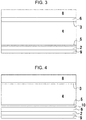
- FIG. 3 is a conceptual diagram of a cross section showing another embodiment of the film for projection screen according to the present invention.
- the film in this embodiment is a type to be bonded to the indoor side of a glass window, and has a weather-resistant pressure-sensitive adhesive layer 8, a light-diffusing layer 6, a first anchor coat 3, a layer 4 of a film substrate, a second anchor coat 5, an infrared shielding layer 2, and a hard coat 9 in order from the side to be bonded to the glass.
- the film in this embodiment is a so-called transmission type, and a video content is projected from the indoor side and viewed from the outdoor side.
- FIG. 4 is a conceptual diagram of a cross section showing another embodiment of the film for projection screen according to the present invention.
- the film in this embodiment is a type to be bonded to the indoor side of a glass window, and has a weather-resistant pressure-sensitive adhesive layer 8, a first anchor coat 3, a layer 4 of a film substrate, a second anchor coat 5, a reflective layer 10, a light-diffusing layer 6, an infrared shielding layer 2, and a hard coat 9.
- the film in this embodiment is a so-called reflection type, and a video content is projected from the indoor side and viewed from the indoor side.
- the film for projection screen according to the present invention has a total light transmittance (measured in accordance with JIS K7361-1: 1997) of preferably 85% or more, more preferably 88% or more, furthermore preferably 90% or more, and still more preferably 91% or more. If the total light transmittance is 85% or more, the film for projection screen according to the present invention, which is utilized in the form of being bonded to a medium having transparent visibility such as a glass window, can be suitably used as a film for projection screen on which a video content is projected for display when desired, while maintaining the transparent visibility for the routine use. It is preferable to have a higher total light transmittance.
- the total light transmittance can be measured by using, for example, a turbidity meter, "NDH2000" (trade name) available from NIPPON DENSHOKU INDUSTRIES CO., LTD., in accordance with JIS K7361-1: 1997.
- NDH2000 trade name
- the film for projection screen according to the present invention may have a haze (measured under the condition that light is incident from the light-diffusing layer side surface, in accordance with JIS K7136: 2000) of preferably 30% or less, more preferably 20% or less, furthermore preferably 15% or less, and most preferably 12% or less. If the haze is 30% or less, the transparency when a video content is not projected for display can be retained. From the viewpoint of retaining the transparency, it is preferable to have a lower haze.
- the haze can be measured by using, for example, a turbidity meter, "NDH2000" (trade name) available from NIPPON DENSHOKU INDUSTRIES CO., LTD., under the condition that light is incident from the light-diffusing layer side surface, in accordance with JIS K7136: 2000.
- NDH2000 trade name
- the film for projection screen according to the present invention has a diffusivity of 2% or more, preferably 4% or more, and more preferably 7% or more. From the viewpoint of the video display property, it is preferable to have a higher diffusivity.
- the diffusivity is a value measured and calculated in accordance with test (iii) of the following Examples.
- the film for projection screen according to the present invention may have a viewing angle (at which the image projected for display can be clearly seen) of preferably 100° or more, more preferably 120° or more, furthermore preferably 140° or more, and most preferably 160° or more. From the viewpoint of the video display property, it is preferable to have a wider viewing angle.
- the viewing angle refers to the maximum angle at which the evaluation is ⁇ or ⁇ when evaluated in accordance with test (iv) of the following Examples.
- the yellowness index (measured in accordance with JIS K7105: 1981) of a hard coat laminated film of the present invention in the film for projection screen according to the present invention is preferably 5 or less, more preferably 3 or less, furthermore preferably 2 or less, and most preferably 1.6 or less. It is preferable to have a lower yellowness index.
- the yellowness index of a film is 5 or less, the film can be suitably used as a film for projection screen.
- the yellowness index can be measured by using a colorimeter, for example, "SolidSpec-3700" (trade name) available from Shimadzu Corporation, in accordance with JIS K7105: 1981.
- the projection screen according to the present invention contains a light-diffusing layer formed by using the coating material according to the present invention.
- the projection screen according to the present invention is made by bonding the film for projection screen according to the present invention to a part or all of a medium having transparent visibility such as a glass window.
- the projection screen according to the present invention is made by forming a light-diffusing layer on a part or all of a medium having transparent visibility such as a glass window directly or by interposing an anchor coat therebetween with the use of the coating material according to the present invention.
- the medium having transparent visibility may be a transparent resin plate (including a laminate).
- a transparent resin plate including a laminate.
- problems of glass for example, being fragile due to low impact resistance, low processability, high specific gravity and heavy weight, and the like
- the transparent resin plate it becomes easy to produce one having a surface in a curved shape with high productivity.
- the total light transmittance was measured by using a turbidity meter, "NDH2000" (trade name) available from NIPPON DENSHOKU INDUSTRIES CO., LTD. under the condition that light was incident from the light-diffusing layer side surface of a film, in accordance with JIS K7361-1: 1997.
- NDH2000 trade name
- the haze was measured by using a turbidity meter, "NDH2000" (trade name) available from NIPPON DENSHOKU INDUSTRIES CO., LTD. under the condition that light was incident from the light-diffusing layer side surface of a film, in accordance with JIS K7136: 2000.
- variable angle photometer "GC 5000L” (trade name) available from NIPPON DENSHOKU INDUSTRIES CO., LTD.
- light was incident on the light-diffusing layer side surface of a film at a projection angle of 0°, and the transmittance and the reflectance were measured at a light receiving angle of from -85° to 85° at 1° intervals, and then the diffusivity was calculated by a program (according to the following calculation formula) built in the variable angle photometer.
- L 20 represents the reflectance at a light receiving angle of 20°
- L 70 represents the reflectance at a light receiving angle of 70°
- L 5 represents the reflectance at a light receiving angle of 5°
- T 20 represents the transmittance at a light receiving angle of 20°
- T 70 represents the transmittance at a light receiving angle of 70°
- T 5 represents the transmittance at a light receiving angle of 5°.
- an addition reaction-type silicone pressure sensitive adhesive "KR-3704" (trade name) available from Shin-Etsu Chemical Co., Ltd., 0.5 parts by mass of a platinum compound-based addition reaction catalyst, "CAT-PL-50T” (trade name) available from Shin-Etsu Chemical Co., Ltd., and 20 parts by mass of toluene were mixed and stirred to obtain a coating material for formation of an adhesive layer.
- the coating material for formation of an adhesive layer was applied onto a surface opposite to the light-diffusing layer formed side of a film for projection screen so as to have a thickness after curing of 30 ⁇ m, and heated and cured under the conditions of 130°C for one minute to form an adhesive layer.
- the adhesive layer side surface of the film for projection screen was bonded to a float plate glass (having a thickness of 3 mm) specified in JIS R3202: 2011 available from Testpiece Co., Ltd. to prepare a projection screen.
- a projector "ZenBeam E1" (trade name) available from ASUSTeK COMPUTER INC.
- an image was projected from the glass surface side of the projection screen under the conditions of an incident angle of 0° and a distance between the glass surface and the projector lens of 30 cm, in a dark place; and a visual acuity chart was then displayed at a predetermined position so that a Landolt ring of the visual acuity chart had a predetermined size (with which the visual acuity was determined to be 1.0 when the slit of the ring was discriminated at a position 4 m away from the chart (hereinafter, abbreviated as the size for visual acuity 1.0) or so that the visual acuity was determined
- a subject (the corrected visual acuity of the eye used in the test (the unused eye was covered with an occluder) was 1.0) who was waited in a place at an angle of 80° (the angle between the normal line to the light-diffusing layer side surface of the projection screen passing through the Landolt ring-displayed part and the line connecting the Landolt ring-displayed part and the place where a subject was waited was 80°, that is 160° in terms of viewing angle, hereinafter, the same applies) and a distance of 60 cm, answered the position of the slit of the Landolt ring displayed. Evaluation was made on the basis of the following criteria.
- a projection screen was prepared, and an image is projected on the projection screen in a similar manner as in the test (iv), and a blue and red checkered pattern was displayed so that the length of one side of the square was 3 mm.
- the checkered pattern was visually observed from a place at an angle of 0° and a distance of 60 cm, and evaluated on the basis of the following criteria.
- the yellowness index was measured by using a colorimeter, "SolidSpec-3700" (trade name) available from Shimadzu Corporation under the condition that light was incident from the light-diffusing layer side surface of a film, in accordance with JIS K7105: 1981.
- the light-diffusing layer side surface of a film for projection screen was measured by using a pencil, "uni" (trade name) available from MITSUBISHI PENCIL CO., LTD. under the conditions of a test length of 25 mm and a load of 200 g, in accordance with JIS K5600-5-4: 1999. Whether or not scars were generated was determined by visually observing the surface of a sample under a fluorescent lamp at a position 50 cm away from the fluorescent lamp.
- the light-diffusing layer side surface of a film for projection screen was visually observed under a fluorescent lamp while changing variously the incident angle of the light, and evaluated on the basis of the following criteria.
- a test for bending resistance (crack resistance) with a cylindrical mandrel method was conducted by using a sample taken from a film for projection screen so that the sample was 100 mm in the machine direction of the film ⁇ 50 mm in the lateral direction of the film, in accordance with JIS K5600-5-1: 1999.
- the diameter of a mandrel having the smallest diameter among the mandrels in each of which the coat (light-diffusing layer) was not cracked was determined. Evaluation was made on the basis of the following criteria.
- a sample of 10 cm in the machine direction ⁇ 10 cm in the lateral direction was taken from a film roll of a film for projection screen, and the heights of lifting due to curling at the four corners were measured when the sample was placed on a horizontal plane with the light-diffusing layer side up. Among the four corners, a corner with the largest height of lifting was used as the value of the height of lifting due to curling. Evaluation was made on the basis of the following criteria.
- a film for projection screen was treated in a thermo-hygrostat chamber at a temperature of 60°C and a relative humidity of 90% for 500 hours.
- a tape for adhesion test was stuck onto the grid squares, rubbed with fingers, and then peeled off. Evaluation was made in accordance with Table 1 of the above JIS standard as the evaluation criteria.
- (B-1) Yttrium phosphate, available from MITSUI MINING & SMELTING CO., LTD.
- the average particle diameter is 0.085 ⁇ m.
- the coating material for formation of a light-diffusing layer, obtained in the above (a) was applied onto one side of a double-sided easy adhesive biaxially-oriented polyethylene terephthalate-based resin film having a thickness of 50 ⁇ m, "LUMIRROR” (trade name) available from Toray Industries, Inc. by using a coater according to the Meyer-bar coating method so as to have a thickness after curing of 5 ⁇ m, was dried, and was cured by the irradiation with UV rays to form a light-diffusing layer.
- LUMIRROR trade name
- the coating material was applied onto one side of a double-sided easy adhesive biaxially-oriented polyethylene terephthalate-based resin film having a thickness of 50 ⁇ m, "LUMIRROR” (trade name) available from Toray Industries, Inc. by using a coater according to the Meyer-bar coating method so as to have a thickness after drying of 5 ⁇ m, and was dried to form a light-diffusing layer.
- the above tests (i) to (xi) were conducted. The results are shown in Table 1.
- the formation of the light-diffusing layer and the evaluation of the film for projection screen were made in a similar manner as in Example 1 except that the amount of the suspension was changed, and the amounts of components (B) to (E) were changed to the amounts as shown in Table 1 or 2 by appropriately controlling the amount of the (E-1) to be newly mixed when a component other than the suspension and the suspension were mixed so that the viscosity of the coating material for formation of a light-diffusing layer could be made adequate.
- Table 1 or 2 The results are shown in Table 1 or 2.
- the formation of the light-diffusing layer and the evaluation of the film for projection screen were made in a similar manner as in Example 1 except that the preparation of the coating material for formation of a light-diffusing layer was changed as follows. The results are shown in Table 1 or 2.
- the coating material for formation of a light-diffusing layer was applied onto one side of a double-sided easy adhesive biaxially-oriented polyethylene terephthalate-based resin film having a thickness of 50 ⁇ m, "LUMIRROR” (trade name) available from Toray Industries, Inc. by using a coater according to the Meyer-bar coating method so as to have a thickness after curing of 5 ⁇ m, was dried, and was cured by the irradiation with UV rays to form a light-diffusing layer.
- the total light transmittance was 86.9%
- the haze was 2.5%
- the diffusivity was 1.3%.
- the film for projection screen in which the light-diffusing layer was formed by using the coating material according to the present invention, had an excellent video display property (high diffusivity), high transparency, and a wide viewing angle, hardly generated chromatic aberration, and had no color tint (lower yellowness index).
- the film for projection screen in which the light-diffusing layer was formed by using the preferable coating material according to the present invention, can be expected to have favorable workability when bonded to a glass window or the like, and to hardly generate a trouble such as cracking of the light-diffusing layer even with time, from the excellent results of the mandrel test, the curl resistance, and the moist heat resistance.
Landscapes
- Chemical & Material Sciences (AREA)
- Organic Chemistry (AREA)
- Wood Science & Technology (AREA)
- Life Sciences & Earth Sciences (AREA)
- Engineering & Computer Science (AREA)
- Materials Engineering (AREA)
- Physics & Mathematics (AREA)
- General Physics & Mathematics (AREA)
- Chemical Kinetics & Catalysis (AREA)
- Health & Medical Sciences (AREA)
- Medicinal Chemistry (AREA)
- Polymers & Plastics (AREA)
- Optics & Photonics (AREA)
- Inorganic Chemistry (AREA)
- Dispersion Chemistry (AREA)
- Paints Or Removers (AREA)
- Overhead Projectors And Projection Screens (AREA)
- Optical Elements Other Than Lenses (AREA)
- Transforming Electric Information Into Light Information (AREA)
Applications Claiming Priority (2)
| Application Number | Priority Date | Filing Date | Title |
|---|---|---|---|
| JP2018208519 | 2018-11-06 | ||
| PCT/JP2019/038104 WO2020095566A1 (fr) | 2018-11-06 | 2019-09-27 | Matériau de revêtement pour formation de couche de diffusion de lumière, film pour écran de projection, et écran de projection |
Publications (3)
| Publication Number | Publication Date |
|---|---|
| EP3879340A1 true EP3879340A1 (fr) | 2021-09-15 |
| EP3879340A4 EP3879340A4 (fr) | 2022-08-10 |
| EP3879340B1 EP3879340B1 (fr) | 2026-03-18 |
Family
ID=70611946
Family Applications (1)
| Application Number | Title | Priority Date | Filing Date |
|---|---|---|---|
| EP19881677.9A Active EP3879340B1 (fr) | 2018-11-06 | 2019-09-27 | Matériau de revêtement pour formation de couche de diffusion de lumière, film pour écran de projection, et écran de projection |
Country Status (6)
| Country | Link |
|---|---|
| EP (1) | EP3879340B1 (fr) |
| JP (2) | JP2020076993A (fr) |
| KR (1) | KR102938723B1 (fr) |
| CN (1) | CN113168084B (fr) |
| TW (1) | TWI889657B (fr) |
| WO (1) | WO2020095566A1 (fr) |
Families Citing this family (11)
| Publication number | Priority date | Publication date | Assignee | Title |
|---|---|---|---|---|
| US12180581B2 (en) | 2017-09-18 | 2024-12-31 | Waters Technologies Corporation | Use of vapor deposition coated flow paths for improved chromatography of metal interacting analytes |
| US12181452B2 (en) | 2017-09-18 | 2024-12-31 | Waters Technologies Corporation | Use of vapor deposition coated flow paths for improved chromatography of metal interacting analytes |
| US11709155B2 (en) | 2017-09-18 | 2023-07-25 | Waters Technologies Corporation | Use of vapor deposition coated flow paths for improved chromatography of metal interacting analytes |
| US11709156B2 (en) | 2017-09-18 | 2023-07-25 | Waters Technologies Corporation | Use of vapor deposition coated flow paths for improved analytical analysis |
| US11918936B2 (en) | 2020-01-17 | 2024-03-05 | Waters Technologies Corporation | Performance and dynamic range for oligonucleotide bioanalysis through reduction of non specific binding |
| JP2022013063A (ja) * | 2020-07-03 | 2022-01-18 | 大日本印刷株式会社 | 投影装置及び投影システム |
| JP7092828B2 (ja) * | 2020-07-09 | 2022-06-28 | 株式会社ダイセル | 光学積層体ならびにその製造方法および用途 |
| US12352734B2 (en) | 2020-09-24 | 2025-07-08 | Waters Technologies Corporation | Chromatographic hardware improvements for separation of reactive molecules |
| CN114805889B (zh) * | 2022-04-13 | 2023-04-11 | 滁州金桥德克新材料有限公司无锡分公司 | 一种用于柔性显示屏的罩层胶膜及其制备方法 |
| CN115294857A (zh) * | 2022-08-04 | 2022-11-04 | 湖南福泰数码材料科技有限公司 | 一种荧光标签及其制备方法 |
| JPWO2024043110A1 (fr) | 2022-08-22 | 2024-02-29 |
Family Cites Families (17)
| Publication number | Priority date | Publication date | Assignee | Title |
|---|---|---|---|---|
| DK1116964T3 (da) * | 1995-07-29 | 2004-06-01 | Sanyo Chemical Ind Ltd | UV-hærdende harpiksmasse til Fresnel-linser, Fresnel-linser og en bagprojektionsskærm |
| TW415888B (en) * | 1998-02-17 | 2000-12-21 | Nippon Kayaku Kk | Transparent sheet or film |
| JP4219514B2 (ja) * | 1999-12-16 | 2009-02-04 | 化成オプトニクス株式会社 | 希土類燐酸塩の製造方法、希土類燐酸塩蛍光体及び希土類燐酸塩蛍光体の製造方法 |
| US6804053B2 (en) * | 1999-12-22 | 2004-10-12 | Kimoto Co., Ltd. | See-through light transmitting type screen |
| JP4315106B2 (ja) | 2004-04-15 | 2009-08-19 | ダイキン工業株式会社 | 光機能性積層体 |
| JP5610191B2 (ja) * | 2010-03-24 | 2014-10-22 | Dic株式会社 | 無機粒子分散体、エネルギー線硬化性樹脂組成物、及びフィルム |
| EP2623520B1 (fr) * | 2010-09-28 | 2017-03-22 | Sekisui Plastics Co., Ltd. | Particules de résine et procédé pour leur préparation, film contre l'éblouissement, composition de résine diffusant la lumière et préparation externe |
| JP5698993B2 (ja) * | 2011-01-27 | 2015-04-08 | 富士フイルム株式会社 | 光拡散層形成材料、及び光取り出し部材、並びに有機電界発光装置及びその製造方法 |
| KR101371562B1 (ko) * | 2011-10-10 | 2014-03-12 | 정성훈 | 투명 필름 스크린용 코팅 조성물, 이를 포함하는 투명 필름 스크린 및 투명 필름 스크린의 제조 방법 |
| JP6207862B2 (ja) | 2013-04-05 | 2017-10-04 | 三井金属鉱業株式会社 | 希土類リン酸塩粉末及びその製造方法並びに該粉末を含む分散液 |
| JP5752834B1 (ja) | 2014-04-14 | 2015-07-22 | 国立大学法人東京工業大学 | 透明スクリーン用フィルムおよびその製造方法ならびにそれを備えた透明スクリーン |
| JPWO2016068087A1 (ja) * | 2014-10-27 | 2017-08-31 | 旭硝子株式会社 | 透過型透明スクリーン、映像表示システムおよび映像表示方法 |
| EP3309611A4 (fr) * | 2015-06-15 | 2019-02-20 | JXTG Nippon Oil & Energy Corporation | Écran transparent et système de projection d'image le comprenant |
| JP6644534B2 (ja) * | 2015-12-08 | 2020-02-12 | リケンテクノス株式会社 | ハードコート積層フィルム |
| JP6633973B2 (ja) | 2016-05-30 | 2020-01-22 | 日華化学株式会社 | スクリーンフィルム及びスクリーン |
| CN109476485B (zh) * | 2016-08-02 | 2022-04-12 | 三井金属矿业株式会社 | 稀土磷酸盐颗粒、使用其的散射性提高方法 |
| EP3581974A1 (fr) * | 2017-02-07 | 2019-12-18 | Mitsui Mining & Smelting Co., Ltd. | Feuille de diffusion de la lumière |
-
2019
- 2019-09-27 WO PCT/JP2019/038104 patent/WO2020095566A1/fr not_active Ceased
- 2019-09-27 CN CN201980067574.1A patent/CN113168084B/zh active Active
- 2019-09-27 EP EP19881677.9A patent/EP3879340B1/fr active Active
- 2019-09-27 KR KR1020217012929A patent/KR102938723B1/ko active Active
- 2019-10-15 TW TW108137133A patent/TWI889657B/zh active
- 2019-11-06 JP JP2019201113A patent/JP2020076993A/ja active Pending
-
2023
- 2023-12-19 JP JP2023213436A patent/JP7561954B2/ja active Active
Also Published As
| Publication number | Publication date |
|---|---|
| TW202100456A (zh) | 2021-01-01 |
| EP3879340A4 (fr) | 2022-08-10 |
| WO2020095566A1 (fr) | 2020-05-14 |
| EP3879340B1 (fr) | 2026-03-18 |
| JP2020076993A (ja) | 2020-05-21 |
| CN113168084B (zh) | 2023-06-27 |
| TWI889657B (zh) | 2025-07-11 |
| JP2024023707A (ja) | 2024-02-21 |
| JP7561954B2 (ja) | 2024-10-04 |
| CN113168084A (zh) | 2021-07-23 |
| KR102938723B1 (ko) | 2026-03-12 |
| KR20210087455A (ko) | 2021-07-12 |
Similar Documents
| Publication | Publication Date | Title |
|---|---|---|
| EP3879340B1 (fr) | Matériau de revêtement pour formation de couche de diffusion de lumière, film pour écran de projection, et écran de projection | |
| EP3785906B1 (fr) | Film stratifié de revêtement dur et son procédé de production | |
| EP3666522B1 (fr) | Film stratifié à revêtement dur antireflet | |
| EP3272528B1 (fr) | Film de revêtement dur multicouche | |
| US10538673B2 (en) | Method for producing anti-blocking hard coat film | |
| KR102846866B1 (ko) | 눈부심 방지 하드 코트 다층 필름 | |
| EP3388237A1 (fr) | Film en couches de revêtement dur | |
| EP3513970B1 (fr) | Film stratifié à revêtement dur | |
| EP3623153B1 (fr) | Film stratifié à revêtement dur | |
| EP3406660B1 (fr) | Film stratifié à revêtement dur | |
| EP3564717B1 (fr) | Film stratifié ayant une fonction antireflet et une fonction de protection contre les infrarouges | |
| JP7492371B2 (ja) | 低屈折率bステージ塗膜、積層フィルム、三次元成形体、及びこれらの製造方法 | |
| KR102748410B1 (ko) | 점착 필름 |
Legal Events
| Date | Code | Title | Description |
|---|---|---|---|
| STAA | Information on the status of an ep patent application or granted ep patent |
Free format text: STATUS: THE INTERNATIONAL PUBLICATION HAS BEEN MADE |
|
| PUAI | Public reference made under article 153(3) epc to a published international application that has entered the european phase |
Free format text: ORIGINAL CODE: 0009012 |
|
| STAA | Information on the status of an ep patent application or granted ep patent |
Free format text: STATUS: REQUEST FOR EXAMINATION WAS MADE |
|
| 17P | Request for examination filed |
Effective date: 20210407 |
|
| AK | Designated contracting states |
Kind code of ref document: A1 Designated state(s): AL AT BE BG CH CY CZ DE DK EE ES FI FR GB GR HR HU IE IS IT LI LT LU LV MC MK MT NL NO PL PT RO RS SE SI SK SM TR |
|
| DAV | Request for validation of the european patent (deleted) | ||
| DAX | Request for extension of the european patent (deleted) | ||
| A4 | Supplementary search report drawn up and despatched |
Effective date: 20220713 |
|
| RIC1 | Information provided on ipc code assigned before grant |
Ipc: C08K 5/5425 20060101ALI20220707BHEP Ipc: G03B 21/56 20060101ALI20220707BHEP Ipc: C09D 175/16 20060101ALI20220707BHEP Ipc: C08K 3/32 20060101ALI20220707BHEP Ipc: C08G 18/81 20060101ALI20220707BHEP Ipc: C08G 18/79 20060101ALI20220707BHEP Ipc: C08G 18/67 20060101ALI20220707BHEP Ipc: C08F 290/06 20060101ALI20220707BHEP Ipc: C08K 3/105 20180101ALI20220707BHEP Ipc: G02B 5/02 20060101ALI20220707BHEP Ipc: C09D 201/00 20060101ALI20220707BHEP Ipc: C09D 175/00 20060101ALI20220707BHEP Ipc: C09D 7/63 20180101ALI20220707BHEP Ipc: C09D 7/61 20180101ALI20220707BHEP Ipc: C09D 5/00 20060101ALI20220707BHEP Ipc: C09D 4/02 20060101ALI20220707BHEP Ipc: G03B 21/62 20140101AFI20220707BHEP |
|
| STAA | Information on the status of an ep patent application or granted ep patent |
Free format text: STATUS: EXAMINATION IS IN PROGRESS |
|
| 17Q | First examination report despatched |
Effective date: 20240306 |
|
| GRAP | Despatch of communication of intention to grant a patent |
Free format text: ORIGINAL CODE: EPIDOSNIGR1 |
|
| STAA | Information on the status of an ep patent application or granted ep patent |
Free format text: STATUS: GRANT OF PATENT IS INTENDED |
|
| INTG | Intention to grant announced |
Effective date: 20251202 |
|
| GRAS | Grant fee paid |
Free format text: ORIGINAL CODE: EPIDOSNIGR3 |
|
| GRAA | (expected) grant |
Free format text: ORIGINAL CODE: 0009210 |
|
| STAA | Information on the status of an ep patent application or granted ep patent |
Free format text: STATUS: THE PATENT HAS BEEN GRANTED |
|
| AK | Designated contracting states |
Kind code of ref document: B1 Designated state(s): AL AT BE BG CH CY CZ DE DK EE ES FI FR GB GR HR HU IE IS IT LI LT LU LV MC MK MT NL NO PL PT RO RS SE SI SK SM TR |
|
| REG | Reference to a national code |
Ref country code: CH Ref legal event code: F10 Free format text: ST27 STATUS EVENT CODE: U-0-0-F10-F00 (AS PROVIDED BY THE NATIONAL OFFICE) Effective date: 20260318 Ref country code: GB Ref legal event code: FG4D |
|
| REG | Reference to a national code |
Ref country code: DE Ref legal event code: R096 Ref document number: 602019082686 Country of ref document: DE |
|
| REG | Reference to a national code |
Ref country code: IE Ref legal event code: FG4D |