EP3879416A1 - Verfahren, gerät und vorrichtung zur automatischen vervollständigung einer abfrage sowie computerspeichermedium - Google Patents
Verfahren, gerät und vorrichtung zur automatischen vervollständigung einer abfrage sowie computerspeichermedium Download PDFInfo
- Publication number
- EP3879416A1 EP3879416A1 EP20894917.2A EP20894917A EP3879416A1 EP 3879416 A1 EP3879416 A1 EP 3879416A1 EP 20894917 A EP20894917 A EP 20894917A EP 3879416 A1 EP3879416 A1 EP 3879416A1
- Authority
- EP
- European Patent Office
- Prior art keywords
- poi
- query
- user
- vector representation
- pois
- Prior art date
- Legal status (The legal status is an assumption and is not a legal conclusion. Google has not performed a legal analysis and makes no representation as to the accuracy of the status listed.)
- Ceased
Links
Images





Classifications
-
- G—PHYSICS
- G06—COMPUTING OR CALCULATING; COUNTING
- G06F—ELECTRIC DIGITAL DATA PROCESSING
- G06F16/00—Information retrieval; Database structures therefor; File system structures therefor
- G06F16/90—Details of database functions independent of the retrieved data types
- G06F16/903—Querying
- G06F16/9032—Query formulation
- G06F16/90324—Query formulation using system suggestions
-
- G—PHYSICS
- G06—COMPUTING OR CALCULATING; COUNTING
- G06F—ELECTRIC DIGITAL DATA PROCESSING
- G06F16/00—Information retrieval; Database structures therefor; File system structures therefor
- G06F16/90—Details of database functions independent of the retrieved data types
- G06F16/95—Retrieval from the web
- G06F16/953—Querying, e.g. by the use of web search engines
- G06F16/9537—Spatial or temporal dependent retrieval, e.g. spatiotemporal queries
Definitions
- the present application relates to the technical field of computer applications, and particularly to a query auto-completion method and apparatus, a device and a computer storage medium in the technical field of intelligent search.
- Query Auto-Completion is widely used by mainstream general search engines and vertical search engines.
- a search engine may recommend a series of candidate POIs to the user in real time in a candidate list for the user to select as a completion result of the query (queries recommended in the candidate list are referred to as query completion suggestions in the present application).
- query completion suggestions are referred to as query completion suggestions in the present application.
- candidate POIs such as "Baidu Building”, “Baidu Building-Tower C”, “Baidu Science & Technology Park”, or the like, may be recommended to the user in the form of a candidate list for the user to select, and once the user selects "Baidu Building” therefrom, the query is completed, and a search for "Baidu Building" is initiated.
- the suggestions provided for the same query prefixes are all the same, for example, all the suggestions are ranked in the candidate list based on the search popularity of each POI, and personalized requirements of the user are unable to be well met.
- the present application provides a query auto-completion method and apparatus, a device and a computer storage medium, such that recommended query completion suggestions better meet practical requirements of a user.
- the present application provides a query auto-completion method, including:
- the acquiring vector representation of query history information of the user includes:
- the vector representation of each POI is pre-obtained by:
- the training a skip-gram model using each slice includes: encoding attribute information of each POI using the skip-gram model to obtain the vector representation of each POI, predicting the vector representation of the contextual POIs in each slice using the vector representation of the central POI in the same slice, and iteratively updating model parameters of the skip-gram model according to an error of the prediction result.
- the encoding attribute information of each POI includes:
- vector representation of attribute features of the user and vector representation of popularity features of each candidate POI are further used when each candidate POI is scored by the ranking model.
- the present application provides a method for building a ranking model for query auto-completion, including:
- the acquiring vector representation of query history information of the user before the query prefix is input includes:
- the vector representation of each POI is pre-obtained by:
- the training a skip-gram model using each slice includes: encoding attribute information of each POI using the skip-gram model to obtain the vector representation of each POI, predicting the vector representation of the contextual POIs in each slice using the vector representation of the central POI in the same slice, and iteratively updating model parameters of the skip-gram model according to an error of the prediction result.
- the positive example further includes vector representation of attribute features of the user and vector representation of popularity features of the POI selected by the user; and the negative example further includes the vector representation of the attribute features of the user and vector representation of popularity features of the POIs not selected by the user.
- the present application further provides a query auto-completion apparatus, including:
- the present application provides an apparatus for building a ranking model for query auto-completion, including:
- the present application provides an electronic device, including:
- the present application provides a non-transitory computer readable storage medium with computer instructions stored thereon, wherein the computer instructions are used for causing a computer to perform the methods as mentioned above.
- the query history information of the user is merged into the ranking model to rank the candidate POIs, such that the query completion suggestions recommended to the user are more in line with search preference of the user.
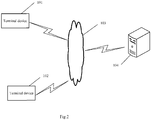
- Fig. 2 shows an exemplary system architecture to which the embodiment of the present disclosure may be applied.
- the system architecture may include terminal devices 101, 102, a network 103 and a server 104.
- the network 103 serves as a medium for providing communication links between the terminal devices 101, 102 and the server 104.
- the network 103 may include various connection types, such as wired and wireless communication links, or fiber-optic cables, or the like.
- Terminal devices 101, 102 Users may use the terminal devices 101, 102 to interact with the server 104 through the network 103.
- Various applications such as a voice interaction application, a web browser application, a communication application, or the like, may be installed on the terminal devices 101, 102.
- the terminal devices 101, 102 may be configured as various electronic devices, including, but not limited to, smart phones, PCs, smart televisions, or the like.
- a query auto-completion apparatus according to the present disclosure may be provided and run on the server 104.
- the apparatus may be implemented as a plurality of pieces of software or software modules (for example, for providing distributed service), or a single piece of software or software module, which is not limited specifically herein.
- the browser or the client when a user inputs a query prefix on a retrieval interface provided by a browser or a client on the terminal device 101, the browser or the client provides the query prefix to the server 104 in real time, and the server returns query completion suggestions corresponding to the query prefix currently input by the user to the terminal device 101 with a method according to the present application. If the user finds a wanted POI from the query completion suggestions, a search for this POI may be initiated by selecting the POI.
- an input operation may continue, the browser or the client then provides the query prefix for the server 104 in real time, and the server 104 returns the query completion suggestions corresponding to the query prefix input by the user, thereby achieving an effect that in the process of inputting a query by the user, the query completion suggestions are recommended to the user in real time along with the query prefix input by the user.
- the server 104 may be configured as a single server or a server group including a plurality of servers. It should be understood that the numbers of the terminal devices, the network, and the server in Fig. 2 are merely schematic. There may be any number of terminal devices, networks and servers as desired for an implementation.
- the technical essence of the present application lies in establishing the association between the user and the POI, and may have a use scenario that when the user uses map data to search for the POI, the query completion suggestions are recommended to the user in real time along with the query prefix input by the user.
- the query completion suggestions are obtained by ranking candidate POIs with a ranking model after determination of the candidate POIs corresponding to the query prefix input by the user.
- the ranking operation for each candidate POI usually takes into account popularity features of each candidate POI, and in some cases, also takes into account some user attribute features.
- this ranking way is unable to meet actual demands of the user well.
- a large number of users are found to repeatedly search the same POI. For example, about 20% of users will repeatedly search the same POI within 7 days.
- the present application has a core concept that personalized query history information of the users is taken as unique features of the users to be merged into the ranking model, such that the situation that the users repeatedly search the same POI may be captured quickly, and search intentions of the users may be completed more quickly.
- Fig. 3 is a flow chart of a query completion method according to a first embodiment of the present application, and as shown in Fig. 3 , the method may include the following steps: 301: acquiring a query prefix input by a user currently, and determining candidate POIs corresponding to the query prefix.
- the method is suitable for various types of input contents, such as Chinese characters, pinyin, initials, or the like, but the input query prefix may be regarded as a character string.
- the query prefix input by the user currently is acquired in real time.
- the user may input a plurality of query prefixes, such as "Bai”, “Baidu” and “Baidu Build”, and the method according to the present application is executed for each query prefix. That is, when the user inputs "Bai", the currently input query prefix is "Bai”, and the method according to the present application is executed for the query prefix to recommend query completion suggestions to the user.
- the currently input query prefix is “Baidu”
- the method according to the present application is executed for the query prefix to recommend query completion suggestions to the user.
- the currently input query prefix is "Baidu Build”
- the method according to the present application is executed for the query prefix to recommend query completion suggestions to the user.
- the manner for determining the candidate POIs corresponding to the currently input query prefix may adopt an existing implementation manner, and aims to find POIs strongly related to the query prefix, or find POIs with the query prefix as the beginning of texts.
- a reverse index may be established in advance for POIs in a POI library with various corresponding query prefixes.
- the query history information of the user may be obtained first, and then, the vector representation of the query history information of the user may be obtained using the vector representation of the POI.
- the query history information of the user includes POIs queried or clicked by the user in first duration and high-frequency POIs queried or clicked by the user in second duration, and the second duration is longer than the first duration.
- the POIs queried or clicked by the user in the first duration may be regarded as short-term query history of the user.
- the short-term query history may include preceding user behaviors in the same search session as the currently input query prefix, for example, POIs queried and clicked before the currently input query prefix in the same session.
- the short-term search history may be viewed as contextual information of a current query (the query prefix), which reflects short-term instantaneous interest of the user.
- the above-mentioned "session” refers to a search session, and a widely adopted determination method of a search session may be used here. If the user does not have any search behavior before the first duration (for example, 30 minutes), the first search behavior within the first duration may be referred to as the beginning of the session. That is, if the user has consecutive search behaviors within 30 minutes, the consecutive search behaviors within 30 minutes all belong to the same session.
- the first duration for example, 30 minutes
- the first search behavior within the first duration may be referred to as the beginning of the session. That is, if the user has consecutive search behaviors within 30 minutes, the consecutive search behaviors within 30 minutes all belong to the same session.
- the POIs queried or clicked by the user in the second duration may be regarded as long-term query history of the user.
- the long-term query history refers to all search behaviors of the user in second duration before the currently input query (the query prefix), and includes queried or clicked high-frequency POIs in all sessions of the user in the second duration.
- the high-frequency POIs may have query or click numbers exceeding a preset threshold.
- the long-term query history reflects long-term intrinsic interest preference of the user.
- the above-mentioned first duration may be in the order of minutes or hours, for example, 30 minutes.
- the above-mentioned second duration may be in the order of days or months, for example, 3 months.
- the vector representation of each POI may be acquired in advance.
- the vector representation of the POI is assumed to be k-dimensional, k being a positive integer greater than 1.
- the (m+n) POIs are represented using the vector representation of the POIs, and then, a (m+n) ⁇ k-dimensional vector matrix may be obtained as the vector representation of the query history information of the user.
- the vector representation of the POIs here is vector representation of a text meaning, and the acquiring method thereof may be shown in Fig. 4 , and includes the following steps: 401: acquiring POI query logs of mass users, and arranging the POIs queried or clicked by the users according to a time sequence respectively to obtain POI sequences.
- each POI sequence is slicing each POI sequence according to the size of a preset sliding window, each slice including a central POI and contextual POIs of the central POI.
- each POI sequence may be sliced into the slices each composed of at most 3 POIs, for example, after the POI timing sequence corresponding to the user_B is sliced, the following slices may be obtained: [POI_ID_2, POI_ID_6, POI_ID_7], [POI_ID_6, POI_ID_7, POI_ID_8], or the like.
- the central POI and the contextual POIs of the central POI may be included in each slice.
- the central POI is a POI not located at two ends of the slice, and the contextual POIs of the central POI may be other POIs than the central POI in the slice or POIs adjacent to the central POI in the slice.
- the skip-gram model is a model used in the natural language processing field for predicting contextual words corresponding to a given key word.
- the skip-gram model is referred to and used for acquiring the vector representation of each POI.
- attribute information of each POI may be encoded using the skip-gram model to obtain the vector representation of each POI, the vector representation of the contextual POIs in each slice is predicted using the vector representation of the central POI in the same slice, and model parameters of the skip-gram model are iteratively updated according to an error of the prediction result.
- the involved attribute information may include, but not limited to, the identification, name, category, address, tag, etc. of the POI.
- Name and address information of the POI may be encoded by a convolutional neural network, and other attribute information of the POI may be encoded by a feedforward neural network. Then, a vector obtained after the encoding results of the same POI are spliced is mapped by a fully connected layer to obtain the vector representation of the POI.
- the training operation of the skip-gram model is ended.
- 303 inputting the vector representation of the query history information of the user and the vector representation of each candidate POI into a pre-trained ranking model, so as to obtain a score of each candidate POI.
- Vector representation of attribute features of the user and vector representation of popularity features of each candidate POI are further used when each candidate POI is scored by the ranking model. That is, input to the ranking model includes the vector representation of the query history information of the user, the vector representation of each candidate POI, the vector representation of the attribute features of the user and the vector representation of the popularity features of each candidate POI, and output of the ranking model is the score for each candidate POI.
- the ranking model may be configured as a neural network model, and the training process thereof will be described in detail in the second embodiment.
- the attribute features of the user may include information, such as the user's age, gender, job, income level, city, etc., and the vector representation of the attribute features of the user may be obtained by encoding the information.
- the popularity features of the candidate POI may be characterized by information, such as click frequency, retrieval frequency, navigation frequency, or the like, of the candidate POI, and the vector representation of the popularity features of the candidate POI may be obtained by encoding the information. Specifically, encoding methods are not repeated and may adopt the prior art.
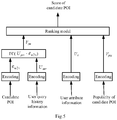
- e w 2 v is taken as the vector representation of the POI
- U per is taken as a vector table of the query history information of the user
- U d is taken as the vector representation of the attribute feature of the user
- V pop is taken as the vector representation of the popularity feature of the candidate POI, and the above-mentioned whole process may be shown in Fig. 5 .
- (m+n) ⁇ k-dimensional U per and k-dimensional e w 2 v may be multiplied to obtain a (m+n)-dimensional similarity feature matrix V per :
- V per U per T e w 2 v
- V per , U d and V pop are input into the ranking model, and in the ranking model, V per , U d and V pop may spliced into a new feature vector which is converted into the score of the candidate POI by the neural network.
- the candidate POIs with score values greater than or equal to a preset score threshold may be used as the query completion suggestions, or the POIs with top P score values may be used as the query completion suggestions, and so on, and P is a preset positive integer.
- the POIs are ranked in a candidate list according to the scores thereof. An existing drop-down box near the search box or other forms may be adopted as the recommendation way.
- the query history information of the user is merged into the ranking model to rank the candidate POIs, such that the query completion suggestions recommended to the user are more in line with search preference of the user. For example, since one user works in the "Baidu Building", the user often searches the POI "Baidu Building” to perform navigation, a road condition query, or the like, but in the prior art, POIs are ranked according to search popularity thereof. Unless a large number of users would like to click or search the POI "Baidu Building", "Baidu Building” would not rank higher in the query completion suggestions.
- Fig. 6 is a flow chart of a method for building a ranking model according to a second embodiment of the present application, and as shown in Fig. 6 , the method may include the following steps: 601: acquiring, from a POI query log, user identification, a query prefix input when a user selects a POI from query completion suggestions, POIs in the query completion suggestions corresponding to the query prefix and the POI selected by the user in the query completion suggestions.
- the user user_A clicks the POI "Baidu Building A tower” from the query completion suggestions, user identification user_A, the query prefix "Baidu Build", each POI in the corresponding query completion suggestions, and the POI "Baidu Building-Tower A" selected by the user are acquired as one piece of data.
- a plurality of pieces of data may be obtained from POI query logs of mass users for training the ranking model.
- the query history information of the user before the query prefix is input may be acquired, the query history information may include POIs queried or clicked by the user in first duration before the query prefix is input and high-frequency POIs queried or clicked in second duration, and the second duration is longer than the first duration; and then, the vector representation of the query history information of the user before the query prefix is input may be obtained using the vector representation of the POI.
- this step is similar to that of the step 302 in the first embodiment, and for the vector representation of the POI, reference may be made to the implementation of the step 302 in the first embodiment, which is not repeated herein.
- training a neural network model by taking the vector representation of the query history information of the user before the query prefix is input and the vector representation of the POI selected by the user in the corresponding query completion suggestions as a positive example and the vector representation of the query history information of the user before the query prefix is input and the POIs not selected by the user in the corresponding query completion suggestions as negative examples, so as to obtain the ranking model.
- the ranking model may be trained pairwise. Further, the above-mentioned positive example may further include vector representation of attribute features of the user and vector representation of popularity features of the POI selected by the user; and the negative example further includes the vector representation of the attribute features of the user and vector representation of popularity features of the POIs not selected by the user.
- the processing process is similar to Fig. 5 . That is, the positive example includes: the vector representation (corresponding to U per in Fig. 5 ) of the query history information of the user before the query prefix is input, the vector representation (corresponding to e w 2 v in Fig. 5 ) of the POI selected by the user in the corresponding query completion suggestions, the vector representation (corresponding to U d in Fig. 5 ) of the attribute features of the user, the vector representation (corresponding to V pop in Fig. 5 ) of the popularity features of the POI selected by the user, and U per and e w 2 v may be multiplied to obtain the similarity feature matrix V per .
- the negative example includes: the vector representation (corresponding to U per in Fig.
- the input vector representation is spliced and transformed by the ranking model to obtain the scores of the positive and negative example POIs, and parameters of the ranking model are updated according to the obtained scores of the positive and negative example POIs until a training target is reached.
- the training target may be to maximize the difference between the scores of the positive and negative example POIs by the neural network model.
- One piece of training data ( i th piece of training data) may be represented as: (u (i) , ⁇ v ( i ,1) , .., v ( i,j ) , ...
- u is the vector representation of the user, and is U d of the user in the embodiment of the present application
- (v ( i ,1) , .., v ( i,j ) ,... v ( i,n ) ⁇ is a set formed by the POIs in the query completion suggestions
- k ( i ) is the POI selected by the user in the query completion suggestions.
- the vector v may be obtained by splicing V pop and V per .
- h() is a function used by the ranking model to score the POI, and contains model parameters required to be updated in the training process of the ranking model.
- Fig. 7 is a structural diagram of a query auto-completion apparatus according to a third embodiment of the present application, and as shown in Fig. 7 , the apparatus may include a first acquiring unit 01, a second acquiring unit 02, a scoring unit 03 and a query completion unit 04, and may further include a third acquiring unit 05.
- the main functions of each constitutional unit are as follows.
- the first acquiring unit 01 is configured to acquire a query prefix input by a user currently, and determine candidate POIs corresponding to the query prefix.
- the manner for determining the candidate POIs corresponding to the currently input query prefix may adopt an existing implementation manner, and aims to find POIs strongly related to the query prefix, or find POIs with the query prefix as the beginning of texts.
- a reverse index may be established in advance for POIs in a POI library with various corresponding query prefixes.
- the second acquiring unit 02 is configured to acquire vector representation of query history information of the user and vector representation of each candidate POI.
- the second acquiring unit 02 may: acquire the query history information of the user, the query history information including POIs queried or clicked by the user in first duration and high-frequency POIs queried or clicked by the user in second duration, and the second duration being longer than the first duration; and acquire the vector representation of the query history information of the user using the vector representation of the POI.
- the vector representation of each POI may be determined by the third acquiring unit 05 in advance.
- the third acquiring unit 05 may acquire POI query logs of mass users, and arrange the POIs queried or clicked by the users according to a time sequence respectively to obtain POI sequences; slice each POI sequence according to the size of a preset sliding window, each slice including a central POI and contextual POIs of the central POI; train a skip-gram model using each slice; and after the training operation is finished, obtain the vector representation of each POI from the skip-gram model.
- the third acquiring unit 05 may encode attribute information of each POI using the skip-gram model to obtain the vector representation of each POI, predict the vector representation of the contextual POIs in each slice using the vector representation of the central POI in the same slice, and iteratively update model parameters of the skip-gram model according to an error of the prediction result.
- the third acquiring unit 05 may encode name and address information of the POI by a convolutional neural network; encode other attribute information of the POI by a feedforward neural network; and splice the encoding results of the same POI, and then map the splicing result by a fully connected layer to obtain the vector representation of the POI.
- the scoring unit 03 is configured to input the vector representation of the query history information of the user and the vector representation of each candidate POI into a pre-trained ranking model, so as to obtain a score of each candidate POI.
- the scoring unit 03 may input vector representation of attribute features of the user and vector representation of popularity features of each candidate POI together into the ranking model, such that each candidate POI may be scored by the ranking model.
- the specific processing manner reference may be made to the related description in the first embodiment, and the specific processing manner is not repeated herein.
- the query completion unit 04 is configured to determine query completion suggestions recommended to the user according to the score of each candidate POI.
- the candidate POIs with score values greater than or equal to a preset score threshold may be used as the query completion suggestions, or the POIs with top P score values may be used as the query completion suggestions, and so on, and P is a preset positive integer.
- the POIs are ranked in a candidate list according to the scores thereof. An existing drop-down box near the search box or other forms may be adopted as the recommendation way.
- Fig. 8 is a structural diagram of an apparatus for building a ranking model according to an embodiment of the present application, and as shown in Fig. 8 , the apparatus may include a first acquiring unit 11, a second acquiring unit 12 and a model training unit 13, and may further include a third acquiring unit 14.
- the main functions of each constitutional unit are as follows.
- the first acquiring unit 11 is configured to acquire, from a POI query log, user identification, a query prefix input when a user selects a POI from query completion suggestions, POIs in the query completion suggestions corresponding to the query prefix and the POI selected by the user in the query completion suggestions.
- the second acquiring unit 12 is configured to acquire vector representation of query history information of the user before the query prefix is input and vector representation of each POI in the query completion suggestions.
- the second acquiring unit 12 may: acquire the query history information of the user before the query prefix is input, the query history information including POIs queried or clicked by the user in first duration before the query prefix is input and high-frequency POIs queried or clicked in second duration, and the second duration being longer than the first duration; and obtain the vector representation of the query history information of the user before the query prefix is input using the vector representation of the POI.
- the vector representation of each POI is acquired by the third acquiring unit 14 in advance.
- the third acquiring unit 14 may acquire POI query logs of mass users, and arrange the POIs queried or clicked by the users according to a time sequence respectively to obtain POI sequences; slice each POI sequence according to the size of a preset sliding window, each slice including a central POI and contextual POIs of the central POI; train a skip-gram model using each slice; and after the training operation is finished, obtain the vector representation of each POI from the skip-gram model.
- the third acquiring unit 14 may encode attribute information of each POI using the skip-gram model to obtain the vector representation of each POI, predict the vector representation of the contextual POIs in each slice using the vector representation of the central POI in the same slice, and iteratively update model parameters of the skip-gram model according to an error of the prediction result.
- the third acquiring unit 14 may encode name and address information of the POI by a convolutional neural network; encode other attribute information of the POI by a feedforward neural network; and splice the encoding results of the same POI, and then map the splicing result by a fully connected layer to obtain the vector representation of the POI.
- the model training unit 13 is configured to train a neural network model by taking the vector representation of the query history information of the user before the query prefix is input and the vector representation of the POI selected by the user in the corresponding query completion suggestions as a positive example and the vector representation of the query history information of the user before the query prefix is input and the POIs not selected by the user in the corresponding query completion suggestions as negative examples, so as to obtain the ranking model, with a training target of maximizing the difference between scores of the positive and negative example POIs by the neural network model.
- the above-mentioned positive example may further include vector representation of attribute features of the user and vector representation of popularity features of the POI selected by the user; and the negative example may further include the vector representation of the attribute features of the user and vector representation of popularity features of the POIs not selected by the user.
- an electronic device and a readable storage medium.
- Fig. 9 is a block diagram of an electronic device for the query auto-completion method or the method for building a ranking model according to the embodiments of the present application.
- the electronic device is intended to represent various forms of digital computers, such as laptop computers, desktop computers, workstations, personal digital assistants, servers, blade servers, mainframe computers, and other appropriate computers.
- the electronic device may also represent various forms of mobile apparatuses, such as personal digital processors, cellular telephones, smart phones, wearable devices, and other similar computing apparatuses.
- the components shown herein, their connections and relationships, and their functions, are meant to be exemplary only, and are not meant to limit implementation of the present application described and/or claimed herein.
- the electronic device includes one or more processors 901, a memory 902, and interfaces configured to connect the components, including high-speed interfaces and low-speed interfaces.
- the components are interconnected using different buses and may be mounted at a common motherboard or in other manners as desired.
- the processor may process instructions for execution within the electronic device, including instructions stored in or at the memory to display graphical information for a GUI at an external input/output apparatus, such as a display device coupled to the interface.
- plural processors and/or plural buses may be used with plural memories, if desired.
- plural electronic devices may be connected, with each device providing some of necessary operations (for example, as a server array, a group of blade servers, or a multi-processor system).
- one processor 901 is taken as an example.
- the memory 902 is configured as the non-transitory computer readable storage medium according to the present application.
- the memory stores instructions executable by the at least one processor to cause the at least one processor to perform a query auto-completion method or a method for building a ranking model according to the present application.
- the non-transitory computer readable storage medium according to the present application stores computer instructions for causing a computer to perform the query auto-completion method or the method for building a ranking model according to the present application.
- the memory 902 which is a non-transitory computer readable storage medium may be configured to store non-transitory software programs, non-transitory computer executable programs and modules, such as program instructions/modules corresponding to the query auto-completion method or the method for building a ranking model according to the embodiments of the present application.
- the processor 901 executes various functional applications and data processing of a server, that is, implements the query auto-completion method or the method for building a ranking model according to the above-mentioned embodiments, by running the non-transitory software programs, instructions, and modules stored in the memory 902.
- the memory 902 may include a program storage area and a data storage area, wherein the program storage area may store an operating system and an application program required for at least one function; the data storage area may store data created according to use of the electronic device, or the like. Furthermore, the memory 902 may include a high-speed random access memory, or a non-transitory memory, such as at least one magnetic disk storage device, a flash memory device, or other non-transitory solid state storage devices. In some embodiments, optionally, the memory 902 may include memories remote from the processor 901, and such remote memories may be connected to the electronic device via a network. Examples of such a network include, but are not limited to, the Internet, intranets, local area networks, mobile communication networks, and combinations thereof.
- the electronic device may further include an input apparatus 903 and an output apparatus 904.
- the processor 901, the memory 902, the input apparatus 903 and the output apparatus 904 may be connected by a bus or other means, and Fig. 9 takes the connection by a bus as an example.
- the input apparatus 903 may receive input numeric or character information and generate key signal input related to user settings and function control of the electronic device, such as a touch screen, a keypad, a mouse, a track pad, a touch pad, a pointing stick, one or more mouse buttons, a trackball, a joystick, or the like.
- the output apparatus 904 may include a display device, an auxiliary lighting apparatus (for example, an LED) and a tactile feedback apparatus (for example, a vibrating motor), or the like.
- the display device may include, but is not limited to, a liquid crystal display (LCD), a light emitting diode (LED) display, and a plasma display. In some implementations, the display device may be a touch screen.
- Various implementations of the systems and technologies described here may be implemented in digital electronic circuitry, integrated circuitry, application specific integrated circuits (ASIC), computer hardware, firmware, software, and/or combinations thereof.
- the systems and technologies may be implemented in one or more computer programs which are executable and/or interpretable on a programmable system including at least one programmable processor, and the programmable processor may be special or general, and may receive data and instructions from, and transmitting data and instructions to, a storage system, at least one input apparatus, and at least one output apparatus.
- a computer having: a display apparatus (for example, a cathode ray tube (CRT) or liquid crystal display (LCD) monitor) for displaying information to a user; and a keyboard and a pointing apparatus (for example, a mouse or a trackball) by which a user may provide input for the computer.
- a display apparatus for example, a cathode ray tube (CRT) or liquid crystal display (LCD) monitor
- a keyboard and a pointing apparatus for example, a mouse or a trackball
- Other kinds of apparatuses may also be used to provide interaction with a user; for example, feedback provided for a user may be any form of sensory feedback (for example, visual feedback, auditory feedback, or tactile feedback); and input from a user may be received in any form (including acoustic, voice or tactile input).
- the systems and technologies described here may be implemented in a computing system (for example, as a data server) which includes a back-end component, or a computing system (for example, an application server) which includes a middleware component, or a computing system (for example, a user computer having a graphical user interface or a web browser through which a user may interact with an implementation of the systems and technologies described here) which includes a front-end component, or a computing system which includes any combination of such back-end, middleware, or front-end components.
- the components of the system may be interconnected through any form or medium of digital data communication (for example, a communication network). Examples of the communication network include: a local area network (LAN), a wide area network (WAN) and the Internet.
- a computer system may include a client and a server.
- the client and the server are remote from each other and interact through the communication network.
- the relationship between the client and the server is generated by virtue of computer programs which run on respective computers and have a client-server relationship to each other.
- the above-mentioned method and apparatus, the device as well as the computer storage medium according to the embodiments of the present application may have the following advantages.
Landscapes
- Engineering & Computer Science (AREA)
- Databases & Information Systems (AREA)
- Theoretical Computer Science (AREA)
- Physics & Mathematics (AREA)
- Data Mining & Analysis (AREA)
- General Engineering & Computer Science (AREA)
- General Physics & Mathematics (AREA)
- Mathematical Physics (AREA)
- Computational Linguistics (AREA)
- Information Retrieval, Db Structures And Fs Structures Therefor (AREA)
Applications Claiming Priority (2)
| Application Number | Priority Date | Filing Date | Title |
|---|---|---|---|
| CN202010010479.2A CN111222058B (zh) | 2020-01-06 | 2020-01-06 | 查询自动补全的方法、装置、设备和计算机存储介质 |
| PCT/CN2020/116632 WO2021139209A1 (zh) | 2020-01-06 | 2020-09-21 | 查询自动补全的方法、装置、设备和计算机存储介质 |
Publications (2)
| Publication Number | Publication Date |
|---|---|
| EP3879416A1 true EP3879416A1 (de) | 2021-09-15 |
| EP3879416A4 EP3879416A4 (de) | 2022-03-09 |
Family
ID=70832259
Family Applications (1)
| Application Number | Title | Priority Date | Filing Date |
|---|---|---|---|
| EP20894917.2A Ceased EP3879416A4 (de) | 2020-01-06 | 2020-09-21 | Verfahren, gerät und vorrichtung zur automatischen vervollständigung einer abfrage sowie computerspeichermedium |
Country Status (4)
| Country | Link |
|---|---|
| US (1) | US20220342936A1 (de) |
| EP (1) | EP3879416A4 (de) |
| CN (1) | CN111222058B (de) |
| WO (1) | WO2021139209A1 (de) |
Families Citing this family (14)
| Publication number | Priority date | Publication date | Assignee | Title |
|---|---|---|---|---|
| CN111222058B (zh) * | 2020-01-06 | 2021-04-16 | 百度在线网络技术(北京)有限公司 | 查询自动补全的方法、装置、设备和计算机存储介质 |
| CN111694919B (zh) * | 2020-06-12 | 2023-07-25 | 北京百度网讯科技有限公司 | 生成信息的方法、装置、电子设备及计算机可读存储介质 |
| CN111767479B (zh) * | 2020-06-30 | 2023-06-27 | 北京百度网讯科技有限公司 | 推荐模型生成方法、装置、电子设备及存储介质 |
| CN112395044B (zh) * | 2020-11-10 | 2023-04-28 | 新华三技术有限公司合肥分公司 | 命令行关键词填充方法、装置及网络设备 |
| CN113779176B (zh) * | 2020-12-14 | 2025-07-18 | 北京沃东天骏信息技术有限公司 | 查询请求补全方法、装置、电子设备和存储介质 |
| CN112528156B (zh) * | 2020-12-24 | 2024-03-26 | 北京百度网讯科技有限公司 | 建立排序模型的方法、查询自动补全的方法及对应装置 |
| CN120804443A (zh) * | 2021-06-17 | 2025-10-17 | 华为技术有限公司 | 信息点搜索的方法和装置 |
| CN114090894B (zh) * | 2021-11-29 | 2025-07-25 | 北京爱奇艺科技有限公司 | 关键词推荐方法、装置、电子设备及存储介质 |
| US12259916B1 (en) * | 2023-06-08 | 2025-03-25 | Amazon Technologies, Inc. | Enhanced search autocompletion framework |
| US12450268B2 (en) * | 2023-07-26 | 2025-10-21 | Sap Se | Efficient search query auto-completion from unstructured text |
| CN117009451A (zh) * | 2023-08-22 | 2023-11-07 | 深圳依时货拉拉科技有限公司 | 检索服务中查询信息的补全方法、装置和可读存储介质 |
| CN116821271B (zh) * | 2023-08-30 | 2023-11-24 | 安徽商信政通信息技术股份有限公司 | 一种基于音形码的地址识别和规范化方法及系统 |
| CN117235210B (zh) * | 2023-10-13 | 2025-07-15 | 浪潮云信息技术股份公司 | 基于自动补全模型的内容补全方法、装置、设备及介质 |
| US20250355924A1 (en) * | 2024-05-20 | 2025-11-20 | Microsoft Technology Licensing, Llc | Mechanism to reduce query reject rate |
Family Cites Families (13)
| Publication number | Priority date | Publication date | Assignee | Title |
|---|---|---|---|---|
| US8438142B2 (en) * | 2005-05-04 | 2013-05-07 | Google Inc. | Suggesting and refining user input based on original user input |
| CN103455507B (zh) * | 2012-05-31 | 2017-03-29 | 国际商业机器公司 | 搜索引擎推荐方法及装置 |
| US20160041983A1 (en) * | 2014-08-07 | 2016-02-11 | Yahoo! Inc. | Local query ranking for search assist method and apparatus |
| CN104462369A (zh) * | 2014-12-08 | 2015-03-25 | 沈阳美行科技有限公司 | 一种导航设备的搜索自动补全方法 |
| CN107122469B (zh) * | 2017-04-28 | 2019-12-17 | 中国人民解放军国防科学技术大学 | 基于语义相似度与时效性频率的查询推荐排序方法与装置 |
| WO2018201280A1 (en) * | 2017-05-02 | 2018-11-08 | Alibaba Group Holding Limited | Method and apparatus for query auto-completion |
| CN107862004A (zh) * | 2017-10-24 | 2018-03-30 | 科大讯飞股份有限公司 | 智能排序方法及装置、存储介质、电子设备 |
| CN107832404A (zh) * | 2017-11-02 | 2018-03-23 | 武汉大学 | 一种poi信息的补全方法 |
| US11366866B2 (en) * | 2017-12-08 | 2022-06-21 | Apple Inc. | Geographical knowledge graph |
| CN110046298B (zh) * | 2019-04-24 | 2021-04-13 | 中国人民解放军国防科技大学 | 一种查询词推荐方法、装置、终端设备及计算机可读介质 |
| US20210109958A1 (en) * | 2019-10-14 | 2021-04-15 | Stacks LLC | Conceptual, contextual, and semantic-based research system and method |
| CN111222058B (zh) * | 2020-01-06 | 2021-04-16 | 百度在线网络技术(北京)有限公司 | 查询自动补全的方法、装置、设备和计算机存储介质 |
| CN111241427B (zh) * | 2020-01-06 | 2021-06-11 | 百度在线网络技术(北京)有限公司 | 查询自动补全的方法、装置、设备和计算机存储介质 |
-
2020
- 2020-01-06 CN CN202010010479.2A patent/CN111222058B/zh active Active
- 2020-09-21 EP EP20894917.2A patent/EP3879416A4/de not_active Ceased
- 2020-09-21 US US17/311,793 patent/US20220342936A1/en not_active Abandoned
- 2020-09-21 WO PCT/CN2020/116632 patent/WO2021139209A1/zh not_active Ceased
Also Published As
| Publication number | Publication date |
|---|---|
| US20220342936A1 (en) | 2022-10-27 |
| CN111222058B (zh) | 2021-04-16 |
| EP3879416A4 (de) | 2022-03-09 |
| WO2021139209A1 (zh) | 2021-07-15 |
| CN111222058A (zh) | 2020-06-02 |
Similar Documents
| Publication | Publication Date | Title |
|---|---|---|
| EP3879416A1 (de) | Verfahren, gerät und vorrichtung zur automatischen vervollständigung einer abfrage sowie computerspeichermedium | |
| KR102781095B1 (ko) | 검색어의 추천 방법, 타겟 모델의 트레이닝 방법, 장치, 기기, 저장 매체 및 컴퓨터 프로그램 | |
| US11847150B2 (en) | Method and apparatus for training retrieval model, device and computer storage medium | |
| US20220129448A1 (en) | Intelligent dialogue method and apparatus, and storage medium | |
| US11847147B2 (en) | Method for building ranking model, query auto-completion method and corresponding apparatuses | |
| US11907671B2 (en) | Role labeling method, electronic device and storage medium | |
| JP7379804B2 (ja) | 検索結果を決定する方法、装置、機器、及びコンピュータ記憶媒体 | |
| EP3879415A1 (de) | Verfahren und vorrichtung zur automatischen vervollständigung einer abfrage, vorrichtung und computerspeichermedium | |
| US20210200813A1 (en) | Human-machine interaction method, electronic device, and storage medium | |
| JP2021166109A (ja) | 融合順序付けモデルの訓練方法と装置、検索の順序付け方法と装置、電子デバイス、記憶媒体、及びプログラム | |
| CN111737559A (zh) | 资源排序方法、训练排序模型的方法及对应装置 | |
| US11704326B2 (en) | Generalization processing method, apparatus, device and computer storage medium | |
| CN112765452B (zh) | 搜索推荐方法、装置及电子设备 | |
| EP3876563A1 (de) | Verfahren und vorrichtung zum senden von konfigurationsinformationen eines synchronisationssignalblocks, und verfahren und vorrichtung zum empfangen von konfigurationsinformationen eines synchronisationssignalblocks | |
| KR20210145811A (ko) | 지리적 위치를 검색하는 방법, 장치, 기기 및 컴퓨터 기록 매체 | |
| CN111881255B (zh) | 同义文本获取方法、装置、电子设备及存储介质 | |
| US20250328540A1 (en) | Method, apparatus, electronic device, and computer program product for data retrieval | |
| CN111274497A (zh) | 社区推荐及模型训练方法、装置、电子设备及存储介质 | |
| CN117668342A (zh) | 双塔模型的训练方法及商品召回方法 | |
| CN117807188A (zh) | 搜索信息处理方法、装置、电子设备以及存储介质 |
Legal Events
| Date | Code | Title | Description |
|---|---|---|---|
| STAA | Information on the status of an ep patent application or granted ep patent |
Free format text: STATUS: UNKNOWN |
|
| STAA | Information on the status of an ep patent application or granted ep patent |
Free format text: STATUS: THE INTERNATIONAL PUBLICATION HAS BEEN MADE |
|
| PUAI | Public reference made under article 153(3) epc to a published international application that has entered the european phase |
Free format text: ORIGINAL CODE: 0009012 |
|
| STAA | Information on the status of an ep patent application or granted ep patent |
Free format text: STATUS: REQUEST FOR EXAMINATION WAS MADE |
|
| 17P | Request for examination filed |
Effective date: 20210609 |
|
| AK | Designated contracting states |
Kind code of ref document: A1 Designated state(s): AL AT BE BG CH CY CZ DE DK EE ES FI FR GB GR HR HU IE IS IT LI LT LU LV MC MK MT NL NO PL PT RO RS SE SI SK SM TR |
|
| A4 | Supplementary search report drawn up and despatched |
Effective date: 20220204 |
|
| RIC1 | Information provided on ipc code assigned before grant |
Ipc: G06F 16/9032 20190101ALI20220131BHEP Ipc: G06F 16/9537 20190101AFI20220131BHEP |
|
| STAA | Information on the status of an ep patent application or granted ep patent |
Free format text: STATUS: EXAMINATION IS IN PROGRESS |
|
| 17Q | First examination report despatched |
Effective date: 20220825 |
|
| DAV | Request for validation of the european patent (deleted) | ||
| DAX | Request for extension of the european patent (deleted) | ||
| REG | Reference to a national code |
Ref country code: DE Ref legal event code: R003 |
|
| STAA | Information on the status of an ep patent application or granted ep patent |
Free format text: STATUS: THE APPLICATION HAS BEEN REFUSED |
|
| 18R | Application refused |
Effective date: 20230922 |