EP3879470A1 - Datenverwaltungssystem und datenverwaltungsverfahren - Google Patents
Datenverwaltungssystem und datenverwaltungsverfahren Download PDFInfo
- Publication number
- EP3879470A1 EP3879470A1 EP20210052.5A EP20210052A EP3879470A1 EP 3879470 A1 EP3879470 A1 EP 3879470A1 EP 20210052 A EP20210052 A EP 20210052A EP 3879470 A1 EP3879470 A1 EP 3879470A1
- Authority
- EP
- European Patent Office
- Prior art keywords
- data
- priority
- sensors
- management system
- sensor
- Prior art date
- Legal status (The legal status is an assumption and is not a legal conclusion. Google has not performed a legal analysis and makes no representation as to the accuracy of the status listed.)
- Granted
Links
Images


Classifications
-
- G—PHYSICS
- G06—COMPUTING OR CALCULATING; COUNTING
- G06F—ELECTRIC DIGITAL DATA PROCESSING
- G06F16/00—Information retrieval; Database structures therefor; File system structures therefor
- G06F16/20—Information retrieval; Database structures therefor; File system structures therefor of structured data, e.g. relational data
- G06F16/21—Design, administration or maintenance of databases
- G06F16/215—Improving data quality; Data cleansing, e.g. de-duplication, removing invalid entries or correcting typographical errors
-
- G—PHYSICS
- G06—COMPUTING OR CALCULATING; COUNTING
- G06F—ELECTRIC DIGITAL DATA PROCESSING
- G06F3/00—Input arrangements for transferring data to be processed into a form capable of being handled by the computer; Output arrangements for transferring data from processing unit to output unit, e.g. interface arrangements
- G06F3/06—Digital input from, or digital output to, record carriers, e.g. RAID, emulated record carriers or networked record carriers
- G06F3/0601—Interfaces specially adapted for storage systems
- G06F3/0602—Interfaces specially adapted for storage systems specifically adapted to achieve a particular effect
- G06F3/0604—Improving or facilitating administration, e.g. storage management
-
- G—PHYSICS
- G06—COMPUTING OR CALCULATING; COUNTING
- G06Q—INFORMATION AND COMMUNICATION TECHNOLOGY [ICT] SPECIALLY ADAPTED FOR ADMINISTRATIVE, COMMERCIAL, FINANCIAL, MANAGERIAL OR SUPERVISORY PURPOSES; SYSTEMS OR METHODS SPECIALLY ADAPTED FOR ADMINISTRATIVE, COMMERCIAL, FINANCIAL, MANAGERIAL OR SUPERVISORY PURPOSES, NOT OTHERWISE PROVIDED FOR
- G06Q50/00—Information and communication technology [ICT] specially adapted for implementation of business processes of specific business sectors, e.g. utilities or tourism
- G06Q50/04—Manufacturing
-
- G—PHYSICS
- G01—MEASURING; TESTING
- G01D—MEASURING NOT SPECIALLY ADAPTED FOR A SPECIFIC VARIABLE; ARRANGEMENTS FOR MEASURING TWO OR MORE VARIABLES NOT COVERED IN A SINGLE OTHER SUBCLASS; TARIFF METERING APPARATUS; MEASURING OR TESTING NOT OTHERWISE PROVIDED FOR
- G01D21/00—Measuring or testing not otherwise provided for
- G01D21/02—Measuring two or more variables by means not covered by a single other subclass
-
- G—PHYSICS
- G05—CONTROLLING; REGULATING
- G05B—CONTROL OR REGULATING SYSTEMS IN GENERAL; FUNCTIONAL ELEMENTS OF SUCH SYSTEMS; MONITORING OR TESTING ARRANGEMENTS FOR SUCH SYSTEMS OR ELEMENTS
- G05B23/00—Testing or monitoring of control systems or parts thereof
- G05B23/02—Electric testing or monitoring
- G05B23/0205—Electric testing or monitoring by means of a monitoring system capable of detecting and responding to faults
- G05B23/0218—Electric testing or monitoring by means of a monitoring system capable of detecting and responding to faults characterised by the fault detection method dealing with either existing or incipient faults
- G05B23/0221—Preprocessing measurements, e.g. data collection rate adjustment; Standardization of measurements; Time series or signal analysis, e.g. frequency analysis or wavelets; Trustworthiness of measurements; Indexes therefor; Measurements using easily measured parameters to estimate parameters difficult to measure; Virtual sensor creation; De-noising; Sensor fusion; Unconventional preprocessing inherently present in specific fault detection methods like PCA-based methods
-
- G—PHYSICS
- G06—COMPUTING OR CALCULATING; COUNTING
- G06F—ELECTRIC DIGITAL DATA PROCESSING
- G06F16/00—Information retrieval; Database structures therefor; File system structures therefor
- G06F16/20—Information retrieval; Database structures therefor; File system structures therefor of structured data, e.g. relational data
- G06F16/21—Design, administration or maintenance of databases
- G06F16/219—Managing data history or versioning
-
- G—PHYSICS
- G06—COMPUTING OR CALCULATING; COUNTING
- G06F—ELECTRIC DIGITAL DATA PROCESSING
- G06F16/00—Information retrieval; Database structures therefor; File system structures therefor
- G06F16/20—Information retrieval; Database structures therefor; File system structures therefor of structured data, e.g. relational data
- G06F16/22—Indexing; Data structures therefor; Storage structures
-
- G—PHYSICS
- G06—COMPUTING OR CALCULATING; COUNTING
- G06F—ELECTRIC DIGITAL DATA PROCESSING
- G06F16/00—Information retrieval; Database structures therefor; File system structures therefor
- G06F16/20—Information retrieval; Database structures therefor; File system structures therefor of structured data, e.g. relational data
- G06F16/24—Querying
- G06F16/245—Query processing
- G06F16/2455—Query execution
- G06F16/24568—Data stream processing; Continuous queries
-
- G—PHYSICS
- G06—COMPUTING OR CALCULATING; COUNTING
- G06F—ELECTRIC DIGITAL DATA PROCESSING
- G06F3/00—Input arrangements for transferring data to be processed into a form capable of being handled by the computer; Output arrangements for transferring data from processing unit to output unit, e.g. interface arrangements
- G06F3/06—Digital input from, or digital output to, record carriers, e.g. RAID, emulated record carriers or networked record carriers
- G06F3/0601—Interfaces specially adapted for storage systems
- G06F3/0602—Interfaces specially adapted for storage systems specifically adapted to achieve a particular effect
- G06F3/0608—Saving storage space on storage systems
-
- G—PHYSICS
- G06—COMPUTING OR CALCULATING; COUNTING
- G06F—ELECTRIC DIGITAL DATA PROCESSING
- G06F3/00—Input arrangements for transferring data to be processed into a form capable of being handled by the computer; Output arrangements for transferring data from processing unit to output unit, e.g. interface arrangements
- G06F3/06—Digital input from, or digital output to, record carriers, e.g. RAID, emulated record carriers or networked record carriers
- G06F3/0601—Interfaces specially adapted for storage systems
- G06F3/0628—Interfaces specially adapted for storage systems making use of a particular technique
- G06F3/0646—Horizontal data movement in storage systems, i.e. moving data in between storage devices or systems
- G06F3/0652—Erasing, e.g. deleting, data cleaning, moving of data to a wastebasket
-
- G—PHYSICS
- G06—COMPUTING OR CALCULATING; COUNTING
- G06F—ELECTRIC DIGITAL DATA PROCESSING
- G06F3/00—Input arrangements for transferring data to be processed into a form capable of being handled by the computer; Output arrangements for transferring data from processing unit to output unit, e.g. interface arrangements
- G06F3/06—Digital input from, or digital output to, record carriers, e.g. RAID, emulated record carriers or networked record carriers
- G06F3/0601—Interfaces specially adapted for storage systems
- G06F3/0668—Interfaces specially adapted for storage systems adopting a particular infrastructure
- G06F3/0671—In-line storage system
- G06F3/0673—Single storage device
-
- G—PHYSICS
- G06—COMPUTING OR CALCULATING; COUNTING
- G06F—ELECTRIC DIGITAL DATA PROCESSING
- G06F3/00—Input arrangements for transferring data to be processed into a form capable of being handled by the computer; Output arrangements for transferring data from processing unit to output unit, e.g. interface arrangements
- G06F3/06—Digital input from, or digital output to, record carriers, e.g. RAID, emulated record carriers or networked record carriers
- G06F3/0601—Interfaces specially adapted for storage systems
- G06F3/0668—Interfaces specially adapted for storage systems adopting a particular infrastructure
- G06F3/0671—In-line storage system
- G06F3/0673—Single storage device
- G06F3/0679—Non-volatile semiconductor memory device, e.g. flash memory, one time programmable memory [OTP]
-
- G—PHYSICS
- G06—COMPUTING OR CALCULATING; COUNTING
- G06Q—INFORMATION AND COMMUNICATION TECHNOLOGY [ICT] SPECIALLY ADAPTED FOR ADMINISTRATIVE, COMMERCIAL, FINANCIAL, MANAGERIAL OR SUPERVISORY PURPOSES; SYSTEMS OR METHODS SPECIALLY ADAPTED FOR ADMINISTRATIVE, COMMERCIAL, FINANCIAL, MANAGERIAL OR SUPERVISORY PURPOSES, NOT OTHERWISE PROVIDED FOR
- G06Q10/00—Administration; Management
- G06Q10/06—Resources, workflows, human or project management; Enterprise or organisation planning; Enterprise or organisation modelling
-
- Y—GENERAL TAGGING OF NEW TECHNOLOGICAL DEVELOPMENTS; GENERAL TAGGING OF CROSS-SECTIONAL TECHNOLOGIES SPANNING OVER SEVERAL SECTIONS OF THE IPC; TECHNICAL SUBJECTS COVERED BY FORMER USPC CROSS-REFERENCE ART COLLECTIONS [XRACs] AND DIGESTS
- Y02—TECHNOLOGIES OR APPLICATIONS FOR MITIGATION OR ADAPTATION AGAINST CLIMATE CHANGE
- Y02P—CLIMATE CHANGE MITIGATION TECHNOLOGIES IN THE PRODUCTION OR PROCESSING OF GOODS
- Y02P90/00—Enabling technologies with a potential contribution to greenhouse gas [GHG] emissions mitigation
- Y02P90/30—Computing systems specially adapted for manufacturing
Definitions
- the present invention relates to a data management system and a data management method.
- Patent document 1 describes that "a data management apparatus 1 is configured to delete sensor data according to a saving priority order ".
- Patent document 1 Japanese Patent Application Publication No. 2020-016938
- a first aspect of the present invention provides a data management system.
- the data management system may include a data acquiring unit for acquiring, from each of a plurality of sensors, measurement data generated by measuring a measurement target.
- the data management system may include a data storage unit for recording the measurement data.
- the data management system may include a priority setting unit for setting a priority to be given to each of the plurality of sensors, based on the measurement data acquired from each of the plurality of sensors.
- the data management system may include a data selecting unit for selecting data to be deleted from among the measurement data, according to the priority for each of the plurality of sensors.
- the data management system may include a data deleting unit for deleting the data to be deleted.
- the data selecting unit may be configured to preferentially select the measurement data acquired from a sensor with a low priority as the data to be deleted.
- the priority setting unit may be configured to calculate, for each of the plurality of sensors, a variance of the measurement data during a predetermined period, and set a sensor having a smaller variance to be given a lower priority than a sensor having a greater variance.
- the priority setting unit may be configured to calculated, for each of the plurality of sensors, a variation of the measurement data during a predetermined period, and set a sensor having a smaller variation to be given a lower priority than a sensor having a greater variation.
- the priority setting unit may be configured to calculate, for each of the plurality of sensors, the difference between estimation data estimated and the measurement data, and set a sensor having a smaller difference to be given a lower priority than a sensor having a greater difference.
- the priority setting unit may be configured to dynamically update the priority for each of the plurality of sensors.
- the priority setting unit may be configured to update the priority for each of the plurality of sensors at a predetermined timing.
- the priority setting unit may be configured to change the criterion for setting the priority before or after the predetermined timing.
- the priority setting unit may be configured to update the priority for each of the plurality of sensors in response to occurrence of a predetermined event.
- the priority setting unit may be configured to change the criterion for setting the priority before or after the occurrence of the predetermined event.
- the data management system may further comprise a data sending unit for sending the measurement data after deleting the data to be deleted to another system or apparatus.
- a second aspect of the present invention provides a data management method.
- the data management method may include acquiring, from each of a plurality of sensors, measurement data generated by measuring a measurement target.
- the data management method may include recording the measurement data.
- the data management method may include setting a priority to be given to each of the plurality of sensors, based on the measurement data acquired from each of the plurality of sensors.
- the data management method may include selecting data to be deleted from among the measurement data, according to the priority for each of the plurality of sensors.
- the data management method may include deleting the data to be deleted.
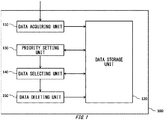
- Fig. 1 shows an example of a block diagram of a data management system 100 according to the present embodiment.
- the data management system 100 according to the present embodiment is configured to acquire and record measurement data from a plurality of sensors. Then, the data management system 100 is configured to set a priority for each sensor based on the measurement data, and selectively delete the recorded measurement data according to the priority.
- the data management system 100 is configured to manage measurement data acquired from a plurality of sensors provided in a plant.
- the data management system 100 may be configured to manage data from sensors provided in any different places from the plant.
- the data management system 100 may be a computer such as a PC (personal computer), a tablet computer, a smartphone, a workstation, a server computer, or a general purpose computer, or may be a computer system in which a plurality of computers are connected to each other. Such computer system is also a computer in a broad sense. Moreover, the data management system 100 may be implemented by one or plurality of virtual computer environments that can be executed in a computer. Instead, the data management system 100 may be a dedicated computer designed for management of data, or may be a dedicated hardware implemented by a dedicated circuit. Moreover, when the data management system 100 can be connected to the Internet, the data management system 100 may be implemented by a cloud computing.
- a cloud computing when the data management system 100 can be connected to the Internet, the data management system 100 may be implemented by a cloud computing.
- the data management system 100 includes a data acquiring unit 110, a data storage unit 120, a priority setting unit 130, a data selecting unit 140, and a data deleting unit 150.
- each of these blocks is a functional block functionality separated, and may not necessarily be consistent with an actual device configuration. That is, even if shown as one block in Fig. 1 , the block may not necessarily be configured by one device. Moreover, even if shown as separate blocks in Fig. 1 , those blocks may not necessarily be configured by separate devices.
- the data acquiring unit 110 is configured to acquire, from each of the plurality of sensors, measurement data generated by measuring a measurement target.
- the data acquiring unit 110 may be a communication unit and, for example, is configured to acquire the measurement data from each of the plurality of sensors in time series, via a communication network.
- Such communication network may be a network connecting a plurality of computers.
- the communication network may be a global network interconnecting a plurality of computer networks, and, as an example, the communication network may be the Internet using the Internet Protocol or the like. Instead, the communication network may be implemented by a dedicated line.
- the data acquiring unit 110 is configured to acquire the measurement data from each of the plurality of sensors via the communication network, but it is not limited thereto.
- the data acquiring unit 110 may be configured to acquire the measurement data from each of the plurality of sensors via other means that is different from the communication network, such as a user input or various types of memory device.
- Such plurality of sensors here can acquire measurement data generated by measuring a measurement target.
- the plurality of sensors may be sensors (for example, process control (measuring) sensor) installed in an OT (Operational Technology) region or IoT (Internet of Things) sensors, and, as an example, may be industrial sensors connected with or integrally configured with one or plurality of field devices provided in the plant.
- Such plant here may be, for example, besides an industrial plant such as a chemical plant, a plant for managing and controlling a wellhead or its surrounding area of a gas field, an oil field or the like, a plant for managing and controlling power generation such as hydraulic power generation, thermal power generation and nuclear power generation, a plant for managing and controlling energy harvesting such as solar photovoltaic generation, wind power generation or the like, and a plant for managing and controlling water and sewerage, a dam or the like.
- an industrial plant such as a chemical plant, a plant for managing and controlling a wellhead or its surrounding area of a gas field, an oil field or the like
- a plant for managing and controlling power generation such as hydraulic power generation, thermal power generation and nuclear power generation
- a plant for managing and controlling energy harvesting such as solar photovoltaic generation, wind power generation or the like
- a plant for managing and controlling water and sewerage, a dam or the like for managing and controlling water and sewerage, a dam or the like.
- a field device provided in such plant may be, for example, a pressure gauge, a flow meter, a sensor device such as a temperature sensor, a valve device such as a flow control valve or an on-off valve, an actuator device such as a fan or a motor, an imaging device such as a camera or a video camera for capturing a situation or an object in the plant, an audio device such as a microphone or a speaker for collecting noises or the like in the plant or emitting an alarm or the like, and a location detection device for outputting location information of each device, or the like.
- the data acquiring unit 110 may acquire from each of the plurality of field devices or the like, as the measurement data, for example, measurement data generated by measuring by the sensor itself or measurement data measured in field devices such as a temperature, pressure, a fluid flow, acceleration, a magnetic field, a location, a camera image, switching on/off data, a sound, and any combination thereof. Moreover, the data acquiring unit 110 may acquire, as the measurement data, a value generated by using a formula based on these data. The data acquiring unit 110 is configured to supply the measurement data acquired from each of the plurality of sensors to the data storage unit 120.
- the data storage unit 120 is configured to record the measurement data.
- the data storage unit 120 may be configured to record for each sensor in time series the measurement data from the plurality of sensors supplied from the data acquiring unit 110.
- the priority setting unit 130 may be able to access the data storage unit 120, and is configured to view the measurement data from the plurality of sensors recorded in the data storage unit 120. Then, the priority setting unit 130 is configured to set a priority to be given to each of the plurality of sensors, based on the measurement data acquired from each of the plurality of sensors. This will be described below.
- the priority setting unit 130 is configured to supply information related to the set priority to the data selecting unit 140.
- the data selecting unit 140 is configured to refer to information related to the priority supplied from the priority setting unit 130, when deleting the measurement data recorded in the data storage unit 120. Then, the data selecting unit 140 is configured to select data to be deleted from among the measurement data, according to the priority for each of the plurality of sensors. For example, the data selecting unit 140 may preferentially select the measurement data acquired from a sensor with a low priority as the data to be deleted. The data selecting unit 140 is configured to supply information related to the selected data to be deleted to the data deleting unit 150.
- the data deleting unit 150 is configured to refer to the information related to the data to be deleted supplied from the data selecting unit 140. Then, the data deleting unit 150 is configured to delete the measurement data selected as the data to be deleted among the measurement data recorded in the data storage unit 120.
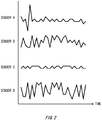
- Fig. 2 shows an example of measurement data managed by the data management system 100 according to the present embodiment.
- the data management system 100 is configured to manage measurement data from four sensors: a sensor A, a sensor B, a sensor C, and a sensor D.
- the data management system 100 may manage measurement data from more than four sensors, or may manage measurement data from one or less than four sensors.
- the types of the plurality of sensors here may be each the same. That is, all of the sensor A to the sensor D may be able to acquire measurement data of the same type (for example, a temperature or the like). Instead, the types of the plurality of sensors may be partly or wholly different. That is, some of the sensor A to the sensor D may be able to acquire measurement data of different types (for example, a temperature and pressure or the like), and all of the sensor A to the sensor D may be able to acquire measurement data of different types (a temperature, pressure, a fluid flow, and acceleration or the like).
- Fig. 2 shows, in order from the top, measurement data from the sensor A, the sensor B, the sensor C, and the sensor D during a predetermined period in time series.
- the sensor D has the greatest variance
- the sensor B has the second greatest variance
- the sensor A has the third greatest variance
- the sensor C has the smallest variance of the measurement data.
- such variance may be an index for indicating a degree of dispersion of the time series data for each sensor, and may be calculated by averaging of the square of the difference between the individual data and the mean value, for example.
- the sensor A has the greatest variation
- the sensor D has the second greatest variation
- the sensor B has the third greatest variation
- the sensor C has the smallest variation of the measurement data.
- such variation may be an index for indicating a degree of relative dispersion of the time series data for each sensor, and, for example, may be calculated by dividing the standard deviation by the mean value.
- the data management system 100 is configured to acquire and record the measurement data as shown in Fig. 2 . Then, the data management system 100 is configured to selectively delete the recorded measurement data, when the total capacity of the measurement data recorded in the data storage unit 120 exceeds a predefined upper limit value. This will be described in detail using a flow.
- Fig. 3 shows an example of a flow in which the data management system 100 according to the present embodiment deletes measurement data.
- the data management system 100 acquires, from each of the plurality of sensors, measurement data generated by measuring a measurement target.
- the data acquiring unit 110 acquires the measurement data from each of the plurality of sensors (for example, the sensor A, the sensor B, the sensor C, and the sensor D) in time series, via a communication network.
- the data acquiring unit 110 supplies the measurement data acquired from each of the plurality of sensors to the data storage unit 120.
- the data management system 100 records the measurement data.
- the data storage unit 120 records, for each sensor in time series, the measurement data acquired from each of the plurality of sensors at Step 310.
- the data management system 100 sets a priority to be given to each of the plurality of sensors, based on the measurement data acquired from each of the plurality of sensors.
- the priority setting unit 130 accesses the data storage unit 120, and views the measurement data from the plurality of sensors recorded at Step 320. Then, the priority setting unit 130 analyzes the measurement data for each sensor, and set a priority to be given to each of the plurality of sensors based on the analyzed result.
- the priority setting unit 130 calculates, for each of the plurality of sensors, a variance of the measurement data during a predetermined period, and sets a sensor having a smaller variance to be given a lower priority than a sensor having a greater variance. More specifically, for example, the priority setting unit 130 calculates, for each sensor, the variance of the measurement data by averaging the square of the difference between the individual data and the mean value during the predetermined period.
- the priority setting unit 130 sets the sensor D to be given a priority 1, the sensor B to be given a priority 2, the sensor A to be given a priority 3, and the sensor C to be given a priority 4. Note that here the priority 1 is the highest priority and the priority 4 is the lowest priority.
- the priority setting unit 130 may calculate, for each of the plurality of sensors, a variation of the measurement data during the predetermined period, and set a sensor having a smaller variation to be given a lower priority than a sensor having a greater variation. More specifically, for example, the priority setting unit 130 calculates, for each sensor, the variation (coefficient of variation) of the measurement data by dividing the standard deviation of the individual data during the predetermined period by the mean value.
- the priority setting unit 130 may set the sensor A to be given a priority 1, the sensor D to be given a priority 2, the sensor B to be given a priority 3, and the sensor C to be given a priority 4.
- the priority setting unit 130 is configured to set the priority based on the variance or variation of the measurement data, but it is not limited thereto.
- the priority setting unit 130 may set a priority, based on any index that can be calculated from the measurement data such as the maximum value, the minimum value and a range (the difference between the maximum value and the minimum value), for example.
- the priority setting unit 130 is configured to set the priority based on one index calculated from the measurement data, but it is not limited thereto.
- the priority setting unit 130 may set the priority based on a scored value obtained by combining a plurality of indices.
- the priority setting unit 130 supplies information related to the set priority to the data selecting unit 140.
- the data management system 100 determines whether the total capacity of the measurement data recorded in the data storage unit 120 at Step 320 is equal to or lower than a predetermined threshold (upper limit value). When it is determined that the total capacity of the measurement data is equal to or lower than the predetermined threshold, the data management system 100 ends the flow.
- a predetermined threshold upper limit value
- the data management system 100 selects data to be deleted at Step 350.
- the data selecting unit 140 refers to information related to the priority set at Step 330 and selects the data to be deleted from among the measurement data according to the priority for each of the plurality of sensors. In doing so, the data selecting unit 140 may preferentially select, as the data to be deleted, the measurement data acquired from a sensor with a lower priority, for example, the sensor C for which the priority 4 is set. The data selecting unit 140 supplies information related to the selected data to be deleted to the data deleting unit 150.
- the data management system 100 deletes the data to be deleted.
- the data deleting unit 150 deletes the measurement data selected as the data to be deleted at Step 350, among the measurement data recorded at Step 320.
- the data management system 100 returns the process to Step 340. That is, at Step 340, the data management system 100 determines again whether the total capacity of the measurement data after deleting the data to be deleted at Step 360 is equal to or lower than the predetermined threshold. When it is determined that the total capacity of the measurement data still exceeds the predetermined threshold at Step 340, the data management system 100 selects data to be deleted again at Step 350.
- the data selecting unit 140 may refer to information related to the priority set at Step 330, and select, as the data to be deleted, the measurement data acquired from a sensor having the second lowest priority, for example, a sensor for which the priority 3 is set.
- the data management system 100 deletes the measurement data acquired from the sensor for which the priority 3 is set. The data management system 100 repeats such process until the total capacity of the measurement data becomes equal to or lower than the predetermined threshold.
- an evaluation index is calculated by using the sensor data, and, at a point where a degree of change of the evaluation index is large, the saving priority order of the sensor data is raised so that the sensor data is not easily deleted and, at a point where the degree of change is small, the saving priority order of the sensor data is lowered so that the sensor data is easily deleted. That is, the conventional data management apparatus focuses on one sensor data and is configured to preferentially delete, among the sensor data in time series, sensor data in a period where the degree of change is small than sensor data in a period where the degree of change is large. However, the conventional data management apparatus cannot delete sensor data by a unit of sensor.
- the data management system 100 is configured to set a priority to be given to each of the plurality of sensors based on the measurement data acquired from each of the plurality of sensors, and selectively delete the measurement data according to the priority for each sensor.
- the data management system 100 according to the present embodiment can selectively delete measurement data from a sensor with a low priority, and more efficiently leave measurement data from a sensor with a high priority on record.
- the data management system 100 is configured to set a sensor having a smaller variance of measurement data to be given a lower priority than a sensor having a greater variance.
- the data management system 100 according to the present embodiment can, for example, when the data management system 100 acquired measurement data from each of a plurality of sensors of the same type, preferentially delete the measurement data from a sensor which has a small dispersion and is expected to have no high importance (user's interest is low) among the plurality of sensors.
- the measurement data from the plurality of sensors each have different units and sizes.
- a data group having larger values for the individual data i.e. having a larger mean value
- analyzing the dispersion for each sensor data using the variance is not necessarily effective.
- the data management system 100 according to the present embodiment is configured to set a sensor having a smaller variation of the measurement data to be given a lower priority than a sensor having a greater variation.
- the data management system 100 can, for example, even when the data management system 100 acquired measurement data from each of a plurality of sensors of the different types, preferentially delete the measurement data from a sensor which has a relatively small dispersion and is expected to have no high importance among the plurality of sensors.
- the priority setting unit 130 is configured to set the priority based on a statistics (the variance or variation) of the measurement data from the plurality of sensors.
- the priority setting unit 130 may calculate, for each of the plurality of sensors, the difference between estimation data estimated and the measurement data, and set a sensor having a smaller difference to be given a lower priority than a sensor having a greater difference.
- the priority setting unit 130 may estimate, for each of the plurality of sensors, the next data from data obtained in the past. For example, the priority setting unit 130 may estimate a value of the next data by adding the difference between the preceding data and the current data to the current data. Moreover, the priority setting unit 130 may estimate a value of the next data by focusing on a periodicity of the data obtained in the past. Then, the priority setting unit 130 may calculate, for each of the plurality of sensors, the difference between estimation data thus estimated and the measurement data actually obtained, and set a sensor having a smaller difference to be given a lower priority than a sensor having a greater difference.
- the priority setting unit 130 may estimate, for each of the plurality of sensors, a value of data of a target sensor from data obtained from other sensors.
- the measurement data from the plurality of sensors may have mutual dependency. For example, there is a case where a value of pressure data can be estimated to some extent from fluid flow data and temperature data obtained at surrounding locations. Therefore, for example, the priority setting unit 130 may estimate a value of data of a target sensor from values of one or plurality of sensors at locations surrounding the target sensor, by interpolating the values of the sensors. Then, the priority setting unit 130 may calculate, for each of the plurality of sensors, the difference between estimation data thus estimated and the measurement data actually obtained, and set a sensor having a smaller difference to be given a lower priority than a sensor having a greater difference.
- the priority setting unit 130 may estimate, for each of the plurality of sensors, a value of data of a target sensor from a simulated result.
- the priority setting unit 130 is configured to acquire, for each of the plurality of sensors, data estimated with high accuracy by using a simulator (not shown). Then, the priority setting unit 130 may calculate, for each of the plurality of sensors, the difference between estimation data thus estimated and the measurement data actually obtained, and set a sensor having a smaller difference to be given a lower priority than a sensor having a greater difference.
- the data management system 100 may preferentially delete the measurement data from a sensor having a smaller difference between the estimation data and the measurement data than the measurement data from a sensor having a greater difference.
- the data management system 100 according to the present embodiment can preferentially delete the measurement data from a sensor that is easily estimated (that can be estimated with high accuracy) among the plurality of sensors.
- Fig. 4 shows an example of a flow in which the data management system 100 according to the present embodiment updates the priority.
- the data management system 100 according to the present embodiment may be configured to update the priority for each sensor.
- Step 410 the data management system 100 sets a priority to be given to each of the plurality of sensors.
- Step 410 is the same process as the Step 330 and therefore its description is omitted.
- the data management system 100 determines whether a predetermined event has occurred. As an example, the data management system 100 determines whether the predetermined event has occurred, according to whether an abnormality has occurred in the measurement target. For example, the data management system 100 may determine that the predetermined event has occurred when the data management system 100 receives, from a user or another system, an indicator indicating an abnormality has occurred. Instead, the data management system 100 may spontaneously determine that an abnormality has occurred from measurement data acquired from the plurality of sensors.
- the data management system 100 may determine that an abnormality has occurred in the measurement target when the data management system 100 calculates a Mahalanobis distance by MT (Maharanobis-Taguchi) method from the measurement data acquired from the plurality of sensors and the Mahalanobis distance exceeds a predetermined threshold.
- MT Miharanobis-Taguchi
- the data management system 100 updates the priority at Step 430. That is, the priority setting unit 130 dynamically updates the priority for each of the plurality of sensors. In doing so, the priority setting unit 130 may be configured to change the criterion for setting the priority before or after the occurrence of the event. For example, when the measurement target is in a normal state, a single change in the measurement data is unlikely to be a noise. On the other hand, when the measurement target is in an abnormal state, a continuous change in the measurement data may be likely to be important data. In this manner, the importance of the measurement data may change before or after the occurrence of the event.
- the priority setting unit 130 changes the criterion for setting a high priority for what sensor before or after the occurrence of the event.
- the data management system 100 is configured to update the priority when an abnormality has occurred in the measurement target, but it is not limited thereto.
- the data management system 100 may update the priority when any of various events has occurred, such as when the data management system 100 receives a priority update request from the user or another system, when a disaster such as an earthquake has occurred, and when raw materials are changed.
- the data management system 100 can change the priority according to a condition such as the difference of raw materials (for example, oil fields).
- the data management system 100 determines whether it is a predetermined update timing at Step 440. As an example, the data management system 100 may determine whether it is the update timing according to whether the elapsed time since the previous setting of the priority exceeds a predetermined time.
- the data management system 100 When it is determined that it is not the predetermined update timing at Step 440, the data management system 100 returns the process to Step 420 and continues the flow. On the other hand, when it is determined that it is the predetermined update timing at Step 440, the data management system 100 updates the priority at Step 430.
- the priority setting unit 130 may change the criterion for setting the priority before or after the update timing. That is, the priority setting unit 130 may change the criterion for setting the priority according to the lapse of time.
- the data management system 100 can periodically change the priority every fixed period, or, for example, can change the priority by any time (for example, by day and by night).
- the data management system 100 dynamically updates the priority for each of the plurality of sensors.
- the data management system 100 according to the present embodiment can update the priority according to occurrence of any of various events or periodically.
- the data management system 100 is configured to completely delete the data to be deleted from the storage area in the system.
- the data management system 100 is configured to completely delete the data to be deleted from the storage area in the system.
- it is not limited thereto.
- Fig. 5 shows an example of a block diagram of the data management system 100 according to a variant of the present embodiment.
- the data management system 100 according to the present variant may be provided in an OT region, and may be able to send measurement data acquired from a sensor provided in the OT region to another system or apparatus provided in an IT region.
- the data management system 100 according to the present variant further comprises a data accumulating unit 510 and a data sending unit 520.
- the data acquiring unit 110 is configured to supply the measurement data acquired from each of the plurality of sensors to the data accumulating unit 510 instead of the data storage unit 120.
- the data accumulating unit 510 is configured to accumulate the measurement data.
- the data accumulating unit 510 may be configured to record, for each sensor in time series, all of the measurement data supplied from the data acquiring unit 110. Then, the data accumulating unit 510 is configured to supply, among the accumulated measurement data, target measurement data to be sent to another system or apparatus to the data storage unit 120. Note that such target to be sent may be selected based on a user input or may be automatically selected by the data management system 100, for example.
- the data storage unit 120 is configured to record, among the measurement data acquired from each of the plurality of sensors, target measurement data to be sent to another system or apparatus.
- the data deleting unit 150 is configured to delete, among the target measurement data to be sent that are recorded in the data storage unit 120, measurement data selected as data to be deleted.
- the data sending unit 520 is configured to send the measurement data recorded in the data storage unit 120 after deleting the data to be deleted, i.e., the target measurement data to be sent from which the data to be deleted is deleted, to another system or apparatus via a network or the like.
- the data management system 100 according to the present variant is configured to delete the data to be deleted from the target measurement data to be sent.
- the data management system 100 according to the present variant can reduce an amount of data to be sent from the data management system 100, for example, when sending the measurement data from the OT region to the IT region. That is, in the data management system 100 according to the present embodiment, deleting the data to be deleted may include, in a broad sense, besides completely deleting the data to be deleted from the storage area, excluding the data to be deleted from the target to be sent to another system or apparatus.
- Various embodiments of the present invention may be described with reference to flowcharts and block diagrams whose blocks may represent (1) steps of processes in which operations are performed or (2) sections of devices responsible for performing operations. Certain steps and sections may be implemented by dedicated circuitry, programmable circuitry supplied with computer readable instructions stored on computer readable media, and/or processors supplied with computer readable instructions stored on computer readable media.
- Dedicated circuitry may include digital and/or analog hardware circuits and may include integrated circuits (IC) and/or discrete circuits.
- Programmable circuitry may include reconfigurable hardware circuits comprising logical AND, OR, XOR, NAND, NOR, and other logical operations, flip-flops, registers, memory elements, etc., such as field-programmable gate arrays (FPGA), programmable logic arrays (PLA), etc.
- FPGA field-programmable gate arrays
- PLA programmable logic arrays
- Computer readable media may include any tangible device that can store instructions for execution by a suitable device, such that the computer readable medium having instructions stored therein comprises an article of manufacture including instructions which can be executed to create means for performing operations specified in the flowcharts or block diagrams.
- Examples of computer readable media may include an electronic storage medium, a magnetic storage medium, an optical storage medium, an electromagnetic storage medium, a semiconductor storage medium, etc.
- Computer readable media may include a Floppy (registered trademark) disk, a diskette, a hard disk, a random access memory (RAM), a read-only memory (ROM), an erasable programmable read-only memory (EPROM or Flash memory), an electrically erasable programmable read-only memory (EEPROM), a static random access memory (SRAM), a compact disc read-only memory (CD-ROM), a digital versatile disk (DVD), a Blu-ray (registered trademark) disc, a memory stick, an integrated circuit card, etc.
- Floppy registered trademark
- ROM read-only memory
- EPROM or Flash memory erasable programmable read-only memory
- EEPROM electrically erasable programmable read-only memory
- SRAM static random access memory
- CD-ROM compact disc read-only memory
- DVD digital versatile disk
- Blu-ray registered trademark
- Computer readable instructions may include assembler instructions, instruction-set-architecture (ISA) instructions, machine instructions, machine dependent instructions, microcode, firmware instructions, state-setting data, or either source code or object code written in any combination of one or more programming languages, including an object oriented programming language such as Smalltalk (registered trademark), JAVA (registered trademark), C++, etc., and conventional procedural programming languages, such as the "C" programming language or similar programming languages.
- ISA instruction-set-architecture
- machine instructions machine dependent instructions
- microcode firmware instructions
- state-setting data or either source code or object code written in any combination of one or more programming languages, including an object oriented programming language such as Smalltalk (registered trademark), JAVA (registered trademark), C++, etc., and conventional procedural programming languages, such as the "C" programming language or similar programming languages.
- Computer readable instructions may be provided to a processor of a general purpose computer, special purpose computer, or other programmable data processing apparatus, or to programmable circuitry, locally or via a local area network (LAN), a wide area network (WAN) such as the Internet, etc., to execute the computer readable instructions to create means for performing operations specified in the flowcharts or block diagrams.
- processors include computer processors, processing units, microprocessors, digital signal processors, controllers, microcontrollers, etc.
- FIG. 6 shows an example of a computer 2200 in which aspects of the present invention may be wholly or partly embodied.
- a program that is installed in the computer 2200 can cause the computer 2200 to function as or perform operations associated with apparatuses of the embodiments of the present invention or one or more sections thereof, and/or cause the computer 2200 to perform processes of the embodiments of the present invention or steps thereof.
- Such a program may be executed by a CPU 2212 to cause the computer 2200 to perform certain operations associated with some or all of the blocks of flowcharts and block diagrams described herein.
- the computer 2200 includes the CPU 2212, a RAM 2214, a graphics controller 2216, and a display device 2218, which are mutually connected by a host controller 2210.
- the computer 2200 also includes input/output units such as a communication interface 2222, a hard disk drive 2224, a DVD-ROM drive 2226 and an IC card drive, which are connected to the host controller 2210 via an input/output controller 2220.
- the computer also includes legacy input/output units such as a ROM 2230 and a keyboard 2242, which are connected to the input/output controller 2220 through an input/output chip 2240.
- the CPU 2212 operates according to programs stored in the ROM 2230 and the RAM 2214, thereby controlling each unit.
- the graphics controller 2216 obtains image data generated by the CPU 2212 on a frame buffer or the like provided in the RAM 2214 or in itself, and causes the image data to be displayed on the display device 2218.
- the communication interface 2222 communicates with other electronic devices via a network.
- the hard disk drive 2224 stores programs and data used by the CPU 2212 within the computer 2200.
- the DVD-ROM drive 2226 reads the programs or the data from the DVD-ROM 2201, and provides the hard disk drive 2224 with the programs or the data via the RAM 2214.
- the IC card drive reads programs and data from an IC card, and/or writes programs and data into the IC card.
- the ROM 2230 stores therein a boot program or the like executed by the computer 2200 at the time of activation, and/or a program depending on the hardware of the computer 2200.
- the input/output chip 2240 may also connect various input/output units via a parallel port, a serial port, a keyboard port, a mouse port, and the like to the input/output controller 2220.
- a program is provided by computer readable media such as the DVD-ROM 2201 or the IC card.
- the program is read from the computer readable media, installed into the hard disk drive 2224, RAM 2214, or ROM 2230, which are also examples of computer readable media, and executed by the CPU 2212.
- the information processing described in these programs is read into the computer 2200, resulting in cooperation between a program and the above-mentioned various types of hardware resources.
- An apparatus or method may be constituted by realizing the operation or processing of information in accordance with the usage of the computer 2200.
- the CPU 2212 may execute a communication program loaded onto the RAM 2214 to instruct communication processing to the communication interface 2222, based on the processing described in the communication program.
- the communication interface 2222 under control of the CPU 2212, reads transmission data stored on a transmission buffering region provided in a recording medium such as the RAM 2214, the hard disk drive 2224, the DVD-ROM 2201, or the IC card, and sends the read transmission data to a network or writes reception data received from a network to a reception buffering region or the like provided on the recording medium.
- the CPU 2212 may cause all or a necessary portion of a file or a database to be read into the RAM 2214, the file or the database having been stored in an external recording medium such as the hard disk drive 2224, the DVD-ROM drive 2226 (DVD-ROM 2201), the IC card, etc., and perform various types of processing on the data on the RAM 2214.
- the CPU 2212 may then write back the processed data to the external recording medium.
- the CPU 2212 may perform various types of processing on the data read from the RAM 2214, which includes various types of operations, processing of information, condition judging, conditional branch, unconditional branch, search/replace of information, etc., as described throughout this disclosure and designated by an instruction sequence of programs, and writes the result back to the RAM 2214.
- the CPU 2212 may search for information in a file, a database, etc., in the recording medium.
- the CPU 2212 may search for an entry matching the condition whose attribute value of the first attribute is designated, from among the plurality of entries, and read the attribute value of the second attribute stored in the entry, thereby obtaining the attribute value of the second attribute associated with the first attribute satisfying the predetermined condition.
- the above-explained program or software modules may be stored in the computer readable media on or near the computer 2200.
- a recording medium such as a hard disk or a RAM provided in a server system connected to a dedicated communication network or the Internet can be used as the computer readable media, thereby providing the program to the computer 2200 via the network.
Landscapes
- Engineering & Computer Science (AREA)
- Theoretical Computer Science (AREA)
- Physics & Mathematics (AREA)
- General Physics & Mathematics (AREA)
- General Engineering & Computer Science (AREA)
- Human Computer Interaction (AREA)
- Databases & Information Systems (AREA)
- Business, Economics & Management (AREA)
- Data Mining & Analysis (AREA)
- Strategic Management (AREA)
- Human Resources & Organizations (AREA)
- Economics (AREA)
- Tourism & Hospitality (AREA)
- Marketing (AREA)
- Entrepreneurship & Innovation (AREA)
- Quality & Reliability (AREA)
- General Business, Economics & Management (AREA)
- Software Systems (AREA)
- Educational Administration (AREA)
- Primary Health Care (AREA)
- Automation & Control Theory (AREA)
- Computational Linguistics (AREA)
- General Health & Medical Sciences (AREA)
- Development Economics (AREA)
- Manufacturing & Machinery (AREA)
- Health & Medical Sciences (AREA)
- Game Theory and Decision Science (AREA)
- Operations Research (AREA)
- Arrangements For Transmission Of Measured Signals (AREA)
- Recording Measured Values (AREA)
- Information Retrieval, Db Structures And Fs Structures Therefor (AREA)
Applications Claiming Priority (1)
| Application Number | Priority Date | Filing Date | Title |
|---|---|---|---|
| JP2020044562A JP7431070B2 (ja) | 2020-03-13 | 2020-03-13 | データ管理システム、および、データ管理方法 |
Publications (2)
| Publication Number | Publication Date |
|---|---|
| EP3879470A1 true EP3879470A1 (de) | 2021-09-15 |
| EP3879470B1 EP3879470B1 (de) | 2023-05-03 |
Family
ID=73598757
Family Applications (1)
| Application Number | Title | Priority Date | Filing Date |
|---|---|---|---|
| EP20210052.5A Active EP3879470B1 (de) | 2020-03-13 | 2020-11-26 | Datenverwaltungssystem und datenverwaltungsverfahren |
Country Status (4)
| Country | Link |
|---|---|
| US (1) | US20210286519A1 (de) |
| EP (1) | EP3879470B1 (de) |
| JP (1) | JP7431070B2 (de) |
| CN (1) | CN113392095A (de) |
Cited By (1)
| Publication number | Priority date | Publication date | Assignee | Title |
|---|---|---|---|---|
| EP4279876A1 (de) * | 2022-05-17 | 2023-11-22 | Yokogawa Electric Corporation | Datenaufzeichnungsvorrichtung, datenaufzeichnungsverfahren und datenaufzeichnungsprogramm |
Families Citing this family (7)
| Publication number | Priority date | Publication date | Assignee | Title |
|---|---|---|---|---|
| JP7691320B2 (ja) * | 2021-09-06 | 2025-06-11 | 株式会社三共 | 遊技機 |
| JP7691319B2 (ja) * | 2021-09-06 | 2025-06-11 | 株式会社三共 | 遊技機 |
| JP7740976B2 (ja) * | 2021-12-08 | 2025-09-17 | 矢崎総業株式会社 | 情報提供システム、サーバ及び情報提供システム用のプログラム |
| JP7629881B2 (ja) * | 2022-02-02 | 2025-02-14 | 株式会社日立製作所 | タクト分割データ収集システム、及び、異常検知システム |
| JP7753979B2 (ja) * | 2022-05-18 | 2025-10-15 | 横河電機株式会社 | データ記録装置、データ記録方法、および、データ記録プログラム |
| JP2025031400A (ja) * | 2023-08-25 | 2025-03-07 | 横河電機株式会社 | 情報処理方法、情報処理装置、情報処理システム、及び、プログラム |
| JP7485190B1 (ja) | 2023-11-16 | 2024-05-16 | 横河電機株式会社 | 装置、システム、方法およびプログラム |
Citations (2)
| Publication number | Priority date | Publication date | Assignee | Title |
|---|---|---|---|---|
| US20170091252A1 (en) * | 2015-09-28 | 2017-03-30 | International Business Machines Corporation | Reconciling sensor data in a database |
| US20200026435A1 (en) * | 2018-07-23 | 2020-01-23 | Fanuc Corporation | Data management device, data management program, and data management method |
Family Cites Families (9)
| Publication number | Priority date | Publication date | Assignee | Title |
|---|---|---|---|---|
| JP3169511B2 (ja) * | 1994-03-10 | 2001-05-28 | 三菱電機株式会社 | メモリ装置及びメモリ管理方法 |
| JPH0916633A (ja) * | 1995-06-28 | 1997-01-17 | Hitachi Ltd | 携帯型アナログ信号収録装置及びアナログ信号収録方法 |
| WO2006030530A1 (ja) * | 2004-09-17 | 2006-03-23 | National Institute Of Advanced Industrial Science And Technology | 刺激優先度判定手段を備えた模擬生物装置 |
| JP4709791B2 (ja) * | 2007-03-13 | 2011-06-22 | 株式会社東芝 | 映像処理装置及び映像処理方法 |
| EP2449511A1 (de) * | 2009-06-29 | 2012-05-09 | BAE Systems PLC | Schätzung eines zustandes von mindestens einem ziel mit mehreren sensoren |
| JP6277716B2 (ja) * | 2013-12-27 | 2018-02-14 | セイコーエプソン株式会社 | 生体情報計測機器、生体情報処理方法及びプログラム |
| JP2017076334A (ja) * | 2015-10-16 | 2017-04-20 | 株式会社日立製作所 | 管理サーバ及び管理システム及び管理方法 |
| CA3027503C (en) * | 2016-08-31 | 2021-01-12 | Halliburton Energy Services, Inc. | Pressure pump performance monitoring system using torque measurements |
| JP7077815B2 (ja) * | 2018-06-21 | 2022-05-31 | 岩崎電気株式会社 | 照明制御システム |
-
2020
- 2020-03-13 JP JP2020044562A patent/JP7431070B2/ja active Active
- 2020-11-26 EP EP20210052.5A patent/EP3879470B1/de active Active
- 2020-11-29 US US17/106,174 patent/US20210286519A1/en not_active Abandoned
- 2020-12-31 CN CN202011616025.6A patent/CN113392095A/zh active Pending
Patent Citations (3)
| Publication number | Priority date | Publication date | Assignee | Title |
|---|---|---|---|---|
| US20170091252A1 (en) * | 2015-09-28 | 2017-03-30 | International Business Machines Corporation | Reconciling sensor data in a database |
| US20200026435A1 (en) * | 2018-07-23 | 2020-01-23 | Fanuc Corporation | Data management device, data management program, and data management method |
| JP2020016938A (ja) | 2018-07-23 | 2020-01-30 | ファナック株式会社 | データ管理装置、データ管理プログラム及びデータ管理方法 |
Cited By (1)
| Publication number | Priority date | Publication date | Assignee | Title |
|---|---|---|---|---|
| EP4279876A1 (de) * | 2022-05-17 | 2023-11-22 | Yokogawa Electric Corporation | Datenaufzeichnungsvorrichtung, datenaufzeichnungsverfahren und datenaufzeichnungsprogramm |
Also Published As
| Publication number | Publication date |
|---|---|
| EP3879470B1 (de) | 2023-05-03 |
| US20210286519A1 (en) | 2021-09-16 |
| JP2021144629A (ja) | 2021-09-24 |
| JP7431070B2 (ja) | 2024-02-14 |
| CN113392095A (zh) | 2021-09-14 |
Similar Documents
| Publication | Publication Date | Title |
|---|---|---|
| EP3879470B1 (de) | Datenverwaltungssystem und datenverwaltungsverfahren | |
| CN113934365B (zh) | 数据管理系统、数据管理方法及记录有数据管理程序的记录介质 | |
| EP3929684B1 (de) | Datenverwaltungssystem, datenverwaltungsverfahren und datenverwaltungsprogramm | |
| US20220121164A1 (en) | Control apparatus, controller, control system, control method, and computer-readable medium having recorded thereon control program | |
| CN113805796B (zh) | 数据管理系统、数据管理方法及记录有数据管理程序的记录介质 | |
| CN113220551A (zh) | 指标趋势预测及预警方法、装置、电子设备及存储介质 | |
| JP2021162459A (ja) | データ管理システム、データ管理方法、および、データ管理プログラム | |
| EP3832557B1 (de) | Bestimmungsvorrichtung, bestimmungsverfahren, bestimmungsprogramm, und zugehöriges system, verfahren, programm und computer-lesbares medium | |
| US12190208B2 (en) | Data management system, data management method, and recording medium having recorded thereon a data management program | |
| CN114090540B (zh) | 数据管理系统、数据管理方法以及记录了程序的记录介质 | |
| US20250005454A1 (en) | Apparatus, method, and computer readable medium | |
| US20230375382A1 (en) | Data recording apparatus, data recording method, and non-transitory computer readable medium | |
| JP7753979B2 (ja) | データ記録装置、データ記録方法、および、データ記録プログラム |
Legal Events
| Date | Code | Title | Description |
|---|---|---|---|
| PUAI | Public reference made under article 153(3) epc to a published international application that has entered the european phase |
Free format text: ORIGINAL CODE: 0009012 |
|
| STAA | Information on the status of an ep patent application or granted ep patent |
Free format text: STATUS: THE APPLICATION HAS BEEN PUBLISHED |
|
| AK | Designated contracting states |
Kind code of ref document: A1 Designated state(s): AL AT BE BG CH CY CZ DE DK EE ES FI FR GB GR HR HU IE IS IT LI LT LU LV MC MK MT NL NO PL PT RO RS SE SI SK SM TR |
|
| STAA | Information on the status of an ep patent application or granted ep patent |
Free format text: STATUS: REQUEST FOR EXAMINATION WAS MADE |
|
| 17P | Request for examination filed |
Effective date: 20211001 |
|
| RBV | Designated contracting states (corrected) |
Designated state(s): AL AT BE BG CH CY CZ DE DK EE ES FI FR GB GR HR HU IE IS IT LI LT LU LV MC MK MT NL NO PL PT RO RS SE SI SK SM TR |
|
| STAA | Information on the status of an ep patent application or granted ep patent |
Free format text: STATUS: EXAMINATION IS IN PROGRESS |
|
| 17Q | First examination report despatched |
Effective date: 20211214 |
|
| GRAP | Despatch of communication of intention to grant a patent |
Free format text: ORIGINAL CODE: EPIDOSNIGR1 |
|
| STAA | Information on the status of an ep patent application or granted ep patent |
Free format text: STATUS: GRANT OF PATENT IS INTENDED |
|
| RIC1 | Information provided on ipc code assigned before grant |
Ipc: G05B 23/00 20060101ALI20221121BHEP Ipc: G05B 17/00 20060101ALI20221121BHEP Ipc: G06F 3/06 20060101ALI20221121BHEP Ipc: G06F 16/2455 20190101ALI20221121BHEP Ipc: G06Q 50/04 20120101ALI20221121BHEP Ipc: G06Q 10/06 20120101AFI20221121BHEP |
|
| INTG | Intention to grant announced |
Effective date: 20221205 |
|
| GRAS | Grant fee paid |
Free format text: ORIGINAL CODE: EPIDOSNIGR3 |
|
| GRAA | (expected) grant |
Free format text: ORIGINAL CODE: 0009210 |
|
| STAA | Information on the status of an ep patent application or granted ep patent |
Free format text: STATUS: THE PATENT HAS BEEN GRANTED |
|
| AK | Designated contracting states |
Kind code of ref document: B1 Designated state(s): AL AT BE BG CH CY CZ DE DK EE ES FI FR GB GR HR HU IE IS IT LI LT LU LV MC MK MT NL NO PL PT RO RS SE SI SK SM TR |
|
| REG | Reference to a national code |
Ref country code: GB Ref legal event code: FG4D |
|
| REG | Reference to a national code |
Ref country code: AT Ref legal event code: REF Ref document number: 1565296 Country of ref document: AT Kind code of ref document: T Effective date: 20230515 Ref country code: CH Ref legal event code: EP |
|
| REG | Reference to a national code |
Ref country code: DE Ref legal event code: R096 Ref document number: 602020010368 Country of ref document: DE |
|
| REG | Reference to a national code |
Ref country code: IE Ref legal event code: FG4D |
|
| P01 | Opt-out of the competence of the unified patent court (upc) registered |
Effective date: 20230603 |
|
| REG | Reference to a national code |
Ref country code: LT Ref legal event code: MG9D |
|
| REG | Reference to a national code |
Ref country code: NL Ref legal event code: MP Effective date: 20230503 |
|
| REG | Reference to a national code |
Ref country code: AT Ref legal event code: MK05 Ref document number: 1565296 Country of ref document: AT Kind code of ref document: T Effective date: 20230503 |
|
| PG25 | Lapsed in a contracting state [announced via postgrant information from national office to epo] |
Ref country code: SE Free format text: LAPSE BECAUSE OF FAILURE TO SUBMIT A TRANSLATION OF THE DESCRIPTION OR TO PAY THE FEE WITHIN THE PRESCRIBED TIME-LIMIT Effective date: 20230503 Ref country code: PT Free format text: LAPSE BECAUSE OF FAILURE TO SUBMIT A TRANSLATION OF THE DESCRIPTION OR TO PAY THE FEE WITHIN THE PRESCRIBED TIME-LIMIT Effective date: 20230904 Ref country code: NO Free format text: LAPSE BECAUSE OF FAILURE TO SUBMIT A TRANSLATION OF THE DESCRIPTION OR TO PAY THE FEE WITHIN THE PRESCRIBED TIME-LIMIT Effective date: 20230803 Ref country code: NL Free format text: LAPSE BECAUSE OF FAILURE TO SUBMIT A TRANSLATION OF THE DESCRIPTION OR TO PAY THE FEE WITHIN THE PRESCRIBED TIME-LIMIT Effective date: 20230503 Ref country code: ES Free format text: LAPSE BECAUSE OF FAILURE TO SUBMIT A TRANSLATION OF THE DESCRIPTION OR TO PAY THE FEE WITHIN THE PRESCRIBED TIME-LIMIT Effective date: 20230503 Ref country code: AT Free format text: LAPSE BECAUSE OF FAILURE TO SUBMIT A TRANSLATION OF THE DESCRIPTION OR TO PAY THE FEE WITHIN THE PRESCRIBED TIME-LIMIT Effective date: 20230503 |
|
| PG25 | Lapsed in a contracting state [announced via postgrant information from national office to epo] |
Ref country code: RS Free format text: LAPSE BECAUSE OF FAILURE TO SUBMIT A TRANSLATION OF THE DESCRIPTION OR TO PAY THE FEE WITHIN THE PRESCRIBED TIME-LIMIT Effective date: 20230503 Ref country code: PL Free format text: LAPSE BECAUSE OF FAILURE TO SUBMIT A TRANSLATION OF THE DESCRIPTION OR TO PAY THE FEE WITHIN THE PRESCRIBED TIME-LIMIT Effective date: 20230503 Ref country code: LV Free format text: LAPSE BECAUSE OF FAILURE TO SUBMIT A TRANSLATION OF THE DESCRIPTION OR TO PAY THE FEE WITHIN THE PRESCRIBED TIME-LIMIT Effective date: 20230503 Ref country code: LT Free format text: LAPSE BECAUSE OF FAILURE TO SUBMIT A TRANSLATION OF THE DESCRIPTION OR TO PAY THE FEE WITHIN THE PRESCRIBED TIME-LIMIT Effective date: 20230503 Ref country code: IS Free format text: LAPSE BECAUSE OF FAILURE TO SUBMIT A TRANSLATION OF THE DESCRIPTION OR TO PAY THE FEE WITHIN THE PRESCRIBED TIME-LIMIT Effective date: 20230903 Ref country code: HR Free format text: LAPSE BECAUSE OF FAILURE TO SUBMIT A TRANSLATION OF THE DESCRIPTION OR TO PAY THE FEE WITHIN THE PRESCRIBED TIME-LIMIT Effective date: 20230503 Ref country code: GR Free format text: LAPSE BECAUSE OF FAILURE TO SUBMIT A TRANSLATION OF THE DESCRIPTION OR TO PAY THE FEE WITHIN THE PRESCRIBED TIME-LIMIT Effective date: 20230804 |
|
| PG25 | Lapsed in a contracting state [announced via postgrant information from national office to epo] |
Ref country code: FI Free format text: LAPSE BECAUSE OF FAILURE TO SUBMIT A TRANSLATION OF THE DESCRIPTION OR TO PAY THE FEE WITHIN THE PRESCRIBED TIME-LIMIT Effective date: 20230503 |
|
| PG25 | Lapsed in a contracting state [announced via postgrant information from national office to epo] |
Ref country code: SK Free format text: LAPSE BECAUSE OF FAILURE TO SUBMIT A TRANSLATION OF THE DESCRIPTION OR TO PAY THE FEE WITHIN THE PRESCRIBED TIME-LIMIT Effective date: 20230503 |
|
| PG25 | Lapsed in a contracting state [announced via postgrant information from national office to epo] |
Ref country code: SM Free format text: LAPSE BECAUSE OF FAILURE TO SUBMIT A TRANSLATION OF THE DESCRIPTION OR TO PAY THE FEE WITHIN THE PRESCRIBED TIME-LIMIT Effective date: 20230503 Ref country code: SK Free format text: LAPSE BECAUSE OF FAILURE TO SUBMIT A TRANSLATION OF THE DESCRIPTION OR TO PAY THE FEE WITHIN THE PRESCRIBED TIME-LIMIT Effective date: 20230503 Ref country code: RO Free format text: LAPSE BECAUSE OF FAILURE TO SUBMIT A TRANSLATION OF THE DESCRIPTION OR TO PAY THE FEE WITHIN THE PRESCRIBED TIME-LIMIT Effective date: 20230503 Ref country code: EE Free format text: LAPSE BECAUSE OF FAILURE TO SUBMIT A TRANSLATION OF THE DESCRIPTION OR TO PAY THE FEE WITHIN THE PRESCRIBED TIME-LIMIT Effective date: 20230503 Ref country code: DK Free format text: LAPSE BECAUSE OF FAILURE TO SUBMIT A TRANSLATION OF THE DESCRIPTION OR TO PAY THE FEE WITHIN THE PRESCRIBED TIME-LIMIT Effective date: 20230503 Ref country code: CZ Free format text: LAPSE BECAUSE OF FAILURE TO SUBMIT A TRANSLATION OF THE DESCRIPTION OR TO PAY THE FEE WITHIN THE PRESCRIBED TIME-LIMIT Effective date: 20230503 |
|
| REG | Reference to a national code |
Ref country code: DE Ref legal event code: R097 Ref document number: 602020010368 Country of ref document: DE |
|
| PLBE | No opposition filed within time limit |
Free format text: ORIGINAL CODE: 0009261 |
|
| STAA | Information on the status of an ep patent application or granted ep patent |
Free format text: STATUS: NO OPPOSITION FILED WITHIN TIME LIMIT |
|
| 26N | No opposition filed |
Effective date: 20240206 |
|
| PG25 | Lapsed in a contracting state [announced via postgrant information from national office to epo] |
Ref country code: SI Free format text: LAPSE BECAUSE OF FAILURE TO SUBMIT A TRANSLATION OF THE DESCRIPTION OR TO PAY THE FEE WITHIN THE PRESCRIBED TIME-LIMIT Effective date: 20230503 |
|
| PG25 | Lapsed in a contracting state [announced via postgrant information from national office to epo] |
Ref country code: SI Free format text: LAPSE BECAUSE OF FAILURE TO SUBMIT A TRANSLATION OF THE DESCRIPTION OR TO PAY THE FEE WITHIN THE PRESCRIBED TIME-LIMIT Effective date: 20230503 Ref country code: IT Free format text: LAPSE BECAUSE OF FAILURE TO SUBMIT A TRANSLATION OF THE DESCRIPTION OR TO PAY THE FEE WITHIN THE PRESCRIBED TIME-LIMIT Effective date: 20230503 |
|
| REG | Reference to a national code |
Ref country code: CH Ref legal event code: PL |
|
| PG25 | Lapsed in a contracting state [announced via postgrant information from national office to epo] |
Ref country code: MC Free format text: LAPSE BECAUSE OF FAILURE TO SUBMIT A TRANSLATION OF THE DESCRIPTION OR TO PAY THE FEE WITHIN THE PRESCRIBED TIME-LIMIT Effective date: 20230503 |
|
| PG25 | Lapsed in a contracting state [announced via postgrant information from national office to epo] |
Ref country code: LU Free format text: LAPSE BECAUSE OF NON-PAYMENT OF DUE FEES Effective date: 20231126 |
|
| PG25 | Lapsed in a contracting state [announced via postgrant information from national office to epo] |
Ref country code: CH Free format text: LAPSE BECAUSE OF NON-PAYMENT OF DUE FEES Effective date: 20231130 |
|
| PG25 | Lapsed in a contracting state [announced via postgrant information from national office to epo] |
Ref country code: MC Free format text: LAPSE BECAUSE OF FAILURE TO SUBMIT A TRANSLATION OF THE DESCRIPTION OR TO PAY THE FEE WITHIN THE PRESCRIBED TIME-LIMIT Effective date: 20230503 Ref country code: LU Free format text: LAPSE BECAUSE OF NON-PAYMENT OF DUE FEES Effective date: 20231126 Ref country code: CH Free format text: LAPSE BECAUSE OF NON-PAYMENT OF DUE FEES Effective date: 20231130 |
|
| REG | Reference to a national code |
Ref country code: BE Ref legal event code: MM Effective date: 20231130 |
|
| REG | Reference to a national code |
Ref country code: IE Ref legal event code: MM4A |
|
| PG25 | Lapsed in a contracting state [announced via postgrant information from national office to epo] |
Ref country code: IE Free format text: LAPSE BECAUSE OF NON-PAYMENT OF DUE FEES Effective date: 20231126 |
|
| PG25 | Lapsed in a contracting state [announced via postgrant information from national office to epo] |
Ref country code: BE Free format text: LAPSE BECAUSE OF NON-PAYMENT OF DUE FEES Effective date: 20231130 |
|
| PG25 | Lapsed in a contracting state [announced via postgrant information from national office to epo] |
Ref country code: FR Free format text: LAPSE BECAUSE OF NON-PAYMENT OF DUE FEES Effective date: 20231130 |
|
| PG25 | Lapsed in a contracting state [announced via postgrant information from national office to epo] |
Ref country code: IE Free format text: LAPSE BECAUSE OF NON-PAYMENT OF DUE FEES Effective date: 20231126 Ref country code: FR Free format text: LAPSE BECAUSE OF NON-PAYMENT OF DUE FEES Effective date: 20231130 Ref country code: BE Free format text: LAPSE BECAUSE OF NON-PAYMENT OF DUE FEES Effective date: 20231130 |
|
| PG25 | Lapsed in a contracting state [announced via postgrant information from national office to epo] |
Ref country code: BG Free format text: LAPSE BECAUSE OF FAILURE TO SUBMIT A TRANSLATION OF THE DESCRIPTION OR TO PAY THE FEE WITHIN THE PRESCRIBED TIME-LIMIT Effective date: 20230503 |
|
| PG25 | Lapsed in a contracting state [announced via postgrant information from national office to epo] |
Ref country code: BG Free format text: LAPSE BECAUSE OF FAILURE TO SUBMIT A TRANSLATION OF THE DESCRIPTION OR TO PAY THE FEE WITHIN THE PRESCRIBED TIME-LIMIT Effective date: 20230503 |
|
| GBPC | Gb: european patent ceased through non-payment of renewal fee |
Effective date: 20241126 |
|
| PG25 | Lapsed in a contracting state [announced via postgrant information from national office to epo] |
Ref country code: CY Free format text: LAPSE BECAUSE OF FAILURE TO SUBMIT A TRANSLATION OF THE DESCRIPTION OR TO PAY THE FEE WITHIN THE PRESCRIBED TIME-LIMIT; INVALID AB INITIO Effective date: 20201126 |
|
| PG25 | Lapsed in a contracting state [announced via postgrant information from national office to epo] |
Ref country code: HU Free format text: LAPSE BECAUSE OF FAILURE TO SUBMIT A TRANSLATION OF THE DESCRIPTION OR TO PAY THE FEE WITHIN THE PRESCRIBED TIME-LIMIT; INVALID AB INITIO Effective date: 20201126 |
|
| PG25 | Lapsed in a contracting state [announced via postgrant information from national office to epo] |
Ref country code: GB Free format text: LAPSE BECAUSE OF NON-PAYMENT OF DUE FEES Effective date: 20241126 |
|
| PG25 | Lapsed in a contracting state [announced via postgrant information from national office to epo] |
Ref country code: TR Free format text: LAPSE BECAUSE OF FAILURE TO SUBMIT A TRANSLATION OF THE DESCRIPTION OR TO PAY THE FEE WITHIN THE PRESCRIBED TIME-LIMIT Effective date: 20230503 |
|
| PGFP | Annual fee paid to national office [announced via postgrant information from national office to epo] |
Ref country code: DE Payment date: 20251022 Year of fee payment: 6 |