EP3882012A2 - Dispositif de fabrication de sacs ou des sacs et procede de fabrication de sacs ou de sacs - Google Patents
Dispositif de fabrication de sacs ou des sacs et procede de fabrication de sacs ou de sacs Download PDFInfo
- Publication number
- EP3882012A2 EP3882012A2 EP21162712.0A EP21162712A EP3882012A2 EP 3882012 A2 EP3882012 A2 EP 3882012A2 EP 21162712 A EP21162712 A EP 21162712A EP 3882012 A2 EP3882012 A2 EP 3882012A2
- Authority
- EP
- European Patent Office
- Prior art keywords
- sack
- manufacturing device
- belt
- bag manufacturing
- transport
- Prior art date
- Legal status (The legal status is an assumption and is not a legal conclusion. Google has not performed a legal analysis and makes no representation as to the accuracy of the status listed.)
- Pending
Links
- 238000004519 manufacturing process Methods 0.000 title claims abstract description 48
- 238000000034 method Methods 0.000 title claims description 10
- 239000000835 fiber Substances 0.000 claims description 22
- 239000004033 plastic Substances 0.000 claims description 15
- 229920003023 plastic Polymers 0.000 claims description 15
- 239000000463 material Substances 0.000 claims description 12
- 239000002184 metal Substances 0.000 claims description 4
- 229920002635 polyurethane Polymers 0.000 claims description 4
- 239000004814 polyurethane Substances 0.000 claims description 4
- 229910000831 Steel Inorganic materials 0.000 claims description 2
- 239000000049 pigment Substances 0.000 claims description 2
- 239000010959 steel Substances 0.000 claims description 2
- 230000000295 complement effect Effects 0.000 description 3
- 238000005299 abrasion Methods 0.000 description 2
- 230000000694 effects Effects 0.000 description 2
- 239000003292 glue Substances 0.000 description 2
- 230000004048 modification Effects 0.000 description 2
- 238000012986 modification Methods 0.000 description 2
- 239000006223 plastic coating Substances 0.000 description 2
- 239000000654 additive Substances 0.000 description 1
- 239000004566 building material Substances 0.000 description 1
- 239000004568 cement Substances 0.000 description 1
- 238000004040 coloring Methods 0.000 description 1
- 230000007547 defect Effects 0.000 description 1
- 230000001419 dependent effect Effects 0.000 description 1
- 238000006073 displacement reaction Methods 0.000 description 1
- 229920001971 elastomer Polymers 0.000 description 1
- 230000008030 elimination Effects 0.000 description 1
- 238000003379 elimination reaction Methods 0.000 description 1
- 239000003337 fertilizer Substances 0.000 description 1
- 238000009434 installation Methods 0.000 description 1
- 238000005304 joining Methods 0.000 description 1
- 230000007935 neutral effect Effects 0.000 description 1
- 238000003825 pressing Methods 0.000 description 1
- 230000005855 radiation Effects 0.000 description 1
- 239000002689 soil Substances 0.000 description 1
- 230000003068 static effect Effects 0.000 description 1
- 239000004636 vulcanized rubber Substances 0.000 description 1
Images

Classifications
-
- B—PERFORMING OPERATIONS; TRANSPORTING
- B31—MAKING ARTICLES OF PAPER, CARDBOARD OR MATERIAL WORKED IN A MANNER ANALOGOUS TO PAPER; WORKING PAPER, CARDBOARD OR MATERIAL WORKED IN A MANNER ANALOGOUS TO PAPER
- B31B—MAKING CONTAINERS OF PAPER, CARDBOARD OR MATERIAL WORKED IN A MANNER ANALOGOUS TO PAPER
- B31B70/00—Making flexible containers, e.g. envelopes or bags
- B31B70/02—Feeding or positioning sheets, blanks or webs
- B31B70/04—Feeding sheets or blanks
-
- B—PERFORMING OPERATIONS; TRANSPORTING
- B65—CONVEYING; PACKING; STORING; HANDLING THIN OR FILAMENTARY MATERIAL
- B65H—HANDLING THIN OR FILAMENTARY MATERIAL, e.g. SHEETS, WEBS, CABLES
- B65H5/00—Feeding articles separated from piles; Feeding articles to machines
- B65H5/02—Feeding articles separated from piles; Feeding articles to machines by belts or chains, e.g. between belts or chains
- B65H5/021—Feeding articles separated from piles; Feeding articles to machines by belts or chains, e.g. between belts or chains by belts
- B65H5/023—Feeding articles separated from piles; Feeding articles to machines by belts or chains, e.g. between belts or chains by belts between a pair of belts forming a transport nip
-
- B—PERFORMING OPERATIONS; TRANSPORTING
- B31—MAKING ARTICLES OF PAPER, CARDBOARD OR MATERIAL WORKED IN A MANNER ANALOGOUS TO PAPER; WORKING PAPER, CARDBOARD OR MATERIAL WORKED IN A MANNER ANALOGOUS TO PAPER
- B31B—MAKING CONTAINERS OF PAPER, CARDBOARD OR MATERIAL WORKED IN A MANNER ANALOGOUS TO PAPER
- B31B2150/00—Flexible containers made from sheets or blanks, e.g. from flattened tubes
- B31B2150/001—Flexible containers made from sheets or blanks, e.g. from flattened tubes with square or cross bottom
- B31B2150/0014—Flexible containers made from sheets or blanks, e.g. from flattened tubes with square or cross bottom having their openings facing transversally to the direction of movement
-
- B—PERFORMING OPERATIONS; TRANSPORTING
- B31—MAKING ARTICLES OF PAPER, CARDBOARD OR MATERIAL WORKED IN A MANNER ANALOGOUS TO PAPER; WORKING PAPER, CARDBOARD OR MATERIAL WORKED IN A MANNER ANALOGOUS TO PAPER
- B31B—MAKING CONTAINERS OF PAPER, CARDBOARD OR MATERIAL WORKED IN A MANNER ANALOGOUS TO PAPER
- B31B2150/00—Flexible containers made from sheets or blanks, e.g. from flattened tubes
- B31B2150/002—Flexible containers made from sheets or blanks, e.g. from flattened tubes by joining superimposed sheets, e.g. with separate bottom sheets
-
- B—PERFORMING OPERATIONS; TRANSPORTING
- B31—MAKING ARTICLES OF PAPER, CARDBOARD OR MATERIAL WORKED IN A MANNER ANALOGOUS TO PAPER; WORKING PAPER, CARDBOARD OR MATERIAL WORKED IN A MANNER ANALOGOUS TO PAPER
- B31B—MAKING CONTAINERS OF PAPER, CARDBOARD OR MATERIAL WORKED IN A MANNER ANALOGOUS TO PAPER
- B31B2150/00—Flexible containers made from sheets or blanks, e.g. from flattened tubes
- B31B2150/003—Flexible containers made from sheets or blanks, e.g. from flattened tubes made from tubular sheets
-
- B—PERFORMING OPERATIONS; TRANSPORTING
- B31—MAKING ARTICLES OF PAPER, CARDBOARD OR MATERIAL WORKED IN A MANNER ANALOGOUS TO PAPER; WORKING PAPER, CARDBOARD OR MATERIAL WORKED IN A MANNER ANALOGOUS TO PAPER
- B31B—MAKING CONTAINERS OF PAPER, CARDBOARD OR MATERIAL WORKED IN A MANNER ANALOGOUS TO PAPER
- B31B2150/00—Flexible containers made from sheets or blanks, e.g. from flattened tubes
- B31B2150/20—Flexible containers made from sheets or blanks, e.g. from flattened tubes the longitudinal axes of the containers being perpendicular to the direction in which the sheets or blanks are fed
-
- B—PERFORMING OPERATIONS; TRANSPORTING
- B31—MAKING ARTICLES OF PAPER, CARDBOARD OR MATERIAL WORKED IN A MANNER ANALOGOUS TO PAPER; WORKING PAPER, CARDBOARD OR MATERIAL WORKED IN A MANNER ANALOGOUS TO PAPER
- B31B—MAKING CONTAINERS OF PAPER, CARDBOARD OR MATERIAL WORKED IN A MANNER ANALOGOUS TO PAPER
- B31B2160/00—Shape of flexible containers
- B31B2160/20—Shape of flexible containers with structural provision for thickness of contents
-
- B—PERFORMING OPERATIONS; TRANSPORTING
- B65—CONVEYING; PACKING; STORING; HANDLING THIN OR FILAMENTARY MATERIAL
- B65H—HANDLING THIN OR FILAMENTARY MATERIAL, e.g. SHEETS, WEBS, CABLES
- B65H2401/00—Materials used for the handling apparatus or parts thereof; Properties thereof
- B65H2401/10—Materials
- B65H2401/11—Polymer compositions
-
- B—PERFORMING OPERATIONS; TRANSPORTING
- B65—CONVEYING; PACKING; STORING; HANDLING THIN OR FILAMENTARY MATERIAL
- B65H—HANDLING THIN OR FILAMENTARY MATERIAL, e.g. SHEETS, WEBS, CABLES
- B65H2401/00—Materials used for the handling apparatus or parts thereof; Properties thereof
- B65H2401/20—Physical properties, e.g. lubricity
- B65H2401/22—Optical properties, e.g. opacity or transparency
-
- B—PERFORMING OPERATIONS; TRANSPORTING
- B65—CONVEYING; PACKING; STORING; HANDLING THIN OR FILAMENTARY MATERIAL
- B65H—HANDLING THIN OR FILAMENTARY MATERIAL, e.g. SHEETS, WEBS, CABLES
- B65H2404/00—Parts for transporting or guiding the handled material
- B65H2404/20—Belts
- B65H2404/22—Cross section profile
- B65H2404/222—Flat belt
- B65H2404/2222—Flat belt with protrusions on inner side; Beads
-
- B—PERFORMING OPERATIONS; TRANSPORTING
- B65—CONVEYING; PACKING; STORING; HANDLING THIN OR FILAMENTARY MATERIAL
- B65H—HANDLING THIN OR FILAMENTARY MATERIAL, e.g. SHEETS, WEBS, CABLES
- B65H2404/00—Parts for transporting or guiding the handled material
- B65H2404/20—Belts
- B65H2404/24—Longitudinal profile
- B65H2404/243—Longitudinal profile with portions of different thickness
-
- B—PERFORMING OPERATIONS; TRANSPORTING
- B65—CONVEYING; PACKING; STORING; HANDLING THIN OR FILAMENTARY MATERIAL
- B65H—HANDLING THIN OR FILAMENTARY MATERIAL, e.g. SHEETS, WEBS, CABLES
- B65H2404/00—Parts for transporting or guiding the handled material
- B65H2404/20—Belts
- B65H2404/25—Driving or guiding arrangements
-
- B—PERFORMING OPERATIONS; TRANSPORTING
- B65—CONVEYING; PACKING; STORING; HANDLING THIN OR FILAMENTARY MATERIAL
- B65H—HANDLING THIN OR FILAMENTARY MATERIAL, e.g. SHEETS, WEBS, CABLES
- B65H2404/00—Parts for transporting or guiding the handled material
- B65H2404/20—Belts
- B65H2404/25—Driving or guiding arrangements
- B65H2404/252—Details of idler roller
-
- B—PERFORMING OPERATIONS; TRANSPORTING
- B65—CONVEYING; PACKING; STORING; HANDLING THIN OR FILAMENTARY MATERIAL
- B65H—HANDLING THIN OR FILAMENTARY MATERIAL, e.g. SHEETS, WEBS, CABLES
- B65H2404/00—Parts for transporting or guiding the handled material
- B65H2404/20—Belts
- B65H2404/26—Particular arrangement of belt, or belts
- B65H2404/261—Arrangement of belts, or belt(s) / roller(s) facing each other for forming a transport nip
-
- B—PERFORMING OPERATIONS; TRANSPORTING
- B65—CONVEYING; PACKING; STORING; HANDLING THIN OR FILAMENTARY MATERIAL
- B65H—HANDLING THIN OR FILAMENTARY MATERIAL, e.g. SHEETS, WEBS, CABLES
- B65H2701/00—Handled material; Storage means
- B65H2701/10—Handled articles or webs
- B65H2701/19—Specific article or web
- B65H2701/191—Bags, sachets and pouches or the like
Definitions
- the invention relates to a sack or bag production device according to the preamble of claim 1 and a method for sack or bag production according to the preamble of claim 15.
- sacks or bags For the production of sacks or bags, these are processed with at least one processing station for carrying out a work step in the production of sacks or bags. This is about the production of at least one closed base on a material hose or a material sheet, the latter being first formed into a hose piece. To produce the floor, various individual steps are necessary, which can be carried out or are carried out in the respective work stations. Also unfinished sacks or bags are understood in the context of the invention by the term "sacks or bags”. This also includes the material hoses or material sheets as starting elements of the sack or bag production. Different sacks are produced by creating a closed sack on two bottoms, which can later be filled via a valve. An example of such a sack is a cross-bottom valve sack. Such cross-bottom valve bags are often used to transport building materials such as cement, fertilizers or other pourable or free-flowing products.
- a transport system for supplying and removing sacks or bags to and from the processing station, the transport system comprising at least one transport belt with which the sack or bag can be transported by means of frictional engagement.
- the sack or bag is held immovable relative to the transport belt.
- cross-bottom valve bags are often transported orthogonally to their main axis of extension and often lying down, that is, horizontally. Often two parallel transport belts are used, each of which is in contact with one end of the sack near one end of the sack.
- the object of the present invention is therefore to propose a sack or bag production device and a method for sack or bag production which avoids or even overcomes the disadvantages of the prior art.
- the transport system comprises at least one transport belt with which the sack or the bag can be transported by means of frictional engagement, the transport belt is designed as a flat belt which has notches on at least one of its surfaces.
- the surface acts on the sacks or bags via frictional engagement - also referred to as a transport surface - or a deflection roller or drive pulley acts on the surface for the purpose of guiding or driving (guided surface or drive surface).
- a flat belt is characterized in that said surfaces have a width which is at least three times greater than the thickness of the flat belt. The side faces are therefore not to be understood as surfaces. The notches now have the effect that the flexibility of the flat belt is increased, so that this flat belt can also be guided around rollers or rollers with small diameters without causing damage to the flat belt.
- a flat belt is in particular exclusively frictionally engaged by means of a Drive pulley driven. It is therefore irrelevant whether the drive pulley is in contact with the surface with notches or with the opposite surface.
- the advantage here is that if a surface of the conveyor belt is worn, it can be rotated about its longitudinal axis so that the opposite surface can now take over the functions of the original surface. This means that the conveyor belt has a longer service life, so that ultimately costs can be saved.
- the transport system is designed as a double belt conveyor, the sacks or bags being able to be conveyed in a clamping manner with the surfaces of the transport belts facing one another.
- the frictional engagement between a sack or bag and the transport belt is further increased, which increases the transport reliability.
- both conveyor belts are provided with notches on their surfaces.
- the frictional engagement can be further increased if force supply means are provided which apply a force to the aforementioned transport belts which is directed towards the other transport belt in each case. This can be done in a simple manner by spring-mounted rollers, the spring force pressing the roller onto the transport belt.
- the transport belt comprises at least one inner fiber made of a metal, in particular a steel wire. consists.
- An inner fiber made of metal has the great advantage that it is flexible, but at the same time has high tensile strength, so that it elongates only insignificantly over the course of the operating time. Thus, even after a long operating time of a sack or bag manufacturing device according to the invention, a high quality of the sacks or bags is still guaranteed.
- the transport belt comprises at least one inner fiber which is surrounded by a plastic, in particular a polyurethane.
- a plastic sheathing of the inner fiber can be designed with a suitable choice of the plastic used in the desired hardness.
- the flexibility of the conveyor belt can also be adjusted with a desired hardness so that it can be guided around the drive pulleys provided without damage.
- Polyurethane is a plastic whose properties can be varied greatly, in particular by adding additives, so that the transport belt, in addition to its strength, also has a good frictional connection with the material from which the sacks and bags are made, in particular paper.
- a transport belt that can be used in a sack or bag manufacturing device according to the invention preferably has a width between 10 and 50 mm.
- Its thickness is preferably greater than 3 mm and less than 10 mm. Its coefficient of static friction is preferably between 0.3 and 1, in particular between 0.4 and 0.9. Furthermore, a plastic sheathing, which in particular comprises polyurethane, can be adapted in terms of its abrasion resistance, so that the conveyor belt has a long service life (the time it takes for a worn conveyor belt to be replaced).
- the transport belt is designed as an endless belt, with at least one inner fiber being provided, which is endless, with the inner fiber being encased with plastic.
- the inner fiber can be formed from at least one metal wire by joining its ends to form a continuous fiber. Subsequently, this continuous fiber can be provided with a plastic sheath, thereby creating an endless transport belt.
- An advantage of this configuration of the transport belt is the elimination of a seam or a similar connection point, as is the case with a transport belt Prior art is known. Such a connection point often has particularly large tolerances, so that it is precisely at this point that quality losses can occur.
- the transport belt is designed as an endless belt, the circumferential length being at least 30 meters.
- Such a transport belt is particularly in combination with a device for the production of cross-bottom valve bags, which has a considerable length because of the numerous processing stations required.
- the notches extend as far as the inner fiber.
- the conveyor belt can be bent particularly well, so that smaller drive pulleys can be provided.
- the notches themselves can have a triangular or rectangular cross-section, as will be clarified further below in connection with the drawing.
- the flat belt also has notches on its second surface opposite the first surface. This is accompanied by an even better flexibility of the transport belt. In this case, a surface provided with notches is also in contact with the sacks or bags without any damage being visible.
- the flat belt also has notches on its second surface lying opposite the first surface, the notches being arranged exactly opposite one another. This measure can again increase the flexibility.
- the flat belt also has notches on its second surface opposite the first surface, the notches on the second surface being arranged offset in the longitudinal direction relative to the first surface. This variant improves flexibility, and the transport belt also has good stability.
- the flat belt comprises a groove running in the conveying direction or a web running in the conveying direction on at least one surface.
- At least one deflection pulley and / or one drive pulley and / or at least one further guide element preferably have a complementary profile, so that it is achieved that the transport belt has a very good straight-line ability.
- the plastic material has a hardness of at least 50 Shore A. What is achieved here is that the transport belt is not deformed too much, which could affect the quality of the bags or sacks.
- the plastic material prefferably includes white color pigments. This achieves a light coloring of the transport belt, which means that abrasion of the transport belt which remains on a bag or sack does not lead to strongly visible soiling of the sack or bag. Pollution is also often viewed as a quality defect.
- a signal element can be an element that can be detected by a sensor, for example a magnetic element or any other element which, for example, reacts to radiation from the outside with a reflection of the signal.
- the purpose is to determine the passage of the signal element in order to be able to determine, for example, a changing rotational speed. If there is a deviation from a setpoint speed, the actual speed can be adjusted, for example.
- the above-mentioned object is additionally achieved by a method for sack or pouch production with at least one work step in a processing station, with sacks or bags being fed to and removed from the processing station with a transport system, the transport system comprising at least one transport belt with which the sack or bag is transported by means of frictional engagement.
- the method according to the invention is characterized in that a flat belt is used as the transport belt, which has notches on at least one of its surfaces.
- the Figure 1 shows as an example of bag or sack production a sequence of process steps for forming a base onto a piece of tubing within a sack or bag production device 100.
- Each process step is carried out in an assigned processing station, which are labeled 1. to 7..
- the hose pieces 8, which are already referred to as sacks or bags in the context of the present application, are preferably conveyed to the individual work stations by a double belt conveyor 9, the hose axis running transversely to the conveying direction but in the conveying plane.
- the hose end is pulled open so that the now open bottom 10 lies in a plane which runs essentially orthogonally to the hose axis.
- a valve label 11 is optionally applied to the open floor 10.
- Another valve label 12 can be applied in the work station 3.
- areas of the floor 10 are coated with glue in a manner not shown in detail.
- the floors are then laid in work station 5, with areas of the floors sticking to one another due to the applied glue and thus forming a permanent floor.
- a bottom cover sheet 13 can finally be glued to the laid-up bottom.
- an imprint is optionally printed on the base cover sheet by means of a format cylinder 14.
- the format cylinder 14 can carry raised clichés (not shown).
- the double belt conveyor 9 comprises two revolving, endless transport belts 15 which are guided over deflection rollers 16. To transport the hose pieces, the two conveyor belts 15 are placed one on top of the other in areas of the double belt conveyor and are pressed together by rollers 17 acted on by spring forces, so that a displacement of the hose pieces relative to the conveyor belts is avoided.
- the drive of the The transport belt 15 is shown as an example for the lower transport belt 15.
- the drive comprises a drive motor, not shown, which drives the drive pulley 18.
- the transport belt 15 is guided over the pulleys 19, which are arranged in such a way that the transport belt 15 wraps around the drive pulley 18 preferably over an angle of at least 180 °.
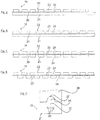
- FIG. 3 now shows a detailed view of a transport belt 15 as it is part of a sack or bag manufacturing device 100 according to the invention.
- This conveyor belt comprises at least one inner fiber 20, which can also be referred to as a neutral fiber, since it is neither elongated nor compressible.
- a lower part 21 of a plastic sheath is arranged below the inner fiber.
- an upper part 22 of a plastic sheath can be seen above the inner fiber.
- the upper part 22 additionally includes notches 24, which preferably extend as far as the inner fiber. As shown, these notches can have a rectangular cross-section. This has the consequence that the remaining webs 23 assume a cuboid shape.
- the lower part 21 can be provided with notches.
- the Figure 4 shows a variant of the embodiment of FIG Figure 3 , in which the notches 24 are triangular or trapezoidal, so that the remaining webs 23 have a trapezoidal shape.
- the Figure 5 shows an embodiment of a conveyor belt 15 in which both the upper 22 and the lower part 21 have notches 24, the notches in the upper part 22 and the notches 24 in the lower part being opposite one another.
- the width of the notches can differ from one another in the upper and lower part.
- FIG. 6 is a variant of a conveyor belt 15 according to FIG Figure 5 to see.
- the notches in the upper part 22 and in the lower part 21 are offset from one another.
- the width of the notches and the ridges can be so be chosen so that the webs in the upper part and the webs in the lower part overlap.
- FIG. 3 shows a cross section of a conveyor belt 15. More than one inner fiber 20 can be provided.
- the upper part 22 has a web 25.
- a guide element 26, for example a roller, a disk or a guide rail, comprises a complementary groove 27 in which the web slides.
- the guide element can also have a web and the transport belt can accordingly have a groove. It is also conceivable that the web or the groove of the conveyor belt is assigned to the lower part 21.
Landscapes
- Engineering & Computer Science (AREA)
- Mechanical Engineering (AREA)
- Making Paper Articles (AREA)
Applications Claiming Priority (1)
| Application Number | Priority Date | Filing Date | Title |
|---|---|---|---|
| DE102020203493 | 2020-03-18 |
Publications (2)
| Publication Number | Publication Date |
|---|---|
| EP3882012A2 true EP3882012A2 (fr) | 2021-09-22 |
| EP3882012A3 EP3882012A3 (fr) | 2022-01-05 |
Family
ID=74884806
Family Applications (1)
| Application Number | Title | Priority Date | Filing Date |
|---|---|---|---|
| EP21162712.0A Pending EP3882012A3 (fr) | 2020-03-18 | 2021-03-16 | Dispositif de fabrication de sacs ou des sacs et procede de fabrication de sacs ou de sacs |
Country Status (1)
| Country | Link |
|---|---|
| EP (1) | EP3882012A3 (fr) |
Citations (1)
| Publication number | Priority date | Publication date | Assignee | Title |
|---|---|---|---|---|
| EP1578596B1 (fr) | 2002-12-20 | 2006-06-14 | Windmöller & Hölscher KG | Dispositif de pose de fond pour sacs a fond croise |
Family Cites Families (7)
| Publication number | Priority date | Publication date | Assignee | Title |
|---|---|---|---|---|
| ATE136867T1 (de) * | 1989-12-04 | 1996-05-15 | Interbold | Blatthandhabungsvorrichtung |
| JPH0780262B2 (ja) * | 1992-11-12 | 1995-08-30 | 株式会社藤田機械 | 製袋機における袋の搬送構造 |
| US5807194A (en) * | 1996-10-31 | 1998-09-15 | The Gates Corporation | Toothed belt |
| DE10028831A1 (de) * | 1999-06-22 | 2001-01-04 | Norddeutsche Seekabelwerk Gmbh | Riemen, insbesondere Förderriemen und Verfahren zur Herstellung desselben |
| DE10011680C2 (de) * | 2000-03-10 | 2003-10-30 | Boewe Systec Ag | Vorrichtung zum Transport von flächigem Gut |
| CN108162491A (zh) * | 2017-11-22 | 2018-06-15 | 昆明理工大学 | 一种试卷袋密封折盖装置 |
| DE102018113631A1 (de) * | 2018-06-07 | 2019-12-12 | Windmöller & Hölscher Kg | Transportvorrichtung |
-
2021
- 2021-03-16 EP EP21162712.0A patent/EP3882012A3/fr active Pending
Patent Citations (1)
| Publication number | Priority date | Publication date | Assignee | Title |
|---|---|---|---|---|
| EP1578596B1 (fr) | 2002-12-20 | 2006-06-14 | Windmöller & Hölscher KG | Dispositif de pose de fond pour sacs a fond croise |
Also Published As
| Publication number | Publication date |
|---|---|
| EP3882012A3 (fr) | 2022-01-05 |
Similar Documents
| Publication | Publication Date | Title |
|---|---|---|
| EP3571145B1 (fr) | Arrangement d'entraînement, élément d'entraînement et mécanisme d'entraînement pour chariot de transport | |
| DE69219977T2 (de) | Verfahren und Vorrichtung zur kontinuierlichen Herstellung eines Gegenstandes | |
| DE3404006A1 (de) | Vorrichtung zum aufbringen eines klebenden stranges aus kunststoff auf eine glasscheibe | |
| EP0835747A2 (fr) | Procédé de transfert pour une bande de ceinture dans la confection de couches de ceinture pour bandages pneumatiques | |
| DD229350A5 (de) | Kontinuierliches verfahren zum pressen einer verbundanordnung | |
| EP2415700A2 (fr) | Dispositif d'orientation d'un produit plat | |
| EP3529180B1 (fr) | Système de transport | |
| EP0138745A2 (fr) | Tambour d'entraînement pour un convoyeur à barres | |
| EP0416213A1 (fr) | Procédé pour la fabrication de bandes souples et étanches | |
| DE102016221271B4 (de) | Verfahren und Vorrichtung zum Anbringen einer flexiblen Dichtung an dem Umfang eines Bauteils | |
| EP0771643B1 (fr) | Procédé et table de transfert pour transporter en continu une matière plastique en forme de ruban | |
| DE69307921T2 (de) | Vorrichtung und verfahren zur herstellung eines teigstrangs | |
| DE2643346C3 (de) | Presse zur Ausübung einer Flächenpressung mit umlaufenden Bändern und Steuerung der Seitenlage derselben | |
| DE2805870C2 (de) | Vorrichtung zum Querschneiden von Gummibahnen | |
| DE3903599A1 (de) | Maschine zum anbringen eines klebmittels auf langgestrecktem bahnmaterial | |
| DE2549762C2 (de) | Einrichtung zum Einhalten einer Dehnung | |
| DE69028080T2 (de) | Herstellung von reifenglied und vorrichtung dazu | |
| DE9002430U1 (de) | Vorrichtung zur Warenführung, insbesondere für automatische Schneid- und Nähanlagen von textilen Bahnen o. dgl. | |
| DE3875625T2 (de) | Verstaerker polymergegenstand. | |
| DE102023201456A1 (de) | Anpressband-Vorrichtung | |
| WO1995027799A1 (fr) | Machine a refendre pour un materiau plat et souple, notamment pour le cuir, utilisation de cette machine, procede de refendage en relief et gabarit correspondant | |
| DE10233483B4 (de) | Transportvorrichtung | |
| DE102008057462A1 (de) | Feder aus einem Faserverbundwerkstoff sowie Verfahren und Vorrichtung zur Herstellung derselben | |
| DE2632337A1 (de) | Vorrichtung zum beschichten der seiten eines abstandshalterahmens fuer isolierglasscheiben mit einer aushaertenden klebeschicht | |
| EP1329403A2 (fr) | Dispositif d'alignement automatique pour le déroulement de rubans de corde |
Legal Events
| Date | Code | Title | Description |
|---|---|---|---|
| PUAI | Public reference made under article 153(3) epc to a published international application that has entered the european phase |
Free format text: ORIGINAL CODE: 0009012 |
|
| STAA | Information on the status of an ep patent application or granted ep patent |
Free format text: STATUS: THE APPLICATION HAS BEEN PUBLISHED |
|
| AK | Designated contracting states |
Kind code of ref document: A2 Designated state(s): AL AT BE BG CH CY CZ DE DK EE ES FI FR GB GR HR HU IE IS IT LI LT LU LV MC MK MT NL NO PL PT RO RS SE SI SK SM TR |
|
| PUAL | Search report despatched |
Free format text: ORIGINAL CODE: 0009013 |
|
| AK | Designated contracting states |
Kind code of ref document: A3 Designated state(s): AL AT BE BG CH CY CZ DE DK EE ES FI FR GB GR HR HU IE IS IT LI LT LU LV MC MK MT NL NO PL PT RO RS SE SI SK SM TR |
|
| RIC1 | Information provided on ipc code assigned before grant |
Ipc: B31B 160/20 20170101ALN20211126BHEP Ipc: B31B 150/20 20170101ALN20211126BHEP Ipc: B31B 150/00 20170101ALN20211126BHEP Ipc: B65H 5/02 20060101ALI20211126BHEP Ipc: B65H 29/12 20060101ALI20211126BHEP Ipc: B31B 70/04 20170101AFI20211126BHEP |
|
| STAA | Information on the status of an ep patent application or granted ep patent |
Free format text: STATUS: REQUEST FOR EXAMINATION WAS MADE |
|
| 17P | Request for examination filed |
Effective date: 20220705 |
|
| RBV | Designated contracting states (corrected) |
Designated state(s): AL AT BE BG CH CY CZ DE DK EE ES FI FR GB GR HR HU IE IS IT LI LT LU LV MC MK MT NL NO PL PT RO RS SE SI SK SM TR |