EP3885076A1 - Dispositif de frappe hydraulique - Google Patents
Dispositif de frappe hydraulique Download PDFInfo
- Publication number
- EP3885076A1 EP3885076A1 EP19886108.0A EP19886108A EP3885076A1 EP 3885076 A1 EP3885076 A1 EP 3885076A1 EP 19886108 A EP19886108 A EP 19886108A EP 3885076 A1 EP3885076 A1 EP 3885076A1
- Authority
- EP
- European Patent Office
- Prior art keywords
- chamber
- fluid pressure
- piston
- fluid
- cylinder
- Prior art date
- Legal status (The legal status is an assumption and is not a legal conclusion. Google has not performed a legal analysis and makes no representation as to the accuracy of the status listed.)
- Pending
Links
Images

Classifications
-
- B—PERFORMING OPERATIONS; TRANSPORTING
- B25—HAND TOOLS; PORTABLE POWER-DRIVEN TOOLS; MANIPULATORS
- B25D—PERCUSSIVE TOOLS
- B25D9/00—Portable percussive tools with fluid-pressure drive, i.e. driven directly by fluids, e.g. having several percussive tool bits operated simultaneously
- B25D9/14—Control devices for the reciprocating piston
- B25D9/145—Control devices for the reciprocating piston for hydraulically actuated hammers having an accumulator
-
- B—PERFORMING OPERATIONS; TRANSPORTING
- B25—HAND TOOLS; PORTABLE POWER-DRIVEN TOOLS; MANIPULATORS
- B25D—PERCUSSIVE TOOLS
- B25D17/00—Details of, or accessories for, portable power-driven percussive tools
- B25D17/02—Percussive tool bits
-
- B—PERFORMING OPERATIONS; TRANSPORTING
- B25—HAND TOOLS; PORTABLE POWER-DRIVEN TOOLS; MANIPULATORS
- B25D—PERCUSSIVE TOOLS
- B25D9/00—Portable percussive tools with fluid-pressure drive, i.e. driven directly by fluids, e.g. having several percussive tool bits operated simultaneously
- B25D9/14—Control devices for the reciprocating piston
- B25D9/16—Valve arrangements therefor
- B25D9/18—Valve arrangements therefor involving a piston-type slide valve
-
- B—PERFORMING OPERATIONS; TRANSPORTING
- B25—HAND TOOLS; PORTABLE POWER-DRIVEN TOOLS; MANIPULATORS
- B25D—PERCUSSIVE TOOLS
- B25D2209/00—Details of portable percussive tools with fluid-pressure drive, i.e. driven directly by fluids, e.g. having several percussive tool bits operated simultaneously
- B25D2209/002—Pressure accumulators
Definitions
- the present disclosure relates to a fluid pressure hitting device.
- a fluid pressure hitting device can be used in the crushing work of concrete, rock, etc.
- a fluid pressure hitting device has a cylindrical cylinder, a piston fitted in the cylinder, and a rod-shaped chisel.
- the piston is slidable in the cylinder in an axial direction of the cylinder.
- the chisel may be fitted in the cylinder so that a part of the chisel projects from one axial end of the cylinder.
- the piston hits the chisel.
- the chisel projects further from the one end of the cylinder.
- the piston may be designed to slide in the cylinder toward one end side or the other end side in the axial direction using fluid pressure. There are various means for causing the piston to slide.
- Japanese Unexamined Patent Application Publication No. 2015-163426 discloses a piston front chamber (hereinafter referred to as a first chamber).
- the first chamber is formed by partitioning an inner peripheral surface of the cylinder and an outer peripheral surface of the piston.
- the first chamber is located near one end side (the chisel side) in the axial direction.
- the piston is configured to reciprocate in the axial direction of the cylinder by switching the pressure in the first chamber between a high liquid pressure and a low liquid pressure. For example, when the first chamber has a high liquid pressure, the piston is pushed out of the first chamber. This causes the piston to slide in the axial direction toward the other end side of the cylinder. When the first chamber has a low liquid pressure, the piston slides toward the one end in the axial direction.
- the liquid in the first chamber can suddenly boil and/or vaporize. Additionally, any gas dissolved in the liquid may be released from the liquid. As a result, bubbles can be generated in the liquid.
- erosion of the fluid pressure hitting device may occur.
- an inner wall of the first chamber, its surroundings, and a surface of the piston can be scraped off by the contraction force of the bubbles. The phenomenon associated with the generation and disappearance of bubbles is so-called cavitation. Cavitation and erosion can lower the durability of the first chamber and/or the piston. This can cause the failure of a liquid pressure hitting device, such as due to leakage of liquid from the first chamber.
- a fluid pressure hitting device comprises a cylindrical cylinder, a piston inserted in the cylinder, a bar-shaped chisel, a first chamber, a second chamber, and a third chamber.
- the piston is capable of sliding in an axial direction of the cylinder.
- the chisel is fitted in the cylinder such that a part of the chisel is projected from one axial end of the cylinder.
- the chisel is configured to be further projected from the one axial end of the cylinder by being hit by the piston when the piston slides to the one axial end side.
- the first chamber, the second chamber, and the third chamber are partitioned by an inner peripheral surface of the cylinder and an outer peripheral surface of the piston.
- the first chamber, the second chamber, and the third chamber are arranged in the axial direction in order from the one axial end to the other axial end of the cylinder.
- the piston is configured to slide to the one axial end or the other axial end in the cylinder when a fluid pressure in the first chamber is shifted to a high fluid pressure or a low fluid pressure.
- a flow path is formed in the fluid pressure hitting device. The flow path is configured to supply fluid from a fluid supply portion, which has a fluid pressure higher than that of the first chamber of when the piton hits the chisel, to the first chamber.
- the flow path is formed in the fluid pressure hitting device.
- the flow path is configured to supply fluid from a fluid supply portion, which has a fluid pressure higher than that of the first chamber of when the piton hits the chisel, to the first chamber.
- a fluid supply portion which has a fluid pressure higher than that of the first chamber of when the piton hits the chisel
- fluid is supplied to the first chamber, thereby relaxing the low pressure state of the first chamber.
- the "low pressure state” means a state in which fluid pressure become relatively lower as compared with a state immediately before.
- the fluid supply portion may include the second chamber.
- the second chamber since the second chamber is in the vicinity of the first chamber, fluid can be more quickly supplied to the first chamber. Thus, it becomes easier to relax the low pressure state of the first chamber of when the piston hits the chisel. In this way, the occurrence of cavitation can be further suppressed.
- the fluid supply portion may include the third chamber.
- the third chamber has a high fluid pressure when the piston hits the chisel.
- a large amount of fluid can be supplied from the third chamber to the first chamber.
- the low pressure state of the first chamber can be more easily relaxed. In this way, the occurrence of cavitation can be further suppressed.
- the flow path is provided with a check valve.
- the check valve is configured to allow for fluid flow from the fluid supply portion into the first chamber.
- the check valve is also configured to prevent fluid flow from the first chamber into the fluid supply portion.
- At least a part of the flow path is provided with a throttle portion where a fluid passage is narrowed.
- an appropriate amount of fluid may flow into the first chamber from the fluid supply portion, via the flow path having the throttle portion.
- the low pressure state of the first chamber can be relaxed within an appropriate range.
- the fluid supply portion includes the second chamber and the third chamber.
- a flow path connecting the first chamber with the second chamber may be provided with a check valve.
- the check valve is configured to allow for fluid flow from the second chamber into the first chamber and to prevent fluid flow from the first chamber into the second chamber.
- At least a part of a flow path connecting the first chamber with the third chamber may be provided with a throttle portion where a fluid passage is narrowed.
- a fourth chamber may be provided between the second chamber and the third chamber.
- the fourth chamber is partitioned by the inner peripheral surface of the cylinder and the outer peripheral surface of the piston.
- the fluid supply portion may include the fourth chamber. Fluid can be supplied from the fourth chamber to the first chamber when the piston hits the chisel.
- fluid can be supplied from the fourth chamber to the first chamber when the piston hits the chisel.
- the fluid can be supplied to the first chamber at an appropriate timing. In this way, the low pressure state of the first chamber can be more accurately relaxed. Additionally, the occurrence of cavitation can be more accurately suppressed.
- the third chamber may always be in a high fluid pressure state.
- the hitting force applied to the chisel by the piston can be increased.
- the piston may receive a stronger repulsive force from the chisel, thereby sliding to the other axial end side of the cylinder to a greater extend.
- the first chamber tends to enter into a lower pressure state.
- the third chamber is always in a high fluid pressure state, the frequency of cavitation is higher.
- the flow path is formed so as to supply fluid from the fluid supply portion to the first chamber. This allows for relaxing the low pressure state of the first chamber when the piston hits the chisel. Further, it is possible to suppress the frequency of cavitation, peculiar to the case where the third chamber is always in a high fluid pressure state.
- FIGS. 1 to 5 a fluid pressure hitting device, and its operation, according to various embodiment will be described with reference to FIGS. 1 to 5 .
- the upward direction is referred to as “upward” and the downward direction is referred to as “downward” on the basis of the corresponding states, which are shown in FIGS. 1 to 5 .
- the directions correspond to those of a fluid pressure hitting device that is actually being used in the work of crushing concrete, rock, etc.
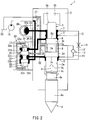
- the fluid pressure hitting device 1 shown in FIG. 1 may be a hydraulic type using oil as a fluid.
- the fluid pressure hitting device 1 shown in FIG. 1 is an example of an embodiment according to the present disclosure.
- the fluid pressure hitting device 1 has a cylinder 2, a piston 3, and a chisel 4.
- the cylinder 2 is a tubular member having an inner peripheral surface 2a.
- the piston 3 is inserted in the cylinder 2 so that the piston 3 fits in the inner peripheral surface 2a.
- a gas chamber 2b is formed on a rear end side (upper side in FIG. 1 ) of the piston 3.
- the gas chamber 2b is configured to enclose a gas, such as nitrogen, to assist the piston 3 at the time of hitting.
- the piston 3 has a first small diameter portion 3a, a first large diameter portion 3b, an intermediate portion 3c, a second large diameter portion 3d, and a second small diameter portion 3e, all of which are columnar in shape and are arranged in this order from the upper side to the lower side of the piston.
- the first large diameter portion 3b has a ring-shaped surface on its upper side. This ring-shaped surface is formed as a piston upper-side pressure receiving surface 3u.
- the second large diameter portion 3d has a ring-shaped surface on its lower side. The ring-shaped surface of the second large diameter portion 3d is formed as a piston lower-side pressure receiving surface 3v.
- the area of the piston upper-side pressure receiving surface 3u may be smaller than that of the piston lower-side pressure receiving surface 3v.
- the inner peripheral surface 2a of the cylinder 2 is provided with a first chamber 5, a second chamber 6, a pilot chamber 8, and a third chamber 7, which are arranged in the axial direction in this order from one axial end side (lower side in FIG. 1 ) to the other axial end side (upper side in FIG. 1 ) of the cylinder 2.
- Each chamber is formed as a ring-shaped groove.
- the first chamber 5, the second chamber 6, the pilot chamber 8, and the third chamber 7 are generally formed by being partitioned from each other by the inner peripheral surface 2a of the cylinder 2 and the outer peripheral surface 3s of the piston 3.
- Each of the first chamber 5, the second chamber 6, the pilot chamber 8, and the third chamber 7 may be arranged such that the third chamber 7 and the pilot chamber 8 are in communication with or disconnected from each other depending on the position of the piston 3, as will be described later. This communication/disconnection may occur during the reciprocating motion of the piston 3 in the axial direction (vertical direction in FIG. 1 ). Further, each of the first chamber 5, the second chamber 6, the pilot chamber 8, and the third chamber 7 may be arranged such that the second chamber 6 and the pilot chamber 8 are in communication with or disconnected from each other depending on the position of the piston 3 during the reciprocating motion of the piston 3 in the axial direction.
- the chisel 4 is a pile-shaped member.
- the chisel 4 has a tip portion 4a and a rear end portion 4b.
- the tip portion 4a is configured to pierce.
- the rear end portion 4b has a rear end surface 4c having a flat shape.
- the rear end surface 4c is provided on an upper end of the chisel 4.
- the chisel 4 may be inserted through an opening located at one axial end (lower end) of the cylinder 2.
- the tip portion 4a which is a part of the chisel 4, may be installed so as to project from the one axial end of the cylinder 2. When the piston 3 hits the rear end surface 4c of the chisel 4, the chisel 4 may project further from the one axial end of the cylinder 2.
- first chamber 5 and the second chamber 6 are in communication with each other via a first flow path 11 (flow path).
- a check valve 13 is provided in the middle of the first flow path. Although the check valve 13 allows oil to flow into the first chamber 5 from the second chamber 6, the check valve 13 prevents oil from flowing into the second chamber 6 from the first chamber 5.
- the first chamber 5 and the third chamber 7 are in communication with each other via a second flow path 12 (flow path).
- a part of or the entire second flow path 12 has a throttle portion 14.
- a passage for oil is narrowed.
- the throttle portion 14 does not allow for an excessive flow of oil.
- the fluid pressure hitting device 1 further includes a hydraulic pump 10, a switching valve 30, an oil tank 50, and an accumulator 60.
- the hydraulic pump 10 is always in communication with the third chamber 7 formed in the cylinder 2, via a passage 24 branching from a passage 21.
- the hydraulic pump 10 continues to supply fluid to the third chamber 7 through the passage 24.
- the third chamber 7 can be kept in a high fluid pressure state.
- the switching valve 30 is configured to switch the stroke direction of the piston 3.
- the switching valve 30 has a switching valve cylinder 31 and a valve 32.
- the switching valve cylinder 31 is tubular. An upper end opening and a lower end opening of the switching cylinder 31 are in communication with each other by a communication passage 37.
- the valve 32 is fitted in the switching valve cylinder 31 so that the valve 32 can slide in the axial direction (i.e. vertical direction in FIG. 1 ).
- the valve 32 has a cylindrical valve first small diameter portion 32a, a valve first large diameter portion 32b, a connection portion 32c, a valve second large diameter portion 32d, and a valve second small diameter portion 32e, all of which are arranged in this order from the bottom to the top of the valve 32.
- the valve first large diameter portion 32b has a ring-shaped lower surface. This lower surface is set as a valve lower-side pressure receiving surface 32v.
- the valve second large diameter portion 32d has a ring-shaped upper surface. This upper surface is set as a valve upper-side pressure receiving surface 32u.
- the area of the valve lower-side pressure receiving surface 32v may be set smaller than that of the valve upper-side pressure receiving surface 32u.
- an inner surface of the switching valve cylinder 31 is provided with a valve high pressure chamber 33, a valve reversing chamber 34, a valve low pressure chamber 35, and a valve pilot chamber 36, all of which are arranged in this order from the bottom to the top.
- Each chamber 33-36 is formed as a ring-shaped groove.
- the arrangement of the valve high pressure chamber 33, the valve reversing chamber 34, the valve low pressure chamber 35, and the valve pilot chamber 36 may be such that the valve high pressure chamber 33 and the valve reversing chamber 34 are in communication with or disconnected from each other depending on the position of the valve 32 reciprocating in the vertical direction.
- valve high pressure chamber 33 the valve reversing chamber 34, the valve low pressure chamber 35, and the valve pilot chamber 36 may be such that the valve low pressure chamber 35 and the valve reversing chamber 34 are in communication with or disconnected from each other depending on the position of the valve 32 reciprocating in the vertical direction.
- the valve high pressure chamber 33 is always in communication with the hydraulic pump 10 via the passage 21.
- the hydraulic pump 10 continues to supply oil to the valve high pressure chamber 33 through the passage 21.
- the valve high pressure chamber 33 can be kept in a high fluid pressure state.
- the valve reversing chamber 34 is in communication with the first chamber 5 via a passage 22.
- the valve low pressure chamber 35 is in communication with the second chamber 6 via a passage 25.
- the valve pilot chamber 36 is in communication with the pilot chamber 8 via a passage 26.
- the oil tank 50 is in communication with the second chamber 6 through a passage 27, which communicates with the oil tank 50 where the discharged oil is received.
- the accumulator 60 is provided with a chamber 60a having a contractile force inside.
- the accumulator 60 is configured to maintain the fluid pressure in the passages 21, 23, 24 in communication with the accumulator 60, so that the fluid pressure in the passages 21, 23, 24 is prevented form decreasing too much.
- the accumulator 60 is configured to maintain the fluid pressure in the third chamber 7 and the valve high pressure chamber 33, which are in communication with the accumulator 60 via the passages 21, 23, 24, so that the fluid pressure in the third chamber 7 and the valve high pressure chamber 33 does not decrease too much.
- the accumulator 60 discharges oil, which was previously taken into the chamber 60a, from the chamber by the contractile force of the accumulator 60. In this way, the accumulator 60 can suppress a decrease in the fluid pressure of the passages 21, 23, 24, the third chamber 7, and the valve high pressure chamber 33.
- FIG. 2 shows a state immediately after the piston 3 hits the rear end surface 4c of the chisel 4. At this time, the tip portion 4a of the chisel 4 is in a state of being pressed against a portion of concrete or rock to be crushed.
- the hydraulic pump 10 continues to supply oil to the third chamber 7, via the passage 21 and the passage 24 branching from such passage 21. Further, the hydraulic pump 10 continues to supply oil to the valve high pressure chamber 33 via the passage 21.
- the third chamber 7 and the valve high pressure chamber 33 are in a high fluid pressure state.
- the pilot chamber 8 When the piston 3 is positioned as shown in FIG. 2 , the pilot chamber 8 is in communication with the third chamber 7.
- the valve reversing chamber 34 When the valve 32 is positioned as shown in FIG. 2 , the valve reversing chamber 34 is in communication with the valve high pressure chamber 33. Thus, the pilot chamber 8 and the valve reversing chamber 34 are in a high fluid pressure state. Further, the pilot chamber 8 is in communication with the valve pilot chamber 36 via the passage 26. The valve reversing chamber 34 is in communication with the first chamber 5 via the passage 22. Thus, the valve pilot chamber 36 and the first chamber 5 are also in a high fluid pressure state.
- both the first chamber 5 and the third chamber 7 shown in FIG. 2 are in a high fluid pressure state.
- the same fluid pressure is applied, per unit area, to the piston upper-side pressure receiving surface 3u as it is to the piston lower-side pressure receiving surface 3v.
- the area of the piston lower-side pressure receiving surface 3v is larger than that of the piston upper-side pressure receiving surface 3u.
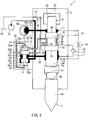
- FIG. 3 shows a state in which the piston 3 has moved toward the other axial end side of the cylinder 2 in order to reach its top dead center.
- the first large diameter portion 3b blocks a space between the third chamber 7 and the pilot chamber 8. This causes the third chamber 7 to become disconnected from the pilot chamber 8. Further, the first large diameter portion 3b moves away from the area between the second chamber 6 and the pilot chamber 8. This causes the second chamber 6 to be in communication with the pilot chamber 8. As a result, oil is prevented from flowing into the pilot chamber 8.
- the second chamber 6 is in communication with the oil tank 50 via the passage 27.
- the pilot chamber 8, which is in communication with the second chamber 6, is placed in a low fluid pressure state.
- the pilot chamber 8 is in communication with the valve pilot chamber 36 via the passage 26.
- the valve pilot chamber 36 also is placed in a low fluid pressure state.
- valve pilot chamber 36 shown in FIG. 3 enters the low fluid pressure state.
- the valve high pressure chamber 33 is in communication with the hydraulic pump 10 via the passage 21.
- the valve high pressure chamber 33 is kept in a high fluid pressure state. Since the valve high pressure chamber 33 is in a high fluid pressure state, the high fluid pressure presses against the valve lower-side pressure receiving surface 32v. As a result, the valve 32 is moved in the direction of arrow B, i.e. toward the upper side in FIG. 3 .
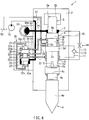
- FIG. 4 shows a state in which the valve 32 has moved upward in order to reach its top dead center.
- the valve first large diameter portion 32b blocks a space between the valve high pressure chamber 33 and the valve reversing chamber 34.
- the valve high pressure chamber 33 is disconnected from the valve reversing chamber 34.
- the valve second large diameter portion 32d moves away from between the valve reversing chamber 34 and the valve low pressure chamber 35.
- the valve reversing chamber 34 becomes in communication with the valve low pressure chamber 35.
- the valve low pressure chamber 35 remains in communication with the second chamber 6 via the passage 25.
- the second chamber 6 is in communication with the oil tank 50 via the passage 27.
- valve reversing chamber 34 which is now in communication with the valve low pressure chamber 35, enters a low fluid pressure state. Since, the first chamber 5 is in communication with the valve reversing chamber 34 via the passage 22, the first chamber 5 also enters a low fluid pressure state. Since the third chamber 7 is still in communication with the hydraulic pump 10 via the passages 21, 24, the third chamber 7 is kept in a high fluid pressure state. Thus, the high fluid pressure in the third chamber 7 presses the upper-side pressure receiving surface 3u, which causes the piston 3 to be moved in the direction of arrow C, i.e. toward one axial end side (lower side in FIG. 4 ).
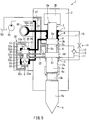
- FIG. 5 shows a moment when the piston 3 hits the rear end surface 4c of the chisel 4.
- the piston 3 hits the rear end surface 4c of the chisel 4 after the piston 3 has moved in the axial direction toward the one end side.
- the first large diameter portion 3b blocks the space between the second chamber 6 and the pilot chamber 8. This causes the second chamber 6 to be disconnected from the pilot chamber 8.
- the first large diameter portion 3b of the piston 3 moves away from the space between the third chamber 7 and the pilot chamber 8.
- the third chamber 7 becomes in communication with the pilot chamber 8.
- the third chamber 7 also remains in communication with the hydraulic pump 10 via the passages 21, 24.
- both the third chamber 7 and the pilot chamber 8 enter a high fluid pressure state.
- the pilot chamber 8 is in communication with the valve pilot chamber 36 via the passage 26.
- the valve pilot chamber 36 also enters a high fluid pressure state.
- the valve high pressure chamber 33 is in communication with the hydraulic pump 10 via the passage 21.
- the valve high pressure chamber 33 also enters a high fluid pressure state.
- the volume of the third chamber 7 can be enlarged when the piston 3 moves toward the one end side. This allows additional oil to flow into the expanded region of the third chamber 7. As a result, the fluid pressure of the passages 21, 23, 24 and the third chamber 7 can temporarily decrease. In the state shown in FIG. 5 , the previously accumulated oil in the chamber 60a of the accumulator 60, which can be seen in the state depicted in FIG. 3 , can be discharged by the contraction force of the chamber 60a. In this way, a drop in the fluid pressure of the passages 21, 23, 24 and the third chamber 7 can be suppressed.
- valve high pressure chamber 33 and the valve pilot chamber 36 are in a high fluid pressure state during the stage shown in FIG. 5 .
- the area of the valve lower-side pressure receiving surface 32v is smaller than that of the valve upper-side pressure receiving surface 32u.
- the valve 32 moves in the direction of arrow D, i.e. toward the lower side in FIG. 5 .
- the valve second large diameter portion 32d blocks a space between the valve low pressure chamber 35 and the valve reversing chamber 34, as shown in FIG 2 .
- the valve low pressure chamber 35 becomes disconnected from the valve reversing chamber 34.
- valve large diameter portion 32b is moved away from the area between the valve high pressure chamber 33 and the valve reversing chamber 34.
- the valve high pressure chamber 33 becomes in communication with the valve reversing chamber 34.
- the valve high pressure chamber 33 is in communication with the hydraulic pump 10 via the passage 21.
- the valve reversing chamber 34 which is now in communication with the valve high pressure chamber 33, also enters a high fluid pressure state. Since the first chamber 5 is in communication with the valve reversing chamber 34 via the passage 22, the first chamber 5 also enters a high fluid pressure state.
- the fluid pressure hitting device 1 is configured to repeat operations of FIGS. 2 to 5 .
- the piston 3 reciprocates in the axial direction of the cylinder 2 so as to repeatedly hit the chisel 4.
- the tip portion 4a of the chisel 4 can be repeatedly pressed against a portion to be crushed, so as to crush that portion.
- the oil continues to flow out of the first chamber 5 for a short period of time due to its momentum or inertial force. That is, normally, the pressure in the first chamber 5 can be further reduced. Due to such a rapid decrease in the pressure of the first chamber 5, the oil in the first chamber 5 can suddenly boil and/or vaporize. Further, gas dissolved in the liquid can be released from the liquid, such that bubbles may be generated in the oil. Thus, there is a concern about cavitation and/or erosion.
- the fluid pressure hitting device 1 has a first flow path 11 that connects the first chamber 5 with the second chamber 6.
- the pressure in the first chamber 5 becomes lower than that of the second chamber 6. This may cause the oil to flow from the second chamber 6 to the first chamber 5 via the first flow path 11. This flow can relax the low pressure state of the first chamber 5.
- the second chamber 6 is positioned adjacent to the first chamber 5, oil can be quickly supplied to the first chamber 5 from the second chamber 6.
- the low pressure state of the first chamber 5, which may be caused when the piston 3 hits the chisel 4 can be easily relaxed. In this way, the occurrence of cavitation can be further suppressed.
- a check valve 13 is provided in the middle of the first flow path 11. Although the check valve 13 allows oil to flow from the second chamber 6 to the first chamber 5, the check valve 13 prevents oil from flowing from the first chamber 5 into the second chamber 6. Thus, even when the first chamber 5 is switched from a low fluid pressure state to a high fluid pressure state, the fluid does not flow from the first chamber 5 back into the second chamber 6. That is, since a high fluid pressure state of the first chamber 5 may be maintained, the low pressure state of the first chamber 5 can be relaxed while efficiently operating the fluid pressure hitting device 1.
- the fluid pressure hitting device 1 has the second flow path 12 that connects the first chamber 5 with the third chamber 7.
- the pressure in the first chamber 5 is lower than that of the third chamber 7.
- oil may flow from the third chamber 7 to the first chamber 5, via the second flow path 12.
- the third chamber 7 has a high fluid pressure when the piston 3 hits the chisel 4.
- a large amount of oil can be supplied to the first chamber 5 from the third chamber 7.
- the low pressure state of the first chamber 5 can be easily relaxed. Additionally, the occurrence of cavitation can be further suppressed.
- a part of the second flow path 12 or the entire second flow path 12 has a throttle portion 14.
- the passage for oil is narrowed.
- the throttle portion 14 does not allow for an excessive flow of oil.
- an appropriate amount of oil can flow from the third chamber 7 to the first chamber 5 through the second flow path 12.
- the low pressure state of the first chamber 5 can be relaxed within an appropriate range, without excessively decreasing the fluid pressure in the third chamber 7.
- the third chamber 7 is always in communication with the hydraulic pump 10.
- the third chamber 7 is always in a high fluid pressure state. Since the third chamber 7 is always in the high fluid pressure state, the hitting force of the chisel 4, which is supplied from the piston 3, can be strong.
- the piston 3 may receive a stronger repulsive force from the chisel 4, such that the piston 3 slides toward the other axial end side of the cylinder 2. In this way, the first chamber 5 can easily enter a lower pressure state.
- the frequency of cavitation usually increases.
- the first flow path 11 and the second flow path 12 are formed to supply oil from the second and third chambers 6, 7 to the first chamber 5.
- the low pressure state of the first chamber 5 can be relaxed.
- the frequency of cavitation which often occurs in the case where the third chamber 7 is constantly in a high fluid pressure state, can be suppressed.
- a fourth chamber 9 may be provided between the second chamber 6 and the third chamber 7.
- the fourth chamber 9 may be formed as a ring-shaped groove provided on the inner peripheral surface 2a of the cylinder 2.
- the fourth chamber 9 may be partitioned by the inner peripheral surface 2a of the cylinder 2 and the outer peripheral surface 3s of the piston 3.
- a third flow path (flow path) 15 which connects the fourth chamber 9 with the first chamber 5, may be provided.
- the third flow path 15 may be provided together with the second flow path 12, which connects the third chamber 7 with the first chamber 5, or instead of the second flow path 12. That is, a fluid supply portion may include a fourth chamber 9 in addition to the third chamber 7. Alternatively, the fluid supply portion may include a fourth chamber 9 instead of a third chamber 7.
- the first large diameter portion 3b of the piston 3 blocks the area between the third chamber 7 and the fourth chamber 9.
- the third chamber 7 is disconnected from the fourth chamber 9.
- the first large diameter portion 3b of the piston 3 also moves to the one axial end side of the cylinder 2.
- the first large diameter portion 3b does not block communication between the third chamber 7 and the fourth chamber 9.
- the third chamber 7 and the fourth chamber 9 may be in communication with each other. Since the third chamber 7 remains in communication with the hydraulic pump 10 via the passages 21, 24, the third chamber 7 is in a high fluid pressure state. Thus, the fourth chamber 9, which is in communication with the third chamber 7, also enters a high fluid pressure state.
- the fluid supply portion has a third chamber 7 and a second flow path 12
- oil is continuously supplied from the third chamber 7 to the first chamber 5 as the piston 3 moves downward.
- a third flow path 15 may be provided, instead of also including a second flow path 12.
- a fourth chamber 9 may be included in the fluid supply portion, instead of also including a third chamber 7.
- the oil is allowed to flow from the fourth chamber 9 into the first chamber 5 through the third flow path 15.
- the fluid pressure hitting device 1 is, for example, a hydraulic type using oil as a fluid.
- the type of fluid is not particularly limited, as long as it is a liquid fluid in which cavitation can occur.
- the fluid may be water.
- the third chamber 7 of the fluid pressure hitting device 1 of the above embodiments are kept in a high fluid pressure state. However, when the first chamber 5 is in a high fluid pressure state, the third chamber 7 may enter a low fluid pressure state. In contrast, when the first chamber 5 is in a low fluid pressure state, the third chamber 7 may enter a high fluid pressure state. In this way, the piston 3 may reciprocate in the axial direction of the cylinder 2.
- the inner peripheral surface 2a of the cylinder 2 is provided with grooves.
- the first chamber 5, the second chamber 6, the third chamber 7, the pilot chamber 8, and/or the fourth chamber 9 are formed between the inner peripheral surface 2a of the cylinder 2 and the outer peripheral surface 3s of the piston 3.
- the shape of the inner peripheral surface of the cylinder 2 may be combined with the shape of the outer peripheral surface of the piston 3 to form the first chamber 5, the second chamber 6, the third chamber 7, the pilot chamber 8, and/or the fourth chamber 9.
- the fluid pressure hitting device 1 described above has both a first flow path 11 and a second flow path 12.
- the fluid pressure hitting device 1 may have only one of the first flow path 11, the second flow path 12, or the third flow path 15.
- the check valve 13 of the above embodiments is provided in the first flow path 11.
- the check valve 13 may be provided in the second flow path 12 and/or the third flow path 15.
- the throttle portion 14 of the above embodiments is provided in the second flow path 12.
- the throttle portion 14 may be provided in the first flow path 11 and/or the third flow path 15.
- a fluid supply portion capable of supplying fluid to the first chamber is the second chamber, the third chamber, and/or the fourth chamber in the above embodiments.
- the fluid supply portion may be any structure capable of supplying fluid so as to relax the low pressure state of the first chamber when the piston hits the chisel.
- a separate hydraulic tank may be provided to supply fluid to the first chamber, as needed.
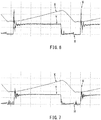
- FIGS. 6 to 9 a comparative example shown in FIGS. 6 to 9 .
- the first flow path 11 (and the check valve 13) of the fluid pressure hitting device 1 shown in FIG. 1 described above is provided; the second flow path 12 (and the throttle portion 14) is not provided.
- a fluid pressure in the first chamber 5 and a gas pressure in the gas chamber 2b were determined.
- the results of the first example are shown in FIG.6 .
- X indicates the gas pressure in the gas chamber 2b.
- Y indicates the fluid pressure in the first chamber 5.
- H indicates a moment when the piston 3 hit the chisel 4.
- V indicates a moment when the state of the fluid pressure hitting device 1 shifts from that shown in FIG. 5 to that shown in FIG. 2 .
- the valve high pressure chamber 33 and the valve reversing chamber 34 become in communication with each other, such that the valve reversing chamber 34 enters a high fluid pressure state.
- the first chamber 5, which is in communicate with the valve reversing chamber 34 via the passage 22, also enters a high fluid pressure state.
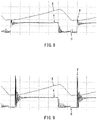
- the second flow path 12 (and the throttle portion 14) is provided to relax the low pressure state of the first chamber 5 when the piston 3 hits the chisel 4.
- the degree of the high pressure state in the second example was smaller than that of the first example. We believe that this is because the fluid pressure in the third chamber 7 was higher than the fluid pressure in the second chamber 6, thereby supplying a more sufficient amount of oil to the first chamber 5.
- Example 3 when the piston 3 hits the chisel 4 as shown in FIG. 5 (corresponding to the moment of H in FIG. 8 ), the fluid pressure in the first chamber 5 decreased.
- the first chamber 5 reached the high pressure state (at the moment of V in FIG. 8 )
- the fluid pressure in the first chamber 5 was smaller than that of the comparative example (see FIG. 9 ).
- this is because even if bubbles are generated, a sudden crushing of the bubbles was suppressed, thereby suppressing the high pressure state. That is, we believe that sudden crushing of bubbles was suppressed in the third example as compared with the comparative example. As a result, the occurrence of cavitation, and its associated erosion, was suppressed.
Landscapes
- Engineering & Computer Science (AREA)
- Mechanical Engineering (AREA)
- Physics & Mathematics (AREA)
- Fluid Mechanics (AREA)
- Percussive Tools And Related Accessories (AREA)
Applications Claiming Priority (2)
| Application Number | Priority Date | Filing Date | Title |
|---|---|---|---|
| JP2018219081A JP7171035B2 (ja) | 2018-11-22 | 2018-11-22 | 流体圧式打撃装置 |
| PCT/JP2019/043632 WO2020105447A1 (fr) | 2018-11-22 | 2019-11-07 | Dispositif de frappe hydraulique |
Publications (2)
| Publication Number | Publication Date |
|---|---|
| EP3885076A1 true EP3885076A1 (fr) | 2021-09-29 |
| EP3885076A4 EP3885076A4 (fr) | 2022-08-10 |
Family
ID=70773416
Family Applications (1)
| Application Number | Title | Priority Date | Filing Date |
|---|---|---|---|
| EP19886108.0A Pending EP3885076A4 (fr) | 2018-11-22 | 2019-11-07 | Dispositif de frappe hydraulique |
Country Status (4)
| Country | Link |
|---|---|
| US (1) | US11850717B2 (fr) |
| EP (1) | EP3885076A4 (fr) |
| JP (1) | JP7171035B2 (fr) |
| WO (1) | WO2020105447A1 (fr) |
Families Citing this family (1)
| Publication number | Priority date | Publication date | Assignee | Title |
|---|---|---|---|---|
| KR102317232B1 (ko) * | 2020-01-08 | 2021-10-22 | 주식회사 현대에버다임 | 유압 브레이커 |
Family Cites Families (17)
| Publication number | Priority date | Publication date | Assignee | Title |
|---|---|---|---|---|
| US3780621A (en) | 1971-06-07 | 1973-12-25 | Atlas Copco Ab | Hydraulic fluid actuated percussion tool |
| JPS5837569Y2 (ja) | 1980-05-19 | 1983-08-24 | 株式会社 帝国鑿岩機製作所 | 打撃装置 |
| US4401030A (en) * | 1981-06-15 | 1983-08-30 | Gator Manufacturing, Inc. | Portable marking tool |
| DE3221758A1 (de) * | 1982-06-09 | 1983-12-15 | Hartmann & Lämmle GmbH & Co KG, 7255 Rutesheim | Hydraulische antriebsvorrichtung |
| JPH0763940B2 (ja) * | 1986-10-08 | 1995-07-12 | 日本ニユ−マチツク工業株式会社 | 衝撃動工具 |
| GB9314145D0 (en) * | 1993-07-08 | 1993-08-18 | Savair Ltd | Pneumatic cylinder and control valve therefor |
| JPH07214479A (ja) * | 1994-02-02 | 1995-08-15 | Matsuda Astec Kk | 油圧衝撃工具 |
| DE4404009C1 (de) | 1994-02-09 | 1995-04-27 | Klemm Guenter | Fluidbetätigter Schlaghammer |
| EP1731271A1 (fr) * | 2005-06-09 | 2006-12-13 | Netter Gmbh | Dispositif batteur pneumatique ainsi que procédé de fonctionnement d'un dispositif batteur pneumatique |
| US8968204B2 (en) * | 2006-06-12 | 2015-03-03 | Transonic Systems, Inc. | System and method of perivascular pressure and flow measurement |
| US20080236297A1 (en) | 2007-01-23 | 2008-10-02 | Geoff Van Fleet | Acoustically compatible insert for an ultrasonic probe |
| JP2013233595A (ja) * | 2010-08-27 | 2013-11-21 | Teisaku:Kk | 流体圧式打撃装置 |
| JP6470058B2 (ja) * | 2014-01-30 | 2019-02-13 | 古河ロックドリル株式会社 | 液圧式打撃装置 |
| JP6480201B2 (ja) | 2014-01-30 | 2019-03-06 | 古河ロックドリル株式会社 | 液圧式打撃装置 |
| JP6495672B2 (ja) * | 2015-01-30 | 2019-04-03 | 古河ロックドリル株式会社 | 液圧式打撃装置、並びにバルブタイミングの切換方法およびバルブポートの設定方法 |
| US10335043B2 (en) | 2015-04-06 | 2019-07-02 | Thomas Jefferson University | Implantable vital sign sensor |
| JP6757682B2 (ja) * | 2017-02-24 | 2020-09-23 | 古河ロックドリル株式会社 | 液圧式打撃装置 |
-
2018
- 2018-11-22 JP JP2018219081A patent/JP7171035B2/ja active Active
-
2019
- 2019-11-07 WO PCT/JP2019/043632 patent/WO2020105447A1/fr not_active Ceased
- 2019-11-07 US US17/296,538 patent/US11850717B2/en active Active
- 2019-11-07 EP EP19886108.0A patent/EP3885076A4/fr active Pending
Also Published As
| Publication number | Publication date |
|---|---|
| US11850717B2 (en) | 2023-12-26 |
| WO2020105447A1 (fr) | 2020-05-28 |
| EP3885076A4 (fr) | 2022-08-10 |
| US20220024012A1 (en) | 2022-01-27 |
| JP2020082256A (ja) | 2020-06-04 |
| JP7171035B2 (ja) | 2022-11-15 |
Similar Documents
| Publication | Publication Date | Title |
|---|---|---|
| CN105916634B (zh) | 液压式冲击装置 | |
| US12070844B2 (en) | Hydraulic hammering device | |
| WO2012026571A1 (fr) | Dispositif de battage à pression de liquide | |
| KR101592445B1 (ko) | 3단 가변 자동 스트로크 유압 브레이커 | |
| JP2008510910A (ja) | 油圧衝撃装置 | |
| EP3369927B1 (fr) | Amplificateur de pression | |
| US11850717B2 (en) | Fluid pressure striking device | |
| JP2014513221A (ja) | 岩盤及びコンクリートの機械掘り用装置及び方法 | |
| KR20020043209A (ko) | 충격 공구 | |
| CN105710845B (zh) | 具有可变冲程控制的液压锤 | |
| JP6713778B2 (ja) | 液圧式打撃装置 | |
| CA2808373C (fr) | Pompe a membrane et procede pour ajuster une telle pompe | |
| EP3660224A1 (fr) | Dispositif de frappe hydraulique | |
| JP2005177899A (ja) | 液圧式打撃装置 | |
| JP2017078507A (ja) | 片ロッド形複動油圧シリンダ | |
| JP6757682B2 (ja) | 液圧式打撃装置 | |
| KR101903357B1 (ko) | 윤활유 자동공급구조가 내장된 유압 브레이커 | |
| JP2759497B2 (ja) | 打撃工具 | |
| RU2265721C1 (ru) | Устройство ударного действия | |
| JP3221589U (ja) | 切削油噴射装置 | |
| JP2007196293A (ja) | 打撃装置 | |
| RU2443863C2 (ru) | Устройство ударного действия | |
| US20180209405A1 (en) | Improved pulse-free metering pump and methods relating thereto | |
| EP2865493A1 (fr) | Dispositif de percussion | |
| KR20250082884A (ko) | 유압브레이커 |
Legal Events
| Date | Code | Title | Description |
|---|---|---|---|
| STAA | Information on the status of an ep patent application or granted ep patent |
Free format text: STATUS: THE INTERNATIONAL PUBLICATION HAS BEEN MADE |
|
| PUAI | Public reference made under article 153(3) epc to a published international application that has entered the european phase |
Free format text: ORIGINAL CODE: 0009012 |
|
| STAA | Information on the status of an ep patent application or granted ep patent |
Free format text: STATUS: REQUEST FOR EXAMINATION WAS MADE |
|
| 17P | Request for examination filed |
Effective date: 20210617 |
|
| AK | Designated contracting states |
Kind code of ref document: A1 Designated state(s): AL AT BE BG CH CY CZ DE DK EE ES FI FR GB GR HR HU IE IS IT LI LT LU LV MC MK MT NL NO PL PT RO RS SE SI SK SM TR |
|
| DAV | Request for validation of the european patent (deleted) | ||
| DAX | Request for extension of the european patent (deleted) | ||
| A4 | Supplementary search report drawn up and despatched |
Effective date: 20220708 |
|
| RIC1 | Information provided on ipc code assigned before grant |
Ipc: B25D 9/18 20060101ALI20220704BHEP Ipc: B25D 9/14 20060101AFI20220704BHEP |
|
| STAA | Information on the status of an ep patent application or granted ep patent |
Free format text: STATUS: EXAMINATION IS IN PROGRESS |
|
| 17Q | First examination report despatched |
Effective date: 20250723 |