EP3885191A1 - Dispositif de châssis roulant destiné à la réception, au support et au positionnement d'une unité (résidentielle) mobile, unité (résidentielle) dotée d'un tel dispositif de châssis roulant, ainsi que procédé et utilisation - Google Patents
Dispositif de châssis roulant destiné à la réception, au support et au positionnement d'une unité (résidentielle) mobile, unité (résidentielle) dotée d'un tel dispositif de châssis roulant, ainsi que procédé et utilisation Download PDFInfo
- Publication number
- EP3885191A1 EP3885191A1 EP21401016.7A EP21401016A EP3885191A1 EP 3885191 A1 EP3885191 A1 EP 3885191A1 EP 21401016 A EP21401016 A EP 21401016A EP 3885191 A1 EP3885191 A1 EP 3885191A1
- Authority
- EP
- European Patent Office
- Prior art keywords
- unit
- roll
- frame device
- residential
- mobile
- Prior art date
- Legal status (The legal status is an assumption and is not a legal conclusion. Google has not performed a legal analysis and makes no representation as to the accuracy of the status listed.)
- Withdrawn
Links
- 238000000034 method Methods 0.000 title claims abstract description 10
- 230000008878 coupling Effects 0.000 claims abstract description 42
- 238000010168 coupling process Methods 0.000 claims abstract description 42
- 238000005859 coupling reaction Methods 0.000 claims abstract description 42
- 238000005096 rolling process Methods 0.000 claims abstract description 4
- 238000010276 construction Methods 0.000 claims description 16
- 230000010354 integration Effects 0.000 claims description 10
- 230000003068 static effect Effects 0.000 claims description 8
- 238000003860 storage Methods 0.000 claims description 3
- 238000013519 translation Methods 0.000 claims description 2
- 230000008901 benefit Effects 0.000 description 9
- 239000000463 material Substances 0.000 description 9
- 238000006073 displacement reaction Methods 0.000 description 5
- 239000002023 wood Substances 0.000 description 5
- 239000000969 carrier Substances 0.000 description 4
- 239000002184 metal Substances 0.000 description 4
- 229910052751 metal Inorganic materials 0.000 description 4
- 238000013461 design Methods 0.000 description 3
- 230000007246 mechanism Effects 0.000 description 3
- 229910000831 Steel Inorganic materials 0.000 description 2
- 239000004033 plastic Substances 0.000 description 2
- 229920003023 plastic Polymers 0.000 description 2
- 239000010959 steel Substances 0.000 description 2
- 241000272470 Circus Species 0.000 description 1
- 238000013459 approach Methods 0.000 description 1
- 230000004888 barrier function Effects 0.000 description 1
- 238000000151 deposition Methods 0.000 description 1
- 238000011161 development Methods 0.000 description 1
- 230000018109 developmental process Effects 0.000 description 1
- 238000005516 engineering process Methods 0.000 description 1
- 150000002739 metals Chemical class 0.000 description 1
- 230000002441 reversible effect Effects 0.000 description 1
- 230000007480 spreading Effects 0.000 description 1
- 238000003892 spreading Methods 0.000 description 1
- 230000000087 stabilizing effect Effects 0.000 description 1
- 230000003442 weekly effect Effects 0.000 description 1
Images



Classifications
-
- B—PERFORMING OPERATIONS; TRANSPORTING
- B60—VEHICLES IN GENERAL
- B60P—VEHICLES ADAPTED FOR LOAD TRANSPORTATION OR TO TRANSPORT, TO CARRY, OR TO COMPRISE SPECIAL LOADS OR OBJECTS
- B60P1/00—Vehicles predominantly for transporting loads and modified to facilitate loading, consolidating the load, or unloading
- B60P1/64—Vehicles predominantly for transporting loads and modified to facilitate loading, consolidating the load, or unloading the load supporting or containing element being readily removable
- B60P1/6409—Vehicles predominantly for transporting loads and modified to facilitate loading, consolidating the load, or unloading the load supporting or containing element being readily removable details, accessories, auxiliary devices
-
- B—PERFORMING OPERATIONS; TRANSPORTING
- B60—VEHICLES IN GENERAL
- B60P—VEHICLES ADAPTED FOR LOAD TRANSPORTATION OR TO TRANSPORT, TO CARRY, OR TO COMPRISE SPECIAL LOADS OR OBJECTS
- B60P1/00—Vehicles predominantly for transporting loads and modified to facilitate loading, consolidating the load, or unloading
- B60P1/64—Vehicles predominantly for transporting loads and modified to facilitate loading, consolidating the load, or unloading the load supporting or containing element being readily removable
- B60P1/6418—Vehicles predominantly for transporting loads and modified to facilitate loading, consolidating the load, or unloading the load supporting or containing element being readily removable the load-transporting element being a container or similar
- B60P1/6463—Vehicles predominantly for transporting loads and modified to facilitate loading, consolidating the load, or unloading the load supporting or containing element being readily removable the load-transporting element being a container or similar fitted with articulated beams for longitudinal displacement of the container
-
- B—PERFORMING OPERATIONS; TRANSPORTING
- B60—VEHICLES IN GENERAL
- B60P—VEHICLES ADAPTED FOR LOAD TRANSPORTATION OR TO TRANSPORT, TO CARRY, OR TO COMPRISE SPECIAL LOADS OR OBJECTS
- B60P3/00—Vehicles adapted to transport, to carry or to comprise special loads or objects
- B60P3/32—Vehicles adapted to transport, to carry or to comprise special loads or objects comprising living accommodation for people, e.g. caravans, camping, or like vehicles
- B60P3/34—Vehicles adapted to transport, to carry or to comprise special loads or objects comprising living accommodation for people, e.g. caravans, camping, or like vehicles the living accommodation being expansible, collapsible or capable of rearrangement
-
- B—PERFORMING OPERATIONS; TRANSPORTING
- B65—CONVEYING; PACKING; STORING; HANDLING THIN OR FILAMENTARY MATERIAL
- B65D—CONTAINERS FOR STORAGE OR TRANSPORT OF ARTICLES OR MATERIALS, e.g. BAGS, BARRELS, BOTTLES, BOXES, CANS, CARTONS, CRATES, DRUMS, JARS, TANKS, HOPPERS, FORWARDING CONTAINERS; ACCESSORIES, CLOSURES, OR FITTINGS THEREFOR; PACKAGING ELEMENTS; PACKAGES
- B65D88/00—Large containers
- B65D88/02—Large containers rigid
- B65D88/12—Large containers rigid specially adapted for transport
- B65D88/129—Transporter frames for containers
-
- B—PERFORMING OPERATIONS; TRANSPORTING
- B65—CONVEYING; PACKING; STORING; HANDLING THIN OR FILAMENTARY MATERIAL
- B65D—CONTAINERS FOR STORAGE OR TRANSPORT OF ARTICLES OR MATERIALS, e.g. BAGS, BARRELS, BOTTLES, BOXES, CANS, CARTONS, CRATES, DRUMS, JARS, TANKS, HOPPERS, FORWARDING CONTAINERS; ACCESSORIES, CLOSURES, OR FITTINGS THEREFOR; PACKAGING ELEMENTS; PACKAGES
- B65D90/00—Component parts, details or accessories for large containers
- B65D90/0033—Lifting means forming part of the container
-
- B—PERFORMING OPERATIONS; TRANSPORTING
- B65—CONVEYING; PACKING; STORING; HANDLING THIN OR FILAMENTARY MATERIAL
- B65D—CONTAINERS FOR STORAGE OR TRANSPORT OF ARTICLES OR MATERIALS, e.g. BAGS, BARRELS, BOTTLES, BOXES, CANS, CARTONS, CRATES, DRUMS, JARS, TANKS, HOPPERS, FORWARDING CONTAINERS; ACCESSORIES, CLOSURES, OR FITTINGS THEREFOR; PACKAGING ELEMENTS; PACKAGES
- B65D90/00—Component parts, details or accessories for large containers
- B65D90/12—Supports
- B65D90/18—Castors, rolls, or the like; e.g. detachable
Definitions
- the present invention relates to a roll-off frame device for receiving, supporting and positioning a mobile (residential) unit and a (residential) unit with such a roll-off frame device. Furthermore, the present invention also relates to a method for picking up, supporting and positioning an autonomously mobile or relocatable residential unit or a mobile exhibition or sales unit by means of such a roll-off frame device, in particular using lifting-swivel kinematics of a transport vehicle. Last but not least, the present invention also relates to the use of the roll-off frame device, in particular in an advantageous spatial (in particular permanent) arrangement on the (residential) unit.
- Mobile residential units, mini houses, lounges or other exhibition / sales units are required in many applications with the same equipment or configuration by the same people in a short time sequence at different locations.
- it is crucial for usability and practicability that mobility is good and that as little time and material expenditure as possible is required when moving and repositioning the unit. It is of course attractive if the mobility is as great as possible, which can be ensured in the case of food trucks or other combinations in which the drive machine is constantly carried.
- DE 3927646 A1 describes a device for picking up and depositing loads.
- US 2019/0 144 201 A1 describes a roll-off frame on which containers can be stored.
- DE 81 29 692 U1 describes a truck with a transport container.
- DE 15 31 805 A describes a method and an apparatus for loading a container onto a truck.
- the object is to provide a device or an overall system with which the mobility of residential units, exhibition or sales units can be improved, in particular with the minimum possible material use, in particular also with regard to a time-efficient relocation concept.
- the task is also to design the device or the overall concept in such a way that spatial and structural advantages can also be achieved by using the device.
- it is the task of designing the device in such a way that the area of application for the respective unit can be maximized, even in the event that a separate transport vehicle is not available or at most only temporarily available for moving the unit.
- a roll-off frame device is set up to receive, support and position a mobile residential unit or a mobile exhibition or sales unit, in particular an autonomously mobile or relocatable residential unit with a frame structure, the roll-off frame device having: a first coupling with at least one point of application for a positioning kinematics Transport vehicle, in particular for a lifting and swiveling kinematics of a truck or a low-loader; and a second coupling or connection interface, which is set up and arranged for coupling / connecting and holding the mobile residential unit, in particular on its underside, in particular on its frame structure, with the second coupling / connection interface, in particular in the form of a support structure for standardized means of transport (e.g.
- the roll-off frame device is set up for a structurally rigid support of the positioned (or to be positioned) mobile residential unit between the at least one point of application on the first coupling and the at least one roll-off point, optionally in two-point or three-point support with intermediate support on a rear edge of the transport vehicle, in particular over a free length of at least 5 m, in particular with the roll-off frame device in a predefined fixed relative position relative to the living unit.
- Moving is to be understood as transporting for the purpose of changing location or parking space.
- the relocation can take place, for example, by means of transport vehicles or at least for short distances in an autonomous manner by means of a drive of the mobile residential unit.
- Positioning is to be understood as an alignment or exact placement in a desired position.
- the length of the (residential) unit to be bridged or supported is to be understood as the free length.
- the free length can be (significantly) smaller than the absolute length of the (living) unit.
- the free length can, however, also correspond at least approximately to the absolute length, in particular in the event that the unit is held free in space essentially exclusively via the force application point when it is supported on a rear edge.
- An owner or owner or user of the (residential) unit is much more flexible, in particular more location-independent, thanks to the roll-off frame device.
- a standardized transport / logistics service provider can be commissioned to relocate the unit in many places around the world, in particular in a very user-friendly way on the basis of smartphone / online applications provided for this purpose. Thanks to this independence in terms of location and time, a unit equipped with the roll-off frame device is also particularly suitable for dwellings for rides (circus, fair, weekly market, folk festival).
- height-adjustable feet or supports are provided on the roll-off frame device, in particular in the floor area, in particular to compensate for unevenness / slopes.
- the frame structure is at least partially, in particular completely made of wood.
- the roll-off frame device is then preferably reversibly coupled to the frame structure, that is to say positively and / or non-positively, in particular by means of screws and / or dowels. It has been shown that functional integration into the unit by means of the roll-off frame device can take place, in particular in the case of wooden structures, namely on the one hand with regard to mobility and on the other hand with regard to structural rigidity. In other words, especially with wooden constructions, a good additional stability advantage can be achieved by means of the roll-off frame device, so that the actual wooden construction can be made comparatively slim and, for example, a comparatively low entry height can be achieved (keyword: barrier-free).
- plastics, metals or other materials can also form the unit or the frame construction, in particular materials which are already used in camping vehicles or camping units.
- the roll-off frame device is set up in particular for relocating and supporting residential units in accordance with the patent application DE 10 2018 127 871 described configuration.
- the present invention relates primarily to residential units for temporary or permanent living, show rooms, service building units.
- the at least one roll-off point defined by the roll-off frame device does not necessarily have to be a bearing point of the roll-off frame device;
- a bearing over which the unit is rolled can also or alternatively also be provided on the unit itself.
- the roll-off point created by this bearing is nevertheless defined by the roll-off frame device, because the roll-off frame device specifies the relative position of the unit on the roll-off frame device.
- unit unit, (residential) unit and residential unit are used synonymously. Each of these terms can be used implicitly to refer to the different configurations and possible uses of the (residential) unit, provided that there is no explicit restriction to a specific configuration / use.
- the roll-off frame device is set up to support and position the mobile living unit when moving the mobile living unit within a length in the range of up to 17m and a clear height in the range of 7.5m, in particular in the case of a mobile living unit with a length of 5m and a height of 2.5m. It can be seen that space is required when positioning the housing unit. However, comparatively little space is required. The required height depends in particular on the design of the lifting-swivel kinematics and the swivel angle, and can optionally also be significantly smaller than 7.5 m, for example only 5-6 m in length. In any case, no particularly large clearance is required for a crane or the like.
- the (residential) unit can also be positioned under trees or the like (e.g. canopies), and optionally also be relocated further on the rollers, at least for maneuvering.
- a space requirement of the length of the transport vehicle plus the length of the (residential) unit and approx. 1-2m maneuvering length must be expected.
- this space requirement can also be regarded as comparatively small, and in addition the required space requirement can be predefined comparatively exactly and also maintained during positioning.
- a length of the residential unit or the roll-off frame device limited to approx. 5 m also extends the area of application, in particular also with regard to the use of parking spaces for cars.
- the structurally rigid supporting structure has longitudinal and transverse beams in the area arranged / to be arranged under the (residential) unit, which are arranged at least approximately in the same plane (i.e. not one above the other). This enables a minimized overall height to be achieved. If one of the girders has a greater cross-sectional height than the other girders, the girders with the smaller cross-sectional height can be spatially integrated into the structural height of the girder with the greater / greatest cross-sectional height, in particular in an arrangement with the tops of all girders in the same height plane. This favors the attachment to the floor pan of the (residential) unit.
- crossing supports of the structurally rigid support structure are preferably arranged at least on the upper side in the same height plane (that is, not one above the other).
- the mobile (residential) unit has a height of up to 3.0 m.
- the space available in the height direction which is also available when transporting over the road, can be used well, and the space available can be maximized.
- the mobile unit has at least approximately the external dimensions of a so-called 20-foot high cube container.
- the force application point is provided on the front side of the mobile living unit, in particular at least approximately in the middle in the transverse direction, in particular at a height of e.g. 1.5 m. Last but not least, this favors coupling with the transport vehicle.
- the roll-off frame device has at least one vertical support and / or at least one vertical strut. This means that a force can be passed on from a lifting and swiveling kinematics system to the residential unit.
- the point of application is arranged in an at least approximately central position by means of the carrier (s), in particular centrally both in the vertical and in the horizontal direction (transversely).
- the second coupling / connection interface of the roll-off frame device has at least one guide rail and / or a slide bearing or a slide bearing component, which is arranged and aligned in the longitudinal direction in such a way that the roll-off frame device is set up for the optional translational guidance of the unit relative to the Transport vehicle, especially with pure translation without pivoting movement. Last but not least, this also favors an advantageous movement path.
- the roll-off point is arranged / can be arranged in the area of a rear edge of the mobile living unit, in particular with a longitudinal variance (deviation from the exact longitudinal position of the edge) of a maximum of plus / minus 10-20cm to the rear edge.
- the (respective) roll-off point can be defined by a ball or roller bearing of the roll-off frame device. This arrangement has proven to be advantageous for many applications.
- the roll-off frame device is set up to support and position the mobile living unit with a width of up to 2.5 m, up to 3.0 m or over 3.0 m, in particular up to 3.6 m, in particular with a width of the roll-off frame device of up to 2.4m.
- These dimensions also make it possible to take into account requirements or commands in road traffic.
- the roll-off frame device in the side view has an L-shaped geometry, in particular with a / the vertical support (or a vertical strut) for defining the upwardly directed section and with a / the longitudinal and / or transverse support for defining the horizontal aligned section.
- a geometry can also be spatially integrated in an expedient manner into the residential unit or its structure (in particular the sub-floor).
- the roll-off frame device is mounted on rollers which have a radius of less than 100 mm, in particular less than or equal to 60 mm. As a result, an entry height or structural height can be further minimized.
- the roll-off frame device has, for example, rollers which are arranged exclusively on a rear end-side edge of the roll-off frame device, in particular in a predefined longitudinal position, in particular with a predefined alignment of the roll axis.
- the cross-sectional profile of individual carriers of the roll-off frame device is at least in sections an I, L, U or T profile.
- a particularly high rigidity can also be ensured for the respective load, in particular with a cross-sectional height that is as minimally large as possible.
- the roll-off frame device consists of a materially connectable material or at least has this, in particular weldable metal, preferably steel.
- the roll-off frame device is flatter than 20 cm in cross section, in particular flatter than 18 cm, in particular at least in a horizontal section of the roll-off frame device to be arranged below the residential unit.
- This can also prevent the (residential) unit with a roll-off frame device mounted underneath it must receive greater entry height. It has been shown that the concept according to the invention can be used to optimize / minimize the entry height to 17cm or even smaller, in particular when minimizing the roll diameter and with functional / structural integration of the carrier of the roll-off frame device into the frame structure or another supporting structure or floor assembly of the (Residential) unit.
- the roll-off frame device with integrated / mounted rollers has a height of less than or equal to 18 cm. This enables an entry height into the (living) unit or on its floor level at a height of (max.) 20cm. In particular with a combined use of metal and wood materials, in particular steel / wood sandwich, a comparatively low entry height can be ensured.
- the roll-off frame device is provided according to the invention in an embodiment as a roll-off frame device for spatial integration under a floor level of a mobile (residential) unit, in particular by the roll-off frame device in the structural width and optionally also in the arrangement of the cross members to the structural width of the mobile (residential) ) Unit and optionally also to the relative arrangement of cross members of a floor pan of the (residential) unit is adapted.
- the roll-off frame device can be designed geometrically / structurally in such a way that, as intended, spatial integration into a cavity under cross members and between longitudinal members of a frame construction of the mobile (residential) unit can / should take place.
- the aforementioned object is also achieved by a mobile living unit or mobile exhibition or sales unit with a roll-off frame device described above, the roll-off frame device being coupled to a floor structure of the mobile living unit, exhibition or sales unit, in particular exclusively via the second coupling, in particular to form an integral transport unit from living unit and roll-off frame device.
- the interior fittings of the residential unit should be anchored as firmly (mechanically) as possible. Screw connections can be used for this, and the respective doors and windows can be locked.
- Kitchen and bathroom modules can be firmly anchored to / in the living unit and therefore remain in the living unit, even when pivoting by means of a lift-swivel kinematics.
- the invention makes it possible to provide the residential unit in a short time; For the area of care, for example, a concept can be implemented that can be described under the keyword "immediately accessible": If necessary, a mobile Housing unit placed next to the family home, and the family member in need of care can move into the barrier-free housing unit without having to be separated from the family.
- the lifting / swiveling kinematics can also have at least one translational displacement axis, in particular in the longitudinal direction of the vehicle.
- the combination with a translational displacement of the force application point of the lever on the vehicle enables a comparatively short lever arm and an advantageous movement path for the unit, and can also minimize forces and / or keep the pivot angle moderately low.
- the entry height to a floor level of the unit is less than or equal to 20 cm, in particular less than or equal to 18 cm.
- the unit can have a floor construction height (measured from an underside of the unit to an accessible floor level) which is less than or equal to 20 cm, even when the roll-off frame device is arranged below the unit. This also makes it easier to achieve the goal of providing barrier-free access, for example.
- the roll-off frame device is spatially integrated into a floor group of the unit when used, in particular between two longitudinal members of the unit / floor group, the roll-off frame device in the section arranged below the unit preferably having a structural height less than or equal to 15 cm, in particular less than or equal to 10 cm, optionally less than or equal to 7cm, and wherein a / the accessible floor level of the unit, both with and without a roll-off frame device arranged underneath, is / can be arranged / can be arranged at a height of less than or equal to 20cm to the ground.
- the roll-off frame device can be spatially integrated, in particular also as a retrofit component.
- the roll-off frame device can only be integrated under the unit for transport, in particular by lifting the unit on one side and pushing the roll-off frame device under the unit and securing it in a form-fitting and / or force-fitting manner, in particular at least partially also by means of locking mechanisms.
- the residential unit according to the invention can also be easily coupled to an existing house or, for example, expand a garage, or be used in combination with another parking space or a carport.
- the height difference to be bridged is in any case small. Even in the event that the existing living space is at ground level, the residential unit can be safely accessed over a small step of a maximum of 20cm be accessible.
- a modular concept can be provided by means of the residential unit in connection with the roll-off frame.
- Longitudinal girders of the residential unit can in particular be configured from laterally external girders which ensure ground contact and at the same time have a greater cross-sectional height than cross girders, so that a free space or a receiving cavity for the roll-off frame device is / is formed under the unit between the longitudinal girders.
- the roll-off frame device is reversibly (detachable) positively and / or non-positively or irreversibly cohesively connected to at least one carrier of a frame construction of the mobile living unit, exhibition or sales unit.
- the roll-off frame device can also be mounted on the (residential) unit in the case of reversible assembly for a permanent connection and permanent arrangement.
- the mobile residential unit has a length of up to 7.5 m, a width of up to 3.6 m (in particular up to 2.5 m, in particular up to 3.0 m or over 3.0 m) and a height of up to 3.0m up.
- the (residential) unit can be scalable in terms of size, in particular also in accordance with regulations for maintaining size dimensions in road traffic.
- the external dimensions correspond to those of a so-called 20-foot high cube container.
- the roll-off frame device can for example be attached to cross members of the frame structure or floor assembly.
- the roll-off frame device is also particularly suitable for spatial integration in a frame construction with comparatively high longitudinal member profiles, the roll-off frame device preferably being arranged between the longitudinal members and optionally being connected to the residential unit exclusively via the cross members. Screws or the like are suitable as connecting means.
- the supports of the residential unit can be made of any material, be it e.g. metal, wood, plastic.
- twist-lock connections can also be used as fastening means between the roll-off frame and the vehicle and / or optionally also between the roll-off frame and the (residential) unit. This provides an advantageous connection technology, particularly with regard to longer transport routes.
- the (residential) unit has rollers on at least one end face, in particular on both end faces, in particular rollers mounted on longitudinal members of the (residential) unit, in particular in an arrangement with a height clearance or height difference to the floor in the single digit Millimeter or centimeter range (e.g. 1 to 2 cm).
- a height clearance or height difference to the floor in the single digit Millimeter or centimeter range e.g. 1 to 2 cm.
- a height clearance or height difference to the floor in the single digit Millimeter or centimeter range e.g. 1 to 2 cm.
- a stable arrangement in particular transversely far to the outside
- a particularly flat overall height can also be ensured.
- the roll-off frame device does not necessarily have to have roles as well; rather, the roles usually provided on the roll-off frame device can be integrated into the (residential) unit or its frame structure.
- the height clearance of the rollers can be selected so that the rollers only contact the floor when the living unit is lifted on
- a transport vehicle in particular a truck or low-loader
- a roll-off frame device described above, the roll-off frame device being set up to receive, support and forward masses in the range of at least 3.5 to 10 tons, in particular 5 to 8 tons [to].
- the transport vehicle can have positioning kinematics in the form of lifting-swiveling kinematics with a hooking mechanism, the first coupling having a bracket that protrudes freely upwards and / or forwards and is arranged to correspond to the hooking mechanism.
- the invention also relates to the use of a roll-off frame device, in particular a roll-off frame device described above, during / for moving and / or positioning a mobile residential unit, the roll-off frame device functioning as a coupling between the unit and a transport vehicle, in particular a truck or low-loader, in particular when positioning the mobile residential unit on a parking space or on the transport vehicle, the roll-off frame device preferably being integrated under the unit in such a way that a / the accessible floor level of the unit, both with and without a roll-off frame device arranged underneath, has the same height, in particular a height less than or equal to 20cm Underground.
- a roll-off frame device functioning as a coupling between the unit and a transport vehicle, in particular a truck or low-loader, in particular when positioning the mobile residential unit on a parking space or on the transport vehicle
- the roll-off frame device preferably being integrated under the unit in such a way that a / the accessible floor level of the unit, both with and without a
- the aforementioned object is also achieved by using a roll-off frame device, in particular a roll-off frame device described above, to stiffen and support a floor assembly of an autonomously mobile or relocatable residential unit or a mobile exhibition or sales unit, in particular when relocating and / or positioning the mobile (residential) ) Unit, wherein the roll-off frame device is reversibly (dismantled) positively and / or non-positively or irreversibly cohesively connected to at least one carrier of a frame structure of the mobile living unit, exhibition or sales unit, the roll-off frame device being integrated in this way into the floor assembly, in particular between two longitudinal members the unit / floor group that a / the accessible floor level of the unit, both with and without a roll-off frame device arranged underneath, has the same height, in particular a height less than or equal to 20 cm to the ground.
- the invention also relates to the use of a roll-off frame device, in particular a roll-off frame device described above, in a permanently mounted arrangement under an autonomously mobile or relocatable residential unit or a mobile exhibition or sales unit, on the one hand for dynamic support when positioning the unit, and on the other hand for permanent static support and Stiffening of the unit with static arrangement of the unit on the ground / floor, wherein the roll-off frame device is preferably arranged under the unit, in particular between two longitudinal members of the unit / floor group, that a floor level of the unit that can be walked on both with and without a roll-off frame device arranged below has the same height, in particular a height less than or equal to 20cm to the ground.
- the aforementioned object is also achieved by a method for picking up, supporting and positioning an autonomously mobile or relocatable residential unit or a mobile exhibition or sales unit for the purpose of relocating the unit, in particular for relocating a residential unit with a frame structure, using a roll-off frame device via a first clutch, a force is transmitted from a transport vehicle to the unit in at least one point of application, in particular by means of positioning kinematics (in particular lifting-swivel kinematics) by the force from the first coupling through the roll-off frame device to a second coupling or connection interface in the Unit is passed on, with the unit being held via the second coupling / connection interface, in particular on its underside, in particular on its frame structure, and the force in this case via a structurally rigid support structure, by means of which Structural rigidity between the first and second coupling and the at least one roll-off point both at static arrangement as well as during positioning is ensured in such a way to at least one roll-off point defined by
- the (residential) unit is first shifted translationally backwards (combined lifting-swivel kinematics with translational guidance or translational actuation) and only then pivoted down to the floor when the unit is at least approximately up to half the length x1 backwards from Transport vehicle was pushed. This enables the unit to incline as little as possible due to the swiveling.
- the (residential) unit is at least partially or additionally guided and supported on longitudinal members of the (residential) unit during picking, positioning and / or rolling, in particular by means of sliding guides provided on the underside of the longitudinal members. Last but not least, this also favors a very flat construction.
- the downward extension of the roll-off frame device is a minimal noticeable amount greater than that of the side members, i.e. the roll-off frame device protrudes downwards with guides or rails or the like, e.g. by 1-5mm.
- the longitudinal beams of the (residential) unit can also take over the guidance and support in a stabilizing manner, at least in addition in the event of slight tilting movements (e.g. lateral tilting due to tension, unevenness, strong crosswinds or the like).
- the at least one roll-off point is defined by one or more rollers that are fixed and supported or mounted on the (residential) unit. Last but not least, this also provides good stability, in particular when the roll-off frame device is arranged in the floor area or in a floor group of the unit.
- a mobile (residential) unit 1 has an underside 1a and a rear edge 1b.
- the unit 1 is designed to be structurally rigid by means of a frame construction 1.1, in particular also by providing (preferably integrally designed) longitudinal members with the greatest possible, stable cross-sectional height over the entire length x1.
- the roll-off frame device 10 described below has an underside 10a, a first coupling 11 with a first coupling point 12, in particular with a hooking bracket, and a second coupling 13, in particular with a guide rail, and a second coupling point 14, in particular in the form of a support.
- Rollers 2 are provided on a ball or roller bearing or a corresponding axle 15.
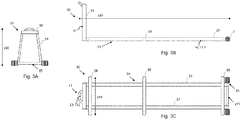
- a structurally rigid support structure 16 is formed by longitudinal beams 17, transverse beams 18 and vertical beams or vertical struts 19, the respective beam preferably having an angle profile or being configured as an angle profile.
- Longitudinal rails 17.1 or slide bearings or slide bearing components can be provided on an underside 17a of the respective longitudinal support.
- a transport vehicle 20, in particular a truck or low-loader has positioning kinematics 21, in particular in the form of lifting-pivoting kinematics with at least one arm 22 which is actuated by an actuator 23, in particular in a hydraulic manner.
- the unit 1 can be shifted over a rear edge 20b and loaded or unloaded.
- the kinematics 21 interacts with rollers 2, which are mounted about a roll-off axis y15 and which are optionally provided on the residential unit 1 and / or on the roll-off frame device 10 are.
- the rollers 2 contact the ground in each case at a roll-off or movement point Pb.
- the arm 22 is shifted to a force application point F12 on the first coupling 11 or in the first coupling point 12 and coupled there so that the force exerted by the actuator via the arm to the roll-off frame device and indirectly into the unit 1 or into the ground can be forwarded.
- the respective unit 1 is accessible on a front side yz; the first coupling 11 is preferably arranged centrally on the end face, in particular in such a way that the force can be introduced via only one coupling point.
- the coordinate axes x, y and z define the longitudinal, transverse and height directions, and the length specifications x1; x10 relate to the length of the respective (residential) unit 1 or the length of the roll-off frame device 10, and the width information y1; y10 relate to the width in the transverse direction, and the height increases z1; z10 relate to the height of the unit or the roll-off frame device.
- a clear height z0 is required depending on the type of kinematics and depending on the size of the residential unit 1.
- the parameter ⁇ z indicates a height clearance or difference in height between a respective roller underside and the floor in the static arrangement of the (residential) unit, i.e. a gap without floor contact.
- the individual carriers of the roll-off frame device can, for example, be dimensioned and connected to one another depending on the load condition and / or type of use in accordance with relevant standards, e.g. DIN or ISO.
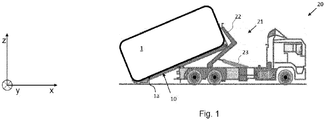
- a truck 20 which loads or unloads a (residential) unit.
- the residential unit 1 is shown in a pivoting position in which the ground has just (still) been contacted.
- the lifting and swiveling kinematics 21 positions the unit 1 on the floor or pulls the unit onto the vehicle 20, the rear edge of the unit 1 being pushed or rolled over the floor.
- Figures 2A, 2B describe the basic concept of the present invention, namely the preferably permanent / permanent combination of (residential) unit 1 and roll-off frame device 10 to form an integral transport unit.
- the device 10 is not fully integrated in the substructure or in the floor pan of the unit 1; At least for some applications, the spatial integration of the frame 10 in the unit 1 has not yet been optimized; Optionally, however, this can be done, especially if the lowest possible entry height is to be ensured (barrier-free).
- Figures 3A, 3B, 3C describe constructive details.
- the number and position of the individual girders, in particular also the cross girders 18, can be selected individually.
- the roll-off frame device 10 has the following dimensions, for example: height z10 approx. 1,500 mm, overall length x10 approx. 4,000 to 8,000 mm, width y10 approx. 2,400 to 3,400 mm.
- the structural design of the carrier can also be based, in particular, on standardized standards for a particular load.
- Fig. 4 shows two different points in time when the unit 1 is set down and illustrates a movement path of a lift-swivel kinematics 21 without additional translational displacement.
- the height of the loading area of the transport vehicle is comparatively small.
- the unit 1 overlaps the transport vehicle 20 towards the rear in the longitudinal direction x or protrudes significantly towards the rear.
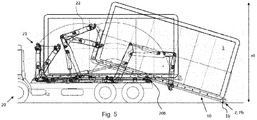
- Fig. 5 an arrangement is shown in which the unit 1 protrudes to the rear with only a very short exposed section at the rear, that is to say can be almost completely integrated onto the loading area.
- Fig. 5 illustrates a movement path of a lifting-swivel kinematics 21 with an optional additional translational displacement.
- the additional translational displacement of arm 22 also enables the smallest possible swivel angle.
- the residential unit is first shifted backwards in a translatory manner and only then pivoted down to the floor when the residential unit has been pushed backwards by the transport vehicle at least approximately up to half the length x1.
- the height of the loading area of the transport vehicle is comparatively large.
- Fig. 6 an arrangement is shown in which the section of the roll-off frame device 10 arranged under the unit 1 is spatially fully integrated into the floor assembly or frame structure 1.1 of the unit 1, here in an arrangement between longitudinal members of the frame structure 1.1.
- the rollers 2 can optionally be provided directly on the frame structure 1.1 and / or on the roll-off frame device 10.
Landscapes
- Engineering & Computer Science (AREA)
- Transportation (AREA)
- Mechanical Engineering (AREA)
- Health & Medical Sciences (AREA)
- Public Health (AREA)
- Handcart (AREA)
Applications Claiming Priority (2)
| Application Number | Priority Date | Filing Date | Title |
|---|---|---|---|
| DE202020101679.2U DE202020101679U1 (de) | 2020-03-28 | 2020-03-28 | Abrollrahmenvorrichtung zur Aufnahme, Abstützung und Positionierung einer mobilen Wohneinheit, (Wohn-)Einheit mit einer solchen Abrollrahmenvorrichtung, sowie Verwendung der Abrollrahmenvorrichtung an der (Wohn-)Einheit |
| DE102020109372.1A DE102020109372B3 (de) | 2020-04-03 | 2020-04-03 | Abrollrahmenvorrichtung zur Aufnahme, Abstützung und Positionierung einer mobilen (Wohn-)Einheit, (Wohn-)Einheit mit einer solchen Abrollrahmenvorrichtung, sowie Verfahren und Verwendung |
Publications (1)
| Publication Number | Publication Date |
|---|---|
| EP3885191A1 true EP3885191A1 (fr) | 2021-09-29 |
Family
ID=75477994
Family Applications (1)
| Application Number | Title | Priority Date | Filing Date |
|---|---|---|---|
| EP21401016.7A Withdrawn EP3885191A1 (fr) | 2020-03-28 | 2021-03-27 | Dispositif de châssis roulant destiné à la réception, au support et au positionnement d'une unité (résidentielle) mobile, unité (résidentielle) dotée d'un tel dispositif de châssis roulant, ainsi que procédé et utilisation |
Country Status (1)
| Country | Link |
|---|---|
| EP (1) | EP3885191A1 (fr) |
Citations (7)
| Publication number | Priority date | Publication date | Assignee | Title |
|---|---|---|---|---|
| DE1531805A1 (de) | 1966-10-25 | 1970-01-22 | Autolava Oy | Verfahren und Vorrichtung zum Aufladen eines Containers auf einen Lastkraftwagen und zum Abladen desselben |
| DE8129692U1 (de) | 1981-10-10 | 1982-02-25 | Franz Gerbracht Stahlblech- und Behälterbau GmbH & Co KG, 5758 Fröndenberg | Lastfahrzeug mit transportbehaelter |
| DE3927646A1 (de) | 1989-08-22 | 1991-03-14 | Rietbergwerke Gmbh & Co Kg | Vorrichtung zum aufnehmen und absetzen von lasten |
| DE102004003564A1 (de) * | 2003-02-27 | 2004-09-30 | Stahl- Und Containerbau Gmbh | Mobile Transport- und Aufbewahrungseinheit |
| DE102009033146A1 (de) * | 2008-07-11 | 2010-01-28 | We Make Stars Gmbh | Mobiler Imbiß- und/oder Getränke-Stand |
| US20190144201A1 (en) * | 2017-11-16 | 2019-05-16 | John Bloom | Transportable container with subfloor for use with a roll-off truck |
| DE102018127871A1 (de) | 2018-11-08 | 2020-05-14 | Ernst-Peter Amat Kreft | Montage-Bausatz und Verfahren zur form- und/oder kraftschlüssigen Vormontage für eine Rahmenkonstruktion sowie Verwendung |
-
2021
- 2021-03-27 EP EP21401016.7A patent/EP3885191A1/fr not_active Withdrawn
Patent Citations (7)
| Publication number | Priority date | Publication date | Assignee | Title |
|---|---|---|---|---|
| DE1531805A1 (de) | 1966-10-25 | 1970-01-22 | Autolava Oy | Verfahren und Vorrichtung zum Aufladen eines Containers auf einen Lastkraftwagen und zum Abladen desselben |
| DE8129692U1 (de) | 1981-10-10 | 1982-02-25 | Franz Gerbracht Stahlblech- und Behälterbau GmbH & Co KG, 5758 Fröndenberg | Lastfahrzeug mit transportbehaelter |
| DE3927646A1 (de) | 1989-08-22 | 1991-03-14 | Rietbergwerke Gmbh & Co Kg | Vorrichtung zum aufnehmen und absetzen von lasten |
| DE102004003564A1 (de) * | 2003-02-27 | 2004-09-30 | Stahl- Und Containerbau Gmbh | Mobile Transport- und Aufbewahrungseinheit |
| DE102009033146A1 (de) * | 2008-07-11 | 2010-01-28 | We Make Stars Gmbh | Mobiler Imbiß- und/oder Getränke-Stand |
| US20190144201A1 (en) * | 2017-11-16 | 2019-05-16 | John Bloom | Transportable container with subfloor for use with a roll-off truck |
| DE102018127871A1 (de) | 2018-11-08 | 2020-05-14 | Ernst-Peter Amat Kreft | Montage-Bausatz und Verfahren zur form- und/oder kraftschlüssigen Vormontage für eine Rahmenkonstruktion sowie Verwendung |
Similar Documents
| Publication | Publication Date | Title |
|---|---|---|
| DE69004018T2 (de) | Ausziehbare, starre struktur. | |
| DE4305190B4 (de) | Schubmaststapler | |
| DE2329888B2 (de) | Bewegliche Trennwand | |
| DE102018127871B4 (de) | Montage-Bausatz und Verfahren zur form- und/oder kraftschlüssigen Vormontage für eine Rahmenkonstruktion sowie Verwendung | |
| DE102014002480B4 (de) | Verfahren und Einrichtung zum Nivellieren und Verbinden von mindestens zwei in einer Reihe auf einem Untergrund abgestellten begehbaren Container-Modulen zu einem modularen Gebäude | |
| DE102020109372B3 (de) | Abrollrahmenvorrichtung zur Aufnahme, Abstützung und Positionierung einer mobilen (Wohn-)Einheit, (Wohn-)Einheit mit einer solchen Abrollrahmenvorrichtung, sowie Verfahren und Verwendung | |
| DE102014002497A1 (de) | Verfahren und Einrichtung zum Koppeln eines ersten und eines zweiten begehbaren Containers | |
| EP3885191A1 (fr) | Dispositif de châssis roulant destiné à la réception, au support et au positionnement d'une unité (résidentielle) mobile, unité (résidentielle) dotée d'un tel dispositif de châssis roulant, ainsi que procédé et utilisation | |
| DE2364021A1 (de) | Mobile raumeinheit | |
| EP2281959A1 (fr) | Elément de connexion pour dalle en porte-à-faux | |
| EP4370753B1 (fr) | Console de toits et façades rétractables | |
| DE202020101679U1 (de) | Abrollrahmenvorrichtung zur Aufnahme, Abstützung und Positionierung einer mobilen Wohneinheit, (Wohn-)Einheit mit einer solchen Abrollrahmenvorrichtung, sowie Verwendung der Abrollrahmenvorrichtung an der (Wohn-)Einheit | |
| DE102009011220A1 (de) | Gebäude in Leichtbauweise, insbesondere Freizeit-, Garten- oder Wirtschaftshaus | |
| DE102016002845A1 (de) | Bodenaufbausystem | |
| EP3887611B1 (fr) | Système de balcon doté d'une unité de force antagoniste | |
| EP2886393A1 (fr) | Sécurisation de charge pour une structure d'un véhicule utilitaire | |
| EP2423034B1 (fr) | Dispositif de fixation pour un dispositif de siège | |
| EP3608488B1 (fr) | Agencement et procédé de positionnement de conteneurs | |
| DE3877213T2 (de) | Anordnung in einer baustruktur. | |
| DE9113701U1 (de) | Transportabler Container mit veränderbarer Grundfläche | |
| DE2927430C2 (fr) | ||
| DE202016105654U1 (de) | Container und Bauwerk aus wenigstens zwei derartigen Containern | |
| DE202016105596U1 (de) | Tragwerk und Gebäude | |
| DE102022132919A1 (de) | Lieferfahrzeug | |
| EP1350444A1 (fr) | Glissières fixées sous une pièce de meuble extensible |
Legal Events
| Date | Code | Title | Description |
|---|---|---|---|
| PUAI | Public reference made under article 153(3) epc to a published international application that has entered the european phase |
Free format text: ORIGINAL CODE: 0009012 |
|
| STAA | Information on the status of an ep patent application or granted ep patent |
Free format text: STATUS: THE APPLICATION HAS BEEN PUBLISHED |
|
| AK | Designated contracting states |
Kind code of ref document: A1 Designated state(s): AL AT BE BG CH CY CZ DE DK EE ES FI FR GB GR HR HU IE IS IT LI LT LU LV MC MK MT NL NO PL PT RO RS SE SI SK SM TR |
|
| STAA | Information on the status of an ep patent application or granted ep patent |
Free format text: STATUS: REQUEST FOR EXAMINATION WAS MADE |
|
| 17P | Request for examination filed |
Effective date: 20220329 |
|
| RBV | Designated contracting states (corrected) |
Designated state(s): AL AT BE BG CH CY CZ DE DK EE ES FI FR GB GR HR HU IE IS IT LI LT LU LV MC MK MT NL NO PL PT RO RS SE SI SK SM TR |
|
| STAA | Information on the status of an ep patent application or granted ep patent |
Free format text: STATUS: THE APPLICATION IS DEEMED TO BE WITHDRAWN |
|
| 18D | Application deemed to be withdrawn |
Effective date: 20231003 |