EP3886437B1 - Videokodierung und -dekodierung - Google Patents
Videokodierung und -dekodierung Download PDFInfo
- Publication number
- EP3886437B1 EP3886437B1 EP19902594.1A EP19902594A EP3886437B1 EP 3886437 B1 EP3886437 B1 EP 3886437B1 EP 19902594 A EP19902594 A EP 19902594A EP 3886437 B1 EP3886437 B1 EP 3886437B1
- Authority
- EP
- European Patent Office
- Prior art keywords
- block
- sub
- motion information
- prediction value
- target motion
- Prior art date
- Legal status (The legal status is an assumption and is not a legal conclusion. Google has not performed a legal analysis and makes no representation as to the accuracy of the status listed.)
- Active
Links
Images




Classifications
-
- H—ELECTRICITY
- H04—ELECTRIC COMMUNICATION TECHNIQUE
- H04N—PICTORIAL COMMUNICATION, e.g. TELEVISION
- H04N19/00—Methods or arrangements for coding, decoding, compressing or decompressing digital video signals
- H04N19/10—Methods or arrangements for coding, decoding, compressing or decompressing digital video signals using adaptive coding
- H04N19/134—Methods or arrangements for coding, decoding, compressing or decompressing digital video signals using adaptive coding characterised by the element, parameter or criterion affecting or controlling the adaptive coding
- H04N19/157—Assigned coding mode, i.e. the coding mode being predefined or preselected to be further used for selection of another element or parameter
- H04N19/159—Prediction type, e.g. intra-frame, inter-frame or bidirectional frame prediction
-
- H—ELECTRICITY
- H04—ELECTRIC COMMUNICATION TECHNIQUE
- H04N—PICTORIAL COMMUNICATION, e.g. TELEVISION
- H04N19/00—Methods or arrangements for coding, decoding, compressing or decompressing digital video signals
- H04N19/50—Methods or arrangements for coding, decoding, compressing or decompressing digital video signals using predictive coding
-
- H—ELECTRICITY
- H04—ELECTRIC COMMUNICATION TECHNIQUE
- H04N—PICTORIAL COMMUNICATION, e.g. TELEVISION
- H04N19/00—Methods or arrangements for coding, decoding, compressing or decompressing digital video signals
- H04N19/10—Methods or arrangements for coding, decoding, compressing or decompressing digital video signals using adaptive coding
- H04N19/102—Methods or arrangements for coding, decoding, compressing or decompressing digital video signals using adaptive coding characterised by the element, parameter or selection affected or controlled by the adaptive coding
- H04N19/103—Selection of coding mode or of prediction mode
- H04N19/105—Selection of the reference unit for prediction within a chosen coding or prediction mode, e.g. adaptive choice of position and number of pixels used for prediction
-
- H—ELECTRICITY
- H04—ELECTRIC COMMUNICATION TECHNIQUE
- H04N—PICTORIAL COMMUNICATION, e.g. TELEVISION
- H04N19/00—Methods or arrangements for coding, decoding, compressing or decompressing digital video signals
- H04N19/10—Methods or arrangements for coding, decoding, compressing or decompressing digital video signals using adaptive coding
- H04N19/102—Methods or arrangements for coding, decoding, compressing or decompressing digital video signals using adaptive coding characterised by the element, parameter or selection affected or controlled by the adaptive coding
- H04N19/119—Adaptive subdivision aspects, e.g. subdivision of a picture into rectangular or non-rectangular coding blocks
-
- H—ELECTRICITY
- H04—ELECTRIC COMMUNICATION TECHNIQUE
- H04N—PICTORIAL COMMUNICATION, e.g. TELEVISION
- H04N19/00—Methods or arrangements for coding, decoding, compressing or decompressing digital video signals
- H04N19/10—Methods or arrangements for coding, decoding, compressing or decompressing digital video signals using adaptive coding
- H04N19/134—Methods or arrangements for coding, decoding, compressing or decompressing digital video signals using adaptive coding characterised by the element, parameter or criterion affecting or controlling the adaptive coding
- H04N19/136—Incoming video signal characteristics or properties
- H04N19/137—Motion inside a coding unit, e.g. average field, frame or block difference
- H04N19/139—Analysis of motion vectors, e.g. their magnitude, direction, variance or reliability
-
- H—ELECTRICITY
- H04—ELECTRIC COMMUNICATION TECHNIQUE
- H04N—PICTORIAL COMMUNICATION, e.g. TELEVISION
- H04N19/00—Methods or arrangements for coding, decoding, compressing or decompressing digital video signals
- H04N19/10—Methods or arrangements for coding, decoding, compressing or decompressing digital video signals using adaptive coding
- H04N19/169—Methods or arrangements for coding, decoding, compressing or decompressing digital video signals using adaptive coding characterised by the coding unit, i.e. the structural portion or semantic portion of the video signal being the object or the subject of the adaptive coding
- H04N19/17—Methods or arrangements for coding, decoding, compressing or decompressing digital video signals using adaptive coding characterised by the coding unit, i.e. the structural portion or semantic portion of the video signal being the object or the subject of the adaptive coding the unit being an image region, e.g. an object
- H04N19/174—Methods or arrangements for coding, decoding, compressing or decompressing digital video signals using adaptive coding characterised by the coding unit, i.e. the structural portion or semantic portion of the video signal being the object or the subject of the adaptive coding the unit being an image region, e.g. an object the region being a slice, e.g. a line of blocks or a group of blocks
-
- H—ELECTRICITY
- H04—ELECTRIC COMMUNICATION TECHNIQUE
- H04N—PICTORIAL COMMUNICATION, e.g. TELEVISION
- H04N19/00—Methods or arrangements for coding, decoding, compressing or decompressing digital video signals
- H04N19/10—Methods or arrangements for coding, decoding, compressing or decompressing digital video signals using adaptive coding
- H04N19/169—Methods or arrangements for coding, decoding, compressing or decompressing digital video signals using adaptive coding characterised by the coding unit, i.e. the structural portion or semantic portion of the video signal being the object or the subject of the adaptive coding
- H04N19/17—Methods or arrangements for coding, decoding, compressing or decompressing digital video signals using adaptive coding characterised by the coding unit, i.e. the structural portion or semantic portion of the video signal being the object or the subject of the adaptive coding the unit being an image region, e.g. an object
- H04N19/176—Methods or arrangements for coding, decoding, compressing or decompressing digital video signals using adaptive coding characterised by the coding unit, i.e. the structural portion or semantic portion of the video signal being the object or the subject of the adaptive coding the unit being an image region, e.g. an object the region being a block, e.g. a macroblock
-
- H—ELECTRICITY
- H04—ELECTRIC COMMUNICATION TECHNIQUE
- H04N—PICTORIAL COMMUNICATION, e.g. TELEVISION
- H04N19/00—Methods or arrangements for coding, decoding, compressing or decompressing digital video signals
- H04N19/50—Methods or arrangements for coding, decoding, compressing or decompressing digital video signals using predictive coding
- H04N19/503—Methods or arrangements for coding, decoding, compressing or decompressing digital video signals using predictive coding involving temporal prediction
- H04N19/51—Motion estimation or motion compensation
- H04N19/513—Processing of motion vectors
-
- H—ELECTRICITY
- H04—ELECTRIC COMMUNICATION TECHNIQUE
- H04N—PICTORIAL COMMUNICATION, e.g. TELEVISION
- H04N19/00—Methods or arrangements for coding, decoding, compressing or decompressing digital video signals
- H04N19/50—Methods or arrangements for coding, decoding, compressing or decompressing digital video signals using predictive coding
- H04N19/503—Methods or arrangements for coding, decoding, compressing or decompressing digital video signals using predictive coding involving temporal prediction
- H04N19/51—Motion estimation or motion compensation
- H04N19/513—Processing of motion vectors
- H04N19/517—Processing of motion vectors by encoding
- H04N19/52—Processing of motion vectors by encoding by predictive encoding
-
- H—ELECTRICITY
- H04—ELECTRIC COMMUNICATION TECHNIQUE
- H04N—PICTORIAL COMMUNICATION, e.g. TELEVISION
- H04N19/00—Methods or arrangements for coding, decoding, compressing or decompressing digital video signals
- H04N19/70—Methods or arrangements for coding, decoding, compressing or decompressing digital video signals characterised by syntax aspects related to video coding, e.g. related to compression standards
-
- H—ELECTRICITY
- H04—ELECTRIC COMMUNICATION TECHNIQUE
- H04N—PICTORIAL COMMUNICATION, e.g. TELEVISION
- H04N19/00—Methods or arrangements for coding, decoding, compressing or decompressing digital video signals
- H04N19/10—Methods or arrangements for coding, decoding, compressing or decompressing digital video signals using adaptive coding
- H04N19/134—Methods or arrangements for coding, decoding, compressing or decompressing digital video signals using adaptive coding characterised by the element, parameter or criterion affecting or controlling the adaptive coding
- H04N19/146—Data rate or code amount at the encoder output
- H04N19/147—Data rate or code amount at the encoder output according to rate distortion criteria
-
- H—ELECTRICITY
- H04—ELECTRIC COMMUNICATION TECHNIQUE
- H04N—PICTORIAL COMMUNICATION, e.g. TELEVISION
- H04N19/00—Methods or arrangements for coding, decoding, compressing or decompressing digital video signals
- H04N19/10—Methods or arrangements for coding, decoding, compressing or decompressing digital video signals using adaptive coding
- H04N19/169—Methods or arrangements for coding, decoding, compressing or decompressing digital video signals using adaptive coding characterised by the coding unit, i.e. the structural portion or semantic portion of the video signal being the object or the subject of the adaptive coding
- H04N19/184—Methods or arrangements for coding, decoding, compressing or decompressing digital video signals using adaptive coding characterised by the coding unit, i.e. the structural portion or semantic portion of the video signal being the object or the subject of the adaptive coding the unit being bits, e.g. of the compressed video stream
-
- H—ELECTRICITY
- H04—ELECTRIC COMMUNICATION TECHNIQUE
- H04N—PICTORIAL COMMUNICATION, e.g. TELEVISION
- H04N19/00—Methods or arrangements for coding, decoding, compressing or decompressing digital video signals
- H04N19/10—Methods or arrangements for coding, decoding, compressing or decompressing digital video signals using adaptive coding
- H04N19/169—Methods or arrangements for coding, decoding, compressing or decompressing digital video signals using adaptive coding characterised by the coding unit, i.e. the structural portion or semantic portion of the video signal being the object or the subject of the adaptive coding
- H04N19/186—Methods or arrangements for coding, decoding, compressing or decompressing digital video signals using adaptive coding characterised by the coding unit, i.e. the structural portion or semantic portion of the video signal being the object or the subject of the adaptive coding the unit being a colour or a chrominance component
Definitions
- the present disclosure relates to video encoding and decoding, and more particularly, to coding by using geometric partitioning mode with triangular partition.
- a video coding method can include processes such as prediction, transformation, quantization, filtering, and entropy coding.
- Prediction coding can include intra prediction coding and inter prediction coding.
- Inter prediction coding refers to prediction coding using reconstructed pixel values of a temporal neighboring block of a current block (the temporal neighboring block and the current block are not located in a same picture).
- Intra prediction coding refers to prediction coding using reconstructed pixel values of a spatial neighboring block of the current block (the spatial neighboring block and the current block are located in a same picture).
- a motion vector can be used to represent a relative displacement between the current block of the current slice and a reference block of the reference picture.
- the current slice A and the reference picture B have a high time-domain correlation.
- a reference block B1 that best matches the current block A1 can be searched for in the reference picture B, and the relative displacement between the current block A1 and the reference block B1 is determined and used as the motion vector of the current block A1.
- a foreground i.e., a physical object
- a background i.e., a background
- the prediction effect of a certain part of the object in the rectangular block can be undesirable, resulting in a large coding residual.
- R-L LIAO PANASONIC ET AL: "CE10.3.1.b: Triangular prediction unit mode", 124.
- MOTION PICTURE EXPERT GROUP OR 1S0/IEC JTC1/SC29/WG11 refers to the concept of a triangular prediction unit mode to introduce a triangular partition for motion compensated prediction.
- a CU is split into two triangular prediction unit, in either diagonal or inverse diagonal direction.
- the triangular prediction unit mode is only applied to a CU which block size is larger than or equal to 8x8, and its coding prediction mode is only applied to skip and merge modes.
- the present disclosure provides a video encoding and decoding method, which can be performed by a video encoder or a video decoder, and includes: partitioning a current block into a first triangular sub-block and a second triangular sub-block when the current block satisfies specific conditions for enabling a geometric partitioning mode with triangular partition and the geometric partitioning mode with triangular partition is determined to be enabled; obtaining first target motion information of the first triangle sub-block and second target motion information is different from the second target motion information; and performing an encoding processing or a decoding processing on the current block based on the first target motion information and the second target motion information.
- the present disclosure provides a video decoder, which includes a processor and a machine-readable storage medium, wherein the machine-readable storage medium stores machine-executable instructions that can be invoked by the processor; when the processor executes the instructions, the processor is caused to perform the video encoding and decoding method.
- the present disclosure provides a video encoder, which includes a processor and a machine-readable storage medium, wherein the machine-readable storage medium stores machine-executable instructions that can be invoked by the processor; when the processor executes the instructions, the processor is caused to perform the video encoding and decoding method.
- the present disclosure provides a machine-readable storage medium on which computer instructions are stored.
- the processor is caused to perform the video encoding and decoding method.
- Intra prediction prediction coding using reconstructed pixel values of a spatial neighboring block (in the same picture as the current block) of a current block.
- a variety of intra prediction modes have been proposed, and each intra prediction mode except a DC mode corresponds to one texture direction.
- the predicted pixels of the current block can be generated from boundary reconstruction pixel values of the neighboring block in its prediction direction. For example, if the texture of the image is in horizontal direction, then a horizontal prediction mode can better predict image information.
- Inter prediction prediction coding using reconstructed pixel values of a temporal neighboring block (in a different picture from the current block) of a current block.
- Part of the inter prediction of main video coding standards adopts a block-based motion compensation technology, in which a best matching block is found in a reference picture for the current block. This process is referred to as Motion Estimation (ME).
- ME Motion Estimation
- Motion Vector In inter prediction coding, a motion vector is used to represent a relative displacement between a current encoded block and a best matching block in a reference picture. Each block obtained by partition has a corresponding motion vector to be transmitted to a decoder. If the motion vector of each block is encoded and transmitted independently, especially when smaller-sized blocks are obtained from partition, more bits have to be consumed. In order to reduce the number of bits used to encode the motion vector, spatial correlation between neighboring image blocks can be used in video encoding to predict the motion vector of the current to-be-encoded block based on the motion vector of the neighboring encoded block, and then a prediction difference is encoded. Thus, the number of bits representing the motion vector can be effectively reduced.
- the motion vector of the neighboring encoded block is generally used to predict the motion vector of the current macroblock, and then a motion vector difference (MVD) between a motion vector prediction (MVP) value and a real estimation value of the motion vector is encoded, thereby effectively reducing the number of encoded bits for the MV.
- MVP motion vector prediction
- Motion Information Since the motion vector represents the displacement of the current image block relative to a block in a reference picture, in order to accurately obtain the information of the indicated image block, in addition to the motion vector, a reference index is also needed to indicate which reference picture is used for the current image block.
- a reference picture list can usually be established, and the reference index specifies which reference picture listed in the reference picture list is used by the current image block.
- many coding technologies also support multiple reference picture lists, so an index is needed to indicate which reference picture list is used, and this index can be referred to as a reference direction.
- coding information related to motion such as motion vector, reference index, and reference direction, can be collectively referred to as motion information.
- Rate distortion optimized There are usually two indicators for evaluating video encoding efficiency: bit rate and peak signal to noise ratio (PSNR). The smaller the bit stream is, the larger the compression rate is; the higher the PSNR is, the better the quality of the reconstructed image is. Selection of a mode is usually based on a comprehensive evaluation of the two indicators.
- SSE sum of squared differences
- FIG. 1 schematically shows a framework of a video coding system, which can be used to implement the processing at an encoder according to an example of the present disclosure.
- the framework of the video coding system can include an intra prediction module, a motion estimation/motion compensation module, a reference picture buffer, an in-loop filtering module, a reconstruction module, a transform module, a quantization module, an inverse transform module, an inverse quantization module, an entropy encoder, etc.
- the framework of the video decoding system corresponding to the framework of the video encoding system can be used to implement the processing at a decoder according to an example of the present disclosure.
- FIG. 2 is a flowchart of a video decoding method according to an example of the present disclosure. This method can be applied to a decoder, and can include steps 201 to 203.
- Step 201 if a current block satisfies specific conditions for enabling the geometric partitioning mode with triangular partition and it is determined to enable the geometric partitioning mode with triangular partition, the video decoder is configured to partition the current block into a first triangular sub-block and a second triangular sub-block, that is, the current block can be partitioned into two triangular sub-blocks.
- Step 202 the video decoder is configured to obtain the first target motion information of the first triangle sub-block and the second target motion information of the second triangle sub-block.
- the first target motion information can be different from the second target motion information.
- Step 203 the video decoder is configured to perform the decoding process of the current block based on the first target motion information and the second target motion information.
- the video decoder can perform a decoding process of encoded data corresponding to the current block in the received encoded bit stream based on the first target motion information and the second target motion information.
- a current block satisfies specific conditions for enabling the geometric partitioning mode with triangular partition and it is determined to enable the geometric partitioning mode with triangular partition
- the current block is partitioned into the first triangular sub-block and the second triangular sub-block. Therefore, the current block can be predicted based on the first target motion information of the first triangle sub-block and the second target motion information of the second triangle sub-block. Therefore, prediction accuracy, prediction performance and coding performance can be improved, and coding residuals can be reduced.
- FIG. 3 is a flowchart of a video encoding method according to an example of the present disclosure.
- the method can be applied to an encoder and can include steps 301 to 303.
- Step 301 if a current block satisfies specific conditions for enabling the geometric partitioning mode with triangular partition and it is determined to enable the geometric partitioning mode with triangular partition, the video encoder is configured to partition the current block into the first triangular sub-block and the second triangular sub-block, that is, the current block can be partitioned into two triangular sub-blocks.
- Step 302 the video encoder is configured to obtain the first target motion information of the first triangle sub-block and the second target motion information of the second triangle sub-block.
- the first target motion information can be different from the second target motion information.
- Step 303 the video encoder is configured to encode the current block based on the first target motion information and the second target motion information.
- the video encoder can encode the bit stream corresponding to the current block based on the first target motion information and the second target motion information to obtain an encoded bit stream.
- a current block satisfies specific conditions for enabling the geometric partitioning mode with triangular partition and it is determined to enable the geometric partitioning mode with triangular partition
- the current block is partitioned into the first triangular sub-block and the second triangular sub-block. Therefore, the current block can be predicted based on first target motion information of the first triangle sub-block and second target motion information of the second triangle sub-block. Therefore, prediction accuracy, prediction performance and coding performance can be improved, and coding residuals can be reduced.
- the video decoder/video encoder is configured to determine whether the current block satisfies specific conditions for enabling the geometric partitioning mode with triangular partition; if so, the current block is partitioned into the first triangular sub-block and the second triangular sub-block; and if not, the current block is not partitioned into the first triangle sub-block and the second triangle sub-block. Determining whether the current block satisfies the specific conditions can include the steps of: determining whether the slice type of a current slice where the current block is located, the motion information mode of the current block, and size information of the current block satisfy the specific conditions.
- the slice type of the current slice is a B slice or a non-I slice, it can be determined that the slice type satisfies the specific conditions.
- the slice type of the current slice allows intra block copy, it can be determined that the slice type satisfies the specific conditions.
- a motion information mode of the current block is a general merge mode
- the motion information mode of the current block is another type of mode (such as Advanced Motion Vector Prediction (AMVP) mode, or the like)
- AMVP Advanced Motion Vector Prediction
- the width of the current block is greater than or equal to a first value, and a height of the current block is greater than or equal to a second value, it can be determined that the size information of the current block satisfies the specific conditions.
- the width of the current block is greater than or equal to a third value, or the height of the current block is greater than or equal to a fourth value, it can be determined that the size information of the current block satisfies the specific conditions.
- the width of the current block is greater than or equal to a fifth value and less than or equal to a sixth value, and the height of the current block is greater than or equal to a seventh value and less than or equal to an eighth value, it can be determined that the size information of the current block satisfies the specific conditions.
- the width of the current block is greater than or equal to a ninth value and less than or equal to a tenth value, or the height of the current block is greater than or equal to an eleventh value and less than or equal to a twelfth value, it can be determined that the size information of the current block satisfies the specific conditions.
- the width of the current block is greater than or equal to a thirteenth value and less than or equal to a fourteenth value
- the height of the current block is greater than or equal to a fifteenth value and less than or equal to a sixteenth value
- an area of the current block is greater than or equal to a seventeenth value and less than or equal to an eighteenth value
- the above values can be set based on experience, such as 8, 16, 32, 64, 128, and so on.
- the first value can be 8, the second value can be 8, the third value can be 8, the fourth value can be 8, the fifth value can be 8, the sixth value can be 128, the seventh value can be 8, the eighth value can be 128, the ninth value can be 8, the tenth value can be 32, the eleventh value can be 8, the twelfth value can be 32, the thirteenth value can be 8, the fourteenth value can be 64, the fifteenth value can be 8, the sixteenth value can be 64, the seventeenth value can be 16, and the eighteenth value can be 1024.
- step 201 and step 301 several examples are given below.
- Example 1 If the current block satisfies all the following conditions, the current block is partitioned into the first triangle sub-block and the second triangle sub-block; otherwise, the current block is not partitioned into the first triangle sub-block and the second triangle sub-block:
- Example 2 If the current block satisfies all the following conditions, the current block is partitioned into the first triangle sub-block and the second triangle sub-block; otherwise, the current block is not partitioned into the first triangle sub-block and the second triangle sub-block:
- Example 3 If the current block satisfies all the following conditions, the current block is partitioned into the first triangle sub-block and the second triangle sub-block; otherwise, the current block is not partitioned into the first triangle sub-block and the second triangle sub-block:
- Example 4 If the current block satisfies all the following conditions, the current block is partitioned into the first triangle sub-block and the second triangle sub-block; otherwise, the current block is not partitioned into the first triangle sub-block and the second triangle sub-block:
- Example 5 If the current block satisfies all the following conditions, the current block is partitioned into the first triangle sub-block and the second triangle sub-block; otherwise, the current block is not partitioned into the first triangle sub-block and the second triangle sub-block:
- Example 6 If the current block satisfies all the following conditions, the current block is partitioned into the first triangle sub-block and the second triangle sub-block; otherwise, the current block is not partitioned into the first triangle sub-block and the second triangle sub-block:
- Example 7 If the current block satisfies all the following conditions, the current block is partitioned into the first triangle sub-block and the second triangle sub-block; otherwise, the current block is not partitioned into the first triangle sub-block and the second triangle sub-block:
- Example 8 For any of Examples 1 to 7, the restriction on the slice type can be modified to: the current slice allows intra block copy (that is, allows to search for blocks similar to the current block in the reconstructed blocks of the current slice that have been decoded). For example, for Example 1, the listed conditions can become:
- Example 9 the restriction on the motion information mode can be modified to: the motion information mode of the current block is the general merge mode, and not any of a sub-block partition mode, a multi-hypothesis mode, and a general merge mode of coding motion information difference. That is to say, when any one of the sub-block partition mode, multi-hypothesis mode, the general merge mode of coding motion information difference is enabled for the current block, it is determined that the current block does not satisfy the specific conditions, and thus the current block is not partitioned into the first triangle sub-block and the second triangle sub-block.
- the video decoder/video encoder is configured to partition the current block into the first triangular sub-block and the second triangular sub-block.
- the current block can be partitioned into the first triangle sub-block and the second triangle sub-block with a first diagonal method (that is, using a diagonal that forms an acute angle (for example, a 45-degree angle) with the horizontal and right direction), such as shown in FIG. 4A .
- the current block can be partitioned into the first triangular sub-block and the second triangular sub-block with a second diagonal method (that is, using a diagonal with an obtuse angle (for example, a 135-degree angle) from the horizontal and right direction), as shown in FIG. 4B .
- a second diagonal method that is, using a diagonal with an obtuse angle (for example, a 135-degree angle) from the horizontal and right direction
- the current block can be partitioned into the first triangle sub-block and the second triangle sub-block through the following approaches.
- the video encoder agrees to partition the current block with the first diagonal method by default through protocol agreement
- the video decoder agrees to partition the current block with the first diagonal method by default through protocol agreement.
- the video encoder is configured to partition the current block into the first triangle sub-block and the second triangle sub-block with the first diagonal method
- the video decoder is configured to partition the current block into the first triangle sub-block and the second triangle sub-block with the first diagonal method.
- the video encoder agrees to partition the current block with the second diagonal method by default through protocol agreement
- the video decoder agrees to partition the current block with the second diagonal method by default through protocol agreement.
- the video encoder is configured to partition the current block into the first triangle sub-block and the second triangle sub-block with the second diagonal method
- the video decoder is configured to partition the current block into the first triangle sub-block and the second triangle sub-block with the second diagonal method.
- the video encoder is configured to determine a rate distortion cost 1 corresponding to the partition with the first diagonal method and a rate distortion cost 2 corresponding to the partition with the second diagonal method. If the rate distortion cost 1 is less than the rate distortion cost 2, the video encoder is configured to partition the current block into the first triangle sub-block and the second triangle sub-block with the first diagonal method.
- the encoded bit stream sent by the video encoder to the decoder carries first indication information, and the first indication information specifies that the current block is partitioned with the first diagonal method.
- the video decoder is configured to derive the encoded bit stream from the encoder, and if the encoded bit stream carries the first indication information, the current block is partitioned into the first triangle sub-block and the second triangle sub-block with the first diagonal method. On the other hand, if the rate distortion cost 1 is greater than the rate distortion cost 2, the video encoder partitions the current block into the first triangular sub-block and the second triangular sub-block with the second diagonal method.
- the encoded bit stream sent by the video encoder to the decoder carries second indication information, and the second indication information specifies that the current block is partitioned with the second diagonal method.
- the video decoder is configured to derive the encoded bit stream from the encoder, and if the encoded bit stream carries the second indication information, the current block is partitioned into the first triangle sub-block and the second triangle sub-block with the second diagonal method.
- the video decoder/video encoder can obtain the first target motion information of the first triangle sub-block and the second target motion information of the second triangle sub-block through the following approaches.
- a first candidate motion information list is constructed, and the first candidate motion information list can include a plurality of candidate motion information; one candidate motion information is selected from the first candidate motion information list as the first target motion information of the first triangle sub-block.
- the first target motion information is excluded from the first candidate motion information list, and another candidate motion information is selected from the remaining candidate motion information in the first candidate motion information list as the second target motion information of the second triangle sub-block. In this way, it can be ensured that the first target motion information is different from the second target motion information.
- candidate blocks corresponding to the current block can be obtained, and the motion information of the candidate blocks can be added to the first candidate motion information list.
- the motion information of the candidate block includes unidirectional motion information of the candidate block;
- a candidate block is a bidirectional prediction block, the motion information of the candidate block includes first motion information of the candidate block (that is, L0 motion information of the candidate block) and second motion information of the candidate block (that is, L1 motion information of the candidate block), but does not include weighted motion information of the first motion information of the candidate block and the second motion information of the candidate block.
- the blocks at the 7 positions shown can be used as candidate blocks corresponding to the current block, where block 1, block 2, block 3, block 4, and block 5 are candidate blocks in the current slice (that is, spatial candidate blocks), and blocks 6 and 7 are candidate blocks in the reference picture (that is, time-domain candidate blocks).
- the motion information of the candidate blocks at these 7 positions can be collected to construct the first candidate motion information list.
- the length of the first candidate motion information list does not reach a preset maximum length MaxL (for example, 7)
- MaxL for example, 7
- motion information of several available spatial non-neighboring sub-blocks can be added to the end of the first candidate motion information list (that is, a spatial non-neighboring sub-block is also regarded as a candidate block corresponding to the current block)
- the spatial non-neighboring sub-block refers to a sub-block that has no boundary line or boundary point with the current block.
- the motion information of the candidate blocks are collected, the motion information are sorted in an order of unidirectional motion information, L0 motion information of bidirectional prediction, and L1 motion information of bidirectional prediction, or in an order of L0 motion information of bidirectional prediction, L1 motion information of bidirectional prediction, and unidirectional motion information, and the collected motion information are added to the first candidate motion information list one by one according to the sorting result.
- each time when motion information is added to the first candidate motion information list it can be determined whether a number of candidate motion information in the first candidate motion information list has reached an upper limit M. If the number has reached the upper limit M, it is rejected to add motion information, and the process of adding motion information is ended. If the number has not reached the upper limit M, it can be continued to add motion information, for example, next motion information is added to the first candidate motion information list after the addition of the current motion information is completed.
- the value of the upper limit M can be configured based on experience, to be 5, for example.
- each time when motion information is added to the first candidate motion information list it can be determined whether the motion information is consistent with some motion information which has already exist in the first candidate motion information list. If there is such duplicated motion information in the first candidate motion information list, it is rejected to add the motion information to the first candidate motion information list. If there is no such duplicated motion information, the motion information is added to the first candidate motion information list. In this way, it can duplicated motion information in the first candidate motion information list. Alternatively, it is also possible not to determine whether the to-be-added motion information duplicates with some existing motion information in the first candidate motion information list, but directly add the motion information to the first candidate motion information list.
- the number of candidate motion information in the first candidate motion information list is lower than the upper limit M, then zero motion information can be filled in the first candidate motion information list.
- the first candidate motion information list when the first candidate motion information list is constructed, each time the motion information of the candidate block of the current block is to be collected, there is no need to compare the motion information of the candidate block with the motion information that has been collected for the current block to see whether they are the same, but directly collect the motion information of the candidate block.
- Example 1 From candidate blocks corresponding to the current block, after obtaining motion information (such as motion vectors) based on the position sequence shown in FIG. 5A , the obtained motion information are sorted in an order of unidirectional motion vector, L0 motion vector of bidirectional prediction, and L1 motion vector of bidirectional prediction (without an average value of L0 motion vector and L1 motion vector of bidirectional prediction), and the obtained motion information are added to the first candidate motion information list one by one according to the sorting result.
- M for example, 5
- filling is stopped.
- the number of candidate motion information is less than M after the filling process is completed, zero motion vectors are filled in.
- Example 2 From candidate blocks corresponding to the current block, after obtaining motion information (such as motion vectors) based on the position sequence shown in FIG. 5A , the obtained motion information are sorted in an order of unidirectional motion vector, L0 motion vector of bidirectional prediction, and L1 motion vector of bidirectional prediction (without an average value of L0 motion vector and L1 motion vector of bidirectional prediction), and the obtained motion information are added to the first candidate motion information list one by one according to the sorting result. During the filling process, if the number of candidate motion information in the first candidate motion information list reaches M (for example, 5), filling of motion information is stopped. During the filling process, it is not necessary to check duplicates in the first candidate motion information list. When the number of candidate motion information is less than M after the filling process is completed, zero motion vectors are filled in.
- M for example, 5
- Example 3 From candidate blocks corresponding to the current block, after obtaining motion information (such as motion vectors) based on the position sequence shown in FIG. 5A , the obtained motion information are sorted in an order of L0 motion vector of bidirectional prediction, L1 motion vector of bidirectional prediction, and unidirectional motion vector (without an average value of L0 motion vector and L1 motion vector of the bidirectional prediction), and the obtained motion information are added to the first candidate motion information list one by one according to the sorting result.
- M for example, 5
- filling is stopped.
- the number of candidate motion information is less than M after the filling process is completed, zero motion vectors are filled in.
- Example 4 From candidate blocks corresponding to the current block, motion information (such as motion vectors) are obtained based on the position sequence shown in FIG. 5A . If the candidate blocks are unidirectional prediction blocks, that is, unidirectional motion information are used for the candidate blocks, the unidirectional motion information are added to the first candidate motion information list based on the sequence. If the candidate blocks are bidirectional prediction blocks, that is, bidirectional motion information are used for the candidate blocks, either L0 motion information or L1 motion information are added to the first candidate motion information list based on the sequence. During the filling process, if the number of candidate motion information in the first candidate motion information list reaches M (for example, 5), filling is stopped. During the filling process, it is necessary to repeatedly check the duplicates to ensure that the first candidate motion information list does not have the same motion information. When the number of candidate motion information is less than M after the filling process is completed, zero motion vectors are filled in.
- M for example, 5
- Example 5 If a length of the first candidate motion information list constructed after traversing all the candidate blocks shown in FIG. 5A does not reach the preset maximum length MaxL (for example, 7), motion information of several available spatial non-neighboring sub-blocks are added to the end of the first candidate motion information list. Spatial non-neighboring sub-blocks refer to sub-blocks that have no boundary lines or boundary points with the current block.
- Example 6 From candidate blocks corresponding to the current block, after obtaining motion information (such as motion vectors) based on the position sequence shown in FIG. 5A , the obtained motion information are sorted in an order of unidirectional motion vector, L0 motion vector of bidirectional prediction, and L1 motion vector of bidirectional prediction (without an average value of the L0 motion vector and L1 motion vector of bidirectional prediction), and the obtained motion information are added to the first candidate motion information list one by one according to the sorting result. During the filling process, if the number of candidate motion information in the first candidate motion information list reaches M (for example, 5), filling of motion information is stopped.
- M for example, 5
- Example 7 When adding motion information to the first candidate motion information list, two processes are involved. One process is the motion information collection process, that is, the motion information of the candidate blocks are collected, and the other process is the motion information adding process, that is, the motion information is added to the first candidate motion information list. An example of the motion information collection process will be described below.
- the process of collecting the motion information of the candidate blocks it can be determined whether the motion information of the current candidate block is exactly the same as the previously collected motion information. If the motion information of the current candidate block is exactly the same as the previously collected motion information, the process of collecting the motion information of the current candidate block can be skipped. In this example, the motion information of the current candidate block can be compared only with the motion information of the candidate block close to the current candidate block.
- motion information of candidate block 1 is collected. Since candidate block 1 is the first candidate block, no comparison is needed, and the motion information of candidate block 1 is collected directly.
- candidate block 1 is available. If it is available, it can be determined whether the motion information of candidate block 2 is exactly the same as that of candidate block 1. If they are exactly the same, collection of the motion information of candidate block 2 is not performed, and if they are not the same, collection of the motion information of candidate block 2 is performed.
- candidate block 2 when collecting motion information of candidate block 3, it can be determined whether candidate block 2 which is close to candidate block 3 is available. If candidate block 2 is available, it can be determined whether the motion information of candidate block 3 and the motion information of candidate block 2 are exactly the same. If they are exactly the same, collection of the motion information of candidate block 3 is not performed, and if they are not the same, collection of the motion information of candidate block 3 is performed. It should be noted that the motion information of candidate block 3 is no longer compared with the motion information of candidate block 1 which is far away from candidate block 3.
- candidate block 1 which is close to candidate block 4 is available. If candidate block 1 is available, it can be determined whether the motion information of candidate block 4 and the motion information of candidate block 1 are exactly the same. If they are exactly the same, collection of the motion information of candidate block 4 is not performed, and if they are not the same, collection of the motion information of candidate block 4 is performed. It should be noted that the motion information of candidate block 4 is no longer compared with the motion information of candidate blocks 2 and 3 which are far away from candidate block 4.
- candidate block 1 which is close to candidate block 5 is available. If candidate block 1 is available, it can be determined whether the motion information of candidate block 5 is exactly the same as that of candidate block 1. If they are exactly the same, the motion information of candidate block 5 is not collected. If they are not the same, it can be determined whether candidate block 2 which is close to candidate block 5 is available. If available, it can be determined whether the motion information of candidate block 5 and the motion information of candidate block 2 are exactly the same. If they are exactly the same, collection of the motion information of candidate block 5 is not performed, and if they are not the same, collection of the motion information of candidate block 5 is performed. It should be noted that the motion information of candidate block 5 is no longer compared with the motion information of the candidate blocks 3 and 4 which are far away from candidate block 5.
- Example 8 In the process of collecting motion information of the candidate blocks, there is no need to determine whether the motion information of the current candidate block is exactly the same as the previously collected motion information, but the motion information of the current candidate block is directly collected. Even if the motion information of the current candidate block is exactly the same as the previously collected motion information, subsequently, it is possible to perform duplicate checking operations to avoid the same motion information in the first candidate motion information list.
- the video encoder can set default first target motion information through protocol agreement. For example, the video encoder can set the top candidate motion information in the first candidate motion information list as the first target motion information of the first triangle sub-block by default.
- the video decoder can set default first target motion information through protocol agreement. For example, the video decoder can set the top candidate motion information in the first candidate motion information list as the first target motion information of the first triangle sub-block by default.
- the video encoder can determine a rate distortion cost corresponding to each candidate motion information in the first candidate motion information list, and use the candidate motion information corresponding to the smallest rate distortion cost as the target motion information of the first triangle sub-block.
- the encoded bit stream sent by the video encoder to the decoder can carry the third indication information, and the third indication information specifies an index value of the first target motion information in the first candidate motion information list.
- the video decoder is configured to derive the encoded bit stream from the encoder. If the encoded bit stream carries the third indication information, the index value is used to derive the candidate motion information corresponding to the index information from the first candidate motion information list, and the candidate motion information is determined as the first target motion information.
- the video encoder can set default second target motion information through protocol agreement. For example, the video encoder can set the second-top candidate motion information in the first candidate motion information list as the second target motion information of the second triangle sub-block by default.
- the video decoder can set default second target motion information through protocol agreement. For example, the video decoder can set the second-top candidate motion information in the first candidate motion information list as the second target motion information of the second triangle sub-block by default.
- the video encoder can exclude the first target motion information from the first candidate motion information list (that is, does not select the first target motion information in the first candidate motion information list), and on this basis, the video encoder can determine a rate distortion cost corresponding to each candidate motion information remaining in the first candidate motion information list (that is, the candidate motion information remaining after excluding the first target motion information), and use the candidate motion information corresponding to the minimum rate distortion cost as the second target motion information of the second triangle sub-block.
- the encoded bit stream sent by the video encoder to the decoder can carry fourth indication information, which specifies an index value of the second target motion information in the first candidate motion information list.
- the video decoder is configured to derive the encoded bit stream from the encoder. If the encoded bit stream carries the fourth indication information, the index value is used to select the candidate motion information corresponding to the index information from the first candidate motion information list, and then the candidate motion information is determined as the second target motion information.
- the video decoder/video encoder can obtain the first target motion information of the first triangle sub-block and the second target motion information of the second triangle sub-block through the following approaches.
- a second candidate motion information list corresponding to the first triangle sub-block and a third candidate motion information list corresponding to the second triangle sub-block are constructed.
- the second candidate motion information list includes a plurality of candidate motion information.
- the third candidate motion information list includes a plurality of candidate motion information.
- One candidate motion information is selected from the second candidate motion information list as the first target motion information of the first triangle sub-block as the first target motion information of the first triangle sub-block, and one candidate motion information is selected from the third candidate motion information list as the second target motion information of the second triangle sub-block.
- the first target motion information is different from the second target motion information.
- first candidate blocks corresponding to the first triangle sub-block can be obtained, and the motion information of each first candidate block can be added to the second candidate motion information list.
- the motion information of the first candidate block includes the unidirectional motion information of the first candidate block;
- the first candidate block is a bidirectional prediction block, the motion information of the first candidate block includes first motion information of the first candidate block (that is, L0 motion information of the first candidate block) and/or second motion information of the first candidate block (that is, L1 motion information of the first candidate block), but does not include the weighted motion information of the first motion information of the first candidate block and the second motion information of the first candidate block.
- second candidate blocks corresponding to the second triangle sub-block can be obtained, and the motion information of each second candidate block can be added to the third candidate motion information list.
- the motion information of the second candidate block includes the unidirectional motion information of the second candidate block;
- the motion information of the second candidate block includes first motion information of the second candidate block (that is, L0 motion information of the second candidate block) and/or second motion information of the second candidate block (that is, L1 motion information of the second candidate block), but does not include the weighted motion information of the first motion information of the second candidate block and the second motion information of the second candidate block.
- the first triangle sub-block is the triangle sub-block on the upper right side
- the second triangle sub-block is the triangle sub-block on the lower left side.
- the first candidate blocks corresponding to the first triangular sub-block can include, but is not limited to: neighboring blocks on the upper side of the current block, and time-domain candidate blocks in pictures other than the current slice.
- the second candidate blocks corresponding to the second triangular sub-block can include, but is not limited to: neighboring blocks on the left side of the current block, and time-domain candidate blocks in other pictures than the current slice.
- the blocks at 5 positions shown in FIG. 5B can be used as the first candidate blocks corresponding to the first triangular sub-block, where block 2, block 3, and block 5 are candidate blocks in the current slice, and block 6 and block 7 are candidate blocks in other pictures (that is, time-domain candidate blocks).
- the blocks at 5 positions shown in FIG. 5C can be used as the second candidate blocks corresponding to the second triangle sub-block, where block 1, block 4, and block 5 are candidate blocks in the current slice, and block 6 and block 7 are candidate blocks in other pictures (that is, time-domain candidate blocks).
- motion information of candidate blocks can be collected. If the candidate block is a unidirectional prediction block, the motion information of the candidate block includes the unidirectional motion information of the candidate block; if the candidate block is a bidirectional prediction block, the motion information of the candidate block includes the L0 motion information of the candidate block and/or the L1 motion information of the candidate block, but does not include the weighted motion information of the L0 motion information of the candidate block and the L1 motion information of the candidate block.
- the collected motion information are sorted in an order of unidirectional motion information, L0 motion information of bidirectional prediction, and L1 motion information of bidirectional prediction, and the collected motion information are added to the second candidate motion information list or the third candidate motion information list one by one according to the sorting result.
- the collected motion information are sorted in an order of L0 motion information of bidirectional prediction, L1 motion information of bidirectional prediction, and unidirectional motion information, and the collected motion information are added to the second candidate motion information list or the third candidate motion information list one by one according to the sorting result.
- each time when motion information is added to the second candidate motion information list or the third candidate motion information list it can be determined whether a number of candidate motion information in the second candidate motion information list or the third candidate motion information list has reached an upper limit M. If the number has reached the upper limit M, it is rejected to add motion information, and the process of adding motion information is ended; and if the number has not reached the upper limit M, it can be continued to add motion information. After the current motion information is added, the next motion information is added to the second candidate motion information list or the third candidate motion information list.
- the value of the upper limit M can be 4, for example.
- every time when motion information is added to the second candidate motion information list or the third candidate motion information list it can be determined whether the motion information is consistent with some motion information which has already exist in the second candidate motion information list or the third candidate motion information list. If there is such duplicated motion information in the second candidate motion information list or the third candidate motion information list, it is rejected to add the motion information to the second candidate motion information list or the third candidate motion information list. If there is no such motion information, the motion information is added to the second candidate motion information list or the third candidate motion information list. In this way, it can avoid duplicated motion information in the second candidate motion information list or the third candidate motion information list. Alternatively, it is also possible not to determine whether the to-be-added motion information duplicates with some existing motion information, but directly add the motion information to the second candidate motion information list or the third candidate motion information list.
- the number of candidate motion information in the second candidate motion information list or the third candidate motion information list is lower than the upper limit M, then zero motion information can be filled in the second candidate motion information list or the third candidate motion information list.
- each time the motion information of the candidate block of the current block is to be collected there is no need to compare the motion information of the candidate block with the motion information that has been collected for the current block to see whether they are consistent, but directly collect the motion information of the candidate block.
- the examples 1 to 8 in the above implementation 5 can also be applied to the implementation 6, except that the first candidate motion information list is replaced by the second candidate motion information list or the third candidate motion information list.
- the candidate block is the candidate block shown in FIG. 5B or FIG. 5C , instead of the candidate block shown in FIG. 5A .
- the other steps are similar, and details will not be described herein again.
- the video encoder can set default first target motion information through protocol agreement. For example, the video encoder can set the top candidate motion information in the second candidate motion information list as the first target motion information of the first triangle sub-block by default.
- the video decoder can set default first target motion information through protocol agreement. For example, the video decoder can set the top candidate motion information in the second candidate motion information list as the first target motion information of the first triangle sub-block by default.
- the video encoder can determine a rate distortion cost corresponding to each candidate motion information in the second candidate motion information list, and use the candidate motion information corresponding to the smallest rate distortion cost as the target motion information of the first triangle sub-block.
- the encoded bit stream sent by the video encoder to the decoder can carry fifth indication information, and the fifth indication information specifies an index value of the first target motion information in the second candidate motion information list.
- the video decoder is configured to derive the encoded bit stream from the encoder. If the encoded bit stream carries the fifth indication information, the index value indicated by the fifth indication information is used to retrieve the corresponding candidate motion information from the second candidate motion information list, and the candidate motion information is used as the first target motion information.
- the video encoder can set default second target motion information through protocol agreement. For example, the video encoder can set the top candidate motion information in the third candidate motion information list as the second target motion information of the second triangle sub-block by default.
- the video decoder can set default second target motion information through protocol agreement. For example, the decoder can set the top candidate motion information in the third candidate motion information list as the second target motion information of the second triangle sub-block by default.
- the video encoder can determine a rate distortion cost corresponding to each candidate motion information in the third candidate motion information list, and use the candidate motion information corresponding to the minimum rate distortion cost as the second target motion information of the second triangle sub-block.
- the encoded bit stream sent by the video encoder to the decoder can carry sixth indication information, which specifies an index value of the second target motion information in the third candidate motion information list.
- the video decoder is configured to derive the encoded bit stream from the encoder. If the encoded bit stream carries the sixth indication information, the index value indicated by the sixth indication information is used to retrieve the corresponding candidate motion information from the third candidate motion information list, and then the candidate motion information is used as the second target motion information.
- the first candidate motion information list can be constructed and the first target motion information and the second target motion information are determined based on the first candidate motion information list, that is, Implementation 5 can be adopted.
- a second candidate motion information list corresponding to the first triangle sub-block and a third candidate motion information list corresponding to the second triangle sub-block can be constructed, the first target motion information is determined based on the second candidate motion information list and the second target motion information is determined based on the third candidate motion information list, that is, Implementation 6 can be adopted.
- Implementation 5 can be adopted.
- the current block is partitioned with the first diagonal method, that is, the current block is partitioned in a 45-degree direction
- implementation 5 can be adopted, and the upper limit M is 4, for example.
- the current block is partitioned with the second diagonal method, that is, the current block is partitioned in a 135 degree direction
- Implementation 6 can be adopted.
- the first triangle sub-block is a triangle sub-block on the upper right side.
- the first candidate blocks of the first triangle sub-block are block 2, block 3, block 5, block 6 and block 7 in sequence, that is, block 1 and block 4 that are farther from the first triangle sub-block are excluded.
- the second candidate blocks of the second triangle sub-block are block 1, block 4, block 5, block 6 and block 7 in sequence, that is, block 2 and block 3 that are farther from the second triangle sub-block are excluded.
- the upper limit value M can be 4, for example.
- one flag bit can be encoded to indicate whether the partition is performed in a direction of 45 degrees or 135 degrees. If it is partitioned in a direction of 45 degree, the index of M*(M-1) combinations can be encoded according to the truncated unary code; if it is partitioned in a direction of 135 degrees, the index of M*M combinations can be encoded according to the truncated unary code.
- the first target motion information and the second target motion information are selected from the first candidate motion information list
- M e.g., M is 4
- the first target motion information has M (e.g., M is 4) possible choices
- the second target motion information has (M-1) possible choices, and therefore, the index of the motion information is an index of M*(M-1) combinations.
- the first target motion information is selected from the second candidate motion information list, and the second target motion information is selected from the third candidate motion information list
- M e.g., M is 4
- the first target motion information has M possible choices
- M e.g., M is 4
- candidate motion information in the third candidate motion information list the second target motion information has M possible choices, and therefore, the index of the motion information is an index of M*M combinations.
- motion compensation can be performed on the first triangle sub-block and the second triangle sub-block through the following approaches.
- the current block is partitioned into a plurality of sub-blocks, the width of each sub-block can be greater than or equal to 2, and the height of each sub-block is greater than or equal to 2.
- motion compensation is performed on the sub-block based on the first target motion information of the first triangular sub-block to obtain the prediction value of the sub-block;
- motion compensation is performed on the sub-block based on the second target motion information of the second triangle sub-block to obtain the prediction value of the sub-block;
- the sub-block is neither completely located in the first triangle sub-block nor completely located in the second triangle sub-block (that is, the sub-block is located across the diagonal separating the first triangle sub-block from the second triangle sub-block), weighted compensation is performed on the sub-block based on the first target motion information of the first triangular sub-block and the second target motion information of the second
- the weighted compensation can include the steps of: obtaining a first prediction value of the sub-block based on the first target motion information; obtaining a second prediction value of the sub-block based on the second target motion information; and performing weighted compensation for the sub-block based on the first prediction value, a first weight coefficient corresponding to the first prediction value, the second prediction value, and a second weight coefficient corresponding to the second prediction value.
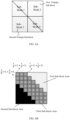
- the current block can be partitioned into sub-block 1, sub-block 2, sub-block 3, and sub-block 4.
- the current block can be partitioned into more sub-blocks, such as the width of each sub-block is greater than or equal to 2 and the height of each sub-block is greater than or equal to 2.
- description will be given with reference to the sub-block partition shown in FIG. 6A as an example.
- the first target motion information is used to perform motion compensation on sub-block 2 to obtain the prediction value.
- the second target motion information is used to perform motion compensation on sub-block 3 to obtain the prediction value.
- a first prediction value P1 of sub-block 1 is determined based on the first target motion information, and a second prediction value P2 of sub-block 1 is determined based on the second target motion information.
- weighted compensation is performed on sub-block 1 based on P1, a, P2, and b.
- the prediction value of sub-block 1 after weighted compensation is equal to, for example, P1*a+P2*b.
- the motion compensation for sub-block 4 is similar to the motion compensation for sub-block 1, and will not be repeated here.
- the current block is partitioned into a first sub-block area, a second sub-block area, and a third sub-block area, where the first sub-block area is located in the first triangular sub-block, the second sub-block area is located in the second triangle sub-block, and the distance between the center of each sub-block in the third sub-block area and the diagonal separating the first triangle sub-block from the second triangle sub-block is less than a preset threshold.
- Motion compensation is performed on each sub-block in the first sub-block area based on the first target motion information of the first triangular sub-block, motion compensation is performed on each sub-block in the second sub-block area based on the second target motion information of the second triangular sub-block; and weighted compensation is performed on each sub-block in the third sub-block area based on the first target motion information and the second target motion information.
- the weighted compensation can include the stpes of: for each sub-block in the third sub-block area, determining a first prediction value of the sub-block based on the first target motion information, and determining a second prediction value of the sub-block based on the second target motion information; based on the first prediction value, a first weight coefficient corresponding to the first prediction value, the second prediction value, and a second weight coefficient corresponding to the second prediction value, performing weighted compensation on the sub-block, wherein if the sub-block is located or mostly located in the first triangular sub-block, the first weight coefficient is greater than the second weight coefficient; if the sub-block is located or mostly located in the second triangular sub-block, the first weight coefficient is less than the second weight coefficient; if the sub-block is located across the diagonal separating the first triangular sub-block from the second triangular sub-block, the first weight coefficient is equal to the second weight coefficient.
- Each sub-block in the third sub-block area can be a 1*1 sub-block, that is, a single pixel block, or a N*M sub-block, where N can be greater than or equal to 1, and M can also be greater than or equal to 1.
- the current block can be partitioned into a first sub-block area, a second sub-block area, and a third sub-block area.
- the first sub-block area is located in the first triangular sub-block, and thus the first target motion information of the first triangular sub-block can be used to perform motion compensation on each sub-block in the first sub-block area to obtain a prediction value.
- the second sub-block area is located in the second triangle sub-block, and thus the second target motion information of the second triangle sub-block can be used to perform motion compensation on each sub-block in the second sub-block area to obtain a prediction value.
- the third sub-block area can include sub-blocks labelled 1, sub-blocks labelled 2, sub-blocks labelled 4, sub-blocks labelled 6, and sub-blocks labelled 7.
- a first prediction value P1 of sub-block 7 can be determined based on the first target motion information
- a second prediction value P2 of sub-block 7 can be determined based on the second target motion information.
- the prediction value of the sub-block 7 after weighted compensation can be equal to: P1*a+P2*b.
- the first weight coefficient "a” is greater than the second weight coefficient "b”.
- the prediction value of sub-block 7 after weighted compensation is equal to P1 *7/8+P2* 1/8.
- the weighted compensation process is similar to that of sub-block 7. Since the sub-block 6 is located in the first triangular sub-block, the first weight coefficient "a" is greater than the second weight coefficient "b". In addition, since the sub-block 6 is closer to the second sub-block area than the sub-block 7, the first weight coefficient "a" of the sub-block 6 can be less than the first weight coefficient "a" of the sub-block 7. For example, the first weight coefficient "a" of the sub-block 6 is 6/8, the second weight coefficient "b” is 2/8, and the prediction value of the sub-block 6 after weighted compensation is equal to P1*6/8+P2*2/8.
- the weighted compensation process is similar to that of sub-block 7. Since sub-block 4 is located across the diagonal separating the first triangle sub-block from the second triangle sub-block, the first weight coefficient "a" is equal to the second weight coefficient "b". For example, "a" is 4/8, "b" is 4/8, and the prediction value of sub-block 4 after weighted compensation is equal to P1*4/8+P2*4/8.
- sub-block 2 For each sub-block labelled 2, which will be referred to as sub-block 2 in the following, the weighted compensation process is similar to that of sub-block 7. Since sub-block 2 is located in the second triangular sub-block, the first weight coefficient "a" is less than the second weight coefficient "b". For example, "a" is 2/8, “b” is 6/8, and the prediction value of sub-block 2 after weighted compensation is equal to P1*2/8+P2*6/8.
- the weighting compensation process is similar to that for sub-block 7. Since sub-block 1 is located in the second triangular sub-block, the first weight coefficient "a" is less than the second weight coefficient "b". In addition, since sub-block 1 is closer to the second sub-block area than sub-block 2, the first weight coefficient "a" of sub-block 1 can be less than the first weight coefficient "a" of sub-block 2. For example, the first weight coefficient "a" of sub-block 1 is 1/8, and the second weight coefficient "b” is 7/8, and the prediction value of sub-block 1 after weighted compensation is equal to P1*1/8+P2*7/8.
- the sum of the first weight coefficient "a” and the second weight coefficient "b" of each sub-block is equal to 1. The closer the sub-block is to the first sub-block area, the larger the first weight coefficient "a” is, and the smaller the second weight coefficient "b” is. The closer the sub-block is to the second sub-block area, the smaller the first weight coefficient "a” is, and the larger the second weight coefficient "b” is.
- a first set of weight coefficients can be configured for the luma components.
- the first weight coefficient "a" of the luma component of each sub-block is respectively 7/8, 6/8, 4/8, 2/8, 1/8 in sequence.
- the first weight coefficient "a" of the luma component of sub-block 7 is 7/8
- the first weight coefficient "a” of the luma component of sub-block 6 is 6/8
- the first weight coefficient "a” of the luma component of sub-block 4 is 4/8
- the first weight coefficient "a” of the luma component of sub-block 2 is 2/8
- the first weight coefficient "a” of the luma component of sub-block 1 is 1/8.
- a second set of weight coefficients can be configured for the luma components.
- the first weight coefficient "a" of the luma component of each sub-block is respectively 7/8, 6/8, 5/8, 4/8, 3/ 8, 2/8, 1/8 in sequence.
- the first weight coefficient "a" of the luma component of sub-block 7 is 7/8
- the first weight coefficient "a” of the luma component of sub-block 6 is 6/8
- the first weight coefficient "a” of the luma component of sub-block 5 (sub-block 5 can be located between sub-block 4 and sub-block 6, FIG. 6B does not show sub-block 5) is 5/8
- the first weight coefficient "a” of the luma component of sub-block 4 is 4/8
- the first weight coefficient "a” of the luma component of sub-block 3 (sub-block 3 can be located between sub-block 2 and sub-block 4, and sub-block 3 is not shown in FIG.
- the first prediction value P1 and the second prediction value P2 are both the prediction values of luma component, and the prediction value P1*a+P2*b after weighted compensation is also the prediction value of luma component.
- a first set of weight coefficients can be configured for the chroma components.
- the first weight coefficient "a" of the chroma component of each sub-block is respectively 7/8, 4/8, 1/8 in sequence.
- the first weight coefficient "a" of the chroma component of sub-block 7 is 7/8
- the first weight coefficient "a" of the chroma component of sub-block 4 is 4/8
- the first weight coefficient "a" of the chroma component of sub-block 1 is 1/8.
- a second set of weight coefficients can be configured for the chroma components.
- the first weight coefficient "a" of the chroma component of each sub-block is respectively 6/8, 4/8, and 2/8 in sequence.
- the first weight coefficient "a" of the chroma component of sub-block 7 is 6/8
- the first weight coefficient "a" of the chroma component of sub-block 4 is 4/8
- the first weight coefficient "a" of the chroma component of sub-block 1 is 2/8.
- the first prediction value P1 and the second prediction value P2 are both the prediction values of the chroma component, and the prediction value P1*a+P2*b after weighted compensation is also the prediction value of the chroma component.
- Example 1 For motion compensation, the current block can be partitioned into a first sub-block area, a second sub-block area, and a third sub-block area. Motion compensation is performed on each sub-block in the first sub-block area based on first target motion information of the first triangular sub-block. Motion compensation is performed on each sub-block in the second sub-block area based on second target motion information of the second triangular sub-block. Weighted compensation is performed on each sub-block in the third sub-block area based on the first target motion information and the second target motion information.
- the current block can be partitioned into multiple M*M (e.g., M is 4) sub-blocks.
- M*M e.g., M is 4
- unidirectional motion information is used to perform motion compensation on the sub-block.
- the sub-block is referred to as the first sub-block area, and the first target motion information is used for motion compensation;
- the sub-block is referred to as the second sub-block area and the second target motion information is used for motion compensation.
- the sub-block is referred to as the third sub-block area, for which the two kinds of unidirectional motion information (that is, the first target motion information and the second target motion information) can be used to perform weighted compensation.
- the two kinds of unidirectional motion information that is, the first target motion information and the second target motion information
- the current block can be partitioned into a first sub-block area, a second sub-block area, and a third sub-block area. Motion compensation is performed on each sub-block in the first sub-block area based on the first target motion information of the first triangular sub-block. Motion compensation is performed on each sub-block in the second sub-block area based on the second target motion information of the second triangular sub-block.
- weighted compensation is performed on each sub-block in the third sub-block area, where only one set of weight coefficients is used: the weight coefficients used for the luma components: ⁇ 7/8, 6/ 8, 4/8, 2/8, 1/8 ⁇ , the weight coefficient used for chroma components: ⁇ 7/8, 4/8, 1/8 ⁇ .
- Example 3 For motion compensation, the current block can be partitioned into a first sub-block area, a second sub-block area, and a third sub-block area. Motion compensation is performed on each sub-block in the first sub-block area based on the first target motion information of the first triangular sub-block. Motion compensation is performed on each sub-block in the second sub-block area based on the second target motion information of the second triangular sub-block. Based on the first target motion information and the second target motion information, weighted compensation is performed on each sub-block in the third sub-block area, where only one set of weight coefficients can be configured for the weighted compensation.
- the weight coefficients for the luma component are configured as follows: ⁇ 7/8, 6/ 8, 5/8, 4/8, 3/8, 2/8, 1/8 ⁇
- the weight coefficient for the chroma component are configured as follows: ⁇ 6/8, 4/8, 2/8 ⁇ .
- the current block is partitioned into a first sub-block area, a second sub-block area and a third sub-block area, where the first sub-block area is located in the first triangular sub-block, and the second sub-block area is located in the second triangle sub-block, the distance between the center of each sub-block in the third sub-block area and the diagonal line separating the first triangle sub-block from the second triangle sub-block is less than a preset threshold.
- Motion compensation is performed on each sub-block in the first sub-block area based on the first target motion information.
- Motion compensation is performed on each sub-block in the second sub-block area based on the second target motion information.
- Motion compensation is performed on each sub-block in the third sub-block area based on the first target motion information or the second target motion information.
- a first condition for example, the width of the current block is greater than or equal to the height of the current block
- motion compensation is performed on each sub-block in the third sub-block area based on the first target motion information
- a second condition for example, the width of the current block is less than the height of the current block
- motion compensation is performed on each sub-block in the third sub-block area based on the second target motion information.
- Each sub-block in the third sub-block area can be a 1*1 sub-block, that is, a single pixel block, or it can be an N*M sub-block, where N can be greater than or equal to 1, and M can also be greater than or equal to 1.
- the first target motion information or the second target motion information is used for motion compensation on each sub-block in the third sub-block area. That is, there are no sub-blocks to be subjected to motion compensation using bidirectional prediction, so weighted compensation is not required.
- first target motion information or the second target motion information to perform motion compensation on each sub-block in the third sub-block area it can be determined in any of the following ways: (1) using the first target motion information by default to perform motion compensation on each sub-block in the third sub-block area; (2) using the second target motion information by default to perform motion compensation in the third sub-block area; (3) determining based on the size of the current block.
- the first target motion information is used to perform motion compensation on each sub-block in the third sub-block area; if the width of the current block is less than the height of the current block, the second target motion information is used to perform motion compensation on each sub-block in the third sub-block area.
- the video encoder first determines whether the current block satisfies specific conditions for enabling the geometric partitioning mode with triangular partition. If not, it is decided not to use the geometric partitioning mode with triangular partition, but use other mode. If so, the video encoder can enable the geometric partitioning mode with triangular partition by default, or the video encoder can determine whether to enable the geometric partitioning mode with triangular partition. If the video encoder enables the geometric partitioning mode with triangular partition by default or decides to enable the geometric partitioning mode with triangular partition, the video encoder performs the operation of partitioning the current block into triangular sub-blocks and other subsequent operations in the above related examples; otherwise, these operations are not performed.
- the video encoder can determine the rate distortion cost corresponding to the geometric partitioning mode with triangular partition. If the rate distortion cost corresponding to the geometric partitioning mode with triangular partition is less than the rate distortion cost corresponding to each of the other modes, it can be determined to enable the geometric partitioning mode with triangular partition; otherwise, it can be determined not to enable the geometric partitioning mode with triangular partition.
- the encoded bit stream sent by the video encoder to the decoder can carry seventh indication information, where the seventh indication information specifies that the geometric partitioning mode with triangular partition is enabled.
- the video decoder first determines whether the current block satisfies the specific conditions for enabling the geometric partitioning mode with triangular partition. If not, it is decided not to use the geometric partitioning mode with triangular partition, but use other mode. If so, the video decoder can enable the geometric partitioning mode with triangular partition by default, or the video decoder is configured to derive the encoded bit stream from the encodier. If the encoded bit stream carries the seventh indication information, it can be determined to enable the geometric partitioning mode with triangular partition; otherwise, it can be determined not to enable the geometric partitioning mode with triangular partition.
- the video decoder If the video decoder enables the geometric partitioning mode with triangular partition by default or decides to enable the geometric partitioning mode with triangular partition, the video decoder performs the operation of partitioning the current block into triangular sub-blocks and other subsequent operations in the above related examples; otherwise, these operations are not performed.
- the video encoder/video decoder can also store the first target motion information and the second target motion information as follows. If the candidate block corresponding to the first target motion information is a unidirectional prediction block, the first target motion information is stored for the first triangle sub-block; if the candidate block corresponding to the first target motion information is a bidirectional prediction block, the first target motion information and third target motion information is stored for the first triangle sub-block, and the third target motion information is another motion information of the bidirectional prediction block.
- the second target motion information is stored for the second triangle sub-block; if the candidate block corresponding to the second target motion information is a bidirectional prediction block, the second target motion information and fourth target motion information is stored for the second triangle sub-block, and the fourth target motion information is another motion information of the bidirectional prediction block.
- the first target motion information of the first sub-block area is MV1
- MV1 comes from a unidirectional prediction block R1
- the unidirectional prediction block R1 is a candidate block of the current block
- the motion information list includes the motion information MV1 of the unidirectional prediction block R1
- MV1 is selected as the first target motion information of the first sub-block area
- MV1 is stored for the first sub-block area, as shown in FIG. 7A .
- the second target motion information of the second sub-block area is MV2
- MV2 comes from a unidirectional prediction block R2 that is, the unidirectional prediction block R2 is a candidate block of the current block
- the motion information list includes the motion information MV2 of the unidirectional prediction block R2
- MV2 is selected as the second target motion information of the second sub-block area
- MV2 is stored for the second sub-block area, as shown in FIG. 7A .
- the first target motion information of the first sub-block area is MV1
- MV1 comes from a bidirectional prediction block R3, that is, the bidirectional prediction block R3 is a candidate block of the current block
- the motion information list includes the motion information MV1 and MV2 of the bidirectional prediction block R3, and MV1 is selected as the first target motion information of the first sub-block area
- MV1 and MV2, rather than only M1 are stored for the first sub-block area, as shown in FIG. 7B .
- the second target motion information of the second sub-block area is MV3, and MV3 comes from a bidirectional prediction block R4, that is, the bidirectional prediction block R4 is a candidate block of the current block, and the motion information list includes the motion information MV3 and MV4 of the bidirectional prediction block R4, and MV3 is selected as the second target motion information of the second sub-block area, then MV3 and MV4, rather than only MV3, are stored for the second sub-block area, as shown in FIG. 7B .
- the motion information can be stored in a unit of 4*4.
- FIG. 8 is a schematic block diagram of the video decoder.
- the video decoder can include a processor 81 and a machine-readable storage medium 82.
- the machine-readable storage medium 82 stores machine-executable instructions that can be invoked by the processor 81.
- the processor 81 invokes the machine-executable instructions, the processor 81 is configured to perform the video decoding method according to the above related examples of the present disclosure.
- FIG. 9 is a schematic block diagram of the video encoder.
- the video encoder can include a processor 91 and a machine-readable storage medium 92.
- the machine-readable storage medium 92 stores machine-executable instructions that can be invoked by the processor 91.
- the processor 91 invokes the machine-executable instructions
- the processor 91 is configured to perform the video encoding method according to the above related examples of the present disclosure.
- An example of the present disclosure also provides a machine-readable storage medium, which stores computer instructions, and when the computer instructions are executed by a processor, the processor can implement the video encoding/decoding method of the above examples.
- the machine-readable storage medium can be an electronic, magnetic, optical, or other physical storage device, and can contain or store information, such as executable instructions, data, and so on.
- the machine-readable storage medium can include volatile memory (for example, RAM (Random Access Memory) ), non-volatile memory (for example, flash memory, storage drive (such as hard disk drive), solid state drive, optical storage (for example, CD-ROM (Compact Disc Read-Only Memory), DVD (Digital Versatile Disc), etc.) or a combination thereof.
- a typical implementation device is an electronic device, including but not limited to: a personal computer, a laptop computer, a tablet computer, a cellular phone, a camera, a smart phone, a personal digital assistant, a media player, a navigation device, an email receiving and sending device, a game console, a wearable device, or any combination thereof.
Landscapes
- Engineering & Computer Science (AREA)
- Multimedia (AREA)
- Signal Processing (AREA)
- Compression Or Coding Systems Of Tv Signals (AREA)
- Television Systems (AREA)
Claims (13)
- Decodierverfahren, das Folgendes umfasst:wenn ein aktueller Block spezifische Bedingungen zum Aktivieren eines geometrischen Partitionierungsmodus mit dreieckiger Partition erfüllt und bestimmt wird, den geometrischen Partitionierungsmodus mit dreieckiger Partition zu aktivieren, Durchführen der folgenden Schritte:Erhalten erster Zielbewegungsinformationen und zweiter Zielbewegungsinformationen des aktuellen Blocks, wobei sich die ersten Zielbewegungsinformationen von den zweiten Zielbewegungsinformationen unterscheiden; wobei die ersten Zielbewegungsinformationen und die zweiten Zielbewegungsinformationen jeweils Bewegungsinformationen eines ersten dreieckigen Unterblocks und eines zweiten dreieckigen Unterblocks sind, die durch Partitionieren des aktuellen Blocks erhalten werden; undDurchführen eines Decodierprozesses an dem aktuellen Block basierend auf den ersten Zielbewegungsinformationen und den zweitenZielbewegungsinformationen;wobei, ob der aktuelle Block die spezifischen Bedingungen zum Aktivieren des geometrischen Partitionierungsmodus mit dreieckiger Partition erfüllt, bestimmt wird durch: Bestimmen, ob ein Typ einer aktuellen Scheibe, in der sich der aktuelle Block befindet, ein Bewegungsinformationsmodus des aktuellen Blocks und Größeninformationen des aktuellen Blocks die spezifischen Bedingungen erfüllen;wobei das Durchführen eines Decodierprozesses an dem aktuellen Block basierend auf den ersten Zielbewegungsinformationen und den zweiten Zielbewegungsinformationen Folgendes umfasst: Durchführen einer Bewegungskompensation an dem aktuellen Block basierend auf den ersten Zielbewegungsinformationen und den zweiten Zielbewegungsinformationen, um einen Vorhersagewert des aktuellen Blocks zu erhalten;wobei der Vorhersagewert des aktuellen Blocks mindestens einen Vorhersagewert eines ersten Unterblockbereichs, einen Vorhersagewert eines zweiten Unterblockbereichs und einen Vorhersagewert eines dritten Unterblockbereichs umfasst;wobei der Vorhersagewert des ersten Unterblockbereichs durch Durchführen einer Bewegungskompensation an dem ersten Unterblockbereich basierend auf den ersten Zielbewegungsinformationen erhalten wird, der Vorhersagewert des zweiten Unterblockbereichs durch Durchführen einer Bewegungskompensation an dem zweiten Unterblockbereich basierend auf den zweiten Zielbewegungsinformationen erhalten wird und der Vorhersagewert des dritten Unterblockbereichs durch Durchführen einer gewichteten Kompensation an dem dritten Unterblockbereich basierend auf den ersten Zielbewegungsinformationen und den zweiten Zielbewegungsinformationen erhalten wird; undwobei der Vorhersagewert des dritten Unterblockbereichs Vorhersagewerte aller Unterblöcke in dem dritten Unterblockbereich umfasst und jeder Unterblock in dem dritten Unterblockbereich ein 1*1-Pixelblock ist,wobei das Erhalten des Vorhersagewerts des dritten Unterblockbereichs durch Durchführen einer gewichteten Kompensation an dem dritten Unterblockbereich basierend auf den ersten Zielbewegungsinformationen und den zweiten Zielbewegungsinformationen Folgendes umfasst:für jeden Unterblock in dem dritten Unterblockbereich,Bestimmen eines ersten Vorhersagewerts des Unterblocks basierend auf den ersten Zielbewegungsinformationen;Bestimmen eines zweiten Vorhersagewerts des Unterblocks basierend auf den zweiten Zielbewegungsinformationen; undErhalten eines gewichteten Vorhersagewerts des Unterblocks basierend auf dem ersten Vorhersagewert, einem ersten Gewichtungskoeffizienten, der dem ersten Vorhersagewert entspricht, dem zweiten Vorhersagewert und einem zweiten Gewichtungskoeffizienten, der dem zweiten Vorhersagewert entspricht,wobei der gewichtete Vorhersagewert des Unterblocks P1*a+P2*b ist, wenn der erste Vorhersagewert P1 ist, der zweite Vorhersagewert P2 ist, der erste Gewichtungskoeffizient a ist und der zweite Gewichtungskoeffizient b ist,wobei ein Satz von Werten des ersten Gewichtungskoeffizienten für eine Lumakomponente jedes Unterblocks in dem dritten Unterblockbereich {7/8, 6/8, 5/8, 4/8, 3/8, 2/8, 1/8} ist.
- Decodierverfahren nach Anspruch 1, wobei
wenn der aktuelle Block die spezifischen Bedingungen zum Aktivieren eines geometrischen Partitionierungsmodus mit dreieckiger Partition erfüllt und bestimmt wird, den geometrischen Partitionierungsmodus mit dreieckiger Partition zu aktivieren, die ausgeführten Schritte ferner Folgendes umfassen:
Partitionieren des aktuellen Blocks in den ersten dreieckigen Unterblock und den zweiten dreieckigen Unterblock basierend auf einem Partitionierungsverfahren, das durch Anzeigeinformationen angezeigt wird. - Decodierverfahren nach Anspruch 2, wobei das Partitionieren des aktuellen Blocks in einen ersten dreieckigen Unterblock und einen zweiten dreieckigen Unterblock basierend auf einem Partitionierungsverfahren, das durch Anzeigeinformationen angezeigt wird, Folgendes umfasst:Partitionieren des aktuellen Blocks in den ersten dreieckigen Unterblock und den zweiten dreieckigen Unterblock mit einem ersten Diagonalverfahren, wenn das Partitionierungsverfahren, das durch die Anzeigeinformationen angezeigt wird, spezifiziert, dass der aktuelle Block mit dem ersten Diagonalverfahren partitioniert werden darf; oderPartitionieren des aktuellen Blocks in den ersten dreieckigen Unterblock und den zweiten dreieckigen Unterblock mit einem zweiten Diagonalverfahren, wenn das Partitionierungsverfahren, das durch die Anzeigeinformationen angezeigt wird, spezifiziert, dass der aktuelle Block mit dem zweiten Diagonalverfahren partitioniert werden darf.
- Decodierverfahren nach Anspruch 1, wobei jeder Unterblock in dem dritten Unterblockbereich eine Lumakomponente umfasst;für die Lumakomponenteder erste Vorhersagewert ein Vorhersagewert der Lumakomponente ist, der basierend auf den ersten Zielbewegungsinformationen bestimmt wird,der zweite Vorhersagewert ein Vorhersagewert der Lumakomponente ist, der basierend auf den zweiten Zielbewegungsinformationen bestimmt wird, undder gewichtete Vorhersagewert des Unterblocks ein gewichteter Vorhersagewert der Lumakomponente ist.
- Decodierverfahren nach Anspruch 1, wobei jeder Unterblock in dem dritten Unterblockbereich eine Chromakomponente umfasst;für die Chromakomponenteder erste Vorhersagewert ein Vorhersagewert der Chromakomponente ist, der basierend auf den ersten Zielbewegungsinformationen bestimmt wird,der zweite Vorhersagewert ein Vorhersagewert der Chromakomponente ist, der basierend auf den zweiten Zielbewegungsinformationen bestimmt wird, undder gewichtete Vorhersagewert des Unterblocks ein gewichteter Vorhersagewert der Chromakomponente ist, der basierend auf dem ersten Vorhersagewert, dem zweiten Vorhersagewert, dem ersten Gewichtungskoeffizienten und dem zweiten Gewichtungskoeffizienten bestimmt wird.
- Decodierverfahren nach Anspruch 2, wobei für jeden Unterblock in dem dritten Unterblockbereich,wenn sich der Unterblock in dem ersten dreieckigen Unterblock befindet, der erste Gewichtungskoeffizient größer als der zweite Gewichtungskoeffizient ist;wenn sich der Unterblock in dem zweiten dreieckigen Unterblock befindet, der erste Gewichtungskoeffizient kleiner als der zweite Gewichtungskoeffizient ist;wenn sich der Unterblock über eine Partitionslinie hinweg befindet, der erste Gewichtungskoeffizient gleich dem zweiten Gewichtungskoeffizient ist.
- Decodierverfahren nach Anspruch 1, das ferner Folgendes umfasst:für den aktuellen Block, Speichern von Bewegungsinformationen in einer Einheit von 4*4 Block;wobei für den ersten Unterblockbereich, wenn MV1 als die ersten Zielbewegungsinformationen ausgewählt wird, Speichern des MV1 für den ersten Unterblockbereich, wobei der MV1 von einem unidirektionalen Vorhersageblock stammt und eine Kandidatenliste des aktuellen Blocks den MV1 umfasst;für den zweiten Unterblockbereich, wenn MV2 als die zweiten Zielbewegungsinformationen ausgewählt wird, Speichern des MV2 für den zweiten Unterblockbereich, wobei der MV2 von einem unidirektionalen Vorhersageblock stammt und die Kandidatenliste den MV2 umfasst.
- Decodierverfahren nach Anspruch 1, wobei das Erhalten von ersten Zielbewegungsinformationen und zweiten Zielbewegungsinformationen des aktuellen Blocks Folgendes umfasst:Konstruieren einer Kandidatenliste, die mehrere Kandidatenbewegungsinformationen umfasst;Auswählen einer Kandidatenbewegungsinformation aus der Kandidatenliste als die ersten Zielbewegungsinformationen; undAuswählen einer anderen Kandidatenbewegungsinformation aus der Kandidatenliste als die zweiten Zielbewegungsinformationen;
oderKonstruieren einer Kandidatenliste, die mehrere Kandidatenbewegungsinformationen umfasst;Auswählen, gemäß einem Indexwert, der durch dritte Anzeigeinformationen angezeigt wird, von Kandidatenbewegungsinformationen, die dem Indexwert entsprechen, aus der Kandidatenliste und Verwenden der ausgewählten Kandidatenbewegungsinformationen als die ersten Zielbewegungsinformationen; undAuswählen, gemäß einem Indexwert, der durch vierte Anzeigeinformationen angezeigt wird, von Kandidatenbewegungsinformationen, die dem Indexwert entsprechen, aus der Kandidatenliste und Verwenden der ausgewählten Kandidatenbewegungsinformationen als die zweiten Zielbewegungsinformationen. - Codierverfahren, das Folgendes umfasst:wenn ein aktueller Block spezifische Bedingungen zum Aktivieren eines geometrischen Partitionierungsmodus mit dreieckiger Partition erfüllt und bestimmt wird, den geometrischen Partitionierungsmodus mit dreieckiger Partition zu aktivieren, Durchführen der folgenden Schritte:Erhalten erster Zielbewegungsinformationen und zweiter Zielbewegungsinformationen des aktuellen Blocks, wobei sich die ersten Zielbewegungsinformationen von den zweiten Zielbewegungsinformationen unterscheiden; wobei die ersten Zielbewegungsinformationen und die zweiten Zielbewegungsinformationen jeweils Bewegungsinformationen eines ersten dreieckigen Unterblocks und eines zweiten dreieckigen Unterblocks sind, die durch Partitionieren des aktuellen Blocks erhalten werden; undDurchführen eines Codierprozesses an dem aktuellen Block basierend auf den ersten Zielbewegungsinformationen und den zweiten Zielbewegungsinformationen;wobei, ob der aktuelle Block die spezifischen Bedingungen zum Aktivieren des geometrischen Partitionierungsmodus mit dreieckiger Partition erfüllt, bestimmt wird durch: Bestimmen, ob ein Typ einer aktuellen Scheibe, in der sich der aktuelle Block befindet, ein Bewegungsinformationsmodus des aktuellen Blocks und Größeninformationen des aktuellen Blocks die spezifischen Bedingungen erfüllen;wobei das Durchführen eines Codierprozesses an dem aktuellen Block basierend auf den ersten Zielbewegungsinformationen und den zweiten Zielbewegungsinformationen Folgendes umfasst: Durchführen einer Bewegungskompensation an dem aktuellen Block basierend auf den ersten Zielbewegungsinformationen und den zweiten Zielbewegungsinformationen, um einen Vorhersagewert des aktuellen Blocks zu erhalten;wobei der Vorhersagewert des aktuellen Blocks mindestens einen Vorhersagewert eines ersten Unterblockbereichs, einen Vorhersagewert eines zweiten Unterblockbereichs und einen Vorhersagewert eines dritten Unterblockbereichs umfasst;wobei der Vorhersagewert des ersten Unterblockbereichs durch Durchführen einer Bewegungskompensation an dem ersten Unterblockbereich basierend auf den ersten Zielbewegungsinformationen erhalten wird, der Vorhersagewert des zweiten Unterblockbereichs durch Durchführen einer Bewegungskompensation an dem zweiten Unterblockbereich basierend auf den zweiten Zielbewegungsinformationen erhalten wird und der Vorhersagewert des dritten Unterblockbereichs durch Durchführen einer gewichteten Kompensation an dem dritten Unterblockbereich basierend auf den ersten Zielbewegungsinformationen und den zweiten Zielbewegungsinformationen erhalten wird; undwobei der Vorhersagewert des dritten Unterblockbereichs Vorhersagewerte aller Unterblöcke in dem dritten Unterblockbereich umfasst und jeder Unterblock in dem dritten Unterblockbereich ein 1*1-Pixelblock ist,wobei das Erhalten des Vorhersagewerts des dritten Unterblockbereichs durch Durchführen einer gewichteten Kompensation an dem dritten Unterblockbereich basierend auf den ersten Zielbewegungsinformationen und den zweiten Zielbewegungsinformationen Folgendes umfasst:für jeden Unterblock in dem dritten Unterblockbereich,Bestimmen eines ersten Vorhersagewerts des Unterblocks basierend auf den ersten Zielbewegungsinformationen;Bestimmen eines zweiten Vorhersagewerts des Unterblocks basierend auf den zweiten Zielbewegungsinformationen; undErhalten eines gewichteten Vorhersagewerts des Unterblocks basierend auf dem ersten Vorhersagewert, einem ersten Gewichtungskoeffizienten, der dem ersten Vorhersagewert entspricht, dem zweiten Vorhersagewert und einem zweiten Gewichtungskoeffizienten, der dem zweiten Vorhersagewert entspricht,wobei der gewichtete Vorhersagewert des Unterblocks P1*a+P2*b ist, wenn der erste Vorhersagewert P1 ist, der zweite Vorhersagewert P2 ist, der erste Gewichtungskoeffizient a ist und der zweite Gewichtungskoeffizient b ist,wobei ein Satz von Werten des ersten Gewichtungskoeffizienten für eine Lumakomponente jedes Unterblocks in dem dritten Unterblockbereich {7/8, 6/8, 5/8, 4/8, 3/8, 2/8, 1/8} ist.
- Decodiervorrichtung, die einen Prozessor und ein maschinenlesbares Speichermedium umfasst, wobei das maschinenlesbare Speichermedium maschinenausführbare Befehle speichert, die durch den Prozessor aufgerufen werden; wenn der Prozessor die Befehle aufruft, der Prozessor zu Folgendem eingerichtet ist:wenn ein aktueller Block spezifische Bedingungen zum Aktivieren eines geometrischen Partitionierungsmodus mit dreieckiger Partition erfüllt und bestimmt wird, den geometrischen Partitionierungsmodus mit dreieckiger Partition zu aktivieren, Durchführen der folgenden Schritte:Erhalten erster Zielbewegungsinformationen und zweiter Zielbewegungsinformationen des aktuellen Blocks, wobei sich die ersten Zielbewegungsinformationen von den zweiten Zielbewegungsinformationen unterscheiden; wobei die ersten Zielbewegungsinformationen und die zweiten Zielbewegungsinformationen jeweils Bewegungsinformationen eines ersten dreieckigen Unterblocks und eines zweiten dreieckigen Unterblocks sind, die durch Partitionieren des aktuellen Blocks erhalten werden; undDurchführen eines Decodierprozesses an dem aktuellen Block basierend auf den ersten Zielbewegungsinformationen und den zweiten Zielbewegungsinformationen;wobei, ob der aktuelle Block die spezifischen Bedingungen zum Aktivieren des geometrischen Partitionierungsmodus mit dreieckiger Partition erfüllt, bestimmt wird durch: Bestimmen, ob ein Typ einer aktuellen Scheibe, in der sich der aktuelle Block befindet, ein Bewegungsinformationsmodus des aktuellen Blocks und Größeninformationen des aktuellen Blocks die spezifischen Bedingungen erfüllen;wobei das Durchführen eines Decodierprozesses an dem aktuellen Block basierend auf den ersten Zielbewegungsinformationen und den zweiten Zielbewegungsinformationen Folgendes umfasst: Durchführen einer Bewegungskompensation an dem aktuellen Block basierend auf den ersten Zielbewegungsinformationen und den zweiten Zielbewegungsinformationen, um einen Vorhersagewert des aktuellen Blocks zu erhalten;wobei der Vorhersagewert des aktuellen Blocks mindestens einen Vorhersagewert eines ersten Unterblockbereichs, einen Vorhersagewert eines zweiten Unterblockbereichs und einen Vorhersagewert eines dritten Unterblockbereichs umfasst;wobei der Vorhersagewert des ersten Unterblockbereichs durch Durchführen einer Bewegungskompensation an dem ersten Unterblockbereich basierend auf den ersten Zielbewegungsinformationen erhalten wird, der Vorhersagewert des zweiten Unterblockbereichs durch Durchführen einer Bewegungskompensation an dem zweiten Unterblockbereich basierend auf den zweiten Zielbewegungsinformationen erhalten wird und der Vorhersagewert des dritten Unterblockbereichs durch Durchführen einer gewichteten Kompensation an dem dritten Unterblockbereich basierend auf den ersten Zielbewegungsinformationen und den zweiten Zielbewegungsinformationen erhalten wird; undwobei der Vorhersagewert des dritten Unterblockbereichs Vorhersagewerte aller Unterblöcke in dem dritten Unterblockbereich umfasst und jeder Unterblock in dem dritten Unterblockbereich ein 1*1-Pixelblock ist,wobei das Erhalten des Vorhersagewerts des dritten Unterblockbereichs durch Durchführen einer gewichteten Kompensation an dem dritten Unterblockbereich basierend auf den ersten Zielbewegungsinformationen und den zweiten Zielbewegungsinformationen Folgendes umfasst:für jeden Unterblock in dem dritten Unterblockbereich,Bestimmen eines ersten Vorhersagewerts des Unterblocks basierend auf den ersten Zielbewegungsinformationen;Bestimmen eines zweiten Vorhersagewerts des Unterblocks basierend auf den zweiten Zielbewegungsinformationen; undErhalten eines gewichteten Vorhersagewerts des Unterblocks basierend auf dem ersten Vorhersagewert, einem ersten Gewichtungskoeffizienten, der dem ersten Vorhersagewert entspricht, dem zweiten Vorhersagewert und einem zweiten Gewichtungskoeffizienten, der dem zweiten Vorhersagewert entspricht,wobei der gewichtete Vorhersagewert des Unterblocks P1*a+P2*b ist, wenn der erste Vorhersagewert P1 ist, der zweite Vorhersagewert P2 ist, der erste Gewichtungskoeffizient a ist und der zweite Gewichtungskoeffizient b ist,wobei ein Satz von Werten des ersten Gewichtungskoeffizienten für eine Lumakomponente jedes Unterblocks in dem dritten Unterblockbereich {7/8, 6/8, 5/8, 4/8, 3/8, 2/8, 1/8} ist.
- Codiervorrichtung, die Folgendes umfasst:einen Prozessor und ein maschinenlesbares Speichermedium, wobei das maschinenlesbare Speichermedium maschinenausführbare Befehle speichert, die durch den Prozessor aufgerufen werden; wenn der Prozessor die Befehle aufruft, der Prozessor zu Folgendem eingerichtet ist:
wenn ein aktueller Block spezifische Bedingungen zum Aktivieren eines geometrischen Partitionierungsmodus mit dreieckiger Partition erfüllt und bestimmt wird, den geometrischen Partitionierungsmodus mit dreieckiger Partition zu aktivieren, Durchführen der folgenden Schritte:Erhalten erster Zielbewegungsinformationen und zweiter Zielbewegungsinformationen des aktuellen Blocks, wobei sich die ersten Zielbewegungsinformationen von den zweiten Zielbewegungsinformationen unterscheiden; wobei die ersten Zielbewegungsinformationen und die zweiten Zielbewegungsinformationen jeweils Bewegungsinformationen eines ersten dreieckigen Unterblocks und eines zweiten dreieckigen Unterblocks sind, die durch Partitionieren des aktuellen Blocks erhalten werden; undDurchführen eines Codierprozesses an dem aktuellen Block basierend auf den ersten Zielbewegungsinformationen und den zweiten Zielbewegungsinformationen;wobei, ob der aktuelle Block die spezifischen Bedingungen zum Aktivieren des geometrischen Partitionierungsmodus mit dreieckiger Partition erfüllt, bestimmt wird durch: Bestimmen, ob ein Typ einer aktuellen Scheibe, in der sich der aktuelle Block befindet, ein Bewegungsinformationsmodus des aktuellen Blocks und Größeninformationen des aktuellen Blocks die spezifischen Bedingungen erfüllen;wobei das Durchführen eines Codierprozesses an dem aktuellen Block basierend auf den ersten Zielbewegungsinformationen und den zweiten Zielbewegungsinformationen Folgendes umfasst: Durchführen einer Bewegungskompensation an dem aktuellen Block basierend auf den ersten Zielbewegungsinformationen und den zweiten Zielbewegungsinformationen, um einen Vorhersagewert des aktuellen Blocks zu erhalten;wobei der Vorhersagewert des aktuellen Blocks mindestens einen Vorhersagewert eines ersten Unterblockbereichs, einen Vorhersagewert eines zweiten Unterblockbereichs und einen Vorhersagewert eines dritten Unterblockbereichs umfasst;wobei der Vorhersagewert des ersten Unterblockbereichs durch Durchführen einer Bewegungskompensation an dem ersten Unterblockbereich basierend auf den ersten Zielbewegungsinformationen erhalten wird, der Vorhersagewert des zweiten Unterblockbereichs durch Durchführen einer Bewegungskompensation an dem zweiten Unterblockbereich basierend auf den zweiten Zielbewegungsinformationen erhalten wird und der Vorhersagewert des dritten Unterblockbereichs durch Durchführen einer gewichteten Kompensation an dem dritten Unterblockbereich basierend auf den ersten Zielbewegungsinformationen und den zweiten Zielbewegungsinformationen erhalten wird; undwobei der Vorhersagewert des dritten Unterblockbereichs Vorhersagewerte aller Unterblöcke in dem dritten Unterblockbereich umfasst und jeder Unterblock in dem dritten Unterblockbereich ein 1*1-Pixelblock ist,wobei das Erhalten des Vorhersagewerts des dritten Unterblockbereichs durch Durchführen einer gewichteten Kompensation an dem dritten Unterblockbereich basierend auf den ersten Zielbewegungsinformationen und den zweiten Zielbewegungsinformationen Folgendes umfasst:für jeden Unterblock in dem dritten Unterblockbereich,Bestimmen eines ersten Vorhersagewerts des Unterblocks basierend auf den ersten Zielbewegungsinformationen;Bestimmen eines zweiten Vorhersagewerts des Unterblocks basierend auf den zweiten Zielbewegungsinformationen; undErhalten eines gewichteten Vorhersagewerts des Unterblocks basierend auf dem ersten Vorhersagewert, einem ersten Gewichtungskoeffizienten, der dem ersten Vorhersagewert entspricht, dem zweiten Vorhersagewert und einem zweiten Gewichtungskoeffizienten, der dem zweiten Vorhersagewert entspricht,wobei der gewichtete Vorhersagewert des Unterblocks P1*a+P2*b ist, wenn der erste Vorhersagewert P1 ist, der zweite Vorhersagewert P2 ist, der erste Gewichtungskoeffizient a ist und der zweite Gewichtungskoeffizient b ist,wobei ein Satz von Werten des ersten Gewichtungskoeffizienten für eine Lumakomponente jedes Unterblocks in dem dritten Unterblockbereich {7/8, 6/8, 5/8, 4/8, 3/8, 2/8, 1/8} ist. - Decodierer, der eingerichtet ist zum:wenn ein aktueller Block spezifische Bedingungen zum Aktivieren eines geometrischen Partitionierungsmodus mit dreieckiger Partition erfüllt und bestimmt wird, den geometrischen Partitionierungsmodus mit dreieckiger Partition zu aktivieren, Durchführen der folgenden Schritte:Erhalten erster Zielbewegungsinformationen und zweiter Zielbewegungsinformationen des aktuellen Blocks, wobei sich die ersten Zielbewegungsinformationen von den zweiten Zielbewegungsinformationen unterscheiden; wobei die ersten Zielbewegungsinformationen und die zweiten Zielbewegungsinformationen jeweils Bewegungsinformationen eines ersten dreieckigen Unterblocks und eines zweiten dreieckigen Unterblocks sind, die durch Partitionieren des aktuellen Blocks erhalten werden; undDurchführen eines Decodierprozesses an dem aktuellen Block basierend auf den ersten Zielbewegungsinformationen und den zweiten Zielbewegungsinformationen;wobei, ob der aktuelle Block die spezifischen Bedingungen zum Aktivieren des geometrischen Partitionierungsmodus mit dreieckiger Partition erfüllt, bestimmt wird durch: Bestimmen, ob ein Typ einer aktuellen Scheibe, in der sich der aktuelle Block befindet, ein Bewegungsinformationsmodus des aktuellen Blocks und Größeninformationen des aktuellen Blocks die spezifischen Bedingungen erfüllen;wobei das Durchführen eines Decodierprozesses an dem aktuellen Block basierend auf den ersten Zielbewegungsinformationen und den zweiten Zielbewegungsinformationen Folgendes umfasst: Durchführen einer Bewegungskompensation an dem aktuellen Block basierend auf den ersten Zielbewegungsinformationen und den zweiten Zielbewegungsinformationen, um einen Vorhersagewert des aktuellen Blocks zu erhalten;wobei der Vorhersagewert des aktuellen Blocks mindestens einen Vorhersagewert eines ersten Unterblockbereichs, einen Vorhersagewert eines zweiten Unterblockbereichs und einen Vorhersagewert eines dritten Unterblockbereichs umfasst;wobei der Vorhersagewert des ersten Unterblockbereichs durch Durchführen einer Bewegungskompensation an dem ersten Unterblockbereich basierend auf den ersten Zielbewegungsinformationen erhalten wird, der Vorhersagewert des zweiten Unterblockbereichs durch Durchführen einer Bewegungskompensation an dem zweiten Unterblockbereich basierend auf den zweiten Zielbewegungsinformationen erhalten wird und der Vorhersagewert des dritten Unterblockbereichs durch Durchführen einer gewichteten Kompensation an dem dritten Unterblockbereich basierend auf den ersten Zielbewegungsinformationen und den zweiten Zielbewegungsinformationen erhalten wird; undwobei der Vorhersagewert des dritten Unterblockbereichs Vorhersagewerte aller Unterblöcke in dem dritten Unterblockbereich umfasst und jeder Unterblock in dem dritten Unterblockbereich ein 1*1-Pixelblock ist,wobei das Erhalten des Vorhersagewerts des dritten Unterblockbereichs durch Durchführen einer gewichteten Kompensation an dem dritten Unterblockbereich basierend auf den ersten Zielbewegungsinformationen und den zweiten Zielbewegungsinformationen Folgendes umfasst:für jeden Unterblock in dem dritten Unterblockbereich,Bestimmen eines ersten Vorhersagewerts des Unterblocks basierend auf den ersten Zielbewegungsinformationen;Bestimmen eines zweiten Vorhersagewerts des Unterblocks basierend auf den zweiten Zielbewegungsinformationen; undErhalten eines gewichteten Vorhersagewerts des Unterblocks basierend auf dem ersten Vorhersagewert, einem ersten Gewichtungskoeffizienten, der dem ersten Vorhersagewert entspricht, dem zweiten Vorhersagewert und einem zweiten Gewichtungskoeffizienten, der dem zweiten Vorhersagewert entspricht,wobei der gewichtete Vorhersagewert des Unterblocks P1*a+P2*b ist, wenn der erste Vorhersagewert P1 ist, der zweite Vorhersagewert P2 ist, der erste Gewichtungskoeffizient a ist und der zweite Gewichtungskoeffizient b ist,wobei ein Satz von Werten des ersten Gewichtungskoeffizienten für eine Lumakomponente jedes Unterblocks in dem dritten Unterblockbereich {7/8, 6/8, 5/8, 4/8, 3/8, 2/8, 1/8} ist.
- Maschinenlesbares Speichermedium, auf dem maschinenausführbare Befehle gespeichert sind, wobei die Befehle durch einen Prozessor aufgerufen werden, um das Verfahren nach einem der Ansprüche 1-9 durchzuführen.
Applications Claiming Priority (2)
| Application Number | Priority Date | Filing Date | Title |
|---|---|---|---|
| CN201811628695.2A CN111385581B (zh) | 2018-12-28 | 2018-12-28 | 一种编解码方法及其设备 |
| PCT/CN2019/124453 WO2020135033A1 (zh) | 2018-12-28 | 2019-12-11 | 视频编解码 |
Publications (3)
| Publication Number | Publication Date |
|---|---|
| EP3886437A1 EP3886437A1 (de) | 2021-09-29 |
| EP3886437A4 EP3886437A4 (de) | 2022-02-16 |
| EP3886437B1 true EP3886437B1 (de) | 2025-01-29 |
Family
ID=66615056
Family Applications (1)
| Application Number | Title | Priority Date | Filing Date |
|---|---|---|---|
| EP19902594.1A Active EP3886437B1 (de) | 2018-12-28 | 2019-12-11 | Videokodierung und -dekodierung |
Country Status (16)
| Country | Link |
|---|---|
| US (1) | US11889072B2 (de) |
| EP (1) | EP3886437B1 (de) |
| JP (1) | JP7360464B2 (de) |
| KR (2) | KR20210093347A (de) |
| CN (38) | CN112565787B (de) |
| AU (1) | AU2019416266B2 (de) |
| BR (1) | BR112021012638A2 (de) |
| CA (2) | CA3124889C (de) |
| ES (1) | ES3013325T3 (de) |
| FI (1) | FI3886437T3 (de) |
| MX (2) | MX2021007710A (de) |
| PH (1) | PH12021551503A1 (de) |
| PL (1) | PL3886437T3 (de) |
| SG (1) | SG11202106972TA (de) |
| WO (4) | WO2020135035A1 (de) |
| ZA (2) | ZA202104449B (de) |
Families Citing this family (34)
| Publication number | Priority date | Publication date | Assignee | Title |
|---|---|---|---|---|
| US11997311B2 (en) * | 2018-09-17 | 2024-05-28 | Hfi Innovation Inc. | Methods and apparatuses of combining multiple predictors for block prediction in video coding systems |
| CN112565787B (zh) * | 2018-12-28 | 2022-05-31 | 杭州海康威视数字技术股份有限公司 | 一种编解码方法及其设备 |
| CN115460424B (zh) * | 2019-06-05 | 2024-09-20 | 杭州海康威视数字技术股份有限公司 | 一种编解码方法、装置及其设备 |
| CN112073734B (zh) * | 2019-06-10 | 2023-02-28 | 杭州海康威视数字技术股份有限公司 | 一种编解码方法、装置及其设备 |
| CN111031318B (zh) | 2019-06-21 | 2020-12-29 | 杭州海康威视数字技术股份有限公司 | 一种编解码方法、装置及其设备 |
| CN112118450B (zh) * | 2019-06-21 | 2022-03-29 | 杭州海康威视数字技术股份有限公司 | 预测模式的解码、编码方法及装置 |
| CN113875251B (zh) * | 2019-06-21 | 2023-11-28 | 华为技术有限公司 | 用于几何分割模式的自适应滤波器强度指示 |
| CN113163208B (zh) * | 2019-06-24 | 2022-11-01 | 杭州海康威视数字技术股份有限公司 | 一种编解码方法、装置及其设备 |
| CN111699689B (zh) * | 2019-06-25 | 2023-03-31 | 北京大学 | 视频处理方法、装置和设备 |
| CN110312130B (zh) * | 2019-06-25 | 2021-10-15 | 浙江大华技术股份有限公司 | 基于三角模式的帧间预测、视频编码方法及设备 |
| EP3973708A4 (de) | 2019-06-25 | 2023-02-22 | Zhejiang Dahua Technology Co., Ltd. | Systeme und verfahren zur interframeprädiktion |
| CN110213588B (zh) * | 2019-06-25 | 2021-07-13 | 浙江大华技术股份有限公司 | 空域候选运动信息获取方法、装置、编解码器及存储装置 |
| CN116405697B (zh) * | 2019-07-23 | 2024-10-29 | 杭州海康威视数字技术股份有限公司 | 一种编解码方法、装置及其设备 |
| KR20250086816A (ko) * | 2019-08-26 | 2025-06-13 | 후아웨이 테크놀러지 컴퍼니 리미티드 | 모션 정보 저장을 위한 방법 및 장치 |
| CN112449180B (zh) * | 2019-08-27 | 2023-02-28 | 杭州海康威视数字技术股份有限公司 | 一种编解码方法、装置及其设备 |
| CN117499625A (zh) * | 2019-09-01 | 2024-02-02 | 北京字节跳动网络技术有限公司 | 视频编解码中预测权重的对准 |
| CN114424537B (zh) * | 2019-09-05 | 2026-01-02 | 夏普株式会社 | 在视频编码中用于执行帧间预测编码的系统和方法 |
| CN114556915B (zh) | 2019-10-10 | 2023-11-10 | 北京字节跳动网络技术有限公司 | 几何分割模式中被编解码的块的去块 |
| WO2021122416A1 (en) * | 2019-12-18 | 2021-06-24 | Interdigital Vc Holdings France | Subblock merge candidates in triangle merge mode |
| US11496755B2 (en) | 2019-12-28 | 2022-11-08 | Tencent America LLC | Method and apparatus for video coding |
| CN113141507B (zh) * | 2020-01-17 | 2022-07-15 | 腾讯科技(深圳)有限公司 | 视频编解码中的运动信息列表构建方法、装置及设备 |
| CN113452997B (zh) | 2020-03-25 | 2022-07-29 | 杭州海康威视数字技术股份有限公司 | 一种编解码方法、装置及其设备 |
| EP4131955A4 (de) | 2020-04-03 | 2023-04-19 | Guangdong Oppo Mobile Telecommunications Corp., Ltd. | Zwischenrahmenvorhersageverfahren, codierer, decodierer und speichermedium |
| CN114586366B (zh) * | 2020-04-03 | 2025-09-05 | Oppo广东移动通信有限公司 | 帧间预测方法、编码器、解码器及存储介质 |
| EP4131957A4 (de) * | 2020-04-03 | 2023-04-19 | Guangdong Oppo Mobile Telecommunications Corp., Ltd. | Zwischenrahmenvorhersageverfahren, codierer, decodierer und speichermedium |
| CN113873249B (zh) * | 2020-06-30 | 2023-02-28 | 杭州海康威视数字技术股份有限公司 | 一种编解码方法、装置及其设备 |
| CN112004096B (zh) * | 2020-07-20 | 2024-07-12 | 浙江大华技术股份有限公司 | 角度模式帧间预测方法、编码器及存储介质 |
| CN114071159B (zh) * | 2020-07-29 | 2023-06-30 | Oppo广东移动通信有限公司 | 帧间预测方法、编码器、解码器及计算机可读存储介质 |
| CN112040242A (zh) * | 2020-07-30 | 2020-12-04 | 浙江大华技术股份有限公司 | 基于高级运动矢量表达的帧间预测方法、装置及设备 |
| CN114079785B (zh) * | 2020-08-21 | 2025-08-05 | Oppo广东移动通信有限公司 | 帧间预测方法、编码器、解码器及存储介质 |
| EP4183132A4 (de) * | 2020-12-02 | 2023-09-13 | Zhejiang Dahua Technology Co., Ltd. | Systeme und verfahren zur interprädiktion auf der basis eines zusammenführungsmodus |
| WO2023154574A1 (en) * | 2022-02-14 | 2023-08-17 | Beijing Dajia Internet Information Technology Co., Ltd. | Methods and devices for geometric partitioning mode with adaptive blending |
| CN115955565B (zh) * | 2023-03-15 | 2023-07-04 | 深圳传音控股股份有限公司 | 处理方法、处理设备及存储介质 |
| CN116939205A (zh) * | 2023-04-10 | 2023-10-24 | 深圳传音控股股份有限公司 | 图像处理方法、处理设备及存储介质 |
Family Cites Families (46)
| Publication number | Priority date | Publication date | Assignee | Title |
|---|---|---|---|---|
| JP3426092B2 (ja) | 1996-09-12 | 2003-07-14 | シャープ株式会社 | 動画像符号化装置における動き補償フレーム間予測方法 |
| KR100265721B1 (ko) * | 1997-03-31 | 2000-09-15 | 윤종용 | 2차원삼각형조각선격자모델을이용한동영상의움직임추정방법 |
| JPH10294942A (ja) * | 1997-04-18 | 1998-11-04 | Ricoh Co Ltd | 画像データ符号化装置 |
| US6879324B1 (en) * | 1998-07-14 | 2005-04-12 | Microsoft Corporation | Regional progressive meshes |
| US7053894B2 (en) * | 2001-01-09 | 2006-05-30 | Intel Corporation | Compression of surface light fields |
| KR100886191B1 (ko) * | 2004-12-06 | 2009-02-27 | 엘지전자 주식회사 | 영상 블록을 디코딩 하는 방법 |
| KR101526914B1 (ko) * | 2006-08-02 | 2015-06-08 | 톰슨 라이센싱 | 비디오 디코딩을 위한 적응형 기하학적 파티셔닝 방법 및 장치 |
| CN101873500B (zh) * | 2009-04-24 | 2012-05-23 | 华为技术有限公司 | 帧间预测编码方法、帧间预测解码方法及设备 |
| EP2509319A4 (de) * | 2009-12-01 | 2013-07-10 | Humax Co Ltd | Verfahren und vorrichtung zur kodierung/dekodierung von bildern mit hoher auflösung |
| US8879632B2 (en) * | 2010-02-18 | 2014-11-04 | Qualcomm Incorporated | Fixed point implementation for geometric motion partitioning |
| CN102215395B (zh) * | 2010-04-09 | 2013-10-09 | 华为技术有限公司 | 一种视频编解码方法和装置 |
| CN102215396A (zh) * | 2010-04-09 | 2011-10-12 | 华为技术有限公司 | 一种视频编解码方法和系统 |
| CN102223528B (zh) * | 2010-04-15 | 2014-04-30 | 华为技术有限公司 | 一种参考运动矢量获得方法 |
| CN103281527B (zh) * | 2010-04-15 | 2015-12-23 | 华为技术有限公司 | 图像编解码方法及相关装置 |
| KR101712156B1 (ko) * | 2010-12-06 | 2017-03-06 | 에스케이 텔레콤주식회사 | 임의의 형태의 블록을 이용한 인터예측에 의한 영상의 부호화/복호화 방법 및 장치 |
| CN102075748B (zh) * | 2010-12-27 | 2013-12-25 | 北京自动测试技术研究所 | 用于视频编码运动估计的搜索方法 |
| CN102611880B (zh) | 2011-01-19 | 2015-02-04 | 华为技术有限公司 | 标识图像块几何划分模式的编解码方法和设备 |
| CN102611881B (zh) * | 2011-01-19 | 2014-06-25 | 华为技术有限公司 | 参考运动矢量获取方法、模块及编、解码装置 |
| CN102611884B (zh) | 2011-01-19 | 2014-07-09 | 华为技术有限公司 | 图像编解码方法及编解码设备 |
| US9532066B2 (en) * | 2011-01-21 | 2016-12-27 | Qualcomm Incorporated | Motion vector prediction |
| KR20120090740A (ko) * | 2011-02-07 | 2012-08-17 | (주)휴맥스 | 정밀한 단위의 필터 선택을 적용한 영상 부호화/복호화 장치 및 방법 |
| WO2013051209A1 (ja) | 2011-10-05 | 2013-04-11 | パナソニック株式会社 | 画像符号化方法、画像符号化装置、画像復号方法、画像復号装置、および、画像符号化復号装置 |
| KR20130050149A (ko) * | 2011-11-07 | 2013-05-15 | 오수미 | 인터 모드에서의 예측 블록 생성 방법 |
| EP2942961A1 (de) | 2011-11-23 | 2015-11-11 | HUMAX Holdings Co., Ltd. | Verfahren zur codierung/decodierung von videos unter verwendung gemeinsamer verschmelzungskandidatensätze von asymmetrischen partitionen |
| CN103686165B (zh) * | 2012-09-05 | 2018-01-09 | 乐金电子(中国)研究开发中心有限公司 | 深度图像帧内编解码方法及视频编解码器 |
| WO2015133838A1 (ko) * | 2014-03-05 | 2015-09-11 | 엘지전자(주) | 폴리곤 유닛 기반 영상 인코딩/디코딩 방법 및 이를 위한 장치 |
| BR112017010160B1 (pt) * | 2014-11-14 | 2023-05-02 | Huawei Technologies Co., Ltd | Aparelho e método para gerar uma pluralidade de coeficientes de transformada, método para codificar um quadro, aparelho e método para decodificar um quadro e meio legível por computador |
| CN104717513B (zh) * | 2015-03-31 | 2018-02-09 | 北京奇艺世纪科技有限公司 | 一种双向帧间预测方法及装置 |
| CN108028942B (zh) | 2015-06-04 | 2020-06-26 | 清华大学 | 像素预测方法、编码方法、解码方法及其装置、存储介质 |
| CN106294918A (zh) * | 2015-06-10 | 2017-01-04 | 中国科学院宁波材料技术与工程研究所 | 一种虚拟透明化办公系统的设计方法 |
| CN104935938B (zh) * | 2015-07-15 | 2018-03-30 | 哈尔滨工业大学 | 一种混合视频编码标准中帧间预测方法 |
| JP2019515570A (ja) | 2016-05-02 | 2019-06-06 | 漢陽大学校産学協力団Industry−University Cooperation Foundation Hanyang University | 画面内予測を利用した映像符号化/復号化方法および装置 |
| CN109479141B (zh) | 2016-07-12 | 2023-07-14 | 韩国电子通信研究院 | 图像编码/解码方法和用于所述方法的记录介质 |
| CN116708776A (zh) | 2016-07-18 | 2023-09-05 | 韩国电子通信研究院 | 图像编码/解码方法和装置以及存储比特流的记录介质 |
| CN106375764B (zh) * | 2016-08-31 | 2018-04-10 | 中国科学技术大学 | 一种结合方向预测和块复制预测的视频帧内编码方法 |
| US20210160507A1 (en) * | 2016-10-04 | 2021-05-27 | Sharp Kabushiki Kaisha | Systems and methods for adaptively clipping sample values |
| US10313673B2 (en) * | 2016-10-19 | 2019-06-04 | Google Llc | Methods and apparatus to encode and/or decode normals of geometric representations of surfaces |
| CN116668728A (zh) | 2016-11-08 | 2023-08-29 | 株式会社Kt | 对视频进行解码和编码的方法、发送压缩数据的方法 |
| CN109997363B (zh) | 2016-11-28 | 2023-12-05 | 英迪股份有限公司 | 图像编码/解码方法和装置以及存储有比特流的记录介质 |
| EP3466875B1 (de) | 2017-01-05 | 2022-11-09 | LG Chem, Ltd. | Kohlenstoffnanoröhrchendispersion mit verbesserter bearbeitbarkeit und herstellungsverfahren dafür |
| WO2018128466A1 (ko) * | 2017-01-09 | 2018-07-12 | 에스케이텔레콤 주식회사 | 영상 부호화 또는 복호화하기 위한 장치 및 방법 |
| US11677940B2 (en) * | 2017-09-20 | 2023-06-13 | Electronics And Telecommunications Research Institute | Method and device for encoding/decoding image, and recording medium having stored bitstream |
| CN117478880A (zh) * | 2017-10-16 | 2024-01-30 | 数字洞察力有限公司 | 用于将图像编码/解码的方法和存储比特流的记录介质 |
| WO2019089864A1 (en) * | 2017-11-01 | 2019-05-09 | Vid Scale, Inc. | Overlapped block motion compensation |
| CN112565787B (zh) * | 2018-12-28 | 2022-05-31 | 杭州海康威视数字技术股份有限公司 | 一种编解码方法及其设备 |
| CN110312130B (zh) * | 2019-06-25 | 2021-10-15 | 浙江大华技术股份有限公司 | 基于三角模式的帧间预测、视频编码方法及设备 |
-
2018
- 2018-12-28 CN CN202011480859.9A patent/CN112565787B/zh active Active
- 2018-12-28 CN CN202011484037.8A patent/CN112468825B/zh active Active
- 2018-12-28 CN CN202011480759.6A patent/CN112565781B/zh active Active
- 2018-12-28 CN CN202011484132.8A patent/CN112584178B/zh active Active
- 2018-12-28 CN CN201910104323.8A patent/CN109862368B/zh active Active
- 2018-12-28 CN CN202011480872.4A patent/CN112511842B/zh active Active
- 2018-12-28 CN CN202011484121.XA patent/CN112584177B/zh active Active
- 2018-12-28 CN CN202011484039.7A patent/CN112584172B/zh active Active
- 2018-12-28 CN CN202011480862.0A patent/CN112584164B/zh active Active
- 2018-12-28 CN CN202011483974.1A patent/CN112584168B/zh active Active
- 2018-12-28 CN CN202011480776.XA patent/CN112565783B/zh active Active
- 2018-12-28 CN CN202011484095.0A patent/CN112584175B/zh active Active
- 2018-12-28 CN CN202011480749.2A patent/CN112584159B/zh active Active
- 2018-12-28 CN CN202011484041.4A patent/CN112584173B/zh active Active
- 2018-12-28 CN CN201910104299.8A patent/CN109819255B/zh active Active
- 2018-12-28 CN CN202011480780.6A patent/CN112565784B/zh active Active
- 2018-12-28 CN CN202011480779.3A patent/CN112584161B/zh active Active
- 2018-12-28 CN CN202011480768.5A patent/CN112565782B/zh active Active
- 2018-12-28 CN CN202011484003.9A patent/CN112584170B/zh active Active
- 2018-12-28 CN CN201910104281.8A patent/CN109862369B/zh active Active
- 2018-12-28 CN CN202011480919.7A patent/CN112565788B/zh active Active
- 2018-12-28 CN CN202011484110.1A patent/CN112584176B/zh active Active
- 2018-12-28 CN CN202011480849.5A patent/CN112565786B/zh active Active
- 2018-12-28 CN CN202011483957.8A patent/CN112584166B/zh active Active
- 2018-12-28 CN CN202011480854.6A patent/CN112584163B/zh active Active
- 2018-12-28 CN CN202011484020.2A patent/CN112584171B/zh active Active
- 2018-12-28 CN CN202011480817.5A patent/CN112565785B/zh active Active
- 2018-12-28 CN CN202011484057.5A patent/CN112584174B/zh active Active
- 2018-12-28 CN CN202011483975.6A patent/CN112584169B/zh active Active
- 2018-12-28 CN CN202011483959.7A patent/CN112584167B/zh active Active
- 2018-12-28 CN CN202011480851.2A patent/CN112468824B/zh active Active
- 2018-12-28 CN CN202011480792.9A patent/CN112532993B/zh active Active
- 2018-12-28 CN CN202011483940.2A patent/CN112532994B/zh active Active
- 2018-12-28 CN CN201811628695.2A patent/CN111385581B/zh active Active
- 2018-12-28 CN CN202011480803.3A patent/CN112584162B/zh active Active
- 2018-12-28 CN CN202011480770.2A patent/CN112584160B/zh active Active
- 2018-12-28 CN CN202011480874.3A patent/CN112584165B/zh active Active
- 2018-12-28 CN CN202011480801.4A patent/CN112511841B/zh active Active
-
2019
- 2019-12-11 MX MX2021007710A patent/MX2021007710A/es unknown
- 2019-12-11 CA CA3124889A patent/CA3124889C/en active Active
- 2019-12-11 JP JP2021537882A patent/JP7360464B2/ja active Active
- 2019-12-11 FI FIEP19902594.1T patent/FI3886437T3/fi active
- 2019-12-11 EP EP19902594.1A patent/EP3886437B1/de active Active
- 2019-12-11 WO PCT/CN2019/124458 patent/WO2020135035A1/zh not_active Ceased
- 2019-12-11 KR KR1020217019915A patent/KR20210093347A/ko active Pending
- 2019-12-11 ES ES19902594T patent/ES3013325T3/es active Active
- 2019-12-11 SG SG11202106972TA patent/SG11202106972TA/en unknown
- 2019-12-11 PL PL19902594.1T patent/PL3886437T3/pl unknown
- 2019-12-11 KR KR1020247039903A patent/KR20250002713A/ko active Pending
- 2019-12-11 AU AU2019416266A patent/AU2019416266B2/en active Active
- 2019-12-11 BR BR112021012638-4A patent/BR112021012638A2/pt unknown
- 2019-12-11 WO PCT/CN2019/124453 patent/WO2020135033A1/zh not_active Ceased
- 2019-12-11 WO PCT/CN2019/124461 patent/WO2020135036A1/zh not_active Ceased
- 2019-12-11 CA CA3214820A patent/CA3214820A1/en active Pending
- 2019-12-11 WO PCT/CN2019/124455 patent/WO2020135034A1/zh not_active Ceased
-
2021
- 2021-06-23 PH PH12021551503A patent/PH12021551503A1/en unknown
- 2021-06-24 MX MX2026002595A patent/MX2026002595A/es unknown
- 2021-06-25 US US17/358,368 patent/US11889072B2/en active Active
- 2021-06-28 ZA ZA2021/04449A patent/ZA202104449B/en unknown
-
2023
- 2023-01-13 ZA ZA2023/00583A patent/ZA202300583B/en unknown
Also Published As
Similar Documents
| Publication | Publication Date | Title |
|---|---|---|
| EP3886437B1 (de) | Videokodierung und -dekodierung | |
| RU2793275C2 (ru) | Кодирование и декодирование видео | |
| RU2776941C1 (ru) | Кодирование и декодирование видео | |
| HK40046512A (en) | Coding and decoding method and equipment thereof |
Legal Events
| Date | Code | Title | Description |
|---|---|---|---|
| STAA | Information on the status of an ep patent application or granted ep patent |
Free format text: STATUS: THE INTERNATIONAL PUBLICATION HAS BEEN MADE |
|
| PUAI | Public reference made under article 153(3) epc to a published international application that has entered the european phase |
Free format text: ORIGINAL CODE: 0009012 |
|
| STAA | Information on the status of an ep patent application or granted ep patent |
Free format text: STATUS: REQUEST FOR EXAMINATION WAS MADE |
|
| 17P | Request for examination filed |
Effective date: 20210622 |
|
| AK | Designated contracting states |
Kind code of ref document: A1 Designated state(s): AL AT BE BG CH CY CZ DE DK EE ES FI FR GB GR HR HU IE IS IT LI LT LU LV MC MK MT NL NO PL PT RO RS SE SI SK SM TR |
|
| A4 | Supplementary search report drawn up and despatched |
Effective date: 20220118 |
|
| RIC1 | Information provided on ipc code assigned before grant |
Ipc: H04N 19/176 20140101ALI20220112BHEP Ipc: H04N 19/50 20140101AFI20220112BHEP |
|
| DAV | Request for validation of the european patent (deleted) | ||
| DAX | Request for extension of the european patent (deleted) | ||
| GRAP | Despatch of communication of intention to grant a patent |
Free format text: ORIGINAL CODE: EPIDOSNIGR1 |
|
| STAA | Information on the status of an ep patent application or granted ep patent |
Free format text: STATUS: GRANT OF PATENT IS INTENDED |
|
| INTG | Intention to grant announced |
Effective date: 20241002 |
|
| GRAS | Grant fee paid |
Free format text: ORIGINAL CODE: EPIDOSNIGR3 |
|
| GRAA | (expected) grant |
Free format text: ORIGINAL CODE: 0009210 |
|
| STAA | Information on the status of an ep patent application or granted ep patent |
Free format text: STATUS: THE PATENT HAS BEEN GRANTED |
|
| P01 | Opt-out of the competence of the unified patent court (upc) registered |
Free format text: CASE NUMBER: APP_65378/2024 Effective date: 20241211 |
|
| AK | Designated contracting states |
Kind code of ref document: B1 Designated state(s): AL AT BE BG CH CY CZ DE DK EE ES FI FR GB GR HR HU IE IS IT LI LT LU LV MC MK MT NL NO PL PT RO RS SE SI SK SM TR |
|
| REG | Reference to a national code |
Ref country code: GB Ref legal event code: FG4D |
|
| REG | Reference to a national code |
Ref country code: CH Ref legal event code: EP |
|
| REG | Reference to a national code |
Ref country code: DE Ref legal event code: R096 Ref document number: 602019065530 Country of ref document: DE |
|
| REG | Reference to a national code |
Ref country code: IE Ref legal event code: FG4D |
|
| REG | Reference to a national code |
Ref country code: FI Ref legal event code: FGE |
|
| REG | Reference to a national code |
Ref country code: NL Ref legal event code: FP |
|
| REG | Reference to a national code |
Ref country code: ES Ref legal event code: FG2A Ref document number: 3013325 Country of ref document: ES Kind code of ref document: T3 Effective date: 20250411 |
|
| PG25 | Lapsed in a contracting state [announced via postgrant information from national office to epo] |
Ref country code: RS Free format text: LAPSE BECAUSE OF FAILURE TO SUBMIT A TRANSLATION OF THE DESCRIPTION OR TO PAY THE FEE WITHIN THE PRESCRIBED TIME-LIMIT Effective date: 20250429 |
|
| REG | Reference to a national code |
Ref country code: LT Ref legal event code: MG9D |
|
| PG25 | Lapsed in a contracting state [announced via postgrant information from national office to epo] |
Ref country code: IS Free format text: LAPSE BECAUSE OF FAILURE TO SUBMIT A TRANSLATION OF THE DESCRIPTION OR TO PAY THE FEE WITHIN THE PRESCRIBED TIME-LIMIT Effective date: 20250529 Ref country code: NO Free format text: LAPSE BECAUSE OF FAILURE TO SUBMIT A TRANSLATION OF THE DESCRIPTION OR TO PAY THE FEE WITHIN THE PRESCRIBED TIME-LIMIT Effective date: 20250429 |
|
| REG | Reference to a national code |
Ref country code: AT Ref legal event code: MK05 Ref document number: 1764581 Country of ref document: AT Kind code of ref document: T Effective date: 20250129 |
|
| PG25 | Lapsed in a contracting state [announced via postgrant information from national office to epo] |
Ref country code: HR Free format text: LAPSE BECAUSE OF FAILURE TO SUBMIT A TRANSLATION OF THE DESCRIPTION OR TO PAY THE FEE WITHIN THE PRESCRIBED TIME-LIMIT Effective date: 20250129 |
|
| PG25 | Lapsed in a contracting state [announced via postgrant information from national office to epo] |
Ref country code: PT Free format text: LAPSE BECAUSE OF FAILURE TO SUBMIT A TRANSLATION OF THE DESCRIPTION OR TO PAY THE FEE WITHIN THE PRESCRIBED TIME-LIMIT Effective date: 20250529 Ref country code: LV Free format text: LAPSE BECAUSE OF FAILURE TO SUBMIT A TRANSLATION OF THE DESCRIPTION OR TO PAY THE FEE WITHIN THE PRESCRIBED TIME-LIMIT Effective date: 20250129 |
|
| PG25 | Lapsed in a contracting state [announced via postgrant information from national office to epo] |
Ref country code: GR Free format text: LAPSE BECAUSE OF FAILURE TO SUBMIT A TRANSLATION OF THE DESCRIPTION OR TO PAY THE FEE WITHIN THE PRESCRIBED TIME-LIMIT Effective date: 20250430 Ref country code: BG Free format text: LAPSE BECAUSE OF FAILURE TO SUBMIT A TRANSLATION OF THE DESCRIPTION OR TO PAY THE FEE WITHIN THE PRESCRIBED TIME-LIMIT Effective date: 20250129 |
|
| PG25 | Lapsed in a contracting state [announced via postgrant information from national office to epo] |
Ref country code: AT Free format text: LAPSE BECAUSE OF FAILURE TO SUBMIT A TRANSLATION OF THE DESCRIPTION OR TO PAY THE FEE WITHIN THE PRESCRIBED TIME-LIMIT Effective date: 20250129 |
|
| PG25 | Lapsed in a contracting state [announced via postgrant information from national office to epo] |
Ref country code: SE Free format text: LAPSE BECAUSE OF FAILURE TO SUBMIT A TRANSLATION OF THE DESCRIPTION OR TO PAY THE FEE WITHIN THE PRESCRIBED TIME-LIMIT Effective date: 20250129 |
|
| PG25 | Lapsed in a contracting state [announced via postgrant information from national office to epo] |
Ref country code: SM Free format text: LAPSE BECAUSE OF FAILURE TO SUBMIT A TRANSLATION OF THE DESCRIPTION OR TO PAY THE FEE WITHIN THE PRESCRIBED TIME-LIMIT Effective date: 20250129 |
|
| PG25 | Lapsed in a contracting state [announced via postgrant information from national office to epo] |
Ref country code: DK Free format text: LAPSE BECAUSE OF FAILURE TO SUBMIT A TRANSLATION OF THE DESCRIPTION OR TO PAY THE FEE WITHIN THE PRESCRIBED TIME-LIMIT Effective date: 20250129 |
|
| PG25 | Lapsed in a contracting state [announced via postgrant information from national office to epo] |
Ref country code: EE Free format text: LAPSE BECAUSE OF FAILURE TO SUBMIT A TRANSLATION OF THE DESCRIPTION OR TO PAY THE FEE WITHIN THE PRESCRIBED TIME-LIMIT Effective date: 20250129 Ref country code: CZ Free format text: LAPSE BECAUSE OF FAILURE TO SUBMIT A TRANSLATION OF THE DESCRIPTION OR TO PAY THE FEE WITHIN THE PRESCRIBED TIME-LIMIT Effective date: 20250129 |
|
| PG25 | Lapsed in a contracting state [announced via postgrant information from national office to epo] |
Ref country code: RO Free format text: LAPSE BECAUSE OF FAILURE TO SUBMIT A TRANSLATION OF THE DESCRIPTION OR TO PAY THE FEE WITHIN THE PRESCRIBED TIME-LIMIT Effective date: 20250129 |
|
| PG25 | Lapsed in a contracting state [announced via postgrant information from national office to epo] |
Ref country code: SK Free format text: LAPSE BECAUSE OF FAILURE TO SUBMIT A TRANSLATION OF THE DESCRIPTION OR TO PAY THE FEE WITHIN THE PRESCRIBED TIME-LIMIT Effective date: 20250129 |
|
| REG | Reference to a national code |
Ref country code: DE Ref legal event code: R097 Ref document number: 602019065530 Country of ref document: DE |
|
| PLBE | No opposition filed within time limit |
Free format text: ORIGINAL CODE: 0009261 |
|
| STAA | Information on the status of an ep patent application or granted ep patent |
Free format text: STATUS: NO OPPOSITION FILED WITHIN TIME LIMIT |
|
| PGFP | Annual fee paid to national office [announced via postgrant information from national office to epo] |
Ref country code: NL Payment date: 20251127 Year of fee payment: 7 |
|
| 26N | No opposition filed |
Effective date: 20251030 |
|
| PGFP | Annual fee paid to national office [announced via postgrant information from national office to epo] |
Ref country code: GB Payment date: 20251229 Year of fee payment: 7 |
|
| PGFP | Annual fee paid to national office [announced via postgrant information from national office to epo] |
Ref country code: IT Payment date: 20251210 Year of fee payment: 7 Ref country code: FI Payment date: 20251124 Year of fee payment: 7 |
|
| PGFP | Annual fee paid to national office [announced via postgrant information from national office to epo] |
Ref country code: FR Payment date: 20251230 Year of fee payment: 7 |
|
| PGFP | Annual fee paid to national office [announced via postgrant information from national office to epo] |
Ref country code: TR Payment date: 20251205 Year of fee payment: 7 |
|
| PGFP | Annual fee paid to national office [announced via postgrant information from national office to epo] |
Ref country code: PL Payment date: 20251120 Year of fee payment: 7 |
|
| PGFP | Annual fee paid to national office [announced via postgrant information from national office to epo] |
Ref country code: ES Payment date: 20260112 Year of fee payment: 7 |
|
| PGFP | Annual fee paid to national office [announced via postgrant information from national office to epo] |
Ref country code: DE Payment date: 20251231 Year of fee payment: 7 |