EP3890391A1 - Procédé et dispositif de mesure rrm - Google Patents
Procédé et dispositif de mesure rrm Download PDFInfo
- Publication number
- EP3890391A1 EP3890391A1 EP18944159.5A EP18944159A EP3890391A1 EP 3890391 A1 EP3890391 A1 EP 3890391A1 EP 18944159 A EP18944159 A EP 18944159A EP 3890391 A1 EP3890391 A1 EP 3890391A1
- Authority
- EP
- European Patent Office
- Prior art keywords
- measurement
- terminal device
- inter
- frequency
- rrm
- Prior art date
- Legal status (The legal status is an assumption and is not a legal conclusion. Google has not performed a legal analysis and makes no representation as to the accuracy of the status listed.)
- Granted
Links
Images


Classifications
-
- H—ELECTRICITY
- H04—ELECTRIC COMMUNICATION TECHNIQUE
- H04W—WIRELESS COMMUNICATION NETWORKS
- H04W52/00—Power management, e.g. Transmission Power Control [TPC] or power classes
- H04W52/02—Power saving arrangements
- H04W52/0209—Power saving arrangements in terminal devices
- H04W52/0225—Power saving arrangements in terminal devices using monitoring of external events, e.g. the presence of a signal
- H04W52/0238—Power saving arrangements in terminal devices using monitoring of external events, e.g. the presence of a signal where the received signal is an unwanted signal, e.g. interference or idle signal
-
- H—ELECTRICITY
- H04—ELECTRIC COMMUNICATION TECHNIQUE
- H04W—WIRELESS COMMUNICATION NETWORKS
- H04W24/00—Supervisory, monitoring or testing arrangements
- H04W24/10—Scheduling measurement reports ; Arrangements for measurement reports
-
- H—ELECTRICITY
- H04—ELECTRIC COMMUNICATION TECHNIQUE
- H04B—TRANSMISSION
- H04B17/00—Monitoring; Testing
- H04B17/30—Monitoring; Testing of propagation channels
- H04B17/309—Measuring or estimating channel quality parameters
-
- H—ELECTRICITY
- H04—ELECTRIC COMMUNICATION TECHNIQUE
- H04W—WIRELESS COMMUNICATION NETWORKS
- H04W36/00—Hand-off or reselection arrangements
- H04W36/0005—Control or signalling for completing the hand-off
- H04W36/0083—Determination of parameters used for hand-off, e.g. generation or modification of neighbour cell lists
- H04W36/0085—Hand-off measurements
- H04W36/0094—Definition of hand-off measurement parameters
-
- H—ELECTRICITY
- H04—ELECTRIC COMMUNICATION TECHNIQUE
- H04W—WIRELESS COMMUNICATION NETWORKS
- H04W72/00—Local resource management
- H04W72/50—Allocation or scheduling criteria for wireless resources
- H04W72/54—Allocation or scheduling criteria for wireless resources based on quality criteria
- H04W72/541—Allocation or scheduling criteria for wireless resources based on quality criteria using the level of interference
-
- H—ELECTRICITY
- H04—ELECTRIC COMMUNICATION TECHNIQUE
- H04W—WIRELESS COMMUNICATION NETWORKS
- H04W72/00—Local resource management
- H04W72/50—Allocation or scheduling criteria for wireless resources
- H04W72/54—Allocation or scheduling criteria for wireless resources based on quality criteria
- H04W72/542—Allocation or scheduling criteria for wireless resources based on quality criteria using measured or perceived quality
-
- H—ELECTRICITY
- H04—ELECTRIC COMMUNICATION TECHNIQUE
- H04W—WIRELESS COMMUNICATION NETWORKS
- H04W88/00—Devices specially adapted for wireless communication networks, e.g. terminals, base stations or access point devices
- H04W88/02—Terminal devices
-
- H—ELECTRICITY
- H04—ELECTRIC COMMUNICATION TECHNIQUE
- H04W—WIRELESS COMMUNICATION NETWORKS
- H04W52/00—Power management, e.g. Transmission Power Control [TPC] or power classes
- H04W52/02—Power saving arrangements
- H04W52/0209—Power saving arrangements in terminal devices
- H04W52/0225—Power saving arrangements in terminal devices using monitoring of external events, e.g. the presence of a signal
- H04W52/0245—Power saving arrangements in terminal devices using monitoring of external events, e.g. the presence of a signal according to signal strength
-
- Y—GENERAL TAGGING OF NEW TECHNOLOGICAL DEVELOPMENTS; GENERAL TAGGING OF CROSS-SECTIONAL TECHNOLOGIES SPANNING OVER SEVERAL SECTIONS OF THE IPC; TECHNICAL SUBJECTS COVERED BY FORMER USPC CROSS-REFERENCE ART COLLECTIONS [XRACs] AND DIGESTS
- Y02—TECHNOLOGIES OR APPLICATIONS FOR MITIGATION OR ADAPTATION AGAINST CLIMATE CHANGE
- Y02D—CLIMATE CHANGE MITIGATION TECHNOLOGIES IN INFORMATION AND COMMUNICATION TECHNOLOGIES [ICT], I.E. INFORMATION AND COMMUNICATION TECHNOLOGIES AIMING AT THE REDUCTION OF THEIR OWN ENERGY USE
- Y02D30/00—Reducing energy consumption in communication networks
- Y02D30/70—Reducing energy consumption in communication networks in wireless communication networks
Definitions
- Embodiments of the application relate to the communication field, and more specifically, to a method and a device for radio resource management (RRM) measurement.
- RRM radio resource management
- the 5G system or new radio (NR) system has the characteristics of large bandwidth, high peak rate, and low delay, which bring many challenges to the terminal equipment.
- large bandwidth causes sharp increase in power consumption of each radio frequency device on respective radio frequency path of the terminal equipment.
- the high peak rate requires the baseband processing device of the terminal equipment to operate at a high speed, which also causes a sharp increase in the power consumption of the terminal equipment. Therefore, how to reduce the power consumption of the terminal equipment has become an urgent problem to be solved.
- Embodiments of the application provide a method and a device for RRM measurement, which can reduce power consumption of the terminal device.
- a method for RRM measurement including: determining, by a terminal device, a measurement mode of the RRM measurement in following multiple measurement modes: performing the RRM measurement only on a serving cell of the terminal device; not performing the RRM measurement; performing intra-frequency measurement based on first information configured for measurement; performing inter-frequency measurement or inter-RAT measurement based on the first information configured for measurement; performing intra-frequency measurement based on second information configured for measurement; and performing inter-frequency measurement or inter-RAT measurement based on the second information configured for measurement.
- a method for RRM measurement including: sending, by a network device, second indication information, wherein the second indication information is used for indicating a measurement mode of the RRM measurement in following multiple measurement modes: performing the RRM measurement only on a serving cell of a terminal device; not performing the RRM measurement; performing intra-frequency measurement based on first information configured for measurement; performing inter-frequency measurement or inter-RAT measurement based on the first information configured for measurement; performing intra-frequency measurement based on second information configured for measurement; and performing inter-frequency measurement or inter-RAT measurement based on the second information configured for measurement.
- a method for RRM measurement including: sending, by a network device, first indication information, wherein the first indication information is used for indicating a threshold corresponding to each of at least one measurement parameter used by the RRM measurement, and the threshold corresponding to each of the at least one measurement parameter is used by a terminal device for determining a measurement mode of the RRM measurement in following multiple measurement modes: performing the RRM measurement only on a serving cell of the terminal device; not performing the RRM measurement; performing intra-frequency measurement based on first information configured for measurement; performing inter-frequency measurement or inter-RAT measurement based on the first information configured for measurement; performing intra-frequency measurement based on second information configured for measurement; and performing inter-frequency measurement or inter-RAT measurement based on the second information configured for measurement.
- a terminal device configured to implement the method according to the forgoing first aspect or any embodiment thereof.
- the terminal device includes a function module configured to implement the method according to the forgoing first aspect or any embodiment thereof.
- a network device configured to implement the method according to the forgoing second aspect or any embodiment thereof.
- the network device includes a function module configured to implement the method according to the forgoing second aspect or any embodiment thereof.
- a network device configured to implement the method according to the forgoing third aspect or any embodiment thereof.
- the network device includes a function module configured to implement the method according to the forgoing third aspect or any embodiment thereof.
- a terminal device including a processor and a memory, wherein the memory is configured to store a computer program, and the processor is configured to call and run the computer program stored in the memory, thereby implementing the method according to the forgoing first aspect or any embodiment thereof.
- a network device including a processor and a memory, wherein the memory is configured to store a computer program, and the processor is configured to call and run the computer program stored in the memory, thereby implementing the method according to the forgoing second aspect or any embodiment thereof.
- a network device including a processor and a memory, wherein the memory is configured to store a computer program, and the processor is configured to call and run the computer program stored in the memory, thereby implementing the method according to the forgoing third aspect or any embodiment thereof.
- a chip configured to implement the method according to the forgoing first aspect or any embodiment thereof.
- the chip includes: a processor, configured to call and run a computer program from a memory, thereby causing an apparatus installed with the chip to implement the method according to the forgoing first aspect or any embodiment thereof.
- a chip configured to implement the method according to the forgoing second aspect or any embodiment thereof.
- the chip includes: a processor, configured to call and run a computer program from a memory, thereby causing an apparatus installed with the chip to implement the method according to the forgoing second aspect or any embodiment thereof.
- a chip configured to implement the method according to the forgoing third aspect or any embodiment thereof.
- the chip includes: a processor, configured to call and run a computer program from a memory, thereby causing an apparatus installed with the chip to implement the method according to the forgoing third aspect or any embodiment thereof.
- a computer readable storage medium being used for storing a computer program, wherein the computer program is used for causing a computer to implement the method according to the forgoing first aspect or any embodiment thereof.
- a fourteenth aspect there is provided a computer readable storage medium, being used for storing a computer program, wherein the computer program is used for causing a computer to implement the method according to the forgoing second aspect or any embodiment thereof.
- a computer readable storage medium being used for storing a computer program, wherein the computer program is used for causing a computer to implement the method according to the forgoing third aspect or any embodiment thereof.
- a computer program product including computer program instructions, wherein the computer program instructions are used for causing a computer to implement the method according to the forgoing first aspect or any embodiment thereof.
- a computer program product including computer program instructions, wherein the computer program instructions are used for causing a computer to implement the method according to the forgoing second aspect or any embodiment thereof.
- a computer program product including computer program instructions, wherein the computer program instructions are used for causing a computer to implement the method according to the forgoing third aspect or any embodiment thereof.
- a computer program which, when running on a computer, causes the computer to implement the method according to the forgoing first aspect or any embodiment thereof.
- a computer program which, when running on a computer, causes the computer to implement the method according to the forgoing second aspect or any embodiment thereof.
- a computer program which, when running on a computer, causes the computer to implement the method according to the forgoing third aspect or any embodiment thereof.
- a communication system including a network device and a terminal device.
- the terminal device is configured to determine a measurement mode of RRM measurement in multiple measurement modes.
- the network device is configured to send second indication information, wherein the second indication information is used for indicating the measurement mode of the RRM measurement in multiple measurement modes.
- the network device is configured to send first indication information, wherein the first indication information is used for indicating a threshold corresponding to each of at least one measurement parameter used by the RRM measurement, and the threshold corresponding to each of the at least one measurement parameter is used by a terminal device for determining a measurement mode of the RRM measurement in multiple measurement modes.
- the multiple measurement modes include: performing the RRM measurement only on a serving cell of the terminal device; not performing the RRM measurement; performing intra-frequency measurement based on first information configured for measurement; performing inter-frequency measurement or inter-RAT measurement based on the first information configured for measurement; performing intra-frequency measurement based on second information configured for measurement; and performing inter-frequency measurement or inter-RAT measurement based on the second information configured for measurement.
- the measurement modes that can be selected when the terminal device performs RRM measurement include not only the RRM measurement based on the second information configured for measurement, but also the RRM measurement based on the first information configured for measurement, so that the terminal device can have more measurement modes available for selection, thereby selecting an appropriate measurement mode according to the measurement to reduce the power consumption of the terminal device.
- GSM Global System of Mobile communication
- CDMA Code Division Multiple Access
- WCDMA Wideband Code Division Multiple Access
- GPRS General Packet Radio Service
- LTE Long Term Evolution
- FDD Frequency Division Duplex
- TDD Time Division Duplex
- LTE-A New Radio
- NR evolution system of NR system
- LTE-based access to unlicensed spectrum LTE-U
- NR-based access to unlicensed spectrum NR-U
- UMTS Universal Mobile Telecommunication System
- WiMAX Worldwide Interoperability for Microwave Access
- WiMAX wireless local area network
- WiFi wireless fidelity
- D2D device to device
- M2M machine-to-machine
- MTC machine-type communication
- V2V vehicle-to-vehicle
- the communication system in the embodiments of the application may be applied in scenarios such as carrier aggregation (CA), dual connectivity (DC), and standalone (SA) networking.
- CA carrier aggregation
- DC dual connectivity
- SA standalone networking
- the wireless communication system 100 may include an access network device 110.
- the access network device 110 may be a device that communicates with a terminal device.
- the access network device 110 may provide communication coverage for a specific geographic area, and may communicate with terminal devices located within the coverage area.
- the access network device 100 may be a base transceiver station (BTS) in GSM system or CDMA system, a NodeB (NB) in WCDMA system, an evolutional Node B (eNB or eNodeB) in LTE system, or a network side device in NR system, or a wireless controller in cloud radio access network (CRAN).
- the network device may be a relay station, an access point, vehicle-mounted equipment, wearable equipment, a network side device in the next-generation network or in a future-evolved public land mobile network (PLMN).
- PLMN public land mobile network
- the wireless communication system 100 further includes at least one terminal device 120 located within the coverage of the access network device 110.
- the terminal device 120 may be mobile or fixed.
- the terminal device 120 may be referred to as access terminal, user equipment (UE), user unit, user station, mobile station, mobile site, remote station, remote terminal, mobile device, user terminal, terminal, wireless communication device, user agent or user device.
- the access terminal may include cellular phones, cordless phones, session initiation protocol (SIP) phones, wireless local loop (WLL) stations, personal digital assistant (PDA), handheld devices or computing devices provided with wireless communication function, or other processing devices, in-vehicle devices, wearable devices connected to a wireless modem, terminal devices in the 5G network, or terminal devices in a future-evolved PLMN.
- a device to device (D2D) communication may be performed between the terminal devices 120.
- D2D device to device
- the network device 110 may provide services to a cell, and the terminal device 120 communicates with the network device 110 through transmission resources (e.g., frequency domain resources, or spectrum resources) used by the cell, and the cell may correspond to the network device 110 (e.g., base station).
- the cell may belong to a macro base station, or a base station corresponding to a small cell.
- the small cell may include, for example, a metro cell, a micro cell, and a pico cell, a femto cell, and the like. These small cells have the characteristics of small coverage and low transmission power, and are suitable for providing high-speed data transmission services.
- FIG. 1 exemplarily illustrates one network device and two terminal devices.
- the wireless communication system 100 may include multiple network devices and each network device may include other numbers of terminal devices within the coverage area. Embodiments of the application are not limited thereto.
- the wireless communication system 100 may further include other network entities such as a network controller and a mobility management entity, which are not limited in the embodiments of the application.
- the terminal device may perform RRM measurement in different states, and the RRM measurement may include intra-frequency measurement, inter-frequency measurement, and inter-RAT measurement.
- the terminal device In a radio resource control (RRC) idle state (RRC idle), the terminal device needs to perform intra-frequency measurement or inter-frequency measurement to support mobility operations according to the measurement, such as performing cell reselection.
- RRC connected state In the RRC connected state (RRC connected), the terminal device needs to continuously perform intra-frequency measurement or inter-frequency measurement based on configuration of the network device to support mobility operations, such as performing cell handover.
- a measurement of a serving cell for example, a measurement of reference signal receiving power (RSRP) is greater than a corresponding RSRP threshold, and a measurement of reference signal receiving quality (RSRQ) is greater than a corresponding RSRQ threshold, the terminal device may not perform the intra-frequency measurement. Otherwise, it is necessary to perform the intra-frequency measurement.
- This rule may also be called S measurement criterion (S-measure).
- the terminal device when performing inter-frequency measurement or inter-RAT (inter-radio access technologies) measurement, the terminal device needs to perform the inter-frequency measurement or inter-RAT measurement for a frequency having a higher priority than the currently used frequency. For a frequency having a priority lower than or equal to the currently used frequency, according to the S-measure criterion, if the measurement of the serving cell, for example, the RSRP measurement is greater than the corresponding RSRP threshold, and the RSRQ measurement is greater than the corresponding RSRQ threshold, the terminal device may not perform the inter-frequency measurement or inter-RAT measurement; otherwise, the inter-frequency measurement or inter-RAT measurement needs to be performed.
- the measurement of the serving cell for example, the RSRP measurement is greater than the corresponding RSRP threshold, and the RSRQ measurement is greater than the corresponding RSRQ threshold
- the priority of frequency may also be referred to as a reselection priority.
- the terminal device When the terminal device reselects a frequency, it will preferentially select the frequency with a higher priority to use. Therefore, for a frequency higher than the current NR frequency, the terminal device needs to perform RRM measurement; and for a frequency lower than the current NR frequency, the terminal device can determine whether to perform RRM measurement based on the S-measure criterion.
- the terminal device may perform RRM measurement based on the above S-measure criterion. If the RSRP measurement is greater than the corresponding RSRP threshold and the RSRQ measurement is greater than the corresponding RSRQ threshold, the terminal device may perform RRM measurement only on the serving cell without performing measurement outside the serving cell; otherwise, RRM measurement needs to be performed according to the configuration of the measurement object (Measurement Object, MO).
- MO Measurement Object
- the above method still cannot meet the power consumption requirements of the terminal device.
- embodiments of the application propose an RRM measurement method. Based on the method, the measurement modes that can be selected when the terminal device performs RRM measurement include not only the RRM measurement based on the second information configured for measurement, but also the RRM measurement based on the first information configured for measurement, so that the terminal device can have more measurement modes available for selection, thereby selecting an appropriate measurement mode according to the measurement to reduce the power consumption of the terminal device.
- FIG. 2 is a schematic flowchart of a method 200 for RRM measurement according to some embodiments of the application.
- the method described in FIG. 2 may be executed by a terminal device, and the terminal device may be, for example, the terminal device 120 shown in FIG. 1 .
- the method 200 for RRM measurement may include a part or all of the following steps.
- the terminal device determines a measurement mode of the RRM measurement in the following multiple measurement modes:
- the possible measurement modes of RRM measurement performed by the terminal device include RRM measurement based on multiple types of information configured for measurement, for example, not only the RRM measurement based on the second information configured for measurement in related art, but also the RRM measurement based on the first information configured for measurement, so that the terminal device can select appropriate information configured for measurement according to current channel condition when performing the RRM measurement based on the information configured for measurement, thereby reducing the power consumption of the terminal device.
- the first information configured for measurement includes, for example, at least one of the following measurement objects: synchronization signal block measurement time configuration (also referred to as SSPBCH block measurement time configuration, SMTC), a pattern of measured synchronization signal block (also referred to as Synchronizing Signal/PBCH Block, SSB or SS/PBCH Block), a pattern of measured time slot, a list of measured cell identities, and the like.
- synchronization signal block measurement time configuration also referred to as SSPBCH block measurement time configuration, SMTC
- a pattern of measured synchronization signal block also referred to as Synchronizing Signal/PBCH Block, SSB or SS/PBCH Block
- SSB Synchronizing Signal/PBCH Block
- SS/PBCH Block Synchronizing Signal/PBCH Block
- the second information configured for measurement includes, for example, at least one of the following measurement objects: SMTC, a pattern of measured SSB, a pattern of measured time slot, a list of measured cell identities and the like.
- the SSB pattern (also referred to as SSB-ToMeasure) measured by the terminal device is a collection of SSB sending positions of all cells to be measured;
- the slot pattern (also referred to as Slot-ToMeasure) measured by the terminal device covers time slots where the reference signal to be measured is located;
- the list of cells (also referred to as Cell-ID lists) measured by the terminal device includes the cells to be measured by the terminal device.
- the measurement object in the first information configured for measurement is a subset of the measurement objects in the second information configured for measurement.
- the first information configured for measurement includes only the SSB sending positions of neighboring or close cells
- the second information configured for measurement includes the SSB sending positions of more cells
- the first information configured for measurement includes only reference signals sent by neighboring or close cells, so the number of measured time slots is small
- the second information configured for measurement includes reference signals sent by more cells, so the number of measured time slots is larger
- the first information configured for measurement includes only Cell-ID lists of neighboring or close cells, and the number of cells to be measured is small, while the second information configured for measurement includes Cell-ID lists of more cells, and the number of cells to be measured is larger.
- the terminal device may choose to perform RRM measurement based on the first information configured for measurement or the second information configured for measurement according to the current channel condition. For example, when the channel condition is relatively good, RRM measurement is performed only for the serving cell or not performed; when the channel condition is moderate, RRM measurement is performed based on the first information configured for measurement; when the channel condition is poor, RRM measurement is performed based on the second information configured for measurement. Since it is not necessary to always perform RRM measurement based on the second information configured for measurement, and more measurement modes can be selected, for example, RRM measurement can be performed based on the first information configured for measurement, so unnecessary power consumption of the terminal device can be reduced.
- the embodiments of the present application include two RRM measurement modes, which are described separately below.
- the terminal device determines the measurement mode of the RRM measurement in multiple measurement modes includes: the terminal device determines the measurement mode according to a measurement of at least one measurement parameter used for the RRM measurement, and a threshold corresponding to each of the at least one measurement parameter.
- the at least one measurement parameter may include, for example, at least one of the following measurement parameters: reference signal receiving power (RSRP), reference signal receiving quality (RSRQ), reference signal-signal to interference plus noise ratio (RS-SINR), moving speed of the terminal device, temporal change rate of RSRP, temporal change rate of RSRQ, temporal change rate of RS-SINR, a measured number of cells and the like.
- RSRP reference signal receiving power
- RSRQ reference signal receiving quality
- RS-SINR reference signal-signal to interference plus noise ratio
- moving speed of the terminal device temporal change rate of RSRP, temporal change rate of RSRQ, temporal change rate of RS-SINR, a measured number of cells and the like.
- the terminal device may determine the measurement mode according to the magnitude relationship between the at least one measurement parameter and the corresponding threshold respectively.
- the at least one measurement parameter includes a first measurement parameter and a second measurement parameter. If the first measurement parameter and/or the second measurement parameter are greater than their corresponding first thresholds, respectively, the terminal device determines the measurement mode as not to perform RRM measurement or only perform RRM measurement on the serving cell. If the first measurement parameter and/or the second measurement parameter are greater than their corresponding second thresholds and less than their corresponding first thresholds, the terminal device determines the measurement method as to perform RRM measurement based on the first information configured for measurement. If the first measurement parameter and/or the second measurement parameter are less than their corresponding second thresholds, the terminal device determines the measurement mode as to perform RRM measurement based on the second information configured for measurement.
- RRM measurement is only performed on the serving cell or no RRM measurement is performed. If the first measurement parameter and/or the second measurement parameter are greater than their corresponding second thresholds and less than their corresponding first thresholds, and the third measurement parameter is less than its corresponding third threshold, RRM measurement is performed based on the first information configured for measurement. Otherwise, RRM measurement is performed based on the second information configured for measurement.
- the RRM measurement is only performed on the serving cell or the RRM measurement is not performed. If the first measurement parameter and/or the second measurement parameter are less than their corresponding first thresholds, and the third measurement parameter is less than its corresponding third threshold, RRM measurement is performed based on the first information configured for measurement; if the first measurement parameter and/or the second measurement parameter are less than their corresponding first thresholds, and the third measurement parameter is greater than or equal to its corresponding third threshold, RRM measurement is performed based on the second information configured for measurement.
- each measurement parameter may correspond to one or more measurement thresholds, and different measurement parameters among the at least one measurement parameter may also correspond to different numbers of measurement thresholds.
- each measurement parameter may correspond not only to the first threshold, but also to the second threshold or more thresholds.
- the embodiments of the application take RRM measurement based on the two types of RRM information configured for measurement only as an example, that is, the multiple measurement modes include RRM measurement based on the first information configured for measurement and RRM measurement based on the second information configured for measurement, but the application is not limited thereto.
- the multiple measurement modes may further include RRM measurement based on more information configured for measurement, so as to further subdivide the measurement modes and provide more selections for the terminal device.
- the terminal device determines the measurement mode according to the measurement of the at least one measurement parameter used by the RRM measurement and the threshold corresponding to the at least one measurement parameter, includes:
- the terminal device is in the RRC idle state, and the at least one measurement parameter includes RSRP and RSRQ.
- the terminal device For a frequency to be measured or an inter-RAT frequency having a priority lower than or equal to the priority of the current frequency, if the RSRP of the serving cell of the terminal device is greater than the first RSRP threshold, and/or the RSRQ of the serving cell is greater than the first RSRQ threshold, the terminal device may choose not to perform inter-frequency measurement or inter-RAT measurement; if the RSRP of the serving cell is greater than the second RSRP threshold and less than the first RSRP threshold, and/or, the RSRQ of the serving cell is greater than the second RSRQ threshold and less than the first RSRQ threshold, the terminal device performs inter-frequency measurement or inter-RAT measurement based on the first information configured for measurement; if the RSRP of the serving cell is less than the second RSRP threshold and/or the RSRQ of the serving cell is less than the second RSRQ threshold, the terminal device performs inter
- the terminal device determines the measurement mode according to the measurement of the at least one measurement parameter used by the RRM measurement and the threshold corresponding to the at least one measurement parameter, includes: the terminal device determines to perform inter-frequency measurement or inter-RAT measurement based on the second information configured for measurement.
- the terminal device is in the RRC idle state, and the at least one measurement parameter includes RSRP and RSRQ.
- the terminal device For a frequency point to be measured or an inter-RAT frequency point having a higher priority than the current frequency point, regardless of the measurements of RSRP and RSRQ, the terminal device performs the inter-frequency measurement or the inter-RAT measurement based on the second information configured for measurement.
- the measurement cell list in the first information configured for measurement includes only neighboring or close cells.
- the serving cell of the terminal device is cell 1
- the neighboring or close cells include cell 2, cell 3, cell 4, cell 5, cell 6, and cell 7.
- the measurement cell list in the second information configured for measurement includes more cells.
- the cells to be measured by the terminal device include cell 2 to cell 15.
- the RRM measurement for the terminal device in the RRC idle state for the purpose of cell reselection or the RRM measurement for the terminal device in the RRC connected state for the purpose of cell handover, it is most meaningful for the terminal device to perform measurements on the closest cells to the serving cell where the terminal device is located, because it is precisely these cells that may become the reselection cell or handover cell due to the location movement of the terminal device in the subsequent period.
- the RRM measurement of the nearest few cells may be sufficient to support the mobility measurement of the terminal device for a considerable period of time, because the terminal may be always within the area of the nearest cells during a relatively long period of time.
- the terminal device may choose not to perform RRM measurement or only perform RRM measurement on the serving cell to reduce unnecessary power consumption. If the measured value of RSRP is greater than the second RSRP threshold and less than the first RSRP threshold, and/or the measured value of RSRQ is greater than the second RSRQ threshold and less than the first RSRQ threshold, the terminal device performs RRM based on the first information configured for measurement, that is, performing RRM measurement only on cell 2 to cell 7 to reduce unnecessary power consumption.
- the terminal device performs RRM measurement based on the second information configured for measurement, that is, the RRM measurement is performed on all the cells 2 to 19 to meet the requirement of mobility measurement.
- At least one measurement parameter for performing RRM measurement may also include the moving speed of the terminal device, the temporal change rate of RSRP, the temporal change rate of RSRQ, temporal change rate of RS-SINR and the like.
- the moving speed of the terminal device, the temporal change rate of RSRP, the temporal change rate of RSRQ, and the temporal change rate of RS-SINR are collectively referred to as the moving speed.
- the terminal device may select the measurement mode to be used among the aforementioned multiple measurement modes according to the moving speed.
- the terminal device is in the RRC connected state, and the at least one measurement parameter includes RSRP, RSRQ, and moving speed. If the RSRP of the serving cell of the terminal device is greater than the first RSRP threshold, and/or the RSRQ of the serving cell is greater than the first RSRQ threshold, the terminal device performs RRM measurement only on the serving cell.
- the terminal device performs RRM measurement based on the first information configured for measurement.
- the signal of the terminal device is relatively weak, the moving speed of the terminal device is small, so it may be within the coverage of adjacent or close cells for a long time. Therefore, the RRM measurement of these cells is enough for mobility measurement of the terminal.
- the terminal performs RRM measurement based on the second information configured for measurement.
- the terminal device performs RRM measurement based on the second information configured for measurement.
- the terminal device performs RRM measurement only on the serving cell. If the RSRP of the serving cell of the terminal device is less than the first RSRP threshold, and/or the RSRQ of the serving cell is less than the first RSRQ threshold, and the moving speed of the terminal device is less than the speed threshold, the terminal device performs RRM measurement based on the first information configured for measurement.
- the terminal device performs RRM measurement based on the second information configured for measurement.
- the method further includes: the terminal device acquires thresholds corresponding to the at least one measurement parameter stored in the terminal device; or, the terminal device receives first indication information sent by the network device, the first indication information is indicative of the thresholds corresponding to the at least one measured parameter.
- the first indication information is carried in, for example, radio resource control (RRC) signaling, medium access control (MAC) signaling, or a broadcast message.
- RRC radio resource control
- MAC medium access control
- the thresholds corresponding to the measurement parameters used by the terminal device in the RRC connected state is the same as or different from the thresholds corresponding to the same measurement parameters used by the terminal device in the RRC idle state.
- the first RSRP threshold corresponding to the RSRP used by the terminal device in the RRC connection state is different from the first RSRP threshold corresponding to the RSRP used by the terminal device in the RRC idle state; and/or, the second RSRP threshold corresponding to the RSRP used by the terminal device in the RRC connection state is different from the second RSRP threshold corresponding to the RSRP used by the terminal device in the RRC idle state; and/or, the first RSRQ threshold corresponding to the RSRQ used by the terminal device in the RRC connection state is different from the first RSRQ threshold corresponding to the RSRQ used by the terminal device in the RRC idle state; and/or the second RSRQ threshold corresponding to the RSRQ used by the terminal device in the RRC connected state is different from the second RSRQ threshold corresponding to the RSRQ used by the terminal device in the RRC idle state.
- the first information configured for measurement used when the terminal device performs the RRM measurement on different frequency points is the same or different, and/or the second information configured for measurement used when the terminal device performs the RRM measurement on different frequency points is the same or different.
- the first information configured for measurement used when the terminal device performs the RRM measurement on the frequency point f 1 is different from the first information configured for measurement used when the terminal device performs the RRM measurement on the frequency point f 2 ; and/or, the second information configured for measurement used when the terminal device performs the RRM measurement on the frequency point f 1 is different from the second information configured for measurement used when the terminal device performs the RRM measurement on the frequency point f 2 .
- the method further includes: the terminal device receives second indication information, where the second indication information is used for indicating the measurement mode of the RRM measurement among the multiple measurement modes.
- the terminal device determines the measurement mode of the RRM measurement in the following multiple measurement modes includes: the terminal device determines the measurement mode of the RRM measurement according to the second indication information.
- the network device can notify the terminal device through the second indication information.
- the second indication information is carried in PDCCH, RRC signaling, MAC signaling or broadcast message.
- the method further includes: the terminal device acquires the first information configured for measurement and/or the second information configured for measurement stored in the terminal device; or, the terminal device receives third indication information, the third indication information is used for indicating the first information configured for measurement and/or the second information configured for measurement.
- the third indication information is, for example, carried in RRC signaling, MAC signaling, or broadcast message.
- FIG. 4 is a schematic flowchart of a method 400 for RRM measurement according to an embodiment of the application.
- the method described in FIG. 4 may be performed by a network device, and the network device may be, for example, the network device 110 shown in FIG. 1 .
- the RRM measurement method 400 may include a part or all of the following steps.
- the network device sends second indication information, wherein the second indication information is used for indicating a measurement mode of the RRM measurement in following multiple measurement modes:
- the second indication information is, for example, carried in PDCCH, RRC signaling, MAC signaling, or a broadcast message.
- the method further includes: sending, by the network device, third indication information, wherein the third indication information is used for indicating the first information configured for measurement and/or the second information configured for measurement.
- the third indication information is carried in RRC signaling, MAC signaling, or a broadcast message.
- the network device may determine the measurement mode of the RRM measurement among the multiple measurement modes based on the manner to the terminal device, that is, the aforementioned manner 1. For example, the network device may determine the measurement mode according to the measurement of the at least one measured parameter reported by the terminal device and compare it with the threshold corresponding to the at least one measured parameter. Alternatively, the network device may determine the measurement mode to be used by itself based on the information reported by the terminal device, such as the measurement of the above-mentioned measurement parameter, the position and speed of the terminal device, and notify the terminal device of the measurement mode through the second indication information.
- the embodiments of the application also provide a method for RRM measurement.
- the method includes: the network device sends first indication information to the terminal device, where the first indication information is used for indicating a threshold corresponding to each of the at least one measurement parameter used by the RRM measurement.
- the threshold corresponding to each of the at least one measurement parameter may be used by the terminal device to determine the measurement mode of the RRM measurement.
- the network device sends first indication information to the terminal device to notify the terminal device of the measurement threshold corresponding to each of the at least one measurement parameter.
- the terminal device may determine the measurement mode of the RRM measurement according to the measurements of the at least one measurement parameter used for the RRM measurement and the threshold corresponding to each of the at least one measurement parameter.
- the at least one measurement parameter may include, for example, at least one of the following measurement parameters: RSRP, RSRQ, RS-SINR, the moving speed of the terminal device, the temporal change rate of RSRP, the temporal change rate of RSRQ, and the temporal change of RS-SINR, and the number of measured cells.
- the terminal device may determine the measurement mode according to the magnitude relationship between the at least one measurement parameter and the corresponding threshold respectively.
- the specific process of determining the measurement mode by the terminal device reference may be made to the foregoing related description for FIG. 2 , which will not be repeated here for brevity.
- the first indication information may be, for example, carried in RRC signaling, MAC signaling, or broadcast messages.
- the method further includes: the network device sends third indication information to the terminal device, where the third indication information is used for indicating the first information configured for measurement and/or the second information configured for measurement.
- the third indication information may be, for example, carried in RRC signaling, MAC signaling, or broadcast messages.
- FIG. 5 is a block diagram of a terminal device 500 according to an embodiment of the application.
- the terminal device 500 includes a processing unit 510.
- the processing unit 510 is configured to:
- the measurement modes that can be selected when the terminal device performs RRM measurement include not only the RRM measurement based on the second information configured for measurement, but also the RRM measurement based on the first information configured for measurement, so that the terminal device can have more measurement modes available for selection, thereby selecting an appropriate measurement mode according to the measurement to reduce the power consumption of the terminal device.
- the processing unit 510 is specifically configured to: determine the measurement mode according to a measurement of at least one measurement parameter used for the RRM measurement, and a threshold corresponding to each of the at least one measurement parameter.
- the at least one measurement parameter includes at least one of following measurement parameters: reference signal receiving power RSRP, reference signal receiving quality RSRQ, reference signal-signal to interference plus noise ratio RS-SINR, moving speed of the terminal device, temporal change rate of RSRP, temporal change rate of RSRQ, temporal change rate of RS-SINR, and a measured number of cells.
- the terminal device is in a radio resource control RRC connected state
- the processing unit 510 is specifically configured to: determine to perform the RRM measurement only on the serving cell if the measurement of a part or all of the at least one measurement parameter is greater than its corresponding first threshold; determine to perform the RRM measurement based on the first information configured for measurement if the measurement of a part or all of the at least one measurement parameter is greater than its corresponding second threshold and less than its corresponding first threshold; and determine to perform the RRM measurement based on the second information configured for measurement if the measurement of a part or all of the at least one measurement parameter is less than the corresponding second threshold.
- the terminal device is in an RRC idle state, and the RRM measurement includes intra-frequency measurement
- the processing unit 510 is specifically configured to: determine not to perform the intra-frequency measurement if the measurement of a part or all of the at least one measurement parameter is greater than its corresponding first threshold; determine to perform the intra-frequency measurement based on the first information configured for measurement if the measurement of a part or all of the at least one measurement parameter is greater than its corresponding second threshold and less than its corresponding first threshold; and determine to perform the intra-frequency measurement based on the second information configured for measurement if the measurement of a part or all of the at least one measurement parameter is less than the corresponding second threshold.
- the terminal device is in an RRC idle state
- the RRM measurement includes inter-frequency measurement or inter-RAT measurement
- the inter-frequency measurement or inter-RAT measurement has a priority of frequency lower than or equal to a priority of a currently used frequency
- the processing unit 510 is specifically configured to: determine not to perform the inter-frequency measurement or inter-RAT measurement if the measurement of a part or all of the at least one measurement parameter is greater than its corresponding first threshold; determine to perform the inter-frequency measurement or inter-RAT measurement based on the first information configured for measurement if the measurement of a part or all of the at least one measurement parameter is greater than its corresponding second threshold and less than its corresponding first threshold; and determine to perform the inter-frequency measurement or inter-RAT measurement based on the second information configured for measurement if the measurement of a part or all of the at least one measurement parameter is less than the corresponding second threshold.
- the terminal device is in an RRC idle state
- the RRM measurement includes inter-frequency measurement or inter-RAT measurement
- the inter-frequency measurement or inter-RAT measurement has a priority of frequency higher than a priority of a currently used frequency
- the processing unit 510 is specifically configured to: determine to perform the inter-frequency measurement or inter-RAT measurement based on the second information configured for measurement.
- the terminal device further includes a transceiving unit 520, wherein the processing unit 510 is further configured to: acquire the threshold corresponding to each of the at least one measurement parameter stored in the terminal device; or, control the transceiving unit 520 to receive first indication information, wherein the first indication information is used for indicating the threshold corresponding to each of the at least one measurement parameter.
- the first indication information is carried in radio resource control RRC signaling, media access control MAC signaling, or a broadcast message.
- a threshold corresponding to the measurement parameter used by the terminal device in an RRC connected state is same as or different from a threshold corresponding to the measurement parameter used by the terminal device in an RRC idle state.
- the first information configured for measurement used by the terminal device for performing the RRM measurement on different frequencies is the same or different, and/or the second information configured for measurement used by the terminal device for performing the RRM measurement on different frequencies is the same or different.
- the first information configured for measurement includes at least one of following measurement objects: synchronization signal block measurement time configuration SMTC, a pattern of measured synchronization signal block SSB, a pattern of measured time slot, and a list of measured cell identities.
- the second information configured for measurement includes at least one of following measurement objects: SMTC, a pattern of measured SSB, a pattern of measured time slot, and a list of measured cell identities.
- a measurement object in the first information configured for measurement is a subset of measurement objects in the second information configured for measurement.
- the terminal device further includes a transceiving unit 520 configured to: receive second indication information, wherein the second indication information is used for indicating the measurement mode of the RRM measurement among the multiple measurement modes; wherein the processing unit 510 is specifically configured to: determine the measurement mode of the RRM measurement according to the second indication information.
- a transceiving unit 520 configured to: receive second indication information, wherein the second indication information is used for indicating the measurement mode of the RRM measurement among the multiple measurement modes; wherein the processing unit 510 is specifically configured to: determine the measurement mode of the RRM measurement according to the second indication information.
- the second indication information is carried in a physical downlink control channel PDCCH, radio resource control RRC signaling, medium access control MAC signaling, or a broadcast message.
- the terminal device further includes a transceiving unit 520, wherein the processing unit 510 is further configured to: acquire the first information configured for measurement and/or the second information configured for measurement stored in the terminal device; or, control the transceiving unit 520 to receive third indication information, wherein the third indication information is used for indicating the first information configured for measurement and/or the second information configured for measurement.
- the processing unit 510 is further configured to: acquire the first information configured for measurement and/or the second information configured for measurement stored in the terminal device; or, control the transceiving unit 520 to receive third indication information, wherein the third indication information is used for indicating the first information configured for measurement and/or the second information configured for measurement.
- the third indication information is carried in RRC signaling, MAC signaling, or a broadcast message.
- terminal device 500 may perform the corresponding operations performed by the terminal device in the above method 200, and for the sake of brevity, details are not described herein again.
- FIG. 6 is a block diagram of a network device 600 according to an embodiment of the application. As shown in FIG. 6 , the network device 600 includes a processing unit 610 and a transceiver unit 620.
- the processing unit 610 is configured to generate second indication information, wherein the second indication information is used for indicating a measurement mode of radio resource management RRM measurement in multiple measurement modes.
- the transceiving unit 620 is configured to send the second indication information
- the measurement modes that can be selected when the terminal device performs RRM measurement include not only the RRM measurement based on the second information configured for measurement, but also the RRM measurement based on the first information configured for measurement, so that the terminal device can have more measurement modes available for selection, thereby selecting an appropriate measurement mode according to the measurement to reduce the power consumption of the terminal device.
- the second indication information is carried in a physical downlink control channel PDCCH, radio resource control RRC signaling, medium access control MAC signaling, or a broadcast message.
- the transceiving unit 620 is specifically configured to send the first information configured for measurement and/or the second information configured for measurement.
- the first information configured for measurement and/or the second information configured for measurement is carried in RRC signaling, MAC signaling, or a broadcast message.
- the network device 600 may perform the corresponding operations performed by the network device in the above method 400, and for the sake of brevity, details are not described herein again.
- Embodiments of the application further provides a network device.
- the network device includes a processing unit and a transceiver unit.
- the processing unit is configured to generate first indication information, wherein the first indication information is used for indicating a threshold corresponding to each of at least one measurement parameter used by radio resource management RRM measurement, and the threshold corresponding to each of the at least one measurement parameter is used by a terminal device for determining a measurement mode of the RRM measurement in multiple measurement modes.
- the transceiving unit is configured to send the first indication information
- the measurement modes that can be selected when the terminal device performs RRM measurement include not only the RRM measurement based on the second information configured for measurement, but also the RRM measurement based on the first information configured for measurement, so that the terminal device can have more measurement modes available for selection, thereby selecting an appropriate measurement mode according to the measurement to reduce the power consumption of the terminal device.
- the first indication information is carried in RRC signaling, MAC signaling, or a broadcast message.
- the transceiving unit is further configured to: send third indication information, wherein the third indication information is used for indicating the first information configured for measurement and/or the second information configured for measurement.
- the third indication information is carried in RRC signaling, MAC signaling, or a broadcast message.
- FIG. 7 is a block diagram of a communication device 700 according to an embodiment of the application.
- the communication device 700 shown in FIG. 7 includes a processor 710, which can call and run a computer program from a memory to implement the method according to the embodiments of the application.
- the communication device 700 may further include a memory 420.
- the processor 710 may call and run the computer program from the memory 720 to implement the method according to the embodiments of the application.
- the memory 720 may be a separate device independent of the processor 710, or may be integrated in the processor 710.
- the communication device 700 may further include a transceiver 730, and the processor 710 may control the transceiver 730 to communicate with other devices. Specifically, it may send information or data to other devices, or receive information or data sent by other devices.
- the transceiver 730 may include a transmitter and a receiver.
- the transceiver 730 may further include antennas, and the number of antennas may be one or more.
- the communication device 700 may be the terminal device according to any embodiments of the applicant and may implement the corresponding processes implemented by the terminal device in each method according to the embodiments of the application. For brevity, details are not repeated herein.
- the communication device 700 may be the network device according to any embodiments of the applicant and may implement the corresponding processes implemented by the network device in each method according to the embodiments of the application. For brevity, details are not repeated herein.
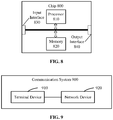
- FIG. 8 is a block diagram illustrating a chip according to an embodiment of the application.
- the chip 800 shown in FIG. 8 includes a processor 810, which can call and run a computer program from a memory to implement the method according to the embodiments of the application.
- the chip 800 may further include a memory 820.
- the processor 510 may call and run the computer program from the memory 820 to implement the method according to the embodiments of the application.
- the memory 820 may be a separate device independent of the processor 810, or may be integrated in the processor 810.
- the chip 800 may further include an input interface 830.
- the processor 810 may control the input interface 830 to communicate with other devices or chips. Specifically, the processor 810 may acquire information or data sent by other devices or chips.
- the chip 800 may further include an output interface 840.
- the processor 810 may control the output interface 840 to communicate with other devices or chips. Specifically, the processor 810 may output information or data to the other devices or chips.
- the chip can be applied to the terminal device according to the embodiments of the application, and the chip can implement the corresponding process implemented by the terminal device in the method according to the embodiments of the application.
- the chip can implement the corresponding process implemented by the terminal device in the method according to the embodiments of the application.
- the chip can be applied to the network device according to the embodiments of the application, and the chip can implement the corresponding process implemented by the network device in the method according to the embodiments of the application.
- the chip can implement the corresponding process implemented by the network device in the method according to the embodiments of the application.
- the chip mentioned in some embodiments of the application may also be referred to as a system-level chip, a system chip, a chip system or a system-on-chip.
- the processor in the embodiments of the application may be an integrated circuit chip with signal processing capabilities.
- each step of the foregoing method embodiment may be completed by an integrated logic circuit of hardware in a processor or instructions in the form of software.
- the aforementioned processor may be a general-purpose processor, a digital signal processor (DSP), an application specific integrated circuit (ASIC), a field programmable gate Array (FPGA), or other available programming logic devices, discrete gates or transistor logic devices, discrete hardware components, which can implement or execute the methods, steps, and logical block diagrams disclosed in the embodiments of the present application.
- the general-purpose processor may be a microprocessor or the processor may be any conventional processor or the like.
- the steps of the method disclosed with reference to the embodiments of the application may be directly embodied and executed by a hardware decoding processor, or may be executed and completed by a combination of hardware and software modules in the decoding processor.
- the software module may be located in a mature storage medium in the art, such as random access memory, flash memory, read-only memory, programmable read-only memory, or electrically erasable programmable memory, and registers.
- the storage medium is located in the memory, and the processor reads the information in the memory and completes the steps of the above method in combination with its hardware.
- the memory mentioned in some embodiments of the application may be a volatile memory or a non-volatile memory, or may include both volatile and non-volatile memory.
- the non-volatile memory may be read-only memory (ROM), programmable read-only memory (PROM), erasable programmable read-only memory (erasable PROM, EPROM), electrically erasable programmable read-only memory (electrically EPROM, EEPROM) or flash memory.
- the volatile memory may be a random access memory (RAM), which is used as an external cache.
- RAM random access memory
- static random access memory static random access memory
- DRAM dynamic random access memory
- DRAM synchronous dynamic random access memory
- SDRAM double data rate synchronous dynamic random access memory
- ESDRAM enhanced synchronous dynamic random access memory
- synch link dynamic random access memory synch link DRAM, SLDRAM
- direct Rambus random access memory direct Rambus RAM, DR RAM
- the memory in the embodiments of the application may also be static RAM (SRAM), dynamic RAM (DRAM), synchronous DRAM (SDRAM), double data rate SDRAM (DDR SDRAM), enhanced SDRAM (ESDRAM), synch link DRAM (SLDRAM) and direct Rambus RAM (DR RAM) and so on. That is to say, the memories in the embodiments of the application are intended to include but are not limited to these and any other suitable types of memories.
- SRAM static RAM
- DRAM dynamic RAM
- SDRAM synchronous DRAM
- DDR SDRAM double data rate SDRAM
- ESDRAM enhanced SDRAM
- SLDRAM synch link DRAM
- DR RAM direct Rambus RAM
- FIG. 9 is a block diagram of a communication system 900 according to an embodiment of the application. As shown in FIG. 9 , the communication system 900 includes a terminal device 910 and a network device 920.
- the terminal device 910 is configured to determine the measurement mode of RRM measurement in the following multiple measurement modes.
- the network device 920 is configured to send second indication information, and the second indication information is used for indicating the measurement mode of RRM measurement in the following multiple measurement modes.
- the network device 920 is configured to send first indication information, the first indication information is used for indicating a threshold corresponding to at least one measurement parameter used by the RRM measurement, and the threshold corresponding to each of the at least one measurement parameter is used by the terminal device 910 for determining the measurement mode of RRM measurement among the multiple measurement modes.
- the multiple measurement modes include: performing the RRM measurement only on a serving cell of the terminal device; not performing the RRM measurement; performing intra-frequency measurement based on first information configured for measurement; performing inter-frequency measurement or inter-RAT measurement based on the first information configured for measurement; performing intra-frequency measurement based on second information configured for measurement; and performing inter-frequency measurement or inter-RAT measurement based on the second information configured for measurement.
- the terminal device 910 may be configured to implement the corresponding functions implemented by the terminal device in the above method 200, and the composition of the terminal device 910 may be as shown by the terminal device 500 in FIG. 5 , which will not be repeated here for brevity.
- the network device 920 may be configured to implement the corresponding functions implemented by the network device in the above method 300, and the composition of the network device 920 may be as shown by the network device 600 in FIG. 6 , which will not be repeated here for brevity.
- Embodiments of the disclosure further provide a computer readable storage medium, which is configured to store a computer program.
- the computer readable storage medium may be applied to the network device in some embodiments of the application, and the computer program causes the computer to execute the corresponding process implemented by the network device in each method in some embodiments of the application.
- the computer readable storage medium may be applied to the terminal device in some embodiments of the application, and the computer program causes the computer to execute the corresponding process implemented by the terminal device in each method in some embodiments of the application.
- the computer program causes the computer to execute the corresponding process implemented by the terminal device in each method in some embodiments of the application.
- a computer program product is also provided in some embodiments of the application, including computer program instructions.
- the computer program product can be applied to the network device in some embodiments of the application, and the computer program instruction causes the computer to execute a corresponding process implemented by the network device in each method in some embodiments of the application.
- the computer program product can be applied to the terminal device in some embodiments of the application, and the computer program instruction causes the computer to execute a corresponding process implemented by the terminal device in each method in some embodiments of the application.
- details will not be repeated here.
- a computer program is also provided in some embodiments of the application.
- the computer program may be applied to the network device in some embodiments of the application.
- the computer program When the computer program is run on a computer, the computer is caused to execute a corresponding process implemented by the network device in each method in some embodiments of the application. For the sake of brevity, details will not be repeated here.
- the computer program may be applied to the terminal device in some embodiments of the application.
- the computer program is run on a computer, the computer is caused to execute a corresponding process implemented by the terminal device in each method in some embodiments of the application. For the sake of brevity, details will not be repeated here.
- system and "network” in the embodiments of the application are often used interchangeably herein.
- the term “and/or” in this disclosure refers to only an association relationship that describes associated objects, which means that there can be three kinds of relationships, for example, A and/or B means three cases: A exists alone, A and B exist at the same time, B exists alone.
- the character "/" in this disclosure generally indicates that the related objects before and after are in an "or" relationship.
- B corresponding to A means that B is associated with A, and B can be determined according to A.
- determining B based on A does not mean determining B based on A alone, and B may also be determined based on A and/or other information.
- the above-mentioned units described display as separate components may be or may not be physically separated, that is, they may be located in one place, or may be distributed on multiple network units. A part or all of the units can be selected according to actual needs to achieve the objectives of the embodiments of the application.
- each functional unit in each embodiment of the application may be integrated into one processing unit, or each unit may exist alone physically, or two or more units may be integrated into one unit.
- the functions are implemented in the form of software functional units and sold or used as an independent product, they can be stored in a computer-readable storage medium.
- a computer-readable storage medium including several instructions used for causing a computer device (which may be a personal computer, a server, or a network device, and the like) to perform all or part of the steps of the method described in some embodiments of the application.
- the foregoing storage medium includes various medium that can store program codes, such as a U disk, a mobile hard disk, a ROM, a RAM, a magnetic disk, or an optical disk.
Landscapes
- Engineering & Computer Science (AREA)
- Computer Networks & Wireless Communication (AREA)
- Signal Processing (AREA)
- Quality & Reliability (AREA)
- Physics & Mathematics (AREA)
- Electromagnetism (AREA)
- Mobile Radio Communication Systems (AREA)
Priority Applications (1)
| Application Number | Priority Date | Filing Date | Title |
|---|---|---|---|
| EP25203457.4A EP4648471A3 (fr) | 2018-12-25 | 2018-12-25 | Procédé et dispositif de mesure rrm |
Applications Claiming Priority (1)
| Application Number | Priority Date | Filing Date | Title |
|---|---|---|---|
| PCT/CN2018/123520 WO2020132871A1 (fr) | 2018-12-25 | 2018-12-25 | Procédé et dispositif de mesure rrm |
Related Child Applications (1)
| Application Number | Title | Priority Date | Filing Date |
|---|---|---|---|
| EP25203457.4A Division EP4648471A3 (fr) | 2018-12-25 | 2018-12-25 | Procédé et dispositif de mesure rrm |
Publications (3)
| Publication Number | Publication Date |
|---|---|
| EP3890391A1 true EP3890391A1 (fr) | 2021-10-06 |
| EP3890391A4 EP3890391A4 (fr) | 2021-12-15 |
| EP3890391B1 EP3890391B1 (fr) | 2025-10-22 |
Family
ID=71126870
Family Applications (2)
| Application Number | Title | Priority Date | Filing Date |
|---|---|---|---|
| EP25203457.4A Pending EP4648471A3 (fr) | 2018-12-25 | 2018-12-25 | Procédé et dispositif de mesure rrm |
| EP18944159.5A Active EP3890391B1 (fr) | 2018-12-25 | 2018-12-25 | Procédé et dispositif de mesure rrm |
Family Applications Before (1)
| Application Number | Title | Priority Date | Filing Date |
|---|---|---|---|
| EP25203457.4A Pending EP4648471A3 (fr) | 2018-12-25 | 2018-12-25 | Procédé et dispositif de mesure rrm |
Country Status (10)
| Country | Link |
|---|---|
| US (1) | US20210321335A1 (fr) |
| EP (2) | EP4648471A3 (fr) |
| JP (1) | JP7222099B2 (fr) |
| KR (1) | KR102802520B1 (fr) |
| CN (2) | CN113709798B (fr) |
| BR (1) | BR112021012508A2 (fr) |
| ES (1) | ES3058484T3 (fr) |
| PT (1) | PT3890391T (fr) |
| SG (1) | SG11202106946UA (fr) |
| WO (1) | WO2020132871A1 (fr) |
Families Citing this family (15)
| Publication number | Priority date | Publication date | Assignee | Title |
|---|---|---|---|---|
| US20220095223A1 (en) * | 2019-02-14 | 2022-03-24 | Ntt Docomo, Inc. | User equipment and measurement method |
| US11510215B2 (en) * | 2019-03-28 | 2022-11-22 | Mediatek Inc. | Electronic device and method for radio resource management (RRM) measurement relaxation |
| CN111800800B (zh) * | 2019-08-15 | 2022-02-08 | 维沃移动通信有限公司 | 测量方法、终端设备和网络设备 |
| EP4128867A1 (fr) * | 2020-03-25 | 2023-02-08 | Nokia Technologies Oy | Équilibrage de mesures rrm |
| WO2022087792A1 (fr) * | 2020-10-26 | 2022-05-05 | Oppo广东移动通信有限公司 | Procédé et appareil de rapport de mesures dans un réseau ntn, procédé et appareil de réception, ainsi que dispositif et support |
| CN116569591A (zh) * | 2021-01-15 | 2023-08-08 | 华为技术有限公司 | 一种通信方法及装置 |
| WO2022266838A1 (fr) * | 2021-06-22 | 2022-12-29 | 北京小米移动软件有限公司 | Procédé de mesurage de cellule, procédé et appareil de configuration de mesurage de cellule, dispositif et support |
| CN115696471A (zh) * | 2021-07-21 | 2023-02-03 | 维沃移动通信有限公司 | Rrm测量方法、rrm测量配置方法、终端设备和网络侧设备 |
| KR102848637B1 (ko) * | 2021-12-07 | 2025-08-21 | 주식회사 엘지유플러스 | 무선통신시스템에서 반송파 병합 및 전송전력에 관련된 동작 방법 |
| CN116419298A (zh) * | 2021-12-28 | 2023-07-11 | 维沃移动通信有限公司 | 测量方法及装置、终端 |
| CN118402269A (zh) * | 2022-11-24 | 2024-07-26 | 北京小米移动软件有限公司 | 一种测量方法、装置、设备及存储介质 |
| JP2026502856A (ja) * | 2022-12-23 | 2026-01-27 | 北京小米移動軟件有限公司 | 情報処理方法及び装置、通信デバイス及び記憶媒体 |
| WO2024257223A1 (fr) * | 2023-06-13 | 2024-12-19 | 日本電信電話株式会社 | Procédé de mesure de qualité de communication pour réseau sans fil, système de réseau sans fil, terminal et programme |
| CN120343673A (zh) * | 2024-01-09 | 2025-07-18 | 展讯半导体(南京)有限公司 | 小区测量方法及装置 |
| WO2025208422A1 (fr) * | 2024-04-03 | 2025-10-09 | Oppo广东移动通信有限公司 | Procédé et appareil d'envoi d'informations de mesure, dispositif, et support de stockage |
Family Cites Families (17)
| Publication number | Priority date | Publication date | Assignee | Title |
|---|---|---|---|---|
| CN103024804B (zh) * | 2007-09-26 | 2016-03-02 | 日本电气株式会社 | 无线通信系统和方法 |
| CN102823288B (zh) * | 2010-03-26 | 2015-09-02 | Lg电子株式会社 | 用于在无线通信系统中执行测量的方法和装置 |
| CN102281552B (zh) * | 2010-06-12 | 2015-04-15 | 华为技术有限公司 | 一种小区测量方法与装置 |
| US9198069B2 (en) * | 2011-02-09 | 2015-11-24 | Broadcom Corporation | Priority measurement rules for channel measurement occasions |
| US8731477B2 (en) * | 2011-10-26 | 2014-05-20 | Blackberry Limited | Performing inter-frequency measurements in a mobile network |
| CN102547881B (zh) * | 2012-01-20 | 2018-08-31 | 中兴通讯股份有限公司 | 一种用户设备控制方法、用户设备和网络侧设备 |
| CN105493551A (zh) * | 2013-05-17 | 2016-04-13 | 华为技术有限公司 | 小区测量方法和终端 |
| CN106233805B (zh) * | 2014-04-28 | 2020-01-10 | 夏普株式会社 | 终端装置、基站装置、通信方法以及集成电路 |
| EP3253111B1 (fr) * | 2015-01-29 | 2020-05-20 | Ntt Docomo, Inc. | Dispositif d'utilisateur et procédé de mesure de cellule |
| CN108353303B (zh) * | 2015-11-09 | 2021-07-23 | 瑞典爱立信有限公司 | 在不连续活动下测量多个载波 |
| EP3524002B1 (fr) * | 2016-10-05 | 2023-08-09 | Sony Group Corporation | Mesure de canal dépendant de l'état de connexion |
| CN108023717B (zh) * | 2016-11-04 | 2021-08-20 | 华为技术有限公司 | 一种参考信号的测量方法和装置 |
| CN108260136B (zh) * | 2016-12-29 | 2021-02-26 | 中国移动通信集团广西有限公司 | 一种异频测量控制方法及装置 |
| WO2018127395A1 (fr) * | 2017-01-05 | 2018-07-12 | Sony Corporation | Dispositif terminal et procédé |
| JP6890175B2 (ja) * | 2017-03-22 | 2021-06-18 | シャープ株式会社 | 端末装置、および、通信方法 |
| EP3596964B1 (fr) * | 2017-04-27 | 2023-12-13 | Sony Group Corporation | Dispositif de communication, équipement d'infrastructure, réseau de communication sans fil et procédés |
| AR113000A1 (es) * | 2017-09-06 | 2020-01-15 | Ericsson Telefon Ab L M | Configuración de medición de señales |
-
2018
- 2018-12-25 EP EP25203457.4A patent/EP4648471A3/fr active Pending
- 2018-12-25 WO PCT/CN2018/123520 patent/WO2020132871A1/fr not_active Ceased
- 2018-12-25 CN CN202111014267.2A patent/CN113709798B/zh active Active
- 2018-12-25 SG SG11202106946UA patent/SG11202106946UA/en unknown
- 2018-12-25 ES ES18944159T patent/ES3058484T3/es active Active
- 2018-12-25 BR BR112021012508-6A patent/BR112021012508A2/pt unknown
- 2018-12-25 KR KR1020217020718A patent/KR102802520B1/ko active Active
- 2018-12-25 EP EP18944159.5A patent/EP3890391B1/fr active Active
- 2018-12-25 CN CN201880099372.0A patent/CN112970281A/zh active Pending
- 2018-12-25 JP JP2021537033A patent/JP7222099B2/ja active Active
- 2018-12-25 PT PT189441595T patent/PT3890391T/pt unknown
-
2021
- 2021-06-24 US US17/357,774 patent/US20210321335A1/en active Pending
Also Published As
| Publication number | Publication date |
|---|---|
| BR112021012508A2 (pt) | 2021-09-14 |
| ES3058484T3 (en) | 2026-03-11 |
| KR102802520B1 (ko) | 2025-05-02 |
| EP3890391A4 (fr) | 2021-12-15 |
| US20210321335A1 (en) | 2021-10-14 |
| JP2022520319A (ja) | 2022-03-30 |
| CN113709798A (zh) | 2021-11-26 |
| JP7222099B2 (ja) | 2023-02-14 |
| EP4648471A2 (fr) | 2025-11-12 |
| CN112970281A (zh) | 2021-06-15 |
| EP3890391B1 (fr) | 2025-10-22 |
| PT3890391T (pt) | 2026-01-05 |
| SG11202106946UA (en) | 2021-07-29 |
| KR20210105370A (ko) | 2021-08-26 |
| EP4648471A3 (fr) | 2026-02-11 |
| WO2020132871A1 (fr) | 2020-07-02 |
| CN113709798B (zh) | 2023-05-26 |
Similar Documents
| Publication | Publication Date | Title |
|---|---|---|
| EP3890391B1 (fr) | Procédé et dispositif de mesure rrm | |
| CN109644079B (zh) | 动态覆盖模式切换和通信带宽调整 | |
| CN111565428B (zh) | 小区重选方法以及装置 | |
| CN114846851B (zh) | 小区重选方法、终端设备和网络设备 | |
| AU2018429021B2 (en) | Wireless link monitoring method, terminal device, and network device | |
| WO2019242154A1 (fr) | Procédé de mesure d'informations, dispositif terminal et dispositif de réseau | |
| CN112889316B (zh) | 一种小区重选方法及装置、终端 | |
| US10869214B2 (en) | Wireless communication device and a method therein for reporting signal quality measurements | |
| CN113271685B (zh) | 一种添加辅小区组的方法、接入网设备和终端设备 | |
| KR20220136244A (ko) | 무선 통신에서의 사이드링크 릴레이 선택 및 재선택 | |
| CN113170341A (zh) | 一种资源配置处理方法、终端设备及网络设备 | |
| CN103404072B (zh) | 多载波通信的方法和装置 | |
| CN114868456A (zh) | 一种无线资源管理测量方法、电子设备及存储介质 | |
| RU2703986C1 (ru) | Сеть связи, узлы сети связи и способ установления соединений в сети беспроводной связи | |
| WO2024169512A1 (fr) | Procédé de mesure et appareil de mesure | |
| CN115334530A (zh) | 测量配置方法和装置 | |
| CN112601251B (zh) | 无线资源管理测量的方法和设备 | |
| CN110312284A (zh) | 速率匹配方法、终端设备和网络设备 | |
| US20210092774A1 (en) | Radio Link Monitoring Method and Terminal Device | |
| CN113261329B (zh) | 用于切换网络设备的方法、终端设备和网络设备 | |
| EP4626083A1 (fr) | Procédé, appareil et système de communication | |
| CN117858176A (zh) | 一种确定邻区网络类型的方法及相关设备 | |
| WO2025152118A1 (fr) | Procédé et appareil de transmission de données, procédé et appareil de réception de données, et système de communication |
Legal Events
| Date | Code | Title | Description |
|---|---|---|---|
| STAA | Information on the status of an ep patent application or granted ep patent |
Free format text: STATUS: THE INTERNATIONAL PUBLICATION HAS BEEN MADE |
|
| PUAI | Public reference made under article 153(3) epc to a published international application that has entered the european phase |
Free format text: ORIGINAL CODE: 0009012 |
|
| STAA | Information on the status of an ep patent application or granted ep patent |
Free format text: STATUS: REQUEST FOR EXAMINATION WAS MADE |
|
| 17P | Request for examination filed |
Effective date: 20210629 |
|
| AK | Designated contracting states |
Kind code of ref document: A1 Designated state(s): AL AT BE BG CH CY CZ DE DK EE ES FI FR GB GR HR HU IE IS IT LI LT LU LV MC MK MT NL NO PL PT RO RS SE SI SK SM TR |
|
| A4 | Supplementary search report drawn up and despatched |
Effective date: 20211116 |
|
| RIC1 | Information provided on ipc code assigned before grant |
Ipc: H04W 52/02 20090101ALN20211110BHEP Ipc: H04W 36/00 20090101ALN20211110BHEP Ipc: H04W 24/10 20090101AFI20211110BHEP |
|
| DAV | Request for validation of the european patent (deleted) | ||
| DAX | Request for extension of the european patent (deleted) | ||
| STAA | Information on the status of an ep patent application or granted ep patent |
Free format text: STATUS: EXAMINATION IS IN PROGRESS |
|
| 17Q | First examination report despatched |
Effective date: 20240325 |
|
| GRAP | Despatch of communication of intention to grant a patent |
Free format text: ORIGINAL CODE: EPIDOSNIGR1 |
|
| STAA | Information on the status of an ep patent application or granted ep patent |
Free format text: STATUS: GRANT OF PATENT IS INTENDED |
|
| RIC1 | Information provided on ipc code assigned before grant |
Ipc: H04W 52/02 20090101ALN20250417BHEP Ipc: H04W 36/00 20090101ALN20250417BHEP Ipc: H04W 24/10 20090101AFI20250417BHEP |
|
| RIC1 | Information provided on ipc code assigned before grant |
Ipc: H04W 52/02 20090101ALN20250428BHEP Ipc: H04W 36/00 20090101ALN20250428BHEP Ipc: H04W 24/10 20090101AFI20250428BHEP |
|
| INTG | Intention to grant announced |
Effective date: 20250512 |
|
| GRAS | Grant fee paid |
Free format text: ORIGINAL CODE: EPIDOSNIGR3 |
|
| GRAA | (expected) grant |
Free format text: ORIGINAL CODE: 0009210 |
|
| STAA | Information on the status of an ep patent application or granted ep patent |
Free format text: STATUS: THE PATENT HAS BEEN GRANTED |
|
| AK | Designated contracting states |
Kind code of ref document: B1 Designated state(s): AL AT BE BG CH CY CZ DE DK EE ES FI FR GB GR HR HU IE IS IT LI LT LU LV MC MK MT NL NO PL PT RO RS SE SI SK SM TR |
|
| REG | Reference to a national code |
Ref country code: CH Ref legal event code: F10 Free format text: ST27 STATUS EVENT CODE: U-0-0-F10-F00 (AS PROVIDED BY THE NATIONAL OFFICE) Effective date: 20251022 Ref country code: GB Ref legal event code: FG4D |
|
| REG | Reference to a national code |
Ref country code: DE Ref legal event code: R096 Ref document number: 602018086661 Country of ref document: DE |
|
| REG | Reference to a national code |
Ref country code: IE Ref legal event code: FG4D |
|
| PGFP | Annual fee paid to national office [announced via postgrant information from national office to epo] |
Ref country code: NL Payment date: 20251126 Year of fee payment: 8 |
|
| REG | Reference to a national code |
Ref country code: PT Ref legal event code: SC4A Ref document number: 3890391 Country of ref document: PT Date of ref document: 20260105 Kind code of ref document: T Free format text: AVAILABILITY OF NATIONAL TRANSLATION Effective date: 20251229 |
|
| REG | Reference to a national code |
Ref country code: NL Ref legal event code: FP |
|
| PGFP | Annual fee paid to national office [announced via postgrant information from national office to epo] |
Ref country code: DE Payment date: 20251119 Year of fee payment: 8 |
|
| PGFP | Annual fee paid to national office [announced via postgrant information from national office to epo] |
Ref country code: GB Payment date: 20251120 Year of fee payment: 8 |
|
| PGFP | Annual fee paid to national office [announced via postgrant information from national office to epo] |
Ref country code: AT Payment date: 20251126 Year of fee payment: 8 |
|
| PGFP | Annual fee paid to national office [announced via postgrant information from national office to epo] |
Ref country code: FR Payment date: 20251124 Year of fee payment: 8 |
|
| PGFP | Annual fee paid to national office [announced via postgrant information from national office to epo] |
Ref country code: TR Payment date: 20251231 Year of fee payment: 8 |
|
| PGFP | Annual fee paid to national office [announced via postgrant information from national office to epo] |
Ref country code: SE Payment date: 20251126 Year of fee payment: 8 |
|
| REG | Reference to a national code |
Ref country code: SE Ref legal event code: TRGR |
|
| PGFP | Annual fee paid to national office [announced via postgrant information from national office to epo] |
Ref country code: HU Payment date: 20251212 Year of fee payment: 8 |
|
| P01 | Opt-out of the competence of the unified patent court (upc) registered |
Free format text: CASE NUMBER: UPC_APP_0001890_3890391/2026 Effective date: 20260120 |
|
| REG | Reference to a national code |
Ref country code: ES Ref legal event code: FG2A Ref document number: 3058484 Country of ref document: ES Kind code of ref document: T3 Effective date: 20260311 |
|
| PGFP | Annual fee paid to national office [announced via postgrant information from national office to epo] |
Ref country code: ES Payment date: 20260113 Year of fee payment: 8 |
|
| REG | Reference to a national code |
Ref country code: LT Ref legal event code: MG9D |
|
| PG25 | Lapsed in a contracting state [announced via postgrant information from national office to epo] |
Ref country code: NO Free format text: LAPSE BECAUSE OF FAILURE TO SUBMIT A TRANSLATION OF THE DESCRIPTION OR TO PAY THE FEE WITHIN THE PRESCRIBED TIME-LIMIT Effective date: 20260122 |
|
| PG25 | Lapsed in a contracting state [announced via postgrant information from national office to epo] |
Ref country code: HR Free format text: LAPSE BECAUSE OF FAILURE TO SUBMIT A TRANSLATION OF THE DESCRIPTION OR TO PAY THE FEE WITHIN THE PRESCRIBED TIME-LIMIT Effective date: 20251022 Ref country code: FI Free format text: LAPSE BECAUSE OF FAILURE TO SUBMIT A TRANSLATION OF THE DESCRIPTION OR TO PAY THE FEE WITHIN THE PRESCRIBED TIME-LIMIT Effective date: 20251022 |
|
| PGFP | Annual fee paid to national office [announced via postgrant information from national office to epo] |
Ref country code: IT Payment date: 20260116 Year of fee payment: 8 |
|
| PG25 | Lapsed in a contracting state [announced via postgrant information from national office to epo] |
Ref country code: RS Free format text: LAPSE BECAUSE OF FAILURE TO SUBMIT A TRANSLATION OF THE DESCRIPTION OR TO PAY THE FEE WITHIN THE PRESCRIBED TIME-LIMIT Effective date: 20260122 |
|
| PG25 | Lapsed in a contracting state [announced via postgrant information from national office to epo] |
Ref country code: IS Free format text: LAPSE BECAUSE OF FAILURE TO SUBMIT A TRANSLATION OF THE DESCRIPTION OR TO PAY THE FEE WITHIN THE PRESCRIBED TIME-LIMIT Effective date: 20260222 |