EP3892246B1 - Verfahren zum aufbringen einer polymerzusammensetzung und absorbierende artikel mit einer solchen zusammensetzung - Google Patents
Verfahren zum aufbringen einer polymerzusammensetzung und absorbierende artikel mit einer solchen zusammensetzung Download PDFInfo
- Publication number
- EP3892246B1 EP3892246B1 EP21167447.8A EP21167447A EP3892246B1 EP 3892246 B1 EP3892246 B1 EP 3892246B1 EP 21167447 A EP21167447 A EP 21167447A EP 3892246 B1 EP3892246 B1 EP 3892246B1
- Authority
- EP
- European Patent Office
- Prior art keywords
- substrate
- pattern
- lip
- polymeric composition
- substrate carrier
- Prior art date
- Legal status (The legal status is an assumption and is not a legal conclusion. Google has not performed a legal analysis and makes no representation as to the accuracy of the status listed.)
- Active
Links
Images














Classifications
-
- A—HUMAN NECESSITIES
- A61—MEDICAL OR VETERINARY SCIENCE; HYGIENE
- A61L—METHODS OR APPARATUS FOR STERILISING MATERIALS OR OBJECTS IN GENERAL; DISINFECTION, STERILISATION OR DEODORISATION OF AIR; CHEMICAL ASPECTS OF BANDAGES, DRESSINGS, ABSORBENT PADS OR SURGICAL ARTICLES; MATERIALS FOR BANDAGES, DRESSINGS, ABSORBENT PADS OR SURGICAL ARTICLES
- A61L15/00—Chemical aspects of, or use of materials for, bandages, dressings or absorbent pads
- A61L15/16—Bandages, dressings or absorbent pads for physiological fluids such as urine or blood, e.g. sanitary towels, tampons
- A61L15/22—Bandages, dressings or absorbent pads for physiological fluids such as urine or blood, e.g. sanitary towels, tampons containing macromolecular materials
- A61L15/24—Macromolecular compounds obtained by reactions only involving carbon-to-carbon unsaturated bonds; Derivatives thereof
-
- A—HUMAN NECESSITIES
- A61—MEDICAL OR VETERINARY SCIENCE; HYGIENE
- A61F—FILTERS IMPLANTABLE INTO BLOOD VESSELS; PROSTHESES; DEVICES PROVIDING PATENCY TO, OR PREVENTING COLLAPSING OF, TUBULAR STRUCTURES OF THE BODY, e.g. STENTS; ORTHOPAEDIC, NURSING OR CONTRACEPTIVE DEVICES; FOMENTATION; TREATMENT OR PROTECTION OF EYES OR EARS; BANDAGES, DRESSINGS OR ABSORBENT PADS; FIRST-AID KITS
- A61F13/00—Bandages or dressings; Absorbent pads
- A61F13/15—Absorbent pads, e.g. sanitary towels, swabs or tampons for external or internal application to the body; Supporting or fastening means therefor; Tampon applicators
- A61F13/15577—Apparatus or processes for manufacturing
- A61F13/15699—Forming webs by bringing together several webs, e.g. by laminating or folding several webs, with or without additional treatment of the webs
-
- B—PERFORMING OPERATIONS; TRANSPORTING
- B32—LAYERED PRODUCTS
- B32B—LAYERED PRODUCTS, i.e. PRODUCTS BUILT-UP OF STRATA OF FLAT OR NON-FLAT, e.g. CELLULAR OR HONEYCOMB, FORM
- B32B27/00—Layered products comprising a layer of synthetic resin
- B32B27/12—Layered products comprising a layer of synthetic resin next to a fibrous or filamentary layer
-
- B—PERFORMING OPERATIONS; TRANSPORTING
- B32—LAYERED PRODUCTS
- B32B—LAYERED PRODUCTS, i.e. PRODUCTS BUILT-UP OF STRATA OF FLAT OR NON-FLAT, e.g. CELLULAR OR HONEYCOMB, FORM
- B32B27/00—Layered products comprising a layer of synthetic resin
- B32B27/18—Layered products comprising a layer of synthetic resin characterised by the use of special additives
- B32B27/20—Layered products comprising a layer of synthetic resin characterised by the use of special additives using fillers, pigments, thixotroping agents
-
- B—PERFORMING OPERATIONS; TRANSPORTING
- B32—LAYERED PRODUCTS
- B32B—LAYERED PRODUCTS, i.e. PRODUCTS BUILT-UP OF STRATA OF FLAT OR NON-FLAT, e.g. CELLULAR OR HONEYCOMB, FORM
- B32B27/00—Layered products comprising a layer of synthetic resin
- B32B27/32—Layered products comprising a layer of synthetic resin comprising polyolefins
- B32B27/327—Layered products comprising a layer of synthetic resin comprising polyolefins comprising polyolefins obtained by a metallocene or single-site catalyst
-
- B—PERFORMING OPERATIONS; TRANSPORTING
- B32—LAYERED PRODUCTS
- B32B—LAYERED PRODUCTS, i.e. PRODUCTS BUILT-UP OF STRATA OF FLAT OR NON-FLAT, e.g. CELLULAR OR HONEYCOMB, FORM
- B32B37/00—Methods or apparatus for laminating, e.g. by curing or by ultrasonic bonding
- B32B37/12—Methods or apparatus for laminating, e.g. by curing or by ultrasonic bonding characterised by using adhesives
-
- B—PERFORMING OPERATIONS; TRANSPORTING
- B32—LAYERED PRODUCTS
- B32B—LAYERED PRODUCTS, i.e. PRODUCTS BUILT-UP OF STRATA OF FLAT OR NON-FLAT, e.g. CELLULAR OR HONEYCOMB, FORM
- B32B37/00—Methods or apparatus for laminating, e.g. by curing or by ultrasonic bonding
- B32B37/14—Methods or apparatus for laminating, e.g. by curing or by ultrasonic bonding characterised by the properties of the layers
- B32B37/15—Methods or apparatus for laminating, e.g. by curing or by ultrasonic bonding characterised by the properties of the layers with at least one layer being manufactured and immediately laminated before reaching its stable state, e.g. in which a layer is extruded and laminated while in semi-molten state
-
- B—PERFORMING OPERATIONS; TRANSPORTING
- B32—LAYERED PRODUCTS
- B32B—LAYERED PRODUCTS, i.e. PRODUCTS BUILT-UP OF STRATA OF FLAT OR NON-FLAT, e.g. CELLULAR OR HONEYCOMB, FORM
- B32B38/00—Ancillary operations in connection with laminating processes
- B32B38/06—Embossing
-
- B—PERFORMING OPERATIONS; TRANSPORTING
- B32—LAYERED PRODUCTS
- B32B—LAYERED PRODUCTS, i.e. PRODUCTS BUILT-UP OF STRATA OF FLAT OR NON-FLAT, e.g. CELLULAR OR HONEYCOMB, FORM
- B32B5/00—Layered products characterised by the non- homogeneity or physical structure, i.e. comprising a fibrous, filamentary, particulate or foam layer; Layered products characterised by having a layer differing constitutionally or physically in different parts
- B32B5/02—Layered products characterised by the non- homogeneity or physical structure, i.e. comprising a fibrous, filamentary, particulate or foam layer; Layered products characterised by having a layer differing constitutionally or physically in different parts characterised by structural features of a fibrous or filamentary layer
- B32B5/022—Non-woven fabric
-
- B—PERFORMING OPERATIONS; TRANSPORTING
- B05—SPRAYING OR ATOMISING IN GENERAL; APPLYING FLUENT MATERIALS TO SURFACES, IN GENERAL
- B05C—APPARATUS FOR APPLYING FLUENT MATERIALS TO SURFACES, IN GENERAL
- B05C5/00—Apparatus in which liquid or other fluent material is projected, poured or allowed to flow on to the surface of the work
- B05C5/02—Apparatus in which liquid or other fluent material is projected, poured or allowed to flow on to the surface of the work the liquid or other fluent material being discharged through an outlet orifice by pressure, e.g. from an outlet device in contact or almost in contact, with the work
- B05C5/0254—Coating heads with slot-shaped outlet
-
- B—PERFORMING OPERATIONS; TRANSPORTING
- B32—LAYERED PRODUCTS
- B32B—LAYERED PRODUCTS, i.e. PRODUCTS BUILT-UP OF STRATA OF FLAT OR NON-FLAT, e.g. CELLULAR OR HONEYCOMB, FORM
- B32B2250/00—Layers arrangement
- B32B2250/03—3 layers
-
- B—PERFORMING OPERATIONS; TRANSPORTING
- B32—LAYERED PRODUCTS
- B32B—LAYERED PRODUCTS, i.e. PRODUCTS BUILT-UP OF STRATA OF FLAT OR NON-FLAT, e.g. CELLULAR OR HONEYCOMB, FORM
- B32B2307/00—Properties of the layers or laminate
- B32B2307/50—Properties of the layers or laminate having particular mechanical properties
- B32B2307/54—Yield strength; Tensile strength
-
- B—PERFORMING OPERATIONS; TRANSPORTING
- B32—LAYERED PRODUCTS
- B32B—LAYERED PRODUCTS, i.e. PRODUCTS BUILT-UP OF STRATA OF FLAT OR NON-FLAT, e.g. CELLULAR OR HONEYCOMB, FORM
- B32B2307/00—Properties of the layers or laminate
- B32B2307/70—Other properties
- B32B2307/726—Permeability to liquids, absorption
-
- B—PERFORMING OPERATIONS; TRANSPORTING
- B32—LAYERED PRODUCTS
- B32B—LAYERED PRODUCTS, i.e. PRODUCTS BUILT-UP OF STRATA OF FLAT OR NON-FLAT, e.g. CELLULAR OR HONEYCOMB, FORM
- B32B2323/00—Polyalkenes
- B32B2323/04—Polyethylene
-
- B—PERFORMING OPERATIONS; TRANSPORTING
- B32—LAYERED PRODUCTS
- B32B—LAYERED PRODUCTS, i.e. PRODUCTS BUILT-UP OF STRATA OF FLAT OR NON-FLAT, e.g. CELLULAR OR HONEYCOMB, FORM
- B32B2323/00—Polyalkenes
- B32B2323/10—Polypropylene
-
- B—PERFORMING OPERATIONS; TRANSPORTING
- B32—LAYERED PRODUCTS
- B32B—LAYERED PRODUCTS, i.e. PRODUCTS BUILT-UP OF STRATA OF FLAT OR NON-FLAT, e.g. CELLULAR OR HONEYCOMB, FORM
- B32B2555/00—Personal care
- B32B2555/02—Diapers or napkins
Definitions
- the present disclosure relates in a first aspect to a method for applying a polymeric composition having a Tensile Strength at Yield of from 0.5 MPa to 10 MPa in a fluid form to a substrate by a contact method which is different from conventional slot coating.
- the polymeric composition may be used to providing a texture to a substrate or to bond two substrates together.
- the polymeric composition may be applied in a pre-defined pattern.
- the present disclosure is for an absorbent article comprising a substrate having the polymeric composition deposited thereon on a pattern, which is not a slot pattern.
- the substrate on which the polymeric composition is applied may in particular be a nonwoven.
- hot melt adhesives have been used to bond individual layers of the chassis of the absorbent article, such as the topsheet and backsheet together.
- Hot melt adhesives have also been used to bond discrete components, such as fasteners and leg elastics or cuffs, to the article.
- the hot melt adhesive is often called a construction adhesive because it is used to help construct the absorbent article from individual components.
- Common hot melt adhesives are made by combining polymer and additive components in a substantially uniform thermoplastic blend.
- Typical additives include tackifiers, plasticizers, and/or waxes, for example. While such formulations generally work, they can be costly and their performance properties can be improved.
- tackifiers which can comprise up to 65% of an adhesive formula, can be expensive and difficult to source. Therefore, there is a need for improved hot melt adhesives, such as substantially tackifier-free polymeric compositions, that offer (1) superior performance compared to tackifier-based hot melt adhesives (2) at a lower cost.
- US2016/0053,149A1 discloses a ready-to-use hotmelt adhesive comprising at least 95 wt % of one or more polyolefin copolymer waxes produced using metallocene catalysts, where the polyolefin copolymer wax consists of propylene and one or more further monomers selected from ethylene and branched or unbranched 1-alkenes having 4 to 20 C atoms. More recently, polymer compositions having a Tensile Strength at Yield of from 0.5 MPa to 10 MPa have been proposed in US2020/0108167A1 ,filed on October 9, 2019 , for making nonwoven-nonwoven bond. These polymeric compositions have the advantages of requiring no or little blending with other ingredients, which saves costs and increase purity.
- the patterns generated by spray applications are defined by thin adhesive strands, which are generated during the spraying process and whose diameters typically range between 5 and 20 ⁇ m. On a microscopic level, these thin adhesive strands do by purpose not completely cover the surface of the substrate but leave adhesive free zones in between.
- a typical random fibrous pattern (as e.g. accessible via the Control Coat ® application) is characterized by adhesive free zones on the surface on a sub-millimeter scale.
- the fiber diameter of a typical spun nonwoven, for comparison ranges between 15 and 20 ⁇ m, so that a zone of a spun nonwoven covered with a spray pattern can stay permeable to air or liquid.
- a complete coverage may, however, be desirable for some applications, like e.g. sealing bonds (like the C-wrap bond in the core bag).
- Spray applications do not allow, either, - unlike contact applications - for patterns of more complex geometry not oriented in the machine direction, such as discrete pattern elements like squares, dots, rectangles.
- Bead application is an example of a non-contact adhesive application method which does not operate with process air (unlike a spray application).
- the adhesive is extruded through a millimeter large orifice and falls by gravity onto the substrate as a continuous bead of adhesive.
- the adhesive pattern thus laid down can have a width of around a millimeter (as it has not been stretched via air) and can allow for effective sealing, but bead applications cannot be applied intermittently and there are limitations to the line speed with which they can be used. In any case, these adhesive beads can only be laid down in machine direction.
- the coating gap is directly controlled by fixed equipment parts, i.e. the slot die applicator and the substrate carrier, as opposed to indirect control via the web tension only as is used in conventional slot coating. While the claimed method involves some tension of the web during the application of the polymeric composition, a lower web tension can be used relative to slot die conventional processes. Without this direct control, the inventor believes that the coating gap is subjected to larger variations that can create the anomaly described above as blobbing.
- the substrate may be subject to a tension at the point of application of less than 10 N/m (Force per unit width), in particular from about 1 N/m to about 6 N/m. A lower tension value can provide for a more reliable application process, especially a more accurate deposition pattern.
- the substrate carrier is a patterned roll, the roll being advantageously driven by a motor.
- This method allows for applying the polymeric composition from a slot die applicator to the substrate in a pattern, the substrate having a first surface disposed opposite of a second surface and an unconstrained caliper, Hs.
- This method may in particular comprise the steps of:
- a patterned substrate carrier enables the creation of application patterns having any desired shapes, which may be a regular geometric pattern, or a non-regular pattern, or a combination thereof.
- the pattern is not limited to stripes oriented in machine direction as is the case for standard slot coating process.
- the pattern may in particular comprise discrete or continuous elements having a dimension in machine direction which is less than 10 mm, for example from 1 mm to 10 mm.
- the invention is for absorbent article comprising a substrate, in particular a nonwoven material, and a polymeric composition applied on the substrate according to a contact application, the polymeric composition having a Tensile Strength at Yield of from 0.5 MPa to 10 MPa according to the Tensile Strength Test Method described herein, wherein the application pattern does not consist solely of one or more stripes oriented in machine direction.
- the absorbent article may comprise any conventional components, in particular a topsheet, a backsheet, an absorbent core and an acquisition layer.
- the substrate may be any layers of the absorbent article, but in particular a nonwoven.
- the article may thus comprise two layers, one and advantageously both being a nonwoven, bonded by a pattern of the polymeric composition described herein.
- the application pattern may in particular comprise continuous and/or discrete pattern elements having a dimension in machine direction of less than 10 mm.
- the application pattern may also in particular comprise at least one cross-direction oriented stripe. Such stripes may be for example used to form core wrap end seals of the absorbent core.
- the polymeric composition used in the present invention may comprise less than 5 % of a tackifier, by weight of the polymeric composition.
- the polymeric composition may also comprise as main component a propylene butene copolymer, a polypropylene homopolymer, a propylene ethylene copolymer, or a mixture thereof.
- Diaper is used herein to refer to an absorbent article generally worn by infants and incontinent persons about the lower torso.
- absorbent articles which generally are not intended to be laundered or otherwise restored or reused as an absorbent article (e.g., they are intended to be discarded after a single use and may also be configured to be recycled, composted or otherwise disposed of in an environmentally compatible manner).
- substrate is used herein to describe a material which is primarily two-dimensional (i.e. in an XY plane) and whose thickness (in a Z direction) is relatively small (i.e. 1/10 or less) in comparison to its length (in an X direction) and width (in a Y direction).
- substrates include a layer or layers or fibrous materials, films and foils such as plastic films or metallic foils that may be used alone or laminated to one or more web, layer, film and/or foil. As such, a web is a substrate.
- cross direction is used herein to refer to a direction that is generally perpendicular to the machine direction.
- the term "compliant” refers to any material with a durometer hardness of 90 or less as measured according to ASTM International Designation: D2240-05 (Reapproved 2010) for Type M durometers.
- non-compliant refers to any material with a hardness value greater than 100 HRBW as defined on the Rockwell B Scale in the American National Standard Designation.
- inventions and methods disclosed herein provide for the application of viscous fluids, such as adhesives, in pre-determined patterns to an advancing substrate.
- viscous fluids such as adhesives
- the disclosure below relating to the apparatus as disclosed in Figure 1 to Figure 10 is generally identical to the disclosure in previous patent application WO2014/085063 (Brown et al., P&G ).
- the present invention method is not limited to an application and may be used for simpler applications such as machine-direction oriented stripes, as will be briefly discussed in relation with Fig. 12-13 further below.
- polymeric compositions including various examples, that are applied by the method of the present invention are described in a second part of the description further below.
- the present invention may use a flexographic sleeve provided with a pattern affixed on the surface of the roll.
- the roll takes up the fluid polymeric composition leaving the nozzle only at the protrusions on this sleeve, which enables the creation of intricate patterns, for example comprising discrete pattern elements of any shape, such as cross-direction or machine-direction oriented stripes with a short intermittent length, or artwork comprising curves lines or logos etc...
- a lower web tension is advantageous to obtain sharply resolved patterns. This advantageous embodiment will be now be discussed in relation to Figs. 1-10 in the next pages.
- the apparatuses and methods disclosed herein may include substrate carriers having various configurations.
- the substrate carrier may be configured as a roller.
- the substrate carrier may include an endless belt.
- the substrate carriers may also utilize various outer surface arrangements.
- the base surface may be configured as a continuous surface and the substrate carrier may include a plurality of discrete pattern elements separated from each other by the continuous surface.
- each pattern element may include a pattern surface and each pattern element may protrude outward from the continuous surface such that each pattern surface is separated from the continuous surface by the distance, Hp.
- the pattern surface may be configured as a continuous surface and the base surface may include a plurality of discrete base surfaces separated from each other by the pattern element.
- apparatuses and methods of the present disclosure may be utilized to apply adhesives to continuous substrates used in the manufacture of absorbent articles.
- substrates may be utilized in absorbent article components such as, for example: backsheets, topsheets, absorbent cores, front and/or back ears, fastener components, and various types of elastic webs and components such as leg elastics, barrier leg cuff elastics, and waist elastics. Exemplary descriptions of absorbent article components and substrates are provided below with reference to Figure 11 .
- substrates may include continuous webs of material and component parts mounted on carrier substrates or may be in the form of a continuous substrate.
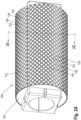
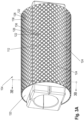
- the pattern surface 126 in Figures 3A and 3B defines a continuous crossing line pattern wherein the shape and size of each base surface 124 are identical or substantially identical to each other. It is to be appreciated that the number, size, and shape of some or all the base surfaces may be different. In addition, the distance, Hp, between the base surfaces 124 and the pattern surface 126 of the pattern element 122 may be the same or different for some or all of the base surfaces. It should also be appreciated that the substrate carrier may be configured without base surfaces.
- the substrate carrier may include a plurality of holes and the pattern surface may be configured as a continuous surface wherein the plurality of holes are separated from each other by the pattern element.
- the substrate carrier may be constructed in various ways such that the base surface and/or pattern elements may include compliant materials.
- the compliant material(s) may be compressible to allow a pattern surface of a pattern element to deflect away from the slot die applicator.
- the substrate carrier may be configured such that deflection of the pattern surface away from the slot die applicator compresses the pattern element and/or base surface as the substrate and the pattern element advance past the first lip, the slot opening, and the second lip of the slot die applicator.
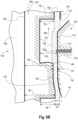
- the pattern element and/or base surface may be compressed to allow the pattern surface 126 of the pattern element to deflect away from the slot die applicator 102 as the substrate 106 and the pattern surface 126 of the pattern element 122 advances past the first lip 116, the slot opening 114, and the second lip 118 of the slot die applicator 102.
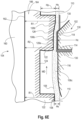
- the minimum distance between the base surface 124 of the substrate carrier 104 and the slot die applicator 102 is greater than the unconstrained caliper of the substrate 106.
- the base surface 124 is not compressed as the substrate advances past the first lip 116, the slot opening 114, and the second lip 118 of the slot die applicator 102.
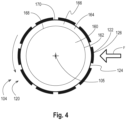
- the substrate carrier 104 is positioned adjacent the slot die applicator 102 to define a minimum distance, Hg, between the uncompressed pattern surface 126 of the pattern element 122 and the first lip 116 and the second lip 118 that is less than the unconstrained caliper, Hs, of the substrate 106.
- the substrate carrier 104 is positioned adjacent the slot die applicator 102 to define a minimum distance, Hb, between the base surface 124 and the first lip 116 and the second lip 118 that is greater than the unconstrained caliper, Hs, of the substrate.
- the apparatus 100 may also be configured such that a sum of the distance, Hp, and distance, Hg, is greater than the unconstrained caliper, Hs, of the substrate 106.
- a portion 106a of the substrate 106 that is located between the slot opening 114 of the slot die applicator 102 and the advancing base surface 124 is not pressed against the base surface 124.
- fluid 130 is continuously discharged from the slot opening 114, fluid 130 is not being transferred to the second surface 110 of the substrate 106.
- the remainder of the compliant pattern element 122 and/or base surface 124 may return to an uncompressed state wherein the both the upstream portion 126a and downstream portion 126b of the pattern surface 126 have deflected away from the non-compliant surface 162 such that the minimum distance between the non-compliant surface 162 and the pattern surface 126 is the distance, R1.
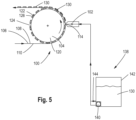
- the apparatuses 100 herein may be used to apply adhesive 130 discharged from a slot die applicator 102 to a substrate 106 in a pattern by continuously advancing the substrate in a machine direction past a first lip 116, second lip 118, and slot opening 114 in the slot die applicator 102.
- the substrate 106 may be engaged with a substrate carrier 104 that may include a base surface 124 and a pattern element 122, wherein the pattern element includes a pattern surface 126.
- the pattern element 122 protrudes from the base surface 124 to define a distance, Hp, between the pattern surface 126 and the base surface 124.
- the substrate 106 is intermittently compressed between the slot die applicator 102 and the pattern surface 126 of the pattern element 122 by advancing the pattern element as the pattern surface of the pattern element advances past the first lip 116, the slot opening 114, and the second lip 118 of the slot die applicator 102 while the first surface 108 of the substrate 106 is disposed on the substrate carrier 104.
- core wrap end seals at the front and back of the absorbent core are optional, the present invention may be particularly used to deposit at least one cross-direction oriented stripe of the polymeric onto the inner surface of the top or bottom side of the core wrap in order to make one or both of these core end wrap seal(s).
- the polymer can comprise 100%, alternatively from about 75% to about 95%, alternatively from about 80% to about 90%, alternatively from about 30 % to about 70 %, alternatively from about 35 % to about 65 %, alternatively from about 40 % to about 60 %, alternatively from about 45 % to about 55 %, alternatively from about 10 % to about 20 %, and alternatively from about 15 % to about 25 %, alternatively from about 1% to about 5%, and alternatively from about 5% to about 12 % of 1-butene monomer units, by weight of the polymer.
- the percentage of 1-butene monomer units may be determined by a suitable method, such as nuclear magnetic resonance or infrared spectroscopies, known to those of skill in the art.
- the polymeric composition may comprise a homopolymer of propylene.
- the homopolymer of propylene may comprise 0% tackifier.
- the homopolymer of propylene may have a viscosity of from about 500 mPa s to about 3,000 mPa.s, alternatively from about 750 mPa s to about 2,250 mPa s, and alternatively from about 1,200 mPa s to about 1,800 mPa s at 170° C according to ASTM D3236-15.
- the homopolymer of propylene may be made using one or more metallocene catalysts.
- An example of a homopolymer of propylene may be Licocene 6502 from Clariant.
- the value of the fitted line at a Hencky strain of zero (that is, the y-intercept) is defined as the Yield Stress, which is reported in MPa to the nearest kilopascal. Otherwise, the maximum value of extensional stress recorded during the measurement is reported as the Yield Stress, again reported in MPa to the nearest kilopascal.
- the Oscillatory Rheometry Test Method is used to measure the Storage Modulus G' and the Loss Factor of a polymer composition.
- a controlled-strain rotational rheometer (such as Discovery HR-3, TA Instruments, New Castle, DE, USA, or equivalent) capable of sample temperature control (using a Peltier cooler and resistance heater combination) with a precision equal to or exceeding 0.5°C over at least the range of -10 °C to 150 °C.
- the rheometer is operated in a parallel plate configuration with 20-mm stainless steel parallel-plate tooling.
- the sample temperature is set to 23 °C (temperature is ramped to this setpoint at a rate of 10 °C/min), and the sample is allowed to rest for 4.0 hours at 23 °C.
- the temperature is set to -10 °C (temperature is ramped to this setpoint at a rate of 10 °C/min), the sample is equilibrated for 300 seconds at -10 °C, and a second oscillatory rheology measurement is conducted (0.1% strain, frequency of oscillation of 1 Hz) while temperature is ramped upward to 130 °C at a constant rate of increase of 2 °C/min.
- the storage modulus G' is calculated and recorded at 37°C, and these values are reported in Pascals (Pa) to the nearest 1 Pa as the "Storage Modulus at 100 °C".
- the loss factor also known as tan delta
- the storage modulus G' can also be calculated and recorded at different temperatures, for example 60°C.
Landscapes
- Health & Medical Sciences (AREA)
- Engineering & Computer Science (AREA)
- Chemical & Material Sciences (AREA)
- Chemical Kinetics & Catalysis (AREA)
- Life Sciences & Earth Sciences (AREA)
- General Health & Medical Sciences (AREA)
- Veterinary Medicine (AREA)
- Epidemiology (AREA)
- Public Health (AREA)
- Animal Behavior & Ethology (AREA)
- Textile Engineering (AREA)
- Hematology (AREA)
- Materials Engineering (AREA)
- Manufacturing & Machinery (AREA)
- Biomedical Technology (AREA)
- Heart & Thoracic Surgery (AREA)
- Vascular Medicine (AREA)
- Application Of Or Painting With Fluid Materials (AREA)
- Absorbent Articles And Supports Therefor (AREA)
Claims (15)
- Verfahren zum Auftragen einer Polymerzusammensetzung (130), die in einer Fluidform von einem Schlitzdüsenapplikator (102) auf ein Substrat (106) ausgeschieden wird, wobei der Schlitzdüsenapplikator (102) eine Spaltöffnung (114), eine erste Lippe (116) und eine zweite Lippe (118) einschließt, wobei sich die Spaltöffnung (114) zwischen der ersten Lippe (116) und der zweiten Lippe (118) befindet; und das Substrat (106) eine erste Oberfläche (108), die gegenüber einer zweiten Oberfläche (110) und einer unbegrenzten Dicke, Hs, angeordnet ist, aufweist, das Verfahren umfassend die Schritte zum:- ununterbrochenen Vorschieben des Substrats (106) in einer Maschinenrichtung;- Ineingriffnehmen des Substrats (106) mit einem Substratträger (104), derart, dass die erste Oberfläche in direktem Kontakt mit dem Substratträger steht und die zweite Oberfläche nach außen von dem Substratträger zeigt;- Positionieren des Substratträgers (104) benachbart des Schlitzdüsenapplikators (102), um einen Mindestabstand, Hg, zwischen dem Substratträger und der ersten Lippe (116) und der zweiten Lippe (118), der im Wesentlichen gleich oder kleiner als die unbegrenzte Dicke, Hs, des Substrats (106) ist, zu bestimmen;- Vorschieben der zweiten Oberfläche (110) des Substrats (106) an der ersten Lippe (116), der Spaltöffnung (114), und der zweiten Lippe (118) des Schlitzdüsenapplikators (102) vorbei, während die erste Oberfläche (108) des Substrats (106) auf dem Substratträger (104) angeordnet ist; und- Abscheiden der Polymerzusammensetzung (130) von der Spaltöffnung (114) des Schlitzdüsenapplikators (102) auf die zweite Oberfläche (110) des Substrats (106),wobei die Polymerzusammensetzung wenigstens zu 50 Gew.-% ein oder mehrere Polymere der Polymerzusammensetzung umfasst und eine Zugfestigkeit bei einer Ausbeute von 0,5 MPa bis 10 MPa, gemessen gemäß der Zugfestigkeit bei dem hierin beschriebenen Ausbeuteprüfverfahren, aufweist.
- Verfahren nach Anspruch 1, wobei die Polymerzusammensetzung weniger als zu 5 Gew.-% einen Klebrigmacher der Polymerzusammensetzung umfasst.
- Verfahren nach Anspruch 1 oder 2, wobei die Polymerzusammensetzung wenigstens ein Polymer umfasst, das ausgewählt ist aus der Gruppe bestehend aus einem Propylen-Buten-Copolymer, einem Polypropylenhomopolymer, einem Propylen-Ethylen-Copolymer und Mischungen davon.
- Verfahren nach einem der vorstehenden Ansprüche, wobei die Polymerzusammensetzung eine Zähigkeit von wenigstens 25 MJ.m-3, gemessen gemäß dem hierin offenbarten Ausdehnungsprüfverfahren, aufweist und/oder wobei die Polymerzusammensetzung einen Speichermodul (G') von mehr als 300.000 Pa bei 37 °C, vorzugsweise von mehr als 300.000 Pa bei 60 °C aufweist, wobei der G' mit dem hierin beschriebenen oszillatorischen Rheometrieprüfverfahren gemessen wird.
- Verfahren nach einem der vorstehenden Ansprüche, wobei der Substratträger aus einer flachen oder gekrümmten Platte (104'), einer glatten Walze oder einer gemusterten Walze (104) ausgewählt ist, wobei die Walze wahlweise angetrieben wird.
- Verfahren nach einem der vorstehenden Ansprüche, wobei die Polymerzusammensetzung von einem Schlitzdüsenapplikator (102) auf ein Substrat (106) in einem Muster ausgeschieden wird, das Verfahren umfassend die Schritte zum:- ununterbrochenen Vorschieben des Substrats (106) in einer Maschinenrichtung;- Ineingriffnehmen des Substrats (106) mit einem Substratträger (104), derart, dass die erste Oberfläche (108) in direktem Kontakt mit dem Substratträger (104) steht und die zweite Oberfläche (110) von dem Substratträger (104) nach außen zeigt, wobei der Substratträger (104) eine nicht nachgiebige Stützoberfläche (162) und ein Musterelement (122) umfasst, wobei das Musterelement eine Musteroberfläche (126) einschließt, wobei sich das Musterelement von der nicht nachgiebigen Stützoberfläche weg erstreckt, um einen ersten Mindestabstand, R1, zwischen der Musteroberfläche (126) und der nicht nachgiebigen Stützoberfläche (162) zu bestimmen;- Positionieren des Substratträgers (104) benachbart zu dem Schlitzdüsenapplikator (102), um einen Mindestabstand, Hg, zwischen der Musteroberfläche (126) des Musterelements und der ersten Lippe (116) und der zweiten Lippe (118), der kleiner als die nicht unbegrenzte Dicke, Hs, des Substrats (106) ist, zu bestimmen;- Vorschieben der zweiten Oberfläche (110) des Substrats (106) an dem Schlitzdüsenapplikator vorbei, während die erste Oberfläche (108) des Substrats auf dem Substratträger (104) angeordnet ist;- ununterbrochenes Ablenken der Musteroberfläche zu der nicht nachgiebigen Trägeroberfläche (162), derart, um einen zweiten Mindestabstand, R2, zwischen der Musteroberfläche (126) und der nicht nachgiebigen Oberfläche (162) zu bestimmen, wobei R2 kleiner als R1 ist, durch das Vorschieben des Substrats und des Musterelements an der ersten Lippe (116), der Spaltöffnung (114) und der zweiten Lippe (118) des Schlitzdüsenapplikators (102) vorbei, während die erste Oberfläche des Substrats auf dem Substratträger (104) angeordnet ist; und- Ausscheiden des Fluids aus der Spaltöffnung (114) des Schlitzdüsenapplikators auf die zweite Oberfläche (110) des Substrats (106).
- Verfahren nach dem vorstehenden Anspruch, wobei der Substratträger (104) eine Rolle (120) umfasst und wobei die Rolle (120) eine Basisrolle (160), die eine äußere Umfangsoberfläche aufweist, die die nicht nachgiebige Stützoberfläche (162) bestimmt, umfasst, und wobei die Basisrolle konzipiert ist, um sich um eine Drehachse (105) zu drehen, wobei das Musterelement von der Drehachse (105) radial nach außen vorsteht.
- Verfahren nach den Ansprüchen 6 oder 7, der Substratträger ferner umfassend eine Basisschicht aus nachgiebigem Material, das sich von der nicht nachgiebigen Stützoberfläche radial nach außen erstreckt, um eine Basisoberfläche zu bestimmen, und wobei das nachgiebige Musterelement einen proximalen Endabschnitt und einen distalen Endabschnitt einschließt, wobei der proximale Endabschnitt mit der Basisoberfläche verbunden ist, wobei sich das Musterelement von der Basisoberfläche zu dem distalen Endabschnitt radial nach außen erstreckt, wobei der Substratträger (104) ferner eine nachgiebige Basisoberfläche (124) umfasst, wobei das Musterelement von der nachgiebigen Basisoberfläche vorsteht, um einen Abstand, Hp, zwischen der Musteroberfläche und der nachgiebigen Basisoberfläche zu bestimmen.
- Verfahren nach Anspruch 8, wobei der Substratträger zu dem Schlitzdüsenapplikator benachbart angeordnet ist, um einen Mindestabstand, Hg, zwischen der Musteroberfläche des Musterelements und der ersten Lippe und der zweiten Lippe, der kleiner als die unbegrenzte Dicke, Hs, des Substrats ist, zu bestimmen; und wobei eine Summe des Abstands, Hp, und des Abstands, Hg, größer als die unbegrenzte Dicke, Hs, des Substrats ist.
- Verfahren nach Anspruch 8, wobei der Substratträger ferner eine nachgiebige Materialschicht zwischen dem Musterelement und der nicht nachgiebigen Trägeroberfläche umfasst und wobei die nachgiebige Schicht des Materials die Basisoberfläche bestimmt.
- Verfahren nach einem der vorstehenden Ansprüche, wobei das Substrat einer Zugspannung pro Längeneinheit an dem Auftragepunkt von weniger als 10 N/m ausgesetzt ist.
- Verfahren nach einem der vorstehenden Ansprüche, wobei ein zweites Substrat auf die zweite Oberfläche des Substrats aufgetragen wird, umfassend die Polymerzusammensetzung, während die Zusammensetzung noch in Fluidform ist, sodass das Substrat und das zweite Substrat durch die Polymerzusammensetzung aneinander gebunden sind, vorzugsweise wobei die zwei Substrate Vliese sind und durch die Polymerzusammensetzung gemäß einem Klebemuster, das einem Auftragemuster entspricht, gebunden sind.
- Absorptionsartikel (250), umfassend ein Substrat, insbesondere ein Vliesmaterial und eine Polymerzusammensetzung, die auf das Substrat gemäß einer Kontaktauftragung aufgetragen ist, wobei die Polymerzusammensetzung eine Zugfestigkeit bei der Ausbeute von 0,5 MPa bis 10 MPa gemäß dem hierin beschriebenen Zugfestigkeitsprüfverfahren aufweist, wobei das Auftragemuster nicht ausschließlich aus einem oder mehreren in der Maschinenrichtung ausgerichteten Streifen besteht, insbesondere wobei die Polymerzusammensetzung weniger als zu 5 Gew-% einen Klebrigmacher der Polymerzusammensetzung umfasst und/oder wobei die Polymerzusammensetzung wenigstens ein Polymer, das ausgewählt ist aus der Gruppe bestehend aus einem Propylen-Buten-Copolymer, einem Polypropylenhomopolymer, einem Propylen-Ethylen-Copolymer und Mischungen davon, umfasst.
- Absorptionsartikel nach Anspruch 13, wobei das Auftragemuster ununterbrochene und/oder separate Musterelemente, die eine Abmessung in der Maschinenrichtung von weniger als 10 mm aufweisen, umfasst, insbesondere wobei die Elemente separate Musterelemente sind.
- Absorptionsartikel nach Anspruch 13 oder 14, wobei das Auftragemuster wenigstens einen in einer Querrichtung ausgerichteten Streifen umfasst, insbesondere wobei der eine oder die mehreren in der Querrichtung ausgerichteten Streifen eine oder mehrere Kernenddichtung(en) ausbilden.
Applications Claiming Priority (1)
| Application Number | Priority Date | Filing Date | Title |
|---|---|---|---|
| US202063006934P | 2020-04-08 | 2020-04-08 |
Publications (2)
| Publication Number | Publication Date |
|---|---|
| EP3892246A1 EP3892246A1 (de) | 2021-10-13 |
| EP3892246B1 true EP3892246B1 (de) | 2024-06-19 |
Family
ID=75438652
Family Applications (1)
| Application Number | Title | Priority Date | Filing Date |
|---|---|---|---|
| EP21167447.8A Active EP3892246B1 (de) | 2020-04-08 | 2021-04-08 | Verfahren zum aufbringen einer polymerzusammensetzung und absorbierende artikel mit einer solchen zusammensetzung |
Country Status (2)
| Country | Link |
|---|---|
| US (1) | US20210316036A1 (de) |
| EP (1) | EP3892246B1 (de) |
Families Citing this family (1)
| Publication number | Priority date | Publication date | Assignee | Title |
|---|---|---|---|---|
| US11707548B2 (en) | 2018-10-09 | 2023-07-25 | The Procter & Gamble Company | Absorbent article comprising a lotion resistant polymeric filler composition |
Family Cites Families (32)
| Publication number | Priority date | Publication date | Assignee | Title |
|---|---|---|---|---|
| US5302675A (en) | 1992-09-08 | 1994-04-12 | Rexene Corporation | High tensile strength amorphous 1-butene/propylene copolymers |
| EP0745368A1 (de) | 1995-06-01 | 1996-12-04 | The Procter & Gamble Company | Absorbierender Wegwerfartikel mit einem geformten Klebverschluss für Damenslip |
| FI990459L (fi) * | 1996-09-04 | 1999-03-30 | Dow Chemical Co | Alfa-olefiinin kopolymeeriä sisältäviä seoksia |
| US5723546A (en) | 1997-03-24 | 1998-03-03 | Rexene Corporation | Low- and high-molecular weight amorphous polyalphaolefin polymer blends having high melt viscosity, and products thereof |
| EP0965627A1 (de) | 1998-06-16 | 1999-12-22 | Henkel Kommanditgesellschaft auf Aktien | Schmelzkleber mit langer Verarbeitungszeit auf Polyamidbasis |
| MXPA00013015A (es) | 1998-06-30 | 2002-11-07 | Fuller H B Licensing Financ | Composicion adhesiva en caliente que comprende interpolimero de etileno homogeneo y copolimero de bloque. |
| EP1013694A1 (de) | 1998-12-21 | 2000-06-28 | Henkel Kommanditgesellschaft auf Aktien | Schmelzklebstoffzusammensetzungen auf Basis von Polyamiden |
| US8653169B2 (en) * | 2002-10-15 | 2014-02-18 | Exxonmobil Chemical Patents Inc. | Propylene copolymers for adhesive applications |
| DE10320813B4 (de) | 2003-05-08 | 2005-12-22 | Itw Dynatec Gmbh | Vorrichtung zum flächigen Auftragen von viskosen Medien |
| DE602004026566D1 (de) | 2004-07-28 | 2010-05-27 | Procter & Gamble | Indirekter Druck von AMG |
| US20070142798A1 (en) | 2005-12-16 | 2007-06-21 | The Procter & Gamble Company | Disposable absorbent article having serviceable indicia indicating improper fit |
| US7432413B2 (en) | 2005-12-16 | 2008-10-07 | The Procter And Gamble Company | Disposable absorbent article having side panels with structurally, functionally and visually different regions |
| US20070219521A1 (en) | 2006-03-17 | 2007-09-20 | The Procter & Gamble Company | Absorbent article comprising a synthetic polymer derived from a renewable resource and methods of producing said article |
| US20070287983A1 (en) | 2006-06-07 | 2007-12-13 | Richard Worthington Lodge | Absorbent article having an anchored core assembly |
| WO2008064950A1 (de) | 2006-11-29 | 2008-06-05 | Henkel Ag & Co. Kgaa | Formteile aus schmelzklebstoffen |
| AR065226A1 (es) | 2006-11-29 | 2009-05-27 | Procter & Gamble | Articulo absorbente desechable adaptado para ponerse alrededor de la region del bajo vientre de un usuario |
| US8242198B2 (en) * | 2008-06-09 | 2012-08-14 | Exxonmobil Chemical Patents Inc. | Polyolefin adhesive compositions |
| US8206533B2 (en) | 2008-08-26 | 2012-06-26 | The Procter & Gamble Company | Method and apparatus for making disposable absorbent article with absorbent particulate polymer material and article made therewith |
| WO2011071807A1 (en) | 2009-12-07 | 2011-06-16 | The Procter & Gamble Company | Absorbent articles comprising wetness indicators |
| CN103459533B (zh) | 2011-02-18 | 2016-03-09 | 汉高知识产权控股有限责任公司 | 用于一次性制品的具有高抗蠕变性的低温热熔性粘合剂 |
| US9241843B2 (en) * | 2012-09-19 | 2016-01-26 | The Procter & Gamble Company | Article with tackifier-free adhesive |
| US9265672B2 (en) | 2012-11-27 | 2016-02-23 | The Procter & Gamble Company | Methods and apparatus for applying adhesives in patterns to an advancing substrate |
| DE102013005089A1 (de) | 2013-03-23 | 2014-09-25 | Clariant International Ltd. | Gebrauchsfertige Heißschmelzklebemasse mit verbessertem Eigenschaftsprofil |
| WO2014179372A1 (en) * | 2013-05-03 | 2014-11-06 | The Procter & Gamble Company | Absorbent articles comprising stretch laminates |
| EP3360615A1 (de) * | 2017-02-08 | 2018-08-15 | The Procter & Gamble Company | Verfahren und vorrichtung zum anbringen von haftstoffen in mustern auf einem sich vorschiebenden substrat |
| WO2018213597A1 (en) * | 2017-05-17 | 2018-11-22 | H.B. Fuller Company | Disposable absorbent article including an elastic hot melt adhesive back sheet |
| EP3781640A1 (de) | 2018-04-20 | 2021-02-24 | The Procter & Gamble Company | Klebstoffzusammensetzung für absorbierende artikel |
| US11021636B2 (en) | 2018-04-20 | 2021-06-01 | The Procter & Gamble Company | Adhesive composition for absorbent articles |
| WO2019204544A1 (en) | 2018-04-20 | 2019-10-24 | The Procter & Gamble Company | Absorbent article comprising an adhesive composition |
| US11505719B2 (en) | 2018-04-20 | 2022-11-22 | The Procter & Gamble Company | Adhesive composition for absorbent articles |
| US20190321242A1 (en) | 2018-04-20 | 2019-10-24 | The Procter & Gamble Company | Absorbent article comprising an adhesive composition |
| US11707548B2 (en) * | 2018-10-09 | 2023-07-25 | The Procter & Gamble Company | Absorbent article comprising a lotion resistant polymeric filler composition |
-
2021
- 2021-04-08 EP EP21167447.8A patent/EP3892246B1/de active Active
- 2021-04-08 US US17/225,168 patent/US20210316036A1/en not_active Abandoned
Also Published As
| Publication number | Publication date |
|---|---|
| US20210316036A1 (en) | 2021-10-14 |
| EP3892246A1 (de) | 2021-10-13 |
Similar Documents
| Publication | Publication Date | Title |
|---|---|---|
| EP4326203B1 (de) | Faserschicht mit heissschmelzbeschichtungszusammensetzung | |
| EP3863582B1 (de) | Absorbierender artikel mit einer im wesentlichen klebrigmacherfreien polymeren füllstoffzusammensetzung | |
| EP2925261B1 (de) | Verfahren und vorrichtung zum anbringen von haftstoffen in mustern auf einem sich vorschiebenden substrat | |
| KR100511760B1 (ko) | 연속적인 열가소성 도포물의 제조방법 및 그에 의해 제조된 용품 | |
| US12138145B2 (en) | Absorbent article comprising an adhesive composition | |
| US20200222579A1 (en) | Topsheet laminates with tackifier-free adhesive | |
| EP3781105B1 (de) | Saugfähiger artikel mit einer haftzusammensetzung | |
| US11878492B2 (en) | Tackified hotmelt adhesive composition | |
| EP3892246B1 (de) | Verfahren zum aufbringen einer polymerzusammensetzung und absorbierende artikel mit einer solchen zusammensetzung | |
| US20220331480A1 (en) | Laminate for use in an absorbent article | |
| EP4048754B1 (de) | Heissschmelzzusammensetzung mit drei polymeren mit unterschiedlichem maximalem molekulargewicht | |
| US20220332985A1 (en) | Tackified hotmelt adhesive | |
| US12617984B2 (en) | Hydrophilic hotmelt adhesive | |
| US20230340305A1 (en) | Hydrophilic hotmelt adhesive | |
| WO2022222031A1 (en) | Hydrophilic hotmelt adhesive |
Legal Events
| Date | Code | Title | Description |
|---|---|---|---|
| PUAI | Public reference made under article 153(3) epc to a published international application that has entered the european phase |
Free format text: ORIGINAL CODE: 0009012 |
|
| STAA | Information on the status of an ep patent application or granted ep patent |
Free format text: STATUS: THE APPLICATION HAS BEEN PUBLISHED |
|
| AK | Designated contracting states |
Kind code of ref document: A1 Designated state(s): AL AT BE BG CH CY CZ DE DK EE ES FI FR GB GR HR HU IE IS IT LI LT LU LV MC MK MT NL NO PL PT RO RS SE SI SK SM TR |
|
| STAA | Information on the status of an ep patent application or granted ep patent |
Free format text: STATUS: REQUEST FOR EXAMINATION WAS MADE |
|
| 17P | Request for examination filed |
Effective date: 20220322 |
|
| RBV | Designated contracting states (corrected) |
Designated state(s): AL AT BE BG CH CY CZ DE DK EE ES FI FR GB GR HR HU IE IS IT LI LT LU LV MC MK MT NL NO PL PT RO RS SE SI SK SM TR |
|
| TPAC | Observations filed by third parties |
Free format text: ORIGINAL CODE: EPIDOSNTIPA |
|
| STAA | Information on the status of an ep patent application or granted ep patent |
Free format text: STATUS: EXAMINATION IS IN PROGRESS |
|
| 17Q | First examination report despatched |
Effective date: 20230103 |
|
| P01 | Opt-out of the competence of the unified patent court (upc) registered |
Effective date: 20230429 |
|
| GRAP | Despatch of communication of intention to grant a patent |
Free format text: ORIGINAL CODE: EPIDOSNIGR1 |
|
| STAA | Information on the status of an ep patent application or granted ep patent |
Free format text: STATUS: GRANT OF PATENT IS INTENDED |
|
| INTG | Intention to grant announced |
Effective date: 20230913 |
|
| RIN1 | Information on inventor provided before grant (corrected) |
Inventor name: GIBSON, FREDRICK WILLIAM Inventor name: LINDNER, TORSTEN Inventor name: TURNER, ROBERT HAINES Inventor name: STRASEMEIER, JOHN ANDREW |
|
| GRAS | Grant fee paid |
Free format text: ORIGINAL CODE: EPIDOSNIGR3 |
|
| GRAJ | Information related to disapproval of communication of intention to grant by the applicant or resumption of examination proceedings by the epo deleted |
Free format text: ORIGINAL CODE: EPIDOSDIGR1 |
|
| GRAL | Information related to payment of fee for publishing/printing deleted |
Free format text: ORIGINAL CODE: EPIDOSDIGR3 |
|
| STAA | Information on the status of an ep patent application or granted ep patent |
Free format text: STATUS: EXAMINATION IS IN PROGRESS |
|
| GRAP | Despatch of communication of intention to grant a patent |
Free format text: ORIGINAL CODE: EPIDOSNIGR1 |
|
| STAA | Information on the status of an ep patent application or granted ep patent |
Free format text: STATUS: GRANT OF PATENT IS INTENDED |
|
| INTC | Intention to grant announced (deleted) | ||
| INTG | Intention to grant announced |
Effective date: 20240201 |
|
| GRAA | (expected) grant |
Free format text: ORIGINAL CODE: 0009210 |
|
| STAA | Information on the status of an ep patent application or granted ep patent |
Free format text: STATUS: THE PATENT HAS BEEN GRANTED |
|
| AK | Designated contracting states |
Kind code of ref document: B1 Designated state(s): AL AT BE BG CH CY CZ DE DK EE ES FI FR GB GR HR HU IE IS IT LI LT LU LV MC MK MT NL NO PL PT RO RS SE SI SK SM TR |
|
| REG | Reference to a national code |
Ref country code: GB Ref legal event code: FG4D |
|
| REG | Reference to a national code |
Ref country code: CH Ref legal event code: EP |
|
| REG | Reference to a national code |
Ref country code: DE Ref legal event code: R096 Ref document number: 602021014506 Country of ref document: DE |
|
| PG25 | Lapsed in a contracting state [announced via postgrant information from national office to epo] |
Ref country code: BG Free format text: LAPSE BECAUSE OF FAILURE TO SUBMIT A TRANSLATION OF THE DESCRIPTION OR TO PAY THE FEE WITHIN THE PRESCRIBED TIME-LIMIT Effective date: 20240619 |
|
| PG25 | Lapsed in a contracting state [announced via postgrant information from national office to epo] |
Ref country code: FI Free format text: LAPSE BECAUSE OF FAILURE TO SUBMIT A TRANSLATION OF THE DESCRIPTION OR TO PAY THE FEE WITHIN THE PRESCRIBED TIME-LIMIT Effective date: 20240619 Ref country code: HR Free format text: LAPSE BECAUSE OF FAILURE TO SUBMIT A TRANSLATION OF THE DESCRIPTION OR TO PAY THE FEE WITHIN THE PRESCRIBED TIME-LIMIT Effective date: 20240619 |
|
| REG | Reference to a national code |
Ref country code: LT Ref legal event code: MG9D |
|
| PG25 | Lapsed in a contracting state [announced via postgrant information from national office to epo] |
Ref country code: GR Free format text: LAPSE BECAUSE OF FAILURE TO SUBMIT A TRANSLATION OF THE DESCRIPTION OR TO PAY THE FEE WITHIN THE PRESCRIBED TIME-LIMIT Effective date: 20240920 |
|
| REG | Reference to a national code |
Ref country code: NL Ref legal event code: MP Effective date: 20240619 |
|
| PG25 | Lapsed in a contracting state [announced via postgrant information from national office to epo] |
Ref country code: LV Free format text: LAPSE BECAUSE OF FAILURE TO SUBMIT A TRANSLATION OF THE DESCRIPTION OR TO PAY THE FEE WITHIN THE PRESCRIBED TIME-LIMIT Effective date: 20240619 |
|
| PG25 | Lapsed in a contracting state [announced via postgrant information from national office to epo] |
Ref country code: NO Free format text: LAPSE BECAUSE OF FAILURE TO SUBMIT A TRANSLATION OF THE DESCRIPTION OR TO PAY THE FEE WITHIN THE PRESCRIBED TIME-LIMIT Effective date: 20240919 Ref country code: LV Free format text: LAPSE BECAUSE OF FAILURE TO SUBMIT A TRANSLATION OF THE DESCRIPTION OR TO PAY THE FEE WITHIN THE PRESCRIBED TIME-LIMIT Effective date: 20240619 Ref country code: HR Free format text: LAPSE BECAUSE OF FAILURE TO SUBMIT A TRANSLATION OF THE DESCRIPTION OR TO PAY THE FEE WITHIN THE PRESCRIBED TIME-LIMIT Effective date: 20240619 Ref country code: GR Free format text: LAPSE BECAUSE OF FAILURE TO SUBMIT A TRANSLATION OF THE DESCRIPTION OR TO PAY THE FEE WITHIN THE PRESCRIBED TIME-LIMIT Effective date: 20240920 Ref country code: FI Free format text: LAPSE BECAUSE OF FAILURE TO SUBMIT A TRANSLATION OF THE DESCRIPTION OR TO PAY THE FEE WITHIN THE PRESCRIBED TIME-LIMIT Effective date: 20240619 Ref country code: BG Free format text: LAPSE BECAUSE OF FAILURE TO SUBMIT A TRANSLATION OF THE DESCRIPTION OR TO PAY THE FEE WITHIN THE PRESCRIBED TIME-LIMIT Effective date: 20240619 Ref country code: RS Free format text: LAPSE BECAUSE OF FAILURE TO SUBMIT A TRANSLATION OF THE DESCRIPTION OR TO PAY THE FEE WITHIN THE PRESCRIBED TIME-LIMIT Effective date: 20240919 |
|
| PG25 | Lapsed in a contracting state [announced via postgrant information from national office to epo] |
Ref country code: NL Free format text: LAPSE BECAUSE OF FAILURE TO SUBMIT A TRANSLATION OF THE DESCRIPTION OR TO PAY THE FEE WITHIN THE PRESCRIBED TIME-LIMIT Effective date: 20240619 |
|
| REG | Reference to a national code |
Ref country code: AT Ref legal event code: MK05 Ref document number: 1695449 Country of ref document: AT Kind code of ref document: T Effective date: 20240619 |
|
| PG25 | Lapsed in a contracting state [announced via postgrant information from national office to epo] |
Ref country code: NL Free format text: LAPSE BECAUSE OF FAILURE TO SUBMIT A TRANSLATION OF THE DESCRIPTION OR TO PAY THE FEE WITHIN THE PRESCRIBED TIME-LIMIT Effective date: 20240619 |
|
| PG25 | Lapsed in a contracting state [announced via postgrant information from national office to epo] |
Ref country code: PT Free format text: LAPSE BECAUSE OF FAILURE TO SUBMIT A TRANSLATION OF THE DESCRIPTION OR TO PAY THE FEE WITHIN THE PRESCRIBED TIME-LIMIT Effective date: 20241021 |
|
| PG25 | Lapsed in a contracting state [announced via postgrant information from national office to epo] |
Ref country code: PT Free format text: LAPSE BECAUSE OF FAILURE TO SUBMIT A TRANSLATION OF THE DESCRIPTION OR TO PAY THE FEE WITHIN THE PRESCRIBED TIME-LIMIT Effective date: 20241021 |
|
| PG25 | Lapsed in a contracting state [announced via postgrant information from national office to epo] |
Ref country code: PL Free format text: LAPSE BECAUSE OF FAILURE TO SUBMIT A TRANSLATION OF THE DESCRIPTION OR TO PAY THE FEE WITHIN THE PRESCRIBED TIME-LIMIT Effective date: 20240619 |
|
| PG25 | Lapsed in a contracting state [announced via postgrant information from national office to epo] |
Ref country code: EE Free format text: LAPSE BECAUSE OF FAILURE TO SUBMIT A TRANSLATION OF THE DESCRIPTION OR TO PAY THE FEE WITHIN THE PRESCRIBED TIME-LIMIT Effective date: 20240619 |
|
| PG25 | Lapsed in a contracting state [announced via postgrant information from national office to epo] |
Ref country code: AT Free format text: LAPSE BECAUSE OF FAILURE TO SUBMIT A TRANSLATION OF THE DESCRIPTION OR TO PAY THE FEE WITHIN THE PRESCRIBED TIME-LIMIT Effective date: 20240619 Ref country code: IS Free format text: LAPSE BECAUSE OF FAILURE TO SUBMIT A TRANSLATION OF THE DESCRIPTION OR TO PAY THE FEE WITHIN THE PRESCRIBED TIME-LIMIT Effective date: 20241019 |
|
| PG25 | Lapsed in a contracting state [announced via postgrant information from national office to epo] |
Ref country code: CZ Free format text: LAPSE BECAUSE OF FAILURE TO SUBMIT A TRANSLATION OF THE DESCRIPTION OR TO PAY THE FEE WITHIN THE PRESCRIBED TIME-LIMIT Effective date: 20240619 |
|
| PG25 | Lapsed in a contracting state [announced via postgrant information from national office to epo] |
Ref country code: RO Free format text: LAPSE BECAUSE OF FAILURE TO SUBMIT A TRANSLATION OF THE DESCRIPTION OR TO PAY THE FEE WITHIN THE PRESCRIBED TIME-LIMIT Effective date: 20240619 Ref country code: SK Free format text: LAPSE BECAUSE OF FAILURE TO SUBMIT A TRANSLATION OF THE DESCRIPTION OR TO PAY THE FEE WITHIN THE PRESCRIBED TIME-LIMIT Effective date: 20240619 |
|
| PG25 | Lapsed in a contracting state [announced via postgrant information from national office to epo] |
Ref country code: SM Free format text: LAPSE BECAUSE OF FAILURE TO SUBMIT A TRANSLATION OF THE DESCRIPTION OR TO PAY THE FEE WITHIN THE PRESCRIBED TIME-LIMIT Effective date: 20240619 Ref country code: ES Free format text: LAPSE BECAUSE OF FAILURE TO SUBMIT A TRANSLATION OF THE DESCRIPTION OR TO PAY THE FEE WITHIN THE PRESCRIBED TIME-LIMIT Effective date: 20240619 |
|
| PG25 | Lapsed in a contracting state [announced via postgrant information from national office to epo] |
Ref country code: SM Free format text: LAPSE BECAUSE OF FAILURE TO SUBMIT A TRANSLATION OF THE DESCRIPTION OR TO PAY THE FEE WITHIN THE PRESCRIBED TIME-LIMIT Effective date: 20240619 Ref country code: SK Free format text: LAPSE BECAUSE OF FAILURE TO SUBMIT A TRANSLATION OF THE DESCRIPTION OR TO PAY THE FEE WITHIN THE PRESCRIBED TIME-LIMIT Effective date: 20240619 Ref country code: RO Free format text: LAPSE BECAUSE OF FAILURE TO SUBMIT A TRANSLATION OF THE DESCRIPTION OR TO PAY THE FEE WITHIN THE PRESCRIBED TIME-LIMIT Effective date: 20240619 Ref country code: PL Free format text: LAPSE BECAUSE OF FAILURE TO SUBMIT A TRANSLATION OF THE DESCRIPTION OR TO PAY THE FEE WITHIN THE PRESCRIBED TIME-LIMIT Effective date: 20240619 Ref country code: IS Free format text: LAPSE BECAUSE OF FAILURE TO SUBMIT A TRANSLATION OF THE DESCRIPTION OR TO PAY THE FEE WITHIN THE PRESCRIBED TIME-LIMIT Effective date: 20241019 Ref country code: ES Free format text: LAPSE BECAUSE OF FAILURE TO SUBMIT A TRANSLATION OF THE DESCRIPTION OR TO PAY THE FEE WITHIN THE PRESCRIBED TIME-LIMIT Effective date: 20240619 Ref country code: EE Free format text: LAPSE BECAUSE OF FAILURE TO SUBMIT A TRANSLATION OF THE DESCRIPTION OR TO PAY THE FEE WITHIN THE PRESCRIBED TIME-LIMIT Effective date: 20240619 Ref country code: CZ Free format text: LAPSE BECAUSE OF FAILURE TO SUBMIT A TRANSLATION OF THE DESCRIPTION OR TO PAY THE FEE WITHIN THE PRESCRIBED TIME-LIMIT Effective date: 20240619 Ref country code: AT Free format text: LAPSE BECAUSE OF FAILURE TO SUBMIT A TRANSLATION OF THE DESCRIPTION OR TO PAY THE FEE WITHIN THE PRESCRIBED TIME-LIMIT Effective date: 20240619 |
|
| PG25 | Lapsed in a contracting state [announced via postgrant information from national office to epo] |
Ref country code: IT Free format text: LAPSE BECAUSE OF FAILURE TO SUBMIT A TRANSLATION OF THE DESCRIPTION OR TO PAY THE FEE WITHIN THE PRESCRIBED TIME-LIMIT Effective date: 20240619 |
|
| REG | Reference to a national code |
Ref country code: DE Ref legal event code: R097 Ref document number: 602021014506 Country of ref document: DE |
|
| PG25 | Lapsed in a contracting state [announced via postgrant information from national office to epo] |
Ref country code: DK Free format text: LAPSE BECAUSE OF FAILURE TO SUBMIT A TRANSLATION OF THE DESCRIPTION OR TO PAY THE FEE WITHIN THE PRESCRIBED TIME-LIMIT Effective date: 20240619 |
|
| PLBE | No opposition filed within time limit |
Free format text: ORIGINAL CODE: 0009261 |
|
| STAA | Information on the status of an ep patent application or granted ep patent |
Free format text: STATUS: NO OPPOSITION FILED WITHIN TIME LIMIT |
|
| 26N | No opposition filed |
Effective date: 20250320 |
|
| PGFP | Annual fee paid to national office [announced via postgrant information from national office to epo] |
Ref country code: DE Payment date: 20250305 Year of fee payment: 5 |
|
| PG25 | Lapsed in a contracting state [announced via postgrant information from national office to epo] |
Ref country code: SE Free format text: LAPSE BECAUSE OF FAILURE TO SUBMIT A TRANSLATION OF THE DESCRIPTION OR TO PAY THE FEE WITHIN THE PRESCRIBED TIME-LIMIT Effective date: 20240619 |
|
| REG | Reference to a national code |
Ref country code: CH Ref legal event code: H13 Free format text: ST27 STATUS EVENT CODE: U-0-0-H10-H13 (AS PROVIDED BY THE NATIONAL OFFICE) Effective date: 20251125 |
|
| PG25 | Lapsed in a contracting state [announced via postgrant information from national office to epo] |
Ref country code: LU Free format text: LAPSE BECAUSE OF NON-PAYMENT OF DUE FEES Effective date: 20250408 |
|
| PG25 | Lapsed in a contracting state [announced via postgrant information from national office to epo] |
Ref country code: MC Free format text: LAPSE BECAUSE OF FAILURE TO SUBMIT A TRANSLATION OF THE DESCRIPTION OR TO PAY THE FEE WITHIN THE PRESCRIBED TIME-LIMIT Effective date: 20240619 |
|
| REG | Reference to a national code |
Ref country code: BE Ref legal event code: MM Effective date: 20250430 |
|
| PG25 | Lapsed in a contracting state [announced via postgrant information from national office to epo] |
Ref country code: FR Free format text: LAPSE BECAUSE OF NON-PAYMENT OF DUE FEES Effective date: 20250430 |
|
| PG25 | Lapsed in a contracting state [announced via postgrant information from national office to epo] |
Ref country code: BE Free format text: LAPSE BECAUSE OF NON-PAYMENT OF DUE FEES Effective date: 20250430 |
|
| PG25 | Lapsed in a contracting state [announced via postgrant information from national office to epo] |
Ref country code: CH Free format text: LAPSE BECAUSE OF NON-PAYMENT OF DUE FEES Effective date: 20250430 |
|
| PGFP | Annual fee paid to national office [announced via postgrant information from national office to epo] |
Ref country code: GB Payment date: 20260223 Year of fee payment: 6 |
|
| PG25 | Lapsed in a contracting state [announced via postgrant information from national office to epo] |
Ref country code: IE Free format text: LAPSE BECAUSE OF NON-PAYMENT OF DUE FEES Effective date: 20250408 |