EP3893016A1 - Concept de déploiement de points d'accès sans fil pour positionnement basé sur rtt - Google Patents
Concept de déploiement de points d'accès sans fil pour positionnement basé sur rtt Download PDFInfo
- Publication number
- EP3893016A1 EP3893016A1 EP20169069.0A EP20169069A EP3893016A1 EP 3893016 A1 EP3893016 A1 EP 3893016A1 EP 20169069 A EP20169069 A EP 20169069A EP 3893016 A1 EP3893016 A1 EP 3893016A1
- Authority
- EP
- European Patent Office
- Prior art keywords
- wireless access
- mobile device
- information
- access point
- position estimate
- Prior art date
- Legal status (The legal status is an assumption and is not a legal conclusion. Google has not performed a legal analysis and makes no representation as to the accuracy of the status listed.)
- Withdrawn
Links
Images


Classifications
-
- H—ELECTRICITY
- H04—ELECTRIC COMMUNICATION TECHNIQUE
- H04W—WIRELESS COMMUNICATION NETWORKS
- H04W64/00—Locating users or terminals or network equipment for network management purposes, e.g. mobility management
- H04W64/003—Locating users or terminals or network equipment for network management purposes, e.g. mobility management locating network equipment
-
- H—ELECTRICITY
- H04—ELECTRIC COMMUNICATION TECHNIQUE
- H04W—WIRELESS COMMUNICATION NETWORKS
- H04W4/00—Services specially adapted for wireless communication networks; Facilities therefor
- H04W4/02—Services making use of location information
- H04W4/029—Location-based management or tracking services
-
- G—PHYSICS
- G01—MEASURING; TESTING
- G01S—RADIO DIRECTION-FINDING; RADIO NAVIGATION; DETERMINING DISTANCE OR VELOCITY BY USE OF RADIO WAVES; LOCATING OR PRESENCE-DETECTING BY USE OF THE REFLECTION OR RERADIATION OF RADIO WAVES; ANALOGOUS ARRANGEMENTS USING OTHER WAVES
- G01S13/00—Systems using the reflection or reradiation of radio waves, e.g. radar systems; Analogous systems using reflection or reradiation of waves whose nature or wavelength is irrelevant or unspecified
- G01S13/74—Systems using reradiation of radio waves, e.g. secondary radar systems; Analogous systems
- G01S13/76—Systems using reradiation of radio waves, e.g. secondary radar systems; Analogous systems wherein pulse-type signals are transmitted
- G01S13/765—Systems using reradiation of radio waves, e.g. secondary radar systems; Analogous systems wherein pulse-type signals are transmitted with exchange of information between interrogator and responder
-
- G—PHYSICS
- G01—MEASURING; TESTING
- G01S—RADIO DIRECTION-FINDING; RADIO NAVIGATION; DETERMINING DISTANCE OR VELOCITY BY USE OF RADIO WAVES; LOCATING OR PRESENCE-DETECTING BY USE OF THE REFLECTION OR RERADIATION OF RADIO WAVES; ANALOGOUS ARRANGEMENTS USING OTHER WAVES
- G01S13/00—Systems using the reflection or reradiation of radio waves, e.g. radar systems; Analogous systems using reflection or reradiation of waves whose nature or wavelength is irrelevant or unspecified
- G01S13/74—Systems using reradiation of radio waves, e.g. secondary radar systems; Analogous systems
- G01S13/76—Systems using reradiation of radio waves, e.g. secondary radar systems; Analogous systems wherein pulse-type signals are transmitted
- G01S13/767—Responders; Transponders
-
- G—PHYSICS
- G01—MEASURING; TESTING
- G01S—RADIO DIRECTION-FINDING; RADIO NAVIGATION; DETERMINING DISTANCE OR VELOCITY BY USE OF RADIO WAVES; LOCATING OR PRESENCE-DETECTING BY USE OF THE REFLECTION OR RERADIATION OF RADIO WAVES; ANALOGOUS ARRANGEMENTS USING OTHER WAVES
- G01S13/00—Systems using the reflection or reradiation of radio waves, e.g. radar systems; Analogous systems using reflection or reradiation of waves whose nature or wavelength is irrelevant or unspecified
- G01S13/87—Combinations of radar systems, e.g. primary radar and secondary radar
- G01S13/876—Combination of several spaced transponders or reflectors of known location for determining the position of a receiver
-
- G—PHYSICS
- G01—MEASURING; TESTING
- G01S—RADIO DIRECTION-FINDING; RADIO NAVIGATION; DETERMINING DISTANCE OR VELOCITY BY USE OF RADIO WAVES; LOCATING OR PRESENCE-DETECTING BY USE OF THE REFLECTION OR RERADIATION OF RADIO WAVES; ANALOGOUS ARRANGEMENTS USING OTHER WAVES
- G01S5/00—Position-fixing by co-ordinating two or more direction or position line determinations; Position-fixing by co-ordinating two or more distance determinations
- G01S5/02—Position-fixing by co-ordinating two or more direction or position line determinations; Position-fixing by co-ordinating two or more distance determinations using radio waves
- G01S5/0205—Details
- G01S5/0242—Determining the position of transmitters to be subsequently used in positioning
-
- G—PHYSICS
- G01—MEASURING; TESTING
- G01S—RADIO DIRECTION-FINDING; RADIO NAVIGATION; DETERMINING DISTANCE OR VELOCITY BY USE OF RADIO WAVES; LOCATING OR PRESENCE-DETECTING BY USE OF THE REFLECTION OR RERADIATION OF RADIO WAVES; ANALOGOUS ARRANGEMENTS USING OTHER WAVES
- G01S5/00—Position-fixing by co-ordinating two or more direction or position line determinations; Position-fixing by co-ordinating two or more distance determinations
- G01S5/02—Position-fixing by co-ordinating two or more direction or position line determinations; Position-fixing by co-ordinating two or more distance determinations using radio waves
- G01S5/14—Determining absolute distances from a plurality of spaced points of known location
-
- H—ELECTRICITY
- H04—ELECTRIC COMMUNICATION TECHNIQUE
- H04W—WIRELESS COMMUNICATION NETWORKS
- H04W4/00—Services specially adapted for wireless communication networks; Facilities therefor
- H04W4/02—Services making use of location information
-
- H—ELECTRICITY
- H04—ELECTRIC COMMUNICATION TECHNIQUE
- H04W—WIRELESS COMMUNICATION NETWORKS
- H04W4/00—Services specially adapted for wireless communication networks; Facilities therefor
- H04W4/30—Services specially adapted for particular environments, situations or purposes
- H04W4/33—Services specially adapted for particular environments, situations or purposes for indoor environments, e.g. buildings
-
- H—ELECTRICITY
- H04—ELECTRIC COMMUNICATION TECHNIQUE
- H04W—WIRELESS COMMUNICATION NETWORKS
- H04W4/00—Services specially adapted for wireless communication networks; Facilities therefor
- H04W4/70—Services for machine-to-machine communication [M2M] or machine type communication [MTC]
-
- H—ELECTRICITY
- H04—ELECTRIC COMMUNICATION TECHNIQUE
- H04W—WIRELESS COMMUNICATION NETWORKS
- H04W4/00—Services specially adapted for wireless communication networks; Facilities therefor
- H04W4/80—Services using short range communication, e.g. near-field communication [NFC], radio-frequency identification [RFID] or low energy communication
Definitions
- the present disclosure generally relates to the field of positioning technologies, more specifically to the field of indoor positioning.
- Indoor positioning technologies may include indoor positioning solutions based on use of pseudolites, i.e. GPS-like short-range beacons, solutions based on ultra-sound positioning, solutions based on Bluetooth (e.g. Bluetooth Low Energy, BTLE), Wireless Local Area Network (WLAN) or cellular signals.
- Bluetooth e.g. Bluetooth Low Energy, BTLE
- WLAN Wireless Local Area Network
- solutions based on the latter Bluetooth, WLAN and cellular signals may be considered advantageous in that corresponding technology is supported by existing mobile devices and that corresponding infrastructure already exists in many places.
- Wi-Fi Round Trip Time has been introduced into the IEEE 802.11 specification as parameter to be employed for estimating a distance e.g. between a mobile device and a Wi-Fi Access point (AP). Based thereon, if a location of three Wi-Fi APs is known, a location of a mobile device can be determined based on RTT parameters received by the mobile device from the respective Wi-Fi APs and corresponding distances derived therefrom using e.g. trilateration methods.
- RTT parameter based positioning technology is a further technology suitable in particular for indoor positioning and is in particular beneficial as it does not depend on signal strengths.
- RTT based positioning is often not available as the corresponding technology is often not supported by Wi-Fi APs deployed within an area of interest, e.g. a shopping mall or the like.
- cases may exist in which Wi-Fi APs supporting the corresponding technology are already deployed within such area of interest, however, in which cases positions of such Wi-Fi APs are not known to a positioning system.
- an older Wi-Fi AP not supporting the corresponding technology may have been replaced by a new Wi-Fi AP supporting the corresponding technology (among other advantages which may be a reason for the replacement), but may not have been registered in a corresponding positioning system.
- a reason therefor may be that such registering currently corresponds to a laborious task of manually capturing and storing corresponding AP information and position in the positioning system. This laborious task may also hamper testing of multiple positions of a Wi-Fi AP to be used for a positioning system for position optimization of the Wi-Fi AP.
- a method performed by at least one first apparatus comprising:
- a method performed by at least one second apparatus comprising:
- an apparatus is furthermore disclosed (and subsequently referred to as apparatus according to the first or second aspect of the present disclosure) that is configured to perform and/or control the respective method or comprises respective means for performing and/or controlling the steps of the respective method.
- the respective method it is possible either for all the steps of the respective method to be controlled, or for all the steps of the respective method to be performed, or for one or more steps to be controlled and one or more steps to be performed.
- One or more of the means can also be performed and/or controlled by the same unit.
- one or more of the means may be formed by one or more processors.
- an apparatus e.g. the at least one first apparatus according to the first aspect or the at least one second apparatus according to the second aspect
- an apparatus that comprises at least one processor and at least one memory that contains program code, wherein the memory and the program code are configured to use the at least one processor to cause an apparatus (for example the apparatus having the processor and the memory) to perform and/or control at least the respective method.
- the memory and the program code are configured to use the at least one processor to cause an apparatus (for example the apparatus having the processor and the memory) to perform and/or control at least the respective method.
- the at least one first apparatus according to the first aspect of the present disclosure may correspond to or comprise or be comprised by at least one network entity such as at least one server (e.g. a server cloud).
- the at least one first apparatus according to the first aspect of the present disclosure may e.g. be integrated in the back end of a positioning service providing company, for example.
- the at least one second apparatus according to the second aspect of the present disclosure may correspond to at least one mobile device, for example, such as e.g. an Internet-of-Things (IoT) device, a smartphone, a tablet computer, a notebook computer, a smart watch, or a smart band.
- IoT Internet-of-Things
- a system is furthermore disclosed (and subsequently referred to a system according to the first or second aspect of the present disclosure) that comprises at least one apparatus (e.g. the at least one first apparatus according to the first aspect and/or the at least one second apparatus according to the second aspect) that is configured to perform and/or control the respective method or has means for performing and/or controlling the steps of the respective method.
- at least one apparatus e.g. the at least one first apparatus according to the first aspect and/or the at least one second apparatus according to the second aspect
- a system comprises at least one first apparatus according to the first aspect of the present disclosure and at least one second apparatus according to the second aspect of the present disclosure.
- a system may comprise:
- a computer program is furthermore disclosed (and subsequently referred to as computer program according to the first, or second aspect of the present disclosure) that comprises program instructions that cause a processor to perform and/or control the respective method when the computer program runs on the processor.
- a processor is intended to be understood to mean control units, microprocessors, micro control units such as microcontrollers, digital signal processors (DSP), application-specific integrated circuits (ASICs) or field programmable gate arrays (FPGAs), inter alia.
- the computer program may be distributable via a network such as the internet, a telephone or mobile radio network and/or a local area network, for example.
- the computer program may at least in part be software and/or firmware of a processor. It may equally be implemented at least in part as hardware.
- the computer program may be stored on a computer-readable storage medium, e.g. a magnetic, electric, electromagnetic, optical and/or other kind of storage medium.
- the storage medium may be part of the processor, for example a (nonvolatile or volatile) program memory of the processor or a part thereof.
- the storage medium is substantive, that is to say tangible, and/or non-transitory.
- Exemplary embodiments of all aspects of the present disclosure may have one or more (or for instance all) of the properties described below.
- the method according to the first aspect is in particular suitable for enabling a positioning system, in particular an indoor positioning system, to obtain position information of one or more newly employed access points to be used as access points for the positioning system.
- a positioning system comprises a network of wireless access points configured for obtaining a position estimate of an entity to be positioned.
- entity may correspond to a mobile device, e.g. a smartphone, of a person.
- entity may further correspond to said newly employed access point to be used as part of the positioning system after its position has been obtained by the positioning system.
- the positioning system may in addition to wireless access points comprise a server comprising or connected with a database storing information usable by the positioning system.
- server may in an exemplary embodiment correspond to or comprise the at least one first apparatus configured to perform steps of the method according to the first aspect and may be configured for determining a position estimate of the mobile device based on first information obtained at the mobile device from one or more first wireless access points and transmitted to the server.
- the mobile device may determine a position estimate based on information representative of a distance between the mobile device and the at least one of at least two first wireless access points and may transmit the position estimate of the mobile device as an alternative example of first information to the server to perform further steps of the method according to the first aspect.
- the method according to the first aspect comprises
- a first wireless access point is a wireless access point suitable for determining a position estimate of the mobile device, e.g. a position of the first wireless access point may be registered in and thus available to the positioning system, and/or a confidence level of the position of the first wireless access point may be above a predefined threshold value.
- the position estimate of the mobile device may in particular be determined in relation to the first wireless access points.
- one or all of the at least two first wireless access points respectively correspond to or comprise wireless access points configured for supporting Round-Trip-Time (RTT) measurements as defined in the IEEE 802.11-2016 standard (and later versions thereof).
- RTT Round-Trip-Time
- the at least two first wireless access points comprise at least one of a mobile device (exemplarily referred to as RTT responder further herein) and a permanently installed wireless access point.
- At least one of the at least two first wireless access points may correspond to or comprise a permanently installed wireless access point (e.g. a fixedly installed router or base station), in an exemplary embodiment, at least one of the at least two first wireless access points corresponds to or comprises a mobile device configured for supporting Round-Trip-Time (RTT) measurements as defined in the IEEE 802.11-2016 standard (and/or later versions thereof). Such mobile device is referred to as Round-Trip-Time (RTT) responder herein.
- RTT Round-Trip-Time
- a Round-Trip-Time (RTT) responder corresponds to or comprises a mobile device configured for supporting Round-Trip-Time (RTT) measurements as defined in the IEEE 802.11-2016 standard (and/or later versions thereof).
- a mobile device corresponds to or comprises a smartphone, an Internet-of-Things (IoT) device, a smart home device, a tablet computer, a notebook computer, a smart watch, and/or a smart band.
- IoT Internet-of-Things
- RTT responders can be easily and flexibly installed within an area of interest as a seed for enabling a positioning system to learn locations of wireless access points (e.g. permanently installed wireless access points), a respective position of which is (yet) unknown to the positioning system.
- wireless access points e.g. permanently installed wireless access points
- a second wireless access point is a wireless access point of (yet) unknown position, the position of which is to be determined, e.g. at least in part by employing the method according to the first aspect. It is noted that determining a position estimate of the mobile device may further rely on identification information of the at least two first wireless access points which enables determining a respective position of each of the at least two first wireless access points.
- the method according to the first aspect further comprises obtaining or causing obtaining identification information of the at least one of at least two first wireless access points and determining or causing determining a position estimate of the mobile device based at least in part on the obtained first information and based on the obtained identification information.
- a location (position information) of the at least one of the at least two first wireless access points may be obtained.
- the at least two first wireless access points are comprised by a network of access points of a positioning system unaware of a position of the at least one second wireless access point before the second information representative of the distance between the mobile device and the at least one second wireless access point is obtained and/or before a position estimate of the at least one second wireless access point is determined.
- Wireless access points of such positioning system may in particular include Wireless Local Area Network (WLAN) and/or Bluetooth wireless access points that are configured to connect for example to a mobile device to enable connection of the mobile device with a network such as the Internet.
- WLAN Wireless Local Area Network
- Bluetooth wireless access points that are configured to connect for example to a mobile device to enable connection of the mobile device with a network such as the Internet.
- such wireless access points may include in particular permanently installed wireless access points, i.e. wireless access points that are permanently and/or fixedly installed in a given location and are not intended to be moved.
- a permanently installed access point is an access point permanently and/or fixedly installed at a given location not intended to be moved.
- wireless access points may include non-permanently installed access points, for example an access point removably installed at a given location.
- non-permanently installed access point corresponds to or comprises a mobile device, e.g. a smartphone, configured for performing operations of a wireless access point.
- a mobile device e.g. a smartphone
- being configured for performing operations of a wireless access point is to be understood as being configured for connecting with an external device, e.g. a further mobile device, to enable connection of the external device to a network, in particular to the Internet.
- non-permanently installed access points are of particular advantage as they can be placed easily at in the vicinity of interesting locations, e.g. within a target premise, for example using temporary stands, by being placed on a shelve, on top of a cabinet, and/or by being temporarily and removably attached to a wall, e.g. using adhesive tape.
- a non-permanently installed access point corresponds to or comprises one or more of:
- a wireless access point (e.g. at least one of the at least two first wireless access points and/or the at least one second wireless access point) corresponds to or comprises at least one of:
- Determining a position estimate of an entity such as a mobile device using the positioning system may be performed at the entity itself and/or at a positioning entity such as a positioning server and/or server cloud.
- the at least one first apparatus corresponds to or comprises the mobile device, a server and/or a server cloud.
- obtaining the first information representative of the distance between a mobile device and the at least one of at least two first wireless access points comprises obtaining or causing obtaining the first information representative of the distance between the mobile device and the at least one of at least two first wireless access points based on communication with the at least one of the at least two first wireless access points.
- the mobile device may be configured to transmit (e.g. relay) the first information to the positioning server.
- obtaining the first information representative of the distance between a mobile device and the at least one of at least two first wireless access points comprises receiving or causing receiving the first information representative of the distance between the mobile device and the at least one of at least two first wireless access points from the at least one of the at least two first wireless access points.
- the first information representative of the distance between the mobile device and the at least one of the at least two first wireless access points corresponds to or comprises a Received Signal Strength Indication (RSSI) of a signal received at the mobile device from the at least one of the at least two first wireless access points.
- RSSI Received Signal Strength Indication
- the at least one first apparatus may determine a distance between the mobile device and the at least one of the at least two first wireless access points such that a position estimate of the mobile device may be obtained by the at least one first apparatus employing a suitable trilateration processing (based on RSSIs of at least three first wireless access points).
- the at least one first apparatus may determine a position estimate employing a fingerprinting processing, exploiting the fact that different combinations of signal strengths from different first wireless access points are uniquely related to different locations.
- the second information representative of the distance between the mobile device and the at least one second wireless access point corresponds to or comprises an RSSI of a signal received at the mobile device from the at least one second wireless access point.
- the at least one first apparatus may determine a distance between the mobile device and the at least one second wireless access point.
- the first information representative of the distance between the mobile device and the at least one of the at least two first wireless access points corresponds to or comprises Round Trip Time (RTT) information and/or one or more RTT parameters.
- RTT Round Trip Time
- the first information corresponds to or comprises first round-trip time information representative of a respective round-trip time of at least one corresponding signal exchanged between the mobile device and at least one of the at least two first wireless access points.
- first round-trip time information is representative of or comprises one or more RTT parameters respectively corresponding to respective round-trip times of signals exchanged between the mobile device and respective one or more first wireless access points.
- Round Trip Time is defined as parameter of the IEEE 802.11 specification and may be referred to also as Wi-Fi Round Trip Time (RTT).
- RTT Round Trip Time
- the mobile device may transmit a Fine Timing Measurement (FTM) request to the at least one of the at least two first wireless access points.
- FTM Fine Timing Measurement
- the at least one of the at least two first wireless access points may then respond with a FTM response, which in turn is answered (e.g. with "ACK") by the mobile device.
- the at least one of the at least two first wireless access points may then return the time (e.g. "t1") it transmitted the first FTM response and the time it received the ACK (e.g. "t2”) to the mobile device.
- the mobile device may then determine the RTT value as the difference between t1 and t2 from which the processing time the mobile device needs to respond to the first FTM response with the ACK is subtracted.
- RTT-based position calculation is in particular advantageous for indoor positioning systems.
- the at least one first apparatus is configured for determining the position estimate based on a suitable trilateration processing.
- the first information is representative of at least three respective distances between the mobile device and at least three corresponding wireless access points; and determining the position estimate of the mobile device based at least in part on the obtained first information comprises employing or causing employing a processing based on trilateration at the at least one first apparatus.
- the second information representative of the distance between the mobile device and the at least one second wireless access point corresponds to or comprises a Received Signal Strength Indication (RSSI) of a signal received at the mobile device from the at least one second wireless access point.
- the second information representative of the distance between the mobile device and the at least one second wireless access point corresponds to or comprises Round Trip Time (RTT) information and/or one or more RTT parameters.
- RTT Round Trip Time
- the second information corresponds to or comprises second round-trip time information representative of a round-trip time of a corresponding signal exchanged between the mobile device and the at least one second wireless access point.
- second round-trip time information is representative of or comprises one or more RTT parameters respectively corresponding to respective round-trip times of signals exchanged between the mobile device and respective one or more second wireless access points.
- the at least one first apparatus may be configured for obtaining the second information representative of the distance between the mobile device and the at least one second wireless access point based on communication between the mobile device and the at least one second wireless access point.
- the mobile device may transmit an FTM request to the at least one second wireless access point, may receive an FTM response from the at least one second wireless access point, may answer e.g. with "ACK", and may again receive an FTM response from the at least one second wireless access point.
- the mobile device may determine the RTT value based on the communication with the at least one second wireless access point.
- the first round-trip time information and/or the second round-trip time information respectively corresponds to information obtained at the mobile device in response to a Fine Timing Measurement, FTM, request.
- a first wireless access point as referred to herein is a wireless access point of known position.
- a position of each of the at least two first wireless access points is stored in a database, e.g. accessible by the positioning system, and/or is obtained by the at least first apparatus in combination with the first information.
- the at least first apparatus is connected to the database.
- the position estimate is determined in relation to the first wireless access points. In other words, in an exemplary embodiment, determining the position estimate of the mobile device is further based on position information of at least one of the at least two first wireless access points.
- a second wireless access point as referred to herein is a wireless access point of (yet) unknown position, the position of which is to be determined, e.g. at least in part by employing the method according to the first aspect.
- this distance may for example be stored in the database, e.g. accessible to the positioning system, as at least part of a position of the at least one second wireless access point.
- associating or causing associating the second information with the determined position estimate of the mobile device comprises:
- the at least one first apparatus may be configured to store the determined position estimate of the mobile device in association with the second information in a database connected with the server and/or the server cloud.
- the mobile device may transmit the determined position estimate of the mobile device in association with the second information to an external device, e.g. the server and/or the server cloud, to be stored in a database connected to the external device.
- associating or causing associating the second information with the determined position estimate of the mobile device comprises:
- the method according to the first aspect comprises:
- the position estimate may be determined based on the second information and the position estimate of the mobile device associated with the second information and based on further second information obtained by the mobile device at a different position in association with a corresponding different position estimate of the mobile device and/or based on further second information obtained by a further mobile device at a different position in association with a corresponding different position estimate of the further mobile device.
- Such further second information and such corresponding different position estimate may be further stored at and/or obtained from the database.
- the method according to the first aspect comprises:
- the database may be connected to the server and/or the server cloud such that in case the at least one first apparatus corresponds to or comprises the server and/or the server cloud, the at least one first apparatus is in an exemplary embodiment configured for directly accessing the at least one further position estimate and the corresponding further second information.
- the database may correspond to a storage device, e.g. a cloud storage device, accessible by the at least one first apparatus (e.g. the mobile device or the server/the server cloud) via a network communication path.
- network communication path is to be understood as a (bi-directional) wireless and/or wired connection i.e. a wireless connection that enables a network entity to transmit and receive data via said connection.
- a wireless connection include a wireless communication path or link in a wireless communication network, in particular a terrestrial wireless communication network like a Wireless Local Area Network (WLAN) or a cellular network.
- WLAN is for example specified by the standards of the IEEE 802.11 family (http://www.ieee.org/).
- a cellular network may for example be a mobile phone network like a 2G/3G/4G/5G cellular communication network.
- a wireless connection may further include a Device-to-Device (D2D) communication path.
- D2D Device-to-Device
- Examples of a wired connection include a Local Area Network (LAN) connection, and/or any further wired computer connection, e.g. a bus, in particular a Universal Serial Bus (USB), connection, and/or in particular an internet connection.
- LAN Local Area Network
- USB Universal Serial Bus
- a position estimate of the mobile device may represent an accurate measure of the position of the mobile device
- the determined position estimate of the mobile device is associated with a level of confidence of the position estimate.
- level of confidence may for example correspond to or be determined based on a statistical parameter such as a standard deviation.
- the level of confidence may reflect an uncertainty for example of respective RTT measurements.
- the level of confidence may reflect or be based on a level of confidence of a position of at least one of the at least two first wireless access points based on which the position estimate of the mobile device is in an exemplary embodiment determined.
- the method according to the first aspect comprises:
- the at least one first apparatus is in an exemplary embodiment configured for determining a level of confidence of the determined position estimate of the at least one second wireless access point. For example, if second information representative of more than three distances between respective mobile devices and the at least one second wireless access point are stored at the database in association with corresponding position estimates of the respective mobile devices and with corresponding levels of confidence of the respective position estimates, these levels of confidence may be taken into account when estimating a position of the at least one second wireless access point, e.g. based on trilateration processing. In this way, the respective levels of confidence of the position estimates of the mobile devices may translate into a corresponding level of confidence of a position estimate of the at least one second wireless access point.
- the method according to the first aspect comprises:
- This information may be stored in the database, whereby the level of confidence of the position estimate of the at least one second wireless access point may be updated each time new second information is obtained in association with a corresponding position estimate of the/a mobile device.
- the method according to the first aspect comprises:
- a new wireless access point (the at least one second wireless access point) is deployed for the first time at a new location within or at an edge of an area covered by the positioning system
- its position may be unknown to the positioning system.
- the positioning system starts to learn the location of the at least one second wireless access point of initially unknown position.
- the at least one second wireless access point may be flagged by the positioning system (e.g. by the at least one first apparatus when corresponding to the positioning server having corresponding control capability of the positioning system) as "new" and/or "unqualified" wireless access point. Flagged in this way, at this stage, the new wireless access point may be ignored by the positioning processing when e.g. a mobile device is located by the positioning system.
- the method according to the first aspect comprises:
- the at least one second wireless access point flagged as “qualified” may then be used in position calculations of mobile devices by the positioning system or may be used in locating further "unqualified” second wireless access points. In this way, the position estimates of second wireless access points which are for example further away from the at least two first wireless access points may gradually improve in a self-learning manner.
- determining the level of confidence of the position estimate of the at least one second wireless access point is based at least in part on a number of times a position estimate of the at least one second wireless access point is determined to be within a predefined distance interval from a position estimate of the at least one second wireless access point determined before. In other words, a position estimate is assumed to be trustable if a position of the at least one second wireless access point has been determined to be within the predetermined distance interval from this position estimate sufficiently often.
- the method according to the first aspect further comprises:
- the first information corresponds to or comprises one or more Round Trip Time (RTT) parameters.
- RTT Round Trip Time
- use of RTT-based position calculation turned out to be in particular beneficial as it is independent on signal strength which may be strongly dependent on the particular environment.
- the use of RTT-based position calculation thus turned out to be in particular advantageous for indoor positioning systems.
- the RTT parameter has been introduced to the IEEE 802.11 specification only recently, there may be a need to replace wireless access points which do not support RTT location measurements by wireless access points which support RTT location measurement
- the at least two first wireless access points and/or the at least one second wireless access point respectively correspond to or comprise wireless access points configured for supporting Round-Trip-Time (RTT) measurements as defined in the IEEE 802.11-2016 standard (and later versions thereof).
- RTT Round-Trip-Time
- the at least two first wireless access points and the at least one second wireless access point are respectively configured to transmit a response message in response to a Fine Timing Measurement, FTM, request as defined in the IEEE 802.11-2016 standard (and later versions thereof).
- FTM Fine Timing Measurement
- at least one of (e.g. both of) the at least two first wireless access points corresponds to a mobile device.
- a mobile device corresponds to or comprises a smartphone
- a mobile device corresponds to or comprises an Internet-of-Things (IoT) device, a smart home device, a tablet computer, a notebook computer, a smart watch, and/or a smart band.
- IoT Internet-of-Things
- the methods according to the first and/or second aspects of the present disclosure in particular benefit from use of battery-operated mobile devices such as smart phones.
- mobile devices are easily available and by installing an application or firmware, mobile devices may be configured to operate as a wireless access point (e.g. Wi-Fi AP) in particular with RTT support and/or as Bluetooth Low Energy (BLE) beacon with RTT support, and may thus be configured to respond to RTT requests (referred to in IEEE 802.11-2016 as Fine Timing Measurement (FTM) Request).
- Wi-Fi AP wireless access point
- BLE Bluetooth Low Energy
- FTM Fine Timing Measurement
- cordless RTT responders can be placed easily and quickly at points of interest within a target premise, for example utilizing temporary stands, or by placing the mobile devices on shelves or on top of cabinets, or by attaching the mobile devices to walls e.g. with adhesive tape.
- the RTT responders can thus advantageously be employed for helping a positioning system in learning unknown positions of wireless access points deployed within an area covered by the positioning system.
- At least one of the at least two first wireless access points is a permanently installed wireless access point.
- Such permanently installed wireless access point is in an exemplary embodiment a permanently installed wireless access point, a Wireless Local Area Network (WLAN) or Wi-Fi base station or router and/or a BLE beacon.
- WLAN Wireless Local Area Network
- the methods according to the first and second aspects are applicable to permanently installed and non-permanently installed wireless access points, a position estimate of which is not yet known to the positioning system (examples of the second wireless access point).
- the following provides an example of utilizing RTT responders (examples of the at least two first wireless access points) as seed to accelerate availability of RTT-based positioning.
- RTT responders examples of the at least two first wireless access points
- a number of Wi-Fi APs are already present within an area of a target premise (such as a shopping mall). Additionally, a number of mobile devices configured as RTT responders are distributed within this area. For some of the Wi-Fi APs, a respective location is yet unknown to the positioning system.
- One or more mobile devices then collect signal measurements from the RTT responders (ID + RTT measurement and/or Location + RTT measurement) and ID + RTT measurements from Wi-Fi APs for which a position has not been configured for the positioning system.
- the obtained information is then sent for example to a positioning server (an example of the at least one first apparatus).
- the positioning server calculates position estimates of the RTT responders and stores the position estimates in association with information of RTT measurements received at the respective position estimates from such Wi-Fi APs of which a location has not been configured for the positioning system.
- the positioning server models the previously unknown locations of the corresponding Wi-Fi APs, which then can be used in position calculation.
- a small group of RTT responders can be used as a seed to make a large population of Wi-Fi APs "RTT positioning capable".
- the RTT responders may be removed from the area afterwards and may be used as seed for setting up an RTT based positioning system in a different premise.
- the positioning server is used as example of the at least one first apparatus which obtains results of measurements performed by one or more mobile devices from the one or more mobile devices.
- the method according to the first aspect comprises:
- the first information and/or the second information may be received at the server via the above disclosed network communication path.
- the mobile device may correspond to or comprise the at least one second apparatus which is in particular configured for providing the second information obtained at the mobile device in association with the obtained first information to be accessible by an external device, e.g. by the positioning server, to be processed. It is however noted that the processing itself may alternatively or in addition be performed at the mobile device.
- the mobile device is in such exemplary embodiment a further example of the at least one first apparatus configured for performing any of the steps of the method according to the first aspect.
- Fig. 1 is a schematic high-level block diagram of a system 10 according to an exemplary embodiment.
- steps of a method according to the first aspect and/or of the second aspect may in part or fully be performed by one or more mobile devices and/or by a centralized entity such as a network server, may be performed by a single one of these entities and/or may be performed in a distributed manner, without limiting the scope of the invention and only exemplarily, it is assumed in the following that the at least one first apparatus is embodied by a network server 3. Accordingly, it is assumed in the following that the at least one second apparatus is embodied by mobile device 2.
- Fig. 1 shows mobile device 2 moving along path 20 in a premise such as a shopping mall.
- mobile device 2 is located in an area 41 of wireless signal coverage of fixedly installed Wi-Fi routers 4.1, 4.2 and 4.3 which are part of a network of wireless access points forming an indoor positioning system deployed in the premise.
- positions of Wi-Fi routers 4.1, 4.2 and 4.3 are known to the positioning system, i.e. for example identification information of Wi-Fi routers 4.1, 4.2 and 4.3 is stored in relation to map data and/or position data at a database of server 3 accessible for mobile device 2 and/or at one or more of Wi-Fi routers 4.1, 4.2 and 4.3 to be transmitted to mobile device 2.
- Arrows 241, 242, 243 and 23 show mobile device 2 exchanging signals with Wi-Fi routers 4.1,4.2 and 4.3 and/or with server 3 for positioning of mobile device 2.
- mobile device 2 is configured to transmit a Fine Timing Measurement (FTM) request as defined in the IEEE 802.11-2016 standard (and later versions thereof).
- the Wi-Fi routers 4.1, 4.2 and 4.3 being configured for supporting Round-Trip-Time (RTT) measurements as defined in this standard
- Wi-Fi routers 4.1, 4.2 and 4.3 respond to the FTM request with a response message at a point in time t1 which is responded by mobile device 2 e.g. by an ACK message received at a corresponding router at point in time t2.
- FTM Fine Timing Measurement
- RTT Round-Trip-Time
- This router sends RTT information (exemplary first information) corresponding to or comprising the time difference t2-t1 back to mobile device 2 which then calculates the corresponding signal round-trip-time e.g. by subtracting necessary processing time at the mobile device from the time difference t2-t1.
- Mobile device 2 may further obtain identification information and/or position information from and of each of Wi-Fi routers 4.1, 4.2 and 4.3.
- the identification information may be used to derive position information of Wi-Fi routers 4.1, 4.2 and 4.3, e.g. from corresponding map data.
- mobile device 2 may estimate its position and/or may transmit the obtained information to server 3 via communication path 23 so that server 3 may estimate the position of mobile device 2.
- mobile device 2 enters an area 42 of coverage of newly installed Wi-Fi wireless access point 1, a position of which is not yet known to the indoor positioning system.
- Mobile devices 4.4, 4.5 and 4.6 (respective examples of the at least one first wireless access point) which are configured to operate as wireless access points and which are in particular configured for supporting Round-Trip-Time (RTT) measurements as defined in the IEEE 802.11-2016 standard (and later versions thereof) are distributed in area 42 as auxiliary wireless access points to enable the indoor positioning system to learn a position of wireless access point 1 in an automatized manner.
- RTT responders 4.4, 4.5 and 4.6 in the following.
- Fig. 1 shows only a single wireless access point 1 of unknown position
- deployment of RTT responders 4.4, 4.5 and 4.6 may similarly enable the positioning system to learn positions of further wireless access points deployed in area 42 which may correspond to an area of the premise where wireless access points not supporting RTT based positioning are replaced by wireless access points supporting RTT based positioning and/or an area of the premise where the indoor positioning system is newly installed.
- respective positions of RTT responders 4.4, 4.5 and 4.6 are known to the indoor positioning system, e.g. respective position information and/or identification information may be stored at a database connected to server 3.
- a user who deploys the RTT responders may use in a corresponding mobile device (e.g. a smart phone) a purpose-built application which may be referred to as "Configurator".
- the Configurator may visualize a floor plan or venue map of the premise and may enable the user to enter the position of the corresponding RTT responder being deployed for example by tapping a corresponding map view at a user interface provided by the mobile device.
- the Configurator may be configured to supply the identification information in association with position information to the positioning system, e.g. to server 3 via any one of communication paths 443, 453 or 463.
- the MAC address may be obtained by the Configurator by prompting the user to enter the MAC address or by internal communication between the Configurator and the corresponding mobile device.
- mobile device 2 may communicate with RTT responders 4.4, 4.5 and 4.6 via communication paths 244, 245, 246 and/or with server 3 via communication path 23 and one or more position estimates of mobile device 2 along path 20 may be obtained in area 42 based on RTT information (exemplary first information) received from RTT responders 4.4, 4.5 and 4.6 at mobile device 2 in a corresponding manner as position estimates of mobile device 2 are obtained in area 41 based on communication with Wi-Fi access points 4.1, 4.2 and 4.3.
- RTT information exemplary first information
- mobile device 2 When performing communication with RTT responders 4.4, 4.5 and 4.6 for obtaining a position estimate e.g. at position II, mobile device 2 additionally performs communication with wireless access point 1 via communication path 21. For example, mobile device may transmit an FTM request to wireless access point 1 and may obtain RTT information (exemplary second information) from wireless access point 1 based thereon. Mobile device 2 may then transmit the RTT information received from any one or all RTT responders 4.4, 4.5 and 4.6 at position II (the exemplary first information) and/or a position estimate determined based thereon (the position estimate being a further example of first information) to server 3 in combination with the RTT information received from wireless access point 1 at position II (the exemplary second information). Server 3 may thereby obtain the first information and the second information.
- RTT information exemplary second information
- Server 3 may determine a position estimate of mobile device 2 based on the RTT information received by mobile device 2 at position II transmitted by mobile device 2 to server 3 or may use a position estimate determined by and received from mobile device 2 to associate the second information obtained from mobile device 2 with the position estimate of mobile device 2 at position II, for example, by storing the position estimate in association with the second information at a database connected to server 3.
- mobile device 2 may communicate with RTT responders 4.4, 4.5 and 4.6 and with wireless access point 1 at position III and may transmit first and second obtained at position III to server 3.
- position estimates of mobile device 2 may be obtained and stored at server 3 in association with corresponding distances between mobile device 2 at the respective positions and wireless access point 1.
- position estimates of mobile device 2 and/or of one or more further mobile devices
- a position estimate of the wireless access point 1 (the at least one second wireless access point) can be obtained based at least in part on the second information and the position estimate of the mobile device associated with the second information.
- a position estimate obtained for mobile device 2 is provided with a level of confidence (e.g.
- such level of confidence may be used for calculating a corresponding level of confidence of a position estimate calculated for wireless access point 1 based on one or more respective position estimates of mobile device 2 and corresponding associated second information.
- a flag set for wireless access point 1 at the positioning system e.g. in the database connected to server 3 may be changed from a value indicating "unqualified” to a value indicating "qualified” when the level of confidence matches or exceeds a predefined threshold value.
- wireless access point 1 Once wireless access point 1 is determined to be a "qualified” wireless access point, it may then be used as a wireless access point of the positioning system for example for estimating positions of mobile devices moving within area 42.
- any of the communication paths shown in Fig. 1 may be direct or indirect communication paths.
- any of the communication paths shown in Fig. 1 may comprise one or more hops, for example one or more communication links or communication connections.
- communication paths are to be understood as (bi-directional) wireless communication connections like 2G/3G/4G/5G cellular wireless connections, Device-to-Device (D2D) communication paths, (bi-directional) wireless communication connections such as Wireless Local Area Network (WLAN) connections, and/or wired computer connections such as computer buses.
- Fig. 2 is a block diagram of mobile device 2 of Fig. 1 as an example of the at least one second apparatus configured for performing the method according to the second aspect of the present disclosure.
- Mobile device 2 comprises a processor 21.
- Processor 21 may represent a single processor or two or more processors, which are for instance at least partially coupled, for instance via a bus.
- Processor 21 may use program memory 22 and main memory 23 to execute a program code stored in program memory 22 (for instance program code causing mobile device 2 to perform embodiments of the different methods, when executed on processor 21). Some or all of memories 22 and 23 may also be included into processor 21.
- One of or both of memories 22 and 23 may be fixedly connected to processor 21 or at least partially removable from processor 21.
- Program memory 22 may for instance be a non-volatile memory. It may for instance be a FLASH memory, any of a ROM, PROM, EPROM and EEPROM memory or a hard disc, to name but a few examples.
- Program memory 22 may also comprise an operating system for processor 21.
- Main memory 23 may for instance be a volatile memory. It may for instance be a RAM or DRAM memory, to give but a few non-limiting examples. It may for instance be used as a working memory for processor 21 when executing an operating system and/or programs.
- Processor 21 further controls one or more communication interfaces 24 configured to receive and/or send information.
- mobile device 2 may be configured to communicate with server 3 of system 10 of Fig. 1 .
- Such a communication may for instance comprise providing or causing providing the second information in association with the obtained first information to be accessible by server 3.
- mobile device 2 may be able to obtain (e.g. receive) e.g. RTT information as first information from any one or all of RTT responders 4.4, 4.5 or 4.6.
- Such communication may for instance be based on a (e.g. partly) wireless connection.
- Communication interface 24 may thus comprise circuitry such as modulators, filters, mixers, switches and/or one or more antennas to allow transmission and/or reception of radio signals.
- communication interface 24 is inter alia configured to allow communication according to a 2G/3G/4G/5G cellular communication system and/or a non-cellular communication system, such as for instance a WLAN/Wi-Fi network and/or a Bluetooth network.
- Processor 21 further controls a user interface 25 configured to present information to a user of mobile device 2 and to receive information from such a user, such as an indoor map of the premise or the like.
- User interface 25 may for instance be the standard user interface via which a user of mobile device 2 controls other functionality thereof, such as making phone calls, browsing the Internet, etc.
- the components 22-25 of mobile device 2 may for instance be connected with processor 21 by means of one or more serial and/or parallel busses.
- Fig. 3 is a block diagram of server 3 of Fig. 1 as an example of the at least one first apparatus configured for performing a method according to the first aspect of the present disclosure.
- Server 3 comprises a processor 31.
- Processor 31 may represent a single processor or two or more processors, which are for instance at least partially coupled, for instance via a bus.
- Processor 31 may use program memory 32 and main memory 33 to execute a program code stored in program memory 32 (for instance program code causing server 3 to perform embodiments of the different methods, when executed on or by processor 31).
- Some or all of memories 32 and 33 may also be included into processor 31.
- One of or both of memories 32 and 33 may be fixedly connected to processor 31 or at least partially removable from processor 31.
- Program memory 32 may for instance be a non-volatile memory. It may for instance be a FLASH memory, any of a ROM, PROM, EPROM and EEPROM memory or a hard disc, to name but a few examples.
- Program memory 32 may also comprise an operating system for processor 31.
- Main memory 33 may for instance be a volatile memory. It may for instance be a RAM or DRAM memory, to give but a few non-limiting examples. It may for instance be used as a working memory for processor 31 when executing an operating system and/or programs.
- Processor 31 further controls one or more communication interfaces 34 configured to receive and/or send information.
- server 3 may be configured to communicate with mobile device 2 of system 10 of Fig. 1 (corresponding to mobile device 2 of Fig. 2 ).
- Such a communication may for instance comprise receiving (e.g. obtaining) the first information representative of a distance between mobile device 2 and at least one of at least two of wireless access points 4.4, 4.5, 4.6 (first wireless access points).
- RTT information may be obtained by mobile device 2 from any one or all of wireless access points 4.4, 4.5, 4.6 and may be transmitted to server 3 to be received by server 3 via communication interface 34.
- the communication may for instance be based on a (e.g. partly) wireless connection.
- the communication interface 34 may thus comprise circuitry such as modulators, filters, mixers, switches and/or one or more antennas to allow transmission and/or reception of signals.
- communication interface 34 is inter alia configured to allow communication according to a 2G/3G/4G/5G cellular communication system and/or a non-cellular communication system, such as for instance a WLAN network and/or a Bluetooth network.
- Processor 31 further interfaces with a mass storage 35, which may be part of the server 3 or remote from server 3, and which may for instance be used to store in particular the mentioned database.
- server 3 may store, in the database, obtained first and/or second information and may be configured to determine a position estimate of wireless access point 1 based thereon.
- the components 32-35 of server 3 may for instance be connected with processor 31 by means of one or more serial and/or parallel busses.
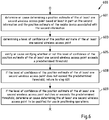
- Fig. 4 is a flowchart 400 illustrating an example of a method according to the first aspect of the present disclosure. Without limiting the scope of the invention, it is assumed in the following that server 3 (an example of the at least one first apparatus) as disclosed above with respect to system 10 of Fig. 1 performs the steps of flowchart 400. It is to be understood that any step of flowchart 400 may be performed by any one or more than one apparatus (e.g. one or more processors of server 3). It is further noted that in an alternative embodiment not shown in the figures, the steps of flowchart 400 may all or in part be performed by mobile device 2.
- server 3 obtains (or processor 31 of server 3 causes server 3 to obtain) first information representative of a distance between a mobile device and at least one of at least two first wireless access points.
- server 3 may obtain from mobile device 2 RTT information as an example of first information obtained by mobile device from any one or more of wireless access points 4.4, 4.5, or 4.6 and may determine a position estimate of mobile device 2 based thereon.
- server 3 may obtain the position estimate of mobile device 2 determined by mobile device 2 based on the RTT information obtained from any one or more of wireless access points 4.4, 4.5, or 4.6, the position estimate corresponding in this case to an example of first information.
- server 3 obtains (or processor 31 of server 3 causes server 3 to obtain) second information representative of a distance between the mobile device and at least one second wireless access point.
- server 3 may obtain (e.g. receive) from mobile device 2 RTT information obtained by mobile device 2 from wireless access point 1 representing a round trip time of a signal exchanged between mobile device 2 and wireless access point 1 and thus representing a distance between the mobile device 2 and the wireless access point 1.
- server 3 associates (or processor 31 of server 3 causes server 3 to associate) the second information with the position estimate of mobile device 2 determined at server 3 and/or at mobile device 2 based on the at least one distance between the mobile device and the at least one of at least two first wireless access points.
- server 3 may associate the second information with the position estimate by storing the second information in association with the position estimate in the database.
- mobile device 2 may in such case associate the second information with the position estimate by transmitting the second information in association with the position estimate to server 3 to be stored by server 3 in the database.
- Fig. 5 is a flowchart 500 illustrating an example of a method according to the second aspect of the present disclosure. Without limiting the scope of the invention, it is assumed in the following that mobile device 2 (an example of the at least one second apparatus) as disclosed above with respect to system 10 of Fig. 1 performs the steps of flowchart 500. It is to be understood that any step of flowchart 500 may be performed by any one or more than one apparatus (e.g. one or more processors of mobile device 2).
- mobile device 2 obtains (or processor 21 of mobile device 2 causes mobile device 2 to obtain) first information representative of a distance between the mobile device 2 and at least one of at least two first wireless access points.
- mobile device 2 may obtain from any one or more of wireless access points 4.4, 4.5, or 4.6 RTT information as an example of first information representative of a distance between mobile device 2 and the one or more of wireless access points 4.4, 4.5, or 4.6.
- mobile device 2 obtains (or processor 21 of mobile device 2 causes mobile device 2 to obtain) second information representative of a distance between the at least one second apparatus and at least one second wireless access point.
- mobile device 2 may obtain (e.g. receive) from wireless access point 1 RTT information representing a round trip time of a signal exchanged between mobile device 2 and wireless access point 1 and thus representing a distance between the mobile device 2 and the wireless access point 1.
- mobile device 2 provides (or processor 21 of mobile device 2 causes mobile device 2 to provide) the second information in association with the obtained first information and/or a position estimate obtained based on the first information as first information to be accessible by an external apparatus.
- mobile device 2 may transmit the obtained second information in association with the obtained first information to server 3 (an example of the external apparatus).
- server 3 an example of the external apparatus.
- mobile device 2 may estimate its position based on the obtained first information and may transmit a corresponding position estimate in association with the obtained second information to server 3.
- Fig. 6 is a flowchart 600 illustrating an exemplary method according to an exemplary embodiment of the present disclosure. Without limiting the scope of the invention, it is assumed in the following that server 3 as disclosed above with respect to system 10 of Fig. 1 performs the steps of flowchart 600. It is to be understood that any step of flowchart 600 may be performed by any one or more than one apparatus (e.g. one or more processors of server 3). It is further assumed without limitation that the steps of flowchart 600 are performed in combination or after the steps of flowchart 400.
- server 3 determines (or processor 31 of server 3 causes server 3 to determine) a position estimate of the at least one second wireless access point based at least in part on the second information and the position estimate of the mobile device associated with the second information. For example, server 3 may determine a position of wireless access point 1 based on three positions of mobile device 2 in the vicinity of wireless access point 1 and corresponding distances between mobile device 2 and wireless access point 1. Alternatively or in addition, server 3 may determine a position estimate of wireless access point 1 based on one or more positions of mobile device 2 and corresponding distances in combination with positions of further mobile devices and corresponding distances stored at the database of server 3.
- server 3 determines (or processor 31 of server 3 causes server 3 to determine) a level of confidence of the position estimate of the at least one second wireless access point.
- server 3 may determine the level of confidence of the position estimate of wireless access point 1 based on the number of times the position of wireless access point 1 has been determined to be within a predetermined are and/or within a statistical value, e.g. a standard deviation, of a predetermined number of estimates of the position of wireless access point 1.
- server 3 is configured to determine the level of confidence of the position estimate of the at least one second wireless access point based on the obtained level of confidence of the position estimate of the mobile device.
- the method according to the first aspect comprises a step of determining or causing determining the level of confidence of the position estimate of the at least one second wireless access point based on the obtained level of confidence of the position estimate of the mobile device.
- mobile device 2 may in addition also determine the level of confidence of the position estimate of mobile device 2, e.g. as a statistical value that may follow from the calculation of the position estimate or as an independent value.
- Mobile device 2 may in such case transmit a parameter indicative of the level of confidence in combination with the determined position estimate to server 3.
- the level of confidence may in such case be determined at server 3.
- server 3 verifies (or processor 31 of server 3 causes server 3 to verify) whether or not the level of confidence of the position estimate of wireless access point 1 exceeds a predetermined threshold. If the confidence level of the position estimate of wireless access point 1 does not exceed the predetermined threshold, the level of confidence determined in step 603 may be stored in the database in combination with the position estimate determined in step 601. Then, method 600 may return to step 601 at step 608 and perform steps 601 to 605. If again, the level of confidence of the position estimate of wireless access point 1 does not exceed the predetermined threshold server 3 may update the level of confidence previously stored in combination with the position estimate of wireless access point 1.
- server 3 determines wireless access point 1 to be qualified for use in positioning operations. For example, after being newly installed, when its position is unknown to the positioning system, a flag may be set (e.g. at the database of the server 3) for wireless access point 1 indicating that wireless access point 1 is "new" and/or "unqualified", i.e. not to be used for positioning operations of the positioning system (e.g. determining a position estimate of a mobile device moving within area 42).
- server 3 may determine wireless access point 1 to be qualified for use in positioning operations of the positioning system by setting the flag to "qualified”. Wireless access point 1 may then be used in positioning operations of determining positions of mobile devices and/or further wireless access points within area 42, the position of which are (yet) unknown and/or are associated with a confidence level below the predefined threshold.
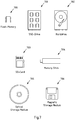
- Fig. 7 is a schematic illustration of examples of tangible and non-transitory computer-readable storage media according to the present disclosure that may for instance be used to implement memory 22 of Fig. 2 or memory 32 of Fig. 3 .
- Fig. 7 displays a flash memory 700, which may for instance be soldered or bonded to a printed circuit board, a solid-state drive 701 comprising a plurality of memory chips (e.g. Flash memory chips), a magnetic hard drive 702, a Secure Digital (SD) card 703, a Universal Serial Bus (USB) memory stick 704, an optical storage medium 705 (such as for instance a CD-ROM or DVD) and a magnetic storage medium 706.
- SD Secure Digital
- USB Universal Serial Bus
- connection in the described embodiments is to be understood in a way that the involved components are operationally coupled.
- connections can be direct or indirect with any number or combination of intervening elements, and there may be merely a functional relationship between the components.
- circuitry refers to any of the following:
- circuitry' also covers an implementation of merely a processor (or multiple processors) or section of a processor and its (or their) accompanying software and/or firmware.
- the term 'circuitry' also covers, for example, a baseband integrated circuit or applications processor integrated circuit for a mobile phone.
- Any of the processors mentioned in this text could be a processor of any suitable type.
- Any processor may comprise but is not limited to one or more microprocessors, one or more processor(s) with accompanying digital signal processor(s), one or more processor(s) without accompanying digital signal processor(s), one or more special-purpose computer chips, one or more field-programmable gate arrays (FPGAS), one or more controllers, one or more application-specific integrated circuits (ASICS), or one or more computer(s).
- FPGAS field-programmable gate arrays
- ASICS application-specific integrated circuits
- the relevant structure/hardware has been programmed in such a way to carry out the described function.
- any of the actions or steps described or illustrated herein may be implemented using executable instructions in a general-purpose or special-purpose processor and stored on a computer-readable storage medium (e.g., disk, memory, or the like) to be executed by such a processor.
- a computer-readable storage medium e.g., disk, memory, or the like
- References to 'computer-readable storage medium' should be understood to encompass specialized circuits such as FPGAs, ASICs, signal processing devices, and other devices.
- A, or B, or C, or a combination thereof or "at least one of A, B and C” may be understood to be not exhaustive and to include at least the following: (1) A, or (2) B, or (3) C, or (4) A and B, or (5) A and C, or (6) B and C, or (7) A and B and C.
Landscapes
- Engineering & Computer Science (AREA)
- Radar, Positioning & Navigation (AREA)
- Remote Sensing (AREA)
- Computer Networks & Wireless Communication (AREA)
- Physics & Mathematics (AREA)
- General Physics & Mathematics (AREA)
- Signal Processing (AREA)
- Position Fixing By Use Of Radio Waves (AREA)
Priority Applications (2)
| Application Number | Priority Date | Filing Date | Title |
|---|---|---|---|
| EP20169069.0A EP3893016A1 (fr) | 2020-04-09 | 2020-04-09 | Concept de déploiement de points d'accès sans fil pour positionnement basé sur rtt |
| US17/213,424 US20210321219A1 (en) | 2020-04-09 | 2021-03-26 | Concept of deploying wireless access points for rtt based positioning |
Applications Claiming Priority (1)
| Application Number | Priority Date | Filing Date | Title |
|---|---|---|---|
| EP20169069.0A EP3893016A1 (fr) | 2020-04-09 | 2020-04-09 | Concept de déploiement de points d'accès sans fil pour positionnement basé sur rtt |
Publications (1)
| Publication Number | Publication Date |
|---|---|
| EP3893016A1 true EP3893016A1 (fr) | 2021-10-13 |
Family
ID=70285523
Family Applications (1)
| Application Number | Title | Priority Date | Filing Date |
|---|---|---|---|
| EP20169069.0A Withdrawn EP3893016A1 (fr) | 2020-04-09 | 2020-04-09 | Concept de déploiement de points d'accès sans fil pour positionnement basé sur rtt |
Country Status (2)
| Country | Link |
|---|---|
| US (1) | US20210321219A1 (fr) |
| EP (1) | EP3893016A1 (fr) |
Families Citing this family (3)
| Publication number | Priority date | Publication date | Assignee | Title |
|---|---|---|---|---|
| US11395252B2 (en) * | 2020-07-23 | 2022-07-19 | Skyhook Wireless, Inc. | Crowd sourced RTT-based positioning |
| KR20220167080A (ko) * | 2021-06-11 | 2022-12-20 | 현대자동차주식회사 | 이종 네트워크 기반 측위 장치 및 그의 제어 방법 |
| CN118444353A (zh) * | 2023-02-03 | 2024-08-06 | 腾讯科技(深圳)有限公司 | 定位方法、装置、设备、存储介质和计算机程序产品 |
Citations (4)
| Publication number | Priority date | Publication date | Assignee | Title |
|---|---|---|---|---|
| US20070002813A1 (en) * | 2005-06-24 | 2007-01-04 | Tenny Nathan E | Apparatus and method for determining WLAN access point position |
| WO2007056738A2 (fr) * | 2005-11-07 | 2007-05-18 | Qualcomm Incorporated | Localisation dans des reseaux locaux sans fil et dans d'autres reseaux sans fil |
| US20130307723A1 (en) * | 2012-05-21 | 2013-11-21 | Qualcomm Incorporated | Method and apparatus for determining locations of access points |
| US20140187257A1 (en) * | 2013-01-03 | 2014-07-03 | Qualcomm Incorporated | Inter-ap distance estimation using crowd sourcing |
Family Cites Families (1)
| Publication number | Priority date | Publication date | Assignee | Title |
|---|---|---|---|---|
| US9560620B2 (en) * | 2014-05-05 | 2017-01-31 | Qualcomm Incorporated | Methods and systems for enhanced round trip time (RTT) exchange |
-
2020
- 2020-04-09 EP EP20169069.0A patent/EP3893016A1/fr not_active Withdrawn
-
2021
- 2021-03-26 US US17/213,424 patent/US20210321219A1/en not_active Abandoned
Patent Citations (4)
| Publication number | Priority date | Publication date | Assignee | Title |
|---|---|---|---|---|
| US20070002813A1 (en) * | 2005-06-24 | 2007-01-04 | Tenny Nathan E | Apparatus and method for determining WLAN access point position |
| WO2007056738A2 (fr) * | 2005-11-07 | 2007-05-18 | Qualcomm Incorporated | Localisation dans des reseaux locaux sans fil et dans d'autres reseaux sans fil |
| US20130307723A1 (en) * | 2012-05-21 | 2013-11-21 | Qualcomm Incorporated | Method and apparatus for determining locations of access points |
| US20140187257A1 (en) * | 2013-01-03 | 2014-07-03 | Qualcomm Incorporated | Inter-ap distance estimation using crowd sourcing |
Also Published As
| Publication number | Publication date |
|---|---|
| US20210321219A1 (en) | 2021-10-14 |
Similar Documents
| Publication | Publication Date | Title |
|---|---|---|
| US10845454B2 (en) | Checking the health of radio model data | |
| US8831507B2 (en) | Method and system for determining a position fix indoors | |
| JP6085353B2 (ja) | セル識別子情報を利用して移動端末の設定を変更する位置基盤サービス提供方法およびシステム | |
| EP3286575B1 (fr) | Prise en charge de l'utilisation de cartes radio | |
| EP3594711B1 (fr) | Détermination d'une pluralité de positions d'installation potentielles | |
| US20210321219A1 (en) | Concept of deploying wireless access points for rtt based positioning | |
| US10547983B2 (en) | Controlling radio fingerprint observation report collection | |
| WO2013103586A1 (fr) | Calcul d'emplacement de points d'accès wi-fi à l'aide d'ondes de découverte | |
| KR101297483B1 (ko) | 위치 추적 방법 및 위치 추적 시스템 | |
| EP3650881A1 (fr) | Reconfiguration d'un système de support de positionnement radio | |
| CN104956745B (zh) | 基于小基站的定位用户终端的方法和小基站控制器 | |
| KR20120087472A (ko) | 휴대용 단말기의 위치결정 시스템 및 방법 | |
| CN107277761B (zh) | 一种终端位置发送方法及装置 | |
| CN114520953A (zh) | 基于跟踪装置捕获的至少一组无线电信号观测结果确定其是否位于感兴趣区域内 | |
| US11012969B2 (en) | System and method for determining device location | |
| KR101626767B1 (ko) | 위치 측위 방법 및 이를 위한 어플리케이션 | |
| US20200103488A1 (en) | Determining a position estimate of an asset | |
| EP3552039B1 (fr) | Détection de changements d'infrastructure dans des données de signal d'opportunité | |
| JP6317285B2 (ja) | 通信システム、情報収集装置、通信方法及び情報収集装置のプログラム | |
| EP3803437A1 (fr) | Gestion de dispositifs de détection et/ou actionneurs | |
| EP4564947A1 (fr) | Procédé de positionnement et produit associé | |
| KR101636303B1 (ko) | 위치 측위 방법, 및 시스템 | |
| EP3712637A1 (fr) | Utilisation de points d'accès en double pour le positionnement | |
| KR20120010741A (ko) | 근거리 통신을 이용하는 로그정보 제공/조회 시스템, 서비스 서버 및 고객 단말기, 및 그 로그정보 제공/조회 방법 |
Legal Events
| Date | Code | Title | Description |
|---|---|---|---|
| PUAI | Public reference made under article 153(3) epc to a published international application that has entered the european phase |
Free format text: ORIGINAL CODE: 0009012 |
|
| STAA | Information on the status of an ep patent application or granted ep patent |
Free format text: STATUS: THE APPLICATION HAS BEEN PUBLISHED |
|
| AK | Designated contracting states |
Kind code of ref document: A1 Designated state(s): AL AT BE BG CH CY CZ DE DK EE ES FI FR GB GR HR HU IE IS IT LI LT LU LV MC MK MT NL NO PL PT RO RS SE SI SK SM TR |
|
| STAA | Information on the status of an ep patent application or granted ep patent |
Free format text: STATUS: REQUEST FOR EXAMINATION WAS MADE |
|
| 17P | Request for examination filed |
Effective date: 20220407 |
|
| RBV | Designated contracting states (corrected) |
Designated state(s): AL AT BE BG CH CY CZ DE DK EE ES FI FR GB GR HR HU IE IS IT LI LT LU LV MC MK MT NL NO PL PT RO RS SE SI SK SM TR |
|
| STAA | Information on the status of an ep patent application or granted ep patent |
Free format text: STATUS: EXAMINATION IS IN PROGRESS |
|
| 17Q | First examination report despatched |
Effective date: 20230628 |
|
| STAA | Information on the status of an ep patent application or granted ep patent |
Free format text: STATUS: THE APPLICATION IS DEEMED TO BE WITHDRAWN |
|
| 18D | Application deemed to be withdrawn |
Effective date: 20241101 |