EP3893444B1 - Procédé de commande d'un élément apte au knx d'un système d'automatisation du bâtiment et agencement - Google Patents
Procédé de commande d'un élément apte au knx d'un système d'automatisation du bâtiment et agencement Download PDFInfo
- Publication number
- EP3893444B1 EP3893444B1 EP21159026.0A EP21159026A EP3893444B1 EP 3893444 B1 EP3893444 B1 EP 3893444B1 EP 21159026 A EP21159026 A EP 21159026A EP 3893444 B1 EP3893444 B1 EP 3893444B1
- Authority
- EP
- European Patent Office
- Prior art keywords
- enabled
- knx
- command
- group address
- gateway device
- Prior art date
- Legal status (The legal status is an assumption and is not a legal conclusion. Google has not performed a legal analysis and makes no representation as to the accuracy of the status listed.)
- Active
Links
Images
Classifications
-
- H—ELECTRICITY
- H04—ELECTRIC COMMUNICATION TECHNIQUE
- H04L—TRANSMISSION OF DIGITAL INFORMATION, e.g. TELEGRAPHIC COMMUNICATION
- H04L12/00—Data switching networks
- H04L12/28—Data switching networks characterised by path configuration, e.g. LAN [Local Area Networks] or WAN [Wide Area Networks]
- H04L12/2803—Home automation networks
- H04L12/2816—Controlling appliance services of a home automation network by calling their functionalities
- H04L12/2818—Controlling appliance services of a home automation network by calling their functionalities from a device located outside both the home and the home network
-
- H—ELECTRICITY
- H04—ELECTRIC COMMUNICATION TECHNIQUE
- H04L—TRANSMISSION OF DIGITAL INFORMATION, e.g. TELEGRAPHIC COMMUNICATION
- H04L12/00—Data switching networks
- H04L12/28—Data switching networks characterised by path configuration, e.g. LAN [Local Area Networks] or WAN [Wide Area Networks]
- H04L12/2803—Home automation networks
- H04L12/283—Processing of data at an internetworking point of a home automation network
- H04L12/2834—Switching of information between an external network and a home network
Definitions
- the invention relates to a method for controlling a KNX-enabled element of a building automation system and an arrangement.
- Building automation systems combine several elements that serve to control different functionalities in buildings. These include, for example, air conditioning and lighting.
- a field bus system based on the KNX standard can be implemented in the building automation system, for example.
- KNX for example lighting, sun protection devices such as blinds or shading devices, but also the building heating as well as locking and alarm systems.
- KNX also enables remote monitoring and control of building automation.
- the patent specification U.S. 2020/044884 A1 discloses a multi-protocol home automation control system in which a mobile communication terminal, e.g. a smartphone, can access home automation devices via a web server.
- the home automation devices can be addressed by a device specific resource locator, DURL.
- DURL device specific resource locator
- a given example for the DURL of a KNX device is knx://0201-0001-1234/1.1.3.
- the components of the DURL correspond to a device that communicates with an individual address 1.1.3 via the KNX protocol.
- the device is accessible via a central control unit, which in turn has the identifier #0201-0001-1234.
- the object of the invention is to create a method for controlling a KNX-enabled element of a building automation system and an arrangement with which KNX-enabled elements of the building automation system can be controlled reliably and easily during operation.
- a method for controlling a KNX-enabled element of a building automation system according to independent claim 1 and an arrangement according to independent claim 13 are created for the solution. Configurations are the subject of dependent subclaims.
- a method for controlling a KNX-enabled element of a building automation system in which method a command input is received in an IP-enabled telecommunications device and an action command is provided in response to the command input in the IP-enabled telecommunications device comprising: an IP address of a gateway device connected to a building automation system implementing a KNX bus standard is; a group address that is assigned to (at least) one KNX-enabled element; and a control command for controlling the KNX-enabled element.
- the method also includes the following: transmitting the action command to the gateway device; providing group address information in the gateway device; determining whether the group address is included in the group address information; Providing a KNX command in the gateway device if the gateway device was determined to include the group address as group address information, the KNX command being designed in accordance with the KNX bus standard and at least the group address of the KNX-enabled element and the control command includes; Transmission of the KNX command from the gateway device to the KNX-enabled element in the building automation system and controlling an operating state of the KNX-enabled element according to the control command.
- an arrangement in which an IP-enabled (IP - Internet Protocol) telecommunications device, a gateway device and a KNX-enabled element are set up for: receiving a command input in the IP-enabled telecommunications device and providing an action command in response to the command input in the IP-enabled telecommunications device, the action command comprising: an IP address of the gateway device which is connected to a building automation system implementing a KNX bus standard; a group address assigned to the (at least) KNX-enabled element; and a control command for controlling the KNX-enabled element.
- IP-enabled IP - Internet Protocol
- the elements of the arrangement are set up for: transmitting the action command to the gateway device; providing group address information in the gateway device; determining whether the group address is included in the group address information; Providing a KNX command in the gateway device if the gateway device was determined to include the group address as group address information, the KNX command being designed in accordance with the KNX bus standard and at least the group address of the KNX-enabled element and the control command includes; Transmission of the KNX command from the gateway device to the KNX-enabled element in the building automation system and controlling an operating state of the KNX-enabled element according to the control command.
- the gateway device is provided for this purpose, which translates action commands provided in the IP-enabled telecommunications device, which can be generated directly in this, into the KNX bus standard, so that the control command comprised by the action command is transmitted by the KNX-enabled element of the building automation system is finally carried out during operation.
- lighting can be switched on or off in this way.
- Something similar can be provided in connection with switching a building heating system on or off.
- any function of the building automation system can be controlled by entering commands on the IP-enabled telecommunications device using the proposed technology.
- the data communication between the provided elements of the arrangement can include wired and/or wireless data communication.
- the envisaged structure of the action command enables the gateway device, on the one hand, to assign the received action command to the KNX-enabled element of the building automation system and, on the other hand, to convert the control command in such a way that it can finally be executed by the KNX-enabled element.
- the group address information can be provided in the gateway device, for example, as an assignment between several group addresses on the one hand and KNX-enabled elements on the other hand, be it in a local memory or for retrieval from a central memory, for example in a server device .
- the group address information can include one or more lookup tables.
- a group address can be assigned to one or more KNX-enabled elements. If several KNX-capable elements are assigned to one (individual or common) group address, these can be controlled using the action command. If only one KNX-enabled element is assigned to a group address, this will be controlled using an action command.
- the gateway device can evaluate additional information that indicates the affiliation of the group address (ie the associated KNX-enabled element) to the building automation system.
- the IP-enabled telecommunications device has one or more processors and a storage device that can be used for data processing. For this purpose, one or more software applications are implemented on the IP-enabled telecommunications device.
- the action command can also be provided in the IP-enabled telecommunication device, comprising a port identification, which specifies an access port of a web server that is implemented in the gateway device, and upon receiving the action command in the gateway Setup is accessed via the access port on the web server.
- the port identification specifies which port is to be used to access the web server in the gateway device, i.e. which port is provided for this purpose.
- Various web servers can be implemented in the gateway device: (i) a KNX web server for receiving the action command to an input port of the gateway device and (ii) another web server for access to a web interface Gateway setup and for accessing files for control via a navigation menu via another input port.
- the command input may be received at an IP enabled phone and the action command may be provided at the IP enabled phone in response thereto.
- the command input can relate to a KNX-enabled element of the building automation system in the room in which the IP-enabled telephone is arranged.
- a user can, for example, control the lighting and/or the heating in the room of the building where the phone is located.
- the following can also be provided in the IP-enabled telecommunications device: receiving the command input via a function key of the IP-enabled telecommunications device and determining a control command which is assigned to the function key.
- the input via the function key can be initiated by a user.
- Function keys on the IP-enabled telecommunications device can be assigned to different Way are provided, be it by means of a button device and / or touch-sensitive surfaces on a touch-sensitive display.
- the IP-enabled telecommunications device can be set up to receive voice inputs from the user via a user interface.
- an action command associated with the command input (the function key) is determined.
- command input can relate to turning on or off a light or a heater.
- Light protection devices on building windows can also be operated in this way.
- voice input this is evaluated to determine a user command (control command) contained therein.
- the following can be provided: providing assignment data in a storage device that is connected to the IP-enabled telecommunications device, the assignment data for the KNX-enabled element and another KNX-enabled element of the building automation system being an assignment between different action commands and function keys view the IP-enabled telecommunications device; and determining, from among the various action commands, an action command that is associated with the function key through which the command input is received.
- the assignment data are stored in a storage device that can be part of the IP-enabled telecommunications device or formed separately from it, for example in a central server device.
- a number of function keys are available, it being possible for one or more action commands to be assigned to each of the function keys. If several action commands are assigned to one and the same function key, the action command determined as a reaction can depend, for example, on whether the function key was operated once or several times.
- the following can be provided in the method: Receiving an assignment input in the IP-enabled telecommunications device, which for the KNX-enabled element and the further KNX-enabled element of the building automation system the assignment between the various action commands and the function keys of the IP-enabled indicates telecommunications facility; and generating the mapping data.
- the association input which may be received from a user or a remote server facility, is used to customize the association data. It can be provided that on receiving the assignment input, an existing assignment between the KNX-enabled elements and the action commands partially or is completely changed. In this way, it is possible to generate and optionally change the assignment data depending on the situation and operation.
- Receiving the command input and/or the association input may include: receiving a command input and/or an association input by a user via a graphical user interface of the IP-enabled telecommunication device.
- the graphical user interface can be provided, for example, on a display of the IP-enabled telecommunications device and enables the user to enter the command and/or the assignment input and thus configure the assignment data and control the KNX-enabled element.
- Receiving the command input may further include: detecting sensor signals using a sensor device; Providing control data in response to the detected sensor signals in the IP-enabled telecommunications device and generating the action command in response to the control data in the IP-enabled telecommunications device.
- the command input which leads to the provision of the action command in the IP-enabled telecommunications device, is triggered by control data which were derived from sensor signals which were previously detected using a sensor device. In this way, the control of the KNX-enabled element in the building automation system can take place automatically depending on the sensor signals.
- it can be a light-sensitive sensor that supplies sensor signals that indicate a brightness state in a room in the building, whereupon the room lighting is set using the controller of the KNX-enabled element.
- a temperature sensor can be used.
- Other sensors can also be provided, for example a humidity sensor.
- a proximity sensor can be provided, which can be arranged on the IP-enabled telecommunications device or separately from it.
- the proximity sensor can be set up to detect the approach and optionally the distance of a person in relation to the sensor device, whereupon the control data and the action command are provided, for example for switching a light on or off.
- control data can be stored, which is an assignment between sensor signals and control data to be derived therefrom, on the other hand, so that the determination and provision of the control data can take place on the receipt of the sensor signals using the stored further assignment data.
- control data can then be assigned to one or more action commands, so that finally one or more action commands are assigned to certain detected sensor signals.
- sensor signals can be recorded using an internal sensor device that is included in the IP-enabled telecommunications device.
- sensor signals can be recorded by means of an external sensor device, which is formed separately from the IP-enabled telecommunications device and is connected to it for signal transmission.
- an external sensor device is provided here, which is arranged separately from the IP-enabled telecommunications device.
- it can be a sensor somewhere in a room in the building, for which, for example, light or temperature is to be regulated.
- the external sensor device can be arranged in a light switch box, be it in a flush-mounted or surface-mounted installation.
- the KNX-capable element Upon receipt of the KNX command, the KNX-capable element can generate a response message and send it to the gateway device, which optionally sends or forwards the response message to the IP-capable telecommunications device.
- the response message can include status information that displays the current status of the KNX-enabled element after the control command has been executed. Provision can be made for the response message to be evaluated in the IP-enabled telecommunications device and for an optical and/or acoustic output to be produced via an output device in the IP-enabled telecommunications device, which data indicates the current status of the KNX-enabled element.
- the action command and/or the various action commands can each be in the form of an HTTP request (HTTP—Hypertext Transfer Protocol).
- HTTP Hypertext Transfer Protocol
- the action command can be a so-called URL (uniform Resource pointer) be designed accordingly.
- URL Uniform Resource pointer
- other network protocols can be used.
- the IP-enabled telecommunications device can be designed with a mobile radio base station (for example 5G NR) or a DECT base station (DECT— Digital Enhanced Cordless Telecommunications).
- the DECT base station receives a command or request via/from a DECT-enabled (mobile) component and then sends an HTTP request to the network, i.e. to the gateway device.
- the external sensor device can itself be an IP-enabled sensor device, which can provide and transmit HTTP requests wirelessly or with a cable.
- the external sensor device can have a Bluetooth (beacons) DECT gateway.
- the beacons / Bluetooth technology known as such is also used for locating devices or tracking (location).
- DECT-enabled components can be set up to send beacons or Bluetooth signals. These are converted into DECT signals by a beacons gateway, and a DECT base station can then send HTTP requests to the gateway device in order to control the KNX-enabled element, for example switching a system or a light switch.
- the IP-enabled telecommunications device can be set up to output audio and/or video data for user information ("public announcement") via an acoustic/optical output device. For example, it can be provided that such a voice or image output takes place when a sensor device connected to the IP-enabled telecommunications device transmits sensor signals that indicate a dangerous situation, for example a smoke or fire alarm.
- Encryption of the data to be transmitted can be used when transmitting the action command from the IP-enabled telecommunications device to the gateway device and/or when transmitting the KNX command from the gateway device to the KNX-enabled element. Provision can be made for the gateway device to be set up to decrypt encrypted data received from the KNX-enabled element and to translate the decrypted data into an IP protocol in order to then send them to the IP-enabled according to the IP protocol to send telecommunications equipment. Encryption techniques are known as such in various embodiments.
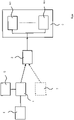
- the figure shows a schematic representation of an arrangement with an IP-enabled telecommunications device 1, a gateway device 2 and a building automation system 3 connected thereto are used to control different functionalities of building automation, for example in connection with controlling lighting and/or heating.
- the KNX bus standard is implemented here for data exchange in the building automation system 3 . This standard is known as such.
- the gateway device 2 makes it possible to control any functions of the KNX-enabled elements 4.1, . . . , 4.n in the building automation system 3 by entering commands on the IP-enabled telecommunications device 1.
- the command can be entered in particular with the help of a user input on the IP-enabled telecommunication device 1, for example by user input via a function key on the IP-enabled telecommunication device 1.
- function keys can be provided as buttons and/or touch-sensitive surfaces on a display on the IP-enabled telecommunication device be.
- One or more action commands are assigned to each of the function keys, and the assignment can consist in the function key being assigned an individual control command for one or more of the KNX-enabled elements 4.1, . . . , 4.n.
- the function button is also assigned a group address that belongs to the KNX-enabled element that is to be controlled by pressing the function button.
- Corresponding allocation data can be stored in a memory device 5, which is formed as the IP-enabled telecommunications device 1 or separately from it.
- IP-enabled telecommunications device 1 which can be an IP telephone, for example, an action command is provided which is stored in the IP-enabled telecommunications device 1 or in a server device (not shown) can be generated.
- the action command includes the following components: IP address of the gateway device 2, a group address of a KNX-enabled element and a control command for controlling the KNX-enabled element.
- the action command can also be provided in the IP-enabled telecommunication device 1 including a port identification, which specifies an access port of a web server that is implemented in the gateway device 2 .
- the web server is accessed in the gateway device 2 via the access port.
- the port identification indicates which port is to be used for accessing the web server in the gateway device 2, ie which port is provided for this purpose.
- the gateway device 2 Upon receiving the action command, which can be executed, for example, with an HTTP request, the gateway device 2 checks, based on electronic information about the building automation system 3, which are provided in the gateway device 2, whether in the action -Command identified KNX-enabled element is part of the KNX-enabled elements 4.1,..., 4.n of the building automation system 3. If this is the case, the action command is converted by the gateway device 2 into a KNX command according to the KNX bus standard and transmitted to the KNX-enabled element identified in the action command, in order to then execute the control command there, i.e. to switch the lighting or the heating on or off, for example.
- the command input is received at the IP-enabled telecommunications device 1 in the form of control data that was generated in response to sensor signals from a sensor device 6 .
- different physical parameters can be detected, for example brightness and/or temperature.
- the sensor device 6 can be part of the IP-enabled telecommunications device 1 or formed separately from it.
- IP-enabled telecommunications devices 7 can be provided and the IP-enabled telecommunications device 1 for controlling the KNX-enabled elements 4.1, . . . , 4.n can be integrated and used in a comparable manner.
- a further embodiment variant can provide voice control.
- Voice command inputs can be received via the IP-enabled telecommunication device 1, for example an IP-enabled telephone, a DECT-enabled mobile component or an external sensor device, which can have a microphone.
Landscapes
- Engineering & Computer Science (AREA)
- Automation & Control Theory (AREA)
- Computer Networks & Wireless Communication (AREA)
- Signal Processing (AREA)
- Computing Systems (AREA)
- Selective Calling Equipment (AREA)
- Data Exchanges In Wide-Area Networks (AREA)
- Computer And Data Communications (AREA)
- Telephonic Communication Services (AREA)
Claims (13)
- Procédé de commande d'un élément compatible KNX d'un système d'automatisation de bâtiment (3), comprenant de :- recevoir une entrée de commande dans un dispositif de télécommunications compatible IP (1) ;- fournir une commande d'action en réponse à l'entrée de commande dans le dispositif de télécommunications compatible IP (1), dans lequel la commande d'action comprend :- une adresse IP d'un dispositif de passerelle (2) qui est connecté à un système d'automatisation de bâtiment (3), dans lequel une norme de bus KNX est implémentée ;- une adresse de groupe attribuée à un élément compatible KNX ; et- une instruction de commande pour commander l'élément compatible KNX ;- transmettre la commande d'action au dispositif passerelle (2) ;- fournir des informations d'adresse de groupe dans le dispositif passerelle (2) ;- déterminer si l'adresse de groupe est comprise dans les informations d'adresse de groupe ;- fournir une commande KNX dans le dispositif de passerelle (2), si le dispositif de passerelle (2) a déterminé l'adresse de groupe comme étant composée d'informations d'adresse de groupe, dans lequel la commande KNX est conçue conformément à la norme de bus KNX et comprend au moins l'adresse de groupe de l'élément compatible KNX et l'instruction de commande ;- transmettre la commande KNX du dispositif de passerelle (2) à l'élément compatible KNX dans le système d'automatisation du bâtiment (3) et- commander un état de fonctionnement de l'élément compatible KNX conformément à l'instruction de commande.
- Procédé selon la revendication 1, caractérisé en ce que la commande d'action dans le dispositif de télécommunications compatible IP (1) est en outre pourvue d'un identifiant de port, qui spécifie un port d'accès d'un serveur Web, qui est implémenté dans le dispositif de passerelle (2), et la réception de la commande d'action dans le dispositif de passerelle (2) est accessible via le port d'accès sur le serveur Web.
- Procédé selon la revendication 1 ou 2, caractérisé en ce que l'entrée de commande est reçue dans un téléphone compatible IP et la commande d'action est fournie en réponse à celle-ci dans le téléphone compatible IP.
- Procédé selon au moins une des revendications précédentes, caractérisé en ce que dans le dispositif de télécommunications compatible IP (1) il est également prévu de :- recevoir l'entrée de commande via une touche de fonction du dispositif de télécommunication compatible IP (1) ; et- déterminer une instruction de commande, qui est affectée à la touche de fonction.
- Procédé selon la revendication 4, caractérisé en ce qu'il est également prévu de :- fournir des données d'affectation dans un dispositif de stockage qui est connecté au dispositif de télécommunication compatible IP (1), dans lequel les données d'affectation pour l'élément compatible KNX et un autre élément compatible KNX du système d'automatisation de bâtiment (3) affichent une affectation entre les différentes commandes d'action et les touches de fonction du dispositif de télécommunications compatible IP (1) ; et- déterminer une commande d'action à partir des différentes commandes d'action, qui est affectée à la touche de fonction, via laquelle l'entrée de commande est reçue.
- Procédé selon la revendication 5, caractérisé en ce qu'il est également prévu de :- recevoir une entrée d'attribution dans le dispositif de télécommunications compatible IP (1), qui, pour l'élément compatible KNX et l'autre élément compatible KNX du système d'automatisation de bâtiment (3), affiche l'attribution entre les diverses commandes d'action et les touches de fonction du dispositif de télécommunications compatible IP (1) indique ; et- générer des données cartographiques.
- Procédé selon au moins une des revendications précédentes, caractérisé en ce que la réception de l'entrée de commande et/ou de l'entrée d'association comprend de : recevoir une entrée de commande et/ou une entrée d'association par un utilisateur via une interface d'utilisateur graphique du dispositif de télécommunication compatible IP (1).
- Procédé selon au moins une des revendications précédentes, caractérisé en ce que la réception de l'entrée de commande comprend de :- détecter des signaux de capteur au moyen d'un dispositif de capteur (6) ;- fournir des données de commande en réponse aux signaux de capteur détectés dans le dispositif de télécommunication compatible IP (1) et- générer la commande d'action en réponse aux données de commande dans le dispositif de télécommunications compatible IP (1).
- Procédé selon la revendication 8, caractérisé en ce que lors de la détection, des signaux de capteur sont enregistrés au moyen d'un dispositif de capteur interne qui est compris dans le dispositif de télécommunication compatible IP (1).
- Procédé selon la revendication 8 ou 9, caractérisé en ce que pendant la détection, des signaux de capteur sont détectés au moyen d'un dispositif de capteur externe qui est formé séparément du dispositif de télécommunication compatible IP (1) et qui lui est connecté pour la transmission de signaux.
- Procédé selon au moins une des revendications précédentes, caractérisé en ce que la commande d'action et/ou les différentes commandes d'action sont formées respectivement sous la forme d'une requête HTTP.
- Procédé selon au moins une des revendications précédentes, caractérisé en ce que l'élément compatible KNX génère un message de réponse lors de la réception de la commande KNX et l'envoie au dispositif de passerelle (2).
- Agencement dans lequel un dispositif de télécommunications compatible IP (1), un dispositif de passerelle (2) et un élément compatible KNX sont configurés pour :- recevoir une entrée de commande dans un dispositif de télécommunications compatible IP (1) ;- fournir une commande d'action en réponse à l'entrée de commande dans le dispositif de télécommunications compatible IP (1), dans lequel la commande d'action comprend :- une adresse IP d'un dispositif de passerelle (2) qui est connecté à un système d'automatisation de bâtiment (3), dans lequel une norme de bus KNX est implémentée ;- une adresse de groupe attribuée à un élément compatible KNX ; et- une instruction de commande pour commander l'élément compatible KNX ;- transmettre la commande d'action au dispositif passerelle (2) ;- fournir des informations d'adresse de groupe dans le dispositif passerelle (2) ;- déterminer si l'adresse de groupe est comprise dans les informations d'adresse de groupe ;- fournir une commande KNX dans le dispositif de passerelle (2), si le dispositif de passerelle (2) a déterminé l'adresse de groupe comme étant composée d'informations d'adresse de groupe, dans lequel la commande KNX est conçue conformément à la norme de bus KNX et comprend au moins l'adresse de groupe de l'élément compatible KNX et l'instruction de commande ;- transmettre la commande KNX du dispositif de passerelle (2) à l'élément compatible KNX dans le système d'automatisation du bâtiment (3) et- commander un état de fonctionnement de l'élément compatible KNX conformément à l'instruction de commande.
Applications Claiming Priority (1)
| Application Number | Priority Date | Filing Date | Title |
|---|---|---|---|
| DE102020109672.0A DE102020109672A1 (de) | 2020-04-07 | 2020-04-07 | Verfahren zum Steuern eines KNX-fähigen Elements eines Gebäudeautomatisierungssystems und Anordnung |
Publications (2)
| Publication Number | Publication Date |
|---|---|
| EP3893444A1 EP3893444A1 (fr) | 2021-10-13 |
| EP3893444B1 true EP3893444B1 (fr) | 2022-07-20 |
Family
ID=74758496
Family Applications (1)
| Application Number | Title | Priority Date | Filing Date |
|---|---|---|---|
| EP21159026.0A Active EP3893444B1 (fr) | 2020-04-07 | 2021-02-24 | Procédé de commande d'un élément apte au knx d'un système d'automatisation du bâtiment et agencement |
Country Status (3)
| Country | Link |
|---|---|
| EP (1) | EP3893444B1 (fr) |
| DE (1) | DE102020109672A1 (fr) |
| ES (1) | ES2928727T3 (fr) |
Family Cites Families (4)
| Publication number | Priority date | Publication date | Assignee | Title |
|---|---|---|---|---|
| DE102011077012A1 (de) | 2011-06-06 | 2012-12-06 | S. Siedle & Söhne Telefon- und Telegrafenwerke OHG | Vorrichtung und Verfahren zur skriptgesteuerten Datenverarbeitung von Daten für ein Hauskommunikations- oder Hausautomationssystem |
| FR3061390B1 (fr) * | 2016-12-28 | 2022-12-16 | Overkiz | Procede de configuration, de controle ou de supervision d’une installation domotique |
| CN106850359B (zh) * | 2016-12-30 | 2019-11-12 | 中科同德(北京)生态科技有限公司 | 一种智能网关的knx控制模块及信号处理方法 |
| DE102017215125A1 (de) | 2017-08-30 | 2019-02-28 | Tridonic Gmbh & Co Kg | Kommunikationsmodul und Beleuchtungs-Bussystem mit Netzwerkschnittstelle |
-
2020
- 2020-04-07 DE DE102020109672.0A patent/DE102020109672A1/de not_active Withdrawn
-
2021
- 2021-02-24 EP EP21159026.0A patent/EP3893444B1/fr active Active
- 2021-02-24 ES ES21159026T patent/ES2928727T3/es active Active
Also Published As
| Publication number | Publication date |
|---|---|
| EP3893444A1 (fr) | 2021-10-13 |
| ES2928727T3 (es) | 2022-11-22 |
| DE102020109672A1 (de) | 2021-10-07 |
Similar Documents
| Publication | Publication Date | Title |
|---|---|---|
| DE602004007534T2 (de) | Verfahren und anordnung zum zuweisen von namen zu einrichtungen in einem netzwerk | |
| EP3172882B1 (fr) | Établissement d'une connexion sans fil avec un véhicule | |
| EP3705955B1 (fr) | Procédé de communication sécurisée entre un appareil de terrain de la technique de l'automatisation et un terminal ainsi que système de communication sécurisée entre un appareil de terrain et un terminal | |
| EP1175755B1 (fr) | Systeme d'echange de donnees comportant un element mobile pour commander des consommateurs | |
| DE10000609B4 (de) | Schnittstellengerät für eine Datenverbindung zwischen einem Elektro-Installationssystem und einem Komminikationssystem sowie damit ausgestattetes Elektro-Installationssystem | |
| DE102014105075A1 (de) | Verfahren und Kommunikationsanordnung zur Datenkommunikation | |
| EP4092573B1 (fr) | Affectation d'adresse et configuration des composants d'un système d'éclairage au moyen des transpondeurs | |
| DE102018129595A1 (de) | Verfahren zum Identifizieren eines Feldgeräts | |
| EP3416337B1 (fr) | Dispositif d'automatisation d'une maison ou d'un bâtiment | |
| EP3861412B1 (fr) | Dispositif agrégateur pour un accès unifié à une pluralité de segments de réseau d'un système de bus de terrain | |
| DE60031291T2 (de) | Tragbare telekommunikationsvorichtung zur steuerung eines elektronischen gebrauchsgerätes | |
| DE112004000055T5 (de) | Fernsteuerungseinrichtung, Fernsteuerungsverfahren und ferngesteuertes Gerät | |
| EP3893444B1 (fr) | Procédé de commande d'un élément apte au knx d'un système d'automatisation du bâtiment et agencement | |
| EP3635987A1 (fr) | Configuration de protection de données pour appareils électroniques dans un réseau | |
| DE112004000056T5 (de) | Fernsteuerungseinrichtung, Fernsteuerungsverfahren und ferngesteuertes Gerät | |
| EP3673642B1 (fr) | Procédé de désactivation de canaux de commande | |
| CN100433681C (zh) | 一种家庭智能网络控制系统及家庭智能网络控制方法 | |
| DE102014210000A1 (de) | Vorortbedienung von Geräten eines Installationsbuses | |
| WO2022089926A1 (fr) | Couplage d'un appareil électroménager à un dispositif mobile | |
| EP3116167A1 (fr) | Contrôle de pièce à l'aide de capteurs d'un smartphone | |
| EP3696985B1 (fr) | Agencement audio doté d'une radio encastré et d'au moins un haut-parleur ainsi que procédé correspondant | |
| EP4136824A1 (fr) | Dispositif destiné à être utilisé dans l'internet des objets | |
| DE60114350T2 (de) | Vorrichtung und Verfahren zur Abstandssteuerung von Haushaltsgeräten | |
| DE102006010379A1 (de) | Vorrichtung und Verfahren zum Steuern und/oder Abfragen von Endgeräten über ein Mobilfunknetz | |
| EP3825792B1 (fr) | Procédé de commande d'au moins un actionneur d'un système domotique et/ou de génération et/ou de transmission d'au moins un message de commande à au moins un actionneur du système domotique à l'aide d'un dispositif d'actionnement, système, utilisation d'un dispositif d'actionnement, d'un agencement de capteur ou d'un agencement de commande, programme informatique et support lisible par ordinateur |
Legal Events
| Date | Code | Title | Description |
|---|---|---|---|
| PUAI | Public reference made under article 153(3) epc to a published international application that has entered the european phase |
Free format text: ORIGINAL CODE: 0009012 |
|
| STAA | Information on the status of an ep patent application or granted ep patent |
Free format text: STATUS: REQUEST FOR EXAMINATION WAS MADE |
|
| 17P | Request for examination filed |
Effective date: 20210820 |
|
| AK | Designated contracting states |
Kind code of ref document: A1 Designated state(s): AL AT BE BG CH CY CZ DE DK EE ES FI FR GB GR HR HU IE IS IT LI LT LU LV MC MK MT NL NO PL PT RO RS SE SI SK SM TR |
|
| GRAP | Despatch of communication of intention to grant a patent |
Free format text: ORIGINAL CODE: EPIDOSNIGR1 |
|
| STAA | Information on the status of an ep patent application or granted ep patent |
Free format text: STATUS: GRANT OF PATENT IS INTENDED |
|
| INTG | Intention to grant announced |
Effective date: 20220316 |
|
| GRAS | Grant fee paid |
Free format text: ORIGINAL CODE: EPIDOSNIGR3 |
|
| GRAA | (expected) grant |
Free format text: ORIGINAL CODE: 0009210 |
|
| STAA | Information on the status of an ep patent application or granted ep patent |
Free format text: STATUS: THE PATENT HAS BEEN GRANTED |
|
| AK | Designated contracting states |
Kind code of ref document: B1 Designated state(s): AL AT BE BG CH CY CZ DE DK EE ES FI FR GB GR HR HU IE IS IT LI LT LU LV MC MK MT NL NO PL PT RO RS SE SI SK SM TR |
|
| REG | Reference to a national code |
Ref country code: CH Ref legal event code: EP |
|
| REG | Reference to a national code |
Ref country code: DE Ref legal event code: R096 Ref document number: 502021000076 Country of ref document: DE |
|
| REG | Reference to a national code |
Ref country code: AT Ref legal event code: REF Ref document number: 1506280 Country of ref document: AT Kind code of ref document: T Effective date: 20220815 |
|
| REG | Reference to a national code |
Ref country code: IE Ref legal event code: FG4D Free format text: LANGUAGE OF EP DOCUMENT: GERMAN |
|
| REG | Reference to a national code |
Ref country code: LT Ref legal event code: MG9D |
|
| REG | Reference to a national code |
Ref country code: ES Ref legal event code: FG2A Ref document number: 2928727 Country of ref document: ES Kind code of ref document: T3 Effective date: 20221122 |
|
| REG | Reference to a national code |
Ref country code: NL Ref legal event code: MP Effective date: 20220720 |
|
| PG25 | Lapsed in a contracting state [announced via postgrant information from national office to epo] |
Ref country code: SE Free format text: LAPSE BECAUSE OF FAILURE TO SUBMIT A TRANSLATION OF THE DESCRIPTION OR TO PAY THE FEE WITHIN THE PRESCRIBED TIME-LIMIT Effective date: 20220720 Ref country code: RS Free format text: LAPSE BECAUSE OF FAILURE TO SUBMIT A TRANSLATION OF THE DESCRIPTION OR TO PAY THE FEE WITHIN THE PRESCRIBED TIME-LIMIT Effective date: 20220720 Ref country code: PT Free format text: LAPSE BECAUSE OF FAILURE TO SUBMIT A TRANSLATION OF THE DESCRIPTION OR TO PAY THE FEE WITHIN THE PRESCRIBED TIME-LIMIT Effective date: 20221121 Ref country code: NO Free format text: LAPSE BECAUSE OF FAILURE TO SUBMIT A TRANSLATION OF THE DESCRIPTION OR TO PAY THE FEE WITHIN THE PRESCRIBED TIME-LIMIT Effective date: 20221020 Ref country code: NL Free format text: LAPSE BECAUSE OF FAILURE TO SUBMIT A TRANSLATION OF THE DESCRIPTION OR TO PAY THE FEE WITHIN THE PRESCRIBED TIME-LIMIT Effective date: 20220720 Ref country code: LV Free format text: LAPSE BECAUSE OF FAILURE TO SUBMIT A TRANSLATION OF THE DESCRIPTION OR TO PAY THE FEE WITHIN THE PRESCRIBED TIME-LIMIT Effective date: 20220720 Ref country code: LT Free format text: LAPSE BECAUSE OF FAILURE TO SUBMIT A TRANSLATION OF THE DESCRIPTION OR TO PAY THE FEE WITHIN THE PRESCRIBED TIME-LIMIT Effective date: 20220720 Ref country code: FI Free format text: LAPSE BECAUSE OF FAILURE TO SUBMIT A TRANSLATION OF THE DESCRIPTION OR TO PAY THE FEE WITHIN THE PRESCRIBED TIME-LIMIT Effective date: 20220720 |
|
| PG25 | Lapsed in a contracting state [announced via postgrant information from national office to epo] |
Ref country code: PL Free format text: LAPSE BECAUSE OF FAILURE TO SUBMIT A TRANSLATION OF THE DESCRIPTION OR TO PAY THE FEE WITHIN THE PRESCRIBED TIME-LIMIT Effective date: 20220720 Ref country code: IS Free format text: LAPSE BECAUSE OF FAILURE TO SUBMIT A TRANSLATION OF THE DESCRIPTION OR TO PAY THE FEE WITHIN THE PRESCRIBED TIME-LIMIT Effective date: 20221120 Ref country code: HR Free format text: LAPSE BECAUSE OF FAILURE TO SUBMIT A TRANSLATION OF THE DESCRIPTION OR TO PAY THE FEE WITHIN THE PRESCRIBED TIME-LIMIT Effective date: 20220720 Ref country code: GR Free format text: LAPSE BECAUSE OF FAILURE TO SUBMIT A TRANSLATION OF THE DESCRIPTION OR TO PAY THE FEE WITHIN THE PRESCRIBED TIME-LIMIT Effective date: 20221021 |
|
| REG | Reference to a national code |
Ref country code: DE Ref legal event code: R097 Ref document number: 502021000076 Country of ref document: DE |
|
| PG25 | Lapsed in a contracting state [announced via postgrant information from national office to epo] |
Ref country code: SM Free format text: LAPSE BECAUSE OF FAILURE TO SUBMIT A TRANSLATION OF THE DESCRIPTION OR TO PAY THE FEE WITHIN THE PRESCRIBED TIME-LIMIT Effective date: 20220720 Ref country code: RO Free format text: LAPSE BECAUSE OF FAILURE TO SUBMIT A TRANSLATION OF THE DESCRIPTION OR TO PAY THE FEE WITHIN THE PRESCRIBED TIME-LIMIT Effective date: 20220720 Ref country code: DK Free format text: LAPSE BECAUSE OF FAILURE TO SUBMIT A TRANSLATION OF THE DESCRIPTION OR TO PAY THE FEE WITHIN THE PRESCRIBED TIME-LIMIT Effective date: 20220720 Ref country code: CZ Free format text: LAPSE BECAUSE OF FAILURE TO SUBMIT A TRANSLATION OF THE DESCRIPTION OR TO PAY THE FEE WITHIN THE PRESCRIBED TIME-LIMIT Effective date: 20220720 |
|
| PLBE | No opposition filed within time limit |
Free format text: ORIGINAL CODE: 0009261 |
|
| STAA | Information on the status of an ep patent application or granted ep patent |
Free format text: STATUS: NO OPPOSITION FILED WITHIN TIME LIMIT |
|
| PG25 | Lapsed in a contracting state [announced via postgrant information from national office to epo] |
Ref country code: SK Free format text: LAPSE BECAUSE OF FAILURE TO SUBMIT A TRANSLATION OF THE DESCRIPTION OR TO PAY THE FEE WITHIN THE PRESCRIBED TIME-LIMIT Effective date: 20220720 Ref country code: EE Free format text: LAPSE BECAUSE OF FAILURE TO SUBMIT A TRANSLATION OF THE DESCRIPTION OR TO PAY THE FEE WITHIN THE PRESCRIBED TIME-LIMIT Effective date: 20220720 |
|
| 26N | No opposition filed |
Effective date: 20230421 |
|
| PG25 | Lapsed in a contracting state [announced via postgrant information from national office to epo] |
Ref country code: AL Free format text: LAPSE BECAUSE OF FAILURE TO SUBMIT A TRANSLATION OF THE DESCRIPTION OR TO PAY THE FEE WITHIN THE PRESCRIBED TIME-LIMIT Effective date: 20220720 |
|
| PG25 | Lapsed in a contracting state [announced via postgrant information from national office to epo] |
Ref country code: SI Free format text: LAPSE BECAUSE OF FAILURE TO SUBMIT A TRANSLATION OF THE DESCRIPTION OR TO PAY THE FEE WITHIN THE PRESCRIBED TIME-LIMIT Effective date: 20220720 |
|
| PG25 | Lapsed in a contracting state [announced via postgrant information from national office to epo] |
Ref country code: MC Free format text: LAPSE BECAUSE OF FAILURE TO SUBMIT A TRANSLATION OF THE DESCRIPTION OR TO PAY THE FEE WITHIN THE PRESCRIBED TIME-LIMIT Effective date: 20220720 |
|
| REG | Reference to a national code |
Ref country code: BE Ref legal event code: MM Effective date: 20230228 |
|
| PG25 | Lapsed in a contracting state [announced via postgrant information from national office to epo] |
Ref country code: LU Free format text: LAPSE BECAUSE OF NON-PAYMENT OF DUE FEES Effective date: 20230224 |
|
| REG | Reference to a national code |
Ref country code: IE Ref legal event code: MM4A |
|
| PG25 | Lapsed in a contracting state [announced via postgrant information from national office to epo] |
Ref country code: IE Free format text: LAPSE BECAUSE OF NON-PAYMENT OF DUE FEES Effective date: 20230224 |
|
| PG25 | Lapsed in a contracting state [announced via postgrant information from national office to epo] |
Ref country code: BE Free format text: LAPSE BECAUSE OF NON-PAYMENT OF DUE FEES Effective date: 20230228 |
|
| PGFP | Annual fee paid to national office [announced via postgrant information from national office to epo] |
Ref country code: ES Payment date: 20240307 Year of fee payment: 4 |
|
| PGFP | Annual fee paid to national office [announced via postgrant information from national office to epo] |
Ref country code: DE Payment date: 20240229 Year of fee payment: 4 Ref country code: CH Payment date: 20240301 Year of fee payment: 4 |
|
| PGFP | Annual fee paid to national office [announced via postgrant information from national office to epo] |
Ref country code: IT Payment date: 20240229 Year of fee payment: 4 Ref country code: FR Payment date: 20240223 Year of fee payment: 4 |
|
| PG25 | Lapsed in a contracting state [announced via postgrant information from national office to epo] |
Ref country code: BG Free format text: LAPSE BECAUSE OF FAILURE TO SUBMIT A TRANSLATION OF THE DESCRIPTION OR TO PAY THE FEE WITHIN THE PRESCRIBED TIME-LIMIT Effective date: 20220720 |
|
| PG25 | Lapsed in a contracting state [announced via postgrant information from national office to epo] |
Ref country code: BG Free format text: LAPSE BECAUSE OF FAILURE TO SUBMIT A TRANSLATION OF THE DESCRIPTION OR TO PAY THE FEE WITHIN THE PRESCRIBED TIME-LIMIT Effective date: 20220720 |
|
| PGFP | Annual fee paid to national office [announced via postgrant information from national office to epo] |
Ref country code: AT Payment date: 20250417 Year of fee payment: 5 |
|
| PG25 | Lapsed in a contracting state [announced via postgrant information from national office to epo] |
Ref country code: CY Free format text: LAPSE BECAUSE OF FAILURE TO SUBMIT A TRANSLATION OF THE DESCRIPTION OR TO PAY THE FEE WITHIN THE PRESCRIBED TIME-LIMIT; INVALID AB INITIO Effective date: 20210224 |
|
| PG25 | Lapsed in a contracting state [announced via postgrant information from national office to epo] |
Ref country code: HU Free format text: LAPSE BECAUSE OF FAILURE TO SUBMIT A TRANSLATION OF THE DESCRIPTION OR TO PAY THE FEE WITHIN THE PRESCRIBED TIME-LIMIT; INVALID AB INITIO Effective date: 20210224 |
|
| REG | Reference to a national code |
Ref country code: DE Ref legal event code: R119 Ref document number: 502021000076 Country of ref document: DE |
|
| REG | Reference to a national code |
Ref country code: CH Ref legal event code: PL |
|
| PG25 | Lapsed in a contracting state [announced via postgrant information from national office to epo] |
Ref country code: CH Free format text: LAPSE BECAUSE OF NON-PAYMENT OF DUE FEES Effective date: 20250228 |
|
| GBPC | Gb: european patent ceased through non-payment of renewal fee |
Effective date: 20250224 |
|
| PG25 | Lapsed in a contracting state [announced via postgrant information from national office to epo] |
Ref country code: TR Free format text: LAPSE BECAUSE OF FAILURE TO SUBMIT A TRANSLATION OF THE DESCRIPTION OR TO PAY THE FEE WITHIN THE PRESCRIBED TIME-LIMIT Effective date: 20220720 |
|
| PG25 | Lapsed in a contracting state [announced via postgrant information from national office to epo] |
Ref country code: DE Free format text: LAPSE BECAUSE OF NON-PAYMENT OF DUE FEES Effective date: 20250902 |
|
| PG25 | Lapsed in a contracting state [announced via postgrant information from national office to epo] |
Ref country code: GB Free format text: LAPSE BECAUSE OF NON-PAYMENT OF DUE FEES Effective date: 20250224 |
|
| PG25 | Lapsed in a contracting state [announced via postgrant information from national office to epo] |
Ref country code: FR Free format text: LAPSE BECAUSE OF NON-PAYMENT OF DUE FEES Effective date: 20250228 Ref country code: IT Free format text: LAPSE BECAUSE OF NON-PAYMENT OF DUE FEES Effective date: 20250224 |
|
| REG | Reference to a national code |
Ref country code: ES Ref legal event code: FD2A Effective date: 20260326 |
|
| PG25 | Lapsed in a contracting state [announced via postgrant information from national office to epo] |
Ref country code: ES Free format text: LAPSE BECAUSE OF NON-PAYMENT OF DUE FEES Effective date: 20250225 |