EP3896257B1 - Profil aérodynamique comprenant une nervure en forme de y - Google Patents
Profil aérodynamique comprenant une nervure en forme de y Download PDFInfo
- Publication number
- EP3896257B1 EP3896257B1 EP21168388.3A EP21168388A EP3896257B1 EP 3896257 B1 EP3896257 B1 EP 3896257B1 EP 21168388 A EP21168388 A EP 21168388A EP 3896257 B1 EP3896257 B1 EP 3896257B1
- Authority
- EP
- European Patent Office
- Prior art keywords
- airfoil
- side wall
- unbranched
- passage
- arm
- Prior art date
- Legal status (The legal status is an assumption and is not a legal conclusion. Google has not performed a legal analysis and makes no representation as to the accuracy of the status listed.)
- Active
Links
Images


Classifications
-
- F—MECHANICAL ENGINEERING; LIGHTING; HEATING; WEAPONS; BLASTING
- F01—MACHINES OR ENGINES IN GENERAL; ENGINE PLANTS IN GENERAL; STEAM ENGINES
- F01D—NON-POSITIVE DISPLACEMENT MACHINES OR ENGINES, e.g. STEAM TURBINES
- F01D5/00—Blades; Blade-carrying members; Heating, heat-insulating, cooling or antivibration means on the blades or the members
- F01D5/12—Blades
- F01D5/14—Form or construction
- F01D5/18—Hollow blades, i.e. blades with cooling or heating channels or cavities; Heating, heat-insulating or cooling means on blades
- F01D5/187—Convection cooling
-
- F—MECHANICAL ENGINEERING; LIGHTING; HEATING; WEAPONS; BLASTING
- F01—MACHINES OR ENGINES IN GENERAL; ENGINE PLANTS IN GENERAL; STEAM ENGINES
- F01D—NON-POSITIVE DISPLACEMENT MACHINES OR ENGINES, e.g. STEAM TURBINES
- F01D5/00—Blades; Blade-carrying members; Heating, heat-insulating, cooling or antivibration means on the blades or the members
- F01D5/12—Blades
- F01D5/14—Form or construction
- F01D5/147—Construction, i.e. structural features, e.g. of weight-saving hollow blades
-
- F—MECHANICAL ENGINEERING; LIGHTING; HEATING; WEAPONS; BLASTING
- F05—INDEXING SCHEMES RELATING TO ENGINES OR PUMPS IN VARIOUS SUBCLASSES OF CLASSES F01-F04
- F05D—INDEXING SCHEME FOR ASPECTS RELATING TO NON-POSITIVE-DISPLACEMENT MACHINES OR ENGINES, GAS-TURBINES OR JET-PROPULSION PLANTS
- F05D2220/00—Application
- F05D2220/30—Application in turbines
- F05D2220/32—Application in turbines in gas turbines
-
- F—MECHANICAL ENGINEERING; LIGHTING; HEATING; WEAPONS; BLASTING
- F05—INDEXING SCHEMES RELATING TO ENGINES OR PUMPS IN VARIOUS SUBCLASSES OF CLASSES F01-F04
- F05D—INDEXING SCHEME FOR ASPECTS RELATING TO NON-POSITIVE-DISPLACEMENT MACHINES OR ENGINES, GAS-TURBINES OR JET-PROPULSION PLANTS
- F05D2240/00—Components
- F05D2240/20—Rotors
- F05D2240/30—Characteristics of rotor blades, i.e. of any element transforming dynamic fluid energy to or from rotational energy and being attached to a rotor
-
- F—MECHANICAL ENGINEERING; LIGHTING; HEATING; WEAPONS; BLASTING
- F05—INDEXING SCHEMES RELATING TO ENGINES OR PUMPS IN VARIOUS SUBCLASSES OF CLASSES F01-F04
- F05D—INDEXING SCHEME FOR ASPECTS RELATING TO NON-POSITIVE-DISPLACEMENT MACHINES OR ENGINES, GAS-TURBINES OR JET-PROPULSION PLANTS
- F05D2240/00—Components
- F05D2240/20—Rotors
- F05D2240/30—Characteristics of rotor blades, i.e. of any element transforming dynamic fluid energy to or from rotational energy and being attached to a rotor
- F05D2240/301—Cross-sectional characteristics
-
- F—MECHANICAL ENGINEERING; LIGHTING; HEATING; WEAPONS; BLASTING
- F05—INDEXING SCHEMES RELATING TO ENGINES OR PUMPS IN VARIOUS SUBCLASSES OF CLASSES F01-F04
- F05D—INDEXING SCHEME FOR ASPECTS RELATING TO NON-POSITIVE-DISPLACEMENT MACHINES OR ENGINES, GAS-TURBINES OR JET-PROPULSION PLANTS
- F05D2250/00—Geometry
- F05D2250/10—Two-dimensional
- F05D2250/11—Two-dimensional triangular
-
- Y—GENERAL TAGGING OF NEW TECHNOLOGICAL DEVELOPMENTS; GENERAL TAGGING OF CROSS-SECTIONAL TECHNOLOGIES SPANNING OVER SEVERAL SECTIONS OF THE IPC; TECHNICAL SUBJECTS COVERED BY FORMER USPC CROSS-REFERENCE ART COLLECTIONS [XRACs] AND DIGESTS
- Y02—TECHNOLOGIES OR APPLICATIONS FOR MITIGATION OR ADAPTATION AGAINST CLIMATE CHANGE
- Y02T—CLIMATE CHANGE MITIGATION TECHNOLOGIES RELATED TO TRANSPORTATION
- Y02T50/00—Aeronautics or air transport
- Y02T50/60—Efficient propulsion technologies, e.g. for aircraft
Definitions
- a gas turbine engine typically includes a fan section, a compressor section, a combustor section and a turbine section. Air entering the compressor section is compressed and delivered into the combustion section where it is mixed with fuel and ignited to generate a high-speed exhaust gas flow. The high-speed exhaust gas flow expands through the turbine section to drive the compressor and the fan section.
- the compressor section typically includes low and high pressure compressors, and the turbine section includes low and high pressure turbines.
- the high pressure turbine drives the high pressure compressor through an outer shaft to form a high spool
- the low pressure turbine drives the low pressure compressor through an inner shaft to form a low spool.
- the fan section may also be driven by the low inner shaft.
- a direct drive gas turbine engine includes a fan section driven by the low spool such that the low pressure compressor, low pressure turbine and fan section rotate at a common speed in a common direction.
- US 2010/0254824 A1 describes a turbine component that includes a root, a tip, and an airfoil portion having a leading and a trailing edge, an external suction side and pressure side wall between the leading and trailing edge.
- the walls enclose a central cavity for the passage of cooling air.
- US 6126396 A1 describes a gas turbine engine hollow airfoil including an airfoil outer wall having width wise spaced aparted pressure and suction side walls joined together at chordally spaced apart leading and trailing edges of the airfoil and extending longitudinally from a root to a tip.
- an airfoil as recited in claim 1.
- the third unbranched arm connects at the node.
- the third unbranched arm connects at one of the first or second unbranched arms.
- the triangular passage defines a height (h) and a width (w) that have a ratio of h/w of less than 0.75.
- the ratio is less than 0.5.
- first and second arms are of substantially equal length.
- an airfoil as recited in claim 7.
- the pentagonal passage has a longest side defined by the first side wall.
- the second side wall is a suction side.
- the pentagonal passage is part of a serpentine cooling air circuit.
- the pentagonal passage excludes any cooling apertures through the first and second side walls.
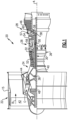
- FIG. 1 schematically illustrates a gas turbine engine 20.
- the gas turbine engine 20 is disclosed herein as a two-spool turbofan that generally incorporates a fan section 22, a compressor section 24, a combustor section 26 and a turbine section 28.
- the fan section 22 drives air along a bypass flow path B in a bypass duct defined within a housing 15 such as a fan case or nacelle, and also drives air along a core flow path C for compression and communication into the combustor section 26 then expansion through the turbine section 28.
- the exemplary engine 20 generally includes a low speed spool 30 and a high speed spool 32 mounted for rotation about an engine central longitudinal axis A relative to an engine static structure 36 via several bearing systems 38. It should be understood that various bearing systems 38 at various locations may alternatively or additionally be provided, and the location of bearing systems 38 may be varied as appropriate to the application.
- the low speed spool 30 generally includes an inner shaft 40 that interconnects, a first (or low) pressure compressor 44 and a first (or low) pressure turbine 46.
- the inner shaft 40 is connected to the fan 42 through a speed change mechanism, which in exemplary gas turbine engine 20 is illustrated as a geared architecture 48 to drive a fan 42 at a lower speed than the low speed spool 30.
- the high speed spool 32 includes an outer shaft 50 that interconnects a second (or high) pressure compressor 52 and a second (or high) pressure turbine 54.
- a combustor 56 is arranged in exemplary gas turbine 20 between the high pressure compressor 52 and the high pressure turbine 54.
- a mid-turbine frame 57 of the engine static structure 36 may be arranged generally between the high pressure turbine 54 and the low pressure turbine 46.
- the mid-turbine frame 57 further supports bearing systems 38 in the turbine section 28.
- the inner shaft 40 and the outer shaft 50 are concentric and rotate via bearing systems 38 about the engine central longitudinal axis A which is colline
- the core airflow is compressed by the low pressure compressor 44 then the high pressure compressor 52, mixed and burned with fuel in the combustor 56, then expanded through the high pressure turbine 54 and low pressure turbine 46.
- the mid-turbine frame 57 includes airfoils 59 which are in the core airflow path C.
- the turbines 46, 54 rotationally drive the respective low speed spool 30 and high speed spool 32 in response to the expansion.
- gear system 48 may be located aft of the low pressure compressor, or aft of the combustor section 26 or even aft of turbine section 28, and fan 42 may be positioned forward or aft of the location of gear system 48.
- the engine 20 in one example is a high-bypass geared aircraft engine.
- the engine 20 bypass ratio is greater than about six (6), with an example embodiment being greater than about ten (10)
- the geared architecture 48 is an epicyclic gear train, such as a planetary gear system or other gear system, with a gear reduction ratio of greater than about 2.3
- the low pressure turbine 46 has a pressure ratio that is greater than about five.
- the engine 20 bypass ratio is greater than about ten (10:1)
- the fan diameter is significantly larger than that of the low pressure compressor 44
- the low pressure turbine 46 has a pressure ratio that is greater than about five 5:1.
- Low pressure turbine 46 pressure ratio is pressure measured prior to inlet of low pressure turbine 46 as related to the pressure at the outlet of the low pressure turbine 46 prior to an exhaust nozzle.
- the geared architecture 48 may be an epicycle gear train, such as a planetary gear system or other gear system, with a gear reduction ratio of greater than about 2.3:1 and less than about 5:1. It should be understood, however, that the above parameters are only exemplary of one embodiment of a geared architecture engine and that the present invention is applicable to other gas turbine engines including direct drive turbofans.
- the fan section 22 of the engine 20 is designed for a particular flight condition -- typically cruise at about 0.8 Mach and about 35,000 feet (10,668 meters).
- the flight condition of 0.8 Mach and 35,000 ft (10,668 meters), with the engine at its best fuel consumption - also known as "bucket cruise Thrust Specific Fuel Consumption ('TSFC')" - is the industry standard parameter of lbm of fuel being burned divided by lbf of thrust the engine produces at that minimum point.
- "Low fan pressure ratio” is the pressure ratio across the fan blade alone, without a Fan Exit Guide Vane (“FEGV”) system.
- the low fan pressure ratio as disclosed herein according to one non-limiting embodiment is less than about 1.45.
- Low corrected fan tip speed is the actual fan tip speed in ft/sec divided by an industry standard temperature correction of [(Tram °R) / (518.7 °R)] 0.5 .
- the "Low corrected fan tip speed” as disclosed herein according to one non-limiting embodiment is less than about 1150 ft / second (350.5 meters/second).
- Figure 2A shows a representation of a sectioned airfoil 60 used in the turbine engine 20 (see also Figure 1 ), and Figure 2B illustrates a view of the region identified in Figure 1 .
- the airfoil 60 is a turbine blade; however, it is to be understood that this disclosure is also applicable to cooled blades or vanes.
- the airfoil 60 includes an (outer) airfoil wall 62 that spans in a radial direction and delimits the aerodynamic profile of the airfoil 60.
- the wall 62 defines a leading end 62a, a trailing end 62b, and first and second side walls 62c/62d that join the leading end 62a and the trailing end 62b.
- the first side wall 62c is a pressure side
- the second side wall 62d is a suction side.
- the airfoil 60 further includes one or more ribs 64.
- the airfoil has two such ribs 64, although in modified examples the airfoil 60 can include a single rib 64 or more than two ribs 64.
- a single rib 64 is described in some instances herein, it is to be understood that each such rib 64 has the described attributes of the single rib 64.
- the ribs 64 and a rib 65 partition the interior cavity of the airfoil 60 into several passages, which in this example include a forward-most passage 66a, an aft-most passage 66d, a forward intermediate passage 66b, and an aft intermediate passage 66c.
- Each rib 64 connects the first and second side walls 62c/62d and is generally longitudinally elongated between an inner diameter and outer diameter of the airfoil 60. Except for connection through the airfoil wall 62, the ribs 64 are disjoined from each other. As used herein, the term “disjoined” refers to the ribs 64 excluding any structural attachments to each other. Such an attachment configuration permits each rib 64 to reinforce the side walls 62c/62d and facilitate reduction in bulging from internal pressure, while still permitting the ribs 64 to move and thermally expand and contract at a different rate than the side walls 62c/62d during thermal cycling and without interference from adjacent ribs 64.
- Each rib 64 includes first and second unbranched arms 68/70 that initiate at the second side wall 62d and extend there from to meet at a node, identified at N.
- a third unbranched arm 72 initiates at the first side wall 62c and extends perpendicularly (locally) there from.
- the third unbranched side arm 72 connects to the first and second unbranched arms 68/70 at the node (N) in this example.
- the perpendicular orientation provides the shortest distance to the node (N), thereby facilitating reductions in airfoil mass.
- the term "unbranched” refers to an arm that has no other arms extending off of it between its initiation point and the node to which it connects. It is to be further understood that the term “perpendicular” or variations thereof encompass deviations from 90° due to manufacturing tolerances or other variances, such as deviations of 90° +/- 10%.
- the first and second unbranched arms 68/70 together with the second side wall 62d define a triangular passage 74 (triangular in cross-sectional shape, taken in a plane perpendicular to the radial direction).
- the two ribs 64 in the airfoil 60 in this example also define the aft-intermediate passage 66c there between.
- the aft-intermediate passage 66c is a pentagonal passage (pentagonal in cross-sectional shape) that is bound by the third unbranched arms 72, the first unbranched arm 68 of one of the aft one of the ribs 64, the second unbranched arm 70 of the forward one of the ribs 64, and the first side wall 62c.
- Cooling air such as bleed air from the compressor section 24, is fed into and through the passages 66a/66b/66c/66d/74.
- the triangular passages 74 are radial flow passages and the passages 66a/66b/66c/66d are a part of a serpentine cooling air circuit, generally denoted at 76.
- the triangular passages 74 are fed from a radially inner location of the airfoil 60 (and/or radially outer location if the airfoil 60 is a vane) and the cooling air flows radially outwards.
- the cooling air is then discharged through the tip of the airfoil and/or through one or more cooling apertures 78.
- the triangular passages 74 serve to cool the second side wall 62d.
- the passages 74 are flow isolated from the passages 66a/66b/66c/66d.
- the phrase "flow isolated” or variations thereof refers to passages, channels, or both that are not fluidly connected to each other within the airfoil 60 such that air cannot flow within the airfoil 60 from one passage or channel to the other passage or channel.
- the cooling of the first side wall 62c is in essence segregated from the cooling of the second side wall 62d. This enables the cooling to be controlled and optimized for each side wall 62c/62d.
- different cooling air pressures are utilized in the triangular passages 74 versus the passages 66a/66b/66c/66d. Such pressures can be controlled, for example, by metering orifices or the like at or near the inlets of the cooling air into the passages 66a/66b/66c/66d/74.
- Coriolis effects cause relatively high heat transfer on the first side wall 62c and relatively low heat transfer on the second side wall 62d in radially outward cooling air flow schemes, facilitating reduction in thermal stresses between the relatively hot side walls 62c/62d and the relatively cool ribs 64. This is further facilitated by the geometry of the pentagonal passage 66c.
- the passage 66c has a longest side defined by the first side wall 62c and a shortest side defined by one or both of the unbranched arms 68/70.
- the triangular passages 74 have low aspect ratio geometries.
- the second side wall 62d serves as the base of the triangle and defines a width (w).
- the arms 68/70 serve as the sides of the triangle and define a height (h).
- Such a width and height are defined by straight-line distances with respect to mid-line axes of the walls and intersections of such axes.
- the triangular passage 74 has an aspect ratio h/w of less than 0.75.
- a low aspect ratio enables fewer of the triangular passages 74 to cool the second side wall 62d, thereby reducing the number of ribs and in turn reducing airfoil mass.
- the triangular passage 74 has an aspect ratio h/w of less than 0.5, which may facilitate further weight reduction as well as minimize reduction in heat transfer due to Coriolis effects.
- the unbranched arms 68/70 are of substantially equal length.
- the lengths are taken as straight line distances with respect to mid-line axes of the walls and intersections of such axes.
- the term "substantially equal” or variations thereof encompass deviations due to manufacturing tolerances or other variances, such as deviations of 10% between the lengths of the unbranched arms 68/70.
- the configuration in which the unbranched arms 68/70 are of substantially equal length facilitates balancing heat transfer and thermal stresses.
- the triangular passage 74 permits flexibility for the second side wall 62d to thermally expand/contract. For example, differences in thermal growth between the second side wall 62d and the rib 64 are taken up by the height of the triangle such that in a relatively cold state the triangle elongates in height and in a relatively hot state the triangle compresses in height.
- the configuration of the rib or ribs 64 provides additional cooling configurations.
- the third unbranched arm 72 connects to the second unbranched arm 70 at the node (N1) in this example rather than a node that is at the apex of the triangle as in the example in Figure 2A .
- the third unbranched arm 72 may alternatively connect to the first unbranched arm 68.
- the unbranched arm 72 is longer than in the example in Figure 2A and thus adds mass in comparison.
- changing the location of the node facilitates changing the size of the passages 66b/66c/66d/74 to further tailor cooling effects.
- Figure 4 illustrates a further example airfoil 260 that is the same as the airfoil 60 except that the orientation of the ribs 64 is flipped such that the triangular passages 74 border the first side wall 62c and the passages 66b/66c/66d border the second side wall 62d.
- the passages 66b/66c/66d may be part of a serpentine circuit as discussed above.
- the passages 66c/66d may exclude any film cooling apertures and the passage 66b may have film cooling apertures such that the cooling air is discharged forward of the gauge point of the airfoil 260.
- the airfoils 60/160/260 include cooling apertures 78. Flow arrows of the cooling air are shown and a depiction of a flow arrow that extends through a wall indicates that there is a cooling hole or aperture 78 at that location (not all of which are numbered).
- the cooling apertures 78 provide additional cooling schemes to further enhance cooling. For instance, some of the cooling apertures 78 may serve as impingement holes to concentrate flow onto the inside surface of the adjacent portion of the wall 62. Other of the cooling apertures that are on the wall 62 serve as film cooling holes for the exterior surfaces of the airfoil wall 62. Other of the cooling apertures 78 that are on the long portions of the second and third arms 68/70 serve as feed holes to feed cooling air from the serpentine cooling air circuit 76 into the passage 74. Therefore, various configurations of the cooling apertures 78 can be used to control cooling air flow in the respective airfoils. In these examples, although cooling air may flow radially, the cooling apertures 78 provide for impingement cooling and axial flow of the cooling air.
Landscapes
- Engineering & Computer Science (AREA)
- Mechanical Engineering (AREA)
- General Engineering & Computer Science (AREA)
- Architecture (AREA)
- Structures Of Non-Positive Displacement Pumps (AREA)
- Turbine Rotor Nozzle Sealing (AREA)
Claims (12)
- Profil aérodynamique (60) comprenant :une paroi de profil aérodynamique (62) définissant une extrémité avant (62a), une extrémité arrière (62b), une première paroi latérale (62c) et une seconde paroi latérale (62d) ; etune nervure (64) reliant les première et seconde parois latérales (62c, 62d) de la paroi de profil aérodynamique (62), la nervure (64) comportantdes premier et deuxième bras non ramifiés (68, 70) commençant au niveau de la seconde paroi latérale (62d) et se prolongeant à partir de là pour se rencontrer au niveau d'un noeud (N), etun troisième bras non ramifié (72) commençant au niveau de la première paroi latérale (62c), le troisième bras non ramifié (72) se prolongeant perpendiculairement à partir de là et se connectant soit au noeud (N), soit au premier bras non ramifié (68), soit au deuxième bras non ramifié (70),dans lequel les premier et deuxième bras non ramifiés (68, 70) définissent ensemble avec la seconde paroi latérale (62d) un passage triangulaire (74), etcaractérisé en ce que le troisième bras non ramifié (72) et la première paroi latérale (62c) bordent un passage qui est isolé du passage triangulaire (74).
- Profil aérodynamique (60) selon la revendication 1, dans lequel le troisième bras non ramifié (72) se connecte au niveau du noeud (N).
- Profil aérodynamique (60) selon la revendication 1, dans lequel le troisième bras non ramifié (72) se connecte à l'un des premier ou deuxième bras non ramifiés (68, 70).
- Profil aérodynamique (60) selon une quelconque revendication précédente, dans lequel, avec la seconde paroi latérale (62d) comme base, le passage triangulaire (74) définit une hauteur (h) et une largeur (w) qui ont un rapport de h/w inférieur à 0,75.
- Profil aérodynamique (60) selon la revendication 4, dans lequel le rapport est inférieur à 0,5.
- Profil aérodynamique (60) selon une quelconque revendication précédente, dans lequel les premier et deuxième bras (68, 70) sont de longueur sensiblement égale.
- Profil aérodynamique (60) comprenant :une paroi de profil aérodynamique (62) définissant une extrémité avant (62a), une extrémité arrière (62b), une première paroi latérale (62c) et une seconde paroi latérale (62d) ; etune paire de nervures définissant entre elles un passage pentagonal (66c), chacune desdites nervures reliant les première et seconde parois latérales (62c, 62d) de la paroi de profil aérodynamique (62) et comportantdes premier et deuxième bras non ramifiés (68, 70) commençant au niveau de l'une de la première paroi latérale (62c) ou de la seconde paroi latérale (62d) et se prolongeant à partir de là pour se rencontrer au niveau d'un noeud (N), les premier et deuxième bras non ramifiés (68, 70) ensemble avec l'une de la première paroi latérale (62c) ou de la seconde paroi latérale (62d) définissant un passage triangulaire (74) entre elles, et un troisième bras non ramifié (72) commençant au niveau de l'autre de la première paroi latérale (62c) ou de la seconde paroi latérale (62d), le troisième bras non ramifié (72) se prolongeant perpendiculairement à partir de là et se connectant au niveau du noeud (N),caractérisé en ce que le troisième bras non ramifié (72) et la première paroi latérale (62c) bordent un passage isolé du passage triangulaire (74).
- Profil aérodynamique (60) selon la revendication 7, dans lequel le passage pentagonal (66c) a un côté le plus long défini par la première paroi latérale (62c).
- Profil aérodynamique (60) selon la revendication 8, dans lequel la seconde paroi latérale (62d) est un côté aspiration.
- Profil aérodynamique (60) selon la revendication 7, 8 ou 9, dans lequel le passage pentagonal (66c) fait partie d'un circuit d'air de refroidissement en serpentin (76).
- Profil aérodynamique (60) selon la revendication 10, dans lequel le passage pentagonal (66c) exclut une quelconque ouverture de refroidissement à travers les première et seconde parois latérales (62c, 62d).
- Moteur à turbine à gaz comprenant :une section de compresseur (24) ;une chambre de combustion (56) en communication fluidique avec la section de compresseur (24) ; etune section de turbine (28) en communication fluidique avec la chambre de combustion (56),la section de turbine (28) ayant un profil aérodynamique (60) selon une quelconque revendication précédente.
Applications Claiming Priority (1)
| Application Number | Priority Date | Filing Date | Title |
|---|---|---|---|
| US16/850,593 US11220912B2 (en) | 2020-04-16 | 2020-04-16 | Airfoil with y-shaped rib |
Publications (2)
| Publication Number | Publication Date |
|---|---|
| EP3896257A1 EP3896257A1 (fr) | 2021-10-20 |
| EP3896257B1 true EP3896257B1 (fr) | 2024-09-25 |
Family
ID=75529885
Family Applications (1)
| Application Number | Title | Priority Date | Filing Date |
|---|---|---|---|
| EP21168388.3A Active EP3896257B1 (fr) | 2020-04-16 | 2021-04-14 | Profil aérodynamique comprenant une nervure en forme de y |
Country Status (2)
| Country | Link |
|---|---|
| US (1) | US11220912B2 (fr) |
| EP (1) | EP3896257B1 (fr) |
Families Citing this family (6)
| Publication number | Priority date | Publication date | Assignee | Title |
|---|---|---|---|---|
| US11629602B2 (en) * | 2021-06-17 | 2023-04-18 | Raytheon Technologies Corporation | Cooling schemes for airfoils for gas turbine engines |
| EP4343116A3 (fr) * | 2022-09-26 | 2024-04-17 | RTX Corporation | Profils aérodynamiques à cavités de refroidissement à lobes |
| US12215601B2 (en) | 2023-02-17 | 2025-02-04 | Rtx Corporation | Air foil with staggered cooling hole configuration |
| US12540552B2 (en) | 2023-03-07 | 2026-02-03 | Rtx Corporation | Airfoils with axial leading edge impingement slots |
| US12065944B1 (en) | 2023-03-07 | 2024-08-20 | Rtx Corporation | Airfoils with mixed skin passageway cooling |
| US12404775B1 (en) * | 2024-09-16 | 2025-09-02 | Rtx Corporation | Turbine blade with cooling channels |
Family Cites Families (19)
| Publication number | Priority date | Publication date | Assignee | Title |
|---|---|---|---|---|
| US5156526A (en) * | 1990-12-18 | 1992-10-20 | General Electric Company | Rotation enhanced rotor blade cooling using a single row of coolant passageways |
| US5246340A (en) * | 1991-11-19 | 1993-09-21 | Allied-Signal Inc. | Internally cooled airfoil |
| US6183198B1 (en) * | 1998-11-16 | 2001-02-06 | General Electric Company | Airfoil isolated leading edge cooling |
| US6126396A (en) * | 1998-12-09 | 2000-10-03 | General Electric Company | AFT flowing serpentine airfoil cooling circuit with side wall impingement cooling chambers |
| US6206638B1 (en) | 1999-02-12 | 2001-03-27 | General Electric Company | Low cost airfoil cooling circuit with sidewall impingement cooling chambers |
| US6832889B1 (en) * | 2003-07-09 | 2004-12-21 | General Electric Company | Integrated bridge turbine blade |
| US6984103B2 (en) * | 2003-11-20 | 2006-01-10 | General Electric Company | Triple circuit turbine blade |
| US7097426B2 (en) * | 2004-04-08 | 2006-08-29 | General Electric Company | Cascade impingement cooled airfoil |
| US7217092B2 (en) | 2004-04-14 | 2007-05-15 | General Electric Company | Method and apparatus for reducing turbine blade temperatures |
| US7131818B2 (en) | 2004-11-02 | 2006-11-07 | United Technologies Corporation | Airfoil with three-pass serpentine cooling channel and microcircuit |
| US7569172B2 (en) * | 2005-06-23 | 2009-08-04 | United Technologies Corporation | Method for forming turbine blade with angled internal ribs |
| US7293961B2 (en) * | 2005-12-05 | 2007-11-13 | General Electric Company | Zigzag cooled turbine airfoil |
| US7296973B2 (en) * | 2005-12-05 | 2007-11-20 | General Electric Company | Parallel serpentine cooled blade |
| ES2442873T3 (es) | 2008-03-31 | 2014-02-14 | Alstom Technology Ltd | Perfil aerodinámico de turbina de gas |
| US10053990B2 (en) * | 2016-05-12 | 2018-08-21 | General Electric Company | Internal rib with defined concave surface curvature for airfoil |
| US10465525B2 (en) | 2016-07-22 | 2019-11-05 | General Electric Company | Blade with internal rib having corrugated surface(s) |
| US10626734B2 (en) * | 2017-10-03 | 2020-04-21 | United Technologies Corporation | Airfoil having internal hybrid cooling cavities |
| US10378364B2 (en) * | 2017-11-07 | 2019-08-13 | United Technologies Corporation | Modified structural truss for airfoils |
| US10871074B2 (en) * | 2019-02-28 | 2020-12-22 | Raytheon Technologies Corporation | Blade/vane cooling passages |
-
2020
- 2020-04-16 US US16/850,593 patent/US11220912B2/en active Active
-
2021
- 2021-04-14 EP EP21168388.3A patent/EP3896257B1/fr active Active
Also Published As
| Publication number | Publication date |
|---|---|
| US20210324741A1 (en) | 2021-10-21 |
| EP3896257A1 (fr) | 2021-10-20 |
| US11220912B2 (en) | 2022-01-11 |
Similar Documents
| Publication | Publication Date | Title |
|---|---|---|
| EP3896257B1 (fr) | Profil aérodynamique comprenant une nervure en forme de y | |
| EP3081753B1 (fr) | Agencement de refroidissement de pointe de lame | |
| EP3543464B1 (fr) | Déflecteur à double cavité | |
| EP3783197B1 (fr) | Profil aérodynamique avec une nervure dotée de bras connecteurs | |
| EP3056672B1 (fr) | Passages d'intercommunication inclinés pour aubes | |
| EP3034793B1 (fr) | Composant de moteur à turbine à gaz avec capacité de refroidissement accrue | |
| EP3578758A1 (fr) | Profil d'aube de turbine, moteur à turbine à gaz et procédé de manufacture associé | |
| EP3783198B1 (fr) | Profil aérodynamique à nervures ayant des bras de connecteur et des ouvertures définissant un circuit de refroidissement | |
| US20240271536A1 (en) | Airfoil with ribs defining shaped cooling channel | |
| EP3054094A1 (fr) | Chicane d'aube de turbine à gaz et passage de refroidissement en serpentin | |
| EP3150800B1 (fr) | Déflecteur aérodynamique avec région de coin | |
| EP3533971B1 (fr) | Profil aérodynamique à épaisseur de paroi variable | |
| US20250230751A1 (en) | Turbine blade with boomerang shaped wall cooling passages | |
| EP3670841B1 (fr) | Profil aérodynamique ayant un réapprovisionnement hybride du passage central de l'enveloppe | |
| EP3246520A2 (fr) | Procédé et appareil permettant d'améliorer l'écoulement laminaire pour des composants de moteur de turbine à gaz | |
| EP3650641A1 (fr) | Profil aérodynamique avec circuit de passage de refroidissement par des plateformes et section de profil aérodynamique | |
| EP3819473B1 (fr) | Insert de bord de fuite d'aube directrice | |
| EP2977557B1 (fr) | Structure d'aube refroidie et procédé de refroidissement associé | |
| EP3502417B1 (fr) | Éléments de déflection d'écoulement d'une plateforme pour composants de moteur de turbine à gaz |
Legal Events
| Date | Code | Title | Description |
|---|---|---|---|
| PUAI | Public reference made under article 153(3) epc to a published international application that has entered the european phase |
Free format text: ORIGINAL CODE: 0009012 |
|
| STAA | Information on the status of an ep patent application or granted ep patent |
Free format text: STATUS: THE APPLICATION HAS BEEN PUBLISHED |
|
| AK | Designated contracting states |
Kind code of ref document: A1 Designated state(s): AL AT BE BG CH CY CZ DE DK EE ES FI FR GB GR HR HU IE IS IT LI LT LU LV MC MK MT NL NO PL PT RO RS SE SI SK SM TR |
|
| B565 | Issuance of search results under rule 164(2) epc |
Effective date: 20210825 |
|
| STAA | Information on the status of an ep patent application or granted ep patent |
Free format text: STATUS: REQUEST FOR EXAMINATION WAS MADE |
|
| 17P | Request for examination filed |
Effective date: 20220407 |
|
| RBV | Designated contracting states (corrected) |
Designated state(s): AL AT BE BG CH CY CZ DE DK EE ES FI FR GB GR HR HU IE IS IT LI LT LU LV MC MK MT NL NO PL PT RO RS SE SI SK SM TR |
|
| STAA | Information on the status of an ep patent application or granted ep patent |
Free format text: STATUS: EXAMINATION IS IN PROGRESS |
|
| 17Q | First examination report despatched |
Effective date: 20230519 |
|
| RAP3 | Party data changed (applicant data changed or rights of an application transferred) |
Owner name: RTX CORPORATION |
|
| GRAP | Despatch of communication of intention to grant a patent |
Free format text: ORIGINAL CODE: EPIDOSNIGR1 |
|
| STAA | Information on the status of an ep patent application or granted ep patent |
Free format text: STATUS: GRANT OF PATENT IS INTENDED |
|
| INTG | Intention to grant announced |
Effective date: 20240515 |
|
| GRAS | Grant fee paid |
Free format text: ORIGINAL CODE: EPIDOSNIGR3 |
|
| GRAA | (expected) grant |
Free format text: ORIGINAL CODE: 0009210 |
|
| STAA | Information on the status of an ep patent application or granted ep patent |
Free format text: STATUS: THE PATENT HAS BEEN GRANTED |
|
| AK | Designated contracting states |
Kind code of ref document: B1 Designated state(s): AL AT BE BG CH CY CZ DE DK EE ES FI FR GB GR HR HU IE IS IT LI LT LU LV MC MK MT NL NO PL PT RO RS SE SI SK SM TR |
|
| REG | Reference to a national code |
Ref country code: GB Ref legal event code: FG4D |
|
| REG | Reference to a national code |
Ref country code: CH Ref legal event code: EP |
|
| REG | Reference to a national code |
Ref country code: DE Ref legal event code: R096 Ref document number: 602021019163 Country of ref document: DE |
|
| REG | Reference to a national code |
Ref country code: IE Ref legal event code: FG4D |
|
| REG | Reference to a national code |
Ref country code: LT Ref legal event code: MG9D |
|
| PG25 | Lapsed in a contracting state [announced via postgrant information from national office to epo] |
Ref country code: NO Free format text: LAPSE BECAUSE OF FAILURE TO SUBMIT A TRANSLATION OF THE DESCRIPTION OR TO PAY THE FEE WITHIN THE PRESCRIBED TIME-LIMIT Effective date: 20241225 |
|
| PG25 | Lapsed in a contracting state [announced via postgrant information from national office to epo] |
Ref country code: GR Free format text: LAPSE BECAUSE OF FAILURE TO SUBMIT A TRANSLATION OF THE DESCRIPTION OR TO PAY THE FEE WITHIN THE PRESCRIBED TIME-LIMIT Effective date: 20241226 Ref country code: FI Free format text: LAPSE BECAUSE OF FAILURE TO SUBMIT A TRANSLATION OF THE DESCRIPTION OR TO PAY THE FEE WITHIN THE PRESCRIBED TIME-LIMIT Effective date: 20240925 |
|
| PG25 | Lapsed in a contracting state [announced via postgrant information from national office to epo] |
Ref country code: BG Free format text: LAPSE BECAUSE OF FAILURE TO SUBMIT A TRANSLATION OF THE DESCRIPTION OR TO PAY THE FEE WITHIN THE PRESCRIBED TIME-LIMIT Effective date: 20240925 |
|
| PG25 | Lapsed in a contracting state [announced via postgrant information from national office to epo] |
Ref country code: LV Free format text: LAPSE BECAUSE OF FAILURE TO SUBMIT A TRANSLATION OF THE DESCRIPTION OR TO PAY THE FEE WITHIN THE PRESCRIBED TIME-LIMIT Effective date: 20240925 |
|
| PG25 | Lapsed in a contracting state [announced via postgrant information from national office to epo] |
Ref country code: RS Free format text: LAPSE BECAUSE OF FAILURE TO SUBMIT A TRANSLATION OF THE DESCRIPTION OR TO PAY THE FEE WITHIN THE PRESCRIBED TIME-LIMIT Effective date: 20241225 |
|
| REG | Reference to a national code |
Ref country code: NL Ref legal event code: MP Effective date: 20240925 |
|
| PG25 | Lapsed in a contracting state [announced via postgrant information from national office to epo] |
Ref country code: RS Free format text: LAPSE BECAUSE OF FAILURE TO SUBMIT A TRANSLATION OF THE DESCRIPTION OR TO PAY THE FEE WITHIN THE PRESCRIBED TIME-LIMIT Effective date: 20241225 Ref country code: NO Free format text: LAPSE BECAUSE OF FAILURE TO SUBMIT A TRANSLATION OF THE DESCRIPTION OR TO PAY THE FEE WITHIN THE PRESCRIBED TIME-LIMIT Effective date: 20241225 Ref country code: LV Free format text: LAPSE BECAUSE OF FAILURE TO SUBMIT A TRANSLATION OF THE DESCRIPTION OR TO PAY THE FEE WITHIN THE PRESCRIBED TIME-LIMIT Effective date: 20240925 Ref country code: GR Free format text: LAPSE BECAUSE OF FAILURE TO SUBMIT A TRANSLATION OF THE DESCRIPTION OR TO PAY THE FEE WITHIN THE PRESCRIBED TIME-LIMIT Effective date: 20241226 Ref country code: FI Free format text: LAPSE BECAUSE OF FAILURE TO SUBMIT A TRANSLATION OF THE DESCRIPTION OR TO PAY THE FEE WITHIN THE PRESCRIBED TIME-LIMIT Effective date: 20240925 Ref country code: BG Free format text: LAPSE BECAUSE OF FAILURE TO SUBMIT A TRANSLATION OF THE DESCRIPTION OR TO PAY THE FEE WITHIN THE PRESCRIBED TIME-LIMIT Effective date: 20240925 |
|
| REG | Reference to a national code |
Ref country code: AT Ref legal event code: MK05 Ref document number: 1726780 Country of ref document: AT Kind code of ref document: T Effective date: 20240925 |
|
| PG25 | Lapsed in a contracting state [announced via postgrant information from national office to epo] |
Ref country code: NL Free format text: LAPSE BECAUSE OF FAILURE TO SUBMIT A TRANSLATION OF THE DESCRIPTION OR TO PAY THE FEE WITHIN THE PRESCRIBED TIME-LIMIT Effective date: 20240925 |
|
| PG25 | Lapsed in a contracting state [announced via postgrant information from national office to epo] |
Ref country code: IS Free format text: LAPSE BECAUSE OF FAILURE TO SUBMIT A TRANSLATION OF THE DESCRIPTION OR TO PAY THE FEE WITHIN THE PRESCRIBED TIME-LIMIT Effective date: 20250125 Ref country code: PT Free format text: LAPSE BECAUSE OF FAILURE TO SUBMIT A TRANSLATION OF THE DESCRIPTION OR TO PAY THE FEE WITHIN THE PRESCRIBED TIME-LIMIT Effective date: 20250127 |
|
| PG25 | Lapsed in a contracting state [announced via postgrant information from national office to epo] |
Ref country code: RO Free format text: LAPSE BECAUSE OF FAILURE TO SUBMIT A TRANSLATION OF THE DESCRIPTION OR TO PAY THE FEE WITHIN THE PRESCRIBED TIME-LIMIT Effective date: 20240925 Ref country code: SM Free format text: LAPSE BECAUSE OF FAILURE TO SUBMIT A TRANSLATION OF THE DESCRIPTION OR TO PAY THE FEE WITHIN THE PRESCRIBED TIME-LIMIT Effective date: 20240925 |
|
| PG25 | Lapsed in a contracting state [announced via postgrant information from national office to epo] |
Ref country code: ES Free format text: LAPSE BECAUSE OF FAILURE TO SUBMIT A TRANSLATION OF THE DESCRIPTION OR TO PAY THE FEE WITHIN THE PRESCRIBED TIME-LIMIT Effective date: 20240925 |
|
| PG25 | Lapsed in a contracting state [announced via postgrant information from national office to epo] |
Ref country code: EE Free format text: LAPSE BECAUSE OF FAILURE TO SUBMIT A TRANSLATION OF THE DESCRIPTION OR TO PAY THE FEE WITHIN THE PRESCRIBED TIME-LIMIT Effective date: 20240925 Ref country code: AT Free format text: LAPSE BECAUSE OF FAILURE TO SUBMIT A TRANSLATION OF THE DESCRIPTION OR TO PAY THE FEE WITHIN THE PRESCRIBED TIME-LIMIT Effective date: 20240925 |
|
| PG25 | Lapsed in a contracting state [announced via postgrant information from national office to epo] |
Ref country code: PL Free format text: LAPSE BECAUSE OF FAILURE TO SUBMIT A TRANSLATION OF THE DESCRIPTION OR TO PAY THE FEE WITHIN THE PRESCRIBED TIME-LIMIT Effective date: 20240925 Ref country code: CZ Free format text: LAPSE BECAUSE OF FAILURE TO SUBMIT A TRANSLATION OF THE DESCRIPTION OR TO PAY THE FEE WITHIN THE PRESCRIBED TIME-LIMIT Effective date: 20240925 |
|
| PG25 | Lapsed in a contracting state [announced via postgrant information from national office to epo] |
Ref country code: IT Free format text: LAPSE BECAUSE OF FAILURE TO SUBMIT A TRANSLATION OF THE DESCRIPTION OR TO PAY THE FEE WITHIN THE PRESCRIBED TIME-LIMIT Effective date: 20240925 Ref country code: SK Free format text: LAPSE BECAUSE OF FAILURE TO SUBMIT A TRANSLATION OF THE DESCRIPTION OR TO PAY THE FEE WITHIN THE PRESCRIBED TIME-LIMIT Effective date: 20240925 |
|
| REG | Reference to a national code |
Ref country code: DE Ref legal event code: R097 Ref document number: 602021019163 Country of ref document: DE |
|
| PGFP | Annual fee paid to national office [announced via postgrant information from national office to epo] |
Ref country code: DE Payment date: 20250319 Year of fee payment: 5 |
|
| PG25 | Lapsed in a contracting state [announced via postgrant information from national office to epo] |
Ref country code: DK Free format text: LAPSE BECAUSE OF FAILURE TO SUBMIT A TRANSLATION OF THE DESCRIPTION OR TO PAY THE FEE WITHIN THE PRESCRIBED TIME-LIMIT Effective date: 20240925 |
|
| PLBE | No opposition filed within time limit |
Free format text: ORIGINAL CODE: 0009261 |
|
| STAA | Information on the status of an ep patent application or granted ep patent |
Free format text: STATUS: NO OPPOSITION FILED WITHIN TIME LIMIT |
|
| 26N | No opposition filed |
Effective date: 20250626 |
|
| PG25 | Lapsed in a contracting state [announced via postgrant information from national office to epo] |
Ref country code: SE Free format text: LAPSE BECAUSE OF FAILURE TO SUBMIT A TRANSLATION OF THE DESCRIPTION OR TO PAY THE FEE WITHIN THE PRESCRIBED TIME-LIMIT Effective date: 20240925 |
|
| REG | Reference to a national code |
Ref country code: CH Ref legal event code: H13 Free format text: ST27 STATUS EVENT CODE: U-0-0-H10-H13 (AS PROVIDED BY THE NATIONAL OFFICE) Effective date: 20251125 |
|
| PG25 | Lapsed in a contracting state [announced via postgrant information from national office to epo] |
Ref country code: LU Free format text: LAPSE BECAUSE OF NON-PAYMENT OF DUE FEES Effective date: 20250414 |
|
| PG25 | Lapsed in a contracting state [announced via postgrant information from national office to epo] |
Ref country code: MC Free format text: LAPSE BECAUSE OF FAILURE TO SUBMIT A TRANSLATION OF THE DESCRIPTION OR TO PAY THE FEE WITHIN THE PRESCRIBED TIME-LIMIT Effective date: 20240925 |
|
| REG | Reference to a national code |
Ref country code: BE Ref legal event code: MM Effective date: 20250430 |
|
| PG25 | Lapsed in a contracting state [announced via postgrant information from national office to epo] |
Ref country code: HR Free format text: LAPSE BECAUSE OF FAILURE TO SUBMIT A TRANSLATION OF THE DESCRIPTION OR TO PAY THE FEE WITHIN THE PRESCRIBED TIME-LIMIT Effective date: 20240925 |
|
| PG25 | Lapsed in a contracting state [announced via postgrant information from national office to epo] |
Ref country code: BE Free format text: LAPSE BECAUSE OF NON-PAYMENT OF DUE FEES Effective date: 20250430 |
|
| PG25 | Lapsed in a contracting state [announced via postgrant information from national office to epo] |
Ref country code: CH Free format text: LAPSE BECAUSE OF NON-PAYMENT OF DUE FEES Effective date: 20250430 |
|
| PGFP | Annual fee paid to national office [announced via postgrant information from national office to epo] |
Ref country code: GB Payment date: 20260319 Year of fee payment: 6 |
|
| PG25 | Lapsed in a contracting state [announced via postgrant information from national office to epo] |
Ref country code: IE Free format text: LAPSE BECAUSE OF NON-PAYMENT OF DUE FEES Effective date: 20250414 |
|
| PGFP | Annual fee paid to national office [announced via postgrant information from national office to epo] |
Ref country code: FR Payment date: 20260320 Year of fee payment: 6 |