EP3896965A1 - Procédé, dispositif et appareil pour prédire un seuil jnd par images, et support de stockage - Google Patents
Procédé, dispositif et appareil pour prédire un seuil jnd par images, et support de stockage Download PDFInfo
- Publication number
- EP3896965A1 EP3896965A1 EP18943329.5A EP18943329A EP3896965A1 EP 3896965 A1 EP3896965 A1 EP 3896965A1 EP 18943329 A EP18943329 A EP 18943329A EP 3896965 A1 EP3896965 A1 EP 3896965A1
- Authority
- EP
- European Patent Office
- Prior art keywords
- image
- compressed
- perceptual distortion
- compressed image
- perceptual
- Prior art date
- Legal status (The legal status is an assumption and is not a legal conclusion. Google has not performed a legal analysis and makes no representation as to the accuracy of the status listed.)
- Granted
Links
Images


Classifications
-
- G—PHYSICS
- G06—COMPUTING OR CALCULATING; COUNTING
- G06T—IMAGE DATA PROCESSING OR GENERATION, IN GENERAL
- G06T1/00—General purpose image data processing
- G06T1/20—Processor architectures; Processor configuration, e.g. pipelining
-
- G—PHYSICS
- G06—COMPUTING OR CALCULATING; COUNTING
- G06T—IMAGE DATA PROCESSING OR GENERATION, IN GENERAL
- G06T7/00—Image analysis
- G06T7/0002—Inspection of images, e.g. flaw detection
-
- G—PHYSICS
- G06—COMPUTING OR CALCULATING; COUNTING
- G06F—ELECTRIC DIGITAL DATA PROCESSING
- G06F18/00—Pattern recognition
- G06F18/20—Analysing
- G06F18/21—Design or setup of recognition systems or techniques; Extraction of features in feature space; Blind source separation
- G06F18/214—Generating training patterns; Bootstrap methods, e.g. bagging or boosting
- G06F18/2148—Generating training patterns; Bootstrap methods, e.g. bagging or boosting characterised by the process organisation or structure, e.g. boosting cascade
-
- G—PHYSICS
- G06—COMPUTING OR CALCULATING; COUNTING
- G06F—ELECTRIC DIGITAL DATA PROCESSING
- G06F18/00—Pattern recognition
- G06F18/20—Analysing
- G06F18/25—Fusion techniques
- G06F18/253—Fusion techniques of extracted features
-
- G—PHYSICS
- G06—COMPUTING OR CALCULATING; COUNTING
- G06N—COMPUTING ARRANGEMENTS BASED ON SPECIFIC COMPUTATIONAL MODELS
- G06N3/00—Computing arrangements based on biological models
- G06N3/02—Neural networks
- G06N3/04—Architecture, e.g. interconnection topology
- G06N3/045—Combinations of networks
-
- G—PHYSICS
- G06—COMPUTING OR CALCULATING; COUNTING
- G06N—COMPUTING ARRANGEMENTS BASED ON SPECIFIC COMPUTATIONAL MODELS
- G06N3/00—Computing arrangements based on biological models
- G06N3/02—Neural networks
- G06N3/04—Architecture, e.g. interconnection topology
- G06N3/0464—Convolutional networks [CNN, ConvNet]
-
- G—PHYSICS
- G06—COMPUTING OR CALCULATING; COUNTING
- G06N—COMPUTING ARRANGEMENTS BASED ON SPECIFIC COMPUTATIONAL MODELS
- G06N3/00—Computing arrangements based on biological models
- G06N3/02—Neural networks
- G06N3/08—Learning methods
- G06N3/0895—Weakly supervised learning, e.g. semi-supervised or self-supervised learning
-
- G—PHYSICS
- G06—COMPUTING OR CALCULATING; COUNTING
- G06N—COMPUTING ARRANGEMENTS BASED ON SPECIFIC COMPUTATIONAL MODELS
- G06N3/00—Computing arrangements based on biological models
- G06N3/02—Neural networks
- G06N3/08—Learning methods
- G06N3/09—Supervised learning
-
- G—PHYSICS
- G06—COMPUTING OR CALCULATING; COUNTING
- G06T—IMAGE DATA PROCESSING OR GENERATION, IN GENERAL
- G06T7/00—Image analysis
- G06T7/10—Segmentation; Edge detection
- G06T7/11—Region-based segmentation
-
- G—PHYSICS
- G06—COMPUTING OR CALCULATING; COUNTING
- G06T—IMAGE DATA PROCESSING OR GENERATION, IN GENERAL
- G06T9/00—Image coding
- G06T9/002—Image coding using neural networks
-
- G—PHYSICS
- G06—COMPUTING OR CALCULATING; COUNTING
- G06V—IMAGE OR VIDEO RECOGNITION OR UNDERSTANDING
- G06V10/00—Arrangements for image or video recognition or understanding
- G06V10/40—Extraction of image or video features
-
- G—PHYSICS
- G06—COMPUTING OR CALCULATING; COUNTING
- G06V—IMAGE OR VIDEO RECOGNITION OR UNDERSTANDING
- G06V10/00—Arrangements for image or video recognition or understanding
- G06V10/94—Hardware or software architectures specially adapted for image or video understanding
- G06V10/95—Hardware or software architectures specially adapted for image or video understanding structured as a network, e.g. client-server architectures
-
- H—ELECTRICITY
- H04—ELECTRIC COMMUNICATION TECHNIQUE
- H04N—PICTORIAL COMMUNICATION, e.g. TELEVISION
- H04N19/00—Methods or arrangements for coding, decoding, compressing or decompressing digital video signals
- H04N19/10—Methods or arrangements for coding, decoding, compressing or decompressing digital video signals using adaptive coding
- H04N19/134—Methods or arrangements for coding, decoding, compressing or decompressing digital video signals using adaptive coding characterised by the element, parameter or criterion affecting or controlling the adaptive coding
- H04N19/154—Measured or subjectively estimated visual quality after decoding, e.g. measurement of distortion
-
- G—PHYSICS
- G06—COMPUTING OR CALCULATING; COUNTING
- G06T—IMAGE DATA PROCESSING OR GENERATION, IN GENERAL
- G06T2207/00—Indexing scheme for image analysis or image enhancement
- G06T2207/10—Image acquisition modality
- G06T2207/10016—Video; Image sequence
-
- G—PHYSICS
- G06—COMPUTING OR CALCULATING; COUNTING
- G06T—IMAGE DATA PROCESSING OR GENERATION, IN GENERAL
- G06T2207/00—Indexing scheme for image analysis or image enhancement
- G06T2207/20—Special algorithmic details
- G06T2207/20021—Dividing image into blocks, subimages or windows
-
- G—PHYSICS
- G06—COMPUTING OR CALCULATING; COUNTING
- G06T—IMAGE DATA PROCESSING OR GENERATION, IN GENERAL
- G06T2207/00—Indexing scheme for image analysis or image enhancement
- G06T2207/20—Special algorithmic details
- G06T2207/20081—Training; Learning
-
- G—PHYSICS
- G06—COMPUTING OR CALCULATING; COUNTING
- G06T—IMAGE DATA PROCESSING OR GENERATION, IN GENERAL
- G06T2207/00—Indexing scheme for image analysis or image enhancement
- G06T2207/20—Special algorithmic details
- G06T2207/20084—Artificial neural networks [ANN]
-
- G—PHYSICS
- G06—COMPUTING OR CALCULATING; COUNTING
- G06T—IMAGE DATA PROCESSING OR GENERATION, IN GENERAL
- G06T2207/00—Indexing scheme for image analysis or image enhancement
- G06T2207/30—Subject of image; Context of image processing
- G06T2207/30168—Image quality inspection
Definitions
- the invention relates to the prediction method, device, equipment, and storage medium for the image-level JND threshold, which belongs to the technical field of image/video compression.
- JND Threshold describes the minimum image distortion perceived by human eyes and reflects the human visual system's perception and sensitivity. Therefore, the JND threshold has been widely used for image/video processing, such as image/video encoding, streaming application, and watermarking technique.
- JND models have been proposed, which are generally divided into two categories: pixel domain-based JND models and frequency domain-based JND models.
- Pixel domain-based JND models mainly take into account the influence of adaptive illumination effect and spatial masking effect on JND threshold.
- Wu et al. adopted the regularity of spatial structure to measure spatial masking effect and proposed a new JND model to enhance the accuracy of estimating the JND threshold of irregular texture regions in 2012 in combination with the adaptive illumination effect; Wu et al.
- Wu et al. proposed a function of pattern masking effect in 2013 and further put forward a JND model on the basis of pattern masking effect; in 2016, Wang et al. established a JND model for screen image rebuilt based on the edge contour, which decomposed the calculations of edge contour-based JND threshold into independent estimations of adaptive illumination and masking effects and structured masking effect; Hadizadeh et al. incorporated factors like visual attention mechanism to propose a JND model.
- Frequency domain-based JND models mainly consider Contrast Sensitivity Function (CSF), Contrast Masking Effect, Adaptive Illumination Effect, and Fovea Centralis Retinae Masking Effect.
- CSF Contrast Sensitivity Function
- Contrast Masking Effect Adaptive Illumination Effect
- Fovea Centralis Retinae Masking Effect gamma coefficient was introduced to compensate illumination effect; Bae et al. took into account the influence of different frequencies on adaptive illumination, and thus proposed a new adaptive illumination-based JND model;
- H. Ko et al. calculated contrast masking effect, and established a JND model in 2014 that could adapt to the core of Discrete Cosine Transform (DCT) of any size; Ki et al. considered the impact of quantification-induced energy losses on JND threshold during the compression process, and hence put forward a learning-based JND predicting method in 2018.
- DCT Discrete Cosine Transform
- pixel domain-based JND models are used to calculate a JND threshold for each image pixel
- frequency domain-based JND models can be adopted to first convert the image's pixel domain into its frequency domain and then calculate a JND threshold for each sub-frequency.
- both pixel domain-based and frequency domain-based JND models are local JND threshold estimation models which just estimate the JND threshold of a single pixel or frequency.
- the quality of the entire image is determined by some key regions and poor regions, so it is difficult for the above two kinds of JND models to accurately estimate human eyes' JND threshold for the entire image; moreover, traditional JND models mainly took into account the estimations of JND thresholds of raw images but failed to estimate the JND thresholds of the image of any quality level. Since the images or videos received by the image or video processing systems in real life are mostly distorted ones, the practical application of traditional JND models is subject to restrictions. As such, it is of great significance to predict the JND threshold for the image of any quality level.
- the invention provides a prediction method, device, equipment, and storage medium for the image-level JND threshold, aiming to eliminate a huge deviation in the prediction of the JND threshold for the entire image because an effective prediction method for the image-level JND threshold is not available based on current technologies.
- the invention provides a prediction method for the image-level JND threshold, and the said method can be explained in the following steps:
- the invention provides a prediction device for the image-level JND threshold, and the said device consists of:
- the invention also provides a computing device, comprising a memory, a processor, and a computer program stored in the said memory and executable in the said processor, wherein the said steps for the prediction method of the above image-level JND threshold are effectuated when the said computer program is executed by the said processor.
- the invention also provides a computer-readable storage medium in which the computer program is stored, wherein the said steps for the prediction method of the above image-level JND threshold are effectuated when the said computer program is executed by the said processor.
- perceptual distortion discrimination is conducted on the raw image and on the compressed images in the compressed image set of the said image through trained multi-class perceptual distortion discriminator to obtain the set of perceptual distortion discrimination results, and preset image-level JND search strategies are adopted for fault tolerance of the said set of perceptual distortion discrimination results to predict the image-level JND threshold of the said image, thus reducing the prediction deviation of the image-level JND threshold, improving the prediction accuracy of the image-level JND threshold, and bringing the predicted JND threshold closer to the human visual system's perception of the quality of the entire image.
- Fig. 1 gives the flow chart on how the prediction method for the image-level JND threshold is effectuated as provided by Embodiment I of the invention. For clarification, only some processes regarding this embodiment of the invention are displayed, as detailed below:
- perceptual distortion discrimination is conducted on the raw image and on the corresponding compressed images in the compressed image set of the said image through a trained multi-class perceptual distortion discriminator to obtain the set of perceptual distortion discrimination results.
- This embodiment of the invention applies to image/video processing platforms, systems, or devices, such as personal computers and servers.
- the raw image is compressed through different compression ways to obtain compressed images of different quality levels, and all compressed images of different quality levels form a compressed image set.
- perceptual distortion discrimination is effectuated on the raw image x and the i th compressed image x i through the trained multi-class perceptual distortion discriminator to get perceptual distortion discrimination results, and all these results form a set of perceptual distortion discrimination results, wherein perceptual distortion discrimination results comprise true values (such as 1) and false values (such as 0).
- a multi-class perceptual distortion discriminator Before implementing perceptual distortion discrimination on the raw image and on the corresponding compressed image in the compressed image set of the raw image through the trained multi-class perceptual distortion discriminator, preferably, a multi-class perceptual distortion discriminator is constructed, and supervised, half-supervised or unsupervised image training samples are adopted for training the multi-class perceptual distortion discriminator, thus making it possible for the multi-class perceptual distortion discriminator to distinguish between two images of the same content but with different quality levels about whether there is any perceptual distortion.
- a binary perceptual quality discriminator is constructed by means of Convolutional Neural Network, Linear Regression Function, and Logistic Regression Function, so a multi-class perceptual distortion discriminator is built based on this binary perceptual quality discriminator; the learning is conducted on this binary perceptual quality discriminator in accordance with pre-generated training image samples; the first parameter set of Convolutional Neural Network, the second parameter set of Linear Regression Function and the third parameter set of Logistic Regression Function are adjusted based on the sample labels of training image samples, so as to make use of the learned binary perceptual quality discriminator, and realize the perceptual distortion discrimination between the raw image and the corresponding compressed image in the compressed image set of the raw image, thus decomposing the training of the multi-class perceptual distortion discriminator into the training of the binary perceptual quality discriminator and improving the training speed and efficiency of the discriminator model.
- the learning is conducted on the binary perceptual quality discriminator based on pre-generated training image samples, preferably, the learning of the binary perceptual quality discriminator is achieved through the following steps:
- the training of multi-class perceptual distortion discriminator is converted into the training of binary perceptual quality discriminator based on Steps 1)-7), thus improving the training speed and efficiency of multi-class perceptual distortion discriminator and lowering the difficulty in predicting subsequent image-level JND thresholds.
- the learning efficiency is initialized into 1 ⁇ 10 -4 , and Adam Algorithm is adopted as the gradient descent method; also, the mini-batch gradient descent is set as 4 to process one mini-batch; then, the first parameter set, the second parameter set, and the third parameter set are updated to improve the training speed and efficiency of multi-class perceptual distortion discriminator.
- perceptual distortion discrimination is conducted on the raw image and on the compressed images in the compressed image set of the said image through trained multi-class perceptual distortion discriminator to obtain the set of perceptual distortion discrimination results, and preset image-level JND search strategies are adopted for fault tolerance of the said set of perceptual distortion discrimination results to predict the image-level JND threshold of the said image, thus reducing the prediction deviation of the image-level JND threshold, improving the prediction accuracy of the image-level JND threshold, and bringing the predicted JND threshold closer to the human visual system's perception of the quality of the entire image.
- Fig. 2 gives the flow chart on how the perceptual distortion discrimination is effectuated on the raw image and the compressed image in S 101 of Embodiment I as provided by Embodiment II of the invention. For clarification, only some processes regarding this embodiment of the invention are displayed, as detailed below:
- S201 the raw image and the compressed image are divided into image blocks of preset size to get the corresponding raw image block set and compressed image block set.
- the raw image x and the i th compressed image x i of the raw image are divided into image blocks of preset size to get the corresponding raw image block set and compressed image block set, where the raw image blocks and the compressed image blocks are arranged in the same sequence.
- the image block divided by the compressed image x i at the same position with the raw image block P x,j at the raw image x is called P x,j , namely, the j th compressed image block.
- the image block size is determined as 32 ⁇ 32, thus avoiding oversize or undersize image block, which may reduce the efficiency of feature extraction for subsequent image blocks.
- a predetermined number of corresponding raw image blocks and compressed image blocks are chosen from the raw image block set and the compressed image block set, respectively.
- a predetermined number of corresponding raw image blocks and compressed image blocks are randomly selected from the raw image block set and the compressed image block set, respectively, and the selected raw image blocks in the raw image are arranged at the same positions with the selected compressed image blocks in the compressed image.
- the quantities of the selected raw image blocks and the selected compressed image blocks are both 32, thus avoiding excessive or inadequate image blocks for feature extraction, which may reduce the efficiency of feature extraction for subsequent image blocks.
- the Convolutional Neural Network's network structure comprises an activated layer immediately following each convolutional layer and a pooling layer between every two convolutional layers, thus enhancing the distinctiveness of the features extracted from raw image blocks and compressed image blocks.
- the Convolutional Neural Network has ten convolutional layers, a convolutional kernel size of 3, and a convolutional step size of 2, thus further enhancing the distinctiveness of the features extracted from raw image blocks and compressed image blocks.
- Rectified linear unit (ReLU) is adopted for the activation function of the Convolutional Neural Network, and the maximum pooling method is adopted for the pooling, thus improving the calculation and convergence speeds of the Convolutional Neural Network.
- ReLU Rectified linear unit
- feature fusion is implemented on raw image block features in the raw image block feature set and on compressed image block features in the compressed image block feature set based on preset feature fusion ways to get the fused feature set.
- feature fusion is conducted on the /th raw image block feature F x,l in the raw image block feature set ⁇ F x,1 ,F x,2 ,... , F x,N ⁇ and the corresponding compressed image block feature F x,l in the compressed image block feature set ⁇ F xi,1 ,F xi,2 ,..., F xi,N ⁇ through the feature fusion methods ⁇ F x,j ,F xi,j ⁇ , ⁇ F x,j -F xi,j ⁇ or ⁇ F x,j ,F xi,j ,F x,j -F xi,j ⁇ , and the fused feature set ⁇ F' 1 , F' 2 ,..., F' N ⁇ is thus obtained, wherein N is the number of the selected raw and compressed image blocks.
- the feature fusion method ⁇ F x,j ,F xi,j ,F x,j -F xi,j ⁇ is adopted for the fusion of raw image block features and corresponding compressed image block features, thus improving the distinctiveness of features.
- the quality of compressed image blocks is assessed through the preset linear regression function based on the fused feature set, and the corresponding quality score set is thus obtained.
- the quality of each compressed image block in the compressed image block set is assessed through any linear regression function (such as Support Vector Machine (SVM)) based on the fused feature set, and corresponding quality scores are obtained.
- SVM Support Vector Machine
- the quality score of the j th compressed image block P xi,j is marked as S j
- the quality scores of all compressed image blocks form the quality score set, marked as ⁇ S 1 ,S 2 ,...,S N ⁇ .
- Multi-layer Perception (MLP) is adopted as the linear regression function, and the number of layers for the Multi-layer Perception is set as 1, thus improving the accuracy of quality scoring.
- the preset logistic regression function is adopted to judge whether there is a perceptual distortion between the raw image and the compressed image, and the perceptual distortion discrimination results are obtained.
- the quality score set ⁇ S 1 ,S 2 ,...,S N ⁇ for compressed image blocks is obtained.
- the raw image and compressed image are firstly divided into image blocks; then, feature extraction and feature fusion are organized for the divided raw and compressed image blocks; finally, the quality of the compressed image block is assessed based on the fused features, and the perceptual distortion discrimination results of the compressed image and raw image are obtained, thus enhancing the accuracy of perceptual distortion discrimination results.
- Fig. 3 gives the flow chart on how the fault tolerance is effectuated on the perceptual distortion discrimination results in S102 of Embodiment I as provided by Embodiment III of the invention. For clarification, only some processes regarding this embodiment of the invention are displayed, as detailed below:
- S301 based on the corresponding compressed image sequences of the set of perceptual distortion discrimination results, the sliding window of preset size slides along the preset sliding direction, and the number of compressed images whose perceptual distortion discrimination results within the sliding window are true values is calculated, wherein the sliding director is from right to left or from left to right.
- each perceptual distortion discrimination result in the perceptual distortion discrimination result set corresponds to a compressed image
- the compressed image sequences x 1 , x 2 ,... x N corresponding to the perceptual distortion discrimination result set constitute an XY coordinate system together with the perceptual distortion discrimination results, where the compressed image sequences x 1 , x 2 , ...x N form the coordinates along X-axis; the true value (1) and the false value (0) of perceptual distortion discrimination results form the coordinates along Y-axis;
- the sliding window of preset size begins to slide from the last compressed image (namely, the Nth compressed image x N ) on the right of X-axis in the coordinate system to the origin on the left of the XY coordinate system (namely, sliding along X-axis from right to left), or the sliding window starts to slide from the first compressed image (namely, the 1st compressed image x 1 ) on the X-axis close to the origin of the coordination system to the
- the compressed image sequences x 1 , x 2 , ...x N corresponding to the perceptual distortion discrimination result set constitute the coordinates of X-axis in the XY coordinate system in Fig. 4
- the true value (1) and the false value (0) of perceptual distortion discrimination results form the coordinates along Y-axis
- the sliding window begins to slide from the last compressed image (namely, the Nth compressed image x N ) on the right of X-axis in the coordinate system to the origin on the left of the XY coordinate system.
- the size of the sliding window is set as 6, thus enhancing the success rate of correcting erroneous results in the perceptual distortion discrimination result set.
- the size of the preset window threshold is set as 5, thus enhancing the success rate of correcting erroneous results in the perceptual distortion discrimination result set.
- the image compression indicator adopted for JND compressed image is set as the image-level JND threshold of the raw image.
- JND compressed image (namely, the kth compressed image x k ) is obtained by compressing the raw image with the corresponding image compression indicator, and the compression factor, bit rate, or other image quality indicator (such as Peak Signal to Noise Ratio (PSNR)) adopted for the compressed image x k during the compression process is used as the JND threshold of the raw image.
- PSNR Peak Signal to Noise Ratio
- the image-level JND search strategies based on the sliding window are adopted for fault tolerance, and the image-level JND threshold of the raw image is predicted, thus improving the accuracy of the prediction of the image-level JND threshold.
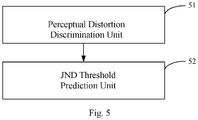
- Fig. 5 shows a schematic view of the prediction device for the image-level JND threshold as provided in Embodiment IV of the invention. For clarification, only some parts regarding this embodiment of the invention are displayed, comprising:
- various units of the prediction device for the image-level JND threshold can be achieved through corresponding hardware or software units, while various units can serve as independent software or hardware units or can be integrated into a software and hardware unit, wherein the invention is not restricted in this respect.
- the embodiments of various units have been described in the hereinbefore embodiments and will not be elaborated again here.
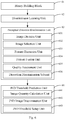
- Fig. 6 shows a schematic view of the prediction device for the image-level JND threshold as provided in Embodiment V of the invention. For clarification, only some parts regarding this embodiment of the invention are displayed, comprising:
- a perceptual distortion discrimination unit 63 comprises:
- various units of the prediction device for the image-level JND threshold can be achieved through corresponding hardware or software units, while various units can serve as independent software or hardware units or can be integrated into a software and hardware unit, wherein the invention is not restricted in this respect.
- the embodiments of various units have been described in the hereinbefore embodiments and will not be elaborated again here.
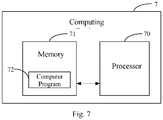
- Fig. 7 shows a schematic view of the computing device as provided in Embodiment VI of the invention. For clarification, only some parts regarding this embodiment of the invention are displayed.
- the computing device 7 consists of a processor 70, a memory 71, and a computer program 72 stored in memory 71 and executable on the processor 70.
- processor 70 executes the computer program 72
- the steps in the hereinbefore embodiments of the prediction method for the image-level JND threshold are effectuated, such as S101 or S102 in Fig.1 .
- processor 70 executes the computer program 72
- the functions of various units in the hereinbefore device embodiments are effectuated, such as the functions of Unit 51 and Unit 52 in Fig. 5 .
- perceptual distortion discrimination is conducted on the raw image and on the compressed images in the compressed image set of the said image through trained multi-class perceptual distortion discriminator to obtain the set of perceptual distortion discrimination results, and preset image-level JND search strategies are adopted for fault tolerance of the said set of perceptual distortion discrimination results to predict the image-level JND threshold of the said image, thus reducing the prediction deviation of the image-level JND threshold, improving the prediction accuracy of the image-level JND threshold, and bringing the predicted JND threshold closer to the human visual system's perception of the quality of the entire image.
- the computing device in this embodiment of the invention consists of a personal computer and a server.
- the processor 70 in the computing device 7 executes the computer program 72, the steps of effectuating the prediction method for the image-level JND threshold have been described in the hereinbefore method embodiments and will not be further elaborated here.
- a computer-readable storage medium is presented, provided with a computer program.
- the steps in the prediction method embodiments for the image-level JND threshold are effectuated, such as S101 and S102 in Fig. 1 .
- the functions of various units in the hereinbefore device embodiments are effectuated, such as the functions of Unit 51 and Unit 52 in Fig. 5 .
- perceptual distortion discrimination is conducted on the raw image and on the compressed images in the compressed image set of the said image through trained multi-class perceptual distortion discriminator to obtain the set of perceptual distortion discrimination results, and preset image-level JND search strategies are adopted for fault tolerance of the said set of perceptual distortion discrimination results to predict the image-level JND threshold of the said image, thus reducing the prediction deviation of the image-level JND threshold, improving the prediction accuracy of the image-level JND threshold, and bringing the predicted JND threshold closer to the human visual system's perception of the quality of the entire image.
- the computer-readable storage medium comprises any physical device or recording medium, such as ROM/RAM, disc, compact disc, flash memory, and other memories.
Landscapes
- Engineering & Computer Science (AREA)
- Theoretical Computer Science (AREA)
- Physics & Mathematics (AREA)
- General Physics & Mathematics (AREA)
- Data Mining & Analysis (AREA)
- Artificial Intelligence (AREA)
- Evolutionary Computation (AREA)
- Life Sciences & Earth Sciences (AREA)
- General Engineering & Computer Science (AREA)
- Software Systems (AREA)
- Computer Vision & Pattern Recognition (AREA)
- Computing Systems (AREA)
- Health & Medical Sciences (AREA)
- General Health & Medical Sciences (AREA)
- Computational Linguistics (AREA)
- Mathematical Physics (AREA)
- Biophysics (AREA)
- Biomedical Technology (AREA)
- Molecular Biology (AREA)
- Multimedia (AREA)
- Bioinformatics & Cheminformatics (AREA)
- Evolutionary Biology (AREA)
- Bioinformatics & Computational Biology (AREA)
- Quality & Reliability (AREA)
- Signal Processing (AREA)
- Image Analysis (AREA)
Applications Claiming Priority (1)
| Application Number | Priority Date | Filing Date | Title |
|---|---|---|---|
| PCT/CN2018/120749 WO2020118588A1 (fr) | 2018-12-12 | 2018-12-12 | Procédé, dispositif et appareil pour prédire un seuil jnd par images, et support de stockage |
Publications (3)
| Publication Number | Publication Date |
|---|---|
| EP3896965A1 true EP3896965A1 (fr) | 2021-10-20 |
| EP3896965A4 EP3896965A4 (fr) | 2021-12-15 |
| EP3896965B1 EP3896965B1 (fr) | 2025-10-01 |
Family
ID=71075829
Family Applications (1)
| Application Number | Title | Priority Date | Filing Date |
|---|---|---|---|
| EP18943329.5A Active EP3896965B1 (fr) | 2018-12-12 | 2018-12-12 | Procédé, dispositif et appareil pour prédire un seuil jnd par images, et support de stockage |
Country Status (3)
| Country | Link |
|---|---|
| US (1) | US20220051385A1 (fr) |
| EP (1) | EP3896965B1 (fr) |
| WO (1) | WO2020118588A1 (fr) |
Families Citing this family (9)
| Publication number | Priority date | Publication date | Assignee | Title |
|---|---|---|---|---|
| CN112437302B (zh) * | 2020-11-12 | 2022-09-13 | 深圳大学 | 屏幕内容图像的jnd预测方法、装置、计算机设备及存储介质 |
| CN112637597B (zh) * | 2020-12-24 | 2022-10-18 | 深圳大学 | Jpeg图像压缩方法、装置、计算机设备及存储介质 |
| CN114612281B (zh) * | 2022-02-28 | 2025-06-27 | 南京信息工程大学 | 针对光照环境下的屏幕拍照鲁棒水印方法 |
| CN115187519B (zh) * | 2022-06-21 | 2023-04-07 | 上海市计量测试技术研究院 | 图像质量评价方法、系统及计算机可读介质 |
| US12456179B2 (en) | 2022-09-30 | 2025-10-28 | Netflix, Inc. | Techniques for generating a perceptual quality model for predicting video quality across different viewing parameters |
| US12167000B2 (en) * | 2022-09-30 | 2024-12-10 | Netflix, Inc. | Techniques for predicting video quality across different viewing parameters |
| CN116366860A (zh) * | 2023-04-25 | 2023-06-30 | 广东赛昉科技有限公司 | 一种图像宽动态压缩方法、系统、电子设备及储存介质 |
| CN118823379B (zh) * | 2024-09-20 | 2025-03-04 | 江西财经大学 | 动态跨层级失真信息融合无参考全景图像质量评价方法 |
| CN119743609A (zh) * | 2024-12-27 | 2025-04-01 | 中国科学院深圳先进技术研究院 | 一种图像级jnd阈值预测方法、装置、设备以及存储介质 |
Family Cites Families (10)
| Publication number | Priority date | Publication date | Assignee | Title |
|---|---|---|---|---|
| US7596242B2 (en) * | 1995-06-07 | 2009-09-29 | Automotive Technologies International, Inc. | Image processing for vehicular applications |
| US6075884A (en) * | 1996-03-29 | 2000-06-13 | Sarnoff Corporation | Method and apparatus for training a neural network to learn and use fidelity metric as a control mechanism |
| US7475048B2 (en) * | 1998-05-01 | 2009-01-06 | Health Discovery Corporation | Pre-processed feature ranking for a support vector machine |
| US6996549B2 (en) * | 1998-05-01 | 2006-02-07 | Health Discovery Corporation | Computer-aided image analysis |
| CN102610173B (zh) * | 2012-04-01 | 2013-11-06 | 友达光电(苏州)有限公司 | 显示装置 |
| CN103002280B (zh) * | 2012-10-08 | 2016-09-28 | 中国矿业大学 | 基于hvs&roi的分布式编解码方法及系统 |
| CN103096079B (zh) * | 2013-01-08 | 2015-12-02 | 宁波大学 | 一种基于恰可察觉失真的多视点视频码率控制方法 |
| CN103501441B (zh) * | 2013-09-11 | 2016-08-17 | 北京交通大学长三角研究院 | 一种基于人类视觉系统的多描述视频编码方法 |
| CN104063894B (zh) * | 2014-06-13 | 2017-02-22 | 中国科学院深圳先进技术研究院 | 点云三维模型重建方法及系统 |
| CN105550701B (zh) * | 2015-12-09 | 2018-11-06 | 福州华鹰重工机械有限公司 | 实时图像提取识别方法及装置 |
-
2018
- 2018-12-12 WO PCT/CN2018/120749 patent/WO2020118588A1/fr not_active Ceased
- 2018-12-12 EP EP18943329.5A patent/EP3896965B1/fr active Active
- 2018-12-12 US US17/312,736 patent/US20220051385A1/en not_active Abandoned
Also Published As
| Publication number | Publication date |
|---|---|
| EP3896965B1 (fr) | 2025-10-01 |
| EP3896965A4 (fr) | 2021-12-15 |
| WO2020118588A1 (fr) | 2020-06-18 |
| US20220051385A1 (en) | 2022-02-17 |
Similar Documents
| Publication | Publication Date | Title |
|---|---|---|
| EP3896965B1 (fr) | Procédé, dispositif et appareil pour prédire un seuil jnd par images, et support de stockage | |
| Wu et al. | Perceptual quality metric with internal generative mechanism | |
| CN111163338B (zh) | 视频清晰度评估模型训练方法、视频推荐方法及相关装置 | |
| CN109740416B (zh) | 目标跟踪方法及相关产品 | |
| CN108805016B (zh) | 一种头肩区域检测方法及装置 | |
| CN111918130A (zh) | 视频封面确定方法、装置、电子设备及存储介质 | |
| US10467737B2 (en) | Method and device for adjusting grayscale values of image | |
| CN110633643A (zh) | 一种面向智慧社区的异常行为检测方法及系统 | |
| CN112801536B (zh) | 图像处理方法、装置和电子设备 | |
| CN111314704A (zh) | 图像级jnd阈值的预测方法、装置、设备及存储介质 | |
| CN115880495B (zh) | 复杂环境下的舰船图像目标检测方法与系统 | |
| CN113450385B (zh) | 一种夜间工作工程机械视觉跟踪方法、装置及存储介质 | |
| CN109558901A (zh) | 一种语义分割训练方法及装置、电子设备、存储介质 | |
| EP3924889A1 (fr) | Procédé, appareil et produit-programme informatique pour codage et décodage vidéo | |
| CN107622503A (zh) | 一种恢复图像遮挡边界的分层分割方法 | |
| CN115329849B (zh) | 一种面向物联网边缘服务环境感知数据异常智能处理方法 | |
| Jakhetiya et al. | Stretching artifacts identification for quality assessment of 3D-synthesized views | |
| CN117896546A (zh) | 一种数据传输方法、系统、电子设备及存储介质 | |
| CN108513132A (zh) | 一种视频质量评价方法及装置 | |
| CN112468808B (zh) | 一种基于强化学习的i帧目标带宽分配方法及装置 | |
| Lin et al. | Action density based frame sampling for human action recognition in videos | |
| CN101355649A (zh) | 去噪声的影像处理方法及其装置 | |
| CN117557499A (zh) | 一种海底管线泄漏的识别方法、装置、电子设备及介质 | |
| US20140321558A1 (en) | Video quality measurement considering multiple artifacts | |
| CN114359784A (zh) | 一种面向视频压缩的人眼恰可察觉失真的预测方法及系统 |
Legal Events
| Date | Code | Title | Description |
|---|---|---|---|
| STAA | Information on the status of an ep patent application or granted ep patent |
Free format text: STATUS: THE INTERNATIONAL PUBLICATION HAS BEEN MADE |
|
| PUAI | Public reference made under article 153(3) epc to a published international application that has entered the european phase |
Free format text: ORIGINAL CODE: 0009012 |
|
| STAA | Information on the status of an ep patent application or granted ep patent |
Free format text: STATUS: REQUEST FOR EXAMINATION WAS MADE |
|
| 17P | Request for examination filed |
Effective date: 20210602 |
|
| AK | Designated contracting states |
Kind code of ref document: A1 Designated state(s): AL AT BE BG CH CY CZ DE DK EE ES FI FR GB GR HR HU IE IS IT LI LT LU LV MC MK MT NL NO PL PT RO RS SE SI SK SM TR |
|
| A4 | Supplementary search report drawn up and despatched |
Effective date: 20211117 |
|
| RIC1 | Information provided on ipc code assigned before grant |
Ipc: G06T 9/00 20060101ALI20211111BHEP Ipc: G06T 1/20 20060101ALI20211111BHEP Ipc: H04N 7/20 20060101AFI20211111BHEP |
|
| DAV | Request for validation of the european patent (deleted) | ||
| DAX | Request for extension of the european patent (deleted) | ||
| STAA | Information on the status of an ep patent application or granted ep patent |
Free format text: STATUS: EXAMINATION IS IN PROGRESS |
|
| 17Q | First examination report despatched |
Effective date: 20240816 |
|
| REG | Reference to a national code |
Ref country code: DE Ref legal event code: R079 Free format text: PREVIOUS MAIN CLASS: H04N0007200000 Ipc: H04N0019154000 Ref document number: 602018086138 Country of ref document: DE |
|
| GRAP | Despatch of communication of intention to grant a patent |
Free format text: ORIGINAL CODE: EPIDOSNIGR1 |
|
| STAA | Information on the status of an ep patent application or granted ep patent |
Free format text: STATUS: GRANT OF PATENT IS INTENDED |
|
| RIC1 | Information provided on ipc code assigned before grant |
Ipc: H04N 19/154 20140101AFI20250701BHEP Ipc: G06T 1/20 20060101ALI20250701BHEP Ipc: G06T 9/00 20060101ALI20250701BHEP |
|
| GRAS | Grant fee paid |
Free format text: ORIGINAL CODE: EPIDOSNIGR3 |
|
| INTG | Intention to grant announced |
Effective date: 20250729 |
|
| GRAA | (expected) grant |
Free format text: ORIGINAL CODE: 0009210 |
|
| STAA | Information on the status of an ep patent application or granted ep patent |
Free format text: STATUS: THE PATENT HAS BEEN GRANTED |
|
| AK | Designated contracting states |
Kind code of ref document: B1 Designated state(s): AL AT BE BG CH CY CZ DE DK EE ES FI FR GB GR HR HU IE IS IT LI LT LU LV MC MK MT NL NO PL PT RO RS SE SI SK SM TR |
|
| REG | Reference to a national code |
Ref country code: GB Ref legal event code: FG4D Ref country code: CH Ref legal event code: F10 Free format text: ST27 STATUS EVENT CODE: U-0-0-F10-F00 (AS PROVIDED BY THE NATIONAL OFFICE) Effective date: 20251001 |
|
| REG | Reference to a national code |
Ref country code: DE Ref legal event code: R096 Ref document number: 602018086138 Country of ref document: DE |
|
| REG | Reference to a national code |
Ref country code: IE Ref legal event code: FG4D |
|
| REG | Reference to a national code |
Ref country code: NL Ref legal event code: MP Effective date: 20251001 |
|
| REG | Reference to a national code |
Ref country code: AT Ref legal event code: MK05 Ref document number: 1843816 Country of ref document: AT Kind code of ref document: T Effective date: 20251001 |
|
| PG25 | Lapsed in a contracting state [announced via postgrant information from national office to epo] |
Ref country code: NL Free format text: LAPSE BECAUSE OF FAILURE TO SUBMIT A TRANSLATION OF THE DESCRIPTION OR TO PAY THE FEE WITHIN THE PRESCRIBED TIME-LIMIT Effective date: 20251001 |
|
| PG25 | Lapsed in a contracting state [announced via postgrant information from national office to epo] |
Ref country code: ES Free format text: LAPSE BECAUSE OF FAILURE TO SUBMIT A TRANSLATION OF THE DESCRIPTION OR TO PAY THE FEE WITHIN THE PRESCRIBED TIME-LIMIT Effective date: 20251001 |
|
| REG | Reference to a national code |
Ref country code: LT Ref legal event code: MG9D |
|
| PG25 | Lapsed in a contracting state [announced via postgrant information from national office to epo] |
Ref country code: NO Free format text: LAPSE BECAUSE OF FAILURE TO SUBMIT A TRANSLATION OF THE DESCRIPTION OR TO PAY THE FEE WITHIN THE PRESCRIBED TIME-LIMIT Effective date: 20260101 |
|
| PG25 | Lapsed in a contracting state [announced via postgrant information from national office to epo] |
Ref country code: AT Free format text: LAPSE BECAUSE OF FAILURE TO SUBMIT A TRANSLATION OF THE DESCRIPTION OR TO PAY THE FEE WITHIN THE PRESCRIBED TIME-LIMIT Effective date: 20251001 Ref country code: HR Free format text: LAPSE BECAUSE OF FAILURE TO SUBMIT A TRANSLATION OF THE DESCRIPTION OR TO PAY THE FEE WITHIN THE PRESCRIBED TIME-LIMIT Effective date: 20251001 Ref country code: FI Free format text: LAPSE BECAUSE OF FAILURE TO SUBMIT A TRANSLATION OF THE DESCRIPTION OR TO PAY THE FEE WITHIN THE PRESCRIBED TIME-LIMIT Effective date: 20251001 |
|
| PG25 | Lapsed in a contracting state [announced via postgrant information from national office to epo] |
Ref country code: RS Free format text: LAPSE BECAUSE OF FAILURE TO SUBMIT A TRANSLATION OF THE DESCRIPTION OR TO PAY THE FEE WITHIN THE PRESCRIBED TIME-LIMIT Effective date: 20260101 |
|
| PG25 | Lapsed in a contracting state [announced via postgrant information from national office to epo] |
Ref country code: IS Free format text: LAPSE BECAUSE OF FAILURE TO SUBMIT A TRANSLATION OF THE DESCRIPTION OR TO PAY THE FEE WITHIN THE PRESCRIBED TIME-LIMIT Effective date: 20260201 |
|
| PG25 | Lapsed in a contracting state [announced via postgrant information from national office to epo] |
Ref country code: PT Free format text: LAPSE BECAUSE OF FAILURE TO SUBMIT A TRANSLATION OF THE DESCRIPTION OR TO PAY THE FEE WITHIN THE PRESCRIBED TIME-LIMIT Effective date: 20260202 Ref country code: CZ Free format text: LAPSE BECAUSE OF FAILURE TO SUBMIT A TRANSLATION OF THE DESCRIPTION OR TO PAY THE FEE WITHIN THE PRESCRIBED TIME-LIMIT Effective date: 20251001 |
|
| PG25 | Lapsed in a contracting state [announced via postgrant information from national office to epo] |
Ref country code: PL Free format text: LAPSE BECAUSE OF FAILURE TO SUBMIT A TRANSLATION OF THE DESCRIPTION OR TO PAY THE FEE WITHIN THE PRESCRIBED TIME-LIMIT Effective date: 20251001 |
|
| PG25 | Lapsed in a contracting state [announced via postgrant information from national office to epo] |
Ref country code: LV Free format text: LAPSE BECAUSE OF FAILURE TO SUBMIT A TRANSLATION OF THE DESCRIPTION OR TO PAY THE FEE WITHIN THE PRESCRIBED TIME-LIMIT Effective date: 20251001 |