EP3898595B1 - Dérivés de pyrimidone en tant qu'agents cytotoxiques sélectifs contre des cellules infectées par le vih - Google Patents
Dérivés de pyrimidone en tant qu'agents cytotoxiques sélectifs contre des cellules infectées par le vih Download PDFInfo
- Publication number
- EP3898595B1 EP3898595B1 EP19845846.5A EP19845846A EP3898595B1 EP 3898595 B1 EP3898595 B1 EP 3898595B1 EP 19845846 A EP19845846 A EP 19845846A EP 3898595 B1 EP3898595 B1 EP 3898595B1
- Authority
- EP
- European Patent Office
- Prior art keywords
- oxo
- dihydropyrimidin
- methyl
- oxy
- dimethyl
- Prior art date
- Legal status (The legal status is an assumption and is not a legal conclusion. Google has not performed a legal analysis and makes no representation as to the accuracy of the status listed.)
- Active
Links
Classifications
-
- C—CHEMISTRY; METALLURGY
- C07—ORGANIC CHEMISTRY
- C07D—HETEROCYCLIC COMPOUNDS
- C07D403/00—Heterocyclic compounds containing two or more hetero rings, having nitrogen atoms as the only ring hetero atoms, not provided for by group C07D401/00
- C07D403/02—Heterocyclic compounds containing two or more hetero rings, having nitrogen atoms as the only ring hetero atoms, not provided for by group C07D401/00 containing two hetero rings
- C07D403/06—Heterocyclic compounds containing two or more hetero rings, having nitrogen atoms as the only ring hetero atoms, not provided for by group C07D401/00 containing two hetero rings linked by a carbon chain containing only aliphatic carbon atoms
-
- C—CHEMISTRY; METALLURGY
- C07—ORGANIC CHEMISTRY
- C07D—HETEROCYCLIC COMPOUNDS
- C07D239/00—Heterocyclic compounds containing 1,3-diazine or hydrogenated 1,3-diazine rings
- C07D239/02—Heterocyclic compounds containing 1,3-diazine or hydrogenated 1,3-diazine rings not condensed with other rings
- C07D239/24—Heterocyclic compounds containing 1,3-diazine or hydrogenated 1,3-diazine rings not condensed with other rings having three or more double bonds between ring members or between ring members and non-ring members
- C07D239/28—Heterocyclic compounds containing 1,3-diazine or hydrogenated 1,3-diazine rings not condensed with other rings having three or more double bonds between ring members or between ring members and non-ring members with hetero atoms or with carbon atoms having three bonds to hetero atoms with at the most one bond to halogen, directly attached to ring carbon atoms
- C07D239/46—Two or more oxygen, sulphur or nitrogen atoms
- C07D239/52—Two oxygen atoms
-
- A—HUMAN NECESSITIES
- A61—MEDICAL OR VETERINARY SCIENCE; HYGIENE
- A61K—PREPARATIONS FOR MEDICAL, DENTAL OR TOILETRY PURPOSES
- A61K31/00—Medicinal preparations containing organic active ingredients
- A61K31/33—Heterocyclic compounds
- A61K31/395—Heterocyclic compounds having nitrogen as a ring hetero atom, e.g. guanethidine or rifamycins
- A61K31/495—Heterocyclic compounds having nitrogen as a ring hetero atom, e.g. guanethidine or rifamycins having six-membered rings with two or more nitrogen atoms as the only ring heteroatoms, e.g. piperazine or tetrazines
- A61K31/505—Pyrimidines; Hydrogenated pyrimidines, e.g. trimethoprim
- A61K31/513—Pyrimidines; Hydrogenated pyrimidines, e.g. trimethoprim having oxo groups directly attached to the heterocyclic ring, e.g. cytosine
-
- A—HUMAN NECESSITIES
- A61—MEDICAL OR VETERINARY SCIENCE; HYGIENE
- A61K—PREPARATIONS FOR MEDICAL, DENTAL OR TOILETRY PURPOSES
- A61K45/00—Medicinal preparations containing active ingredients not provided for in groups A61K31/00 - A61K41/00
- A61K45/06—Mixtures of active ingredients without chemical characterisation, e.g. antiphlogistics and cardiaca
-
- A—HUMAN NECESSITIES
- A61—MEDICAL OR VETERINARY SCIENCE; HYGIENE
- A61P—SPECIFIC THERAPEUTIC ACTIVITY OF CHEMICAL COMPOUNDS OR MEDICINAL PREPARATIONS
- A61P31/00—Antiinfectives, i.e. antibiotics, antiseptics, chemotherapeutics
- A61P31/12—Antivirals
- A61P31/14—Antivirals for RNA viruses
- A61P31/18—Antivirals for RNA viruses for HIV
-
- C—CHEMISTRY; METALLURGY
- C07—ORGANIC CHEMISTRY
- C07D—HETEROCYCLIC COMPOUNDS
- C07D403/00—Heterocyclic compounds containing two or more hetero rings, having nitrogen atoms as the only ring hetero atoms, not provided for by group C07D401/00
- C07D403/14—Heterocyclic compounds containing two or more hetero rings, having nitrogen atoms as the only ring hetero atoms, not provided for by group C07D401/00 containing three or more hetero rings
Definitions
- HIV Human immunodeficiency virus
- AIDS acquired immunodeficiency syndrome
- HIV is a retrovirus whose life cycle involves reverse transcription of a viral RNA genome into DNA via an enzyme known as reverse transcriptase and subsequent integration of the DNA copy into the host chromosomal DNA via the virally encoded integrase.
- Viral RNA is transcribed and viral proteins are translated using the host cellular machinery in conjunction with viral accessory proteins.
- Many viral proteins are contained within the GAG and GAG-POL proteins, with GAG containing structural proteins and GAG-POL resulting from a frameshift near the carboxy-terminus of GAG and containing protease (PR), reverse transcriptase (RT), and integrase (IN) viral enzymes, in addition to the structural proteins.
- GAG and GAG-POL are cleaved into individual proteins through the process of maturation which occurs during budding of virions from the infected cell.
- GAG-POL dimerizes and the now dimeric HIV PR within the GAG-POL dimer forms an active enzyme which can cleave itself out of the polyprotein and catalyze further cleavage to form the remaining viral enzymes and structural proteins.
- Available antiretroviral drugs act by blocking the virus at different stages in the viral life cycle.
- reverse transcriptase inhibitors target the viral reverse transcriptase and prevent the RNA genome from being copied into DNA
- integrase inhibitors block the ability of the copied DNA from being integrated into the host cell
- protease inhibitors prevent viral maturation so that virions produced from cells treated with protease inhibitors are immature and non-infectious.
- WO 2014/058747 and WO 2015/153304 describe other compounds for treating HIV. Chelur et al., Proc. Natl. Acad. Sci. U.S.A., 2007, 104(7): 2283-2288 describes targeted cell killing by reconsistuted caspases.
- references to methods of treatment in the subsequent paragraphs of this description are to be interpreted as references to the compounds, pharmaceutical compositions and medicaments of the present invention for use in a method for treatment of the human (or animal) body by therapy (or for diagnosis).
- the present disclosure is directed to pyrimidone derivatives according to the appended claims and their use as HIV-Targeted Activator of Cell Kill agents which accelerate the death of HIV GAG-POL expressing cells without concomitant cytotoxicity to HIV naive cells.
- the compounds disclosed herein are useful for the treatment or prophylaxis of infection by HIV, or for the treatment, prophylaxis or delay in the onset or progression of AIDS or AIDS Related Complex (ARC). Additionally, the compounds are useful for selectively killing HIV infected GAG-POL expressing cells in a subject infected with HIV.
- Compositions and methods of use comprising the compounds of this disclosure are also provided.
- the present disclosure is directed to pyrimidone derivative compounds and their use for accelerating the death of HIV GAG-POL expressing cells without concomitant cytotoxicity to HIV naive cells.
- protease (PR) activation takes place during viral maturation and the concentration of mature PR in the cytoplasm is limited.
- the present compounds promote the desired phenotype by catalyzing GAG-POL dimerization inside the infected cell by binding to the immature RT binding site and triggering premature activation of the HIV PR enzyme inside the host infected cell prior to budding.
- PR cleaves host substrates within the cell, leading to cytotoxicity and cell death. This effect can be blocked in the presence of an HIV protease inhibitor such as indinavir or darunavir demonstrating the role of HIV protease in the process.
- NRTIs Non-Nucleoside Reverse Transcriptase Inhibitors
- the present disclosure is directed to a compound of Formula I or a pharmaceutically acceptable salt thereof, wherein:
- Ring A is selected from:
- R 1a is halo, -C 1-3 alkyl unsubstituted or substituted with 1 to 7 of F; -OC 1-3 alkyl unsubstituted or substituted with 1 to 7 of F; or -NH 2 , -NH-C 1-3 alkyl, -N(C 1-3 alkyl) 2 , or - C 3-6 cycloalkyl;
- R 2a is -H, halo, -C 1-3 alkyl, -CF 3 , -CHF 2, -CH 2 F, -NH 2 , -NH-C 1-3 alkyl , -N(C 1-3 alkyl) 2 , - C 3-6 cycloalkyl or -OC 1-3 alkyl unsubstituted or substituted with 1 to 3 of F;
- R 3a is -H or halo; provided that R 2a and R 3a are not both -H;
- R 1b is halo, -C 1-3
- Embodiment 1 of this disclosure are compounds of Formula I, or pharmaceutically acceptable salts thereof, wherein:
- Embodiment 2 of this disclosure are compounds of Formula I or Embodiment 1, or pharmaceutically acceptable salts thereof, wherein:
- Embodiment 3 of this disclosure are compounds of Formula I, Embodiment 1 or Embodiment 2, or pharmaceutically acceptable salts thereof, wherein:
- Embodiment 4 of this disclosure are compounds of Formula I, Embodiment 1, Embodiment 2, or Embodiment 3, wherein Ring A is (Aa) having the following Formula Ia: or a pharmaceutically acceptable salt thereof, provided that said compound or said pharmaceutically acceptable salt of Formula I is selected from those in Table (i).
- Embodiment 4A of this disclosure are compounds of Formula I, Formula Ia, Embodiment 1, Embodiment 2, Embodiment 3, or Embodiment 4, or pharmaceutically acceptable salts thereof, wherein:
- Embodiment 4B of this disclosure are compounds of Formula I, Formula Ia, Embodiment 1, Embodiment 2, Embodiment 3, Embodiment 4, or Embodiment 4A, or pharmaceutically acceptable salts thereof, wherein: R 4 is -CH(F)-R 8 or -C(F 2 )-R 8 wherein R 8 is (a) -CH 3 unsubstituted or substituted with 1 to 3 of F, or (b) -CH 2 CH 3 unsubstituted or substituted with 1 to 5 of -F, provided that said compound or said pharmaceutically acceptable salt of Formula I is selected from those in Table (i).
- Embodiment 5 of this disclosure are compounds of Formula I, Embodiment 1, Embodiment 2, or Embodiment 3, wherein Ring A is (Ab) having the following Formula Ib: or a pharmaceutically acceptable salt thereof, provided that said compound or said pharmaceutically acceptable salt of Formula I is selected from those in Table (i).
- Embodiment 5A of this disclosure are compounds of Formula I, Formula Ib, Embodiment 1, Embodiment 2, Embodiment 3, or Embodiment 5, or pharmaceutically acceptable salts thereof, wherein:
- Embodiment 5B of this disclosure are compounds of Formula I, Formula Ib, Embodiment 1, Embodiment 2, Embodiment 3, or Embodiment 5, or pharmaceutically acceptable salts thereof, wherein:
- Embodiment 5C of this disclosure are compounds of Formula I, Formula Ib, Embodiment 1, Embodiment 2, Embodiment 3, Embodiment 5, or Embodiment 5A, or Embodiment 5B, or pharmaceutically acceptable salts thereof, wherein: R 4 is -CF 3 , -CH(F)-R 8 or -C(F 2 )-R 8 wherein R 8 is (a) -CH 3 unsubstituted or substituted with 1 to 3 of F, or (b) -CH 2 CH 3 unsubstituted or substituted with 1 to 5 of -F, provided that said compound or said pharmaceutically acceptable salt of Formula I is selected from those in Table (i).
- Embodiment 6 of this disclosure are compounds of Formula I, Embodiment 1, Embodiment 2, or Embodiment 3, wherein Ring A is (Ac) having the following Formula Ic: or a pharmaceutically acceptable salt thereof, provided that said compound or said pharmaceutically acceptable salt of Formula I is selected from those in Table (i).
- Embodiment 6A of this disclosure are compounds of Formula I, Formula Ic, Embodiment 1, Embodiment 2, Embodiment 3 or Embodiment 6, or pharmaceutically acceptable salts thereof, wherein:
- Embodiment 6B of this disclosure are compounds of Formula I, Formula Ic, Embodiment 1, Embodiment 2, Embodiment 3, Embodiment 6, or Embodiment 6A, or pharmaceutically acceptable salts thereof, wherein: R 4 is -CH(F)-R 8 or -C(F 2 )-R 8 wherein R 8 is (a) -CH 3 unsubstituted or substituted with 1 to 3 of -F, or (b) -CH 2 CH 3 unsubstituted or substituted with 1 to 5 of -F.
- Embodiment 7 are compounds of Formula I or a pharmaceutically acceptable salt thereof, wherein:
- references to the compounds of Formula I herein encompasses the compounds of Formula I, Ia, Ib and Ic, and all embodiments, classes and sub-classes thereof and includes the compounds of the Examples herein.
- the compounds of Formula I encompass neutral compounds or salts thereof when such salts are possible, including pharmaceutically acceptable salts.
- alkyl refers to both branched- and straight-chain saturated aliphatic hydrocarbon groups having the specified number of carbon atoms in a specified range.
- C 1-4 alkyl has 1, 2, 3 or 4 carbon atoms and includes each of n -, i -, s - and t -butyl, n- and i -propyl, ethyl and methyl.
- C 1-3 alkyl has 1, 2 or 3 carbon atoms and includes each of n -propyl, i -propyl, ethyl and methyl.
- Cycloalkyl refers to a cyclized alkyl ring having the indicated number of carbon atoms in a specified range.
- C 3-6 cycloalkyl includes each of cyclopropyl, cyclobutyl, cyclopentyl and cyclohexyl
- C 3-4 cycloalkyl includes each of cyclopropyl and cyclobutyl.
- Halo or "halogen” refers to chloro, fluoro, bromo or iodo. Chloro, fluoro and bromo are a class of halogens of interest, and more particularly fluoro.
- HIV naive cell(s) are cells that are not infected with HIV.
- Compatible anti-HIV agent(s) are anti-HIV agents excluding HIV protease inhibitors.
- a “stable” compound is a compound which can be prepared and isolated and whose structure and properties remain or can be caused to remain essentially unchanged for a period of time sufficient to allow use of the compound for the purposes described herein (e.g., therapeutic or prophylactic administration to a subject).
- the compounds of the present disclosure are limited to stable compounds embraced by Formula I and its embodiments.
- certain moieties as defined in Formula I may be unsubstituted or substituted, and the latter is intended to encompass substitution patterns (i.e., number and kind of substituents) that are chemically possible for the moiety and that result in a stable compound.
- This disclosure includes individual diastereomers, particularly epimers, i.e., compounds having the same chemical formula but which differ in the spatial arrangement around a single atom.
- This disclosure also includes mixtures of diastereomers, particularly mixtures of epimers, in all ratios.
- This disclosure encompasses compounds of Formula I having either the ( R ) or ( S ) stereo-configuration at an asymmetric center and at any additional asymmetric centers that may be present in a compound of Formula I, as well as stereo-isomeric mixtures thereof.
- Embodiments of this disclosure also include a mixture of enantiomers enriched with 51% or more of one of the enantiomers, including for example 60% or more, 70% or more, 80% or more, or 90% or more of one enantiomer.
- a single epimer is preferred.
- An individual or single enantiomer refers to an enantiomer obtained by chiral synthesis and/or using generally known separation and purification techniques, and which may be 100% of one enantiomer or may contain small amounts (e.g., 10% or less) of the opposite enantiomer.
- individual enantiomers are a subject of this disclosure in pure form, both as levorotatory and as dextrorotatory antipodes, in the form of racemates and in the form of mixtures of the two enantiomers in all ratios.
- this disclosure includes both the cis form and the trans form as well as mixtures of these forms in all ratios.
- the preparation of individual stereoisomers can be carried out, if desired, by separation of a mixture by customary methods, for example by chromatography or crystallization, by the use of stereochemically uniform starting materials for the synthesis or by stereoselective synthesis.
- a derivatization can be carried out before a separation of stereoisomers.
- the separation of a mixture of stereoisomers can be carried out at an intermediate step during the synthesis of a compound of Formula I or it can be done on a final racemic product.
- Absolute stereochemistry may be determined by X-ray crystallography of crystalline products or crystalline intermediates which are derivatized, if necessary, with a reagent containing a stereogenic center of known configuration.
- absolute stereochemistry may be determined by Vibrational Circular Dichroism (VCD) spectroscopy analysis.
- VCD Vibrational Circular Dichroism
- the present disclosure includes all such isomers, as well as salts, solvates (which includes hydrates). and solvated salts of such racemates, enantiomers, diastereomers and tautomers and mixtures thereof.
- the atoms in a compound of Formula I may exhibit their natural isotopic abundances, or one or more of the atoms may be artificially enriched in a particular isotope having the same atomic number, but an atomic mass or mass number different from the atomic mass or mass number predominantly found in nature.
- the present disclosure is meant to include all suitable isotopic variations of the compounds of Formula I; for example, different isotopic forms of hydrogen (H) include protium ( 1 H) and deuterium ( 2 H). Protium is the predominant hydrogen isotope found in nature. Enriching for deuterium may afford certain therapeutic advantages, such as increasing in vivo half-life or reducing dosage requirements, or may provide a compound useful as a standard for characterization of biological samples.
- Isotopically-enriched compounds of Formula I can be prepared without undue experimentation by conventional techniques well known to those skilled in the art or by processes analogous to those described in the Schemes and Examples herein using appropriate isotopically-enriched reagents and/or intermediates.
- the compounds can be administered in the form of pharmaceutically acceptable salts.
- pharmaceutically acceptable salt refers to a salt which possesses the effectiveness of the parent compound and which is not biologically or otherwise undesirable (e.g., is neither toxic nor otherwise deleterious to the recipient thereof).
- the invention includes the corresponding pharmaceutically acceptable salts.
- the compounds of Formula I that contain acidic groups can be used according to the invention as, for example but not limited to, alkali metal salts, alkaline earth metal salts or as ammonium salts.
- alkali metal salts e.g., -COOH
- ammonium salts examples include but are not limited to sodium salts, potassium salts, calcium salts, magnesium salts or salts with ammonia or organic amines such as, for example, ethylamine, ethanolamine, triethanolamine or amino acids.
- the invention also includes, in addition to the salt forms mentioned, inner salts or betaines (zwitterions). Salts can be obtained from the compounds of Formula I by customary methods which are known to the person skilled in the art, for example by combination with an organic or inorganic acid or base in a solvent or dispersant, or by anion exchange or cation exchange from other salts.
- the present invention also includes all salts of the compounds of Formula I which, owing to low physiological compatibility, are not directly suitable for use in pharmaceuticals but which can be used, for example, as intermediates for chemical reactions or for the preparation of pharmaceutically acceptable salts.
- compositions comprised of a compound of Formula I or a compound that is a salt thereof, including for example but not limited to, a composition comprised of said compound associated together with one or more additional molecular and/or ionic component(s) which may be referred to as a "co-crystal.”
- co-crystal refers to a solid phase (which may or may not be crystalline) wherein two or more different molecular and/or ionic components (generally in a stoichiometric ratio) are held together by non-ionic interactions including but not limited to hydrogen-bonding, dipole-dipole interactions, dipole-quadrupole interactions or dispersion forces (van der Waals).
- compounds of the present disclosure may exist in amorphous form and/or one or more crystalline forms, and as such all amorphous and crystalline forms and mixtures thereof of the compounds of Formula I and salts thereof are intended to be included within the scope of the present disclosure.
- some of the compounds of the instant disclosure may form solvates with water (i.e., a hydrate) or common organic solvents.
- Such solvates and hydrates, particularly the pharmaceutically acceptable solvates and hydrates, of the compounds of this disclosure are likewise encompassed within the scope of the compounds defined by Formula I and the pharmaceutically acceptable salts thereof, along with un-solvated and anhydrous forms of such compounds.
- the compounds of Formula I or salts thereof including pharmaceutically acceptable salts thereof, embodiments thereof and specific compounds described and claimed herein encompass all possible stereoisomers, tautomers, physical forms (e.g., amorphous and crystalline forms), co-crystal forms, solvate and hydrate forms, and any combination of the foregoing forms where such forms are possible.
- substantially pure means suitably at least about 60 wt.%, typically at least about 70 wt.%, preferably at least about 80 wt.%, more preferably at least about 90 wt.% (e.g., from about 90 wt.% to about 99 wt.%), even more preferably at least about 95 wt.% (e.g., from about 95 wt.% to about 99 wt.%, or from about 98 wt. % to 100 wt.
- a product containing a compound of Formula I or its salt e.g., the product isolated from a reaction mixture affording the compound or salt
- the level of purity of the compounds and salts can be determined using a standard method of analysis such as, high performance liquid chromatography, and/or mass spectrometry or NMR techniques. If more than one method of analysis is employed and the methods provide experimentally significant differences in the level of purity determined, then the method providing the highest purity level governs.
- a compound or salt of 100% purity is one which is free of detectable impurities as determined by a standard method of analysis.
- a substantially pure compound can be either a substantially pure mixture of the stereoisomers or a substantially pure individual stereoisomer.
- the compounds of Formula I herein, and pharmaceutically acceptable salts thereof are useful for eliciting GAG-POL dimerization in HIV-infected cells and thereby selectively killing HIV infected GAG-POL expressing cells without concomitant cytotoxicity to HIV naive cells, referred to herein as TACK (Targeted Activator of Cell Kill) activity, or more specifically HIV TACK activity .
- HIV TACK or TACK have also been previously referred to as Small Molecule Activated Cell Kill (SMACK).
- SMACK Small Molecule Activated Cell Kill
- the compounds of Formula I and pharmaceutically acceptable salts thereof are useful for any of the methods (i), (ii) or (iii) above, further comprising administering to the human subject an effective amount of one or more compatible HIV antiviral agents selected from nucleoside or nucleotide HIV reverse transcriptase inhibitors, nucleoside reverse transcriptase translocation inhibitors, non-nucleoside HIV reverse transcriptase inhibitors, HIV integrase inhibitors, HIV fusion inhibitors, HIV entry inhibitors, HIV maturation inhibitors and post-attachment inhibitors.
- the human subject can be treated with a compound Formula I or a pharmaceutically acceptable salt thereof in addition to treatment with one or more compatible HIV antiviral agents.
- the compounds of Formula I and pharmaceutically acceptable salts thereof are also useful for a method for augmenting the suppression of HIV viremia in a human subject whose viremia is being suppressed by administration of one or more compatible HIV antiviral agents, which comprises additionally administering to the human subject an effective amount of the compound according to Formula I, or a pharmaceutically acceptable salt thereof.
- Additional embodiments of the present invention include each of the pharmaceutical compositions, methods and uses set forth in the preceding paragraphs, wherein the compound of Formula I or its salt employed therein in substantially pure.
- compositions, methods and uses set forth above wherein the HIV of interest is HIV-1.
- An additional embodiment of the present invention includes the pharmaceutical compositions, methods, medicaments, uses and combinations set forth herein, wherein the HIV of interest is HIV-1.
- the compound or salt thereof is employed in an amount effective against HIV-1; and when used in combination with one or more compatible anti-HIV agent(s), each such additional agent is a compatible HIV-1 antiviral selected from one or more of nucleoside or nucleotide HIV reverse transcriptase inhibitors, nucleoside reverse transcriptase translocation inhibitors, non-nucleoside HIV reverse transcriptase inhibitors, HIV integrase inhibitors, HIV fusion inhibitors, HIV entry inhibitors, HIV maturation inhibitors and post-attachment inhibitors.
- administration and variants thereof (e.g., “administering” a compound) in reference to a compound of Formula I means providing the compound to the individual in need of treatment or prophylaxis and includes both self-administration and administration to the patient by another person or any other means.
- a compound is provided in combination with one or more other active agents (e.g., antiviral agents useful for treating or prophylaxis of HIV infection or AIDS)
- administration and its variants are each understood to include provision of the compound and other agents at the same time or at different times.
- the agents of a combination are administered at the same time, they can be administered together in a single composition or they can be administered separately.
- composition is intended to encompass a product comprising the specified ingredients, as well as any product which results from combining the specified ingredients.
- Ingredients suitable for inclusion in a pharmaceutical composition are pharmaceutically acceptable ingredients, which means the ingredients must be compatible with each other and not deleterious to the recipient thereof.
- subject or “patient” as used herein refers to a human (or "person") who has been the object of treatment, observation or experiment.
- HIV TACK agent examples include but are not limited to, patients who have been infected with HIV, and/or HIV infected patients whose HIV viral load has been suppressed and/or is considered to be undetectable at time of HIV TACK treatment.
- Patients to be treated with an HIV TACK agent also include, but are not limited to, those using an HIV TACK agent for prophylaxis of HIV infection or for post-exposure prophylaxis after being potentially exposed to HIV to prevent becoming infected.
- Prophylaxis includes each of pre-exposure prophylaxis (PrEP), i.e., using a compound of Formula I or a pharmaceutically acceptable salt thereof to prevent HIV infection in a person who does not have HIV, and post-exposure prophylaxis (PEP), i.e., using a compound of Formula I or a pharmaceutically acceptable salt thereof after being potentially exposed to HIV to prevent becoming infected with HIV.
- PrEP pre-exposure prophylaxis
- PEP post-exposure prophylaxis
- an effective amount means an amount of a compound sufficient to elicit GAG-POL dimerization in HIV-infected cells and selectively kill HIV infected GAG-POL expressing cells without concomitant cytotoxicity to HIV naive cells; and/or exert a therapeutic effect, and/or a exert a prophylactic effect after administration.
- One embodiment of "effective amount” is a “therapeutically effective amount” which is an amount of a compound that is effective for selectively killing HIV infected GAG-POL expressing cells, effective for treating HIV infection, or effective for the treatment, prophylaxis or delay in the onset or progression of AIDS or ARC in a patient infected with HIV.
- an effective amount is a “prophylactically effective amount” which is an amount of the compound that is effective for prophylaxis of HIV infection, or prophylaxis of AIDS or ARC in an HIV-infected patient. It is understood that an effective amount can simultaneously be both a therapeutically effective amount, e.g., for treatment of HIV infection, and a prophylactically effective amount, e.g., for prevention or reduction of risk for developing AIDS or ARC in a subject infected with HIV.
- an effective amount can refer to each individual agent or to the combination as a whole, wherein the amounts of all agents administered in the combination are together effective, but wherein a component agent of the combination may or may not be present individually in an effective amount with reference to what is considered effective for that component agent if it were administered alone.
- the compounds of this invention can be administered by means that produce contact of the active agent with the agent's site of action. They can be administered by conventional means available for use in conjunction with pharmaceuticals, either as individual therapeutic agents or in a combination of therapeutic agents.
- the compound can be administered itself, but typically is administered with a pharmaceutical carrier selected on the basis of the chosen route of administration and standard pharmaceutical practice.
- the compounds of the invention can, for example, be administered orally (e.g., via tablet or capsule), parenterally (including subcutaneous injections, intravenous, intramuscular or intrasternal injection, or infusion techniques), by inhalation spray, or rectally, in the form of a unit dosage of a pharmaceutical composition containing an effective amount of the compound and conventional non-toxic pharmaceutically acceptable carriers, adjuvants and vehicles.
- the compound could also be administered via an implantable drug delivery device adapted to provide an effective amount of the compound or a pharmaceutical composition of the compound over an extended period of time.
- Solid preparations suitable for oral administration can be prepared according to techniques known in the art and can employ such solid excipients as starches, sugars, kaolin, lubricants, binders, disintegrating agents and the like.
- Liquid preparations suitable for oral administration e.g., suspensions, syrups, elixirs and the like
- Parenteral compositions can be prepared according to techniques known in the art and typically employ sterile water as a carrier and optionally other ingredients, such as a solubility aid.
- Injectable solutions can be prepared according to methods known in the art wherein the carrier comprises a saline solution, a glucose solution or a solution containing a mixture of saline and glucose.
- Implantable compositions can be prepared according to methods known in the art wherein the carrier comprises the active chemical ingredient with polymers and suitable excipients, or utilizing an implantable device for drug delivery. Further description of methods suitable for use in preparing pharmaceutical compositions for use in the present invention and of ingredients suitable for use in said compositions is provided in Remington - The Science and Practice of Pharmacy, 22nd Edition, published by Pharmaceutical Press and Philadelphia College of Pharmacy at University of the Sciences, 2012, ISBN 978 0 85711-062-6 and prior editions .
- Formulations of compounds of Formula I that result in drug supersaturation and/or rapid dissolution may be utilized to facilitate oral drug absorption.
- Formulation approaches to cause drug supersaturation and/or rapid dissolution include, but are not limited to, nanoparticulate systems, amorphous systems, solid solutions, solid dispersions, and lipid systems.
- Such formulation approaches and techniques for preparing them are known in the art.
- solid dispersions can be prepared using excipients and processes as described in reviews (e.g., A.T.M. Serajuddin, J Pharm Sci, 88:10, pp. 1058-1066 (1999 )).
- Nanoparticulate systems based on both attrition and direct synthesis have also been described in reviews such as Wu et al ( F. Kesisoglou, S. Panmai, Y. Wu, Advanced Drug Delivery Reviews, 59:7 pp. 631-644 (2007 )).
- the compounds of Formula I may be administered in a dosage range of, e.g., 1 to 20 mg/kg, or 1 to 10 mg/kg, or about 5 mg/kg of mammal (e.g., human) body weight per day, or at other time intervals as appropriate, in a single dose or in divided doses.
- the compounds of Formula I may be administered in a dosage range of 0.001 to 2000 mg. per day in a single dose or in divided doses. Examples of dosage ranges are 0.01 to 1500 mg per day, or 0.1 to 1000 mg per day, administered orally or via other routes of administration in a single dose or in divided doses.
- the dosage units may contain 100 mg to 1500 mg of the active ingredient, for example but not limited to, 100, 150, 200, 250, 300, 350, 400, 450, 500, 600, 700, 800, 900, 1000, 1100, 1200, 1300, 1400 or 1500 milligrams of the active ingredient for the symptomatic adjustment of the dosage to the patient to be treated.
- the compound may be formulated in oral formulations for immediate or modified release such as extended or controlled release.
- reference to an amount of the compound in milligrams or grams is based on the free form (i.e., the non-salt form) of the compound.
- Daily administration can be via any suitable route of administration but is preferably via oral administration and can be a single dose or more than one dose at staggered times (divided daily doses) within each 24-hour period. Each dose may be administered using one or multiple dosage units as appropriate.
- the specific dose level and frequency of dosage for any particular patient may be varied and will depend upon a variety of factors including the activity of the specific compound employed, the metabolic stability and length of action of that compound, the age, body weight, general health, sex, diet, mode and time of administration, rate of excretion, drug combination, the severity of the particular condition, and the host undergoing therapy. In some cases, depending on the potency of the compound or the individual response, it may be necessary to deviate upwards or downwards from the given dose. The amount and frequency of administration will be regulated according to the judgment of the attending clinician considering such factors.
- an "anti-HIV agent” is any agent which is directly or indirectly effective in the inhibition of HIV, the treatment or prophylaxis of HIV infection, and/or the treatment, prophylaxis or delay in the onset or progression of AIDS or ARC. It is understood that an anti-HIV agent is effective in treating, preventing, or delaying the onset or progression of HIV infection or AIDS and/or diseases or conditions arising therefrom or associated therewith.
- the present disclosure is additionally directed to use of a compound of Formula I or pharmaceutically acceptable salts thereof, with one or more compatible anti-HIV agents, i.e., anti-HIV agents excluding HIV protease inhibitors.
- the compounds of Formula I may be administered in combination with effective amounts of one or more compatible anti-HIV agents selected from HIV antiviral agents, immunomodulators, anti-infectives, or vaccines useful for treating HIV infection or AIDS.
- suitable compatible HIV antivirals for use in combination with the compounds of the present disclosure include, but are not limited to, those listed in Table A as follows: TABLE A : Antiviral Agents for Treating HIV infection or AIDS Name Type abacavir, ABC, ZIAGEN ® NRTI abacavir +lamivudine, EPZICOM ® NRTI abacavir + lamivudine + zidovudine, TRIZIVIR ® NRTI AZT, zidovudine, azidothymidine, RETROVIR ® NRTI bictegravir InSTI bictegravir + tenofovir alafenamide fumarate + emtricitabine, BIKTARVY ® InSTI/NR
- compatible anti-HIV agents are not limited to the HIV antivirals listed in Table A, but includes in principle any combination with any pharmaceutical composition useful for the treatment or prophylaxis of HIV AIDS, or ARC, with the exception of HIV protease inhibitors.
- the compatible HIV antiviral agents and other active agents will typically be employed in these combinations in their conventional dosage ranges and regimens as reported in the art, including, for example, the dosages described in the current Physicians' Desk Reference, Thomson PDR, 70th edition (2016), Montvale, NJ : PDR Network, or in prior editions thereof.
- the dosage ranges for a compound of the disclosure in these combinations can be the same as those set forth above.
- the compounds of this invention are also useful in the preparation and execution of screening assays for antiviral compounds.
- the compounds of this invention are useful for isolating enzyme mutants, which are excellent screening tools for more powerful antiviral compounds.
- the compounds of this invention are useful in establishing or determining the binding site of other antivirals to the reverse transcriptase region within GAG-POL, e.g., by competitive inhibition.
- B 2 bis(pinacolato)diboron
- BPO benzoyl peroxide
- CAN ceric amonium nitrate cataCXium
- a Pd G2 precatalyst chloro[(di(1-adamantyl)- N- butylphosphine)-2-(2-aminobiphenyl)]palladium(II);
- DAST (diethylamino)sulfur trifluoride
- DCE 1,2-dichloroethane
- DCM dichloromethane
- DDQ 2,3-Dichloro-5,6-dicyano-1,4-benzoquinone
- DIAD diisopropyl azodicarboxylate
- EDC 1-Ethyl-3-(3-dimethylaminopropyl)carbodiimide
- EDTA ethylenediaminetetraacetic acid
- EtOAc ethyl acetate
- EtOH ethanol
- FBS fetal bovine serum
- GFP Green fluorescent protein
- HIV human immunodeficiency virus
- HOBt hydroxybenzotriazole
- LCAP liquid chromatography area percent
- LC-MS liquid chromatography-mass spectroscopy
- LDA lithium diisoproplyamide
- LAH lithium aluminium hydride
- m-CPBA 3-chloroperbenzoic acid
- MeOH methanol
- Scheme 1 depicts a method for preparing compounds of Formula I.
- Intermediate AB is prepared with procedures illustrated in the Intermediate AB section. Mitsunobu reaction or alkylation using an appropriate pyrimidone benzylic alcohol or halide (Intermediate C) provides Intermediate ABC.
- Intermediate C usually has a protected pyrimidone moiety shown as Z in Scheme 1.
- Synthesis of C is illustrated in the Intermediate C section.
- the resulting Intermediate ABC may optionally undergo additional modification, followed by a deprotection step to afford compounds of Formula I.
- Scheme 2 illustrates another method for preparing compounds of Formula I.
- An SN Ar reaction between a phenol A (either commercially available or prepared using procedures in the Intermediate A section) and an Intermediate BC (made by procedures illustrated in the Intermediate BC section) is used to make Intermediate ABC.
- the pyrimidone C ring is generally protected with a protecting group (PG') such as methyl or a PMB group.
- PG' protecting group
- the resulting Intermediate ABC may then optionally undergo additional modification followed by a deprotection step to afford compounds of Formula I.
- Reactions sensitive to moisture or air were performed under nitrogen or argon using anhydrous solvents and reagents. Reactions performed using microwave irradiation were normally carried out using an Emrys Optimizer manufactured by Personal Chemistry, or an Initiator manufactured by Biotage. Concentration of solutions was carried out on a rotary evaporator under reduced pressure.
- the progress of reactions was determined by either analytical thin layer chromatography (TLC) usually performed with E. Merck pre-coated TLC plates, silica gel 60F-254, layer thickness 0.25 mm or analytical liquid chromatography-mass spectrometry (LC-MS).
- TLC analytical thin layer chromatography
- LC-MS analytical liquid chromatography-mass spectrometry
- the analytical LC-MS system used consisted of a Waters ZQ TM platform with electrospray ionization in positive ion detection mode with an Agilent 1100 series HPLC with autosampler.
- the column was commonly a Waters Xterra MS C18, 3.0 ⁇ 50 mm, 5 ⁇ m or a Waters Acquity UPLC ® BEH C18 1.0 ⁇ 50 mm, 1.7 ⁇ m.
- the flow rate was 1 mL/min, and the injection volume was 10 ⁇ L.
- UV detection was in the range 210-400 nm.
- the mobile phase consisted of solvent A (water plus 0.05% TFA) and solvent B (acetonitrile plus 0.05% TFA) with a gradient of 100% solvent A for 0.7 min changing to 100% solvent B over 3.75 min, maintained for 1.1 min, then reverting to 100% solvent A over 0.2 min.
- LC/MS determinations were carried out on a Waters Classing Aquity system equipped with TUV and MS detectors and a Waters SQD mass spectrometer, a Shimadzu 20 UV 254 and 220nM with Shimadzu 2010 or 2020 mass spectrometer, or an Agilent 1200 HPLC quipped with DAD/ELSD and G6110 MSD using one of the following conditions: 1) Ascentis Express C18 (3 ⁇ 50 mm) 2.7 ⁇ m column using mobile phase containing A: 0.05% Trifluoroacetic acid in water and B: 0.05% Trifluoroacetic acid in acetonitrile with a gradient from 90:10 (A:B) to 5:95 (A:B) over 6 min at a flow rate of 1.8 mL/min, UV detection at 210 nm; 2) Aquity BEH C18, (1.0 ⁇ 50 mm) 1.7 ⁇ m column using mobile phase containing A: 0.05% Trifluoroacetic acid in water and B: 0.05% Tri
- Preparative HPLC purifications were usually performed using either a mass spectrometry directed system or a non-mass guided system. Usually they were performed on a Waters Chromatography Workstation configured with LC-MS System consisting of: Waters ZQ TM single quad MS system with Electrospray Ionization, Waters 2525 Gradient Pump, Waters 2767 Injecto /Collector, Waters 996 PDA Detector, the MS Conditions of: 150-750 amu, Positive Electrospray, Collection Triggered by MS, and a Waters SUNFIRE ® C-18 5 micron, 30 mm (id) ⁇ 100 mm column. The mobile phases consisted of mixtures of acetonitrile (10-100%) in water containing 0.1% TFA.
- Flow rates were maintained at 50 mL/min, the injection volume was 1800 ⁇ L, and the UV detection range was 210-400 nm.
- An alternate preparative HPLC system used was a Gilson Workstation consisting of: Gilson GX-281 Injector/Collector, Gilson UV/VIS-155 Detector, Gilson 333 and 334 Pumps, and equipped with a column selected from the following: Phenomenexd Synergi C18 (150mm ⁇ 30mm ⁇ 4 micron), YMC-Actus Pro C18 (150mm ⁇ 30mm ⁇ 5 micron), Xtimate C18 (150mm ⁇ 25mm ⁇ 5 micron), Boston Green ODS (150mm ⁇ 30mm ⁇ 5 micron), XSELECT C18 (150mm ⁇ 30mm ⁇ 5 micron), and Waters XSELECT C18 (150mm ⁇ 30mm ⁇ 5 micron).
- Conditions included either high pH (0-100% acetonitrile/water eluent comprising 0.1% v/v 10mM NH 4 HCO 3 or 0.05% NH 4 OH) or low pH (0-95% acetonitrile/water eluent comprising 0.1% v/v TFA).
- the injection volume ranged from 1000-8000 ⁇ L, and the UV detection range was 210-400 nm.
- Mobile phase gradients were optimized for the individual compounds.
- Flash chromatography was usually performed using either a Biotage ® Flash Chromatography apparatus (Dyax Corp.), an ISCO CombiFlash ® Rf apparatus, or an ISCO CombiFlash ® Companion XL on silica gel (32-63 ⁇ m, 60 ⁇ pore size) in pre-packed cartridges of the size noted.
- Chiral analytical chromatography was most commonly performed on one of CHIRALPAK ® AS, CHIRALPAK ® AD, CHIRALCEL ® OD, CHIRALCEL ® IA, or CHIRALCEL ® OJ columns (250x4.6 mm) (Daicel Chemical Industries, Ltd.) with noted percentage of either ethanol in hexane (%Et/Hex) or isopropanol in heptane (%IPA/Hep) as isocratic solvent systems.
- Chiral preparative chromatography was conducted on one of of CHIRALPAK AS, of CHIRALPAK AD, CHIRALCEL ® OD, CHIRALCEL ® IA, CHIRALCEL ® OJ columns (20x250 mm) (Daicel Chemical Industries, Ltd.) with desired isocratic solvent systems identified on chiral analytical chromatography or by supercritical fluid (SFC) conditions.
- SFC supercritical fluid
- Proton or 1 H NMR was acquired using a Varian Unity-Inova 400 MHz NMR spectrometer equipped with a Varian 400 ATB PFG 5mm, Nalorac DBG 400-5 or a Nalorac IDG 400-5 probe, a Varian-400MHz MR spectrometer equipped with an Auto X ID PFG Probe 5mm, a Varian 400MHz VNMRS spectrometer equipped with a PFG 4Nuc Probe 5 mm, or a Bruker AvanceIII 500MHz spectrometer equipped with a PABBO Probe 5 mm in accordance with standard analytical techniques, unless specified otherwise, and results of spectral analysis are reported.
- 1 H NMR spectra were acquired in CDCl 3 solutions unless otherwise noted.
- TMS Tetramethylsilane
- J hertz
- a chiral center in a compound may exist in the " S " or " R “ stereo-configuration, or as a mixture of both.
- each bond drawn as a straight line from a chiral center encompasses each of the ( R ) and ( S ) stereoisomers as well as mixtures thereof unless otherwise noted.
- the compounds in Examples 17 , 18 , 28-36 , 43 , 44, 53 and 54 contain a chiral center.
- the isomer mixture made in each of Examples 17 , 18 , 28-36 , 43 , 44, 53 and 54 was separated, providing one or both of an isomer A (the faster eluting isomer) and an isomer B (the slower eluting isomer), based on their observed elution order resulting from the separation as performed in the Example. Elution time and/or order of separated isomers may differ if performed under conditions different than those employed herein.
- Absolute stereochemistry ( R or S ) of the chiral center in each of the "A" and/or “B” separated stereoisomers in Examples 17 , 18 , 28-36 , 43 , 44, 53 and 54 was not determined, and "A” and “B” only refer to elution order resulting from the purification conditions as performed.
- An asterisk (*) may be used in the associated chemical structure drawings of the Example compounds to indicate a chiral center.
- Purification conditions 17 SFC Chiralpak IC-H, 250 ⁇ 30 mm id, 5 ⁇ m, IPA/CO 2 45%, 80 mL/min.
- Trimethylsilyl chloride (25.7 mL, 201 mmol) was slowly added to a stirring slurry of methyl 5-fluoro-6-methoxypyrimidine-4-carboxylate, B09 (25 g, 134 mmol) and potassium iodide (33.4 g, 201 mmol) in ACN (300 mL) at 25 °C. The resulting mixture was stirred at 25 °C for 2 h. LC-MS indicated reaction was complete. The reaction was quenched with methanol (100 mL) and concentrated to afford the title compound, which was used in the next step without further purification. MS: 173.0 (M+1). 1 H NMR (400 MHz, DMSO-JJ6) 8.12 (s, 1H), 2.59 (s, 3H).
- Step 1 methyl 4-hydroxy-2-methylpyrimidine-5-carboxylate
- Step 2 methyl 4-[(4-methoxyphenyl)methoxy]-2-methylpyrimidine-5-carboxylate
- Step 1 5-(((tert-butyldiphenylsilyl)oxy)methyl)-2-chloro-4-methoxy-6-methylpyrimidine
- Step 2 5-(((tert-butyldiphenylsilyl)oxy)methyl)-4-methoxy-6-methyl-2-vinylpyrimidine
- Step 4 (5-(((tert-butyldiphenylsilyl)oxy)methyl)-4-methoxy-6-methylpyrimidin-2-yl)methanol
- Step 5 5-(((tert-butyldiphenylsilyl)oxy)methyl)-4-methoxy-6-methyl-2-((pyrimidin-2-yloxy)methyl)pyrimidine
- Step 1 4-(Bis(4-methoxybenzyl)amino)-6-chloro-2-methylpyrimidine-5-carbaldehyde
- Step 1 3-bromo-5-((4-(1,1-difluoroethyl)-1-(4-methoxybenzyl)-6-oxo-1,6-dihydropyrimidin-5-yl)oxy)benzonitrile
- Step 1 5-(difluoromethyl)-3-((1-(4-methoxybenzyl)-6-oxo-4-(1,1,2-trifluoroethyl)-1,6-dihydropyrimidin-5-yl)oxy)-2-methylbenzonitrile
- Step 2 5-(difluoromethyl)-2-methyl-3-((6-oxo-4-(1,1,2-trifluoroethyl)-1,6-dihydropyrimidin-5-yl)oxy)benzonitrile
- Step 1 5-bromo-2-chloro-3-((1-(4-methoxybenzyl)-6-oxo-4-(1,1,2,2-tetrafluoroethyl)-1,6-dihydropyrimidin-5-yl)oxy)benzonitrile
- Step 2 2-chloro-3-((1-(4-methoxybenzyl)-6-oxo-4-(1,1,2,2-tetrafluoroethyl)-1,6-dihydropyrimidin-5-yl)oxy)-5-vinylbenzonitrile
- Step 3 2-chloro-5-formyl-3-((1-(4-methoxybenzyl)-6-oxo-4-(1,1,2,2-tetrafluoroethyl)-1,6-dihydropvrimidin-5-vl)oxy)benzonitrile
- Step 4 2-chloro-5-(difluoromethyl)-3-((1-(4-methoxybenzyl)-6-oxo-4-(1,1,2,2-tetrafluoroethyl)-1,6-dihydropyrimidin-5-yl)oxy)benzonitrile
- Step 5 2-chloro-5-(difluoromethyl)-3-((6-oxo-4-(1,1,2,2-tetrafluoroethyl)-1,6-dihydropyrimidin-5-yl)oxy)benzonitrile
- Step 1 4-((4-(1,1-difluoroethyl)-1-(4-methoxybenzyl)-6-oxo-1,6-dihydropyrimidin-5-yl)oxy)-3,5-dimethylbenzonitrile
- Step 3 4-((4-(1,1-difluoroethyl)-6-oxo-1,6-dihydropyrimidin-5-yl)oxy)-3,5-dimethylbenzonitrile
- Step 1 5-(3-bromo-5-(difluoromethyl)-2-methoxyphenoxy)-3-(4-methoxybenzyl)-6-(1,1,2,2 tetrafluoroethyl)pyrimidin-4(3H)-one
- Step 2 5-(difluoromethyl)-2-methoxy-3-((1-(4-methoxybenzyl)-6-oxo-4-(1,1,2,2-tetrafluoroethyl)-1,6-dihydropyrimidin-5-yl)oxy)benzonitrile
- Step 3 5-(difluoromethyl)-2-methoxy-3-((6-oxo-4-(1,1,2,2-tetrafluoroethyl)-1,6-dihydropvrimidin-5-vl)oxy)benzonitrile
- Step 1 6-acetyl-5-(3-bromo-5-(difluoromethyl)-2-methoxyphenoxy)-3-(4-methoxvbenzvl)pyrimidin-4(3H)-one
- Step 2 5-(3-bromo-5-(difluoromethyl)-2-methoxyphenoxy)-6-(L1-difluoroethyl)-3-(4-methoxybenzyl)pyrimidin-4(3H)-one
- Step 3 3-((4-(1,1-difluoroethyl)-1-(4-methoxybenzyl)-6-oxo-1,6-dihydropyrimidin-5-yl)oxy)-5-(difluoromethyl)-2-methoxybenzonitrile
- Step 4 3-((4-(1,1-difluoroethyl)-6-oxo-1,6-dihydropyrimidin-5-yl)oxy)-5-(difluoromethyl)-2-methoxybenzonitrile
- Step 1 6-acetyl-5-(3-bromo-5-chloro-2-fluorophenoxy)-3-(4-methoxybenzyl)pyrimidin-4(3H)-one
- Step 2 5-(3-bromo-5-chloro-2-fluorophenoxy)-6-(1-hydroxyethyl)-3-(4-methoxvbenzvl)pyrimidin-4(3H)-one
- Step 3 5-(3-bromo-5-chloro-2-fluorophenoxy)-6-(1-fluoroethyl)-3-(4-methoxybenzyl)pyrimidin-4(3H)-one
- Step 4 5-chloro-2-fluoro-3-((4-(1-fluoroethyl)-1-(4-methoxybenzyl)-6-oxo-1,6-dihydropyrimidin-5-yl)oxy)benzonitrile
- Step 5 5-chloro-2-fluoro-3-((4-(1-fluoroethyl)-6-oxo-1,6-dihydropyrimidin-5-yl)oxy)benzonitrile
- Step 1 3-((4-acetyl-1-(4-methoxybenzyl)-6-oxo-1,6-dihydropyrimidin-5-yl)oxy)-2,5-dichlorobenzonitrile
- Step 2 2,5-dichloro-3-((6-(1-hydroxyethyl)-3-(4-methoxybenzyl)-4-oxo-1,2,3,4-tetrahvdropvrimidin-5-vl)oxv)benzonitrile
- Step 3 2,5-dichloro-3-((4-(1-hydroxyethyl)-I-(4-methoxybenzyl)-6-oxo-1,6-dihydropyrimidin-5-yl)oxy)benzonitrile
- Step 4 2,5-dichloro-3-((4-(1-fluoroethyl)-1-(4-methoxybenzyl)-6-oxo-1,6-dihydropyrimidin-5-yl)oxy)benzonitrile
- Step 1 3-((4-acetyl-1-(4-methoxybenzyl)-6-oxo-1,6-dihydropyrimidin-5-yl)oxy)-5-(difluoromethyl)-2-methylbenzonitrile
- Step 2 5-(difluoromethyl)-3-((6-(1-hydroxyethyl)-3-(4-methoxybenzyl)-4-oxo-1,2,3,4-tetrahydropyrimidin-5-yl)oxy)-2-methylbenzonitrile
- Step 3 5-(difluoromethyl)-3-((4-(1-hydroxyethyl)-1-(4-methoxybenzyl)-6-oxo-1,6-dihydropyrimidin-5-yl)oxy)-2-methylbenzonitrile
- Step 4 5-(difluoromethyl)-3-((4-(1-fluoroethyl)-1-(4-methoxybenzyl)-6-oxo-1,6-dihydropyrimidin-5-yl)oxy)-2-methylbenzonitrile
- Step 5 5-(difluoromethyl)-3-((4-(1-fluoroethyl)-6-oxo-1,6-dihydropyrimidin-5-yl)oxy)-2-methylbenzonitrile
- Step 1 6-acetyl-5-(4-bromo-2-chloro-6-methylphenoxy)-3-(4-methoxybenzyl)pyrimidin-4(3H)-one
- Step 2 5-(4-bromo-2-chloro-6-methylphenoxy)-6-(1-hydroxyethyl)-3-(4-methoxybenzyl)-2,3-dihydropyrimidin-4(1H)-one
- Step 3 5-(4-bromo-2-chloro-6-methylphenoxy)-6-(1-hydroxyethyl)-3-(4-methoxybenzyl)pyrimidin-4(3H)-one
- Step 4 5-(4-bromo-2-chloro-6-methylphenoxy)-6-(1-fluoroethyl)-3-(4-methoxvbenzvl)pvrimidin-4(3H)-one
- Step 5 3-chloro-4-((4-(1-fluoroethyl)-1-(4-methoxybenzyl)-6-oxo-1,6-dihydropyrimidin-5-yl)oxy)-5-methylbenzonitrile
- Step 6 3-chloro-4-((4-(1-fluoroethyl)-6-oxo-1,6-dihydropyrimidin-5-yl)oxy)-5-methylbenzonitrile
- Step 1 5-(4-bromo-2-chloro-6-methylphenoxy)-3-(4-methoxybenzyl)-6-(1,1,2,2-tetrafluoroethyl)pyrimidin-4(3H)-one
- Step 2 3-chloro-4-((1-(4-methoxybenzyl)-6-oxo-4-(1,1,2,2-tetrafluoroethyl)-1,6-dihydropyrimidin-5-yl)oxy)-5-methylbenzonitrile
- Step 1 3-cyclopropyl-4-((1-(4-methoxybenzyl)-6-oxo-4-(1,1,2,2-tetrafluoroethyl)-1,6-dihydropyrimidin-5-yl)oxy)-5-methylbenzonitrile
- Step 4 3-cyclopropyl-5-methyl-4-((6-oxo-4-(1,1,2,2-tetrafluoroethyl)-1,6-dihydropyrimidin-5-yl)oxy)benzonitrile
- Step 1 4-((1-(4-methoxybenzyl)-6-oxo-4-(1,1,2,2-tetrafluoroethyl)-1,6-dihydropyrimidin-5-yl)oxy)-3-methyl-5-vinylbenzonitrile
- Step 2 3-formyl-4-((1-(4-methoxybenzyl)-6-oxo-4-(1,1,2,2-tetrafluoroethyl)-1,6-dihydropyrimidin-5-yl)oxy)-5-methylbenzonitrile
- Step 3 3-(difluoromethyl)-4-((1-(4-methoxybenzyl)-6-oxo-4-(1,1,2,2-tetrafluoroethyl)-1 ,6- dihydropyrimidin-5-yl)oxy)-5-methylbenzonitrile
- Step 4 3-(difluoromethyl)-5-methyl-4-((6-oxo-4-(1,1,2,2-tetrafluoroethyl)-1,6-dihydropyrimidin-5-yl)oxy)benzonitrile
- Step 1 6-acetyl-5-(3-bromo-5-(difluoromethyl)-2-methoxyphenoxy)-3-(4-methoxybenzyl) pyrimidin-4(3H)-one
- Step 2 6-acetyl-5-(3-bromo-5-(difluoromethyl)-2-methoxyphenoxy)-3-(4-methoxybenzyl)-2,3-dihvdropvrimidin-4(1H)-one
- Step 3 5-(3-bromo-5-(difluoromethyl)-2-methoxyphenoxy)-6-(1-hydroxyethyl)-3-(4-methoxybenzyl)pyrimidin-4(3H)-one
- Step 4 5-(3-bromo-5-(difluoromethyl)-2-methoxyphenoxy)-6-(1-fluoroethyl)-3-(4-methoxvbenzvl)pyrimidin-4(3H)-one
- Step 5 5-(difluoromethyl)-3-((4-(1-fluoroethyl)-1-(4-methoxybenzyl)-6-oxo-1,6-dihydropyrimidin-5-yl)oxy)-2-methoxybenzonitrile
- Step 6 5-(difluoromethyl)-3-((4-(1-fluoroethyl)-6-oxo-1,6-dihydropyrimidin-5-yl)oxy)-2-methoxybenzonitrile
- Step 1 6-acetyl-5-(3-bromo-5-chloro-2-fluorophenoxy)-3-(4-methoxybenzyl)pyrimidin-4(3H)-one
- Step 2 5-(3-bromo-5-chloro-2-fluorophenoxy)-6-(1-hydroxyethyl)-3-(4-methoxybenzyl)-2,3-dihvdropvrimidin-4(1H)-one
- Step 3 5-(3-bromo-5-chloro-2-fluorophenoxy)-6-(1-hydroxyethyl)-3-(4-methoxvbenzvl)pyrimidin-4(3H)-one
- Step 4 5-(3-bromo-5-chloro-2-fluorophenoxy)-6-(1-fluoroethyl)-3-(4-methoxybenzyl)pyrimidin-4(3H)-one
- Step 5 5-chloro-2-fluoro-3-((4-(1-fluoroethyl)-1-(4-methoxybenzyl)-6-oxo-1,6-dihydropyrimidin-5-yl)oxy)benzonitrile
- Step 6 2-fluoro-3-((4-(1-fluoroethyl)-1-(4-methoxybenzyl)-6-oxo-1,6-dihydropyrimidin-5-yl)oxy)-5-vinylbenzonitrile
- Step 7 2-fluoro-3-((4-(1-fluoroethyl)-1-(4-methoxybenzyl)-6-oxo-1,6-dihydropyrimidin-5-yl)oxy)-5-formylbenzonitrile
- Step 8 5-(difluoromethyl)-2-fluoro-3-((4-(1-fluoroethyl)-1-(4-methoxybenzyl)-6-oxo-1,6-dihydropyrimidin-5-yl)oxy)benzonitrile
- Step 9 5-(difluoromethyl)-2-fluoro-3-((4-(1-fluoroethyl)-6-oxo-1,6-dihydropyrimidin-5-yl)oxy)benzonitrile-notebook page
- Step 2 5-(5-Chloro-3-cyano-2-fluorophenoxy)-1-(4-methoxybenzyl)-6-oxo-1,6-dihydropyrimidine-4-carboxylic acid
- Step 3 5-(5-Chloro-3-cyano-2-fluorophenoxy)- N -methoxy-1-(4-methoxybenzyl)- N -methyl-6-oxo-1,6-dihydropyrimidine-4-carboxamide
- Step 4 3-((4-Acetyl-1-(4-methoxybenzyl)-6-oxo-1,6-dihydropyrimidin-5-yl)oxy)-5-chloro-2-fluorobenzonitrile
- Methylmagnesium bromide (3M in THF, 40 mL, 120 mmol) was added dropwise to a cooled (-78 °C) mixture of 5-(5-chloro-3-cyano-2-fluorophenoxy)-N-methoxy-1-(4-methoxybenzyl)-N-methyl-6-oxo-1,6-dihydropyrimidine-4-carboxamide (16.5 g, 34.9 mmol) in THF (350 mL). The resulting mixture was stirred at -78°C for 3h. LC-MS showed desired product but still starting material. The reaction mixture was then warmed up to 0 °C and stirred for 30 min. LC-MS indicated completion of the reaction.
- Step 5 5-Chloro-3-((4-(1,1-difluoroethyl)-1-(4-methoxybenzyl)-6-oxo-1,6-dihydropyrimidin-5-yl)oxy)-2-fluorobenzonitrile
- Step 6 5-Chloro-3-((4-(1,1-difluoroethyl)-6-oxo-1,6-dihydropyrimidin-5-yl)oxy)-2-fluorobenzonitrile
- Step 3 5-chloro-3-((1-(4-methoxybenzyl)-4-((4-methoxybenzyl)oxy)-6-oxo-1,6-dihydropyrimidin-5-yl)oxy)-2-methylbenzonitrile
- Step 4 5-chloro-3-((4-hydroxy-1-(4-methoxybenzyl)-6-oxo-1,6-dihydropyrimidin-5-yl)oxy)-2-methylbenzonitrile
- Step 5 3-((4-hydroxy-1-(4-methoxybenzyl)-6-oxo-1,6-dihydropyrimidin-5-yl)oxy)-2,5-dimethylbenzonitrile
- Step 8 3-((4-bromo-6-oxo-1,6-dihydropyrimidin-5-yl)oxy)-2,5-dimethylbenzonitrile
- Step 1 5-(difluoromethyl)-2-methoxy-3-((1-((4-((4-methoxybenzyl)oxy)-2-methylpyrimidin-5-yl)methyl)-6-oxo-4-(1,1,2,2-tetrafluoroethyl)-1,6-dihydropyrimidin-5-yl)oxy)benzonitrile
- Step 2 5-(difluoromethyl)-2-methoxy-3-((1-((2-methyl-6-oxo-1,6-dihydropyrimidin-5-yl)methyl)-6-oxo-4-(1,1,2,2-tetrafluoroethyl)-1,6-dihydropyrimidin-5-yl)oxy)benzonitrile
- Step 1 5-chloro-3-((4-(1,1-difluoroethyl)-1-((4-methoxy-2,6-dimethylpyrimidin-5-yl)methyl)-6-oxo-1,6-dihydropyrimidin-5-yl)oxy)-2-methylbenzonitrile
- Step 2 2,5-dichloro-3-((4-(1,1-difluoroethyl)-1-((2,4-dimethyl-6-oxo-1,6-dihydropyrimidin-5-yl)methyl)-6-oxo-1,6-dihydropyrimidin-5-yl)oxy)benzonitrile
- Step 1 5-Chloro-3-((4-(1,1-difluoroethyl)-1-((4-methoxy-2,6-dimethylpyrimidin-5-yl)methyl)-6-oxo-1,6-dihydropyrimidin-5-yl)oxy)-2-fluorobenzonitrile
- Step 2 5-Chloro-3-((4-(1,1-difluoroethyl)-1-((2,4-dimethyl-6-oxo-1,6-dihydropyrimidin-5-yl)methyl)-6-oxo-1,6-dihydropyrimidin-5-yl)oxy)-2-fluorobenzonitrile
- Step 1 5-(difluoromethyl)-3-((4-(1-fluoroethyl)-1-((4-methoxy-2,6-dimethylpyrimidin-5-yl)methyl)-6-oxo-1,6-dihydropyrimidin-5-yl)oxy)-2-methylbenzonitrile
- Step 2 5-(difluoromethyl)-3-((1-((2,4-dimethyl-6-oxo-1,6-dihydropyrimidin-5-yl)methyl)-4-(1-fluoroethyl)-6-oxo-1,6-dihydropyrimidin-5-yl)oxy)-2-methylbenzonitrile
- Example 28 isomer A (faster eluting): MS: 460.2 (M+1), and Example 29 isomer B (slower eluting): MS: 460.2 (M+1).
- Step 1 5-chloro-2-fluoro-3-((4-(1-fluoroethyl)-1-((4-methoxy-2,6-dimethylpyrimidin-5-yl)methyl)-6-oxo-1,6-dihydropyrimidin-5-yl)oxy)benzonitrile
- Step 2 5-chloro-2-fluoro-3-((4-(1-fluoroethyl)-1-((4-hydroxy-2,6-dimethylpyrimidin-5-yl)methyl)-6-oxo-1,6-dihydropyrimidin-5-yl)oxy)benzonitrile
- Step 1 3-((1-((4-(bis(4-methoxybenzyl)amino)-6-methoxy-2-methylpyrimidin-5-yl)methyl)-6-oxo-4-(perfluoroethyl)-1,6-dihydropyrimidin-5-yl)oxy)-5-(difluoromethyl)-2-methylbenzonitrile
- Step 2 3-((1-((4-amino-6-methoxy-2-methylpyrimidin-5-yl)methyl)-6-oxo-4-(perfluoroethyl)-1,6-dihydropyrimidin-5-yl)oxy)-5-(difluoromethyl)-2-methylbenzonitrile
- Step 3 3-((1-((4-amino-2-methyl-6-oxo-1,6-dihydropyrimidin-5-yl)methyl)-6-oxo-4-(perfluoroethyl)-1,6-dihydropyrimidin-5-yl)oxy)-5-(difluoromethyl)-2-methylbenzonitrile
- Step 1 5-chloro-2-fluoro-3-((1-((4-methoxy-2,6-dimethylpyrimidin-5-yl)methyl)-6-oxo-4-(1,1,2,2-tetrafluoroethyl)-1,6-dihydropyrimidin-5-yl)oxy)benzonitrile
- Step 2 2-fluoro-3-((1-((4-methoxy-2,6-dimethylpyrimidin-5-yl)methyl)-6-oxo-4-(1,1,2,2-tetrafluoroethyl)-1,6-dihydropyrimidin-5-yl)oxy)-5-methylbenzonitrile
- Step 3 3-((1-((2,4-dimethyl-6-oxo-1,6-dihydropyrimidin-5-yl)methyl)-6-oxo-4-(1,1,2,2-tetrafluoroethyl)-1,6-dihydropyrimidin-5-yl)oxy)-2-fluoro-5-methylbenzonitrile
- Step 1 4-((4-acetyl-6-oxo-1,6-dihydropyrimidin-5-yl)oxy)-3,5-dimethylbenzonitrile
- Step 2 4-((4-acetyl-1-((4-methoxy-2,6-dimethylpyrimidin-5-yl)methyl)-6-oxo-1,6-dihydropyrimidin-5-yl)oxy)-3,5-dimethylbenzonitrile
- Step 3 4-((4-(1-hydroxyethyl)-1-((4-methoxy-2,6-dimethylpyrimidin-5-yl)methyl)-6-oxo-1,6-dihydropyrimidin-5-yl)oxy)-3,5-dimethylbenzonitrile
- Step 4 4-((4-(1-fluoroethyl)-1-((4-methoxy-2,6-dimethylpyrimidin-5-yl)methyl)-6-oxo-1,6-dihydropyrimidin-5-yl)oxy)-3,5-dimethylbenzonitrile
- Step 5 4-((1-((2,4-dimethyl-6-oxo-1,6-dihydropyrimidin-5-yl)methyl)-4-(1-fluoroethyl)-6-oxo-1,6-dihydropyrimidin-5-yl)oxy)-3,5-dimethylbenzonitrile
- Step 1 3-((1-((2-acetyl-4-methoxy-6-methylpyrimidin-5-yl)methyl)-6-oxo-4-(1,1,2,2-tetrafluoroethyl)-1,6-dihydropyrimidin-5-yl)oxy)-5-chloro-2-fluorobenzonitrile
- Step 2 5-chloro-2-fluoro-3-((1-((2-(1-hydroxyethyl)-4-methoxy-6-methylpyrimidin-5-yl)methyl)-6-oxo-4-(1,1,2,2-tetrafluoroethyl)-1,6-dihydropyrimidin-5-yl)oxy)benzonitrile
- Step 3 5-chloro-2-fluoro-3-((1-((2-(1-hydroxyethyl)-4-methyl-6-oxo-1,6-dihydropyrimidin-5-yl)methyl)-6-oxo-4-(1,1,2,2-tetrafluoroethyl)-1,6-dihydropyrimidin-5-yl)oxy)benzonitrile
- Step 1 5-chloro-2-fluoro-3-((1-((4-methoxy-6-methyl-2-vinylpyrimidin-5-yl)methyl)-6-oxo-4-(1,1,2,2-tetrafluoroethyl)-1,6-dihydropyrimidin-5-yl)oxy)benzonitrile
- Step 2 5-chloro-2-fluoro-3-((1-((2-formyl-4-methoxy-6-methylpyrimidin-5-yl)methyl)-6-oxo-4-(1,1,2,2-tetrafluoroethyl)-1,6-dihydropyrimidin-5-yl)oxy)benzonitrile
- Step 3 5-chloro-2-fluoro-3-((1-((2-(hydroxymethyl)-4-methoxy-6-methylpyrimidin-5-yl)methyl)-6-oxo-4-(1,1,2,2-tetrafluoroethyl)-1,6-dihydropyrimidin-5-yl)oxy)benzonitrile
- Step 4 5-chloro-2-fluoro-3-((1-((2-(hydroxymethyl)-4-methyl-6-oxo-1,6-dihydropyrimidin-5-yl)methyl)-6-oxo-4-(1,1,2,2-tetrafluoroethyl)-1,6-dihydropyrimidin-5-yl)oxy)benzonitrile
- Step 1 3-((1-((2-chloro-4-methoxypyrimidin-5-yl)methyl)-6-oxo-4-(1,1,2,2-tetrafluoroethyl)-1,6-dihydropyrimidin-5-yl)oxy)-5-(difluoromethyl)-2-methylbenzonitrile
- Step 2 5-(difluoromethyl)-3-((1-((2-(3-hydroxypropyl)-6-oxo-1,6-dihydropyrimidin-5-yl)methyl)-6-oxo-4-(1,1,2,2-tetrafluoroethyl)-1,6-dihydropyrimidin-5-yl)oxy)-2-methylbenzonitrile
- reaction mixture was heated at 120 °C in a microwave oven for 10 min.
- LC-MS showed desired product.
- the reaction mixture was diluted with Et 2 O, dried over anhydrous Na 2 SO 4 , filtered and concentrated under reduced pressure. The residue was retaken up with ACN(1.5 mL), and then treated with potassium iodide (28.0 mg, 0.169 mmol), and chlorotrimethylsilane (0.071 mL, 0.562 mmol).
- the resulting reaction mixture was heated at 100 °C for 10 min, then purified by reverse phase HPLC (ACN/water with 0.1% TFA as modifier) to afford the title compound.
- MS 544.2 (M+1).
- Step 1 3-((1-((2-chloro-4-methoxy-6-methylpyrimidin-5-yl)methyl)-6-oxo-4-(1,1,2,2-tetrafluoroethyl)-1,6-dihydropyrimidin-5-yl)oxy)-5-(difluoromethyl)-2-methylbenzonitrile
- Step 2 5-(difluoromethyl)-3-((1-((2-(hydroxymethyl)-4-methyl-6-oxo-1,6-dihydropyrimidin-5-yl)methyl)-6-oxo-4-(1,1,2,2-tetrafluoroethyl)-1,6-dihydropyrimidin-5-yl)oxy)-2-methylbenzonitrile
- Step 1 5-(difluoromethyl)-3-((1-((4-methoxy-6-methyl-2-vinylpyrimidin-5-yl)methyl)-6-oxo-4-(1,1,2,2-tetrafluoroethyl)-1,6-dihydropyrimidin-5-yl)oxy)-2-methylbenzonitrile
- Step 2 5-(difluoromethyl)-3-((1-((2-formyl-4-methoxy-6-methylpyrimidin-5-yl)methyl)-6-oxo-4-(1,1,2,2-tetrafluoroethyl)-1,6-dihydropyrimidin-5-yl)oxy)-2-methylbenzonitrile
- Step 3 5-(difluoromethyl)-3-((1-((2-(1-hydroxyethyl)-4-methoxy-6-methylpyrimidin-5-yl)methyl)-6-oxo-4-(1,1,2,2-tetrafluoroethyl)-1,6-dihydropyrimidin-5-yl)oxy)-2-ethylbenzonitrile
- Step 4 5-(difluoromethyl)-3-((1-((2-(1-hydroxyethyl)-4-methyl-6-oxo-1,6-dihydropyrimidin-5-yl)methyl)-6-oxo-4-(1,1,2,2-tetrafluoroethyl)-1,6-dihydropyrimidin-5-yl)oxy)-2-methylbenzonitrile
- Step 1 5-chloro-3-((1-((2-chloro-4-methoxy-6-methylpyrimidin-5-yl)methyl)-6-oxo-4-(perfluoroethyl)-1,6-dihydropyrimidin-5-yl)oxy)-2-fluorobenzonitrile
- the resulting vial was placed under N 2 and 250 uL of the nickel stock solution [prepared by sonicating a mixture of NiCl 2 DME (35 mg) and 4,4'-di-tert-butyl-2,2'-dipyridyl (40 mg) in degassed DME (10 mL) under N 2 for 10 min].
- the resulting mixture was sealed and irridiated with a 34 W Kessil ® LED lamp (7 cm away, with cooling fan to keep the temperature at 25 °C) overnight.
- the reaction was quenched by exposure to air.
- the reaction mixture was diluted with water (2 mL) and EtOAc (2 mL). The organic layer was separated and concentrated under reduced pressure.
- Step 1 3-((1-((2-chloro-4-methoxypyrimidin-5-yl)methyl)-6-oxo-4-(1,1,2,2-tetrafluoroethyl)-1,6-dihydropyrimidin-5-yl)oxy)-5-(difluoromethyl)-2-methylbenzonitrile
- Step 2 5-(difluoromethyl)-3-((1-((4-methoxy-2-((4-methoxybenzyl)amino)pyrimidin-5-yl)methyl)-6-oxo-4-(1,1,2,2-tetrafluoroethyl)-1,6-dihydropyrimidin-5-yl)oxy)-2-methylbenzonitrile
- Step 3 3-((1-((2-amino-4-methoxypyrimidin-5-yl)methyl)-6-oxo-4-(1,1,2,2-tetrafluoroethyl-1,6-dihydropyrimidin-5-yl)oxy)-5-(difluoromethyl)-2-methylbenzonitrile
- Step 4 3-((1-((2-amino-6-oxo-1,6-dihydropyrimidin-5-yl)methyl)-6-oxo-4-(1,1,2,2-tetrafluoroethyl)-1,6-dihydropyrimidin-5-yl)oxy)-5-(difluoromethyl)-2-methylbenzonitrile
- Step 1 5-chloro-3-((1-((4-chloro-6-methoxy-2-methylpyrimidin-5-yl)methyl)-4-(1,1-difluoroethyl)-6-oxo-1,6-dihydropyrimidin-5-yl)oxy)-2-fluorobenzonitrile
- Step 2 5-chloro-3-((9-(1,1-difluoroethyl)-4-methoxy-1 1-(4-methoxybenzyl)-2-methyl-7-oxo- 7,10,10a,11-tetrahydro-5H-dipyrimido[1,2-a:4',5'-d]pyrimidin-8-yl)oxy)-2-fluorobenzonitrile
- Step 3 3-((1-((4-amino-6-methoxy-2-methylpyrimidin-5-yl)methyl)-4-(1,1-difluoroethyl)-6-oxo-1,6-dihydropyrimidin-5-yl)oxy)-5-chloro-2-fluorobenzonitrile
- Step 4 3-((1-((4-amino-2-methyl-6-oxo-1,6-dihydropyrimidin-5-yl)methyl)-4-(1,1-difluoroethyl)-6-oxo-1,6-dihydropyrimidin-5-yl)oxy)-5-chloro-2-fluorobenzonitrile
- Step 1 3-((1-((4-chloro-6-methoxy-2-methylpyrimidin-5-yl)methyl)-6-oxo-4-(1,1,2,2-tetrafluoroethyl)-1,6-dihydropyrimidin-5-yl)oxy)-5-(difluoromethyl)-2-methylbenzonitrile
- Step 2 5-(difluoromethyl)-3-((1-((4-ethyl-2-methyl-6-oxo-1,6-dihydropyrimidin-5-yl)methyl)-6-oxo-4-(1,1,2,2-tetrafluoroethyl)-1,6-dihydropyrimidin-5-yl)oxy)-2-methylbenzonitrile
- Step 1 3-((1-((4-chloro-6-methoxy-2-methylpyrimidin-5-yl)methyl)-6-oxo-4-(perfluoroethyl)-1,6-dihydropyrimidin-5-yl)oxy)-5-difluoromethyl)-2-methylbenzonitrile
- Step 2 5-(difluoromethyl)-3-((1-((4-ethyl-6-methoxy-2-methylpyrimidin-5-yl)methyl)-6-oxo-4-(perfluoroethyl)-1,6-dihydropyrimidin-5-yl)oxy)-2-methylbenzonitrile
- Step 3 5-(difluoromethyl)-3-((1-((4-ethyl-2-methyl-6-oxo-1,6-dihydropyrimidin-5-yl)methyl)-6-oxo-4-(perfluoroethyl)-1,6-dihydropyrimidin-5-yl)oxy)-2-methylbenzonitrile
- Step 1 3-((1-((4-chloro-6-methoxy-2-methylpyrimidin-5-yl)methyl)-6-oxo-4-(perfluoroethyl)-1,6-dihydropyrimidin-5-yl)oxy)-5-(difluoromethyl)-2-methylbenzonitrile
- Step 2 5-(difluoromethyl)-3-((1-((4-methoxy-6-(((4-methoxybenzyl)oxy)methyl)-2-methylpyrimidin-5-yl)methyl)-6-oxo-4-(perfluoroethyl)-1,6-dihydropyrimidin-5-yl)oxy)-2-methylbenzonitrile
- Step 3 5-(difluoromethyl)-3-((1-((4-(hydroxymethyl)-6-methoxy-2-methylpyrimidin-5-yl)methyl)-6-oxo-4-(perfluoroethyl)-1,6-dihydropyrimidin-5-yl)oxy)-2-methylbenzonitrile
- Step 5 5-(difluoromethyl)-3-((1-((4-(fluoromethyl)-2-methyl-6-oxo-1,6-dihydropyrimidin-5-yl)methyl)-6-oxo-4-(perfluoroethyl)-1,6-dihydropyrimidin-5-yl)oxy)-2-methylbenzonitrile
- Step 1 5-(difluoromethyl)-3-((1-((6-methoxy-2-methyl-4-vinyl-1,6-dihydropyrimidin-5-yl)methyl)-6-oxo-4-(perfluoroethyl)-1,6-dihydropyrimidin-5-yl)oxy)-2-methylbenzonitrile
- Step 2 5-(difluoromethyl)-3-((1-((4-formyl-6-methoxy-2-methylpyrimidin-5-yl)methyl)-6-oxo-4-(perfluoroethyl)-1,6-dihydropyrimidin-5-yl)oxy)-2-methylbenzonitrile
- Step 3 5-(difluoromethyl)-3-((1-((4-(difluoromethyl)-2-methyl-6-oxo-1,6-dihydropyrimidin-5-yl)methyl)-6-oxo-4-(perfluoroethyl)-1,6-dihydropyrimidin-5-yl)oxy)-2-methylbenzonitrile
- Step 1 5-(difluoromethyl)-3-((1-((4-methoxy-2,6-dimethylpyrimidin-5-yl)methyl)-6-oxo-4-(1,1,2,2-tetrafluoroethyl)-1,6-dihydropyrimidin-5-yl)oxy)-2-methylbenzonitrile
- Step 2 5-(difluoromethyl)-3-((1-((2,4-dimethyl-6-oxo-1,6-dihydropyrimidin-5-yl)methyl)-6-oxo-4-(1,1,2,2-tetrafluoroethyl)-1,6-dihydropyrimidin-5-yl)oxy)-2-methylbenzonitrile
- Step 1 5-(difluoromethyl)-3-((1-((4-methoxy-2-methylpyrimidin-5-yl)methyl)-6-oxo-4-(perfluoroethyl)-1,6-dihydropyrimidin-5-yl)oxy)-2-methylbenzonitrile
- Step 2 5-(difluoromethyl)-2-methyl-3-((1-((2-methyl-6-oxo-1,6-dihydropyrimidin-5-yl)methyl)-6-oxo-4-(perfluoroethyl)-1,6-dihydropyrimidin-5-yl)oxy)benzonitrile
- Step 1 2,5-dichloro-3-((1-((4-methoxy-2,6-dimethylpyrimidin-5-yl)methyl)-6-oxo-4-(perfluoroethyl)-1,6-dihydropyrimidin-5-yl)oxy)benzonitrile
- Step 2 2,5-dichloro-3-((1-((2,4-dimethyl-6-oxo-1,6-dihydropyrimidin-5-yl)methyl)-6-oxo-4-(perfluoroethyl)-1,6-dihydropyrimidin-5-yl)oxy)benzonitrile
- Step 1 5-chloro-2-fluoro-3-((1-((4-methoxy-2,6-dimethylpyrimidin-5-yl)methyl)-6-oxo-4-(perfluoroethyl)-1,6-dihydropyrimidin-5-yl)oxy)benzonitrile
- Step 2 5-methyl-2-fluoro-3-((1-((4-methoxy-2,6-dimethylpyrimidin-5-yl)methyl)-6-oxo-4-(perfluoroethyl)-1,6-dihydro i )yrimidin-5-yl)oxy)benzonitrile
- Step 3 3-((1-((2,4-dimethyl-6-oxo-1,6-dihydropyrimidin-5-yl)methyl)-6-oxo-4-(perfluoroethyl)-1,6-dihydropyrimidin-5-yl)oxy)-2-fluoro-5-methylbenzonitrile
- Step 1 5-(3-bromo-2-chloro-5-(trifluoromethyl)phenoxy)-3-((4-methoxy-2,6-dimethylpyrimidin-5-yl)methyl)-6-(1,1,2,2-tetrafluoroethyl)pyrimidin-4(3H)-one
- Step 2 2-chloro-3-((1-((2,4-dimethyl-6-oxo-1,6-dihydropyrimidin-5-yl)methyl)-6-oxo-4-(1,1,2,2-tetrafluoroethyl)-1,6-dihydropyrimidin-5-yl)oxy)-5-(trifluoromethyl)benzonitrile
- Step 1 5-(2-chloro-4-methoxy-6-methylphenoxy)-3-((4-methoxy-2,6-dimethylpyrimidin-5-yl)methyl)-6-(perfluoroethyl)pyrimidin-4(3H)-one
- Step 2 5-(2-chloro-4-hydroxy-6-methylphenoxy)-3-((4-methoxy-2,6-dimethylpyrimidin-5-yl)methyl)-6-(perfluoroethyl)pyrimidin-4(3H)-one
- Step 3 3-chloro-4-((1-((4-methoxy-2,6-dimethylpyrimidin-5-yl)methyl)-6-oxo-4-(perfluoroethyl)-1,6-dihydropyrimidin-5-yl)oxy)-5-methylphenyl trifluoromethanesulfonate
- Step 4 3-chloro-4-((1-((4-methoxy-2,6-dimethylpyrimidin-5-yl)methyl)-6-oxo-4-(perfluoroethyl)-1,6-dihydropyrimidin-5-yl)oxy)-5-methylbenzonitrile
- Step 5 3-chloro-4-((1-((2,4-dimethyl-6-oxo-1,6-dihydropyrimidin-5-yl)methyl)-6-oxo-4-(perfluoroethyl)-1,6-dihydropyrimidin-5-yl)oxy)-5-methylbenzonitrile
- PBMCs derived from healthy donors were grown in complete media (RPMI 1640 with L-glutamine; 10% heat inactivated Fetal Bovine Serum; 100 U/mL Penicillin-Streptomycin) containing 5 ⁇ g/mL Phytohemagglutinin at about 2.5 x 10 6 cells/mL for 3 days at 5% CO 2 , 37°C, and 90% humidity.
- VSV-G/pNLG1-P2A- ⁇ Env 20 ⁇ g/mL p24
- VSV-G/pNLG1-P2A- ⁇ Env is a VSV-G pseudotyped virus derived from pNL43 with egfp inserted 5° of ne ⁇ and eGFP expression driven off normal spliced RNA transcripts.
- Virus contained Vif truncated by 50 amino acids due to deletion of a single nucleotide causing a frameshift and does not express Nef due to a stop codon after gfp. HIV Env is not expressed due to a frameshift resulting in multiple stop codons.
- Infected cells were then washed with complete media plus 10U/mL IL-2 3-times with centrifuging at 200 x g for 3 minutes at 22°C. Cells were resuspended at 5 ⁇ 10 6 cells/mL in complete media plus 10 U/mL IL-2 and incubated overnight at 37°C, 5% CO 2 and 90% humidity.
- infected PBMCs were diluted to 4 ⁇ 10 5 cells/mL with RPMI 1640 with L-glutamine, 50% Normal Human Serum (NHS), 100 U/mL Penicillin-Streptomycin plus IL-2 (10 U/mL) and 20,000 cells were transferred to each well in a 384-well poly-D-lysine coated compound plate containing compounds with final DMSO ⁇ 0.5%.
- Compounds were tested with 10-point 3-fold titration. Plates were analyzed on an Acumen ex3 imager using the Blue Laser 488 nm and the number of GFP positive objects were collected with loss of GFP representing death of infected cells. Titration curves and EC 50 values were calculated using a four-parameter logistic fit.
Landscapes
- Chemical & Material Sciences (AREA)
- Organic Chemistry (AREA)
- Health & Medical Sciences (AREA)
- Life Sciences & Earth Sciences (AREA)
- Virology (AREA)
- Medicinal Chemistry (AREA)
- Pharmacology & Pharmacy (AREA)
- Animal Behavior & Ethology (AREA)
- General Health & Medical Sciences (AREA)
- Public Health (AREA)
- Veterinary Medicine (AREA)
- Communicable Diseases (AREA)
- Tropical Medicine & Parasitology (AREA)
- Molecular Biology (AREA)
- AIDS & HIV (AREA)
- Oncology (AREA)
- Chemical Kinetics & Catalysis (AREA)
- General Chemical & Material Sciences (AREA)
- Nuclear Medicine, Radiotherapy & Molecular Imaging (AREA)
- Epidemiology (AREA)
- Pharmaceuticals Containing Other Organic And Inorganic Compounds (AREA)
- Plural Heterocyclic Compounds (AREA)
- Medicines That Contain Protein Lipid Enzymes And Other Medicines (AREA)
Claims (17)
- Composé sélectionné parmi :
5-(difluorométhyl)-2-méthoxy-3-((1-((2-méthyl-6-oxo-1,6-dihydropyrimidin-5-yl)méthyl)-6-oxo-4-(1,1,2,2-tétrafluoroéthyl)-1,6-dihydropyrimidin-5-yl)oxy)benzonitrile ; 3-(difluorométhyl)-5-((1-((2-méthyl-6-oxo-1,6-dihydropyrimidin-5-yl)méthyl)-6-oxo-4-(1,1,2,2-tétrafluoroéthyl)-1,6-dihydropyrimidin-5-yl)oxy)benzonitrile ; 2,5-dichloro-3-((4-(1,1-difluoroéthyl)-1-((2,4-diméthyl-6-oxo-1,6-dihydropyrimidin-5-yl)méthyl)-6-oxo- 1,6-dihydropyrimidin-5-yl)oxy)benzonitrile ; 5-chloro-3-((4-(1,1-difluoroéthyl)-1-((2,4-diméthyl-6-oxo-1,6-dihydropyrimidin-5-yl)méthyl)-6-oxo-1,6-dihydropyrimidin-5-yl)oxy)-2-méthylbenzonitrile ; 5-(difluorométhyl)-3-((1-((2,6-diméthyl-4-oxo-4,5-dihydropyrimidin-5-yl)méthyl)-6-oxo-4-(1,1,2-trifluoroéthyl)-1,6-dihydropyrimidin-5-yl)oxy)-2-méthylbenzonitrile ; 3-((4-(1,1-difluoroéthyl)-1-((2,4-diméthyl-6-oxo-1,6-dihydropyrimidin-5-yl)méthyl)-6-oxo-1,6-dihydropyrimidin-5-yl)oxy)-5-(difluorométhyl)-2-méthylbenzonitrile ; 3-bromo-5-((1-((2,4-diméthyl-6-oxo-1,6-dihydropyrimidin-5-yl)méthyl)-6-oxo-4-(1,1,2,2-tétrafluoroéthyl)-1,6-dihydropyrimidin-5-yl)oxy)benzonitrile ; 5-(difluorométhyl)-3-((1-((2,4-diméthyl-6-oxo-1,6-dihydropyrimidin-5-yl)méthyl)-6-oxo-4-(trifluorométhyl)-1,6-dihydropyrimidin-5-yl)oxy)-2-méthylbenzonitrile ; 3-((4-(1,1-difluoroéthyl)-1-((2,4-diméthyl-6-oxo-1,6-dihydropyrimidin-5-yl)méthyl)-6-oxo-1,6-dihydropyrimidin-5-yl)oxy)-5-(difluorométhyl)-2-méthoxybenzonitrile ; 5-(difluorométhyl)-3-((1-((2,4-diméthyl-6-oxo-1,6-dihydropyrimidin-5-yl)méthyl)-6-oxo-4-(1,1,2,2-tétrafluoroéthyl)-1,6-dihydropyrimidin-5-yl)oxy)-2-méthoxybenzonitrile ; 4-((4-(1,1-difluoroéthyl)-1-((2,4-diméthyl-6-oxo-1,6-dihydropyrimidin-5-yl)méthyl)-6-oxo-1,6-dihydropyrimidin-5-yl)oxy)-3,5-diméthylbenzonitrile ; 3-chloro-4-((4-(1,1-difluoroéthyl)-1-((2,4-diméthyl-6-oxo-1,6-dihydropyrimidin-5-yl)méthyl)-6-oxo-1,6-dihydropyrimidin-5-yl)oxy)-5-méthylbenzonitrile ; 3,5-dichloro-4-((4-(1,1-difluoroéthyl)-1-((2,4-diméthyl-6-oxo-1,6-dihydropyrimidin-5-yl)méthyl)-6-oxo-1,6-dihydropyrimidin-5-yl)oxy)benzonitrile; 3-((4-(1,1-difluoroéthyl)-1-((2,4-diméthyl-6-oxo-1,6-dihydropyrimidin-5-yl)méthyl)-6-oxo-1,6-dihydropyrimidin-5-yl)oxy)-2,4,5-trifluorobenzonitrile ; 3-((4-(1,1-difluoroéthyl)-1-((2,4-diméthyl-6-oxo-1,6-dihydropyrimidin-5-yl)méthyl)-6-oxo-1,6-dihydropyrimidin-5-yl)oxy)-5-(difluorométhyl)-2-fluorobenzonitrile ; 4-((4-(1,1-difluoroéthyl)-1-((4-hydroxy-2,6-diméthylpyrimidin-5-yl)méthyl)-6-oxo-1,6-dihydropyrimidin-5-yl)oxy)-3-méthyl-5-(trifluorométhyl)benzonitrile ; 3-cyclopropyl-4-((1-((2,4-diméthyl-6-oxo-1,6-dihydropyrimidin-5-yl)méthyl)-6-oxo-4-(1,1,2,2-tétrafluoroéthyl)-1,6-dihydropyrimidin-5-yl)oxy)-5-méthylbenzonitrile ; 3-(difluorométhyl)-4-((1-((2,4-diméthyl-6-oxo-1,6-dihydropyrimidin-5-yl)méthyl)-6-oxo-4-(1,1,2,2-tétrafluoroéthyl)-1,6-dihydropyrimidin-5-yl)oxy)-5-méthylbenzonitrile ; 2-chloro-5-(difluorométhyl)-3-((1-((2,4-diméthyl-6-oxo-1,6-dihydropyrimidin-5-yl)méthyl)-6-oxo-4-(1,1,2,2-tétrafluoroéthyl)-1,6-dihydropyrimidin-5-yl)oxy)benzonitrile ; 5-(difluorométhyl)-3-((1-((2,4-diméthyl-6-oxo-1,6-dihydropyrimidin-5-yl)méthyl)-4-(1-fluoroéthyl)-6-oxo-1,6-dihydropyrimidin-5-yl)oxy)-2-méthylbenzonitrile; 3-((4-(1,1-difluoroéthyl)-1-((2,4-diméthyl-6-oxo-1,6-dihydropyrimidin-5-yl)méthyl)-6-oxo-1,6-dihydropyrimidin-5-yl)oxy)-5-(difluorométhyl)benzonitrile; 5-chloro-3-((4-(1,1-difluoroéthyl)-1-((4-méthyl-6-oxo-2-((pyrimidin-2-yloxy)méthyl)-1,6-dihydropyrimidin-5-yl)méthyl)-6-oxo-1,6-dihydropyrimidin-5-yl)oxy)-2-fluorobenzonitrile ; 3-((4-(1,1-difluoroéthyl)-1-((4-méthyl-6-oxo-2-((pyrimidin-2-yloxy)méthyl)-1,6-dihydropyrimidin-5-yl)méthyl)-6-oxo-1,6-dihydropyrimidin-5-yl)oxy)-5-(difluorométhyl)-2-méthylbenzonitrile ; 3-((4-bromo-1-((2,4-diméthyl-6-oxo-1,6-dihydropyrimidin-5-yl)méthyl)-6-oxo-1,6-dihydropyrimidin-5-yl)oxy)-2,5-diméthylbenzonitrile ; 2-amino-5-chloro-3-((1-((2,4-diméthyl-6-oxo-1,6-dihydropyrimidin-5-yl)méthyl)-6-oxo-4-(1,1,2,2-tétrafluoroéthyl)-1,6-dihydropyrimidin-5-yl)oxy)benzonitrile ; (S)-5-(difluorométhyl)-3-((1-((2,4-diméthyl-6-oxo-1,6-dihydropyrimidin-5-yl)méthyl)-4-(1-fluoroéthyl)-6-oxo-1,6-dihydropyrimidin-5-yl)oxy)-2-méthylbenzonitrile ; (R)-5-(difluorométhyl)-3-((1-((2,4-diméthyl-6-oxo-1,6-dihydropyrimidin-5-yl)méthyl)-4-(1-fluoroéthyl)-6-oxo-1,6-dihydropyrimidin-5-yl)oxy)-2-méthylbenzonitrile ; (S)-5-chloro-3-((1-((2,4-diméthyl-6-oxo-1,6-dihydropyrimidin-5-yl)méthyl)-4-(1-fluoroéthyl)-6-oxo-1,6-dihydropyrimidin-5-yl)oxy)-2-fluorobenzonitrile ; (R)-5-chloro-3-((1-((2,4-diméthyl-6-oxo-1,6-dihydropyrimidin-5-yl)méthyl)-4-(1-fluoroéthyl)-6-oxo-1,6-dihydropyrimidin-5-yl)oxy)-2-fluorobenzonitrile ; (S)-5-(difluorométhyl)-3-((1-((2,4-diméthyl-6-oxo-1,6-dihydropyrimidin-5-yl)méthyl)-4-(1-fluoroéthyl)-6-oxo-1,6-dihydropyrimidin-5-yl)oxy)-2-fluorobenzonitrile, (R)-5-(difluorométhyl)-3-((1-((2,4-diméthyl-6-oxo-1,6-dihydropyrimidin-5-yl)méthyl)-4-(1-fluoroéthyl)-6-oxo-1,6-dihydropyrimidin-5-yl)oxy)-2-fluorobenzonitrile ; (S)-5-(difluorométhyl)-3-((1-((2,4-diméthyl-6-oxo-1,6-dihydropyrimidin-5-yl)méthyl)-4-(1-fluoroéthyl)-6-oxo-1,6-dihydropyrimidin-5-yl)oxy)-2-méthoxybenzonitrile ; (R)-5-(difluorométhyl)-3-((1-((2,4-diméthyl-6-oxo-1,6-dihydropyrimidin-5-yl)méthyl)-4-(1-fluoroéthyl)-6-oxo-l,6-dihydropyrimidin-5-yl)oxy)-2-méthoxybenzonitrile ; 3-((1-((4-amino-2-méthyl-6-oxo-1,6-dihydropyrimidin-5-yl)méthyl)-6-oxo-4-(perfluoroéthyl)-1,6-dihydropyrimidin-5-yl)oxy)-5-(difluorométhyl)-2-méthylbenzonitrile ; 3-((1-((4-amino-2-méthyl-6-oxo-1,6-dihydropyrimidin-5-yl)méthyl)-6-oxo-4-(perfluoroéthyl)-1,6-dihydropyrimidin-5-yl)oxy)-5-chloro-2-fluorobenzonitrile; 3-((1-((4-amino-2-méthyl-6-oxo-1,6-dihydropyrimidin-5-yl)méthyl)-6-oxo-4-(1,1,2,2-tétrafluoroéthyl)-1,6-dihydropyrimidin-5-yl)oxy)-5-chloro-2-fluorobenzonitrile ; 3-((1-((2,4-diméthyl-6-oxo-1,6-dihydropyrimidin-5-yl)méthyl)-6-oxo-4-(1,1,2,2-tétrafluoroéthyl)-1,6-dihydropyrimidin-5-yl)oxy)-2-fluoro-5-méthylbenzonitrile ; 3-((4-(1,1-difluoroéthyl)-1-((2,4-diméthyl-6-oxo-1,6-dihydropyrimidin-5-yl)méthyl)-6-oxo-1,6-dihydropyrimidin-5-yl)oxy)-2-fluoro-5-méthylbenzonitrile ; 3-((1-((2,4-diméthyl-6-oxo-1,6-dihydropyrimidin-5-yl)méthyl)-6-oxo-4-(1,1,2,2-tétrafluoroéthyl)-1,6-dihydropyrimidin-5-yl)oxy)-5-éthyl-2-fluorobenzonitrile ; 5-chloro-2-fluoro-3-((1-((2-(hydroxyméthyl)-4-méthyl-6-oxo-1,6-dihydropyrimidin-5-yl)méthyl)-6-oxo-4-(1,1,2,2-tétrafluoroéthyl)-1,6-dihydropyrimidin-5-yl)oxy)benzonitrile ; 5-(difluorométhyl)-3-((1-((2-(3-hydroxypropyl)-6-oxo-1,6-dihydropyrimidin-5-yl)méthyl)-6-oxo-4-(1,1,2,2-tétrafluoroéthyl)-1,6-dihydropyrimidin-5-yl)oxy)-2-méthylbenzonitrile ; 5-(difluorométhyl)-2-méthyl-3-((1-((2-(1-méthyl-1H-pyrazol-4-yl)-6-oxo-1,6-dihydropyrimidin-5-yl)méthyl)-6-oxo-4-(1,1,2,2-tétrafluoroéthyl)-1,6-dihydropyrimidin-5-yl)oxy)benzonitrile ; 5-(difluorométhyl)-3-((1-((2-(hydroxyméthyl)-4-méthyl-6-oxo-1,6-dihydropyrimidin-5-yl)méthyl)-6-oxo-4-(1,1,2,2-tétrafluoroéthyl)-1,6-dihydropyrimidin-5-yl)oxy)-2-méthylbenzonitrile ; 5-(difluorométhyl)-3-((1-((2-(3-hydroxypropyl)-4-méthyl-6-oxo-1,6-dihydropyrimidin-5-yl)méthyl)-6-oxo-4-(1,1,2,2-tétrafluoroéthyl)-1,6-dihydropyrimidin-5-yl)oxy)-2-méthylbenzonitrile ; 4-((1-((2-(3-hydroxypropyl)-4-méthyl-6-oxo-1,6-dihydropyrimidin-5-yl)méthyl)-6-oxo-4-(1,1,2,2-tétrafluoroéthyl)-1,6-dihydropyrimidin-5-yl)oxy)-3,5-diméthylbenzonitrile ; 5-(difluorométhyl)-3-((1-((2-(méthoxyméthyl)-4-méthyl-6-oxo-1,6-dihydropyrimidin-5-yl)méthyl)-6-oxo-4-(1,1,2,2-tétrafluoroéthyl)-1,6-dihydropyrimidin-5-yl)oxy)-2-méthylbenzonitrile ; 5-(difluorométhyl)-2-méthyl-3-((1-((4-méthyl-2-(2-méthylprop-1-en-1-yl)-6-oxo-1,6-dihydropyrimidin-5-yl)méthyl)-6-oxo-4-(1,1,2,2-tétrafluoroéthyl)-1,6-dihydropyrimidin-5-yl)oxy)benzonitrile ; 5-chloro-2-fluoro-3-((1-((2-(3-méthoxypropyl)-4-méthyl-6-oxo-1,6-dihydropyrimidin-5-yl)méthyl)-6-oxo-4-(perfluoroéthyl)-1,6-dihydropyrimidin-5-yl)oxy)benzonitrile ; 3-(5-((5-(5-chloro-3-cyano-2-fluorophénoxy)-6-oxo-4-(perfluoroéthyl)pyrimidin-1(6H)-yl)méthyl)-4-méthyl-6-oxo-1,6-dihydropyrimidin-2-yl)propanoate de méthyle ; 3-((1-((2-amino-6-oxo-1,6-dihydropyrimidin-5-yl)méthyl)-6-oxo-4-(1,1,2,2-tétrafluoroéthyl)-1,6-dihydropyrimidin-5-yl)oxy)-5-(difluorométhyl)-2-méthylbenzonitrile ; 3-((1-((4-amino-2-méthyl-6-oxo-1,6-dihydropyrimidin-5-yl)méthyl)-4-(1,1-difluoroéthyl)-6-oxo-1,6-dihydropyrimidin-5-yl)oxy)-5-chloro-2-fluorobenzonitrile ; 3-((1-((4-amino-2-méthyl-6-oxo-1,6-dihydropyrimidin-5-yl)méthyl)-6-oxo-4-(1,1,2,2-tétrafluoroéthyl)-1,6-dihydropyrimidin-5-yl)oxy)-5-(difluorométhyl)-2-méthylbenzonitrile ; 3-((1-((4-amino-2-méthyl-6-oxo-1,6-dihydropyrimidin-5-yl)méthyl)-6-oxo-4-(trifluorométhyl)-1,6-dihydropyrimidin-5 -yl)oxy)-5-(difluorométhyl)-2-méthylbenzonitrile ; 5-(difluorométhyl)-3-((1-((4-éthyl-2-méthyl-6-oxo-1,6-dihydropyrimidin-5-yl)méthyl)-6-oxo-4-(1,1,2,2-tétrafluoroéthyl)-1,6-dihydropyrimidin-5-yl)oxy)-2-méthylbenzonitrile ; 2-((1-((4-cyclopropyl-6-méthoxy-2-méthylpyrimidin-5-yl)méthyl)-6-oxo-4-(1,1,2,2-tétrafluoroéthyl)-1,6-dihydropyrimidin-5-yl)oxy)-5-(difluorométhyl)-2-méthylbenzonitrile ; 5-(difluorométhyl)-3-((1-((4-éthyl-2-méthyl-6-oxo-1,6-dihydropyrimidin-5-yl)méthyl)-6-oxo-4-(perfluoroéthyl)-1,6-dihydropyrimidin-5-yl)oxy)-2-méthylbenzonitrile ; 5-(difluorométhyl)-3-((1-((4-(fluorométhyl)-2-méthyl-6-oxo-1,6-dihydropyrimidin-5-yl)méthyl)-6-oxo-4-(perfluoroéthyl)- 1,6-dihydropyrimidin-5-yl)oxy)-2-méthylbenzonitrile ; 5-(difluorométhyl)-3-((1-((4-(difluorométhyl)-2-méthyl-6-oxo-1,6-dihydropyrimidin-5-yl)méthyl)-6-oxo-4-(perfluoroéthyl)-1,6-dihydropyrimidin-5-yl)oxy)-2-méthylbenzonitrile ; 5-(difluorométhyl)-3-((1-((2,4-diméthyl-6-oxo-1,6-dihydropyrimidin-5-yl)méthyl)-6-oxo-4-(1,1,2,2-tétrafluoroéthyl)-1,6-dihydropyrimidin-5-yl)oxy)-2-méthylbenzonitrile ; 5-(difluorométhyl)-2-méthyl-3-((1-((2-méthyl-6-oxo-1,6-dihydropyrimidin-5-yl)méthyl)-6-oxo-4-(perfluoroéthyl)-1,6-dihydropyrimidin-5-yl)oxy)benzonitrile; 2-chloro-3-((1-((2,4-diméthyl-6-oxo-1,6-dihydropyrimidin-5-yl)méthyl)-6-oxo-4-(1,1,2,2-tétrafluoroéthyl)-1,6-dihydropyrimidin-5-yl)oxy)-5-méthylbenzonitrile ; 3-(difluorométhyl)-5-((1-((2,4-diméthyl-6-oxo-1,6-dihydropyrimidin-5-yl)méthyl)-6-oxo-4-(1,1,2,2-tétrafluoroéthyl)-1,6-dihydropyrimidin-5-yl)oxy)benzonitrile ; 5-(difluorométhyl)-2-méthyl-3-((1-((2-méthyl-6-oxo-1,6-dihydropyrimidin-5-yl)méthyl)-6-oxo-4-(1,1,2,2-tétrafluoroéthyl)-1,6-dihydropyrimidin-5-yl)oxy)benzonitrile ; 3-((1-((2,4-diméthyl-6-oxo-1,6-dihydropyrimidin-5-yl)méthyl)-6-oxo-4-(perfluoroéthyl)-1,6-dihydropyrimidin-5-yl)oxy)-2,4-difluorobenzonitrile ; 5-chloro-3-((1-((2,4-diméthyl-6-oxo-1,6-dihydropyrimidin-5-yl)méthyl)-6-oxo-4-(perfluoroéthyl)-1,6-dihydropyrimidin-5-yl)oxy)-2-méthylbenzonitrile ; 3-((1-((2,4-diméthyl-6-oxo-1,6-dihydropyrimidin-5-yl)méthyl)-6-oxo-4-(perfluoroéthyl)-1,6-dihydropyrimidin-5-yl)oxy)-2-méthylbenzonitrile ; 3-((1-((2,4-diméthyl-6-oxo-1,6-dihydropyrimidin-5-yl)méthyl)-6-oxo-4-(perfluoroéthyl)-1,6-dihydropyrimidin-5-yl)oxy)-2-méthylbenzonitrile ; 4-((1-((2,4-diméthyl-6-oxo-1,6-dihydropyrimidin-5-yl)méthyl)-6-oxo-4-(1,1,2,2-tétrafluoroéthyl)- 1,6-dihydropyrimidin-5-yl)oxy)-3,5 -diméthylbenzonitri le ; 4-((1-((2,4-diméthyl-6-oxo-1,6-dihydropyrimidin-5-yl)méthyl)-6-oxo-4-(perfluoroéthyl)-1,6-dihydropyrimidin-5-yl)oxy)-3-méthoxy-5-méthylbenzonitrile; 4-((1-((2,4-diméthyl-6-oxo-1,6-dihydropyrimidin-5-yl)méthyl)-6-oxo-4-(trifluorométhyl)-1,6-dihydropyrimidin-5-yl)oxy)-3,5-diméthylbenzonitrile ; 4-((1-((2,4-diméthyl-6-oxo-1,6-dihydropyrimidin-5-yl)méthyl)-6-oxo-4-(perfluoroéthyl)-1,6-dihydropyrimidin-5-yl)oxy)-3,5-diméthylbenzonitrile ; 5-(difluorométhyl)-2-méthyl-3-((1-((4-méthyl-6-oxo-1,6-dihydropyrimidin-5-yl)méthyl)-6-oxo-4-(1,1,2,2-tétrafluoroéthyl)-1,6-dihydropyrimidin-5-yl)oxy)benzonitrile ; 2,5-dichloro-3-((1-((2,4-diméthyl-6-oxo-1,6-dihydropyrimidin-5-yl)méthyl)-6-oxo-4-(perfluoroéthyl)-1,6-dihydropyrimidin-5-yl)oxy)benzonitrile; 5-chloro-3-((1-((2,4-diméthyl-6-oxo-1,6-dihydropyrimidin-5-yl)méthyl)-6-oxo-4-(1,1,2,2-tétrafluoroéthyl)-1,6-dihydropyrimidin-5-yl)oxy)-2-fluorobenzonitrile ; 5-bromo-2-chloro-3-((1-((2,4-diméthyl-6-oxo-1,6-dihydropyrimidin-5-yl)méthyl)-6-oxo-4-(perfluoroéthyl)-1,6-dihydropyrimidin-5-yl)oxy)benzonitrile ; 5-(difluorométhyl)-3-((1-((4-méthoxy-2,6-diméthylpyrimidin-5-yl)méthyl)-6-oxo-4-(perfluoroéthyl)-1,6-dihydropyrimidin-5-yl)oxy)-2-méthylbenzonitrile; 3-(difluorométhyl)-5-((1-((4-méthoxy-2,6-diméthylpyrimidin-5-yl)méthyl)-6-oxo-4-(perfluoroéthyl)-1,6-dihydropyrimidin-5-yl)oxy)benzonitrile; 3-((1-((2,4-diméthyl-6-oxo-1,6-dihydropyrimidin-5-yl)méthyl)-6-oxo-4-(perfluoroéthyl)-1,6-dihydropyrimidin-5-yl)oxy)-2-fluorobenzonitrile ; 3-bromo-5-((1-((2,4-diméthyl-6-oxo-1,6-dihydropyrimidin-5-yl)méthyl)-6-oxo-4-(perfluoroéthyl)-1,6-dihydropyrimidin-5-yl)oxy)benzonitrile ; 5-chloro-3-((1-((2,4-diméthyl-6-oxo-1,6-dihydropyrimidin-5-yl)méthyl)-6-oxo-4-(perfluoroéthyl)-1,6-dihydropyrimidin-5-yl)oxy)-2-fluorobenzonitrile ; 3-((1-((4-méthoxy-2,6-diméthylpyrimidin-5-yl)méthyl)-6-oxo-4-(perfluoroéthyl)-1,6-dihydropyrimidin-5-yl)oxy)-5-méthylbenzonitrile ; 5-bromo-2-chloro-3-((1-((2,4-diméthyl-6-oxo-1,6-dihydropyrimidin-5-yl)méthyl)-6-oxo-4-(trifluorométhyl)- 1,6-dihydropyrimidin-5-yl)oxy)benzonitrile ; 2,5-dichloro-3-((1-((2,4-diméthyl-6-oxo-1,6-dihydropyrimidin-5-yl)méthyl)-6-oxo-4-(trifluorométhyl)-1,6-dihydropyrimidin-5-yl)oxy)benzonitrile; 3-((1-((2,4-diméthyl-6-oxo-1,6-dihydropyrimidin-5-yl)méthyl)-6-oxo-4-(1,1,2,2-tétrafluoroéthyl)-1,6-dihydropyrimidin-5-yl)oxy)-2,5-diméthylbenzonitrile; 5-chloro-3-((1-((2,4-diméthyl-6-oxo-1,6-dihydropyrimidin-5-yl)méthyl)-6-oxo-4-(trifluorométhyl)-1,6-dihydropyrimidin-5-yl)oxy)-2-fluorobenzonitrile; 3-((1-((2,4-diméthyl-6-oxo-1,6-dihydropyrimidin-5-yl)méthyl)-6-oxo-4-(perfluoroéthyl)-1,6-dihydropyrimidin-5-yl)oxy)-2-fluoro-5-méthylbenzonitrile; 2-chloro-3-((1-((2,4-diméthyl-6-oxo-1,6-dihydropyrimidin-5-yl)méthyl)-6-oxo-4-(1,1,2,2-tétrafluoroéthyl)-1,6-dihydropyrimidin-5-yl)oxy)-5-(trifluorométhyl)benzonitrile ; 3-chloro-4-((1-((2,4-diméthyl-6-oxo-1,6-dihydropyrimidin-5-yl)méthyl)-6-oxo-4-(perfluoroéthyl)-1,6-dihydropyrimidin-5-yl)oxy)-5-méthylbenzonitrile ; 3,5-dichloro-4-((1-((2,4-diméthyl-6-oxo-1,6-dihydropyrimidin-5-yl)méthyl)-6-oxo-4-(perfluoroéthyl)-1,6-dihydropyrimidin-5-yl)oxy)benzonitrile; 3,5-dichloro-4-((1-((2,4-diméthyl-6-oxo-1,6-dihydropyrimidin-5-yl)méthyl)-6-oxo-4-(1,1,2,2-tétrafluoroéthyl)-1,6-dihydropyrimidin-5-yl)oxy)benzonitrile ; 3-chloro-4-((1-((2,4-diméthyl-6-oxo-1,6-dihydropyrimidin-5-yl)méthyl)-6-oxo-4-(1,1,2,2-tétrafluoroéthyl)-1,6-dihydropyrimidin-5-yl)oxy)-5-méthylbenzonitrile; (3,5-dichloro-4-((1-((2,4-diméthyl-6-oxo-1,6-dihydropyrimidin-5-yl)méthyl)-4-(1-fluoroéthyl)-6-oxo-1,6-dihydropyrimidin-5-yl)oxy)benzonitrile, et ses stéréoisomères (S) et (R); (3-chloro-4-((1-((2,4-diméthyl-6-oxo-1,6-dihydropyrimidin-5-yl)méthyl)-4-(1-fluoroéthyl)-6-oxo-1,6-dihydropyrimidin-5-yl)oxy)-5-méthylbenzonitrile, et ses stéréoisomères (S) et (R); 2,5-dichloro-3-((1-((2,4-diméthyl-6-oxo-1,6-dihydropyrimidin-5-yl)méthyl)-4-(1-fluoroéthyl)-6-oxo-1,6-dihydropyrimidin-5-yl)oxy)benzonitrile, et ses stéréoisomères (S) et (R); 4-((1-((2,4-diméthyl-6-oxo-1,6-dihydropyrimidin-5-yl)méthyl)-4-(1-fluoroéthyl)-6-oxo-1,6-dihydropyrimidin-5-yl)oxy)-3,5-diméthylbenzonitrile, et ses stéréoisomères (S) et (R) ; 5-chloro-2-fluoro-3-((1-((2-(1-hydroxyéthyl)-4-méthyl-6-oxo-1,6-dihydropyrimidin-5-yl)méthyl)-2-oxo-4-(1,1,2,2-tétrafluoroéthyl)-1,2-dihydropyridin-3-yl)oxy)benzonitrile, et ses stéréoisomères (S) et (R) ; et 5-(difluorométhyl)-3-((1-((2-(1-hydroxyéthyl)-4-méthyl-6-oxo-1,6-dihydropyrimidin-5-yl)méthyl)-6-oxo-4-(1,1,2,2-tétrafluoroéthyl)-1,6-dihydropyrimidin-5-yl)oxy)-2-méthylbenzonitrile, et ses stéréoisomères (S) et (R) ; - Composé selon la revendication 1, qui est :
(3,5-dichloro-4-((1-(2,4-diméthyl-6-oxo-1,6-dihydropyrimidin-5-yl)méthyl)-4-(1-fluoroéthyl)-6-oxo-1,6-dihydropyrimidin-5-yl)oxy)benzonitrile, et ses stéréoisomères (S) et (R); (3-chloro-4-((1-(2,4-diméthyl-6-oxo-1,6-dihydropyrimidin-5-yl)méthyl)-4-(1-fluoroéthyl)-6-oxo-1,6-dihydropyrimidin-5-yl)oxy)-5-méthylbenzonitrile, et ses stéréoisomères (S) et (R); 2,5-dichloro-3-((1-(2,4-diméthyl-6-oxo-1,6-dihydropyrimidin-5-yl)méthyl)-4-(1-fluoroéthyl)-6-oxo-1,6-dihydropyrimidin-5-yl)oxy)benzonitrile, et ses stéréoisomères (S) et (R) ; 4-((1-(2,4-diméthyl-6-oxo-1,6-dihydropyrimidin-5-yl)méthyl)-4-(1-fluoroéthyl)-6-oxo-1,6-dihydropyrimidin-5-yl)oxy)-3,5-diméthylbenzonitrile, et ses stéréoisomères (S) et (R) ; 5-chloro-2-fluoro-3-((1-((2-(hydroxyméthyl)-4-méthyl-6-oxo-1,6-dihydropyrimidin-5-yl)méthyl)-2-oxo-4-(1,1,2,2-tétrafluoroéthyl)-1,2-dihydropyrimidin-3-yl)oxy)benzonitrile, et ses stéréoisomères (S) et (R) ; et 5-(difluorométhyl)-3-((1-((2-(1-hydroxyéthyl)-4-méthyl-6-oxo-1,6-dihydropyrimidin-5-yl)méthyl)-6-oxo-4-(1,1,2,2-tétrafluoroéthyl)-1,6-dihydropyrimidin-5-yl)oxy)-2-méthylbenzonitrile, et ses stéréoisomères (S) et (R) ; - Composé selon la revendication 1, qui est

- Composé selon la revendication 3, qui est

- Composé selon la revendication 1, qui est
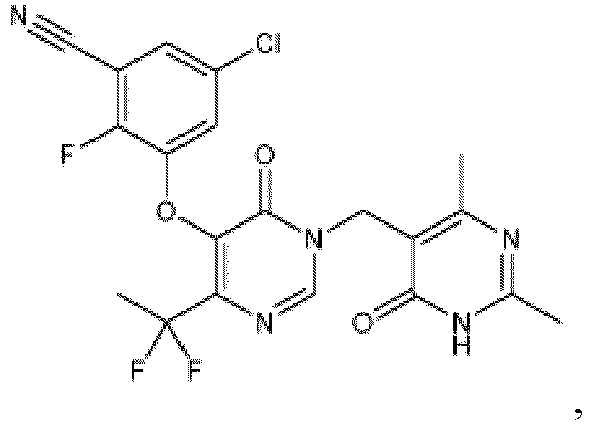
- Composé selon la revendication 5, qui est

- Composé selon la revendication 1, qui est

- Composé selon la revendication 7, qui est

- Composé selon la revendication 1, qui est

- Composé selon la revendication 9, qui est

- Composé selon la revendication 1, qui est

- Composé selon la revendication 11, qui est

- Composition pharmaceutique comprenant une quantité efficace du composé selon l'une quelconque des revendications 1 à 3, 5, 7, 9 ou 11 ou d'un sel pharmaceutiquement acceptable de celui-ci, ou un composé selon l'une quelconque des revendications 4, 6, 8, 10 ou 12, et un véhicule pharmaceutiquement acceptable.
- Composition pharmaceutique selon la revendication 13, comprenant en outre une quantité efficace d'un ou plusieurs inhibiteurs nucléosidiques ou nucléotidiques de la transcriptase inverse du VIH, inhibiteurs nucléosidiques ou nucléotidiques de la translocation de la transcriptase inverse, inhibiteurs non nucléosidiques de la transcriptase inverse du VIH, inhibiteurs de l'intégrase du VIH, inhibiteurs de la fusion du VIH, inhibiteurs d'entrée du VIH, inhibiteurs de maturation du VIH et inhibiteurs post-attachement supplémentaires.
- Composé selon l'une quelconque des revendications 1 à 3, 5, 7, 9 ou 11 ou sel pharmaceutiquement acceptable de celui-ci, ou composé selon l'une quelconque des revendications 4, 6, 8, 10 ou 12, pour utilisation dans le traitement ou la prophylaxie d'une infection par le VIH, ou pour le traitement, la prophylaxie ou le retardement de l'apparition ou de la progression du SIDA ou du complexe associé au SIDA chez un sujet humain.
- Composé selon l'une quelconque des revendications 1 à 3, 5, 7, 9 ou 11 ou sel pharmaceutiquement acceptable de celui-ci, ou composé selon l'une quelconque des revendications 4, 6, 8, 10 ou 12, pour utilisation dans l'élimination sélective des cellules exprimant GAG-POL infectées par le VIH sans cytotoxicité concomitante pour les cellules naïves au VIH chez un sujet humain.
- Composé selon l'une quelconque des revendications 1 à 3, 5, 7, 9 ou 11 ou sel pharmaceutiquement acceptable de celui-ci, ou composé selon l'une quelconque des revendications 4, 6, 8, 10 ou 12, pour utilisation dans le renforcement de la suppression de la virémie du VIH chez un sujet humain dont la virémie est en cours de suppression par un ou plusieurs agents antiviraux VIH compatibles.
Applications Claiming Priority (2)
| Application Number | Priority Date | Filing Date | Title |
|---|---|---|---|
| US201862781356P | 2018-12-18 | 2018-12-18 | |
| PCT/US2019/066125 WO2020131597A1 (fr) | 2018-12-18 | 2019-12-13 | Dérivés de pyrimidone en tant qu'agents cytotoxiques sélectifs contre des cellules infectées par le vih |
Publications (2)
| Publication Number | Publication Date |
|---|---|
| EP3898595A1 EP3898595A1 (fr) | 2021-10-27 |
| EP3898595B1 true EP3898595B1 (fr) | 2024-05-01 |
Family
ID=69411500
Family Applications (1)
| Application Number | Title | Priority Date | Filing Date |
|---|---|---|---|
| EP19845846.5A Active EP3898595B1 (fr) | 2018-12-18 | 2019-12-13 | Dérivés de pyrimidone en tant qu'agents cytotoxiques sélectifs contre des cellules infectées par le vih |
Country Status (25)
| Country | Link |
|---|---|
| US (1) | US12258329B2 (fr) |
| EP (1) | EP3898595B1 (fr) |
| JP (1) | JP7045528B2 (fr) |
| KR (1) | KR102645602B1 (fr) |
| CN (1) | CN113423695A (fr) |
| AR (1) | AR119126A1 (fr) |
| AU (1) | AU2019402998B2 (fr) |
| BR (1) | BR112021011733A8 (fr) |
| CA (1) | CA3122571C (fr) |
| CL (2) | CL2021001514A1 (fr) |
| CO (1) | CO2021007667A2 (fr) |
| CR (1) | CR20210317A (fr) |
| DO (1) | DOP2021000129A (fr) |
| EA (1) | EA202191711A1 (fr) |
| EC (1) | ECSP21043491A (fr) |
| IL (1) | IL283821A (fr) |
| JO (1) | JOP20210149A1 (fr) |
| MA (1) | MA54549A (fr) |
| MX (1) | MX2021007382A (fr) |
| NI (1) | NI202100048A (fr) |
| PE (1) | PE20211704A1 (fr) |
| PH (1) | PH12021551408A1 (fr) |
| SG (1) | SG11202106310YA (fr) |
| TW (1) | TW202122384A (fr) |
| WO (1) | WO2020131597A1 (fr) |
Families Citing this family (7)
| Publication number | Priority date | Publication date | Assignee | Title |
|---|---|---|---|---|
| EP3898595B1 (fr) | 2018-12-18 | 2024-05-01 | Merck Sharp & Dohme LLC | Dérivés de pyrimidone en tant qu'agents cytotoxiques sélectifs contre des cellules infectées par le vih |
| CA3141143A1 (fr) * | 2019-05-22 | 2020-11-26 | Merck Sharp & Dohme Corp. | Derives de pyridinone utilises en tant qu'agents cytotoxiques selectifs contre des cellules infectees par le vih |
| JP2024506858A (ja) | 2021-02-02 | 2024-02-15 | リミナル・バイオサイエンシーズ・リミテッド | Gpr84アンタゴニストおよびその使用 |
| KR20230153387A (ko) | 2021-02-02 | 2023-11-06 | 리미널 바이오사이언시스 리미티드 | Gpr84 길항제 및 이의 용도 |
| US12133620B2 (en) | 2022-02-11 | 2024-11-05 | Whirlpool Corporation | Dishwasher with direct water supply |
| CN116217493A (zh) * | 2023-02-07 | 2023-06-06 | 郑州猫眼农业科技有限公司 | 一种4,6-二氯-2-甲基-5-嘧啶甲醛的制备方法 |
| WO2025193566A1 (fr) * | 2024-03-15 | 2025-09-18 | Merck Sharp & Dohme Llc | Dérivés de n-oxyde utilisés en tant qu'agents cytotoxiques sélectifs |
Family Cites Families (11)
| Publication number | Priority date | Publication date | Assignee | Title |
|---|---|---|---|---|
| CA2330304A1 (fr) * | 1998-04-27 | 1999-11-04 | Centre National De La Recherche Scientifique | Derives de 3-(amino- ou aminoalkyl)pyridinone et utilisation de ceux-ci dans le traitement de pathologies associees au vih |
| KR20050119652A (ko) | 2003-03-24 | 2005-12-21 | 에프. 호프만-라 로슈 아게 | 역전사 효소 저해제로서의 벤질-피리다진온 |
| US7166738B2 (en) | 2004-04-23 | 2007-01-23 | Roche Palo Alto Llc | Non-nucleoside reverse transcriptase inhibitors |
| TW200831085A (en) | 2006-12-13 | 2008-08-01 | Merck & Co Inc | Non-nucleoside reverse transcriptase inhibitors |
| CA2687747C (fr) | 2007-05-30 | 2015-11-17 | F. Hoffmann-La Roche Ag | Inhibiteurs non nucleosidiques de transcriptase inverse |
| KR20100088142A (ko) | 2007-11-20 | 2010-08-06 | 머크 샤프 앤드 돔 코포레이션 | 비-뉴클레오사이드 역전사효소 억제제 |
| PL2924034T3 (pl) | 2010-03-30 | 2017-07-31 | Merck Canada Inc. | Kompozycja farmaceutyczna zawierająca nienukleozydowy inhibitor odwrotnej transkryptazy |
| JO3470B1 (ar) | 2012-10-08 | 2020-07-05 | Merck Sharp & Dohme | مشتقات 5- فينوكسي-3h-بيريميدين-4-أون واستخدامها كمثبطات ناسخ عكسي ل hiv |
| EP3785714A1 (fr) * | 2014-04-01 | 2021-03-03 | Merck Sharp & Dohme Corp. | Promédicaments d'inhibiteurs de la transcriptase inverse du vih |
| EP3669876A1 (fr) | 2018-12-18 | 2020-06-24 | Aelis Farma | 3béta- (benzyloxy)-17alpha-méthyl-pregn-5-en-20-one pour une utilisation dans le traitement de troubles cognitifs |
| EP3898595B1 (fr) | 2018-12-18 | 2024-05-01 | Merck Sharp & Dohme LLC | Dérivés de pyrimidone en tant qu'agents cytotoxiques sélectifs contre des cellules infectées par le vih |
-
2019
- 2019-12-13 EP EP19845846.5A patent/EP3898595B1/fr active Active
- 2019-12-13 AU AU2019402998A patent/AU2019402998B2/en active Active
- 2019-12-13 JP JP2021534709A patent/JP7045528B2/ja active Active
- 2019-12-13 JO JOP/2021/0149A patent/JOP20210149A1/ar unknown
- 2019-12-13 MX MX2021007382A patent/MX2021007382A/es unknown
- 2019-12-13 CN CN201980092427.XA patent/CN113423695A/zh active Pending
- 2019-12-13 KR KR1020217022074A patent/KR102645602B1/ko active Active
- 2019-12-13 EA EA202191711A patent/EA202191711A1/ru unknown
- 2019-12-13 WO PCT/US2019/066125 patent/WO2020131597A1/fr not_active Ceased
- 2019-12-13 PE PE2021000891A patent/PE20211704A1/es unknown
- 2019-12-13 CR CR20210317A patent/CR20210317A/es unknown
- 2019-12-13 US US17/413,882 patent/US12258329B2/en active Active
- 2019-12-13 CA CA3122571A patent/CA3122571C/fr active Active
- 2019-12-13 MA MA054549A patent/MA54549A/fr unknown
- 2019-12-13 PH PH1/2021/551408A patent/PH12021551408A1/en unknown
- 2019-12-13 BR BR112021011733A patent/BR112021011733A8/pt unknown
- 2019-12-13 SG SG11202106310YA patent/SG11202106310YA/en unknown
-
2020
- 2020-05-20 TW TW109116741A patent/TW202122384A/zh unknown
- 2020-06-09 AR ARP200101624A patent/AR119126A1/es not_active Application Discontinuation
-
2021
- 2021-06-08 IL IL283821A patent/IL283821A/en unknown
- 2021-06-09 CL CL2021001514A patent/CL2021001514A1/es unknown
- 2021-06-11 CO CONC2021/0007667A patent/CO2021007667A2/es unknown
- 2021-06-14 NI NI202100048A patent/NI202100048A/es unknown
- 2021-06-15 EC ECSENADI202143491A patent/ECSP21043491A/es unknown
- 2021-06-18 DO DO2021000129A patent/DOP2021000129A/es unknown
-
2022
- 2022-03-17 CL CL2022000659A patent/CL2022000659A1/es unknown
Non-Patent Citations (1)
| Title |
|---|
| CHELUR DATTANANDA S. ET AL: "Targeted cell killing by reconstituted caspases", PROCEEDINGS OF THE NATIONAL ACADEMY OF SCIENCES, vol. 104, no. 7, 13 February 2007 (2007-02-13), pages 2283 - 2288, XP093046410, ISSN: 0027-8424, DOI: 10.1073/pnas.0610877104 * |
Also Published As
| Publication number | Publication date |
|---|---|
| EP3898595A1 (fr) | 2021-10-27 |
| CR20210317A (es) | 2021-07-14 |
| MA54549A (fr) | 2022-03-30 |
| IL283821A (en) | 2021-07-29 |
| BR112021011733A2 (pt) | 2021-08-31 |
| TW202122384A (zh) | 2021-06-16 |
| US12258329B2 (en) | 2025-03-25 |
| CA3122571C (fr) | 2023-08-01 |
| WO2020131597A1 (fr) | 2020-06-25 |
| AU2019402998A1 (en) | 2021-06-24 |
| MX2021007382A (es) | 2021-07-15 |
| US20220064147A1 (en) | 2022-03-03 |
| PH12021551408A1 (en) | 2022-05-16 |
| NI202100048A (es) | 2021-08-09 |
| JP2022508380A (ja) | 2022-01-19 |
| CO2021007667A2 (es) | 2021-07-19 |
| KR20210104796A (ko) | 2021-08-25 |
| CL2022000659A1 (es) | 2022-10-28 |
| CN113423695A (zh) | 2021-09-21 |
| JP7045528B2 (ja) | 2022-03-31 |
| ECSP21043491A (es) | 2021-07-30 |
| DOP2021000129A (es) | 2021-08-15 |
| SG11202106310YA (en) | 2021-07-29 |
| CL2021001514A1 (es) | 2021-11-26 |
| CA3122571A1 (fr) | 2020-06-25 |
| AR119126A1 (es) | 2021-11-24 |
| EA202191711A1 (ru) | 2021-10-04 |
| JOP20210149A1 (ar) | 2023-01-30 |
| KR102645602B1 (ko) | 2024-03-07 |
| PE20211704A1 (es) | 2021-09-01 |
| BR112021011733A8 (pt) | 2023-04-18 |
| AU2019402998B2 (en) | 2022-12-15 |
Similar Documents
| Publication | Publication Date | Title |
|---|---|---|
| US12258329B2 (en) | Pyrimidone derivatives as selective cytotoxic agents against HIV infected cells | |
| CN120247911B (zh) | PI3K-α抑制剂和其使用方法 | |
| EP4204413B1 (fr) | Dérivés de dihydroquinazolin-2-one en tant qu'agents cytotoxiques sélectifs utiles dans le traitement du vih | |
| EP3785714A1 (fr) | Promédicaments d'inhibiteurs de la transcriptase inverse du vih | |
| US12492183B2 (en) | Tetrahydroquinazoline derivatives as selective cytotoxic agents | |
| US20250214962A1 (en) | Pyridinone derivatives as selective cytotoxic agents against hiv infected cells | |
| RU2816090C2 (ru) | Соединения пиридинона в качестве селективных цитотоксических агентов против клеток, инфицированных вич | |
| HK40055115A (en) | Pyrimidone derivatives as selective cytotoxic agents against hiv infected cells | |
| CN116745269A (zh) | 用于治疗hiv的作为选择性细胞毒性剂的二氢喹唑啉-2-酮衍生物 | |
| EA045274B1 (ru) | Производные пиримидона в качестве селективных цитотоксических агентов против вич-инфицированных клеток | |
| US20240409531A1 (en) | Benzoxazinone derivatives as selective cytotoxic agents | |
| WO2025193566A1 (fr) | Dérivés de n-oxyde utilisés en tant qu'agents cytotoxiques sélectifs |
Legal Events
| Date | Code | Title | Description |
|---|---|---|---|
| STAA | Information on the status of an ep patent application or granted ep patent |
Free format text: STATUS: UNKNOWN |
|
| STAA | Information on the status of an ep patent application or granted ep patent |
Free format text: STATUS: THE INTERNATIONAL PUBLICATION HAS BEEN MADE |
|
| TPAC | Observations filed by third parties |
Free format text: ORIGINAL CODE: EPIDOSNTIPA |
|
| TPAB | Information related to observations by third parties deleted |
Free format text: ORIGINAL CODE: EPIDOSDTIPA |
|
| TPAC | Observations filed by third parties |
Free format text: ORIGINAL CODE: EPIDOSNTIPA |
|
| PUAI | Public reference made under article 153(3) epc to a published international application that has entered the european phase |
Free format text: ORIGINAL CODE: 0009012 |
|
| STAA | Information on the status of an ep patent application or granted ep patent |
Free format text: STATUS: REQUEST FOR EXAMINATION WAS MADE |
|
| 17P | Request for examination filed |
Effective date: 20210719 |
|
| AK | Designated contracting states |
Kind code of ref document: A1 Designated state(s): AL AT BE BG CH CY CZ DE DK EE ES FI FR GB GR HR HU IE IS IT LI LT LU LV MC MK MT NL NO PL PT RO RS SE SI SK SM TR |
|
| RAV | Requested validation state of the european patent: fee paid |
Extension state: TN Effective date: 20210719 Extension state: MD Effective date: 20210719 Extension state: MA Effective date: 20210719 |
|
| STAA | Information on the status of an ep patent application or granted ep patent |
Free format text: STATUS: EXAMINATION IS IN PROGRESS |
|
| 17Q | First examination report despatched |
Effective date: 20220615 |
|
| RAP1 | Party data changed (applicant data changed or rights of an application transferred) |
Owner name: MERCK SHARP & DOHME LLC |
|
| GRAP | Despatch of communication of intention to grant a patent |
Free format text: ORIGINAL CODE: EPIDOSNIGR1 |
|
| STAA | Information on the status of an ep patent application or granted ep patent |
Free format text: STATUS: GRANT OF PATENT IS INTENDED |
|
| INTG | Intention to grant announced |
Effective date: 20231130 |
|
| GRAS | Grant fee paid |
Free format text: ORIGINAL CODE: EPIDOSNIGR3 |
|
| GRAA | (expected) grant |
Free format text: ORIGINAL CODE: 0009210 |
|
| STAA | Information on the status of an ep patent application or granted ep patent |
Free format text: STATUS: THE PATENT HAS BEEN GRANTED |
|
| AK | Designated contracting states |
Kind code of ref document: B1 Designated state(s): AL AT BE BG CH CY CZ DE DK EE ES FI FR GB GR HR HU IE IS IT LI LT LU LV MC MK MT NL NO PL PT RO RS SE SI SK SM TR |
|
| REG | Reference to a national code |
Ref country code: GB Ref legal event code: FG4D |
|
| REG | Reference to a national code |
Ref country code: CH Ref legal event code: EP |
|
| REG | Reference to a national code |
Ref country code: IE Ref legal event code: FG4D |
|
| REG | Reference to a national code |
Ref country code: DE Ref legal event code: R096 Ref document number: 602019051611 Country of ref document: DE |
|
| REG | Reference to a national code |
Ref country code: LT Ref legal event code: MG9D |
|
| REG | Reference to a national code |
Ref country code: NL Ref legal event code: MP Effective date: 20240501 |
|
| PG25 | Lapsed in a contracting state [announced via postgrant information from national office to epo] |
Ref country code: IS Free format text: LAPSE BECAUSE OF FAILURE TO SUBMIT A TRANSLATION OF THE DESCRIPTION OR TO PAY THE FEE WITHIN THE PRESCRIBED TIME-LIMIT Effective date: 20240901 |
|
| PG25 | Lapsed in a contracting state [announced via postgrant information from national office to epo] |
Ref country code: BG Free format text: LAPSE BECAUSE OF FAILURE TO SUBMIT A TRANSLATION OF THE DESCRIPTION OR TO PAY THE FEE WITHIN THE PRESCRIBED TIME-LIMIT Effective date: 20240501 |
|
| PG25 | Lapsed in a contracting state [announced via postgrant information from national office to epo] |
Ref country code: HR Free format text: LAPSE BECAUSE OF FAILURE TO SUBMIT A TRANSLATION OF THE DESCRIPTION OR TO PAY THE FEE WITHIN THE PRESCRIBED TIME-LIMIT Effective date: 20240501 Ref country code: FI Free format text: LAPSE BECAUSE OF FAILURE TO SUBMIT A TRANSLATION OF THE DESCRIPTION OR TO PAY THE FEE WITHIN THE PRESCRIBED TIME-LIMIT Effective date: 20240501 |
|
| PG25 | Lapsed in a contracting state [announced via postgrant information from national office to epo] |
Ref country code: GR Free format text: LAPSE BECAUSE OF FAILURE TO SUBMIT A TRANSLATION OF THE DESCRIPTION OR TO PAY THE FEE WITHIN THE PRESCRIBED TIME-LIMIT Effective date: 20240802 |
|
| PG25 | Lapsed in a contracting state [announced via postgrant information from national office to epo] |
Ref country code: PT Free format text: LAPSE BECAUSE OF FAILURE TO SUBMIT A TRANSLATION OF THE DESCRIPTION OR TO PAY THE FEE WITHIN THE PRESCRIBED TIME-LIMIT Effective date: 20240902 |
|
| REG | Reference to a national code |
Ref country code: AT Ref legal event code: MK05 Ref document number: 1682225 Country of ref document: AT Kind code of ref document: T Effective date: 20240501 |
|
| PG25 | Lapsed in a contracting state [announced via postgrant information from national office to epo] |
Ref country code: NL Free format text: LAPSE BECAUSE OF FAILURE TO SUBMIT A TRANSLATION OF THE DESCRIPTION OR TO PAY THE FEE WITHIN THE PRESCRIBED TIME-LIMIT Effective date: 20240501 |
|
| PG25 | Lapsed in a contracting state [announced via postgrant information from national office to epo] |
Ref country code: ES Free format text: LAPSE BECAUSE OF FAILURE TO SUBMIT A TRANSLATION OF THE DESCRIPTION OR TO PAY THE FEE WITHIN THE PRESCRIBED TIME-LIMIT Effective date: 20240501 |
|
| PG25 | Lapsed in a contracting state [announced via postgrant information from national office to epo] |
Ref country code: AT Free format text: LAPSE BECAUSE OF FAILURE TO SUBMIT A TRANSLATION OF THE DESCRIPTION OR TO PAY THE FEE WITHIN THE PRESCRIBED TIME-LIMIT Effective date: 20240501 |
|
| PG25 | Lapsed in a contracting state [announced via postgrant information from national office to epo] |
Ref country code: PL Free format text: LAPSE BECAUSE OF FAILURE TO SUBMIT A TRANSLATION OF THE DESCRIPTION OR TO PAY THE FEE WITHIN THE PRESCRIBED TIME-LIMIT Effective date: 20240501 |
|
| PG25 | Lapsed in a contracting state [announced via postgrant information from national office to epo] |
Ref country code: LV Free format text: LAPSE BECAUSE OF FAILURE TO SUBMIT A TRANSLATION OF THE DESCRIPTION OR TO PAY THE FEE WITHIN THE PRESCRIBED TIME-LIMIT Effective date: 20240501 |
|
| PG25 | Lapsed in a contracting state [announced via postgrant information from national office to epo] |
Ref country code: PT Free format text: LAPSE BECAUSE OF FAILURE TO SUBMIT A TRANSLATION OF THE DESCRIPTION OR TO PAY THE FEE WITHIN THE PRESCRIBED TIME-LIMIT Effective date: 20240902 Ref country code: PL Free format text: LAPSE BECAUSE OF FAILURE TO SUBMIT A TRANSLATION OF THE DESCRIPTION OR TO PAY THE FEE WITHIN THE PRESCRIBED TIME-LIMIT Effective date: 20240501 Ref country code: NO Free format text: LAPSE BECAUSE OF FAILURE TO SUBMIT A TRANSLATION OF THE DESCRIPTION OR TO PAY THE FEE WITHIN THE PRESCRIBED TIME-LIMIT Effective date: 20240801 Ref country code: NL Free format text: LAPSE BECAUSE OF FAILURE TO SUBMIT A TRANSLATION OF THE DESCRIPTION OR TO PAY THE FEE WITHIN THE PRESCRIBED TIME-LIMIT Effective date: 20240501 Ref country code: LV Free format text: LAPSE BECAUSE OF FAILURE TO SUBMIT A TRANSLATION OF THE DESCRIPTION OR TO PAY THE FEE WITHIN THE PRESCRIBED TIME-LIMIT Effective date: 20240501 Ref country code: IS Free format text: LAPSE BECAUSE OF FAILURE TO SUBMIT A TRANSLATION OF THE DESCRIPTION OR TO PAY THE FEE WITHIN THE PRESCRIBED TIME-LIMIT Effective date: 20240901 Ref country code: HR Free format text: LAPSE BECAUSE OF FAILURE TO SUBMIT A TRANSLATION OF THE DESCRIPTION OR TO PAY THE FEE WITHIN THE PRESCRIBED TIME-LIMIT Effective date: 20240501 Ref country code: GR Free format text: LAPSE BECAUSE OF FAILURE TO SUBMIT A TRANSLATION OF THE DESCRIPTION OR TO PAY THE FEE WITHIN THE PRESCRIBED TIME-LIMIT Effective date: 20240802 Ref country code: FI Free format text: LAPSE BECAUSE OF FAILURE TO SUBMIT A TRANSLATION OF THE DESCRIPTION OR TO PAY THE FEE WITHIN THE PRESCRIBED TIME-LIMIT Effective date: 20240501 Ref country code: ES Free format text: LAPSE BECAUSE OF FAILURE TO SUBMIT A TRANSLATION OF THE DESCRIPTION OR TO PAY THE FEE WITHIN THE PRESCRIBED TIME-LIMIT Effective date: 20240501 Ref country code: BG Free format text: LAPSE BECAUSE OF FAILURE TO SUBMIT A TRANSLATION OF THE DESCRIPTION OR TO PAY THE FEE WITHIN THE PRESCRIBED TIME-LIMIT Effective date: 20240501 Ref country code: AT Free format text: LAPSE BECAUSE OF FAILURE TO SUBMIT A TRANSLATION OF THE DESCRIPTION OR TO PAY THE FEE WITHIN THE PRESCRIBED TIME-LIMIT Effective date: 20240501 Ref country code: RS Free format text: LAPSE BECAUSE OF FAILURE TO SUBMIT A TRANSLATION OF THE DESCRIPTION OR TO PAY THE FEE WITHIN THE PRESCRIBED TIME-LIMIT Effective date: 20240801 |
|
| PG25 | Lapsed in a contracting state [announced via postgrant information from national office to epo] |
Ref country code: DK Free format text: LAPSE BECAUSE OF FAILURE TO SUBMIT A TRANSLATION OF THE DESCRIPTION OR TO PAY THE FEE WITHIN THE PRESCRIBED TIME-LIMIT Effective date: 20240501 |
|
| PG25 | Lapsed in a contracting state [announced via postgrant information from national office to epo] |
Ref country code: EE Free format text: LAPSE BECAUSE OF FAILURE TO SUBMIT A TRANSLATION OF THE DESCRIPTION OR TO PAY THE FEE WITHIN THE PRESCRIBED TIME-LIMIT Effective date: 20240501 |
|
| PG25 | Lapsed in a contracting state [announced via postgrant information from national office to epo] |
Ref country code: CZ Free format text: LAPSE BECAUSE OF FAILURE TO SUBMIT A TRANSLATION OF THE DESCRIPTION OR TO PAY THE FEE WITHIN THE PRESCRIBED TIME-LIMIT Effective date: 20240501 |
|
| PG25 | Lapsed in a contracting state [announced via postgrant information from national office to epo] |
Ref country code: SK Free format text: LAPSE BECAUSE OF FAILURE TO SUBMIT A TRANSLATION OF THE DESCRIPTION OR TO PAY THE FEE WITHIN THE PRESCRIBED TIME-LIMIT Effective date: 20240501 Ref country code: RO Free format text: LAPSE BECAUSE OF FAILURE TO SUBMIT A TRANSLATION OF THE DESCRIPTION OR TO PAY THE FEE WITHIN THE PRESCRIBED TIME-LIMIT Effective date: 20240501 |
|
| PG25 | Lapsed in a contracting state [announced via postgrant information from national office to epo] |
Ref country code: SM Free format text: LAPSE BECAUSE OF FAILURE TO SUBMIT A TRANSLATION OF THE DESCRIPTION OR TO PAY THE FEE WITHIN THE PRESCRIBED TIME-LIMIT Effective date: 20240501 |
|
| PG25 | Lapsed in a contracting state [announced via postgrant information from national office to epo] |
Ref country code: SM Free format text: LAPSE BECAUSE OF FAILURE TO SUBMIT A TRANSLATION OF THE DESCRIPTION OR TO PAY THE FEE WITHIN THE PRESCRIBED TIME-LIMIT Effective date: 20240501 Ref country code: SK Free format text: LAPSE BECAUSE OF FAILURE TO SUBMIT A TRANSLATION OF THE DESCRIPTION OR TO PAY THE FEE WITHIN THE PRESCRIBED TIME-LIMIT Effective date: 20240501 Ref country code: RO Free format text: LAPSE BECAUSE OF FAILURE TO SUBMIT A TRANSLATION OF THE DESCRIPTION OR TO PAY THE FEE WITHIN THE PRESCRIBED TIME-LIMIT Effective date: 20240501 Ref country code: EE Free format text: LAPSE BECAUSE OF FAILURE TO SUBMIT A TRANSLATION OF THE DESCRIPTION OR TO PAY THE FEE WITHIN THE PRESCRIBED TIME-LIMIT Effective date: 20240501 Ref country code: DK Free format text: LAPSE BECAUSE OF FAILURE TO SUBMIT A TRANSLATION OF THE DESCRIPTION OR TO PAY THE FEE WITHIN THE PRESCRIBED TIME-LIMIT Effective date: 20240501 Ref country code: CZ Free format text: LAPSE BECAUSE OF FAILURE TO SUBMIT A TRANSLATION OF THE DESCRIPTION OR TO PAY THE FEE WITHIN THE PRESCRIBED TIME-LIMIT Effective date: 20240501 |
|
| REG | Reference to a national code |
Ref country code: DE Ref legal event code: R097 Ref document number: 602019051611 Country of ref document: DE |
|
| PG25 | Lapsed in a contracting state [announced via postgrant information from national office to epo] |
Ref country code: IT Free format text: LAPSE BECAUSE OF FAILURE TO SUBMIT A TRANSLATION OF THE DESCRIPTION OR TO PAY THE FEE WITHIN THE PRESCRIBED TIME-LIMIT Effective date: 20240501 |
|
| PLBE | No opposition filed within time limit |
Free format text: ORIGINAL CODE: 0009261 |
|
| STAA | Information on the status of an ep patent application or granted ep patent |
Free format text: STATUS: NO OPPOSITION FILED WITHIN TIME LIMIT |
|
| 26N | No opposition filed |
Effective date: 20250204 |
|
| PG25 | Lapsed in a contracting state [announced via postgrant information from national office to epo] |
Ref country code: SI Free format text: LAPSE BECAUSE OF FAILURE TO SUBMIT A TRANSLATION OF THE DESCRIPTION OR TO PAY THE FEE WITHIN THE PRESCRIBED TIME-LIMIT Effective date: 20240501 |
|
| VS25 | Lapsed in a validation state [announced via postgrant information from nat. office to epo] |
Ref country code: MD Free format text: LAPSE BECAUSE OF FAILURE TO SUBMIT A TRANSLATION OF THE DESCRIPTION OR TO PAY THE FEE WITHIN THE PRESCRIBED TIME-LIMIT Effective date: 20240501 |
|
| PG25 | Lapsed in a contracting state [announced via postgrant information from national office to epo] |
Ref country code: MC Free format text: LAPSE BECAUSE OF FAILURE TO SUBMIT A TRANSLATION OF THE DESCRIPTION OR TO PAY THE FEE WITHIN THE PRESCRIBED TIME-LIMIT Effective date: 20240501 |
|
| REG | Reference to a national code |
Ref country code: CH Ref legal event code: PL |
|
| PG25 | Lapsed in a contracting state [announced via postgrant information from national office to epo] |
Ref country code: LU Free format text: LAPSE BECAUSE OF NON-PAYMENT OF DUE FEES Effective date: 20241213 |
|
| PG25 | Lapsed in a contracting state [announced via postgrant information from national office to epo] |
Ref country code: SE Free format text: LAPSE BECAUSE OF FAILURE TO SUBMIT A TRANSLATION OF THE DESCRIPTION OR TO PAY THE FEE WITHIN THE PRESCRIBED TIME-LIMIT Effective date: 20240501 |
|
| REG | Reference to a national code |
Ref country code: BE Ref legal event code: MM Effective date: 20241231 |
|
| PG25 | Lapsed in a contracting state [announced via postgrant information from national office to epo] |
Ref country code: BE Free format text: LAPSE BECAUSE OF NON-PAYMENT OF DUE FEES Effective date: 20241231 |
|
| PG25 | Lapsed in a contracting state [announced via postgrant information from national office to epo] |
Ref country code: CH Free format text: LAPSE BECAUSE OF NON-PAYMENT OF DUE FEES Effective date: 20241231 |
|
| PG25 | Lapsed in a contracting state [announced via postgrant information from national office to epo] |
Ref country code: IE Free format text: LAPSE BECAUSE OF NON-PAYMENT OF DUE FEES Effective date: 20241213 |
|
| PGFP | Annual fee paid to national office [announced via postgrant information from national office to epo] |
Ref country code: DE Payment date: 20251118 Year of fee payment: 7 |
|
| PGFP | Annual fee paid to national office [announced via postgrant information from national office to epo] |
Ref country code: GB Payment date: 20251113 Year of fee payment: 7 |
|
| PGFP | Annual fee paid to national office [announced via postgrant information from national office to epo] |
Ref country code: FR Payment date: 20251111 Year of fee payment: 7 |
|
| VS25 | Lapsed in a validation state [announced via postgrant information from nat. office to epo] |
Ref country code: MA Free format text: LAPSE BECAUSE OF FAILURE TO SUBMIT A TRANSLATION OF THE DESCRIPTION OR TO PAY THE FEE WITHIN THE PRESCRIBED TIME-LIMIT; INVALID AB INITIO Effective date: 20191213 |