EP3899795B1 - Étiquette et système rfid multiprotcole - Google Patents
Étiquette et système rfid multiprotcole Download PDFInfo
- Publication number
- EP3899795B1 EP3899795B1 EP19820853.0A EP19820853A EP3899795B1 EP 3899795 B1 EP3899795 B1 EP 3899795B1 EP 19820853 A EP19820853 A EP 19820853A EP 3899795 B1 EP3899795 B1 EP 3899795B1
- Authority
- EP
- European Patent Office
- Prior art keywords
- signal
- rfid
- tag assembly
- frequency
- rfid tag
- Prior art date
- Legal status (The legal status is an assumption and is not a legal conclusion. Google has not performed a legal analysis and makes no representation as to the accuracy of the status listed.)
- Active
Links
Images


Classifications
-
- G—PHYSICS
- G06—COMPUTING OR CALCULATING; COUNTING
- G06K—GRAPHICAL DATA READING; PRESENTATION OF DATA; RECORD CARRIERS; HANDLING RECORD CARRIERS
- G06K19/00—Record carriers for use with machines and with at least a part designed to carry digital markings
- G06K19/06—Record carriers for use with machines and with at least a part designed to carry digital markings characterised by the kind of the digital marking, e.g. shape, nature, code
- G06K19/067—Record carriers with conductive marks, printed circuits or semiconductor circuit elements, e.g. credit or identity cards also with resonating or responding marks without active components
- G06K19/07—Record carriers with conductive marks, printed circuits or semiconductor circuit elements, e.g. credit or identity cards also with resonating or responding marks without active components with integrated circuit chips
- G06K19/0723—Record carriers with conductive marks, printed circuits or semiconductor circuit elements, e.g. credit or identity cards also with resonating or responding marks without active components with integrated circuit chips the record carrier comprising an arrangement for non-contact communication, e.g. wireless communication circuits on transponder cards, non-contact smart cards or RFIDs
- G06K19/0724—Record carriers with conductive marks, printed circuits or semiconductor circuit elements, e.g. credit or identity cards also with resonating or responding marks without active components with integrated circuit chips the record carrier comprising an arrangement for non-contact communication, e.g. wireless communication circuits on transponder cards, non-contact smart cards or RFIDs the arrangement being a circuit for communicating at a plurality of frequencies, e.g. for managing time multiplexed communication over at least two antennas of different types
-
- G—PHYSICS
- G06—COMPUTING OR CALCULATING; COUNTING
- G06K—GRAPHICAL DATA READING; PRESENTATION OF DATA; RECORD CARRIERS; HANDLING RECORD CARRIERS
- G06K19/00—Record carriers for use with machines and with at least a part designed to carry digital markings
- G06K19/06—Record carriers for use with machines and with at least a part designed to carry digital markings characterised by the kind of the digital marking, e.g. shape, nature, code
- G06K19/067—Record carriers with conductive marks, printed circuits or semiconductor circuit elements, e.g. credit or identity cards also with resonating or responding marks without active components
- G06K19/07—Record carriers with conductive marks, printed circuits or semiconductor circuit elements, e.g. credit or identity cards also with resonating or responding marks without active components with integrated circuit chips
- G06K19/077—Constructional details, e.g. mounting of circuits in the carrier
- G06K19/07749—Constructional details, e.g. mounting of circuits in the carrier the record carrier being capable of non-contact communication, e.g. constructional details of the antenna of a non-contact smart card
- G06K19/07766—Constructional details, e.g. mounting of circuits in the carrier the record carrier being capable of non-contact communication, e.g. constructional details of the antenna of a non-contact smart card comprising at least a second communication arrangement in addition to a first non-contact communication arrangement
-
- G—PHYSICS
- G06—COMPUTING OR CALCULATING; COUNTING
- G06K—GRAPHICAL DATA READING; PRESENTATION OF DATA; RECORD CARRIERS; HANDLING RECORD CARRIERS
- G06K7/00—Methods or arrangements for sensing record carriers, e.g. for reading patterns
- G06K7/10—Methods or arrangements for sensing record carriers, e.g. for reading patterns by electromagnetic radiation, e.g. optical sensing; by corpuscular radiation
- G06K7/10009—Methods or arrangements for sensing record carriers, e.g. for reading patterns by electromagnetic radiation, e.g. optical sensing; by corpuscular radiation sensing by radiation using wavelengths larger than 0.1 mm, e.g. radio-waves or microwaves
- G06K7/10019—Methods or arrangements for sensing record carriers, e.g. for reading patterns by electromagnetic radiation, e.g. optical sensing; by corpuscular radiation sensing by radiation using wavelengths larger than 0.1 mm, e.g. radio-waves or microwaves resolving collision on the communication channels between simultaneously or concurrently interrogated record carriers.
- G06K7/10029—Methods or arrangements for sensing record carriers, e.g. for reading patterns by electromagnetic radiation, e.g. optical sensing; by corpuscular radiation sensing by radiation using wavelengths larger than 0.1 mm, e.g. radio-waves or microwaves resolving collision on the communication channels between simultaneously or concurrently interrogated record carriers. the collision being resolved in the time domain, e.g. using binary tree search or RFID responses allocated to a random time slot
-
- G—PHYSICS
- G06—COMPUTING OR CALCULATING; COUNTING
- G06K—GRAPHICAL DATA READING; PRESENTATION OF DATA; RECORD CARRIERS; HANDLING RECORD CARRIERS
- G06K7/00—Methods or arrangements for sensing record carriers, e.g. for reading patterns
- G06K7/10—Methods or arrangements for sensing record carriers, e.g. for reading patterns by electromagnetic radiation, e.g. optical sensing; by corpuscular radiation
- G06K7/10009—Methods or arrangements for sensing record carriers, e.g. for reading patterns by electromagnetic radiation, e.g. optical sensing; by corpuscular radiation sensing by radiation using wavelengths larger than 0.1 mm, e.g. radio-waves or microwaves
- G06K7/10316—Methods or arrangements for sensing record carriers, e.g. for reading patterns by electromagnetic radiation, e.g. optical sensing; by corpuscular radiation sensing by radiation using wavelengths larger than 0.1 mm, e.g. radio-waves or microwaves using at least one antenna particularly designed for interrogating the wireless record carriers
- G06K7/10336—Methods or arrangements for sensing record carriers, e.g. for reading patterns by electromagnetic radiation, e.g. optical sensing; by corpuscular radiation sensing by radiation using wavelengths larger than 0.1 mm, e.g. radio-waves or microwaves using at least one antenna particularly designed for interrogating the wireless record carriers the antenna being of the near field type, inductive coil
-
- G—PHYSICS
- G06—COMPUTING OR CALCULATING; COUNTING
- G06K—GRAPHICAL DATA READING; PRESENTATION OF DATA; RECORD CARRIERS; HANDLING RECORD CARRIERS
- G06K7/00—Methods or arrangements for sensing record carriers, e.g. for reading patterns
- G06K7/10—Methods or arrangements for sensing record carriers, e.g. for reading patterns by electromagnetic radiation, e.g. optical sensing; by corpuscular radiation
- G06K7/10009—Methods or arrangements for sensing record carriers, e.g. for reading patterns by electromagnetic radiation, e.g. optical sensing; by corpuscular radiation sensing by radiation using wavelengths larger than 0.1 mm, e.g. radio-waves or microwaves
- G06K7/10316—Methods or arrangements for sensing record carriers, e.g. for reading patterns by electromagnetic radiation, e.g. optical sensing; by corpuscular radiation sensing by radiation using wavelengths larger than 0.1 mm, e.g. radio-waves or microwaves using at least one antenna particularly designed for interrogating the wireless record carriers
- G06K7/10356—Methods or arrangements for sensing record carriers, e.g. for reading patterns by electromagnetic radiation, e.g. optical sensing; by corpuscular radiation sensing by radiation using wavelengths larger than 0.1 mm, e.g. radio-waves or microwaves using at least one antenna particularly designed for interrogating the wireless record carriers using a plurality of antennas, e.g. configurations including means to resolve interference between the plurality of antennas
Definitions
- the present invention generally relates to wireless RF (Radio Frequency) communication and particularly to an electronic tag such as a RFID (Radio Frequency Identification) tag adapted to simultaneously communicate with one or more reader(s) utilising different communication protocols/standards.
- RFID Radio Frequency Identification
- RFID radio-frequency identification
- RFID uses radio frequency (RF) signals to identify and track objects, such as, for example, vehicles, shipping containers, equipment, tools and even personnel utilising so called tags (i.e. transponders) that are attached to the object.
- RFID may also be used to provide information about the tracked object's state, such as, for example, temperature, humidity or a precise location.
- RFID systems are categorised according to the operating carrier frequency.
- Low-Frequency (LF) RFID operates at 125KHz to 134KHz (kilohertz), offering data communication that is limited to data rates of less than 1 kbits/s (kilobits per second) and operating ranges of less than 1m (meter).
- High-Frequency (HF) RFID operates at 13.56MHz (megahertz) offering data communication with data rates approaching 25kbits/s and operating ranges of up to 1.5m.
- Ultra-High-Frequency (UHF) RFID typically operates in the 860MHz to 960MHz frequency band offering data rates of up to 100 kbits/s and operating ranges of up to 10m.
- Microwave (MW) RFID operates at 2.45GHz and 5.8GHz (gigahertz) offering further increase in data rates and operating range.
- tags may be classified into three categories (i) passive tags, (ii) semi-passive tags and (iii) active tags.
- Passive tags have no internal power supply and utilise the signal energy transmitted by the reader (i.e. interrogator) to power the tags' internal circuit and communicate with the reader.
- Semi-active tags have an internal power supply, but the tags are only activated to establish communication when "interrogated" by a reader.
- Active tags have an internal power supply, such as, for example, a battery, and a transmitter that is periodically transmitting the tag's ID or other tag information. The ID and/or other tag information is then picked up by an interrogating reader to simply track an associated object, or to establish a communication link between the reader and the tag.
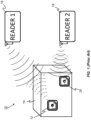
- Figure 1 shows a simplified illustration of a typical RFID system 10 where a first tag 12 is attached to an object 14 tracked by a first reader 16 (Reader 1) that is configured to "couple" with the tag 12 via a first communication protocol.
- a second reader 18 (Reader 2) to track the object 14 using a second communication protocol, a second tag 20 has to be attached to the object 14.
- RFID operates according to international and national standards and within a number of distinct frequency bands dedicated to respective standards.
- the International Standards Organisation (ISO) and EPCglobal (Electronic Product Code) are two organisations that work together to approve standards and protocols in order to provide universal specifications for RFID equipment. Once ratified, these protocols define communication methods approved with the air interface in conjunction with the operating frequency, channel bandwidth, data transmission rate, etc. The protocol also defines how the information is coded, how it is modulated, as well as any anti-collision protocol used.
- TTF Tag-Talks-First
- RTF Reader-Talks-First
- TTO Tag-Talks-Only
- TOTAL Tag-Only-Talks-After-Listening
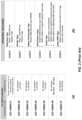
- Figure 2 (a) shows an example of one of the main RFID standards, ISO 18000, which is a standard for the air interface for RFID frequencies around the world. There are numerous other standards under ISO including, inter alia, RFID standards for close-coupled cards, payment systems, used in supply chain, and so on.
- Figure 2 (b) shows a series of classes for RFID tags under EPC Global.
- US2016/0371518 A1 discloses a system and method using a single antenna for multiple resonant frequency ranges.
- US2016292557A1 discloses a multi-frequency transponder that communicates at a first frequency according to a first communication protocol and at a second different frequency according to a second communication protocol.
- EP2056234A2 discloses a multi-mode RFID tag operable in a near-field mode and in a far-field mode.
- Preferred embodiment(s) of the invention seek to overcome one or more of the disadvantages of the prior art.
- a RFID tag assembly as set out in claim 1.
- time-division multiplexing allows for one tag (i.e. a single antenna and/or IC, active or passive) to (almost) simultaneously provide its ID (or other information) via one or more protocols and/or standards, but also to selectively provide different information via different protocols, i.e. so as to send different information to different readers. Therefore, the tag design can be kept relatively simple minimising manufacturing costs, as well as, tag dimensions.
- said plurality of predetermined signal transmission parameters may be any one of (i) at least one predetermined information, (ii) at least one parameter of at least one RFID standard and (iii) a time stamp.
- said at least one parameter of said at least one RFID standard may be any one of a signal carrier frequency, a data transmission rate and an encoding scheme.
- said IC may comprise a memory device, configured to store at least said predetermined information; an encoder device, configured to apply said at least one encoding scheme to the RFID signal; a clock generator, configured to provide at least one first clock signal; a signal modulator, adapted to modulate said RFID signal according to at least one modulation process; and a controller, configured to control any one of said at least one memory, said at least one encoder, said clock generator and said signal modulator.
- said memory device may comprise a first memory, configured to store a first predetermined information, and at least one second memory, configured to store a second information.
- said encoder device may comprise a first encoder, adapted to apply a first encoding scheme to the RFID signal, and at least one second encoder, adapted to apply a second encoding scheme to the RFID signal.
- said clock generator may comprise a first clock, configured to generate said at least one first clock signal, and at least one second clock, configured to generate at least one second clock signal.
- said signal modulator may be a load modulator.
- said load modulator may be adapted to provide any one of near-field- (NFC) or inductive coupling, and, far-field or backscatter coupling.
- said load modulator may be adapted to utilise any one of an Amplitude-Shift-Keying (ASK) scheme, Frequency-Shift-Keying (FSK) and a Phase-Shift-Keying (PSK) scheme.
- ASK Amplitude-Shift-Keying
- FSK Frequency-Shift-Keying
- PSK Phase-Shift-Keying
- said antenna member may be a single antenna, configured to transmit and/or receive an RFID signal of a first signal frequency.
- said single antenna may be a multi-resonant antenna adapted to transmit and/or receive an RFID signal of said first signal frequency and at least one RFID signal of a second signal frequency.
- said first signal frequency may be a Ultra-High-Frequency (UHF) and said second signal frequency may be any one of a High-Frequency (HF) and Low-Frequency (LF).
- UHF Ultra-High-Frequency
- LF Low-Frequency
- said at least one RFID standard may be any one of a UHF air interface protocol, a HF air interface protocol and a LF air interface protocol.
- said IC may further comprise a power generator adapted to provide energy to said IC from the RFID signal.
- the exemplary embodiments of this invention will be described in relation to RFID systems, and in particular to RFID systems using TTO tag(s) that are configured to receive power from an interrogating reader (passive tag).
- Examples not in accordance with the claimed invention include battery-powered TTO tag(s) that are configured to continuously broadcast information, either autonomously or when activated by an interrogating reader.
- the tag(s) could be operated at 860 MHz to 960 MHz, 13.56 MHz or 125/134 KHz and according to any one of the standards and classes shown in Figure 2 (a) and (b) .
- signal transmission includes the emission of a radio wave, but also the modulation of a "load" presented to a reader by a tag, in order to communicate information from the tag to the reader.
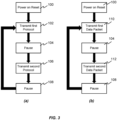
- FIGs 3 (a) and (b) show flow charts of two example operation schemes for a TTO tag of the present invention.
- the tag operation (executed by the IC) includes the sequential step of 'Power on Reset' 100, followed by the 'Transmit first Protocol' step 102, a 'Pause' 104, followed by a 'Transmit second Protocol' step 106 and another 'Pause' 108, the sequence may then be repeated, i.e. going back to step 'Transmit first Protocol' step 102.
- the step 'Transmit first Protocol' 102 and 'Transmit second Protocol' 106 may be replaced by the alternative steps 'Transmit first data packet' 110 and 'Transmit second data packet' 112, as shown in the example of Figure 3 (b) .
- the sequentially repeating and alternating signal transmissions are not limited to the illustrated two different signal transmissions but may be any number of different signal transmissions alternating at any suitable iteration pattern.
- the signal transmissions may differ in any one or any combination of a suitable signal transmission characteristic, such as, for example, the communication protocol / standard including, inter alia, the carrier frequency, data transmission rate, the modulation scheme applied, but the distinguishing signal transmission characteristic may also be the actual data content, or a time stamp given to a separate signal transmission.
- a single RFID tag / IC operates with a single antenna by alternating between different transmitted bursts (signal transmissions) in a Tag Talks Only (TTO) mode, repeatedly broadcasting its alternating information whilst receiving power (and potentially listening for modulation) but interpreting no data or commands from a reader.
- TTO Tag Talks Only
- the tag of the present invention is compatible with multiple different reader systems and/or can broadcast different sets of data at a predetermined rate/pattern.
- Embodiments of the present invention include tags that may operate at a single carrier frequency utilising a single antenna, but it also includes tags that may operate at multiple frequencies utilising a single antenna interface.
- all IC controlled signal transmissions are in the form of load modulation (i.e.
- one first signal transmission may use amplitude modulation (amplitude shift keying, ASK) and the other may use phase modulation (phase shift keying, PSK).
- ASK amplitude shift keying
- PSK phase shift keying
- envisaged signal transmission iteration patterns may include a symmetric, asymmetric, regular, irregular or random order.
- two different signal transmissions 'A' and 'B' e.g. differing in the communication protocol used
- any other order and/or number of different signal transmissions may be used without departing from the inventive concept of the present invention.
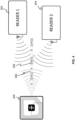
- FIG. 4 shows a simplified schematic illustration of a RFID system including a tag 200 of the present invention, as well as, a first reader 202 and second reader 204, each one of the readers 202, 204 using a different communication protocol to "communicatively couple" with the tag 200.
- tag 200 provides sequentially arranged (time-division multiplexed) signal transmission (e.g. via load modulation) including alternating signal "bursts" of a first 206 and second signal transmission 208, wherein the first signal transmission 206 applies the communication protocol used by the first reader 202 and the second signal transmission 208 applies the communication protocol used by the second reader 204.
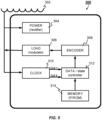
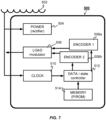
- Figures 5 to 8 show simplified illustrations of examples of different IC architecture designs.
- Figure 5 shows a block diagram of an IC 300 (e.g. FlexIC, PragmatIC ® ), comprising an antenna 302 (e.g. simple loop or coil), a power rectifier 304 and load modulator 306, as well as, an encoder 308, clock 310, controller 312 and a memory 314.
- the encoder 308 is configured to simply provide a single encoding scheme, wherein the clock 310 is adapted to provide at least a first clock signal (CLK1) and a second clock signal (CLK2).
- the memory 314 may store basic ID tag information but may also include additional information.
- a tag comprising an IC 300, as shown in Figure 5 may alternate between signal transmissions at two different data rates, each signal transmission including the same data (from memory 314).
- the block diagram of the IC 400 illustrated in Figure 6 comprises a first memory 414a storing first data, and a second memory 414b storing second data.
- the other components are identical to the architecture of the IC 300 shown in Figure 5 , i.e. antenna 402, power rectifier 404, load modulator 406, encoder 408, clock 410, and controller 412.
- a tag comprising IC 400 may be adapted to alternate between transmitting two different sets of data, using the same data rate, but may also alternate between transmitting two different sets of data, each using a different data rate (CLK1 or CLK2).
- Figure 7 shows a block diagram of IC 500, further comprising a first encoder 508a configured to apply a first encoding scheme, and a second encoder 508b configured to apply a second encoding scheme.
- the other components are similar to the architecture of the IC 300 shown in Figure 5 , i.e. antenna 502, power rectifier 504, load modulator 506, clock 510 (only one CLK signal), controller 512 and memory 514.
- a tag comprising IC 500 may be adapted to alternate between transmitting in two different encoding schemes.
- Figure 8 shows a block diagram of IC 600, comprising a first encoder 608a configured to apply a first encoding scheme, and a second encoder 608b configured to apply a second encoding scheme, but also a first clock 610a, adapted to provide a first clock signal from the carrier frequency of the RF signal received from the reader, and a second clock 610b, adapted to provide an internally-generated clock signal.
- the other components are similar to the architecture of the IC 300 shown in Figure 5 , i.e. antenna 602, power rectifier 604, load modulator 606, controller 612 and memory 614.
- a tag comprising IC 600 may be adapted to alternate between transmitting in two different encoding schemes, one of which uses the internally generated clock signal.
- the invention allows the design and development of a single IC 300, 400, 500, 600 adapted to transmit different protocols that are separated in the time domain. Consequently, IC and tag costs are kept at a minimum, in particular, by using a single antenna and a minimized number of bond pads, as well as, a minimum of fabrication steps over currently available prior art (i.e. tags combining two separate ICs on a single tag, or two separate tags within a single tag, or a single IC with two antennas).
- the tag of the present invention may be a HF tag that is compatible with both (i) proximity readers, such as a smartphone, transmitting information via NFC designed to enable interaction with a consumer and (ii) vicinity readers with a longer range, designed for track and trace interactions within the supply chain.
- a first broadcast i.e. first signal transmission
- a second broadcast may contain more detailed proprietary information that is interpreted by a custom reader.
- a first broadcast i.e. first signal transmission
- a standards-based smartphone reader
- a second broadcast may contain more detailed information that is interpreted by software (e.g. an App) installed on the smartphone.
- a single antenna may be used for multi-frequency operation.
- a suitable antenna may be a multi-resonant antenna employed to enable reception and transmission at two or more different frequencies via a single two-contact interface or feed.
- Multi-resonant antennas are known in the art and are not described in any more detail.
- a dual-frequency operation may also enable operational range extension by supplying energy to the IC 300, 600 at one frequency, whilst receiving transmissions from the IC 300, 600 at a second frequency.
- energy received at a higher frequency may supplement that received at a HF frequency, allowing HF communication with an extended range during a HF protocol burst (i.e. signal transmission) between bursts of signal transmissions at a higher frequency.
Landscapes
- Engineering & Computer Science (AREA)
- Physics & Mathematics (AREA)
- Health & Medical Sciences (AREA)
- Toxicology (AREA)
- General Physics & Mathematics (AREA)
- Theoretical Computer Science (AREA)
- Computer Networks & Wireless Communication (AREA)
- Electromagnetism (AREA)
- General Health & Medical Sciences (AREA)
- Artificial Intelligence (AREA)
- Computer Vision & Pattern Recognition (AREA)
- Computer Hardware Design (AREA)
- Microelectronics & Electronic Packaging (AREA)
- Near-Field Transmission Systems (AREA)
Claims (14)
- Ensemble étiquette RFID passive destiné à fonctionner avec au moins un ensemble lecteur RFID, comprenant :un élément d'antenne passif unique (302) pour transmettre et/ou recevoir un signal RFID ; etau moins un circuit intégré, CI, (300) pour traiter le signal RFID, etqui est configuré pour, tout en recevant une alimentation, communiquer, par diffusion, de manière alternée et séquentielle dans le temps, une première transmission de signal et au moins une seconde transmission de signal, chacune définie par une pluralité de paramètres de transmission de signal prédéterminés, à l'au moins un ensemble lecteur RFID utilisant un multiplexage par répartition dans le temps, dans lequel ladite au moins une première transmission de signal diffère de ladite au moins une seconde transmission de signal dans au moins un de ladite pluralité de paramètres de transmission de signal prédéterminés,caractérisé en ce que :l'ensemble étiquette RFID passive est un ensemble étiquette RFID Tag-Talks-Only, TTO, etla diffusion, de manière alternée et séquentielle dans le temps, est effectuée sans interprétation de données ni de commandes provenant de l'au moins un ensemble lecteur RFID.
- Ensemble étiquette RFID selon la revendication 1, dans lequel ladite pluralité de paramètres de transmission de signal prédéterminés sont l'un quelconque parmi (i) au moins une information prédéterminée, (ii) au moins un paramètre d'au moins une norme RFID et (iii) un horodatage.
- Ensemble étiquette RFID selon la revendication 2, dans lequel ledit au moins un paramètre de ladite au moins une norme RFID est l'un quelconque parmi une fréquence porteuse de signal, un débit de transmission de données et un schéma de codage.
- Ensemble étiquette RFID selon la revendication 3, dans lequel ledit CI (300) comprend :un dispositif de mémoire (314), configuré pour stocker au moins ladite information prédéterminée ;un dispositif codeur (308), configuré pour appliquer ledit au moins un schéma de codage au signal RFID ;un générateur d'horloge (310), configuré pour fournir au moins un premier signal d'horloge ;un modulateur de signal, adapté pour moduler ledit signal RFID selon au moins un processus de modulation ;un contrôleur (312), configuré pour commander l'un quelconque de ladite au moins une mémoire (314), dudit au moins un codeur (308), dudit générateur d'horloge (310) et dudit modulateur de signal.
- Ensemble étiquette RFID selon la revendication 4, dans lequel ledit dispositif de mémoire (314) comprend une première mémoire (414a), configurée pour stocker une première information prédéterminée, et au moins une seconde mémoire (414b), configurée pour stocker une seconde information.
- Ensemble étiquette RFID selon l'une quelconque des revendications 4 et 5, dans lequel ledit dispositif codeur (308) comprend un premier codeur (508a), adapté pour appliquer un premier schéma de codage au signal RFID, et au moins un second codeur (508b), adapté pour appliquer un second schéma de codage au signal RFID.
- Ensemble étiquette RFID selon l'une quelconque des revendications 4 à 6, dans lequel ledit générateur d'horloge (310) comprend une première horloge (610a), configurée pour générer ledit au moins un premier signal d'horloge, et au moins une seconde horloge (610b), configurée pour générer au moins un second signal d'horloge.
- Ensemble étiquette RFID selon l'une quelconque des revendications 4 à 7, dans lequel ledit modulateur de signal est un modulateur de charge (306).
- Ensemble étiquette RFID selon la revendication 8, dans lequel ledit modulateur de charge (306) est adapté pour fournir l'un quelconque d'un couplage en champ proche, NFC ou inductif, et d'un couplage en champ lointain ou rétrodiffusé.
- Ensemble étiquette RFID selon l'une quelconque des revendications 8 et 9, dans lequel ledit modulateur de charge (306) est adapté pour utiliser l'un quelconque d'un schéma de modulation par déplacement d'amplitude, ASK, de modulation par déplacement de fréquence, FSK, et de modulation par déplacement de phase, PSK.
- Ensemble étiquette RFID selon l'une quelconque des revendications précédentes, dans lequel ledit élément d'antenne (302) est une antenne unique, configurée pour transmettre et/ou recevoir un signal RFID d'une première fréquence de signal, et dans lequel ladite antenne unique est une antenne multi-résonante conçue pour transmettre et/ou recevoir un signal RFID de ladite première fréquence de signal et au moins un signal RFID d'une seconde fréquence de signal, et dans lequel ladite première fréquence de signal est une ultra-haute fréquence, UHF, et ladite seconde fréquence de signal est l'une quelconque parmi une haute fréquence, HF, et une basse fréquence, LF.
- Ensemble étiquette RFID selon l'une quelconque des revendications 2 à 11, dans lequel ladite au moins une norme RFID est l'un quelconque d'un protocole d'interface aérienne UHF, d'un protocole d'interface aérienne HF et d'un protocole d'interface aérienne LF.
- Ensemble étiquette RFID selon l'une quelconque des revendications précédentes, dans lequel ledit CI comprend en outre un générateur d'alimentation adapté pour fournir de l'énergie audit CI à partir du signal RFID.
- Système d'identification par radiofréquences, RFID, comprenant :au moins un ensemble étiquette selon l'une quelconque des revendications précédentes, etau moins un ensemble lecteur RFID, configuré pour se coupler de manière opérationnelle et communicative audit au moins un ensemble étiquette.
Applications Claiming Priority (2)
| Application Number | Priority Date | Filing Date | Title |
|---|---|---|---|
| GB1820967.6A GB2580094B (en) | 2018-12-21 | 2018-12-21 | A multi-protocol RFID tag and system |
| PCT/GB2019/053410 WO2020128425A1 (fr) | 2018-12-21 | 2019-12-03 | Étiquette et système rfid multiprotcole |
Publications (4)
| Publication Number | Publication Date |
|---|---|
| EP3899795A1 EP3899795A1 (fr) | 2021-10-27 |
| EP3899795C0 EP3899795C0 (fr) | 2024-11-20 |
| EP3899795B1 true EP3899795B1 (fr) | 2024-11-20 |
| EP3899795B8 EP3899795B8 (fr) | 2024-12-25 |
Family
ID=65364524
Family Applications (1)
| Application Number | Title | Priority Date | Filing Date |
|---|---|---|---|
| EP19820853.0A Active EP3899795B8 (fr) | 2018-12-21 | 2019-12-03 | Étiquette et système rfid multiprotcole |
Country Status (4)
| Country | Link |
|---|---|
| US (1) | US11836562B2 (fr) |
| EP (1) | EP3899795B8 (fr) |
| GB (1) | GB2580094B (fr) |
| WO (1) | WO2020128425A1 (fr) |
Families Citing this family (2)
| Publication number | Priority date | Publication date | Assignee | Title |
|---|---|---|---|---|
| CN112532342B (zh) * | 2019-09-17 | 2023-05-16 | 华为技术有限公司 | 一种背反射通信中的数据传输方法和装置 |
| CN116095736B (zh) * | 2023-01-31 | 2024-08-13 | 中国铁塔股份有限公司 | 一种链路损耗测量系统及方法 |
Family Cites Families (37)
| Publication number | Priority date | Publication date | Assignee | Title |
|---|---|---|---|---|
| US4897642A (en) * | 1988-10-14 | 1990-01-30 | Secura Corporation | Vehicle status monitor and management system employing satellite communication |
| MXPA05001550A (es) * | 2002-08-08 | 2005-10-05 | Neology Inc | Dispositivo de identificacion de frecuencias multiples. |
| EP1406208A1 (fr) * | 2002-10-02 | 2004-04-07 | EM Microelectronic-Marin SA | Procédé d'identification d'une pluralité de transpondeurs localisés dans un espace par un lecteur ayant plusiers antennes |
| US7248165B2 (en) * | 2003-09-09 | 2007-07-24 | Motorola, Inc. | Method and apparatus for multiple frequency RFID tag architecture |
| US7132946B2 (en) * | 2004-04-08 | 2006-11-07 | 3M Innovative Properties Company | Variable frequency radio frequency identification (RFID) tags |
| US7307534B2 (en) * | 2004-04-21 | 2007-12-11 | Impinj, Inc. | RFID tag using hybrid non-volatile memory |
| US7307529B2 (en) * | 2004-12-17 | 2007-12-11 | Impinj, Inc. | RFID tags with electronic fuses for storing component configuration data |
| US7602274B2 (en) * | 2004-04-23 | 2009-10-13 | Microchip Technology Incorporated | Dynamic configuration of a radio frequency transponder |
| WO2006030344A1 (fr) | 2004-09-14 | 2006-03-23 | Ipico Innovation Inc | Transpondeur rf pour authentification hors ligne d'une source d'un produit portant le transpondeur |
| US20060224647A1 (en) * | 2005-03-30 | 2006-10-05 | Impinj, Inc. | RFID tag using updatable seed values for generating a random number |
| JP5148504B2 (ja) * | 2005-12-09 | 2013-02-20 | テゴ,インコーポレイテッド | 多重無線周波数ネットワークノードrfidタグ |
| GB0525623D0 (en) * | 2005-12-16 | 2006-01-25 | Hill Nicholas P R | RFID reader |
| US20070213951A1 (en) * | 2006-03-13 | 2007-09-13 | Ipico Innovation Inc. | Method and system for automatically monitoring the read quality of an rfid system |
| AU2006346817A1 (en) * | 2006-08-01 | 2008-02-07 | Agency For Science, Technology And Research | Antenna for near field and far field radio frequency identification |
| US7952464B2 (en) * | 2006-10-05 | 2011-05-31 | Intermec Ip Corp. | Configurable RFID tag with protocol and band selection |
| US7843316B1 (en) * | 2007-03-19 | 2010-11-30 | Synopsys, Inc. | Power-on reset apparatus, systems, and methods |
| US7679514B2 (en) * | 2007-03-30 | 2010-03-16 | Broadcom Corporation | Multi-mode RFID tag architecture |
| US8063769B2 (en) * | 2007-03-30 | 2011-11-22 | Broadcom Corporation | Dual band antenna and methods for use therewith |
| US7761061B2 (en) * | 2007-05-02 | 2010-07-20 | Broadcom Corporation | Programmable antenna assembly and applications thereof |
| US8712334B2 (en) * | 2008-05-20 | 2014-04-29 | Micron Technology, Inc. | RFID device using single antenna for multiple resonant frequency ranges |
| US9087281B2 (en) * | 2009-06-12 | 2015-07-21 | Impinj, Inc. | Dual-frequency RFID tag with isolated inputs |
| US20120293307A1 (en) * | 2011-05-17 | 2012-11-22 | Astraion, LLC | RFID systems having improved read rates for localization and proximity detection |
| US9449265B1 (en) * | 2011-08-02 | 2016-09-20 | Impinj International Ltd. | RFID tags with port-dependent functionality |
| US8702008B2 (en) * | 2012-06-05 | 2014-04-22 | Em Microelectronic-Marin Sa | RFID transponder chip with a programmable wake-up |
| US9633243B1 (en) * | 2013-07-19 | 2017-04-25 | Geotoll, Inc. | Method and apparatus for facilitating a wireless transaction event via a RFID tag device with a mobile device |
| US10418711B2 (en) * | 2013-07-19 | 2019-09-17 | Geotoll, Inc. | RFID antenna structure for increased range when coupled with a mobile device |
| US9613277B2 (en) * | 2013-08-26 | 2017-04-04 | International Business Machines Corporation | Role-based tracking and surveillance |
| US20150087935A1 (en) * | 2013-09-23 | 2015-03-26 | Alice McKinstry Davis | Real-time blood detection system |
| US10335596B2 (en) * | 2014-03-14 | 2019-07-02 | Nalu Medical, Inc. | Method and apparatus for neuromodulation treatments of pain and other conditions |
| US10474852B2 (en) * | 2014-10-31 | 2019-11-12 | Teslonix Inc. | Charging long-range radio frequency identification tags |
| US20170030853A1 (en) * | 2014-11-21 | 2017-02-02 | John William Hodges, JR. | Apparatus, Method and System for Distributed Chemical or Biological to Digital Conversion to Digital Information Using Radio Frequencies |
| US10660726B2 (en) * | 2015-01-21 | 2020-05-26 | Covidien Lp | Sterilizable wirelessly detectable objects for use in medical procedures and methods of making same |
| US9501731B2 (en) * | 2015-04-02 | 2016-11-22 | Em Microelectronic-Marin Sa | Multi-frequency transponder |
| US10088547B1 (en) * | 2017-11-15 | 2018-10-02 | Magnet Consulting, Inc. | RFID antenna array for gaming |
| WO2019133347A1 (fr) * | 2017-12-28 | 2019-07-04 | Avery Dennison Retail Information Services, Llc | Appareil et procédé d'interaction de formes multiples de technologie rfid pour fournir un supplément d'informations, de sécurité et de performances |
| EP3599573B1 (fr) * | 2018-07-25 | 2020-10-21 | Siemens Aktiengesellschaft | Procédé de transmission de données entre un appareil de lecture transpondeur radio et un transpondeur radio et transpondeur radio |
| TWI755138B (zh) * | 2020-11-02 | 2022-02-11 | 凌通科技股份有限公司 | 一種低功耗及降低碰撞之無線射頻識別通訊方法以及使用其之無線射頻識別通訊系統 |
-
2018
- 2018-12-21 GB GB1820967.6A patent/GB2580094B/en active Active
-
2019
- 2019-12-03 EP EP19820853.0A patent/EP3899795B8/fr active Active
- 2019-12-03 US US17/311,754 patent/US11836562B2/en active Active
- 2019-12-03 WO PCT/GB2019/053410 patent/WO2020128425A1/fr not_active Ceased
Also Published As
| Publication number | Publication date |
|---|---|
| US11836562B2 (en) | 2023-12-05 |
| EP3899795C0 (fr) | 2024-11-20 |
| WO2020128425A1 (fr) | 2020-06-25 |
| EP3899795A1 (fr) | 2021-10-27 |
| US20220027701A1 (en) | 2022-01-27 |
| US20220343128A9 (en) | 2022-10-27 |
| GB201820967D0 (en) | 2019-02-06 |
| GB2580094A (en) | 2020-07-15 |
| GB2580094B (en) | 2021-12-22 |
| EP3899795B8 (fr) | 2024-12-25 |
Similar Documents
| Publication | Publication Date | Title |
|---|---|---|
| US6745008B1 (en) | Multi-frequency communication system and method | |
| CN101425148B (zh) | 多模rfid标签及其操作方法 | |
| EP4028934B1 (fr) | Transpondeur rfid polyvalent et système permettant de le lire | |
| US8207825B2 (en) | RFID reader with receiver clock derived from transmitter output | |
| EP1896863B1 (fr) | Systemes et procedes de transmission rfid | |
| US11514255B1 (en) | Fast frequency switching for RFID applications | |
| US20090009295A1 (en) | Transceiver with far field and near field operation and methods for use therewith | |
| WO2005048612A1 (fr) | Systeme de surveillance electronique rfid configurable pour environnement de reglementations multiples | |
| WO2008076898A1 (fr) | Opérations mises en file d'attente dans des applications rfid hf/uhf | |
| US20070176755A1 (en) | Method for wireless data transmission and a transponder | |
| EP3899795B1 (fr) | Étiquette et système rfid multiprotcole | |
| EP2070002B1 (fr) | Conception de puce programmable pour génération de signal radiofréquence et son procédé | |
| EP0936571B1 (fr) | Carte à puce, lecteur et système | |
| CN102254132B (zh) | Rfid读取器 | |
| JP2010021684A (ja) | Rfidシステム、rfidリーダライタ、rfidタグおよびrfid通信方法 | |
| US8416060B2 (en) | Method and device for reading radio frequency identification (RFID) tags | |
| Ying et al. | A system design for UHF RFID reader | |
| CN214475020U (zh) | 射频识别系统 | |
| US20070176754A1 (en) | Method for operating a transponder, and a transponder device | |
| EP3899777B1 (fr) | Un système rfid avec des caractéristiques de transmission de signaux améliorées | |
| US20090109001A1 (en) | Wireless IC tag, wireless IC tag system and operation method for wireless IC tag | |
| EP3751462B1 (fr) | Transpondeur et procédé de fonctionnement correspondant | |
| Ayer et al. | Evaluation of ISO 18000-6C artifacts | |
| Handy | Rfid technology |
Legal Events
| Date | Code | Title | Description |
|---|---|---|---|
| STAA | Information on the status of an ep patent application or granted ep patent |
Free format text: STATUS: UNKNOWN |
|
| STAA | Information on the status of an ep patent application or granted ep patent |
Free format text: STATUS: THE INTERNATIONAL PUBLICATION HAS BEEN MADE |
|
| PUAI | Public reference made under article 153(3) epc to a published international application that has entered the european phase |
Free format text: ORIGINAL CODE: 0009012 |
|
| STAA | Information on the status of an ep patent application or granted ep patent |
Free format text: STATUS: REQUEST FOR EXAMINATION WAS MADE |
|
| 17P | Request for examination filed |
Effective date: 20210527 |
|
| AK | Designated contracting states |
Kind code of ref document: A1 Designated state(s): AL AT BE BG CH CY CZ DE DK EE ES FI FR GB GR HR HU IE IS IT LI LT LU LV MC MK MT NL NO PL PT RO RS SE SI SK SM TR |
|
| DAV | Request for validation of the european patent (deleted) | ||
| DAX | Request for extension of the european patent (deleted) | ||
| STAA | Information on the status of an ep patent application or granted ep patent |
Free format text: STATUS: EXAMINATION IS IN PROGRESS |
|
| 17Q | First examination report despatched |
Effective date: 20221121 |
|
| GRAP | Despatch of communication of intention to grant a patent |
Free format text: ORIGINAL CODE: EPIDOSNIGR1 |
|
| STAA | Information on the status of an ep patent application or granted ep patent |
Free format text: STATUS: GRANT OF PATENT IS INTENDED |
|
| INTG | Intention to grant announced |
Effective date: 20240715 |
|
| GRAS | Grant fee paid |
Free format text: ORIGINAL CODE: EPIDOSNIGR3 |
|
| GRAA | (expected) grant |
Free format text: ORIGINAL CODE: 0009210 |
|
| STAA | Information on the status of an ep patent application or granted ep patent |
Free format text: STATUS: THE PATENT HAS BEEN GRANTED |
|
| AK | Designated contracting states |
Kind code of ref document: B1 Designated state(s): AL AT BE BG CH CY CZ DE DK EE ES FI FR GR HR HU IE IS IT LI LT LU LV MC MK MT NL NO PL PT RO RS SE SI SK SM TR |
|
| RBV | Designated contracting states (corrected) |
Designated state(s): AL AT BE BG CH CY CZ DE DK EE ES FI FR GR HR HU IE IS IT LI LT LU LV MC MK MT NL NO PL PT RO RS SE SI SK SM TR |
|
| REG | Reference to a national code |
Ref country code: DE Ref legal event code: R081 Ref document number: 602019062318 Country of ref document: DE Owner name: PRAGMATIC SEMICONDUCTOR LIMITED, GB Free format text: FORMER OWNER: PRAGMATIC PRINTING LTD, SEDGEFIELD, DURHAM, GB |
|
| RIN1 | Information on inventor provided before grant (corrected) |
Inventor name: WHITE, SCOTT Inventor name: COBB, BRIAN HARDY |
|
| RAP4 | Party data changed (patent owner data changed or rights of a patent transferred) |
Owner name: PRAGMATIC SEMICONDUCTOR LIMITED |
|
| REG | Reference to a national code |
Ref country code: CH Ref legal event code: PK Free format text: BERICHTIGUNG B8 Ref country code: CH Ref legal event code: EP |
|
| REG | Reference to a national code |
Ref country code: DE Ref legal event code: R096 Ref document number: 602019062318 Country of ref document: DE |
|
| REG | Reference to a national code |
Ref country code: IE Ref legal event code: FG4D |
|
| U01 | Request for unitary effect filed |
Effective date: 20241120 |
|
| U07 | Unitary effect registered |
Designated state(s): AT BE BG DE DK EE FI FR IT LT LU LV MT NL PT RO SE SI Effective date: 20241126 |
|
| U20 | Renewal fee for the european patent with unitary effect paid |
Year of fee payment: 6 Effective date: 20241128 |
|
| PG25 | Lapsed in a contracting state [announced via postgrant information from national office to epo] |
Ref country code: HR Free format text: LAPSE BECAUSE OF FAILURE TO SUBMIT A TRANSLATION OF THE DESCRIPTION OR TO PAY THE FEE WITHIN THE PRESCRIBED TIME-LIMIT Effective date: 20241120 Ref country code: IS Free format text: LAPSE BECAUSE OF FAILURE TO SUBMIT A TRANSLATION OF THE DESCRIPTION OR TO PAY THE FEE WITHIN THE PRESCRIBED TIME-LIMIT Effective date: 20250320 |
|
| PG25 | Lapsed in a contracting state [announced via postgrant information from national office to epo] |
Ref country code: ES Free format text: LAPSE BECAUSE OF FAILURE TO SUBMIT A TRANSLATION OF THE DESCRIPTION OR TO PAY THE FEE WITHIN THE PRESCRIBED TIME-LIMIT Effective date: 20241120 |
|
| PG25 | Lapsed in a contracting state [announced via postgrant information from national office to epo] |
Ref country code: NO Free format text: LAPSE BECAUSE OF FAILURE TO SUBMIT A TRANSLATION OF THE DESCRIPTION OR TO PAY THE FEE WITHIN THE PRESCRIBED TIME-LIMIT Effective date: 20250220 |
|
| PG25 | Lapsed in a contracting state [announced via postgrant information from national office to epo] |
Ref country code: GR Free format text: LAPSE BECAUSE OF FAILURE TO SUBMIT A TRANSLATION OF THE DESCRIPTION OR TO PAY THE FEE WITHIN THE PRESCRIBED TIME-LIMIT Effective date: 20250221 |
|
| PG25 | Lapsed in a contracting state [announced via postgrant information from national office to epo] |
Ref country code: PL Free format text: LAPSE BECAUSE OF FAILURE TO SUBMIT A TRANSLATION OF THE DESCRIPTION OR TO PAY THE FEE WITHIN THE PRESCRIBED TIME-LIMIT Effective date: 20241120 |
|
| PG25 | Lapsed in a contracting state [announced via postgrant information from national office to epo] |
Ref country code: RS Free format text: LAPSE BECAUSE OF FAILURE TO SUBMIT A TRANSLATION OF THE DESCRIPTION OR TO PAY THE FEE WITHIN THE PRESCRIBED TIME-LIMIT Effective date: 20250220 |
|
| PG25 | Lapsed in a contracting state [announced via postgrant information from national office to epo] |
Ref country code: SM Free format text: LAPSE BECAUSE OF FAILURE TO SUBMIT A TRANSLATION OF THE DESCRIPTION OR TO PAY THE FEE WITHIN THE PRESCRIBED TIME-LIMIT Effective date: 20241120 |
|
| PG25 | Lapsed in a contracting state [announced via postgrant information from national office to epo] |
Ref country code: SK Free format text: LAPSE BECAUSE OF FAILURE TO SUBMIT A TRANSLATION OF THE DESCRIPTION OR TO PAY THE FEE WITHIN THE PRESCRIBED TIME-LIMIT Effective date: 20241120 |
|
| PG25 | Lapsed in a contracting state [announced via postgrant information from national office to epo] |
Ref country code: CZ Free format text: LAPSE BECAUSE OF FAILURE TO SUBMIT A TRANSLATION OF THE DESCRIPTION OR TO PAY THE FEE WITHIN THE PRESCRIBED TIME-LIMIT Effective date: 20241120 |
|
| REG | Reference to a national code |
Ref country code: CH Ref legal event code: PL |
|
| PG25 | Lapsed in a contracting state [announced via postgrant information from national office to epo] |
Ref country code: MC Free format text: LAPSE BECAUSE OF FAILURE TO SUBMIT A TRANSLATION OF THE DESCRIPTION OR TO PAY THE FEE WITHIN THE PRESCRIBED TIME-LIMIT Effective date: 20241120 |
|
| PLBE | No opposition filed within time limit |
Free format text: ORIGINAL CODE: 0009261 |
|
| STAA | Information on the status of an ep patent application or granted ep patent |
Free format text: STATUS: NO OPPOSITION FILED WITHIN TIME LIMIT |
|
| PG25 | Lapsed in a contracting state [announced via postgrant information from national office to epo] |
Ref country code: CH Free format text: LAPSE BECAUSE OF NON-PAYMENT OF DUE FEES Effective date: 20241231 |
|
| 26N | No opposition filed |
Effective date: 20250821 |
|
| PG25 | Lapsed in a contracting state [announced via postgrant information from national office to epo] |
Ref country code: IE Free format text: LAPSE BECAUSE OF NON-PAYMENT OF DUE FEES Effective date: 20241203 |
|
| PG25 | Lapsed in a contracting state [announced via postgrant information from national office to epo] |
Ref country code: CY Free format text: LAPSE BECAUSE OF FAILURE TO SUBMIT A TRANSLATION OF THE DESCRIPTION OR TO PAY THE FEE WITHIN THE PRESCRIBED TIME-LIMIT; INVALID AB INITIO Effective date: 20191203 |