EP3901413A2 - Aubes présentant des poches d'extrémité - Google Patents
Aubes présentant des poches d'extrémité Download PDFInfo
- Publication number
- EP3901413A2 EP3901413A2 EP21167073.2A EP21167073A EP3901413A2 EP 3901413 A2 EP3901413 A2 EP 3901413A2 EP 21167073 A EP21167073 A EP 21167073A EP 3901413 A2 EP3901413 A2 EP 3901413A2
- Authority
- EP
- European Patent Office
- Prior art keywords
- airfoil
- cavities
- mid
- rotor blade
- outboard
- Prior art date
- Legal status (The legal status is an assumption and is not a legal conclusion. Google has not performed a legal analysis and makes no representation as to the accuracy of the status listed.)
- Granted
Links
Images



Classifications
-
- F—MECHANICAL ENGINEERING; LIGHTING; HEATING; WEAPONS; BLASTING
- F01—MACHINES OR ENGINES IN GENERAL; ENGINE PLANTS IN GENERAL; STEAM ENGINES
- F01D—NON-POSITIVE DISPLACEMENT MACHINES OR ENGINES, e.g. STEAM TURBINES
- F01D5/00—Blades; Blade-carrying members; Heating, heat-insulating, cooling or antivibration means on the blades or the members
- F01D5/12—Blades
- F01D5/22—Blade-to-blade connections, e.g. for damping vibrations
- F01D5/225—Blade-to-blade connections, e.g. for damping vibrations by shrouding
-
- F—MECHANICAL ENGINEERING; LIGHTING; HEATING; WEAPONS; BLASTING
- F01—MACHINES OR ENGINES IN GENERAL; ENGINE PLANTS IN GENERAL; STEAM ENGINES
- F01D—NON-POSITIVE DISPLACEMENT MACHINES OR ENGINES, e.g. STEAM TURBINES
- F01D5/00—Blades; Blade-carrying members; Heating, heat-insulating, cooling or antivibration means on the blades or the members
- F01D5/12—Blades
- F01D5/14—Form or construction
- F01D5/147—Construction, i.e. structural features, e.g. of weight-saving hollow blades
-
- F—MECHANICAL ENGINEERING; LIGHTING; HEATING; WEAPONS; BLASTING
- F01—MACHINES OR ENGINES IN GENERAL; ENGINE PLANTS IN GENERAL; STEAM ENGINES
- F01D—NON-POSITIVE DISPLACEMENT MACHINES OR ENGINES, e.g. STEAM TURBINES
- F01D5/00—Blades; Blade-carrying members; Heating, heat-insulating, cooling or antivibration means on the blades or the members
- F01D5/12—Blades
- F01D5/14—Form or construction
- F01D5/16—Form or construction for counteracting blade vibration
-
- F—MECHANICAL ENGINEERING; LIGHTING; HEATING; WEAPONS; BLASTING
- F01—MACHINES OR ENGINES IN GENERAL; ENGINE PLANTS IN GENERAL; STEAM ENGINES
- F01D—NON-POSITIVE DISPLACEMENT MACHINES OR ENGINES, e.g. STEAM TURBINES
- F01D5/00—Blades; Blade-carrying members; Heating, heat-insulating, cooling or antivibration means on the blades or the members
- F01D5/12—Blades
- F01D5/14—Form or construction
- F01D5/18—Hollow blades, i.e. blades with cooling or heating channels or cavities; Heating, heat-insulating or cooling means on blades
-
- F—MECHANICAL ENGINEERING; LIGHTING; HEATING; WEAPONS; BLASTING
- F01—MACHINES OR ENGINES IN GENERAL; ENGINE PLANTS IN GENERAL; STEAM ENGINES
- F01D—NON-POSITIVE DISPLACEMENT MACHINES OR ENGINES, e.g. STEAM TURBINES
- F01D5/00—Blades; Blade-carrying members; Heating, heat-insulating, cooling or antivibration means on the blades or the members
- F01D5/12—Blades
- F01D5/14—Form or construction
- F01D5/20—Specially-shaped blade tips to seal space between tips and stator
-
- F—MECHANICAL ENGINEERING; LIGHTING; HEATING; WEAPONS; BLASTING
- F05—INDEXING SCHEMES RELATING TO ENGINES OR PUMPS IN VARIOUS SUBCLASSES OF CLASSES F01-F04
- F05D—INDEXING SCHEME FOR ASPECTS RELATING TO NON-POSITIVE-DISPLACEMENT MACHINES OR ENGINES, GAS-TURBINES OR JET-PROPULSION PLANTS
- F05D2240/00—Components
- F05D2240/20—Rotors
- F05D2240/30—Characteristics of rotor blades, i.e. of any element transforming dynamic fluid energy to or from rotational energy and being attached to a rotor
- F05D2240/307—Characteristics of rotor blades, i.e. of any element transforming dynamic fluid energy to or from rotational energy and being attached to a rotor related to the tip of a rotor blade
-
- F—MECHANICAL ENGINEERING; LIGHTING; HEATING; WEAPONS; BLASTING
- F05—INDEXING SCHEMES RELATING TO ENGINES OR PUMPS IN VARIOUS SUBCLASSES OF CLASSES F01-F04
- F05D—INDEXING SCHEME FOR ASPECTS RELATING TO NON-POSITIVE-DISPLACEMENT MACHINES OR ENGINES, GAS-TURBINES OR JET-PROPULSION PLANTS
- F05D2260/00—Function
- F05D2260/30—Retaining components in desired mutual position
-
- F—MECHANICAL ENGINEERING; LIGHTING; HEATING; WEAPONS; BLASTING
- F05—INDEXING SCHEMES RELATING TO ENGINES OR PUMPS IN VARIOUS SUBCLASSES OF CLASSES F01-F04
- F05D—INDEXING SCHEME FOR ASPECTS RELATING TO NON-POSITIVE-DISPLACEMENT MACHINES OR ENGINES, GAS-TURBINES OR JET-PROPULSION PLANTS
- F05D2260/00—Function
- F05D2260/96—Preventing, counteracting or reducing vibration or noise
-
- Y—GENERAL TAGGING OF NEW TECHNOLOGICAL DEVELOPMENTS; GENERAL TAGGING OF CROSS-SECTIONAL TECHNOLOGIES SPANNING OVER SEVERAL SECTIONS OF THE IPC; TECHNICAL SUBJECTS COVERED BY FORMER USPC CROSS-REFERENCE ART COLLECTIONS [XRACs] AND DIGESTS
- Y02—TECHNOLOGIES OR APPLICATIONS FOR MITIGATION OR ADAPTATION AGAINST CLIMATE CHANGE
- Y02T—CLIMATE CHANGE MITIGATION TECHNOLOGIES RELATED TO TRANSPORTATION
- Y02T50/00—Aeronautics or air transport
- Y02T50/60—Efficient propulsion technologies, e.g. for aircraft
Definitions
- the present application relates generally to apparatus, methods and/or systems concerning the design and operation of turbine rotor blades. More specifically, but not by way of limitation, the present application relates to apparatus and systems pertaining to turbine blades and configurations of turbine blades having tip pockets.
- the present application describes a rotor blade for use in a turbine of a combustion turbine engine.
- the rotor blade comprises an airfoil.
- the airfoil including a concave pressure sidewall and a convex suction sidewall extending axially between corresponding leading and trailing edges and radially between the base and an outboard tip end.
- the rotor blade further including at least one mid-span shroud configured to engage a corresponding mid-span shroud on at least one neighboring rotor blade during operation.
- the airfoil further includes an inboard region between the at least one mid-span shroud and the base of the blade with an inboard direction of the airfoil toward the base; and an outboard region between the at least one mid-span shroud and the outward tip end of the blade with an outboard direction of the airfoil toward the outward tip end.
- the outboard region includes at least two cavities extending from the outboard tip end inboard of the airfoil toward the at least one mid-span shroud; and inboard of the at least one mid-span shroud, the inboard region is substantially solid.
- a combustion turbine engine that comprises a rotor blade including an airfoil including a concave pressure sidewall and a convex suction sidewall extending axially between corresponding leading and trailing edges and radially between the base and an outboard tip end.
- the rotor blade further including at least one mid-span shroud configured to engage a corresponding mid-span shroud on at least one neighboring rotor blade during operation.
- the airfoil further includes an inboard region between the at least one mid-span shroud and the base of the blade with an inboard direction of the airfoil toward the base; and an outboard region between the at least one mid-span shroud and the outward tip end of the blade with an outboard direction of the airfoil toward the outward tip end.
- the outboard region includes at least two cavities extending from the outboard tip end inboard of the airfoil toward the at least one mid-span shroud; and inboard of the at least one mid-span shroud, the inboard region is substantially solid.
- downstream and upstream are terms that indicate a direction relative to the flow of a fluid, such as the working fluid through the turbine engine or, for example, the flow of air through the combustor or coolant through one of the turbine's component systems.
- downstream corresponds to the direction of flow of the fluid
- upstream refers to the direction opposite to the flow.
- forward and aft refer to directions, with “forward” referring to the forward or compressor end of the engine, and “aft” referring to the aft or turbine end of the engine.
- radial refers to movement or position perpendicular to an axis. It is often required to describe parts that are at differing radial positions with regard to a center axis. In cases such as this, if a first component resides closer to the axis than a second component, it will be stated herein that the first component is “radially inward” or “inboard” of the second component.
- first component resides further from the axis than the second component, it may be stated herein that the first component is “radially outward” or “outboard” of the second component.
- axial refers to movement or position parallel to an axis.
- circumferential refers to movement or position around an axis. It will be appreciated that such terms may be applied in relation to the center axis of the turbine, or, when referring to components within a combustor, the center axis of the combustor.
- a combustion turbine engine In a combustion turbine engine, it is well known that air pressurized in a compressor is used to combust a fuel in a combustor to generate a flow of hot combustion gases, whereupon such gases flow downstream through one or more turbines so that energy can be extracted therefrom.
- rows of circumferentially spaced turbine rotor blades extend radially outwardly from a supporting rotor disc.
- Each blade typically includes a dovetail that permits assembly and disassembly of the blade in a corresponding dovetail slot in the rotor disc, as well as an airfoil that extends radially outwardly from the dovetail and interacts with the flow of the working fluid through the engine.
- the airfoil has a generally concave pressure side and generally convex suction side extending axially between corresponding leading and trailing edges and radially between a root and a tip. It will be understood that the blade tip is spaced closely to a radially outer stationary shroud for minimizing leakage therebetween of the combustion gases flowing downstream between the turbine blades.
- Shrouds at the tip of the airfoil or tip shrouds often are implemented on aft stages or rotor blades to provide damping and reduce the over-tip leakage of the working fluid.
- the damping function of the tip shrouds provides a significant performance benefit.
- taking full advantage of the damping function may be difficult considering the weight that the tip shroud adds to the assembly and the other criteria which include enduring thousands of hours of operation exposed to high temperatures and extreme mechanical loads.
- large tip shrouds are desirable because they seal the gas path more effectively and may provide significant connection between neighboring rotor blades, which may improve damping
- larger tip shrouds may increase load on the rotor blade.
- Output and efficiency of gas turbine engines improve as the size of the engine and, and more specifically, the amount of air able to pass through it increase.
- the size of the engine is limited by operable length of the turbine blades, with longer turbine rotor blades enabling enlargement of the flow path through the engine.
- Longer rotor blades though, incur increased mechanical loads, which place further demands on the blades and the rotor disc that holds them. Longer rotor blades may also decrease the natural vibrational frequencies of the blades during operation, which increases the vibratory response of the rotor blades. Additional vibratory load may place demands on the rotor blade, which may further shorten the life of the component and, in some cases, may cause vibratory loads.
- One way to address the vibratory load of longer rotor blades is through shrouds that connect adjacent rotor blades to each other.
- shrouds can be positioned near the middle radial portion of the airfoil. As used herein, such shrouds will be referred to as a "mid-span shroud(s)." At this lower (or more inboard) radius, the mass of the shroud causes a reduced level of stress to the rotor blade.
- this type of shroud leaves a portion of the airfoil of the rotor blade unrestrained or cantilevered which is the portion of the airfoil that extends outboard of the mid-span shroud. This cantilevered portion of the airfoil typically results in lower frequency vibration and increased vibratory loads.
- an overall weight of the outboard portion of the blade may be beneficial.
- the reduction should also desirably alter the frequency and mode shape of the blade. This alteration will enhance blade and turbine efficiency.
- Figures 1 through 3 show an illustrative combustion turbine engine in which embodiments of the present application may be used. It will be understood by those skill in the art that the present embodiments are not limited to this type of usage. As stated, the present embodiments may be used in combustion turbine engines, such as the engines used in power generation and airplanes, steam turbine engines, and other type of rotary engines.
- FIG. 1 is a schematic, non-limiting, representation of a combustion turbine engine 10.
- combustion turbine engines operate by extracting energy from a pressurized flow of hot gas produced by the combustion of a fuel in a stream of compressed air.
- combustion turbine engine 10 may be configured with an axial compressor 11 that is mechanically coupled by a common shaft or rotor to a downstream turbine section or turbine 12, and a combustor 13 positioned between compressor 11 and turbine 12.
- FIG 2 illustrates a view of an exemplary, non-limiting, multi-staged axial compressor 11 that may be used in the combustion turbine engine of Figure 1 .
- compressor 11 may include a plurality of stages. Each stage may include a row of compressor rotor blades 14 followed by a row of compressor stator nozzles 15.
- a first stage may include a row of compressor rotor blades 14, which rotate about a central shaft, followed by a row of compressor stator nozzles 15, which remain stationary during operation.
- the compressor stator nozzles 15 generally are circumferentially spaced one from the other and fixed about the axis of rotation.
- the compressor rotor blades 14 are circumferentially spaced and attached to the shaft.
- compressor rotor blades 14 When the shaft rotates during operation, compressor rotor blades 14 rotate with it. Compressor rotor blades 14 are configured such that, when spun about the shaft, they impart kinetic energy to the air or fluid flowing through compressor 11. Compressor 11 may have other stages beyond the stages that are illustrated in Figure 2 . Additional stages may include a plurality of circumferential spaced compressor rotor blades 14 followed by a plurality of circumferentially spaced compressor stator nozzles 15.
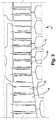
- FIG 3 illustrates a non-limiting, partial view of an exemplary turbine section or turbine 13 that may be used in the combustion turbine engine of Figure 1 .
- Turbine 13 also may include a plurality of stages. Three exemplary stages are illustrated, but this is merely exemplary and is non-limiting and not intended to restrict the embodiments in any manner. Accordingly, more or less stages may present in turbine 13.
- a first stage includes a plurality of turbine buckets or turbine rotor blades 16 (hereinafter “blades”), which rotate about the shaft during operation, and a plurality of nozzles or turbine stator blades 17 (hereinafter “nozzles”), which remain stationary during operation.
- Nozzles 17 generally are circumferentially spaced one from the other and fixed about the axis of rotation.
- Turbine rotor blades 16 may be mounted on a turbine wheel or disc (not shown) for rotation with the shaft (not shown).
- a second stage of turbine 13 also is illustrated. The second stage similarly includes a plurality of circumferentially spaced nozzles 17 followed by a plurality of circumferentially spaced turbine rotor blades 16, which are also mounted on a turbine wheel for rotation.
- a third stage also is illustrated, and similarly includes a plurality of nozzles 17 and rotor blades 16. It will be appreciated that nozzles 17 and turbine rotor blades 16 lie in the hot gas path of turbine 13. The direction of flow of the hot gases through the hot gas path is indicated by the arrow.
- Turbine 13 may have other stages beyond the stages that are illustrated in Figure 3 . Each additional stage may include a row of nozzles 17 followed by a row of turbine rotor blades 16.
- rotation of compressor rotor blades 14 within axial compressor 11 may compress a flow of air.
- energy may be released when the compressed air is mixed with a fuel and ignited.
- the resulting flow of hot gases from combustor 12, which may be referred to as the working fluid is then directed over turbine rotor blades 16, the flow of working fluid inducing the rotation of turbine rotor blades 16 and the shaft.
- energy of the flow of working fluid is transformed into mechanical energy of the rotating blades and, because of the connection between the rotor blades and the shaft, the shaft rotates.
- the mechanical energy of the shaft may then be used to drive the rotation of compressor rotor blades 14, such that the necessary supply of compressed air is produced, and also, for example, a generator to produce electricity.
- blades 16 include an airfoil 25.
- Blade 16 includes a root or base 121 at one end attachable to a rotor, and an outboard tip end 41 at an opposed tip end of the airfoil 25 from the base 121.
- Airfoil 25 includes at least one of and preferably a plurality mid-span shrouds 51. With reference to the mid-span shrouds 51, the airfoil 25 defines an inboard portion of the airfoil 25 between the mid-span shrouds 51 and the base 121 of the blade 16, with an "inboard" orientation or direction being toward the base 121 of the airfoil 25.
- airfoil 25 defines an outboard portion of the airfoil 25 between the mid-span shrouds 51 and the outboard tip end 41 of the blade 16, with an "outboard" orientation or direction being toward outboard tip end 41 of the airfoil 25.
- airfoil 25 has an inboard region 58, which is the portion of airfoil 25 that is radially inboard of at least one of a plurality mid-span shrouds 51.
- Airfoil 25 also has an outboard region 59, which is the portion of airfoil 25 that is radially outboard of mid-span shrouds 51.
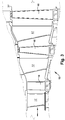
- Figures 4 and 5 are side views of a rotor blade 16 having a mid-span shrouds 51 and 51', and internal structure or configuration (which is shown via the dotted lines) according to embodiments of the present disclosure.
- Figures 6 and 7 illustrate the embodiment of the disclosure with focus on outboard region 59 of airfoil 25, as described hereinafter.
- inboard region 58 is solid or substantially solid, and outboard region 59 is hollow or “substantially" hollow.
- outboard region 59 includes a hollow region 64 that is any region or space within airfoil 25 that is hollow, such as cavities 61 and 66 formed therein (discussed below).
- inboard region includes a solid region 62 that is any region or space within airfoil 25 that is substantially solid material.
- outboard region 59 has a hollowness percentage of at least 40% and inboard region 58 has a solidness percentage of at least 60%.
- outboard region 59 may include at least two cavities 61 and 66 formed therein. As shown, the at least two cavities 61 and 66 are closed at their inboard end and in the outward orientation are open at outboard tip end 41 of airfoil 25. As illustrated in Figures 4-7 , cavities 61 and 66 that take up volume between pressure sidewall 26 and a suction sidewall 27 of airfoil 25. In accordance with non-limiting aspects of the disclosure, the at least two cavities 61 and 66 can be entirely in outboard region 59 above mid-span shrouds 51 and 51'.
- Cavities 61, 66 in outboard region 59 includes sidewalls 65 and 67, respectively and bottom walls 165 and 167, respectively.
- bottom walls 165 and 167 of cavities 61, 66 can be equi-distant into airfoil 25.
- cavities 61, 66 need not extend generally equi-distant, but can extend varying unequal distances into airfoil 25.
- bottom walls 165 and 167 of cavities 61, 66 do not need to be equidistant toward inboard region 58.
- bottom walls 165 and 167 can be generally orthogonal with the sidewalls 65 and 67, as per Figure 6 . While the Figures illustrate the bottom walls to be generally orthogonal to sidewalls, the scope of the embodiments do not restrict the bottoms walls to be generally orthogonal. As also illustrated in Figure 6 , a further non-limiting aspect of the embodiments can provide bottom walls angled from sidewalls 65 and 67, as indicated by dashed sidewalls 265 and 267.
- angles of the bottom walls 265 and 267 could be intersecting, angled extending from leading edge 20 to trailing edge 21 of airfoil 25, angled extending from trailing edge 21 to leading edge 20 of airfoil 25, angled from pressure side to suction side, angled from suction side to pressure side, and/or one bottom wall 265 and 267 angled extending from leading edge 20 to trailing edge 21 of airfoil 25 while the other bottom wall 265 and 267 is angled extending from trailing edge 21 to leading edge 20 of airfoil 25.
- non-limiting aspects of the disclosure's embodiments also include bottom walls that are equi-distant into airfoil 25 from outboard tip end 41 from the sidewalls 65 and 67, as indicated by dashed and dotted sidewalls 365 and 367 in Figure 7 .
- Other alternative arrangements of the bottom walls can incorporate orthogonal bottom walls with angled sections, curved bottom walls, and any combination of bottom walls in accordance to the non-limiting and illustrative description herein.
- the illustrated embodiments set forth two cavities 61 and 66. This configuration of two cavities is non-limiting of the embodiments and merely illustrative of the number of cavities that can be provided herein. More than two cavities 61 and 66 can be provided in airfoil 25.
- a stiffening rib 68 is formed in airfoil 25 at outboard tip end 41 between each cavity 61 and 66. Stiffening rib 68 provides enhanced structural integrity and overall strength to the airfoil, especially with the reduced mass in airfoil 25 at cavities 61 and 66 at outboard region 59. Of course, if more than two cavities are provided, more stiffening ribs 68 will be created, further enhancing integrity of the airfoil.
- cavities 61 and 66 at outboard region 59 extend a distance A from leading edge 20 towards trailing edge 21.
- distance A be no more than about 60% of airfoil 25, which should retain integrity and overall strength in airfoil 25 proximate trailing edge 21 with more solid mass compared to the cavities at area of airfoil 25 proximate leading edge 20. So, outboard region 59 has more solid material but still with a reduced weight, thereby reducing vibration and load.
- aspects of the embodiments could also include a distance A that is less than 60% of airfoil 25.
- each cavity 61 and 66 can have varying volumes. As noted above, any of the herein described bottom walls of cavities 65, 67 need not be equal. Also, noting the configuration of airfoil 25, each cavity will have a distinct periphery to confirm with the airfoil's shape and profile. For example and in a non-limiting example in Figure 6 , cavity 61 defines a first perimeter 161 of sidewall 65, and cavity 66 defines a second perimeter 166 of sidewall 65. These perimeters 161 and 166 are not necessarily equal, and thus an area of the respective cavities 61, 66 may not be equal even if the bottom walls extend to the same depth in hollow region 64.
- sidewalls of cavities 61 and 66 can vary along the depth of cavities 61 and 66.
- Figure 7 illustrates cavity 61 with two differing, non-limiting of the embodiments, sidewalls 465 and 466.
- Sidewall 465 is a roughened irregular sidewall.
- Sidewall 466 tapers increasing in width from outboard tip end 41 towards its bottom wall (omitted for ease of illustration).
- These sidewall structural arrangements are merely of multiple non-limiting sidewall structures, in whatever form that the end wall (as discussed above) takes. In other words, the geometry of cavities 61 and 66 can be different.
- the volume of cavities 61 and 66 can be unequal, as the depth of cavities 61, 66 into hollow region 64 can vary, the configurations, orientations, and angles of side and bottom wall can vary. Further peripheral area of each cavity can vary. All of these variations permit the volume of cavities 61 and 66 to not be necessarily equal. However, as can be envisioned, volumes of cavities 61 and 66 can be the same if above factors determining the cavity volume are selected to be equated in a volumetric determination.
- Blade 16 as embodied by the disclosure, provides an airfoil 25 with a reduced overall weight with cavities 61 and 66.
- the reduced overall weight should inhibit vibrations, and excitation forces on blade 16 during operation.
- Blade 16 including cavities 61 and 66 is capable of reducing vibrational forces and any loads therein over blade 16.
- a blade 16 with reduced weight provided by cavities 61 and 66 can reduce amplitudes of vibration forces (or natural frequency) so the mode shape or deflection at the natural frequency of such a blade is lower (compared to a blade without cavities 61 and 66). Thus, degradation of a blade 16 with cavities 61 and 66 may be reduced.
- Mid-span shrouds 51 and 51' may be defined broadly to include any shroud that is positioned inboard of an outboard tip end 41 of airfoil 25 and outboard of a base 121.
- the at least two cavities 61 and 66 should be entirely in outboard region 59 above mid-span shrouds 51 and 51'.
- Mid-span shrouds 51 and 51' also may be disposed within a range of radial positions on airfoil 25.
- the range of positions of mid-span shrouds 51 and 51' is defined between an inboard boundary of approximately 25% of the radial height of airfoil 25 and an outboard boundary of approximately 75% of the radial height of airfoil 25.
- the range of positions of a mid-span shrouds 51 and 51' is defined between an inboard boundary of approximately 33% of the radial height of airfoil 25 and an outboard boundary of approximately 66% of the radial height of airfoil 25.
- a mid-span shrouds 51 and 51' are positioned near the approximate radial center region of airfoil 25.
- vibratory response of turbine blades may be reduced to limit the damaging mechanical loads, which may enable lengthening of rotor blades so that greater engine efficiencies can be achieved. That is, the present disclosure teaches providing cavities 61 and 66 in turbine blades to limit the vibratory response of outboard region 59 that extends beyond the one or more mid-span shrouds 51 and 51', which thus increases the stiffness and decreases the portion of airfoil 25 outboard of mid-span shrouds 51 and 51'. In this manner, harmful vibrations can be avoided, thereby allowing for longer turbine blades.
Landscapes
- Engineering & Computer Science (AREA)
- Mechanical Engineering (AREA)
- General Engineering & Computer Science (AREA)
- Architecture (AREA)
- Turbine Rotor Nozzle Sealing (AREA)
Applications Claiming Priority (1)
| Application Number | Priority Date | Filing Date | Title |
|---|---|---|---|
| US16/851,371 US11168569B1 (en) | 2020-04-17 | 2020-04-17 | Blades having tip pockets |
Publications (3)
| Publication Number | Publication Date |
|---|---|
| EP3901413A2 true EP3901413A2 (fr) | 2021-10-27 |
| EP3901413A3 EP3901413A3 (fr) | 2021-11-10 |
| EP3901413B1 EP3901413B1 (fr) | 2023-05-31 |
Family
ID=75426402
Family Applications (1)
| Application Number | Title | Priority Date | Filing Date |
|---|---|---|---|
| EP21167073.2A Active EP3901413B1 (fr) | 2020-04-17 | 2021-04-06 | Aubes présentant des poches d'extrémité |
Country Status (5)
| Country | Link |
|---|---|
| US (1) | US11168569B1 (fr) |
| EP (1) | EP3901413B1 (fr) |
| JP (1) | JP2021173283A (fr) |
| CN (1) | CN113530610B (fr) |
| TW (1) | TW202204760A (fr) |
Cited By (2)
| Publication number | Priority date | Publication date | Assignee | Title |
|---|---|---|---|---|
| EP3981952A1 (fr) * | 2020-10-09 | 2022-04-13 | General Electric Company | Aube de turbine à anneaux de renforcement en deux parties et éléments aérodynamiques |
| WO2024208427A1 (fr) * | 2023-04-06 | 2024-10-10 | General Electric Technology Gmbh | Procédé d'amélioration d'une pale de rotor de section basse pression pour une turbine à vapeur, pale de rotor de section basse pression pour une turbine à vapeur, rotor et centrale électrique à turbine à vapeur |
Family Cites Families (22)
| Publication number | Priority date | Publication date | Assignee | Title |
|---|---|---|---|---|
| US1970435A (en) * | 1932-01-09 | 1934-08-14 | Baldwin Southwark Corp | Balanced turbine or pump runner and method of balancing |
| US4097192A (en) * | 1977-01-06 | 1978-06-27 | Curtiss-Wright Corporation | Turbine rotor and blade configuration |
| US4497613A (en) * | 1983-01-26 | 1985-02-05 | General Electric Company | Tapered core exit for gas turbine bucket |
| US6039542A (en) * | 1997-12-24 | 2000-03-21 | General Electric Company | Panel damped hybrid blade |
| EP1041247B1 (fr) * | 1999-04-01 | 2012-08-01 | General Electric Company | Aube de turbineà gaz comprenant un circuit de refroidissement ouvert |
| DE10301755A1 (de) * | 2003-01-18 | 2004-07-29 | Rolls-Royce Deutschland Ltd & Co Kg | Fanschaufel für ein Gasturbienentriebwerk |
| US7001150B2 (en) * | 2003-10-16 | 2006-02-21 | Pratt & Whitney Canada Corp. | Hollow turbine blade stiffening |
| US7413409B2 (en) * | 2006-02-14 | 2008-08-19 | General Electric Company | Turbine airfoil with weight reduction plenum |
| US7507073B2 (en) * | 2006-02-24 | 2009-03-24 | General Electric Company | Methods and apparatus for assembling a steam turbine bucket |
| US7766625B2 (en) * | 2006-03-31 | 2010-08-03 | General Electric Company | Methods and apparatus for reducing stress in turbine buckets |
| US8684692B2 (en) * | 2010-02-05 | 2014-04-01 | Siemens Energy, Inc. | Cooled snubber structure for turbine blades |
| US10215032B2 (en) * | 2012-10-29 | 2019-02-26 | General Electric Company | Blade having a hollow part span shroud |
| US20140255207A1 (en) | 2012-12-21 | 2014-09-11 | General Electric Company | Turbine rotor blades having mid-span shrouds |
| US20150176413A1 (en) * | 2013-12-20 | 2015-06-25 | General Electric Company | Snubber configurations for turbine rotor blades |
| US9822647B2 (en) * | 2014-01-29 | 2017-11-21 | General Electric Company | High chord bucket with dual part span shrouds and curved dovetail |
| EP2942481B1 (fr) * | 2014-05-07 | 2019-03-27 | Rolls-Royce Corporation | Rotor pour un moteur à turbine à gaz |
| US10287895B2 (en) * | 2015-12-28 | 2019-05-14 | General Electric Company | Midspan shrouded turbine rotor blades |
| US10221699B2 (en) * | 2015-12-28 | 2019-03-05 | General Electric Company | Shrouded turbine rotor blades |
| US10577940B2 (en) * | 2017-01-31 | 2020-03-03 | General Electric Company | Turbomachine rotor blade |
| EP3511522A1 (fr) * | 2018-01-11 | 2019-07-17 | Siemens Aktiengesellschaft | Aube de turbine à gaz et procédé de production d'une telle aube |
| EP3765713B1 (fr) * | 2018-04-13 | 2023-01-04 | Siemens Energy Global GmbH & Co. KG | Désaccordage d'aubes de turbine avec une ou plusieurs cavités |
| US11111815B2 (en) * | 2018-10-16 | 2021-09-07 | General Electric Company | Frangible gas turbine engine airfoil with fusion cavities |
-
2020
- 2020-04-17 US US16/851,371 patent/US11168569B1/en active Active
-
2021
- 2021-03-16 CN CN202110282958.4A patent/CN113530610B/zh active Active
- 2021-03-16 TW TW110109291A patent/TW202204760A/zh unknown
- 2021-03-23 JP JP2021049175A patent/JP2021173283A/ja active Pending
- 2021-04-06 EP EP21167073.2A patent/EP3901413B1/fr active Active
Cited By (3)
| Publication number | Priority date | Publication date | Assignee | Title |
|---|---|---|---|---|
| EP3981952A1 (fr) * | 2020-10-09 | 2022-04-13 | General Electric Company | Aube de turbine à anneaux de renforcement en deux parties et éléments aérodynamiques |
| US11808168B2 (en) | 2020-10-09 | 2023-11-07 | General Electric Company | Turbine bucket with dual part span shrouds and aerodynamic features |
| WO2024208427A1 (fr) * | 2023-04-06 | 2024-10-10 | General Electric Technology Gmbh | Procédé d'amélioration d'une pale de rotor de section basse pression pour une turbine à vapeur, pale de rotor de section basse pression pour une turbine à vapeur, rotor et centrale électrique à turbine à vapeur |
Also Published As
| Publication number | Publication date |
|---|---|
| US20210324744A1 (en) | 2021-10-21 |
| JP2021173283A (ja) | 2021-11-01 |
| EP3901413B1 (fr) | 2023-05-31 |
| CN113530610B (zh) | 2025-10-28 |
| CN113530610A (zh) | 2021-10-22 |
| US11168569B1 (en) | 2021-11-09 |
| EP3901413A3 (fr) | 2021-11-10 |
| TW202204760A (zh) | 2022-02-01 |
Similar Documents
| Publication | Publication Date | Title |
|---|---|---|
| US5435694A (en) | Stress relieving mount for an axial blade | |
| CN109538352B (zh) | 外鼓转子组件和燃气涡轮发动机 | |
| JP7638676B2 (ja) | ターボ機械ロータブレード用のダンパスタック | |
| US20150176413A1 (en) | Snubber configurations for turbine rotor blades | |
| CN107035422B (zh) | 带中跨护罩的涡轮转子叶片 | |
| US8371816B2 (en) | Rotor blades for turbine engines | |
| EP2000631A2 (fr) | Rotor aubagé et procédé de fabrication associé | |
| JP2015140807A (ja) | 2つの部分スパンシュラウドおよび湾曲したダブテールを有する高翼弦動翼 | |
| EP2617944A2 (fr) | Gaine d'extrémité de pales de turbomachine | |
| EP3835550B1 (fr) | Aube rotorique pour une turbomachine et turbomachine | |
| US20140255207A1 (en) | Turbine rotor blades having mid-span shrouds | |
| US11401815B2 (en) | Bladed rotor system and corresponding method of servicing | |
| EP3901413B1 (fr) | Aubes présentant des poches d'extrémité | |
| EP3885533B1 (fr) | Aube rotorique pour une turbomachine et turbomachine associée | |
| CN110778367B (zh) | 带有肋的叶片节段 | |
| US11339670B2 (en) | Part-span shroud configurations | |
| CN113530609B (zh) | 缓冲护罩构造 | |
| CN114320481B (zh) | 具有双部分跨度护罩和空气动力学特征的涡轮机桨叶 | |
| US20250179922A1 (en) | Turbine engine with a nozzle having cooling features |
Legal Events
| Date | Code | Title | Description |
|---|---|---|---|
| PUAI | Public reference made under article 153(3) epc to a published international application that has entered the european phase |
Free format text: ORIGINAL CODE: 0009012 |
|
| STAA | Information on the status of an ep patent application or granted ep patent |
Free format text: STATUS: THE APPLICATION HAS BEEN PUBLISHED |
|
| PUAL | Search report despatched |
Free format text: ORIGINAL CODE: 0009013 |
|
| AK | Designated contracting states |
Kind code of ref document: A2 Designated state(s): AL AT BE BG CH CY CZ DE DK EE ES FI FR GB GR HR HU IE IS IT LI LT LU LV MC MK MT NL NO PL PT RO RS SE SI SK SM TR |
|
| AK | Designated contracting states |
Kind code of ref document: A3 Designated state(s): AL AT BE BG CH CY CZ DE DK EE ES FI FR GB GR HR HU IE IS IT LI LT LU LV MC MK MT NL NO PL PT RO RS SE SI SK SM TR |
|
| RIC1 | Information provided on ipc code assigned before grant |
Ipc: F01D 5/22 20060101ALI20211007BHEP Ipc: F01D 5/20 20060101ALI20211007BHEP Ipc: F01D 5/18 20060101ALI20211007BHEP Ipc: F01D 5/16 20060101AFI20211007BHEP |
|
| STAA | Information on the status of an ep patent application or granted ep patent |
Free format text: STATUS: REQUEST FOR EXAMINATION WAS MADE |
|
| 17P | Request for examination filed |
Effective date: 20220506 |
|
| RBV | Designated contracting states (corrected) |
Designated state(s): AL AT BE BG CH CY CZ DE DK EE ES FI FR GB GR HR HU IE IS IT LI LT LU LV MC MK MT NL NO PL PT RO RS SE SI SK SM TR |
|
| GRAP | Despatch of communication of intention to grant a patent |
Free format text: ORIGINAL CODE: EPIDOSNIGR1 |
|
| STAA | Information on the status of an ep patent application or granted ep patent |
Free format text: STATUS: GRANT OF PATENT IS INTENDED |
|
| INTG | Intention to grant announced |
Effective date: 20220725 |
|
| GRAJ | Information related to disapproval of communication of intention to grant by the applicant or resumption of examination proceedings by the epo deleted |
Free format text: ORIGINAL CODE: EPIDOSDIGR1 |
|
| STAA | Information on the status of an ep patent application or granted ep patent |
Free format text: STATUS: REQUEST FOR EXAMINATION WAS MADE |
|
| INTC | Intention to grant announced (deleted) | ||
| GRAP | Despatch of communication of intention to grant a patent |
Free format text: ORIGINAL CODE: EPIDOSNIGR1 |
|
| STAA | Information on the status of an ep patent application or granted ep patent |
Free format text: STATUS: GRANT OF PATENT IS INTENDED |
|
| INTG | Intention to grant announced |
Effective date: 20230127 |
|
| GRAS | Grant fee paid |
Free format text: ORIGINAL CODE: EPIDOSNIGR3 |
|
| GRAA | (expected) grant |
Free format text: ORIGINAL CODE: 0009210 |
|
| STAA | Information on the status of an ep patent application or granted ep patent |
Free format text: STATUS: THE PATENT HAS BEEN GRANTED |
|
| AK | Designated contracting states |
Kind code of ref document: B1 Designated state(s): AL AT BE BG CH CY CZ DE DK EE ES FI FR GB GR HR HU IE IS IT LI LT LU LV MC MK MT NL NO PL PT RO RS SE SI SK SM TR |
|
| REG | Reference to a national code |
Ref country code: GB Ref legal event code: FG4D Ref country code: CH Ref legal event code: EP |
|
| REG | Reference to a national code |
Ref country code: AT Ref legal event code: REF Ref document number: 1571020 Country of ref document: AT Kind code of ref document: T Effective date: 20230615 Ref country code: DE Ref legal event code: R096 Ref document number: 602021002512 Country of ref document: DE |
|
| REG | Reference to a national code |
Ref country code: IE Ref legal event code: FG4D |
|
| REG | Reference to a national code |
Ref country code: NL Ref legal event code: FP |
|
| REG | Reference to a national code |
Ref country code: LT Ref legal event code: MG9D |
|
| REG | Reference to a national code |
Ref country code: AT Ref legal event code: MK05 Ref document number: 1571020 Country of ref document: AT Kind code of ref document: T Effective date: 20230531 |
|
| PG25 | Lapsed in a contracting state [announced via postgrant information from national office to epo] |
Ref country code: SE Free format text: LAPSE BECAUSE OF FAILURE TO SUBMIT A TRANSLATION OF THE DESCRIPTION OR TO PAY THE FEE WITHIN THE PRESCRIBED TIME-LIMIT Effective date: 20230531 Ref country code: NO Free format text: LAPSE BECAUSE OF FAILURE TO SUBMIT A TRANSLATION OF THE DESCRIPTION OR TO PAY THE FEE WITHIN THE PRESCRIBED TIME-LIMIT Effective date: 20230831 Ref country code: ES Free format text: LAPSE BECAUSE OF FAILURE TO SUBMIT A TRANSLATION OF THE DESCRIPTION OR TO PAY THE FEE WITHIN THE PRESCRIBED TIME-LIMIT Effective date: 20230531 Ref country code: AT Free format text: LAPSE BECAUSE OF FAILURE TO SUBMIT A TRANSLATION OF THE DESCRIPTION OR TO PAY THE FEE WITHIN THE PRESCRIBED TIME-LIMIT Effective date: 20230531 |
|
| REG | Reference to a national code |
Ref country code: DE Ref legal event code: R081 Ref document number: 602021002512 Country of ref document: DE Owner name: GENERAL ELECTRIC TECHNOLOGY GMBH, CH Free format text: FORMER OWNER: GENERAL ELECTRIC COMPANY, SCHENECTADY, NY, US |
|
| PG25 | Lapsed in a contracting state [announced via postgrant information from national office to epo] |
Ref country code: RS Free format text: LAPSE BECAUSE OF FAILURE TO SUBMIT A TRANSLATION OF THE DESCRIPTION OR TO PAY THE FEE WITHIN THE PRESCRIBED TIME-LIMIT Effective date: 20230531 Ref country code: PL Free format text: LAPSE BECAUSE OF FAILURE TO SUBMIT A TRANSLATION OF THE DESCRIPTION OR TO PAY THE FEE WITHIN THE PRESCRIBED TIME-LIMIT Effective date: 20230531 Ref country code: LV Free format text: LAPSE BECAUSE OF FAILURE TO SUBMIT A TRANSLATION OF THE DESCRIPTION OR TO PAY THE FEE WITHIN THE PRESCRIBED TIME-LIMIT Effective date: 20230531 Ref country code: LT Free format text: LAPSE BECAUSE OF FAILURE TO SUBMIT A TRANSLATION OF THE DESCRIPTION OR TO PAY THE FEE WITHIN THE PRESCRIBED TIME-LIMIT Effective date: 20230531 Ref country code: IS Free format text: LAPSE BECAUSE OF FAILURE TO SUBMIT A TRANSLATION OF THE DESCRIPTION OR TO PAY THE FEE WITHIN THE PRESCRIBED TIME-LIMIT Effective date: 20230930 Ref country code: HR Free format text: LAPSE BECAUSE OF FAILURE TO SUBMIT A TRANSLATION OF THE DESCRIPTION OR TO PAY THE FEE WITHIN THE PRESCRIBED TIME-LIMIT Effective date: 20230531 Ref country code: GR Free format text: LAPSE BECAUSE OF FAILURE TO SUBMIT A TRANSLATION OF THE DESCRIPTION OR TO PAY THE FEE WITHIN THE PRESCRIBED TIME-LIMIT Effective date: 20230901 |
|
| RAP2 | Party data changed (patent owner data changed or rights of a patent transferred) |
Owner name: GENERAL ELECTRIC TECHNOLOGY GMBH |
|
| PG25 | Lapsed in a contracting state [announced via postgrant information from national office to epo] |
Ref country code: FI Free format text: LAPSE BECAUSE OF FAILURE TO SUBMIT A TRANSLATION OF THE DESCRIPTION OR TO PAY THE FEE WITHIN THE PRESCRIBED TIME-LIMIT Effective date: 20230531 |
|
| PG25 | Lapsed in a contracting state [announced via postgrant information from national office to epo] |
Ref country code: SK Free format text: LAPSE BECAUSE OF FAILURE TO SUBMIT A TRANSLATION OF THE DESCRIPTION OR TO PAY THE FEE WITHIN THE PRESCRIBED TIME-LIMIT Effective date: 20230531 |
|
| PG25 | Lapsed in a contracting state [announced via postgrant information from national office to epo] |
Ref country code: SM Free format text: LAPSE BECAUSE OF FAILURE TO SUBMIT A TRANSLATION OF THE DESCRIPTION OR TO PAY THE FEE WITHIN THE PRESCRIBED TIME-LIMIT Effective date: 20230531 Ref country code: SK Free format text: LAPSE BECAUSE OF FAILURE TO SUBMIT A TRANSLATION OF THE DESCRIPTION OR TO PAY THE FEE WITHIN THE PRESCRIBED TIME-LIMIT Effective date: 20230531 Ref country code: RO Free format text: LAPSE BECAUSE OF FAILURE TO SUBMIT A TRANSLATION OF THE DESCRIPTION OR TO PAY THE FEE WITHIN THE PRESCRIBED TIME-LIMIT Effective date: 20230531 Ref country code: PT Free format text: LAPSE BECAUSE OF FAILURE TO SUBMIT A TRANSLATION OF THE DESCRIPTION OR TO PAY THE FEE WITHIN THE PRESCRIBED TIME-LIMIT Effective date: 20231002 Ref country code: EE Free format text: LAPSE BECAUSE OF FAILURE TO SUBMIT A TRANSLATION OF THE DESCRIPTION OR TO PAY THE FEE WITHIN THE PRESCRIBED TIME-LIMIT Effective date: 20230531 Ref country code: DK Free format text: LAPSE BECAUSE OF FAILURE TO SUBMIT A TRANSLATION OF THE DESCRIPTION OR TO PAY THE FEE WITHIN THE PRESCRIBED TIME-LIMIT Effective date: 20230531 Ref country code: CZ Free format text: LAPSE BECAUSE OF FAILURE TO SUBMIT A TRANSLATION OF THE DESCRIPTION OR TO PAY THE FEE WITHIN THE PRESCRIBED TIME-LIMIT Effective date: 20230531 |
|
| REG | Reference to a national code |
Ref country code: DE Ref legal event code: R097 Ref document number: 602021002512 Country of ref document: DE |
|
| REG | Reference to a national code |
Ref country code: GB Ref legal event code: 732E Free format text: REGISTERED BETWEEN 20240222 AND 20240228 |
|
| PLBE | No opposition filed within time limit |
Free format text: ORIGINAL CODE: 0009261 |
|
| STAA | Information on the status of an ep patent application or granted ep patent |
Free format text: STATUS: NO OPPOSITION FILED WITHIN TIME LIMIT |
|
| REG | Reference to a national code |
Ref country code: NL Ref legal event code: PD Owner name: GENERAL ELECTRIC TECHNOLOGY GMBH; CH Free format text: DETAILS ASSIGNMENT: CHANGE OF OWNER(S), ASSIGNMENT; FORMER OWNER NAME: GENERAL ELECTRIC COMPANY Effective date: 20240410 |
|
| PG25 | Lapsed in a contracting state [announced via postgrant information from national office to epo] |
Ref country code: SI Free format text: LAPSE BECAUSE OF FAILURE TO SUBMIT A TRANSLATION OF THE DESCRIPTION OR TO PAY THE FEE WITHIN THE PRESCRIBED TIME-LIMIT Effective date: 20230531 |
|
| 26N | No opposition filed |
Effective date: 20240301 |
|
| PG25 | Lapsed in a contracting state [announced via postgrant information from national office to epo] |
Ref country code: SI Free format text: LAPSE BECAUSE OF FAILURE TO SUBMIT A TRANSLATION OF THE DESCRIPTION OR TO PAY THE FEE WITHIN THE PRESCRIBED TIME-LIMIT Effective date: 20230531 |
|
| PG25 | Lapsed in a contracting state [announced via postgrant information from national office to epo] |
Ref country code: BG Free format text: LAPSE BECAUSE OF FAILURE TO SUBMIT A TRANSLATION OF THE DESCRIPTION OR TO PAY THE FEE WITHIN THE PRESCRIBED TIME-LIMIT Effective date: 20230531 |
|
| PG25 | Lapsed in a contracting state [announced via postgrant information from national office to epo] |
Ref country code: MC Free format text: LAPSE BECAUSE OF FAILURE TO SUBMIT A TRANSLATION OF THE DESCRIPTION OR TO PAY THE FEE WITHIN THE PRESCRIBED TIME-LIMIT Effective date: 20230531 |
|
| PG25 | Lapsed in a contracting state [announced via postgrant information from national office to epo] |
Ref country code: MC Free format text: LAPSE BECAUSE OF FAILURE TO SUBMIT A TRANSLATION OF THE DESCRIPTION OR TO PAY THE FEE WITHIN THE PRESCRIBED TIME-LIMIT Effective date: 20230531 Ref country code: BG Free format text: LAPSE BECAUSE OF FAILURE TO SUBMIT A TRANSLATION OF THE DESCRIPTION OR TO PAY THE FEE WITHIN THE PRESCRIBED TIME-LIMIT Effective date: 20230531 |
|
| REG | Reference to a national code |
Ref country code: CH Ref legal event code: PL |
|
| PG25 | Lapsed in a contracting state [announced via postgrant information from national office to epo] |
Ref country code: LU Free format text: LAPSE BECAUSE OF NON-PAYMENT OF DUE FEES Effective date: 20240406 |
|
| REG | Reference to a national code |
Ref country code: BE Ref legal event code: MM Effective date: 20240430 |
|
| PG25 | Lapsed in a contracting state [announced via postgrant information from national office to epo] |
Ref country code: LU Free format text: LAPSE BECAUSE OF NON-PAYMENT OF DUE FEES Effective date: 20240406 |
|
| PG25 | Lapsed in a contracting state [announced via postgrant information from national office to epo] |
Ref country code: BE Free format text: LAPSE BECAUSE OF NON-PAYMENT OF DUE FEES Effective date: 20240430 |
|
| PG25 | Lapsed in a contracting state [announced via postgrant information from national office to epo] |
Ref country code: FR Free format text: LAPSE BECAUSE OF NON-PAYMENT OF DUE FEES Effective date: 20240430 |
|
| PG25 | Lapsed in a contracting state [announced via postgrant information from national office to epo] |
Ref country code: FR Free format text: LAPSE BECAUSE OF NON-PAYMENT OF DUE FEES Effective date: 20240430 Ref country code: BE Free format text: LAPSE BECAUSE OF NON-PAYMENT OF DUE FEES Effective date: 20240430 Ref country code: CH Free format text: LAPSE BECAUSE OF NON-PAYMENT OF DUE FEES Effective date: 20240430 |
|
| PG25 | Lapsed in a contracting state [announced via postgrant information from national office to epo] |
Ref country code: IE Free format text: LAPSE BECAUSE OF NON-PAYMENT OF DUE FEES Effective date: 20240406 |
|
| PGFP | Annual fee paid to national office [announced via postgrant information from national office to epo] |
Ref country code: DE Payment date: 20250319 Year of fee payment: 5 |
|
| PG25 | Lapsed in a contracting state [announced via postgrant information from national office to epo] |
Ref country code: CY Free format text: LAPSE BECAUSE OF FAILURE TO SUBMIT A TRANSLATION OF THE DESCRIPTION OR TO PAY THE FEE WITHIN THE PRESCRIBED TIME-LIMIT; INVALID AB INITIO Effective date: 20210406 |
|
| PG25 | Lapsed in a contracting state [announced via postgrant information from national office to epo] |
Ref country code: HU Free format text: LAPSE BECAUSE OF FAILURE TO SUBMIT A TRANSLATION OF THE DESCRIPTION OR TO PAY THE FEE WITHIN THE PRESCRIBED TIME-LIMIT; INVALID AB INITIO Effective date: 20210406 |
|
| PG25 | Lapsed in a contracting state [announced via postgrant information from national office to epo] |
Ref country code: TR Free format text: LAPSE BECAUSE OF FAILURE TO SUBMIT A TRANSLATION OF THE DESCRIPTION OR TO PAY THE FEE WITHIN THE PRESCRIBED TIME-LIMIT Effective date: 20230531 |
|
| PGFP | Annual fee paid to national office [announced via postgrant information from national office to epo] |
Ref country code: GB Payment date: 20260319 Year of fee payment: 6 |
|
| PGFP | Annual fee paid to national office [announced via postgrant information from national office to epo] |
Ref country code: IT Payment date: 20260319 Year of fee payment: 6 |
|
| PGFP | Annual fee paid to national office [announced via postgrant information from national office to epo] |
Ref country code: NL Payment date: 20260319 Year of fee payment: 6 |