EP3904280A1 - Colonne d'absorption avec boite de distributeur à seuil dentelé et procédé de production d'acide nitrique - Google Patents
Colonne d'absorption avec boite de distributeur à seuil dentelé et procédé de production d'acide nitrique Download PDFInfo
- Publication number
- EP3904280A1 EP3904280A1 EP20171996.0A EP20171996A EP3904280A1 EP 3904280 A1 EP3904280 A1 EP 3904280A1 EP 20171996 A EP20171996 A EP 20171996A EP 3904280 A1 EP3904280 A1 EP 3904280A1
- Authority
- EP
- European Patent Office
- Prior art keywords
- absorption column
- nitrogen oxides
- nitric acid
- absorption
- structured packing
- Prior art date
- Legal status (The legal status is an assumption and is not a legal conclusion. Google has not performed a legal analysis and makes no representation as to the accuracy of the status listed.)
- Withdrawn
Links
Images


Classifications
-
- C—CHEMISTRY; METALLURGY
- C01—INORGANIC CHEMISTRY
- C01B—NON-METALLIC ELEMENTS; COMPOUNDS THEREOF; METALLOIDS OR COMPOUNDS THEREOF NOT COVERED BY SUBCLASS C01C
- C01B21/00—Nitrogen; Compounds thereof
- C01B21/20—Nitrogen oxides; Oxyacids of nitrogen; Salts thereof
- C01B21/38—Nitric acid
- C01B21/40—Preparation by absorption of oxides of nitrogen
-
- B—PERFORMING OPERATIONS; TRANSPORTING
- B01—PHYSICAL OR CHEMICAL PROCESSES OR APPARATUS IN GENERAL
- B01D—SEPARATION
- B01D53/00—Separation of gases or vapours; Recovering vapours of volatile solvents from gases; Chemical or biological purification of waste gases, e.g. engine exhaust gases, smoke, fumes, flue gases, aerosols
- B01D53/14—Separation of gases or vapours; Recovering vapours of volatile solvents from gases; Chemical or biological purification of waste gases, e.g. engine exhaust gases, smoke, fumes, flue gases, aerosols by absorption
- B01D53/1456—Removing acid components
-
- B—PERFORMING OPERATIONS; TRANSPORTING
- B01—PHYSICAL OR CHEMICAL PROCESSES OR APPARATUS IN GENERAL
- B01D—SEPARATION
- B01D53/00—Separation of gases or vapours; Recovering vapours of volatile solvents from gases; Chemical or biological purification of waste gases, e.g. engine exhaust gases, smoke, fumes, flue gases, aerosols
- B01D53/14—Separation of gases or vapours; Recovering vapours of volatile solvents from gases; Chemical or biological purification of waste gases, e.g. engine exhaust gases, smoke, fumes, flue gases, aerosols by absorption
- B01D53/18—Absorbing units; Liquid distributors therefor
- B01D53/185—Liquid distributors
-
- B—PERFORMING OPERATIONS; TRANSPORTING
- B01—PHYSICAL OR CHEMICAL PROCESSES OR APPARATUS IN GENERAL
- B01D—SEPARATION
- B01D53/00—Separation of gases or vapours; Recovering vapours of volatile solvents from gases; Chemical or biological purification of waste gases, e.g. engine exhaust gases, smoke, fumes, flue gases, aerosols
- B01D53/34—Chemical or biological purification of waste gases
- B01D53/46—Removing components of defined structure
- B01D53/54—Nitrogen compounds
- B01D53/56—Nitrogen oxides
-
- B—PERFORMING OPERATIONS; TRANSPORTING
- B01—PHYSICAL OR CHEMICAL PROCESSES OR APPARATUS IN GENERAL
- B01D—SEPARATION
- B01D53/00—Separation of gases or vapours; Recovering vapours of volatile solvents from gases; Chemical or biological purification of waste gases, e.g. engine exhaust gases, smoke, fumes, flue gases, aerosols
- B01D53/34—Chemical or biological purification of waste gases
- B01D53/74—General processes for purification of waste gases; Apparatus or devices specially adapted therefor
- B01D53/77—Liquid phase processes
- B01D53/78—Liquid phase processes with gas-liquid contact
-
- B—PERFORMING OPERATIONS; TRANSPORTING
- B01—PHYSICAL OR CHEMICAL PROCESSES OR APPARATUS IN GENERAL
- B01J—CHEMICAL OR PHYSICAL PROCESSES, e.g. CATALYSIS OR COLLOID CHEMISTRY; THEIR RELEVANT APPARATUS
- B01J19/00—Chemical, physical or physico-chemical processes in general; Their relevant apparatus
- B01J19/32—Packing elements in the form of grids or built-up elements for forming a unit or module inside the apparatus for mass or heat transfer
-
- C—CHEMISTRY; METALLURGY
- C01—INORGANIC CHEMISTRY
- C01B—NON-METALLIC ELEMENTS; COMPOUNDS THEREOF; METALLOIDS OR COMPOUNDS THEREOF NOT COVERED BY SUBCLASS C01C
- C01B21/00—Nitrogen; Compounds thereof
- C01B21/20—Nitrogen oxides; Oxyacids of nitrogen; Salts thereof
- C01B21/38—Nitric acid
- C01B21/46—Purification; Separation ; Stabilisation
-
- B—PERFORMING OPERATIONS; TRANSPORTING
- B01—PHYSICAL OR CHEMICAL PROCESSES OR APPARATUS IN GENERAL
- B01D—SEPARATION
- B01D2252/00—Absorbents, i.e. solvents and liquid materials for gas absorption
- B01D2252/10—Inorganic absorbents
- B01D2252/103—Water
-
- B—PERFORMING OPERATIONS; TRANSPORTING
- B01—PHYSICAL OR CHEMICAL PROCESSES OR APPARATUS IN GENERAL
- B01D—SEPARATION
- B01D53/00—Separation of gases or vapours; Recovering vapours of volatile solvents from gases; Chemical or biological purification of waste gases, e.g. engine exhaust gases, smoke, fumes, flue gases, aerosols
- B01D53/14—Separation of gases or vapours; Recovering vapours of volatile solvents from gases; Chemical or biological purification of waste gases, e.g. engine exhaust gases, smoke, fumes, flue gases, aerosols by absorption
- B01D53/18—Absorbing units; Liquid distributors therefor
-
- B—PERFORMING OPERATIONS; TRANSPORTING
- B01—PHYSICAL OR CHEMICAL PROCESSES OR APPARATUS IN GENERAL
- B01J—CHEMICAL OR PHYSICAL PROCESSES, e.g. CATALYSIS OR COLLOID CHEMISTRY; THEIR RELEVANT APPARATUS
- B01J2219/00—Chemical, physical or physico-chemical processes in general; Their relevant apparatus
- B01J2219/32—Details relating to packing elements in the form of grids or built-up elements for forming a unit of module inside the apparatus for mass or heat transfer
- B01J2219/322—Basic shape of the elements
- B01J2219/32203—Sheets
- B01J2219/32213—Plurality of essentially parallel sheets
-
- B—PERFORMING OPERATIONS; TRANSPORTING
- B01—PHYSICAL OR CHEMICAL PROCESSES OR APPARATUS IN GENERAL
- B01J—CHEMICAL OR PHYSICAL PROCESSES, e.g. CATALYSIS OR COLLOID CHEMISTRY; THEIR RELEVANT APPARATUS
- B01J2219/00—Chemical, physical or physico-chemical processes in general; Their relevant apparatus
- B01J2219/32—Details relating to packing elements in the form of grids or built-up elements for forming a unit of module inside the apparatus for mass or heat transfer
- B01J2219/322—Basic shape of the elements
- B01J2219/32203—Sheets
- B01J2219/32255—Other details of the sheets
-
- B—PERFORMING OPERATIONS; TRANSPORTING
- B01—PHYSICAL OR CHEMICAL PROCESSES OR APPARATUS IN GENERAL
- B01J—CHEMICAL OR PHYSICAL PROCESSES, e.g. CATALYSIS OR COLLOID CHEMISTRY; THEIR RELEVANT APPARATUS
- B01J2219/00—Chemical, physical or physico-chemical processes in general; Their relevant apparatus
- B01J2219/32—Details relating to packing elements in the form of grids or built-up elements for forming a unit of module inside the apparatus for mass or heat transfer
- B01J2219/324—Composition or microstructure of the elements
- B01J2219/32408—Metal
Definitions
- the present invention relates to a vertical absorption column for the production of an aqueous nitric acid solution in a process for producing nitric acid, and a process for the production of an aqueous nitric acid solution in a process for producing nitric acid. More particularly, the invention relates to a vertical absorption column and absorption process where nitrogen oxides are absorbed into water using a structured packing and a specially designed liquid distributor which is new for use in said process and absorption column.
- Nitric acid is a clear, colourless liquid with a strong odour.
- Nitric acid is produced in large quantities principally by catalytic oxidation of ammonia (Ostwald process). Ammonia is converted to nitric acid in two stages. First, ammonia is oxidized on platinum webs, producing nitric oxide and water (Formula 1): 4 NH 3 (g) + 5 O 2 (g) ⁇ 4 NO (g) + 6 H 2 O (g) (1)
- nitric oxide NO
- N 2 O 4 N 2 O 4
- the oxidation of NO to nitrogen oxides NO x (defined herein as at least comprising nitrogen dioxide NO 2 and dinitrogen tetroxide N 2 O 4 ) in nitric acid plants is currently carried out by a combination of two methods: gas cooling, which shifts the equilibrium towards NO 2 formation; and providing sufficient residence time to allow the homogeneous oxidation reaction to complete.
- NO 2 and N 2 O 4 are subsequently absorbed in water in an absorption column (also called absorption tower) to form nitric acid and nitric oxide (Formula 4 and 5) : 3 NO 2 (g) + H 2 O (I) ⁇ 2 HNO 3 (aq) + NO (g) (4) 3 N 2 O 4 (g) + H 2 O (I) ⁇ 4 HNO 3 (aq) + 2 NO (g) (5)
- the residual nitric oxide is re-oxidized in the absorption column to nitrogen oxides for further conversion to nitric acid.
- the absorption efficiency achieved is generally in the range of 98.2 to 99.3 %.
- weak nitric acid which is up to 68 % (azeotrope) is obtained.
- concentration of nitric acid can be increased up to 99 % concentrated nitric acid.
- the tail gas of the absorption column comprising the reaction product NO and unreacted NO 2 and N 2 O 4 , is usually treated in a "DeNOx unit" before being discharged into the environment. Without treatment, the tail gas gives rise to an air pollution problem and is recognized as a typical red-brown plume with a pungent odor, escaping from the top of an absorption column.
- a typical absorption tower comprises 30 to 50 horizontal plates (also called trays) and only the top 8 to 9 plates are not cooled. Cooling is required for the other trays, since all of the reactions in the process for the production of nitric acid are exothermic.
- the nitrogen oxide gases to be absorbed are sent to the absorption column counter-currently with respect to the water used for absorbing said nitrogen oxide gases.
- the nitric acid resulting from the absorption flows from the top to the bottom of the absorption column.
- the equilibrium for reaction (Formula 4), expressed in terms of the constituent partial pressures, is a function of temperature, with low temperatures favoring the formation of nitric acid.
- nitrogen dioxide rapidly forms an equilibrium mixture with its dimer, dinitrogen tetroxide, the latter being favored by low temperature and high pressure.
- the mechanisms and rate-controlling steps for acid formation change with concentration and extent of oxidation to dinitrogen tetroxide.
- N 2 O 4 is the principal route to nitric acid formation.
- a combination of mechanisms involving NO 2 , N 2 O 3 , and HNO 2 become more important.
- the absorption process involves a large number of reactive components in the gas phase and the reaction model is complicated but well-known to the skilled person.
- nitric acid by the absorption of NO 2 or N 2 O 4 in water generates nitric acid, the oxidation of which is carried out in different ways according to pressure in the absorption system.
- pressurized process gas from the ammonia combustion is fed into the lower part of the absorption columns, which is normally a tray (plate) column, and passes upwards through the absorption column counter current to process water, which is introduced at the top of the column.
- Weak/diluted acid from condensed steam present in the process gas is introduced at a suitable height of the absorption column.
- tray absorption columns the oxidation of nitrogen oxide gases proceeds in the free spaces between the trays, and the absorption proceeds on the trays.
- the trays are bubble-cap plates or perforated (sieved) plates, on which the liquid is flowed, while the gas diffuses through small holes in the sieved tray or through the bubble-caps.
- the trays in the absorption column are provided with cooling means to remove the absorption heat, especially in the lower part of the column.
- the tail gas, containing nitrogen oxides, is treated for removing or lowering the content of nitrogen oxides in the flue gas, before being passed to an expansion turbine for recovering compression energy.
- Produced nitric acid is passed to a bleacher column where dissolved NO x gases in the nitric acid are stripped.
- the principal effluent from a nitric acid plant is tail gas containing nitrogen oxides from the absorber.
- the emissions of tail gas can be minimized by optimizing process conditions, increasing the efficiency of absorption, and/or using special tail gas treatment methods.
- Investments for nitrogen oxides abatement are to a certain extent recovered by increased yield of nitric acid product.
- the requirement for reduced nitrogen oxide emissions is often compromised with economic and production requirement.
- the design of absorption columns for nitric acid production is a specialized process requiring individual tailoring on each absorption step for its cooling requirements and the air or other oxygen-containing gas volumes containing oxygen needed for oxidation of the nitrogen oxides.
- the traditional process for nitric acid production requires significant investments, and the plant makes a large footprint. Therefore, there is a desire of providing a more efficient process for producing nitric acid process compared to the traditional industry, further there is a desire to reduce the footprint of the nitric acid plant. More importantly, for environmental reasons, there is a need of a more sustainable production of nitric acid, therefore the content of nitrogen oxide gases in the tail gas should be minimized.
- WO 02/083260 A2 discloses a liquid distributor in a mass transfer column that distributes liquid to an underlying mass transfer bed containing one or more random, grid or structured packing elements.
- a serrated weir is used for distribution of liquid through downward-pointing serrations of the serrated weir into the underlying mass transfer bed.
- the use in an absorption tower in an absorption stage of the nitric acid production process is not mentioned, nor is the use of a serrated weir for distribution of liquid through upward-pointing serrations of the serrated weir into perforated trays of the liquid distributor.
- structured packing in mass transfer columns is generally known, e.g. in distillation processes, separation and some absorption processes (see for the latter e.g. Decanini et al. Ind. Eng. Chem. Res. 2000, 39, 5003-5011 ). While structured packing has advantages over conventional packing or other internal elements in a column, there are several aspects which has influenced the usage of structured packing in mass transfer processes, such as a significantly higher cost, difficulties in operating e.g. due to flooding conditions and heat control, to mention some. Structured packing has not been utilized in absorption columns in the nitric acid production process. Due to the exothermic absorption reactions the absorption heat would be very high in an absorption column equipped with structured packing, and external cooling would have to be provided, complicating the overall process.
- a vertical absorption column for the absorption of nitrogen oxides from a process gas comprising said nitrogen oxides into water, for the production of an aqueous nitric acid solution.
- the absorption column comprises:
- a structured packing in the absorption column in combination with a liquid distributor comprising a feed box having a serrated weir for distribution of liquid through upward-pointing serrations of the serrated weir into perforated trays of the liquid distributor, allows for more efficient absorption of nitrogen oxide gases, that allows in return for reducing the dimensions of the absorption column and/or reduced nitrogen oxide emissions at the outlet of the absorption tower.
- an absorption method for the production of an aqueous nitric acid solution by the absorption of nitrogen oxides from a process gas comprising nitrogen oxides into water in a vertical absorption column according to the disclosure.
- the method comprises the steps of
- a method for producing nitric acid comprises the steps of:
- a method for minimizing the amount of nitrogen oxide gases in the tail gas from a vertical absorption column according to the disclosure, in an absorption method according to disclosure or in a method according to the disclosure for producing nitric acid.
- the method comprises the steps of:
- a vertical absorption tower for the absorption of nitrogen oxides from a process gas comprising said nitrogen oxides into an aqueous solution for the production of an aqueous nitric acid solution in a process for producing nitric acid.
- a vertical absorption tower for the absorption of nitrogen oxides from a process gas comprising said nitrogen oxides into water for the production of an aqueous nitric acid solution in a process for producing nitric acid, of a structured packing in combination of a liquid distributor comprising a feed box having a serrated weir for distribution of the liquid through upward-pointing serrations of the serrated weir into perforated trays of the liquid distributor and located directly above the structured packing for distributing the liquid to the structured packing.
- a vertical absorption column for the absorption of nitrogen oxides from a process gas comprising said nitrogen oxides into water for the production of an aqueous nitric acid solution.
- the absorption column comprises:
- an aqueous solution is selected from the group consisting of water, or up to 0.5 weight% nitric acid in water, or up to 1 weight% ammonium nitrate in water or combinations thereof.
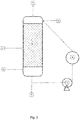
- FIG. 1 showing an absorption tower 1 according to the disclosure and comprising a structured packing 2, an inlet for the process gas, an outlet for tail gas 4, a water or nitric acid condensate or ammonium nitrate condensate inlet 5 and a nitric acid outlet 6.
- a structured packing in the absorption column in combination with a liquid distributor comprising a feed box having a serrated weir for distribution of liquid through upward-pointing serrations of the serrated weir into perforated trays of the liquid distributor, allows for more efficient absorption of nitrogen oxide gases, that allows in return for reducing the dimensions of the absorption column and/or reduced nitrogen oxides emissions at the outlet of the absorption tower.
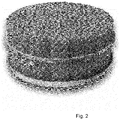
- structured packings are corrugated thin metal sheets (e.g. 1-2 mm thick), expanded metal structures, wire gauze, wherein sheets are arranged vertically and corrugations are oriented at an angle to the vertical axis ( Fig. 2 ).
- the corrugated metal sheets can be perforated and/or have textured surface.
- the material of the structured packing should withstand the corrosive environment and temperature in the absorption column over a prolonged time. Suitable materials are acid resistant stainless steels, suitable plastic materials and titanium . Further, the structured packing section should have a mechanical strength sufficient to support the weight of the packing and the liquid at the operating conditions.
- FIG. 3 is a picture showing a liquid distributor for use in combination with structured packing in a vertical absorption tower of a nitric acid production process, according to the present disclosure.
- the liquid distributor comprises the following elements: serrated weir 301, feed box 302, tray(s) 303 and grid 304.
- the liquid distributor is placed on top of structured packing in a vertical absorption tower in a column/tower of a chemical plant.
- the aqueous solution is fed to the feed box 302.
- the aqueous solution is distributed into the perforated trays through the serrated weir. There are many small holes in the bottom of the perforated trays.
- the distribution of the aqueous solution into the perforated trays is optimized, the surface area between the aqueous solution and the nitrogen oxide gas is optimized, the amount of nitrogen oxide flow to the absorption section is kept minimal, and the pressure drop is optimized.
- Figure 4 is a picture showing perforated liquid distributor trays 402, where the perforated trays 402 are placed directly on a structured packing 401.
- the liquid distributor comprises a feed box to receive the aqueous solution entering the absorption tower.
- the aqueous solution is distributed from the feed box into perforated trays.
- the feed box has upward-pointing serrated weir.
- the serrated weir may be located at one or both of the longitudinal edges of the feed box.
- the aqueous solution is distributed from the feed box through the serrations and into the perforated trays.
- the use of the serrated weir and its positioning within the distributor will further contribute to the optimization of the mass transfer between the nitrogen oxides and the aqueous solution.
- serrations of the weirs may provide the same or similar effect, such as V-shaped, castellated shape, U-shaped serrations.
- serration weir it should be understood that this does not only comprise a sawtooth-shape, but also other non-linear shapes providing the same or similar distributing effect of the aqueous solution.
- the feed box may have holes in the bottom and/or the walls for distribution of the aqueous solution to the perforated trays.
- the holes may be circular, or may have the shape of vertical or horizontal slits.
- the bottom of the feed box may be located at a higher location than the perforated trays. In another embodiment, the bottom of the feed box may be located at the same height as the bottom of the perforated trays. If the feed box comprises serrated weir, the serrations must be located higher than the upper edge of the perforated trays.
- Perforated liquid distribution trays can be placed on support grids or directly on a structured packing.
- a section of an absorption column of the prior art, having conventional trays and lacking any structured packing is replaced with a section of structured packing.
- the dimensions of the absorption column can be significantly reduced, especially the height of the column can be significantly reduced.
- the amount of nitrogen oxide gases in the tail gas is substantially reduced, which also leads to an improved yield in the nitric acid production process.
- the very large surface area of the structured packing section provides a very large gas-liquid interface, enabling high mass transfer. The large gas-liquid interface leads to a highly increased absorption efficiency of nitrogen oxide gases in the liquid compared to the conventional absorption trays.
- the large gas-liquid interface also leads to an increased rate of the desorption and oxidation of the formed nitrogen oxide gases.
- the nitrogen oxide emissions were estimated to be reduced from 5200 ppm downwards to 3200 ppm.
- the liquid distributor and the structured packing are arranged between the water inlet and an uppermost horizontal plate of the plate packing, and the liquid is water.
- the structured packing located in the uppermost part of the absorption tower.
- the heat of absorption resulting from the absorption of nitrogen oxide gases in water or dilute nitric acid is at its maximum at the bottom of an absorption tower where the entering gases are at a very high temperature and at their maximum concentration inside the tower. Consequently, the absorption of nitrogen oxide gases is at its maximum at the bottom of an absorption tower.
- the maximum heat of absorption is, therefore, generated at the bottom of the absorption tower and can only be efficiently recovered if a sufficiently cold cooling medium such as water or ammonia is used, using a heat exchange system. Sufficient cooling of the water will represent significant costs.
- maximizing the absorption at the bottom of the absorption tower implies associated costs in the energy used in cooling the water used in the heat exchange system for recovering the heat of absorption resulting from the absorption of nitrogen oxide gases.
- the concentration of nitrogen oxide gases is decreased with regard to the concentration of nitrogen oxide gases entering the absorption tower at its bottom: indeed as the nitrogen oxide gases travel from the bottom to the top of the tower, their concentration decreases as they are progressively absorbed through the horizontal plates constituting the plate packing. Therefore, the absorption of the nitrogen oxide gases at the top of the absorption tower is expected to be less efficient than at the bottom of the tower. Therefore, the use of structured packing is particularly encouraged in the uppermost part of the tower.
- the concentration of nitrogen oxide gases in the uppermost part of the absorption tower is lower than the corresponding concentration at the bottom of the absorption tower, the generated heat of absorption of the nitrogen oxide gases is lower such that a heat exchange system with, for example, water at a temperature ranging from 5 to 45 °C, will suffice for recovering the heat of absorption.
- the present inventors found that substituting the top section of a conventional absorption column lacking structured packing, with structured packing will lead to a significantly reduced concentration of nitrogen oxide gases in the tail gas, thus increasing the yield of the nitric acid production process. Given the high production volumes in a nitric acid production plant, such increased yield would constitute significant savings both in terms of more produced nitric acid, but also in terms of less need of nitrogen oxides abatement.
- the structured packing By arranging the structured packing at the top section of the absorption column, cooling by heat exchanging is not required. The process water added above the structured packing will provide sufficient cooling of the structured packing section in order for the reactions to proceed in an efficient way.
- the absorption tower may comprise fifty trays and the eight to nine uppermost trays inside the absorption tower comprise structured packing and are not cooled.
- one embodiment of the absorption column according to the present invention comprises a new design of the top section of the absorption column.
- the liquid distributor and the structured packing are arranged between a lowermost horizontal plate of the plate packing and the inlet of process gas containing nitrogen oxides, and the liquid is an aqueous solution of nitric acid.
- the concentration of nitrogen oxides gases is highest at the bottom of the column, it is particularly important to have an efficient absorption in this bottom part of the tower, in order to avoid nitrogen oxide emissions exiting the tower.
- the absorption column further comprises means for measuring the temperature of the aqueous nitric acid solution on one or more horizontal plates of the plate packing and, preferably, further comprises means for measuring the concentration of nitrogen oxide gases in the free space between two adjacent horizontal plates of the plate packing.
- the temperature means are particularly useful in order to calculate the expected heat resulting from the absorption of the nitrogen oxide gases into the absorption liquid and ensure that the temperature of the cooling medium in a heat exchange system is appropriate for recovering this heat of absorption.
- the concentration measurement of the nitrogen oxide gases shall enable the person skilled in the art to calculate the expected heat resulting from the absorption of the nitrogen oxides in the absorption liquid, and to ensure that the operating conditions of the heat exchange system for recovering the heat generated from the absorption of the nitrogen oxide gases are optimal.
- a further benefit is the fact that it is possible to tune the absorption and abatement parameters of the technology to not exceed the permitted emission levels.
- the cooling means are one or more cooling coils, comprising a cooling medium, superposed on an horizontal plate of the plate packing.
- This design and layout assures an optimum heat transfer between the absorption medium and the cooling medium.
- the cooling means are one or more cooling coils and the cooling coils are selected from bare tubes, staggered tubes, finned tubes, or any combination thereof.
- the initial temperature of the cooling medium in the cooling coils is between 5 to 45 °C. Within such a temperature range, maximum recovery of the heat generated from the absorption of nitrogen oxide gases is achieved.
- the structured packing has a surface area of at least 250 m 2 /m 3 , preferably 450 to 750 m 2 /m 3 . Maximum absorption of the nitrogen oxide gases is achieved under those conditions.
- the liquid distributor has a drip-point density of at least 30 dripping points per m 2 , preferably from 60 to 200 dripping points per m 2 . Maximum absorption of the nitrogen oxide gases is achieved under those conditions.
- the structured packing is made of acid resistant stainless steel, titanium, or other acid compatible materials. In this manner, maintenance and replacement of the structured packing is minimized through increased lifetime of the packing.
- an absorption method for the production of an aqueous nitric acid solution by the absorption of nitrogen oxides from a process gas comprising nitrogen oxides into an aqueous solution in a vertical absorption column according to the disclosure, comprising the steps of
- the absorption method includes the use of the vertical absorption column of the disclosure, using conventional steps that are also applicable to conventional columns.
- the method according to the disclosure provides for a better absorption of the nitrogen oxide gases in the aqueous solution used as the absorption liquid, and is hence more efficient.
- the aqueous solution water, such as process water, but also nitric acid or ammonium nitrate in water, can be used.
- process water is used as the aqueous solution. In this manner, the absorption of the nitrogen oxide gases will be maximized since, the water being devoid in nitrogen oxides, there will be maximum capacity for absorbing the gases prior to the equilibrium concentrations of the nitrogen oxides in the gas phase and in the water.
- the method further comprises the step of returning part of the produced nitric acid to the top of the vertical absorption column where the aqueous solution is introduced through a liquid distributor and the aqueous solution consists of water and the produced nitric acid.
- the aqueous solution is introduced through a liquid distributor and the aqueous solution consists of water and the produced nitric acid.
- both the weight of the aqueous solution hence the ratio of the weight of the nitrogen oxides over the weight of the aqueous solution, and the concentration of the produced nitric acid can be effectively controlled.
- part of the produced nitric acid is returned to the inlet 5, through a pump 7 and after having been cooled through cooler 8.
- the method further comprises the step of providing oxygen to the lower part of the vertical absorption column.
- the absorption column of the disclosure is designed to cope with the increased amount of nitrogen oxides, thus again increasing the absorption efficiency.
- the process gas comprising nitrogen oxides from an ammonia oxidation process moving in a counter-current direction to the aqueous solution is in a process gas /aqueous solution ratio of ranging from 2.5 kg gas/kg aqueous solution to 25 kg gas/kg aqueous solution.
- the pressure drop over the vertical absorption column is ranging from 20 mbar to 500 mbar, preferably from 20 mbar to 85 mbar.
- Another important parameter, besides the liquid temperature, influencing the yield of the absorption process is the pressure in the absorption column, which should preferably be between 9-11 bar (900-1100 kPa) in a dual pressure absorption column.
- the pressure drop over the structured packing with the same height, is lower than the pressure drop over the sieve tray with the liquid layer. Therefore, use of structured packing will maintain higher pressure throughout the absorption column.
- the higher pressure at the top of the column improves the absorption of nitrogen oxides and reduces their emissions.
- the concentration of the produced nitric acid increases with increased pressure in the absorption column. For production reasons, as well as operating costs, the pressure drop over the absorption column should be as low as possible.
- a method for producing nitric acid comprises the steps of:
- a method for minimizing the amount of nitrogen oxide gases in the tail gas from a vertical absorption column in the absorption method of the disclosure or in the method of the disclosure for producing nitric acid.
- the method comprises the steps of:
- a vertical absorption column for the absorption of nitrogen oxides from a process gas comprising said nitrogen oxides into an aqueous solution for the production of an aqueous nitric acid solution in a process for producing nitric acid.
- a vertical absorption tower for the absorption of nitrogen oxides from a process gas comprising said nitrogen oxides into the aqueous solution for the production of an aqueous nitric acid solution in a process for producing nitric acid, of a structured packing in combination of a liquid distributor comprising a feed box having a serrated weir for distribution of the liquid through upward-pointing serrations of the serrated weir into perforated trays of the liquid distributor and located directly above the structured packing for distributing the liquid to the structured packing.
Landscapes
- Chemical & Material Sciences (AREA)
- Engineering & Computer Science (AREA)
- Organic Chemistry (AREA)
- Chemical Kinetics & Catalysis (AREA)
- Analytical Chemistry (AREA)
- Oil, Petroleum & Natural Gas (AREA)
- General Chemical & Material Sciences (AREA)
- Environmental & Geological Engineering (AREA)
- Inorganic Chemistry (AREA)
- Health & Medical Sciences (AREA)
- Biomedical Technology (AREA)
- Thermal Sciences (AREA)
- Physics & Mathematics (AREA)
- Physical Or Chemical Processes And Apparatus (AREA)
- Gas Separation By Absorption (AREA)
- Treating Waste Gases (AREA)
Priority Applications (10)
| Application Number | Priority Date | Filing Date | Title |
|---|---|---|---|
| EP20171996.0A EP3904280A1 (fr) | 2020-04-29 | 2020-04-29 | Colonne d'absorption avec boite de distributeur à seuil dentelé et procédé de production d'acide nitrique |
| BR112022021875A BR112022021875A2 (pt) | 2020-04-29 | 2021-04-28 | Coluna de absorção compreendendo uma caixa de alimentação com uma barragem serrilhada e uma embalagem estruturada e processo para a produção de ácido nítrico |
| EP21719840.7A EP4143132B1 (fr) | 2020-04-29 | 2021-04-28 | Colonne d'absorption avec boite de distributeur à seuil dentelé et procédé de production d'acide nitrique |
| US17/919,794 US12692156B2 (en) | 2020-04-29 | 2021-04-28 | Absorption column comprising a feed box having a serrated weir and a structured packing and process for the production of nitric acid |
| ES21719840T ES2984140T3 (es) | 2020-04-29 | 2021-04-28 | Columna de absorción que comprende una caja de alimentación con un vertedero dentado y un relleno estructurado, y proceso para la producción de ácido nítrico |
| UAA202203266A UA130805C2 (uk) | 2020-04-29 | 2021-04-28 | Абсорбційна колона, що містить живильник, який має зубчастий злив і структуровану насадку, і спосіб виробництва азотної кислоти |
| CN202180025416.7A CN115335323B (zh) | 2020-04-29 | 2021-04-28 | 用于生产硝酸的包含具有锯齿状堰的进料箱和整装填料的吸收塔和方法 |
| PL21719840.7T PL4143132T3 (pl) | 2020-04-29 | 2021-04-28 | Kolumna absorpcyjna zawierająca skrzynkę podającą z ząbkowanym przelewem i strukturalne wypełnienie oraz proces produkcji kwasu azotowego |
| PCT/EP2021/061153 WO2021219733A1 (fr) | 2020-04-29 | 2021-04-28 | Colonne d'absorption comprenant une boîte d'alimentation dotée d'un déversoir dentelé et d'une garniture structurée et procédé de production d'acide nitrique |
| CONC2022/0013822A CO2022013822A2 (es) | 2020-04-29 | 2022-09-27 | Columna de absorción que comprende una caja de alimentación que tiene un vertedero dentado y un relleno estructurado y proceso para la producción de ácido nítrico |
Applications Claiming Priority (1)
| Application Number | Priority Date | Filing Date | Title |
|---|---|---|---|
| EP20171996.0A EP3904280A1 (fr) | 2020-04-29 | 2020-04-29 | Colonne d'absorption avec boite de distributeur à seuil dentelé et procédé de production d'acide nitrique |
Publications (1)
| Publication Number | Publication Date |
|---|---|
| EP3904280A1 true EP3904280A1 (fr) | 2021-11-03 |
Family
ID=70476117
Family Applications (2)
| Application Number | Title | Priority Date | Filing Date |
|---|---|---|---|
| EP20171996.0A Withdrawn EP3904280A1 (fr) | 2020-04-29 | 2020-04-29 | Colonne d'absorption avec boite de distributeur à seuil dentelé et procédé de production d'acide nitrique |
| EP21719840.7A Active EP4143132B1 (fr) | 2020-04-29 | 2021-04-28 | Colonne d'absorption avec boite de distributeur à seuil dentelé et procédé de production d'acide nitrique |
Family Applications After (1)
| Application Number | Title | Priority Date | Filing Date |
|---|---|---|---|
| EP21719840.7A Active EP4143132B1 (fr) | 2020-04-29 | 2021-04-28 | Colonne d'absorption avec boite de distributeur à seuil dentelé et procédé de production d'acide nitrique |
Country Status (9)
| Country | Link |
|---|---|
| US (1) | US12692156B2 (fr) |
| EP (2) | EP3904280A1 (fr) |
| CN (1) | CN115335323B (fr) |
| BR (1) | BR112022021875A2 (fr) |
| CO (1) | CO2022013822A2 (fr) |
| ES (1) | ES2984140T3 (fr) |
| PL (1) | PL4143132T3 (fr) |
| UA (1) | UA130805C2 (fr) |
| WO (1) | WO2021219733A1 (fr) |
Cited By (1)
| Publication number | Priority date | Publication date | Assignee | Title |
|---|---|---|---|---|
| CN121082097A (zh) * | 2025-09-04 | 2025-12-09 | 安徽红园化纤科技有限公司 | 一种化纤废气净化喷淋塔 |
Families Citing this family (2)
| Publication number | Priority date | Publication date | Assignee | Title |
|---|---|---|---|---|
| CN121666358A (zh) * | 2023-07-28 | 2026-03-13 | 斯塔米卡邦有限公司 | 向吸收段供氧的硝酸生产 |
| EP4529965A1 (fr) * | 2023-09-29 | 2025-04-02 | Yara International ASA | Plateau de tamis pour absorbeur |
Citations (7)
| Publication number | Priority date | Publication date | Assignee | Title |
|---|---|---|---|---|
| US4062928A (en) * | 1977-03-17 | 1977-12-13 | American Hydrocarbon Company | Process for the preparation of nitric acid |
| EP0256533A2 (fr) | 1986-08-13 | 1988-02-24 | Norsk Hydro A/S | Procédé et appareil de réduction de la teneur en oxydes d'azote dans les gaz effluents de la colonne d'absorption pour la fabrication d'acide nitrique |
| US4816191A (en) | 1988-01-19 | 1989-03-28 | Koch Engineering Company, Inc. | Distributor for liquid-gas contact column and method of preparation and use |
| DE4035205A1 (de) * | 1990-08-30 | 1992-05-07 | Fritz Curtius | Verfahren zur reinigung von abgasen in einem oxidierenden waschverfahren mit h202 |
| DE4034752A1 (de) * | 1990-08-30 | 1992-05-07 | Fritz Curtius | Vorrichtung zur gleichzeitigen behandlung von mehreren schadstoffen eines gasstromes |
| WO2002083260A2 (fr) | 2001-04-10 | 2002-10-24 | Koch-Glitsch, Lp | Distributeur de liquide dans une colonne de transfert de masse, procede d'installation et d'utilisation associe |
| WO2020169465A1 (fr) * | 2019-02-22 | 2020-08-27 | Yara International Asa | Tour de blanchiment et procédé de production d'acide nitrique |
Family Cites Families (22)
| Publication number | Priority date | Publication date | Assignee | Title |
|---|---|---|---|---|
| GB668293A (en) * | 1948-01-10 | 1952-03-12 | Directie Staatsmijnen Nl | Device for producing a film-like flow of a liquid |
| DE1288081B (de) * | 1965-05-07 | 1969-01-30 | Kaltenbach, Roger, Paris | Verfahren und Sättiger zur Herstellung von Ammoniumnitrat |
| US5017348A (en) * | 1989-01-26 | 1991-05-21 | Beco Engineering Company | Treatment of nitrogen oxides |
| US5167773A (en) * | 1990-01-16 | 1992-12-01 | Exxon Research And Engineering Co. | Distillation tower and sidestream stripper therefor |
| US6165435A (en) * | 1998-12-24 | 2000-12-26 | Praxair Technology, Inc. | Method and production of nitric acid |
| US6610268B1 (en) * | 1999-04-12 | 2003-08-26 | Phillips Petroleum Company | Method for the microbiological production of sulfuric acid |
| DE10336386A1 (de) | 2003-08-06 | 2004-03-04 | Basf Ag | Verfahren zur absorptiven Grundabtrennung von Acrylsäure aus dem Produktgasgemisch einer heterogen katalysierten partiellen Gasphasenoxidation von Propen zu Acrylsäure |
| CN100389103C (zh) | 2004-12-27 | 2008-05-21 | 上海焦化有限公司 | 乙酸甲酯的制备方法和具有立体传质塔板的反应精馏塔 |
| WO2008132096A1 (fr) * | 2007-04-27 | 2008-11-06 | Basf Se | Colonne comportant des fonds à courants croisés et des distributeurs de liquide |
| CN201271518Y (zh) | 2008-09-28 | 2009-07-15 | 西安市宝润实业发展有限公司 | 填料塔的汽液分布器 |
| DE102009052045A1 (de) * | 2009-11-05 | 2011-05-12 | Rvt Process Equipment Gmbh | Gewelltes Packungsgitter sowie geordnete, aus mehreren Packungsgittern aufgebaute Packung |
| CN201760118U (zh) | 2009-12-08 | 2011-03-16 | 上海同特化工科技有限公司 | 悬空溢流堰 |
| US9272908B2 (en) * | 2010-09-29 | 2016-03-01 | Linde Aktiengesellschaft | Gas stream purification apparatus |
| CN102068881A (zh) | 2010-12-27 | 2011-05-25 | 南京大学 | 同步换热式气体吸收塔和氮氧化物吸收浓缩工艺 |
| DE102012011553A1 (de) * | 2012-06-11 | 2013-12-12 | Rvt Process Equipment Gmbh | Niedriglastverteiler |
| US9295925B2 (en) * | 2012-12-11 | 2016-03-29 | Praxair Technology, Inc. | Structured packing and method |
| US9089787B2 (en) * | 2012-12-14 | 2015-07-28 | Koch-Glitsch, Lp | Distributor in mass transfer column and method of use |
| WO2016062590A1 (fr) * | 2014-10-24 | 2016-04-28 | Basf Se | Article absorbant les fluides |
| JP6356589B2 (ja) * | 2014-12-05 | 2018-07-11 | 東芝エネルギーシステムズ株式会社 | 二酸化炭素回収システムおよびその運転方法 |
| CN204485600U (zh) * | 2015-04-01 | 2015-07-22 | 薛锐 | 一种多圆孔、圆盘形板板式塔 |
| CN108097178B (zh) | 2016-11-25 | 2021-06-04 | 中国石油化工股份有限公司 | 一种齿堰式减冲均流盘 |
| CN206660895U (zh) | 2017-03-30 | 2017-11-24 | 安徽八一化工股份有限公司 | 一种尾气吸收塔 |
-
2020
- 2020-04-29 EP EP20171996.0A patent/EP3904280A1/fr not_active Withdrawn
-
2021
- 2021-04-28 EP EP21719840.7A patent/EP4143132B1/fr active Active
- 2021-04-28 US US17/919,794 patent/US12692156B2/en active Active
- 2021-04-28 PL PL21719840.7T patent/PL4143132T3/pl unknown
- 2021-04-28 WO PCT/EP2021/061153 patent/WO2021219733A1/fr not_active Ceased
- 2021-04-28 BR BR112022021875A patent/BR112022021875A2/pt unknown
- 2021-04-28 CN CN202180025416.7A patent/CN115335323B/zh active Active
- 2021-04-28 ES ES21719840T patent/ES2984140T3/es active Active
- 2021-04-28 UA UAA202203266A patent/UA130805C2/uk unknown
-
2022
- 2022-09-27 CO CONC2022/0013822A patent/CO2022013822A2/es unknown
Patent Citations (7)
| Publication number | Priority date | Publication date | Assignee | Title |
|---|---|---|---|---|
| US4062928A (en) * | 1977-03-17 | 1977-12-13 | American Hydrocarbon Company | Process for the preparation of nitric acid |
| EP0256533A2 (fr) | 1986-08-13 | 1988-02-24 | Norsk Hydro A/S | Procédé et appareil de réduction de la teneur en oxydes d'azote dans les gaz effluents de la colonne d'absorption pour la fabrication d'acide nitrique |
| US4816191A (en) | 1988-01-19 | 1989-03-28 | Koch Engineering Company, Inc. | Distributor for liquid-gas contact column and method of preparation and use |
| DE4035205A1 (de) * | 1990-08-30 | 1992-05-07 | Fritz Curtius | Verfahren zur reinigung von abgasen in einem oxidierenden waschverfahren mit h202 |
| DE4034752A1 (de) * | 1990-08-30 | 1992-05-07 | Fritz Curtius | Vorrichtung zur gleichzeitigen behandlung von mehreren schadstoffen eines gasstromes |
| WO2002083260A2 (fr) | 2001-04-10 | 2002-10-24 | Koch-Glitsch, Lp | Distributeur de liquide dans une colonne de transfert de masse, procede d'installation et d'utilisation associe |
| WO2020169465A1 (fr) * | 2019-02-22 | 2020-08-27 | Yara International Asa | Tour de blanchiment et procédé de production d'acide nitrique |
Non-Patent Citations (2)
| Title |
|---|
| DECANINI ET AL., IND. ENG. CHEM. RES., vol. 39, 2000, pages 5003 - 5011 |
| KANKANI ET AL., CHEMICAL ENGINEERING JOURNAL, vol. 278, 2015, pages 430 - 446 |
Cited By (1)
| Publication number | Priority date | Publication date | Assignee | Title |
|---|---|---|---|---|
| CN121082097A (zh) * | 2025-09-04 | 2025-12-09 | 安徽红园化纤科技有限公司 | 一种化纤废气净化喷淋塔 |
Also Published As
| Publication number | Publication date |
|---|---|
| PL4143132T3 (pl) | 2024-10-28 |
| BR112022021875A2 (pt) | 2023-01-17 |
| US12692156B2 (en) | 2026-07-28 |
| EP4143132A1 (fr) | 2023-03-08 |
| US20230202845A1 (en) | 2023-06-29 |
| CO2022013822A2 (es) | 2022-10-11 |
| CN115335323A (zh) | 2022-11-11 |
| ES2984140T3 (es) | 2024-10-29 |
| UA130805C2 (uk) | 2026-05-20 |
| EP4143132B1 (fr) | 2024-07-03 |
| CN115335323B (zh) | 2024-07-26 |
| WO2021219733A1 (fr) | 2021-11-04 |
| EP4143132C0 (fr) | 2024-07-03 |
Similar Documents
| Publication | Publication Date | Title |
|---|---|---|
| EP4143132B1 (fr) | Colonne d'absorption avec boite de distributeur à seuil dentelé et procédé de production d'acide nitrique | |
| US7687041B2 (en) | Apparatus and methods for urea production | |
| EP2595974B1 (fr) | Procédé amélioré de récupération d'anhydride maléique par utilisation de solvant organique | |
| CN1229177C (zh) | 包含至少一种有毒组分的混合物的蒸馏或反应蒸馏 | |
| US20130216461A1 (en) | Nitric acid production | |
| EP3927658B1 (fr) | Tour de blanchiment et procédé de production d'acide nitrique | |
| US4183906A (en) | Oxygen-enrichment columnar absorption process for making nitric acid | |
| CN100413833C (zh) | 环氧乙烷水合制乙二醇的方法 | |
| US20230074083A1 (en) | Absorption tower for a nitric acid plant method for producing nitric acid | |
| RU2830188C1 (ru) | Абсорбционная колонна и способ производства азотной кислоты | |
| WO2014154751A2 (fr) | Procédé de production d'acétate de vinyle | |
| EP1714959B1 (fr) | Procédé et installation de production d'urée | |
| RU66224U1 (ru) | Колонна абсорбции | |
| EP3140253B1 (fr) | Procédé et installation pour la production d'acide sulfurique | |
| US4219534A (en) | Method for removing nitrogen oxides from a gas stream | |
| RU2810315C2 (ru) | Отбелочная колонна и способ производства азотной кислоты | |
| TW202210153A (zh) | 用於進行質量傳遞過程之設備 | |
| BR112021012336B1 (pt) | Torre de branqueamento vertical, métodos de branqueamento e para produzir ácido nítrico, e, uso de uma torre de branqueamento vertical | |
| JP2004533392A (ja) | 無塩ヒドロキシルアミン水溶液の製造方法 | |
| JPH0360765B2 (fr) | ||
| US10442750B2 (en) | Method for producing vinyl acetate | |
| WO2003037790A2 (fr) | Procede et appareil de production d'acide sulfurique | |
| Mayland et al. | Nitrogen Oxides Emmision Control CDL/Vitok Enhanced Absorption Process | |
| Rehman et al. | Plant design Report on Production of 140 MTPD Conc. Nitric Acid (98%) by Recycling and Rectification | |
| JP2002241336A (ja) | アクロレインの水和方法 |
Legal Events
| Date | Code | Title | Description |
|---|---|---|---|
| PUAI | Public reference made under article 153(3) epc to a published international application that has entered the european phase |
Free format text: ORIGINAL CODE: 0009012 |
|
| STAA | Information on the status of an ep patent application or granted ep patent |
Free format text: STATUS: THE APPLICATION HAS BEEN PUBLISHED |
|
| AK | Designated contracting states |
Kind code of ref document: A1 Designated state(s): AL AT BE BG CH CY CZ DE DK EE ES FI FR GB GR HR HU IE IS IT LI LT LU LV MC MK MT NL NO PL PT RO RS SE SI SK SM TR |
|
| B565 | Issuance of search results under rule 164(2) epc |
Effective date: 20201009 |
|
| STAA | Information on the status of an ep patent application or granted ep patent |
Free format text: STATUS: THE APPLICATION IS DEEMED TO BE WITHDRAWN |
|
| 18D | Application deemed to be withdrawn |
Effective date: 20220504 |