EP3904346B1 - Neuartige verbindung und organische lichtemittierende vorrichtung damit - Google Patents
Neuartige verbindung und organische lichtemittierende vorrichtung damit Download PDFInfo
- Publication number
- EP3904346B1 EP3904346B1 EP20763578.0A EP20763578A EP3904346B1 EP 3904346 B1 EP3904346 B1 EP 3904346B1 EP 20763578 A EP20763578 A EP 20763578A EP 3904346 B1 EP3904346 B1 EP 3904346B1
- Authority
- EP
- European Patent Office
- Prior art keywords
- compound
- group
- substituted
- unsubstituted
- light emitting
- Prior art date
- Legal status (The legal status is an assumption and is not a legal conclusion. Google has not performed a legal analysis and makes no representation as to the accuracy of the status listed.)
- Active
Links
Images

Classifications
-
- C—CHEMISTRY; METALLURGY
- C07—ORGANIC CHEMISTRY
- C07F—ACYCLIC, CARBOCYCLIC OR HETEROCYCLIC COMPOUNDS CONTAINING ELEMENTS OTHER THAN CARBON, HYDROGEN, HALOGEN, OXYGEN, NITROGEN, SULFUR, SELENIUM OR TELLURIUM
- C07F7/00—Compounds containing elements of Groups 4 or 14 of the Periodic Table
- C07F7/02—Silicon compounds
- C07F7/08—Compounds having one or more C—Si linkages
- C07F7/0803—Compounds with Si-C or Si-Si linkages
- C07F7/081—Compounds with Si-C or Si-Si linkages comprising at least one atom selected from the elements N, O, halogen, S, Se or Te
- C07F7/0812—Compounds with Si-C or Si-Si linkages comprising at least one atom selected from the elements N, O, halogen, S, Se or Te comprising a heterocyclic ring
- C07F7/0816—Compounds with Si-C or Si-Si linkages comprising at least one atom selected from the elements N, O, halogen, S, Se or Te comprising a heterocyclic ring said ring comprising Si as a ring atom
-
- C—CHEMISTRY; METALLURGY
- C07—ORGANIC CHEMISTRY
- C07C—ACYCLIC OR CARBOCYCLIC COMPOUNDS
- C07C211/00—Compounds containing amino groups bound to a carbon skeleton
- C07C211/43—Compounds containing amino groups bound to a carbon skeleton having amino groups bound to carbon atoms of six-membered aromatic rings of the carbon skeleton
- C07C211/57—Compounds containing amino groups bound to a carbon skeleton having amino groups bound to carbon atoms of six-membered aromatic rings of the carbon skeleton having amino groups bound to carbon atoms of six-membered aromatic rings being part of condensed ring systems of the carbon skeleton
- C07C211/61—Compounds containing amino groups bound to a carbon skeleton having amino groups bound to carbon atoms of six-membered aromatic rings of the carbon skeleton having amino groups bound to carbon atoms of six-membered aromatic rings being part of condensed ring systems of the carbon skeleton with at least one of the condensed ring systems formed by three or more rings
-
- C—CHEMISTRY; METALLURGY
- C07—ORGANIC CHEMISTRY
- C07D—HETEROCYCLIC COMPOUNDS
- C07D209/00—Heterocyclic compounds containing five-membered rings, condensed with other rings, with one nitrogen atom as the only ring hetero atom
- C07D209/56—Ring systems containing three or more rings
- C07D209/80—[b, c]- or [b, d]-condensed
- C07D209/82—Carbazoles; Hydrogenated carbazoles
-
- C—CHEMISTRY; METALLURGY
- C07—ORGANIC CHEMISTRY
- C07D—HETEROCYCLIC COMPOUNDS
- C07D209/00—Heterocyclic compounds containing five-membered rings, condensed with other rings, with one nitrogen atom as the only ring hetero atom
- C07D209/56—Ring systems containing three or more rings
- C07D209/80—[b, c]- or [b, d]-condensed
- C07D209/82—Carbazoles; Hydrogenated carbazoles
- C07D209/86—Carbazoles; Hydrogenated carbazoles with only hydrogen atoms, hydrocarbon or substituted hydrocarbon radicals, directly attached to carbon atoms of the ring system
-
- C—CHEMISTRY; METALLURGY
- C07—ORGANIC CHEMISTRY
- C07D—HETEROCYCLIC COMPOUNDS
- C07D307/00—Heterocyclic compounds containing five-membered rings having one oxygen atom as the only ring hetero atom
- C07D307/77—Heterocyclic compounds containing five-membered rings having one oxygen atom as the only ring hetero atom ortho- or peri-condensed with carbocyclic rings or ring systems
-
- C—CHEMISTRY; METALLURGY
- C07—ORGANIC CHEMISTRY
- C07D—HETEROCYCLIC COMPOUNDS
- C07D307/00—Heterocyclic compounds containing five-membered rings having one oxygen atom as the only ring hetero atom
- C07D307/77—Heterocyclic compounds containing five-membered rings having one oxygen atom as the only ring hetero atom ortho- or peri-condensed with carbocyclic rings or ring systems
- C07D307/91—Dibenzofurans; Hydrogenated dibenzofurans
-
- C—CHEMISTRY; METALLURGY
- C07—ORGANIC CHEMISTRY
- C07D—HETEROCYCLIC COMPOUNDS
- C07D307/00—Heterocyclic compounds containing five-membered rings having one oxygen atom as the only ring hetero atom
- C07D307/77—Heterocyclic compounds containing five-membered rings having one oxygen atom as the only ring hetero atom ortho- or peri-condensed with carbocyclic rings or ring systems
- C07D307/93—Heterocyclic compounds containing five-membered rings having one oxygen atom as the only ring hetero atom ortho- or peri-condensed with carbocyclic rings or ring systems condensed with a ring other than six-membered
-
- C—CHEMISTRY; METALLURGY
- C07—ORGANIC CHEMISTRY
- C07D—HETEROCYCLIC COMPOUNDS
- C07D333/00—Heterocyclic compounds containing five-membered rings having one sulfur atom as the only ring hetero atom
- C07D333/50—Heterocyclic compounds containing five-membered rings having one sulfur atom as the only ring hetero atom condensed with carbocyclic rings or ring systems
- C07D333/78—Heterocyclic compounds containing five-membered rings having one sulfur atom as the only ring hetero atom condensed with carbocyclic rings or ring systems condensed with rings other than six-membered or with ring systems containing such rings
-
- C—CHEMISTRY; METALLURGY
- C07—ORGANIC CHEMISTRY
- C07D—HETEROCYCLIC COMPOUNDS
- C07D405/00—Heterocyclic compounds containing both one or more hetero rings having oxygen atoms as the only ring hetero atoms, and one or more rings having nitrogen as the only ring hetero atom
- C07D405/02—Heterocyclic compounds containing both one or more hetero rings having oxygen atoms as the only ring hetero atoms, and one or more rings having nitrogen as the only ring hetero atom containing two hetero rings
- C07D405/04—Heterocyclic compounds containing both one or more hetero rings having oxygen atoms as the only ring hetero atoms, and one or more rings having nitrogen as the only ring hetero atom containing two hetero rings directly linked by a ring-member-to-ring-member bond
-
- C—CHEMISTRY; METALLURGY
- C07—ORGANIC CHEMISTRY
- C07D—HETEROCYCLIC COMPOUNDS
- C07D493/00—Heterocyclic compounds containing oxygen atoms as the only ring hetero atoms in the condensed system
- C07D493/02—Heterocyclic compounds containing oxygen atoms as the only ring hetero atoms in the condensed system in which the condensed system contains two hetero rings
- C07D493/04—Ortho-condensed systems
-
- C—CHEMISTRY; METALLURGY
- C07—ORGANIC CHEMISTRY
- C07D—HETEROCYCLIC COMPOUNDS
- C07D495/00—Heterocyclic compounds containing in the condensed system at least one hetero ring having sulfur atoms as the only ring hetero atoms
- C07D495/02—Heterocyclic compounds containing in the condensed system at least one hetero ring having sulfur atoms as the only ring hetero atoms in which the condensed system contains two hetero rings
- C07D495/04—Ortho-condensed systems
-
- C—CHEMISTRY; METALLURGY
- C07—ORGANIC CHEMISTRY
- C07F—ACYCLIC, CARBOCYCLIC OR HETEROCYCLIC COMPOUNDS CONTAINING ELEMENTS OTHER THAN CARBON, HYDROGEN, HALOGEN, OXYGEN, NITROGEN, SULFUR, SELENIUM OR TELLURIUM
- C07F7/00—Compounds containing elements of Groups 4 or 14 of the Periodic Table
- C07F7/02—Silicon compounds
- C07F7/08—Compounds having one or more C—Si linkages
- C07F7/0803—Compounds with Si-C or Si-Si linkages
- C07F7/081—Compounds with Si-C or Si-Si linkages comprising at least one atom selected from the elements N, O, halogen, S, Se or Te
- C07F7/0812—Compounds with Si-C or Si-Si linkages comprising at least one atom selected from the elements N, O, halogen, S, Se or Te comprising a heterocyclic ring
-
- C—CHEMISTRY; METALLURGY
- C09—DYES; PAINTS; POLISHES; NATURAL RESINS; ADHESIVES; COMPOSITIONS NOT OTHERWISE PROVIDED FOR; APPLICATIONS OF MATERIALS NOT OTHERWISE PROVIDED FOR
- C09K—MATERIALS FOR MISCELLANEOUS APPLICATIONS, NOT PROVIDED FOR ELSEWHERE
- C09K11/00—Luminescent materials, e.g. electroluminescent or chemiluminescent
- C09K11/06—Luminescent materials, e.g. electroluminescent or chemiluminescent containing organic luminescent materials
-
- H—ELECTRICITY
- H10—SEMICONDUCTOR DEVICES; ELECTRIC SOLID-STATE DEVICES NOT OTHERWISE PROVIDED FOR
- H10K—ORGANIC ELECTRIC SOLID-STATE DEVICES
- H10K85/00—Organic materials used in the body or electrodes of devices covered by this subclass
- H10K85/40—Organosilicon compounds, e.g. TIPS pentacene
-
- H—ELECTRICITY
- H10—SEMICONDUCTOR DEVICES; ELECTRIC SOLID-STATE DEVICES NOT OTHERWISE PROVIDED FOR
- H10K—ORGANIC ELECTRIC SOLID-STATE DEVICES
- H10K85/00—Organic materials used in the body or electrodes of devices covered by this subclass
- H10K85/60—Organic compounds having low molecular weight
- H10K85/631—Amine compounds having at least two aryl rest on at least one amine-nitrogen atom, e.g. triphenylamine
-
- H—ELECTRICITY
- H10—SEMICONDUCTOR DEVICES; ELECTRIC SOLID-STATE DEVICES NOT OTHERWISE PROVIDED FOR
- H10K—ORGANIC ELECTRIC SOLID-STATE DEVICES
- H10K85/00—Organic materials used in the body or electrodes of devices covered by this subclass
- H10K85/60—Organic compounds having low molecular weight
- H10K85/631—Amine compounds having at least two aryl rest on at least one amine-nitrogen atom, e.g. triphenylamine
- H10K85/633—Amine compounds having at least two aryl rest on at least one amine-nitrogen atom, e.g. triphenylamine comprising polycyclic condensed aromatic hydrocarbons as substituents on the nitrogen atom
-
- H—ELECTRICITY
- H10—SEMICONDUCTOR DEVICES; ELECTRIC SOLID-STATE DEVICES NOT OTHERWISE PROVIDED FOR
- H10K—ORGANIC ELECTRIC SOLID-STATE DEVICES
- H10K85/00—Organic materials used in the body or electrodes of devices covered by this subclass
- H10K85/60—Organic compounds having low molecular weight
- H10K85/631—Amine compounds having at least two aryl rest on at least one amine-nitrogen atom, e.g. triphenylamine
- H10K85/636—Amine compounds having at least two aryl rest on at least one amine-nitrogen atom, e.g. triphenylamine comprising heteroaromatic hydrocarbons as substituents on the nitrogen atom
-
- H—ELECTRICITY
- H10—SEMICONDUCTOR DEVICES; ELECTRIC SOLID-STATE DEVICES NOT OTHERWISE PROVIDED FOR
- H10K—ORGANIC ELECTRIC SOLID-STATE DEVICES
- H10K85/00—Organic materials used in the body or electrodes of devices covered by this subclass
- H10K85/60—Organic compounds having low molecular weight
- H10K85/649—Aromatic compounds comprising a hetero atom
- H10K85/657—Polycyclic condensed heteroaromatic hydrocarbons
-
- H—ELECTRICITY
- H10—SEMICONDUCTOR DEVICES; ELECTRIC SOLID-STATE DEVICES NOT OTHERWISE PROVIDED FOR
- H10K—ORGANIC ELECTRIC SOLID-STATE DEVICES
- H10K85/00—Organic materials used in the body or electrodes of devices covered by this subclass
- H10K85/60—Organic compounds having low molecular weight
- H10K85/649—Aromatic compounds comprising a hetero atom
- H10K85/657—Polycyclic condensed heteroaromatic hydrocarbons
- H10K85/6572—Polycyclic condensed heteroaromatic hydrocarbons comprising only nitrogen in the heteroaromatic polycondensed ring system, e.g. phenanthroline or carbazole
-
- H—ELECTRICITY
- H10—SEMICONDUCTOR DEVICES; ELECTRIC SOLID-STATE DEVICES NOT OTHERWISE PROVIDED FOR
- H10K—ORGANIC ELECTRIC SOLID-STATE DEVICES
- H10K85/00—Organic materials used in the body or electrodes of devices covered by this subclass
- H10K85/60—Organic compounds having low molecular weight
- H10K85/649—Aromatic compounds comprising a hetero atom
- H10K85/657—Polycyclic condensed heteroaromatic hydrocarbons
- H10K85/6576—Polycyclic condensed heteroaromatic hydrocarbons comprising only sulfur in the heteroaromatic polycondensed ring system, e.g. benzothiophene
-
- C—CHEMISTRY; METALLURGY
- C07—ORGANIC CHEMISTRY
- C07C—ACYCLIC OR CARBOCYCLIC COMPOUNDS
- C07C2603/00—Systems containing at least three condensed rings
- C07C2603/02—Ortho- or ortho- and peri-condensed systems
- C07C2603/52—Ortho- or ortho- and peri-condensed systems containing five condensed rings
-
- C—CHEMISTRY; METALLURGY
- C09—DYES; PAINTS; POLISHES; NATURAL RESINS; ADHESIVES; COMPOSITIONS NOT OTHERWISE PROVIDED FOR; APPLICATIONS OF MATERIALS NOT OTHERWISE PROVIDED FOR
- C09K—MATERIALS FOR MISCELLANEOUS APPLICATIONS, NOT PROVIDED FOR ELSEWHERE
- C09K2211/00—Chemical nature of organic luminescent or tenebrescent compounds
- C09K2211/10—Non-macromolecular compounds
- C09K2211/1003—Carbocyclic compounds
- C09K2211/1007—Non-condensed systems
-
- C—CHEMISTRY; METALLURGY
- C09—DYES; PAINTS; POLISHES; NATURAL RESINS; ADHESIVES; COMPOSITIONS NOT OTHERWISE PROVIDED FOR; APPLICATIONS OF MATERIALS NOT OTHERWISE PROVIDED FOR
- C09K—MATERIALS FOR MISCELLANEOUS APPLICATIONS, NOT PROVIDED FOR ELSEWHERE
- C09K2211/00—Chemical nature of organic luminescent or tenebrescent compounds
- C09K2211/10—Non-macromolecular compounds
- C09K2211/1003—Carbocyclic compounds
- C09K2211/1011—Condensed systems
-
- C—CHEMISTRY; METALLURGY
- C09—DYES; PAINTS; POLISHES; NATURAL RESINS; ADHESIVES; COMPOSITIONS NOT OTHERWISE PROVIDED FOR; APPLICATIONS OF MATERIALS NOT OTHERWISE PROVIDED FOR
- C09K—MATERIALS FOR MISCELLANEOUS APPLICATIONS, NOT PROVIDED FOR ELSEWHERE
- C09K2211/00—Chemical nature of organic luminescent or tenebrescent compounds
- C09K2211/10—Non-macromolecular compounds
- C09K2211/1003—Carbocyclic compounds
- C09K2211/1014—Carbocyclic compounds bridged by heteroatoms, e.g. N, P, Si or B
-
- C—CHEMISTRY; METALLURGY
- C09—DYES; PAINTS; POLISHES; NATURAL RESINS; ADHESIVES; COMPOSITIONS NOT OTHERWISE PROVIDED FOR; APPLICATIONS OF MATERIALS NOT OTHERWISE PROVIDED FOR
- C09K—MATERIALS FOR MISCELLANEOUS APPLICATIONS, NOT PROVIDED FOR ELSEWHERE
- C09K2211/00—Chemical nature of organic luminescent or tenebrescent compounds
- C09K2211/10—Non-macromolecular compounds
- C09K2211/1018—Heterocyclic compounds
-
- H—ELECTRICITY
- H10—SEMICONDUCTOR DEVICES; ELECTRIC SOLID-STATE DEVICES NOT OTHERWISE PROVIDED FOR
- H10K—ORGANIC ELECTRIC SOLID-STATE DEVICES
- H10K50/00—Organic light-emitting devices
- H10K50/10—OLEDs or polymer light-emitting diodes [PLED]
- H10K50/11—OLEDs or polymer light-emitting diodes [PLED] characterised by the electroluminescent [EL] layers
-
- H—ELECTRICITY
- H10—SEMICONDUCTOR DEVICES; ELECTRIC SOLID-STATE DEVICES NOT OTHERWISE PROVIDED FOR
- H10K—ORGANIC ELECTRIC SOLID-STATE DEVICES
- H10K85/00—Organic materials used in the body or electrodes of devices covered by this subclass
- H10K85/60—Organic compounds having low molecular weight
- H10K85/615—Polycyclic condensed aromatic hydrocarbons, e.g. anthracene
- H10K85/623—Polycyclic condensed aromatic hydrocarbons, e.g. anthracene containing five rings, e.g. pentacene
-
- H—ELECTRICITY
- H10—SEMICONDUCTOR DEVICES; ELECTRIC SOLID-STATE DEVICES NOT OTHERWISE PROVIDED FOR
- H10K—ORGANIC ELECTRIC SOLID-STATE DEVICES
- H10K85/00—Organic materials used in the body or electrodes of devices covered by this subclass
- H10K85/60—Organic compounds having low molecular weight
- H10K85/649—Aromatic compounds comprising a hetero atom
- H10K85/657—Polycyclic condensed heteroaromatic hydrocarbons
- H10K85/6574—Polycyclic condensed heteroaromatic hydrocarbons comprising only oxygen in the heteroaromatic polycondensed ring system, e.g. cumarine dyes
Definitions
- the present disclosure relates to a novel compound and an organic light emitting device comprising the same.
- an organic light emitting phenomenon refers to a phenomenon where electric energy is converted into light energy by using an organic material.
- the organic light emitting device using the organic light emitting phenomenon has characteristics such as a wide viewing angle, an excellent contrast, a fast response time, an excellent luminance, driving voltage and response speed, and thus many studies have proceeded.
- the organic light emitting device generally has a structure which comprises an anode, a cathode, and an organic material layer interposed between the anode and the cathode.
- the organic material layer frequently has a multilayered structure that comprises different materials in order to enhance efficiency and stability of the organic light emitting device, and for example, the organic material layer may be formed of a hole injection layer, a hole transport layer, a light emitting layer, an electron transport layer, an electron injection layer and the like.
- the holes are injected from an anode into the organic material layer and the electrons are injected from the cathode into the organic material layer, and when the injected holes and electrons meet each other, an exciton is formed, and light is emitted when the exciton falls to a ground state again.
- Patent Literature 2 discloses the following compounds:
- the present disclosure provides novel materials for organic light emitting devices that can be used for an organic light emitting device and simultaneously, can be deposited by a solution process.
- an organic light emitting device comprising: a first electrode; a second electrode that is provided opposite to the first electrode; and a light emitting layer that is provided between the first electrode and the second electrode, wherein the light emitting layer includes the above-mentioned compound represented by Chemical Formula 1.
- the above-mentioned compound represented by the Chemical Formula 1 can be used as a material of an organic material layer of an organic light emitting device, can be subjected to a solution process, and can improve the efficiency, achieve low driving voltage and/or improve lifetime characteristics in the organic light emitting device.
- the notation means a bond linked to another substituent group
- Ph means a phenyl group
- D means deuterium
- t-Bu means tert-butyl group.
- substituted or unsubstituted means being unsubstituted or substituted with one or more substituents selected from the group consisting of deuterium; a halogen group; a cyano group; a nitro group; a hydroxy group; a carbonyl group; an ester group; an imide group; an amino group; a phosphine oxide group; an alkoxy group; an aryloxy group; an alkylthioxy group; an arylthioxy group; an alkylsulfoxy group; an arylsulfoxy group; a silyl group; a boron group; an alkyl group; a cycloalkyl group; an alkenyl group; an aryl group; an aralkyl group; an aralkenyl group; an alkylaryl group; an alkylamine group; an aralkylamine group; a heteroarylamine group; an arylamine group; an arylamine group; an
- a substituent in which two or more substituents are connected may be a biphenyl group.
- a biphenyl group may be an aryl group, or it may also be interpreted as a substituent in which two phenyl groups are connected.
- the carbon number of a carbonyl group is not particularly limited, but is preferably 1 to 40.
- the carbonyl group may be a group having the following structural formulas, but is not limited thereto.
- an ester group may have a structure in which oxygen of the ester group may be substituted by a straight-chain, branched-chain, or cyclic alkyl group having 1 to 25 carbon atoms, or an aryl group having 6 to 25 carbon atoms.
- the ester group may be a gruop having the following structural formulas, but is not limited thereto.
- the carbon number of an imide group is not particularly limited, but is preferably 1 to 25.
- the imide group may be a group having the following structural formulas, but is not limited thereto.
- a silyl group specifically includes a trimethylsilyl group, a triethylsilyl group, a t-butyldimethylsilyl group, a vinyldimethylsilyl group, a propyldimethylsilyl group, a triphenylsilyl group, a diphenylsilyl group, a phenylsilyl group and the like, but is not limited thereto.
- a boron group specifically includes a trimethylboron group, a triethylboron group, a t-butyldimethylboron group, a triphenylboron group, and a phenylboron group, but is not limited thereto.
- examples of a halogen group include fluorine, chlorine, bromine, or iodine.
- the alkyl group may be straight-chain or branched-chain, and the carbon number thereof is not particularly limited, but is preferably 1 to 40. According to one embodiment, the carbon number of the alkyl group is 1 to 20. According to another embodiment, the carbon number of the alkyl group is 1 to 10. According to another embodiment, the carbon number of the alkyl group is 1 to 6.
- alkyl group examples include methyl, ethyl, propyl, n-propyl, isopropyl, butyl, n-butyl, isobutyl, tert-butyl, sec-butyl, 1-methyl-butyl, 1-ethyl-butyl, pentyl, n-pentyl, isopentyl, neopentyl, tert-pentyl, hexyl, n-hexyl, 1-methylpentyl, 2-methylpentyl, 4-methyl-2-pentyl, 3,3-dimethylbutyl, 2-ethylbutyl, heptyl, n-heptyl, 1-methylhexyl, cyclopentylmethyl, cyclohexylmethyl, octyl, n-octyl, tert-octyl, 1-methylheptyl, 2-ethylhexyl, 2-
- the alkenyl group may be straight-chain or branched-chain, and the carbon number thereof is not particularly limited, but is preferably 2 to 40. According to one embodiment, the carbon number of the alkenyl group is 2 to 20. According to another embodiment, the carbon number of the alkenyl group is 2 to 10. According to still another embodiment, the carbon number of the alkenyl group is 2 to 6.
- Specific examples thereof include vinyl, 1-propenyl, isopropenyl, 1-butenyl, 2-butenyl, 3-butenyl, 1-pentenyl, 2-pentenyl, 3-pentenyl, 3-methyl-1-butenyl, 1,3-butadienyl, allyl, 1-phenylvinyl-1-yl, 2-phenylvinyl-1-yl, 2,2-diphenylvinyl-1-yl, 2-phenyl-2-(naphthyl-1-yl)vinyl-1-yl, 2,2-bis(diphenyl-1-yl)vinyl-1-yl, a stilbenyl group, a styrenyl group, and the like, but are not limited thereto.
- a cycloalkyl group is not particularly limited, but the carbon number thereof is preferably 3 to 60. According to one embodiment, the carbon number of the cycloalkyl group is 3 to 30. According to another embodiment, the carbon number of the cycloalkyl group is 3 to 20. According to still another embodiment, the carbon number of the cycloalkyl group is 3 to 6.
- cyclopropyl examples thereof include cyclopropyl, cyclobutyl, cyclopentyl, 3-methylcyclopentyl, 2,3-dimethylcyclopentyl, cyclohexyl, 3-methylcyclohexyl, 4-methylcyclohexyl, 2,3-dimethylcyclohexyl, 3,4,5-trimethylcyclohexyl, 4-tert-butylcyclohexyl, cycloheptyl, cyclooctyl, and the like, but are not limited thereto.
- an aralkyl group is not particularly limited, but the carbon number thereof is preferably 7 to 60. According to one embodiment, the carbon number of the aralkyl group is 7 to 30 . According to another embodiment, the carbon number of the aralkyl group is 7 to 20. Specific examples thereof include phenylmethyl, 2-methylphenylmethyl, 3-methylphenylmethyl, 4-methylphenylmethyl, 2-tert-butylphenylmethyl, 3-tert-butylphenylmethyl, 4-tert-butylphenylmethyl, and the like, but are not limited thereto.
- an aryl group is not particularly limited, but the carbon number thereof is preferably 6 to 60, and it may be a monocyclic aryl group or a polycyclic aryl group. According to one embodiment, the carbon number of the aryl group is 6 to 30. According to one embodiment, the carbon number of the aryl group is 6 to 20.
- the aryl group may be a phenyl group, a biphenyl group, a terphenyl group or the like as the monocyclic aryl group, but is not limited thereto.
- the polycyclic aryl group includes a naphthyl group, an anthracenyl group, a phenanthrenyl group, a pyrenyl group, a perylenyl group, a chrysenyl group, a fluorenyl group or the like, but is not limited thereto.
- the fluorenyl group may be substituted, and two substituents may be linked with each other to form a spiro structure.
- the fluorenyl group is substituted, and the like can be formed.
- the structure is not limited thereto.
- a heteroaryl group is a heteroaryl group containing one or more of O, N, Si and S as a heteroatom, and the carbon number thereof is not particularly limited, but is preferably 2 to 60.
- the heteroaryl group include a xanthene group, a thioxanthene group, a thiophene group, a furan group, a pyrrole group, an imidazole group, a thiazole group, an oxazol group, an oxadiazol group, a triazol group, a pyridyl group, a bipyridyl group, a pyrimidyl group, a triazine group, an acridyl group, a pyridazine group, a pyrazinyl group, a quinolinyl group, a quinazoline group, a quinoxalinyl group, a phthalazinyl group, a pyrid
- the aryl group in the aralkyl group, the aralkenyl group, the alkylaryl group, the arylamine group and the arylsily group is the same as the aforementioned examples of the aryl group.
- the alkyl group in the aralkyl group, the alkylaryl group and the alkylamine group is the same as the aforementioned examples of the alkyl group.
- the heteroaryl in the heteroarylamine can apply the aforementioned description of the heteroaryl group.
- the alkenyl group in the aralkenyl group is the same as the aforementioned examples of the alkenyl group.
- the aforementioned description of the aryl group may be applied except that the arylene is a divalent group.
- the aforementioned description of the heteroaryl group can be applied except that the heteroarylene is a divalent group.
- the aforementioned description of the aryl group or cycloalkyl group can be applied except that the hydrocarbon ring is not a monovalent group but formed by combining two substituent groups.
- the aforementioned description of the heteroaryl group can be applied, except that the heterocycle is not a monovalent group but formed by combining two substituent groups.
- an aromatic ring means a condensed monocyclic or condensed polycyclic ring in which the entire molecule has aromaticity while containing only carbon as a ring-forming atom.
- the carbon number of the aromatic ring is 6 to 60, or 6 to 30, or 6 to 20, but is not limited thereto.
- the aromatic ring may include a benzene ring, a naphthalene ring, an anthracene ring, a phenanthrene ring, a pyrene ring, and the like, but is not limited thereto.
- a non-aromatic ring means a condensed monocyclic or condensed polycyclic ring in which the entire molecule has no aromaticity while containing only carbon as a ring-forming atom.
- the carbon number of the non-aromatic ring is 6 to 60, or 6 to 30, or 6 to 20, but is not limited thereto.
- the non-aromatic ring may include an indene ring, a fluorene ring, and the like, but is not limited thereto. At this time, the indene ring, the fluorene ring, and the like may be substituted or unsubstituted, and as for the type of the substituent, refer to those described above.
- the heterocyclic ring means a condensed monocyclic or condensed polycyclic ring in which the entire molecule has aromaticity or does not have aromaticity, while containing one or more heteroatoms selected among O, N, Si and S in addition to carbon as a ring-forming atom.
- a divalent non-aromatic condensed polycyclic group means a divalent group having the same structure as the above-mentioned monovalent non-aromatic hetero-condensed polycyclic group.
- the carbon number of the heterocyclic ring is 2 to 60, or 2 to 30, or 2 to 20, but is not limited thereto.
- the heterocyclic ring includes a benzofuran ring, a benzothiophene ring, a benzosilole ring, a dibenzofuran ring, a dibenzothiophene ring, a dibenzosilole ring, a silole ring, and the like, but is not limited thereto.
- the benzosilole ring, the dibenzosilole ring, etc. may be substituted or unsubstituted, and as for the type of the substituent, refer to those described above.
- the compound represented by Chemical Formula 1 has a structure in which the fluorene-based core contains 'Z 1 ' and 'LX-Z 2 ' as substituents, and 'Z 1 ' and 'LX-Z 2 ' are different from each other and are not connected to each other, as described in detail below.
- the compound having a structure in which the substituents of the fluorene-based core are identical to each other, or the substituents are connected to each other has a high crystallinity, which cause the problem of low solubility in an organic solvent
- the compound represented by Chemical Formula 1 has a low crystallinity compared to the above, and exhibits increased solubility in an organic solvent used in a solution process, and thus, is preferably used in a solution process during the manufacture of an organic light emitting device.
- At least one of the two R 1 s or the two R 2 s are joined together to form a C 6-60 alicyclic ring; or a C 2-60 heterocycle containing any one or more heteroatoms selected from the group consisting of N, O, S and Si, the rest are hydrogen, or R 1 or R 2 are joined together to form a C 6-60 aromatic ring; a C 6-60 alicyclic ring; or a C 2-60 heterocyclic ring containing any one or more heteroatoms selected from the group consisting of N, O, S and Si.
- the C 6-60 aromatic ring, the C 6-60 alicyclic ring and the C 2-60 heterocyclic ring may be each independently substituted with a substituent group selected from the group consisting of hydrogen, C 1-10 alkyl and C 6-20 aryl.
- At least one of the two R 1 s or the two R 2 s are joined together, together with the carbon atoms to which R 1 or R 2 is attached, to form any one of the structures represented by the following Chemical Formulas 2d to 2g, the rest are hydrogen, or are joined together to form any one of the structures represented by the following Chemical Formulas 2a to 2g: in the Chemical Formulas 2a to 2g,
- R 1 and R 2 are joined together to form a structure represented by Chemical Formula 2d, and the rest are hydrogen or are joined together to form a structure represented by Chemical Formula 2a or 2d.
- one of Y 1 and Y 2 is a single bond, and the other one is O, S, C(methyl) 2 , or Si(methyl) 2
- one of Y 3 and Y 4 is a single bond, and the other one is O, S, C(methyl) 2 , or Si(methyl) 2 .
- Z 1 is phenyl or biphenylyl, wherein Z 1 is unsubstituted, or substituted with 1 to 5 substituents each independently selected from the group consisting of deuterium, halogen, cyano, C 1-10 alkyl, C 3-10 cycloalkyl, Si(C 1-10 alkyl) 3 and Si(C 6-20 aryl) 3 .
- Z 1 is phenyl or biphenylyl, wherein Z 1 is unsubstituted, or substituted with 1 to 5 substituents each independently selected from the group consisting of deuterium, halogen, cyano, methyl, ethyl, propyl, tert-butyl, cyclopentyl, Si(methyl) 3 and Si(phenyl) 3 .
- Z 1 is any one selected from the group consisting of:
- L is phenylene unsubstituted or substituted with C 1-10 alkyl. More preferably, L is phenylene. Most preferably, L is 1,4-phenylene.
- Z 2 to Z 5 are each independently C 1-4 alkyl; C 6-20 aryl; or C 7-20 aralkyl, wherein Z 2 to Z 5 are unsubstituted or substituted with C 1-10 alkyl or Si(C 1-10 alkyl) 3 .
- Z 2 and Z 3 are each independently C 1-4 alkyl; C 6-20 aryl unsubstituted or substituted with C 1-10 alkyl; or C 7-20 aralkyl unsubstituted or substituted with C 1-10 alkyl.
- Z 4 and Z 5 are each independently C 1-4 alkyl; or C 6-60 aryl unsubstituted or substituted with C 1-10 alkyl.
- the L and Z 2 ; Z 2 and Z 3 ; or Z 4 and Z 5 may be connected to each other to form a 5-membered-heterocyclic ring' means that L and Z 2 , Z 2 and Z 3 , or Z 4 and Z 5 may be connected to each other to form a 5-membered-heterocyclic ring containing O, S, N, or Si, which is a hetero atom of X.
- the above-mentioned compound means not only a structure represented by the following Chemical Formula 3a but also a structure of the following Chemical Formula 3b wherein L and Z 2 are connected to each other to form a 5-membered-heterocyclic ring containing heteroatom O of X.
- the above-mentioned compound means not only a structure represented by the following Chemical Formula 3c, but also a structure of the following Chemical Formula 3d wherein Z 2 and Z 3 are connected to each other to form a 5-membered-heterocyclic ring containing heteroatom N of X.
- the above-mentioned compound means not only a structure represented by the following Chemical Formula 3e, but also a structure of the following Chemical Formula 3f wherein Z 4 and Z 5 are connected to each other to form a 5-membered-heterocyclic ring containing heteroatom Si of X.
- L-X-Z 2 is any one selected from the group consisting of: wherein, R, R' and R" are each independently hydrogen, methyl, tert-butyl, or Si(methyl) 3 .
- L 1 and L 2 are a single bond.
- Ar 1 to Ar 4 are each independently phenyl, naphthyl, biphenylyl, or dibenzofuranyl, wherein Ar 1 to Ar 4 are unsubstituted, or substituted with 1 to 5 substituents each independently selected from the group consisting of deuterium, halogen, C 1-10 alkyl and -Si(C 1-10 alkyl) 3 .
- Ar 1 to Ar 4 are each independently phenyl, naphthyl, biphenylyl, or dibenzofuranyl, wherein Ar 1 to Ar 4 are unsubstituted, or substituted with 1 to 5 substituents each independently selected from the group consisting of deuterium, halogen, methyl, tert-butyl and Si(methyl) 3 .
- Ar 1 to Ar 4 are each independently one selected from the group consisting of:
- Ar 1 and Ar 4 are identical to each other, and Ar 2 and Ar 3 are identical to each other.
- the compound represented by Chemical Formula 1 is represented by any one of the following Chemical Formulas 2-1 to 2-10: in the Chemical Formulas 2-1 to 2-10,
- the compound represented by Chemical Formula 1 may be selected from the group consisting of: wherein, the definition of each substituent is the same as described above.
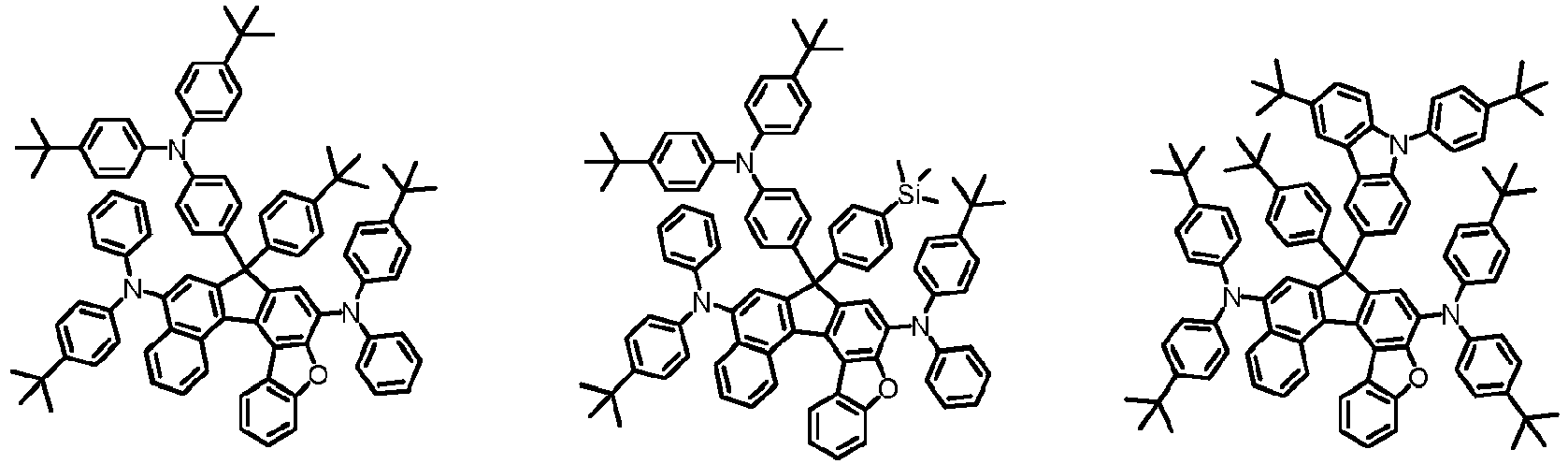
- the compound represented by Chemical Formula 1 is any one selected from the group consisting of the following compounds:
- the compound represented by Chemical Formula 1 may be prepared, for example, by a method as shown in the following Reaction Scheme 1.
- the preparation method may be more specifically described in the Preparation Examples described below.
- the definition of each substituent is the same as described above.
- Step 1-1 is a step of introducing a hydroxy group and a compound SM2 into the starting material SM1 by a reduction reaction of a carbonyl group by a strong base to prepare an intermediate compound INT.1.
- Step 1-2 is a step of introducing a compound SM3 into the hydroxyl group of the intermediate compound INT.1 by Friedel-Crafts type electrophilic substitution reactions to prepare an intermediate compound INT.2.
- Step 1-3 is a step of reacting the intermediate compound INT.2 with a secondary amine SM4 to prepare the compound represented by Chemical Formula 1. Such a preparation method will be more specifically described in the Preparation Examples described hereinafter.
- the compound according to the present disclosure can form an organic material layer, particularly a light emitting layer, of an organic light emitting device by a solution process.
- the above-mentioned compound can be used as a dopant material of the light emitting layer.
- the present disclosure provides a coating composition comprising the above-mentioned compound according to the present disclosure and a solvent.
- the solvent is not particularly limited as long as it is a solvent capable of dissolving or dispersing the compound according to the present disclosure.
- the solvent may include chlorine-based solvents such as chloroform, methylene chloride, 1,2-dichloroethane, 1,1,2-trichloroethane, chlorobenzene and o-dichlorobenzene; ether-based solvents such as tetrahydrofuran and dioxane; aromatic hydrocarbon-based solvents such as toluene, xylene, trimethylbenzene and mesitylene; aliphatic hydrocarbon-based solvents such as cyclohexane, methylcyclohexane, n-pentane, n-hexane, n-heptane, n-octane, n-nonane and n-decane; ketone-based solvents such as acetone, methyl ethyl ketone, and cyclohexan
- the coating composition may further include the compound used as the host material, and the details concerning the compound used as a host material will be described hereinafter.
- the viscosity (25°C) of the coating composition is preferably 1 cP to 10 cP, and coating is easy within the above range.
- the concentration of the compound according to the present disclosure is preferably 0.1 wt/v% to 20 wt/v%.
- solubility (wt%) of the coating composition in a solvent is 2.5 wt% to 10 wt% based on the solvent toluene, and thus the coating composition comprising the compound represented by Chemical Formula 1 is suitable for use in a solution process.
- the method includes the steps of: coating the above-mentioned coating composition according to the present disclosure on the anode or on the hole transport layer formed on the anode by a solution process; and heat treating the coated coating composition.
- the solution process uses the coating composition according to the present disclosure, and refers to spin coating, dip coating, doctor blading, inkjet printing, screen printing, spray method, roll coating, and the like, but is not limited thereto.
- the heat treatment temperature in the heat treatment is preferably from 150 to 230°C.
- a heat treatment time may be from 1 minute to 3 hours, more preferably 10 minutes to 1 hour.
- the heat treatment is preferably carried out in an inert gas atmosphere such as argon and nitrogen.
- an organic light emitting device comprising the compound represented by Chemical Formula 1.
- the present disclosure provides an organic light emitting device comprising: a first electrode; a second electrode that is provided opposite to the first electrode; and a light emitting layer that is provided between the first electrode and the second electrode, wherein the light emitting layer includes the above-mentioned compound represented by Chemical Formula 1.
- the organic light emitting device according to the present disclosure may be a normal type organic light emitting device in which an anode, one or more organic material layers, and a cathode are sequentially stacked on a substrate. Further, the organic light emitting device according to the present disclosure may be an inverted type organic light emitting device in which a cathode, one or more organic material layers, and an anode are sequentially stacked on a substrate. For example, the structure of an organic light emitting device according to an embodiment of the present disclosure is illustrated in FIGS. 1 and 2 .
- FIG. 1 shows an example of an organic light emitting device comprising a substrate 1, an anode 2, a light emitting layer 3, and a cathode 4.
- the compound represented by Chemical Formula 1 may be included in the light emitting layer.
- FIG. 2 shows an example of an organic light emitting device comprising a substrate 1, an anode 2, a hole injection layer 5, a hole transport layer 6, a light emitting layer 7, an electron transport layer 8, an electron injection layer 9 and a cathode 4.
- the compound represented by Chemical Formula 1 may be included in the light emitting layer.
- the organic light emitting device according to the present disclosure may be manufactured by materials and methods known in the art, except that the light emitting layer includes the compound according to the present disclosure.
- the organic light emitting device can be manufactured by sequentially stacking an anode, an organic material layer and a cathode on a substrate.
- the organic light emitting device may be manufactured by depositing a metal, metal oxides having conductivity, or an alloy thereof on the substrate using a PVD (physical vapor deposition) method such as a sputtering method or an e-beam evaporation method to form an anode, forming organic material layers including the hole injection layer, the hole transport layer, the light emitting layer and the electron transport layer thereon, and then depositing a material that can be used as the cathode thereon.
- PVD physical vapor deposition
- the organic light emitting device may be manufactured by sequentially depositing a cathode material, an organic material layer and an anode material on a substrate (International Publication WO2003/012890 ).
- the manufacturing method is not limited thereto.
- the first electrode is an anode
- the second electrode is a cathode
- the first electrode is a cathode and the second electrode is an anode
- anode material generally, a material having a large work function is preferably used so that holes can be smoothly injected into the organic material layer.
- the anode material include metals such as vanadium, chrome, copper, zinc, and gold, or an alloy thereof; metal oxides such as zinc oxides, indium oxides, indium tin oxides (ITO), and indium zinc oxides (IZO); a combination of metals and oxides, such as ZnO:Al or SnO 2 :Sb; conductive compounds such as poly(3-methylthiophene), poly[3,4-(ethylene-1,2-dioxy)thiophene](PEDOT), polypyrrole, and polyaniline, and the like, but are not limited thereto.
- the cathode material generally, a material having a small work function is preferably used so that electrons can be easily injected into the organic material layer.
- the cathode material include metals such as magnesium, calcium, sodium, potassium, titanium, indium, yttrium, lithium, gadolinium, aluminum, silver, tin, and lead, or an alloy thereof; a multilayered structure material such as LiF/Al or LiO 2 /Al, and the like, but are not limited thereto.
- the hole injection layer is a layer for injecting holes from the electrode, and the hole injection material is preferably a compound which has a capability of transporting the holes, thus has a hole injecting effect in the anode and an excellent hole injecting effect to the light emitting layer or the light emitting material, prevents excitons produced in the light emitting layer from moving to a electron injection layer or the electron injection material, and further is excellent in the ability to form a thin film. It is preferable that a HOMO (highest occupied molecular orbital) of the hole injection material is between the work function of the anode material and a HOMO of a peripheral organic material layer.
- a HOMO highest occupied molecular orbital
- the hole injection material examples include metal porphyrine, oligothiophene, an arylamine-based organic material, a hexanitrilehexaazatriphenylene-based organic material, a quinacridone-based organic material, a perylene-based organic material, anthraquinone, polyaniline and polythiophene-based conductive compound, and the like, but are not limited thereto.
- the hole transport layer is a layer that receives holes from a hole injection layer and transports the holes to the light emitting layer.
- the hole transport material is suitably a material having large mobility to the holes, which may receive holes from the anode or the hole injection layer and transfer the holes to the light emitting layer.
- Specific examples thereof include an arylamine-based organic material, a conductive compound, a block copolymer in which a conjugate portion and a non-conjugate portion are present together, and the like, but are not limited thereto.
- the light emitting layer may include a host material and a dopant material.
- a compound represented by Chemical Formula 1 may be used.
- the host material may be a fused aromatic ring derivative, a heterocycle-containing compound or the like.
- the fused aromatic ring derivatives include anthracene derivatives, pyrene derivatives, naphthalene derivatives, pentacene derivatives, phenanthrene compounds, and fluoranthene compounds.
- the heterocycle-containing compound include carbazole derivatives, dibenzofuran derivatives, ladder-type furan compounds, pyrimidine derivatives, and the like, but are not limited thereto.
- the electron transport layer is a layer which receives electrons from an electron injection layer and transports the electrons to a light emitting layer
- an electron transport material is suitably a material which may receive electrons well from a cathode and transfer the electrons to a light emitting layer, and has a large mobility for electrons.
- Specific examples of the electron transport material include: an Al complex of 8-hydroxyquinoline; a complex including Alqs; an organic radical compound; a hydroxyflavone-metal complex, and the like, but are not limited thereto.
- the electron transport layer may be used with any desired cathode material, as used according to the related art.
- cathode material are a typical material which has a low work function, followed by an aluminum layer or a silver layer.
- specific examples thereof include cesium, barium, calcium, ytterbium, and samarium, in each case followed by an aluminum layer or a silver layer.
- the electron injection layer is a layer which injects electrons from an electrode, and is preferably a compound which has a capability of transporting electrons, has an effect of injecting electrons from a cathode and an excellent effect of injecting electrons into a light emitting layer or a light emitting material, prevents excitons produced from the light emitting layer from moving to a hole injection layer, and is also excellent in the ability to form a thin film.
- the electron injection layer include LiF, NaF, NaCl, CsF, Li 2 O, BaO, fluorenone, anthraquinodimethane, diphenoquinone, thiopyran dioxide, oxazole, oxadiazole, triazole, imidazole, perylenetetracarboxylic acid, fluorenylidene methane, anthrone, and the like, and derivatives thereof, a metal complex compound, a nitrogen-containing 5-membered ring derivative, and the like, but are not limited thereto.
- Examples of the metal complex compound include 8-hydroxyquinolinato lithium, bis(8-hydroxyquinolinato)zinc, bis(8-hydroxyquinolinato)copper, bis(8-hydroxyquinolinato)manganese, tris(8-hydroxyquinolinato)aluminum, tris(2-methyl-8-hydroxyquinolinato)aluminum, tris(8-hydroxyquinolinato)gallium, bis(10-hydroxybenzo[h]quinolinato)beryllium, bis(10-hydroxybenzo[h]quinolinato)zinc, bis(2-methyl-8-quinolinato)chlorogallium, bis(2-methyl-8-quinolinato)(o-cresolato)gallium, bis(2-methyl-8-quinolinato)(1-naphtholato)aluminum, bis(2-methyl-8-quinolinato)(2-naphtholato)gallium, and the like, but are not limited thereto.
- the organic light emitting device may be a front side emission type, a back side emission type, or a double side emission type according to the used material.
- the compound according to the present disclosure may be included in an organic solar cell or an organic transistor in addition to an organic light emitting device.
- Example 1 Manufacture of organic light emitting device
- a glass substrate on which ITO (indium tin oxide) was coated as a thin film to a thickness of 500 ⁇ was put into distilled water in which a detergent was dissolved, and ultrasonically cleaned.
- a product manufactured by Fischer Co. was used as the detergent, and as the distilled water, distilled water filtered twice using a filter manufactured by Millipore Co. was used.
- ultrasonic cleaning was repeated twice using distilled water for 10 minutes.
- the substrate was ultrasonically cleaned with solvents of isopropyl alcohol, acetone and methanol, dried, and thereby, the cleaned ITO glass substrate with a thickness of 500 ⁇ was prepared.
- LiF lithium fluoride
- the deposition rate of lithium fluoride was maintained at 0.3 ⁇ /sec
- the deposition rate of aluminum was maintained at 2 ⁇ /sec
- the degree of vacuum during the deposition was maintained at 2 ⁇ 10 -7 to 5 ⁇ 10 -6 torr, thereby manufacturing the organic light emitting device.
- An organic light emitting device was manufactured in the same manner as in Example 1, except that the compounds shown in Table 2 below were used instead of the compound 1.
- Lifetime T90 means the time required for the luminance to be reduced to 90% of the initial luminance (1000 nit).
- the organic light emitting device using the compound of the present disclosure as a dopant of a light emitting layer exhibits very excellent characteristics in terms of driving voltage, efficiency and lifetime as compared with the organic light emitting device using the compound BD of Comparative Example as a dopant of the light emitting layer.
- the organic light emitting device employing the compound of the present disclosure as a dopant of the light emitting layer is significantly improved as compared with the device of the Comparative Example.
Landscapes
- Chemical & Material Sciences (AREA)
- Organic Chemistry (AREA)
- Engineering & Computer Science (AREA)
- Materials Engineering (AREA)
- Physics & Mathematics (AREA)
- Spectroscopy & Molecular Physics (AREA)
- Optics & Photonics (AREA)
- Electroluminescent Light Sources (AREA)
- Furan Compounds (AREA)
- Organic Low-Molecular-Weight Compounds And Preparation Thereof (AREA)
Claims (13)
- Verbindung, dargestellt durch die folgende chemische Formel 1:
 R1 und R2 jeweils unabhängig Wasserstoff sind, oder zwei R1 oder zwei R2 miteinander verbunden sind, um einen substituierten oder unsubstituierten aromatischen C6-60-Ring; einen substituierten oder unsubstituierten nicht-aromatischen C6-60-Ring; oder einen substituierten oder unsubstituierten heterocyclischen C2-60-Ring, der irgendeines oder mehrere Heteroatome enthält, ausgewählt aus der Gruppe bestehend aus N, O, S und Si, zu bilden,zumindest eines der zwei R1 oder der zwei R2 miteinander verbunden sind, um den nicht-aromatischen C6-60-Ring; oder den heterocyclischen C2-60-Ring zu bilden,L ein substituiertes oder unsubstituiertes C6-60-Arylen oder ein substituiertes oder unsubstituiertes C2-60-Heteroarylen, das irgendeines oder mehr Heteroatome umfasst, ausgewählt aus der Gruppe, bestehend aus N, O und S, ist,X O, S, NZ3 oder SiZ4Z5 ist,Z1 substituiertes oder unsubstituiertes C6-60-Aryl ist,Z2 bis Z5 jeweils unabhängig ein substituiertes oder unsubstituiertes C1-60-Alkyl, ein substituiertes oder unsubstituiertes C1-60-Haloalkyl, ein substituiertes oder unsubstituiertes C3-60-Cycloalkyl, ein substituiertes oder unsubstituiertes C7-60-Aralkyl, ein substituiertes oder unsubstituiertes C6-60-Aryl oder ein substituiertes oder unsubstituiertes C2-60-Heteroaryl, das irgendeines oder mehr Heteroatome enthält, ausgewählt aus der Gruppe, bestehend aus N, O und S, sind,die L und Z2; Z2 und Z3; oder Z4 und Z5 optional miteinander verbunden sind, um einen 5-gliedrigen heterocyclischen Ring zu bilden,mit der Maßgabe, dass Z1 und LX-Z2 sich voneinander unterscheiden und nicht miteinander verbunden sind,L1 und L2 jeweils unabhängig eine Einfachbindung; ein substituiertes oder unsubstituiertes C6-60-Arylen; oder ein substituiertes oder unsubstituiertes C2-60-Heteroarylen, das irgendeines oder mehr Heteroatome enthält, ausgewählt aus der Gruppe, bestehend aus N, O und S, sind, undAr1 bis Ar4 jeweils unabhängig ein substituiertes oder unsubstituiertes C6-60-Aryl; oder ein substituiertes oder unsubstituiertes C2-60-Heteroaryl, das irgendeines oder mehr Heteroatome enthält, ausgewählt aus der Gruppe bestehend aus N, O und S, sind.
 - Verbindung gemäß Anspruch 1,
worin zumindest eines von den zwei R1 oder den zwei R2 miteinander verbunden sind, um irgendeine der durch die folgenden chemischen Formeln 2d bis 2g dargestellten Strukturen zu bilden, der Rest Wasserstoff sind oder miteinander verbunden sind, um irgendeine der durch die folgenden chemischen Formeln 2a bis 2g dargestellten Strukturen zu bilden:
 Y O, S, CZ6Z7, oder SiZ8Z9 ist,die Z6 bis Z9 jeweils unabhängig C1-10-Alkyl oder C6-20-Aryl sind und* eine Bindungsposition an den an R1 oder R2 gebundenen Kohlenstoff bezeichnet.
 - Verbindung gemäß Anspruch 2,
worin die durch die chemische Formel 1 dargestellte Verbindung durch irgendeine der folgenden chemischen Formeln 1-1, 1-3 und 1-5 dargestellt ist:

 L, X, Z1, Z2, L1, L2 und Ar1 bis Ar4 wie in Anspruch 1 definiert sind,eines von Y1 und Y2 eine Einfachbindung ist und das andere O, S, C(C1-4-Alkyl)2 oder Si(C1-4-Alkyl)2 ist; undeines von Y3 und Y4 eine Einfachbindung ist und das andere eines von O, S, C(1-4-Alkyl)2 oder Si(C1-4-Alkyl)2 ist.
 - Verbindung gemäß Anspruch 1,worin Z1 Phenyl oder Biphenylyl ist,worin Z1 unsubstituiert ist oder substituiert ist mit 1 Substituent bis 5 Substituenten, unabhängig ausgewählt aus der Gruppe bestehend aus Deuterium, Halogen, Cyano, C1-10-Alkyl, C3-10-Cycloalkyl, Si(C1-10-Alkyl)3 und Si(C6-20-Aryl)3.
- Verbindung gemäß Anspruch 1,
worin Z1 irgendeines ist, das ausgewählt ist aus der Gruppe bestehend aus:

- Verbindung gemäß Anspruch 1,
worin L-X-Z2 irgendeines ist, das ausgewählt ist aus der Gruppe bestehend aus:
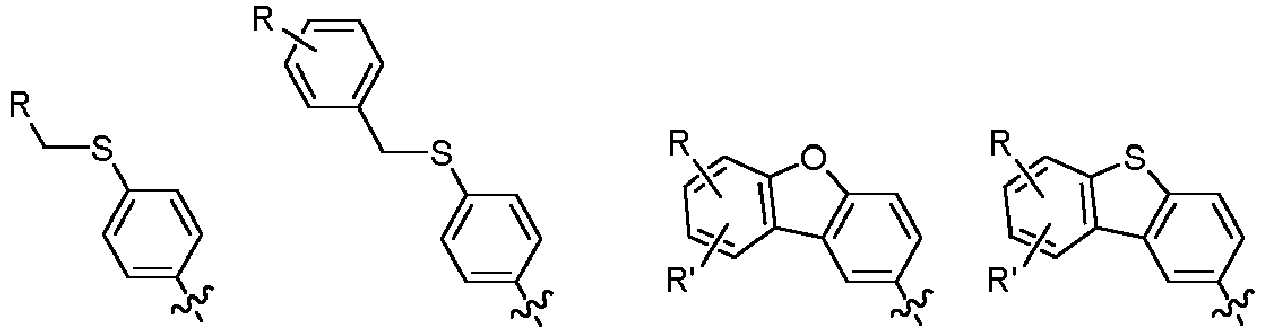


R, R' und R" jeweils unabhängig Wasserstoff, Methyl, tert-Butyl oder Si(Methyl)3 sind. - Verbindung gemäß Anspruch 1
worin L1 und L2 eine Einfachbindung sind. - Verbindung gemäß Anspruch 1,worin Ar1 bis Ar4 jeweils unabhängig Phenyl, Naphthyl, Biphenylyl oder Dibenzofuranyl sind,worin Ar1 bis Ar4 unsubstituiert sind oder mit 1 Substituent bis 5 Substituenten substituiert sind, jeweils unabhängig ausgewählt aus der Gruppe bestehend aus Deuterium, Halogen, C1-10-Alkyl und Si(C1-10-Alkyl)3.
- Verbindung gemäß Anspruch 1,
worin Ar1 bis Ar4 jeweils unabhängig irgendeines sind, das ausgewählt ist aus der Gruppe bestehend aus:

- Verbindung gemäß Anspruch 1,worin Ar1 bis Ar4 zueinander identisch sind undAr2 und Ar3 zueinander identisch sind.
- Verbindung gemäß Anspruch 1,
worin die durch die chemische Formel 1 dargestellte Verbindung durch irgendeine der folgenden chemischen Formeln 2-1, 2-2, 2-4, 2-5, 2-7, 2-8 und 2-10 dargestellt ist:
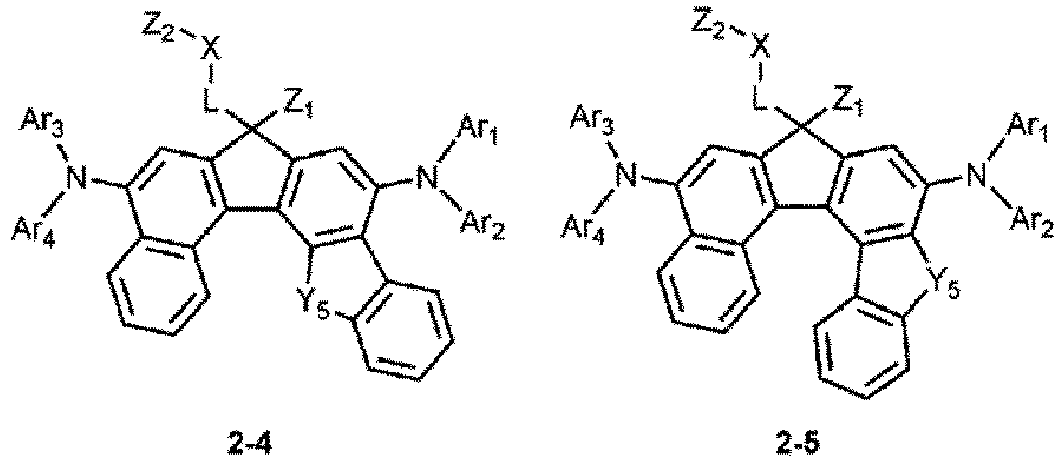
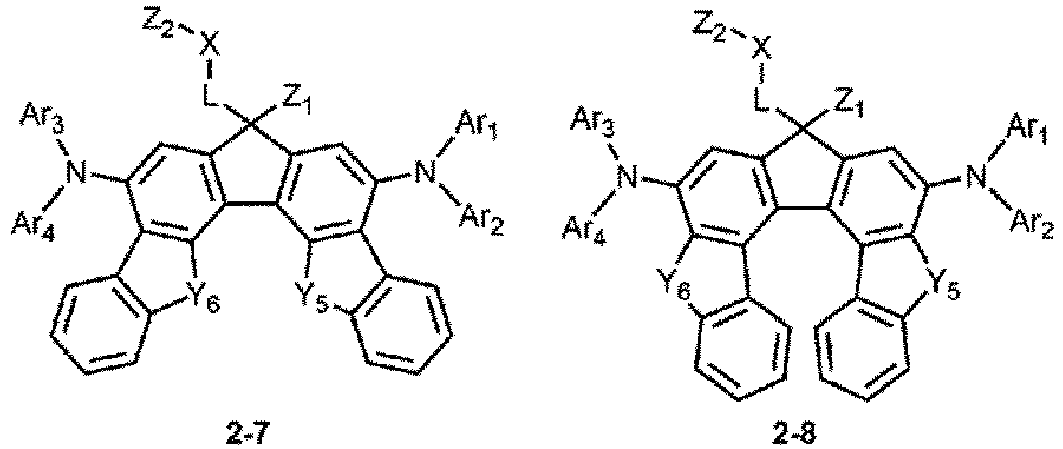
 L, X, Z1, Z2 und Ar1 bis Ar4 wie in Anspruch 1 definiert sind undY5 und Y6 jeweils unabhängig O, S, C(Methyl)2 oder Si(Methyl)2 sind.
 - Verbindung gemäß Anspruch 1,
worin die Verbindung irgendeine der folgenden Verbindungen ist:




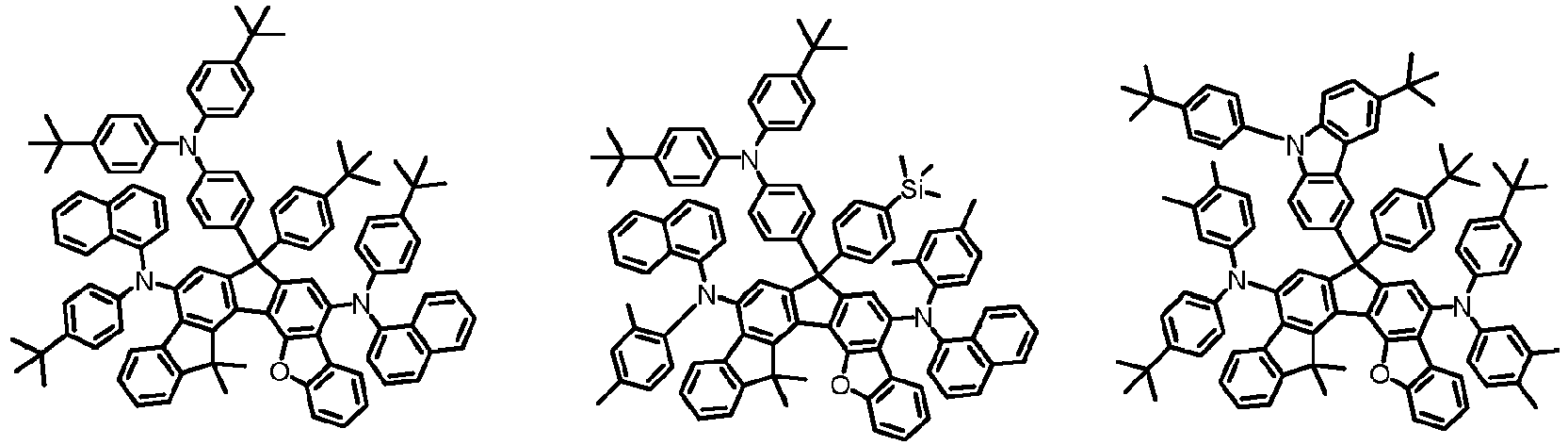

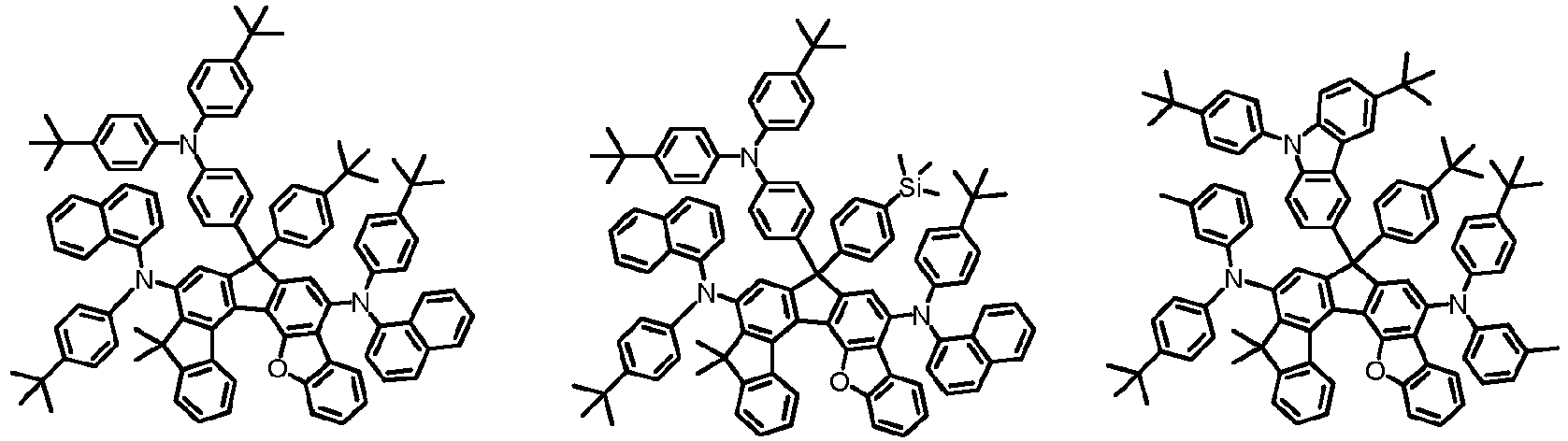


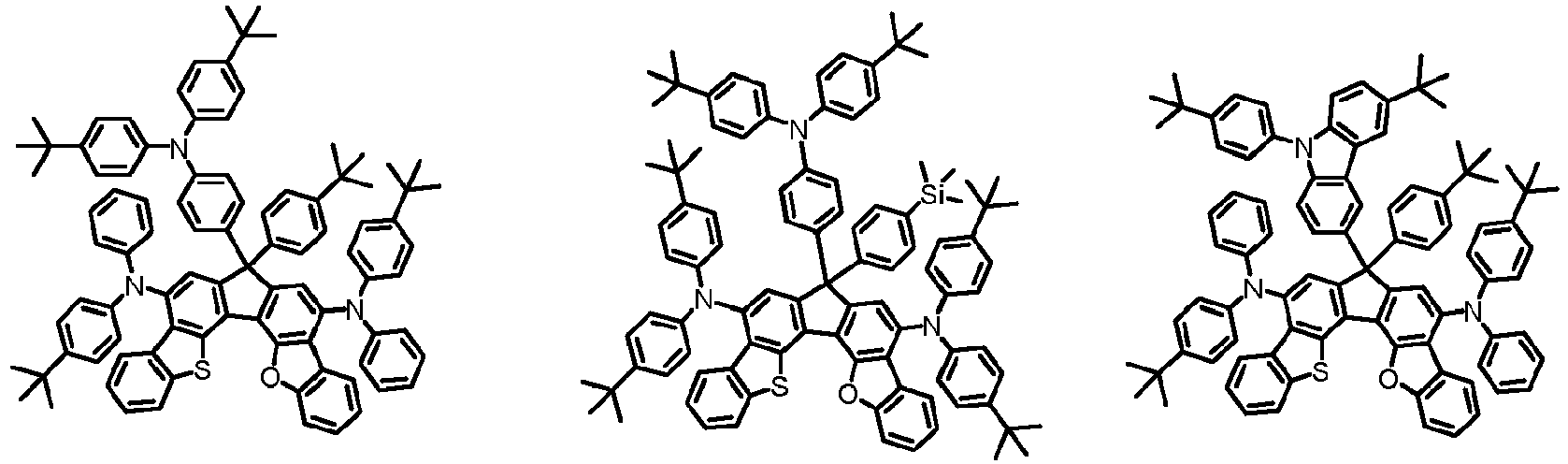

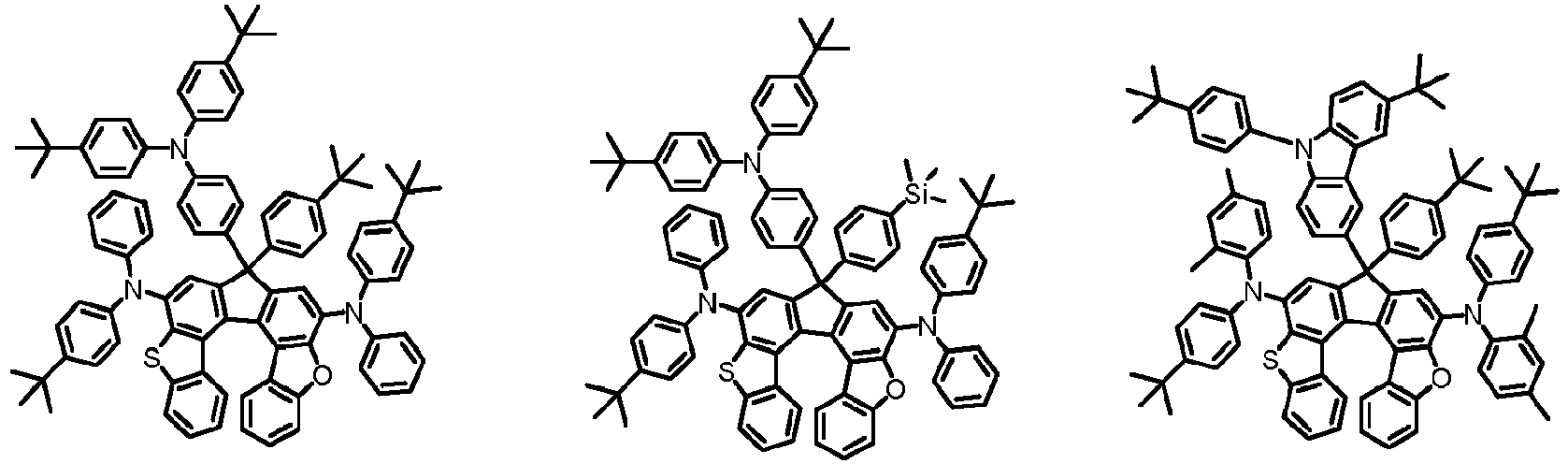
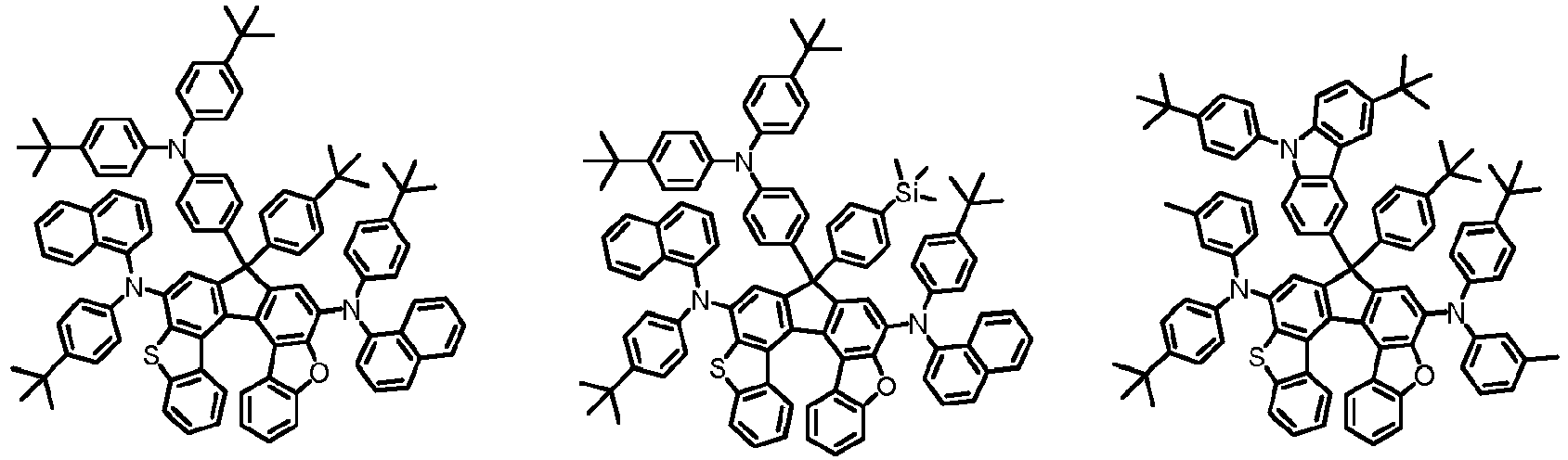


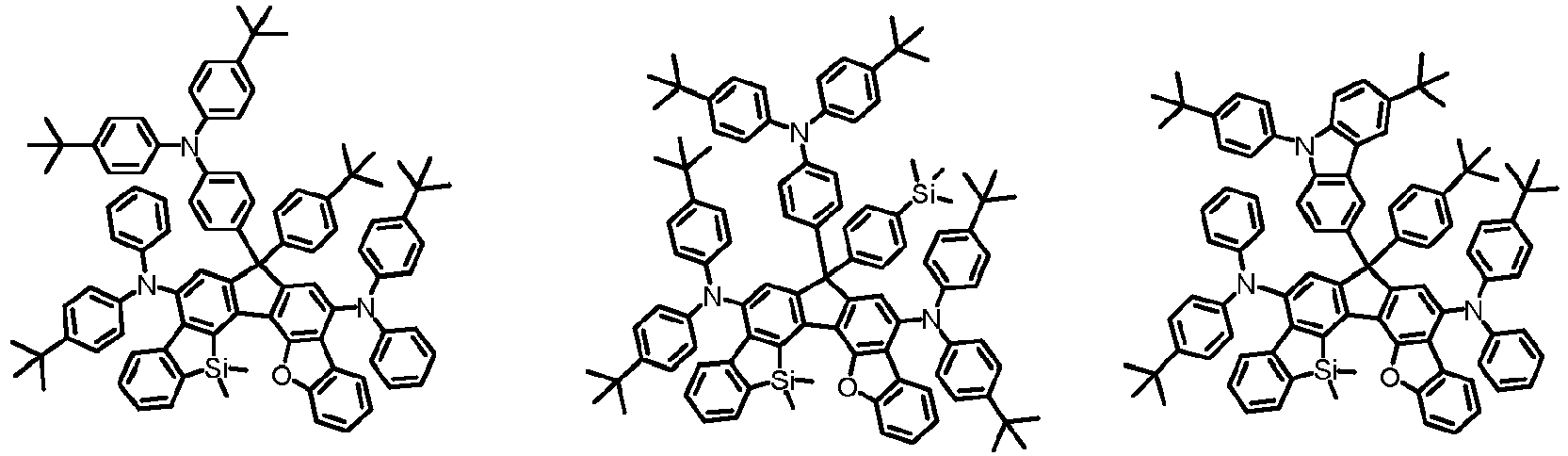


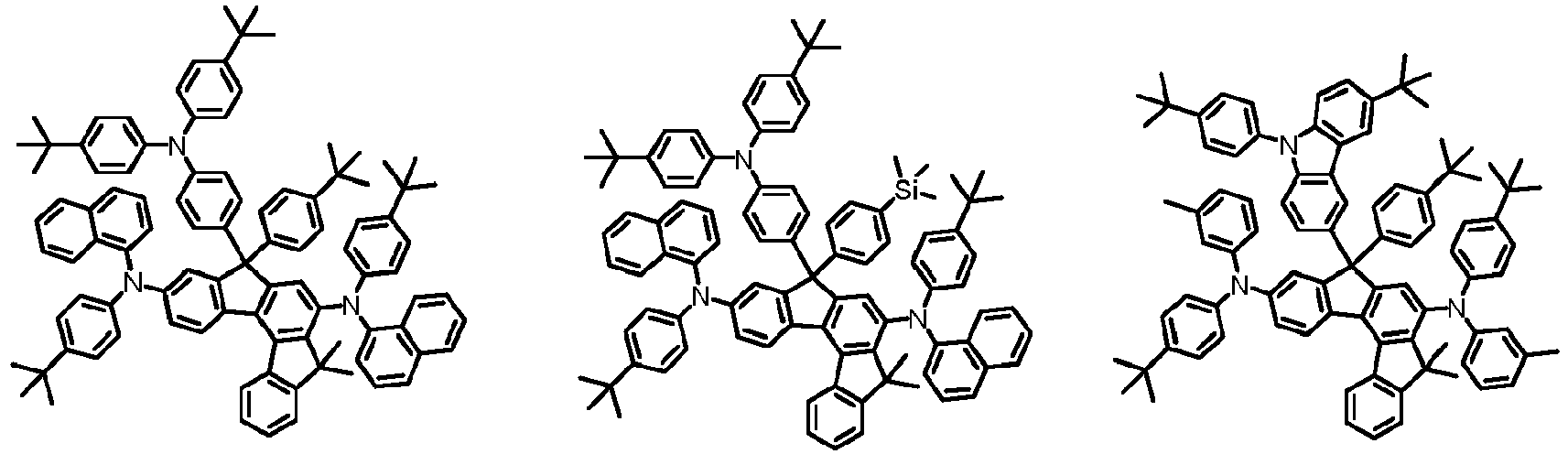


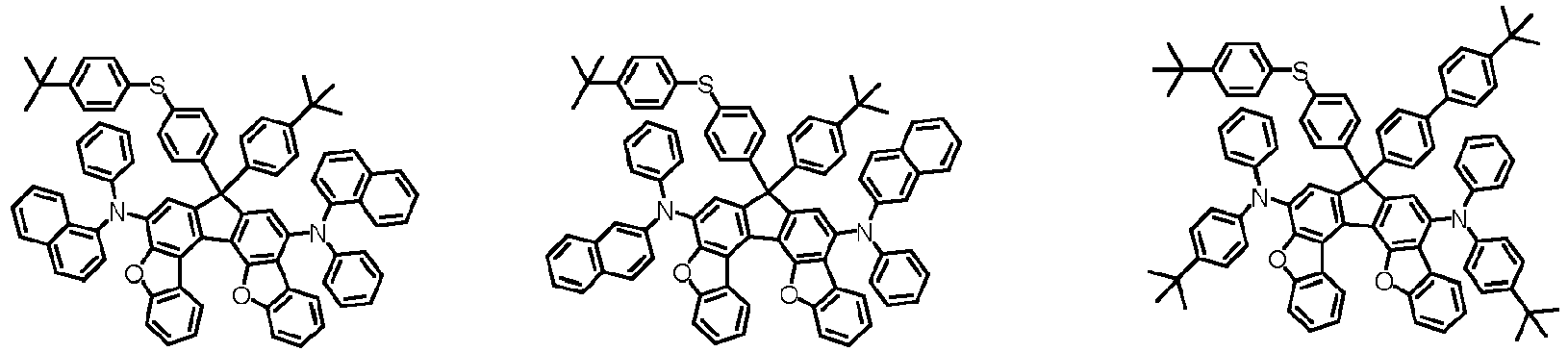


- Organische lichtemittierende Vorrichtung, umfassend:eine erste Elektrode; eine zweite Elektrode, die der ersten Elektrode gegenüberliegend vorgesehen ist; undeine lichtemittierende Schicht, die zwischen der ersten Elektrode und der zweiten Elektrode vorgesehen ist,worin die lichtemittierende Schicht die Verbindung gemäß irgendeinem der Ansprüche 1 bis 12 umfasst.
Applications Claiming Priority (3)
| Application Number | Priority Date | Filing Date | Title |
|---|---|---|---|
| KR20190024296 | 2019-02-28 | ||
| KR1020200021512A KR102372881B1 (ko) | 2019-02-28 | 2020-02-21 | 신규한 화합물 및 이를 이용한 유기 발광 소자 |
| PCT/KR2020/002606 WO2020175867A1 (ko) | 2019-02-28 | 2020-02-24 | 신규한 화합물 및 이를 이용한 유기 발광 소자 |
Publications (3)
| Publication Number | Publication Date |
|---|---|
| EP3904346A1 EP3904346A1 (de) | 2021-11-03 |
| EP3904346A4 EP3904346A4 (de) | 2022-04-06 |
| EP3904346B1 true EP3904346B1 (de) | 2024-08-28 |
Family
ID=72239787
Family Applications (1)
| Application Number | Title | Priority Date | Filing Date |
|---|---|---|---|
| EP20763578.0A Active EP3904346B1 (de) | 2019-02-28 | 2020-02-24 | Neuartige verbindung und organische lichtemittierende vorrichtung damit |
Country Status (4)
| Country | Link |
|---|---|
| US (1) | US20220085295A1 (de) |
| EP (1) | EP3904346B1 (de) |
| JP (1) | JP7250400B2 (de) |
| WO (1) | WO2020175867A1 (de) |
Families Citing this family (2)
| Publication number | Priority date | Publication date | Assignee | Title |
|---|---|---|---|---|
| CN112375054B (zh) * | 2021-01-13 | 2021-05-25 | 南京高光半导体材料有限公司 | 一种化合物及有机电致发光器件 |
| KR102807138B1 (ko) | 2021-02-25 | 2025-05-12 | 삼성에스디아이 주식회사 | 유기 광전자 소자용 화합물, 유기 광전자 소자용 조성물, 유기 광전자 소자 및 표시 장치 |
Family Cites Families (19)
| Publication number | Priority date | Publication date | Assignee | Title |
|---|---|---|---|---|
| JP3824385B2 (ja) * | 1996-08-02 | 2006-09-20 | 三井化学株式会社 | 有機電界発光素子 |
| KR100430549B1 (ko) | 1999-01-27 | 2004-05-10 | 주식회사 엘지화학 | 신규한 착물 및 그의 제조 방법과 이를 이용한 유기 발광 소자 및 그의 제조 방법 |
| DE10135513B4 (de) | 2001-07-20 | 2005-02-24 | Novaled Gmbh | Lichtemittierendes Bauelement mit organischen Schichten |
| JP5221061B2 (ja) * | 2006-06-15 | 2013-06-26 | 三星ディスプレイ株式會社 | シクロペンタフェナントレン系化合物及びそれを利用した有機電界発光素子 |
| KR101338253B1 (ko) * | 2006-06-15 | 2013-12-09 | 삼성디스플레이 주식회사 | 사이클로펜타페난트렌계 화합물 및 이를 이용한 유기 전계발광 소자 |
| US9385324B2 (en) * | 2012-05-07 | 2016-07-05 | Samsung Electronics Co., Ltd. | Electronic system with augmented reality mechanism and method of operation thereof |
| KR102583348B1 (ko) * | 2012-07-23 | 2023-09-26 | 메르크 파텐트 게엠베하 | 화합물 및 유기 전계 발광 디바이스 |
| CN104768929B (zh) * | 2012-10-26 | 2018-07-24 | 捷恩智株式会社 | 苯并芴化合物、使用该化合物的发光层用材料、有机电场发光元件、显示装置及照明装置 |
| JP6306849B2 (ja) * | 2013-09-25 | 2018-04-04 | 出光興産株式会社 | 有機エレクトロルミネッセンス素子、および電子機器 |
| KR102148643B1 (ko) * | 2013-09-26 | 2020-08-28 | 롬엔드하스전자재료코리아유한회사 | 신규한 유기 전계 발광 화합물 및 이를 포함하는 유기 전계 발광 소자 |
| JP6370568B2 (ja) * | 2014-03-14 | 2018-08-08 | 出光興産株式会社 | インク組成物、インク組成物を用いた有機エレクトロルミネッセンス素子、及び電子機器 |
| KR102091695B1 (ko) * | 2015-08-06 | 2020-03-24 | 에스에프씨주식회사 | 고효율을 갖는 유기 발광 소자 |
| KR101900726B1 (ko) * | 2016-07-14 | 2018-09-20 | 에스에프씨주식회사 | 고효율 특성을 갖는 유기 발광 소자 |
| KR102707563B1 (ko) * | 2016-10-17 | 2024-09-20 | 삼성디스플레이 주식회사 | 축합환 화합물 및 이를 포함한 유기 발광 소자 |
| KR102750639B1 (ko) * | 2016-11-07 | 2025-01-08 | 에스에프씨 주식회사 | 장수명 특성을 가지는 유기 발광 소자 |
| KR102122213B1 (ko) * | 2017-01-04 | 2020-06-12 | 에스에프씨주식회사 | 고효율을 갖는 유기 발광 소자 |
| CN110832657B (zh) * | 2017-07-11 | 2023-10-24 | Sfc株式会社 | 具有高效率的有机发光元件 |
| WO2019021797A1 (ja) | 2017-07-26 | 2019-01-31 | 日立オートモティブシステムズ株式会社 | 緩衝器およびその製造方法 |
| KR101988606B1 (ko) | 2017-08-31 | 2019-06-12 | 단국대학교 산학협력단 | 여섯 키를 이용한 알파벳 및 한글 매핑 방법 |
-
2020
- 2020-02-24 JP JP2021539669A patent/JP7250400B2/ja active Active
- 2020-02-24 EP EP20763578.0A patent/EP3904346B1/de active Active
- 2020-02-24 WO PCT/KR2020/002606 patent/WO2020175867A1/ko not_active Ceased
- 2020-02-24 US US17/421,520 patent/US20220085295A1/en active Pending
Also Published As
| Publication number | Publication date |
|---|---|
| EP3904346A1 (de) | 2021-11-03 |
| JP2022517336A (ja) | 2022-03-08 |
| WO2020175867A1 (ko) | 2020-09-03 |
| JP7250400B2 (ja) | 2023-04-03 |
| US20220085295A1 (en) | 2022-03-17 |
| EP3904346A4 (de) | 2022-04-06 |
Similar Documents
| Publication | Publication Date | Title |
|---|---|---|
| EP4230629B1 (de) | Neuartige verbindung und organische lichtemittierende vorrichtung damit | |
| EP4273151A1 (de) | Neuartige verbindung und organische lichtemittierende vorrichtung damit | |
| EP3567026A1 (de) | Neuartige verbindung und organische lichtemittierende vorrichtung mit verwendung davon | |
| KR102336673B1 (ko) | 신규한 화합물 및 이를 이용한 유기 발광 소자 | |
| EP4242214B1 (de) | Neuartige verbindung und organische lichtemittierende vorrichtung damit | |
| EP3904346B1 (de) | Neuartige verbindung und organische lichtemittierende vorrichtung damit | |
| EP4265625B1 (de) | Neuartige verbindung und organische lichtemittierende vorrichtung damit | |
| KR102770366B1 (ko) | 신규한 화합물 및 이를 이용한 유기발광 소자 | |
| JP7527708B2 (ja) | 新規な化合物およびこれを利用した有機発光素子 | |
| KR102372881B1 (ko) | 신규한 화합물 및 이를 이용한 유기 발광 소자 | |
| EP4063367B1 (de) | Neuartige verbindung und organische lichtemittierende vorrichtung mit verwendung davon | |
| KR102770368B1 (ko) | 신규한 화합물 및 이를 이용한 유기 발광 소자 | |
| KR102820024B1 (ko) | 신규한 화합물 및 이를 이용한 유기 발광 소자 | |
| KR102589892B1 (ko) | 신규한 화합물 및 이를 이용한 유기발광 소자 | |
| EP4245760B1 (de) | Neuartige verbindung und organische lichtemittierende vorrichtung damit | |
| KR20210108270A (ko) | 신규한 화합물 및 이를 이용한 유기 발광 소자 | |
| EP4137472B1 (de) | Neuartige verbindung und organische lichtemittierende vorrichtung diese enthaltend | |
| EP4332107B1 (de) | Borhaltige heteroaromatische verbindungen und organische lichtemittierende vorrichtung damit | |
| EP3778582B1 (de) | Neue verbindung, beschichtungszusammensetzung, die diese umfasst und organische leuchtdiode, die diese umfasst | |
| KR20200089183A (ko) | 신규한 화합물 및 이를 포함하는 유기 발광 소자 | |
| EP4335854A1 (de) | Neuartige verbindung und organische lichtemittierende vorrichtung damit | |
| KR102689532B1 (ko) | 신규한 화합물 및 이를 이용한 유기 발광 소자 | |
| KR102654810B1 (ko) | 신규한 화합물 및 이를 이용한 유기발광 소자 |
Legal Events
| Date | Code | Title | Description |
|---|---|---|---|
| STAA | Information on the status of an ep patent application or granted ep patent |
Free format text: STATUS: THE INTERNATIONAL PUBLICATION HAS BEEN MADE |
|
| PUAI | Public reference made under article 153(3) epc to a published international application that has entered the european phase |
Free format text: ORIGINAL CODE: 0009012 |
|
| STAA | Information on the status of an ep patent application or granted ep patent |
Free format text: STATUS: REQUEST FOR EXAMINATION WAS MADE |
|
| 17P | Request for examination filed |
Effective date: 20210728 |
|
| AK | Designated contracting states |
Kind code of ref document: A1 Designated state(s): AL AT BE BG CH CY CZ DE DK EE ES FI FR GB GR HR HU IE IS IT LI LT LU LV MC MK MT NL NO PL PT RO RS SE SI SK SM TR |
|
| A4 | Supplementary search report drawn up and despatched |
Effective date: 20220307 |
|
| RIC1 | Information provided on ipc code assigned before grant |
Ipc: H01L 51/50 20060101ALI20220301BHEP Ipc: C07D 333/78 20060101ALI20220301BHEP Ipc: C07D 307/93 20060101ALI20220301BHEP Ipc: C07D 209/86 20060101ALI20220301BHEP Ipc: C07C 211/61 20060101ALI20220301BHEP Ipc: H01L 51/00 20060101ALI20220301BHEP Ipc: C07F 7/08 20060101ALI20220301BHEP Ipc: C07D 495/04 20060101ALI20220301BHEP Ipc: C07D 493/04 20060101ALI20220301BHEP Ipc: C07D 405/04 20060101ALI20220301BHEP Ipc: C07D 209/82 20060101ALI20220301BHEP Ipc: C07D 307/91 20060101AFI20220301BHEP |
|
| DAV | Request for validation of the european patent (deleted) | ||
| DAX | Request for extension of the european patent (deleted) | ||
| GRAP | Despatch of communication of intention to grant a patent |
Free format text: ORIGINAL CODE: EPIDOSNIGR1 |
|
| STAA | Information on the status of an ep patent application or granted ep patent |
Free format text: STATUS: GRANT OF PATENT IS INTENDED |
|
| RIC1 | Information provided on ipc code assigned before grant |
Ipc: H10K 85/40 20230101ALI20240311BHEP Ipc: C09K 11/06 20060101ALI20240311BHEP Ipc: H10K 85/60 20230101ALI20240311BHEP Ipc: C07D 333/78 20060101ALI20240311BHEP Ipc: C07D 307/93 20060101ALI20240311BHEP Ipc: C07D 209/86 20060101ALI20240311BHEP Ipc: C07C 211/61 20060101ALI20240311BHEP Ipc: H10K 50/11 20230101ALI20240311BHEP Ipc: C07F 7/08 20060101ALI20240311BHEP Ipc: C07D 495/04 20060101ALI20240311BHEP Ipc: C07D 493/04 20060101ALI20240311BHEP Ipc: C07D 405/04 20060101ALI20240311BHEP Ipc: C07D 209/82 20060101ALI20240311BHEP Ipc: C07D 307/91 20060101AFI20240311BHEP |
|
| INTG | Intention to grant announced |
Effective date: 20240408 |
|
| GRAS | Grant fee paid |
Free format text: ORIGINAL CODE: EPIDOSNIGR3 |
|
| GRAA | (expected) grant |
Free format text: ORIGINAL CODE: 0009210 |
|
| STAA | Information on the status of an ep patent application or granted ep patent |
Free format text: STATUS: THE PATENT HAS BEEN GRANTED |
|
| AK | Designated contracting states |
Kind code of ref document: B1 Designated state(s): AL AT BE BG CH CY CZ DE DK EE ES FI FR GB GR HR HU IE IS IT LI LT LU LV MC MK MT NL NO PL PT RO RS SE SI SK SM TR |
|
| REG | Reference to a national code |
Ref country code: CH Ref legal event code: EP |
|
| REG | Reference to a national code |
Ref country code: DE Ref legal event code: R096 Ref document number: 602020036710 Country of ref document: DE |
|
| REG | Reference to a national code |
Ref country code: IE Ref legal event code: FG4D |
|
| REG | Reference to a national code |
Ref country code: LT Ref legal event code: MG9D |
|
| PG25 | Lapsed in a contracting state [announced via postgrant information from national office to epo] |
Ref country code: NO Free format text: LAPSE BECAUSE OF FAILURE TO SUBMIT A TRANSLATION OF THE DESCRIPTION OR TO PAY THE FEE WITHIN THE PRESCRIBED TIME-LIMIT Effective date: 20241128 |
|
| REG | Reference to a national code |
Ref country code: AT Ref legal event code: MK05 Ref document number: 1717849 Country of ref document: AT Kind code of ref document: T Effective date: 20240828 |
|
| PG25 | Lapsed in a contracting state [announced via postgrant information from national office to epo] |
Ref country code: NL Free format text: LAPSE BECAUSE OF FAILURE TO SUBMIT A TRANSLATION OF THE DESCRIPTION OR TO PAY THE FEE WITHIN THE PRESCRIBED TIME-LIMIT Effective date: 20240828 Ref country code: PT Free format text: LAPSE BECAUSE OF FAILURE TO SUBMIT A TRANSLATION OF THE DESCRIPTION OR TO PAY THE FEE WITHIN THE PRESCRIBED TIME-LIMIT Effective date: 20241230 Ref country code: GR Free format text: LAPSE BECAUSE OF FAILURE TO SUBMIT A TRANSLATION OF THE DESCRIPTION OR TO PAY THE FEE WITHIN THE PRESCRIBED TIME-LIMIT Effective date: 20241129 Ref country code: PL Free format text: LAPSE BECAUSE OF FAILURE TO SUBMIT A TRANSLATION OF THE DESCRIPTION OR TO PAY THE FEE WITHIN THE PRESCRIBED TIME-LIMIT Effective date: 20240828 Ref country code: FI Free format text: LAPSE BECAUSE OF FAILURE TO SUBMIT A TRANSLATION OF THE DESCRIPTION OR TO PAY THE FEE WITHIN THE PRESCRIBED TIME-LIMIT Effective date: 20240828 |
|
| PG25 | Lapsed in a contracting state [announced via postgrant information from national office to epo] |
Ref country code: BG Free format text: LAPSE BECAUSE OF FAILURE TO SUBMIT A TRANSLATION OF THE DESCRIPTION OR TO PAY THE FEE WITHIN THE PRESCRIBED TIME-LIMIT Effective date: 20240828 |
|
| PG25 | Lapsed in a contracting state [announced via postgrant information from national office to epo] |
Ref country code: LV Free format text: LAPSE BECAUSE OF FAILURE TO SUBMIT A TRANSLATION OF THE DESCRIPTION OR TO PAY THE FEE WITHIN THE PRESCRIBED TIME-LIMIT Effective date: 20240828 |
|
| REG | Reference to a national code |
Ref country code: NL Ref legal event code: MP Effective date: 20240828 |
|
| PG25 | Lapsed in a contracting state [announced via postgrant information from national office to epo] |
Ref country code: AT Free format text: LAPSE BECAUSE OF FAILURE TO SUBMIT A TRANSLATION OF THE DESCRIPTION OR TO PAY THE FEE WITHIN THE PRESCRIBED TIME-LIMIT Effective date: 20240828 Ref country code: IS Free format text: LAPSE BECAUSE OF FAILURE TO SUBMIT A TRANSLATION OF THE DESCRIPTION OR TO PAY THE FEE WITHIN THE PRESCRIBED TIME-LIMIT Effective date: 20241228 |
|
| PG25 | Lapsed in a contracting state [announced via postgrant information from national office to epo] |
Ref country code: HR Free format text: LAPSE BECAUSE OF FAILURE TO SUBMIT A TRANSLATION OF THE DESCRIPTION OR TO PAY THE FEE WITHIN THE PRESCRIBED TIME-LIMIT Effective date: 20240828 |
|
| PG25 | Lapsed in a contracting state [announced via postgrant information from national office to epo] |
Ref country code: ES Free format text: LAPSE BECAUSE OF FAILURE TO SUBMIT A TRANSLATION OF THE DESCRIPTION OR TO PAY THE FEE WITHIN THE PRESCRIBED TIME-LIMIT Effective date: 20240828 Ref country code: RS Free format text: LAPSE BECAUSE OF FAILURE TO SUBMIT A TRANSLATION OF THE DESCRIPTION OR TO PAY THE FEE WITHIN THE PRESCRIBED TIME-LIMIT Effective date: 20241128 |
|
| PG25 | Lapsed in a contracting state [announced via postgrant information from national office to epo] |
Ref country code: RS Free format text: LAPSE BECAUSE OF FAILURE TO SUBMIT A TRANSLATION OF THE DESCRIPTION OR TO PAY THE FEE WITHIN THE PRESCRIBED TIME-LIMIT Effective date: 20241128 Ref country code: PT Free format text: LAPSE BECAUSE OF FAILURE TO SUBMIT A TRANSLATION OF THE DESCRIPTION OR TO PAY THE FEE WITHIN THE PRESCRIBED TIME-LIMIT Effective date: 20241230 Ref country code: PL Free format text: LAPSE BECAUSE OF FAILURE TO SUBMIT A TRANSLATION OF THE DESCRIPTION OR TO PAY THE FEE WITHIN THE PRESCRIBED TIME-LIMIT Effective date: 20240828 Ref country code: NO Free format text: LAPSE BECAUSE OF FAILURE TO SUBMIT A TRANSLATION OF THE DESCRIPTION OR TO PAY THE FEE WITHIN THE PRESCRIBED TIME-LIMIT Effective date: 20241128 Ref country code: NL Free format text: LAPSE BECAUSE OF FAILURE TO SUBMIT A TRANSLATION OF THE DESCRIPTION OR TO PAY THE FEE WITHIN THE PRESCRIBED TIME-LIMIT Effective date: 20240828 Ref country code: LV Free format text: LAPSE BECAUSE OF FAILURE TO SUBMIT A TRANSLATION OF THE DESCRIPTION OR TO PAY THE FEE WITHIN THE PRESCRIBED TIME-LIMIT Effective date: 20240828 Ref country code: IS Free format text: LAPSE BECAUSE OF FAILURE TO SUBMIT A TRANSLATION OF THE DESCRIPTION OR TO PAY THE FEE WITHIN THE PRESCRIBED TIME-LIMIT Effective date: 20241228 Ref country code: HR Free format text: LAPSE BECAUSE OF FAILURE TO SUBMIT A TRANSLATION OF THE DESCRIPTION OR TO PAY THE FEE WITHIN THE PRESCRIBED TIME-LIMIT Effective date: 20240828 Ref country code: GR Free format text: LAPSE BECAUSE OF FAILURE TO SUBMIT A TRANSLATION OF THE DESCRIPTION OR TO PAY THE FEE WITHIN THE PRESCRIBED TIME-LIMIT Effective date: 20241129 Ref country code: FI Free format text: LAPSE BECAUSE OF FAILURE TO SUBMIT A TRANSLATION OF THE DESCRIPTION OR TO PAY THE FEE WITHIN THE PRESCRIBED TIME-LIMIT Effective date: 20240828 Ref country code: ES Free format text: LAPSE BECAUSE OF FAILURE TO SUBMIT A TRANSLATION OF THE DESCRIPTION OR TO PAY THE FEE WITHIN THE PRESCRIBED TIME-LIMIT Effective date: 20240828 Ref country code: BG Free format text: LAPSE BECAUSE OF FAILURE TO SUBMIT A TRANSLATION OF THE DESCRIPTION OR TO PAY THE FEE WITHIN THE PRESCRIBED TIME-LIMIT Effective date: 20240828 Ref country code: AT Free format text: LAPSE BECAUSE OF FAILURE TO SUBMIT A TRANSLATION OF THE DESCRIPTION OR TO PAY THE FEE WITHIN THE PRESCRIBED TIME-LIMIT Effective date: 20240828 |
|
| PG25 | Lapsed in a contracting state [announced via postgrant information from national office to epo] |
Ref country code: DK Free format text: LAPSE BECAUSE OF FAILURE TO SUBMIT A TRANSLATION OF THE DESCRIPTION OR TO PAY THE FEE WITHIN THE PRESCRIBED TIME-LIMIT Effective date: 20240828 Ref country code: RO Free format text: LAPSE BECAUSE OF FAILURE TO SUBMIT A TRANSLATION OF THE DESCRIPTION OR TO PAY THE FEE WITHIN THE PRESCRIBED TIME-LIMIT Effective date: 20240828 Ref country code: SM Free format text: LAPSE BECAUSE OF FAILURE TO SUBMIT A TRANSLATION OF THE DESCRIPTION OR TO PAY THE FEE WITHIN THE PRESCRIBED TIME-LIMIT Effective date: 20240828 |
|
| PG25 | Lapsed in a contracting state [announced via postgrant information from national office to epo] |
Ref country code: EE Free format text: LAPSE BECAUSE OF FAILURE TO SUBMIT A TRANSLATION OF THE DESCRIPTION OR TO PAY THE FEE WITHIN THE PRESCRIBED TIME-LIMIT Effective date: 20240828 |
|
| PG25 | Lapsed in a contracting state [announced via postgrant information from national office to epo] |
Ref country code: CZ Free format text: LAPSE BECAUSE OF FAILURE TO SUBMIT A TRANSLATION OF THE DESCRIPTION OR TO PAY THE FEE WITHIN THE PRESCRIBED TIME-LIMIT Effective date: 20240828 |
|
| PG25 | Lapsed in a contracting state [announced via postgrant information from national office to epo] |
Ref country code: IT Free format text: LAPSE BECAUSE OF FAILURE TO SUBMIT A TRANSLATION OF THE DESCRIPTION OR TO PAY THE FEE WITHIN THE PRESCRIBED TIME-LIMIT Effective date: 20240828 Ref country code: SK Free format text: LAPSE BECAUSE OF FAILURE TO SUBMIT A TRANSLATION OF THE DESCRIPTION OR TO PAY THE FEE WITHIN THE PRESCRIBED TIME-LIMIT Effective date: 20240828 |
|
| REG | Reference to a national code |
Ref country code: DE Ref legal event code: R097 Ref document number: 602020036710 Country of ref document: DE |
|
| PLBE | No opposition filed within time limit |
Free format text: ORIGINAL CODE: 0009261 |
|
| STAA | Information on the status of an ep patent application or granted ep patent |
Free format text: STATUS: NO OPPOSITION FILED WITHIN TIME LIMIT |
|
| 26N | No opposition filed |
Effective date: 20250530 |
|
| PG25 | Lapsed in a contracting state [announced via postgrant information from national office to epo] |
Ref country code: SE Free format text: LAPSE BECAUSE OF FAILURE TO SUBMIT A TRANSLATION OF THE DESCRIPTION OR TO PAY THE FEE WITHIN THE PRESCRIBED TIME-LIMIT Effective date: 20240828 |
|
| PG25 | Lapsed in a contracting state [announced via postgrant information from national office to epo] |
Ref country code: MC Free format text: LAPSE BECAUSE OF FAILURE TO SUBMIT A TRANSLATION OF THE DESCRIPTION OR TO PAY THE FEE WITHIN THE PRESCRIBED TIME-LIMIT Effective date: 20240828 |
|
| REG | Reference to a national code |
Ref country code: CH Ref legal event code: PL |
|
| PG25 | Lapsed in a contracting state [announced via postgrant information from national office to epo] |
Ref country code: LU Free format text: LAPSE BECAUSE OF NON-PAYMENT OF DUE FEES Effective date: 20250224 |
|
| PG25 | Lapsed in a contracting state [announced via postgrant information from national office to epo] |
Ref country code: CH Free format text: LAPSE BECAUSE OF NON-PAYMENT OF DUE FEES Effective date: 20250228 |
|
| GBPC | Gb: european patent ceased through non-payment of renewal fee |
Effective date: 20250224 |
|
| REG | Reference to a national code |
Ref country code: BE Ref legal event code: MM Effective date: 20250228 |
|
| PG25 | Lapsed in a contracting state [announced via postgrant information from national office to epo] |
Ref country code: GB Free format text: LAPSE BECAUSE OF NON-PAYMENT OF DUE FEES Effective date: 20250224 |
|
| PG25 | Lapsed in a contracting state [announced via postgrant information from national office to epo] |
Ref country code: BE Free format text: LAPSE BECAUSE OF NON-PAYMENT OF DUE FEES Effective date: 20250228 |
|
| PG25 | Lapsed in a contracting state [announced via postgrant information from national office to epo] |
Ref country code: IE Free format text: LAPSE BECAUSE OF NON-PAYMENT OF DUE FEES Effective date: 20250224 |
|
| PGFP | Annual fee paid to national office [announced via postgrant information from national office to epo] |
Ref country code: DE Payment date: 20260120 Year of fee payment: 7 |
|
| PGFP | Annual fee paid to national office [announced via postgrant information from national office to epo] |
Ref country code: FR Payment date: 20260121 Year of fee payment: 7 |