EP3904884A1 - Procédé de prédiction de la trajectoire d'une maladie virale - Google Patents
Procédé de prédiction de la trajectoire d'une maladie virale Download PDFInfo
- Publication number
- EP3904884A1 EP3904884A1 EP20172395.4A EP20172395A EP3904884A1 EP 3904884 A1 EP3904884 A1 EP 3904884A1 EP 20172395 A EP20172395 A EP 20172395A EP 3904884 A1 EP3904884 A1 EP 3904884A1
- Authority
- EP
- European Patent Office
- Prior art keywords
- testosterone
- reference value
- estradiol
- viral disease
- subject
- Prior art date
- Legal status (The legal status is an assumption and is not a legal conclusion. Google has not performed a legal analysis and makes no representation as to the accuracy of the status listed.)
- Withdrawn
Links
Images

Classifications
-
- G—PHYSICS
- G01—MEASURING; TESTING
- G01N—INVESTIGATING OR ANALYSING MATERIALS BY DETERMINING THEIR CHEMICAL OR PHYSICAL PROPERTIES
- G01N33/00—Investigating or analysing materials by specific methods not covered by groups G01N1/00 - G01N31/00
- G01N33/48—Biological material, e.g. blood, urine; Haemocytometers
- G01N33/50—Chemical analysis of biological material, e.g. blood, urine; Testing involving biospecific ligand binding methods; Immunological testing
- G01N33/68—Chemical analysis of biological material, e.g. blood, urine; Testing involving biospecific ligand binding methods; Immunological testing involving proteins, peptides or amino acids
- G01N33/6854—Immunoglobulins
-
- G—PHYSICS
- G01—MEASURING; TESTING
- G01N—INVESTIGATING OR ANALYSING MATERIALS BY DETERMINING THEIR CHEMICAL OR PHYSICAL PROPERTIES
- G01N2800/00—Detection or diagnosis of diseases
- G01N2800/52—Predicting or monitoring the response to treatment, e.g. for selection of therapy based on assay results in personalised medicine; Prognosis
Definitions
- the invention relates to a method for predicting the course of a viral disease in a male subject infected with an influenza virus or coronavirus which is based on measuring testosterone and/or estradiol levels in said subject.
- the invention further relates to a method for monitoring the course of a viral disease in a male subject infected with an influenza virus or coronavirus which comprises predicting the course of the disease in said subject and assigning the subject to preventive or therapeutic measures if a severe course of said viral disease is to be expected.
- the invention further relates to an aromatase inhibitor for use in a method of treating or preventing a severe course of a viral disease in a male subject infected with an influenza virus or coronavirus, wherein said subject has decreased testosterone levels and/or increased estradiol levels as compared to reference values.
- the invention also relates to a kit for carrying out one of the aforementioned methods.
- Influenza can sometimes lead to severe disease progression with high mortality.
- patients may have to be treated in intensive care units (ICUs).
- ICUs intensive care units
- ARDS acute respiratory distress syndrome
- Severe respiratory complications can occur very rapidly in influenza patients, sometimes within only a few hours.
- ARDS is also regularly observed in a subgroup of patients which are infected with a coronavirus, in particular with the severe acute respiratory syndrome coronavirus (SARS-CoV) or severe acute respiratory syndrome coronavirus 2 (SARS-CoV-2). While about 80% of the people infected with SARS-CoV-2 recover without special treatment, about 6% of the infected people encounter severe respiratory complications, including ARDS. Elderly people and those with pre-existing conditions such as asthma, diabetes or heart disease have an increased risk of a severe course. Again, the development of severe respiratory complications can occur very fast.
- SARS-CoV severe acute respiratory syndrome coronavirus
- SARS-CoV-2 severe acute respiratory syndrome coronavirus 2
- the studies underlying the present invention have revealed that the determination of the testosterone and/or estradiol levels in a body fluid sample of a subject, preferably in a serum sample, allows predicting whether an infectious disease which is caused by infection with an influenza virus or coronavirus takes a severe or moderate course.
- testosterone levels which can be detected in samples from male patients infected with an influenza virus or coronavirus are significantly lower in patients that show a severe course of disease at a later stage, including severe respiratory complications like ARDS.
- estradiol levels are higher in patients that later on show complications.
- the present invention allows providing tests that reliably predict, based on testosterone and/or estradiol levels, whether an influenza virus or coronavirus infection takes a severe course that is likely to require intensive care measurements like artificial respiration.
- the methods of the invention allow an improved risk analysis in hospitals and intensive care units.
- the present invention provides a method for predicting the course of a viral disease in a male subject infected with an influenza virus or coronavirus, said method comprising:
- a body fluid sample obtained from the infected male subject is provided.
- the sample to be used in the above method can be, in principle, any type of body fluid obtained from the subject to be diagnosed.
- the sample will be a blood sample, such as a whole-blood sample, or a plasma or serum sample.
- the sample will be a serum sample, such as a human serum sample.
- the sample originates from a male subject that has already been diagnosed to be infected with an influenza virus or coronavirus.
- the male subject can be an adult between 18 and 120 years old, but it will be preferred that the subject is at least 20 years old, at least 25 years old, at least 30 years old, at least 35 years old, at least 40 years old, at least 45 years old, at least 50 years old, at least 55 years old, or at least 60 years old.
- the influenza virus or coronavirus diagnosis can be obtained from any method suitable for confirming the presence of a virus in the subject, for example by PCR-based detection of virus-specific nucleic acid, by electron microscopy, by detection of antibodies against viral proteins, or by immunodetection of viral components using conjugated antibodies, e.g. in the form of an enzyme-linked immunosorbent assay (ELISA).
- ELISA enzyme-linked immunosorbent assay
- the influenza virus or coronavirus diagnosis in the subject has been obtained by an ELISA.
- influenza virus relates to a group of RNA viruses that cause the infectious disease influenza.
- Common symptoms of influenza include fever, headaches, and fatigue. These symptoms are caused by large amounts of pro-inflammatory cytokines and chemokines that are released by influenza-infected cells, including interferon or tumor necrosis factor (TNF). It has been proposed that the massive release of cytokines can produce a life-threatening cytokine storm. The methods described herein can be used to predict such a severe course of disease.
- TNF tumor necrosis factor
- coronavirus relates to a group of related viruses that cause diseases in mammals and birds.
- coronaviruses cause respiratory tract infections that can be linked with symptoms ranging from mild to severe. Mild infections are cause symptoms similar to those of a common cold. More severe coronavirus infections can cause life-threatening complications like the Severe Acute Respiratory Syndrome (SARS), the Middle East Respiratory Syndrome (MERS) and the Coronavirus disease 2019 (COVID-19).
- SARS Severe Acute Respiratory Syndrome
- MERS Middle East Respiratory Syndrome
- COVID-19 Coronavirus disease 2019
- the subject can be infected with any type of a coronavirus, including viruses of the genus Alphacoronavirus, Betacoronavirus, Gammacoronavirus and Deltacoronavirus, but it will preferably be a coronavirus that is known to cause respiratory infections, such as SARS, MERS and COVID-19. It is particularly preferred that the subject is infected with the severe acute respiratory syndrome coronavirus (SARS-CoV) or the severe acute respiratory syndrome coronavirus 2 (SARS-CoV-2).
- SARS-CoV severe acute respiratory syndrome coronavirus
- SARS-CoV-2 severe acute respiratory syndrome coronavirus 2
- the concentration of testosterone and/or estradiol is determined in the sample from the infected male patient.
- the concentration of testosterone is determined in the sample from the infected patient.
- Testosterone is the primary male sex hormone and plays a key role in the development of male reproductive tissues such as testes and prostate. Testosterone is a steroid from the androstane class which is synthesized in several steps from cholesterol. In males, testosterone is secreted primarily by the testicles. In females, which normally have testosterone levels that are 7-8 times lower compared to males, testosterone is produced in the ovaries.
- kits are commercially available for testosterone quantification in a sample, such as the Testosterone ELISA Assay Kit (Eagle Biosciences, Amherst, USA) or the Testosterone ELISA Kit (Abcam, Berlin, Germany).
- estradiol is determined in the sample from the infected male patient.
- Estradiol which is also referred to as E2 in the literature, is an estrogen steroid hormone and the major female sex hormone. As such, it is involved in the regulation of the estrous and menstrual female reproductive cycles. Estradiol is mandatory for development and maintenance of female reproductive tissues such as the mammary glands, uterus, and vagina during puberty, adulthood, and pregnancy. Estradiol is produced from cholesterol through a series of reactions and intermediates. In females, the production takes place especially in the follicles of the ovaries. In males, estradiol is mainly produced by catalytic conversion of testosterone, a reaction that is catalyzed by the enzyme aromatase.
- kits are commercially available for testosterone quantification in a sample, such as the Estradiol Parameter Assay Kit, (R&D Systems, Inc., Minneapolis, USA), the Estradiol ELISA Kit (Eagle Biosciences, Amherst, USA) or the Human Estradiol E2 ELISA Kit (Abcam, Berlin, Germany).
- step (b) of the above method comprises the determination of both the testosterone concentration and the estradiol concentration in the sample from the infected male patient.
- the testosterone concentration and the estradiol concentration can be determined in the same or in different aliquots of the sample, in either order.
- the concentration is compared with at least one testosterone and/or estradiol reference value.
- the comparison of the testosterone and/or estradiol concentration measured in the sample with at least one reference value indicates whether a severe course of said viral disease is to be expected in said subject.
- the method of the first aspect of the invention comprises in step (b) the determination of the testosterone concentration in the body fluid sample, in particular a blood or serum sample, and step (c) comprises the comparison of the testosterone concentration of the sample with a testosterone reference value, wherein a severe course of disease is to be expected if the concentration obtained in step (b) falls below the reference value.
- the reference value for adult males of that age is 8.69 nMol/l and a severe course of disease is to be expected if the concentration in the sample falls below 8.69 nMol/l.
- the reference value for males at that age is 8.5 nMol/l and a severe course of disease is to be expected if the concentration in the sample falls below 8.5 nMol/l.
- reference value for males at that age is 7.5 nMol/l and a severe course of disease is to be expected if the concentration in the sample falls below 7.5 nMol/l.
- reference value for males at that age is 6.5 nMol/l and a severe course of disease is to be expected if the concentration in the sample falls below 6.5 nMol/l.
- reference value for males at that age is 5.5 nMol/l and a severe course of disease is to be expected if the concentration in the sample falls below 5.5 nMol/l.
- reference value for males at that age is 4.5 nMol/l and a severe course of disease is to be expected if the concentration in the sample falls below 4.5 nMol/l.
- reference value for males at that age is 3.5 nMol/l and a severe course of disease is to be expected if the concentration in the sample falls below 3.5 nMol/l.
- reference value for males at that age is 2.5 nMol/l and a severe course of disease is to be expected if the concentration in the sample falls below 2.5 nMol/l.
- reference value for males at that age is 1.5 nMol/l and a severe course of disease is to be expected if the concentration in the sample falls below 1.5 nMol/l.
- the reference value for adult males of that age is 6.68 nMol/l and a severe course of disease is to be expected if the concentration in the sample falls below 6.68 nMol/l.
- reference value for males at that age is 6.5 nMol/l and a severe course of disease is to be expected if the concentration in the sample falls below 6.5 nMol/l.
- reference value for males at that age is 5.5 nMol/l and a severe course of disease is to be expected if the concentration in the sample falls below 5.5 nMol/l.
- reference value for males at that age is 4.5 nMol/l and a severe course of disease is to be expected if the concentration in the sample falls below 4.5 nMol/l.
- reference value for males at that age is 3.5 nMol/l and a severe course of disease is to be expected if the concentration in the sample falls below 3.5 nMol/l.
- reference value for males at that age is 2.5 nMol/l and a severe course of disease is to be expected if the concentration in the sample falls below 2.5 nMol/l.
- reference value for males at that age is 1.5 nMol/l and a severe course of disease is to be expected if the concentration in the sample falls below 1.5 nMol/l.
- reference value for males at that age is 1.0 nMol/l and a severe course of disease is to be expected if the concentration in the sample falls below 1.0 nMol/l.
- estradiol a concentration of between 27.1 and 52.2 pg estradiol per milliliter blood serum is considered normal in males, independent from their age. Instead, estradiol concentrations values above 52.2 pg/ml are considered more than normal and therefore indicative for potentially severe complication in males infected with influenza virus or coronavirus. Therefore, in one embodiment, the reference value for adult males is 52.2 pg/ml and a severe course of disease is to be expected if the estradiol concentration in the sample exceeds 52.2 pg/ml.
- the reference value for adult males is 55 pg/ml and a severe course of disease is to be expected if the estradiol concentration in the sample exceeds 55 pg/ml. In another embodiment, the reference value for adult males is 60 pg/ml and a severe course of disease is to be expected if the estradiol concentration in the sample exceeds 60 pg/ml. In another embodiment, the reference value for adult males is 70 pg/ml and a severe course of disease is to be expected if the estradiol concentration in the sample exceeds 70 pg/ml.
- the reference value for adult males is 80 pg/ml and a severe course of disease is to be expected if the estradiol concentration in the sample exceeds 80 pg/ml. In yet another embodiment, the reference value for adult males is 90 pg/ml and a severe course of disease is to be expected if the estradiol concentration in the sample exceeds 90 pg/ml. In yet another embodiment, the reference value for adult males is 100 pg/ml and a severe course of disease is to be expected if the estradiol concentration in the sample exceeds 100 pg/ml.
- the invention provides a method for monitoring the course of a viral disease in a male subject infected with an influenza virus or coronavirus, said method comprising:
- the predictive method according to the first aspect of the invention can be used for monitoring the course of a viral disease in a male subject infected with an influenza virus or coronavirus. Since subjects infected with influenza or coronavirus may encounter complications rather rapidly, is it helpful to predict the further course of disease in predefined time intervals, such as every 24 hours, every 18 hours, every 12 hours, or every 6 hours.
- a severe course of the infection with respiratory complications can be expected if a drop in the testosterone levels and/or an increase in the estradiol levels can be observed. In this case, a severe course of disease is likely and the subject can be assigned to preventive or therapeutic measures. Such measures include an increased clinical surveillance, the initiation of artificial respiration, or the administration of anti-viral drugs like remdesivir.
- the measures may also include the treatment of the patient with one or more aromatase inhibitors as described elsewhere herein, the treatment of the patient with one or more testosterone or testosterone derivative as described elsewhere herein, or the combinations of such therapies.
- a severe course of the viral disease may include the development of ARDS.
- the invention provides an aromatase inhibitor for use in a method of treating or preventing the severe course of a viral disease in a male subject infected with an influenza virus or coronavirus, wherein said subject has (a) decreased testosterone levels compared to the normal reference levels discussed above and/or (b) increased estradiol levels compared to normal reference levels discussed above.
- the aromatase inhibitor will be formulated to be compatible with the intended route of administration. Different routes of administration are feasible for providing the aromatase inhibitor to the subject.
- the aromatase inhibitor is formulated for oral administration, e.g. in the form of tablets, capsules, granule, powder, liquids, and the like.
- the aromatase inhibitor can be formulated for parenteral administration, for example, for intravenous or subcutaneous administration.
- the aromatase inhibitor may also be formulated for being administered by implantation, e.g. by admixing the aromatase inhibitor with a three-dimensional carrier or scaffold, such as a hydrogel.
- Suitable aromatase inhibitors for use herein include, but are not limited to, aminoglutethimide, testolactone, anastrozole, letrozole, exemestane, vorozole, formestane, and fadrozole.
- the aromatase inhibitor is for use in a method of treating or preventing a severe course of a viral disease which includes the development of ARDS.
- the administration of an aromatase inhibitor can be combined with testosterone supplementation. Accordingly, it is particularly preferred that testosterone is administered to the subject who receives the aromatase inhibitor. Testosterone administration and administration of the aromatase inhibitor can occur simultaneously or sequentially, in either order.
- the invention provides testosterone or a testosterone derivative for use in a method of treating or preventing the severe course of a viral disease in a male subject infected with an influenza virus or coronavirus, wherein said male subject has (a) decreased testosterone levels compared to the normal reference levels discussed above and/or (b) increased estradiol levels compared to normal reference levels discussed above.
- the reference values will be those discussed above in connection with the method according to the first aspect of the invention.
- the testosterone or testosterone derivative will be formulated to be compatible with the intended route of administration. Different routes of administration are feasible for providing testosterone or its derivative to the subject.
- the testosterone or testosterone derivative is formulated for oral administration, e.g. in the form of tablets, capsules, granule, powder, liquids, and the like.
- the testosterone or testosterone derivative can be formulated for parenteral administration, for example, for intravenous or subcutaneous administration.
- the testosterone or testosterone derivative is formulated for transdermal or transmucosal application, e.g. in the form of a patch that releases testosterone to the skin.
- the administration of testosterone can be combined with the administration of one or more aromatase inhibitors. It is hence preferred that the subject who receives the testosterone or testosterone derivative also receives one of the aromatase inhibitors referred to above. Testosterone administration and administration of the aromatase inhibitor can occur simultaneously or sequentially, in either order.
- the invention provides a kit for carrying out the methods described herein above, comprising:
- the kit contains antibodies which are useful for the detection of influenza virus or coronavirus antigens, e.g. by an ELISA.
- the kit may also include suitable immunologic reagents for determining the concentration of testosterone and/or estradiol.
- Example 1 Determination of hormone status in COVID-19 patients
- Acute respiratory distress (ARDS) detected was classified as moderate or severe in most male (37% or 26%) and female (33% or 33%) patients.
- Sequential organ failure assessment (SOFA) scores were evaluated in males and females presenting high (4-7) or very high (8-11) scores in males (35% or 25%) and females (40% or 60%). Due to the strong sex bias of males-to-females with a ratio of 3.5:1, sex hormones known to play a key role not only in fertility but also in innate and adaptive immunity were measured.
- Results The results are shown in Table 1.
- Total testosterone levels were reduced in 69% of males. Herein, 26% of males showed very low and 43% of males extremely low testosterone levels. In 60% of females, testosterone levels were increased to high (50%) or very high (10%) levels. Estradiol levels were elevated in male COVID-19 patients (46%), either to high (30%) or very high (16%) levels. Comparably, 60% of females also showed elevated estradiol concentration to high (40%) or very high (20%) levels. Thus, the vast majority of male COVID-19 patients have very low testosterone levels and very high estradiol levels. In contrast, female COVID-19 patients tend to have high testosterone and estradiol levels. A shift in sex hormones, as seen here in male patients, hints towards increased aromatase activity, i.e. the enzyme that converts testosterone to estradiol.
- Example 2 Determination of hormone status in H7N9 influenza patients
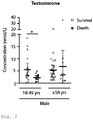
- n 44 avian H7N9 influenza positive cases of reproductive age (18-49 years) were enrolled with a median age of 42 years.
- a total of n 54 avian H7N9 influenza positive cases were included in those ⁇ 50 year olds with the median age of 61 years.
- the male H7N9 cases accounted for 75% in the younger and 70% in the older age groups, which is consistent with previous epidemiological studies based on larger laboratory-confirmed H7N9 cohorts. Blood samples of H7N9 patients were collected within acute phases after illness onset.
Landscapes
- Life Sciences & Earth Sciences (AREA)
- Health & Medical Sciences (AREA)
- Engineering & Computer Science (AREA)
- Immunology (AREA)
- Molecular Biology (AREA)
- Urology & Nephrology (AREA)
- Biomedical Technology (AREA)
- Chemical & Material Sciences (AREA)
- Hematology (AREA)
- Food Science & Technology (AREA)
- Proteomics, Peptides & Aminoacids (AREA)
- Microbiology (AREA)
- Cell Biology (AREA)
- Biotechnology (AREA)
- Medicinal Chemistry (AREA)
- Physics & Mathematics (AREA)
- Analytical Chemistry (AREA)
- Biochemistry (AREA)
- General Health & Medical Sciences (AREA)
- General Physics & Mathematics (AREA)
- Pathology (AREA)
- Pharmaceuticals Containing Other Organic And Inorganic Compounds (AREA)
Priority Applications (6)
| Application Number | Priority Date | Filing Date | Title |
|---|---|---|---|
| EP20172395.4A EP3904884A1 (fr) | 2020-04-30 | 2020-04-30 | Procédé de prédiction de la trajectoire d'une maladie virale |
| JP2022566073A JP7840270B2 (ja) | 2020-04-30 | 2021-04-30 | ウイルス性疾患の経過を予測する方法 |
| EP21722231.4A EP4143580A1 (fr) | 2020-04-30 | 2021-04-30 | Méthode de prédiction de l'évolution d'une maladie virale |
| US17/995,728 US20230168259A1 (en) | 2020-04-30 | 2021-04-30 | Method for predicting the course of a viral disease |
| PCT/EP2021/061452 WO2021219873A1 (fr) | 2020-04-30 | 2021-04-30 | Méthode de prédiction de l'évolution d'une maladie virale |
| CN202180031796.5A CN115485565A (zh) | 2020-04-30 | 2021-04-30 | 用于预测病毒疾病的过程的方法 |
Applications Claiming Priority (1)
| Application Number | Priority Date | Filing Date | Title |
|---|---|---|---|
| EP20172395.4A EP3904884A1 (fr) | 2020-04-30 | 2020-04-30 | Procédé de prédiction de la trajectoire d'une maladie virale |
Publications (1)
| Publication Number | Publication Date |
|---|---|
| EP3904884A1 true EP3904884A1 (fr) | 2021-11-03 |
Family
ID=70482376
Family Applications (1)
| Application Number | Title | Priority Date | Filing Date |
|---|---|---|---|
| EP20172395.4A Withdrawn EP3904884A1 (fr) | 2020-04-30 | 2020-04-30 | Procédé de prédiction de la trajectoire d'une maladie virale |
Country Status (1)
| Country | Link |
|---|---|
| EP (1) | EP3904884A1 (fr) |
Citations (1)
| Publication number | Priority date | Publication date | Assignee | Title |
|---|---|---|---|---|
| US10369205B2 (en) * | 2014-01-07 | 2019-08-06 | Babita Agrawal | Immunomodulatory compositions and methods of use thereof |
-
2020
- 2020-04-30 EP EP20172395.4A patent/EP3904884A1/fr not_active Withdrawn
Patent Citations (1)
| Publication number | Priority date | Publication date | Assignee | Title |
|---|---|---|---|---|
| US10369205B2 (en) * | 2014-01-07 | 2019-08-06 | Babita Agrawal | Immunomodulatory compositions and methods of use thereof |
Non-Patent Citations (10)
| Title |
|---|
| ANKARBERG-LINDGREN ET AL., J STEROID BIOCHEM MOL BIOL, vol. 183, 2018, pages 116 - 124 |
| HOFFMANN MARKUS ET AL: "SARS-CoV-2 Cell Entry Depends on ACE2 and TMPRSS2 and Is Blocked by a Clinically Proven Protease Inhibitor", CELL, ELSEVIER, AMSTERDAM, NL, vol. 181, no. 2, 5 March 2020 (2020-03-05), pages 271, XP086136225, ISSN: 0092-8674, [retrieved on 20200305], DOI: 10.1016/J.CELL.2020.02.052 * |
| POZZILLI PAOLO ET AL: "Commentary: Testosterone, a key hormone in the context of COVID-19 pandemic", METABOLISM, CLINICAL AND EXPERIMENTAL, W.B. SAUNDERS CO., PHILADELPHIA, PA, US, vol. 108, 27 April 2020 (2020-04-27), XP086199066, ISSN: 0026-0495, [retrieved on 20200427], DOI: 10.1016/J.METABOL.2020.154252 * |
| SIQUEIRA FERREIRA ET AL., JOURNAL OF CHROMATOGRAPHY B, vol. 1064, 2017, pages 109 - 114 |
| STAR-WEINSTOCKDEY, CLINICAL MASS SPECTROMETRY, vol. 13, 2019, pages 27 - 35 |
| VAN NULAND ET AL., J PHARM BIOMED ANAL., vol. 170, 2019, pages 161 - 168 |
| VOM STEEG LANDON G ET AL: "Sex and sex steroids impact influenza pathogenesis across the life course", SEMINARS IN IMMUNOPATHOLOGY, SPRINGER BERLIN / HEIDELBERG, DE, vol. 41, no. 2, 8 October 2018 (2018-10-08), pages 189 - 194, XP037120879, ISSN: 1863-2297, [retrieved on 20181008], DOI: 10.1007/S00281-018-0718-5 * |
| WAMBIER CARLOS GUSTAVO ET AL: "Severe acute respiratory syndrome coronavirus 2 (SARS-CoV-2) infection is likely to be androgen mediated", JOURNAL OF THE AMERICAN ACADEMY OF DERMATOLOGY, MOSBY, INC, US, vol. 83, no. 1, 10 April 2020 (2020-04-10), pages 308 - 309, XP086181548, ISSN: 0190-9622, [retrieved on 20200410], DOI: 10.1016/J.JAAD.2020.04.032 * |
| WOODING ET AL., STEROIDS, vol. 96, 2015, pages 89 - 94 |
| WOODINGSIQUEIRA FERREIRAKESKI-RAHKONEN ET AL., ANALYTICAL CHEMISTRY, vol. 87, no. 14, 2015, pages 7180 - 7186 |
Similar Documents
| Publication | Publication Date | Title |
|---|---|---|
| Shih et al. | Fighting COVID-19: A quick review of diagnoses, therapies, and vaccines | |
| Argyropoulos et al. | Association of initial viral load in severe acute respiratory syndrome coronavirus 2 (SARS-CoV-2) patients with outcome and symptoms | |
| Lv et al. | Dynamic change process of target genes by RT-PCR testing of SARS-Cov-2 during the course of a Coronavirus Disease 2019 patient | |
| Duggan et al. | Is novel coronavirus 2019 reinfection possible? Interpreting dynamic SARS-CoV-2 test results | |
| Rothan et al. | The epidemiology and pathogenesis of coronavirus disease (COVID-19) outbreak | |
| Kaul | An overview of coronaviruses including the SARS-2 coronavirus–molecular biology, epidemiology and clinical implications | |
| Ambrosino et al. | Gender differences in patients with COVID-19: a narrative review | |
| Azekawa et al. | Co-infection with SARS-CoV-2 and influenza A virus | |
| Wang et al. | Differences of severe acute respiratory syndrome coronavirus 2 shedding duration in sputum and nasopharyngeal swab specimens among adult inpatients with coronavirus disease 2019 | |
| Anifandis et al. | COVID-19 and human reproduction: A pandemic that packs a serious punch | |
| Alseoudy et al. | Prognostic impact of toll-like receptors gene polymorphism on outcome of COVID-19 pneumonia: A case-control study | |
| Taşlıdere et al. | Melkersson-Rosenthal syndrome induced by COVID-19 | |
| Periolo et al. | Pregnant women infected with pandemic influenza A (H1N1) pdm09 virus showed differential immune response correlated with disease severity | |
| Kumar et al. | COVID-19 pandemic: insights into molecular mechanisms leading to sex-based differences in patient outcomes | |
| Narota et al. | COVID-19 and ARDS: update on preventive and therapeutic venues | |
| Scordio et al. | High frequency of neutralizing antibodies to type I Interferon in HIV-1 patients hospitalized for COVID-19 | |
| Al-Bayati et al. | Potential role of TLR3 and RIG-I genes expression in surviving covid-19 patients with different severity of infection | |
| CN113311164A (zh) | 新型冠状病毒(covid-19)及其他病毒感染的诊断和治疗 | |
| Liang et al. | Low infectious risk of re-positive COVID-19 patients: a single-center study | |
| US20230168259A1 (en) | Method for predicting the course of a viral disease | |
| EP3904884A1 (fr) | Procédé de prédiction de la trajectoire d'une maladie virale | |
| Kashani et al. | Molecular and clinical investigation of covid-19: from pathogenesis and immune responses to novel diagnosis and treatment | |
| Gharib et al. | Profiling Inflammatory Cytokines in a Cohort Study of Egyptian Patients with COVID-19 Infection. | |
| Raoof et al. | Clinical signs, laboratory diagnosis and treatments involved in corona viruses-19 | |
| Hazra et al. | The DNA glycosylase NEIL2 plays a vital role in combating SARS-CoV-2 infection |
Legal Events
| Date | Code | Title | Description |
|---|---|---|---|
| PUAI | Public reference made under article 153(3) epc to a published international application that has entered the european phase |
Free format text: ORIGINAL CODE: 0009012 |
|
| STAA | Information on the status of an ep patent application or granted ep patent |
Free format text: STATUS: THE APPLICATION HAS BEEN PUBLISHED |
|
| AK | Designated contracting states |
Kind code of ref document: A1 Designated state(s): AL AT BE BG CH CY CZ DE DK EE ES FI FR GB GR HR HU IE IS IT LI LT LU LV MC MK MT NL NO PL PT RO RS SE SI SK SM TR |
|
| B565 | Issuance of search results under rule 164(2) epc |
Effective date: 20201116 |
|
| STAA | Information on the status of an ep patent application or granted ep patent |
Free format text: STATUS: THE APPLICATION IS DEEMED TO BE WITHDRAWN |
|
| 18D | Application deemed to be withdrawn |
Effective date: 20220504 |