EP3905721A1 - Procédé d'étalonnage d'un dispositif de traitement audio de niveau d'oreille - Google Patents
Procédé d'étalonnage d'un dispositif de traitement audio de niveau d'oreille Download PDFInfo
- Publication number
- EP3905721A1 EP3905721A1 EP20203622.4A EP20203622A EP3905721A1 EP 3905721 A1 EP3905721 A1 EP 3905721A1 EP 20203622 A EP20203622 A EP 20203622A EP 3905721 A1 EP3905721 A1 EP 3905721A1
- Authority
- EP
- European Patent Office
- Prior art keywords
- ear
- audio processing
- processing device
- level audio
- transducer
- Prior art date
- Legal status (The legal status is an assumption and is not a legal conclusion. Google has not performed a legal analysis and makes no representation as to the accuracy of the status listed.)
- Withdrawn
Links
Images



Classifications
-
- H—ELECTRICITY
- H04—ELECTRIC COMMUNICATION TECHNIQUE
- H04R—LOUDSPEAKERS, MICROPHONES, GRAMOPHONE PICK-UPS OR LIKE ACOUSTIC ELECTROMECHANICAL TRANSDUCERS; ELECTRIC HEARING AIDS; PUBLIC ADDRESS SYSTEMS
- H04R29/00—Monitoring arrangements; Testing arrangements
- H04R29/001—Monitoring arrangements; Testing arrangements for loudspeakers
-
- H—ELECTRICITY
- H04—ELECTRIC COMMUNICATION TECHNIQUE
- H04R—LOUDSPEAKERS, MICROPHONES, GRAMOPHONE PICK-UPS OR LIKE ACOUSTIC ELECTROMECHANICAL TRANSDUCERS; ELECTRIC HEARING AIDS; PUBLIC ADDRESS SYSTEMS
- H04R1/00—Details of transducers, loudspeakers or microphones
- H04R1/10—Earpieces; Attachments therefor ; Earphones; Monophonic headphones
- H04R1/1025—Accumulators specially adapted for earpieces; Arrangements specially adapted for charging thereof
-
- H—ELECTRICITY
- H04—ELECTRIC COMMUNICATION TECHNIQUE
- H04R—LOUDSPEAKERS, MICROPHONES, GRAMOPHONE PICK-UPS OR LIKE ACOUSTIC ELECTROMECHANICAL TRANSDUCERS; ELECTRIC HEARING AIDS; PUBLIC ADDRESS SYSTEMS
- H04R1/00—Details of transducers, loudspeakers or microphones
- H04R1/10—Earpieces; Attachments therefor ; Earphones; Monophonic headphones
- H04R1/1083—Reduction of ambient noise
-
- H—ELECTRICITY
- H04—ELECTRIC COMMUNICATION TECHNIQUE
- H04R—LOUDSPEAKERS, MICROPHONES, GRAMOPHONE PICK-UPS OR LIKE ACOUSTIC ELECTROMECHANICAL TRANSDUCERS; ELECTRIC HEARING AIDS; PUBLIC ADDRESS SYSTEMS
- H04R25/00—Electric hearing aids
- H04R25/30—Monitoring or testing of hearing aids, e.g. functioning, settings, battery power
- H04R25/305—Self-monitoring or self-testing
-
- H—ELECTRICITY
- H04—ELECTRIC COMMUNICATION TECHNIQUE
- H04R—LOUDSPEAKERS, MICROPHONES, GRAMOPHONE PICK-UPS OR LIKE ACOUSTIC ELECTROMECHANICAL TRANSDUCERS; ELECTRIC HEARING AIDS; PUBLIC ADDRESS SYSTEMS
- H04R29/00—Monitoring arrangements; Testing arrangements
- H04R29/004—Monitoring arrangements; Testing arrangements for microphones
Definitions
- the present invention is generally related to the field of ear-level audio processing devices and methods for adjusting one or more characterizing parameters of such devices.
- HIT hearing instrument test
- the tests measure device properties, such as the maximum gain the device can undergo, the frequency response, etc.
- the mentioned electroacoustic standards do not make a distinction between usage by a trained person and usage by a layperson. Emphasis is put on enforcing that the device be used as intended. For instance, an instruction manual is often required to ensure correct operation of the device. Allowing usage by a layperson may put more constraints on the labelling and instructions to be provided or on the built-in safeguards to be implemented for proper device operation.
- a hearing aid device In order to test the performance of a hearing aid device, the latter device is plugged into the test box by using a 2cc coupler, as it is often mandated by standards (e.g. ANSI/ASA S3.55-2014/Part 5 / IEC 60318- 5:2006). These couplers provide a standardized volumetric cavity that resembles the average human ear's acoustical properties.
- a hearing aid device After a hearing aid device has been calibrated, its characteristics may degrade during normal use. Common causes of performance degradation include :
- Smart headsets are technically advanced, electronic in-the-ear-devices designed for multiple purposes, ranging from wireless transmission to communication objectives, medical monitoring and so on. Smart headsets combine major assets of wearable technology with the basic principle of audio-based information services, conventional rendition of music and wireless telecommunication. In order to be able to handle a variety of complex audio tasks, smart headsets contain tiny but capable processing units.
- Modern headsets are equipped with a system-on-chip (SoC) that includes one or several central processing units (CPU) and digital signal processing units (DSP), random access memory (RAM), flash memory and a wireless connectivity, e.g. Bluetooth connectivity, chipset that can perform very complex tasks.
- SoC system-on-chip
- CPU central processing units
- DSP digital signal processing units
- RAM random access memory
- flash memory and a wireless connectivity, e.g. Bluetooth connectivity, chipset that can perform very complex tasks.
- Bluetooth connectivity e.g. Bluetooth connectivity
- TWS True Wireless Stereo
- Such headsets often come in a case that comprises a battery. This allows the headset to provide on-demand charging and also allows for a convenient way of storage with minimal chance of losing the device.
- Certain devices adapted for performing Active Noise Cancelling (ANC) have a multiple microphone configuration, with at least two microphones per ear side.
- US2020/058287 discloses active noise cancelling headphones in the form of a part of a headset or as in-ear headphones that reduce acoustic adaptation by providing an electrodynamic speaker in a housing with ventilation openings and an acoustically permeable front panel. These components form a module that can be integrated into ANC headphones. The module reacts to a reduction of the impermeability situation, whereby an impedance change of the speaker takes place below 100 Hz.
- the invention in a first aspect relates to a method for adjusting with aid of an auxiliary device at least one characteristic of an ear-level audio processing device.
- the ear-level audio processing device comprises at least one output transducer and the auxiliary device comprises at least one input transducer and/or output transducer.
- the method comprises :
- the proposed solution indeed allows for adjusting a characteristic of the ear-level processing device. At least one of the ear-level audio processing device and the auxiliary device is arranged to play the test signal. At least the input transducer of the device not used for playing the test signal captures the latter signal. Test data is then collected from the recorded signals. From the collected data an adjusted value of a characteristic of the ear-level audio processing device can then be determined. It is to be noted that this adjusting of a characteristic in practice comes close to performing calibration, or at least a part thereof, the ear-level processing device.
- the proposed method lends itself for use in a procedure wherein the ear-level audio processing device is in a possibly automated and possibly periodic way kept up-to-date. For example, the method may be carried out a first time at manufacturing time. Once an end user has purchased the ear-level audio processing device, the method can be repeated at regular or irregular times.
- the step of collecting test data comprises determining a noise profile of the output transducer used for playing the test signal and/or of the at least one input transducer used for the recording.
- collecting test data comprises labelling the test data with a time stamp to track an evolution over time. Comparing the noise profile of a given input transducer of the ear-level audio processing device or the auxiliary device.
- the method comprises determining a correlation between two distinct input transducer noise profiles.
- the method comprises anonymizing the collected test data.
- the signals obtained from said recording are stored.
- the signals obtained from said recording are in some embodiments processed before being stored.
- the ear-level audio processing device has audiometer and/or hearing aid functionality.
- the ear-level audio processing device is an earbud of a pair of earbuds and the auxiliary device is a charging box arranged for charging the pair of earbuds.
- the charging box may comprise in some embodiments at least one input transducer and at least one output transducer.
- test signal is also recorded with a feedback input transducer of the device used for playing the test signal.
- the invention relates to the use of the method as previously described in a, possibly automated, procedure for obtaining an updated characterization of the ear-level audio processing device or of the auxiliary device.
- said updated characterization is exploited to produce one or more updated digital calibration tables associated with the ear-level audio processing device or of the auxiliary device.
- the invention relates to the use of the method as previously described for configuring a sound personalization or hearing loss compensation of a used of said ear-level audio processing device.
- the invention relates to a hearing assistive system comprising at least one ear-level audio processing device and an auxiliary device.
- the auxiliary device may in some embodiments be, for example, a charging box or may be implemented rather as a distributed system comprising a charging box and an ear bud of a pair of earbuds, the other one being calibrated.
- the hearing assistive system may also comprise a further ear level audio processing device and/or an accessory to an ear level audio processing device, e.g. a remote microphone (which is not carried at ear level).
- the charging bow could then contain a placeholder for the remote microphone in addition to a placeholder for the ear level audio processing devices.
- the input transducer of the remote microphone can then be used in the method for calibration as described herein.
- ear level audio processing device is used to refer to any device that resides at ear-level and has at least one audio output and some means for standalone processing (a DSP, a CPU).
- DSP digital signal processor
- CPU central processing unit
- 'ear level audio processing device' and 'hearing device' are used as synonyms.
- Hearing devices typically include a set of input and output transducers, for instance microphones and speakers.
- Input acoustic transducers convert variations of the sound pressure level (SPL) into electrical signals which are then sampled by an analog-to-digital converter (ADC) and converted in the digital domain.
- Other transducers such as microelectromechanical systems (MEMS) can convert SPL variation into a digital signal without the need for an external ADC.
- acoustic output transducers coupled with a digital-to-analog converter can convert a digital signal into variation of the SPL.
- Each input or output transducer is associated with one or more digital calibration tables containing correction factors to input or output gains to be applied to the frequency response of the associated transducer. Such correction factors are stored in a digital format.
- a given transducer may be associated with several digital calibration tables for various reasons, for example :
- Calibration tables constitute a set of adjustment factors to be applied to a digital signal so that:
- a digital calibration is defined as the action of adjusting one or more correction factors contained in one or more digital calibration tables corresponding to one or more input or output transducers in order to represent the relationship between digital control signal and generated vibration or sound pressure (output transducer case) or to represent the relationship between measured vibration or sound pressure level and the output digital representation of this measurement (input transducer).
- a digital calibration may be, but is not necessarily, linked to a given standard. The calibration can be performed by an end user or by a professional.
- Self-testing is an automated procedure involving the electro-acoustic interaction between a hearing device (be it made of a single physical object as in an over-the-ear headphones form factor, or of several physical objects as in a pair of TWS earbuds, whereby the self-testing is performed first on one of the earbuds and next on the other) and its user and enabling the assessment of the user hearing profile and/or hearing loss and/or audiogram, that can be used to configure a sound personalization and/or hearing loss compensation device or system.
- Self-assessment is an automated procedure involving one or more hearing devices and/or associated devices producing an updated characterization of the behaviour of the considered hearing devices and/or associated devices, represented in a digital format.
- Self-calibration is an automated procedure involving one or more hearing devices and/or associated devices, which uses the output of one or more previous self-assessment procedures as well as other information available to the set of devices to produce updated digital calibration tables associated with the set of devices input and/or output transducers.
- auxiliary device is meant a single device (e.g. another hearing device or a charging box) used for assisting in a self-assessment or a self-calibration procedure as associated device.
- the auxiliary device can be part of a distributed system.
- Other components of the distributed system can be active (i.e. they can generate signals via output transducers, record signal via input transducers, and/or perform computation), but they can also be passive, for instance, in the case of a storage box with no active electronics.
- the present invention aims to provide a method for adjusting a characteristic of an ear-level audio processing device (i.e. a hearing device) with the aid of an auxiliary device via which the ear-level audio processing device can be adjusted, for example be calibrated.
- an auxiliary device via which the ear-level audio processing device can be adjusted, for example be calibrated.
- the ear-level audio processing device is capable of detecting various types of malfunction, as will be detailed later in this description.
- the ear-level audio processing device in some embodiments offers audiometer and/or hearing aid functionality. Preferably both hearing aid and audiometer functionality are then provided in the ear-level audio processing device.
- the ear-level audio processing device is a consumer headset which does not have hearing aid functionality or audiometer functionality.
- the ear-level audio processing device is in this embodiment implemented as a pair of TWS earbuds, which is one example of what hereafter is also referred to as a headset.
- a pair of earbuds is here to be considered as a pair of hearing devices, i.e. each earbud is seen as a hearing device on its own.
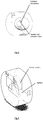
- Fig.1 to Fig.4 provide a schematic representation of a modern TWS earbud enhanced with a hearing aid and/or audiometer functionality.
- the earbuds of the pictured headset each comprise, by way of example, two external microphones (see Fig.1 ) to capture signals from the acoustic environment and one feedback microphone (see Fig.3 ) to record variations of acoustic pressure in a speaker pathway and ear canal.
- the TWS earbud charging connectors as shown in Fig.2 make contact with the charging connectors of the charging box when the earbuds are inserted into it.
- TWS earbud comprise a System-on-Chip comprising amongst other things input/output ports, a CPU and storage and offering wireless connectivity (including but not limited to Bluetooth), and a battery.
- the TWS earbud internal components are shown in Fig.4 .
- the ear-level audio processing device may optionally include sensors such as biometric sensors, contact conduction sensors, capacitive touch sensors, accelerometers, gyroscopes and buttons.
- the pair of TWS earbuds can be inserted in its charging box.
- the receiving enclosure of the charging box includes charging connectors that make contact with the TWS earbuds when they are placed into the box enclosure.
- Existing charging boxes include a connector to an external power supply (typically, but not necessarily, USB), a microcontroller arranged to handle the charging process, and charging connectors which allow making contact with the each of the TWS earbud connectors when they are placed in the box enclosure.
- hearing aid functionality can be provided in the headset, i.e. in each of the earbuds, in the form of a pure software solution that runs on the headset, e.g. on the CPU comprised in the headset.
- the particular hearing characteristics of the user can then be compensated for by adjusting parameters that affect that audio processing.
- These adjustments as a function of frequency, called fitting, can range from a small amplification to very high levels of amplification.
- a large range of required amplification levels can be found.
- audiometer functionality if present, allows measuring user hearing thresholds based on the presentation of auditory stimuli at a controlled sound pressure level and frequency. As such, solutions allowing audiometer functionality need to be acoustically calibrated as well.
- headsets featuring Active Noise Cancellation may allow adjusting individual earbud characteristics.
- the left or right-side earbud generates a test signal using its speaker and records the signal entering the feedback microphone located close to the loudspeaker acoustic pathway while also recording the signal entering the external microphones which are less sensitive to the acoustic pressure variations originating from the loudspeaker because of their position.
- the processing means can analyse the recorded signals and adjust the relative relationship between loudspeaker and microphones gains and digital filters to allow for a fine-tuning of the ANC.
- a hearing assistive system comprises apart from an ear-level audio processing device, possibly with hearing aid and/or audiometer functionality, also an auxiliary tool which is used in the calibration process.
- the charging box takes in an advantageous embodiment the role of auxiliary device employed for calibration purposes.
- one of the earbuds is the audio processing device of which a characteristic is to be adjusted and the other earbud acts as auxiliary device.
- the charging box is then part of a distributed system that further comprises the other bud.
- Various embodiments of the approach of this invention implement calibration and self-adjusting and self-diagnostic scenarios by means of the charging box.
- One option is to provide in the charging box a volumetric cavity (similar to a 2cc coupler) and a central DSP using a configuration with one or more microphones and transducers for converting between electrical and acoustic signals.
- This set-up allows for a self-testing of one or both of the two TWS earbuds when they are placed into the charging box, either with the purpose of charging or not.
- the charging box may produce test signals through its output transducer and record the response to these signals using its input transducers.
- a charging box manufacturer may want the manufactured charging box to perform electroacoustic measurements that meet the maximum allowed uncertainties of a standard to be covered.
- the example is taken of compliance with ANSI S3.22-2003/ IEC 60118-7 (2005), which - among other requirements - specifies the uncertainties allowed for a testing device sound source.
- the sound source in combination with a pressure-calibrated controlling microphone, must be capable of producing at the test point the requisite sound pressure levels between 50 dB and 90 dB, with a minimum step size of 5 dB, within a tolerance of ⁇ 1,5 dB over the frequency range 200 Hz to 2000 Hz and within ⁇ 2,5 dB over the range 2000 Hz to 5000 Hz.
- Requirements for the pressure-calibrated controlling microphone measuring the hearing device output must also be met.
- the equipment for measuring the coupler sound pressure level produced by the hearing device must fulfil the following requirements :
- the charging box manufacturer aims at certifying that the manufactured device meets a given standard from the list already mentioned in the background section, it can be demonstrated the criteria of methodology, maximum allowed uncertainties, and measurements traceability are met, and the manufacturer may ask a third-party entity to audit the manufacturing and calibration process to certify the charging box.
- the manufacturer In addition to certifying the manufactured device characteristics, the manufacturer must make sure that the charging box is used in the intended way (either by a layperson or a trained specialist), for instance by providing complete instructions of use adapted to the targeted user.
- a manufactured device meeting the requirements given above is labelled as "standard-compliant".
- the charging box may be certified as standard-compliant for a given electroacoustic audiometer or hearing aid standard. A periodic maintenance performed by the charging box manufacturer or a certified technician may be required.
- the method of the present invention can advantageously applied as another step towards compliance with a standard. Given that the charging box itself is standard compliant, it can be used to perform the self-assessment and self-calibration of the ear-level audio processing device for this standard, provided that the self-assessment or self-calibration is performed in an environment that is compatible with the intended use of the device. The self-assessment and self-calibration performed are then comparable to a laboratory testing instrument such as a Hearing Instrument Testing device. Doing so provides several advantages :
- the charging box operates in some embodiments of the invention as a calibration tool that calibrates the earbuds when they are placed in the charging box.
- the calibrated earbuds so allow measuring sound pressure levels in the ear.
- the auxiliary device i.e. the charging box, fulfils an active role in the calibration of the earbuds.
- the proposed set-up allows for offering hearing aid characterization of the ear-level audio processing device in accordance to the list of standards already given in the background section.
- the auxiliary device e.g. the charging box
- the charging box still allows for self-assessment of the enclosed earbuds, the presence of one or more input or output transducers or both input and output transducers enabling the detection of anomalies in the hearing devices components (input and output transducers) and their associated acoustic pathways, and allowing cross-device measurements to be made. Also additional redundancy is provided. This approach may provide enough robustness to be a useful alternative to a standard-compliant solution. Also in this scenario the auxiliary device fulfils an active an active role in the calibration of the earbuds.
- auxiliary device is rather part of a distributed system.
- This system comprises a charging box so designed that, when the earbuds are placed into the charging box, either with the purpose of charging or not, the two earbuds face each other's back end. This allows one earbud to act as the sound generating device, while the other earbud acts as sound recording device.
- the charging box and one of the earbuds form the distributed auxiliary system used to characterize the other earbud of the pair, which is the device to be tested.
- the charging box provides a coupling between the two earbuds and/or allows locating the earbuds with respect to one another, i.e.
- the charging box when placed in the charging box the exact position of the two hearing devices relative to each other is known. Both hearing devices' feedforward and, if present, feedback microphones can be used as control means to identify possible malfunction of the earbud being tested. Self-testing of the ear-level audio processing device is so possible, while keeping the cost reduced (no additional transducers or microphones need to be included in the charging box in this case).
- the charging box was an active component in the calibration process, the charging box is now rather used as a tool to enable the self-assessment and self-calibration. It is in this scenario that the other earbud plays an active part in the self-assessment and self-calibration.
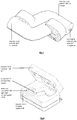
- Fig.5 illustrates the main internal components of a TWS earbud charging box, including a SoC, battery and a power supply connector.
- the charging box also includes one or more output transducers able to generate sound or vibration and input transducers such as measurement microphones, as shown in Fig.8 . Note that these features are not strictly necessary in case a calibration process is adopted wherein the charging box is not actively used.
- Fig.6 shows how TWS earbuds can be spatially arranged so that a device speaker acoustic pathway faces the other earbud's external microphones acoustic pathway.
- this spatial arrangement may readily be obtained.
- An acoustic signal generated via an output transducer of one earbud can be detected and recorded by the other earbud input transducers, such as the external microphones. This allows for inter-device acoustic measurements in the scenario wherein the charging box as such is not actively used.
- Fig.7 shows the design of an acoustic chamber (in the enclosing box) that allows the placement of TWS earbuds as shown in Fig.6 .
- an acoustic canal connecting one device speaker acoustic pathway to the other device (earbud) is provided.
- the designed acoustic canal includes at least an opening for connecting it to an external reference microphone (note only one of the two openings is depicted in Fig.7 ).
- Fig.8 shows a charging box design in which the acoustic chamber depicted in Fig.7 can be implemented, using the box main structure and closing lid when the lid is closed.
- the charging box includes at least two reference microphones, at least one of each being located at the end of each of the two speaker canals.
- the acoustic canal chamber bottom half also includes charging connectors for each of the two TWS earbuds. A physical constraint with respect to the location of the charging connectors of the TWS earbuds needs to be applied for the connectors to be able to contact the box main structure in the proposed physical configuration.
- Fig.9 shows the charging box depicted in Fig.8 with the left and right earbuds installed.
- test signals may come from the set of test signals mentioned in one or more of the various standards listed in the background section of this document.
- the test signals may include a warble tone, a pure tone, random noise, pseudo-random noise, band limited white noise, chirp, ICRA noise, Real Speech.
- the ear-level audio processing device comprises at least one output transducer. In advantageous embodiments the ear-level audio processing device also comprises at least one input transducer.
- the auxiliary device comprises at least one input transducer or output transducer. In some embodiments the auxiliary device comprises at least one input transducer and at least one output transducer. In some embodiments the auxiliary device comprises at least one transducer which is the opposite of a transducer available in the ear-level audio processing device, e.g. if the ear-level audio processing device contains an output transducer then the auxiliary device has an input transducer. If the ear-level audio processing device comprises both an input transducer and an output transducer, the auxiliary device contains an input transducer or an output transducer or one or more of both.
- the test signal can be played back by a speaker of the auxiliary device (i.e. belonging to either the charging box or a hearing device not being tested, if e.g. a set-up with a headset is considered) and the response to the acoustic pressure derived from playback is recorded via one or more microphones of the hearing device to be tested, assessed or calibrated.
- a speaker of the auxiliary device i.e. belonging to either the charging box or a hearing device not being tested, if e.g. a set-up with a headset is considered
- the response to the acoustic pressure derived from playback is recorded via one or more microphones of the hearing device to be tested, assessed or calibrated.
- Two options are available for storing the microphone recorded signal. In the first option the raw digital signal coming from the microphone is stored. In the second option post-processing of the raw digital signal is applied so that statistics describing the recorded signal are computed by either the auxiliary device (e.g. the charging box) or the hearing device, and
- the resulting variations of the sound pressure level can be measured by at least one of, the external microphone(s) of the other hearing device (e.g. in case a pair of earbuds is used) and the same-side reference microphone of the charging box if it is included in the design. Further the sound pressure level may also be measured by a feedback microphone of the sound generating device, if present. In case a speaker of the other hearing device (not being tested) is used, the external microphone(s) or the feedback microphone of the hearing device being tested are used for measuring the sound pressure level or an input transducer of the charging box.
- the test data collection procedure uses test signals generated via a transducer of the charging box
- the resulting variations of the sound pressure level can be measured by the hearing devices input transducers (in an implementation with a pair of earbuds, both earbuds can be tested simultaneously or sequentially in this use case), and possibly also by the charging box input transducers.
- a reference recording can so be obtained with which the recordings of the tested devices input transducers can be compared.
- test data collection procedures described above may further involve the synchronization of the devices involved (for example, the charging box and each of the two TWS earbuds). Playback on one device must be synchronized with the recording on the other device(s). Data communication between the devices enables the exchange of synchronization messages. Data communication can be implemented using for example data transfer over the charging connectors or wireless Bluetooth Low Energy connectivity or any other wireless connectivity protocol.
- the data collection steps described above can be performed at several points in time to extract statistics that allow understanding the evolution over time of transducers (including speaker and microphones) response, and the current obstruction state of their acoustic pathways.
- the data collection sequence is first performed at manufacturing time, where the device characteristics and state of the pathways are as close as possible to the nominal values given the tolerances of the manufacturing process. Characterization before use can also be verified using additional measurement material, as described above. The data collected at this time is stored for the tested device and can be labelled as "factory data".
- a data collection sequence can be scheduled (either manually by the user or in an automated, possibly periodic way), and this data collection sequence will be executed for example the next time the hearing device is placed into the charging box.
- the parameters related to the sound generation part of the test sequence are the same as the ones used for generating the factory data.
- a general method for data collection of test sequences to be used for self-assessment and/or self-calibration using one or more hearing devices coupled with an associated auxiliary device, which in some embodiments can be implemented as a charging box. In other embodiments one of the earbuds of a pair serves as associated auxiliary device.
- the general method encompasses the use cases described above.
- Each hearing device output transducer S s t is labelled with an index s ranging from 0 to S-1, where S is the number of hearing devices, and another index t ranging from 0 to T-1, where T is the number of output transducers per hearing device or per accessory to a hearing device.
- T is the number of output transducers per hearing device or per accessory to a hearing device.
- T is the number of output transducers per hearing device or per accessory to a hearing device.
- T the number of output transducers per hearing device or per accessory to a hearing device.
- T the number of output transducers per hearing device or per accessory to a hearing device.
- T the number of output transducers per hearing device or per accessory to a hearing device.
- T the number of output transducers per hearing device or per accessory to a hearing device.
- Each charging box output transducer b is labelled with an index ranging from 0 to B-1, where B is the number of output transducers in the charging box.
- B is the number of output transducers in the charging box.
- Each microphone m is labelled with an index ranging from 0 to M-1, where M is the number of microphones of each device mh i being used during data collection. If a use case with hearing device speaker-generated test signals is taken and assuming each hearing device is equipped with three microphones (e.g. two external microphones and one feedback microphone), then, for each hearing device, M equals 3 and a possible labelling of the microphones would be :
- the response to a test signal generated by sound source s i or b j can be recorded by microphones mh 0 k , mh 1 k , mb 0 l , mb 1 l , for 0 ⁇ i ⁇ S, 0 ⁇ j ⁇ B, 0 ⁇ k ⁇ M, and 0 ⁇ I ⁇ N.
- the microphone signals can be recorded simultaneously or sequentially, given that the generated signal is constant during the recording sequence.
- the recorded signal is analysed either during recording or after recording (as explained previously), and allows generating any of the following noise profiles :
- the hearing devices and charging box can be connected to a device with increased storage and computational power and possibly with internet connectivity. This is, for instance, the case for existing hearing aids or wireless headsets or earbuds connected to a smartphone and arranged to exchange information with an authorized application installed on the user smartphone.
- the timestamped data obtained after data collection can be analysed to track the evolution over time of the noise profiles obtained after recording a test sequence.
- To perform this assessment for a given generator configuration G wherein the test signals are generated, it is possible to compare several test sequences that were performed for the same generator configuration G, taken at different timestamps.
- the resulting list of data collections is noted [ Test_sequence(G, t 0 ), ..., Test_sequence(G, t T-1 ) ], where T is the number test sequences corresponding to a particular generator configuration, and t 0 , ..., t T-1 are the timestamps at which these test sequences where produced.
- a first method of self-assessment is to compare the noise profile of a given input transducer of a hearing device and/or auxiliary device at different timestamps, allowing for detecting a change in the transducer characteristics.
- Similarity metrics can be used to measure the similarities between noise profiles, including, but not limited to, Root Mean Square error (RMS), Earth-Moving Distance (EMD), Manhattan Distance (MD).
- a second method of self-assessment is to compute the correlation of distinct input transducers noise profiles in a test sequence performed at time t, and also to compute this correlation between successive test sequences produced at time t 0 , ..., t T-1 .
- Several metrics can be used to measure the correlations between noise profiles, including, but not limited to, cross-correlation, Mutual Information, KL-Divergence.
- Detecting outliers can be performed in various ways. Some examples are the following :
- timestamped data obtained after collection from each user's device(s) can be anonymized and forwarded to a companion application installed on a user smartphone, which can apply further processing on it and upload it to a remote server operated by the device manufacturer or distributor.
- timestamped data related to self-testing and calibration for all devices manufactured will be available for further processing. Privacy issues can be addressed provided the collected data does not contain personal information and solely reflects the state of calibration of the device. For instance, such processing may allow answering questions like, for example,
- the headset is a classical headset, i.e. a set of headphones joined by a band (e.g. placed over the head).
- the headphones have at least one microphone attached per ear side, and optionally any number of external or feedback microphones per ear side.
- the two earcups of the headphones are brought close enough into each other's neighbourhood in a way that the acoustic pathways between one earcup output transducer and the other earcup microphones can be controlled in a reproducible way, the methods as described above can readily be applied.
- the two earcups can be brought into each other's neigbourhood by using, for instance, a folding mechanical design in which, when the over-the-ear headphone is folded, the two earcups are in vicinity of each other or face each other.
- the ear-level audio processing device is a hearing aid.
- the hearing aid device includes at least one microphone per ear side and can further also include any number of external or feedback microphones per ear side.
- the hearing aid is further provided with a processing means, for example a digital signal processor or a CPU.
- the hearing aid is capable of exchanging data, synchronizing playback and recording with an auxiliary tool, for example a charging box or the hearing aid at the other side, using a wireless communication protocol, for example Bluetooth, WiFi or Near-Field Magnetic Induction (NFMI), or using a wired communication protocol via the charging connector.
- a wireless communication protocol for example Bluetooth, WiFi or Near-Field Magnetic Induction (NFMI)
- NFMI Near-Field Magnetic Induction
- the ear-level audio processing device is a hearing aid that uses replaceable batteries, as this is the case in several hearing aid models currently distributed on the market.
- the enclosing box is then not meant for charging but has the purpose of storage, self-assessment and self-calibration of the hearing aids.
- the ear-level audio processing device includes at least a feedback microphone per ear side in addition to other transducers.
- the role of the feedback microphone in addition to estimating the output level of the speaker and participating in the self-assessment and self-calibration process described above, is also to provide an estimation of the filtering taking place in the user ear canal due to the user ear canal specific shape, thus yielding an estimate of a Real Ear Measurement (REM).
- REM Real Ear Measurement
- the self-assessment and self-calibration method presented here can be focused at preserving a good approximation of a REM using the feedback microphones included in the hearing devices.
- the ear-level audio processing device includes at least a speaker per ear side in addition to other transducers.
- the speakers included in each side come from a matched pair, which means they have been manufactured and adjusted to have similar characteristics.
- the self-assessment and self-calibration method presented above can be focused at preserving the matching between the matched speakers.
- a computer program may be stored/distributed on a suitable medium, such as an optical storage medium or a solid-state medium supplied together with or as part of other hardware, but may also be distributed in other forms, such as via the Internet or other wired or wireless telecommunication systems. Any reference signs in the claims should not be construed as limiting the scope.
Landscapes
- Physics & Mathematics (AREA)
- Engineering & Computer Science (AREA)
- Acoustics & Sound (AREA)
- Signal Processing (AREA)
- Health & Medical Sciences (AREA)
- General Health & Medical Sciences (AREA)
- Otolaryngology (AREA)
- Neurosurgery (AREA)
- Measurement Of The Respiration, Hearing Ability, Form, And Blood Characteristics Of Living Organisms (AREA)
Applications Claiming Priority (1)
| Application Number | Priority Date | Filing Date | Title |
|---|---|---|---|
| US202063015875P | 2020-04-27 | 2020-04-27 |
Publications (1)
| Publication Number | Publication Date |
|---|---|
| EP3905721A1 true EP3905721A1 (fr) | 2021-11-03 |
Family
ID=73014325
Family Applications (1)
| Application Number | Title | Priority Date | Filing Date |
|---|---|---|---|
| EP20203622.4A Withdrawn EP3905721A1 (fr) | 2020-04-27 | 2020-10-23 | Procédé d'étalonnage d'un dispositif de traitement audio de niveau d'oreille |
Country Status (1)
| Country | Link |
|---|---|
| EP (1) | EP3905721A1 (fr) |
Cited By (6)
| Publication number | Priority date | Publication date | Assignee | Title |
|---|---|---|---|---|
| US20220086578A1 (en) * | 2020-09-11 | 2022-03-17 | Samsung Electronics Co., Ltd. | Electronic device for outputting sound and method for operating the same |
| CN115297419A (zh) * | 2022-07-12 | 2022-11-04 | 中国计量科学研究院 | 一种用于校准助听器测试仪的装置 |
| US20220408199A1 (en) * | 2021-06-18 | 2022-12-22 | Starkey Laboratories, Inc. | Self-check protocol for use by ear-wearable electronic devices |
| CN116456256A (zh) * | 2023-05-15 | 2023-07-18 | 深圳市昂思科技有限公司 | 一种助听设备的控制方法 |
| WO2023142299A1 (fr) * | 2022-01-26 | 2023-08-03 | 耿军 | Écouteur d'appareil auditif à réglage en libre-service ayant une fonction de test sans fil, et procédé de réglage associé |
| WO2025213466A1 (fr) * | 2024-04-12 | 2025-10-16 | Logital Co. Limited | Casque d'écoute d'audiomètre, système d'audiomètre et procédé de fabrication |
Citations (6)
| Publication number | Priority date | Publication date | Assignee | Title |
|---|---|---|---|---|
| US20110222696A1 (en) * | 2010-03-15 | 2011-09-15 | Nikhil Balachandran | Configurable electronic device reprogrammable to modify the device frequency response |
| US20120269356A1 (en) * | 2011-04-20 | 2012-10-25 | Vocollect, Inc. | Self calibrating multi-element dipole microphone |
| CN109246517A (zh) * | 2018-10-12 | 2019-01-18 | 歌尔科技有限公司 | 一种无线耳机的降噪麦克风校正方法、无线耳机及充电盒 |
| WO2019152729A1 (fr) * | 2018-02-01 | 2019-08-08 | Cirrus Logic International Semiconductor Ltd. | Système et procédé d'étalonnage et de test d'un système d'annulation active de bruit (anc) |
| CN110784804A (zh) * | 2019-10-31 | 2020-02-11 | 歌尔科技有限公司 | 一种无线耳机降噪校准方法、装置及耳机盒和存储介质 |
| US20200058287A1 (en) | 2018-08-20 | 2020-02-20 | Austrian Audio Gmbh | Active noise-cancelling headphones |
-
2020
- 2020-10-23 EP EP20203622.4A patent/EP3905721A1/fr not_active Withdrawn
Patent Citations (6)
| Publication number | Priority date | Publication date | Assignee | Title |
|---|---|---|---|---|
| US20110222696A1 (en) * | 2010-03-15 | 2011-09-15 | Nikhil Balachandran | Configurable electronic device reprogrammable to modify the device frequency response |
| US20120269356A1 (en) * | 2011-04-20 | 2012-10-25 | Vocollect, Inc. | Self calibrating multi-element dipole microphone |
| WO2019152729A1 (fr) * | 2018-02-01 | 2019-08-08 | Cirrus Logic International Semiconductor Ltd. | Système et procédé d'étalonnage et de test d'un système d'annulation active de bruit (anc) |
| US20200058287A1 (en) | 2018-08-20 | 2020-02-20 | Austrian Audio Gmbh | Active noise-cancelling headphones |
| CN109246517A (zh) * | 2018-10-12 | 2019-01-18 | 歌尔科技有限公司 | 一种无线耳机的降噪麦克风校正方法、无线耳机及充电盒 |
| CN110784804A (zh) * | 2019-10-31 | 2020-02-11 | 歌尔科技有限公司 | 一种无线耳机降噪校准方法、装置及耳机盒和存储介质 |
Cited By (8)
| Publication number | Priority date | Publication date | Assignee | Title |
|---|---|---|---|---|
| US20220086578A1 (en) * | 2020-09-11 | 2022-03-17 | Samsung Electronics Co., Ltd. | Electronic device for outputting sound and method for operating the same |
| US11849289B2 (en) * | 2020-09-11 | 2023-12-19 | Samsung Electronics Co., Ltd. | Electronic device for outputting sound and method for operating the same |
| US20220408199A1 (en) * | 2021-06-18 | 2022-12-22 | Starkey Laboratories, Inc. | Self-check protocol for use by ear-wearable electronic devices |
| US12108213B2 (en) * | 2021-06-18 | 2024-10-01 | Starkey Laboratories, Inc. | Self-check protocol for use by ear-wearable electronic devices |
| WO2023142299A1 (fr) * | 2022-01-26 | 2023-08-03 | 耿军 | Écouteur d'appareil auditif à réglage en libre-service ayant une fonction de test sans fil, et procédé de réglage associé |
| CN115297419A (zh) * | 2022-07-12 | 2022-11-04 | 中国计量科学研究院 | 一种用于校准助听器测试仪的装置 |
| CN116456256A (zh) * | 2023-05-15 | 2023-07-18 | 深圳市昂思科技有限公司 | 一种助听设备的控制方法 |
| WO2025213466A1 (fr) * | 2024-04-12 | 2025-10-16 | Logital Co. Limited | Casque d'écoute d'audiomètre, système d'audiomètre et procédé de fabrication |
Similar Documents
| Publication | Publication Date | Title |
|---|---|---|
| EP3905721A1 (fr) | Procédé d'étalonnage d'un dispositif de traitement audio de niveau d'oreille | |
| JP7648651B2 (ja) | アクティブノイズリダクションの管理特性 | |
| JP6917373B2 (ja) | 聴覚刺激のパーソナライズ | |
| US8213627B2 (en) | Method and apparatus for monitoring a hearing aid | |
| US12574675B2 (en) | Acoustic device and method | |
| Denk et al. | An individualised acoustically transparent earpiece for hearing devices | |
| CN114143646A (zh) | 检测方法、装置、耳机和可读存储介质 | |
| CN108781324A (zh) | 耳机测试系统 | |
| EP3871212A1 (fr) | Procédé de réglage, procédé de fabrication, support de données lisible par ordinateur et système de réglage | |
| EP3539303A1 (fr) | Ensemble dispositif auditif | |
| US11044557B2 (en) | Method for determining a response function of a noise cancellation enabled audio device | |
| EP4047956B1 (fr) | Appareil auditif comprenant un estimateur de gain en boucle ouverte | |
| WO2016071221A1 (fr) | Procédé d'étalonnage d'écouteurs | |
| KR20130067311A (ko) | 보청기 시스템 및 보청기 시스템을 피팅하는 방법 | |
| US20220225039A1 (en) | Self-fitting hearing aid having built-in pure tone signal generator | |
| CN107566936A (zh) | 自动调整音乐数据的耳机及其方法、存储装置 | |
| TWI713374B (zh) | 用於主動式降噪的音頻調校方法以及相關音頻調校裝置 | |
| CN111212349A (zh) | 一种基于头骨阻抗识别的骨导耳机均衡方法 | |
| US20250097647A1 (en) | Hearing aid configured to perform a recd measurement | |
| JP6511999B2 (ja) | 頭外定位フィルタ生成装置、頭外定位フィルタ生成方法、頭外定位処理装置、及び頭外定位処理方法 | |
| Jin et al. | Individualized Hear-through for Acoustic Transparency using PCA-based sound pressure estimation at the eardrum | |
| US20230109140A1 (en) | Method for determining a head related transfer function and hearing device | |
| CN115086851A (zh) | 人耳骨传导传递函数测量方法、装置、终端设备以及介质 | |
| EP4351171A1 (fr) | Prothèse auditive comprenant une unité de haut-parleur | |
| EP4664926A1 (fr) | Prédiction et correction de la pression sonore au niveau d'un tympan |
Legal Events
| Date | Code | Title | Description |
|---|---|---|---|
| PUAI | Public reference made under article 153(3) epc to a published international application that has entered the european phase |
Free format text: ORIGINAL CODE: 0009012 |
|
| STAA | Information on the status of an ep patent application or granted ep patent |
Free format text: STATUS: THE APPLICATION HAS BEEN PUBLISHED |
|
| AK | Designated contracting states |
Kind code of ref document: A1 Designated state(s): AL AT BE BG CH CY CZ DE DK EE ES FI FR GB GR HR HU IE IS IT LI LT LU LV MC MK MT NL NO PL PT RO RS SE SI SK SM TR |
|
| B565 | Issuance of search results under rule 164(2) epc |
Effective date: 20210325 |
|
| STAA | Information on the status of an ep patent application or granted ep patent |
Free format text: STATUS: THE APPLICATION IS DEEMED TO BE WITHDRAWN |
|
| 18D | Application deemed to be withdrawn |
Effective date: 20220504 |