EP3907157A1 - Composite doté d'un composant obtenu à partir de la pellicule argentée de la cerise de café et capsule comprenant ledit composite - Google Patents
Composite doté d'un composant obtenu à partir de la pellicule argentée de la cerise de café et capsule comprenant ledit composite Download PDFInfo
- Publication number
- EP3907157A1 EP3907157A1 EP20173767.3A EP20173767A EP3907157A1 EP 3907157 A1 EP3907157 A1 EP 3907157A1 EP 20173767 A EP20173767 A EP 20173767A EP 3907157 A1 EP3907157 A1 EP 3907157A1
- Authority
- EP
- European Patent Office
- Prior art keywords
- composite material
- component
- capsule
- base element
- silver
- Prior art date
- Legal status (The legal status is an assumption and is not a legal conclusion. Google has not performed a legal analysis and makes no representation as to the accuracy of the status listed.)
- Pending
Links
- 239000002131 composite material Substances 0.000 title claims abstract description 98
- 241001284615 Frangula californica Species 0.000 title 1
- 235000004433 Simmondsia californica Nutrition 0.000 title 1
- 239000002775 capsule Substances 0.000 claims abstract description 151
- BQCADISMDOOEFD-UHFFFAOYSA-N Silver Chemical compound [Ag] BQCADISMDOOEFD-UHFFFAOYSA-N 0.000 claims abstract description 94
- 229910052709 silver Inorganic materials 0.000 claims abstract description 94
- 239000004332 silver Substances 0.000 claims abstract description 94
- 239000000463 material Substances 0.000 claims abstract description 44
- 238000004519 manufacturing process Methods 0.000 claims abstract description 32
- 238000000605 extraction Methods 0.000 claims abstract description 30
- 241000167854 Bourreria succulenta Species 0.000 claims abstract description 11
- 235000019693 cherries Nutrition 0.000 claims abstract description 11
- 229920003023 plastic Polymers 0.000 claims description 57
- 239000004033 plastic Substances 0.000 claims description 57
- 241000533293 Sesbania emerus Species 0.000 claims description 25
- 239000004629 polybutylene adipate terephthalate Substances 0.000 claims description 25
- 238000000034 method Methods 0.000 claims description 16
- 229920000747 poly(lactic acid) Polymers 0.000 claims description 15
- 239000004372 Polyvinyl alcohol Substances 0.000 claims description 14
- 239000012528 membrane Substances 0.000 claims description 14
- 229920002451 polyvinyl alcohol Polymers 0.000 claims description 14
- -1 polybutylene adipate terephthalate Polymers 0.000 claims description 13
- 238000012545 processing Methods 0.000 claims description 10
- 238000000926 separation method Methods 0.000 claims description 3
- 241000723377 Coffea Species 0.000 description 30
- 239000000654 additive Substances 0.000 description 17
- 229920000704 biodegradable plastic Polymers 0.000 description 16
- 235000013361 beverage Nutrition 0.000 description 11
- 230000000996 additive effect Effects 0.000 description 6
- 238000013329 compounding Methods 0.000 description 5
- 238000001035 drying Methods 0.000 description 5
- 239000000945 filler Substances 0.000 description 5
- 235000013305 food Nutrition 0.000 description 5
- 239000000126 substance Substances 0.000 description 5
- 229920005845 ecovio® Polymers 0.000 description 4
- 235000013399 edible fruits Nutrition 0.000 description 4
- 238000003860 storage Methods 0.000 description 4
- 239000002699 waste material Substances 0.000 description 4
- 240000007154 Coffea arabica Species 0.000 description 3
- 239000004743 Polypropylene Substances 0.000 description 3
- 244000269722 Thea sinensis Species 0.000 description 3
- 239000002318 adhesion promoter Substances 0.000 description 3
- 230000004888 barrier function Effects 0.000 description 3
- 238000011049 filling Methods 0.000 description 3
- 239000004615 ingredient Substances 0.000 description 3
- 239000007788 liquid Substances 0.000 description 3
- 229920001155 polypropylene Polymers 0.000 description 3
- 239000002994 raw material Substances 0.000 description 3
- 238000012958 reprocessing Methods 0.000 description 3
- 238000007789 sealing Methods 0.000 description 3
- 230000007704 transition Effects 0.000 description 3
- XLYOFNOQVPJJNP-UHFFFAOYSA-N water Substances O XLYOFNOQVPJJNP-UHFFFAOYSA-N 0.000 description 3
- 241000196324 Embryophyta Species 0.000 description 2
- 229920000331 Polyhydroxybutyrate Polymers 0.000 description 2
- 239000012620 biological material Substances 0.000 description 2
- 238000013124 brewing process Methods 0.000 description 2
- 238000012512 characterization method Methods 0.000 description 2
- 239000003795 chemical substances by application Substances 0.000 description 2
- 238000009792 diffusion process Methods 0.000 description 2
- 229920005839 ecoflex® Polymers 0.000 description 2
- 230000007613 environmental effect Effects 0.000 description 2
- 239000012535 impurity Substances 0.000 description 2
- 238000001746 injection moulding Methods 0.000 description 2
- 239000005014 poly(hydroxyalkanoate) Substances 0.000 description 2
- 239000005015 poly(hydroxybutyrate) Substances 0.000 description 2
- 239000004631 polybutylene succinate Substances 0.000 description 2
- 229920002961 polybutylene succinate Polymers 0.000 description 2
- 229920000903 polyhydroxyalkanoate Polymers 0.000 description 2
- 230000008092 positive effect Effects 0.000 description 2
- 238000002360 preparation method Methods 0.000 description 2
- 238000004064 recycling Methods 0.000 description 2
- 230000003014 reinforcing effect Effects 0.000 description 2
- 235000020238 sunflower seed Nutrition 0.000 description 2
- 238000003856 thermoforming Methods 0.000 description 2
- 238000003466 welding Methods 0.000 description 2
- 235000007460 Coffea arabica Nutrition 0.000 description 1
- 241000227999 Coffea canephora Species 0.000 description 1
- 241000228031 Coffea liberica Species 0.000 description 1
- 208000034530 PLAA-associated neurodevelopmental disease Diseases 0.000 description 1
- 244000046052 Phaseolus vulgaris Species 0.000 description 1
- 235000010627 Phaseolus vulgaris Nutrition 0.000 description 1
- 229920002472 Starch Polymers 0.000 description 1
- 238000004026 adhesive bonding Methods 0.000 description 1
- XAGFODPZIPBFFR-UHFFFAOYSA-N aluminium Chemical compound [Al] XAGFODPZIPBFFR-UHFFFAOYSA-N 0.000 description 1
- 229910052782 aluminium Inorganic materials 0.000 description 1
- 239000003963 antioxidant agent Substances 0.000 description 1
- 230000003078 antioxidant effect Effects 0.000 description 1
- QVGXLLKOCUKJST-UHFFFAOYSA-N atomic oxygen Chemical compound [O] QVGXLLKOCUKJST-UHFFFAOYSA-N 0.000 description 1
- 239000007767 bonding agent Substances 0.000 description 1
- 238000004140 cleaning Methods 0.000 description 1
- 239000002361 compost Substances 0.000 description 1
- 238000009826 distribution Methods 0.000 description 1
- 230000000694 effects Effects 0.000 description 1
- 238000001125 extrusion Methods 0.000 description 1
- 238000002347 injection Methods 0.000 description 1
- 239000007924 injection Substances 0.000 description 1
- 239000011159 matrix material Substances 0.000 description 1
- 239000000203 mixture Substances 0.000 description 1
- 235000015097 nutrients Nutrition 0.000 description 1
- 238000005457 optimization Methods 0.000 description 1
- 229910052760 oxygen Inorganic materials 0.000 description 1
- 239000001301 oxygen Substances 0.000 description 1
- 229920001277 pectin Polymers 0.000 description 1
- 239000001814 pectin Substances 0.000 description 1
- 235000010987 pectin Nutrition 0.000 description 1
- 230000008117 seed development Effects 0.000 description 1
- 239000008107 starch Substances 0.000 description 1
- 235000019698 starch Nutrition 0.000 description 1
- 235000013311 vegetables Nutrition 0.000 description 1
- 239000002023 wood Substances 0.000 description 1
Images

Classifications
-
- B—PERFORMING OPERATIONS; TRANSPORTING
- B65—CONVEYING; PACKING; STORING; HANDLING THIN OR FILAMENTARY MATERIAL
- B65D—CONTAINERS FOR STORAGE OR TRANSPORT OF ARTICLES OR MATERIALS, e.g. BAGS, BARRELS, BOTTLES, BOXES, CANS, CARTONS, CRATES, DRUMS, JARS, TANKS, HOPPERS, FORWARDING CONTAINERS; ACCESSORIES, CLOSURES, OR FITTINGS THEREFOR; PACKAGING ELEMENTS; PACKAGES
- B65D85/00—Containers, packaging elements or packages, specially adapted for particular articles or materials
- B65D85/70—Containers, packaging elements or packages, specially adapted for particular articles or materials for materials not otherwise provided for
- B65D85/804—Disposable containers or packages with contents which are mixed, infused or dissolved in situ, i.e. without having been previously removed from the package
- B65D85/8043—Packages adapted to allow liquid to pass through the contents
-
- B—PERFORMING OPERATIONS; TRANSPORTING
- B65—CONVEYING; PACKING; STORING; HANDLING THIN OR FILAMENTARY MATERIAL
- B65D—CONTAINERS FOR STORAGE OR TRANSPORT OF ARTICLES OR MATERIALS, e.g. BAGS, BARRELS, BOTTLES, BOXES, CANS, CARTONS, CRATES, DRUMS, JARS, TANKS, HOPPERS, FORWARDING CONTAINERS; ACCESSORIES, CLOSURES, OR FITTINGS THEREFOR; PACKAGING ELEMENTS; PACKAGES
- B65D65/00—Wrappers or flexible covers; Packaging materials of special type or form
- B65D65/38—Packaging materials of special type or form
- B65D65/46—Applications of disintegrable, dissolvable or edible materials
- B65D65/466—Bio- or photodegradable packaging materials
-
- B—PERFORMING OPERATIONS; TRANSPORTING
- B65—CONVEYING; PACKING; STORING; HANDLING THIN OR FILAMENTARY MATERIAL
- B65D—CONTAINERS FOR STORAGE OR TRANSPORT OF ARTICLES OR MATERIALS, e.g. BAGS, BARRELS, BOTTLES, BOXES, CANS, CARTONS, CRATES, DRUMS, JARS, TANKS, HOPPERS, FORWARDING CONTAINERS; ACCESSORIES, CLOSURES, OR FITTINGS THEREFOR; PACKAGING ELEMENTS; PACKAGES
- B65D2221/00—Small packaging specially adapted for product samples, single-use packages or échantillons
-
- Y—GENERAL TAGGING OF NEW TECHNOLOGICAL DEVELOPMENTS; GENERAL TAGGING OF CROSS-SECTIONAL TECHNOLOGIES SPANNING OVER SEVERAL SECTIONS OF THE IPC; TECHNICAL SUBJECTS COVERED BY FORMER USPC CROSS-REFERENCE ART COLLECTIONS [XRACs] AND DIGESTS
- Y02—TECHNOLOGIES OR APPLICATIONS FOR MITIGATION OR ADAPTATION AGAINST CLIMATE CHANGE
- Y02W—CLIMATE CHANGE MITIGATION TECHNOLOGIES RELATED TO WASTEWATER TREATMENT OR WASTE MANAGEMENT
- Y02W90/00—Enabling technologies or technologies with a potential or indirect contribution to greenhouse gas [GHG] emissions mitigation
- Y02W90/10—Bio-packaging, e.g. packing containers made from renewable resources or bio-plastics
Definitions
- the invention is located in the field of devices and methods for preparing beverages by means of liquid introduced into a beverage capsule, the beverage capsule containing a soluble food substance from which a beverage or beverage ingredient can be prepared by injecting water.
- the invention is particularly located in the field of making coffee using a coffee capsule.
- the invention relates in particular to a portion capsule, a method for producing the portion capsule, a composite material that can be produced particularly efficiently in the context of the production of coffee capsules, and a method for producing the composite material.
- the so-called coffee capsule systems (they are also available in variants for preparing tea) are known, in which generally hot water is introduced into a capsule, usually under pressure, in order to prepare a coffee or tea drink by extraction.
- the capsule is often pierced on one side (injection side).
- injection side For the discharge of the brewed beverage, they are generally on the other side of the capsule (the extraction side) different possibilities known.
- piercing is also provided on the extraction side using appropriate perforation pins.
- capsules made from materials that are neither biodegradable nor made from renewable raw materials.
- the capsules consist to a large extent of aluminum or polypropylene (PP), for example.
- PP polypropylene
- Such capsules can have advantageous properties both for storage (for example tightness, especially air / oxygen impermeability) and for use (for example heat resistance, piercing behavior, etc.).
- a major disadvantage of these capsules is the waste that arises after use or the high outlay required to recycle the materials used in the capsules.
- the latter includes collecting the capsules, which are usually used in the private sector, transporting them to recycling plants and the reprocessing process itself. In other words, considerable resources (time, energy, but also transport costs) have to be used for recycling in turn can pollute the environment (e.g. CO 2 emissions during transport and for generating the energy required for reprocessing).
- the extraction material contained in the capsule is also usually lost during reprocessing.
- portion capsules The use of less resource-intensive materials for portion capsules is known per se.
- bio-plastics are plastics that are made from a renewable raw material (so-called bio-based plastics).
- bio-plastics are plastics that are biodegradable (so-called biodegradable plastics).
- the plastics proposed for the production of portion capsules are biodegradable and some contain bio-based plastics.
- WO 2011/015973 A1 a capsule, which consists entirely of biodegradable material, the realization of the membrane closing the capsule in the foreground of the teaching of WO 2011/015973 A1 and the material used is not discussed.
- WO 2015/170358 A2 shows a biodegradable capsule made of a wood material, which has reinforcing elements to withstand the pressure prevailing in the capsule during the brewing process.
- DE 202016104950 U1 shows a hermetically sealable portion pack or a hermetically sealable portion bag with a biodegradable capsule or a biodegradable pad, wherein the portion pack or the portion bag consists entirely of biodegradable material.
- Bioplastics such as polyactide (PLA) or Mater-Bi® are mentioned as examples of the material used.
- WO 2017/186743 A1 discloses the use of a bio-material, inter alia, for coffee and tea capsules, the bio-material comprising a biodegradable plastic and sunflower seed shells or sunflower seed pods.
- portion capsules made of biodegradable material and / or renewable material are a step in the right direction with regard to the careful use of resources, there is still potential for optimization in this regard.
- the composite material can in particular be a bioplastic, in particular a biodegradable bioplastic with a high proportion of renewable raw materials.
- the composite material can be biodegradable according to EN 13432 (as of end of 2019) or ASTM 6400 (as of end of 2019).
- the composite material can be completely biodegradable.
- a central object of the invention is to provide a portion capsule that is optimized with regard to resource consumption and a method for producing such a portion capsule.
- a component of coffee fruits and coffee seeds, in particular of the economically relevant species Coffea arabica, C. canephora, C. liberica (hereinafter: the Coffee fruits and seeds) is the so-called silver skin.
- the silver membrane is the testa, a remnant of the perisperm, which is largely displaced by the endosperm in the course of seed development.
- the silver skin completely encloses the coffee beans and is therefore also found in the characteristic incision of the same.
- the coffee bean as a whole is in turn enclosed by the parchment skin (the endocarp), the pectin layer and the pulp (together: the mesocarp), as well as the fruit skin (the exocarp).
- the silver skin is largely removed during roasting.
- the bean experiences an increase in volume that the silver skin does not take part in.
- the silver skin is blasted off and separated from the roasted material in the roasting apparatus and removed, for example by means of an appropriately designed air flow.
- the silver skin is a waste product of coffee roasting.
- the invention is based on the knowledge that the silver skin of the coffee bean, in particular the silver skin as it is separated during the roasting process, is very well suited as a component of a composite material.
- a composite material comprises at least two components, a first component usually being a plastic (plastic component, plastic matrix) and a second component different from the plastic component also being referred to as a filler.
- the invention is based on the knowledge that silver skins of the coffee beans can be processed into a very good filler for a composite material with a plastic component without great effort, in particular for a composite material which is very well suited for the production of portion capsules.
- the resulting composite material has properties that enable it to be easily transformed into one or more components of the portion capsule, which are food-safe, and which protect the extraction material contained in the portion capsule in such a way that storage, for example for months or a few (e.g.
- the latter means, among other things, that the composite material does not deform too much (temperature resistance, elasticity) or even travel (tensile strength, elongation at break) at the temperatures and pressures prevailing during beverage preparation, that it can be pierced and that the piercing tips / injectors can easily be removed from the drink after the drink has been prepared Composite material can be separated.
- a portion capsule comprising the said composite material
- a portion capsule that comprises or consists of the composite material protects the extraction material contained in the portion capsule in such a way that longer storage is possible compared to other bio-based portion capsules (increased shelf life).
- the filler obtained from silver skin is an antioxidant Has an effect that has a positive effect on the resistance of the extraction material in the portion capsule.
- the composite material can contain further aggregates (additives) in order to adjust the properties of the composite material.
- the composite material according to the invention is preferably a plastic that has been processed using aggregates, an aggregate being obtained from the silver skin of the coffee bean.
- the plastic component can consist of one or more plastics.
- a portion capsule according to the invention has a base element which forms an interior space delimited by an outer wall and which has an opening for introducing an extraction material.
- the portion capsule has a base element which is set up to receive an extraction material.
- the base element can be designed like a cup or sack and have a closable opening through which the Extraction material can be introduced into the base element, that is to say into the interior space formed by the base element.
- the base element can have a bottom area and a circumferential side wall.
- the base element has a composite material, one component of the composite material being made from silver skin of the coffee cherry (hereinafter “silver skin component”). This means that one component of the composite material is obtained from the silver skin of the coffee cherry.
- the base element can essentially consist of the composite material.
- the base element then comprises further materials only in the form of layers (for example diffusion barrier layers, for example PVOH), lettering, coding, etc.
- the composite material is the material that gives the base element its shape and stability.
- additives can be dispensed with. This means that the component can only comprise the material of the silver skin itself.
- the production of the silver skin component can include processing steps such as comminution, drying and / or de-oiling of the silver skin.
- the composite material comprises a plastic component.
- the composite material can comprise further components and / or additives, for example an adhesion promoter.
- the silver skin component and the plastic component form the main mass fraction of the composite material.
- the mass fraction of the silver skin component and the plastic component can make up more than 90%, in particular more than 95% or 98% of the mass of the composite material.
- the mass fraction of the silver skin component can be between 10 and 70%, in particular between 20 and 60% or between 25 and 50%.
- the mass fraction of the silver skin component can be around 30, 35, 40 or 45%.
- the mass fraction of the plastic component can make up the remainder of the mass of the composite minus the mass of additives. Since the mass of the additives is usually a few percent, for example at or below 5%, i.e. for example 4%, 3%, 2% or 1% or less, the mass fraction of the plastic component can be between about 25 and 90% , between 35 and 80% or between 45 and 75%. For example, the mass fraction of the plastic component can be around 65-70%, 60-65%, 55-60% or 50-55%. In addition to the proportion of additives, the range of variations in the silver skin component must also be taken into account.
- the silver skin can be dried.
- the silver skin can have a residual moisture of less than 5%, in particular less than 2%, less than 1%, less than 0.5%, 0.2% or 0.1%.
- the mass fraction of residual moisture in unprocessed silver skin can vary and depend in particular on the type of coffee. Studies have shown that, for example, the mass fraction of residual moisture in the Silver skin of the Arabica variety is around 7-8% ( Borrelli RC, Esposito F, Napolitano A, Ritieni A, Fogliano V (2004) Characterization of a new potential functional ingredient: coffee silverskin. Journal of Agricultural and Food Chemistry 52 (5): 1338-1343 ).
- the silver skin can be de-oiled.
- the silver skin can have a fat content of less than 10%, in particular less than 8%, 6%, 4%, or less than 2%.
- the percentage of fat in unprocessed silver skin can vary and depend in particular on the type of coffee. For example, studies have shown that the fat content in the silver skin of the Arabica variety is relatively low 2-3% ( Borrelli RC, Esposito F, Napolitano A, Ritieni A, Fogliano V (2004) Characterization of a new potential functional ingredient: coffee silverskin. Journal of Agricultural and Food Chemistry 52 (5): 1338-1343 ).
- the silver skin can be crushed.
- a maximum dimension of the crushed silver skin can be less than 1 mm, in particular less than 0.75 mm or 0.5 mm.
- the maximum dimension can be between 0.01 and 1 mm, between 0.01 and 0.5 mm or between 0.01 and 0.3 mm.
- the silver skin can in particular be mechanically comminuted.
- the composite material can in particular be produced by compounding.
- the portion capsule has a capsule lid which is fastened or can be fastened along a circumferential edge of the opening. This means that the capsule lid is designed to close the opening after the base element has been filled with extraction material, or the ready-to-use portion capsule has a capsule lid so that the extraction material is located in a closed interior of the portion capsule formed by the base element and the capsule lid.
- both the base element and the capsule lid preferably have the composite material.
- both the base element and the capsule lid can essentially consist of the composite material.
- the base element and the capsule lid then comprise - if at all - further materials only in the form of layers, labels, codes, etc.
- the composite material is the material that gives the base element and the capsule lid their shape and stability.
- the base element and capsule lid can nevertheless differ in their properties, in particular in their mechanical properties.
- the capsule lid can be flexible, while the base element is rigid.
- both the capsule lid and the base element can be rigid.
- the capsule lid can be different from a bare film, for example a sealing film, or a plate and can be designed as a three-dimensional object and, for example, form an outward curvature.
- the capsule lid can thus form a three-dimensional rigid body.
- the capsule lid is characterized in that it forms a curvature outward radially within a circumferential cover collar, which forms a fastening part during attachment to the circumferential side wall, the circumferential cover collar being dimensioned on a collar ( Edge, flange) of the circumferential side wall (or the base element) is matched.
- the capsule lid differs from a flat, for example, foil-like or plate-like lid element. He is a three-dimensionally shaped body.
- the shape of the capsule lid can have the lid collar, a curved transition area and a central flat area which forms the actual top surface from the outside inwards.
- a flat area is offset to the outside from the plane of the cover collar due to the transition area which causes the curvature.
- the transition area can, for example, be curved in an S-shape or continuously from an outer section at an angle to the plane of the collar to the flat one in the middle Curved area.
- the dimensioning is for example chosen so that the central flat area optically dominates, for example being the same size as or only insignificantly (for example a maximum of 10%) smaller than the area of the floor area.
- this flat area takes up more than 60% of the diameter and correspondingly at least 40% of the area.
- the lid collar will generally form a circumferential surface facing the capsule lid side, which extends from an outer edge of the collar to an approach of the curvature. It can be provided in embodiments that the approach of the curvature is offset inwardly compared to the part of the side wall to which the collar of the circumferential side wall adjoins. Such an offset can be, for example, at least 0.2 mm.
- the capsule lid can be perforated.
- the capsule lid is tight and the base element, together with the capsule lid, completely encloses the extraction material.
- the base element and the capsule lid differ from one another only in their shape. This means that the materials, thicknesses, etc. used are identical.
- the base element and the capsule lid can be dimensionally stable.
- a portion capsule can - depending on the specific implementation - have further elements that comprise the composite material or essentially consist of it, for example a sieve, a means for piercing or scribing the Capsule, a means for controlling the liquid distribution and / or the liquid flow in the capsule, and / or a reinforcing element.
- the composite is biodegradable.
- the plastic component is biodegradable.
- the composite material or the plastic component can in particular be biodegradable in accordance with EN 13432 (as of the end of 2019) and / or ASTM 6400 (as of the end of 2019).
- the filled or empty, unused or used portion capsule can be biodegradable.
- the mass fraction of the biodegradable plastic component and the silver skin component on the composite material is very high, for example over 95% or 98%
- the mass fraction of the composite material on the portion capsule (without extraction material) is also very high, for example is over 95% or 98%.
- the biodegradability of the portion capsule is even better if the additives, layers, labels, etc. used are also biodegradable or are almost negligible in terms of their mass fraction.
- the portion capsule can be completely biodegradable.
- the plastic component can comprise a bioplastic or consist of a bioplastic.
- a bioplastic polybutylene adipate terephthalate (PBAT), polylactide (PLA), polybutylene succinate (PBS), polyhydroxyalkanoate (PHA, for example polyhydroxybutyrate (PHB)) or a starch-based plastic are examples of suitable bioplastics.
- PBAT Polybutylene adipate terephthalate
- PLA polylactide
- PBS polybutylene succinate
- PHA polyhydroxyalkanoate
- PHB polyhydroxybutyrate
- starch-based plastic a starch-based plastic are examples of suitable bioplastics.
- the composite material comprises a plastic component which comprises polybutylene adipate terephthalate (PBAT), polylactide (PLA), polyvinyl alcohol (PVOH) or a combination of these substances, in particular polybutylene adipate terephthalate (PBAT) and polylactide (PLA).
- PBAT polybutylene adipate terephthalate
- PLA polylactide
- PVOH polyvinyl alcohol
- the plastic component can be made essentially or exclusively (apart from unavoidable impurities) from polybutylene adipate terephthalate (PBAT), polylactide (PLA), polyvinyl alcohol (PVOH) or from a combination of these substances, in particular polybutylene adipate terephthalate (PBAT) and polylactide (PLA) exist.
- PBAT polybutylene adipate terephthalate
- PVOH polyvinyl alcohol
- the plastic component is a biodegradable plastic component as described above.
- the plastic component consists of PBAT and PLA.
- the plastic component can in particular be Ecoflex® or Ecovio® (preferred) from BASF or comparable plastics offered under a different name.
- the composite material can consist of PVOH, the silver skin component and possibly other additives, the silver skin component having a mass fraction of 10 to 50%, for example from 20 to 50% or from 30 to 50 % of the composite.
- the base element is cup-shaped and has a rectangular, in particular square, basic shape.
- the base element has a cup axis along which the opening extends.
- the base element then has a rectangular, in particular square, basic shape in a section perpendicular to the cup axis.
- the base element can have the shape of a cuboid, in particular a cube, with one side of the cuboid or cube being open.
- the capsule lid can have a shape that closes this opening of the parallelepiped or cube. This means that the capsule lid can essentially (for example, except for elements that are necessary for fastening and / or functionality of the capsule lid) have the shape of one side of the parallelepiped or cube formed by the base element.
- portion capsule which (apart from the extraction material) consists essentially of the composite material and has a rectangular, in particular square, or cuboid, in particular cube-shaped, basic shape, is particularly suitable for existing, Systems adapted to portion capsules of this form for preparing beverages.
- a method for producing a portion capsule which has a base element is also provided.
- the base element can have any of the properties described above, in particular properties with regard to composition, shape and biodegradability.
- the reshaping can in particular include injection molding or thermoforming. Other forming processes are conceivable, for example extrusion.
- the provision of the composite material can comprise the provision of the silver skin component, a plastic component and at least one additive.
- Silver skin component, plastic component and additive can be made available in the proportions given above.
- the plastic component can be one of the plastic components described above.
- the additive can be one of the additives described above, in particular an adhesion promoter.
- Providing the composite material can include compounding.
- the provision of the composite material can comprise at least one of the steps already described, comminuting the silver membranes, drying the silver membranes and de-oiling the silver membranes.
- the silver membranes required to produce the silver membrane component are separated from the coffee beans during the roasting of the coffee beans, the silver membranes being fed to a processing line for producing the base element and possibly the capsule lid, and the roasted coffee beans being fed to a processing line for producing the extraction material will.
- the silver skins can be separated during the decaffeination.
- the roasted coffee beans can be fed to a processing line for filling the base element.
- the processing lines mentioned can be located entirely at the roasting (and possibly decaffeination) location. This means that the processing lines begin immediately after the roasting (and / or decaffeination) and end with the filling of the processed, roasted coffee beans in the base element produced at the roasting location. The portion capsule can then be sealed with the capsule lid at the same location.
- the feeding of the separated silver skins and the roasted coffee beans to the corresponding processing lines can be automated.
- a capsule lid in particular, can be made available as described in detail above.
- the method for producing a portion capsule can include providing the extraction material.
- the method for producing a portion capsule can include filling the extraction material into the base element and closing the base element with the capsule lid.
- One aspect of the invention relates to a composite material.
- the composite material is, in particular, a composite material for portion capsules. This implies certain requirements regarding food safety, sealing properties, heat resistance, behavior under pressure, processing options, etc.
- the composite material according to the invention has a first component and a second component, the first component being a plastic ("plastic component”) and the second component being made from silver skin of the coffee cherry (“silver skin component”).
- the composite material generally has at least one additive in addition to the silver skin component and the plastic component.
- Silver skin component, plastic component and additive can be contained in the composite material in the proportions given above.
- the plastic component can be one of the plastic components described above.
- the first component i.e. the plastic component
- the plastic component can be a biodegradable component, in particular a plastic component that is biodegradable in accordance with EN 13432 (as of end of 2019) and / or ASTM 6400 (as of end of 2019).
- the first component i.e. the plastic component
- the plastic component comprises polybutylene adipate terephthalate (PBAT), polylactide (PLA), Polyvinyl alcohol (PVOH) or a combination of these substances, in particular polybutylene adipate terephthalate (PBAT) and polylactide (PLA).
- the first component (the plastic component) can comprise PBAT, PLA and / or PVOH as previously described.
- the first component can consist of PBAT and PLA.
- the first component can be Ecoflex® or Ecovio® (preferred) from BASF or a comparable plastic offered under a different name.
- the additive can be one of the additives described above in a mass fraction as described above.
- the composite material can be a compounded composite material. This means that the production of the composite material can include compounding and the composite material can have properties resulting therefrom, in particular with regard to its structure.
- the silver skin component can be present in the composite material in a manner that results from one or more of the already described steps "comminuting the silver skin”, “drying the silver skin” and “de-oiling the silver skin”.
- One aspect of the invention relates to the use of the composite material according to the invention in any of the disclosed embodiments for producing the base element and optionally the capsule lid.
- the invention also relates to the use of the composite material according to the invention in any of the disclosed embodiments for producing a portion capsule.
- One aspect of the invention relates to a method for producing the composite material according to the invention in one of the embodiments described above. That is to say, one aspect of the invention relates to a method for producing a composite material, in particular a composite material for portion capsules.
- the method for producing the composite material has a step in which the silver membranes and the coffee beans are separated.
- the separation takes place in particular during the roasting.
- the roasting process can be set up in such a way that a separate drying step following the extraction of the silver skin is no longer necessary.
- the separation can take place during the decaffeination.
- the method for producing the composite material can have the comminution step.
- the method for producing the composite material can have the de-oiling step.
- the exemplary portion capsule 1 has a base element 11 in the form of a cup (with cup axis 15) and a capsule lid 21 attached to it along a circumferential flange 14, which together have a Form the outer capsule wall and define a capsule interior.
- the base element 11 forms a capsule bottom 16, which is slightly curved here, and a circumferential side wall 12.
- the base element 11 and the capsule lid 21 are made of a composite material which has been compounded from a component obtained from the silver skin of the coffee cherry and from a plastic component with the addition of an adhesion promoter.
- the plastic component is Ecovio® from BASF.
- the bonding agent is Licocene PP MA 7452.
- the attachment of the capsule cover 21 to the base element 11 has been carried out in a known manner, for example by ultrasonic welding or possibly by gluing.
- FIG. 2 shows a detailed view of the base element 11.
- the base element 11 is cup-like with a square basic shape. This means that the base element essentially has the shape of a cube, with one of the six sides of the cube missing and forming an opening 13. Extraction material can be introduced into the interior of the base element and thus into the capsule interior via this opening.
- the circumferential edge 14 to which the capsule lid 21 can be fastened rounded edges and possibly slightly curved sides ensure a deviation from the shape of a cube.
- FIG. 8 shows a detailed view of the capsule cover 21. In the embodiment shown, this consists of the same composite material with the same thickness as the base element 11.
- the capsule lid 21 has a circumferential collar 22 which is matched to the edge 14 of the base element 11, so that the capsule lid 21 can close the base element 11 in a fluid-tight manner when it is appropriately fastened.
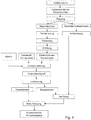
- Figure 4 shows schematically a method for producing a portion capsule ready for consumption.
- various optional features are shown in the scheme.
- the process shown begins with the provision of coffee cherries. From these coffee beans (seeds of the coffee cherries) are obtained. After the coffee beans have been extracted, the silver skin still surrounds the coffee beans.
- the coffee beans are roasted. As the coffee beans expand at the beginning of the roasting process, the silver skins are blown away from the coffee beans.
- the silver skins are separated from the coffee beans and then crushed, dried (not necessary depending on the roasting process) and, if necessary, de-oiled. This means that a substance is produced from the silver skin, which is suitable as a component in a compounding process and as a component of a composite material.
- This "silver skin component” is mixed (compounded) with a plastic component, preferably a biodegradable plastic component such as Ecovio® and other additives to improve the properties of the resulting composite material.
- a plastic component preferably a biodegradable plastic component such as Ecovio® and other additives to improve the properties of the resulting composite material.
- the resulting composite material is then used to shape the base element 11 and optionally the capsule lid 21 and / or other elements of the portion capsule.
- the resulting composite material is particularly suitable for use in an injection molding process or for thermoforming.
- the coffee beans, from which the silver skins have been separated and which have been roasted, are also processed further so that the extraction material is created.
- the coffee beans are ground and, if necessary, decaffeinated.
- the extraction material obtained in this way is filled into the base element produced in this way.
- the base element 11 filled with the extraction material is closed with the capsule lid 21 produced during the process or a capsule lid 21 made available, for example by means of ultrasonic welding.
- barrier layers in particular diffusion barrier layers, cleaning steps, the application of markings, etc.
Landscapes
- Engineering & Computer Science (AREA)
- Mechanical Engineering (AREA)
- Life Sciences & Earth Sciences (AREA)
- Biodiversity & Conservation Biology (AREA)
- Chemical & Material Sciences (AREA)
- Medicinal Chemistry (AREA)
- Health & Medical Sciences (AREA)
- Chemical Kinetics & Catalysis (AREA)
- Packages (AREA)
- Polymers & Plastics (AREA)
- Organic Chemistry (AREA)
- Apparatus For Making Beverages (AREA)
- Tea And Coffee (AREA)
- Compositions Of Macromolecular Compounds (AREA)
- General Preparation And Processing Of Foods (AREA)
- Food Science & Technology (AREA)
Priority Applications (10)
| Application Number | Priority Date | Filing Date | Title |
|---|---|---|---|
| EP20173767.3A EP3907157A1 (fr) | 2020-05-08 | 2020-05-08 | Composite doté d'un composant obtenu à partir de la pellicule argentée de la cerise de café et capsule comprenant ledit composite |
| AU2021269106A AU2021269106A1 (en) | 2020-05-08 | 2021-05-06 | Composite material with a component harvested from the silverskin of coffee cherries, and portion capsule comprising said composite material |
| BR112022022672A BR112022022672A2 (pt) | 2020-05-08 | 2021-05-06 | Material compósito tendo um componente obtido a partir da pele de prata do café cereja e cápsula de porção compreendendo o referido material compósito |
| JP2022567691A JP2023524830A (ja) | 2020-05-08 | 2021-05-06 | コーヒーチェリーの銀皮から得られる成分を有する複合材料および前記複合材料を含むポーションカプセル |
| EP21723739.5A EP4146564A1 (fr) | 2020-05-08 | 2021-05-06 | Matériau composite doté d'un composant récolté à partir de la pellicule argentée des cerises de café, et capsule de portion comprenant ledit matériau composite |
| PCT/EP2021/062069 WO2021224424A1 (fr) | 2020-05-08 | 2021-05-06 | Matériau composite doté d'un composant récolté à partir de la pellicule argentée des cerises de café, et capsule de portion comprenant ledit matériau composite |
| CN202180033585.5A CN115515866A (zh) | 2020-05-08 | 2021-05-06 | 具有从咖啡果的银皮中获得的组分的复合材料和包含所述复合材料的分装胶囊 |
| KR1020227042029A KR20230038137A (ko) | 2020-05-08 | 2021-05-06 | 커피 체리의 실버 스킨으로부터 얻은 성분을 포함하는 복합 재료, 및 상기 복합 재료를 포함하는 1회분 캡슐 |
| US17/922,877 US20230348176A1 (en) | 2020-05-08 | 2021-05-06 | Composite material having a component obtained from the silver skin of the coffee cherry and portion capsule comprising said composite material |
| ZA2022/12346A ZA202212346B (en) | 2020-05-08 | 2022-11-11 | Composite material with a component harvested from the silverskin of coffee cherries, and portion capsule comprising said composite material |
Applications Claiming Priority (1)
| Application Number | Priority Date | Filing Date | Title |
|---|---|---|---|
| EP20173767.3A EP3907157A1 (fr) | 2020-05-08 | 2020-05-08 | Composite doté d'un composant obtenu à partir de la pellicule argentée de la cerise de café et capsule comprenant ledit composite |
Publications (1)
| Publication Number | Publication Date |
|---|---|
| EP3907157A1 true EP3907157A1 (fr) | 2021-11-10 |
Family
ID=70680320
Family Applications (2)
| Application Number | Title | Priority Date | Filing Date |
|---|---|---|---|
| EP20173767.3A Pending EP3907157A1 (fr) | 2020-05-08 | 2020-05-08 | Composite doté d'un composant obtenu à partir de la pellicule argentée de la cerise de café et capsule comprenant ledit composite |
| EP21723739.5A Withdrawn EP4146564A1 (fr) | 2020-05-08 | 2021-05-06 | Matériau composite doté d'un composant récolté à partir de la pellicule argentée des cerises de café, et capsule de portion comprenant ledit matériau composite |
Family Applications After (1)
| Application Number | Title | Priority Date | Filing Date |
|---|---|---|---|
| EP21723739.5A Withdrawn EP4146564A1 (fr) | 2020-05-08 | 2021-05-06 | Matériau composite doté d'un composant récolté à partir de la pellicule argentée des cerises de café, et capsule de portion comprenant ledit matériau composite |
Country Status (9)
| Country | Link |
|---|---|
| US (1) | US20230348176A1 (fr) |
| EP (2) | EP3907157A1 (fr) |
| JP (1) | JP2023524830A (fr) |
| KR (1) | KR20230038137A (fr) |
| CN (1) | CN115515866A (fr) |
| AU (1) | AU2021269106A1 (fr) |
| BR (1) | BR112022022672A2 (fr) |
| WO (1) | WO2021224424A1 (fr) |
| ZA (1) | ZA202212346B (fr) |
Cited By (1)
| Publication number | Priority date | Publication date | Assignee | Title |
|---|---|---|---|---|
| CN116144147A (zh) * | 2022-12-22 | 2023-05-23 | 四川大学 | 环境友好型复合材料及其制备方法 |
Families Citing this family (2)
| Publication number | Priority date | Publication date | Assignee | Title |
|---|---|---|---|---|
| US20200391135A1 (en) * | 2019-06-12 | 2020-12-17 | Rogue Wave LLC | Compostable Toys and Related Methods |
| EP4257510A1 (fr) | 2022-04-08 | 2023-10-11 | B&T Entwicklungs- und Vermarktungsgesellschaft mbH | Soupape et emballage |
Citations (6)
| Publication number | Priority date | Publication date | Assignee | Title |
|---|---|---|---|---|
| WO2011015973A1 (fr) | 2009-08-05 | 2011-02-10 | Ethical Coffee Company Sa | Membrane renforcee avec trame pour capsule utilisee dans la preparation d'une boisson |
| WO2011137550A1 (fr) * | 2010-05-04 | 2011-11-10 | Luna Technology Systems Lts Gmbh | Capsule pour un produit à extraire, son procédé de fabrication et dispositif pour la préparation de café |
| WO2015096990A1 (fr) * | 2013-12-24 | 2015-07-02 | Luna Technology Systems Lts Gmbh | Capsule de portion pour la préparation d'un produit d'infusion et procédé de fabrication de celle-ci |
| WO2015170358A2 (fr) | 2014-05-07 | 2015-11-12 | Rossomando Matteo | Récipient ou capsule biodégradable |
| DE202016104950U1 (de) | 2015-09-10 | 2016-12-01 | Francesco SPIGNESI | Hermetisch verschließbare Portionspackung oder hermetisch verschließbarer Portionsbeutel mit einer biologisch abbaubaren Kaffeekapsel oder einem biologisch abbaubaren Kaffeepad |
| WO2017186743A1 (fr) | 2016-04-25 | 2017-11-02 | Spc Sunflower Plastic Compound Gmbh | Procédé de fabrication d'un produit en bioplastique |
Family Cites Families (11)
| Publication number | Priority date | Publication date | Assignee | Title |
|---|---|---|---|---|
| JP4753908B2 (ja) * | 2007-04-04 | 2011-08-24 | 株式会社 伊藤園 | シルバースキン配合紙及びその製造方法 |
| US20090175973A1 (en) * | 2007-09-05 | 2009-07-09 | Nina Vikhrieva | Coffee cherry compositions and methods for their use in the treatment of diabetes and diabetes related disorders |
| CN104497605A (zh) * | 2010-02-10 | 2015-04-08 | 日立化成工业株式会社 | 复合成型体 |
| AU2016204473B2 (en) * | 2010-09-22 | 2018-06-14 | K-Fee System Gmbh | Portion capsule and method for producing a beverage using a portion capsule |
| KR20180020318A (ko) * | 2013-03-14 | 2018-02-27 | 엠파이어 테크놀로지 디벨롭먼트 엘엘씨 | 커피 체리 부산물을 함유하는 쵸코렛 컴포지션 및 식품과 이를 만드는 방법 |
| CN110525798A (zh) * | 2015-01-09 | 2019-12-03 | 纷美(北京)贸易有限公司 | 复合包装材料、其制造方法、片材组、密封包装 |
| CA2978629A1 (fr) * | 2015-03-05 | 2016-09-09 | University Of Guelph | Biocomposites biodegradables a base de polymere presentant des proprietes sur mesure et procede pour leur fabrication |
| FR3050725B1 (fr) * | 2016-04-29 | 2019-07-12 | Ahlstrom Corporation | Opercule compostable destine a obturer une capsule et capsule obturee par l'opercule |
| WO2018021980A1 (fr) * | 2016-07-28 | 2018-02-01 | Ptt Public Company Limited | Composition bioplastique comprenant une biomasse en tant que composant, et procédé de production |
| US20200087057A1 (en) * | 2018-09-13 | 2020-03-19 | Brett C. Richardson | Biodegradable coffee filter system |
| CN115243862B (zh) * | 2020-02-07 | 2025-05-27 | 贝里国际公司 | 层压件容器 |
-
2020
- 2020-05-08 EP EP20173767.3A patent/EP3907157A1/fr active Pending
-
2021
- 2021-05-06 WO PCT/EP2021/062069 patent/WO2021224424A1/fr not_active Ceased
- 2021-05-06 AU AU2021269106A patent/AU2021269106A1/en not_active Abandoned
- 2021-05-06 US US17/922,877 patent/US20230348176A1/en active Pending
- 2021-05-06 BR BR112022022672A patent/BR112022022672A2/pt unknown
- 2021-05-06 JP JP2022567691A patent/JP2023524830A/ja not_active Withdrawn
- 2021-05-06 EP EP21723739.5A patent/EP4146564A1/fr not_active Withdrawn
- 2021-05-06 CN CN202180033585.5A patent/CN115515866A/zh active Pending
- 2021-05-06 KR KR1020227042029A patent/KR20230038137A/ko not_active Ceased
-
2022
- 2022-11-11 ZA ZA2022/12346A patent/ZA202212346B/en unknown
Patent Citations (6)
| Publication number | Priority date | Publication date | Assignee | Title |
|---|---|---|---|---|
| WO2011015973A1 (fr) | 2009-08-05 | 2011-02-10 | Ethical Coffee Company Sa | Membrane renforcee avec trame pour capsule utilisee dans la preparation d'une boisson |
| WO2011137550A1 (fr) * | 2010-05-04 | 2011-11-10 | Luna Technology Systems Lts Gmbh | Capsule pour un produit à extraire, son procédé de fabrication et dispositif pour la préparation de café |
| WO2015096990A1 (fr) * | 2013-12-24 | 2015-07-02 | Luna Technology Systems Lts Gmbh | Capsule de portion pour la préparation d'un produit d'infusion et procédé de fabrication de celle-ci |
| WO2015170358A2 (fr) | 2014-05-07 | 2015-11-12 | Rossomando Matteo | Récipient ou capsule biodégradable |
| DE202016104950U1 (de) | 2015-09-10 | 2016-12-01 | Francesco SPIGNESI | Hermetisch verschließbare Portionspackung oder hermetisch verschließbarer Portionsbeutel mit einer biologisch abbaubaren Kaffeekapsel oder einem biologisch abbaubaren Kaffeepad |
| WO2017186743A1 (fr) | 2016-04-25 | 2017-11-02 | Spc Sunflower Plastic Compound Gmbh | Procédé de fabrication d'un produit en bioplastique |
Non-Patent Citations (4)
| Title |
|---|
| BORRELLI RCESPOSITO FNAPOLITANO ARITIENI AFOGLIANO V: "Characterization of a new potential functional ingredient: coffee silverskin", JOURNAL OF AGRICULTURAL AND FOOD CHEMISTRY, vol. 52, no. 5, 2004, pages 1338 - 1343, XP055172406, DOI: 10.1021/jf034974x |
| GASSNER GHOHMANN BDEUTSCHMANN F: "Mikroskopische Untersuchung pflanzlicher Lebensmittel.", 1989, GUSTAV FISCHER VERLAG, pages: 457 - 461 |
| MENDES AJT: "Observagöes Citolögicas em Coffea: VI — Desenvolvimento do embriäo e do endosperma em Coffea Arabica l, Bragantia", vol. 2, 1942, pages: 115 - 128 |
| QIAN SHAOPING ET AL: "Improved properties of PLA biocomposites toughened with bamboo cellulose nanowhiskers through silane modification", JOURNAL OF MATERIAL SCIENCE, KLUWER ACADEMIC PUBLISHERS, DORDRECHT, vol. 53, no. 15, 3 May 2018 (2018-05-03), pages 10920 - 10932, XP036503125, ISSN: 0022-2461, [retrieved on 20180503], DOI: 10.1007/S10853-018-2377-2 * |
Cited By (2)
| Publication number | Priority date | Publication date | Assignee | Title |
|---|---|---|---|---|
| CN116144147A (zh) * | 2022-12-22 | 2023-05-23 | 四川大学 | 环境友好型复合材料及其制备方法 |
| CN116144147B (zh) * | 2022-12-22 | 2024-03-22 | 四川大学 | 环境友好型复合材料及其制备方法 |
Also Published As
| Publication number | Publication date |
|---|---|
| BR112022022672A2 (pt) | 2022-12-13 |
| AU2021269106A1 (en) | 2022-12-15 |
| ZA202212346B (en) | 2024-04-24 |
| EP4146564A1 (fr) | 2023-03-15 |
| CN115515866A (zh) | 2022-12-23 |
| WO2021224424A1 (fr) | 2021-11-11 |
| US20230348176A1 (en) | 2023-11-02 |
| JP2023524830A (ja) | 2023-06-13 |
| KR20230038137A (ko) | 2023-03-17 |
Similar Documents
| Publication | Publication Date | Title |
|---|---|---|
| EP2685838B1 (fr) | Capsule-dosette pour préparer une boisson | |
| EP3448649B1 (fr) | Procédé de fabrication d'un produit en bioplastique compostable à domicile, utilisation d'une coque de graines de tournesol, et récipient, emballage, film, produit compostable à domicile moulé par injection et produit similaire, fabriqué par ledit procédé. | |
| EP3359469B2 (fr) | Récipient pour nourriture impermeble au oxygén | |
| DE60302490T2 (de) | Kartusche für Kaffee und wasserlösliche Produkte, Vorrichtung zur Herstellung von Getränken aus solcher Kartusche und Verfahren zur Herstellung von solchen Getränken | |
| EP2218653A1 (fr) | Emballage biodégradable et son procédé de fabrication | |
| EP4146564A1 (fr) | Matériau composite doté d'un composant récolté à partir de la pellicule argentée des cerises de café, et capsule de portion comprenant ledit matériau composite | |
| EP3023362B2 (fr) | Capsule de portion avec moyen d'identification | |
| DE60121454T2 (de) | Bioabbaubare formteile, verfahren zur herstellung derselben sowie zusammensetzung für schaumformteile | |
| WO2014191412A1 (fr) | Capsule de dosage pourvue d'un distributeur de liquide | |
| EP3625140B1 (fr) | Feuille multicouche, en particulier feuille de scellement | |
| AT503943A4 (de) | Topfförmiger, oben offener behälter | |
| EP1555219A1 (fr) | Cartouche mono-dose pour la préparation d'une boisson | |
| DE202016002546U1 (de) | Kapsel für die Zubereitung von Heißgetränken | |
| EP3322651B1 (fr) | Élément filtrant comprenant un évidement | |
| DE102018120783B4 (de) | Portionskapselsystem sowie Verfahren zur Herstellung eines Portionskapselsystems | |
| EP4301672A1 (fr) | Capsule à usage unique biodégradable | |
| WO2015193451A1 (fr) | Système de préparation d'une boisson à base de thé | |
| EP3724101A1 (fr) | Capsule | |
| EP4146565A1 (fr) | Capsule de portion et procédé de production d'une capsule de portion | |
| DE102016110089A1 (de) | Kapsel für die portionsweise Zubereitung eines Getränks | |
| EP3272675B1 (fr) | Capsule de préparation d'un produit alimentaire liquide | |
| DE102023002881B3 (de) | Vorrichtung und Verfahren zur Vorbereitung der Zubereitung eines Heißgetränkes in einer Kaffeemaschine | |
| DE102016201311A1 (de) | Portionskapsel mit einem Getränkesubstrat aus Tee und Saftpulver | |
| AT141500B (de) | Verfahren zur Herstellung eines lager- und transportfähigen Produkts von erhöhter Auslaugefähigkeit aus Röstkaffee. | |
| WO2016120376A1 (fr) | Capsule renfermant une base de boisson constituée de poudre de pulpe de cerise de café |
Legal Events
| Date | Code | Title | Description |
|---|---|---|---|
| PUAI | Public reference made under article 153(3) epc to a published international application that has entered the european phase |
Free format text: ORIGINAL CODE: 0009012 |
|
| STAA | Information on the status of an ep patent application or granted ep patent |
Free format text: STATUS: THE APPLICATION HAS BEEN PUBLISHED |
|
| AK | Designated contracting states |
Kind code of ref document: A1 Designated state(s): AL AT BE BG CH CY CZ DE DK EE ES FI FR GB GR HR HU IE IS IT LI LT LU LV MC MK MT NL NO PL PT RO RS SE SI SK SM TR |
|
| B565 | Issuance of search results under rule 164(2) epc |
Effective date: 20201105 |