EP3907261A1 - Utilisation de revêtement antimicrobien - Google Patents
Utilisation de revêtement antimicrobien Download PDFInfo
- Publication number
- EP3907261A1 EP3907261A1 EP20020209.1A EP20020209A EP3907261A1 EP 3907261 A1 EP3907261 A1 EP 3907261A1 EP 20020209 A EP20020209 A EP 20020209A EP 3907261 A1 EP3907261 A1 EP 3907261A1
- Authority
- EP
- European Patent Office
- Prior art keywords
- coating
- elements
- antimicrobial
- antimicrobial coating
- tio
- Prior art date
- Legal status (The legal status is an assumption and is not a legal conclusion. Google has not performed a legal analysis and makes no representation as to the accuracy of the status listed.)
- Pending
Links
- 238000000576 coating method Methods 0.000 title claims abstract description 272
- 239000011248 coating agent Substances 0.000 title claims abstract description 263
- 230000000845 anti-microbial effect Effects 0.000 title claims abstract description 225
- 239000004599 antimicrobial Substances 0.000 claims abstract description 114
- 239000000758 substrate Substances 0.000 claims abstract description 55
- 229910044991 metal oxide Inorganic materials 0.000 claims abstract description 52
- 150000004706 metal oxides Chemical class 0.000 claims abstract description 52
- 229910052751 metal Inorganic materials 0.000 claims abstract description 32
- 239000002184 metal Substances 0.000 claims abstract description 32
- 230000002779 inactivation Effects 0.000 claims abstract description 31
- 239000012678 infectious agent Substances 0.000 claims abstract description 31
- 150000003839 salts Chemical class 0.000 claims abstract description 31
- 238000000034 method Methods 0.000 claims abstract description 28
- 239000000463 material Substances 0.000 claims abstract description 16
- 238000007590 electrostatic spraying Methods 0.000 claims abstract description 12
- GWEVSGVZZGPLCZ-UHFFFAOYSA-N Titan oxide Chemical compound O=[Ti]=O GWEVSGVZZGPLCZ-UHFFFAOYSA-N 0.000 claims description 217
- SQGYOTSLMSWVJD-UHFFFAOYSA-N silver(I) nitrate Inorganic materials [Ag+].[O-]N(=O)=O SQGYOTSLMSWVJD-UHFFFAOYSA-N 0.000 claims description 108
- 150000001875 compounds Chemical class 0.000 claims description 47
- 239000011159 matrix material Substances 0.000 claims description 41
- 241000700605 Viruses Species 0.000 claims description 34
- 230000000737 periodic effect Effects 0.000 claims description 25
- QVGXLLKOCUKJST-UHFFFAOYSA-N atomic oxygen Chemical compound [O] QVGXLLKOCUKJST-UHFFFAOYSA-N 0.000 claims description 18
- 239000001301 oxygen Substances 0.000 claims description 18
- 229910052760 oxygen Inorganic materials 0.000 claims description 18
- 239000000725 suspension Substances 0.000 claims description 14
- MCMNRKCIXSYSNV-UHFFFAOYSA-N Zirconium dioxide Chemical compound O=[Zr]=O MCMNRKCIXSYSNV-UHFFFAOYSA-N 0.000 claims description 13
- 239000007787 solid Substances 0.000 claims description 13
- 241000711573 Coronaviridae Species 0.000 claims description 11
- 229910052747 lanthanoid Inorganic materials 0.000 claims description 9
- 150000002602 lanthanoids Chemical class 0.000 claims description 9
- 229910052768 actinide Inorganic materials 0.000 claims description 8
- 150000001255 actinides Chemical class 0.000 claims description 8
- 230000003373 anti-fouling effect Effects 0.000 claims description 8
- 239000004814 polyurethane Substances 0.000 claims description 7
- 238000001035 drying Methods 0.000 claims description 6
- 239000004922 lacquer Substances 0.000 claims description 6
- 239000003973 paint Substances 0.000 claims description 6
- 229920001296 polysiloxane Polymers 0.000 claims description 6
- 241001678559 COVID-19 virus Species 0.000 claims description 5
- 241000127282 Middle East respiratory syndrome-related coronavirus Species 0.000 claims description 5
- 241000315672 SARS coronavirus Species 0.000 claims description 5
- 229920002635 polyurethane Polymers 0.000 claims description 5
- 229920003002 synthetic resin Polymers 0.000 claims description 5
- 239000000057 synthetic resin Substances 0.000 claims description 5
- 239000012080 ambient air Substances 0.000 claims description 4
- 230000037303 wrinkles Effects 0.000 claims description 4
- 239000012530 fluid Substances 0.000 claims description 3
- CJNBYAVZURUTKZ-UHFFFAOYSA-N hafnium(IV) oxide Inorganic materials O=[Hf]=O CJNBYAVZURUTKZ-UHFFFAOYSA-N 0.000 claims description 3
- 239000007788 liquid Substances 0.000 claims description 3
- 230000000630 rising effect Effects 0.000 claims description 3
- ZCDOYSPFYFSLEW-UHFFFAOYSA-N chromate(2-) Chemical class [O-][Cr]([O-])(=O)=O ZCDOYSPFYFSLEW-UHFFFAOYSA-N 0.000 claims description 2
- 230000009467 reduction Effects 0.000 description 27
- 239000007864 aqueous solution Substances 0.000 description 26
- 241000588724 Escherichia coli Species 0.000 description 23
- 239000007900 aqueous suspension Substances 0.000 description 20
- 230000000694 effects Effects 0.000 description 16
- 238000011534 incubation Methods 0.000 description 13
- 241000894006 Bacteria Species 0.000 description 12
- 230000002123 temporal effect Effects 0.000 description 12
- 238000012360 testing method Methods 0.000 description 12
- 208000015181 infectious disease Diseases 0.000 description 11
- 230000001603 reducing effect Effects 0.000 description 11
- 241000191967 Staphylococcus aureus Species 0.000 description 10
- JKQOBWVOAYFWKG-UHFFFAOYSA-N molybdenum trioxide Chemical compound O=[Mo](=O)=O JKQOBWVOAYFWKG-UHFFFAOYSA-N 0.000 description 10
- -1 hydrogen cations Chemical class 0.000 description 9
- 239000000203 mixture Substances 0.000 description 9
- XLYOFNOQVPJJNP-UHFFFAOYSA-N water Substances O XLYOFNOQVPJJNP-UHFFFAOYSA-N 0.000 description 9
- 230000000840 anti-viral effect Effects 0.000 description 8
- 229910052709 silver Inorganic materials 0.000 description 8
- 241001429370 Human rhinovirus A16 Species 0.000 description 7
- 230000000844 anti-bacterial effect Effects 0.000 description 7
- 244000052616 bacterial pathogen Species 0.000 description 7
- 230000008901 benefit Effects 0.000 description 7
- 230000001332 colony forming effect Effects 0.000 description 7
- 239000000499 gel Substances 0.000 description 7
- 239000012528 membrane Substances 0.000 description 7
- 244000005700 microbiome Species 0.000 description 7
- 239000004332 silver Substances 0.000 description 7
- 239000007921 spray Substances 0.000 description 7
- 239000010936 titanium Substances 0.000 description 7
- 229910052721 tungsten Inorganic materials 0.000 description 7
- 241000233866 Fungi Species 0.000 description 6
- 230000015572 biosynthetic process Effects 0.000 description 6
- 238000010586 diagram Methods 0.000 description 6
- 238000002474 experimental method Methods 0.000 description 6
- 229910052750 molybdenum Inorganic materials 0.000 description 6
- WFKWXMTUELFFGS-UHFFFAOYSA-N tungsten Chemical compound [W] WFKWXMTUELFFGS-UHFFFAOYSA-N 0.000 description 6
- 239000010937 tungsten Substances 0.000 description 6
- 241000711443 Bovine coronavirus Species 0.000 description 5
- 241000222122 Candida albicans Species 0.000 description 5
- ZOKXTWBITQBERF-UHFFFAOYSA-N Molybdenum Chemical compound [Mo] ZOKXTWBITQBERF-UHFFFAOYSA-N 0.000 description 5
- 229910020628 SiW12O40 Inorganic materials 0.000 description 5
- 239000013543 active substance Substances 0.000 description 5
- 230000001580 bacterial effect Effects 0.000 description 5
- 229940095731 candida albicans Drugs 0.000 description 5
- 239000002131 composite material Substances 0.000 description 5
- 239000011733 molybdenum Substances 0.000 description 5
- 239000002105 nanoparticle Substances 0.000 description 5
- QGLKJKCYBOYXKC-UHFFFAOYSA-N nonaoxidotritungsten Chemical compound O=[W]1(=O)O[W](=O)(=O)O[W](=O)(=O)O1 QGLKJKCYBOYXKC-UHFFFAOYSA-N 0.000 description 5
- 238000005507 spraying Methods 0.000 description 5
- 239000000126 substance Substances 0.000 description 5
- PBYZMCDFOULPGH-UHFFFAOYSA-N tungstate Chemical compound [O-][W]([O-])(=O)=O PBYZMCDFOULPGH-UHFFFAOYSA-N 0.000 description 5
- 229910001930 tungsten oxide Inorganic materials 0.000 description 5
- 230000003612 virological effect Effects 0.000 description 5
- 241001225321 Aspergillus fumigatus Species 0.000 description 4
- VEXZGXHMUGYJMC-UHFFFAOYSA-N Hydrochloric acid Chemical compound Cl VEXZGXHMUGYJMC-UHFFFAOYSA-N 0.000 description 4
- 239000004640 Melamine resin Substances 0.000 description 4
- 229920000877 Melamine resin Polymers 0.000 description 4
- 229910015667 MoO4 Inorganic materials 0.000 description 4
- 241001263478 Norovirus Species 0.000 description 4
- BQCADISMDOOEFD-UHFFFAOYSA-N Silver Chemical compound [Ag] BQCADISMDOOEFD-UHFFFAOYSA-N 0.000 description 4
- 229920002472 Starch Polymers 0.000 description 4
- 230000002378 acidificating effect Effects 0.000 description 4
- 239000003570 air Substances 0.000 description 4
- QGAVSDVURUSLQK-UHFFFAOYSA-N ammonium heptamolybdate Chemical compound N.N.N.N.N.N.O.O.O.O.O.O.O.O.O.O.O.O.O.O.O.O.O.O.O.O.O.O.O.O.[Mo].[Mo].[Mo].[Mo].[Mo].[Mo].[Mo] QGAVSDVURUSLQK-UHFFFAOYSA-N 0.000 description 4
- 239000012736 aqueous medium Substances 0.000 description 4
- 229940091771 aspergillus fumigatus Drugs 0.000 description 4
- 230000005540 biological transmission Effects 0.000 description 4
- 230000008859 change Effects 0.000 description 4
- 238000004140 cleaning Methods 0.000 description 4
- 230000000120 cytopathologic effect Effects 0.000 description 4
- 230000001419 dependent effect Effects 0.000 description 4
- 201000010099 disease Diseases 0.000 description 4
- 208000037265 diseases, disorders, signs and symptoms Diseases 0.000 description 4
- 238000004519 manufacturing process Methods 0.000 description 4
- 229910000476 molybdenum oxide Inorganic materials 0.000 description 4
- PQQKPALAQIIWST-UHFFFAOYSA-N oxomolybdenum Chemical compound [Mo]=O PQQKPALAQIIWST-UHFFFAOYSA-N 0.000 description 4
- 230000008092 positive effect Effects 0.000 description 4
- HKZLPVFGJNLROG-UHFFFAOYSA-M silver monochloride Chemical compound [Cl-].[Ag+] HKZLPVFGJNLROG-UHFFFAOYSA-M 0.000 description 4
- 239000011684 sodium molybdate Substances 0.000 description 4
- TVXXNOYZHKPKGW-UHFFFAOYSA-N sodium molybdate (anhydrous) Chemical compound [Na+].[Na+].[O-][Mo]([O-])(=O)=O TVXXNOYZHKPKGW-UHFFFAOYSA-N 0.000 description 4
- 239000008107 starch Substances 0.000 description 4
- XAEWLETZEZXLHR-UHFFFAOYSA-N zinc;dioxido(dioxo)molybdenum Chemical compound [Zn+2].[O-][Mo]([O-])(=O)=O XAEWLETZEZXLHR-UHFFFAOYSA-N 0.000 description 4
- 229910019626 (NH4)6Mo7O24 Inorganic materials 0.000 description 3
- 241000709661 Enterovirus Species 0.000 description 3
- 229910002651 NO3 Inorganic materials 0.000 description 3
- PXHVJJICTQNCMI-UHFFFAOYSA-N Nickel Chemical compound [Ni] PXHVJJICTQNCMI-UHFFFAOYSA-N 0.000 description 3
- NHNBFGGVMKEFGY-UHFFFAOYSA-N Nitrate Chemical compound [O-][N+]([O-])=O NHNBFGGVMKEFGY-UHFFFAOYSA-N 0.000 description 3
- 240000004808 Saccharomyces cerevisiae Species 0.000 description 3
- VYPSYNLAJGMNEJ-UHFFFAOYSA-N Silicium dioxide Chemical compound O=[Si]=O VYPSYNLAJGMNEJ-UHFFFAOYSA-N 0.000 description 3
- 229910021607 Silver chloride Inorganic materials 0.000 description 3
- 239000004411 aluminium Substances 0.000 description 3
- 229910052782 aluminium Inorganic materials 0.000 description 3
- XAGFODPZIPBFFR-UHFFFAOYSA-N aluminium Chemical compound [Al] XAGFODPZIPBFFR-UHFFFAOYSA-N 0.000 description 3
- 210000000234 capsid Anatomy 0.000 description 3
- 230000010001 cellular homeostasis Effects 0.000 description 3
- 238000006243 chemical reaction Methods 0.000 description 3
- 230000002708 enhancing effect Effects 0.000 description 3
- 238000011156 evaluation Methods 0.000 description 3
- 238000001704 evaporation Methods 0.000 description 3
- 230000008020 evaporation Effects 0.000 description 3
- 239000007943 implant Substances 0.000 description 3
- 230000010534 mechanism of action Effects 0.000 description 3
- 230000002085 persistent effect Effects 0.000 description 3
- NLKNQRATVPKPDG-UHFFFAOYSA-M potassium iodide Chemical compound [K+].[I-] NLKNQRATVPKPDG-UHFFFAOYSA-M 0.000 description 3
- XMVONEAAOPAGAO-UHFFFAOYSA-N sodium tungstate Chemical compound [Na+].[Na+].[O-][W]([O-])(=O)=O XMVONEAAOPAGAO-UHFFFAOYSA-N 0.000 description 3
- 235000019698 starch Nutrition 0.000 description 3
- 239000006228 supernatant Substances 0.000 description 3
- 238000003786 synthesis reaction Methods 0.000 description 3
- 239000004408 titanium dioxide Substances 0.000 description 3
- 229910052725 zinc Inorganic materials 0.000 description 3
- 239000011701 zinc Substances 0.000 description 3
- NDKWCCLKSWNDBG-UHFFFAOYSA-N zinc;dioxido(dioxo)chromium Chemical compound [Zn+2].[O-][Cr]([O-])(=O)=O NDKWCCLKSWNDBG-UHFFFAOYSA-N 0.000 description 3
- 238000010146 3D printing Methods 0.000 description 2
- 102000004190 Enzymes Human genes 0.000 description 2
- 108090000790 Enzymes Proteins 0.000 description 2
- LFQSCWFLJHTTHZ-UHFFFAOYSA-N Ethanol Chemical compound CCO LFQSCWFLJHTTHZ-UHFFFAOYSA-N 0.000 description 2
- 102000004310 Ion Channels Human genes 0.000 description 2
- 241001465754 Metazoa Species 0.000 description 2
- 229910004619 Na2MoO4 Inorganic materials 0.000 description 2
- GRYLNZFGIOXLOG-UHFFFAOYSA-N Nitric acid Chemical compound O[N+]([O-])=O GRYLNZFGIOXLOG-UHFFFAOYSA-N 0.000 description 2
- 229920002413 Polyhexanide Polymers 0.000 description 2
- 241000589517 Pseudomonas aeruginosa Species 0.000 description 2
- NINIDFKCEFEMDL-UHFFFAOYSA-N Sulfur Chemical compound [S] NINIDFKCEFEMDL-UHFFFAOYSA-N 0.000 description 2
- 239000005864 Sulphur Substances 0.000 description 2
- 229910003077 Ti−O Inorganic materials 0.000 description 2
- HCHKCACWOHOZIP-UHFFFAOYSA-N Zinc Chemical compound [Zn] HCHKCACWOHOZIP-UHFFFAOYSA-N 0.000 description 2
- 241000645784 [Candida] auris Species 0.000 description 2
- 125000005233 alkylalcohol group Chemical group 0.000 description 2
- 229940027983 antiseptic and disinfectant quaternary ammonium compound Drugs 0.000 description 2
- 239000008346 aqueous phase Substances 0.000 description 2
- 239000004566 building material Substances 0.000 description 2
- 150000001768 cations Chemical class 0.000 description 2
- 239000004568 cement Substances 0.000 description 2
- 238000012512 characterization method Methods 0.000 description 2
- 239000003795 chemical substances by application Substances 0.000 description 2
- 150000001845 chromium compounds Chemical class 0.000 description 2
- 229910052802 copper Inorganic materials 0.000 description 2
- 239000010949 copper Substances 0.000 description 2
- 238000011161 development Methods 0.000 description 2
- 239000003651 drinking water Substances 0.000 description 2
- 235000020188 drinking water Nutrition 0.000 description 2
- 239000000428 dust Substances 0.000 description 2
- 230000004064 dysfunction Effects 0.000 description 2
- 230000007613 environmental effect Effects 0.000 description 2
- 239000004744 fabric Substances 0.000 description 2
- 238000000227 grinding Methods 0.000 description 2
- 239000001257 hydrogen Substances 0.000 description 2
- 229910052739 hydrogen Inorganic materials 0.000 description 2
- 230000005660 hydrophilic surface Effects 0.000 description 2
- 230000005661 hydrophobic surface Effects 0.000 description 2
- 230000000415 inactivating effect Effects 0.000 description 2
- 150000002484 inorganic compounds Chemical group 0.000 description 2
- 229910010272 inorganic material Inorganic materials 0.000 description 2
- 239000007791 liquid phase Substances 0.000 description 2
- 229910052759 nickel Inorganic materials 0.000 description 2
- 229910017604 nitric acid Inorganic materials 0.000 description 2
- 244000045947 parasite Species 0.000 description 2
- 239000002245 particle Substances 0.000 description 2
- 239000004033 plastic Substances 0.000 description 2
- 229920003023 plastic Polymers 0.000 description 2
- FGIUAXJPYTZDNR-UHFFFAOYSA-N potassium nitrate Chemical compound [K+].[O-][N+]([O-])=O FGIUAXJPYTZDNR-UHFFFAOYSA-N 0.000 description 2
- 230000001376 precipitating effect Effects 0.000 description 2
- 239000000047 product Substances 0.000 description 2
- 150000003856 quaternary ammonium compounds Chemical class 0.000 description 2
- 238000009877 rendering Methods 0.000 description 2
- 230000003362 replicative effect Effects 0.000 description 2
- 230000027756 respiratory electron transport chain Effects 0.000 description 2
- 230000000717 retained effect Effects 0.000 description 2
- 238000000926 separation method Methods 0.000 description 2
- 238000007493 shaping process Methods 0.000 description 2
- 229910001961 silver nitrate Inorganic materials 0.000 description 2
- 235000015393 sodium molybdate Nutrition 0.000 description 2
- 241000894007 species Species 0.000 description 2
- 241000114864 ssRNA viruses Species 0.000 description 2
- 229920001169 thermoplastic Polymers 0.000 description 2
- 239000004416 thermosoftening plastic Substances 0.000 description 2
- 231100000419 toxicity Toxicity 0.000 description 2
- 230000001988 toxicity Effects 0.000 description 2
- 230000009385 viral infection Effects 0.000 description 2
- 229910016556 Al2(MoO4)3 Inorganic materials 0.000 description 1
- 241000004176 Alphacoronavirus Species 0.000 description 1
- 241000238426 Anostraca Species 0.000 description 1
- 241000712892 Arenaviridae Species 0.000 description 1
- 241000238582 Artemia Species 0.000 description 1
- 241001292006 Arteriviridae Species 0.000 description 1
- 241001533362 Astroviridae Species 0.000 description 1
- 241000008922 Beluga Whale coronavirus SW1 Species 0.000 description 1
- 241000008904 Betacoronavirus Species 0.000 description 1
- 241000008905 Betacoronavirus 1 Species 0.000 description 1
- 241000776207 Bornaviridae Species 0.000 description 1
- 241001218594 Bulbul coronavirus HKU11 Species 0.000 description 1
- 241000714198 Caliciviridae Species 0.000 description 1
- 229910052684 Cerium Inorganic materials 0.000 description 1
- VEXZGXHMUGYJMC-UHFFFAOYSA-M Chloride anion Chemical compound [Cl-] VEXZGXHMUGYJMC-UHFFFAOYSA-M 0.000 description 1
- 241000238571 Cladocera Species 0.000 description 1
- 229910018864 CoMoO4 Inorganic materials 0.000 description 1
- 229910019408 CoWO4 Inorganic materials 0.000 description 1
- RYGMFSIKBFXOCR-UHFFFAOYSA-N Copper Chemical compound [Cu] RYGMFSIKBFXOCR-UHFFFAOYSA-N 0.000 description 1
- 239000004971 Cross linker Substances 0.000 description 1
- 230000004543 DNA replication Effects 0.000 description 1
- 241000238578 Daphnia Species 0.000 description 1
- 241001461743 Deltacoronavirus Species 0.000 description 1
- 241000711950 Filoviridae Species 0.000 description 1
- 241000710781 Flaviviridae Species 0.000 description 1
- 241000008920 Gammacoronavirus Species 0.000 description 1
- 241001123922 Hedgehog coronavirus 1 Species 0.000 description 1
- 241001122120 Hepeviridae Species 0.000 description 1
- 241000282412 Homo Species 0.000 description 1
- 241000711467 Human coronavirus 229E Species 0.000 description 1
- 241001109669 Human coronavirus HKU1 Species 0.000 description 1
- 241000482741 Human coronavirus NL63 Species 0.000 description 1
- 241001428935 Human coronavirus OC43 Species 0.000 description 1
- 241000430519 Human rhinovirus sp. Species 0.000 description 1
- 238000012404 In vitro experiment Methods 0.000 description 1
- 241000711450 Infectious bronchitis virus Species 0.000 description 1
- 241000186779 Listeria monocytogenes Species 0.000 description 1
- 241000008902 Miniopterus bat coronavirus 1 Species 0.000 description 1
- 241000008903 Miniopterus bat coronavirus HKU8 Species 0.000 description 1
- 229910016895 MnMoO4 Inorganic materials 0.000 description 1
- 241000008906 Murine coronavirus Species 0.000 description 1
- 229910020350 Na2WO4 Inorganic materials 0.000 description 1
- 229910005809 NiMoO4 Inorganic materials 0.000 description 1
- 229910006167 NiWO4 Inorganic materials 0.000 description 1
- 241000712464 Orthomyxoviridae Species 0.000 description 1
- 241000711504 Paramyxoviridae Species 0.000 description 1
- 241000228143 Penicillium Species 0.000 description 1
- 241000228168 Penicillium sp. Species 0.000 description 1
- 241000150350 Peribunyaviridae Species 0.000 description 1
- 241000709664 Picornaviridae Species 0.000 description 1
- 241000008909 Pipistrellus bat coronavirus HKU5 Species 0.000 description 1
- 241001461748 Porcine coronavirus HKU15 Species 0.000 description 1
- 241001135549 Porcine epidemic diarrhea virus Species 0.000 description 1
- 241000702247 Reoviridae Species 0.000 description 1
- 241000711931 Rhabdoviridae Species 0.000 description 1
- 241000004178 Rhinolophus bat coronavirus HKU2 Species 0.000 description 1
- 241000008907 Rousettus bat coronavirus HKU9 Species 0.000 description 1
- 241000004179 Scotophilus bat coronavirus 512 Species 0.000 description 1
- 241000008910 Severe acute respiratory syndrome-related coronavirus Species 0.000 description 1
- QAOWNCQODCNURD-UHFFFAOYSA-L Sulfate Chemical compound [O-]S([O-])(=O)=O QAOWNCQODCNURD-UHFFFAOYSA-L 0.000 description 1
- 241000710924 Togaviridae Species 0.000 description 1
- WGLPBDUCMAPZCE-UHFFFAOYSA-N Trioxochromium Chemical compound O=[Cr](=O)=O WGLPBDUCMAPZCE-UHFFFAOYSA-N 0.000 description 1
- 241000008908 Tylonycteris bat coronavirus HKU4 Species 0.000 description 1
- 208000036142 Viral infection Diseases 0.000 description 1
- 239000002250 absorbent Substances 0.000 description 1
- 230000002745 absorbent Effects 0.000 description 1
- 239000002253 acid Substances 0.000 description 1
- 150000007513 acids Chemical class 0.000 description 1
- 230000009471 action Effects 0.000 description 1
- 239000000853 adhesive Substances 0.000 description 1
- 230000001070 adhesive effect Effects 0.000 description 1
- 239000000443 aerosol Substances 0.000 description 1
- 230000004075 alteration Effects 0.000 description 1
- 230000002421 anti-septic effect Effects 0.000 description 1
- 238000013459 approach Methods 0.000 description 1
- 230000009286 beneficial effect Effects 0.000 description 1
- 229960000686 benzalkonium chloride Drugs 0.000 description 1
- CADWTSSKOVRVJC-UHFFFAOYSA-N benzyl(dimethyl)azanium;chloride Chemical compound [Cl-].C[NH+](C)CC1=CC=CC=C1 CADWTSSKOVRVJC-UHFFFAOYSA-N 0.000 description 1
- 230000001680 brushing effect Effects 0.000 description 1
- 229910052793 cadmium Inorganic materials 0.000 description 1
- 239000012876 carrier material Substances 0.000 description 1
- 230000003197 catalytic effect Effects 0.000 description 1
- 125000002091 cationic group Chemical group 0.000 description 1
- ZMIGMASIKSOYAM-UHFFFAOYSA-N cerium Chemical compound [Ce][Ce][Ce][Ce][Ce][Ce][Ce][Ce][Ce][Ce][Ce][Ce][Ce][Ce][Ce][Ce][Ce][Ce][Ce][Ce][Ce][Ce][Ce][Ce][Ce][Ce][Ce][Ce][Ce][Ce][Ce][Ce][Ce][Ce][Ce][Ce][Ce][Ce] ZMIGMASIKSOYAM-UHFFFAOYSA-N 0.000 description 1
- JUXLQRHSAFOZOE-UHFFFAOYSA-N cerium(3+);dioxido(dioxo)tungsten Chemical compound [Ce+3].[Ce+3].[O-][W]([O-])(=O)=O.[O-][W]([O-])(=O)=O.[O-][W]([O-])(=O)=O JUXLQRHSAFOZOE-UHFFFAOYSA-N 0.000 description 1
- 229910052804 chromium Inorganic materials 0.000 description 1
- 239000011651 chromium Substances 0.000 description 1
- 229910000423 chromium oxide Inorganic materials 0.000 description 1
- 229910017052 cobalt Inorganic materials 0.000 description 1
- 239000010941 cobalt Substances 0.000 description 1
- GUTLYIVDDKVIGB-UHFFFAOYSA-N cobalt atom Chemical compound [Co] GUTLYIVDDKVIGB-UHFFFAOYSA-N 0.000 description 1
- 229910052681 coesite Inorganic materials 0.000 description 1
- 238000010668 complexation reaction Methods 0.000 description 1
- 238000013329 compounding Methods 0.000 description 1
- 239000000470 constituent Substances 0.000 description 1
- 238000011109 contamination Methods 0.000 description 1
- 238000001816 cooling Methods 0.000 description 1
- OQFRENMCLHGPRB-UHFFFAOYSA-N copper;dioxido(dioxo)tungsten Chemical compound [Cu+2].[O-][W]([O-])(=O)=O OQFRENMCLHGPRB-UHFFFAOYSA-N 0.000 description 1
- 229910052906 cristobalite Inorganic materials 0.000 description 1
- 239000013078 crystal Substances 0.000 description 1
- 230000003247 decreasing effect Effects 0.000 description 1
- 230000002950 deficient Effects 0.000 description 1
- 230000008021 deposition Effects 0.000 description 1
- CRLHSBRULQUYOK-UHFFFAOYSA-N dioxido(dioxo)tungsten;manganese(2+) Chemical compound [Mn+2].[O-][W]([O-])(=O)=O CRLHSBRULQUYOK-UHFFFAOYSA-N 0.000 description 1
- QEKREONBSFPWTQ-UHFFFAOYSA-N disilver dioxido(dioxo)tungsten Chemical compound [Ag+].[Ag+].[O-][W]([O-])(=O)=O QEKREONBSFPWTQ-UHFFFAOYSA-N 0.000 description 1
- 238000009826 distribution Methods 0.000 description 1
- 241001492478 dsDNA viruses, no RNA stage Species 0.000 description 1
- 241001493065 dsRNA viruses Species 0.000 description 1
- 229920001971 elastomer Polymers 0.000 description 1
- 239000000806 elastomer Substances 0.000 description 1
- 230000003028 elevating effect Effects 0.000 description 1
- 230000005284 excitation Effects 0.000 description 1
- 239000011888 foil Substances 0.000 description 1
- 238000009472 formulation Methods 0.000 description 1
- 229910021485 fumed silica Inorganic materials 0.000 description 1
- 230000000855 fungicidal effect Effects 0.000 description 1
- 229910052737 gold Inorganic materials 0.000 description 1
- 239000008187 granular material Substances 0.000 description 1
- 229910052735 hafnium Inorganic materials 0.000 description 1
- 229910000449 hafnium oxide Inorganic materials 0.000 description 1
- WIHZLLGSGQNAGK-UHFFFAOYSA-N hafnium(4+);oxygen(2-) Chemical compound [O-2].[O-2].[Hf+4] WIHZLLGSGQNAGK-UHFFFAOYSA-N 0.000 description 1
- 230000036541 health Effects 0.000 description 1
- 238000013383 initial experiment Methods 0.000 description 1
- 229910052909 inorganic silicate Inorganic materials 0.000 description 1
- 238000011835 investigation Methods 0.000 description 1
- 229910052741 iridium Inorganic materials 0.000 description 1
- 229910052742 iron Inorganic materials 0.000 description 1
- 230000005923 long-lasting effect Effects 0.000 description 1
- 230000007774 longterm Effects 0.000 description 1
- 229910052748 manganese Inorganic materials 0.000 description 1
- 239000011572 manganese Substances 0.000 description 1
- WPBNNNQJVZRUHP-UHFFFAOYSA-L manganese(2+);methyl n-[[2-(methoxycarbonylcarbamothioylamino)phenyl]carbamothioyl]carbamate;n-[2-(sulfidocarbothioylamino)ethyl]carbamodithioate Chemical compound [Mn+2].[S-]C(=S)NCCNC([S-])=S.COC(=O)NC(=S)NC1=CC=CC=C1NC(=S)NC(=O)OC WPBNNNQJVZRUHP-UHFFFAOYSA-L 0.000 description 1
- 230000007246 mechanism Effects 0.000 description 1
- 230000008018 melting Effects 0.000 description 1
- 238000002844 melting Methods 0.000 description 1
- 229910052753 mercury Inorganic materials 0.000 description 1
- 150000002736 metal compounds Chemical class 0.000 description 1
- 150000002739 metals Chemical class 0.000 description 1
- 230000000813 microbial effect Effects 0.000 description 1
- MEFBJEMVZONFCJ-UHFFFAOYSA-N molybdate Chemical compound [O-][Mo]([O-])(=O)=O MEFBJEMVZONFCJ-UHFFFAOYSA-N 0.000 description 1
- 239000006070 nanosuspension Substances 0.000 description 1
- 229910052762 osmium Inorganic materials 0.000 description 1
- 230000003647 oxidation Effects 0.000 description 1
- 238000007254 oxidation reaction Methods 0.000 description 1
- SOQBVABWOPYFQZ-UHFFFAOYSA-N oxygen(2-);titanium(4+) Chemical compound [O-2].[O-2].[Ti+4] SOQBVABWOPYFQZ-UHFFFAOYSA-N 0.000 description 1
- 229910052763 palladium Inorganic materials 0.000 description 1
- 230000001717 pathogenic effect Effects 0.000 description 1
- 230000035699 permeability Effects 0.000 description 1
- 239000012071 phase Substances 0.000 description 1
- 230000001699 photocatalysis Effects 0.000 description 1
- 238000007146 photocatalysis Methods 0.000 description 1
- 229910052697 platinum Inorganic materials 0.000 description 1
- 239000002861 polymer material Substances 0.000 description 1
- 239000013641 positive control Substances 0.000 description 1
- 230000003334 potential effect Effects 0.000 description 1
- 238000002360 preparation method Methods 0.000 description 1
- 230000008569 process Effects 0.000 description 1
- 238000012545 processing Methods 0.000 description 1
- 230000035755 proliferation Effects 0.000 description 1
- 102000004169 proteins and genes Human genes 0.000 description 1
- 108090000623 proteins and genes Proteins 0.000 description 1
- 238000006479 redox reaction Methods 0.000 description 1
- 230000035806 respiratory chain Effects 0.000 description 1
- 229910052702 rhenium Inorganic materials 0.000 description 1
- 229910052703 rhodium Inorganic materials 0.000 description 1
- 229910052707 ruthenium Inorganic materials 0.000 description 1
- 238000004626 scanning electron microscopy Methods 0.000 description 1
- 239000000377 silicon dioxide Substances 0.000 description 1
- MHLYOTJKDAAHGI-UHFFFAOYSA-N silver molybdate Chemical compound [Ag+].[Ag+].[O-][Mo]([O-])(=O)=O MHLYOTJKDAAHGI-UHFFFAOYSA-N 0.000 description 1
- 239000011734 sodium Substances 0.000 description 1
- 230000003330 sporicidal effect Effects 0.000 description 1
- 241001147420 ssDNA viruses Species 0.000 description 1
- 239000007858 starting material Substances 0.000 description 1
- 229910052682 stishovite Inorganic materials 0.000 description 1
- 238000003860 storage Methods 0.000 description 1
- 229910021653 sulphate ion Inorganic materials 0.000 description 1
- 230000004083 survival effect Effects 0.000 description 1
- 230000002195 synergetic effect Effects 0.000 description 1
- 229910052719 titanium Inorganic materials 0.000 description 1
- 231100000331 toxic Toxicity 0.000 description 1
- 230000002588 toxic effect Effects 0.000 description 1
- 230000002110 toxicologic effect Effects 0.000 description 1
- 231100000027 toxicology Toxicity 0.000 description 1
- 238000012546 transfer Methods 0.000 description 1
- 229910052905 tridymite Inorganic materials 0.000 description 1
- ZNOKGRXACCSDPY-UHFFFAOYSA-N tungsten trioxide Chemical compound O=[W](=O)=O ZNOKGRXACCSDPY-UHFFFAOYSA-N 0.000 description 1
- 239000002966 varnish Substances 0.000 description 1
- 230000003253 viricidal effect Effects 0.000 description 1
- 230000036642 wellbeing Effects 0.000 description 1
- ONDPHDOFVYQSGI-UHFFFAOYSA-N zinc nitrate Inorganic materials [Zn+2].[O-][N+]([O-])=O.[O-][N+]([O-])=O ONDPHDOFVYQSGI-UHFFFAOYSA-N 0.000 description 1
- 229910052726 zirconium Inorganic materials 0.000 description 1
- 229910001928 zirconium oxide Inorganic materials 0.000 description 1
Images






Classifications
-
- C—CHEMISTRY; METALLURGY
- C09—DYES; PAINTS; POLISHES; NATURAL RESINS; ADHESIVES; COMPOSITIONS NOT OTHERWISE PROVIDED FOR; APPLICATIONS OF MATERIALS NOT OTHERWISE PROVIDED FOR
- C09D—COATING COMPOSITIONS, e.g. PAINTS, VARNISHES OR LACQUERS; FILLING PASTES; CHEMICAL PAINT OR INK REMOVERS; INKS; CORRECTING FLUIDS; WOODSTAINS; PASTES OR SOLIDS FOR COLOURING OR PRINTING; USE OF MATERIALS THEREFOR
- C09D5/00—Coating compositions, e.g. paints, varnishes or lacquers, characterised by their physical nature or the effects produced; Filling pastes
- C09D5/14—Paints containing biocides, e.g. fungicides, insecticides or pesticides
-
- A—HUMAN NECESSITIES
- A01—AGRICULTURE; FORESTRY; ANIMAL HUSBANDRY; HUNTING; TRAPPING; FISHING
- A01N—PRESERVATION OF BODIES OF HUMANS OR ANIMALS OR PLANTS OR PARTS THEREOF; BIOCIDES, e.g. AS DISINFECTANTS, AS PESTICIDES OR AS HERBICIDES; PEST REPELLANTS OR ATTRACTANTS; PLANT GROWTH REGULATORS
- A01N59/00—Biocides, pest repellants or attractants, or plant growth regulators containing elements or inorganic compounds
- A01N59/16—Heavy metals; Compounds thereof
-
- B—PERFORMING OPERATIONS; TRANSPORTING
- B05—SPRAYING OR ATOMISING IN GENERAL; APPLYING FLUENT MATERIALS TO SURFACES, IN GENERAL
- B05B—SPRAYING APPARATUS; ATOMISING APPARATUS; NOZZLES
- B05B5/00—Electrostatic spraying apparatus; Spraying apparatus with means for charging the spray electrically; Apparatus for spraying liquids or other fluent materials by other electric means
- B05B5/025—Discharge apparatus, e.g. electrostatic spray guns
- B05B5/03—Discharge apparatus, e.g. electrostatic spray guns characterised by the use of gas, e.g. electrostatically assisted pneumatic spraying
-
- B—PERFORMING OPERATIONS; TRANSPORTING
- B05—SPRAYING OR ATOMISING IN GENERAL; APPLYING FLUENT MATERIALS TO SURFACES, IN GENERAL
- B05D—PROCESSES FOR APPLYING FLUENT MATERIALS TO SURFACES, IN GENERAL
- B05D1/00—Processes for applying liquids or other fluent materials
- B05D1/02—Processes for applying liquids or other fluent materials performed by spraying
- B05D1/04—Processes for applying liquids or other fluent materials performed by spraying involving the use of an electrostatic field
-
- B—PERFORMING OPERATIONS; TRANSPORTING
- B05—SPRAYING OR ATOMISING IN GENERAL; APPLYING FLUENT MATERIALS TO SURFACES, IN GENERAL
- B05D—PROCESSES FOR APPLYING FLUENT MATERIALS TO SURFACES, IN GENERAL
- B05D2601/00—Inorganic fillers
- B05D2601/20—Inorganic fillers used for non-pigmentation effect
- B05D2601/24—Titanium dioxide, e.g. rutile
-
- B—PERFORMING OPERATIONS; TRANSPORTING
- B05—SPRAYING OR ATOMISING IN GENERAL; APPLYING FLUENT MATERIALS TO SURFACES, IN GENERAL
- B05D—PROCESSES FOR APPLYING FLUENT MATERIALS TO SURFACES, IN GENERAL
- B05D5/00—Processes for applying liquids or other fluent materials to surfaces to obtain special surface effects, finishes or structures
- B05D5/08—Processes for applying liquids or other fluent materials to surfaces to obtain special surface effects, finishes or structures to obtain an anti-friction or anti-adhesive surface
Definitions
- the present invention relates to the use of an antimicrobial coating of a substrate for inactivating an infectious agent, especially a virus, the coating being obtained by applying the coating on a surface of the substrate by means of an electrostatic spraying method.
- Such surfaces can be represented, for example, by articles of clothing, lounges of buildings and public means of transport as well as their furnishings, medical implants, hygiene articles, face shields, means of payment or medical devices, etc.
- DE 10 2012 103 064 A1 discloses a hydrophilic composite with at least one carrier material and at least one antimicrobially active agent in the form of a metal or metal compound.
- DE 10 2013 114 575A shows a method for producing an antimicrobially active composite material in which at least one molybdenum- and/or tungsten-containing inorganic compound is bonded to at least one further material.
- DE 10 2013 114 573 A1 also shows a method for producing an antimicrobially active furniture and/or interior component, in which at least one molybdenum-containing inorganic compound is arranged at least in the region of a surface of the furniture and/or interior component.
- DE 10 2013 104 284 A1 discloses a method for producing a doped or undoped mixed oxide for a composite material which serves to form antimicrobially active surfaces.
- DE 10 2011 085 862 A1 further discloses a composition
- a composition comprising at least one antimicrobially active substance which acts as a proton donor on contact with an aqueous medium, with the at least one active substance being at least partially encased with at least one coating material, the coating material having a lower water solubility than the active substance.
- WO 2008/058707 A2 shows the use of an inorganic substance which, in contact with an aqueous medium, forms hydrogen cations which trigger an antimicrobial effect, the substance containing molybdenum and/or tungsten.
- a cooling tower is known from DE 10 2007 061 965 A1 in which contamination with microorganisms and their proliferation can be avoided by means of internals made of composite materials and/or material composites and an antimicrobially active substance containing tungsten and/or molybdenum.
- DE 600 22 344 T2 relates to a personal care product which has antimicrobial activity and is selected from antimicrobial, disposable absorbent articles, toothbrushes or baby soothers.
- an antimicrobial coating to be used for inactivation of infectious agents, such as specific types of viruses, bacteria, fungi mould fungi and/or yeasts, in order to prevent infection of subjects.
- the task of the present invention to provide an antimicrobial coating of the type mentioned above in a beneficial manner, in particular, the antimicrobial coating should be usable for inactivation of infectious agents, in particular enveloped viruses.
- the invention is based on the fundamental idea that by applying an aqueous solution (which contains the metal oxide and/or metal salt) in micro-droplet form on the substrate, the solid antimicrobial coating is formed by evaporation.
- the metal oxide and/or the metal salt is/are very well soluble or suspendible in the aqueous solution.
- the aqueous solution / suspension has a nitrate content of about 28 %.
- metal oxides e.g. TiO 2
- metal salts have particularly good and effective antimicrobial properties, making these types of compounds particularly suitable for an improved antimicrobial effect of the coating by a targeted alteration of their composition.
- the great advantage of this coating method is also that the droplets charged during the spraying method find a suitable discharge partner on the oppositely charged coating surfaces and hence are automatically attracted by this partner. This significantly improves the adhesion properties of the micro-droplets and the antimicrobial coating resulting therefrom. This also reduces the undesirable effect of aerosol or fine dust pollution during and/or after application. As a result, the area-specific density of the antimicrobial coating is improved, on the one hand, and its adhesion properties and durability on the other hand.
- an antimicrobial coating may be characterized by e.g. bactericidal, fungicidal, virucidal, sporicidal and/or levurocidal properties.
- a major advantage of the present invention is the permanent germ reduction on surfaces by using antimicrobial coating.
- the coating comprises at least one complex compound.
- the complex compound can be used to create new properties of the antimicrobial coating. In this context, for example, it is conceivable that the antimicrobial effectiveness of the coating is enhanced by the complex compound.
- the structure of the metal oxide is described by the formula A c O d , where A is selected from the elements of group 4 of the periodic table of the elements (IUPAC nomenclature) and O is the element oxygen, wherein c and d, independently of each other, can assume a value between 0 and 24.
- A is selected from the elements of group 4 of the periodic table of the elements (IUPAC nomenclature) and O is the element oxygen, wherein c and d, independently of each other, can assume a value between 0 and 24.
- PSE the use of a metal oxide with the metals of group 4 of the periodic table of the elements (in brief: PSE) ensures a very good antimicrobial effectiveness of this coating. These properties can be influenced even more freely and specifically by a targeted selection of the composition, characterized by the indices c and d.
- group 4 of the PSE refers to the current convention of IUPAC. All other designations of PSE groups listed in this disclosure also refer to the current IUPAC convention.
- the structure of the metal oxide is described by the formula AO 2 , wherein A is selected from the elements of Group 4 of the periodic table of the elements (IUPAC nomenclature) and O is the element oxygen, the metal oxide being in particular TiO 2 , ZrO 2 or HfO 2 .
- the metal dioxides of group 4 of the PSE have a very good antimicrobial effectiveness and are therefore suited for use in antimicrobial coating in a particularly advantageous way. Consequently, the antimicrobial effectiveness of the coating can be further increased.
- the structure of the metal oxide is described by the formula Me e O d , wherein Me is selected from the elements of group 6 of the periodic table of the elements (IUPAC nomenclature) and O is the element oxygen, wherein d and e, independently of each other, can assume a value between 0 and 100, preferably 0 and 40, most preferably 0 and 24.
- d and e independently of each other, can assume a value between 0 and 100, preferably 0 and 40, most preferably 0 and 24.
- metal oxides composed of molybdenum Mo and tungsten W should be mentioned in particular, since corresponding chromium compounds have a very pronounced toxicity. Their redox potential and their acidic properties can be mentioned as the mechanism of action, which has an additional positive effect on the effectiveness of the antimicrobial coating.
- the structure of the complex compound is described by the formula A c B d X n Me e B f or X n Me e B f , wherein A is selected from the elements of group 4, B is selected from the elements of group 15 or 16, X is selected from the elements of groups 5, 7, 8, 9, 10, 11, 12, 13, 14, 15 from the lanthanides or the actinides, and Me is selected from the elements of group 6 of the periodic table of the elements (IUPAC nomenclature), and wherein c, d, n, e and f, independently of one another, can assume a value between 0 and 1000, preferably 0 and 24.
- complex compounds of this type also have good antimicrobial properties
- the use of this type of complex compound in an antimicrobial coating is also particularly advantageous.
- complex compounds are added to lacquers and paints (e.g. anti-fouling lacquers or paints) or sol gels or synthetic resins such as melamine resin, polyurethane or silicone in the form of a suspension or as a solid after drying, which thus acquire antimicrobial properties.
- the complex compound is mixed with a (solid) matrix (e.g. elastomers, duromers or thermoplastics) either as a suspension or by compounding, melting or grinding.
- a (solid) matrix e.g. elastomers, duromers or thermoplastics
- the antimicrobial matrices obtained may be brought into their final form by brushing, spraying, thermoplastic processing or 3D printing.
- the structure of the complex compound is described by the formula AO 2 X n MeO y or X n MeO y , wherein A is selected from the elements of group 4, X is selected from the elements of groups 5, 7, 8, 9, 10, 11, 12, 13, 14, 15 from the lanthanides or the actinides, and Me is selected from the elements of group 6 of the periodic table of the elements (IUPAC nomenclature) and O is the element oxygen, wherein n can assume a value between 0 and 24 and/or wherein y can assume a value between 0 and 1000, and the complex compound comprising in particular molybdates, polyoxomolybdates, tungstates (wolframates) or chromates.
- the complex compound of formula AO 2 X n MeO 4 has in particular a synergetic effect with a view to enhancing the antimicrobial properties or effects of the antimicrobial coating. This is because a complex compound of the formula AO 2 X n MeO 4 has a stronger antimicrobial activity than its constituents with the formulae AO 2 or X n MeO 4 .
- the complex compounds with this composition are present in particular partially in the form of colorless complexes of the form TiO 2 *X n MeO 4 and can be incorporated particularly advantageously into plastics (e.g. silicone, PU, etc.) or building materials (e.g. cement), which thereby exhibit antimicrobial properties at least on their surface.
- the structure of the complex compound is described by the formula AO 2 Me e O d , wherein A is selected from the elements of group 4, Me is selected from the elements of group 6 of the periodic table of the elements (IUPAC nomenclature) and O is the element oxygen, wherein d and e, independently of each other, can assume a value between 0 and 100, preferably 0 and 40, most preferably 0 and 24. Since also this type of complex compound has enhancing effects on the antimicrobial effectiveness of the antimicrobial coating, its use is also particularly advantageous in this respect.
- the structure of the metal oxide and/or metal salt is described by the formula AO 2 XBO 3 or XBO 3 , wherein A is selected from the elements of group 4, X is selected from the elements of groups 5, 7, 8, 9, 10, 11, 12, 13, 14, from the lanthanides or the actinides, and B is selected from the elements of group 15 or 16 of the periodic table of the elements (IUPAC nomenclature) and O is the element oxygen, and the metal oxide and/or metal salt being in particular TiO 2 AgNO 3 or AgNO 3 .
- This type of metal oxide and/or metal salt has in particular enhancing effects on the antimicrobial effectiveness of the antimicrobial coating under darkened environmental conditions and/or total darkness. Especially in situations where the coating is used under low light incidence or no light incidence, e.g. for the internal coating of pipelines or in the case of implants, their use is particularly advantageous.
- the coating is designed in the form of a matrix structure which comprises a plurality of islands spaced apart from one another, and wherein the islands have a diameter in a range in particular from about 0.1 ⁇ m to about 500 ⁇ m, preferably from about 1 ⁇ m to about 200 ⁇ m, particularly preferably from about 2 ⁇ m to about 100 ⁇ m, and wherein the islands are each spaced apart from one another in accordance with their diameter.
- the close spacing of the individual islands relative to each other allows their homogeneous distribution on the substrate and, as a result, a high antimicrobial effectiveness of the coating with a simultaneously optimized material input of the metal oxides or metal salts used. Since the islands are applied on the substrate by means of the aforementioned electrostatic spraying method, their adhesion to the substrate can also be improved.
- the sprayed and deposited micro-droplets evaporate very quickly (e.g. at room temperature) within only 1 to 2 minutes and leave a transparent TiO 2 matrix in the form of said islands.
- the islands comprise clusters formed by TiO 2 and ZnMoO 4 .
- the very effective antimicrobial properties of TiO 2 have been known for a long time.
- ZnMoO 4 these antimicrobial properties can be synergetically increased compared to the two individual components, whereby the antimicrobial effectiveness of the coating can be further increased on the whole.
- a further essential aspect of applying water-soluble titanium dioxide on the substrate by means of the suspension or aqueous solution and thus working as a basic matrix, is the positive charge in the solid state. It retains this positive charge of the titanium dioxide even in the dry state, especially after separation from the aqueous-acidic environment (pH ⁇ 6.8).
- species of the form Ti-O(H + )-Ti as well as O-Ti + -O occur.
- compounds with a permanent positive charge e.g. quaternary ammonium compounds such as PHMB
- PHMB quaternary ammonium compounds
- the positive charge leads to a structural change of the bacterial membrane and to a dysfunction of the ion channels. As a result, cell homeostasis is brought out of balance and the microorganism dies even more effectively.
- the islets have a surface which is formed like a pan with a central region and an edge region rising radially outwards with respect thereto.
- This way of shaping increases the surface of the islands in particular, which makes it possible, on the one hand, to create a larger effective surface of the individual islands.
- the total effective surface of the antimicrobial coating is also increased.
- the pan-like structure of the individual island surfaces also provides better protection, especially for the lowered central region of the individual islands, against mechanical influences, e.g. by means of a cleaning cloth, which allows to further increase the durability of the antimicrobial coating.
- the islands have a convex surface which is formed with a central region and an edge region that flattens out radially outwards with respect thereto.
- This way of convex shaping also increases the surface area of the individual islands, which makes it possible to create a larger effective surface of the individual islands, on the one hand.
- the total effective surface of the antimicrobial coating is also increased.
- the surface of the islands has a wrinkled structure, the wrinkles each having a width of about 10 ⁇ m, preferably about 5 ⁇ m, particularly preferably about 2 ⁇ m, so that the surface of the islands of the matrix structure is enlarged.
- the wrinkles additionally increase the effective surface of the individual islands and consequently also the entire surface of the antimicrobial coating. The antimicrobial effectiveness of the entire coating can thus be improved or increased.
- the surface of the coating has hydrophilic properties.
- the hydrophilic properties of the coating further improve its antimicrobial effectiveness. This circumstance can be explained by the fact that hydrophilic surfaces, in contrast to hydrophobic surfaces, bind bacteria or microorganisms on the surface and prevent a retransfer to their habitat, for instance room air or water.
- the hydrophilic properties facilitate the cleaning of the antimicrobial coating, since a monomolecular water layer forms between the dirt (e.g. cell debris) and the surface.
- the antimicrobial properties of the coating are available independently of light incidence, in particular UV light incidence.
- the independence of certain coating compounds from light incidence has considerable advantages, especially under darkened environmental conditions and/or total darkness of the antimicrobial coating (e.g. TiO 2 *AgNO 3 ).
- the use of antimicrobial coating can be made much more variable and its application conditions can be extended. In this context, for example, application conditions in objects or components are conceivable that are only partially or never exposed to light.
- light incidence can also be understood to mean, in particular, UV light incidence from a natural and/or non-natural light source (e.g. outdoors).
- These can be, for example, coatings of pipelines or containers, implants, filters, hygiene articles, catheters, adhesives, personal care products, varnishes, polymer materials, prostheses, stents, silicone membranes, wound dressings, fittings, credit cards, housings, coins, bank notes, parts of the interior equipment of public means of transport, etc.
- the antimicrobial properties of the coating can be enhanced by light incidence, especially UV light incidence.
- the enhancement of the antimicrobial coating by UV light incidence especially has the advantage of an even stronger antimicrobial effect of this coating. Since the antimicrobial coating is often used under exposed or partially exposed conditions, the use of the antimicrobial coating can be made even more variable or extended.
- electrostatic spraying method described above is used for coating at least one substrate, and that this method comprises at least the following steps:
- the electrostatic spraying method is particularly advantageous with regard to improved properties in terms of adhesion of the antimicrobial coating on the substrate.
- the charged droplets first find an oppositely charged discharge partner on the oppositely charged substrate, so that they are automatically attracted by it. This also reduces the risk of fine dust pollution during application.
- the micro-droplets deposited on it evaporate (e.g. at room temperature) very quickly within only 1 to 2 minutes, leaving behind a transparent matrix of the coating components (especially a TiO 2 matrix) in the form of small islands.
- the metal oxide is present in the form of nanoparticles with an average size of in particular smaller than about 100 nm, preferably smaller than about 20 nm, particularly preferably smaller than about 10 nm, and wherein the aqueous solution or suspension has a pH value of in particular smaller than or equal to about 6.8, preferably smaller than or equal to about 2, particularly preferably smaller than or equal to about 1.5. Since the metal oxide, e.g. TiO 2 , is present in the form of nanoparticles before being added to the aqueous solution or suspension, it is very readily soluble in water.
- the good water solubility is further enhanced by the decreasing size of the individual nanoparticles, which means that a size of the nanoparticles smaller than about 10 nm is particularly advantageous in this context.
- a suitable metal oxide e.g. TiO 2
- TiO 2 can retain this positive charge even in the dry state after separation from the aqueous-acidic environment (pH ⁇ 6.8). This results in an even better effectiveness of the antimicrobial coating.
- the metal oxide is contained in the aqueous solution or suspension in a range in particular from about 0.005 % to about 20 %, preferably from about 0.01 % to about 10 %, particularly preferably from about 0.1 % to about 5 %.
- the electrostatic spraying method allows to apply aqueous solutions especially with a metal oxide content from 0.01 to 10%.
- using a content of 1.5% (15 g/l) is particularly advantageous.
- the aqueous solution or suspension contains at least one complex compound.
- the germ reducing or antimicrobial properties of the coating can be varied or extended advantageously by complex compounds.
- the antimicrobial effectiveness of the coating can be improved or adapted to external conditions such as light incidence or UV light incidence or no light incidence.
- the substrate is electrically positively or negatively charged and the droplets of the aqueous solution or suspension are electrically positively or negatively charged. It is particularly important to note in this context that the droplets must always have a charge which is opposite to that of the substrate, so that an improved and particularly advantageous application of the coating can be achieved and the resulting improved adhesion properties of the coating in the solid state can be obtained in the first place.
- an antimicrobial coating of a substrate for inactivation of an infectious agent may be provided, wherein the coating is obtained by applying the coating on a surface of the substrate by means of an electrostatic spraying method, and wherein the coating comprises at least one metal oxide and/or at least one metal salt.
- metal oxides e.g. TiO 2
- metal salts have particularly good and effective antimicrobial properties, whereby these types of compounds are suitable in a particularly advantageous way for an improved and more varied antimicrobial effect of the coating.
- the coating material may also be available in the form of an anti-fouling lacquer and/or an anti-fouling paint, a sol-gel or synthetic resin such as melamine resin, silicone or polyurethane, wherein at least one complex, in particular at least one TiO 2 *X n MeO 4 complex, is added to the coating material in the form of a suspension or as a solid after drying.
- a sol-gel or synthetic resin such as melamine resin, silicone or polyurethane
- the infectious agent may be a bacterium, especially one of Escherichia coli, Pseudomonas aeruginosa, Staphylococcus aureus or Listeria monocytogenes, and/or a fungus, especially one of Candida albicans, Candida auris, Aspergillus fumigatus or Penicillium sp.) and/or a parasite.
- a bacterium especially one of Escherichia coli, Pseudomonas aeruginosa, Staphylococcus aureus or Listeria monocytogenes
- a fungus especially one of Candida albicans, Candida auris, Aspergillus fumigatus or Penicillium sp.
- the infections agent may also be a virus, such as rhinovirus, norovirus or coronavirus.
- a virus may be a ssDNA virus, dsDNA virus, dsRNA virus, (+)ssRNA virus, (-)ssRNA virus, ssRNA-RT virus, dsDNA-RT virus.
- a virus may be an enveloped virus or a naked virus.
- the virus may be characterized by an icosahedral capsid symmetry or helical capsid symmetry or complex capsid symmetry.
- the virus may be of the family of Reoviridae, Picornaviridae, Caliciviridae, Togaviridae, Arenaviridae, Flaviviridae, Orthomyxoviridae, Paramyxoviridae, Bunyaviridae, Rhabdoviridae, Filoviridae, Coronaviridae, Astroviridae Bornaviridae, Arteriviridae, Hepeviridae.
- the virus may be of the subfamily of Orthocoronavirinae or Letovirinae.
- the virus may be a coronavirus species, especially a severe acute respiratory syndrome coronavirus, severe acute respiratory syndrome coronavirus 2, or Middle East respiratory syndrome-related coronavirus.
- Inactivation of an infectious agent may be understood as reducing completely or reducing partially the infectiousness of an infectious agent.
- inactivation of an infectious agent may be understood as rendering an infectious agent non-viable and/or no longer capable of growing, replicating, infecting a subject or causing disease.
- the object of viral inactivation is to improve viral safety so that transmissions no longer occur.
- the coating is an antimicrobial coating as described above.
- the great advantage of this coating method is that the droplets charged during the spraying procedure find an effective discharge partner on the oppositely charged substrate and are thus automatically attracted by it. This significantly improves the adhesion properties of the micro-droplets and the resulting antimicrobial coating.
- a coating material for producing an antimicrobial coating on a surface of a substrate for inactivation of an infectious agent wherein the coating comprises at least one metal oxide and/or at least one metal salt, is provided.
- a surface of the coating is a working surface and/or is at least temporarily in contact with ambient air and/or fluids and/or liquids.
- the antimicrobial coating according to the invention can noticeably reduce a user's microbial load, which has a particularly positive effect on the user's well-being and health.
- the antimicrobial coating according to the invention is also very advantageous, as the reduced particle load in the air has a positive effect on the production conditions in the clean rooms (fewer defective components) or allows the air quality in the living rooms to be further improved.
- the antimicrobial coating can be applied, for example, as an internal coating on drinking water pipes, containers and fittings.
- Fig. 1 shows an enlarged plan view of a first embodiment of an anti-microbial coating 10 of a substrate 12 according to the invention.
- the anti-microbial coating 10 of the substrate 12 is obtained by applying the coating 10 to a surface 14 of the substrate 12 by means of an electrostatic spray method.
- the coating 10 contains at least one metal oxide.
- the structure of the metal oxide is described by the formula A c O d .
- A is selected from the elements of group 4 of the periodic table of the elements (IUPAC nomenclature) and O is the element oxygen.
- the indices c and d can independently of each other have a value between 0 and 24.
- the structure of the metal oxide is described even more specifically by the formula AO 2 .
- A is also selected from the elements of group 4 of the periodic table of the elements (IUPAC nomenclature) and O is the element oxygen.
- the metal oxide is particularly TiO 2 (or ZrO 2 or HfO 2 ).
- the coating 10 according to Fig. 1 is formed in the form of a matrix structure in which the TiO 2 is contained.
- this matrix structure has several islands 16 spaced apart to one another.
- These islands 16 have a diameter in a range particularly from about 2 ⁇ m to about 100 ⁇ m.
- the islands 16 are each spaced apart according to their diameter.
- the islands 16 also contain AgNO 3 .
- the islands 16 can comprise comprise clusters formed by TiO 2 and ZnMoO 4 .
- Fig. 2 shows two further enlarged representations of a respective plan view of the first embodiment of the coating according to Fig. 1 .
- a SEM analysis of an island shows a flat pan in the central area 18 with a clear elevation at the edges of the TiO 2 -islands.
- the islands 16 have a surface that is pan-like with a central area 18 and an edge area 20 radially outwardly elevating thereto.
- the islands 16 have a convex surface.
- This surface is also formed with a central area and an edge area radially outwardly flattening thereto.
- Fig. 2 shows the surfaces of the islands 16, which have a furrowed structure.
- the furrowed structure is especially formed in the edge area 20 of the individual islands 16.
- the furrows 22 each have a width of about 2 ⁇ m, so that the surface of the islands 16 of the matrix structure is enlarged.
- Fig. 3 also shows in two enlarged perspective views the hydrophilic properties of the first embodiment of coating 10 according to Fig. 1 .
- Fig. 3 show a comparison of an uncoated surface 12 (left) and a coated surface 12 (right).
- the surface of coating 10 with the hydrophilic properties (right) has a clearly recognisable hydrophilic effect.
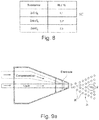
- Fig. 4 shows a tabular characterization of the anti-microbial effectiveness of anti-microbial coatings in general.
- the anti-microbial or anti-bacterial effectiveness of different coatings can be classified according to Fig. 4 as “none”, “slight”, “significant” and “strong”.
- the reduction factor R L is used to quantify the anti-microbial effectiveness.
- R L log (A/B).
- A corresponds to an average value of so-called colony forming units (CFU) per ml on a reference surface without anti-microbial coating.
- B corresponds to an average value of colony forming units (CFU) per ml on a reference surface with an anti-microbial coating according to the present invention.
- the colony-forming units can also be interpreted as the specific total germ count per ml.
- JIS Z 2801 Japanese Industrial Standard Test, JIS Z 2801
- ISO standard 22196 in Europe is used for objective assessment of the germ reducing effect of surfaces.
- Petri dishes coated with the test substance are first wetted with a germ suspension (e.g. E. coli or Staphylococcus aureus), covered with a foil and then incubated at 35°C and 95% humidity.
- a germ suspension e.g. E. coli or Staphylococcus aureus
- the experiments can be performed in the dark or under defined lighting conditions (e.g. by means of LED light at 1600 lux).
- Fig. 5 shows a tabular representation of the anti-microbial effectiveness of further embodiments of an anti-microbial coating 10' according to the invention.
- the anti-microbial effectiveness against E. coli bacteria is shown in Fig. 5 for a duration of 5 min in darkness and under defined light conditions at 1600 lux.
- inventions of the respective anti-microbial coating 10' according to the invention as shown in Fig. 5 essentially have the same structural (macroscopic) and functional features as the embodiments shown in Fig. 1 and 2 .
- the structure of the metal oxide and metal salt or only the metal salt contained in the anti-microbial coating is generally described by the formula AO 2 XBO 3 or XBO 3 according to Fig. 5 .
- A is selected from the elements of group 4
- X is selected from the elements of group 11
- B is selected from the elements of group 15 of the periodic table of the elements (IUPAC nomenclature) and O is the element oxygen.
- the metal oxide and the metal salt are TiO 2 AgNO 3 or the metal salt is AgNO 3 .
- the anti-microbial effectiveness of TiO 2 against E. coli bacteria was assessed for a duration of 0.5h, 4h and 24h both in darkness and under defined light conditions at 1600 lux.
- Fig. 6 shows a further tabular representation of the anti-microbial effectiveness of further embodiments of an anti-microbial coating 10" according to the invention.
- the anti-microbial effectiveness against E. coli bacteria is shown in Fig. 6 for a duration of 5 min, 1 h and 24 h under defined light conditions at 1600 lux.
- the embodiments of the respective anti-microbial coating 10" shown in Fig. 6 essentially have the same structural (macroscopic) and functional features as the embodiments shown in Fig. 1 and 2 .
- the coating 10 contains at least one complex compound.
- the structure of the complex compound is generally described by the formula A c B d X n Me e B f or X n Me e B f .
- A is selected from the elements of group 4
- B is selected from the elements of group 15 or 16
- X is selected from the elements of groups 5, 7, 8, 9, 10, 11, 12, 13, 14, 15 of the lanthanoids, or the actinides
- Me is selected from the elements of group 6 of the periodic table of the elements (IUPAC nomenclature).
- c, d, n, e and f can independently of each other take a value between 0 and 1000, preferably 0 and 24.
- the structure of the complex compound is described by the formula AO 2 X n MeO y or X n MeO y .
- A is selected from the elements of group 4
- X is selected from the elements of groups 5, 7, 8, 9, 10, 11, 12, 13, 14, 15 of the lanthanoids, or the actinides
- Me is selected from the elements of group 6 of the periodic table of the elements (IUPAC nomenclature) and O is the element oxygen.
- n can have a value between 0 and 24.
- y can have a value between 0 and 1000.
- the structure of the complex compound can be described by the formula AO 2 X n MeO 4 or X n MeO 4 .
- the complex compound contains particularly molybdates or tungstates.
- the molybdates comprise particularly (NH 4 ) 6 Mo 7 O 24 , Na 2 MoO 4 , Ag 2 MoO 4 , Al 2 (MoO 4 ) 3 , CeMoO 4 , CoMoO 4 , CuMoO 4 , Fe-III-MoO 4 , MnMoO 4 , NiMoO 4 or ZnMoO 4 .
- the anti-microbial coating 10" can be formed either from these molybdates or from a compound of these molybdates with TiO 2 .
- the anti-microbial coating 10" can also include MoO 3 or a compound of TiO 2 and MoO 3 instead of the molybdates.
- the tungstates comprise particularly Na 2 WO 4 , AgWO 4 , AlWO 4 , CeWO 4 , CoWO 4 , CuWO 4 , Fe-III-WO 4 , MnWO 4 , NiWO 4 or ZnWO 4 .
- the anti-microbial coating 10" can either be formed from these tungstates or from a compound of these tungstates with TiO 2 .
- the anti-microbial coating 10" can also include WO 3 or a compound of TiO 2 and WO 3 .
- Fig. 7 shows a further tabular representation of the anti-microbial effectiveness of further embodiments of an anti-microbial coating 10'" according to the invention.
- the anti-microbial effectiveness against E. coli bacteria is shown in Fig. 7 for a duration of 1 h and 24 h under defined light conditions at 1600 lux.
- the embodiments of the respective anti-microbial coating 10'" shown in Fig. 7 essentially have the same structural (macroscopic) and functional features as the embodiments shown in Fig. 1 and 2 .
- Fig. 7 particularly serves to show the difference in the anti-microbial effectiveness of the anti-microbial coating, which on the one hand is formed from a tungstate and on the other hand is formed from this tungstate in combination with TiO2.
- the tungstates according to Fig. 7 include particularly AgWO 4 , AlWO 4 , CeWO 4 , CuWO 4 , or ZnWO 4 or these tungstates in combination with TiO 2 .
- the second last or last line of the table shown in Fig. 7 shows another metal oxide and another complex compound.
- Me is selected from the elements of group 6 of the periodic table of the elements (IUPAC nomenclature) and O is the element oxygen.
- d and e can independently of each other have a value between 0 and 100.
- d and e can independently of each other have a value between 0 and 40.
- d and e can independently of each other have a value between 0 and 24.
- the metal oxide as shown in Fig. 7 is particularly WO 3 .
- A is selected from the elements of group 4
- Me is selected from the elements of group 6 of the periodic table of the elements (IUPAC nomenclature) and O is the element oxygen.
- d and e can independently of each other take a value between 0 and 100.
- d and e can independently of each other have a value between 0 and 40.
- d and e can independently of each other have a value between 0 and 24.
- the complex compound according to Fig. 7 is particularly WO 3 *TIO 2 .
- Fig. 8 shows a further tabular representation of the anti-microbial effectiveness of further embodiments of an anti-microbial coating 10''' according to the invention.
- the anti-microbial effectiveness against E. coli bacteria is shown in Fig. 8 for a duration of 1 h under defined light conditions at 1600 lux.
- the embodiments of the respective anti-microbial coating 10"" shown in Fig. 8 essentially have the same structural (macroscopic) and functional features as the embodiments shown in Fig. 1 and 2 .
- This coating 10" includes particularly ZnCrO 4 , ZnMoO 4 or ZnWO 4 .
- chromium oxide has a strong toxic effect.
- Fig. 9a shows a schematic representation of an embodiment of an electrostatic spray method for obtaining an anti-microbial coating 10, 10', 10", 10"', 10"" according to the invention.
- the electrostatic spray method for coating at least one substrate 12 comprises the following steps:
- the metal oxide is present in the form of nanoparticles with an average size of less than or equal to about 10 nm.
- the aqueous solution or suspension 24 has a pH value of less than or equal to about 1.5.
- the metal oxide is contained in the aqueous solution or suspension 24 in a range, particularly, of about 0.1% to about 5%.
- the aqueous solution or suspension 24 may also contain a complex compound.
- Fig. 9a it is also shown that during the coating of substrate 12 the microdroplets with the TiO 2 dissolved therein are electrically positively charged.
- Fig. 9b shows an enlarged representation of an island 16 in this respect.
- the moisture content is 2%.
- this behaviour determines the basic idea of converting water-soluble TiO 2 after application in the form of small droplets 26 with the electrostatic spray method described above into a solid matrix into which both soluble and insoluble (complex) compounds with a germ reducing effect can be introduced.
- the deposited microdroplets 26 evaporate very quickly at room temperature within only 1 - 2 min and leave a transparent TiO 2 matrix in the form of small islands 16 (cf. Fig. 1 and 2 ).
- Compounds with a permanent positive charge e.g. quaternary ammonium compounds such as PHMB are known to energize bacteria having a negative polar outer shell and thus preventing them from being transported back into the ambient air.
- the positive charge leads to a structural change of the bacterial membrane and a dysfunction of the ion channels.
- hydrophilic surfaces of the substrate 12 have the advantage, contrary to hydrophobic surfaces, that they bind bacteria on the surface and prevent back transfer away from the coating surface.
- This property is an important first step towards improved room hygiene.
- Fig. 10 shows a diagram with a comparison of the temporal germ reduction of E. coli for an embodiment of the coating according to the invention pursuant to Fig. 5 in the form of TiO 2 .
- the result confirms a two-phase reduction with a rapid loss of vitality within the first hour and a further slow, essentially linear reduction between 1h and 24h.
- Fig. 11 shows a bar chart of the anti-microbial effectiveness of an embodiment of the inventive coating 10' according to Fig. 5 for 2-times, 3-times and 5-times coating of a Petri dish.
- the anti-microbial coating contains a matrix of TiO 2 and silver nitrate TiO 2 *AgNO 3 .
- the anti-microbial effectiveness of the coating against E. coli bacteria is shown in Fig. 11 after an incubation duration of 24 h under defined light conditions at 1600 lux.
- silver changes the tertiary structure of the bacterial outer membrane.
- the structure of the deposited TiO 2 *AgNO 3 matrix is stable against 1000-times wiping with an anti-septic cloth (ethanol, benzalkonium chloride).
- Fig. 12 shows two bar diagrams with a comparison of the temporal germ reduction of a coating containing TiO 2 *AgNO 3 and its individual components according to Fig. 5 in darkness and brightness.
- fig. 13a shows a diagram of a comparison of the temporal germ reduction of these two embodiments of the inventive coating 10' according to Fig. 5 in darkness and brightness (about 1600 Lux).
- 100% correspond to the respective starting concentration (about 5x10 5 CFU).
- TiO 2 *AgNO 3 shows a very strong germ reduction within the first 5 minutes by up to > 99.99%.
- Remarkable is the very strong germ reduction at 1600 lux of 98.1% after 1 min and 99.859% after 3 min.
- the anti-microbial properties of this coating 10' therefore may be enhanced by UV light incidence.
- Fig. 13b additionally shows the data points shown in Fig. 13a in tabular form.
- TiO 2 *AgNO 3 The existing germ reducing property of TiO 2 *AgNO 3 can be explained as follows Firstly, via the proven hydrophilicity and the positive charge of the metal oxide TiO 2 germs can be energized and retained.
- cations from the TiO 2 matrix can change the tertiary structure of the bacterial outer membrane in such a way that this membrane becomes porous and the bacteria dies.
- cationic silver has a very high oxidation potential and is able to attack the outer membrane of the microorganisms by fast electron transfers, whereby additional sulphur-containing enzymes are chemically inactivated.
- Fig. 14a shows a tabular representation of the anti-microbial effectiveness of an embodiment of the coating 10' according to Fig. 5 against a Staphylococcus aureus germ.
- Fig. 14b shows in this respect a temporal reduction of an Aspergillus fumigatus germ on an uncoated Petri dish and a Petri dish coated with an embodiment of the coating 10' according to Fig. 5 .
- the anti-microbial coating in Fig. 14b shows a TiO 2 *AgNO 3 matrix structure, as also shown in Fig. 11 to 14a .
- TiO 2 *AgNO 3 coated Petri dishes show a significant growth control within the first 4h and a clear reduction of germs after 24h compared to the uncoated reference Petri dish (left figure in Fig. 14b ).
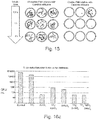
- Fig. 15 shows a temporal reduction of a Candida albicans germ on an uncoated Petri dish and a Petri dish coated with an embodiment of the coating 10' as shown in Fig. 5 .
- the anti-microbial coating 10' in Fig. 15 also shows a TiO 2 *AgNO 3 matrix structure as also shown in Fig. 11 to 14b .
- the anti-microbial coating 10' of substrates according to Fig. 11 to 15 with TiO 2 *AgNO 3 is conceivable e.g. in outdoor areas (e.g. building walls, surfaces of public transport vehicles or road surfaces).
- Petri dishes were coated 0-, 2-, 5- and 10-times with TiO 2 *AgNO 3 and these aquatic organisms were cultivated for three days therein. As a result, these animals show the same vitality in the coated plates as in the uncoated ones.
- the biological matrix was filtered off and hydrochloric acid was added to the clear aqueous solution.
- Fig. 16a also shows a bar chart with a comparison of the temporal E. coli germ reduction of six embodiments of the inventive coating 10', 10" according to Fig. 5 and Fig. 6 after 5 min incubation time in the darkness.
- the anti-microbial coating contains a combination of the TiO 2 matrix with oxides and salts of group 6 (IUPAC nomenclature) of the periodic table of the elements.
- the zinc molybdate (ZnMoO 4 ) was applied alone (about 5.0 g/L) and in combination with the TiO 2 matrix described above (about 15 g/L) to a substrate 12 via electrospray and tested against E. coli.
- ammonium heptamolybdate (NH 4 ) 6 Mo 7 O 24 was tested, which has an anti-microbial effectiveness of 1.4 after 1h and 4.3 after 24h under these experimental conditions.
- ammonium heptamolybdate (NH 4 ) 6 Mo 7 O 24 used for the synthesis has a significant effectiveness already after 1h.
- Na 2 MoO 4 sodium molybdate
- the sodium molybdate which is also highly soluble, shows no anti-microbial effect even after 24 h (see Fig. 6 ).
- silver molybdate (Ag 2 MoO 4 ) could be determined as a further strongly germ-reducing compound.
- the starting material for the syntheses was sodium tungstate, which reacts with the soluble salts (chloride, nitrate, sulphate) of aluminium, cerium, cobalt, copper, nickel, manganese, silver and zinc to form slightly soluble salts of the form X n WO 4 .
- tungsten molybdate shows no antimicrobial effectiveness after an incubation period of 1h and 24h as well.
- zinc tungstate ZnWO 4
- TiO 2 *ZnWO 4 shows a strong antimicrobial effectiveness within 24 h.
- silver tungstate AlWO 4
- aluminium tungstate AlWO 4
- cerium tungstate CeWO 4
- copper tungstate CuWO 4
- tungsten oxide also has this strong effectiveness as well as its combination with the TiO 2 matrix.
- a three-center complex may also be formed between the positively charged TiO 2 , the positive metal cation (e.g. Ce 2+ ) and the tungstate anion.
- the electronic states change in such a way that the sparklingness of the original tungstates is lost.
- the yellow tungsten oxide (WO 3 ) also leads to a colourless suspension with TiO 2 through complexation.
- Such use of a coating material can thus be provided for producing an anti-microbial coating 10, 10', 10", 10"', 10"" as described above on a surface 14 of a substrate 12, said coating 10 containing at least one metal oxide and/or metal salt as described above.
- the coating 10, 10', 10", 10'", 10"” is thereby obtained by an electrostatic spray method as described above.
- the surface 14 of the coating 10, 10', 10", 10''', 10''' may be a work surface or may be in contact, at least temporarily, with ambient air, fluids or liquids.
- TiO 2 *X n MeO 4 can be added to lacquers and paints (e.g. anti-fouling) in the form of the suspension or as a solid after drying, thus giving them anti-microbial properties.
- a TiO 2 *X n MeO 4 complex is added to the coating material, which is especially designed as an anti-fouling lacquer or anti-fouling paint, in the form of a suspension or as a solid after drying.
- the coating material could be designed as a sol gel or a synthetic resin, for instance a melamine resin or a polyurethane.
- the colourless complexes of the form TiO 2 *X n MeO 4 can be incorporated into plastics (e.g. silicone, PU, etc.) or building materials (e.g. cement), which thus become anti-microbial.
- plastics e.g. silicone, PU, etc.
- building materials e.g. cement
- the water-soluble nano-zirconium oxide ZrO 2 can also be applied to a transparent matrix comparable to TiO 2 (same group in periodic table of the elements) by means of the electrostatic spray method.
- hafnium oxide as a group relative of the IV. subgroup should be usable.
- Fig. 17 shows examples for the effect of the use of an antimicrobial coating 10 of a substrate 12 for inactivation of infectious agents.
- bar diagrams show the effect of the use of an antimicrobial coating 10 of a substrate 12 for inactivation of different infectious agents.
- the coating 10 is obtained by applying the coating 10 on a surface 14 of the substrate 12 by means of an electrostatic spraying method.
- the coating 10 comprises at least one metal oxide and/or at least one metal salt.
- a surface 14 has been exposed to different infectious agents.
- the surface 14 has been exposed to bacteria, in particular E. coli, P. aeruginosa or S aureus.
- the surface 14 has also been exposed to a coronavirus, in particular a bovine coronavirus.
- the surface 14 has further been exposed to an antimicrobial coating 10.
- a control group is shown, which indicates the infectious agents not treated with any coating 10.
- the coating 10 has been applied to the surface 14 of a substrate 12 after exposure of the surface 14 to the infectious agent.
- the surface 14 is first coated with the antimicrobial coating and then the infections agent is applied and inactivated by the coating 10.
- the number of bacteria on the surface 14 is reduced by more than 99.99999%, 5 minutes after application of the antimicrobial coating 10.
- the number of bovine corona virus (in log colony forming units) is reduced significantly 5 minutes after application of the antimicrobial coating 10, and is further reduced significantly 30 minutes after application of the antimicrobial coating 10.
- the antimicrobial coating 10 can be applied for inactivation of infectious agents, such as bacteria or viruses.
- Fig. 17 the effect of the antimicrobial coating 10 shown for bovine coronavirus is similar or identical for other viruses of the family of Coronaviridae, especially viruses of the subfamily Orthocoronavirinae, such as the severe acute respiratory syndrome coronavirus, the severe acute respiratory syndrome coronavirus 2 or the Middle East respiratory syndrome-related coronavirus.
- viruses of the subfamily Orthocoronavirinae such as the severe acute respiratory syndrome coronavirus, the severe acute respiratory syndrome coronavirus 2 or the Middle East respiratory syndrome-related coronavirus.
- Fig. 17 the effect of the antimicrobial coating shown for bovine coronavirus is similar or identical for any coronavirus species, due to the comparable structure of the different coronavirus species (Alphacoronavirus type species Human coronavirus 229E, Human coronavirus NL63, Miniopterus bat coronavirus 1, Miniopterus bat coronavirus HKU8, Porcine epidemic diarrhea virus, Rhinolophus bat coronavirus HKU2, Scotophilus bat coronavirus 512, Betacoronavirus species Betacoronavirus 1 (Bovine Coronavirus, Human coronavirus OC43), Human coronavirus HKU1, Murine coronavirus, Pipistrellus bat coronavirus HKU5, Rousettus bat coronavirus HKU9, Severe acute respiratory syndrome-related coronavirus (SARS-CoV, SARS-CoV-2), Tylonycteris bat coronavirus HKU4, Middle East respiratory syndrome-related coronavirus, Hedgehog coronavirus, Hedge
- an antimicrobial coating according to the present invention caused 90% inactivation of coronavirus. after 24h exposure to the antimicrobial coating.
- the antimicrobial coating 10 can be applied for inactivation of infectious agents, such as various bacteria, fungi, moulds or viruses: For instance, the use of an antimicrobial coating 10 according to the present invention caused 99.9999% inactivation of Escherichia coli after 5 minutes exposure to the antimicrobial coating 10.
- an antimicrobial coating 10 caused 99.9999% inactivation of Pseudomonas aeruginosa after less than 60 minutes exposure to the antimicrobial coating 10.
- an antimicrobial coating 10 according to the present invention caused 99.9999% inactivation of staphylococcus aureus after less than 120 minutes exposure to the antimicrobial coating 10.
- an antimicrobial coating 10 caused 99.98% inactivation of Candida albicans or Candida auris after 60 minutes exposure to the antimicrobial coating 10.
- an antimicrobial coating 10 caused 99.9% inactivation of Aspergillus fumigatus or Penicilliums sp. after 4-24h exposure to the antimicrobial coating 10.
- an antimicrobial coating 10 according to the present invention caused 99.999% inactivation of norovirus. after 24h exposure to the antimicrobial coating 10.
- an antimicrobial coating according to the present invention caused more than 99% inactivation of rhinovirus. after 24h exposure to the antimicrobial coating 10.
- iinactivation of an infectious agent may be understood as reducing completely or reducing partially the infectiousness of an infectious agent.
- inactivation of an infectious agent may be understood as rendering an infectious agent non-viable and/or no longer capable of growing, replicating, infecting a subject or causing disease.
- the object of viral inactivation is to improve viral safety so that transmissions no longer occur.
- Fig. 18 shows an example of a workflow for testing the effect of the use of an antimicrobial coating 10 of a substrate 12 for inactivation of human rhinovirus 16 HRV.
- a substrate 12, in particular a plate, coated with TiO 2 AgNO 3 (here referred to as HEC110) is exposed to human rhinovirus 16 HRV for either 5 minutes, 15 minutes or 30 minutes.
- a substrate 12 in particular a plate, coated with (TiO 2 ) 10 *H 4 SiW 12 O 40 (here referred to as HEC117) is exposed to human rhinovirus 16 HRV for either 5 minutes, 15 minutes or 30 minutes.
- the supernatant of the coated plates comprising the human rhinovirus 16 HRV exposed to the respective coating for the respective period of time is transferred to HeLa cells (grown in plates).
- infection This can be referred to as "infection" of the cells with the pre-treated virus.
- HeLa cells infected with human rhinovirus 16 HRV previously not exposed to any coating are used as a control (non-coated group). This can also be referred to as positive control
- Cytopathic effect was assessed by assessing cell detachment from the culture plate and assessing different cell morphology (round structures, bright boundary) after viral infection.
- the virus previously incubated with HEC110 and HEC17 showed less cytopathic effects (compared to the virus not incubated with any antimicrobial coating) 24 hours after infection and HeLa cells could maintain the same morphology as the non-infected group.
- HEC110 showed a fast anti-viral effect within 24 hours after virus infection (hours post infection, hpi).
- HEC117 Compared to HEC110, HEC117 showed a more persistent anti-viral effect.
- HEC117 showed a persistent anti-viral effect after short-term incubation with human rhinovirus (5 and 15 minutes) compared to HEC110.
- HEC110 and HEC17 can display a better anti-viral effect.
- the coating comprises between 0.5% and 10% of a compound comprising nano-TiO 2 , AgNO 3 and/or fumed silica, and is especially designed as a sole gel (tetrahydrosilicane/HNO 3 /alkyl alcohol), showing antimicrobial effects.
- a sole gel tetrahydrosilicane/HNO 3 /alkyl alcohol
- the coating comprises 5% (TiO 2 ) 10 *SiW 12 O 40 and is especially designed as a sole gel (tetrahydrosilicane/HNO 3 /alkyl alcohol). The effect is, however, not dependent on the type of sole gel.
- the coating comprises 0.5-10% (TiO 2 ) 3 *ZnMoO 4 and is especially designed as a synthetic resin, in particular a melamine resin.
- This coating applied to a surface of a substrate showed antibacterial effects (significant reduction of colony forming units of Staphylococcus aureus).
- the coating 10 comprises (TiO 2 ) 3 *ZnMoO 4 and is especially designed as a polyurethane, showing antimicrobial effects.
- the antimicrobial effect can be enhanced by grinding the surface after hardening of the coating 10.
- (TiO 2 )*ZnMoO 4 was compounded to 1-10% with granules and processed in a 3D printing process to form a three-dimensional object, which shows a strong effectiveness against Escherichia coli.
Landscapes
- Life Sciences & Earth Sciences (AREA)
- Chemical & Material Sciences (AREA)
- Plant Pathology (AREA)
- Wood Science & Technology (AREA)
- Engineering & Computer Science (AREA)
- Dentistry (AREA)
- Health & Medical Sciences (AREA)
- Pest Control & Pesticides (AREA)
- Inorganic Chemistry (AREA)
- General Health & Medical Sciences (AREA)
- Agronomy & Crop Science (AREA)
- Zoology (AREA)
- Environmental Sciences (AREA)
- Materials Engineering (AREA)
- Organic Chemistry (AREA)
- Paints Or Removers (AREA)
- Agricultural Chemicals And Associated Chemicals (AREA)
- Application Of Or Painting With Fluid Materials (AREA)
Priority Applications (3)
| Application Number | Priority Date | Filing Date | Title |
|---|---|---|---|
| EP20020209.1A EP3907261A1 (fr) | 2020-05-06 | 2020-05-06 | Utilisation de revêtement antimicrobien |
| PCT/EP2021/061495 WO2021224150A1 (fr) | 2020-05-06 | 2021-05-02 | Utilisation d'un revêtement antimicrobien |
| EP21722233.0A EP4146748A1 (fr) | 2020-05-06 | 2021-05-02 | Utilisation d'un revêtement antimicrobien |
Applications Claiming Priority (1)
| Application Number | Priority Date | Filing Date | Title |
|---|---|---|---|
| EP20020209.1A EP3907261A1 (fr) | 2020-05-06 | 2020-05-06 | Utilisation de revêtement antimicrobien |
Publications (1)
| Publication Number | Publication Date |
|---|---|
| EP3907261A1 true EP3907261A1 (fr) | 2021-11-10 |
Family
ID=70613556
Family Applications (2)
| Application Number | Title | Priority Date | Filing Date |
|---|---|---|---|
| EP20020209.1A Pending EP3907261A1 (fr) | 2020-05-06 | 2020-05-06 | Utilisation de revêtement antimicrobien |
| EP21722233.0A Pending EP4146748A1 (fr) | 2020-05-06 | 2021-05-02 | Utilisation d'un revêtement antimicrobien |
Family Applications After (1)
| Application Number | Title | Priority Date | Filing Date |
|---|---|---|---|
| EP21722233.0A Pending EP4146748A1 (fr) | 2020-05-06 | 2021-05-02 | Utilisation d'un revêtement antimicrobien |
Country Status (2)
| Country | Link |
|---|---|
| EP (2) | EP3907261A1 (fr) |
| WO (1) | WO2021224150A1 (fr) |
Families Citing this family (1)
| Publication number | Priority date | Publication date | Assignee | Title |
|---|---|---|---|---|
| EP4279550A1 (fr) * | 2022-05-19 | 2023-11-22 | Speira GmbH | Bande en aluminium pourvue de revêtement antibactérien |
Citations (22)
| Publication number | Priority date | Publication date | Assignee | Title |
|---|---|---|---|---|
| WO1995020878A1 (fr) | 1994-02-01 | 1995-08-10 | Theodor Krall | Procede de fabrication de corps plastiques bactericides/fongicides |
| DE19936059A1 (de) | 1999-07-30 | 2001-02-01 | J Peter Guggenbichler | Verfahren zur Herstellung von antimikrobiellen Kunststoffkörpern |
| DE10013248A1 (de) | 2000-03-17 | 2001-09-20 | J Peter Guggenbichler | Verfahren zur Herstellung von antimikrobiellen Kunststoffkörpern mit verbessertem Langzeitverhalten |
| DE10120802A1 (de) | 2001-04-27 | 2002-10-31 | Basf Ag | Verfahren zur Herstellung von gecoateten Nanopartikeln |
| DE10323448A1 (de) | 2003-01-09 | 2004-07-22 | Uvr-Fia Gmbh Verfahrensentwicklung Umweltschutztechnik Recycling | Kaltkeramik |
| DE10342258A1 (de) | 2003-09-11 | 2005-04-07 | Josef Peter Prof. Dr.med. Guggenbichler | Antimikrobiell wirkendes Präparat zur äußerlichen Anwendung |
| JP2006068583A (ja) * | 2004-08-31 | 2006-03-16 | Dd Planning Kk | 抗菌・防カビ・消臭剤の噴霧方法及びその噴霧装置 |
| EP1676582A1 (fr) * | 2003-10-16 | 2006-07-05 | Toagosei Co., Ltd. | Agent luttant contre le coronavirus |
| DE60022344T2 (de) | 1999-06-17 | 2006-07-27 | Bernhard Hanke | Antimikrobielles körperpflegemittel |
| DE202006018695U1 (de) | 2006-11-13 | 2007-03-22 | Plansee Se | Stoff mit antimikrobieller Wirkung |
| JP2008037814A (ja) * | 2006-08-08 | 2008-02-21 | Tokyo Medical & Dental Univ | 抗ウイルス材及び環境反応型抗ウイルス材 |
| DE102007061965A1 (de) | 2007-12-21 | 2009-06-25 | Guggenbichler, Joseph Peter | Reduzierung der mikrobiellen Kontamination in Kühltürmen |
| WO2010120730A1 (fr) * | 2009-04-13 | 2010-10-21 | Global Protection Usa, Inc. | Matériaux, appareil et procédés éliminant des substances dangereuses |
| DE102011085862A1 (de) | 2011-11-07 | 2013-05-08 | AMiSTec GmbH & Co. KG | Zusammensetzung mit wenigstens einem antimikrobiell wirksamen Wirkstoff |
| DE102012103064A1 (de) | 2012-04-10 | 2013-10-10 | AMiSTec GmbH & Co. KG | Verbundmaterial mit einem Trägermaterial und einem antimikrobiell wirksamen Agens |
| DE102013101909A1 (de) | 2013-02-26 | 2014-08-28 | AMiSTec GmbH & Co. KG | Verwendung von sauren Makromolekülen zum Herstellen einer antimikrobiell wirksamen Oberfläche |
| DE102013104284A1 (de) | 2013-04-26 | 2014-10-30 | Amistec Gmbh & Co Kg | Verfahren zum Herstellen eines dotierten oder undotierten Mischoxids für einen Verbundwerkstoff und Verbundwerkstoff mit einem solchen Mischoxid |
| DE102013114573A1 (de) | 2013-12-19 | 2015-06-25 | Fritz Egger GmbH & Co.OG Holzwerkstoffe | Verfahren zum Herstellen eines antimikrobiell wirksamen Möbel- und/oder Innenausbauteils |
| DE102013114575A1 (de) | 2013-12-19 | 2015-06-25 | AMiSTec GmbH & Co. KG | Verfahren zum Herstellen eines antimikrobiell wirksamen Verbundwerkstoffs und antimikrobiell wirksamer Verbundwerkstoff |
| WO2016069027A1 (fr) * | 2014-10-29 | 2016-05-06 | Nanonanousa, Llc | Compositions antimicrobiennes et procédés |
| EP3296269A1 (fr) * | 2016-09-16 | 2018-03-21 | POM Patentverwaltungs GbR | Hétéropolyoxométalates |
| WO2019053037A1 (fr) * | 2017-09-15 | 2019-03-21 | Hecosol Gmbh | Revêtement antimicrobien |
-
2020
- 2020-05-06 EP EP20020209.1A patent/EP3907261A1/fr active Pending
-
2021
- 2021-05-02 WO PCT/EP2021/061495 patent/WO2021224150A1/fr not_active Ceased
- 2021-05-02 EP EP21722233.0A patent/EP4146748A1/fr active Pending
Patent Citations (23)
| Publication number | Priority date | Publication date | Assignee | Title |
|---|---|---|---|---|
| WO1995020878A1 (fr) | 1994-02-01 | 1995-08-10 | Theodor Krall | Procede de fabrication de corps plastiques bactericides/fongicides |
| DE60022344T2 (de) | 1999-06-17 | 2006-07-27 | Bernhard Hanke | Antimikrobielles körperpflegemittel |
| DE19936059A1 (de) | 1999-07-30 | 2001-02-01 | J Peter Guggenbichler | Verfahren zur Herstellung von antimikrobiellen Kunststoffkörpern |
| DE10013248A1 (de) | 2000-03-17 | 2001-09-20 | J Peter Guggenbichler | Verfahren zur Herstellung von antimikrobiellen Kunststoffkörpern mit verbessertem Langzeitverhalten |
| DE10120802A1 (de) | 2001-04-27 | 2002-10-31 | Basf Ag | Verfahren zur Herstellung von gecoateten Nanopartikeln |
| DE10323448A1 (de) | 2003-01-09 | 2004-07-22 | Uvr-Fia Gmbh Verfahrensentwicklung Umweltschutztechnik Recycling | Kaltkeramik |
| DE10342258A1 (de) | 2003-09-11 | 2005-04-07 | Josef Peter Prof. Dr.med. Guggenbichler | Antimikrobiell wirkendes Präparat zur äußerlichen Anwendung |
| EP1676582A1 (fr) * | 2003-10-16 | 2006-07-05 | Toagosei Co., Ltd. | Agent luttant contre le coronavirus |
| JP2006068583A (ja) * | 2004-08-31 | 2006-03-16 | Dd Planning Kk | 抗菌・防カビ・消臭剤の噴霧方法及びその噴霧装置 |
| JP2008037814A (ja) * | 2006-08-08 | 2008-02-21 | Tokyo Medical & Dental Univ | 抗ウイルス材及び環境反応型抗ウイルス材 |
| DE202006018695U1 (de) | 2006-11-13 | 2007-03-22 | Plansee Se | Stoff mit antimikrobieller Wirkung |
| WO2008058707A2 (fr) | 2006-11-13 | 2008-05-22 | Plansee Se | Substance à action antimicrobienne |
| DE102007061965A1 (de) | 2007-12-21 | 2009-06-25 | Guggenbichler, Joseph Peter | Reduzierung der mikrobiellen Kontamination in Kühltürmen |
| WO2010120730A1 (fr) * | 2009-04-13 | 2010-10-21 | Global Protection Usa, Inc. | Matériaux, appareil et procédés éliminant des substances dangereuses |
| DE102011085862A1 (de) | 2011-11-07 | 2013-05-08 | AMiSTec GmbH & Co. KG | Zusammensetzung mit wenigstens einem antimikrobiell wirksamen Wirkstoff |
| DE102012103064A1 (de) | 2012-04-10 | 2013-10-10 | AMiSTec GmbH & Co. KG | Verbundmaterial mit einem Trägermaterial und einem antimikrobiell wirksamen Agens |
| DE102013101909A1 (de) | 2013-02-26 | 2014-08-28 | AMiSTec GmbH & Co. KG | Verwendung von sauren Makromolekülen zum Herstellen einer antimikrobiell wirksamen Oberfläche |
| DE102013104284A1 (de) | 2013-04-26 | 2014-10-30 | Amistec Gmbh & Co Kg | Verfahren zum Herstellen eines dotierten oder undotierten Mischoxids für einen Verbundwerkstoff und Verbundwerkstoff mit einem solchen Mischoxid |
| DE102013114573A1 (de) | 2013-12-19 | 2015-06-25 | Fritz Egger GmbH & Co.OG Holzwerkstoffe | Verfahren zum Herstellen eines antimikrobiell wirksamen Möbel- und/oder Innenausbauteils |
| DE102013114575A1 (de) | 2013-12-19 | 2015-06-25 | AMiSTec GmbH & Co. KG | Verfahren zum Herstellen eines antimikrobiell wirksamen Verbundwerkstoffs und antimikrobiell wirksamer Verbundwerkstoff |
| WO2016069027A1 (fr) * | 2014-10-29 | 2016-05-06 | Nanonanousa, Llc | Compositions antimicrobiennes et procédés |
| EP3296269A1 (fr) * | 2016-09-16 | 2018-03-21 | POM Patentverwaltungs GbR | Hétéropolyoxométalates |
| WO2019053037A1 (fr) * | 2017-09-15 | 2019-03-21 | Hecosol Gmbh | Revêtement antimicrobien |
Also Published As
| Publication number | Publication date |
|---|---|
| EP4146748A1 (fr) | 2023-03-15 |
| WO2021224150A1 (fr) | 2021-11-11 |
Similar Documents
| Publication | Publication Date | Title |
|---|---|---|
| US20240049719A1 (en) | Antimicrobial coating | |
| Birkett et al. | Recent advances in metal-based antimicrobial coatings for high-touch surfaces | |
| Gunputh et al. | Antibacterial properties of silver nanoparticles grown in situ and anchored to titanium dioxide nanotubes on titanium implant against Staphylococcus aureus | |
| Puspasari et al. | ZnO-based antimicrobial coatings for biomedical applications | |
| Diu et al. | Cicada-inspired cell-instructive nanopatterned arrays | |
| Manjumeena et al. | Biogenic nanosilver incorporated reverse osmosis membrane for antibacterial and antifungal activities against selected pathogenic strains: an enhanced eco-friendly water disinfection approach | |
| US9701848B2 (en) | Bioactive, ruthenium-containing coating and device | |
| JP7084914B2 (ja) | 金属酸化物ナノアレイでコーティングされた、細胞破裂に基づく抗微生物表面 | |
| US20190246636A1 (en) | Redox Active Metal/Metal Oxide Composites For Antimicrobial Applications | |
| Tripathy et al. | Outstanding antibiofilm features of quanta-CuO film on glass surface | |
| Pérez et al. | Use of nanotechnology to mitigate biofouling in stainless steel devices used in food processing, healthcare, and marine environments | |
| Gunputh et al. | Multilayered composite coatings of titanium dioxide nanotubes decorated with zinc oxide and hydroxyapatite nanoparticles: controlled release of Zn and antimicrobial properties against Staphylococcus aureus | |
| CN103997890B (zh) | 含银的抗微生物材料及其用途 | |
| US20080085326A1 (en) | Antimicrobial material compositions enriched with different active oxygen species | |
| Fisher et al. | Molybdenum doped titanium dioxide photocatalytic coatings for use as hygienic surfaces: the effect of soiling on antimicrobial activity | |
| Lu et al. | Antimicrobial activity of Ag nanoclusters encapsulated in porous silica nanospheres | |
| CN102784645A (zh) | 金属粒子组合TiO2光触媒强化杀菌组成物及制造方法 | |
| CN105327398A (zh) | 抗菌涂层组合物、包含抗菌涂层的医用植入材料及其制备方法 | |
| EP3907261A1 (fr) | Utilisation de revêtement antimicrobien | |
| Warangkar et al. | Antibacterial, antifungal and antiviral nanocomposites: Recent advances and mechanisms of action | |
| HK40063388A (en) | Use of antimicrobial coating | |
| US20140097660A1 (en) | Antimicrobial furniture and method of making | |
| Koklic et al. | Photocatalytic disinfection of surfaces with copper doped Ti02 nanotube coatings illuminated by ceiling mounted fluorescent light | |
| JP4839063B2 (ja) | 金属のイオンまたは化合物と溶菌酵素とを含有する抗菌剤およびその製造方法 | |
| Nguyen | Polymer Films Incorporating Inorganic Materials for Combating Antimicrobial-Resistant Bacteria |
Legal Events
| Date | Code | Title | Description |
|---|---|---|---|
| PUAI | Public reference made under article 153(3) epc to a published international application that has entered the european phase |
Free format text: ORIGINAL CODE: 0009012 |
|
| STAA | Information on the status of an ep patent application or granted ep patent |
Free format text: STATUS: THE APPLICATION HAS BEEN PUBLISHED |
|
| AK | Designated contracting states |
Kind code of ref document: A1 Designated state(s): AL AT BE BG CH CY CZ DE DK EE ES FI FR GB GR HR HU IE IS IT LI LT LU LV MC MK MT NL NO PL PT RO RS SE SI SK SM TR |
|
| B565 | Issuance of search results under rule 164(2) epc |
Effective date: 20201109 |
|
| STAA | Information on the status of an ep patent application or granted ep patent |
Free format text: STATUS: REQUEST FOR EXAMINATION WAS MADE |
|
| 17P | Request for examination filed |
Effective date: 20220510 |
|
| RBV | Designated contracting states (corrected) |
Designated state(s): AL AT BE BG CH CY CZ DE DK EE ES FI FR GB GR HR HU IE IS IT LI LT LU LV MC MK MT NL NO PL PT RO RS SE SI SK SM TR |
|
| REG | Reference to a national code |
Ref country code: HK Ref legal event code: DE Ref document number: 40063388 Country of ref document: HK |