EP3907314B1 - Kompressionsgestrick und kompressionsartikel, insbesondere zur gewebe-, nerven-, muskel- und faszienstimulation - Google Patents
Kompressionsgestrick und kompressionsartikel, insbesondere zur gewebe-, nerven-, muskel- und faszienstimulation Download PDFInfo
- Publication number
- EP3907314B1 EP3907314B1 EP21153934.1A EP21153934A EP3907314B1 EP 3907314 B1 EP3907314 B1 EP 3907314B1 EP 21153934 A EP21153934 A EP 21153934A EP 3907314 B1 EP3907314 B1 EP 3907314B1
- Authority
- EP
- European Patent Office
- Prior art keywords
- knitted fabric
- thread
- compression
- knit
- knitted
- Prior art date
- Legal status (The legal status is an assumption and is not a legal conclusion. Google has not performed a legal analysis and makes no representation as to the accuracy of the status listed.)
- Active
Links
Images



Classifications
-
- D—TEXTILES; PAPER
- D04—BRAIDING; LACE-MAKING; KNITTING; TRIMMINGS; NON-WOVEN FABRICS
- D04B—KNITTING
- D04B1/00—Weft knitting processes for the production of fabrics or articles not dependent on the use of particular machines; Fabrics or articles defined by such processes
- D04B1/10—Patterned fabrics or articles
- D04B1/102—Patterned fabrics or articles with stitch pattern
-
- D—TEXTILES; PAPER
- D04—BRAIDING; LACE-MAKING; KNITTING; TRIMMINGS; NON-WOVEN FABRICS
- D04B—KNITTING
- D04B1/00—Weft knitting processes for the production of fabrics or articles not dependent on the use of particular machines; Fabrics or articles defined by such processes
- D04B1/22—Weft knitting processes for the production of fabrics or articles not dependent on the use of particular machines; Fabrics or articles defined by such processes specially adapted for knitting goods of particular configuration
- D04B1/24—Weft knitting processes for the production of fabrics or articles not dependent on the use of particular machines; Fabrics or articles defined by such processes specially adapted for knitting goods of particular configuration wearing apparel
-
- A—HUMAN NECESSITIES
- A41—WEARING APPAREL
- A41B—SHIRTS; UNDERWEAR; BABY LINEN; HANDKERCHIEFS
- A41B2400/00—Functions or special features of shirts, underwear, baby linen or handkerchiefs not provided for in other groups of this subclass
- A41B2400/32—Therapeutic use
-
- A—HUMAN NECESSITIES
- A41—WEARING APPAREL
- A41D—OUTERWEAR; PROTECTIVE GARMENTS; ACCESSORIES
- A41D2400/00—Functions or special features of garments
- A41D2400/32—Therapeutic use
-
- D—TEXTILES; PAPER
- D10—INDEXING SCHEME ASSOCIATED WITH SUBLASSES OF SECTION D, RELATING TO TEXTILES
- D10B—INDEXING SCHEME ASSOCIATED WITH SUBLASSES OF SECTION D, RELATING TO TEXTILES
- D10B2509/00—Medical; Hygiene
- D10B2509/02—Bandages, dressings or absorbent pads
- D10B2509/028—Elastic support stockings or elastic bandages
Definitions
- the invention relates to a compression knit, in particular for tissue, nerve, muscle and fascia stimulation, as well as compression articles made from the compression knit.
- an upper body garment which, when worn, exerts a compression effect on the body of a wearer and has at least one stimulus-inducing structure with at least one stimulus-inducing functional element which, when worn, is arranged on an inner side of the upper body garment facing the body.
- the at least one functional element comprises a knitted area which differs in terms of its weave from a knitted area of the upper body garment adjacent to the functional element and is designed as a tuck knit.
- a proprioceptive stimulating effect is exerted on the wearer's body at the points where the functional elements are located, which is reinforced by the compression effect of the garment.
- the functional elements can be designed as locally limited elevations and dimensioned in such a way that they exert a point-like pressure on the wearer's skin along a muscle chain and thereby stimulate the muscle activity of the muscle chain in question.
- the stimulus-inducing structures with the stimulus-inducing functional elements are placed on the item of clothing in such a way that the stimulus-inducing structures at least partially overlap with specific muscles or muscle groups or the outer contour of the stimulus-inducing structure at least substantially corresponds to the outer contour of certain muscle groups.
- the EP 2 113 593 B1 discloses a circular knit for compression therapy with a patterned structured surface with elevations which, when applied to a body part to be treated with compression, exert surface pressure on the body part and a massage effect when moved, wherein the structured surface has a regular pattern in the form of chambers which are delimited by the elevations and adjacent chambers in the wale direction of the circular knit are connected to one another by connecting channels, wherein the circular knit is formed from a base knit with a knitting thread in which a stretchable weft thread is deposited in the chambers at a 1:1 offset, wherein the knitting thread forms tuck loops in the elevations and the weft thread in the elevations is not integrated into the base knit and the knitting thread in elevations with a course in the wale direction only forms tuck loops in every second row and a float of the weft thread and the subsequent binding point are offset by one stitch to the side, so that a float of the weft thread over two or three stitches is created.
- This knit can be used for the compression therapy of lymphedema and lipedema, whereby when wearing a compression article made from the knit, a sufficiently high compression pressure is exerted on the body part to be treated and at the same time an improvement in lymphatic drainage is achieved.
- the AT 11 230 U2 describes, for example, clothing elements that support or improve the well-being, physical functions or performance of the human body through targeted stimulation of meridians and/or acupuncture points known from traditional Chinese medicine, in which stimulation bodies arranged on the clothing element exert a stimulation through pressure or friction or through magnetic or electrical stimuli.
- the stimulation bodies are placed along the meridians and acupuncture points.
- tension can be relieved, regeneration after training or injuries accelerated, physical performance can be improved, muscles and bones strengthened or pain alleviated. Compression exerted on the body by the clothing element is intended to support the stimulation.
- the problem is that the functional elements, which are intended to act on certain parts of the wearer's body, such as certain trigger or acupuncture points, or are arranged along certain muscles or muscle chains, change their position when the wearer moves due to the elasticity of the clothing and the position of the functional elements is therefore moved away from the desired position. As a result, the functional elements no longer have a stimulating effect on the desired parts of the body when the wearer moves.
- one object of the invention is to provide a compression knit from which compression articles with stimulus-inducing stimulation or functional elements can be made, which remain dimensionally stable even when the wearer of the compression article moves, so that the functional elements can have a stimulating effect on the intended parts of the body without the functional elements being able to shift location on the wearer's body.
- Another object of the invention is to provide a compression knit for the production of compression articles for tissue, nerve, muscle and fascia stimulation, which enables targeted, as strong and local as possible stimulation of predetermined trigger points on the wearer's body.
- the compression knit according to the invention can be used for tissue, nerve, muscle and fascia stimulation as well as for the treatment of lymphatic insufficiencies and comprises an elastic base knit which is knitted from at least one knitting thread and a backing thread, as well as at least one elastic weft thread inserted or knitted into the base knit, wherein at least one area of the base knit is knitted as a nubby knit which comprises at least one web-shaped elevation which, when the compression knit is placed on a body part of a user, causes muscle or fascia stimulation as well as stimulation of the body tissue and nerves.
- the elevations which form functional elements for stimulating the muscles and in particular the muscle fascia, are formed in the nubby knit by floating the knitting thread and the backing thread.
- the formation of the elevations in the nubby knit by floating the knitting thread and the backed thread creates greater stability in the compression knit.
- the compression knit is more dimensionally stable under longitudinal tension (i.e. a tensile stress in the longitudinal direction or in the wale direction of the knit) than knits in which elevations are formed by tuck stitches.
- longitudinal tension i.e. a tensile stress in the longitudinal direction or in the wale direction of the knit
- a backed thread that runs in the base knit together with the knitting thread a higher degree of elevation is created than is the case, for example, with functional elements that are formed by tuck loops in a knit.
- the higher degree of elevation compared to the surface of the base knit means that targeted and punctual stimulation can be achieved at specific, predetermined trigger points on the wearer's body when a compression article made from the compression knit according to the invention is placed against the wearer's body.
- patterns can be introduced into the base knit using the backed thread.
- the type of weave of the backed thread and/or the weft thread defines the demarcation of the nubby knit from the base knit, in that the weave of the backed thread and/or the weft thread in the area of the nubby knit is designed differently than in the other areas of the base knit outside the nubby knit. The selected By weaving the backing thread and/or the weft thread in the nubby knit, a higher stability of the nubby knit area against longitudinal and transverse tension on the knit can be achieved.
- the elevations that act as functional or stimulation elements remain in the intended place, i.e. in particular at the specific trigger points (such as acupuncture points) on which the elevations are intended to have a stimulating effect.
- the dimensional stability of the compression knit according to the invention and thus the correct positioning of the elevations is maintained even when the wearer moves vigorously. This means that compression articles made from the compression knit can also be used by a wearer during sporting activities, for example, for targeted muscle and fascia stimulation.
- the protrusions of the web-shaped elevations above the base knit remain intact even when the knit is stretched.
- the web-shaped elevations protrude at least 2 mm and particularly preferably between 2.5 and 3.5 mm above the base knitted fabric on the side of the compression article facing the wearer's body. This ensures that the web-shaped elevations can stimulate the fascia at the specified trigger points on the body.
- the elevations can extend in the direction of the stitch rows of the knitted fabric over several stitches or needles of the knitting machine with which the compression knit is produced.
- the extent of the elevations in the direction of the stitch rows is determined by the number of stitches or needles of the knitting machine over which the knitting thread and the deposited thread are each floating.
- the elevations preferably extend in the direction of the stitch rows over at least two and in particular over three or four stitches. However, it is also possible to extend the elevations in the direction of the stitch rows over a larger number of stitches or needles, so that linear stimulation elements extending in the direction of the stitch rows can also be created.
- the elevations can extend over a plurality of consecutive rows of stitches In preferred embodiments, the elevations extend in the wale direction over at least four, particularly preferably over six to twelve and in particular over ten consecutive rows of stitches of the basic knitted fabric.
- the extent of the elevations in the direction of the stitch rows and in the direction of the wales can be adapted to the requirements and in particular to the desired size of the elevations that act as functional elements.
- the size of the elevations in the direction of the stitch rows and/or in the direction of the wales is, for example, in the range of 0.1 to 2 cm.
- the height of the elevations i.e.
- the height of the elevations above the base fabric in the unstretched state of the compression fabric is preferably in the range of 0.1 to 1.0 cm, particularly preferably at least 3 mm, in particular between 4 and 6 mm.
- the knit weave of the nubby knit preferably differs from the knit weave of the base knit.
- the area of the nubby knit differs from the area of the base knit surrounding the nubby knit, in particular through the knit weave of the backed thread and/or the weft thread.
- the base knit can comprise successive rows of stitches in the wale direction in areas outside the nubby knit, in which the knitting thread is knitted into each stitch or each needle and the backed thread is worked into the base knit alternately in a stitch-forming and floating manner.
- the stitch pattern of stitch rows adjacent in the wale direction is preferably arranged offset from one another in the stitch row direction.
- the knitting thread can be knitted on each needle of the knitting machine to form stitches, and the backed thread can form stitches together with the knitting thread between two needles, which can be spaced at least two but also three, four or more needles apart, and can lie loosely between two such knitted stitches.
- both the knitting thread and the underlying thread can be knitted on each needle of the knitting machine to form a stitch.
- the area of the nubby knit is characterized by particularly good dimensional stability and therefore helps to ensure that the elevations remain in the intended place, in particular at specific trigger points, even when the wearer of a compression article made from the knit moves.
- the elastic weft thread is preferably integrated in the same way in the base knit and the nubby knit.
- the elastic weft thread can be inserted or knitted in a tuck or offset manner in both the base knit and the nubby knit, for example in a 1:1, 1:2 or 1:3 ratio. This ensures that the elastic weft thread is securely integrated into the compression knit and therefore a uniform compression effect.
- the elastic weft thread can also be knitted in both the base knit and the nubby knit. On the one hand, the elastic weft thread causes a compressive effect of the elastic knit on the part of the body to which a compression article made from the compression knit is applied.
- the elasticity of the weft thread causes the knitted fabric to contract in the direction of the stitch rows in the area of the floats of the knitting thread and the backed thread in the nubby knit, thereby forming the elevations in such a way that they protrude above the surface of the base knit on one side of the compression knit (left side of the fabric).
- the height of the elevations above the surface of the base knit is determined by the number of floats of the knitting thread and the backed thread in the nubby knit. The more floats there are, the higher the elevations formed by these floats protrude above the surface of the base knit.
- the knitting thread is knitted into the base fabric and the nubby knit and lies loosely in the area of the elevations in the nubby knit.
- the backing thread is alternately knitted and backed with the knitting thread in the base fabric, knitted in the nubby knit and lies loosely in the area of the raised areas.
- the weft thread is inserted into the base fabric, the nubby knit and in the area of the raised areas in the nubby knit and is offset 1:1.
- the compression effect generated by the weft thread can be evenly distributed over the entire surface of the compression knit.
- the compression pressure exerted by the compression knit on a part of the wearer's body can be gradual.
- a pressure gradient of the compression pressure that decreases from distal to proximal is advantageous for supporting blood circulation.
- several web-shaped elevations are formed in the area of a nubby knit, between which a depression is arranged.
- neighboring elevations are spaced apart from one another in the direction of the stitch rows.
- the knitting thread and the underlying thread are knitted like in the rest of the area of the nubby knit, i.e. they are knitted together in each stitch or on each needle to form a stitch.
- the formation of several elevations in one area of the nubby knit, spaced apart from one another in the direction of the stitch rows contributes to improved dimensional stability of the compression knit when subjected to transverse tension (i.e. when there is a tensile stress on the knit in the direction of the stitch rows).
- the compression knit according to the invention is expediently designed as a circular knit and can be produced on both a circular knitting machine and a flat knitting machine. This enables industrial mass production while maintaining small size tolerances and the formation of seamless, tubular compression articles, such as tubular bandages, stockings, sleeves, torso bandages, or even items of clothing such as shirts or trousers.
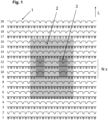
- Fig. 1 the thread path of an embodiment of a compression knit according to the invention is shown in an overview.
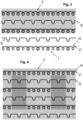
- the Figures 2 - 5 show detailed representations of the thread path.
- the knitting symbols used have the following meaning: weft thread, usually wrapped elastane thread backing thread, polyamide yarn knitting thread, "knitted lycra", (single) wrapped lycra thread
- Weft thread Floating Weft thread: handle/catch knitting thread (float), backing thread (float) knitting thread (stitch), backing thread (float) knitting thread (stitch), backing thread (stitch), backing thread (stitch)
- the embodiment of a compression knit according to the invention shown comprises an elastic base knit 1 which is knitted from at least one knitting thread F and a backing thread H (hereinafter also referred to as backing thread H).
- An elastic weft thread S is inserted into the base knit 1.
- Both the knitting thread F and the elastic weft thread S can be designed as a wound elastane thread, for example as a wound Lycra thread, whereby the knitting thread F is (significantly) thinner than the elastic weft thread S.
- the backing thread H can be a single yarn, for example a polyamide yarn. Instead of wound elastane threads, other yarns can also be used for the knitting thread F and for the weft thread S.
- the basic knitted fabric 1 is designed as a right-left knitted fabric (R/L knitted fabric), wherein the elastic weft thread S is deposited in the basic knitted fabric 1 offset 1:1 in the tuck.
- an area is knitted which is referred to as the nub knit 2 and is shown in the drawings of the thread path of the Figures 1-5 as a rectangle with a light grey background.
- the knitted area of the nubby knitted fabric 2 differs from the surrounding knitted area of the basic knitted fabric 1 by the type of knit weave of the backing thread H and/or the weft thread S.
- the knit weaves of the knitted thread F in the area of the nubby knitted fabric 2 are the same as in the remaining area of the basic knitted fabric 1, i.e., for example, they are designed as R/L knits.
- the knitting thread F in the basic knit 1 forms a stitch in areas outside the nubby knit 2 on each needle of the knitting machine with which the compression knit is knitted, so that a right-left knit is produced in the basic knit 1.
- the backing thread H in the basic knit 1 in the areas outside the nubby knit 2 is knitted into the basic knit 1 with the knitting thread F in such a way that the backing thread H forms a stitch on every second needle and lies loosely between these stitches.
- the backing thread H is therefore worked into the basic knit 1 outside the areas of the nubby knit alternately forming stitches and lying loosely.
- the deposited thread H in the area of the nub knit 2 forms a stitch on each needle, just like the knitting thread F, as can be seen, for example, from the detailed representation of the thread path of the Fig. 5
- This design of the nub knit 2 results in a higher dimensional stability of the compression knit in the area of the nub knit 2, compared to the areas of the base knit 1 outside the nub knit 2.
- Two web-shaped elevations 3 are arranged, which in the thread path representations of the Figures 1 - 5 are represented by rectangles with a dark grey background. In the direction of the stitch rows, the two elevations 3 are arranged at a predetermined distance from each other.
- the web-shaped Elevations 3 are formed in the area of the nub knit 2 by floats of the knitting thread F and the backing thread H.
- both the knitting thread F and the backing thread H are floating over a certain number of needles of the knitting machine.
- the number of needles over which the knitting thread F and the backing thread H are floating determines the width of the web-shaped elevations 3 (i.e. their extension in the direction of the stitch rows of the knitted fabric).
- the Figures 1 - 5 the knitting thread F and the backing thread H lie loosely over three needles, so that the two web-shaped elevations 3 each extend over three needles in the direction of the stitch rows.
- the knitting thread F and the backing thread H are knitted on each needle to form stitches, as in the remaining area of the nubby knit 2 outside the elevations 3.
- the extent of the web-shaped elevations 3 in the wale direction depends on the number of stitch rows in which the knitting thread F and the backing thread H are laid loosely to form the elevations 3.
- the number of stitch rows in which the knitting thread F and the backing thread H form 3 floats to form the elevations is shown in abbreviated form, as in the thread path of the Figure 1 only two stitch rows of the basic fabric 1 with floats of the knitting thread F and the backing thread H formed therein are shown.
- N can be between four and twelve, for example, and in particular N can be 10.
- the elastic weft thread S is integrated in the area of the nub knit 2 in the same way as in the area of the base knit 1 outside the nub knit 2, ie in the embodiment shown the weft thread S is offset 1:1 in the catch in the nub knit 2. In the area of the floats of the knitting thread F and the backing thread H, the weft thread S is hooked into the stitch heads of the stitches of the knitting thread F and is thus fixed in the stitch heads of the knitting thread F.
- the knitting process begins in row 1 with the knitting of the basic fabric 1 by knitting the knitting thread F as a stitch on each needle of the knitting machine as a R/L knit and simultaneously knitting in the backing thread H by forming a stitch on every second needle and floating the backing thread H between stitches of the backing thread H that follow one another in the stitch row direction.
- the weft thread S shown in row 2 is incorporated into the basic fabric 1 at a 1:1 ratio in the tuck.
- Row 3 is knitted with the knitting thread F and the backing thread H as in row 1, but offset by one needle in the stitch row direction. Accordingly, in the next row (row 4) the weft thread S is again incorporated into the basic fabric 1 at a 1:1 ratio in the tuck.
- the nub knit 2 is knitted into the basic knit 1 in some areas, which Fig. 1 with the light grey rectangle.
- the knitting thread F and the backing thread H are knitted in the area outside the nubby knit 2 as in row 1.
- the backing thread H is knitted in a different way. From here, the backing thread is knitted together with the knitting thread F on each needle to form a stitch. This is shown in the Fig. 1 shown embodiment over 15 needles until the basic fabric 1 is knitted again as in the first row.
- the web-shaped elevations 3 are formed in the area of the nubby knit 2 by tying the knitting thread F and the backing thread H into the nubby knit 2 in a floating manner over a predetermined number of needles of the knitting machine.
- the knitting thread F and the backing thread H run in a floating manner over three needles, so that the elevation 3 formed by these floats extends over three needles in the direction of the stitch row.
- two such elevations 3 are provided in the area of the nubby knit 2, which are spaced apart from one another over a predetermined number of needles of the knitting machine (in the example shown, these are five needles).
- the knitting thread F and the backing thread H are knitted on each needle to form stitches, as in the remaining area of the nubby knit 2 outside the elevations 3.
- row 10 the weft thread S is again tied in 1:1 in the tuck into the basic knit 1 and into the nub knit 2.
- Row 11 is again knitted like row 9, but offset by one needle in the stitch row direction.
- row 12 the weft thread S is again tied in in the same way as in the rows below.
- the knit of rows 9 - 12 can be knitted over a specified number of repetitions, for example five times. The number N of repetitions defines the extent of the bar-shaped elevations 3 in the knitting direction (stitch wale direction).
- rows 13 and 14 in the knitting direction are knitted like rows 7 and 8, whereby a long stitch is created over the floats in the previous rows, as the knitting thread F and the backing thread H are inserted in row 7 and remain on the needles without stitch formation until row 13.
- Rows 15 and 16 are knitted like rows 7 and 8 and rows 17 - 20 correspond to rows 1 - 4.
- the floats of the knitting thread F and the backing thread H in certain areas of the nubby knit 2 create the web-shaped elevations 3, because in the area of the floats of the weft thread F and the backing thread H, the weft thread S, which is still integrated 1:1 in the catch, pulls the knit together in the transverse direction and on a Fabric side of the knitted fabric (right fabric side, as in Fig. 6 shown photographically) elevations 3 are formed which protrude above a certain height above the surface of the basic fabric 1. On the other side of the fabric (left side of the fabric, as in Fig. 7 shown photographically), 3 corresponding depressions appear at the locations of the elevations.
- Fig. 8 shows in a perspective view the two web-shaped elevations 3 that are formed by the floats of the knitting thread F and the backing thread H in the area of the nubby knit 2.
- the knitting thread and the backing thread lie floating, while the knitting thread and the backing thread are knitted to form stitches in the remaining area of the nubby knit.
- the weft thread is inserted offset 1:1 in the base knit and in the entire nubby knit, including the area of the elevations.
- any number of elevations 3 can be formed in one area of a nub knit 2.
- Fig. 9 For clarification, an embodiment of a compression knit according to the invention is shown in which only one web-shaped elevation 3 is arranged in the area of a nub knit 2.
- Figure 10 a further embodiment is shown with three such web-shaped elevations 3, which are located in the area of a nubby knit 2 and are arranged at a distance from one another in the direction of the stitch rows.
- the predetermined distance between adjacent elevations 3 is determined by the number of needles over which the knitting thread F and the backing thread H are knitted into the nubby knit 2 on each needle to form stitches.
- the areas of the nub knit 2 with the elevations 3 arranged therein can be knitted into the base knit 1 at any point and as often as desired. It is useful if an area of a nub knit 2 is surrounded on all sides by an area of the base knit 1, as can be seen from Figure 1
- This enables the production of compression knits which have stimulation elements in the form of elevations 3 at certain, predeterminable positions on the knit.
- This allows compression articles for muscle and fascia stimulation or for the treatment of lymphatic insufficiencies to be produced from the compression knit according to the invention, which provide a targeted and, in particular, local stimulation at selected trigger points on the body of a wearer. limited stimulus to the skin, tissue and muscles or muscle fascia as well as nerve strands.
- the compression knit according to the invention is characterized by a high degree of dimensional stability, particularly in the area of the nubby knit 2.
- This high degree of dimensional stability in the area of the nubby knit 2 is achieved by knitting the knitting thread F and the backing thread H on each needle to form a stitch.
- the dimensional stability when pulled transversely i.e. when the knit is pulled in the direction of the stitch rows
- the compression knits according to the invention can therefore be used to produce dimensionally stable compression articles for tissue, nerve, muscle and fascia stimulation, with the web-shaped elevations 3 serving as stimulation elements that exert a stimulating effect on the part of the body to which the compression article is applied.
- Compression articles made from a compression knit according to the invention therefore enable targeted, in particular locally limited or punctual stimulation of nerves, muscles or fascia, in particular at certain trigger points on the body of a wearer of the compression article, without the position of the stimulation elements being changed, for example, by movements of the wearer.
- the invention is not limited to the embodiments described.
- the knit weave in the base knit 1 and in the nub knit 2 can be selected differently than in the R/L knit shown.
- a right-right knit (R/R) can also be used for this.
- R/R right-right knit
- the elastic weft thread can also be integrated differently into the base knit and the nub knit.
- the base knit can (also) be distinguished from the nub knit by the knit weaves of the weft thread.
- the compression knit according to the invention can be designed both as a circular knit and as a flat knit, whereby it is also possible to knit it as a seamless circular knit on a flat knitting machine with two opposing rows of needles.
Landscapes
- Engineering & Computer Science (AREA)
- Textile Engineering (AREA)
- Knitting Of Fabric (AREA)
Description
- Die Erfindung betrifft ein Kompressionsgestrick, insbesondere zur Gewebe-, Nerven-, Muskel- und Faszienstimulation, sowie aus dem Kompressionsgestrick hergestellte Kompressionsartikel.
- Aus dem Stand der Technik sind Bekleidungsstücke mit reizinduzierenden Strukturen zur Stimulation von Muskeln bzw. Faszien von Muskeln bekannt, bspw. aus der
EP 3 170 930 A1 . So ist beispielsweise aus derEP 2 895 021 B1 ein Oberkörperbekleidungsstück bekannt, das im getragenen Zustand eine Kompressionswirkung auf den Körper eines Trägers ausübt und mindestens eine reizinduzierende Struktur mit mindestens einem reizinduzierenden Funktionselement aufweist, das im getragenen Zustand an einer dem Körper zugewandten Innenseite des Oberkörperbekleidungsstücks angeordnet ist. Das mindestens eine Funktionselement umfasst dabei einen gestrickten Bereich, der sich hinsichtlich seiner Bindungsart von einem an das Funktionselement angrenzenden Strickbereich des Oberkörperbekleidungsstücks unterscheidet und als ein Fanggestrick ausgebildet ist. Mittels der reizinduzierenden Struktur wird auf den Körper des Trägers an den Stellen, an denen sich die Funktionselemente befinden, eine propriorezeptiv stimulierende Wirkung ausgeübt, welche durch die Kompressionswirkung des Bekleidungsstücks verstärkt wird. Die Funktionselemente können dabei als lokal begrenzte Erhebungen ausgebildet und so dimensioniert sein, dass sie eine punktuelle Druckausübung auf die Haut des Trägers entlang einer Muskelkette und dadurch eine Stimulation der Muskelaktivität der betreffenden Muskelkette bewirken. - Bei dem aus der
EP 2 895 021 B1 bekannten Bekleidungsstück sind die reizinduzierenden Strukturen mit den reizinduzierenden Funktionselementen so am Bekleidungsstück platziert, dass die reizinduzierenden Strukturen zumindest teilweise mit spezifischen Muskeln oder Muskelgruppen überlappen oder die Außenkontur der reizinduzierenden Struktur zumindest im Wesentlichen der Außenkontur bestimmter Muskelgruppen entspricht. - Die
EP 2 113 593 B1 offenbart ein Rundgestrick für die Kompressionstherapie mit einer musterförmig strukturierten Oberfläche mit Erhebungen, die bei Anlage an einem kompressiv zu therapierenden Körperteil einen Flächendruck auf das Körperteil und bei Bewegung einen Massageeffekt ausüben, wobei die strukturierte Oberfläche ein regelmäßiges Muster in Form von Kammern aufweist, die durch die Erhebungen begrenzt werden und in Maschenstäbchenrichtung des Rundgestricks benachbarte Kammern durch Verbindungskanäle miteinander in Verbindung stehen, wobei das Rundgestrick aus einem Grundgestrick mit einem Strickfaden gebildet ist, in dem in den Kammern ein dehnbarer Schussfaden 1:1 versetzt hinterlegt ist, wobei der Strickfaden in den Erhebungen Fanghenkel bildet und der Schussfaden in den Erhebungen nicht in das Grundgestrick eingebunden ist und der Strickfaden in Erhebungen mit Verlauf in der Maschenstäbchenrichtung nur in jeder zweiten Reihe Fanghenkel bildet und eine Flottung des Schussfaden sowie die darauf folgende Einbindestelle um eine Masche seitlich versetzt ist, so dass eine Flottung des Schussfadens über zwei oder drei Maschen entsteht. Dieses Gestrick kann für die Kompressionstherapie von Lymph-Ödemen und Lip-Ödemen eingesetzt werden, wobei beim Tragen eines aus dem Gestrick hergestellten Kompressionsartikels auf das zu therapierende Körperteil ein ausreichend hoher Kompressionsdruck ausgeübt und gleichzeitig eine Verbesserung des Lymphabflusses bewirkt wird. - Aus
EP 3246 439 A1 ist ein flachgestricktes Gestrickteil aus einem Grundgestrickfaden und einem elastischen Schussfaden bekannt, in dem sich über mehrere Maschenreihen erstreckende Wellenabschnitte eingestrickt sind, in dem jeweils in einem ersten Maschenstäbchen in einer ersten Wellenabschnitt-Maschenreihe und jeder weiteren Wellenabschnitt-Maschenreihe eine Masche gestrickt ist, während jeweils in einem benachbarten zweiten Maschenstäbchen eine in der ersten Wellenabschnitt-Maschenreihe gestrickte Masche sich über mehrere Wellenabschnitt-Maschenreihen erstreckt, wobei der elastische Schussfaden durch zumindest einen Teil der Grundgestrick-Maschenreihen und der Wellenabschnitt-Maschenreihen verläuft. Dadurch werden im Bereich der Wellenabschnitte verstärkt hervortretende Erhebungen bewirkt, die über dem Grundgestrick hervortreten und beim Tragen des Getrickteils einen massierenden Effekt auf den Träger ausüben. - Aus dem Stand der Technik sind weiterhin funktionelle Bekleidungsstücke bekannt, welche über Funktions- oder Stimulationselemente verfügen, die an bestimmten Trigger-Punkten des menschlichen Körpers beispielsweise durch Druck oder Reibung eine Stimulation hervorrufen.
- Die
AT 11 230 U2 - Bei den aus elastischen und kompressiven Gestricken hergestellten Bekleidungsstücken mit Stimulations- bzw. Funktionselementen zur Muskel- und Faszienstimulation besteht beim Tragen des Bekleidungsstücks das Problem, dass die Funktionselemente, die auf bestimmte Stellen des Körpers des Trägers einwirken sollen, wie z.B. bestimmte Trigger- oder Akupunkturpunkte, oder entlang bestimmter Muskeln oder Muskelketten angeordnet sind, bei Bewegungen des Trägers aufgrund der Elastizität der Bekleidungsstücke ihre Position ändern und die Lage der Funktionselemente dadurch von der gewünschten Lage entfernt wird. Dadurch wirken die Funktionselemente bei Bewegungen des Trägers nicht mehr auf die gewünschten Stellen am Körper stimulierend ein.
- Hiervon ausgehend besteht eine Aufgabe der Erfindung darin, ein Kompressionsgestrick bereitzustellen, aus dem Kompressionsartikel mit reizinduzierenden Stimulations- bzw. Funktionselementen hergestellt werden können, welche auch bei einer Bewegung des Trägers des Kompressionsartikels formstabil bleiben, so dass die Funktionselemente an den vorgesehenen Körperstellen stimulierend einwirken können, ohne dass es zu Ortsverschiebungen der Funktionselemente am Körper des Trägers kommen kann. Weiterhin besteht eine Aufgabe der Erfindung darin, ein Kompressionsgestrick zur Herstellung von Kompressionsartikeln zur Gewebe-, Nerven-, Muskel- und Faszienstimulation bereitzustellen, welches eine gezielte, möglichst starke und lokale Stimulation von vorgegebenen Trigger-Punkten am Körper des Trägers ermöglicht.
- Diese Aufgaben werden mit einem Kompressionsgestrick mit den Merkmalen des Anspruchs 1 sowie mit einem aus diesem Kompressionsgestrick hergestellten Kompressionsartikel gelöst. Bevorzugte Ausführungsformen des Kompressionsgestricks und des daraus hergestellten Kompressionsartikels können den abhängigen Ansprüchen entnommen werden.
- Das Kompressionsgestrick gemäß der Erfindung kann zur Gewebe-, Nerven-, Muskel- und Faszienstimulation wie auch zur Behandlung von Lymphinsuffizienzen eingesetzt werden und umfasst ein elastisches Grundgestrick, das aus wenigstens einem Strickfaden und einem hinterlegten Faden gestrickt ist, sowie wenigstens einen im Grundgestrick eingelegten oder eingestrickten elastischen Schussfaden, wobei in dem Grundgestrick wenigstens ein Bereich als ein Noppengestrick eingestrickt ist, welches mindestens eine stegförmige Erhebung umfasst, die bei Anlage des Kompressionsgestricks an einem Körperteil eines Benutzers eine Muskel- oder Faszienstimulation sowie eine Stimulation des Körpergewebes und der Nerven bewirkt. Gemäß der Erfindung sind die Erhebungen, welche Funktionselemente zur Stimulation der Muskeln und insbesondere der Muskelfaszien, bilden, im Noppengestrick durch Flottungen des Strickfadens und des hinterlegten Fadens gebildet.
- Durch die Ausbildung der Erhebungen im Noppengestrick durch Flottungen des Strickfadens und des hinterlegten Fadens wird eine größere Stabilität des Kompressionsgestricks erzeugt. Insbesondere ist das Kompressionsgestrick auf Längszug (also eine Zugspannung in Längsrichtung bzw. in Maschenstäbchenrichtung des Gestricks) formstabiler als Gestricke, in denen Erhebungen durch Fangmaschen ausgebildet sind. Durch die Verwendung eines hinterlegten Fadens, der im Grundgestrick zusammen mit dem Strickfaden verläuft, wird eine höhere Ausprägung der Erhebungen erzeugt, als dies beispielsweise bei Funktionselementen der Fall ist, die durch Fanghenkel in einem Gestrick ausgebildet sind. Durch die höhere Ausprägung der Erhebungen gegenüber der Oberfläche des Grundgestricks kann eine gezielte und punktuelle Stimulation an spezifischen, vorgegebenen Trigger-Punkten am Körper des Trägers erzielt werden, wenn ein aus dem erfindungsgemäßen Kompressionsgestrick hergestellter Kompressionsartikel am Körper des Trägers anliegt. Weiterhin können durch den hinterlegten Faden Musterungen in das Grundgestrick eingebracht werden. Schließlich definiert die Art der Strickbindung des hinterlegten Fadens und/oder des Schussfadens die Abgrenzung des Noppengestricks vom Grundgestrick, indem die Strickbindung des hinterlegten Fadens und/oder des Schussfadens im Bereich des Noppengestricks anders ausgebildet ist als in den übrigen Bereichen des Grundgestricks außerhalb des Noppengestricks. Durch die gewählte Gestrickbindung des hinterlegten Fadens und/oder des Schussfadens in dem Noppengestrick kann eine höhere Stabilität des Bereichs des Noppengestricks gegen Längs- und Querzug auf das Gestrick erzielt werden.
- Durch die hohe Formstabilität des Kompressionsgestricks, die durch die Ausbildung der Erhebungen durch Flottungen des Strickfadens und des hinterlegten Fadens in den Bereichen des Noppengestricks erzielt wird, bleiben die als Funktions- bzw. Stimulationselemente wirkenden Erhebungen am vorgesehenen Ort, d.h. insbesondere an den spezifischen Trigger-Punkten (wie z.B. Akupunkturpunkten), auf welche die Erhebungen stimulierend einwirken sollen. Die Formstabilität des erfindungsgemäßen Kompressionsgestricks und dadurch die korrekte Positionierung der Erhebungen wird dabei auch bei starken Bewegungen des Trägers aufrechterhalten. Dadurch können aus dem Kompressionsgestrick hergestellte Kompressionsartikel von einem Träger beispielsweise auch bei sportlicher Betätigung zur gezielten Muskel- und Faszienstimulation eingesetzt werden. Weiterhin bleiben aufgrund der hohen Formstabilität des Kompressionsgestricks die Überstände der stegförmigen Erhebungen über dem Grundgestrick auch bei einer Dehnung des Gestricks erhalten. Bevorzugt stehen die stegförmigen Erhebungen bei am Körper eines Trägers angelegtem Kompressionsartikel und dadurch gedehntem Gestrick an der dem Körper des Trägers zugewandten Seite des Kompressionsartikels über dem Grundgestrick mindestens 2 mm und besonders bevorzugt zwischen 2,5 und 3,5 mm vor. Dadurch wird gewährleistet, dass die stegförmigen Erhebungen an den vorgegebenen Triggerpunkten des Körpers eine Faszienstimulation ausüben können.
- Die Erhebungen können sich dabei in Maschenreihenrichtung des Gestricks über mehrere Maschen bzw. Nadeln der Strickmaschine, mit der das Kompressionsgestrick hergestellt wird, erstrecken. Die Ausdehnung der Erhebungen in Maschenreihenrichtung wird dabei über die Anzahl der Maschen bzw. Nadeln der Strickmaschine bestimmt, über die der Strickfaden und der hinterlegte Faden jeweils flott liegen. Bevorzugt erstrecken sich die Erhebungen in Maschenreihenrichtung über mindestens zwei und insbesondere über drei oder vier Maschen. Es ist jedoch auch möglich, die Erstreckung der Erhebungen in Maschenreihenrichtung über eine höhere Anzahl von Maschen bzw. Nadeln auszuführen, so dass auch lineare, sich in Maschenreihenrichtung erstreckende Stimulationselemente erzeugt werden können.
- In Längsrichtung des Gestricks (also in Strickrichtung bzw. Maschenstäbchenrichtung) können sich die Erhebungen jeweils über eine Mehrzahl von aufeinanderfolgenden Maschenreihen erstrecken. In bevorzugten Ausführungsbeispielen erstrecken sich die Erhebungen in Maschenstäbchenrichtung über mindestens vier, besonders bevorzugt über sechs bis zwölf und insbesondere über zehn aufeinanderfolgende Maschenreihen des Grundgestricks.
- Die Erstreckung der Erhebungen in Maschenreihenrichtung und in Maschenstäbchenrichtung kann den Erfordernissen und insbesondere der gewünschten Größe der als Funktionselemente wirkenden Erhebungen angepasst werden. Durch eine Ausbildung der Erhebungen über nur wenige Maschenreihen in Maschenstäbchenrichtung sowie die Ausbildung der Flottungen des Strickfadens und des hinterlegten Fadens über nur zwei oder drei Maschen bzw. Nadeln der Strickmaschine können punktuell wirkende Funktionselemente ausgebildet werden. Die Größe der Erhebungen in Maschenreihenrichtung und/oder in Maschenstäbchenrichtung liegt bspw. im Bereich von 0,1 bis 2 cm. Die Höhe der Erhebungen, also deren Überstand über die Oberfläche des Grundgestricks kann durch eine Auswahl der Fadenstärke des Strickfadens und des hinterlegten Fadens sowie durch die Anzahl der Maschen bzw. Nadeln, über die der Strickfaden und der hinterlegte Faden im Bereich der Erhebungen flott liegen, beeinflusst werden. Die Höhe der Erhebungen über dem Grundgestrick liegt dabei in ungedehntem Zustand des Kompressionsgestricks bevorzugt im Bereich von 0,1 bis 1,0 cm, besonders bevorzugt bei mindestens 3 mm, insbesondere zwischen 4 und 6 mm.
- Die Einbindung der Erhebungen in ein Noppengestrick, welches vom Grundgestrick umgeben ist, trägt zur Formstabilität des Kompressionsgestricks bei. Dabei unterscheidet sich die Gestrickbindung des Noppengestricks bevorzugt von der Gestrickbindung des Grundgestricks. Der Bereich des Noppengestricks unterscheidet sich von dem das Noppengestrick umgebenden Bereich des Grundgestricks insbesondere durch die Gestrickbindung des hinterlegten Fadens und/oder des Schussfadens. Erfindungsgemäß kann das Grundgestrick in Bereichen außerhalb des Noppengestricks in Maschenstäbchenrichtung aufeinanderfolgende Maschenreihen umfassen, in denen der Strickfaden in jeder Masche bzw. jeder Nadel verstrickt ist und der hinterlegte Faden abwechselnd maschenbildend und flott liegend in das Grundgestrick eingearbeitet ist. Bevorzugt ist dabei das Maschenbild von in Maschenstäbchenrichtung benachbarten Maschenreihen in Maschenreihenrichtung um je eine Masche versetzt zueinander angeordnet.
- Im Grundgestrick kann also beispielsweise der Strickfaden auf jeder Nadel der Strickmaschine maschenbildend verstrickt sein und der hinterlegte Faden kann zwischen zwei Nadeln, die einen Abstand von mindestens zwei aber auch drei, vier oder mehr Nadeln haben können, zusammen mit dem Strickfaden Maschen bilden und zwischen zwei solchen verstrickten Maschen flott liegen.
- Zusätzlich oder alternativ dazu, können gemäß der Erfindung im Bereich des Noppengestricks außerhalb der Erhebungen sowohl der Strickfaden als auch der hinterlegte Faden auf jeder Nadel der Strickmaschine maschenbildend verstrickt sein. Der Bereich des Noppengestricks zeichnet sich durch eine besonders gute Formstabilität aus und trägt daher dazu bei, dass die Erhebungen auch bei Bewegungen des Trägers eines aus dem Gestrick hergestellten Kompressionsartikels am vorgesehenen Ort, insbesondere an spezifischen Triggerpunkten, bleiben.
- Der elastische Schussfaden ist bevorzugt im Grundgestrick und im Noppengestrick in gleicher Weise eingebunden. So kann der elastische Schussfaden bspw. sowohl im Grundgestrick wie auch im Noppengestrick im Fang oder versetzt eingelegt oder verstrickt sein, bspw. im 1: 1, 1:2 oder 1:3. Dies stellt eine sichere Einbindung des elastischen Schussfadens in dem Kompressionsgestrick und dadurch eine gleichförmige Kompressionswirkung sicher. Der elastische Schussfaden kann auch sowohl im Grundgestrick wie auch im Noppengestrick verstrickt sein. Der elastische Schussfaden bewirkt einerseits eine kompressive Wirkung des elastischen Gestricks auf das Körperteil, an dem ein aus dem Kompressionsgestrick hergestellter Kompressionsartikel angelegt wird. Andererseits bewirkt die Elastizität des Schussfadens, dass sich das Gestrick im Bereich der Flottungen des Strickfadens und des hinterlegten Fadens in dem Noppengestrick in Maschenreihenrichtung zusammenzieht und dadurch die Erhebungen derart ausbildet, dass diese auf einer Warenseite des Kompressionsgestricks (linke Warenseite) über der Oberfläche des Grundgestricks vorstehen. Die Höhe der Erhebungen über der Oberfläche des Grundgestricks wird dabei durch die Anzahl der Flottungen des Strickfadens und des hinterlegten Fadens im Noppengestrick bestimmt. Je mehr Flottungen hier vorgesehen sind, desto höher stehen die Erhebungen, welche durch diese Flottungen ausgebildet sind, über der Oberfläche des Grundgestricks vor.
- In bevorzugten Ausführungsbeispielen ist der Strickfaden im Grundgestrick und im Noppengestrick verstrickt und liegt im Bereich der Erhebungen in dem Noppengestrick flott.
- Der Hinterlegefaden ist dabei im Grundgestrick abwechselnd mit dem Strickfaden verstrickt und hinterlegt, im Noppengestrick verstrickt und liegt im Bereich der Erhebungen flott. Der Schussfaden ist im Grundgestrick, im Noppengestrick und im Bereich der Erhebungen in dem Noppengestrick eingelegt und 1: 1 versetzt.
- Die von dem Schussfaden erzeugte Kompressionswirkung kann dabei gleichmäßig über die gesamte Fläche des Kompressionsgestricks ausgeführt sein. Es ist aber auch möglich, dass ein gradueller Verlauf des vom Kompressionsgestrick auf ein Körperteil des Trägers ausgeübter Kompressionsdruck erzeugt wird. Insbesondere bei Anlegen eines aus dem Kompressionsgestrick hergestellten Kompressionsartikels an einer Körperextremität wie einem Arm oder einem Bein ist ein von distal nach proximal abnehmender Druckverlauf des Kompressionsdrucks zur Unterstützung der Blutzirkulation vorteilhaft.
- In bevorzugten Ausführungsbeispielen sind im Bereich eines Noppengestricks mehrere stegförmige Erhebungen ausgebildet, zwischen denen eine Vertiefung angeordnet ist. In einem Bereich des Noppengestricks liegen dadurch benachbarte Erhebungen in Maschenreihenrichtung im Abstand zueinander. Im Bereich der Vertiefung zwischen zwei benachbarten Erhebungen in dem Bereich eines Noppengestricks sind der Strickfaden und der hinterlegte Faden wie im übrigen Bereich des Noppengestricks gestrickt, also in jeder Masche bzw. auf jeder Nadel maschenbildend miteinander verstrickt. Die Ausbildung von mehreren, in einem Bereich des Noppengestricks in Maschenreihenrichtung im Abstand zueinander liegenden Erhebungen trägt zu einer verbesserten Formstabilität des Kompressionsgestricks bei Querzug (also bei einer Zugspannung auf das Gestrick in Maschenreihenrichtung) bei.
- Das erfindungsgemäße Kompressionsgestrick ist zweckmäßig als Rundgestrick ausgebildet und kann sowohl auf einer Rundstrickmaschine als auch auf einer Flachstrickmaschine hergestellt werden. Dies ermöglicht eine industrielle Massenfertigung unter Einhaltung geringer Größentoleranzen und die Ausbildung von nahtlosen, schlauchförmigen Kompressionsartikeln, wie z.B. schlauchförmige Bandagen, Strümpfe, Ärmel, Rumpfbandagen, oder auch von Bekleidungsstücken wie z.B. Shirts oder Hosen.
- Diese und weitere Vorteile sowie Wirkungen und Merkmale des erfindungsgemäßen Kompressionsgestricks und der daraus hergestellten Kompressionsartikel ergeben sich aus den nachfolgend unter Bezugnahme auf die begleitenden Zeichnungen näher beschriebenen Ausführungsbeispielen.
- Die Figuren zeigen:
- Fig. 1
- Darstellung des Fadenlaufs eines Ausführungsbeispiels eines erfindungsgemäßen Kompressionsgestricks bestehend aus einem Grundgestrick mit darin eingestricktem Noppengestrick, welches zwei stegförmige Erhebungen aufweist;
- Fig. 2
- Detaildarstellung des Fadenlaufs des Kompressionsgestricks von
Fig. 1 im Bereich des Noppengestricks; - Fig. 3
- Detaildarstellung des Fadenlaufs des Kompressionsgestricks von
Fig. 1 im Übergangsbereich vom Grundgestrick zum Noppengestrick; - Fig. 4
- Detaildarstellung des Fadenlaufs des Kompressionsgestricks von
Fig. 1 im Bereich der Erhebungen in dem Noppengestrick; - Fig. 5
- Detaildarstellung des Fadenlaufs des Kompressionsgestricks von
Figur 1 im Übergangsbereich vom Grundgestrick zum Noppengestrick mit einer im Noppengestrick angeordneten Erhebung; - Fig. 6
- Fotografische Darstellung der linken Warenseite des Kompressionsgestricks von
Fig. 1 ; - Fig. 7
- Fotografische Darstellung der rechten Warenseite des Kompressionsgestricks von
Fig. 1 ; - Fig. 8
- Schematische und perspektivische Darstellung der in einem Bereich eines Noppengestricks angeordneten Erhebungen des Kompressionsgestricks von
Fig. 1 ; - Fig. 9
- Schematische und perspektivische Darstellung einer einzelnen, im Bereich des Noppengestricks eines erfindungsgemäßen Kompressionsgestricks angeordneten Erhebung;
- Fig. 10
- Schematische und perspektivische Darstellung eines weiteren Ausführungsbeispiels eines erfindungsgemäßen Kompressionsgestricks mit drei im Bereich des Noppengestricks in Maschenreihenrichtung im Abstand zueinander angeordneten Erhebungen.
- In
Fig. 1 ist der Fadenlauf eines Ausführungsbeispiels eines erfindungsgemäßen Kompressionsgestricks in einer Übersichtsdarstellung gezeigt. DieFiguren 2 - 5 zeigen Detaildarstellungen des Fadenlaufs. In denFiguren 1 bis 5 haben die verwendeten Stricksymbole folgende Bedeutung:
Schussfaden, idR umwundener Elasthanfaden 
Hinterlegfaden, Polyamidgarn 
Strickfaden, "Stricklycra", (einfach) umwundener Lycrafaden 
Schussfaden: Flottung 
Schussfaden: Henkel/Fang 
Strickfaden (Flottung), Hintelegfaden (Flottung) 
Strickfaden (Masche), Hinterlegfaden (Flottung) 
Strickfaden (Masche), Hinterlegfaden (Masche) - Das in den
Figuren 1 bis 5 dargestellte Ausführungsbeispiel eines erfindungsgemäßen Kompressionsgestricks umfasst ein elastisches Grundgestrick 1, das aus wenigstens einem Strickfaden F und einem hinterlegten Faden H (im Folgenden auch als Hinterlegfaden H bezeichnet) gestrickt ist. In das Grundgestrick 1 ist ein elastischer Schussfaden S eingelegt. Sowohl der Strickfaden F als auch der elastische Schussfaden S können als umwundener Elasthanfaden ausgebildet sein, bspw. als umwundener Lycrafaden, wobei der Strickfaden F (wesentlich) dünner ist als der elastische Schussfaden S. Bei dem Hinterlegfaden H kann es sich um ein Einfachgarn handeln, bspw. um ein Polyamidgarn. Anstelle umwundener Elasthanfäden können für den Strickfaden F und für den Schussfaden S auch andere Garne eingesetzt werden. - In dem zeichnerisch dargestellten Ausführungsbeispiel ist das Grundgestrick 1 als Rechts-Links-Gestrick (R/L-Gestrick) ausgebildet, wobei der elastische Schussfaden S 1:1 im Fang versetzt im Grundgestrick 1 hinterlegt ist.
- In dem Grundgestrick 1 ist ein Bereich eingestrickt, der als Noppengestrick 2 bezeichnet wird und in den Zeichnungen des Fadenlaufs der
Figuren 1-5 als hellgrau hinterlegtes Rechteck dargestellt ist. Der Gestrickbereich des Noppengestricks 2 unterscheidet sich von dem ihn umgebenden Gestrickbereich des Grundgestricks 1 zweckmäßig durch die Art der Gestrickbindung des Hinterlegfadens H und/oder des Schussfadens S. Die Gestrickbindungen des Strickfadens F sind in dem gezeigten Ausführungsbeispiel im Bereich des Noppengestricks 2 dieselben wie im übrigen Bereich des Grundgestricks 1, also bspw. als R/L-Gestrick ausgebildet. Wie beispielsweise der Detaildarstellung des Fadenlaufs derFig. 5 zu entnehmen ist, bildet der Strickfaden F in dem Grundgestrick 1 in Bereichen außerhalb des Noppengestricks 2 auf jeder Nadel der Strickmaschine, mit der das Kompressionsgestrick gestrickt wird, eine Masche, so dass sich im Grundgestrick 1 ein Rechts-Links-Gestrick ergibt. Der Hinterlegfaden H ist im Grundgestrick 1 in den Bereichen außerhalb des Noppengestricks 2 mit dem Strickfaden F so in das Grundgestrick 1 eingestrickt, dass der Hinterlegfaden H auf jeder zweiten Nadel eine Masche bildet und zwischen diesen Maschen flott liegt. Der hinterlegte Faden H ist also im Grundgestrick 1 außerhalb der Bereiche des Noppengestricks abwechselnd maschenbildend und flott liegend in das Grundgestrick 1 eingearbeitet. - Im Gegensatz dazu bildet der hinterlegte Faden H im Bereich des Noppengestricks 2 auf jeder Nadel, ebenso wie der Strickfaden F, eine Masche, wie beispielsweise aus der Detaildarstellung des Fadenlaufs der
Fig. 5 ersichtlich. Durch diese Ausbildung des Noppengestricks 2 ergibt sich im Bereich des Noppengestricks 2 eine höhere Formstabilität des Kompressionsgestricks, im Vergleich zu den Bereichen des Grundgestricks 1 außerhalb des Noppengestricks 2. - In dem Bereich des Noppengestricks 2 sind in dem zeichnerisch dargestellten Ausführungsbeispiel des Kompressionsgestricks gemäß den
Figuren 1 - 5 zwei stegförmige Erhebungen 3 angeordnet, welche in den Fadenlauf-Darstellungen derFiguren 1 - 5 durch dunkelgrau hinterlegte Rechtecke dargestellt sind. In Maschenreihenrichtung sind die beiden Erhebungen 3 in einem vorgegebenen Abstand zueinander angeordnet. Die stegförmigen Erhebungen 3 sind im Bereich des Noppengestricks 2 durch Flottungen des Strickfadens F und des hinterlegten Fadens H gebildet. - Wir insbesondere den Detaildarstellungen der
Figuren 4 und5 zu entnehmen ist, liegen im Bereich der stegförmigen Erhebungen 3 sowohl der Strickfaden F als auch der Hinterlegfaden H über eine bestimmte Anzahl von Nadeln der Strickmaschine flott. Die Anzahl der Nadeln, über die der Strickfaden F und der Hinterlegfaden H flott liegen, bestimmt dabei die Breite der stegförmigen Erhebungen 3 (also deren Ausdehnung in Maschenreihenrichtung des Gestricks). In dem gezeigten Ausführungsbeispiel derFiguren 1 - 5 liegen der Strickfaden F und der Hinterlegfaden H über drei Nadeln flott, so dass sich die beiden stegförmigen Erhebungen 3 in Maschenreihenrichtung jeweils über drei Nadeln erstrecken. Zwischen den stegförmigen Erhebungen 3 sind der Strickfaden F und der Hinterlegfaden H, wie im übrigen Bereich des Noppengestricks 2 außerhalb der Erhebungen 3, auf jeder Nadel maschenbildend gestrickt. - Die Erstreckung der stegförmigen Erhebungen 3 in Maschenstäbchenrichtung (bzw. in Strickrichtung des Gestricks) hängt von der Anzahl der Maschenreihen ab, in denen der Strickfaden F und der Hinterlegfaden H zur Ausbildung der Erhebungen 3 flott liegen. In dem in den
Figuren 1 - 5 gezeigten Ausführungsbeispiel ist die Anzahl der Maschenreihen, in denen der Strickfaden F und der Hinterlegfaden H zur Ausbildung der Erhebungen 3 Flottungen bilden, insofern verkürzt dargestellt, als in dem Fadenlauf derFigur 1 nur zwei Maschenreihen des Grundgestricks 1 mit darin ausgebildeten Flottungen des Strickfadens F und des Hinterlegfadens H gezeigt sind. Die Anzahl dieser Maschenreihen, in denen Flottungen des Strickfadens F und des Hinterlegfadens H vorgesehen sind, kann beim Stricken des Kompressionsgestricks beliebig ausgewählt werden, indem die Maschenreihen, die Flottungen des Strickfadens F und des Hinterlegfadens H enthalten, über eine bestimmte Anzahl von Maschenreihen wiederholt werden. Dies ist in dem Bild des Fadenlaufs derFigur 1 durch die mit "N x" bezeichnete Klammer dargestellt, wobei N die Anzahl der Wiederholungen der beiden Maschenreihen mit Flottungen ist. In bevorzugten Varianten des erfindungsgemäßen Kompressionsgestricks kann N beispielsweise zwischen vier und zwölf liegen und insbesondere kann N = 10 sein. - Der elastische Schussfaden S ist im Bereich des Noppengestricks 2 in der gleichen Weise wie im Bereich des Grundgestricks 1 außerhalb des Noppengestricks 2 eingebunden, d.h. in dem gezeigten Ausführungsbeispiel ist der Schussfaden S 1:1 im Fang versetzt im Noppengestrick 2 eingebunden. Im Bereich der Flottungen des Strickfadens F und des Hinterlegfadens H wird der Schussfaden S in die Maschenköpfe der Maschen des Strickfadens F eingehängt und ist dadurch in den Maschenköpfen des Strickfadens F fixiert.
- Im Folgenden wird der Strickprozess beschrieben, mit dem das Kompressionsgestrick gemäß
Figur 1 auf einer Rundstrickmaschine oder einer Flachstrickmaschine als Rund- oder als Flachgestrick gestrickt werden kann, wobei inFig. 1 am linken Rand die Nummern der Strickreihen (Maschenreihen des Grundgestricks 1 und Schussfadenreihen des Schussfadens S) angezeigt sind, wobei die ungeraden Reihen das Grundgestrick 1 und die geraden Reihen den darin eingebundenen Schussfade S darstellen. - Der Strickprozess beginnt in Reihe 1 mit dem Stricken des Grundgestricks 1 durch Verstricken des Strickfadens F als Masche auf jeder Nadel der Strickmaschine als R/L-Gestrick und gleichzeitiges Einstricken des Hinterlegfadens H durch Bildung einer Masche auf jeder zweiten Nadel und Flottungen des Hinterlegfadens H zwischen in Maschenreihenrichtung aufeinanderfolgenden Maschen des Hinterlegefdens H. Dabei wird der in Reihe 2 dargestellte Schussfaden S 1:1 im Fang versetzt in das Grundgestrick 1 eingebunden. Die Reihe 3 wird mit dem Strickfaden F und dem Hinterlegfaden H gestrickt wie in der Reihe 1, allerdings um eine Nadel in Maschenreihenrichtung versetzt. Entsprechend wird in der nächsten Reihe (Reihe 4) der Schussfaden S wieder 1: 1 im Fang versetzt in das Grundgestrick 1 eingebunden.
- In den in Strickrichtung (Maschenstäbchenrichtung) folgenden Reihen 5 - 15 wird in das Grundgestrick 1 bereichsweise das Noppengestrick 2 eingestrickt, welches in
Fig. 1 mit dem hinterlegten hellgrauen Rechteck dargestellt ist. In Reihe 5 wird der Strickfaden F und der Hinterlegfaden H im Bereich außerhalb des Noppengestricks 2 wie in der Reihe 1 verstrickt. Ab einer vorgegebenen Nadel (im gezeigten Ausführungsbeispiel ist dies die neunte Nadel) erfolgt eine andere Gestrickbindung des Hinterlegfadens H. Ab hier wird der Hinterlegfaden zusammen mit dem Strickfaden F auf jeder Nadel maschenbildend verstrickt. Dies wird in dem inFig. 1 gezeigten Ausführungsbeispiel über 15 Nadeln vorgenommen, bis wieder das Grundgestrick 1 wie in der ersten Reihe gestrickt wird. In der folgenden Reihe 6 wird wiederum der Schussfaden S 1: 1 im Fang versetzt in das Grundgestrick 1 und in das Noppengestrick 2 eingebunden. Die nächste Reihe (Reihe 7) wird in entsprechender Weise gestrickt wie Reihe 5, wobei in dem Bereich außerhalb des Noppengestricks 2 die Flottungen des Hinterlegfadens H um eine Nadel gegenüber der Reihe 5 versetzt angeordnet sind. - Ab der Reihe 9 werden im Bereich des Noppengestricks 2 die stegförmigen Erhebungen 3 ausgebildet, indem der Strickfaden F und der Hinterlegfaden H über eine vorgegebene Anzahl von Nadeln der Strickmaschine flott liegend in das Noppengestrick 2 eingebunden werden. In dem gezeigten Ausführungsbeispiel verläuft der Strickfaden F und der Hinterlegfaden H über drei Nadeln flott, so dass sich die durch diese Flottungen ausgebildete Erhebung 3 in Maschenreihenrichtung über drei Nadeln erstreckt.
- In dem in
Fig. 1 gezeigten Ausführungsbeispiel sind in dem Bereich des Noppengestricks 2 zwei solcher Erhebungen 3 vorgesehen, die über eine vorgegebene Anzahl von Nadeln der Strickmaschine (im gezeigten Beispiel sind dies fünf Nadeln) im Abstand zueinander liegen. In dem Bereich zwischen den beiden Erhebungen 3 wird der Strickfaden F und der Hinterlegfaden H auf jeder Nadel maschenbildend verstrickt, wie im übrigen Bereich des Noppengestricks 2 außerhalb der Erhebungen 3. - Nach Reihe 9 wird in Reihe 10 wiederum der Schussfaden S 1:1 im Fang in das Grundgestrick 1 und in das Noppengestrick 2 eingebunden. Reihe 11 wird wiederum gestrickt wie Reihe 9, allerdings um eine Nadel in Maschenreihenrichtung versetzt. In Reihe 12 wird wiederum der Schussfaden S in gleicher Weise wie in den darunterliegenden Reihen eingebunden. Die Gestrickbindung der Reihen 9 - 12 kann über eine vorgegebene Anzahl von Wiederholungen, beispielsweise fünfmal, wiederholt gestrickt werden. Durch die Anzahl N der Wiederholungen wird die Ausdehnung der stegförmigen Erhebungen 3 in Strickrichtung (Maschenstäbchenrichtung) definiert.
- Die in Strickrichtung nachfolgenden Reihen 13 und 14 werden wie die Reihen 7 und 8 gestrickt, wobei hier eine langgezogene Masche über die Flottungen in den vorherigen Reihen entsteht, da der Strickfaden F und der Hinterlegfaden H in Reihe 7 eingelegt werden und bis zur Reihe 13 ohne Maschenbildung auf den Nadeln bleiben. Die Reihen 15 und 16 werden gestrickt wie die Reihen 7 und 8 und die Reihen 17 - 20 entsprechen den Reihen 1 - 4.
- Durch die Flottungen des Strickfadens F und des Hinterlegefadens H in bestimmten Bereichen des Noppengestricks 2 entstehen die stegförmigen Erhebungen 3, weil im Bereich der Flottungen des Schussfadens F und des Hinterlegfadens H der weiterhin 1:1 im Fang versetzt darin eingebundene Schussfaden S das Gestrick in Querrichtung zusammenzieht und auf einer Warenseite des Gestricks (rechte Warenseite, wie in
Fig. 6 fotografisch dargestellt) Erhebungen 3 ausgebildet werden, die über eine bestimmte Höhe über der Oberfläche des Grundgestricks 1 vorstehen. Auf der anderen Warenseite (linke Warenseite, wie inFig. 7 fotografisch dargestellt) ergeben sich an den Stellen der Erhebungen 3 entsprechende Vertiefungen. - Die sich durch diese Gestrickbindung ergebenden stegförmigen Erhebungen 3 sind in der schematischen und perspektivischen Darstellung der
Fig. 8 gezeigt.Fig. 8 zeigt in einer perspektivischen Ansicht die beiden stegförmigen Erhebungen 3, die sich durch die Flottungen des Strickfadens F und des Hinterlegfadens H im Bereich des Noppengestricks 2 bilden. Im Bereich der Erhebung 3 liegen der Strickfaden und der Hinterlegefaden flott, während der Strickfaden und der Hinterlegefaden im übrigen Bereich des Noppengestricks maschenbildend verstrickt sind. Der Schussfaden ist im Grundgestrick und im gesamten Noppengestrick, einschließlich des Bereichs der Erhebungen 1: 1 versetzt eingelegt. - Mit der vorbeschriebenen Stricktechnik können beliebig viele Erhebungen 3 in einem Bereich eines Noppengestricks 2 ausgebildet werden. In
Fig. 9 ist zur Verdeutlichung ein Ausführungsbeispiel eines erfindungsgemäßen Kompressionsgestricks gezeigt, bei dem im Bereich eines Noppengestricks 2 nur eine stegförmige Erhebung 3 angeordnet ist. InFigur 10 ist ein weiteres Ausführungsbeispiel mit drei solcher stegförmigen Erhebungen 3 dargestellt, die im Bereich eines Noppengestricks 2 liegen und in Maschenreihenrichtung im Abstand zueinander angeordnet sind. Der vorgegebene Abstand von benachbarten Erhebungen 3 ergibt sich dabei durch die Anzahl der Nadeln, über die der Strickfaden F und der Hinterlegefaden H auf jeder Nadel maschenbildend in dem Noppengestrick 2 verstrickt werden. - Die Bereiche des Noppengestricks 2 mit den darin angeordneten Erhebungen 3 lassen sich an beliebigen Stellen und beliebig oft in das Grundgestrick 1 einstricken. Zweckmäßig ist dabei, wenn ein Bereich eines Noppengestricks 2 allseitig von einem Bereich des Grundgestricks 1 umgeben ist, wie aus
Figur 1 ersichtlich. Dadurch wird die Herstellung von Kompressionsgestricken ermöglicht, welche an bestimmten, vorgebbaren Positionen des Gestricks Stimulationselemente in Form der Erhebungen 3 aufweisen. Damit lassen sich aus dem erfindungsgemäßen Kompressionsgestrick Kompressionsartikel zur Muskel- und Faszienstimulation oder zur Behandlung von Lymphinsuffizienzen herstellen, die an ausgewählten Triggerpunkten am Körper eines Trägers einen gezielten und insbesondere lokal begrenzten Reiz auf die Haut, das Gewebe und die Muskeln bzw. die Muskelfaszien sowie auf Nervenstränge ausüben. - Das Kompressionsgestrick gemäß der Erfindung zeichnet sich dabei durch eine hohe Formstabilität insbesondere im Bereich des Noppengestricks 2 aus. Diese hohe Formstabilität im Bereich des Noppengestricks 2 wird erzielt, indem der Strickfaden F und der Hinterlegfaden H auf jeder Nadel maschenbildend verstrickt sind. Bei den Ausführungsformen des erfindungsgemäßen Kompressionsgestricks, in denen mehrere stegförmige Erhebungen 3 in einem Bereich eines Noppengestricks 2 ausgebildet sind, wird die Formstabilität auf Querzug (also auf einen Zug auf das Gestrick in Maschenreihenrichtung) noch durch die zwischen benachbarten Erhebungen ausgebildeten Strickbereiche des Noppengestricks 2 verstärkt.
- Aus den erfindungsgemäßen Kompressionsgestricken können daher formstabile Kompressionsartikel zur Gewebe-, Nerven-, Muskel- und Faszienstimulation hergestellt werden, wobei die stegförmigen Erhebungen 3 als Stimulationselemente dienen, die eine stimulierende Wirkung auf das Körperteil ausüben, an denen der Kompressionsartikel angelegt wird. Kompressionsartikel, die aus einem erfindungsgemäßen Kompressionsgestrick hergestellt sind, ermöglichen daher eine gezielte, insbesondere eine lokal begrenzte bzw. punktuelle Stimulierung von Nerven, Muskeln oder Faszien, insbesondere an bestimmten Triggerpunkten des Körpers eines Trägers des Kompressionartikels, ohne dass die Position der Stimulationselemente bspw. durch Bewegungen des Trägers verändert wird.
- Die Erfindung ist nicht auf die beschriebenen Ausführungsbeispiele beschränkt. So kann die Gestrickbindung in dem Grundgestrick 1 und in dem Noppengestrick 2 anders als im gezeigten R/L-Gestrick gewählt werden. Es kann hierfür bspw. auch eine Rechts-Rechts-Gestrick (R/R) verwendet werden. Zur Erzielung einer einheitlichen Struktur ist es jedoch vorteilhaft, wenn im Grundgestrick 1 und im Bereich des Noppengestricks 2 eine einheitliche Gestrickbindung, also bspw. R/R oder R/L verwendet wird. Weiterhin kann auch der elastische Schussfaden anders in das Grundgestrick und das Noppengestrick eingebunden werden. So ist es bspw. möglich, den Schussfaden in das Grundgestrick und das Noppengestrick einzustricken. Hierbei kann das Grundgestrickt vom Noppengestrick (auch) durch die Gestrickbindungen des Schussfadens unterschieden werden.
- Das Kompressionsgestrick gemäß der Erfindung kann sowohl als Rundgestrick als auch als Flachgestrick ausgebildet sein, wobei es auch möglich ist, es als nahtloses Rundgestrick auf einer Flachstrickmaschine mit zwei gegenüberliegenden Nadelreihen zu stricken.
Claims (13)
- Kompressionsgestrick, insbesondere zur Gewebe-, Nerven-, Muskel- und Faszienstimulation, umfassend ein elastisches Grundgestrick (1), das aus wenigstens einem Strickfaden (F) und einem hinterlegten Faden (H) gestrickt ist, sowie wenigstens einen im Grundgestrick (1) eingelegten oder eingestrickten elastischen Schussfaden (S), wobei in dem Grundgestrick (1) wenigstens ein Bereich als ein Noppengestrick (2) eingestrickt ist, welches mindestens eine stegförmige Erhebung (3) umfasst, die dazu ausgebildet ist bei Anlage des Kompressionsgestricks an einem Körperteil eines Benutzers eine Stimulation des Körperteils zu bewirken, dadurch gekennzeichnet, dass die Erhebungen (3) im Noppengestrick (2) durch Flottungen des Strickfadens (F) und des hinterlegten Fadens (H) gebildet sind, wobei das Grundgestrick (1) in Bereichen außerhalb des Noppengestricks (2) in Maschenstäbchenrichtung aufeinanderfolgende Maschenreihen umfasst, in denen der Strickfaden (F) Maschen bildet und der hinterlegte Faden (H) abwechselnd Maschen und Flottungen bildet und/oder das Noppengestrick (2) außerhalb der stegförmigen Erhebungen (3) Maschenreihen umfasst, in denen der Strickfaden (F) und der hinterlegte Faden (H) in jeder Masche maschenbildend miteinander verstrickt sind.
- Kompressionsgestrick nach Anspruch 1, dadurch gekennzeichnet, dass sich die Erhebungen (3) jeweils über mindestens zwei und insbesondere über drei oder mehr Maschen in Maschenreihenrichtung erstrecken, über die der Strickfaden (F) und der hinterlegte Faden (H) jeweils flott liegen und/oder dass sich die Erhebungen (3) in Maschenstäbchenrichtung (L) jeweils über mehr als zwei, bevorzugt über vier bis zwölf, insbesondere über zehn aufeinanderfolgende Maschenreihen erstrecken.
- Kompressionsgestrick nach einem der voranstehenden Ansprüche, dadurch gekennzeichnet, dass das Grundgestrick (1) in Bereichen außerhalb des Noppengestricks (2) in Maschenstäbchenrichtung aufeinanderfolgende Maschenreihen umfasst, in denen der Strickfaden (F) in jeder Masche verstrickt ist und der hinterlegte Faden (H) abwechselnd maschenbildend und flott liegend in das Grundgestrick (1) eingearbeitet ist, wobei das Maschenbild von in Maschenstäbchenrichtung benachbarten Maschenreihen in Maschenreihenrichtung um eine Masche versetzt zueinander verläuft.
- Kompressionsgestrick nach einem der voranstehenden Ansprüche, dadurch gekennzeichnet, dass der Schussfaden (S) sowohl im Grundgestrick (1) wie auch im Noppengestrick (2) im Fang oder versetzt eingelegt oder verstrickt ist.
- Kompressionsgestrick nach einem der voranstehenden Ansprüche, dadurch gekennzeichnet, dass wenigstens ein als Noppengestrick (2) ausgebildeter Bereich mehrere stegförmige Erhebungen (3a, 3b, 3c) umfasst, wobei bevorzugt zwischen in Maschenreihenrichtung benachbarten Erhebungen (3a, 3b; 3b, 3c) der Strickfaden (F) und der hinterlegte Faden (H) in jeder Masche, insbesondere über 3 bis 7 Maschen, maschenbildend miteinander verstrickt sind.
- Kompressionsgestrick nach einem der voranstehenden Ansprüche, dadurch gekennzeichnet, dass sich die Gestrickbindungen des Strickfadens (F) und des hinterlegten Fadens (H) und/oder des Schussfadens (S) im Grundgestrick und im Noppengestrick (2) unterscheiden.
- Kompressionsgestrick nach einem der voranstehenden Ansprüche, dadurch gekennzeichnet, dass im Grundgestrick (1) der Strickfaden (F) auf jeder Nadel der Strickmaschine maschenbildend verstrickt ist und der hinterlegte Faden (H) zwischen zwei Nadeln, die einen Abstand von mindestens zwei Nadeln haben, zusammen mit dem Strickfaden (F) Maschen bildet und zwischen zwei solchen verstrickten Maschen flott liegt.
- Kompressionsgestrick nach einem der voranstehenden Ansprüche, dadurch gekennzeichnet, dass sich die Gestrickbindung des hinterlegten Fadens (H) im Noppengestrick (2) und insbesondere innerhalb der Erhebungen (3) von der Gestrickbindung des hinterlegte Fadens (H) im Grundgestrick (1) unterscheidet.
- Kompressionsgestrick nach einem der voranstehenden Ansprüche, dadurch gekennzeichnet, dass jede der stegförmigen Erhebungen (3) in ungedehntem Zustand des Kompressionsgestricks mindestens 1 mm, bevorzugt mindestens 3 mm und insbesondere zwischen 4 und 6 mm über dem Grundgestrick (1) vorsteht.
- Kompressionsgestrick nach einem der voranstehenden Ansprüche, dadurch gekennzeichnet, dass es ein auf einer Rundstrick- oder einer Flachstrickmaschine gestricktes Rundgestrick oder ein Flachgestrick ist.
- Kompressionsartikel, insbesondere zur Gewebe-, Nerven-, Muskel- und Faszienstimulation, wobei der Kompressionsartikel zumindest bereichsweise oder vollständig aus einem Kompressionsgestrick nach einem der voranstehenden Ansprüche gefertigt ist.
- Kompressionsartikel nach Anspruch 11, dadurch gekennzeichnet, dass das Kompressionsgestrick mehrere als Noppengestrick (2) ausgebildete Bereiche umfasst, wobei jedes Noppengestrick (2) von Bereichen des Grundgestricks (1) umgeben ist und mindestens eine stegförmige Erhebung (3) und bevorzugt zwei oder drei stegförmige Erhebungen (3a, 3b, 3c) umfasst.
- Kompressionsartikel nach einem der Ansprüche 9 bis 12, dadurch gekennzeichnet, dass jede der stegförmigen Erhebungen (3) bei am Körper eines Trägers angelegtem Kompressionsartikel an der dem Körper des Trägers zugewandten Seite des Kompressionsartikels über dem Grundgestrick (1) vorsteht, bevorzugt mindestens 2 mm und besonders bevorzugt zwischen 2,5 und 3,5 mm, wobei die stegförmigen Erhebungen (3) dazu ausgebildet sind, an vorgegebenen Triggerpunkten des Körpers anzuliegen und dort eine Faszienstimulation auszuüben.
Applications Claiming Priority (1)
| Application Number | Priority Date | Filing Date | Title |
|---|---|---|---|
| DE102020112429.5A DE102020112429A1 (de) | 2020-05-07 | 2020-05-07 | Kompressionsgestrick und Kompressionsartikel, insbesondere zur Gewebe-, Nerven-, Muskel- und Faszienstimulation |
Publications (3)
| Publication Number | Publication Date |
|---|---|
| EP3907314A1 EP3907314A1 (de) | 2021-11-10 |
| EP3907314B1 true EP3907314B1 (de) | 2024-10-02 |
| EP3907314C0 EP3907314C0 (de) | 2024-10-02 |
Family
ID=74346919
Family Applications (1)
| Application Number | Title | Priority Date | Filing Date |
|---|---|---|---|
| EP21153934.1A Active EP3907314B1 (de) | 2020-05-07 | 2021-01-28 | Kompressionsgestrick und kompressionsartikel, insbesondere zur gewebe-, nerven-, muskel- und faszienstimulation |
Country Status (2)
| Country | Link |
|---|---|
| EP (1) | EP3907314B1 (de) |
| DE (1) | DE102020112429A1 (de) |
Families Citing this family (2)
| Publication number | Priority date | Publication date | Assignee | Title |
|---|---|---|---|---|
| FR3159506B1 (fr) * | 2024-02-28 | 2026-03-06 | Thuasne | Article tricoté comprenant au moins une protubérance |
| DE102024204344A1 (de) * | 2024-05-08 | 2025-11-13 | Martina Weiss | Kleidungsstück mit Massagefunktion |
Family Cites Families (7)
| Publication number | Priority date | Publication date | Assignee | Title |
|---|---|---|---|---|
| FR2801495B1 (fr) * | 1999-11-30 | 2002-04-12 | Cognon Morin | Orthese compressive ayant au moins une zone renforcee |
| JP5049031B2 (ja) | 2007-02-28 | 2012-10-17 | ピップ株式会社 | 衣類用の編地 |
| DE102008021998B4 (de) | 2008-05-02 | 2019-05-09 | Julius Zorn Gmbh | Verwendung eines Rundgestricks für die Kompressionstherapie von Lymphödemen |
| AT11230U3 (de) | 2010-01-20 | 2011-01-15 | Ines Mueller | Kleidung |
| DE102012216180B4 (de) | 2012-09-12 | 2026-05-07 | Falke Kgaa | Beinbekleidungsstück |
| DE102015119657A1 (de) | 2015-11-13 | 2017-05-18 | Falke Kgaa | Bekleidungsstück |
| EP3246439B1 (de) * | 2016-05-19 | 2022-11-09 | medi GmbH & Co. KG | Gestrickteil |
-
2020
- 2020-05-07 DE DE102020112429.5A patent/DE102020112429A1/de active Pending
-
2021
- 2021-01-28 EP EP21153934.1A patent/EP3907314B1/de active Active
Also Published As
| Publication number | Publication date |
|---|---|
| DE102020112429A1 (de) | 2021-11-11 |
| EP3907314C0 (de) | 2024-10-02 |
| EP3907314A1 (de) | 2021-11-10 |
Similar Documents
| Publication | Publication Date | Title |
|---|---|---|
| DE102013103914B3 (de) | Kompressives Rundgestrick zum Überziehen über eine ein Gelenk aufweisende Extremität | |
| DE1585117C3 (de) | Rundgestrickter Strumpf | |
| EP3214213B1 (de) | Rundgestrickteil sowie verfahren zur herstellung eines solchen | |
| EP3673878B1 (de) | Gestrickter kompressionsartikel | |
| EP2952616B1 (de) | Verfahren zur Herstellung eines flächigen oder räumlichen Gestricks | |
| EP3153615B1 (de) | Kompressive hose und ein verfahren zur herstellung eines das gesäss aufnehmenden hosenteils | |
| EP3246439B1 (de) | Gestrickteil | |
| DE102007063148A1 (de) | Nahtloses Kompressionsgestrick und Verfahren zu dessen Herstellung | |
| EP3412816B1 (de) | Kompressionsgestrick aus einem grundgestrick und einem darin eingelegten elastischen schussfaden, daraus hergestellter kompressionsartikel sowie verfahren zur herstellung eines kompressionsgestricks | |
| EP3141644B1 (de) | Kompressives gestrickteil und verfahren zu seiner herstellung | |
| EP3907314A1 (de) | Kompressionsgestrick und kompressionsartikel, insbesondere zur gewebe-, nerven-, muskel- und faszienstimulation | |
| EP4137626B1 (de) | Verfahren zur herstellung eines nahtlosen kompressionsartikels auf einer flachstrickmaschine | |
| DE3540386A1 (de) | Rohrfoermige stuetzbandage | |
| DE202020102580U1 (de) | Kompressionsgestrick und Kompressionsartikel, insbesondere zur Gewebe-, Nerven-, Muskel- und Faszienstimulation | |
| AT516450B1 (de) | Kompressionsgestrick mit zusätzlichem Kompressionsfaden | |
| CH716437B1 (de) | Medizinisches Gestrickteil und Verfahren zur Herstellung eines solchen Gestrickteils. | |
| DE2821126C2 (de) | Elastischer Rand einer Socke und Verfahren zu seiner Herstellung | |
| EP4328366A1 (de) | Kompressionsgestrick und verfahren zur herstellung eines kompressionsgestricks, insbesondere zur herstellung von gestrickten stumpfstrümpfen mit kompressiver wirkung | |
| AT291419B (de) | Verfahren zur Herstellung nahtloser Stützstrümpfe | |
| DE1635891B1 (de) | Damenstrumpf | |
| DE202022104736U1 (de) | Kompressionsgestrick, insbesondere zur Herstellung von gestrickten Stumpfstrümpfen mit kompressiver Wirkung | |
| AT274201B (de) | Rundgestrickter Damenstrumpf | |
| DE20220756U1 (de) | Rundgestrickte/-gewirkte Befestigungs-Unterhosen | |
| DE7518833U (de) | Kompressionsstrumpfhose | |
| CH718832B1 (de) | Flachgestrickte Kompressionsversorgung. |
Legal Events
| Date | Code | Title | Description |
|---|---|---|---|
| PUAI | Public reference made under article 153(3) epc to a published international application that has entered the european phase |
Free format text: ORIGINAL CODE: 0009012 |
|
| STAA | Information on the status of an ep patent application or granted ep patent |
Free format text: STATUS: THE APPLICATION HAS BEEN PUBLISHED |
|
| AK | Designated contracting states |
Kind code of ref document: A1 Designated state(s): AL AT BE BG CH CY CZ DE DK EE ES FI FR GB GR HR HU IE IS IT LI LT LU LV MC MK MT NL NO PL PT RO RS SE SI SK SM TR |
|
| B565 | Issuance of search results under rule 164(2) epc |
Effective date: 20210715 |
|
| STAA | Information on the status of an ep patent application or granted ep patent |
Free format text: STATUS: REQUEST FOR EXAMINATION WAS MADE |
|
| 17P | Request for examination filed |
Effective date: 20220510 |
|
| RBV | Designated contracting states (corrected) |
Designated state(s): AL AT BE BG CH CY CZ DE DK EE ES FI FR GB GR HR HU IE IS IT LI LT LU LV MC MK MT NL NO PL PT RO RS SE SI SK SM TR |
|
| GRAP | Despatch of communication of intention to grant a patent |
Free format text: ORIGINAL CODE: EPIDOSNIGR1 |
|
| STAA | Information on the status of an ep patent application or granted ep patent |
Free format text: STATUS: GRANT OF PATENT IS INTENDED |
|
| INTG | Intention to grant announced |
Effective date: 20240528 |
|
| GRAS | Grant fee paid |
Free format text: ORIGINAL CODE: EPIDOSNIGR3 |
|
| GRAA | (expected) grant |
Free format text: ORIGINAL CODE: 0009210 |
|
| STAA | Information on the status of an ep patent application or granted ep patent |
Free format text: STATUS: THE PATENT HAS BEEN GRANTED |
|
| AK | Designated contracting states |
Kind code of ref document: B1 Designated state(s): AL AT BE BG CH CY CZ DE DK EE ES FI FR GB GR HR HU IE IS IT LI LT LU LV MC MK MT NL NO PL PT RO RS SE SI SK SM TR |
|
| REG | Reference to a national code |
Ref country code: GB Ref legal event code: FG4D Free format text: NOT ENGLISH |
|
| REG | Reference to a national code |
Ref country code: CH Ref legal event code: EP |
|
| REG | Reference to a national code |
Ref country code: IE Ref legal event code: FG4D Free format text: LANGUAGE OF EP DOCUMENT: GERMAN |
|
| REG | Reference to a national code |
Ref country code: DE Ref legal event code: R096 Ref document number: 502021005284 Country of ref document: DE |
|
| U01 | Request for unitary effect filed |
Effective date: 20241010 |
|
| U07 | Unitary effect registered |
Designated state(s): AT BE BG DE DK EE FI FR IT LT LU LV MT NL PT RO SE SI Effective date: 20241030 |
|
| U20 | Renewal fee for the european patent with unitary effect paid |
Year of fee payment: 5 Effective date: 20250131 |
|
| PG25 | Lapsed in a contracting state [announced via postgrant information from national office to epo] |
Ref country code: IS Free format text: LAPSE BECAUSE OF FAILURE TO SUBMIT A TRANSLATION OF THE DESCRIPTION OR TO PAY THE FEE WITHIN THE PRESCRIBED TIME-LIMIT Effective date: 20250202 Ref country code: HR Free format text: LAPSE BECAUSE OF FAILURE TO SUBMIT A TRANSLATION OF THE DESCRIPTION OR TO PAY THE FEE WITHIN THE PRESCRIBED TIME-LIMIT Effective date: 20241002 |
|
| PG25 | Lapsed in a contracting state [announced via postgrant information from national office to epo] |
Ref country code: ES Free format text: LAPSE BECAUSE OF FAILURE TO SUBMIT A TRANSLATION OF THE DESCRIPTION OR TO PAY THE FEE WITHIN THE PRESCRIBED TIME-LIMIT Effective date: 20241002 |
|
| PG25 | Lapsed in a contracting state [announced via postgrant information from national office to epo] |
Ref country code: NO Free format text: LAPSE BECAUSE OF FAILURE TO SUBMIT A TRANSLATION OF THE DESCRIPTION OR TO PAY THE FEE WITHIN THE PRESCRIBED TIME-LIMIT Effective date: 20250102 |
|
| PG25 | Lapsed in a contracting state [announced via postgrant information from national office to epo] |
Ref country code: GR Free format text: LAPSE BECAUSE OF FAILURE TO SUBMIT A TRANSLATION OF THE DESCRIPTION OR TO PAY THE FEE WITHIN THE PRESCRIBED TIME-LIMIT Effective date: 20250103 |
|
| PG25 | Lapsed in a contracting state [announced via postgrant information from national office to epo] |
Ref country code: PL Free format text: LAPSE BECAUSE OF FAILURE TO SUBMIT A TRANSLATION OF THE DESCRIPTION OR TO PAY THE FEE WITHIN THE PRESCRIBED TIME-LIMIT Effective date: 20241002 Ref country code: CZ Free format text: LAPSE BECAUSE OF FAILURE TO SUBMIT A TRANSLATION OF THE DESCRIPTION OR TO PAY THE FEE WITHIN THE PRESCRIBED TIME-LIMIT Effective date: 20241002 |
|
| PG25 | Lapsed in a contracting state [announced via postgrant information from national office to epo] |
Ref country code: RS Free format text: LAPSE BECAUSE OF FAILURE TO SUBMIT A TRANSLATION OF THE DESCRIPTION OR TO PAY THE FEE WITHIN THE PRESCRIBED TIME-LIMIT Effective date: 20250102 |
|
| PG25 | Lapsed in a contracting state [announced via postgrant information from national office to epo] |
Ref country code: SM Free format text: LAPSE BECAUSE OF FAILURE TO SUBMIT A TRANSLATION OF THE DESCRIPTION OR TO PAY THE FEE WITHIN THE PRESCRIBED TIME-LIMIT Effective date: 20241002 |
|
| PG25 | Lapsed in a contracting state [announced via postgrant information from national office to epo] |
Ref country code: SK Free format text: LAPSE BECAUSE OF FAILURE TO SUBMIT A TRANSLATION OF THE DESCRIPTION OR TO PAY THE FEE WITHIN THE PRESCRIBED TIME-LIMIT Effective date: 20241002 |
|
| PLBE | No opposition filed within time limit |
Free format text: ORIGINAL CODE: 0009261 |
|
| STAA | Information on the status of an ep patent application or granted ep patent |
Free format text: STATUS: NO OPPOSITION FILED WITHIN TIME LIMIT |
|
| 26N | No opposition filed |
Effective date: 20250703 |
|
| PG25 | Lapsed in a contracting state [announced via postgrant information from national office to epo] |
Ref country code: MC Free format text: LAPSE BECAUSE OF FAILURE TO SUBMIT A TRANSLATION OF THE DESCRIPTION OR TO PAY THE FEE WITHIN THE PRESCRIBED TIME-LIMIT Effective date: 20241002 |
|
| PG25 | Lapsed in a contracting state [announced via postgrant information from national office to epo] |
Ref country code: IE Free format text: LAPSE BECAUSE OF NON-PAYMENT OF DUE FEES Effective date: 20250128 |
|
| REG | Reference to a national code |
Ref country code: CH Ref legal event code: U11 Free format text: ST27 STATUS EVENT CODE: U-0-0-U10-U11 (AS PROVIDED BY THE NATIONAL OFFICE) Effective date: 20260201 |
|
| U20 | Renewal fee for the european patent with unitary effect paid |
Year of fee payment: 6 Effective date: 20260202 |
|
| PGFP | Annual fee paid to national office [announced via postgrant information from national office to epo] |
Ref country code: GB Payment date: 20260122 Year of fee payment: 6 |
|
| PGFP | Annual fee paid to national office [announced via postgrant information from national office to epo] |
Ref country code: CH Payment date: 20260201 Year of fee payment: 6 |
|
| PG25 | Lapsed in a contracting state [announced via postgrant information from national office to epo] |
Ref country code: CY Free format text: LAPSE BECAUSE OF FAILURE TO SUBMIT A TRANSLATION OF THE DESCRIPTION OR TO PAY THE FEE WITHIN THE PRESCRIBED TIME-LIMIT Effective date: 20241002 |
|
| PG25 | Lapsed in a contracting state [announced via postgrant information from national office to epo] |
Ref country code: TR Free format text: LAPSE BECAUSE OF FAILURE TO SUBMIT A TRANSLATION OF THE DESCRIPTION OR TO PAY THE FEE WITHIN THE PRESCRIBED TIME-LIMIT Effective date: 20241002 |