EP3908246B1 - Einbau von chitosan in einer mikrokapselwand - Google Patents
Einbau von chitosan in einer mikrokapselwand Download PDFInfo
- Publication number
- EP3908246B1 EP3908246B1 EP20738201.1A EP20738201A EP3908246B1 EP 3908246 B1 EP3908246 B1 EP 3908246B1 EP 20738201 A EP20738201 A EP 20738201A EP 3908246 B1 EP3908246 B1 EP 3908246B1
- Authority
- EP
- European Patent Office
- Prior art keywords
- oil
- acrylate
- meth
- chitosan
- initiator
- Prior art date
- Legal status (The legal status is an assumption and is not a legal conclusion. Google has not performed a legal analysis and makes no representation as to the accuracy of the status listed.)
- Active
Links
Classifications
-
- B—PERFORMING OPERATIONS; TRANSPORTING
- B01—PHYSICAL OR CHEMICAL PROCESSES OR APPARATUS IN GENERAL
- B01J—CHEMICAL OR PHYSICAL PROCESSES, e.g. CATALYSIS OR COLLOID CHEMISTRY; THEIR RELEVANT APPARATUS
- B01J13/00—Colloid chemistry, e.g. the production of colloidal materials or their solutions, not otherwise provided for; Making microcapsules or microballoons
- B01J13/02—Making microcapsules or microballoons
- B01J13/06—Making microcapsules or microballoons by phase separation
- B01J13/14—Polymerisation; cross-linking
-
- A—HUMAN NECESSITIES
- A01—AGRICULTURE; FORESTRY; ANIMAL HUSBANDRY; HUNTING; TRAPPING; FISHING
- A01N—PRESERVATION OF BODIES OF HUMANS OR ANIMALS OR PLANTS OR PARTS THEREOF; BIOCIDES, e.g. AS DISINFECTANTS, AS PESTICIDES OR AS HERBICIDES; PEST REPELLANTS OR ATTRACTANTS; PLANT GROWTH REGULATORS
- A01N25/00—Biocides, pest repellants or attractants, or plant growth regulators, characterised by their forms, or by their non-active ingredients or by their methods of application, e.g. seed treatment or sequential application; Substances for reducing the noxious effect of the active ingredients to organisms other than pests
- A01N25/26—Biocides, pest repellants or attractants, or plant growth regulators, characterised by their forms, or by their non-active ingredients or by their methods of application, e.g. seed treatment or sequential application; Substances for reducing the noxious effect of the active ingredients to organisms other than pests in coated particulate form
- A01N25/28—Microcapsules or nanocapsules
-
- A—HUMAN NECESSITIES
- A23—FOODS OR FOODSTUFFS; TREATMENT THEREOF, NOT COVERED BY OTHER CLASSES
- A23P—SHAPING OR WORKING OF FOODSTUFFS, NOT FULLY COVERED BY A SINGLE OTHER SUBCLASS
- A23P10/00—Shaping or working of foodstuffs characterised by the products
- A23P10/30—Encapsulation of particles, e.g. foodstuff additives
-
- A—HUMAN NECESSITIES
- A61—MEDICAL OR VETERINARY SCIENCE; HYGIENE
- A61K—PREPARATIONS FOR MEDICAL, DENTAL OR TOILETRY PURPOSES
- A61K9/00—Medicinal preparations characterised by special physical form
- A61K9/48—Preparations in capsules, e.g. of gelatin, of chocolate
- A61K9/50—Microcapsules having a gas, liquid or semi-solid filling; Solid microparticles or pellets surrounded by a distinct coating layer, e.g. coated microspheres, coated drug crystals
- A61K9/5005—Wall or coating material
- A61K9/5021—Organic macromolecular compounds
- A61K9/5036—Polysaccharides, e.g. gums, alginate; Cyclodextrin
-
- B—PERFORMING OPERATIONS; TRANSPORTING
- B01—PHYSICAL OR CHEMICAL PROCESSES OR APPARATUS IN GENERAL
- B01J—CHEMICAL OR PHYSICAL PROCESSES, e.g. CATALYSIS OR COLLOID CHEMISTRY; THEIR RELEVANT APPARATUS
- B01J13/00—Colloid chemistry, e.g. the production of colloidal materials or their solutions, not otherwise provided for; Making microcapsules or microballoons
- B01J13/02—Making microcapsules or microballoons
- B01J13/06—Making microcapsules or microballoons by phase separation
- B01J13/10—Complex coacervation, i.e. interaction of oppositely charged particles
-
- B—PERFORMING OPERATIONS; TRANSPORTING
- B01—PHYSICAL OR CHEMICAL PROCESSES OR APPARATUS IN GENERAL
- B01J—CHEMICAL OR PHYSICAL PROCESSES, e.g. CATALYSIS OR COLLOID CHEMISTRY; THEIR RELEVANT APPARATUS
- B01J13/00—Colloid chemistry, e.g. the production of colloidal materials or their solutions, not otherwise provided for; Making microcapsules or microballoons
- B01J13/02—Making microcapsules or microballoons
- B01J13/06—Making microcapsules or microballoons by phase separation
- B01J13/14—Polymerisation; cross-linking
- B01J13/18—In situ polymerisation with all reactants being present in the same phase
- B01J13/185—In situ polymerisation with all reactants being present in the same phase in an organic phase
-
- B—PERFORMING OPERATIONS; TRANSPORTING
- B01—PHYSICAL OR CHEMICAL PROCESSES OR APPARATUS IN GENERAL
- B01J—CHEMICAL OR PHYSICAL PROCESSES, e.g. CATALYSIS OR COLLOID CHEMISTRY; THEIR RELEVANT APPARATUS
- B01J13/00—Colloid chemistry, e.g. the production of colloidal materials or their solutions, not otherwise provided for; Making microcapsules or microballoons
- B01J13/02—Making microcapsules or microballoons
- B01J13/20—After-treatment of capsule walls, e.g. hardening
- B01J13/206—Hardening; drying
-
- C—CHEMISTRY; METALLURGY
- C11—ANIMAL OR VEGETABLE OILS, FATS, FATTY SUBSTANCES OR WAXES; FATTY ACIDS THEREFROM; DETERGENTS; CANDLES
- C11B—PRODUCING, e.g. BY PRESSING RAW MATERIALS OR BY EXTRACTION FROM WASTE MATERIALS, REFINING OR PRESERVING FATS, FATTY SUBSTANCES, e.g. LANOLIN, FATTY OILS OR WAXES; ESSENTIAL OILS; PERFUMES
- C11B9/00—Essential oils; Perfumes
Definitions
- This invention relates to capsule manufacturing processes and microcapsules produced by such processes.
- EP 1145708 A2 describes a cosmetic comprising: component (A): water-insoluble polymer particles having an average particle size of from 1 to 40 ⁇ m, comprising a shell part including a hydrophilic polymer and a core part including a hydrophobic polymer, and carrying an ultraviolet ray preventing agent on their surface or inside; and component (B): a cationic surface active agent.
- EP 1002810 A1 describes a polymer emulsion which contains polymer particles having an average particle size of not more than 30 ⁇ m and having core-parts and shell-parts; which is composed of chitosan (a) and a polymer (b) of organic acids having a reactive vinyl group or a salt thereof, as constituent component of shell-part, and composed of a polymer (c) of hydrophobic monomers, as constituent component of core-part.
- microcapsule manufacture Other useful methods for microcapsule manufacture are: Foris et al., U.S. Pat. Nos. 4,001,140 and 4,089,802 describing a reaction between urea and formaldehyde; Foris et al., U.S. Pat. No. 4,100,103 describing reaction between melamine and formaldehyde; and British Pat. No. 2,062,570 describing a process for producing microcapsules having walls produced by polymerization of melamine and formaldehyde in the presence of a styrenesulfonic acid. Forming microcapsules from urea-formaldehyde resin and/or melamine formaldehyde resin is disclosed in U.S. Pat. Nos.
- Interfacial polymerization is a process wherein a microcapsule wall or polyamide, an epoxy resin, a polyurethane, a polyurea or the like is formed at an interface between two phases.
- Riecke, U.S. Pat. No. 4,622,267 discloses an interfacial polymerization technique for preparation of microcapsules.
- the core material is initially dissolved in a solvent and an aliphatic diisocyanate soluble in the solvent mixture is added. Subsequently, a nonsolvent for the aliphatic diisocyanate is added until the turbidity point is just barely reached.
- This organic phase is then emulsified in an aqueous solution, and a reactive amine is added to the aqueous phase.
- amine diffuses to the interface, where it reacts with the diisocyanate to form polymeric polyurethane shells.
- Matson, U.S. Pat. No. 3,516,941 teaches polymerization reactions in which the material to be encapsulated, or core material, is dissolved in an organic, hydrophobic oil phase which is dispersed in an aqueous phase.
- the aqueous phase has dissolved materials forming aminoplast (amine and aldehyde) resin which upon polymerization form the wall of the microcapsule.
- a dispersion of fine oil droplets is prepared using high shear agitation. Addition of an acid catalyst initiates the polycondensation forming the aminoplast resin within the aqueous phase, resulting in the formation of an aminoplast polymer which is insoluble in both phases. As the polymerization advances, the aminoplast polymer separates from the aqueous phase and deposits on the surface of the dispersed droplets of the oil phase to form a capsule wall at the interface of the two phases, thus encapsulating the core material.
- Urea-formaldehyde (UF), urea-resorcinol-formaldehyde (URF), urea-melamine-formaldehyde (UMF), and melamine-formaldehyde (MF) capsule formations proceed in a like manner.
- the materials to form the capsule wall are in separate phases, one in an aqueous phase and the other in an oil phase. Polymerization occurs at the phase boundary.
- a polymeric capsule shell wall forms at the interface of the two phases thereby encapsulating the core material.
- Wall formation of polyester, polyamide, and polyurea capsules also typically proceed via interfacial polymerization.
- the core material which is to be encapsulated is typically emulsified or dispersed in a suitable dispersion medium.
- This medium is typically aqueous but involves the formation of a polymer rich phase. Most frequently, this medium is a solution of the intended capsule wall material. The solvent characteristics of the medium are changed such as to cause phase separation of the wall material.
- the wall material is thereby contained in a liquid phase which is also dispersed in the same medium as the intended capsule core material.
- the liquid wall material phase deposits itself as a continuous coating about the dispersed droplets of the internal phase or capsule core material.
- the wall material is then solidified. This process is commonly known as coacervation.
- Jabs et al., U.S. Pat. No. 4,847,152 teaches microcapsules with polyurea walls.
- the wall is the reaction product of an aromatic isocyanate with an isocyanate reactive group.
- the isocyanate reactive group can include di- and polyamines such as N-hydroxyethylethylenediamine, ethylene-1,2-diamine.
- Hotz et al. U.S. Pat. Pub. 2013/0089590 teaches a fragrance microcapsule with a polyurea wall.
- the shell in the reaction product of at least two difunctional isocyanates and a difunctional amine.
- EP 1693104 Maruyyama discloses microcapsules having a polyurethane or polyurea wall obtained from polycondensation of a polyfunctional isocyanate with a polyfunctional amine.
- Schwantes, U.S. Pat. Pub. 2009/0274905 teaches cationic microcapsule particles where the wall in the reaction product of an amine acrylate with a multifunctional methacrylate in the presence of an acid and initiator; or alternatively an acid acrylate and multifunctional (meth)acrylate in the presence of a base and initiator.
- U.S. Patent 8765659 describes microcapsules coated with chitosan, polyvinyl acetal, polyvinyl alcohol, polyvinyl pyrrolidone/dimethyl aminoethyl methacrylate (PVP/DMAEMA) and other surface coatings.
- U.S. Pat. Pub. 2016/0058678 describes use of deposition aids such as polyamine, polyvinyl pyrrolidone, poly(propylone) maleic anhydride, polyvinyl formamide and polyallyl amines.
- microcapsules which can adhere to surfaces without, or with reduced amounts of, deposition aid.
- the above references do not teach that an improved microcapsule can be achieved comprising a polysaccharide such as chitosan and (meth)acrylate wall material which can reduce or even obviate the need for a deposition aid.
- the microcapsules of the invention are useful in a variety of challenging environments, such as use with fabric enhancers, laundry, phase change and other industrial and commercial applications.
- (meth)acrylate or "(meth)acrylic” is to be understood as referring to both the acrylate and the methacrylate versions of the specified monomer, oligomer, prepolymer and/or including the polymers thereof (for example “allyl (meth)acrylate” indicates that both allyl methacrylate and allyl acrylate are possible, similarly reference to alkyl esters of (meth)acrylic acid indicates that both alkyl esters of acrylic acid and alkyl esters of methacrylic acid are possible, similarly poly(meth)acrylate indicates that both polyacrylate and polymethacrylate are possible).
- References to (meth)acrylate materials are intended to encompass a broad spectrum of polymeric materials including, for example, poly(meth)acrylates, polyester poly(meth)acrylates, urethane and polyurethane poly(meth)acrylates (especially those prepared by the reaction of an hydroxyalkyl (meth)acrylate with a polyisocyanate or a urethane polyisocyanate), methylcyanoacrylate, ethylcyanoacrylate, diethyleneglycol di(meth)acrylate, trimethylolpropane tri(meth)acrylate, ethylene glycol di(meth)acrylate, allyl (meth)acrylate, glycidyl (meth)acrylate, (meth)acrylate functional silicones, di-, tri- and tetraethylene glycol di(meth)acrylate, dipropylene glycol di(
- Typical monoacrylates include 2-ethylhexyl (meth)acrylate, 2-hydroxyethyl (meth)acrylate, cyanoethyl (meth)acrylate, 2-hydroxypropyl (meth)acrylate, p-dimethylaminoethyl (meth)acrylate, lauryl (meth)acrylate, cyclohexyl (meth)acrylate, tetrahydrofurfuryl (meth)acrylate, chlorobenzyl (meth)acrylate, aminoalkyl(meth)acrylate, various alkyl(meth)acrylates and glycidyl (meth)acrylate.
- mixtures of (meth)acrylates or their derivatives as well as combinations of one or more (meth)acrylate monomers, oligomers and/or prepolymers or their derivatives with other copolymerizable monomers, including acrylonitriles and methacrylonitriles may be used as well.
- the present invention comprises a microcapsule comprising a core, and a shell surrounding the core material.
- the microcapsule made by the process taught in the invention incorporates chitosan into the microcapsule wall material. By chitosan incorporation into the wall material the microcapsules adhere to surfaces without or with reduced deposition aid.
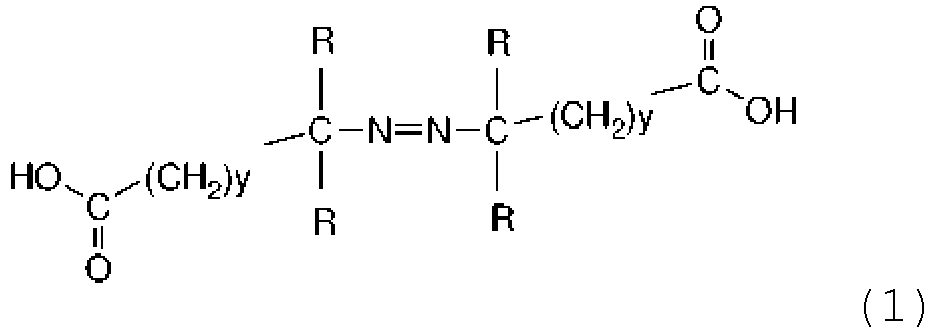
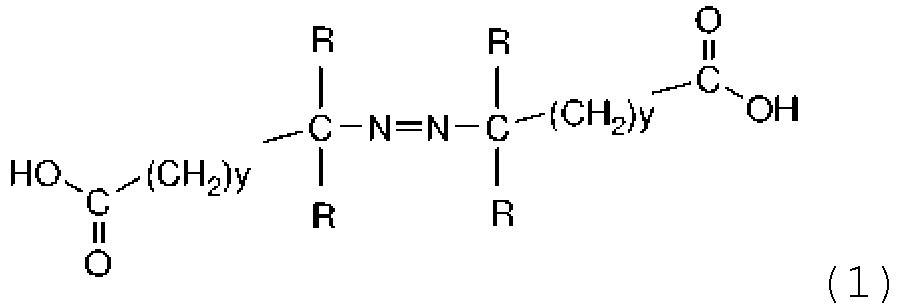
- the invention teaches a population of microcapsules comprising a core material surrounded by a wall material comprising the reaction product of a polysaccharide having pendant amine groups reactive with an initiator of formula 1 and at least one multifunctional (meth)acrylate monomer free radically polymerized with the initiator of formula 1 wherein each R is independently selected from hydrogen, C 1 to C 8 alkyl, or a cyano group; wherein each y is independently an integer from 1 to 8.
- a slurry can be formed greater than zero when measured at a pH of 5. Greater than zero in this context means the zeta potential is a more positive value.
- the polysaccharide is chitosan.
- the chitosan can have a degree of deacetylation of at least 50%.
- the wall material comprises greater than 50 wt % of multifunctional (meth)acrylate.
- the multifunctional (meth)acrylate can be selected from the group consisting of di-, tri-, tetra-, penta-, hexa-, hepta-, or octa-functional acrylate or methacrylate esters, multi-functional urethane acrylate or methacrylate esters, and epoxy acrylates or methacrylates.
- the wall of material of the microcapsule can comprise from 0.1% to 20% by weight of the polysaccharide.
- the wall material comprises a polymer obtained by polymerization of 0.1% to 80% be weight of multifunctional (meth)acrylate monomer, 0.1% to 60% by weight of the polysaccharide and 0.1% to 30% by weight of the initiator of formula 1.
- the population of microcapsules can comprise in addition an aqueous medium into which the microcapsules are dispersed forming a slurry, said slurry having a zeta potential greater than zero millivolts when measured at a pH of 5.
- Disclosed also is a process of forming a population of microcapsules comprising a core material, and a wall material surrounding the core material, the wall material comprising the reaction product of a polysaccharide having one or more amine groups, and a multifunctional (meth)acrylate monomer, the microcapsule population formed by providing a water phase comprising a polysaccharide having a pendant amine group and a first initiator of formula 1, wherein each R is independently selected from hydrogen, C 1 to C 8 alkyl, or a cyano group; wherein each y is independently an integer from 1 to 8, the first initiator having a carboxyl functional group and a free radical azonitrile moiety; providing an oil phase and dispersing or dissolving a core material into the oil phase; dispersing a multifunctional (meth)acrylate monomer, and optionally a second initiator, into the oil phase; combining the oil phase with the water phase; and heating or exposing to actinic radiation the combined oil phase and water phase
- the process also comprises forming a population of microcapsules comprising a core material, chitosan and a (meth)acrylate wall material surrounding the core material, the microcapsule population being formed by providing a benefit agent core material comprising an oil soluble fluid material or oil-dispersible solid particle dispersed in an oil soluble fluid material; providing an oil internal phase comprising a diluent; dividing the oil internal phase into oil 1 and oil 2; dispersing an initiator into oil 1; dispersing into oil 2 a multifunctional (meth)acrylate monomer or oligomer, and optimally one or more acrylates selected from the group consisting of difunctional (meth)acrylate esters and polyfunctional (meth)acrylate esters, and dispersing into oil 2 the oil soluble fluid core material or oil-dispersible solid particle dispersed in a fluid core material; heating or exposing the initiator, oils or combined oils 1 and 2 to actinic radiation sufficient to activate the initiator of oil 1; combining oil 1 and oil 2
- the initiator according to formula 1, in certain embodiments, is 4,4'-azobis (4-cyanopentanoic acid), and the chitosan can have a degree of deacetylation of at least 75%.
- the microcapsule wall can contain from 0.01% to 14% by weight of chitosan.
- the chitosan is partially deacetylated.
- the chitosan can be a D, L lactic acid chitosan, or a glycolic acid chitosan, or the chitosan can be selected from the group of water soluble chitosans selected from glycerol chitosan, hydrolyzed chitosan, n-hydroxypropyl chitosan, polyoxyalkylene chitosan, and chitosan oligosaccharide.
- the chitosan can even be comprised of D-glucosamine and N-acetyl glucosamine moieties, and the ratio of D-glucosamine to N-acetyl glucosamine is typically 3:1 or greater, or even 6:1 or 10:1.
- the oil internal phase is isopropyl myristate.
- the core material can be selected from a biological active, a dye, a perfume, a fragrance, a phase change material, a lubricant or a chromogen, and the multifunctional (meth)acrylate can be selected from the group consisting of di-, tri-, tetra-, penta-, hexa-, hepta-, or octa-functional acrylate or methacrylate esters, multi-functional urethane acrylate or methacrylate esters, and epoxy acrylates or methacrylates.
- the present invention in another aspect discloses an improved microcapsule and a process for forming a population of microcapsules comprising a core material and a chitosan and acrylate wall material surrounding the core material, the microcapsule population being formed by the steps of:
- the invention teaches a population of microcapsules comprising a core material surrounded by a wall material comprising the reaction product of a polysaccharide having amine groups reactive with an initiator of formula 1 and at least one multifunctional (meth)acrylate monomer free radically polymerized with the initiator of formula 1 wherein each R is independently selected from hydrogen, C 1 to C 8 alkyl, or a cyano group; wherein each y is independently an integer from 1 to 8.
- the polysaccharide is chitosan, and preferably with a degree of deacetylation ("DDA") of at least 50%, and preferably at least 75%.
- Chitosan for purposes of the invention, can be a glycolic acid chitosan, including D, L lactic acid chitosan, derivatives such as water soluble chitosans selected, for purposes of illustration and not limitation, from glycerol chitosan, hydrolyzed chitosan, N-cinnamoyl chitosan, chitosan crosslinked with tripolyphoshate, N- hydroxypropyl chitosan, polyoxyalkylene chitosan, and chitosan oligosaccharide.
- DDA degree of deacetylation
- chitosan is comprised of N-acetyl glucosamine moieties, and the ratio of D-glucosamine to N-acetyl glucosamine is 3:1 or greater.
- the multifunctional (meth)acrylate of the wall material can be an aminoalkyl(meth)acrylate or an aminoalkyl(meth)acrylamide.
- the wall material comprises the reaction product of a polysaccharide having one or more amine groups, and a multifunctional (meth)acrylate monomer, wherein the microcapsule population is formed by providing a water phase comprising a polysaccharide and a first initiator of formula 1, the first initiator having a carboxyl functional group and a free radical azonitrile moiety; providing an oil phase and dispersing or dissolving a core material into the oil phase; dispersing a multifunctional (meth)acrylate monomer, and optionally a second initiator, into the oil phase; combining the oil phase with the water phase; and heating or exposing to actinic radiation the combined oil phase and water phase, to activate the initiator of the water phase to generate free radicals and to polymerize the multifunctional methacrylate monomer, and adjusting the pH such that the carboxyl functional group of the first initiator reacts with the amine groups of the polysaccharide.
- the microcapsules are of core shell type.
- the microencapsulation involves oil in water emulsification and optionally can involve the use of a divided oil phase to facilitate encapsulation.
- the microcapsules comprise an oil soluble or dispersible benefit agent core material and a shell surrounding the benefit agent core material.
- the shell is the reaction product of the polysaccharide such as chitosan with the carboxyl substituted initiators of formula 1.
- amino groups of chitosan react, for example, with the initiator 4,4'-azobis(4-cyanopentanoic acid), and involves reaction of the amine group of chitosan with one of the terminal carboxylate groups of the initiator forming amidic carboxyl linkages between the molecules.
- the initiator surprisingly serves a dual function of solubilizing chitosan and also as a reactant in wall formation. As the initiator continues to provide free radicals, reaction of the (meth)acrylate monomers also proceeds further, forming wall material at the water oil interphase.
- This reaction of chitosan with the free radical generating initiator having carboxyl functional groups and azonitrile proceeds by disassociation of the initiator.
- the carboxyl formation can react with the chitosan amine and the free radical azonitrile portion of the initiator furthering free radical polymerization of (meth)acrylate monomers.
- the invention can be usefully adapted for use with acrylate microencapsulation processes such as the free radical initiator promoted reaction of aminoalkyl(meth)acrylate with multifunction (meth)acrylates such as taught in Schwantes U.S. Patent No. 8071214 .
- the invention is useful with acrylate formation processes such as the acrylate encapsulation taught by Schwantes US published application 2014 0186630 and U.S. Patent No. 6,592,900 .
- the invention can also be applied with (meth)acrylates such as aminoalkyl(meth)acrylate and aminoalkyl(meth)acrylamides.
- (meth)acrylates such as aminoalkyl(meth)acrylate and aminoalkyl(meth)acrylamides.
- Aminoalkylacrylates and aminalkylacrylamides are illustrated in U.S. Patent 6,849,591 and may be usefully applied with the reaction product of polysaccharide and the initiator of formula 1 to form chitosan modified (meth)acrylate wall material in microcapsules.
- the shell comprises the reaction product of the polysaccharide such as chitosan and a multifunctional (meth)acrylate monomer or oligomer.
- the invention improves upon the prior art processes by incorporation of a polysaccharide having pendant amine groups into a reaction of a multifunctional (meth)acrylate monomer free radically polymerized with an initiator having carboxy functionality.
- "Monomers” herein are understood as inclusive of oligomers.
- the polysaccharide having pendant amine groups participates in the formation of the microcapsule wall material.
- the resulting shell or microcapsule wall can be adjusted as to desired cationic character where an adherent microcapsule for anionic surfaces and textures is useful for the intended end use application.
- the proportion of the polysaccharide having pendant amine groups to total monomer of the capsule wall or shell desirably ranges from 1:20 to 1:7. In alternative useful embodiments the proportion of polysaccharide to total monomer is 45% or less, 40% or less, preferably 35% or less, or even 30% or less, or even 10% or less, or 5% or less, or even 3% or less. 0.01 to 14% or even 5% to 14% by weight is a preferred range, particularly for chitosan having pendant amine groups, the comparison being to total monomer of the capsule wall.
- the balance of the capsule wall primarily is the reaction product of the multifunctional (meth)acrylate and free radical initiator of formula 1, along with any optional monofunctional (meth)acrylates.
- the multifunctional (meth)acrylate comprises the major component of the shell.
- the polysaccharide imparts zeta potential values to the shell, and even substantially positive zeta potentials are shown in Table 2.
- Table 2 the zeta potential of microcapsules according to the invention, when formed into aqueous slurries, is greater than 0 millivolts, or even greater than 14 millivolts or even greater than 25 millivolts. Zeta potential of the slurry is measured at pH of about 5.
- Multifunctional (meth)acrylate monomers or oligomers are defined for purposes hereof to be multifunctional or methacrylate monomers or oligomers and include, by way of illustration and not limitation, di-; tri-; tetra- penta-; hexa-; hepta-; or octa-functional acrylate esters, methacrylate esters and multi-functional polyurethane acrylate esters and epoxy acrylates.
- Monomers shall be understood as including oligomers thereof.
- Useful multifunctional (meth)acrylate monomers in the invention are one or more di- and poly-functional acrylate esters, difunctional (meth)acrylate esters, polyfunctional (meth)acrylate esters, difunctional urethane acrylate esters, polyfunctional urethane acrylate esters and polyfunctional and difunctional epoxy acrylate monomers and oligomers used alone or in combination as blends.
- the di- and polyfunctional acrylates, methacrylates, urethane acrylates, and epoxy acrylates are further blended with monofunctional acrylates, methacrylates, urethane acrylates and epoxy acrylates.
- multi-functional acrylate or methacrylate monomers or oligomers preferably are selected to have a Tg > 60°C, in one aspect greater than 70°C, and in another aspect greater than 80°C, and can include by way of illustration and not limitation, allyl methacrylate; triethylene glycol dimethacrylate; ethylene glycol dimethacrylate, diethylene glycol dimethacrylate, aliphatic or aromatic polyfunctional (meth)acrylates such as multifunctional urethane acrylates, urethane diacrylates, hexafunctional urethane acrylates, difunctional urethane acrylates, ethoxylated aliphatic difunctional urethane methacrylates, aliphatic or aromatic urethane dimethacrylates, epoxy acrylates, epoxymethacrylates; tetraethylene glycol dimethacrylate; polyethylene glycol dimethacrylate; 1,3 butylene glycol diacrylate; 1,4-butanedio
- Crosslinking may be effected via groups capable of addition or condensation.
- the multi-functional acrylate or methacrylate monomers are used in a relative ratio of from about 99.9:0.1 to about 10:90, preferably from about 99.5:0.5 to about 3:97, and even 99:1 to about 2:98.
- Monofunctional acrylates i.e., those containing only one acrylate group, may also be included in the oil phase.
- Typical monoacrylates include 2-ethylhexyl (meth)acrylate, 2-hydroxyethyl (meth)acrylate, 2-hydroxypropyl (meth)acrylate, lauryl (meth)acrylate, cyclohexyl (meth)acrylate, tetrahydrofurfuryl (meth)acrylate, chlorobenzyl (meth)acrylate, and glycidyl (meth)acrylate.
- mixtures of mono or multi-functional (meth)acrylates or their derivatives as well as combinations of one or more (meth)acrylate monomers, oligomers and/or prepolymers or their derivatives with other copolymerizable monomers may be useful as well.
- from 0 to 10% by weight of the oil phase is a monofunctional acrylate or methacrylate monomer or oligomer.
- the largest constituents are typically solvent, 10 to 70 weight percent, preferably 25 to 55 weight percent oil phase solvent and oil; 10 to 70 weight percent, preferably 35 to 65 weight percent water; 40 to 99.5 weight percent, or even 86 to 95 weight percent, or even 50 to 99.5 weight percent of multi-functional acrylate or methacrylate monomer or oligomer; oil up to 20 weight percent.
- Initiator is 10% or less, usually about 5% or less, preferably 2% by weight or less and more preferably 1 % or less.
- the ratio by weight of the water phase initiator to multifunctional acrylate is from 0.1:99.9 parts to 20:80 by weight; preferably from 0.1:99.9 to about 10:90 parts by weight, or even from 0.2 to about 5:95 parts by weight.
- the benefit agent core material is oil soluble fluid core material or oil dispersible solid particles dispersed in a fluid core material.
- the oil soluble fluid core material can be the same as the internal phase oil or optionally different internal phase oil material.
- the oil soluble fluid material can optimally be the benefit agent core material itself.
- the internal phase oil can comprise various diluents.
- the internal phase oil is an ester of glycerol and fatty acids wherein at least one of the fatty acids is C 12 or greater.
- the oil internal phase is divided into an oil 1 and an oil 2.
- An initiator is dispersed into oil 1. Initiators are described more fully herein.
- a separate water phase is also used and an initiator in the water phase as per formula 1.
- a water phase comprising water, chitosan and a water soluble or dispersible initiator of formula 1 wherein each R is independently selected from hydrogen, C 1 to C 8 alkyl, or a cyano group; wherein each y is independently an integer from 1 to 8.
- Compounds according to formula 1 include 4,4'-azobis(4-cyanopentanecarboxylic) acid, also known as 4,4'-azobis(4-cyanovaleric acid); 4,4'-azobis(4-cyanohexanoic acid); 4,4'-azobis(5-cyanohexanoic acid); 4,4'-azobis(pentanoic acid); and 4,4'-azobis(4-methylpentanoic acid);
- a multifunctional (meth)acrylate monomer or oligomer substantially free of amine is dispersed into oil 2.
- the benefit agent core material which can be an oil soluble fluid core material or an oil dispersible solid particle dispersed in the fluid core material, is also dispersed into oil 2.
- the oil soluble fluid core material can be the same or similar to the oil 2 material.
- Oil 1 can be selected from the same or similar materials as oil 2.
- the shell is the reaction product of chitosan and the multifunctional (meth)acrylate.
- Chitosan is soluble in acidic solution such as hydrochloric acid, lactic acid, propionic acid, succinic acid, acetic acid, citric acid and phosphoric acid, but generally insoluble in water above pH 7. At pH values below 4, the amino groups of chitosan promote electrostatic repulsion and the polymer swells. In acid solution the free amine groups are believed to from hydrogen bonds with adjacent oxygen groups. Chitosan is a cationic polysaccharide at pH below about 6.5.
- the dissolved polysaccharide has positive charged -NH 3 + groups and adheres to anionic surfaces. Chitosan forms aggregate with polyanions and chelates heavy metals.
- Solubility of chitosan in aqueous solution can be increased by modification of the chitosan with succinic acid or succinic anhydride, for example, o-succinyl-chitosan, or by quaternization, and/or carboxymethylation.
- Derivatives such as hydroxypropyl chitosan or substitution with phosphorus or alkyl groups are known to increase solubility in water.
- Phosphoric and alkyl substitution can introduce hydrophilic and hydrophobic groups or segments that can be used to tailor solubility and stabilize emulsions.
- Chitosan is a heteropolymer of N-acetyl glucosamine and D-glucosamine. Chitosan is a deacetylated from of chitin. Chitosan is a polysaccharide and is basic.
- Chitosan can be characterized by degree of deacetylation and molecular weight.
- the molecular weight of chitosan can range from 50 to 2000 kDa. In one aspect the molecular weight of the chitosan is at least 3 kDa, or even at least 50 kDa, to 1000 kDa or even to 2000 kDa.
- chitosan at least 50% deacetylated, or even at least 65% deacetylated or even at least 75% deacetylated.
- the degree of deacetylation is from 50% to 100%, from 70% to 100%, from 75% to 100%, from 60% to 90%, from 50% to 100%, or even from 25% to 70%, from 25% to 98%, from 30% to 98% or even from 50% to 98% deacetylated.
- polyglucosamine is also useful.
- Chitin can be deacetylated by treatment with alkali and heated to remove acetyl groups from chitin.
- alkali for example, a 40% NaOH solution at temperatures above 110°C can form a cationic chitosan.
- the ratio of D-glucosamine to N-acetyl glucosamine 3:1 or greater, or even is from 1:4 to 4:1, or even from 1:4 to 1:1, or even from 1:4 to 1:0.
- the extent of deacetylation tends to be a function of alkali concentration, temperature and time, with increasing deacetylation at elevated temperatures and increasing alkali, such as NaOH, concentration. With concentrated acids, poly D-glucosamine can be formed. Molecular weight of the chitosan can be decreased through increasing the duration of the deacetylation processing.
- Deacetylation removes acetyl groups leaving -NH 2 groups.
- the chitosan usefully has from 0 to 0.3 fraction of N-acetyl units.
- the shell surrounding the core material is a reaction product of a chitosan and (meth)acrylate material, an optimally one or more difunctional or polyfunctional (meth)acrylate esters.
- the two materials can be a reaction product of hydrogen bonded, complex coacervated or the result of ionic interaction and either physically cross-linked or chemically cross-linked. While not being limited to theory, the shell is believed to be largely a physical cross-linking of the chitosan and multi-functional (meth)acrylate, and optionally includes additional (meth)acrylate esters and /or monofunctional acrylates.
- the acid group of the initiator of formula 1 reacts with the amine group of the chitosan forming an ionic bond.
- the cross-linking of the acid group of the initiator with the amine group of the chitosan results in deposition of the polymerized chitosan and initiator onto the forming capsule wall material, resulting in incorporation of chitosan chemically into the microcapsule wall.
- the free radical portion of the initiator promotes polymerization of the (meth)acrylate monomer forming the capsule wall.
- Multifunctional (meth)acrylate monomers or oligomers can include di-; tri-; tetra- penta-; hexa-; hepta-; or octa-functional acrylate esters, methacrylate esters and multi-functional polyurethane acrylate esters and epoxy acrylates.
- Monomers shall be understood as including oligomers thereof.
- an inhibitor such as hydroquinone can be added to the monomer and initiator blend in the capsules to prevent premature polymerization.
- multifunctional (meth)acrylate monomers such as di- and poly-functional (meth)acrylate esters, difunctional (meth)acrylate esters, polyfunctional (meth)acrylate esters, difunctional urethane acrylate esters, polyfunctional urethane acrylate esters and polyfunctional and difunctional epoxy acrylate monomers and oligomers used alone or in combination as blends.
- the di- and polyfunctional acrylates, methacrylates, urethane acrylates, and epoxy amine acrylates are further blended with monofunctional acrylates, methacrylates, urethane acrylates and epoxy acrylates.
- Monofunctional acrylates i.e., those containing only one acrylate group, may also be included in the oil phase.
- Typical monoacrylates include 2-ethylhexyl(meth)acrylate, 2-hydroxyethyl(meth)acrylate, 2-hydroxypropyl(meth)acrylate, lauryl(meth)acrylate, cyclohexyl(meth)acrylate, tetrahydrofurfuryl(meth)acrylate, chlorobenzyl(meth)acrylate, and glycidyl(meth)acrylate.
- mixtures of mono or multi-functional (meth)acrylates or their derivatives, as well as combinations of one or more (meth)acrylate monomers, oligomers and/or prepolymers or their derivatives with other nonpolymerizable monomers, may be useful as well.
- Preferably from 0 to 10% by weight of the oil phase is a monofunctional acrylate or methacrylate monomer or oligomer.
- the largest constituents are typically solvent, 10 to 70 weight percent, preferably 25 to 55 weight percent oil phase solvent and oil; 10 to 70 weight percent, preferably 35 to 65 weight percent water; 0.01 to 1 weight percent, preferably 0.1 to 10 weight percent, usually 0.5 to 8 weight percent multi-functional acrylate or methacrylate monomer or oligomer; oil to 20 weight percent.
- Initiator is 10% or less, usually about 5% or less, preferably 2% by weight or less and more preferably 1 % or less.
- the ratio by weight of the water phase initiator to multifunctional acrylate is from 0.1:99.9 parts to 10:80 by weight, preferably from 0.1:99.9 to about 10:90 parts by weight, or even from 0.2:99.9 to about 5:98 parts by weight
- microcapsules can be separated from the aqueous medium.
- the slurry can either be used as is, used as a dewatered cake, or used in dry powder form depending on the application.
- initiators in addition to those of formula 1 can be incorporated in the oil or water phase.
- Initiators are energy activated and generate free radicals when subjected to heat or other energy input such as actinic radiation or ion beam.
- Second initiators can include peroxy initiators, azo initiators, peroxides, and compounds such as 2,2'-azobismethylbutyronitrile, dibenzoyl peroxide.
- the free radical initiator can be selected from the group of initiators comprising an azo or peroxy initiator, such as peroxide, dialkyl peroxide, alkyl peroxide, peroxyester, peroxycarbonate, peroxyketone and peroxydicarbonate, 2,2'-azobis (isobutylnitrile), 2,2'-azobis(2,4-dimethylpentanenitrile), 2,2'-azobis (2,4-dimethylvaleronitrile), 2,2'-azobis(2-methylpropanenitrile), 2,2'-azobis (methylbutyronitrile), 1,1'-azobis (cyclohexanecarbonitrile), 1,1'-azobis(cyanocyclohexane), benzoyl peroxide, decanoyl peroxide; lauroyl peroxide; benzoyl peroxide, di(n-propyl) peroxydicarbonate, di(sec-butyl) peroxydicarbonate, di(
- Blends of initiators can also be employed.
- Initiators are available commercially, such as Vazo initiators, which typically indicate a decomposition temperature for the initiator.
- the initiator is selected to have a decomposition point of about 50° C. or higher.
- Usefully multiple initiators are employed, either as a blend in the oil phase, or in either of the oil or water phases.
- Preferably initiators are selected to stagger the decomposition temperatures at the various steps, pre-polymerization, wall formation and hardening or polymerizing of the capsule wall material.
- a first initiator in the oil phase can decompose at 55°C., to promote prepolymer formation
- a second can decompose at 60°C. to aid forming the wall material.
- a third initiator can decompose at 65°C. to facilitate polymerization of the capsule wall material.
- the total amount of initiator can be typically as low as 0.1 weight percent or as high as 10 weight percent.
- oil internal phase can comprise a diluent and can be selected from hydrocarbons, more particularly hydrocarbon solvents and the solvents can include by way of illustration and not limitation, ethyldiphenylmethane, butyl biphenyl ethane, benzylxylene, alkyl biphenyls such as propylbiphenyl and butylbiphenyl, dialkyl phthalates e.g.
- alkyl benzenes such as dodecyl benzene; but also carboxylates, ethers, or ketones such as diaryl ethers, di(aralkyl)ethers and aryl aralkyl ethers, ethers such as diphenyl ether, dibenzyl ether and phenyl benzyl ether, liquid higher alkyl ketones (having at least 9 carbon atoms), alkyl or aralky benzoates, e.g., benzyl benzoate, alkylated naphthalenes such as dipropylnaphthalene, partially hydrogenated terphenyls; high-boiling straight or branched chain hydrocarbons, arenes and alkaryl hydrocarbons
- soybean methyl ester straight chain saturated paraffinic aliphatic hydrocarbons of from 10 to 13 carbons; C 8 - C 42 esters, esters of glycerol, fatty acids where at least one of the fatty acids is C 12 or greater, ethyl hexanoate, methyl heptanoate, butyl butyrate, methyl benzoate, methyl such as nonoate, methyl decanoate, methyl dodecanoate, methyl octanoate, methyl laurate, methyl myristate, methyl palmitate, methyl stearate, ethyl heptanoate, ethyl octanoate, ethyl nonoate, ethyl decanoate, ethyl dodecanoate, ethyl laurate, ethyl myristate, ethyl palmitate, ethyl stearate, isopropyl myri
- Common diluents such as straight chain hydrocarbons can also be blended with the solvents, or blend of solvents.
- the solvent is selected on the basis of hydrophobicity and ability to disperse or solvate the multifunction (meth)acrylate monomer or oligomer and the intended benefit agent of the core material.
- the capsules according to the invention are useful with a wide variety of capsule contents ("core materials"), commonly referred to as benefit agents, including, by way of illustration and without limitation, the internal phase oils, solvent oils, phase change materials, lubricants, dyes, perfumes, fragrances, cleaning oils, polishing oils, flavorants, nutrients, sweeteners, chromogens, pharmaceuticals, biological actives such as fertilizers, herbicides or pesticides, and the like.
- the microcapsule core materials can include materials which alter rheology or flow characteristics, or extend shelf life or product stability.
- Essential oils as core materials can include, for example, by way of illustration wintergreen oil, cinnamon oil, clove oil, lemon oil, lime oil, orange oil, peppermint oil and the like.
- Dyes can include fluorans, lactones, indolyl red, I6B, leuco dyes, all by way of illustration and not limitation.
- the core material typically should be dispersible or sufficiently soluble in the capsule internal phase material namely in the internal phase oil or soluble or dispersible in the monomers or oligomers solubilized or dispersed in the internal phase oil.
- the core materials are preferably liquid but can be solid depending on the materials selected, and with temperatures appropriately adjusted to effect dispersion.
- An emulsion is formed by emulsifying under high shear agitation the oil or combined oils into the water phase.
- the water phase can also include emulsifiers.
- the water phase emulsifier can be selected form one or more of polyalkylene glycol ether, condensation products of alkyl phenols, aliphatic alcohols, or fatty acids with alkylene oxide, ethoxylated alkyl phenols, ethoxylated arylphenols, ethoxylated polyaryl phenols, carboxylic esters solubilized with a polyol, polyvinyl alcohol, polyvinyl acetate, or copolymers of polyvinyl alcohol polyvinyl acetate, polyacrylamide, poly(N-isopropylacrylamide), poly(2-hydroxypropyl methacrylate), poly(2-ethyl-2-oxazoline), poly(2-isopropenyl-2-oxazoline-co-methyl methacrylate), poly(
- Especially useful polyvinyl alcohols include polyvinyl alcohols of molecular 13,000 to 1876,000 Daltons, preferably from 13,000 to about 23,000 Daltons, or even from 146,000 to 186,000 Daltons.
- the polyvinyl alcohol can be partially or fully hydrolyzed.
- Polyvinyl alcohol partially hydrolyzed in the range of 85 to 95% hydrolyzed is preferred. Partially hydrolyzed polyvinyl alcohol at 88% hydrolysis or less was useful, with about 88% hydrolysis being more preferred.
- the emulsion is heated in one or more steps to form a wall material comprising the reaction product of the multifunctional (meth)acrylate and chitosan, the wall surrounding the benefit agent core material.
- deposition aids can be included, or applied as a coating in one or more layers over formed or forming microcapsules, to increase deposition or adhesion of the microcapsules to various surfaces such as various substrates including but not limited to paper, fabric skin, hair, towels, or other surfaces.
- Deposition aids can include poly (acrylamide-co-diallyldimethylammonium chloride, poly (diallyldimethylammonium chloride, polyethylenimine, cationic polyamine, poly [(3-methyl-1-vinylimidazolium chloride)- co -(1-vinylpyrrolidone)], copolymer of acrylic acid and diallyldimethylammonium chloride, cationic guar, guar gum, an organopolysiloxane such as described in US Publication 20150030557 .
- the above-described microcapsules can comprise a deposition aid, and in a further aspect the deposition aid coats the outer surface of the shell of the microcapsule.
- a deposition aid in one or more layers on the microcapsules can be applied and can comprise a material selected from the group consisting of poly(meth)acrylate, poly(ethylene-maleic anhydride), polyamine, wax, polyvinylpyrrolidone, polyvinylpyrrolidone co-polymers, polyvinylpyrrolidone-ethyl acrylate, polyvinylpyrrolidone-vinyl acrylate, polyvinylpyrrolidone methylacrylate, polyvinylpyrrolidone-vinyl acetate, polyvinyl acetal, polyvinyl butyral, polysiloxane, polypropylene maleic anhydride), maleic anhydride derivatives, co-polymers of maleic anhydride derivatives, polyvinyl alcohol, styrene-butadiene latex, gelatin, gum Arabic, carboxymethyl
- the size of the capsules can be controlled by adjusting the speed of agitation. Smaller size dispersions are achieved through faster agitation resulting in smaller capsules
- Emulsifying agents or protective colloids can be conveniently employed to facilitate dispersion.
- Such materials include carboxylated or partially hydrolyzed polyvinyl alcohol, methyl cellulose and various latex materials, stearates, lecithins and various surfactants.
- microcapsules according to the invention can be used to microencapsulate various core materials such as chromogens and dyes, flavorants, perfumes, sweeteners, fragrances, oils, fats, pigments, cleaning oils, lubricating oils, pharmaceuticals, pharmaceutical oils, perfume oils, mold inhibitors, antimicrobial agents, absorbers, adhesives, phase change materials, scents, fertilizers, nutrients and herbicides by way of illustration and without limitation.
- core materials such as chromogens and dyes, flavorants, perfumes, sweeteners, fragrances, oils, fats, pigments, cleaning oils, lubricating oils, pharmaceuticals, pharmaceutical oils, perfume oils, mold inhibitors, antimicrobial agents, absorbers, adhesives, phase change materials, scents, fertilizers, nutrients and herbicides by way of illustration and without limitation.
- Microencapsulation can facilitate processing by increasing particle size or by converting liquids into free-flowing solids.
- the largest volume application of microcapsules is in imaging systems such as carbonless papers.
- microcapsules are useful in a variety of challenging environments, such as use with fabric enhancers, laundry, phase change, and other industrial and commercial applications.
- the microcapsules of the invention display high strength and low leakage in environments such as in contact with solvent, detergents, shampoos, fabric softeners and surface cleaners. As a result, the microcapsules of the invention are suitable for use in such produces by being able to survive in such environments.
- the microcapsule wall can serve the purpose of extending the shelf life, stabilize and protect the core material, mask strong flavors, or protect contents so that they are available to participate in reactions such as imaging of adhesive formation when the capsule wall is ruptured, sheared, fractured, broken or melted.
- the core material is a benefit agent core material and can be a minor or major constituent of the material encapsulated by the microcapsules. If the core material can function as the oil or water solvent in the capsules, it is possible to make the core material the major or total material encapsulated. Usually, however, the core material is from 0.01 to 99 weight percent of the capsule internal contents, preferably 0.01 to about 64 by weight of the capsule internal contents, and more preferably from 0.1 to 45% by weight of the capsule internal contents. With certain especially potent materials or materials of high efficiency, the core can be at just trace quantities as compared to diluent or other materials in the core.
- Useful benefit agent core materials include perfume raw materials, such as alcohols, ketones, aldehydes, esters, ethers, nitriles, alkenes, fragrances, fragrance solubilizers, essential oils, phase change materials, lubricants, colorants, cooling agents, preservatives, antimicrobial or antifungal actives, herbicides, antiviral actives, antiseptic actives, antioxidants, biological actives, deodorants, emollients, humectants, exfoliants, ultraviolet absorbing agents, self-healing compositions, corrosion inhibitors, sunscreens, silicone oils, waxes, hydrocarbons, higher fatty acids, essential oils, lipids, skin coolants, vitamins, sunscreens, antioxidants, glycerine, catalysts, bleach particles, silicon dioxide particles, malodor reducing agents, dyes, brighteners, antibacterial actives, antiperspirant actives, cationic polymers and mixtures thereof.
- perfume raw materials such as alcohols, ketones, aldehy
- Phase change materials useful as benefit agent core materials can include, by way of illustration and not limitation, paraffinic hydrocarbons having 13 to 28 carbon atoms, various hydrocarbons such n-octacosane, n-heptacosane, n-hexacosane, n-pentacosane, n-tetracosane, n-tricosane, n-docosane, n-heneicosane, n-eicosane, n-nonadecane, octadecane, n-heptadecane, n-hexadecane, n-pentadecane, n-tetradecane, n-tridecane.
- Phase materials can alternatively, optionally in addition include crystalline materials such as 2,2-dimethyl-1,3-propanediol, 2-hydroxymethyl-2-methyl-1, 3-propanediol, acids of straight or branched chain hydrocarbons such as eicosanoic acid and esters such as methyl palmitate, fatty alcohols and mixtures thereof.
- crystalline materials such as 2,2-dimethyl-1,3-propanediol, 2-hydroxymethyl-2-methyl-1, 3-propanediol, acids of straight or branched chain hydrocarbons such as eicosanoic acid and esters such as methyl palmitate, fatty alcohols and mixtures thereof.
- any of the heating steps in the microencapsulation process can be replaced with a UV or light induced or electron beam induced free radical generation step.
- the invention is a process of obtaining microcapsules by dispersing an oil soluble polyfunctional (meth)acrylate monomer, an oil soluble bi- or polyfunctional vinyl monomer and chitosan with initiator in the water phase, along with a UV initiator in one or more of the oil and water phases.
- a visible light induced free radical generator could also be used.
- This dispersion is subjected to UV light to form a prepolymer.
- a water phase is added comprising a dispersion in water of an optimal anionic emulsifier.
- a UV initiator or alternatively thermal initiator or alternatively no additional initiator is added to the water phase.
- the water phase is emulsified into the oil phase (W/O), or alternatively an excess of the water phase is used and the oil phase is emulsified into the water phase (O/W).
- the dispersion is then subjected to UV light or heated (as appropriate to the initiator) to generate free radicals.
- microcapsule wall material forms at the interface of the water and oil phases.
- a third UV exposure or heating step is used to further polymerize or harden the formed wall material.
- UV initiators include benzophenone; acetophenone; benzil; benzaldehyde; o-chlorobenzaldehyde; xanthone; thioxanthone; 9,10-anthraquinone; 1-hydroxycyclohexyl phenyl ketone; 2,2-diethoxyacetophenone; dimethoxyphenylacetophenone; methyl diethanolamine; dimethylaminobenzoate; 2-hydroxy-2-methyl-1-phenylpropane-1-one; 2,2-di-sec-butoxyacetophenone; 2,2-dimethoxy-1,2-diphenylethan-1-one; dimethoxyketal; and phenyl glyoxal.2,2'-diethoxyacetophenone, hydroxycyclohexyl phenyl ketone, alpha-hydroxy
- UV initiators of this kind are available commercially, e.g., IRGACURE 184.TM. or DEGACURE 1173.TM. from Ciba.
- Thermal initiators are available from DuPont.
- the fraction of the photoinitiator in any of the water or oil phase is approximately from about 0.1 to 10%, preferably 0.1 to about 6% by weight, more preferably 0.5 to 2.5 weight percent. Similar weight percent ranges can also be applied to the thermal initiators.
- UV initiators can be included in substitution as an alternate initiator system (for any heating step or steps of the encapsulation process, or as an additional initiator system. This produces an initiator system for polymerization or oligomerization using a dual cure method or optional thermal or optional light or optional UV initiated method by appropriate selection of initiator and initiation method or methods.
- azo compounds that can be excited or split by UV light or high-energy radiation are used alone or in combination with thermal free radical initiators.
- the combination of thermal and UV initiators is formed only by azo compounds.
- initiators e.g., thioxanthones, phosphine oxides, metallocenes, tertiary aminobenzenes or tertiary aminobenzophenones
- Such microencapsulation systems typically require special handling of the system to prevent premature polymerization or oligomerization by appropriate control of lighting conditions.
- UV initiators For light activated microencapsulation, the use of UV initiators is preferred, or a combination of UV initiators and thermal free radical initiators. This combination can impart considerable versatility to the microencapsulation steps of the process where any step or steps of the microencapsulation process then can be initiated either by appropriate selection of an initiator decomposing at specific temperatures or decomposing under specific light conditions.
- the respective monomers in the process can be polymerized or oligomerized using some suitable means such as heat (used with thermal initiators) or UV light (for use with UV initiators), or electron beam.
- some suitable means such as heat (used with thermal initiators) or UV light (for use with UV initiators), or electron beam.
- the addition of additional initiators can be reduced.
- Options for individual heating steps of the encapsulation process include the freedom to use in substitution for any heating step, the use of visible light with suitable initiators, the use of UV light with suitable UV initiators, or ionizing radiation (e.g. electron beam or gamma ray) without added additional initiator or reduced amounts of initiator. All such means for purposes herein are intended by the terms “heating or exposing to actinin radiation.”
- UV initiators may be selected from those organic chemical compounds conventionally employed to promote UV-initiated formation of radicals.
- a preferred UV initiator is 1-hydroxycyclohexyl phenyl ketone because of the rapidity with which it generates free radicals when exposed to UV radiation. Mixtures of UV initiators or mixtures with thermal initiators may also be used. This is often desirable because it provides more efficient production of radicals in certain cases.
- the UV initiator will be present in an amount of 0.1 to 10.0 weight percent in any of the water or oil phases, based on the total weight of all constituents. However, it is preferable to use between 0.5-2.5 weight percent UV initiator, most preferably 0.5-1.0 weight percent UV initiator, based on total weight.
- the amount of each initiator, thermal, UV or light, that is employed can vary, and is dependent upon factors such as the monomer or oligomer material that is polymerized or further oligomerized. Typically, the amount of initiator ranges from about 0.1 to about 6 percent, and often about 1 to about 3 percent, based on the weight of all constituents.
- a first oil phase consisting of 44.81 g perfume oil, 0.26 g tert-butylamino ethyl methacrylate, 0.26 g CD9055, and 21.51 g CN975 (Sartomer, Exton, PA) was prepared under mixing for 30 minutes at room temperature.
- a second oil phase consisting of 78.51 g of the perfume oil, 100.89 g isopropyl myristate, 1.19 g 2,2'-azobis(2-methylbutyronitrile), and 0.96 g 4,4'-azobis[4-cyanovaleric acid] was added to a jacketed steel reactor.
- the reactor was held at 35°C and the oil solution in mixed at 600 RPM's with a 2" flat mill blade while a nitrogen blanket is applied to the reactor at a rate of 0.1 SLPM.
- the solution was heated to 70°C in 45 minutes and held at 70°C for 45 minutes, before cooling to 50°C in 75 minutes.
- the first oil phase was added to the reactor and the combined oils are mixed for 10 minutes at 50°C.
- a water phase containing 76.04 g Celvol 540 PVA (Sekisui Specialty Chemicals, Dallas, TX) at 5% solids, 240.72 g DI water, 1.43 g 4,4'-azobis[4-cyanovaleric acid], and 1.33g NaOH at 21.5% was prepared and mixed until fully dissolved. After the oil phases pre-reacted together for 10 minutes at 50°C, mixing was ceased and the water phase mixture is added to the oil phases. High shear agitation was applied to produce an emulsion with the desired size characteristics. The temperature was increased to 75°C in 30 minutes, held at 75°C for 4 hours, increased to 95°C in 30 minutes, and held at 95°C for 6 hours. The batch was allowed to cool to room temperature. The microcapsules had a volume-weighted median size of 19.14 microns. The zeta potential at slurry pH ⁇ 5.00 was -0.71mV.
- Example 2 was prepared similarly to Example 1, except that chitosan replaced NaOH in the water phase.
- a water phase containing 76.04 g Celvol 540 PVA (Sekisui Specialty Chemicals, Dallas, TX) at 5% solids, 240.72 g DI water, and 1.43 g 4,4'-azobis[4-cyanovaleric acid] was prepared and mixed over 45 minutes until the 4,4'-azobis[4-cyanovaleric acid] is dissolved into a cloudy solution.
- the pH of the water phase is 3.9, which allows an acidic environment for the subsequent addition of 2.4g chitosan of molecular weight 187kDa and 80-88% DDA.
- the water phase mixture with chitosan was then mixed for 2.5 hours followed by heating to 40°C for 45 minutes, before proceeding as done in example 1.
- the volume-weighted median size was 13.51 microns, and zeta potential at slurry pH ⁇ 5.00 was 27.94mV.
- Example 3 was similarly prepared as Example 2, except the Celvol 540 PVA (Sekisui Specialty Chemicals, Dallas, TX) was removed from the formulation and the difference was replaced with DI water.
- the volume-weighted median size was 20.37microns, and zeta potential at slurry pH ⁇ 5.00 was 39.66mV.
- Example 4 was made following the procedure of example 2 except that the chitosan was of molecular weight 150kDa and 80-88% DDA.
- the volume-weighted median size was 16.90 microns, and zeta potential at slurry pH ⁇ 5.00 was 2.90mV.
- Example 5 was made following the procedure of example 3 except that the chitosan was of molecular weight 150kDa and 80-88% DDA.
- the volume-weighted median size was 36.57 microns, and zeta potential at slurry pH ⁇ 5.00 was 41.55mV.
- Example 6 was made following the procedure of example 2 except that the chitosan was of molecular weight 310->375kDa and >75% DDA.
- the volume-weighted median size was 23.36 microns, and zeta potential at slurry pH ⁇ 5.00 was 26.18mV.
- Example 7 was made following the procedure of example 3 except that the chitosan was of molecular weight 310->375kDa and >75% DDA.
- the volume-weighted median size was 13.51 microns, and zeta potential at slurry pH ⁇ 5.00 was 37.21mV.
- Example 8 was made following the procedure of example 2 except that the chitosan was of molecular weight 190-310kDa and 75-85% DDA.
- the volume-weighted median size was 11.93 microns, and zeta potential at slurry pH ⁇ 5.00 was 19.86mV.
- Example 9 was made following the procedure of example 3 except that the chitosan was of molecular weight 190-310kDa and 75-85% DDA.
- the volume-weighted median size was 17.76 microns, and zeta potential at slurry pH ⁇ 5.00 was 36.65mV.
- Example 10 was made following the procedure of example 2 except that the chitosan was of molecular weight 50-190kDa and 75-85% DDA.
- the volume-weighted median size was 14.92 microns, and zeta potential at slurry pH ⁇ 5.00 was 14.87mV.
- Example 11 was made following the procedure of example 3 except that the chitosan was of molecular weight 50-190kDa and 75-85% DDA.
- the volume-weighted median size was 30.72 microns, and zeta potential at slurry pH ⁇ 5.00 was 46.38mV.
- Example 12 was made following the procedure of example 2 except that the chitosan was of molecular weight 150kDa and 78.3% DDA.
- the volume-weighted median size was 10.41 microns, and zeta potential at slurry pH ⁇ 5.00 was 19.74mV.
- Example 13 was made following the procedure of example 3 except that the chitosan was of molecular weight 150kDa and 78.3% DDA.
- the volume-weighted median size was 14.56 microns, and zeta potential at slurry pH -5.00 was 36.08mV.
Landscapes
- Chemical & Material Sciences (AREA)
- Organic Chemistry (AREA)
- Life Sciences & Earth Sciences (AREA)
- Chemical Kinetics & Catalysis (AREA)
- Engineering & Computer Science (AREA)
- Health & Medical Sciences (AREA)
- Dispersion Chemistry (AREA)
- Wood Science & Technology (AREA)
- General Health & Medical Sciences (AREA)
- Oil, Petroleum & Natural Gas (AREA)
- Environmental Sciences (AREA)
- Bioinformatics & Cheminformatics (AREA)
- Food Science & Technology (AREA)
- Pest Control & Pesticides (AREA)
- Plant Pathology (AREA)
- Toxicology (AREA)
- Dentistry (AREA)
- Zoology (AREA)
- Agronomy & Crop Science (AREA)
- Medicinal Chemistry (AREA)
- Polymers & Plastics (AREA)
- Pharmacology & Pharmacy (AREA)
- Epidemiology (AREA)
- Animal Behavior & Ethology (AREA)
- Public Health (AREA)
- Veterinary Medicine (AREA)
- Manufacturing Of Micro-Capsules (AREA)
Claims (15)
- Population von Mikrokapseln, umfassend ein Kernmaterial, umgeben von einem Wandmaterial, welches das Reaktionsprodukt eines Polysaccharids mit anhängenden Amingruppen, die mit einem Initiator der Formel 1 reaktionsfähig sind, und mindestens eines multifunktionellen (Meth)acrylat-Monomers umfasst, das durch freie radikalische Polymerisation polymerisiert ist mit dem Initiator der Formel 1,
- Mikrokapseln nach Anspruch 1, wobei das Polysaccharid Chitosan ist, gegebenenfalls wobei das Chitosan einen Deacetylierungsgrad von mindestens 50 % aufweist.
- Mikrokapseln nach Anspruch 1, wobei das Wandmaterial umfasst:i. mehr als 50 Gew.-% multifunktionelles (Meth)acrylat; und/oderii. 0,1 bis 20 Gew.-% Polysaccharid.
- Mikrokapseln nach Anspruch 1, wobei das Wandmaterial ein Polymer umfasst, das erhalten wurde durch Polymerisation von:0,1 bis 80 Gew.-% multifunktionelles (Meth)acrylat-Monomer;0,1 bis 60 Gew.-% des Polysaccharids; und0,1 bis 30 Gew.-% des Initiators der Formel 1.
- Population von Mikrokapseln nach Anspruch 1, umfassend zusätzlich ein wässriges Medium, in dem die Mikrokapseln unter Bildung einer Suspension dispergiert sind, wobei die Suspension ein Zeta-Potenzial größer als 0 Millivolt, gemessen bei einem pH-Wert von 5, aufweist.
- Verfahren zur Bildung einer Population von Mikrokapseln, umfassend ein Kernmaterial und ein Wandmaterial, welches das Kernmaterial umgibt, wobei das Wandmaterial das Reaktionsprodukt eines Polysaccharids mit einer oder mehreren Amingruppen und eines multifunktionellen (Meth)acrylat-Monomers umfasst, wobei die Mikrokapselpopulation gebildet wird durch:Bereitstellen einer Wasserphase, die ein Polysaccharid mit einer anhängenden Amingruppe und einen ersten Initiator der Formel 1 umfasst,
 wobei jedes R unabhängig ausgewählt ist aus Wasserstoff, Ci- bis Cs-Alkyl oder einer Cyangruppe; wobei jedes y unabhängig eine Ganzzahl von 1 bis 8 ist,wobei der erste Initiator eine funktionelle Carboxylgruppe und einen Azonitril-Freies-Radikal-Anteil aufweist;Bereitstellen einer Ölphase und Dispergieren oder Auflösen eines Kernmaterials in der Ölphase;Dispergieren eines multifunktionellen (Meth)acrylat-Monomers und gegebenenfalls eines zweiten Initiators in der Ölphase;Kombinieren der Ölphase mit der Wasserphase; undErhitzen oder Aussetzen der kombinierten Öl- und Wasserphase gegenüber aktinischer Strahlung, um den Initiator der Wasserphase zu aktivieren, um freie Radikale zu erzeugen und das multifunktionelle Methacrylat-Monomer zu polymerisieren, und Anpassen des pH-Werts so, dass die Carboxyl-funktionelle Gruppe des ersten Initiators mit den Amingruppen des Polysaccharids reagiert.
 - Verfahren zur Bildung einer Population von Mikrokapseln, umfassend ein Kernmaterial, Chitosan und ein (Meth)acrylat-Wandmaterial, welches das Kernmaterial umgibt, wobei die Mikrokapselpopulation gebildet wird durch:Bereitstellen eines Vorteilsmittel-Kernmaterials, umfassend ein öllösliches fließfähiges Material oder ein öldispergierbares Feststoffpartikel, das in einem öllöslichen fließfähigen Material dispergiert ist;Bereitstellen einer inneren Ölphase, die ein Verdünnungsmittel umfasst;Aufteilen der inneren Ölphase in Öl 1 und Öl 2;Dispergieren eines Initiators in ein Öl 1;Dispergieren eines multifunktionellen (Meth)acrylat-Monomers oder -Oligomers, und im Optimalfall eines oder mehrerer Acrylate, ausgewählt aus der Gruppe bestehend aus monofunktionellen Acrylaten, difunktionellen (Meth)acrylat-Estern und polyfunktionellen (Meth)acrylat-Estern, in Öl 2, und Dispergieren eines öllöslichen fließfähigen Kernmaterials oder öldispergierbaren Feststoffpartikel-Kernmaterials, das in einem fließfähigen Kernmaterial dispergiert ist, in Öl 2;Erhitzen oder Aussetzen gegenüber aktinischer Strahlung, ausreichend, um den Initiator von Öl 1 zu aktivieren; Kombinieren von Öl 1 und Öl 2 unter Bildung einer kombinierten kontinuierlichen inneren Ölphase und Fortschreitenlassen der Reaktion so lange, dass die multifunktionellen Monomere oder Oligomere aus Öl 2 vorpolymerisiert werden;Bereitstellen einer Wasserphase, die Chitosan und einen wasserlöslichen oder dispergierbaren Initiator der Formel 1 enthält,
 wobei jedes R unabhängig ausgewählt ist aus Wasserstoff, C1- bis Ca-Alkyl oder einer Cyangruppe; wobei jedes y unabhängig eine Ganzzahl von 1 bis 8 ist;Erhitzen oder Aussetzen gegenüber aktinischer Strahlung, ausreichend, um den Initiator der Wasserphase zu aktivieren;Bilden eines Chitosan- und (Meth)acrylat-Gemisches durch Dispergieren der kombinierten inneren Ölphase in der Wasserphase;Emulgieren des Chitosan- und (Meth)acrylat-Gemisches durch starke Scherbewegung;Erhitzen oder Aussetzen des Chitosan- und (Meth)acrylat-Gemisches gegenüber aktinischer Strahlung für eine ausreichende Zeit und Temperatur, sodass das multifunktionelle (Meth)acrylat und Chitosan binden und an die Grenzfläche der Öl- und Wasserphasen migrieren, wodurch sie das Kernmaterial in der Ölphase umgeben und Wandmaterial bilden.
 - Verfahren nach Anspruch 7, wobei der Initiator nach Formel 1 4,4'-Azobis(4-Cyanopentansäure) ist.
- Zusammensetzung nach Anspruch 7, wobei das Chitosan:i. einen Deacetylierungsgrad von mindestens 75 % aufweist;ii. teilweise deacetyliert ist oderiii. aus D-Glucosamin- und N-Acetylglucosamin-Gruppen besteht, und das Verhältnis von D-Glucosamin zu N-Acetylglucosamin 3:1 oder mehr beträgt.
- Verfahren nach Anspruch 7, wobei die Mikrokapselwand 0,01 bis 14 Gew.-% Chitosan enthält.
- Verfahren nach Anspruch 7, wobei das Chitosan:i. ein D-, L-Milchsäure-Chitosan ist;ii. ein Glykolsäure-Chitosan ist; oderiii. ausgewählt ist aus der Gruppe der wasserlöslichen Chitosane, ausgewählt aus Glycerin-Chitosan, hydrolysiertem Chitosan, n-Hydroxypropyl-Chitosan, Polyoxyalkylen-Chitosan und Chitosan-Oligosaccharid.
- Verfahren nach Anspruch 7, wobei die innere Ölphase Isopropylmyristat ist.
- Verfahren nach Anspruch 7, wobei das Kernmaterial ausgewählt ist aus einem biologischen Wirkstoff, einem Farbstoff, einem Parfüm, einem Duftstoff, einem Phasenwechselmaterial, einem Schmiermittel oder einem Chromogen.
- Mikrokapseln nach Anspruch 1 oder Verfahren nach Anspruch 7, wobei das multifunktionelle (Meth)acrylat ausgewählt ist aus der Gruppe bestehend aus di-, tri-, tetra-, penta-, hexa-, hepta- oder octafunktionellen Acrylat- oder Methacrylat-Estern, multifunktionellen Urethanacrylat- oder Methacrylat-Estern und Epoxyacrylaten oder Methacrylaten.
- Mikrokapseln nach Anspruch 1 oder Verfahren nach Anspruch 6 oder Anspruch 7, wobei das multifunktionelle (Meth)acrylat-Monomer ausgewählt ist aus di- und polyfunktionellen (Meth)acrylat-Estern, difunktionellen (Meth)acrylat-Estern, polyfunktionellen (Meth)acrylat-Estern, difunktionellen Urethanacrylat-Estern, polyfunktionellen Urethanacrylat-Estern und polyfunktionellen und difunktionellen Epoxyacrylat-Monomeren und -Oligomeren, die allein oder in Kombination als Mischungen verwendet werden.
Applications Claiming Priority (2)
| Application Number | Priority Date | Filing Date | Title |
|---|---|---|---|
| US201962791148P | 2019-01-11 | 2019-01-11 | |
| PCT/US2020/013005 WO2020146691A1 (en) | 2019-01-11 | 2020-01-10 | Incorporation of chitosan in microcapsule wall |
Publications (3)
| Publication Number | Publication Date |
|---|---|
| EP3908246A1 EP3908246A1 (de) | 2021-11-17 |
| EP3908246A4 EP3908246A4 (de) | 2022-11-16 |
| EP3908246B1 true EP3908246B1 (de) | 2024-11-20 |
Family
ID=71518091
Family Applications (1)
| Application Number | Title | Priority Date | Filing Date |
|---|---|---|---|
| EP20738201.1A Active EP3908246B1 (de) | 2019-01-11 | 2020-01-10 | Einbau von chitosan in einer mikrokapselwand |
Country Status (5)
| Country | Link |
|---|---|
| US (1) | US11260359B2 (de) |
| EP (1) | EP3908246B1 (de) |
| CN (1) | CN112770713B (de) |
| CA (1) | CA3106374A1 (de) |
| WO (1) | WO2020146691A1 (de) |
Families Citing this family (25)
| Publication number | Priority date | Publication date | Assignee | Title |
|---|---|---|---|---|
| CN112062932B (zh) * | 2020-08-07 | 2022-05-17 | 宁波芬畅凝科香精香料有限公司 | 一种香精微胶囊及其制备方法 |
| US12403442B2 (en) * | 2020-09-18 | 2025-09-02 | Encapsys, Llc | Amine modified polysaccharide urethane/urea microcapsules |
| MX2023000634A (es) * | 2020-09-18 | 2023-02-22 | Encapsys Llc | Microcapsulas multifuncionales de polisacarido de (met)acrilato. |
| MX2023004231A (es) | 2020-10-16 | 2023-04-21 | Procter & Gamble | Composiciones de producto de consumo que comprenden una poblacion de encapsulados. |
| JP7587030B2 (ja) * | 2020-10-16 | 2024-11-19 | ザ プロクター アンド ギャンブル カンパニー | 高コア対壁比を有する送達粒子を含む消費者製品 |
| JP2023543578A (ja) | 2020-10-16 | 2023-10-17 | ザ プロクター アンド ギャンブル カンパニー | 少なくとも2つの封入体集団を有する消費者製品組成物 |
| JP2023546881A (ja) * | 2020-10-16 | 2023-11-08 | エンカプシス エルエルシー | コアの壁に対する比の高い有益剤を含有するデリバリー粒子 |
| US12486478B2 (en) | 2020-10-16 | 2025-12-02 | The Procter & Gamble Company | Consumer products comprising delivery particles with high core:wall ratios |
| US20220152573A1 (en) * | 2020-11-19 | 2022-05-19 | The Procter & Gamble Company | Consumer product comprising biodegradable delivery particles |
| EP4247896A4 (de) * | 2020-11-19 | 2024-10-23 | Encapsys, LLC | Biologisch abbaubare abgabepartikel |
| WO2022109079A1 (en) | 2020-11-19 | 2022-05-27 | The Procter & Gamble Company | Consumer product comprising biodegradable delivery particles |
| US20240139081A1 (en) * | 2020-11-19 | 2024-05-02 | Encapsys, Llc | Biodegradable delivery particles |
| WO2022109080A1 (en) * | 2020-11-19 | 2022-05-27 | The Procter & Gamble Company | Consumer product comprising biodegradable delivery particles |
| CN112552589B (zh) * | 2020-12-08 | 2022-05-10 | 广东金发科技有限公司 | 一种抗菌聚丙烯熔喷布用的熔喷料及其制备方法和应用 |
| EP4196256A1 (de) * | 2020-12-23 | 2023-06-21 | Firmenich SA | Verfahren zur herstellung von mikrokapseln |
| CN117177808A (zh) * | 2021-06-14 | 2023-12-05 | 恩盖普有限公司 | 具有高芯:壁比的递送颗粒 |
| CA3226680A1 (en) * | 2021-08-13 | 2023-02-16 | Encapsys, Llc | Degradable delivery particles based from amine containing natural materials |
| CN114213965B (zh) * | 2021-12-31 | 2022-11-11 | 清远华湾材料研究院有限公司 | 一种汽车面漆涂料及其制备方法 |
| KR20250099452A (ko) | 2022-12-01 | 2025-07-01 | 더 프록터 앤드 갬블 캄파니 | 산 처리된 키토산으로 제조된 전달 입자를 갖는 처리 조성물 |
| US20240182822A1 (en) * | 2022-12-01 | 2024-06-06 | The Procter & Gamble Company | Treatment composition with delivery particles based on modified chitosan |
| CN119677834A (zh) * | 2022-12-01 | 2025-03-21 | 恩盖普有限公司 | 电荷改性壳聚糖交联包封物 |
| CN116037016B (zh) * | 2022-12-14 | 2026-02-03 | 草本优子(厦门)医学研究有限公司 | 一种多功能微胶囊及其制备方法和应用 |
| CN116445215A (zh) * | 2023-03-15 | 2023-07-18 | 深圳先进技术研究院 | 一种香精微胶囊及其制备方法 |
| CN120119350A (zh) * | 2025-04-10 | 2025-06-10 | 江西省贝肽斯母婴用品有限公司 | 一种仿生胎脂纤维的制备方法 |
| CN121247945B (zh) * | 2025-12-08 | 2026-03-06 | 衡阳市建衡实业有限公司 | 重金属去除剂及其制备方法和应用 |
Family Cites Families (68)
| Publication number | Priority date | Publication date | Assignee | Title |
|---|---|---|---|---|
| BE530008A (de) | 1953-06-30 | |||
| US2800457A (en) | 1953-06-30 | 1957-07-23 | Ncr Co | Oil-containing microscopic capsules and method of making them |
| US2730456A (en) | 1953-06-30 | 1956-01-10 | Ncr Co | Manifold record material |
| US3516941A (en) | 1966-07-25 | 1970-06-23 | Minnesota Mining & Mfg | Microcapsules and process of making |
| JPS5212150B1 (de) | 1968-06-04 | 1977-04-05 | ||
| US3965033A (en) | 1970-07-27 | 1976-06-22 | Fuji Photo Film Co., Ltd. | Process for the production of oil-containing microcapsules |
| US3886085A (en) | 1971-08-31 | 1975-05-27 | Fuji Photo Film Co Ltd | Process for producing fine oil-containing microcapsules having strong protective shells and microcapsules produced thereby |
| US4285720A (en) | 1972-03-15 | 1981-08-25 | Stauffer Chemical Company | Encapsulation process and capsules produced thereby |
| US4001140A (en) | 1974-07-10 | 1977-01-04 | Ncr Corporation | Capsule manufacture |
| US4093556A (en) | 1975-07-02 | 1978-06-06 | Loctite Corporation | Process for microencapsulation of metallocenes |
| GB1507739A (en) | 1975-11-26 | 1978-04-19 | Wiggins Teape Ltd | Capsules |
| US4100103A (en) | 1976-12-30 | 1978-07-11 | Ncr Corporation | Capsule manufacture |
| JPS5425277A (en) | 1977-07-27 | 1979-02-26 | Fuji Photo Film Co Ltd | Method of producing microcapsule |
| US4166152B1 (en) | 1977-08-17 | 1999-05-18 | Minnesota Mining & Mfg | Tacky polymeric microspheres |
| JPS54107881A (en) | 1978-02-14 | 1979-08-24 | Fuji Photo Film Co Ltd | Preparation of minute capsule |
| US4197346A (en) | 1978-10-10 | 1980-04-08 | Appleton Papers Inc. | Self-contained pressure-sensitive record material and process of preparation |
| JPS5651238A (en) | 1979-10-02 | 1981-05-08 | Fuji Photo Film Co Ltd | Production of microminiature capsule |
| US4444699A (en) | 1982-04-20 | 1984-04-24 | Appleton Papers Inc. | Capsule manufacture |
| JPS59159175A (ja) | 1983-03-02 | 1984-09-08 | Konishiroku Photo Ind Co Ltd | 圧力定着性マイクロカプセル型トナ− |
| US4552811A (en) | 1983-07-26 | 1985-11-12 | Appleton Papers Inc. | Capsule manufacture |
| US4610927A (en) | 1983-09-14 | 1986-09-09 | Kureha Kagaku Kogyo Kabushiki Kaisha | Microcapsules containing a hydrophobic, volatile core substance and their production |
| AU561281B2 (en) | 1983-09-14 | 1987-05-07 | Three Bond Co. Ltd. | Acrylic photopolymerised micro-capsules |
| DE3333654A1 (de) | 1983-09-17 | 1985-03-28 | Cassella Ag, 6000 Frankfurt | Verkapselte, in wasser schwerloesliche salze, ihre herstellung und ihre verwendung |
| DE3346601C2 (de) | 1983-12-23 | 1986-06-12 | Feldmühle AG, 4000 Düsseldorf | Mikrokapseln, Verfahren zu ihrer Herstellung und ihre Verwendung in druckempfindlichen kohlefreien Durchschreibepapieren |
| US4601863A (en) | 1984-02-09 | 1986-07-22 | Kanzaki Paper Manufacturing Co., Ltd. | Process for producing powder of microcapsules |
| ES2084698T5 (es) | 1989-05-04 | 2005-03-01 | Southern Research Institute | Procedimiento de encapsulacion. |
| US5105823A (en) | 1990-04-05 | 1992-04-21 | Blum Alvin S | Shielded replaceable lancet blade assembly |
| US5292835A (en) | 1990-05-16 | 1994-03-08 | Basf Aktiengesellschaft | Microcapsules |
| CA2121129A1 (en) | 1991-10-29 | 1993-05-13 | Patrick Soon-Shiong | Crosslinkable polysaccharides, polycations and lipids useful for encapsulation and drug release |
| FR2688422A1 (fr) * | 1992-03-11 | 1993-09-17 | Coletica | Microcapsules a parois en polysaccharides contenant des fonctions alcools primaires, et compositions en contenant. |
| FR2694894B1 (fr) | 1992-08-20 | 1994-11-10 | Coletica | Utilisation d'une réaction de transacylation entre un polysaccharide estérifié et une substance polyaminée ou polyhydroxylée pour la fabrication de microparticules, procédé et composition. |
| US6375872B1 (en) | 1992-11-17 | 2002-04-23 | Moore Business Forms | Microencapsulated adhesive |
| DE4321205B4 (de) | 1993-06-25 | 2006-06-29 | Basf Ag | Mikrokapseln, Verfahren zu ihrer Herstellung und ihre Verwendung |
| US6531156B1 (en) | 1994-04-15 | 2003-03-11 | Temple University | Aqueous solven encapsulation method, apparatus and microcapsules |
| US5518736A (en) * | 1994-06-27 | 1996-05-21 | Yissum Research Development Company Of The Hebrew | Method of preparing natural-oil-containing emulsions and microcapsules and its uses |
| FR2755856B1 (fr) * | 1996-11-21 | 1999-01-29 | Merck Clevenot Laboratoires | Microcapsules de chitine ou de derives de chitine contenant une substance hydrophobe, notamment un filtre solaire et procede de preparation de telles microcapsules |
| US6252003B1 (en) | 1998-06-04 | 2001-06-26 | Kao Corporation | Polymer emulsion and process for producing the same |
| DE19915420A1 (de) | 1999-04-06 | 2000-10-12 | Basf Ag | Stabilisierte Polyvinylpyrrolidon-Zubereitungen |
| DE19932144A1 (de) | 1999-07-09 | 2001-01-11 | Basf Ag | Mikrokapselzubereitungen und Mikrokapseln enthaltende Wasch- und Reinigungsmittel |
| ATE277684T1 (de) * | 1999-11-18 | 2004-10-15 | Cognis Iberia Sl | Mikrokapseln |
| JP2001288064A (ja) * | 2000-04-10 | 2001-10-16 | Kao Corp | 化粧料 |
| CN1189159C (zh) | 2000-05-05 | 2005-02-16 | 欧莱雅 | 含水溶性美容活性组分水性核的微胶囊及含其的组合物 |
| MXPA03001997A (es) | 2000-09-06 | 2004-10-15 | Appleton Paper Inc | Adhesivo microencapsulado in situ. |
| EP1243318B1 (de) | 2001-03-22 | 2005-03-02 | Cognis Iberia, S.L. | Mikrokapseln (VII) |
| DE50105243D1 (de) | 2001-03-22 | 2005-03-10 | Cognis Iberia Sl | Mikrokapseln (VIII) |
| US6974592B2 (en) | 2002-04-11 | 2005-12-13 | Ocean Nutrition Canada Limited | Encapsulated agglomeration of microcapsules and method for the preparation thereof |
| WO2005014698A1 (en) | 2003-08-08 | 2005-02-17 | Mcmaster University | Methods for the preparation of cross-linked polymer networks using coacervation and in situ cross-linking |
| GB0409570D0 (en) | 2004-04-29 | 2004-06-02 | Ciba Spec Chem Water Treat Ltd | Particulate compositions and their manufacture |
| PT103265B (pt) | 2005-04-22 | 2007-02-28 | Univ Do Minho | Microcápsulas com grupos funcionais reactivos de ligação a fibras têxteis e processo de aplicação e fixação |
| GB0523999D0 (en) | 2005-11-25 | 2006-01-04 | Univ Manchester | Microgel particle |
| GB0718300D0 (en) | 2007-09-20 | 2007-10-31 | Univ Leeds | Microcapsules and methods |
| WO2009075652A1 (en) | 2007-12-11 | 2009-06-18 | Nanyang Technological University | Hollow multi-layered microspheres for delivery of hydrophilic active compounds |
| US8071214B2 (en) * | 2008-05-01 | 2011-12-06 | Appleton Papers Inc. | Particle with selected permeance wall |
| CN102170871B (zh) | 2008-07-31 | 2013-04-17 | 费伊肯有限公司 | 微胶囊化物及其制备方法 |
| US20160166480A1 (en) | 2009-09-18 | 2016-06-16 | International Flavors & Fragrances Inc. | Microcapsule compositions |
| US11311467B2 (en) | 2009-09-18 | 2022-04-26 | International Flavors & Fragrances Inc. | Polyurea capsules prepared with a polyisocyanate and cross-linking agent |
| EP2674477B1 (de) | 2010-04-01 | 2018-09-12 | The Procter and Gamble Company | Zusammensetzung enthaltend mit kationischem Polymer stabilisierte Mikrokapseln |
| CN101879427B (zh) * | 2010-06-29 | 2013-02-06 | 南京大学 | 载有盐酸阿霉素的天然高分子-聚(3-丙烯酰胺基苯硼酸)复合纳米微球及其制法和用途 |
| WO2014105440A1 (en) * | 2012-12-27 | 2014-07-03 | Appvion, Inc. | Microcapsule particles |
| EP3003287B1 (de) | 2013-05-28 | 2021-04-28 | Capsulent | Verfahren und mikrokapseln zur behandlung von haarspliss |
| US9993418B2 (en) | 2013-07-29 | 2018-06-12 | The Procter & Gamble Company | Benefit agent emulsions and consumer products containing such emulsions |
| CN105492588A (zh) | 2013-08-28 | 2016-04-13 | 宝洁公司 | 包含微胶囊的洗涤剂或清洁剂 |
| EP3172300B1 (de) | 2014-07-23 | 2018-12-26 | The Procter and Gamble Company | Gewebe und heimpflegebehandlungszusammensetzungen |
| EP3265065A4 (de) | 2015-03-06 | 2018-08-01 | International Flavors & Fragrances Inc. | Mikrokapselzusammensetzung en mit hoher leistung |
| EP3390483B1 (de) * | 2015-10-27 | 2022-05-18 | The Procter & Gamble Company | Verkapselung |
| CN116764558A (zh) | 2016-09-16 | 2023-09-19 | 国际香料和香精公司 | 用粘度控制剂稳定的微胶囊组合物 |
| US10920177B2 (en) | 2017-03-16 | 2021-02-16 | Encapsys, Llc | Benefit agent containing delivery particle composition |
| GB201715535D0 (en) | 2017-09-26 | 2017-11-08 | Givaudan Sa | Improvements in or relating to organic compounds |
-
2020
- 2020-01-10 EP EP20738201.1A patent/EP3908246B1/de active Active
- 2020-01-10 WO PCT/US2020/013005 patent/WO2020146691A1/en not_active Ceased
- 2020-01-10 CN CN202080005049.XA patent/CN112770713B/zh active Active
- 2020-01-10 US US16/739,195 patent/US11260359B2/en active Active
- 2020-01-10 CA CA3106374A patent/CA3106374A1/en active Pending
Also Published As
| Publication number | Publication date |
|---|---|
| EP3908246A4 (de) | 2022-11-16 |
| CA3106374A1 (en) | 2020-07-16 |
| EP3908246A1 (de) | 2021-11-17 |
| US20200222873A1 (en) | 2020-07-16 |
| CN112770713A (zh) | 2021-05-07 |
| CN112770713B (zh) | 2024-05-28 |
| WO2020146691A1 (en) | 2020-07-16 |
| US11260359B2 (en) | 2022-03-01 |
Similar Documents
| Publication | Publication Date | Title |
|---|---|---|
| US11260359B2 (en) | Incorporation of chitosan in microcapsule wall | |
| EP2938429B1 (de) | Mikrokapselpartikel | |
| EP3368207B1 (de) | Verkapselung | |
| EP2279040B1 (de) | Kationische mikrokapselpartikel | |
| US8067089B2 (en) | Cationic microcapsule particles | |
| CN112654341B (zh) | 胶囊化 | |
| EP3955900B1 (de) | Polymerkapseln | |
| WO2006127453A2 (en) | Water-in-oil capsule manufacture process and microcapsules produced by such process | |
| US20200330952A1 (en) | Methods of Making Polymeric Capsules | |
| CN116033963A (zh) | 具有高芯壁比的包含有益剂的递送颗粒 | |
| WO2023064204A1 (en) | Gelatin based urethane/urea microcapsules | |
| US11931711B2 (en) | Microcapsule clusters |
Legal Events
| Date | Code | Title | Description |
|---|---|---|---|
| STAA | Information on the status of an ep patent application or granted ep patent |
Free format text: STATUS: THE INTERNATIONAL PUBLICATION HAS BEEN MADE |
|
| PUAI | Public reference made under article 153(3) epc to a published international application that has entered the european phase |
Free format text: ORIGINAL CODE: 0009012 |
|
| STAA | Information on the status of an ep patent application or granted ep patent |
Free format text: STATUS: REQUEST FOR EXAMINATION WAS MADE |
|
| 17P | Request for examination filed |
Effective date: 20210622 |
|
| AK | Designated contracting states |
Kind code of ref document: A1 Designated state(s): AL AT BE BG CH CY CZ DE DK EE ES FI FR GB GR HR HU IE IS IT LI LT LU LV MC MK MT NL NO PL PT RO RS SE SI SK SM TR |
|
| DAV | Request for validation of the european patent (deleted) | ||
| DAX | Request for extension of the european patent (deleted) | ||
| A4 | Supplementary search report drawn up and despatched |
Effective date: 20221013 |
|
| RIC1 | Information provided on ipc code assigned before grant |
Ipc: C11B 9/00 20060101ALI20221007BHEP Ipc: B01J 13/20 20060101ALI20221007BHEP Ipc: B01J 13/18 20060101ALI20221007BHEP Ipc: B01J 13/10 20060101ALI20221007BHEP Ipc: A23P 10/30 20160101ALI20221007BHEP Ipc: A01N 25/28 20060101ALI20221007BHEP Ipc: B01J 13/02 20060101ALI20221007BHEP Ipc: A61K 47/36 20060101ALI20221007BHEP Ipc: A61K 9/50 20060101ALI20221007BHEP Ipc: A61K 8/73 20060101ALI20221007BHEP Ipc: A61K 8/72 20060101ALI20221007BHEP Ipc: A61K 8/11 20060101AFI20221007BHEP |
|
| GRAP | Despatch of communication of intention to grant a patent |
Free format text: ORIGINAL CODE: EPIDOSNIGR1 |
|
| STAA | Information on the status of an ep patent application or granted ep patent |
Free format text: STATUS: GRANT OF PATENT IS INTENDED |
|
| INTG | Intention to grant announced |
Effective date: 20240617 |
|
| GRAS | Grant fee paid |
Free format text: ORIGINAL CODE: EPIDOSNIGR3 |
|
| GRAA | (expected) grant |
Free format text: ORIGINAL CODE: 0009210 |
|
| STAA | Information on the status of an ep patent application or granted ep patent |
Free format text: STATUS: THE PATENT HAS BEEN GRANTED |
|
| AK | Designated contracting states |
Kind code of ref document: B1 Designated state(s): AL AT BE BG CH CY CZ DE DK EE ES FI FR GB GR HR HU IE IS IT LI LT LU LV MC MK MT NL NO PL PT RO RS SE SI SK SM TR |
|
| P01 | Opt-out of the competence of the unified patent court (upc) registered |
Free format text: CASE NUMBER: APP_55646/2024 Effective date: 20241014 |
|
| REG | Reference to a national code |
Ref country code: GB Ref legal event code: FG4D |
|
| REG | Reference to a national code |
Ref country code: CH Ref legal event code: EP |
|
| REG | Reference to a national code |
Ref country code: DE Ref legal event code: R096 Ref document number: 602020041663 Country of ref document: DE |
|
| REG | Reference to a national code |
Ref country code: IE Ref legal event code: FG4D |
|
| REG | Reference to a national code |
Ref country code: LT Ref legal event code: MG9D |
|
| REG | Reference to a national code |
Ref country code: NL Ref legal event code: MP Effective date: 20241120 |
|
| PG25 | Lapsed in a contracting state [announced via postgrant information from national office to epo] |
Ref country code: HR Free format text: LAPSE BECAUSE OF FAILURE TO SUBMIT A TRANSLATION OF THE DESCRIPTION OR TO PAY THE FEE WITHIN THE PRESCRIBED TIME-LIMIT Effective date: 20241120 Ref country code: IS Free format text: LAPSE BECAUSE OF FAILURE TO SUBMIT A TRANSLATION OF THE DESCRIPTION OR TO PAY THE FEE WITHIN THE PRESCRIBED TIME-LIMIT Effective date: 20250320 Ref country code: PT Free format text: LAPSE BECAUSE OF FAILURE TO SUBMIT A TRANSLATION OF THE DESCRIPTION OR TO PAY THE FEE WITHIN THE PRESCRIBED TIME-LIMIT Effective date: 20250320 |
|
| PG25 | Lapsed in a contracting state [announced via postgrant information from national office to epo] |
Ref country code: NL Free format text: LAPSE BECAUSE OF FAILURE TO SUBMIT A TRANSLATION OF THE DESCRIPTION OR TO PAY THE FEE WITHIN THE PRESCRIBED TIME-LIMIT Effective date: 20241120 Ref country code: FI Free format text: LAPSE BECAUSE OF FAILURE TO SUBMIT A TRANSLATION OF THE DESCRIPTION OR TO PAY THE FEE WITHIN THE PRESCRIBED TIME-LIMIT Effective date: 20241120 |
|
| REG | Reference to a national code |
Ref country code: AT Ref legal event code: MK05 Ref document number: 1742934 Country of ref document: AT Kind code of ref document: T Effective date: 20241120 |
|
| PG25 | Lapsed in a contracting state [announced via postgrant information from national office to epo] |
Ref country code: BG Free format text: LAPSE BECAUSE OF FAILURE TO SUBMIT A TRANSLATION OF THE DESCRIPTION OR TO PAY THE FEE WITHIN THE PRESCRIBED TIME-LIMIT Effective date: 20241120 |
|
| PG25 | Lapsed in a contracting state [announced via postgrant information from national office to epo] |
Ref country code: ES Free format text: LAPSE BECAUSE OF FAILURE TO SUBMIT A TRANSLATION OF THE DESCRIPTION OR TO PAY THE FEE WITHIN THE PRESCRIBED TIME-LIMIT Effective date: 20241120 |
|
| PG25 | Lapsed in a contracting state [announced via postgrant information from national office to epo] |
Ref country code: NO Free format text: LAPSE BECAUSE OF FAILURE TO SUBMIT A TRANSLATION OF THE DESCRIPTION OR TO PAY THE FEE WITHIN THE PRESCRIBED TIME-LIMIT Effective date: 20250220 |
|
| PG25 | Lapsed in a contracting state [announced via postgrant information from national office to epo] |
Ref country code: LV Free format text: LAPSE BECAUSE OF FAILURE TO SUBMIT A TRANSLATION OF THE DESCRIPTION OR TO PAY THE FEE WITHIN THE PRESCRIBED TIME-LIMIT Effective date: 20241120 Ref country code: AT Free format text: LAPSE BECAUSE OF FAILURE TO SUBMIT A TRANSLATION OF THE DESCRIPTION OR TO PAY THE FEE WITHIN THE PRESCRIBED TIME-LIMIT Effective date: 20241120 Ref country code: GR Free format text: LAPSE BECAUSE OF FAILURE TO SUBMIT A TRANSLATION OF THE DESCRIPTION OR TO PAY THE FEE WITHIN THE PRESCRIBED TIME-LIMIT Effective date: 20250221 |
|
| PG25 | Lapsed in a contracting state [announced via postgrant information from national office to epo] |
Ref country code: PL Free format text: LAPSE BECAUSE OF FAILURE TO SUBMIT A TRANSLATION OF THE DESCRIPTION OR TO PAY THE FEE WITHIN THE PRESCRIBED TIME-LIMIT Effective date: 20241120 |
|
| PG25 | Lapsed in a contracting state [announced via postgrant information from national office to epo] |
Ref country code: RS Free format text: LAPSE BECAUSE OF FAILURE TO SUBMIT A TRANSLATION OF THE DESCRIPTION OR TO PAY THE FEE WITHIN THE PRESCRIBED TIME-LIMIT Effective date: 20250220 |
|
| PG25 | Lapsed in a contracting state [announced via postgrant information from national office to epo] |
Ref country code: SM Free format text: LAPSE BECAUSE OF FAILURE TO SUBMIT A TRANSLATION OF THE DESCRIPTION OR TO PAY THE FEE WITHIN THE PRESCRIBED TIME-LIMIT Effective date: 20241120 |
|
| PG25 | Lapsed in a contracting state [announced via postgrant information from national office to epo] |
Ref country code: DK Free format text: LAPSE BECAUSE OF FAILURE TO SUBMIT A TRANSLATION OF THE DESCRIPTION OR TO PAY THE FEE WITHIN THE PRESCRIBED TIME-LIMIT Effective date: 20241120 |
|
| PG25 | Lapsed in a contracting state [announced via postgrant information from national office to epo] |
Ref country code: EE Free format text: LAPSE BECAUSE OF FAILURE TO SUBMIT A TRANSLATION OF THE DESCRIPTION OR TO PAY THE FEE WITHIN THE PRESCRIBED TIME-LIMIT Effective date: 20241120 |
|
| PG25 | Lapsed in a contracting state [announced via postgrant information from national office to epo] |
Ref country code: RO Free format text: LAPSE BECAUSE OF FAILURE TO SUBMIT A TRANSLATION OF THE DESCRIPTION OR TO PAY THE FEE WITHIN THE PRESCRIBED TIME-LIMIT Effective date: 20241120 |
|
| PG25 | Lapsed in a contracting state [announced via postgrant information from national office to epo] |
Ref country code: SK Free format text: LAPSE BECAUSE OF FAILURE TO SUBMIT A TRANSLATION OF THE DESCRIPTION OR TO PAY THE FEE WITHIN THE PRESCRIBED TIME-LIMIT Effective date: 20241120 |
|
| PG25 | Lapsed in a contracting state [announced via postgrant information from national office to epo] |
Ref country code: CZ Free format text: LAPSE BECAUSE OF FAILURE TO SUBMIT A TRANSLATION OF THE DESCRIPTION OR TO PAY THE FEE WITHIN THE PRESCRIBED TIME-LIMIT Effective date: 20241120 |
|
| PG25 | Lapsed in a contracting state [announced via postgrant information from national office to epo] |
Ref country code: IT Free format text: LAPSE BECAUSE OF FAILURE TO SUBMIT A TRANSLATION OF THE DESCRIPTION OR TO PAY THE FEE WITHIN THE PRESCRIBED TIME-LIMIT Effective date: 20241120 |
|
| REG | Reference to a national code |
Ref country code: DE Ref legal event code: R097 Ref document number: 602020041663 Country of ref document: DE |
|
| REG | Reference to a national code |
Ref country code: CH Ref legal event code: PL |
|
| PG25 | Lapsed in a contracting state [announced via postgrant information from national office to epo] |
Ref country code: SE Free format text: LAPSE BECAUSE OF FAILURE TO SUBMIT A TRANSLATION OF THE DESCRIPTION OR TO PAY THE FEE WITHIN THE PRESCRIBED TIME-LIMIT Effective date: 20241120 |
|
| PG25 | Lapsed in a contracting state [announced via postgrant information from national office to epo] |
Ref country code: LU Free format text: LAPSE BECAUSE OF NON-PAYMENT OF DUE FEES Effective date: 20250110 Ref country code: MC Free format text: LAPSE BECAUSE OF FAILURE TO SUBMIT A TRANSLATION OF THE DESCRIPTION OR TO PAY THE FEE WITHIN THE PRESCRIBED TIME-LIMIT Effective date: 20241120 |
|
| PLBE | No opposition filed within time limit |
Free format text: ORIGINAL CODE: 0009261 |
|
| STAA | Information on the status of an ep patent application or granted ep patent |
Free format text: STATUS: NO OPPOSITION FILED WITHIN TIME LIMIT |
|
| PG25 | Lapsed in a contracting state [announced via postgrant information from national office to epo] |
Ref country code: BE Free format text: LAPSE BECAUSE OF NON-PAYMENT OF DUE FEES Effective date: 20250131 |
|
| PG25 | Lapsed in a contracting state [announced via postgrant information from national office to epo] |
Ref country code: CH Free format text: LAPSE BECAUSE OF NON-PAYMENT OF DUE FEES Effective date: 20250131 |
|
| 26N | No opposition filed |
Effective date: 20250821 |
|
| REG | Reference to a national code |
Ref country code: BE Ref legal event code: MM Effective date: 20250131 |
|
| PG25 | Lapsed in a contracting state [announced via postgrant information from national office to epo] |
Ref country code: IE Free format text: LAPSE BECAUSE OF NON-PAYMENT OF DUE FEES Effective date: 20250110 |
|
| PGFP | Annual fee paid to national office [announced via postgrant information from national office to epo] |
Ref country code: GB Payment date: 20260127 Year of fee payment: 7 |
|
| PGFP | Annual fee paid to national office [announced via postgrant information from national office to epo] |
Ref country code: DE Payment date: 20260128 Year of fee payment: 7 |
|
| PGFP | Annual fee paid to national office [announced via postgrant information from national office to epo] |
Ref country code: FR Payment date: 20260126 Year of fee payment: 7 |