EP3910532A1 - Lernverfahren und lernvorrichtung zum trainieren eines objektdetektionsnetzwerks unter verwendung von aufmerksamkeitskarten und testverfahren und testvorrichtung mit verwendung davon - Google Patents
Lernverfahren und lernvorrichtung zum trainieren eines objektdetektionsnetzwerks unter verwendung von aufmerksamkeitskarten und testverfahren und testvorrichtung mit verwendung davon Download PDFInfo
- Publication number
- EP3910532A1 EP3910532A1 EP20214952.2A EP20214952A EP3910532A1 EP 3910532 A1 EP3910532 A1 EP 3910532A1 EP 20214952 A EP20214952 A EP 20214952A EP 3910532 A1 EP3910532 A1 EP 3910532A1
- Authority
- EP
- European Patent Office
- Prior art keywords
- training
- feature maps
- current
- maps
- sub
- Prior art date
- Legal status (The legal status is an assumption and is not a legal conclusion. Google has not performed a legal analysis and makes no representation as to the accuracy of the status listed.)
- Granted
Links
Images


Classifications
-
- G—PHYSICS
- G06—COMPUTING OR CALCULATING; COUNTING
- G06N—COMPUTING ARRANGEMENTS BASED ON SPECIFIC COMPUTATIONAL MODELS
- G06N3/00—Computing arrangements based on biological models
- G06N3/02—Neural networks
- G06N3/08—Learning methods
- G06N3/084—Backpropagation, e.g. using gradient descent
-
- G—PHYSICS
- G06—COMPUTING OR CALCULATING; COUNTING
- G06F—ELECTRIC DIGITAL DATA PROCESSING
- G06F18/00—Pattern recognition
- G06F18/20—Analysing
- G06F18/21—Design or setup of recognition systems or techniques; Extraction of features in feature space; Blind source separation
- G06F18/213—Feature extraction, e.g. by transforming the feature space; Summarisation; Mappings, e.g. subspace methods
- G06F18/2133—Feature extraction, e.g. by transforming the feature space; Summarisation; Mappings, e.g. subspace methods based on naturality criteria, e.g. with non-negative factorisation or negative correlation
-
- G—PHYSICS
- G06—COMPUTING OR CALCULATING; COUNTING
- G06F—ELECTRIC DIGITAL DATA PROCESSING
- G06F18/00—Pattern recognition
- G06F18/20—Analysing
- G06F18/21—Design or setup of recognition systems or techniques; Extraction of features in feature space; Blind source separation
- G06F18/214—Generating training patterns; Bootstrap methods, e.g. bagging or boosting
-
- G—PHYSICS
- G06—COMPUTING OR CALCULATING; COUNTING
- G06F—ELECTRIC DIGITAL DATA PROCESSING
- G06F18/00—Pattern recognition
- G06F18/20—Analysing
- G06F18/25—Fusion techniques
- G06F18/253—Fusion techniques of extracted features
-
- G—PHYSICS
- G06—COMPUTING OR CALCULATING; COUNTING
- G06N—COMPUTING ARRANGEMENTS BASED ON SPECIFIC COMPUTATIONAL MODELS
- G06N20/00—Machine learning
-
- G—PHYSICS
- G06—COMPUTING OR CALCULATING; COUNTING
- G06N—COMPUTING ARRANGEMENTS BASED ON SPECIFIC COMPUTATIONAL MODELS
- G06N3/00—Computing arrangements based on biological models
- G06N3/02—Neural networks
- G06N3/04—Architecture, e.g. interconnection topology
- G06N3/045—Combinations of networks
-
- G—PHYSICS
- G06—COMPUTING OR CALCULATING; COUNTING
- G06N—COMPUTING ARRANGEMENTS BASED ON SPECIFIC COMPUTATIONAL MODELS
- G06N3/00—Computing arrangements based on biological models
- G06N3/02—Neural networks
- G06N3/04—Architecture, e.g. interconnection topology
- G06N3/0464—Convolutional networks [CNN, ConvNet]
-
- G—PHYSICS
- G06—COMPUTING OR CALCULATING; COUNTING
- G06N—COMPUTING ARRANGEMENTS BASED ON SPECIFIC COMPUTATIONAL MODELS
- G06N3/00—Computing arrangements based on biological models
- G06N3/02—Neural networks
- G06N3/04—Architecture, e.g. interconnection topology
- G06N3/048—Activation functions
-
- G—PHYSICS
- G06—COMPUTING OR CALCULATING; COUNTING
- G06N—COMPUTING ARRANGEMENTS BASED ON SPECIFIC COMPUTATIONAL MODELS
- G06N3/00—Computing arrangements based on biological models
- G06N3/02—Neural networks
- G06N3/08—Learning methods
- G06N3/09—Supervised learning
-
- G—PHYSICS
- G06—COMPUTING OR CALCULATING; COUNTING
- G06T—IMAGE DATA PROCESSING OR GENERATION, IN GENERAL
- G06T7/00—Image analysis
- G06T7/10—Segmentation; Edge detection
- G06T7/11—Region-based segmentation
-
- G—PHYSICS
- G06—COMPUTING OR CALCULATING; COUNTING
- G06V—IMAGE OR VIDEO RECOGNITION OR UNDERSTANDING
- G06V10/00—Arrangements for image or video recognition or understanding
- G06V10/20—Image preprocessing
- G06V10/25—Determination of region of interest [ROI] or a volume of interest [VOI]
-
- G—PHYSICS
- G06—COMPUTING OR CALCULATING; COUNTING
- G06V—IMAGE OR VIDEO RECOGNITION OR UNDERSTANDING
- G06V10/00—Arrangements for image or video recognition or understanding
- G06V10/40—Extraction of image or video features
- G06V10/44—Local feature extraction by analysis of parts of the pattern, e.g. by detecting edges, contours, loops, corners, strokes or intersections; Connectivity analysis, e.g. of connected components
- G06V10/443—Local feature extraction by analysis of parts of the pattern, e.g. by detecting edges, contours, loops, corners, strokes or intersections; Connectivity analysis, e.g. of connected components by matching or filtering
- G06V10/449—Biologically inspired filters, e.g. difference of Gaussians [DoG] or Gabor filters
- G06V10/451—Biologically inspired filters, e.g. difference of Gaussians [DoG] or Gabor filters with interaction between the filter responses, e.g. cortical complex cells
-
- G—PHYSICS
- G06—COMPUTING OR CALCULATING; COUNTING
- G06V—IMAGE OR VIDEO RECOGNITION OR UNDERSTANDING
- G06V10/00—Arrangements for image or video recognition or understanding
- G06V10/70—Arrangements for image or video recognition or understanding using pattern recognition or machine learning
- G06V10/77—Processing image or video features in feature spaces; using data integration or data reduction, e.g. principal component analysis [PCA] or independent component analysis [ICA] or self-organising maps [SOM]; Blind source separation
- G06V10/7715—Feature extraction, e.g. by transforming the feature space, e.g. multi-dimensional scaling [MDS]; Mappings, e.g. subspace methods
-
- G—PHYSICS
- G06—COMPUTING OR CALCULATING; COUNTING
- G06V—IMAGE OR VIDEO RECOGNITION OR UNDERSTANDING
- G06V10/00—Arrangements for image or video recognition or understanding
- G06V10/70—Arrangements for image or video recognition or understanding using pattern recognition or machine learning
- G06V10/77—Processing image or video features in feature spaces; using data integration or data reduction, e.g. principal component analysis [PCA] or independent component analysis [ICA] or self-organising maps [SOM]; Blind source separation
- G06V10/774—Generating sets of training patterns; Bootstrap methods, e.g. bagging or boosting
-
- G—PHYSICS
- G06—COMPUTING OR CALCULATING; COUNTING
- G06V—IMAGE OR VIDEO RECOGNITION OR UNDERSTANDING
- G06V10/00—Arrangements for image or video recognition or understanding
- G06V10/70—Arrangements for image or video recognition or understanding using pattern recognition or machine learning
- G06V10/77—Processing image or video features in feature spaces; using data integration or data reduction, e.g. principal component analysis [PCA] or independent component analysis [ICA] or self-organising maps [SOM]; Blind source separation
- G06V10/776—Validation; Performance evaluation
-
- G—PHYSICS
- G06—COMPUTING OR CALCULATING; COUNTING
- G06V—IMAGE OR VIDEO RECOGNITION OR UNDERSTANDING
- G06V10/00—Arrangements for image or video recognition or understanding
- G06V10/70—Arrangements for image or video recognition or understanding using pattern recognition or machine learning
- G06V10/77—Processing image or video features in feature spaces; using data integration or data reduction, e.g. principal component analysis [PCA] or independent component analysis [ICA] or self-organising maps [SOM]; Blind source separation
- G06V10/80—Fusion, i.e. combining data from various sources at the sensor level, preprocessing level, feature extraction level or classification level
- G06V10/806—Fusion, i.e. combining data from various sources at the sensor level, preprocessing level, feature extraction level or classification level of extracted features
-
- G—PHYSICS
- G06—COMPUTING OR CALCULATING; COUNTING
- G06V—IMAGE OR VIDEO RECOGNITION OR UNDERSTANDING
- G06V10/00—Arrangements for image or video recognition or understanding
- G06V10/70—Arrangements for image or video recognition or understanding using pattern recognition or machine learning
- G06V10/82—Arrangements for image or video recognition or understanding using pattern recognition or machine learning using neural networks
-
- G—PHYSICS
- G06—COMPUTING OR CALCULATING; COUNTING
- G06V—IMAGE OR VIDEO RECOGNITION OR UNDERSTANDING
- G06V20/00—Scenes; Scene-specific elements
- G06V20/40—Scenes; Scene-specific elements in video content
- G06V20/41—Higher-level, semantic clustering, classification or understanding of video scenes, e.g. detection, labelling or Markovian modelling of sport events or news items
-
- G—PHYSICS
- G06—COMPUTING OR CALCULATING; COUNTING
- G06V—IMAGE OR VIDEO RECOGNITION OR UNDERSTANDING
- G06V20/00—Scenes; Scene-specific elements
- G06V20/50—Context or environment of the image
- G06V20/56—Context or environment of the image exterior to a vehicle by using sensors mounted on the vehicle
-
- G—PHYSICS
- G06—COMPUTING OR CALCULATING; COUNTING
- G06T—IMAGE DATA PROCESSING OR GENERATION, IN GENERAL
- G06T2207/00—Indexing scheme for image analysis or image enhancement
- G06T2207/20—Special algorithmic details
- G06T2207/20081—Training; Learning
Definitions
- the present disclosure relates to a learning method and learning device for training an object detection network; and more particularly, to the learning method and the learning device for training the object detection network detecting one or more objects on one or more images by using one or more attention maps and a testing method and a testing device using the same.
- an autonomous vehicle may perform an autonomous driving by using a learning network which has been trained by using various learning data corresponding to driving environments in advance.
- a solution such as a method for training a learning device against the various driving environments by transmitting information on the driving environments to a cloud server, allowing the cloud server to analyze the information on the driving environments, receiving the analyzed information from the cloud server as training data, and then training the learning network with the training data, has been suggested, however, the solution cannot be used in a situation when a communication with the cloud server is restricted still remains.
- an on-device learning which can train the learning device against the various driving environments under a condition that the communication with the cloud server is restricted, has been proposed as another solution recently.
- the on-device learning may train the autonomous vehicle against the driving environments by using the information on the driving environments collected from one or more devices on the autonomous vehicle without accessing the cloud server.
- the on-device learning has a problem that it is hard to perform a positive/negative sampling since the on-device learning has no access to a teacher network in the cloud server, and has another problem that it is difficult to perform an end-to end backpropagation since computing powers of embedded system on the autonomous vehicles are limited.
- an advanced technology is needed, which may overcome the aforementioned limitation of the on-device learning and improve a performance of the learning network.
- a method for training an object detection network by using one or more attention maps comprising steps of: (I) an on-device learning device performing or supporting another device to perform (i) a process of inputting the training images into a feature extraction network, to thereby allow the feature extraction network to perform one or more first convolution operations on the training images and thus to output one or more feature maps for training, (ii) a process of inputting the feature maps for training into an attention network, to thereby allow the attention network to output at least part of (ii-1) one or more attention maps for training corresponding to information on object densities for training of the feature maps for training and (ii-2) one or more prediction maps for training corresponding to the feature maps for training, and then (iii) a process of inputting the feature maps for training and the attention maps for training into a concatenation layer, to thereby allow the concatenation layer to concatenate the feature maps for training and the attention maps for training and thus to output one or more
- the on-device learning device performs or supports another device to perform a process of allowing the attention network to perform one or more second convolution operations on the feature maps for training, to thereby generate one or more first sub-feature maps for training, perform one or more first 1x1 convolution operations on the first sub-feature maps for training, to thereby generate one or more second sub-feature maps for training which have the number of channels identical to that of the feature maps for training, and apply a sigmoid function to the second sub-feature maps for training, to thereby output the attention maps for training.
- the on-device learning device performs or supports another device to perform the process of allowing the attention network to perform the second convolution operations on the feature maps for training, to thereby generate the first sub-feature maps for training, perform the first 1x1 convolution operations on the first sub-feature maps for training and thus to generate the second sub-feature maps for training, apply a ReLU function to the second sub-feature maps for training, to thereby generate one or more characterized second sub-feature maps for training, perform one or more second 1x1 convolution operations on the characterized second sub-feature maps for training, to thereby output one or more third sub-feature maps for training which have one channel, and apply the sigmoid function to the third sub-feature maps for training, to thereby output the prediction maps for training.
- the on-device learning device performs or supports another device to perform a process of allowing the concatenation layer to apply element-wise multiplication on the feature maps for training and the attention maps for training, to thereby generate one or more intermediate attention maps for training, and to apply element-wise sum on the feature maps for training and the intermediate attention maps, to thereby output the attentional feature maps for training.
- the on-device learning device performs or supports another device to perform a process of allowing the binary convertor to convert the candidate boxes for training into one or more intermediate binary maps for training and resize one or more sizes of the intermediate binary maps for training by referring to sizes of the feature maps for training and thus to output the binary maps for training.
- a method for testing an object detection network by using one or more attention maps comprising steps of: (I) on condition that an on-device learning device has performed or supported another device to perform a process of inputting one or more training images into a feature extraction network, to thereby allow the feature extraction network to perform one or more first convolution operations on the training images and thus to output one or more feature maps for training, a process of inputting the feature maps for training into an attention network, to thereby allow the attention network to output at least part of one or more attention maps for training, which correspond to information on object densities for training of the feature maps for training, and one or more prediction maps for training, which correspond to the feature maps for training, a process of inputting the feature maps for training and the attention maps for training into a concatenation layer, to thereby allow the concatenation layer to concatenate the feature maps for training and the attention maps for training and thus to output one or more attentional feature maps for training, a process of inputting the attention
- the on-device testing device performs or supports another device to perform a process of allowing the attention network to perform one or more second convolution operations on the current feature maps, to thereby generate one or more current first sub-feature maps, perform one or more first 1x1 convolution operations on the current first sub-feature maps, to thereby output one or more current second sub-feature maps which have the number of channels identical to that of current feature maps, and apply a sigmoid function to the current second sub-feature maps, to thereby output the current attention maps.
- the on-device testing device performs or supports another device to perform the process of allowing the attention network to perform the second convolution operations on the current feature maps, to thereby generate the current first sub-feature maps, perform the first 1x1 convolution operations on the current first sub-feature maps, to thereby generate the current second sub-feature maps which have the number of channels identical to that of current feature maps, apply a ReLU function to the current second sub-feature maps, to thereby generate one or more characterized current second sub-feature maps, perform one or more second 1x1 convolution operations on the characterized current second sub-feature maps, to thereby generate one or more current third sub-feature maps which have one channel, and apply the sigmoid function to the current third sub-feature maps, to thereby output the current prediction maps.
- the on-device testing device performs or supports another device to perform a process of allowing the attention network to perform the second convolution operations on the current feature maps and the previous feature maps respectively, to thereby generate one or more current first sub-feature maps and one or more previous first sub-feature maps, perform one or more first 1x1 convolution operations on the current first sub-feature maps and the previous first sub-feature maps respectively, to thereby generate one or more current second sub-feature maps having the number of channels identical to that of current feature maps and one or more previous second sub-feature maps having the number of channels identical to that of current feature maps, apply the ReLU function to the current second sub-feature maps and the previous second sub-feature maps respectively, to thereby output one or more characterized current second sub-feature maps and one or more characterized previous second sub-feature maps, perform one or more second 1x1 convolution operations on the characterized current second sub-feature maps and the characterized previous second sub-feature maps respectively, to thereby generate one or more current third sub-feature maps with one channel and one or more previous third sub-feature maps
- the soft sigmoid function is an activation function that inputting an input value divided by pre-set hyper parameter into the sigmoid function.
- the on-device testing device performs or supports another device to perform a process of allowing the concatenation layer to apply element-wise multiplication on the current feature maps and the current attention maps, to thereby generate one or more current intermediate attention maps, and to apply element-wise sum on the current feature maps and the current intermediate attention maps, to thereby output the current attentional feature maps.
- the on-device testing device performs or supports another device to perform a process of allowing the binary convertor to convert the current candidate boxes into one or more current intermediate binary maps and resize one or more sizes of the current intermediate binary maps by referring to sizes of the current feature maps and thus to output the current binary maps.
- an on-device learning device for training an object detection network by using one or more attention maps, comprising: at least one memory that stores instructions; and at least one processor configured to execute the instructions perform or support another device to perform: (I) a processor learning device performing or supporting another device to perform (i) inputting the training images into a feature extraction network, to thereby allow the feature extraction network to perform one or more first convolution operations on the training images and thus to output one or more feature maps for training, (ii) a process of inputting the feature maps for training into an attention network, to thereby allow the attention network to output at least part of (ii-1) one or more attention maps for training corresponding to information on object densities for training of the feature maps for training and (ii-2) one or more prediction maps for training corresponding to the feature maps for training, and then (iii) a process of inputting the feature maps for training and the attention maps for training into a concatenation layer, to thereby allow the concatenation layer
- the processor performs or supports another device to perform a process of allowing the attention network to perform one or more second convolution operations on the feature maps for training, to thereby generate one or more first sub-feature maps for training, perform one or more first 1x1 convolution operations on the first sub-feature maps for training, to thereby generate one or more second sub-feature maps for training which have the number of channels identical to that of the feature maps for training, and apply a sigmoid function to the second sub-feature maps for training, to thereby output the attention maps for training.
- the processor performs or supports another device to perform the process of allowing the attention network to perform the second convolution operations on the feature maps for training, to thereby generate the first sub-feature maps for training, perform the first 1x1 convolution operations on the first sub-feature maps for training and thus to generate the second sub-feature maps for training, apply a ReLU function to the second sub-feature maps for training, to thereby generate one or more characterized second sub-feature maps for training, perform one or more second 1x1 convolution operations on the characterized second sub-feature maps for training, to thereby output one or more third sub-feature maps for training which have one channel, and apply the sigmoid function to the third sub-feature maps for training, to thereby output the prediction maps for training.
- the processor performs or supports another device to perform a process of allowing the concatenation layer to apply element-wise multiplication on the feature maps for training and the attention maps for training, to thereby generate one or more intermediate attention maps for training, and to apply element-wise sum on the feature maps for training and the intermediate attention maps, to thereby output the attentional feature maps for training.
- the processor performs or supports another device to perform a process of allowing the binary convertor to convert the candidate boxes for training into one or more intermediate binary maps for training and resize one or more sizes of the intermediate binary maps for training by referring to sizes of the feature maps for training and thus to output the binary maps for training.
- an on-device testing device for testing an object detection network by using one or more attention maps, comprising: at least one memory that stores instructions; and at least one processor configured to execute the instructions to perform or support another device to perform: (I) on condition that an on-device learning device has performed or supported another device to perform a process of inputting one or more training images into a feature extraction network, to thereby allow the feature extraction network to perform one or more first convolution operations on the training images and thus to output one or more feature maps for training, a process of inputting the feature maps for training into an attention network, to thereby allow the attention network to output at least part of one or more attention maps for training, which correspond to information on object densities for training of the feature maps for training, and one or more prediction maps for training, which correspond to the feature maps for training, a process of inputting the feature maps for training and the attention maps for training into a concatenation layer, to thereby allow the concatenation layer to concatenate the feature
- the processor performs or supports another device to perform a process of allowing the attention network to perform one or more second convolution operations on the current feature maps, to thereby generate one or more current first sub-feature maps, perform one or more first 1x1 convolution operations on the current first sub-feature maps, to thereby output one or more current second sub-feature maps which have the number of channels identical to that of current feature maps, and apply a sigmoid function to the current second sub-feature maps, to thereby output the current attention maps.
- the processor performs or supports another device to perform the process of allowing the attention network to perform the second convolution operations on the current feature maps, to thereby generate the current first sub-feature maps, perform the first 1x1 convolution operations on the current first sub-feature maps, to thereby generate the current second sub-feature maps which have the number of channels identical to that of current feature maps, apply a ReLU function to the current second sub-feature maps, to thereby generate one or more characterized current second sub-feature maps, perform one or more second 1x1 convolution operations on the characterized current second sub-feature maps, to thereby generate one or more current third sub-feature maps which have one channel, and apply the sigmoid function to the current third sub-feature maps, to thereby output the current prediction maps.
- the processor performs or supports another device to perform a process of allowing the attention network to perform the second convolution operations on the current feature maps and the previous feature maps respectively, to thereby generate one or more current first sub-feature maps and one or more previous first sub-feature maps, perform one or more first 1x1 convolution operations on the current first sub-feature maps and the previous first sub-feature maps respectively, to thereby generate one or more current second sub-feature maps having the number of channels identical to that of current feature maps and one or more previous second sub-feature maps having the number of channels identical to that of current feature maps, apply the ReLU function to the current second sub-feature maps and the previous second sub-feature maps respectively, to thereby output one or more characterized current second sub-feature maps and one or more characterized previous second sub-feature maps, perform one or more second 1x1 convolution operations on the characterized current second sub-feature maps and the characterized previous second sub-feature maps respectively, to thereby generate one or more current third sub-feature maps with one channel and one or more previous third sub-feature maps with one
- the soft sigmoid function is an activation function that inputting an input value divided by pre-set hyper parameter into the sigmoid function.
- the processor performs or supports another device to perform a process of allowing the concatenation layer to apply element-wise multiplication on the current feature maps and the current attention maps, to thereby generate one or more current intermediate attention maps, and to apply element-wise sum on the current feature maps and the current intermediate attention maps, to thereby output the current attentional feature maps.
- the processor performs or supports another device to perform a process of allowing the binary convertor to convert the current candidate boxes into one or more current intermediate binary maps and resize one or more sizes of the current intermediate binary maps by referring to sizes of the current feature maps and thus to output the current binary maps.
- Any images referred to in the present disclosure may include images related to any roads paved or unpaved, in which case the objects on the roads or near the roads may include vehicles, persons, animals, plants, buildings, flying objects like planes or drones, or any other obstacles which may appear in a road-related scene, but the scope of the present disclosure is not limited thereto.
- said any images referred to in the present disclosure may include images not related to any roads, such as images related to alleyway, land lots, sea, lakes, rivers, mountains, forests, deserts, sky, or any indoor space
- the objects in said any images may include vehicles, persons, animals, plants, buildings, flying objects like planes or drones, ships, amphibious planes or ships, or any other obstacles which may appear in a scene related to alleyway, land lots, sea, lakes, rivers, mountains, forests, deserts, sky, or any indoor space, but the scope of the present disclosure is not limited thereto.
- an on-device active learning device which also can be referred as an on-vehicle active learning device, may include one or more devices, included in a vehicle, performing an active learning.
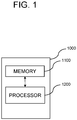
- Fig. 1 is a drawing representing an on-device learning device for training the object detection network which detects one or more objects on one or more training images by using one or more attention maps in accordance with one example embodiment of the present disclosure.
- the on-device learning device 1000 may include a memory 1100 which stores one or more instructions for training the object detection network and a processor 1200 which performs functions for training the object detection network in response to the instructions stored in the memory 1100.
- the on-device learning device 1000 may typically achieve a required performance by combining one or more computing devices and one or more computer software.
- computing devices may include one or more computer processors, one or more memories, one or more storages, one or more input and output devices, and one or more other components conventionally included in computing device; one or more electronic communication devices, such as a router and a switch; and one or more electronic data storage systems, such as a network attached storage (NSA) and a storage area network (SAN), and herein, the computer software are one or more instructions respectively allowing the computing device to perform a corresponding function.
- NSA network attached storage
- SAN storage area network
- the processor of the computing device may include one or more hardware configurations, such as micro processing unit (MPU), central processing unit (CPU), cache memory, data bus, etc.
- the computing device may also include one or more operating systems and one or more software configurations of respective applications which serves respective purpose.
- the computer device do not exclude integrated processor, which is a combined form of one or more media, one or more processors, and one or more memories.
- the on-device learning device 1000 may perform or support another device to perform a process of inputting the training images into a feature extraction network 1210, to thereby allow the feature extraction network 1210 to output one or more feature maps for training.
- the feature extraction network 1210 may include one or more convolution layers, and may perform one or more first convolution operations on the training images and thus to generate the feature maps for training.
- one or more volumes of the feature maps for training can be K*H*W, where K may be the number of channels of the feature maps for training, H may be a height of the feature maps for training, and W may be a width of the feature maps for training.
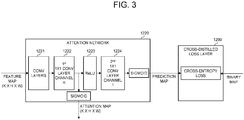
- the on-device learning device 1000 may perform or support another device to perform a process of inputting the feature maps for training into an attention network 1220, to thereby allow the attention network 1220 to output at least part of (i) attention maps for training corresponding to information on object densities of the feature maps for training and (ii) prediction maps for training corresponding to the feature maps for training.
- the attention network 1220 may perform one or more second convolution operations on the feature maps for training through one or more convolution layers 1221, to thereby output one or more first sub-feature maps for training, and may perform one or more first 1x1 convolution operations on the first sub-feature maps for training through a first 1x1 convolution layer 1222, to thereby output one or more second sub-feature maps for training.
- the first 1x1 convolution layer 1222 may perform the first 1x1 convolution operations on the first sub-feature maps for training through K kernels, to thereby make the second sub-feature maps for training have K channels.
- said K may be set as identical to the number of channels on the feature maps for training.
- the second sub-feature maps for training may have the number of channels identical to that of the feature maps for training. That is, one or more volumes of the second sub-feature maps for training can be K*H*W.
- the attention network 1220 may apply a sigmoid function to the second sub-feature maps for training, to thereby output the attention maps for training.
- the attention maps for training may represent information on densities of one or more objects for training in the training image and may be focused on certain sections on which information on the objects for training on the training image is clustered.
- the attention network 1220 may also apply a rectified linear unit function, i.e., ReLU function, to the second sub-feature maps for training through a ReLU layer 1223 without applying the sigmoid function, to thereby output one or more characterized second sub-feature maps for training, and may perform one or more second 1x1 convolution operations on the characterized second sub-feature maps for training through a second 1x1 convolution layer 1224, to thereby output one or more third sub-feature maps for training.
- the second 1x1 convolution layer 1224 may perform the second 1x1 convolution operations on the characterized second sub-feature maps for training through one kernel, to thereby make the third sub-feature maps for training have one channel. That is, one or more volumes of the third sub-feature maps for training can be 1*H*W.
- the attention network 1220 may apply the sigmoid function to the third sub-feature maps for training, to thereby output the prediction maps for training corresponding to the training images.
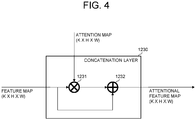
- the on-device learning device 1000 may perform or support another device to perform a process of inputting the feature maps for training acquired from the feature extraction network 1210 and the attention maps for training acquired from attention network 1220 into a concatenation layer 1230, to thereby allow the concatenation layer 1230 to concatenate the feature maps for training and the attention maps for training and thus to output one or more attentional feature maps for training.
- the concatenation layer 1230 may perform an elemental-wise multiplication 1231 of the attention maps for training and the feature maps for training, to thereby generate intermediate attention map for training. And then the concatenation layer 1230 may perform an elemental-wise sum 1232 of the intermediate attention map for training and the feature maps for training, to thereby generate the attentional feature maps for training.
- the attentional feature maps for training may be emphasized on the certain sections on the feature maps for training by using the attention maps for training, the performance of object detection of the object detection network may be improved.
- the on-device learning device 1000 may perform or support another device to perform a process of inputting the attentional feature maps for training into a region proposal network 1240, i.e., RPN 1240, to thereby allow the RPN 1240 to output one or more candidate boxes for training corresponding to one or more object candidates for training on the attentional feature maps for training.
- a region proposal network 1240 i.e., RPN 1240
- the region proposal network 1240 may generate the candidate boxes for training by using the attentional feature maps for training as mentioned above, the region proposal network 1240 may generate more accurate candidate boxes for training than a conventional RPN.
- the on-device learning device 1000 may perform or support another device to perform a process of inputting the candidate boxes for training into a binary convertor 1270, to thereby allow the binary convertor 1270 to convert the candidate boxes for training to one or more binary maps for training.
- the on-device learning device 1000 may perform or support another device to perform a process of resizing the binary maps for training by referring to sizes of the feature maps for training and may use the resized binary maps as target values for training the attention network 1220.
- the on-device learning device 1000 may perform or support another device to perform a process of inputting the attentional feature maps for training and the candidate boxes for training into a region of interest pooling layer 1250, i.e., ROI pooling layer 1250, to thereby allow the ROI pooling layer 1250 to perform one or more pooling operations on each of specific sections on the attentional feature maps for training, each of which corresponds to each of the candidate boxes for training, and thus to output one or more pooled feature maps for training, and then a process of inputting the pooled feature maps for training into a detection network 1260, to thereby allow the detection network 1260 to perform one or more learning operations, such as a fully-connected operation, on the pooled feature maps for training and thus to output each of object detection data for training each of which corresponds to each of the candidate boxes for training.
- a region of interest pooling layer 1250 i.e., ROI pooling layer 1250
- the detection network 1260 to perform one or more learning operations, such as a fully-connected operation,
- the detection network 1260 may generate the object detection data for training by using the pooled feature maps for training, which have been generated by using the more accurate candidate boxes for training than the conventional RPN, the detection network 1260 may generate more improved object detection data for training than a conventional detection network.
- the on-device learning device 1000 may perform or support another device to perform a process of allowing (i) an object loss layer 1261 to generate one or more object detection losses by referring to the object detection data for training and their corresponding object detection ground truths, (ii) an RPN loss layer 1241 to generate one or more RPN losses by referring to the candidate boxes for training and their corresponding RPN ground truths, and (iii) a cross-distilled loss layer 1280 to generate one or more cross-entropy losses by referring to the prediction maps for training and the binary maps for training.
- the on-device learning device 1000 may train (i) at least one of the feature extraction network 1210 and the detection network 1260 through one or more backpropagations using the object detection losses, (ii) the RPN 1240 through one or more backpropagations using the RPN losses, and (iii) the attention network 1220 through one or more backpropagations using the cross-entropy losses.
- Cross entropy loss L ce ( ⁇ ( Z c ), Y c ) .
- ⁇ ( Z c ) may represent one prediction map, among the prediction maps for training, generated by applying the sigmoid function to one corresponding third sub-feature map among the third sub-feature maps for training, and Y c may represent one corresponding binary map among the binary maps for training.
- Fig. 5 is a drawing representing an on-device testing device for testing the object detection network after the object detection network has been trained by using aforementioned method for training the object detection network in accordance with one example embodiment of the present disclosure.
- the on-device testing device 2000 may include a memory 2100 which stores one or more instructions for testing the object detection network and a processor 2200 which performs functions for testing the object detection network in response to the instructions stored in the memory 2100.
- the on-device testing device 2000 may typically achieve a required performance by combining one or more computing devices and one or more computer software.
- computing devices may include one or more computer processors, one or more memories, one or more storages, one or more input and output devices, and one or more other components conventionally included in computing device; one or more electronic communication devices, such as a router and a switch; and one or more electronic data storage systems, such as a network attached storage (NSA) and a storage area network (SAN), and herein, the computer software are one or more instructions respectively allowing the computing device to perform a corresponding function.
- NSA network attached storage
- SAN storage area network
- the processor of the computing device may include one or more hardware configurations, such as micro processing unit (MPU), central processing unit (CPU), cache memory, data bus, etc.
- the computing device may also include one or more operating systems and one or more software configurations of respective applications which serves respective purpose.
- the computer device do not exclude integrated processor, which is a combined form of one or more media, one or more processors, and one or more memories.
- the following on-device testing device and the object detection network may be on-boarded on a device performing the object detection, such as the autonomous vehicle, an autonomous flying vehicle, an autonomous robot, etc., and may be configured to perform an on-device learning in the device performing the object detection.
- the object detection network may have been trained through the aforementioned method for training the object detection network, which is explained by referring to Fig. 2 and Fig. 3 .
- the object detection network may have been trained by the on-device learning device 1000.
- the on-device learning device 1000 may have performed or supported another device to perform a process of inputting the training images into the feature extraction network 1210, to thereby allow the feature extraction network 1210 to perform the first convolution operations on the training images and thus to output the feature maps for training, a process of inputting the feature maps for training into the attention network 1220, to thereby allow the attention network 1220 to output at least part of the attention maps for training, which correspond to information on object densities of the feature maps for training, and the prediction maps for training, which correspond to the feature maps for training, and a process of inputting the feature maps for training and the attention maps for training into the concatenation layer 1230, to thereby allow the concatenation layer to perform the concatenation operations on the feature maps for training and the attention maps for training and thus to output the attentional feature maps for training.
- the on-device learning device 1000 may have performed or supported another device to perform a process of inputting the attentional feature maps for training into the RPN 1240, to thereby allow the RPN 1240 to output the candidate boxes for training, which correspond to one or more object candidates for training on the attentional feature maps for training, a process of inputting the candidate boxes for training into the binary convertor 1270, to thereby allow the binary convertor 1270 to convert the candidate boxes for training to the binary maps for training, a process of inputting the attentional feature maps for training and the candidate boxes for training into the ROI pooling layer 1250, to thereby allow the ROI pooling layer 1250 to perform the pooling operations on each of the specific sections on the attentional feature maps for training, each of which corresponds to each of the candidate boxes for training, and thus to output the pooled feature maps for training, and a process of inputting the pooled feature maps for training into the detection network 1260, to thereby allow the detection network 1260 to perform the leaning operations on the pooled feature maps for training and thus
- the on-device learning device 1000 may also have performed or supported another device to perform a process of allowing the object loss layer 1261 to acquire the object detection losses by referring to the object detection data for training and the object detection ground truths for training, to thereby train at least one of the feature extraction network 1210 and the detection network 1260 through the backpropagations using the object detection losses, a process of allowing the RPN loss layer 1241 to acquire the RPN losses by referring to the candidate boxes for training and the RPN ground truths for training, to thereby train the RPN through the backpropagations using the RPN losses, and a process of allowing the cross-distilled loss layer 1280 to acquire the cross-entropy losses by referring to the prediction maps for training and the binary maps for training, to thereby train the attention network through the backpropagations using the cross-entropy losses.
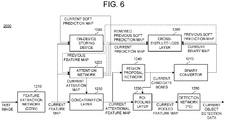
- the on-device testing device 2000 may perform or support another device to perform a process of inputting one or more current images corresponding to one or more current frames of the test videos into the feature extraction network 1210, to thereby allow the feature extraction network 1210 to perform the first convolution operations on the current image and thus to output one or more current feature maps.
- one or more volumes of the current feature maps can be K*H*W, where K may be the number of channels of the current feature maps, H may be a height of the current feature maps, and W may be a width of the current feature maps.
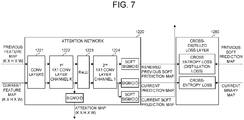
- the on-device testing device 2000 may store the current feature maps in an on-device storing device 1290, to thereby prepare for a continual learning of attentional network 1220 using one or more next frames of the test videos. Additionally, the on-device testing device 2000 may input the current feature maps and one or more previous feature maps corresponding to one or more previous frames of the test videos into the attention network 1220, to thereby allow the attention network 1220 to output (i) one or more current attention maps corresponding to information on object densities of the current feature maps, (ii) one or more current prediction maps corresponding to the current feature maps, (iii) one or more current soft prediction maps corresponding to the current feature maps, and (iv) one or more renewed previous soft prediction maps corresponding to the previous feature maps. Furthermore, the on-device testing device 2000 may store the current soft prediction maps in the on-device storing device 1290, to thereby prepare for the continual learning of attentional network 1220 using the next frames.
- the attention network 1220 may perform the second convolution operations on the current feature maps and the previous feature maps through the convolution layers 1221, to thereby output one or more current first sub-feature maps and one or more previous first sub-feature maps, respectively, and then may perform the first 1x1 convolution operations on the current first sub-feature maps and the previous first sub-feature maps through the first 1x1 convolution layer 1222, to thereby output one or more current second sub-feature maps and one or more previous second sub-feature maps, respectively.
- the first 1x1 convolution layer 1222 may perform the first 1x1 convolution operations on the current first sub-feature maps and the previous first sub-feature maps through K kernels, to thereby make the current second sub-feature maps and the previous second sub-feature maps have K channels,
- said K may be set as identical to the number of channels on the current feature maps and that of the previous feature maps.
- the current second sub-feature maps and the previous second sub-feature maps may have the number of channels identical to that of the current feature maps and that of the previous feature maps. That is, one or more volumes of the current second sub-feature maps and one or more volumes of the previous second sub-feature maps can be K*H*W.
- the attention network 1220 may apply the sigmoid function to the current second sub-feature maps, to thereby output the current attention maps corresponding to the current second sub-feature maps.
- the current attention maps may represent information on densities of one or more current object in the current image and may be focused on certain sections on which information on the current objects on the current image is clustered.
- the attention network 1220 may also apply the ReLU function to the current second sub-feature maps and the previous second sub-feature maps through the ReLU layer 1223 without applying the sigmoid function, to thereby output one or more current characterized second sub-feature maps and one or more previous characterized second sub-feature maps, respectively, and may perform the second 1x1 convolution operations on the current characterized second sub-feature maps and the previous characterized second sub-feature maps through the second 1x1 convolution layer 1224, to thereby output one or more current third sub-feature maps and one or more previous third sub-feature maps, respectively.
- the second 1x1 convolution layer 1224 may perform the second 1x1 convolution operations on the current characterized second sub-feature maps and the previous characterized second sub-feature maps through one kernel, to thereby make the current third sub-feature maps and the previous third sub-feature maps have one channel. That is, one or more volumes of the current third sub-feature maps and one or more volumes of the previous third sub-feature maps can be 1*H*W.
- the attention network 1220 may apply the sigmoid function to the current third sub-feature maps, to thereby output the current prediction maps.
- the attention network 1220 may apply a soft sigmoid function to the current third sub-feature maps instead of the sigmoid function, to thereby output one or more current soft prediction maps and thus to store the current soft prediction maps in the on-device storing device 1290.
- ⁇ (Z) may represent the sigmoid function
- Z may represent an input value
- T may represent a temperature hyper parameter.
- the temperature hyper parameter may be used for calibrating a prediction confidence on a classification task. Additionally, the temperature hyper parameter may also be applied to an out-of-distribution detection issue, to thereby distinguish a class score of an in-distribution sample and a class score of an out-of-distribution sample through distancing them.
- the attention network 1220 may apply the soft sigmoid function to the previous third sub-feature maps, to thereby output one or more renewed previous soft prediction maps.
- the on-device testing device 2000 may perform or support another device to perform a process of inputting the current feature maps acquired from the feature extraction network 1210 and the current attention maps acquired from attention network 1220 into the concatenation layer 1230, to thereby allow the concatenation layer 1230 to concatenate the current feature maps and the current attention maps and thus to output one or more current attentional feature maps.
- the on-device testing device 2000 may perform or support another device to perform a process of inputting the current attentional feature maps into the RPN 1240, to thereby allow the RPN 1240 to output one or more current candidate boxes corresponding to one or more current object candidates on the current attentional feature maps.
- the on-device testing device 2000 may perform or support another device to perform a process of inputting the current candidate boxes into the binary convertor 1270, to thereby allow the binary convertor 1270 to convert the current candidate boxes to one or more current binary maps.
- the on-device testing device 2000 may also perform or support another device to perform a process of inputting the current attentional feature maps and the current candidate boxes into the ROI pooling layer 1250, to thereby allow the ROI pooling layer 1250 to perform the pooling operations on each of specific sections on the current attentional feature maps, each of which corresponds to each of the current candidate boxes, and thus to output one or more current pooled feature maps, and then a process of inputting the current pooled feature maps into the detection network 1260, to thereby allow the detection network 1260 to perform the learning operations, such as the fully-connected operation, on the current pooled feature maps and thus to output each of current object detection data each of which corresponds to each of the current candidate boxes.
- the learning operations such as the fully-connected operation
- the on-device testing device 2000 may perform or support another device to perform a process of allowing the cross-distilled loss layer 1280 to generate (i) one or more current cross-entropy losses by referring to the current prediction maps and the current binary maps, and (ii) one or more distillation losses by referring to the renewed previous soft prediction maps acquired from the attention network 1220 and the previous soft prediction maps, which have been stored in the on-device storing device 1290. Then the on-device testing device 2000 may perform the continual learning of the attention network 1220 through one or more backpropagations using the current cross-entropy losses and one or more backpropagation using the distillation losses.
- ⁇ ( Z c ) may represent one current prediction map among the current prediction maps
- Y c may represent one corresponding current binary map among the current binary maps
- ⁇ Z p T may represent one corresponding renewed previous soft prediction map among the renewed previous soft prediction maps
- Y p may represent one corresponding previous soft prediction map among the previous soft prediction maps
- L ce ( ⁇ ( Z c ), Y c ) may represent one corresponding current cross-entropy loss among the current cross-entropy losses
- L ce ⁇ Z p T , Y p may represent one corresponding current distillation loss among the distillation losses.
- performing the continual learning of the attention network 1220 using the distillation losses may prevent catastrophic forgetting.
- the attention network 1220 may also be updated for each current frames on the test videos through the continual learning of the attention network 1220.
- Training and testing the object detection network with the aforementioned methods may have an advantage of improving a performance of the object detection network by training the object detection network intensively on driving conditions which each of autonomous vehicles frequently encounters, through using a limited computing power of embedded system on each of the autonomous vehicle, while preventing the catastrophic forgetting.
- the present disclosure has an effect of providing the method for improving a performance of an object detection network without accessing a cloud server.
- the present disclosure has another effect of providing the method for improving the performance of the object detection network by using attention maps.
- the present disclosure has still another effect of providing the method for preventing the catastrophic forgetting by using the distillation losses layer.
- the embodiments of the present invention as explained above can be implemented in a form of executable program command through a variety of computer means recordable to computer readable media.
- the computer readable media may include solely or in combination, program commands, data files, and data structures.
- the program commands recorded to the media may be components specially designed for the present invention or may be usable to a skilled human in a field of computer software.
- Computer readable media include magnetic media such as hard disk, floppy disk, and magnetic tape, optical media such as CD-ROM and DVD, magneto-optical media such as floptical disk and hardware devices such as ROM, RAM, and flash memory specially designed to store and carry out program commands.
- Program commands include not only a machine language code made by a complier but also a high level code that can be used by an interpreter etc., which is executed by a computer.
- the aforementioned hardware device can work as more than a software module to perform the action of the present invention and they can do the same in the opposite case.
Landscapes
- Engineering & Computer Science (AREA)
- Theoretical Computer Science (AREA)
- Physics & Mathematics (AREA)
- General Physics & Mathematics (AREA)
- Computer Vision & Pattern Recognition (AREA)
- Evolutionary Computation (AREA)
- Artificial Intelligence (AREA)
- Software Systems (AREA)
- Health & Medical Sciences (AREA)
- General Health & Medical Sciences (AREA)
- Multimedia (AREA)
- Computing Systems (AREA)
- Data Mining & Analysis (AREA)
- Medical Informatics (AREA)
- Life Sciences & Earth Sciences (AREA)
- Databases & Information Systems (AREA)
- General Engineering & Computer Science (AREA)
- Biomedical Technology (AREA)
- Molecular Biology (AREA)
- Mathematical Physics (AREA)
- Computational Linguistics (AREA)
- Biophysics (AREA)
- Biodiversity & Conservation Biology (AREA)
- Bioinformatics & Cheminformatics (AREA)
- Bioinformatics & Computational Biology (AREA)
- Evolutionary Biology (AREA)
- Image Analysis (AREA)
Applications Claiming Priority (2)
| Application Number | Priority Date | Filing Date | Title |
|---|---|---|---|
| US202063024018P | 2020-05-13 | 2020-05-13 | |
| US17/112,413 US10970598B1 (en) | 2020-05-13 | 2020-12-04 | Learning method and learning device for training an object detection network by using attention maps and testing method and testing device using the same |
Publications (3)
| Publication Number | Publication Date |
|---|---|
| EP3910532A1 true EP3910532A1 (de) | 2021-11-17 |
| EP3910532B1 EP3910532B1 (de) | 2023-11-08 |
| EP3910532C0 EP3910532C0 (de) | 2023-11-08 |
Family
ID=75275483
Family Applications (1)
| Application Number | Title | Priority Date | Filing Date |
|---|---|---|---|
| EP20214952.2A Active EP3910532B1 (de) | 2020-05-13 | 2020-12-17 | Lernverfahren und lernvorrichtung zum trainieren eines objektdetektionsnetzwerks unter verwendung von aufmerksamkeitskarten und testverfahren und testvorrichtung mit verwendung davon |
Country Status (6)
| Country | Link |
|---|---|
| US (1) | US10970598B1 (de) |
| EP (1) | EP3910532B1 (de) |
| JP (1) | JP7233571B2 (de) |
| KR (1) | KR102764473B1 (de) |
| CN (1) | CN115769229B (de) |
| WO (1) | WO2021230457A1 (de) |
Cited By (1)
| Publication number | Priority date | Publication date | Assignee | Title |
|---|---|---|---|---|
| CN119902008A (zh) * | 2025-03-31 | 2025-04-29 | 山东安能信息技术有限公司 | 多设备协同的线损异常协同检测方法及系统 |
Families Citing this family (12)
| Publication number | Priority date | Publication date | Assignee | Title |
|---|---|---|---|---|
| CN110598840B (zh) * | 2018-06-13 | 2023-04-18 | 富士通株式会社 | 知识迁移方法、信息处理设备以及存储介质 |
| US10970598B1 (en) * | 2020-05-13 | 2021-04-06 | StradVision, Inc. | Learning method and learning device for training an object detection network by using attention maps and testing method and testing device using the same |
| CN113379674B (zh) * | 2021-04-28 | 2022-05-13 | 北京医准智能科技有限公司 | 一种医学图像的检测方法及装置 |
| CN113221987B (zh) * | 2021-04-30 | 2024-06-28 | 西北工业大学 | 一种基于交叉注意力机制的小样本目标检测方法 |
| CN113592007B (zh) * | 2021-08-05 | 2022-05-31 | 哈尔滨理工大学 | 一种基于知识蒸馏的不良图片识别系统、方法、计算机及存储介质 |
| KR102895633B1 (ko) | 2021-09-08 | 2025-12-05 | 한국전자통신연구원 | Rgb 프레임을 이용한 온라인 행동 탐지 장치 및 방법 |
| US11983240B2 (en) * | 2021-11-16 | 2024-05-14 | Huawei Technologies Co., Ltd. | Meta few-shot class incremental learning |
| US11954837B2 (en) * | 2021-12-08 | 2024-04-09 | Black Sesame Technologies Inc. | Image enhancement system based on nonlocal features |
| KR20230105303A (ko) | 2022-01-03 | 2023-07-11 | 주식회사 에스아이에이 | 모호한 라벨을 이용한 객체 예측 모델 학습 방법 |
| US11869212B1 (en) * | 2023-02-07 | 2024-01-09 | Deeping Source Inc. | Method for training video object detection model using training dataset and learning device using the same |
| CN117036770B (zh) * | 2023-05-19 | 2025-12-09 | 北京交通大学 | 基于级联注意力的检测模型训练和目标检测方法、系统 |
| CN116612378B (zh) * | 2023-05-22 | 2024-07-05 | 河南大学 | 一种基于ssd改进的不平衡数据及复杂背景下水下小目标检测方法 |
Citations (2)
| Publication number | Priority date | Publication date | Assignee | Title |
|---|---|---|---|---|
| US10395140B1 (en) * | 2019-01-23 | 2019-08-27 | StradVision, Inc. | Learning method and learning device for object detector based on CNN using 1×1 convolution to be used for hardware optimization, and testing method and testing device using the same |
| CN110751212A (zh) * | 2019-10-21 | 2020-02-04 | 南京大学 | 一种移动设备上高效的细粒度图像识别方法 |
Family Cites Families (16)
| Publication number | Priority date | Publication date | Assignee | Title |
|---|---|---|---|---|
| US9202144B2 (en) * | 2013-10-30 | 2015-12-01 | Nec Laboratories America, Inc. | Regionlets with shift invariant neural patterns for object detection |
| US9965705B2 (en) * | 2015-11-03 | 2018-05-08 | Baidu Usa Llc | Systems and methods for attention-based configurable convolutional neural networks (ABC-CNN) for visual question answering |
| US9830529B2 (en) * | 2016-04-26 | 2017-11-28 | Xerox Corporation | End-to-end saliency mapping via probability distribution prediction |
| KR102463175B1 (ko) * | 2017-09-04 | 2022-11-04 | 삼성전자주식회사 | 객체 인식 방법 및 장치 |
| CN107861938B (zh) * | 2017-09-21 | 2020-09-25 | 北京三快在线科技有限公司 | 一种poi文案生成方法及装置,电子设备 |
| US9934440B1 (en) * | 2017-10-04 | 2018-04-03 | StradVision, Inc. | Method for monitoring blind spot of monitoring vehicle and blind spot monitor using the same |
| US10169679B1 (en) * | 2017-10-13 | 2019-01-01 | StradVision, Inc. | Learning method and learning device for adjusting parameters of CNN by using loss augmentation and testing method and testing device using the same |
| US10223610B1 (en) * | 2017-10-15 | 2019-03-05 | International Business Machines Corporation | System and method for detection and classification of findings in images |
| US11537871B2 (en) * | 2018-04-25 | 2022-12-27 | Fujitsu Limited | Deep neural network training for application program generation |
| US10755099B2 (en) * | 2018-11-13 | 2020-08-25 | Adobe Inc. | Object detection in images |
| CN109598225A (zh) * | 2018-11-29 | 2019-04-09 | 浙江大学 | 尖锐注意力网络、神经网络及行人再识别方法 |
| US10410120B1 (en) * | 2019-01-25 | 2019-09-10 | StradVision, Inc. | Learning method and testing method of object detector to be used for surveillance based on R-CNN capable of converting modes according to aspect ratios or scales of objects, and learning device and testing device using the same |
| CN109993101B (zh) * | 2019-03-28 | 2021-01-19 | 华南理工大学 | 基于多分支循环自注意力网络与循环边框回归的车辆检测方法 |
| CN110059672B (zh) * | 2019-04-30 | 2022-06-14 | 福州大学 | 一种对显微镜细胞图像检测模型进行增类学习的方法 |
| CN110598029B (zh) * | 2019-09-06 | 2022-03-22 | 西安电子科技大学 | 基于注意力转移机制的细粒度图像分类方法 |
| US10970598B1 (en) * | 2020-05-13 | 2021-04-06 | StradVision, Inc. | Learning method and learning device for training an object detection network by using attention maps and testing method and testing device using the same |
-
2020
- 2020-12-04 US US17/112,413 patent/US10970598B1/en active Active
- 2020-12-17 EP EP20214952.2A patent/EP3910532B1/de active Active
- 2020-12-24 KR KR1020217037929A patent/KR102764473B1/ko active Active
- 2020-12-24 WO PCT/KR2020/019160 patent/WO2021230457A1/en not_active Ceased
- 2020-12-24 CN CN202080100023.3A patent/CN115769229B/zh active Active
- 2020-12-24 JP JP2021570541A patent/JP7233571B2/ja active Active
Patent Citations (2)
| Publication number | Priority date | Publication date | Assignee | Title |
|---|---|---|---|---|
| US10395140B1 (en) * | 2019-01-23 | 2019-08-27 | StradVision, Inc. | Learning method and learning device for object detector based on CNN using 1×1 convolution to be used for hardware optimization, and testing method and testing device using the same |
| CN110751212A (zh) * | 2019-10-21 | 2020-02-04 | 南京大学 | 一种移动设备上高效的细粒度图像识别方法 |
Non-Patent Citations (1)
| Title |
|---|
| "Communications in computer and information science", vol. 1212, 23 April 2020, SPRINGER, DE, ISSN: 1865-0929, article LEE YOUL-KYEONG ET AL: "Faster R-CNN with Attention Feature Map for Robust Object Detection : 26th International Workshop, IW-FCV 2020, Ibusuki, Kagoshima, Japan, February 20-22, 2020, Revised Selected Papers", pages: 180 - 191, XP055808470, DOI: 10.1007/978-981-15-4818-5_14 * |
Cited By (1)
| Publication number | Priority date | Publication date | Assignee | Title |
|---|---|---|---|---|
| CN119902008A (zh) * | 2025-03-31 | 2025-04-29 | 山东安能信息技术有限公司 | 多设备协同的线损异常协同检测方法及系统 |
Also Published As
| Publication number | Publication date |
|---|---|
| JP7233571B2 (ja) | 2023-03-06 |
| JP2022539659A (ja) | 2022-09-13 |
| EP3910532B1 (de) | 2023-11-08 |
| US10970598B1 (en) | 2021-04-06 |
| WO2021230457A1 (en) | 2021-11-18 |
| KR20210143948A (ko) | 2021-11-29 |
| KR102764473B1 (ko) | 2025-02-07 |
| EP3910532C0 (de) | 2023-11-08 |
| CN115769229B (zh) | 2025-12-12 |
| CN115769229A (zh) | 2023-03-07 |
Similar Documents
| Publication | Publication Date | Title |
|---|---|---|
| US10970598B1 (en) | Learning method and learning device for training an object detection network by using attention maps and testing method and testing device using the same | |
| EP3690742B1 (de) | Verfahren zur automatischen markierung von trainingsbildern zur verwendung in einem tiefenlernnetzwerk zur analyse von bildern mit hoher präzision und vorrichtung zur automatischen markierung mit verwendung davon | |
| EP3690714B1 (de) | Verfahren zur erfassung von probenbildern zur inspektion einer markierung unter automatisch markierten bildern, die zum lernen eines neuronalen netzwerks verwendet werden sollen, sowie probenbilderfassungsvorrichtung damit | |
| US10692002B1 (en) | Learning method and learning device of pedestrian detector for robust surveillance based on image analysis by using GAN and testing method and testing device using the same | |
| CN111461106B (zh) | 基于可重配置网络的对象检测方法及装置 | |
| US10579907B1 (en) | Method for automatically evaluating labeling reliability of training images for use in deep learning network to analyze images, and reliability-evaluating device using the same | |
| US10402692B1 (en) | Learning method and learning device for fluctuation-robust object detector based on CNN using target object estimating network adaptable to customers' requirements such as key performance index, and testing device using the same | |
| US10325179B1 (en) | Learning method and learning device for pooling ROI by using masking parameters to be used for mobile devices or compact networks via hardware optimization, and testing method and testing device using the same | |
| US11113574B1 (en) | Methods for performing self-supervised learning of deep-learning based detection network by using deep Q-network and devices using the same | |
| EP3690744A1 (de) | Verfahren zur integration von fahrbildern, die von fahrzeugen mit kooperativem fahren gewonnen wurden, und fahrbildintegrationsvorrichtung damit | |
| EP3686781A1 (de) | Lernverfahren und lernvorrichtung für einen objektdetektor auf der basis von cnn unter verwendung von bildverknüpfung sowie testverfahren und testvorrichtung damit | |
| EP3910563A1 (de) | Verfahren zur durchführung von on-device-lernen eines maschinenlernnetzwerks in einem autonomen fahrzeug durch verwendung von mehrstufigem lernen mit adaptiven hyperparametersätzen und vorrichtung zur verwendung davon | |
| US10402686B1 (en) | Learning method and learning device for object detector to be used for surveillance based on convolutional neural network capable of converting modes according to scales of objects, and testing method and testing device using the same | |
| EP3913530B1 (de) | Lernverfahren und lernvorrichtung zum aktualisieren eines objektdetektors basierend auf tiefenlernen eines autonomen fahrzeugs zur anpassung des objektdetektors an die fahrumstände sowie aktualisierungsverfahren und aktualisierungsvorrichtung damit | |
| US10713815B1 (en) | Method and device for supporting administrators to processes of object detectors to provide logical driving | |
| EP4064126B1 (de) | Verfahren zum trainieren und testen von wahrnehmungsnetzen unter verwendung von bildern, die aus mehreren bildgebungsvorrichtungen mit diversen spezifikationen erhalten werden, und lernvorrichtung und testvorrichtung mit verwendung davon | |
| US11954898B1 (en) | Learning method and learning device for performing transfer learning on an object detector that has been trained to detect first object classes such that the object detector is able to detect second object classes, and testing method and testing device using the same | |
| CN111507154A (zh) | 使用横向滤波器掩膜来检测车道线元素的方法和装置 | |
| de Sa Lowande | Visual Question Answering (VQA) Analyses for Post-Disaster Damage Detection and Identification Using Aerial Footage | |
| CN110942179A (zh) | 一种自动驾驶路线规划方法、装置及车辆 |
Legal Events
| Date | Code | Title | Description |
|---|---|---|---|
| PUAI | Public reference made under article 153(3) epc to a published international application that has entered the european phase |
Free format text: ORIGINAL CODE: 0009012 |
|
| STAA | Information on the status of an ep patent application or granted ep patent |
Free format text: STATUS: REQUEST FOR EXAMINATION WAS MADE |
|
| 17P | Request for examination filed |
Effective date: 20201217 |
|
| AK | Designated contracting states |
Kind code of ref document: A1 Designated state(s): AL AT BE BG CH CY CZ DE DK EE ES FI FR GB GR HR HU IE IS IT LI LT LU LV MC MK MT NL NO PL PT RO RS SE SI SK SM TR |
|
| B565 | Issuance of search results under rule 164(2) epc |
Effective date: 20210611 |
|
| RBV | Designated contracting states (corrected) |
Designated state(s): AL AT BE BG CH CY CZ DE DK EE ES FI FR GB GR HR HU IE IS IT LI LT LU LV MC MK MT NL NO PL PT RO RS SE SI SK SM TR |
|
| REG | Reference to a national code |
Ref country code: DE Ref legal event code: R079 Ipc: G06F0018213000 Ref country code: DE Ref legal event code: R079 Ref document number: 602020020651 Country of ref document: DE Free format text: PREVIOUS MAIN CLASS: G06K0009000000 Ipc: G06F0018213000 |
|
| GRAP | Despatch of communication of intention to grant a patent |
Free format text: ORIGINAL CODE: EPIDOSNIGR1 |
|
| STAA | Information on the status of an ep patent application or granted ep patent |
Free format text: STATUS: GRANT OF PATENT IS INTENDED |
|
| RIC1 | Information provided on ipc code assigned before grant |
Ipc: G06N 3/084 20230101ALI20230601BHEP Ipc: G06V 10/80 20220101ALI20230601BHEP Ipc: G06V 10/77 20220101ALI20230601BHEP Ipc: G06V 10/44 20220101ALI20230601BHEP Ipc: G06F 18/25 20230101ALI20230601BHEP Ipc: G06V 20/56 20220101ALI20230601BHEP Ipc: G06V 10/82 20220101ALI20230601BHEP Ipc: G06V 10/25 20220101ALI20230601BHEP Ipc: G06N 3/045 20230101ALI20230601BHEP Ipc: G06F 18/213 20230101AFI20230601BHEP |
|
| INTG | Intention to grant announced |
Effective date: 20230622 |
|
| GRAS | Grant fee paid |
Free format text: ORIGINAL CODE: EPIDOSNIGR3 |
|
| GRAA | (expected) grant |
Free format text: ORIGINAL CODE: 0009210 |
|
| STAA | Information on the status of an ep patent application or granted ep patent |
Free format text: STATUS: THE PATENT HAS BEEN GRANTED |
|
| AK | Designated contracting states |
Kind code of ref document: B1 Designated state(s): AL AT BE BG CH CY CZ DE DK EE ES FI FR GB GR HR HU IE IS IT LI LT LU LV MC MK MT NL NO PL PT RO RS SE SI SK SM TR |
|
| REG | Reference to a national code |
Ref country code: GB Ref legal event code: FG4D |
|
| REG | Reference to a national code |
Ref country code: CH Ref legal event code: EP |
|
| REG | Reference to a national code |
Ref country code: DE Ref legal event code: R096 Ref document number: 602020020651 Country of ref document: DE |
|
| REG | Reference to a national code |
Ref country code: IE Ref legal event code: FG4D |
|
| U01 | Request for unitary effect filed |
Effective date: 20231108 |
|
| U07 | Unitary effect registered |
Designated state(s): AT BE BG DE DK EE FI FR IT LT LU LV MT NL PT SE SI Effective date: 20231113 |
|
| U20 | Renewal fee for the european patent with unitary effect paid |
Year of fee payment: 4 Effective date: 20231215 |
|
| PG25 | Lapsed in a contracting state [announced via postgrant information from national office to epo] |
Ref country code: GR Free format text: LAPSE BECAUSE OF FAILURE TO SUBMIT A TRANSLATION OF THE DESCRIPTION OR TO PAY THE FEE WITHIN THE PRESCRIBED TIME-LIMIT Effective date: 20240209 |
|
| PG25 | Lapsed in a contracting state [announced via postgrant information from national office to epo] |
Ref country code: IS Free format text: LAPSE BECAUSE OF FAILURE TO SUBMIT A TRANSLATION OF THE DESCRIPTION OR TO PAY THE FEE WITHIN THE PRESCRIBED TIME-LIMIT Effective date: 20240308 |
|
| PG25 | Lapsed in a contracting state [announced via postgrant information from national office to epo] |
Ref country code: ES Free format text: LAPSE BECAUSE OF FAILURE TO SUBMIT A TRANSLATION OF THE DESCRIPTION OR TO PAY THE FEE WITHIN THE PRESCRIBED TIME-LIMIT Effective date: 20231108 |
|
| PG25 | Lapsed in a contracting state [announced via postgrant information from national office to epo] |
Ref country code: IS Free format text: LAPSE BECAUSE OF FAILURE TO SUBMIT A TRANSLATION OF THE DESCRIPTION OR TO PAY THE FEE WITHIN THE PRESCRIBED TIME-LIMIT Effective date: 20240308 Ref country code: GR Free format text: LAPSE BECAUSE OF FAILURE TO SUBMIT A TRANSLATION OF THE DESCRIPTION OR TO PAY THE FEE WITHIN THE PRESCRIBED TIME-LIMIT Effective date: 20240209 Ref country code: ES Free format text: LAPSE BECAUSE OF FAILURE TO SUBMIT A TRANSLATION OF THE DESCRIPTION OR TO PAY THE FEE WITHIN THE PRESCRIBED TIME-LIMIT Effective date: 20231108 |
|
| PG25 | Lapsed in a contracting state [announced via postgrant information from national office to epo] |
Ref country code: RS Free format text: LAPSE BECAUSE OF FAILURE TO SUBMIT A TRANSLATION OF THE DESCRIPTION OR TO PAY THE FEE WITHIN THE PRESCRIBED TIME-LIMIT Effective date: 20231108 Ref country code: PL Free format text: LAPSE BECAUSE OF FAILURE TO SUBMIT A TRANSLATION OF THE DESCRIPTION OR TO PAY THE FEE WITHIN THE PRESCRIBED TIME-LIMIT Effective date: 20231108 Ref country code: NO Free format text: LAPSE BECAUSE OF FAILURE TO SUBMIT A TRANSLATION OF THE DESCRIPTION OR TO PAY THE FEE WITHIN THE PRESCRIBED TIME-LIMIT Effective date: 20240208 Ref country code: HR Free format text: LAPSE BECAUSE OF FAILURE TO SUBMIT A TRANSLATION OF THE DESCRIPTION OR TO PAY THE FEE WITHIN THE PRESCRIBED TIME-LIMIT Effective date: 20231108 |
|
| PG25 | Lapsed in a contracting state [announced via postgrant information from national office to epo] |
Ref country code: CZ Free format text: LAPSE BECAUSE OF FAILURE TO SUBMIT A TRANSLATION OF THE DESCRIPTION OR TO PAY THE FEE WITHIN THE PRESCRIBED TIME-LIMIT Effective date: 20231108 |
|
| PG25 | Lapsed in a contracting state [announced via postgrant information from national office to epo] |
Ref country code: SK Free format text: LAPSE BECAUSE OF FAILURE TO SUBMIT A TRANSLATION OF THE DESCRIPTION OR TO PAY THE FEE WITHIN THE PRESCRIBED TIME-LIMIT Effective date: 20231108 |
|
| PG25 | Lapsed in a contracting state [announced via postgrant information from national office to epo] |
Ref country code: SM Free format text: LAPSE BECAUSE OF FAILURE TO SUBMIT A TRANSLATION OF THE DESCRIPTION OR TO PAY THE FEE WITHIN THE PRESCRIBED TIME-LIMIT Effective date: 20231108 Ref country code: SK Free format text: LAPSE BECAUSE OF FAILURE TO SUBMIT A TRANSLATION OF THE DESCRIPTION OR TO PAY THE FEE WITHIN THE PRESCRIBED TIME-LIMIT Effective date: 20231108 Ref country code: RO Free format text: LAPSE BECAUSE OF FAILURE TO SUBMIT A TRANSLATION OF THE DESCRIPTION OR TO PAY THE FEE WITHIN THE PRESCRIBED TIME-LIMIT Effective date: 20231108 Ref country code: CZ Free format text: LAPSE BECAUSE OF FAILURE TO SUBMIT A TRANSLATION OF THE DESCRIPTION OR TO PAY THE FEE WITHIN THE PRESCRIBED TIME-LIMIT Effective date: 20231108 |
|
| REG | Reference to a national code |
Ref country code: CH Ref legal event code: PL |
|
| REG | Reference to a national code |
Ref country code: DE Ref legal event code: R097 Ref document number: 602020020651 Country of ref document: DE |
|
| PG25 | Lapsed in a contracting state [announced via postgrant information from national office to epo] |
Ref country code: MC Free format text: LAPSE BECAUSE OF FAILURE TO SUBMIT A TRANSLATION OF THE DESCRIPTION OR TO PAY THE FEE WITHIN THE PRESCRIBED TIME-LIMIT Effective date: 20231108 |
|
| PG25 | Lapsed in a contracting state [announced via postgrant information from national office to epo] |
Ref country code: MC Free format text: LAPSE BECAUSE OF FAILURE TO SUBMIT A TRANSLATION OF THE DESCRIPTION OR TO PAY THE FEE WITHIN THE PRESCRIBED TIME-LIMIT Effective date: 20231108 |
|
| PLBE | No opposition filed within time limit |
Free format text: ORIGINAL CODE: 0009261 |
|
| STAA | Information on the status of an ep patent application or granted ep patent |
Free format text: STATUS: NO OPPOSITION FILED WITHIN TIME LIMIT |
|
| REG | Reference to a national code |
Ref country code: IE Ref legal event code: MM4A |
|
| PG25 | Lapsed in a contracting state [announced via postgrant information from national office to epo] |
Ref country code: IE Free format text: LAPSE BECAUSE OF NON-PAYMENT OF DUE FEES Effective date: 20231217 |
|
| 26N | No opposition filed |
Effective date: 20240809 |
|
| PG25 | Lapsed in a contracting state [announced via postgrant information from national office to epo] |
Ref country code: CH Free format text: LAPSE BECAUSE OF NON-PAYMENT OF DUE FEES Effective date: 20231231 |
|
| PG25 | Lapsed in a contracting state [announced via postgrant information from national office to epo] |
Ref country code: IE Free format text: LAPSE BECAUSE OF NON-PAYMENT OF DUE FEES Effective date: 20231217 Ref country code: CH Free format text: LAPSE BECAUSE OF NON-PAYMENT OF DUE FEES Effective date: 20231231 |
|
| U20 | Renewal fee for the european patent with unitary effect paid |
Year of fee payment: 5 Effective date: 20241114 |
|
| PG25 | Lapsed in a contracting state [announced via postgrant information from national office to epo] |
Ref country code: CY Free format text: LAPSE BECAUSE OF FAILURE TO SUBMIT A TRANSLATION OF THE DESCRIPTION OR TO PAY THE FEE WITHIN THE PRESCRIBED TIME-LIMIT; INVALID AB INITIO Effective date: 20201217 |
|
| PG25 | Lapsed in a contracting state [announced via postgrant information from national office to epo] |
Ref country code: HU Free format text: LAPSE BECAUSE OF FAILURE TO SUBMIT A TRANSLATION OF THE DESCRIPTION OR TO PAY THE FEE WITHIN THE PRESCRIBED TIME-LIMIT; INVALID AB INITIO Effective date: 20201217 |
|
| GBPC | Gb: european patent ceased through non-payment of renewal fee |
Effective date: 20241217 |
|
| PG25 | Lapsed in a contracting state [announced via postgrant information from national office to epo] |
Ref country code: GB Free format text: LAPSE BECAUSE OF NON-PAYMENT OF DUE FEES Effective date: 20241217 |
|
| PG25 | Lapsed in a contracting state [announced via postgrant information from national office to epo] |
Ref country code: TR Free format text: LAPSE BECAUSE OF FAILURE TO SUBMIT A TRANSLATION OF THE DESCRIPTION OR TO PAY THE FEE WITHIN THE PRESCRIBED TIME-LIMIT Effective date: 20231108 |
|
| U20 | Renewal fee for the european patent with unitary effect paid |
Year of fee payment: 6 Effective date: 20251117 |