EP3913452A1 - Dispositif et procédé de présentation d'indice de fonctionnement, et programme - Google Patents
Dispositif et procédé de présentation d'indice de fonctionnement, et programme Download PDFInfo
- Publication number
- EP3913452A1 EP3913452A1 EP20763762.0A EP20763762A EP3913452A1 EP 3913452 A1 EP3913452 A1 EP 3913452A1 EP 20763762 A EP20763762 A EP 20763762A EP 3913452 A1 EP3913452 A1 EP 3913452A1
- Authority
- EP
- European Patent Office
- Prior art keywords
- plant
- operating
- time series
- demand
- value
- Prior art date
- Legal status (The legal status is an assumption and is not a legal conclusion. Google has not performed a legal analysis and makes no representation as to the accuracy of the status listed.)
- Withdrawn
Links
Images


Classifications
-
- G—PHYSICS
- G05—CONTROLLING; REGULATING
- G05B—CONTROL OR REGULATING SYSTEMS IN GENERAL; FUNCTIONAL ELEMENTS OF SUCH SYSTEMS; MONITORING OR TESTING ARRANGEMENTS FOR SUCH SYSTEMS OR ELEMENTS
- G05B23/00—Testing or monitoring of control systems or parts thereof
- G05B23/02—Electric testing or monitoring
- G05B23/0205—Electric testing or monitoring by means of a monitoring system capable of detecting and responding to faults
- G05B23/0218—Electric testing or monitoring by means of a monitoring system capable of detecting and responding to faults characterised by the fault detection method dealing with either existing or incipient faults
- G05B23/0224—Process history based detection method, e.g. whereby history implies the availability of large amounts of data
- G05B23/024—Quantitative history assessment, e.g. mathematical relationships between available data; Functions therefor; Principal component analysis [PCA]; Partial least square [PLS]; Statistical classifiers, e.g. Bayesian networks, linear regression or correlation analysis; Neural networks
-
- G—PHYSICS
- G06—COMPUTING OR CALCULATING; COUNTING
- G06Q—INFORMATION AND COMMUNICATION TECHNOLOGY [ICT] SPECIALLY ADAPTED FOR ADMINISTRATIVE, COMMERCIAL, FINANCIAL, MANAGERIAL OR SUPERVISORY PURPOSES; SYSTEMS OR METHODS SPECIALLY ADAPTED FOR ADMINISTRATIVE, COMMERCIAL, FINANCIAL, MANAGERIAL OR SUPERVISORY PURPOSES, NOT OTHERWISE PROVIDED FOR
- G06Q10/00—Administration; Management
- G06Q10/06—Resources, workflows, human or project management; Enterprise or organisation planning; Enterprise or organisation modelling
- G06Q10/063—Operations research, analysis or management
- G06Q10/0631—Resource planning, allocation, distributing or scheduling for enterprises or organisations
- G06Q10/06315—Needs-based resource requirements planning or analysis
-
- G—PHYSICS
- G05—CONTROLLING; REGULATING
- G05B—CONTROL OR REGULATING SYSTEMS IN GENERAL; FUNCTIONAL ELEMENTS OF SUCH SYSTEMS; MONITORING OR TESTING ARRANGEMENTS FOR SUCH SYSTEMS OR ELEMENTS
- G05B19/00—Program-control systems
- G05B19/02—Program-control systems electric
- G05B19/418—Total factory control, i.e. centrally controlling a plurality of machines, e.g. direct or distributed numerical control [DNC], flexible manufacturing systems [FMS], integrated manufacturing systems [IMS] or computer integrated manufacturing [CIM]
- G05B19/41885—Total factory control, i.e. centrally controlling a plurality of machines, e.g. direct or distributed numerical control [DNC], flexible manufacturing systems [FMS], integrated manufacturing systems [IMS] or computer integrated manufacturing [CIM] characterised by modeling, simulation of the manufacturing system
-
- G—PHYSICS
- G05—CONTROLLING; REGULATING
- G05B—CONTROL OR REGULATING SYSTEMS IN GENERAL; FUNCTIONAL ELEMENTS OF SUCH SYSTEMS; MONITORING OR TESTING ARRANGEMENTS FOR SUCH SYSTEMS OR ELEMENTS
- G05B23/00—Testing or monitoring of control systems or parts thereof
- G05B23/02—Electric testing or monitoring
- G05B23/0205—Electric testing or monitoring by means of a monitoring system capable of detecting and responding to faults
- G05B23/0218—Electric testing or monitoring by means of a monitoring system capable of detecting and responding to faults characterised by the fault detection method dealing with either existing or incipient faults
- G05B23/0243—Electric testing or monitoring by means of a monitoring system capable of detecting and responding to faults characterised by the fault detection method dealing with either existing or incipient faults model based detection method, e.g. first-principles knowledge model
- G05B23/0254—Electric testing or monitoring by means of a monitoring system capable of detecting and responding to faults characterised by the fault detection method dealing with either existing or incipient faults model based detection method, e.g. first-principles knowledge model based on a quantitative model, e.g. mathematical relationships between inputs and outputs; functions: observer, Kalman filter, residual calculation, Neural Networks
-
- G—PHYSICS
- G06—COMPUTING OR CALCULATING; COUNTING
- G06Q—INFORMATION AND COMMUNICATION TECHNOLOGY [ICT] SPECIALLY ADAPTED FOR ADMINISTRATIVE, COMMERCIAL, FINANCIAL, MANAGERIAL OR SUPERVISORY PURPOSES; SYSTEMS OR METHODS SPECIALLY ADAPTED FOR ADMINISTRATIVE, COMMERCIAL, FINANCIAL, MANAGERIAL OR SUPERVISORY PURPOSES, NOT OTHERWISE PROVIDED FOR
- G06Q30/00—Commerce
- G06Q30/02—Marketing; Price estimation or determination; Fundraising
- G06Q30/0201—Market modelling; Market analysis; Collecting market data
- G06Q30/0202—Market predictions or forecasting for commercial activities
-
- G—PHYSICS
- G06—COMPUTING OR CALCULATING; COUNTING
- G06Q—INFORMATION AND COMMUNICATION TECHNOLOGY [ICT] SPECIALLY ADAPTED FOR ADMINISTRATIVE, COMMERCIAL, FINANCIAL, MANAGERIAL OR SUPERVISORY PURPOSES; SYSTEMS OR METHODS SPECIALLY ADAPTED FOR ADMINISTRATIVE, COMMERCIAL, FINANCIAL, MANAGERIAL OR SUPERVISORY PURPOSES, NOT OTHERWISE PROVIDED FOR
- G06Q50/00—Information and communication technology [ICT] specially adapted for implementation of business processes of specific business sectors, e.g. utilities or tourism
- G06Q50/06—Energy or water supply
-
- G—PHYSICS
- G05—CONTROLLING; REGULATING
- G05B—CONTROL OR REGULATING SYSTEMS IN GENERAL; FUNCTIONAL ELEMENTS OF SUCH SYSTEMS; MONITORING OR TESTING ARRANGEMENTS FOR SUCH SYSTEMS OR ELEMENTS
- G05B2219/00—Program-control systems
- G05B2219/30—Nc systems
- G05B2219/31—From computer integrated manufacturing till monitoring
- G05B2219/31414—Calculate amount of production energy, waste and toxic release
-
- G—PHYSICS
- G05—CONTROLLING; REGULATING
- G05B—CONTROL OR REGULATING SYSTEMS IN GENERAL; FUNCTIONAL ELEMENTS OF SUCH SYSTEMS; MONITORING OR TESTING ARRANGEMENTS FOR SUCH SYSTEMS OR ELEMENTS
- G05B2219/00—Program-control systems
- G05B2219/30—Nc systems
- G05B2219/32—Operator till task planning
- G05B2219/32021—Energy management, balance and limit power to tools
-
- Y—GENERAL TAGGING OF NEW TECHNOLOGICAL DEVELOPMENTS; GENERAL TAGGING OF CROSS-SECTIONAL TECHNOLOGIES SPANNING OVER SEVERAL SECTIONS OF THE IPC; TECHNICAL SUBJECTS COVERED BY FORMER USPC CROSS-REFERENCE ART COLLECTIONS [XRACs] AND DIGESTS
- Y02—TECHNOLOGIES OR APPLICATIONS FOR MITIGATION OR ADAPTATION AGAINST CLIMATE CHANGE
- Y02P—CLIMATE CHANGE MITIGATION TECHNOLOGIES IN THE PRODUCTION OR PROCESSING OF GOODS
- Y02P70/00—Climate change mitigation technologies in the production process for final industrial or consumer products
- Y02P70/10—Greenhouse gas [GHG] capture, material saving, heat recovery or other energy efficient measures, e.g. motor control, characterised by manufacturing processes, e.g. for rolling metal or metal working
-
- Y—GENERAL TAGGING OF NEW TECHNOLOGICAL DEVELOPMENTS; GENERAL TAGGING OF CROSS-SECTIONAL TECHNOLOGIES SPANNING OVER SEVERAL SECTIONS OF THE IPC; TECHNICAL SUBJECTS COVERED BY FORMER USPC CROSS-REFERENCE ART COLLECTIONS [XRACs] AND DIGESTS
- Y02—TECHNOLOGIES OR APPLICATIONS FOR MITIGATION OR ADAPTATION AGAINST CLIMATE CHANGE
- Y02P—CLIMATE CHANGE MITIGATION TECHNOLOGIES IN THE PRODUCTION OR PROCESSING OF GOODS
- Y02P90/00—Enabling technologies with a potential contribution to greenhouse gas [GHG] emissions mitigation
- Y02P90/02—Total factory control, e.g. smart factories, flexible manufacturing systems [FMS] or integrated manufacturing systems [IMS]
Definitions
- the present invention relates to an operating index presenting device, an operating index presenting method, and a program of a plant.
- Patent Literature 1 discloses an operation optimization method for minimizing cost in a factory.
- Patent Literature 1 Japanese Unexamined Patent Application, First Publication No. 2005-55997
- Patent Literature 1 an optimum solution of an operation at a certain time can be obtained.
- a condition for the optimum operation changes according to fluctuations in the future energy demands in operations of an energy plant, there is a need to perform a prediction of future operations of the plant.
- An object of the present invention is to provide an operating index presenting device, an operating index presenting method, and a program that can perform a prediction of future operations of a plant.
- an operating index presenting device includes a demand prediction unit configured to predict a time series of demand values related to a predetermined prediction period using a predictive model that is a learned model learned to output a demand value of an energy source by inputting an operation plan value of a plant and a predicted value related to an environment of the plant, an optimizing unit configured to specify a time series of operating indices related to the prediction period by specifying the operating indices of the plant that satisfy a plurality of demand values and satisfy a desired condition for each time related to the predicted time series of demand values, and a presentation unit configured to present information related to the time series of operating indices related to the prediction period.
- the optimizing unit may specify the operating indices on the basis of a plurality of models that simulate behaviors of a plurality of components of the plant, and the plurality of models may include at least one learned model learned on the basis of a combination of an input value and an output value related to a component simulated by the plurality of models.
- the plant in the operating index presenting device according to the first or second aspect, may include a plurality of supply means for one energy source, and the optimizing unit may specify a value related to a proportion of outputs by the plurality of supply means as the operating index.
- the optimizing unit may calculate an evaluation value that increases as cost in the plant increases on the basis of the operating index and as operations to be avoided in the plant increases, and specify the operating index such that the evaluation value is small.
- an operating index presenting method includes predicting a time series of demand values related to a predetermined prediction period using a predictive model that is a learned model learned to output a demand value of an energy source by inputting an operation plan value of a plant and a predicted value related to an environment of the plant, specifying a time series of operating indices related to the prediction period by specifying operating indices of the plant that satisfy a plurality of demand values and satisfy a desired condition for each time related to the predicted time series of demand values, and presenting information related to the time series of operating indices related to the prediction period.
- a program causes a computer to execute predicting a time series of demand values related to a predetermined prediction period using a predictive model that is a learned model learned to output a demand value of an energy source by inputting an operation plan value of a plant and a predicted value related to an environment of the plant, specifying a time series of operating indices related to the prediction period by specifying operating indices of the plant that satisfy a plurality of demand values and satisfy a desired condition for each time related to the predicted time series of demand values, and presenting information related to the time series of operating indices related to the prediction period.
- a user can predict the future operation of a plant by recognizing information presented by the operating index presenting device.
- FIG. 1 is a diagram which shows an outline of an operating index presenting device according to an embodiment.
- the operating index presenting device 100 predicts a demand of an energy source by a consumer C such as a factory for a certain period in the future, and presents an operating index of a plant P for satisfying the demand.
- the energy source include electricity, hot water, cold water, steam, and the like.
- the period for which a demand is predicted is referred to as a prediction period.
- the plant P includes two or more supply means for each energy source.
- the plant P uses steam generation by a gas engine and steam generation by a once-through boiler as steam supply means.
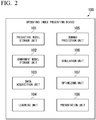
- FIG. 2 is a schematic block diagram which shows a configuration of the operating index presenting device according to the embodiment.
- the operating index presenting device 100 includes a predictive model storage unit 101, a component model storage unit 102, a data acquisition unit 103, a learning unit 104, a demand prediction unit 105, a simulation unit 106, an optimizing unit 107, and a presentation unit 108.
- the predictive model storage unit 101 stores a predictive model that is a learned model learned to output demand values of a plurality of energy sources by inputting an operation plan value of the plant P and a predicted value related to an environment of the plant P.
- the "learned model" in the present embodiment is a combination of a machine learning model and a learned parameter. Examples of the machine learning model include, for example, a neural network, a Bayesian network, linear regression, a regression tree, and the like. If a predicted value and an actual value of a learned model deviate from each other, re-learning may be performed. As a result, it is possible to prevent an effect of deterioration over time and the like.
- the component model storage unit 102 stores a component model that simulates a behavior of each of a plurality of components constituting the plant P.
- the component model consists of a learned model or a mathematical model.
- the component model storage unit 102 stores at least one of each of a component model consisting of a learned model and a component model consisting of a mathematical model on the basis of design information of a component. It is preferable that a component whose performance may change due to deterioration over time or the like be simulated by the learned model. That is, in the present embodiment, the plant P is represented as a hybrid model in which a part of a device configuration is physically modeled and the rest is statistically modeled.
- the data acquisition unit 103 acquires data used for predicting a demand of a consumer and data used for learning a model. Specifically, the data acquisition unit 103 acquires operation result data and operation plan data from the plant P.
- the operation result data includes a consumption amount of a primary energy source of the plant P, a supply amount of a secondary energy source (fuel, or the like), a state of a component, and a control amount of a component.
- the operation plan data is represented by a time series of generation amounts of secondary energy.
- the data acquisition unit 103 acquires environment data and demand result data from the past from the consumer C.
- the demand result data is represented by a time series of demand values of energy from the past. Examples of the environment data include an indoor temperature of a factory, and the like.
- the data acquisition unit 103 acquires weather information, and information such as a price of the primary energy source, and a power purchase price from an external server.
- the weather information and the indoor temperature of a factory are examples of predicted values related to the environment of the
- the learning unit 104 learns a predictive model and a component model on the basis of data acquired by the data acquisition unit 103. Specifically, the learning unit 104 learns a predictive model using a learning data set in which the operation plan data of the plant P from the past, the weather information, and a value of the indoor temperature of a factory are set as input samples and demand result data is set as an output sample. The learned predictive model is recorded in the predictive model storage unit 101. Moreover, the learning unit 104 learns a component model using a learning data set in which a value related to an input of a component in the operation result data is set as an input sample and a value related to an output of a component in the operation result data is set as an output sample. The learned component model is recorded in the component model storage unit 102.
- the learning unit 104 may be provided in a device which is separate from the operating index presenting device 100. In this case, a learned model learned in the separate device is to be recorded in the predictive model storage unit 101 and the component model storage unit 102.
- the demand prediction unit 105 predicts the time series of demand values related to a prediction period by inputting operation plan data related to the prediction period acquired by the data acquisition unit 103, a time series of weather information, and a time series of the indoor temperatures of a factory to the predictive model stored in the predictive model storage unit 101.
- the indoor temperature of a factory related to the prediction period is, for example, a value estimated on the basis of the indoor temperature of the factory from the past.
- the simulation unit 106 simulates a behavior of a plant by using a plurality of component models stored in the component model storage unit 102.
- the simulation unit 106 calculates a generation amount of a plurality of secondary energy sources on the basis of the supply amount of the primary energy source and the control amount of a component.
- the optimizing unit 107 specifies an operating index of the plant P that satisfies the demand values predicted by the demand prediction unit 105 and minimizes a cost using a result of the calculation by the simulation unit 106. Specifically, the optimizing unit 107 calculates a sum of a cost function, which takes a larger value as the cost in the plant P increases, and a penalty function applied to operations to be avoided in the plant P as an evaluation value. The optimizing unit 107 specifies the operating index so that the evaluation value becomes small. Examples of the cost of the plant P include a purchase cost of primary energy, a power purchase cost, and a maintenance cost of components. Examples of operations to be avoided in the plant P include operations that do not satisfy demands, operations that generate large amounts of CO2 and NOx, overload operations, operations that frequently start and stop engines, and the like.
- the optimizing unit 107 specifies an operating index that minimizes the evaluation value by using, for example, optimization methods such as a dynamic programming, a greedy method, a steepest descent method, and a genetic algorithm. Note that "optimization" in this embodiment includes obtaining an approximate solution.
- the presentation unit 108 causes a display to display information indicating the time series of operating indices specified by the optimizing unit 107.
- the presentation unit 108 displays a graph of a time series of proportions of outputs by each supply means (for example, engine generator 70%, power purchase 30%, or the like) for each energy source supplied by the plant P.
- a time series of numerical values related to the outputs by each supply means may be displayed.
- FIG. 3 is a flowchart which shows an operation of the operating index presenting device according to the embodiment.
- the data acquisition unit 103 of the operating index presenting device 100 receives an input of a prediction period from a user (step S1).
- the data acquisition unit 103 acquires an operation plan of the plant P, a time series of weather information, and a time series of indoor temperatures of a factory related to an input prediction period (step S2).
- the demand prediction unit 105 predicts a time series of demand values related to a prediction period by inputting data acquired in step S 1 into the predictive model stored in the predictive model storage unit 101 (step S3).
- the optimizing unit 107 selects the demand values related to the predicted time series one by one, and performs optimization processing of steps S5 to S11 below for each demand value (step S4).
- the optimizing unit 107 generates seeds for the supply amount of the primary energy source and the control amount of a component on the basis of a random number (step S5).
- the simulation unit 106 simulates the behavior of a plant using a plurality of component models stored in the component model storage unit 102, and calculates the generation amount of a secondary energy source on the basis of the generated seeds (step S6).
- the optimizing unit 107 calculates a cost function on the basis of the generated seeds, and the purchase cost of primary energy and the power purchase cost acquired by the data acquisition unit 103 (step S7). In addition, the optimizing unit 107 calculates a penalty function on the basis of a behavior of the plant P simulated by the simulation unit 106 and the generation amount of a secondary energy source (step S8). The optimizing unit 107 calculates an evaluation value by adding the cost function and the penalty function (step S9).
- the optimizing unit 107 determines whether a predetermined convergence condition is satisfied on the basis of the evaluation value (step S10).
- the convergence condition is determined by an optimization algorithm. If the convergence condition is not satisfied (NO in step S10), the procedure returns to step S5 and the seeds are generated again. At this time, the optimizing unit generates seeds on the basis of the optimization algorithm. On the other hand, when the convergence condition is satisfied (YES in step S10), the optimizing unit 107 specifies an operating index on the basis of seeds when the evaluation value is a minimum (step S11).
- the presentation unit 108 displays information indicating a time series of the specified operating indices on the display (step S12).
- the operating index presenting device 100 predicts the time series of demand values related to a predetermined prediction period using the predictive model, and specifies an operating index for each time related to the predicted time series of demand values, thereby specifying the time series of operating indices related to the prediction period.
- the operating index presenting device 100 can present information for predicting the future operation of the plant P.
- the component model for simulating the behavior of the plant P and the optimizing unit 107 are separately configured.
- a designer or maintainer of the operating index presenting device 100 can separate verification of the behavior of the component model from verification of the optimization processing.
- the designer or maintainer can verify whether the component model can accurately simulate the behavior of the plant P in the past by using past operation data for the verification of the component model.
- the plant P is provided with a plurality of supply means for each energy source, and the operating index presenting device 100 specifies an operating index related to the operation of each supply means.
- the operating index presenting device 100 can specify operating indices for which optimization is achieved by combining each supply means.
- the operating index presenting device 100 calculates operating indices at each time of the prediction period such that the evaluation value at a corresponding time is a minimum, but the present invention is not limited thereto.
- the operating index presenting device 100 may specify the time series of the operating indices such that a sum of the evaluation values of the entire prediction period is a minimum.
- the operating index presenting device 100 performs optimization calculation on a condition that the cost is minimized, but the present invention is not limited thereto.
- the operating index presenting device 100 according to another embodiment may perform optimization calculation on a condition of minimizing an amount of CO2 emissions and optimizing factory operations (maximizing profit by operating the plant P).
- the evaluation value a value that decreases as the amount of CO 2 emissions is smaller may be used, or a value that decreases as the profit of the plant P increases may be used.
- the demand prediction unit 105 of the operating index presenting device 100 further predicts a time series of a fuel cost, a power selling unit price, and a power purchasing unit price in addition to the demand values in the prediction period, and specifies an operating index such that the profit is maximized.
- the demand values, fuel cost, power selling unit price, and power purchasing unit price may be predicted by the same predictive model, or each may be predicted by a separate predictive model.
- the operating index includes an amount of fuel purchased and an amount of electricity bought and sold. As a result, the user can appropriately predict a timing of fuel purchasing and a timing of power selling. In this case, it is preferable that the operating index presenting device 100 specify the time series of the operating indices such that the sum of the evaluation values of the entire prediction period is a minimum.
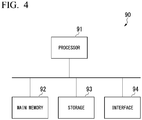
- FIG. 4 is a schematic block diagram which shows a configuration of a computer according to at least one embodiment.
- a computer 90 includes a processor 91, a main memory 92, a storage 93, and an interface 94.
- the operating index presenting device 100 described above is implemented in the computer 90. Then, the operation of each processing unit described above is stored in the storage 93 in the form of a program.
- the processor 91 reads a program from the storage 93 to expand it to the main memory 92, and executes the processing described above according to the program. Moreover, the processor 91 secures a storage area corresponding to each storage unit described above in the main memory 92 according to the program.
- the program may be for realizing a part of functions exerted by the computer 90.
- the program may exert the functions in combination with another program already stored in the storage 93, or in combination with another program implemented in another device.
- the computer 90 may include a custom large scale integrated circuit (LSI) such as a programmable logic device (PLD) in addition to or in place of the configuration described above.
- PLD programmable logic device
- Examples of the PLD include a programmable array logic (PAL), a generic array logic (GAL), a complex programmable logic device (CPLD), and a field programmable gate array (FPGA).
- PAL programmable array logic
- GAL generic array logic
- CPLD complex programmable logic device
- FPGA field programmable gate array
- Examples of the storage 93 include a magnetic disk, a magneto-optical disc, an optical disc, a semiconductor memory, and the like.
- the storage 93 may be an internal media directly connected to a bus of the computer 90, or may be an external media connected to the computer 90 via the interface 94 or a communication line.
- this program when this program is distributed to the computer 90 by the communication line, the computer 90 that has received this program may expand the program to the main memory 92 and execute the processing described above.
- the storage 93 is a non-temporary tangible storage medium.
- the program may be for realizing a part of the functions described above.
- the program may be a so-called difference file (a difference program) that realizes the functions described above in combination with another program already stored in the storage 93.
- a user can predict the future operation of a plant by recognizing information presented by the operating index presenting device.
Landscapes
- Engineering & Computer Science (AREA)
- Business, Economics & Management (AREA)
- Physics & Mathematics (AREA)
- Strategic Management (AREA)
- Human Resources & Organizations (AREA)
- General Physics & Mathematics (AREA)
- Economics (AREA)
- Entrepreneurship & Innovation (AREA)
- Development Economics (AREA)
- Finance (AREA)
- Marketing (AREA)
- General Business, Economics & Management (AREA)
- Theoretical Computer Science (AREA)
- Accounting & Taxation (AREA)
- Automation & Control Theory (AREA)
- Tourism & Hospitality (AREA)
- Game Theory and Decision Science (AREA)
- Health & Medical Sciences (AREA)
- Quality & Reliability (AREA)
- Manufacturing & Machinery (AREA)
- Evolutionary Computation (AREA)
- Artificial Intelligence (AREA)
- Mathematical Physics (AREA)
- Educational Administration (AREA)
- Primary Health Care (AREA)
- General Health & Medical Sciences (AREA)
- Water Supply & Treatment (AREA)
- Public Health (AREA)
- Operations Research (AREA)
- Data Mining & Analysis (AREA)
- General Engineering & Computer Science (AREA)
- Management, Administration, Business Operations System, And Electronic Commerce (AREA)
- General Factory Administration (AREA)
- Testing And Monitoring For Control Systems (AREA)
Applications Claiming Priority (2)
| Application Number | Priority Date | Filing Date | Title |
|---|---|---|---|
| JP2019033276A JP7233964B2 (ja) | 2019-02-26 | 2019-02-26 | 運転指標提示装置、運転指標提示方法、およびプログラム |
| PCT/JP2020/006258 WO2020175239A1 (fr) | 2019-02-26 | 2020-02-18 | Dispositif et procédé de présentation d'indice de fonctionnement, et programme |
Publications (2)
| Publication Number | Publication Date |
|---|---|
| EP3913452A1 true EP3913452A1 (fr) | 2021-11-24 |
| EP3913452A4 EP3913452A4 (fr) | 2022-03-16 |
Family
ID=72239902
Family Applications (1)
| Application Number | Title | Priority Date | Filing Date |
|---|---|---|---|
| EP20763762.0A Withdrawn EP3913452A4 (fr) | 2019-02-26 | 2020-02-18 | Dispositif et procédé de présentation d'indice de fonctionnement, et programme |
Country Status (5)
| Country | Link |
|---|---|
| US (1) | US20220138654A1 (fr) |
| EP (1) | EP3913452A4 (fr) |
| JP (1) | JP7233964B2 (fr) |
| TW (1) | TWI757691B (fr) |
| WO (1) | WO2020175239A1 (fr) |
Cited By (2)
| Publication number | Priority date | Publication date | Assignee | Title |
|---|---|---|---|---|
| EP4254283A1 (fr) * | 2022-03-30 | 2023-10-04 | Yokogawa Electric Corporation | Système d'installation, procédé de commande d'installation et programme de commande d'installation |
| EP4451076A4 (fr) * | 2022-01-24 | 2025-02-26 | NTT Communications Corporation | Dispositif, procédé et programme d'aide à la production |
Families Citing this family (5)
| Publication number | Priority date | Publication date | Assignee | Title |
|---|---|---|---|---|
| JP7487704B2 (ja) * | 2021-04-28 | 2024-05-21 | 横河電機株式会社 | 評価装置、評価方法、評価プログラム、制御装置、および、制御プログラム |
| JP7081728B1 (ja) | 2022-01-20 | 2022-06-07 | 富士電機株式会社 | 運転支援装置、運転支援方法及びプログラム |
| JP7384265B1 (ja) * | 2022-12-01 | 2023-11-21 | 富士電機株式会社 | 運転支援装置、運転支援方法及びプログラム |
| JP7761018B2 (ja) * | 2023-03-14 | 2025-10-28 | 横河電機株式会社 | 情報処理装置、生産計画作成方法及び生産計画作成プログラム |
| CN118642453B (zh) * | 2024-08-16 | 2024-10-18 | 武威恒大牧业服务有限公司 | 一种饲料生产线智能调度控制方法、系统、设备及介质 |
Family Cites Families (37)
| Publication number | Priority date | Publication date | Assignee | Title |
|---|---|---|---|---|
| JP4496587B2 (ja) * | 2000-01-26 | 2010-07-07 | 株式会社Ihi | コジェネプラントの運転方法及びその装置 |
| JP3994910B2 (ja) * | 2003-05-08 | 2007-10-24 | 株式会社日立製作所 | 電力売買支援システム |
| JP4340104B2 (ja) | 2003-08-07 | 2009-10-07 | 新日本製鐵株式会社 | 鉄鋼生産工場の操業最適化方法 |
| GB2464625A (en) * | 2006-10-13 | 2010-04-28 | Responsiveload Ltd | Optimisation of use or provision of a resource or service |
| US8872379B2 (en) * | 2007-11-30 | 2014-10-28 | Johnson Controls Technology Company | Efficient usage, storage, and sharing of energy in buildings, vehicles, and equipment |
| US8260469B2 (en) * | 2008-11-04 | 2012-09-04 | Green Energy Corporation | Distributed hybrid renewable energy power plant and methods, systems, and comptuer readable media for controlling a distributed hybrid renewable energy power plant |
| WO2010083334A1 (fr) * | 2009-01-14 | 2010-07-22 | Integral Analytics, Inc. | Optimisation de l'utilisation et de la distribution de l'énergie dans des microréseaux |
| JP2011013954A (ja) * | 2009-07-02 | 2011-01-20 | Yokogawa Electric Corp | プラント最適運転計画装置 |
| US20110231320A1 (en) * | 2009-12-22 | 2011-09-22 | Irving Gary W | Energy management systems and methods |
| US8617920B2 (en) | 2010-02-12 | 2013-12-31 | Semiconductor Energy Laboratory Co., Ltd. | Semiconductor device and manufacturing method thereof |
| WO2011105070A1 (fr) * | 2010-02-25 | 2011-09-01 | パナソニック株式会社 | Appareil et procédé de régulation par l'offre et la demande, et programme associé |
| US8880202B2 (en) * | 2010-07-09 | 2014-11-04 | Emerson Process Management Power & Water Solutions, Inc. | Optimization system using an iteratively coupled expert engine |
| JP2012034444A (ja) * | 2010-07-28 | 2012-02-16 | Toshiba Corp | 電力需給計画装置及びその方法 |
| WO2012154182A1 (fr) * | 2011-05-12 | 2012-11-15 | Air Products And Chemicals, Inc. | Procédés permettant d'améliorer la production et la distribution |
| CN103650285B (zh) * | 2011-05-24 | 2017-02-15 | D·凯文·卡梅伦 | 一种整合和管理替代能源、电网功率以及负载之间需求/响应的系统和方法 |
| US9588506B1 (en) * | 2011-10-10 | 2017-03-07 | Autani, Llc | Automation devices, systems, architectures, and methods for energy management and other applications |
| WO2014030930A2 (fr) * | 2012-08-21 | 2014-02-27 | 대우정보시스템 주식회사 | Procédé de gestion d'énergie par modélisation d'objet de gestion d'énergie |
| JP5998081B2 (ja) * | 2013-03-08 | 2016-09-28 | 株式会社日立製作所 | 電力需要調整システム及び需要調整実行システム |
| WO2014141435A1 (fr) * | 2013-03-14 | 2014-09-18 | 株式会社日立製作所 | Système d'ajustement de plan opérationnel et procédé d'ajustement de plan opérationnel |
| US10566792B2 (en) * | 2013-06-12 | 2020-02-18 | Applied Hybrid Energy Pty Ltd | Electrical power control method and system |
| US9564757B2 (en) * | 2013-07-08 | 2017-02-07 | Eaton Corporation | Method and apparatus for optimizing a hybrid power system with respect to long-term characteristics by online optimization, and real-time forecasts, prediction or processing |
| US9404426B2 (en) * | 2013-12-31 | 2016-08-02 | General Electric Company | Methods and systems for enhancing control of power plant generating units |
| JP6067865B2 (ja) * | 2014-04-01 | 2017-01-25 | 株式会社東芝 | 監視装置、制御装置及び制御システム |
| US10088184B2 (en) * | 2014-04-11 | 2018-10-02 | Nec Corporation | Environment control system |
| CN104950720B (zh) * | 2015-06-16 | 2018-07-20 | 天津大学 | 基于气象预报将需求响应和舒适度反馈结合的供能系统 |
| US20170091615A1 (en) * | 2015-09-28 | 2017-03-30 | Siemens Aktiengesellschaft | System and method for predicting power plant operational parameters utilizing artificial neural network deep learning methodologies |
| US10241528B1 (en) * | 2015-12-01 | 2019-03-26 | Energyhub, Inc. | Demand response technology utilizing a simulation engine to perform thermostat-based demand response simulations |
| CN105375479B (zh) * | 2015-12-14 | 2017-11-17 | 东南大学 | 一种基于模型预测控制的分布式能源能量管理方法 |
| CN105574680A (zh) * | 2015-12-27 | 2016-05-11 | 乌鲁木齐三力元生产力促进中心有限公司 | 一种企业竞争能力诊断的方法及系统 |
| JP7015108B2 (ja) * | 2016-12-07 | 2022-02-02 | 三菱重工業株式会社 | 運用支援装置、機器運用システム、運用方法、制御方法及びプログラム |
| JP6685949B2 (ja) * | 2017-02-10 | 2020-04-22 | 株式会社東芝 | 運転計画作成装置、運転計画作成方法およびプログラム |
| CN108009667A (zh) * | 2017-07-19 | 2018-05-08 | 国家电网公司西南分部 | 一种能源需求总量及结构预测系统 |
| US20190086106A1 (en) * | 2017-09-18 | 2019-03-21 | Ecofactor, Inc. | Systems and methods for fan delay-based variable thermostat settings |
| US20190086882A1 (en) * | 2017-09-18 | 2019-03-21 | Ecofactor, Inc. | Message-based demand response systems and methods |
| US10459412B2 (en) * | 2017-09-27 | 2019-10-29 | Ademco Inc. | Convergence structure for control and data analytics systems |
| EP3703221A4 (fr) * | 2017-10-23 | 2021-06-16 | Sumitomo Electric Industries, Ltd. | Dispositif de gestion d'énergie, système de gestion d'énergie, et procédé de gestion d'énergie |
| US11361392B2 (en) * | 2018-11-01 | 2022-06-14 | Battelle Memorial Institute | Flexible allocation of energy storage in power grids |
-
2019
- 2019-02-26 JP JP2019033276A patent/JP7233964B2/ja active Active
-
2020
- 2020-02-17 TW TW109104960A patent/TWI757691B/zh active
- 2020-02-18 US US17/431,454 patent/US20220138654A1/en not_active Abandoned
- 2020-02-18 WO PCT/JP2020/006258 patent/WO2020175239A1/fr not_active Ceased
- 2020-02-18 EP EP20763762.0A patent/EP3913452A4/fr not_active Withdrawn
Cited By (2)
| Publication number | Priority date | Publication date | Assignee | Title |
|---|---|---|---|---|
| EP4451076A4 (fr) * | 2022-01-24 | 2025-02-26 | NTT Communications Corporation | Dispositif, procédé et programme d'aide à la production |
| EP4254283A1 (fr) * | 2022-03-30 | 2023-10-04 | Yokogawa Electric Corporation | Système d'installation, procédé de commande d'installation et programme de commande d'installation |
Also Published As
| Publication number | Publication date |
|---|---|
| TWI757691B (zh) | 2022-03-11 |
| JP2020140253A (ja) | 2020-09-03 |
| US20220138654A1 (en) | 2022-05-05 |
| TW202102958A (zh) | 2021-01-16 |
| JP7233964B2 (ja) | 2023-03-07 |
| EP3913452A4 (fr) | 2022-03-16 |
| WO2020175239A1 (fr) | 2020-09-03 |
Similar Documents
| Publication | Publication Date | Title |
|---|---|---|
| EP3913452A1 (fr) | Dispositif et procédé de présentation d'indice de fonctionnement, et programme | |
| Urbanucci et al. | Optimal integrated sizing and operation of a CHP system with Monte Carlo risk analysis for long-term uncertainty in energy demands | |
| Liu et al. | Automated control of transactive HVACs in energy distribution systems | |
| Chassin et al. | GridLAB‐D: an agent‐based simulation framework for smart grids | |
| US9926852B2 (en) | Methods and systems for enhancing control of power plant generating units | |
| US9957843B2 (en) | Methods and systems for enhancing control of power plant generating units | |
| US9960598B2 (en) | Methods and systems for enhancing control of power plant generating units | |
| Pinto et al. | Strategic bidding in electricity markets: An agent-based simulator with game theory for scenario analysis | |
| US20160147204A1 (en) | Methods and systems for enhancing control of power plant generating units | |
| GB2534981A (en) | Methods and systems for enhancing control of power plant generating units | |
| JP7099805B2 (ja) | 予測装置、予測システム、予測方法及びプログラム | |
| US11461727B2 (en) | Plant evaluation system, plant evaluation method, and program | |
| Taccari et al. | Short-term planning of cogeneration power plants: a comparison between MINLP and piecewise-linear MILP formulations | |
| KR20260008704A (ko) | 재생에너지 변동성을 고려한 전력 계통 안정도 해석 방법 | |
| Habibi et al. | Stochastic energy management of a microgrid incorporating two-point estimation method, mobile storage, and fuzzy multi-objective enhanced grey wolf optimizer | |
| US11966989B2 (en) | Robust and fast design of microgrids, der systems, and other energy systems using staged hybrid investment planning | |
| JP2020115276A (ja) | 情報処理方法、情報処理装置、プログラム及び学習済みモデルの生成方法 | |
| JP2009213328A (ja) | 電力系統シミュレータにおける負荷曲線モデルの生成方法 | |
| JP2022169825A (ja) | 評価装置、評価方法、評価プログラム、制御装置、および、制御プログラム | |
| Gardner et al. | Planning electric power systems under demand uncertainty with different technology lead times | |
| JP7828763B2 (ja) | プログラム、電力需要予測方法、及び情報処理装置 | |
| JP2017028816A (ja) | 計画策定装置、計画策定方法、及びプログラム | |
| KR20250003161A (ko) | 디지털 트윈 기반의 발전소 운영 적합성 평가 시스템, 그 방법 및 이를 기록한 컴퓨터 기록 매체 | |
| Chen et al. | High‐Precision Modeling and Optimization of Cogeneration Plants | |
| Günther et al. | Evaluation of long-term scenarios for power generation and district heating at Stadtwerke München |
Legal Events
| Date | Code | Title | Description |
|---|---|---|---|
| STAA | Information on the status of an ep patent application or granted ep patent |
Free format text: STATUS: THE INTERNATIONAL PUBLICATION HAS BEEN MADE |
|
| PUAI | Public reference made under article 153(3) epc to a published international application that has entered the european phase |
Free format text: ORIGINAL CODE: 0009012 |
|
| STAA | Information on the status of an ep patent application or granted ep patent |
Free format text: STATUS: REQUEST FOR EXAMINATION WAS MADE |
|
| 17P | Request for examination filed |
Effective date: 20210820 |
|
| AK | Designated contracting states |
Kind code of ref document: A1 Designated state(s): AL AT BE BG CH CY CZ DE DK EE ES FI FR GB GR HR HU IE IS IT LI LT LU LV MC MK MT NL NO PL PT RO RS SE SI SK SM TR |
|
| A4 | Supplementary search report drawn up and despatched |
Effective date: 20220216 |
|
| RIC1 | Information provided on ipc code assigned before grant |
Ipc: G05B 19/418 20060101ALI20220210BHEP Ipc: G05B 23/02 20060101AFI20220210BHEP |
|
| DAV | Request for validation of the european patent (deleted) | ||
| DAX | Request for extension of the european patent (deleted) | ||
| STAA | Information on the status of an ep patent application or granted ep patent |
Free format text: STATUS: EXAMINATION IS IN PROGRESS |
|
| 17Q | First examination report despatched |
Effective date: 20240227 |
|
| STAA | Information on the status of an ep patent application or granted ep patent |
Free format text: STATUS: THE APPLICATION HAS BEEN WITHDRAWN |
|
| 18W | Application withdrawn |
Effective date: 20240604 |