EP3914577B1 - Procédé de préparation de 1,2 alcanediols sous une forme galénique solide - Google Patents
Procédé de préparation de 1,2 alcanediols sous une forme galénique solide Download PDFInfo
- Publication number
- EP3914577B1 EP3914577B1 EP19702364.1A EP19702364A EP3914577B1 EP 3914577 B1 EP3914577 B1 EP 3914577B1 EP 19702364 A EP19702364 A EP 19702364A EP 3914577 B1 EP3914577 B1 EP 3914577B1
- Authority
- EP
- European Patent Office
- Prior art keywords
- melt
- cooled
- alkanediol
- process according
- alkanediols
- Prior art date
- Legal status (The legal status is an assumption and is not a legal conclusion. Google has not performed a legal analysis and makes no representation as to the accuracy of the status listed.)
- Active
Links
Images



Classifications
-
- C—CHEMISTRY; METALLURGY
- C07—ORGANIC CHEMISTRY
- C07C—ACYCLIC OR CARBOCYCLIC COMPOUNDS
- C07C29/00—Preparation of compounds having hydroxy or O-metal groups bound to a carbon atom not belonging to a six-membered aromatic ring
- C07C29/74—Separation; Purification; Use of additives, e.g. for stabilisation
- C07C29/76—Separation; Purification; Use of additives, e.g. for stabilisation by physical treatment
- C07C29/78—Separation; Purification; Use of additives, e.g. for stabilisation by physical treatment by condensation or crystallisation
-
- C—CHEMISTRY; METALLURGY
- C07—ORGANIC CHEMISTRY
- C07C—ACYCLIC OR CARBOCYCLIC COMPOUNDS
- C07C31/00—Saturated compounds having hydroxy or O-metal groups bound to acyclic carbon atoms
- C07C31/18—Polyhydroxylic acyclic alcohols
- C07C31/20—Dihydroxylic alcohols
-
- C—CHEMISTRY; METALLURGY
- C07—ORGANIC CHEMISTRY
- C07B—GENERAL METHODS OF ORGANIC CHEMISTRY; APPARATUS THEREFOR
- C07B2200/00—Indexing scheme relating to specific properties of organic compounds
- C07B2200/13—Crystalline forms, e.g. polymorphs
Definitions
- the invention is in the field of pastillation technology and relates to an improved process for the production of 1,2-alkanediols in solid dosage form.
- 1,2-alkanediols have been increasingly used as emulsion-forming ingredients in a wide variety of applications - the applications range from personal care products to technical applications in the field of printing inks.
- the solidification process of the materials usually takes place under volume effects - ie the volume of the material expands, whereby the solid material has a rough, uneven surface. From a production point of view, this material property is problematic because filling containers can only be closed after solidification has taken place in order to avoid deformation of the packaging. In order to reduce or avoid delays in the material flow, fast-solidifying melts are desirable.
- the use or dosing of solids for the preparation of application mixtures usually involves a great deal of technical and logistical effort.
- the solids must be melted in the delivery containers (typically up to 180 kg in steel drums) and then dosed into the mixture as a liquid.
- the melting process must take place under an inert gas atmosphere, since product damage cannot be ruled out when exposed to atmospheric oxygen at elevated temperatures. Such a melting process can take up to several hours or even days, depending on the user's technical capabilities. Short-term production planning is therefore only possible to a limited extent.
- an inert gas atmosphere must also be guaranteed for the cooling process in order to prevent product damage. This is particularly important if only small amounts of alkanediols are used for a mixture and the storage containers have to be heated up/cooled down frequently.
- WO 2016/016154 A1 is a process for the production of solid cooling agents in which a pre-scraped melt of menthol compounds is applied to a pre-cooled surface by uniform dropletization.
- WO2008046796 A2 describes C10-C14-alkane-1,2-diols for cosmetic or dermatological applications.
- JP4855217 B2 concerns the preparation of an easily handleable 1,2-octanediol formulation for cosmetic use.
- the solid of 1,2-alkanediols obtained by direct solidification/dropping is of only limited practical use. Accordingly, there is a need for alternative manufacturing processes for solid dosage forms.
- the object of the present invention was therefore to provide an improved process for producing solid dosage forms of 1,2-alkanediols which is free from the disadvantages described above.
- the process should be characterized by the fact that the pastilles have a very low fine dust content, have a surface that is as smooth as possible even after long storage and show no tendency to clump.
- the pastilles obtained in this way have a smooth to slightly rough surface, even after long storage.
- 1,2-alkanediols are used which have 8 to 14 carbon atoms.
- at least one 1,2-alkanediol and preferably at least two alkanediols are used which are selected from the group consisting of 1,2-octanediol, 1,2-decanediol, 1,2-dodecanediol and 1,2-tetradecanediol.
- 1,2-alkanediols of technical quality are used which have a 1,2-alkanediol content of at least 92% by weight, preferably at least 95% by weight and in particular at least 98% by weight.
- shorter-chain homologues in particular 1,2-pentaniol and/or 1,2-hexanediol
- 1,2-hexanediol 1,2-hexanediol
- the process according to the invention is characterized in particular by the fact that 1,2-alkanediols with a smooth or almost smooth surface are prepared.
- the 1,2-alkanediols are melted, i.e. heated to about 60 to about 80 °C depending on the chain length.
- the melts obtained in this way are then cooled while stirring. This can be done, for example, in a mixing vessel with jacket cooling using a paddle stirrer.
- a supercooled (“pre-scratched") melt is obtained at about 40 to 65 °C - again depending on the chain length - in which seed crystals form.
- the cooling process is continued until the seed crystal content is at least 1% by weight and preferably at least 5% by weight.
- seed crystals can also be added from the outside.
- a further limiting factor is the viscosity, which is determined by the torque of the stirrer and should preferably be in the range of about 5 to about 15 Ncm and in particular about 8 to about 12 Ncm.
- the pre-scraped melt Once the pre-scraped melt has reached the required viscosity, it is dripped onto a cooled surface, for example, where uniform and regular pastilles are formed. After a rest period, which can be carried out at ambient temperature and last for about 1 to about 5 minutes, the pastilles can be removed from the cooled surface, for example with a scraper.
- the pre-scraped melt can also be solidified between two cooled surfaces, which can preferably be a few centimeters to a few millimeters apart. This produces solid masses, but not pastilles.
- the temperature of the cooled surfaces can be in the range of about 15 to about 22 °C and preferably between 18 and 20 °C.
- the solid 1,2-alkanediols obtainable by the process according to the invention can, for example, be packed in bags and stored for practically any length of time without clumping or abrasion and the formation of fine dust.
- the pastilles can be used for a variety of purposes, for example as components of cosmetic or pharmaceutical preparations.
- a melt (60°C) of 1,2-decanediol (98%) was gradually cooled at a constant stirring speed (50 rpm).
- the torque applied by the stirrer was recorded as a measure of the viscosity of the melt.
- seed crystals can be added at this point as a starting aid to accelerate the formation of the crystal bed.
- the temperature of the dross was cooled further by 0.2°C/h, whereby an increase in the amount of crystals could be observed.
- drops were added to a steel surface cooled to 18-20°C using a pipette. The time until the pastilles solidified was determined.
- the pastilles obtained in this way were removed from the metal surface using a scraper and the consistency of the pastilles was checked. The pastilles had completely solidified at this point.
- a slurry produced according to the above method with a temperature of 42.2°C (9.5 Ncm) was placed between two evenly spaced, cooled metal surfaces (18°C, distance 2-5 mm). After a contact time of 1 minute, the upper surface was removed and the resulting solid was broken into flakes using a spatula. After removing fine particles, the material was used directly for storage tests. After a storage time of 4 weeks, the storage vessel was checked for clumping and fine particles. The stored flakes were easy to separate and had a low fine particle content (due to mechanical stress during filling).
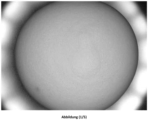
- Figure 3 shows a pastille according to example 3.
- a melt (80°C) of 1,2-tetradecanediol (97%) was gradually cooled at a constant stirring speed (50 rpm).
- the torque applied by the stirrer was recorded as a measure of the viscosity of the melt.
- seed crystals can be added at this point as a starting aid to accelerate the formation of the crystal bed.
- the temperature of the dross was cooled further by 0.2°C/h, whereby an increase in the amount of crystals could be observed.
- drops were added to a steel surface cooled to 18-20°C using a pipette. The time until the pastilles solidified was determined.
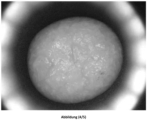
- Figure 5 shows a pastille according to example 4.
Landscapes
- Chemical & Material Sciences (AREA)
- Organic Chemistry (AREA)
- Crystallography & Structural Chemistry (AREA)
- Organic Low-Molecular-Weight Compounds And Preparation Thereof (AREA)
Claims (14)
- Procédé de préparation de 1,2-alcanediols sous forme de dosage solide, comprenant ou consistant dans les étapes suivantes :(a) fournir un fondu d'au moins un 1,2-alcanediol ;(b) refroidissement de la matière fondue de l'étape (a) à une température inférieure au point de fusion du 1,2-alcanediol ou du mélange de 1,2-alcanediol afin d'obtenir une matière fondue pré-grattée constituée d'un 1,2-alcanediol surfondu ou d'un mélange de 1,2-alcanediol surfondu contenant des cristaux de semences de 1,2-alcanediol ;(c) mise en contact du mélange de l'étape b) avec une surface refroidie pour obtenir des 1,2-alcanediols ou des mélanges de 1,2-alcanediols sous forme cristalline,à condition d'utiliser des 1,2-alcanediols ayant de 8 à 14 atomes de carbone.
- Le procédé selon 1, caractérisé par l'utilisation d'au moins un 1,2-alcanediol et de préférence d'au moins deux alcanediols choisis dans le groupe formé par le 1,2-octanediol, le 1,2-décanediol, le 1,2-dodécanediol et le 1,2-tétradécanediol.
- Le procédé selon l'une au moins des revendications 1 et/ou 2, caractérisé par l'utilisation de 1,2-alcanediols de qualité technique dont la teneur en 1,2-alcanediol est d'au moins 92% en poids, de préférence d'au moins 95% en poids.
- Le procédé selon l'une au moins des revendications 1 à 3, caractérisé par la production de 1,2-alcanediols à surface lisse ou à peu près lisse.
- Le procédé selon l'une au moins des revendications 1 à 4, caractérisé par le fait que les produits fondus sont refroidis sous agitation.
- Le procédé selon l'une au moins des revendications 1 à 5, caractérisé par le fait que les matières fondues sont refroidies jusqu'à ce que la proportion de cristaux de semences dans la matière fondue pré-grattée soit d'au moins 1 % en poids.
- Le procédé selon l'une au moins des revendications 1 à 6, caractérisé en ce que des cristaux de semence supplémentaires sont ajoutés à la masse fondue pré-grattée.
- Le procédé selon l'une au moins des revendications 1 à 7, caractérisé par le fait que la matière fondue pré-grattée est refroidie jusqu'à ce qu'elle présente un couple ou une viscosité compris entre environ 5 et environ 15 Ncm lors de l'agitation.
- Le procédé selon l'une au moins des revendications 1 à 8, caractérisé par le fait que les matières fondues pré-grattées sont égouttées sur une surface refroidie.
- Le procédé selon l'une au moins des revendications 1 à 8, caractérisé par le fait que les matières fondues pré-grattées sont solidifiées entre deux surfaces refroidies.
- Le procédé selon l'une au moins des revendications 1 à 10, caractérisé par le fait que les surfaces refroidies ont une température comprise entre 15 et 22°C environ.
- 1,2-décanediol sous forme pastillée, obtenu par(a) en faisant fondre le 1,2-décanediol à environ 60 °C,(b) refroidir la masse fondue de l'étape (a) par étapes jusqu'à environ 40 à 43 °C en agitant jusqu'à ce que la masse fondue précipite des cristaux de semences et atteigne un couple ou une viscosité d'environ 8 à environ 12 Ncm,(c) égoutter la matière fondue pré-grattée de l'étape (b) sur une surface pré-refroidie dont la température est comprise entre 18 et 20 °C environ, et(d) retirer les pastilles ainsi obtenues de la surface pré-réfrigéré après un temps de solidification d'environ 1 à 5 minutes.
- 1,2-dodécanediol sous forme de pastilles, obtenu par(a) en faisant fondre le 1,2-dodécanediol à environ 60 °C,(b) refroidir la masse fondue obtenue à l'étape (a) par étapes jusqu'à environ 50 à 52 °C en agitant jusqu'à ce que la masse fondue précipite des cristaux de semences et atteigne un moment de rotation ou une viscosité d'environ 8 à environ 12 Ncm,(c) égoutter la matière fondue pré-grattée de l'étape (b) sur une surface pré-réfrigéré dont la température est comprise entre 18 et 20 °C environ, et(d) retirer les pastilles ainsi obtenues de la surface pré-réfrigéré après un temps de solidification d'environ 1 à 5 minutes.
- 1,2-tetradécanediol sous forme de pastilles, obtenu par(a) en faisant fondre le 1,2-tetradécanediol à environ 80 °C,(b) refroidir la masse fondue obtenue à l'étape (a) par étapes jusqu'à environ 61 à 63 °C en agitant jusqu'à ce que la masse fondue précipite des cristaux de semences et atteigne un moment de rotation ou une viscosité d'environ 8 à environ 12 Ncm,(c) égoutter la matière fondue pré-grattée de l'étape (b) sur une surface pré-réfrigéré dont la température est comprise entre 18 et 20 °C environ, et(d) retirer les pastilles ainsi obtenues de la surface pré-réfrigéré après un temps de solidification d'environ 1 à 5 minutes.
Applications Claiming Priority (1)
| Application Number | Priority Date | Filing Date | Title |
|---|---|---|---|
| PCT/EP2019/051575 WO2020151812A1 (fr) | 2019-01-23 | 2019-01-23 | Procédé de préparation de 1,2 alcanediols sous une forme galénique solide |
Publications (3)
| Publication Number | Publication Date |
|---|---|
| EP3914577A1 EP3914577A1 (fr) | 2021-12-01 |
| EP3914577C0 EP3914577C0 (fr) | 2024-09-25 |
| EP3914577B1 true EP3914577B1 (fr) | 2024-09-25 |
Family
ID=65243530
Family Applications (1)
| Application Number | Title | Priority Date | Filing Date |
|---|---|---|---|
| EP19702364.1A Active EP3914577B1 (fr) | 2019-01-23 | 2019-01-23 | Procédé de préparation de 1,2 alcanediols sous une forme galénique solide |
Country Status (4)
| Country | Link |
|---|---|
| US (1) | US20220064089A1 (fr) |
| EP (1) | EP3914577B1 (fr) |
| CN (1) | CN113518773B (fr) |
| WO (1) | WO2020151812A1 (fr) |
Citations (2)
| Publication number | Priority date | Publication date | Assignee | Title |
|---|---|---|---|---|
| US3632657A (en) * | 1967-06-22 | 1972-01-04 | Dow Chemical Co | Crystalline propylene glycol |
| EP1876162B1 (fr) * | 2005-04-28 | 2012-02-22 | Adeka Corporation | Composition d'alcanediol, son procede de fabrication, et produit cosmetique |
Family Cites Families (4)
| Publication number | Priority date | Publication date | Assignee | Title |
|---|---|---|---|---|
| EP1923041A1 (fr) * | 2006-10-20 | 2008-05-21 | Symrise GmbH & Co. KG | Utilisation des C10-C14 alcane-diols pour la préparation d'une composition pour la prophylaxe et/ou le traitement des pellicules induites par Malassezia, ainsi que des compositions comprenant des C10-C14 alcane-diols |
| WO2008046796A2 (fr) * | 2006-10-20 | 2008-04-24 | Symrise Gmbh & Co. Kg | Utilisation de c10-c14-alcane-1,2-diols pour l'élaboration d'une composition destinée à la prophylaxie et/ou le traitement d'infections à dermatophytes |
| JP4855217B2 (ja) * | 2006-11-06 | 2012-01-18 | 株式会社Adeka | 1,2−オクタンジオール組成物及びそれを用いた1,2−オクタンジオール含有化粧料の製造方法 |
| EP2979751B1 (fr) * | 2014-07-29 | 2020-10-28 | Symrise AG | Procédé pour la préparation des agents réfrigérée solides |
-
2019
- 2019-01-23 EP EP19702364.1A patent/EP3914577B1/fr active Active
- 2019-01-23 WO PCT/EP2019/051575 patent/WO2020151812A1/fr not_active Ceased
- 2019-01-23 CN CN201980089513.5A patent/CN113518773B/zh active Active
- 2019-01-23 US US17/422,947 patent/US20220064089A1/en not_active Abandoned
Patent Citations (2)
| Publication number | Priority date | Publication date | Assignee | Title |
|---|---|---|---|---|
| US3632657A (en) * | 1967-06-22 | 1972-01-04 | Dow Chemical Co | Crystalline propylene glycol |
| EP1876162B1 (fr) * | 2005-04-28 | 2012-02-22 | Adeka Corporation | Composition d'alcanediol, son procede de fabrication, et produit cosmetique |
Also Published As
| Publication number | Publication date |
|---|---|
| BR112021014256A2 (pt) | 2021-09-28 |
| WO2020151812A1 (fr) | 2020-07-30 |
| CN113518773A (zh) | 2021-10-19 |
| CN113518773B (zh) | 2024-04-23 |
| EP3914577C0 (fr) | 2024-09-25 |
| US20220064089A1 (en) | 2022-03-03 |
| EP3914577A1 (fr) | 2021-12-01 |
Similar Documents
| Publication | Publication Date | Title |
|---|---|---|
| EP2155660B1 (fr) | Procédé de cristallisation de l'ester N-hexylique de l'acide 2-(4-N,N-diéthylamino-2-hydroxybenzoyl)-benzoïque | |
| EP2155638B1 (fr) | Flocons de menthol et procédé de fabrication de ceux-ci | |
| EP2979751B1 (fr) | Procédé pour la préparation des agents réfrigérée solides | |
| DE60218994T2 (de) | Verfahren zur herstellung von hochreinen kaliumfluorotantalat- oder kaliumfluoroniobatkristallen und umkristallisationsgefäss zur verwendung in diesem verfahren und nach diesem verfahren hergestellte hochreine kaliumfluorotantalat- oder kaliumfluroniobatkristalle | |
| DE2623682B2 (de) | Verfahren zur Herstellung einer Sorbinsäure als feine Teilchen in hoher Konzentration enthaltenden wäßrigen Dispersion | |
| DE69503901T2 (de) | Verfahren zur herstellung von perlen welche einen aktiven bestandteil aufweisen mit einem nicht definierten schmelzpunkt | |
| DE10123073A1 (de) | Verfahren zur Herstellung von Kristallen aus in einem Lösungsmittel gelösten Feststoffen | |
| EP3837233B1 (fr) | Procédé de production de particules de menthol stabilisées contre l'agglomération et particules de menthol stable au stockage et leur utilisation | |
| EP0915817B1 (fr) | Procede pour produire du d-sorbitol cristallin | |
| EP2314170A1 (fr) | Procédé de production de germes stables en stockage en beurre de cacao ou masses de chocolat | |
| DE3888276T2 (de) | Lagerstabile Triglyceride und Verfahren zu deren Stabilisierung. | |
| EP3914577A1 (fr) | Procédé de préparation de 1,2 alcanediols sous une forme galénique solide | |
| DE19637380C1 (de) | Verfahren zur Herstellung von Hydroxipivalinsäureneopentylglykolester-Granulaten | |
| EP3059009B1 (fr) | Procédé pour le stockage d'agents rafraîchissants | |
| EP2822896B1 (fr) | Procédé de production et de transformation d'une matière pâteuse à base de sio2 et utilisation de cette matière | |
| DE69623812T2 (de) | Mikrokristalline zucker oder zuckeralkohle;verfahren zur herstellung derselben | |
| WO2002002543A1 (fr) | Procede de production de granules de phenothiazine a proprietes ameliorees | |
| EP2058049B1 (fr) | Procédé de fabrication d'additifs pouvant couler | |
| WO2025168596A1 (fr) | Procédé de production de solides | |
| DE202018005859U1 (de) | Neue Prills von Hydrochinon | |
| EP2754353B1 (fr) | Composition de boisson instantanée, son procédé de fabrication et son utilisation | |
| DE1926938A1 (de) | Verfahren zur Herstellung von pulverfoermigen,frei fliessenden Backmitteln | |
| DE2215590C3 (de) | Verfahren zur Herstellung von aus gesonderten Teilchen bestehenden und weniger als 1,5-Gew.-Prozent adsorptiv gebundene Feuchtigkeit enthaltenden trockenen festen anorganischen und organischen Verbindungen und/oder Verbindungsgemischen | |
| DE202013001163U1 (de) | Instant-Getränkezusammensetzung | |
| DE19834876A1 (de) | Verfahren zur Herstellung sphärischer Teilchen bei der Kristallisation |
Legal Events
| Date | Code | Title | Description |
|---|---|---|---|
| STAA | Information on the status of an ep patent application or granted ep patent |
Free format text: STATUS: UNKNOWN |
|
| STAA | Information on the status of an ep patent application or granted ep patent |
Free format text: STATUS: THE INTERNATIONAL PUBLICATION HAS BEEN MADE |
|
| PUAI | Public reference made under article 153(3) epc to a published international application that has entered the european phase |
Free format text: ORIGINAL CODE: 0009012 |
|
| STAA | Information on the status of an ep patent application or granted ep patent |
Free format text: STATUS: REQUEST FOR EXAMINATION WAS MADE |
|
| 17P | Request for examination filed |
Effective date: 20210709 |
|
| AK | Designated contracting states |
Kind code of ref document: A1 Designated state(s): AL AT BE BG CH CY CZ DE DK EE ES FI FR GB GR HR HU IE IS IT LI LT LU LV MC MK MT NL NO PL PT RO RS SE SI SK SM TR |
|
| DAV | Request for validation of the european patent (deleted) | ||
| DAX | Request for extension of the european patent (deleted) | ||
| GRAP | Despatch of communication of intention to grant a patent |
Free format text: ORIGINAL CODE: EPIDOSNIGR1 |
|
| STAA | Information on the status of an ep patent application or granted ep patent |
Free format text: STATUS: GRANT OF PATENT IS INTENDED |
|
| INTG | Intention to grant announced |
Effective date: 20240429 |
|
| GRAS | Grant fee paid |
Free format text: ORIGINAL CODE: EPIDOSNIGR3 |
|
| GRAA | (expected) grant |
Free format text: ORIGINAL CODE: 0009210 |
|
| STAA | Information on the status of an ep patent application or granted ep patent |
Free format text: STATUS: THE PATENT HAS BEEN GRANTED |
|
| AK | Designated contracting states |
Kind code of ref document: B1 Designated state(s): AL AT BE BG CH CY CZ DE DK EE ES FI FR GB GR HR HU IE IS IT LI LT LU LV MC MK MT NL NO PL PT RO RS SE SI SK SM TR |
|
| REG | Reference to a national code |
Ref country code: GB Ref legal event code: FG4D Free format text: NOT ENGLISH |
|
| REG | Reference to a national code |
Ref country code: CH Ref legal event code: EP |
|
| REG | Reference to a national code |
Ref country code: DE Ref legal event code: R096 Ref document number: 502019012179 Country of ref document: DE |
|
| REG | Reference to a national code |
Ref country code: IE Ref legal event code: FG4D Free format text: LANGUAGE OF EP DOCUMENT: GERMAN |
|
| U01 | Request for unitary effect filed |
Effective date: 20240930 |
|
| U07 | Unitary effect registered |
Designated state(s): AT BE BG DE DK EE FI FR IT LT LU LV MT NL PT RO SE SI Effective date: 20241023 |
|
| PG25 | Lapsed in a contracting state [announced via postgrant information from national office to epo] |
Ref country code: NO Free format text: LAPSE BECAUSE OF FAILURE TO SUBMIT A TRANSLATION OF THE DESCRIPTION OR TO PAY THE FEE WITHIN THE PRESCRIBED TIME-LIMIT Effective date: 20241225 |
|
| PG25 | Lapsed in a contracting state [announced via postgrant information from national office to epo] |
Ref country code: GR Free format text: LAPSE BECAUSE OF FAILURE TO SUBMIT A TRANSLATION OF THE DESCRIPTION OR TO PAY THE FEE WITHIN THE PRESCRIBED TIME-LIMIT Effective date: 20241226 |
|
| PG25 | Lapsed in a contracting state [announced via postgrant information from national office to epo] |
Ref country code: RS Free format text: LAPSE BECAUSE OF FAILURE TO SUBMIT A TRANSLATION OF THE DESCRIPTION OR TO PAY THE FEE WITHIN THE PRESCRIBED TIME-LIMIT Effective date: 20241225 |
|
| PG25 | Lapsed in a contracting state [announced via postgrant information from national office to epo] |
Ref country code: RS Free format text: LAPSE BECAUSE OF FAILURE TO SUBMIT A TRANSLATION OF THE DESCRIPTION OR TO PAY THE FEE WITHIN THE PRESCRIBED TIME-LIMIT Effective date: 20241225 Ref country code: NO Free format text: LAPSE BECAUSE OF FAILURE TO SUBMIT A TRANSLATION OF THE DESCRIPTION OR TO PAY THE FEE WITHIN THE PRESCRIBED TIME-LIMIT Effective date: 20241225 Ref country code: GR Free format text: LAPSE BECAUSE OF FAILURE TO SUBMIT A TRANSLATION OF THE DESCRIPTION OR TO PAY THE FEE WITHIN THE PRESCRIBED TIME-LIMIT Effective date: 20241226 |
|
| U20 | Renewal fee for the european patent with unitary effect paid |
Year of fee payment: 7 Effective date: 20250127 |
|
| PG25 | Lapsed in a contracting state [announced via postgrant information from national office to epo] |
Ref country code: IS Free format text: LAPSE BECAUSE OF FAILURE TO SUBMIT A TRANSLATION OF THE DESCRIPTION OR TO PAY THE FEE WITHIN THE PRESCRIBED TIME-LIMIT Effective date: 20250125 |
|
| PG25 | Lapsed in a contracting state [announced via postgrant information from national office to epo] |
Ref country code: SM Free format text: LAPSE BECAUSE OF FAILURE TO SUBMIT A TRANSLATION OF THE DESCRIPTION OR TO PAY THE FEE WITHIN THE PRESCRIBED TIME-LIMIT Effective date: 20240925 |
|
| PG25 | Lapsed in a contracting state [announced via postgrant information from national office to epo] |
Ref country code: ES Free format text: LAPSE BECAUSE OF FAILURE TO SUBMIT A TRANSLATION OF THE DESCRIPTION OR TO PAY THE FEE WITHIN THE PRESCRIBED TIME-LIMIT Effective date: 20240925 |
|
| PG25 | Lapsed in a contracting state [announced via postgrant information from national office to epo] |
Ref country code: PL Free format text: LAPSE BECAUSE OF FAILURE TO SUBMIT A TRANSLATION OF THE DESCRIPTION OR TO PAY THE FEE WITHIN THE PRESCRIBED TIME-LIMIT Effective date: 20240925 Ref country code: CZ Free format text: LAPSE BECAUSE OF FAILURE TO SUBMIT A TRANSLATION OF THE DESCRIPTION OR TO PAY THE FEE WITHIN THE PRESCRIBED TIME-LIMIT Effective date: 20240925 |
|
| PG25 | Lapsed in a contracting state [announced via postgrant information from national office to epo] |
Ref country code: SK Free format text: LAPSE BECAUSE OF FAILURE TO SUBMIT A TRANSLATION OF THE DESCRIPTION OR TO PAY THE FEE WITHIN THE PRESCRIBED TIME-LIMIT Effective date: 20240925 |
|
| PLBE | No opposition filed within time limit |
Free format text: ORIGINAL CODE: 0009261 |
|
| STAA | Information on the status of an ep patent application or granted ep patent |
Free format text: STATUS: NO OPPOSITION FILED WITHIN TIME LIMIT |
|
| REG | Reference to a national code |
Ref country code: CH Ref legal event code: PL |
|
| 26N | No opposition filed |
Effective date: 20250626 |
|
| PG25 | Lapsed in a contracting state [announced via postgrant information from national office to epo] |
Ref country code: MC Free format text: LAPSE BECAUSE OF FAILURE TO SUBMIT A TRANSLATION OF THE DESCRIPTION OR TO PAY THE FEE WITHIN THE PRESCRIBED TIME-LIMIT Effective date: 20240925 |
|
| GBPC | Gb: european patent ceased through non-payment of renewal fee |
Effective date: 20250123 |
|
| PG25 | Lapsed in a contracting state [announced via postgrant information from national office to epo] |
Ref country code: GB Free format text: LAPSE BECAUSE OF NON-PAYMENT OF DUE FEES Effective date: 20250123 |
|
| PG25 | Lapsed in a contracting state [announced via postgrant information from national office to epo] |
Ref country code: CH Free format text: LAPSE BECAUSE OF NON-PAYMENT OF DUE FEES Effective date: 20250131 |
|
| PG25 | Lapsed in a contracting state [announced via postgrant information from national office to epo] |
Ref country code: HR Free format text: LAPSE BECAUSE OF FAILURE TO SUBMIT A TRANSLATION OF THE DESCRIPTION OR TO PAY THE FEE WITHIN THE PRESCRIBED TIME-LIMIT Effective date: 20240925 |
|
| PG25 | Lapsed in a contracting state [announced via postgrant information from national office to epo] |
Ref country code: IE Free format text: LAPSE BECAUSE OF NON-PAYMENT OF DUE FEES Effective date: 20250123 |
|
| U20 | Renewal fee for the european patent with unitary effect paid |
Year of fee payment: 8 Effective date: 20260128 |