EP3915979B1 - Deuterierte verbindungen für organische lichtemittierende elemente und organische lichtemittierende elemente damit und mit langer lebensdauer - Google Patents
Deuterierte verbindungen für organische lichtemittierende elemente und organische lichtemittierende elemente damit und mit langer lebensdauer Download PDFInfo
- Publication number
- EP3915979B1 EP3915979B1 EP20745758.1A EP20745758A EP3915979B1 EP 3915979 B1 EP3915979 B1 EP 3915979B1 EP 20745758 A EP20745758 A EP 20745758A EP 3915979 B1 EP3915979 B1 EP 3915979B1
- Authority
- EP
- European Patent Office
- Prior art keywords
- substituted
- carbon atoms
- unsubstituted
- deuterium
- atom
- Prior art date
- Legal status (The legal status is an assumption and is not a legal conclusion. Google has not performed a legal analysis and makes no representation as to the accuracy of the status listed.)
- Active
Links
Images
Classifications
-
- C—CHEMISTRY; METALLURGY
- C07—ORGANIC CHEMISTRY
- C07D—HETEROCYCLIC COMPOUNDS
- C07D307/00—Heterocyclic compounds containing five-membered rings having one oxygen atom as the only ring hetero atom
- C07D307/77—Heterocyclic compounds containing five-membered rings having one oxygen atom as the only ring hetero atom ortho- or peri-condensed with carbocyclic rings or ring systems
- C07D307/91—Dibenzofurans; Hydrogenated dibenzofurans
-
- H—ELECTRICITY
- H10—SEMICONDUCTOR DEVICES; ELECTRIC SOLID-STATE DEVICES NOT OTHERWISE PROVIDED FOR
- H10K—ORGANIC ELECTRIC SOLID-STATE DEVICES
- H10K50/00—Organic light-emitting devices
- H10K50/10—OLEDs or polymer light-emitting diodes [PLED]
- H10K50/11—OLEDs or polymer light-emitting diodes [PLED] characterised by the electroluminescent [EL] layers
- H10K50/12—OLEDs or polymer light-emitting diodes [PLED] characterised by the electroluminescent [EL] layers comprising dopants
-
- H—ELECTRICITY
- H10—SEMICONDUCTOR DEVICES; ELECTRIC SOLID-STATE DEVICES NOT OTHERWISE PROVIDED FOR
- H10K—ORGANIC ELECTRIC SOLID-STATE DEVICES
- H10K85/00—Organic materials used in the body or electrodes of devices covered by this subclass
- H10K85/60—Organic compounds having low molecular weight
- H10K85/615—Polycyclic condensed aromatic hydrocarbons, e.g. anthracene
-
- H—ELECTRICITY
- H10—SEMICONDUCTOR DEVICES; ELECTRIC SOLID-STATE DEVICES NOT OTHERWISE PROVIDED FOR
- H10K—ORGANIC ELECTRIC SOLID-STATE DEVICES
- H10K85/00—Organic materials used in the body or electrodes of devices covered by this subclass
- H10K85/60—Organic compounds having low molecular weight
- H10K85/615—Polycyclic condensed aromatic hydrocarbons, e.g. anthracene
- H10K85/626—Polycyclic condensed aromatic hydrocarbons, e.g. anthracene containing more than one polycyclic condensed aromatic rings, e.g. bis-anthracene
-
- H—ELECTRICITY
- H10—SEMICONDUCTOR DEVICES; ELECTRIC SOLID-STATE DEVICES NOT OTHERWISE PROVIDED FOR
- H10K—ORGANIC ELECTRIC SOLID-STATE DEVICES
- H10K85/00—Organic materials used in the body or electrodes of devices covered by this subclass
- H10K85/60—Organic compounds having low molecular weight
- H10K85/649—Aromatic compounds comprising a hetero atom
- H10K85/657—Polycyclic condensed heteroaromatic hydrocarbons
- H10K85/6574—Polycyclic condensed heteroaromatic hydrocarbons comprising only oxygen in the heteroaromatic polycondensed ring system, e.g. cumarine dyes
-
- H—ELECTRICITY
- H10—SEMICONDUCTOR DEVICES; ELECTRIC SOLID-STATE DEVICES NOT OTHERWISE PROVIDED FOR
- H10K—ORGANIC ELECTRIC SOLID-STATE DEVICES
- H10K50/00—Organic light-emitting devices
- H10K50/10—OLEDs or polymer light-emitting diodes [PLED]
- H10K50/11—OLEDs or polymer light-emitting diodes [PLED] characterised by the electroluminescent [EL] layers
-
- H—ELECTRICITY
- H10—SEMICONDUCTOR DEVICES; ELECTRIC SOLID-STATE DEVICES NOT OTHERWISE PROVIDED FOR
- H10K—ORGANIC ELECTRIC SOLID-STATE DEVICES
- H10K85/00—Organic materials used in the body or electrodes of devices covered by this subclass
- H10K85/60—Organic compounds having low molecular weight
- H10K85/631—Amine compounds having at least two aryl rest on at least one amine-nitrogen atom, e.g. triphenylamine
- H10K85/633—Amine compounds having at least two aryl rest on at least one amine-nitrogen atom, e.g. triphenylamine comprising polycyclic condensed aromatic hydrocarbons as substituents on the nitrogen atom
-
- H—ELECTRICITY
- H10—SEMICONDUCTOR DEVICES; ELECTRIC SOLID-STATE DEVICES NOT OTHERWISE PROVIDED FOR
- H10K—ORGANIC ELECTRIC SOLID-STATE DEVICES
- H10K85/00—Organic materials used in the body or electrodes of devices covered by this subclass
- H10K85/60—Organic compounds having low molecular weight
- H10K85/631—Amine compounds having at least two aryl rest on at least one amine-nitrogen atom, e.g. triphenylamine
- H10K85/636—Amine compounds having at least two aryl rest on at least one amine-nitrogen atom, e.g. triphenylamine comprising heteroaromatic hydrocarbons as substituents on the nitrogen atom
-
- H—ELECTRICITY
- H10—SEMICONDUCTOR DEVICES; ELECTRIC SOLID-STATE DEVICES NOT OTHERWISE PROVIDED FOR
- H10K—ORGANIC ELECTRIC SOLID-STATE DEVICES
- H10K85/00—Organic materials used in the body or electrodes of devices covered by this subclass
- H10K85/60—Organic compounds having low molecular weight
- H10K85/658—Organoboranes
Definitions
- the present disclosure relates to a compound for an organic light-emitting diode and an organic light-emitting diode, characterized by longevity, comprising same.
- OLEDs Organic light-emitting diodes
- advantages including a wide viewing angle, high contrast, fast response time, high luminance, a low driving voltage, a high response speed, and polychromatic properties.
- a typical organic light emitting diode includes an anode and a cathode, which face each other, with an organic emission layer for light emission disposed therebetween.
- the organic light-emitting diode may have a structure in which a hole transport layer, a light-emitting layer, an electron transport layer, and a cathode are sequentially formed on an anode.
- the hole transport layer, the light-emitting layer, and the electron transport layer are each an organic thin film composed of an organic compound.
- the organic light-emitting diode operates according to the following principle.
- a voltage is applied between the anode and the cathode
- a hole injected from the anode moves toward the light-emitting layer through the hole transport layer while an electron injected from the cathode moves toward the light-emitting layer through the electron transport layer.
- the carriers such as a hole and an electron recombine to produce an exciton.
- the exciton returns to the ground state from the excited state, emitting light.
- Materials used as organic layers in organic light-emitting diodes may be divided according to functions into luminescent materials and charge transport materials, for example, a hole injection material, a hole transport material, an electron transport material, and an electron injection material.
- the light-emitting mechanism forms the basis of classification of luminescent materials as fluorescent and phosphorescent materials, which use excitons in singlet and triplet states, respectively.
- a host-dopant system may be used as a luminescent material so as to increase the color purity and the luminous efficiency through energy transfer.
- physicochemical properties involving deuterium such as chemical bond lengths, etc.
- the van der Waals radius of deuterium is smaller than that of hydrogen because of the smaller stretching amplitude of the C-D bond compared to the C-H bond.
- the C-D bond is shorter and stronger than the C-H bond.
- the ground state energy is lowered and a short bond length is formed between the carbon atom and the deuterium atom. Accordingly, the molecular hardcore volume becomes smaller, thereby reducing the electron polarizability can be reduced, and the thin film volume can be increased by weakening the intermolecular interaction.
- deuterium substitution provides the effect of reducing the crystallinity of the thin film, that is, it makes the thin film amorphous.
- a compound having deuterium substitution may be advantageously used to increase the lifespan and driving characteristics of an OLED and further improve the thermal resistance.
- Korean Patent Number 10-1111406 discloses a low-voltage driving and long lifespan diode employing a deuterium-substituted, carbazole-containing compound or a mixture of deuterium-substituted compounds
- Korean Patent Number 10-1068224 discloses the use of an anthracene derivative bearing a deuterium-substituted phenyl group as a host.
- an aspect of the present disclosure is to provide an anthracene derivative as a host in a light emitting layer of an organic light emitting diode, the anthracene derivative being based on a special structure and having deuterium introduced at a specific content or higher thereinto, whereby more enhanced long lifespan characteristics can be imparted to the organic light emitting diode.
- Another aspect of the present disclosure is to provide an organic light emitting diode comprising the anthracene derivative as a host in a light emitting layer thereof.
- anthracene derivative represented by the following Chemical Formula A: wherein,
- an organic light-emitting diode comprising the anthracene derivative represented by Chemical Formula A.
- the anthracene derivatives according to the present disclosure When used as hosts in a light-emitting layer, the anthracene derivatives according to the present disclosure exhibit longer lifespan properties than preexisting materials. Thus, the anthracene derivatives according to the present disclosure can impart improved properties to organic light-emitting diodes.
- the present disclosure provides an anthracene derivative useful in a light emitting layer of an organic light emitting diode, the anthracene derivative being based on a special structure and having deuterium introduced at a specific content or higher thereinto, whereby more enhanced long lifespan characteristics can be imparted to the organic light emitting diode.
- an anthracene derivative represented by the following Chemical Formula A: wherein,
- the expression indicating the number of carbon atoms such as "a substituted or unsubstituted alkyl of 1 to 30 carbon atoms", "a substituted or unsubstituted aryl of 5 to 50 carbon atoms", etc. means the total number of carbon atoms of, for example, the alkyl or aryl radical or moiety alone, exclusive of the number of carbon atoms of substituents attached thereto. For instance, a phenyl group with a butyl at the para position falls within the scope of an aryl of 6 carbon atoms, even though it is substituted with a butyl radical of 4 carbon atoms.
- aryl means an organic radical derived from an aromatic hydrocarbon by removing one hydrogen that is bonded to the aromatic hydrocarbon. It may be a single or fused aromatic system including a 5- to 7-membered ring, and preferably a 5- to 6-membered ring. Further, the aromatic system may include a fused ring that is formed by adjacent substituents on the aryl radical.
- aryl examples include phenyl, naphthyl, biphenyl, terphenyl, anthryl, indenyl, fluorenyl, phenanthryl, triperylenyl, pyrenyl, perylenyl, chrysenyl, naphthacenyl, and fluoranthenyl, but are not limited thereto.
- At least one hydrogen atom of the aryl may be substituted by a deuterium atom, a halogen atom, a hydroxy, a nitro, a cyano, a silyl, an amino (-NH 2 , -NH(R), -N(R') (R") wherein R' and R" are each independently an alkyl of 1 to 10 carbon atoms, in this case, called “alkylamino”), an amidino, a hydrazine, a hydrazone, a carboxyl, a sulfonic acid, a phosphoric acid, an alkyl of 1 to 24 carbon atoms, a halogenated alkyl of 1 to 24 carbon atoms, an alkenyl of 1 to 24 carbon atoms, an alkynyl of 1 to 24 carbon atoms, a heteroalkyl of 1 to 24 carbon atoms, an aryl of 6 to 24 carbon atoms, an arylalkyl of 6 to
- the heteroaryl substituent used in the compound of the present disclosure refers to a hetero aromatic radical of 2 to 24 carbon atoms bearing 1 to 4 heteroatoms selected from among N, O, P, Se, Te, Si, Ge, and S. In the aromatic radical, two or more rings may be fused. One or more hydrogen atoms on the heteroaryl may be substituted by the same substituents as on the aryl.
- alkyl substituent useful in the present disclosure include methyl, ethyl, propyl, isopropyl, isobutyl, sec-butyl, tert-butyl, pentyl, iso-amyl, and hexyl. At least one hydrogen atom of the alkyl may be substituted by the same substituent as in the aryl.
- alkoxy substituent useful in the present disclosure include methoxy, ethoxy, propoxy, isobutyloxy, sec-butyloxy, pentyloxy, iso-amyloxy, and hexyloxy. At least one hydrogen atom of the alkoxy may be substituted by the same substituent as in the aryl.
- silyl useful in the present disclosure are trimethylsilyl, triethylsilyl, triphenylsilyl, trimethoxysilyl, dimethoxyphenylsilyl, diphenylmethylsilyl, diphenylvinylsilyl, methylcyclobutylsilyl, and dimethylfurylsilyl.
- One or more hydrogen atoms of the silyl may be substituted by the same substituent as in the aryl.
- the anthracene ring moiety has a deuterium-substituted or unsubstituted phenyl as a substituent on the carbon atom at position 10 thereof and a deuterium-substituted or unsubstituted arylene of 6 to 12 carbon atoms as a linker L 1 on the carbon atom at position 9, the linker L 1 being bonded to a carbon atom of the dibenzofuran ring moiety (see the following Diagram 1), and at least one of the carbon atoms to which the linker is not bonded in the dibenzofuran ring moiety has a substituent selected from a hydrogen atom, a deuterium atom, a deuterium-substituted or unsubstituted phenyl, a deuterium-substituted or unsubstituted biphenyl, a deuterium-substituted or unsubsti
- Z is a substituent selected from a deuterium-substituted or unsubstituted phenyl, a deuterium-substituted or unsubstituted biphenyl, a deuterium-substituted or unsubstituted terphenyl, a deuterium-substituted or unsubstituted naphthyl, a deuterium-substituted or unsubstituted phenanthryl, and a fluorenyl in which identical or different alkyls of 1 to 5 carbon atoms may or may not be substituted on the carbon atom at position 9 and a deuterium atom may or may not be substituted on each of the carbon atoms of the aromatic rings, and n is an integer of 0 to 4.
- the degree of deuteration preferably amounts to 35% or higher, more preferably to 40% or higher, more preferably to 45% or higher, more preferably to 50% or higher, more preferably to 55% or higher, more preferably to 60% or higher, more preferably to 65% or higher, more preferably to 70% or higher, more preferably to 75% or higher, and more preferably to 80% or higher.
- the term "deuterated derivative" of compound X means a compound that is structurally identical to compound X, but has at least one deuterium (D) atom in substitution with a hydrogen atom bonded to a carbon atom, a nitrogen atom, or an oxygen atom in compound X.
- yy % deuterated or “yy % deuteration” refers to yy % for the ratio of deuterium atoms to a sum of hydrogen and deuterium atoms bonded directly to carbon, nitrogen, or oxygen atoms within compound X.
- the degree of deuteration thereof is expressed as a percentage of deuterium atoms bonded directly to carbon atoms within the anthracene derivative relative to a sum of hydrogen and deuterium atoms bonded directly to carbon atoms within the anthracene derivative.
- a degree of deuteration may differ from one compound molecule to another and thus is expressed as an average value.
- an example is given by a partially deuterium-substituted anthracene radical.
- the resulting anthracene derivative may be deuterated fully or partially according to reaction conditions. That is, there may be a mixture including fully deuterated anthracene molecules and partially deuterated anthracene molecules. It is very difficult to separate the fully deuterated anthracene molecules and the partially deuterate anthracene molecules from each other.
- the degree of deuteration can be calculated according to the entire structural formula with reference to an average degree of deuteration.
- the use of the anthracene derivative represented by Chemical Formula A as a material for a light-emitting layer in an organic light-emitting diode can further improve the lifespan of the organic light-emitting diode.
- anthracene moiety in the anthracene derivative of the present disclosure may be fully hydrogenated, so that n may be 0.
- the anthracene moiety in the anthracene derivative of the present disclosure may be substituted with 4 to 8 deuterium atoms, so that n may be 4 to 8.
- the anthracene moiety in the anthracene derivative of the present disclosure may be substituted with 4 or 8 deuterium atoms so that n may be 4 or 8, respectively.
- the substituents R 1 to R 5 in the phenyl moiety of Chemical Formula A may each be a deuterium atom.
- the linker L 1 may be a single bond or a deuterium-substituted or unsubstituted phenylene.
- only one of the substituents R 15 to R 18 may be selected from a deuterium-substituted or unsubstituted phenyl, a deuterium-substituted or unsubstituted biphenyl, a deuterium-substituted or unsubstituted terphenyl, a deuterium-substituted or unsubstituted naphthyl, a deuterium-substituted or unsubstituted phenanthryl, and a fluorenyl in which identical or different alkyls of 1 to 5 carbon atoms may or may not be substituted on the carbon atom at position 9 and a deuterium atom may or may not be substituted on each of the carbon atoms of the aromatic rings.
- anthracene derivative represented by Chemical Formula A examples include compounds represented by ⁇ Compound 1> to ⁇ Compound 66> below, but are not limited thereto.
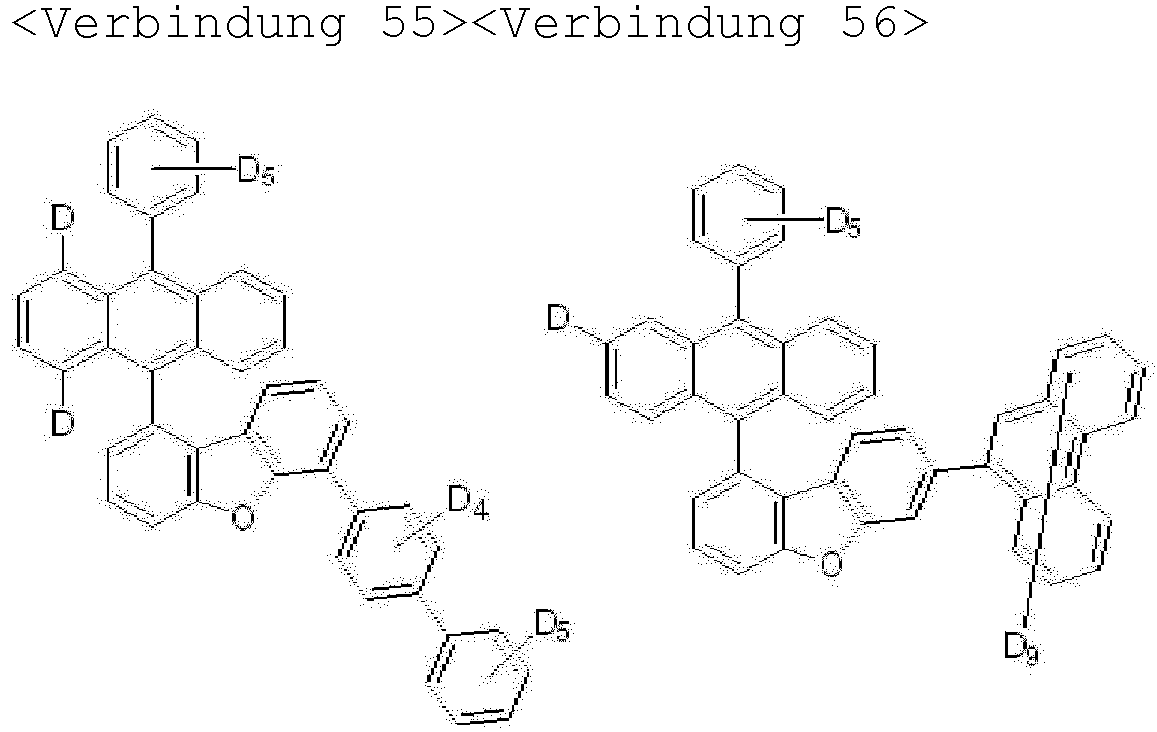
- [Compound 1] to [compound 9], [Compound 43] to [compound 45], [Compound 55] to [compound 56] and [Compound 60] to [compound 61] are compounds of the invention:
- the present disclosure provides an organic light-emitting diode comprising the anthracene derivative represented by Chemical Formula A.
- the organic light-emitting diode may comprise: a first electrode; a second electrode facing the first electrode; and an organic layer disposed between the first electrode and the second electrode, wherein the organic layer includes the anthracene derivative of the present disclosure.
- the organic layer within the organic light-emitting diode may at least one of a hole injection layer, a hole transport layer, a functional layer capable of both hole injection and hole transport, an electron transport layer, and an electron injection layer, in addition to the light-emitting layer.
- the organic layer interposed between the first electrode and the second electrode is a light emitting layer
- the light emitting layer may further contain a dopant wherein the anthracene derivative according to the present disclosure serves as a host.
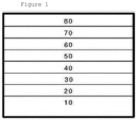
- FIG. 1 is a schematic view of the structure of an organic light-emitting diode according to the present disclosure.
- the organic light-emitting diode comprises an anode 20, a hole transport layer 40, an organic light-emitting layer 50, an electron transport layer 60, and a cathode 80, and optionally a hole injection layer 30 and an electron injection layer 70.
- one or two intermediate layers may be further formed in the organic light-emitting diode.
- anthracene derivative represented by Chemical Formula A can be used as a host in the light emitting layer.
- a substrate 10 is coated with an anode electrode material to form an anode 20.
- an anode electrode material Preferable is an organic substrate or transparent plastic substrate that exhibits excellent transparency, surface smoothness, ease of handling, and waterproofness.
- the anode electrode material indium tin oxide (ITO), indium zinc oxide (IZO), tin oxide (SnO 2 ), or zinc oxide (ZnO), which are transparent and superior in terms of conductivity, may be used.
- a hole injection layer material is applied on the anode 20 by thermal deposition in a vacuum or by spin coating to form a hole injection layer 30. Subsequently, thermal deposition in a vacuum or by spin coating may also be conducted to form a hole transport layer 40 with a hole transport layer material on the hole injection layer 30.
- hole injection layer material No particular limitations are imparted to the hole injection layer material, as long as it is one that is typically used in the art.
- 2-TNATA 4,4',4"-tris(2-naphthylphenyl-phenylamino)-triphenylamine]
- NPD N,N'-di(1-naphthyl)-N,N'-diphenylbenzidine)
- TPD TPD [N,N'-diphenyl-N,N'-bis(3-methylphenyl)-1,1'-biphenyl-4,4'-diamine]
- DNTPD N,N'-diphenyl-N,N'-bis-[4-(phenyl-m-tolyl-amino)-phenyl]-biphenyl-4,4'-diamine]
- the present disclosure is not limited thereby.
- any material may be selected for the hole transport layer without particular limitation.
- examples include, but are not limited to, N,N'-bis(3-methylphenyl)-N,N'-diphenyl-[1,1-biphenyl]-4,4'-diamine (TPD), and N,N'-di(naphthalen-1-yl)-N,N'-diphenylbenzidine (a-NPD).
- an organic light-emitting layer 50 containing a host and a dopant is deposited on the hole transport layer 40 by deposition in a vacuum or by spin coating.
- the light-emitting layer particularly ranges in thickness from 50 to 2,000 ⁇ .
- an electron density control layer (not shown) may be further formed on the organic light emitting layer 50, as necessary.
- the light emitting layer may contain a dopant material as well as the host including the organic light emitting compound according to the present disclosure.
- the content of the dopant may range from about 0.01 to 20 parts by weight, based on 100 parts by weight of the host, but is not limited thereto.
- anthracene derivative represented by Chemical Formula A may be used as a host, alone, or in combination with a well-known host.
- an available host may be at least one of the compounds represented by Chemical Formula B, below: wherein, X 1 to X 10 , which may be the same or different, are each independently selected from the group consisting of a hydrogen atom, a deuterium atom, a substituted or unsubstituted alkyl of 1 to 30 carbon atoms, a substituted or unsubstituted alkenyl of 2 to 30 carbon atoms, a substituted or unsubstituted cycloalkyl of 3 to 30 carbon atoms, a substituted or unsubstituted cycloalkenyl of 5 to 30 carbon atoms, a substituted or unsubstituted alkoxy of 1 to 30 carbon atoms, a substituted or unsubstituted aryloxy of 6 to 30 carbon atoms, a substituted or unsubstituted alkylthioxy of 1 to 30 carbon atoms, a substituted or unsubstituted
- concrete examples of the host compound represented by Chemical Formula B include, but are not limited to, compounds of [Chemical Formula H-1] to [Chemical Formula H-196]:
- the light emitting layer of the present disclosure may contain as a dopant compound at least one of the compounds represented by the following Chemical Formula 2 to Chemical Formula 6: wherein, A in Chemical Formula 2 is any one selected from a substituted or unsubstituted aryl of 5 to 50 carbon atoms, a substituted or unsubstituted heteroaryl of 3 to 50 carbon atoms bearing O, N, or S as a heteroatom, a substituted or unsubstituted arylene of 6 to 60 carbon atoms, and a substituted or unsubstituted heteroarylene of 3 to 50 carbon atoms bearing O, N, or S as a heteroatom.
- a in Chemical Formula 2 is any one selected from a substituted or unsubstituted aryl of 5 to 50 carbon atoms, a substituted or unsubstituted heteroaryl of 3 to 50 carbon atoms bearing O, N, or S as a heteroatom, a substituted or unsubstituted arylene of 6 to 60
- A may be any one of the compounds represented by the following Chemical Formula A1 to Chemical Formula A10:
- the amine moiety in Chemical Formulas 2 to 4 may be any one selected from the following [Substituent 1] to [Substituent 52], but is not limited thereto: wherein, R's, which may be the same or different, are each independently selected from a hydrogen atom, a deuterium atom, a halogen atom, a hydroxyl, a cyano, a nitro, an amino, an amidino, a hydrazine, a hydrazone, a carboxyl or a salt thereof, a sulfonic acid or a salt thereof, a phosphoric acid or a salt thereof, a substituted or unsubstituted alkyl of 1 to 60 carbon atoms, a substituted or unsubstituted alkenyl of 2 to 60 carbon atoms, a substituted or unsubstituted alkynyl of 2 to 60 carbon atoms, a substituted or unsubstituted alkoxy of 1 to
- the electron transport layer 60 After being deposited on the light-emitting layer by deposition in a vacuum and spin coating, the electron transport layer 60 is covered with the electron injection layer 70.
- a cathode metal is deposited on the electron injection layer 70 by thermal vacuum deposition to form the cathode 80, thus obtaining an organic light-emitting diode.
- a material for use in the electron transport layer functions to stably carry the electrons injected from the electron injection electrode (cathode), and may be an electron transport material known in the art.
- the electron transport material known in the art include quinoline derivatives, particularly, tris (8-quinolinorate) aluminum (Alq 3 ), Liq, TAZ, BAlq, beryllium bis(benzoquinolin-10-olate) (Bebq 2 ), AND, Compound 201, Compound 202, BCP, and oxadiazole derivatives such as PBD, BMD, and BND, but are not limited thereto:
- organic metal compound represented by Chemical Formula F may be used, either alone or in combination with the aforementioned electron transport layer material in the present disclosure: [Chemical Formula F] Y m -M-(OA) n wherein,
- Y's are each one selected from among, but not limited to, the following [Structural Formula C1] to [Structural Formula C39]: wherein, R's, which may be the same or different, are each independently selected from a hydrogen atom, a deuterium atom, a halogen, a cyano, a substituted or unsubstituted alkyl of 1 to 30 carbon atoms, a substituted or unsubstituted aryl of 6 to 30 carbon atoms, a substituted or unsubstituted heteroaryl of 3 to 30 carbon atoms, a substituted or unsubstituted alkoxy of 1 to 30 carbon atoms, a substituted or unsubstituted cycloalkyl of 3 to 30 carbon atoms, a substituted or unsubstituted alkenyl of 2 to 30 carbon atoms, a substituted or unsubstituted alkylamino of 1 to 30
- an electron injection layer that functions to facilitate electron injection from the cathode may be deposited on the electron transport layer.
- the material for the EIL is not particularly limited.
- any material can be available for the electron injection layer without particular limitations. Examples include CsF, NaF, LiF, NaCl, Li 2 O, and BaO.
- Deposition conditions for the electron injection layer may vary, depending on compounds used, but may be generally selected from condition scopes that are almost the same as for the formation of hole injection layers.
- the electron injection layer may range in thickness from about 1 ⁇ to about 100 ⁇ , and particularly from about 3 ⁇ to about 90 ⁇ . Given the thickness range for the electron injection layer, the diode can exhibit satisfactory electron injection properties without actually elevating a driving voltage.
- the cathode may be made of lithium (Li), magnesium (Mg), aluminum (Al), aluminum-lithium (Al-Li), calcium (Ca), magnesium-indium (Mg-In), or magnesium-silver (Mg-Ag).
- a transparent cathode made of ITO or IZO may be employed.
- the light-emitting diode of the present disclosure may further comprise a light-emitting layer, made of a blue light-emitting material, a green light-emitting material, or a red light-emitting material, which can emit light in a wavelength range of 380 nm to 800 nm. That is, the light-emitting layer in the organic light-emitting device of the present disclosure may have a multilayer structure in which the additional blue, green, and/or red light-emitting layer may be made of a fluorescent or phosphorescent material.
- the deposition process is a process by which a material is vaporized in a vacuum or at a low pressure and deposited to form a layer
- the solution process is a method in which a material is dissolved in a solvent and applied for the formation of a thin film by means of inkjet printing, roll-to-roll coating, screen printing, spray coating, dip coating, spin coating, etc.
- the organic light-emitting diode of the present disclosure may be applied to a device selected from among flat display devices, flexible display devices, monochrome or grayscale flat illumination devices, and monochrome or grayscale flexible illumination devices.
- An ITO glass substrate was patterned to have a translucent area of 2 mm x 2 mm and cleansed.
- the ITO glass was mounted in a vacuum chamber that was then set to have a base pressure of 1x10 -7 torr.
- films were sequentially formed of 2-TNATA (400 ⁇ ) and HT (200 ⁇ ) in the order.
- a light-emitting layer 250 ⁇ was formed of a combination of host and dopant compounds (97:3 wt%) listed in Table 1, below.
- [Chemical Formula E-1] was deposited to form an electron transport layer (300 ⁇ ) on which an electron injection layer of Liq (10 ⁇ ) was formed and then covered with an Al layer (1000 ⁇ ) to fabricate an organic light-emitting diode.
- the organic light-emitting diodes thus obtained were measured at 10 mA/cm 2 for luminescence properties
- the compounds according to the present disclosure allowed longer lifespans, compared to anthracene compounds bearing none or less than a specific ratio of deuterium atoms, thereby finding high applicability to organic light-emitting diodes.
- the anthracene derivatives according to the present disclosure When used as hosts in a light-emitting layer, the anthracene derivatives according to the present disclosure exhibit longer lifespan properties than preexisting materials. Thus, the anthracene derivatives according to the present disclosure can impart improved properties to organic light-emitting diodes and thus are industrially applicable to organic light-emitting diodes and relevant industries.
Landscapes
- Chemical & Material Sciences (AREA)
- Organic Chemistry (AREA)
- Physics & Mathematics (AREA)
- Spectroscopy & Molecular Physics (AREA)
- Engineering & Computer Science (AREA)
- Materials Engineering (AREA)
- Optics & Photonics (AREA)
- Electroluminescent Light Sources (AREA)
Claims (16)
- Ein Anthracenderivat, dargestellt durch die folgende chemische Formel A:
 R1 bis R5, die gleich oder verschieden sind, jeweils unabhängig voneinander ein Wasserstoff- oder Deuteriumatom sind,R ein Deuteriumatom ist,n eine ganze Zahl von 0 bis 8 ist, mit einem Wasserstoffatom an einem aromatischen Kohlenstoffatom, das nicht mit R innerhalb der Anthraceneinheit substituiert ist,L1, das als Linker fungiert, eine Einfachbindung oder ein Deuterium-substituiertes oder unsubstituiertes Arylen mit 6 bis 12 Kohlenstoffatomen ist;R12 bis R14, die gleich oder verschieden sind, jeweils unabhängig voneinander ein Wasserstoff- oder Deuteriumatom sind, und R11 eine Einfachbindung an den Linker L1 ist, über den der Anthracenyleinheit mit den 6-gliedrigen aromatischen Ringen in der Dibenzofuraneinheit verbunden ist, undR15 bis R18, die gleich oder verschieden sind, jeweils unabhängig voneinander ausgewählt sind aus einem Wasserstoffatom, einem Deuteriumatom, einem Deuterium-substituierten oder unsubstituierten Phenyl, einem Deuterium-substituierten oder unsubstituierten Biphenyl, einem Deuterium-substituierten oder unsubstituierten Terphenyl, einem Deuterium-substituierten oder unsubstituierten Naphthyl, einem Deuterium-substituierten oder unsubstituierten Phenanthryl und ein Fluorenyl, bei dem die Wasserstoffe am Kohlenstoffatom in Position 9 des Fluorenyls durch gleiche oder verschiedene Alkyle mit 1 bis 5 Kohlenstoffatomen substituiert sein können oder nicht, und die Wasserstoffe an den Kohlenstoffatomen der aromatischen Ringe des Fluorenyls durch ein Deuteriumatom substituiert sein können oder nicht,zumindest einer von R15 bis R18 ausgewählt ist aus einem Deuterium-substituierten oder unsubstituierten Phenyl, einem Deuterium-substituierten oder unsubstituierten Biphenyl, einem Deuterium-substituierten oder unsubstituierten Terphenyl, einem Deuterium-substituierten oder unsubstituierten Naphthyl, einem Deuterium-substituierten oder unsubstituierten Phenanthryl, und ein Fluorenyl, bei dem die Wasserstoffe am Kohlenstoffatom in Position 9 des Fluorenyls durch gleiche oder verschiedene Alkyle mit 1 bis 5 Kohlenstoffatomen substituiert sein können oder nicht, und die Wasserstoffe an den Kohlenstoffatomen der aromatischen Ringe des Fluorenyls durch ein Deuteriumatom substituiert sein können oder nicht,wobei das Anthracenderivat einen Deuterierungsgrad von 30 % oder mehr aufweist (Prozentsatz aller Deuteriumatome, die direkt an Kohlenstoffatome des Anthracenderivats gebunden sind, bezogen auf eine Summe aller Deuterium- und Wasserstoffatome, die direkt an Kohlenstoffatome des Anthracenderivats gebunden sind).
 - Das Anthracenderivat nach Anspruch 1, wobei n 0 (Null) ist.
- Das Anthracenderivat nach Anspruch 1, wobei R1 bis R5 jeweils ein Deuteriumatom sind.
- Das Anthracenderivat nach Anspruch 1, wobei L1 eine Einfachbindung oder ein Deuterium-substituiertes oder unsubstituiertes Phenylen ist.
- Das Anthracenderivat nach Anspruch 4, wobei L1 eine Einfachbindung ist.
- Das Anthracenderivat nach Anspruch 1, wobei nur einer von R15 bis R18 ausgewählt ist aus einem Deuterium-substituierten oder unsubstituierten Phenyl, einem Deuterium-substituierten oder unsubstituierten Biphenyl, einem Deuterium-substituierten oder unsubstituierten Terphenyl, einem Deuterium-substituierten oder unsubstituierten Naphthyl, ein deuterium-substituiertes oder unsubstituiertes Phenanthryl und ein Fluorenyl, bei dem gleiche oder verschiedene Alkylgruppen mit 1 bis 5 Kohlenstoffatomen am Kohlenstoffatom in Position 9 substituiert sein können oder nicht und ein Deuteriumatom an jedem der Kohlenstoffatome der aromatischen Ringe substituiert sein kann oder nicht.
- Das Anthracenderivat nach Anspruch 1, wobei das Anthracenderivat einen Deuterierungsgrad von 35 % oder mehr aufweist.
- Das Anthracenderivat nach Anspruch 7, wobei das Anthracenderivat einen Deuterierungsgrad von 40 % oder mehr aufweist.
- Das Anthracenderivat nach Anspruch 1, wobei das Anthracenderivat eine ausgewählt aus der Gruppe der Verbindungen ist, die durch [Verbindung 1] bis [Verbindung 9], [Verbindung 43] bis [Verbindung 45], [Verbindung 55] bis [Verbindung 56], [Verbindung 60] bis [Verbindung 61] dargestellt wird:




- Eine organische lichtemittierende Diode, aufweisend:eine erste Elektrode; eine zweite Elektrode, die der ersten Elektrode gegenüberliegt; undeine organische Schicht, die zwischen der ersten Elektrode und der zweiten Elektrode angeordnet ist,wobei die organische Schicht das Anthracenderivat nach einem der Ansprüche 1 bis 9 der vorliegenden Offenbarung enthält.
- Die organische lichtemittierende Diode nach Anspruch 10, wobei die organische Schicht zumindest eine von einer Lochinjektionsschicht, einer Lochtransportschicht, einerr Funktionsschicht, die sowohl zur Lochinjektion als auch zum Lochtransport fähig ist, eine lichtemittierende Schicht, einer Elektronentransportschicht und einer Elektroneninjektionsschicht aufweist.
- Die organische lichtemittierende Diode nach Anspruch 10, wobei die zwischen der ersten Elektrode und der zweiten Elektrode angeordnete organische Schicht eine lichtemittierende Schicht ist.
- Die organische lichtemittierende Diode nach Anspruch 12, wobei die lichtemittierende Schicht ferner einen Dotierstoff aufweist und das Anthracenderivat als Wirt dient.
- Die organische lichtemittierende Diode nach Anspruch 13, wobei der Dotierstoff zumindest eine der Verbindungen aufweist, die durch die folgenden chemischen Formeln 2 bis 6 dargestellt werden:


 A in der chemischen Formel 2 eines ist ausgewählt aus einem substituierten oder unsubstituierten Aryl mit 5 bis 50 Kohlenstoffatomen, einem substituierten oder unsubstituierten Heteroaryl mit 3 bis 50 Kohlenstoffatomen mit O, N oder S als Heteroatom, einem substituierten oder unsubstituierten Arylen mit 6 bis 60 Kohlenstoffatomen und einem substituierten oder unsubstituierten Heteroarylen mit 3 bis 50 Kohlenstoffatomen mit O, N oder S als Heteroatom;in der chemischen Formel 2,X1 und X2, die gleich oder verschieden sind, jeweils unabhängig voneinander aus einem substituierten oder unsubstituierten Arylen mit 6 bis 30 Kohlenstoffatomen und einer Einfachbindung ausgewählt sind und aneinander gebunden sein können;Y1 und Y2, die gleich oder verschieden sind, jeweils unabhängig voneinander ausgewählt sind aus der Gruppe bestehend aus einem substituierten oder unsubstituierten Aryl mit 6 bis 24 Kohlenstoffatomen, einem substituierten oder unsubstituierten Alkyl mit 1 bis 24 Kohlenstoffatomen, einem substituierten oder unsubstituierten Heteroalkyl mit 1 bis 24 Kohlenstoffatomen, einem substituierten oder unsubstituierten Cycloalkyl mit 3 bis 24 Kohlenstoffatomen, einem Cyano, einem Halogen, einem substituierten oder unsubstituierten Alkylsilyl mit 1 bis 40 Kohlenstoffatomen, einem substituierten oder unsubstituierten Arylsilyl mit 6 bis 30 Kohlenstoffatomen, einem Deuteriumatom und einem Wasserstoffatom, und die jeweils einen kondensierten aliphatischen oder aromatischen Ring oder einen kondensierten aliphatischen oder aromatischen Heteroring mit einem benachbarten Rest bilden können; und1 und m jeweils eine ganze Zahl von 1 bis 20 sind, und n eine ganze Zahl von 1 bis 4 ist;in der chemischen Formel 3 und der chemischen Formel 4,A1, A2, E und F, die gleich oder verschieden sind, jeweils unabhängig voneinander ein substituierter oder unsubstituierter aromatischer Kohlenwasserstoffring mit 6 bis 50 Kohlenstoffatomen oder ein substituierter oder unsubstituierter aromatischer Heteroring mit 2 bis 40 Kohlenstoffatomen sind, wobei zwei benachbarte Kohlenstoffatome des aromatischen Rings A1 und zwei benachbarte Kohlenstoffatome des aromatischen Rings A2 zusammen mit einem Kohlenstoffatom, an das die Substituenten R1 und R2 gebunden sind, einen 5-gliedrigen kondensierten Ring bilden;Linker L1 bis L12, die gleich oder verschieden sind, jeweils unabhängig voneinander ausgewählt sind aus einer Einfachbindung, einem substituierten oder unsubstituierten Alkinylen mit 2 bis 60 Kohlenstoffatomen, einem substituierten oder unsubstituierten Cycloalkylen mit 3 bis 60 Kohlenstoffatomen, einem substituierten oder unsubstituierten Arylen mit 6 bis 60 Kohlenstoffatomen und einem substituierten oder unsubstituierten Heteroarylen mit 2 bis 60 Kohlenstoffatomen;M eine ausgewählt aus N-R3, CR4R5, SiR6R7, O und S ist;R1 bis R7 und Ar1 bis Ar8, die gleich oder verschieden sind, jeweils unabhängig voneinander ausgewählt sind aus einem Wasserstoffatom, einem Deuteriumatom, einem substituierten oder unsubstituierten Alkyl mit 1 bis 30 Kohlenstoffatomen, einem substituierten oder unsubstituierten Aryl mit 6 bis 50 Kohlenstoffatomen, einem substituierten oder unsubstituierten Cycloalkyl mit 3 bis 30 Kohlenstoffatomen, einem substituierten oder unsubstituierten Heteroaryl mit 2 bis 50 Kohlenstoffatomen, einem substituierten oder unsubstituierten Alkylsilyl mit 1 bis 30 Kohlenstoffatomen, einem substituierten oder unsubstituierten Arylsilyl mit 5 bis 30 Kohlenstoffatomen, einem Cyano, einem Nitro und einem Halogen, wobei R1 und R2 zusammen einen mono- oder polyzyklischen aliphatischen oder aromatischen Ring bilden können, der ein heterozyklischer Ring ist, der ein Heteroatom, ausgewählt aus N, O, P, Si, S, Ge, Se und Te, als ein Ringglied trägt;p1 bis p4, r1 bis r4 und s1 bis s4 jeweils unabhängig voneinander eine ganze Zahl von 1 bis 3 sind, wobei, wenn einer von ihnen 2 oder größer ist, die entsprechenden L1 bis L12 gleich oder verschieden sind,x eine ganze Zahl von 1 oder 2 ist, und y und z gleich oder verschieden sind und jeweils unabhängig voneinander eine ganze Zahl von 0 bis 3 sind;Ar1 einen Ring mit Ar2 bilden kann, Ar3 einen Ring mit Ar4 bilden kann, Ar5 einen Ring mit Ar6 bilden kann und Ar7 einen Ring mit Ar8 bilden kann;zwei benachbarte Kohlenstoffatome der A2-Ringeinheit der chemischen Formel 3 die entsprechenden Positionen * der Strukturformel Q1 einnehmen können, um einen kondensierten Ring zu bilden, undzwei benachbarte Kohlenstoffatome des A1-Ringanteils der chemischen Formel 4 die entsprechenden Positionen * der Strukturformel Q2 besetzen können, um einen verschmolzenen Ring zu bilden, und zwei benachbarte Kohlenstoffatome des A2-Ringanteils der chemischen Formel 4 die entsprechenden Positionen * der Strukturformel Q1 besetzen können, um einen verschmolzenen Ring zu bilden;
 X eine ausgewählt aus B, P und P=O ist,T1 bis T3, die gleich oder verschieden sind, jeweils unabhängig voneinander ein substituierter oder unsubstituierter aromatischer Kohlenwasserstoffring mit 6 bis 50 Kohlenstoffatomen oder ein substituierter oder unsubstituierter heteroaromatischer Ring mit 2 bis 50 Kohlenstoffatomen sind, undY1 bis Y3, die gleich oder verschieden sind, jeweils unabhängig eines ausgewählt aus N-R21, CR22R23, O, S, Se und SiR24R25 sind,wobei R21 bis R25, die gleich oder verschieden sind, jeweils unabhängig voneinander ausgewählt sind aus einem Wasserstoffatom, einem Deuteriumatom, einem substituierten oder unsubstituierten Alkyl mit 1 bis 30 Kohlenstoffatomen, einem substituierten oder unsubstituierten Aryl mit 6 bis 50 Kohlenstoffatomen einem substituierten oder unsubstituierten Cycloalkyl mit 3 bis 30 Kohlenstoffatomen, einem substituierten oder unsubstituierten Heteroaryl mit 2 bis 50 Kohlenstoffatomen, einem substituierten oder unsubstituierten Alkylsilyl mit 1 bis 30 Kohlenstoffatomen, einem substituierten oder unsubstituierten Arylsilyl mit 5 bis 30 Kohlenstoffatomen, einem Nitro, einem Cyano und einem Halogen,zumindest einer der Reste R21 bis R25 mit mindestens einem der Reste T1 bis T3 verbunden sein kann, um einen zusätzlichen mono- oder polyzyklischen aliphatischen oder aromatischen Ring zu bilden, undR22 mit R23 verbunden sein kann, um einen zusätzlichen mono- oder polyzyklischen aliphatischen oder aromatischen Ring zu bilden, und R21 mit R25 verbunden sein kann, um einen zusätzlichen mono- oder polyzyklischen aliphatischen oder aromatischen Ring zu bilden.
 - Die organische lichtemittierende Diode nach Anspruch 11, wobei zumindest eine ausgewählt aus den Schichten durch ein Abscheideverfahren oder ein Lösungsverfahren abgeschieden wird.
- Die organische lichtemittierende Diode nach Anspruch 10, wobei die organische lichtemittierende Diode für eine Vorrichtung verwendet wird, die ausgewählt ist aus einer flachen Anzeigevorrichtung, einer flexiblen Anzeigevorrichtung, einer monochromen oder graustufigen flachen Beleuchtung und einer monochromen oder graustufigen flexiblen Beleuchtungsvorrichtung.
Applications Claiming Priority (3)
| Application Number | Priority Date | Filing Date | Title |
|---|---|---|---|
| KR20190007428 | 2019-01-21 | ||
| KR1020190071986A KR102144446B1 (ko) | 2019-01-21 | 2019-06-18 | 유기 발광 소자용 화합물 및 이를 포함하는 장수명의 유기발광소자 |
| PCT/KR2020/000690 WO2020153650A1 (ko) | 2019-01-21 | 2020-01-14 | 유기 발광 소자용 화합물 및 이를 포함하는 장수명의 유기발광소자 |
Publications (3)
| Publication Number | Publication Date |
|---|---|
| EP3915979A1 EP3915979A1 (de) | 2021-12-01 |
| EP3915979A4 EP3915979A4 (de) | 2022-08-31 |
| EP3915979B1 true EP3915979B1 (de) | 2025-06-18 |
Family
ID=71893553
Family Applications (1)
| Application Number | Title | Priority Date | Filing Date |
|---|---|---|---|
| EP20745758.1A Active EP3915979B1 (de) | 2019-01-21 | 2020-01-14 | Deuterierte verbindungen für organische lichtemittierende elemente und organische lichtemittierende elemente damit und mit langer lebensdauer |
Country Status (3)
| Country | Link |
|---|---|
| EP (1) | EP3915979B1 (de) |
| KR (1) | KR102144446B1 (de) |
| CN (1) | CN113227066B (de) |
Cited By (1)
| Publication number | Priority date | Publication date | Assignee | Title |
|---|---|---|---|---|
| US12495716B2 (en) * | 2024-10-30 | 2025-12-09 | Shijiazhuang Chengzhi Yonghua Display Material Co., Ltd. | Blue luminescent compound, blue luminescent composition, and organic electroluminescent device, display device and lighting device comprising same |
Families Citing this family (13)
| Publication number | Priority date | Publication date | Assignee | Title |
|---|---|---|---|---|
| KR102148296B1 (ko) * | 2019-07-29 | 2020-08-26 | 에스에프씨주식회사 | 보론 화합물을 포함하는 유기발광소자 |
| KR20210067844A (ko) * | 2019-11-29 | 2021-06-08 | 주식회사 엘지화학 | 화합물 및 이를 포함하는 유기 발광 소자 |
| US12284908B2 (en) * | 2020-05-29 | 2025-04-22 | Lg Display Co., Ltd. | Organic light emitting device |
| WO2022086125A1 (ko) * | 2020-10-19 | 2022-04-28 | 에스에프씨 주식회사 | 유기발광소자 |
| KR102773827B1 (ko) * | 2020-11-16 | 2025-02-26 | 주식회사 엘지화학 | 안트라센계 화합물 및 이를 포함하는 유기 발광 소자 |
| KR102692702B1 (ko) * | 2020-12-09 | 2024-08-07 | 솔루스첨단소재 주식회사 | 유기 발광 화합물 및 이를 이용한 유기 전계 발광 소자 |
| KR102695265B1 (ko) * | 2021-01-22 | 2024-08-14 | 주식회사 엘지화학 | 중수소화 안트라센 화합물의 제조방법, 반응 조성물, 중수소화 안트라센 화합물 및 조성물 |
| TWI835062B (zh) * | 2021-02-04 | 2024-03-11 | 南韓商Lg化學股份有限公司 | 氘代蒽化合物的製備方法、反應組成物、氘代蒽化合物以及組成物 |
| KR102923907B1 (ko) | 2021-04-15 | 2026-02-04 | 주식회사 엘지화학 | 신규한 화합물 및 이를 이용한 유기 발광 소자 |
| CN116143737A (zh) * | 2021-11-16 | 2023-05-23 | 烟台显华科技集团股份有限公司 | 具有蒽联不对称二苯并杂环的化合物及其用途 |
| CN117486668A (zh) * | 2022-07-21 | 2024-02-02 | 北京大学深圳研究生院 | 一种有机主体材料和发光器件 |
| CN117946664A (zh) * | 2022-10-14 | 2024-04-30 | 阜阳欣奕华材料科技有限公司 | 一种含有蒽基化合物的组合物及包含其的有机电致发光器件 |
| KR20240150138A (ko) * | 2023-04-07 | 2024-10-15 | 주식회사 엘지화학 | 화합물 및 이를 포함하는 유기 발광 소자 |
Family Cites Families (10)
| Publication number | Priority date | Publication date | Assignee | Title |
|---|---|---|---|---|
| KR101068224B1 (ko) | 2008-02-05 | 2011-09-28 | 에스에프씨 주식회사 | 안트라센 유도체 및 이를 포함하는 유기전계발광소자 |
| KR101111406B1 (ko) | 2011-06-22 | 2012-04-12 | 덕산하이메탈(주) | 유기전기소자, 유기전기소자용 신규 화합물 및 조성물 |
| KR101825543B1 (ko) * | 2014-08-19 | 2018-02-05 | 삼성에스디아이 주식회사 | 유기 광전자 소자 및 표시장치 |
| KR102201097B1 (ko) * | 2015-01-20 | 2021-01-11 | 에스에프씨주식회사 | 유기발광소자용 화합물 및 이를 포함하는 유기 발광 소자 |
| CN118530203A (zh) * | 2015-04-23 | 2024-08-23 | Sfc株式会社 | 有机发光元件用化合物以及包括该化合物的有机发光元件 |
| KR102800490B1 (ko) * | 2016-10-05 | 2025-04-29 | 에스에프씨 주식회사 | 장수명, 저전압 및 고효율 특성을 갖는 유기 발광 소자 |
| KR102758692B1 (ko) * | 2016-10-05 | 2025-01-22 | 에스에프씨 주식회사 | 장수명, 저전압 및 고효율 특성을 갖는 유기 발광 소자 |
| KR102122212B1 (ko) * | 2016-12-29 | 2020-06-26 | 에스에프씨주식회사 | 고효율을 갖는 유기 발광 소자 |
| WO2018174293A1 (ja) * | 2017-03-24 | 2018-09-27 | 出光興産株式会社 | 有機エレクトロルミネッセンス素子及び電子機器 |
| KR102102036B1 (ko) * | 2017-06-01 | 2020-04-17 | 주식회사 엘지화학 | 헤테로고리 화합물 및 이를 포함하는 유기 발광 소자 |
-
2019
- 2019-06-18 KR KR1020190071986A patent/KR102144446B1/ko active Active
-
2020
- 2020-01-14 CN CN202080007349.1A patent/CN113227066B/zh active Active
- 2020-01-14 EP EP20745758.1A patent/EP3915979B1/de active Active
Cited By (1)
| Publication number | Priority date | Publication date | Assignee | Title |
|---|---|---|---|---|
| US12495716B2 (en) * | 2024-10-30 | 2025-12-09 | Shijiazhuang Chengzhi Yonghua Display Material Co., Ltd. | Blue luminescent compound, blue luminescent composition, and organic electroluminescent device, display device and lighting device comprising same |
Also Published As
| Publication number | Publication date |
|---|---|
| KR102144446B9 (ko) | 2022-06-07 |
| CN113227066B (zh) | 2024-03-19 |
| KR20200090597A (ko) | 2020-07-29 |
| CN113227066A (zh) | 2021-08-06 |
| EP3915979A1 (de) | 2021-12-01 |
| KR102144446B1 (ko) | 2020-08-13 |
| EP3915979A4 (de) | 2022-08-31 |
Similar Documents
| Publication | Publication Date | Title |
|---|---|---|
| EP3915979B1 (de) | Deuterierte verbindungen für organische lichtemittierende elemente und organische lichtemittierende elemente damit und mit langer lebensdauer | |
| EP3266848B1 (de) | Organisches lichtemittierendes element für niederspannungsantrieb und mit langer lebensdauer | |
| EP3524661B1 (de) | Organische lichtemittierende vorrichtung mit langer lebensdauer, niedriger spannung und hoher effizienz | |
| KR102201097B1 (ko) | 유기발광소자용 화합물 및 이를 포함하는 유기 발광 소자 | |
| US12114562B2 (en) | Compound for organic light-emitting diode and long lifespan organic light-emitting diode comprising same | |
| EP3524660A1 (de) | Organische lichtemittierende vorrichtung mit langer lebensdauer, niedriger spannung und hohem wirkungsgrad | |
| KR102240004B1 (ko) | 신규한 방향족 유기발광 화합물 및 이를 포함하는 유기 발광 소자 | |
| EP3754737B1 (de) | Organische verbindung für organische lichtemittierende diode und organische lichtemittierende diode damit | |
| KR101791022B1 (ko) | 스피로 화합물 및 이를 포함하는 유기전계발광소자 | |
| EP4137486A1 (de) | Neue anthracenverbindung und organisches lichtemittierendes element damit | |
| EP4123738A1 (de) | Hocheffiziente und lang anhaltende organische leuchtdiode | |
| KR102309065B1 (ko) | 유기발광소자용 화합물 및 이를 포함하는 유기 발광 소자 | |
| EP3981855A1 (de) | Verbindung für organisches lichtemittierendes element und organisches lichtemittierendes element damit | |
| EP3654395B9 (de) | Organische leuchtdiode mit hoher effizienz | |
| JP6209242B2 (ja) | 長寿命特性を有する有機発光素子 | |
| EP4190771A1 (de) | Neuartige heterocyclische verbindung und organische lichtemittierende vorrichtung damit | |
| EP3998321B1 (de) | Organische lichtemittierende verbindung und organische lichtemittierende vorrichtung | |
| KR101779914B1 (ko) | 나프탈렌 유도체 및 이를 포함하는 유기전계발광소자 | |
| KR20150114658A (ko) | 유기발광 화합물 및 이를 포함하는 유기전계발광소자 | |
| KR102149449B1 (ko) | 유기발광소자용 화합물 및 이를 포함하는 유기 발광 소자 | |
| KR102278852B1 (ko) | 신규한 방향족 유기발광 화합물 및 이를 포함하는 유기 발광 소자 | |
| JP2023552321A (ja) | 新規な有機化合物を発光層内に含む有機発光素子 | |
| EP4253371A1 (de) | Neuartige organische verbindung und organische lichtemittierende vorrichtung damit | |
| KR20230133787A (ko) | 유기 화합물 및 이를 포함하는 유기발광소자 | |
| KR20220069803A (ko) | 다환 고리 화합물 및 이를 이용한 유기발광소자 |
Legal Events
| Date | Code | Title | Description |
|---|---|---|---|
| STAA | Information on the status of an ep patent application or granted ep patent |
Free format text: STATUS: THE INTERNATIONAL PUBLICATION HAS BEEN MADE |
|
| PUAI | Public reference made under article 153(3) epc to a published international application that has entered the european phase |
Free format text: ORIGINAL CODE: 0009012 |
|
| STAA | Information on the status of an ep patent application or granted ep patent |
Free format text: STATUS: REQUEST FOR EXAMINATION WAS MADE |
|
| 17P | Request for examination filed |
Effective date: 20210624 |
|
| AK | Designated contracting states |
Kind code of ref document: A1 Designated state(s): AL AT BE BG CH CY CZ DE DK EE ES FI FR GB GR HR HU IE IS IT LI LT LU LV MC MK MT NL NO PL PT RO RS SE SI SK SM TR |
|
| DAV | Request for validation of the european patent (deleted) | ||
| DAX | Request for extension of the european patent (deleted) | ||
| A4 | Supplementary search report drawn up and despatched |
Effective date: 20220801 |
|
| RIC1 | Information provided on ipc code assigned before grant |
Ipc: H01L 51/50 20060101ALI20220726BHEP Ipc: H01L 51/00 20060101ALI20220726BHEP Ipc: C07D 307/91 20060101AFI20220726BHEP |
|
| STAA | Information on the status of an ep patent application or granted ep patent |
Free format text: STATUS: EXAMINATION IS IN PROGRESS |
|
| 17Q | First examination report despatched |
Effective date: 20240820 |
|
| GRAP | Despatch of communication of intention to grant a patent |
Free format text: ORIGINAL CODE: EPIDOSNIGR1 |
|
| STAA | Information on the status of an ep patent application or granted ep patent |
Free format text: STATUS: GRANT OF PATENT IS INTENDED |
|
| RIC1 | Information provided on ipc code assigned before grant |
Ipc: H10K 50/11 20230101ALI20250116BHEP Ipc: H10K 85/60 20230101ALI20250116BHEP Ipc: C07D 307/91 20060101AFI20250116BHEP |
|
| INTG | Intention to grant announced |
Effective date: 20250127 |
|
| GRAS | Grant fee paid |
Free format text: ORIGINAL CODE: EPIDOSNIGR3 |
|
| GRAA | (expected) grant |
Free format text: ORIGINAL CODE: 0009210 |
|
| STAA | Information on the status of an ep patent application or granted ep patent |
Free format text: STATUS: THE PATENT HAS BEEN GRANTED |
|
| AK | Designated contracting states |
Kind code of ref document: B1 Designated state(s): AL AT BE BG CH CY CZ DE DK EE ES FI FR GB GR HR HU IE IS IT LI LT LU LV MC MK MT NL NO PL PT RO RS SE SI SK SM TR |
|
| P01 | Opt-out of the competence of the unified patent court (upc) registered |
Free format text: CASE NUMBER: APP_22002/2025 Effective date: 20250508 |
|
| REG | Reference to a national code |
Ref country code: GB Ref legal event code: FG4D |
|
| REG | Reference to a national code |
Ref country code: CH Ref legal event code: EP |
|
| REG | Reference to a national code |
Ref country code: DE Ref legal event code: R096 Ref document number: 602020052932 Country of ref document: DE |
|
| REG | Reference to a national code |
Ref country code: CH Ref legal event code: EP |
|
| REG | Reference to a national code |
Ref country code: IE Ref legal event code: FG4D |
|
| REG | Reference to a national code |
Ref country code: NL Ref legal event code: FP |
|
| PG25 | Lapsed in a contracting state [announced via postgrant information from national office to epo] |
Ref country code: FI Free format text: LAPSE BECAUSE OF FAILURE TO SUBMIT A TRANSLATION OF THE DESCRIPTION OR TO PAY THE FEE WITHIN THE PRESCRIBED TIME-LIMIT Effective date: 20250618 |
|
| REG | Reference to a national code |
Ref country code: LT Ref legal event code: MG9D |
|
| PG25 | Lapsed in a contracting state [announced via postgrant information from national office to epo] |
Ref country code: NO Free format text: LAPSE BECAUSE OF FAILURE TO SUBMIT A TRANSLATION OF THE DESCRIPTION OR TO PAY THE FEE WITHIN THE PRESCRIBED TIME-LIMIT Effective date: 20250918 Ref country code: GR Free format text: LAPSE BECAUSE OF FAILURE TO SUBMIT A TRANSLATION OF THE DESCRIPTION OR TO PAY THE FEE WITHIN THE PRESCRIBED TIME-LIMIT Effective date: 20250919 |
|
| PG25 | Lapsed in a contracting state [announced via postgrant information from national office to epo] |
Ref country code: BG Free format text: LAPSE BECAUSE OF FAILURE TO SUBMIT A TRANSLATION OF THE DESCRIPTION OR TO PAY THE FEE WITHIN THE PRESCRIBED TIME-LIMIT Effective date: 20250618 |
|
| PG25 | Lapsed in a contracting state [announced via postgrant information from national office to epo] |
Ref country code: HR Free format text: LAPSE BECAUSE OF FAILURE TO SUBMIT A TRANSLATION OF THE DESCRIPTION OR TO PAY THE FEE WITHIN THE PRESCRIBED TIME-LIMIT Effective date: 20250618 |
|
| PG25 | Lapsed in a contracting state [announced via postgrant information from national office to epo] |
Ref country code: RS Free format text: LAPSE BECAUSE OF FAILURE TO SUBMIT A TRANSLATION OF THE DESCRIPTION OR TO PAY THE FEE WITHIN THE PRESCRIBED TIME-LIMIT Effective date: 20250918 |
|
| PG25 | Lapsed in a contracting state [announced via postgrant information from national office to epo] |
Ref country code: LV Free format text: LAPSE BECAUSE OF FAILURE TO SUBMIT A TRANSLATION OF THE DESCRIPTION OR TO PAY THE FEE WITHIN THE PRESCRIBED TIME-LIMIT Effective date: 20250618 |
|
| PG25 | Lapsed in a contracting state [announced via postgrant information from national office to epo] |
Ref country code: PT Free format text: LAPSE BECAUSE OF FAILURE TO SUBMIT A TRANSLATION OF THE DESCRIPTION OR TO PAY THE FEE WITHIN THE PRESCRIBED TIME-LIMIT Effective date: 20251020 |
|
| REG | Reference to a national code |
Ref country code: AT Ref legal event code: MK05 Ref document number: 1804092 Country of ref document: AT Kind code of ref document: T Effective date: 20250618 |
|
| PG25 | Lapsed in a contracting state [announced via postgrant information from national office to epo] |
Ref country code: IS Free format text: LAPSE BECAUSE OF FAILURE TO SUBMIT A TRANSLATION OF THE DESCRIPTION OR TO PAY THE FEE WITHIN THE PRESCRIBED TIME-LIMIT Effective date: 20251018 |
|
| PG25 | Lapsed in a contracting state [announced via postgrant information from national office to epo] |
Ref country code: AT Free format text: LAPSE BECAUSE OF FAILURE TO SUBMIT A TRANSLATION OF THE DESCRIPTION OR TO PAY THE FEE WITHIN THE PRESCRIBED TIME-LIMIT Effective date: 20250618 Ref country code: SM Free format text: LAPSE BECAUSE OF FAILURE TO SUBMIT A TRANSLATION OF THE DESCRIPTION OR TO PAY THE FEE WITHIN THE PRESCRIBED TIME-LIMIT Effective date: 20250618 |
|
| PG25 | Lapsed in a contracting state [announced via postgrant information from national office to epo] |
Ref country code: CZ Free format text: LAPSE BECAUSE OF FAILURE TO SUBMIT A TRANSLATION OF THE DESCRIPTION OR TO PAY THE FEE WITHIN THE PRESCRIBED TIME-LIMIT Effective date: 20250618 |
|
| PG25 | Lapsed in a contracting state [announced via postgrant information from national office to epo] |
Ref country code: PL Free format text: LAPSE BECAUSE OF FAILURE TO SUBMIT A TRANSLATION OF THE DESCRIPTION OR TO PAY THE FEE WITHIN THE PRESCRIBED TIME-LIMIT Effective date: 20250618 |
|
| PG25 | Lapsed in a contracting state [announced via postgrant information from national office to epo] |
Ref country code: EE Free format text: LAPSE BECAUSE OF FAILURE TO SUBMIT A TRANSLATION OF THE DESCRIPTION OR TO PAY THE FEE WITHIN THE PRESCRIBED TIME-LIMIT Effective date: 20250618 |
|
| PG25 | Lapsed in a contracting state [announced via postgrant information from national office to epo] |
Ref country code: SK Free format text: LAPSE BECAUSE OF FAILURE TO SUBMIT A TRANSLATION OF THE DESCRIPTION OR TO PAY THE FEE WITHIN THE PRESCRIBED TIME-LIMIT Effective date: 20250618 Ref country code: RO Free format text: LAPSE BECAUSE OF FAILURE TO SUBMIT A TRANSLATION OF THE DESCRIPTION OR TO PAY THE FEE WITHIN THE PRESCRIBED TIME-LIMIT Effective date: 20250618 |
|
| PG25 | Lapsed in a contracting state [announced via postgrant information from national office to epo] |
Ref country code: ES Free format text: LAPSE BECAUSE OF FAILURE TO SUBMIT A TRANSLATION OF THE DESCRIPTION OR TO PAY THE FEE WITHIN THE PRESCRIBED TIME-LIMIT Effective date: 20250618 |
|
| PGFP | Annual fee paid to national office [announced via postgrant information from national office to epo] |
Ref country code: NL Payment date: 20260121 Year of fee payment: 7 |
|
| PGFP | Annual fee paid to national office [announced via postgrant information from national office to epo] |
Ref country code: GB Payment date: 20260122 Year of fee payment: 7 |
|
| PG25 | Lapsed in a contracting state [announced via postgrant information from national office to epo] |
Ref country code: DK Free format text: LAPSE BECAUSE OF FAILURE TO SUBMIT A TRANSLATION OF THE DESCRIPTION OR TO PAY THE FEE WITHIN THE PRESCRIBED TIME-LIMIT Effective date: 20250618 |
|
| PGFP | Annual fee paid to national office [announced via postgrant information from national office to epo] |
Ref country code: DE Payment date: 20260127 Year of fee payment: 7 |
|
| PGFP | Annual fee paid to national office [announced via postgrant information from national office to epo] |
Ref country code: IT Payment date: 20260130 Year of fee payment: 7 |
|
| PGFP | Annual fee paid to national office [announced via postgrant information from national office to epo] |
Ref country code: FR Payment date: 20260121 Year of fee payment: 7 |
|
| PLBE | No opposition filed within time limit |
Free format text: ORIGINAL CODE: 0009261 |
|
| STAA | Information on the status of an ep patent application or granted ep patent |
Free format text: STATUS: NO OPPOSITION FILED WITHIN TIME LIMIT |