EP3916522A1 - Système, procédé et produit programme informatique permettant de connecter les utilisateurs à un environnement de ra persistant - Google Patents
Système, procédé et produit programme informatique permettant de connecter les utilisateurs à un environnement de ra persistant Download PDFInfo
- Publication number
- EP3916522A1 EP3916522A1 EP20176578.1A EP20176578A EP3916522A1 EP 3916522 A1 EP3916522 A1 EP 3916522A1 EP 20176578 A EP20176578 A EP 20176578A EP 3916522 A1 EP3916522 A1 EP 3916522A1
- Authority
- EP
- European Patent Office
- Prior art keywords
- persistent
- server
- environment
- devices
- oriented towards
- Prior art date
- Legal status (The legal status is an assumption and is not a legal conclusion. Google has not performed a legal analysis and makes no representation as to the accuracy of the status listed.)
- Withdrawn
Links
Images


Classifications
-
- G—PHYSICS
- G06—COMPUTING OR CALCULATING; COUNTING
- G06F—ELECTRIC DIGITAL DATA PROCESSING
- G06F3/00—Input arrangements for transferring data to be processed into a form capable of being handled by the computer; Output arrangements for transferring data from processing unit to output unit, e.g. interface arrangements
- G06F3/01—Input arrangements or combined input and output arrangements for interaction between user and computer
- G06F3/011—Arrangements for interaction with the human body, e.g. for user immersion in virtual reality
-
- H—ELECTRICITY
- H04—ELECTRIC COMMUNICATION TECHNIQUE
- H04L—TRANSMISSION OF DIGITAL INFORMATION, e.g. TELEGRAPHIC COMMUNICATION
- H04L67/00—Network arrangements or protocols for supporting network services or applications
- H04L67/01—Protocols
- H04L67/131—Protocols for games, networked simulations or virtual reality
-
- H—ELECTRICITY
- H04—ELECTRIC COMMUNICATION TECHNIQUE
- H04L—TRANSMISSION OF DIGITAL INFORMATION, e.g. TELEGRAPHIC COMMUNICATION
- H04L67/00—Network arrangements or protocols for supporting network services or applications
- H04L67/50—Network services
- H04L67/52—Network services specially adapted for the location of the user terminal
Definitions
- the present disclosure relates to the field of persistent augmented reality, AR, and in particular it relates to a system for connecting users to a persistent AR environment.
- the disclosure also relates to method for connecting users to a persistent AR environment, a server comprising circuitry configured to carry out the method and a computer program product adapted to carry out the method.
- virtual anchor points are used to let multiple devices tap the cloud to share virtual objects within a real-world scene. Recently, some of these virtual anchor points have started to implement persistence, wherein changes to the virtual objects are saved between sessions. Persistence is beneficial in that several users may more easily collaborate in the AR environment. However, a downside of persistence is that some contribution may be unwanted.
- a system for connecting users to a persistent AR environment comprising an anchor point for defining a coordinate system of the persistent AR environment.
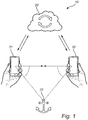
- the system comprises: a server managing the persistent AR environment; and a first and second device connected to the server and configured for displaying the persistent AR environment, each device being configured to transmit to the server data indicating a position and angular orientation of the device compared to the anchor point; wherein the server is configured to detect whether the first and second device are oriented towards each other and if so, to sync the persistent AR environments of the first and second device with each other.
- persistent AR environment should, in the context of present specification, be understood as an AR environment that lasts over an extended period of time and potentially over a plurality of sessions, regardless of whether or not a specific session has ended.
- virtual objects being connected to and managed by the anchor point, remain in the same location in which they were previously positioned in the real world space.
- the persistent AR environment is managed by a server that is in connection with a memory for storing the state of the AR environment between sessions. Possible use cases include leaving virtual notes or objects at specific places in the AR environment that remain for later.
- managing the persistent AR environment should, in the context of present specification, be understood as storing and updating the persistent AR environment as it changes and potentially keeping track of users of the persistent AR environment and transmitting data related to the persistent AR environment to the users. This comprises storing virtual models and their position in the real-world space and serving visual data that allows the users to experience the virtual models in their corresponding position in the real-world space.
- each device will display the same AR environment and any modification made on one device will show up on the other.
- the first and second devices will be connected to a same instance of the persistent AR environment and thus modifications on the AR environment made by either of the two devices will be shown on the both devices.
- communication between the two devices in the AR environment may be possible after syncing.
- the detection of whether the first and second device are oriented towards each other comprises checking, by the server, if the first device has an angular orientation directed towards the position of the second device and vice versa.
- the detection of whether the first and second device are oriented towards each other further comprises measuring how close a line with the angular orientation of the first device starting from the position of the first device comes to the position of the second device and vice versa; and wherein the server is further configured to only sync the persistent AR environments of the first and second device with each other if the respective lines are closer to the respective device than an aligning threshold.
- the aligning threshold is dependent on the number of devices connected to the server, such that a higher number of devices lowers the aligning threshold.
- the detection of whether the first and second device are oriented towards each other comprises checking for how long the devices are oriented towards each other; and wherein the server is further configured to only sync the persistent AR environments of the first and second device with each other if the devices have been oriented towards each other for longer than a time threshold.
- the time threshold is user-dependent.
- a user-dependent time threshold is beneficial in that a user may have more trouble keeping a device steady than another user, for instance due to a disability.
- the user-dependent threshold may be a setting specific to a device or user or automatically adjusted based on user history, such that a user having a history of turning away their device just before the time threshold is reached may automatically have their time threshold lowered.
- the server is further configured to transmit a verification to the first and second device and only sync the persistent AR environments of the first and second device with each other if the verifications have been approved by the first and second device.
- a verification is beneficial in that it reduces the downsides of false positive connections, thereby possibly allowing for looser thresholds for determining that the first and second device are oriented towards each other. However, verifications may become annoying if the thresholds are made too loose.
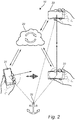
- the system further comprises a third device connected to the server and configured for displaying the persistent AR environment, the third device being configured to transmit to the server data indicating a position and angular orientation of the device compared to the anchor point; wherein if the persistent AR environments of the first and second device are synched, the server is configured to detect whether either of the first and second device is oriented towards the third device and vice versa and if so, to sync the persistent AR environments of the first, second and third device with each other.
- Syncing the persistent AR environments of the first, second and third device with each other based only on if either of the first and second device is oriented towards the third device and vice versa is beneficial in that it is a simple and intuitive way for creating groups of devices with more than two devices.
- the teachings of this embodiment may extend to sync further devices such as a fourth and/or fifth device in a similar manner.
- the method further comprises a transmitting step performed by the server, the step comprising transmitting persistent AR environment data to the first and second device.
- the transmitting step is beneficial in that it reduces the requirements and processor load of the devices.
- the detecting step further comprises measuring how close a line with the angular orientation of the first device starting from the position of the first device comes to the position of the second device and vice versa; wherein the syncing step only occurs if the respective lines are closer to the respective devices than an aligning threshold; and wherein the aligning threshold may be dependent on the number of devices connected to the server, such that a higher number of devices lowers the aligning threshold.
- a server implementing the method of the second aspect.
- a computer program product comprising a non-transitory computer-readable storage medium with instructions adapted to carry out the method of the second aspect when executed by a device having processing capabilities.
- the server 20 is further configured to sync the persistent AR environments of the first and second device 31, 32 with each other.
- each device 31, 32 will display the same AR environment and any modification made on one device 31, 32 will show up on the other. This allows the devices 31, 32 to sync without exchange of any personal information of the users of the devices 31, 32 in a simple and intuitive way.
- the synching may involve connecting the second device to the instance of the AR environment that the first device is already connected to or vice versa.
- the choice of which device that connects to which device AR environment may be predetermined or be the result of input from one or both of the devices.
- the first and second devices are both connected to a new (same) instance of the AR environment.
- the aligning threshold is beneficial in that a threshold allows for a variable margin for error and makes it easier for users to connect with each other.
- a suitable aligning threshold may correspond to a few degrees of geometric coordinates, such as 2-10 or 3-5 degrees, though the threshold may be calculated in any coordinate system.
- a balance should be found between making it easy enough to sync devices 31, 32 that want to be synced without frustration and making it hard enough to not accidentally sync devices that do not want to be synced, i.e. false positive results.
- a time threshold is beneficial in that it reduces the possibility for false positives and may be around 3 seconds, such as 1 second, 2 seconds, 4 seconds or 5 seconds.
- a combination of an aligning threshold and time threshold has synergistic effects in that the aligning threshold lowers the aligning requirements and thereby makes it easier for users that want to connect with each other to sync their devices 31, 32 at the cost of increasing the possibility for false positives; while the time threshold reduces the possibility for false positives.
- the time threshold may be user-dependent.
- a user-dependent time threshold is beneficial in that a user may have more trouble keeping a device 31, 32 steady than another user, for instance due to a disability or the type of device 31, 32 used.
- the user-dependent threshold may be a setting specific to a device 31, 32 or user or automatically adjusted based on user history, such that a user having a history of turning away their device just before the time threshold is reached may automatically have their time threshold lowered.
- the system 10 further comprises a third device 33 connected to the server 20 and configured for displaying the persistent AR environment, the third device 33 being configured to transmit to the server 20 data indicating a position and angular orientation of the device compared to the anchor point 22.
- the third device 33 is analogous to the first and second device 31, 32.
- the server 20 is configured to detect whether either of the first and second device 31, 32 is oriented towards the third device 33 and vice versa. This detection functions as previously described in relation to Fig. 1 .
- the third device 33 only needs to be oriented towards one of the synced devices 31, 32. This simplifies the creation of a group.
- a fourth device 34 may connect to the group of the first, second and third device 31, 32, 33 and so on.
- a similar embodiment concerns two groups of users, each having two synced devices.
- a first group comprises the first and second device 31, 32 and a second group comprises the third and fourth device 33, 34. If one of the devices 31, 32 of the first group is oriented towards one of the devices 33, 34 of the second group and vice versa, the server 20 is configured to sync the persistent AR environments of the first and second group with each other, i.e. connecting the first, second, third and fourth device 31, 32, 33, 34 with each other. This is an efficient way to create large groups of connected devices.
- the method 100 comprises a receiving step S120 comprising receiving data indicating a position and angular orientation compared to the anchor point 22 of a first and second device 31, 32 connected to the server 20.
- the detecting step S130 may further comprise measuring how close a line with the angular orientation of the first device 31 starting from the position of the first device 31 comes to the position of the second device 32 and vice versa. In these embodiments, the detecting step S130 further comprises checking whether the respective lines are closer to the respective devices 31, 32 than an aligning threshold, which may impact further steps, such as a syncing step S150.
- the method 100 comprises a syncing step S150 comprising syncing the persistent AR environments of the first and second device 31, 32 with each other.
- the syncing step S150 is affected by a number of factors dependent on the previous steps of the method 100, primarily the detecting step S130 and possibly the verification step S140.
- the syncing step S150 may further only occur if the verifications of the verification step 140 have been approved by the first and second device 31, 32.
- the method 100 may further comprise extra steps relating to further devices, such as a third device 33 as in Fig. 2 .
- the method 100 comprises an additional receiving step S125 comprising receiving data indicating a position and angular orientation compared to the anchor point 22 of a third device 33 connected to the server 20.
- This step S125 is similar to the regular receiving step S120 and may be improved in similar manners.
Landscapes
- Engineering & Computer Science (AREA)
- Computer Networks & Wireless Communication (AREA)
- Signal Processing (AREA)
- General Engineering & Computer Science (AREA)
- Theoretical Computer Science (AREA)
- Human Computer Interaction (AREA)
- Physics & Mathematics (AREA)
- General Physics & Mathematics (AREA)
- User Interface Of Digital Computer (AREA)
- Information Transfer Between Computers (AREA)
Priority Applications (5)
| Application Number | Priority Date | Filing Date | Title |
|---|---|---|---|
| EP20176578.1A EP3916522A1 (fr) | 2020-05-26 | 2020-05-26 | Système, procédé et produit programme informatique permettant de connecter les utilisateurs à un environnement de ra persistant |
| PCT/EP2021/064026 WO2021239799A1 (fr) | 2020-05-26 | 2021-05-26 | Système, procédé, dispositif et produit programme informatique pour connecter des utilisateurs à un environnement ar persistant |
| US17/331,318 US20210377365A1 (en) | 2020-05-26 | 2021-05-26 | System, method, device and computer program product for connecting users to a persistent ar environment |
| CN202180038009.XA CN115668103A (zh) | 2020-05-26 | 2021-05-26 | 用于将用户连接至持久ar环境的系统、方法、设备和计算机程序产品 |
| EP21726943.0A EP4158449B1 (fr) | 2020-05-26 | 2021-05-26 | Système, procédé et produit programme informatique permettant de connecter les utilisateurs à un environnement de ra persistant |
Applications Claiming Priority (1)
| Application Number | Priority Date | Filing Date | Title |
|---|---|---|---|
| EP20176578.1A EP3916522A1 (fr) | 2020-05-26 | 2020-05-26 | Système, procédé et produit programme informatique permettant de connecter les utilisateurs à un environnement de ra persistant |
Publications (1)
| Publication Number | Publication Date |
|---|---|
| EP3916522A1 true EP3916522A1 (fr) | 2021-12-01 |
Family
ID=70857107
Family Applications (2)
| Application Number | Title | Priority Date | Filing Date |
|---|---|---|---|
| EP20176578.1A Withdrawn EP3916522A1 (fr) | 2020-05-26 | 2020-05-26 | Système, procédé et produit programme informatique permettant de connecter les utilisateurs à un environnement de ra persistant |
| EP21726943.0A Active EP4158449B1 (fr) | 2020-05-26 | 2021-05-26 | Système, procédé et produit programme informatique permettant de connecter les utilisateurs à un environnement de ra persistant |
Family Applications After (1)
| Application Number | Title | Priority Date | Filing Date |
|---|---|---|---|
| EP21726943.0A Active EP4158449B1 (fr) | 2020-05-26 | 2021-05-26 | Système, procédé et produit programme informatique permettant de connecter les utilisateurs à un environnement de ra persistant |
Country Status (4)
| Country | Link |
|---|---|
| US (1) | US20210377365A1 (fr) |
| EP (2) | EP3916522A1 (fr) |
| CN (1) | CN115668103A (fr) |
| WO (1) | WO2021239799A1 (fr) |
Families Citing this family (2)
| Publication number | Priority date | Publication date | Assignee | Title |
|---|---|---|---|---|
| US10838600B2 (en) | 2018-02-12 | 2020-11-17 | Wayfair Llc | Systems and methods for providing an extended reality interface |
| US11557060B2 (en) | 2018-11-05 | 2023-01-17 | Wayfair Llc | Systems and methods for scanning three-dimensional objects |
Citations (2)
| Publication number | Priority date | Publication date | Assignee | Title |
|---|---|---|---|---|
| US20170345167A1 (en) * | 2016-05-31 | 2017-11-30 | Microsoft Technology Licensing, Llc | Systems and methods for utilizing anchor graphs in mixed reality environments |
| US20190340836A1 (en) * | 2018-05-07 | 2019-11-07 | Google Llc | Systems and Methods for Anchoring Virtual Objects to Physical Locations |
Family Cites Families (56)
| Publication number | Priority date | Publication date | Assignee | Title |
|---|---|---|---|---|
| US8730156B2 (en) * | 2010-03-05 | 2014-05-20 | Sony Computer Entertainment America Llc | Maintaining multiple views on a shared stable virtual space |
| US20080182513A1 (en) * | 2007-01-29 | 2008-07-31 | Hassan Amer A | High Frequency Communications |
| US20090286479A1 (en) * | 2008-05-16 | 2009-11-19 | Sony Ericsson Mobile Communications Ab | Method and system for sensory pairing for a portable communication device |
| US9424583B2 (en) * | 2009-10-15 | 2016-08-23 | Empire Technology Development Llc | Differential trials in augmented reality |
| KR101082285B1 (ko) * | 2010-01-29 | 2011-11-09 | 주식회사 팬택 | 증강 현실 제공 단말기 및 방법 |
| US8251819B2 (en) * | 2010-07-19 | 2012-08-28 | XMG Studio | Sensor error reduction in mobile device based interactive multiplayer augmented reality gaming through use of one or more game conventions |
| US9142062B2 (en) * | 2011-03-29 | 2015-09-22 | Qualcomm Incorporated | Selective hand occlusion over virtual projections onto physical surfaces using skeletal tracking |
| US8861310B1 (en) * | 2011-03-31 | 2014-10-14 | Amazon Technologies, Inc. | Surface-based sonic location determination |
| US8804460B1 (en) * | 2011-03-31 | 2014-08-12 | Amazon Technologies, Inc. | Ultrasonic location determination |
| US8493353B2 (en) * | 2011-04-13 | 2013-07-23 | Longsand Limited | Methods and systems for generating and joining shared experience |
| WO2013034070A1 (fr) * | 2011-09-05 | 2013-03-14 | 联想(北京)有限公司 | Procédé d'affichage, dispositif terminal et système à multiples dispositifs terminaux |
| US9674661B2 (en) * | 2011-10-21 | 2017-06-06 | Microsoft Technology Licensing, Llc | Device-to-device relative localization |
| US9342139B2 (en) * | 2011-12-19 | 2016-05-17 | Microsoft Technology Licensing, Llc | Pairing a computing device to a user |
| US20130194304A1 (en) * | 2012-02-01 | 2013-08-01 | Stephen Latta | Coordinate-system sharing for augmented reality |
| US9191798B2 (en) * | 2012-03-09 | 2015-11-17 | Nokia Technologies Oy | Methods, apparatuses, and computer program products for saving and resuming a state of a collaborative interaction session between devices based on their positional relationship |
| KR101959347B1 (ko) * | 2012-05-25 | 2019-03-18 | 삼성전자주식회사 | 복수의 통신 단말을 이용한 다중 디스플레이 방법, 기계로 읽을 수 있는 저장 매체 및 통신 단말 |
| US9801004B2 (en) * | 2012-06-29 | 2017-10-24 | Intel Corporation | Device, method, and system for securely pairing mobile communication devices using movement |
| SG11201501436UA (en) * | 2012-08-29 | 2015-05-28 | Silverlake Mobility Ecosystem Sdn Bhd | Method of pairing mobile devices |
| CN103105993B (zh) * | 2013-01-25 | 2015-05-20 | 腾讯科技(深圳)有限公司 | 基于增强现实技术实现互动的方法和系统 |
| US9846965B2 (en) * | 2013-03-15 | 2017-12-19 | Disney Enterprises, Inc. | Augmented reality device with predefined object data |
| US9723035B1 (en) * | 2013-04-08 | 2017-08-01 | Amazon Technologies, Inc. | Real-time meeting attendance reporting |
| WO2015097792A1 (fr) * | 2013-12-25 | 2015-07-02 | 富士通株式会社 | Appareil, procédé et programme d'appariement |
| US20150193982A1 (en) * | 2014-01-03 | 2015-07-09 | Google Inc. | Augmented reality overlays using position and orientation to facilitate interactions between electronic devices |
| US10335677B2 (en) * | 2014-12-23 | 2019-07-02 | Matthew Daniel Fuchs | Augmented reality system with agent device for viewing persistent content and method of operation thereof |
| CN106805974A (zh) * | 2015-12-01 | 2017-06-09 | 原相科技股份有限公司 | 呼吸探测装置及其操作方法 |
| CN106936884B (zh) * | 2015-12-31 | 2021-05-07 | 阿里巴巴集团控股有限公司 | 跨移动终端的内容分享方法、装置和系统 |
| US9980307B2 (en) * | 2016-03-21 | 2018-05-22 | Motorola Solutions, Inc. | Method and apparatus for orientation-based pairing of devices |
| US10338392B2 (en) * | 2016-06-13 | 2019-07-02 | Microsoft Technology Licensing, Llc | Identification of augmented reality image display position |
| US10234935B2 (en) * | 2016-08-11 | 2019-03-19 | Microsoft Technology Licensing, Llc | Mediation of interaction methodologies in immersive environments |
| US11395253B2 (en) * | 2016-12-23 | 2022-07-19 | Telefonaktiebolaget Lm Ericsson (Publ) | Communication nodes and methods for relative positioning of wireless communication devices |
| US10416333B2 (en) * | 2017-05-19 | 2019-09-17 | Microsoft Technology Licensing, Llc | Magnetic tracker with dual-transmit frequency |
| GB2563004A (en) * | 2017-05-23 | 2018-12-05 | Nokia Technologies Oy | Methods and apparatuses for handling visual virtual reality content |
| US20190176341A1 (en) * | 2017-06-19 | 2019-06-13 | Jungeng Mei | Movable robot capable of providing a projected interactive user interface |
| DE102017006849A1 (de) * | 2017-07-21 | 2019-01-24 | Lukas HEINDL | Verfahren zum Bestimmen der relativen Positionen mindestens zweier mobiler Endgeräte zueinander |
| EP3676656B1 (fr) * | 2018-01-18 | 2025-12-10 | Samsung Electronics Co., Ltd. | Procédé et appareil permettant d'ajuster un contenu de réalité augmentée |
| JP6988531B2 (ja) * | 2018-02-06 | 2022-01-05 | トヨタ自動車株式会社 | ロボット |
| WO2019168886A1 (fr) * | 2018-03-02 | 2019-09-06 | Purdue Research Foundation | Système et procédé de mappage spatial d'objets intelligents dans des scènes de réalité augmentée |
| JP6785385B2 (ja) * | 2018-03-07 | 2020-11-18 | マジック リープ, インコーポレイテッドMagic Leap,Inc. | 周辺デバイスの視覚的追跡 |
| CN112384880A (zh) * | 2018-05-03 | 2021-02-19 | Pcms控股公司 | 用于vr体验的基于物理接近度和/或姿势的链接的系统和方法 |
| US10713849B2 (en) * | 2018-05-29 | 2020-07-14 | International Business Machines Corporation | Augmented reality masking |
| US10854004B2 (en) * | 2018-08-24 | 2020-12-01 | Facebook, Inc. | Multi-device mapping and collaboration in augmented-reality environments |
| US10719989B2 (en) * | 2018-08-24 | 2020-07-21 | Facebook, Inc. | Suggestion of content within augmented-reality environments |
| US20200066046A1 (en) * | 2018-08-24 | 2020-02-27 | Facebook, Inc. | Sharing and Presentation of Content Within Augmented-Reality Environments |
| US11432697B2 (en) * | 2018-09-06 | 2022-09-06 | Lg Electronics Inc. | Robot cleaner and a controlling method for the same |
| WO2020050494A1 (fr) * | 2018-09-06 | 2020-03-12 | Lg Electronics Inc. | Robot nettoyeur et son procédé de commande |
| US10678492B1 (en) * | 2018-11-27 | 2020-06-09 | International Business Machines Corporation | Co-located augmented reality sharing between augmented reality devices |
| US10547974B1 (en) * | 2019-03-19 | 2020-01-28 | Microsoft Technology Licensing, Llc | Relative spatial localization of mobile devices |
| US10852915B1 (en) * | 2019-05-06 | 2020-12-01 | Apple Inc. | User interfaces for sharing content with other electronic devices |
| JP2020204989A (ja) * | 2019-06-19 | 2020-12-24 | ソニー株式会社 | 情報処理装置および情報処理方法、並びにプログラム |
| US20200410764A1 (en) * | 2019-06-28 | 2020-12-31 | Snap Inc. | Real-time augmented-reality costuming |
| US10904668B1 (en) * | 2019-08-20 | 2021-01-26 | Plantronics, Inc. | Interrupt based pairing for wireless audio devices |
| US20210052159A1 (en) * | 2019-08-22 | 2021-02-25 | Qualcomm Incorporated | Techniques for providing health assistance information |
| WO2021104203A1 (fr) * | 2019-11-27 | 2021-06-03 | Guangdong Oppo Mobile Telecommunications Corp., Ltd. | Association de systèmes de coordonnées de dispositifs dans un système de réalité augmentée multi-personne |
| US11488358B2 (en) * | 2020-02-05 | 2022-11-01 | Snap Inc. | Augmented reality session creation using skeleton tracking |
| US11771982B2 (en) * | 2020-02-14 | 2023-10-03 | Real Tech, Llc. | Systems and methods for augmented reality role playing entertainment |
| EP4145397A4 (fr) * | 2020-04-30 | 2024-03-27 | Virtualwindow Co., Ltd. | Dispositif de terminal de communication, procédé de communication, et programme de logiciel |
-
2020
- 2020-05-26 EP EP20176578.1A patent/EP3916522A1/fr not_active Withdrawn
-
2021
- 2021-05-26 WO PCT/EP2021/064026 patent/WO2021239799A1/fr not_active Ceased
- 2021-05-26 CN CN202180038009.XA patent/CN115668103A/zh active Pending
- 2021-05-26 US US17/331,318 patent/US20210377365A1/en active Pending
- 2021-05-26 EP EP21726943.0A patent/EP4158449B1/fr active Active
Patent Citations (2)
| Publication number | Priority date | Publication date | Assignee | Title |
|---|---|---|---|---|
| US20170345167A1 (en) * | 2016-05-31 | 2017-11-30 | Microsoft Technology Licensing, Llc | Systems and methods for utilizing anchor graphs in mixed reality environments |
| US20190340836A1 (en) * | 2018-05-07 | 2019-11-07 | Google Llc | Systems and Methods for Anchoring Virtual Objects to Physical Locations |
Also Published As
| Publication number | Publication date |
|---|---|
| WO2021239799A1 (fr) | 2021-12-02 |
| CN115668103A (zh) | 2023-01-31 |
| US20210377365A1 (en) | 2021-12-02 |
| EP4158449A1 (fr) | 2023-04-05 |
| EP4158449B1 (fr) | 2026-03-04 |
| EP4158449C0 (fr) | 2026-03-04 |
Similar Documents
| Publication | Publication Date | Title |
|---|---|---|
| US11551377B2 (en) | Eye gaze tracking using neural networks | |
| US11704878B2 (en) | Surface aware lens | |
| KR102836642B1 (ko) | 중복 추적 시스템 | |
| US10466777B2 (en) | Private real-time communication between meeting attendees during a meeting using one or more augmented reality headsets | |
| US10636185B2 (en) | Information processing apparatus and information processing method for guiding a user to a vicinity of a viewpoint | |
| US8803800B2 (en) | User interface control based on head orientation | |
| US11314326B2 (en) | Information processing device, information processing method, and program for determining a user gaze | |
| US12175702B2 (en) | Information processing device, information processing method, and recording medium | |
| EP4158449B1 (fr) | Système, procédé et produit programme informatique permettant de connecter les utilisateurs à un environnement de ra persistant | |
| US20100245538A1 (en) | Methods and devices for receiving and transmitting an indication of presence | |
| US9448622B2 (en) | Information processing apparatus, information processing method, and program for generating feedback to an operator regarding positional relationship of other users near a display | |
| US20180272236A1 (en) | Mobile game experience | |
| CN107982916B (zh) | 信息处理方法、装置、电子设备及存储介质 | |
| TWI764366B (zh) | 基於光通信裝置的互動方法和系統 | |
| US11176375B2 (en) | Smart glasses lost object assistance | |
| US11741621B2 (en) | Method and system for detecting plane information | |
| JP6487545B2 (ja) | 認知度算出装置、認知度算出方法及び認知度算出プログラム | |
| US11887151B2 (en) | Method and apparatus for providing advertisement disclosure for identifying advertisements in 3-dimensional space | |
| US20180191998A1 (en) | Video communication method and system | |
| KR102430464B1 (ko) | 혼합현실 체험 시스템 및 그 제어방법 | |
| WO2021106671A1 (fr) | Dispositif de traitement d'informations, procédé de traitement d'informations et programme |
Legal Events
| Date | Code | Title | Description |
|---|---|---|---|
| PUAI | Public reference made under article 153(3) epc to a published international application that has entered the european phase |
Free format text: ORIGINAL CODE: 0009012 |
|
| STAA | Information on the status of an ep patent application or granted ep patent |
Free format text: STATUS: THE APPLICATION HAS BEEN PUBLISHED |
|
| AK | Designated contracting states |
Kind code of ref document: A1 Designated state(s): AL AT BE BG CH CY CZ DE DK EE ES FI FR GB GR HR HU IE IS IT LI LT LU LV MC MK MT NL NO PL PT RO RS SE SI SK SM TR |
|
| B565 | Issuance of search results under rule 164(2) epc |
Effective date: 20201026 |
|
| STAA | Information on the status of an ep patent application or granted ep patent |
Free format text: STATUS: THE APPLICATION IS DEEMED TO BE WITHDRAWN |
|
| 18D | Application deemed to be withdrawn |
Effective date: 20220602 |