EP3916672A1 - Système et procédé d'examen d'objets à la recherche d'erreurs - Google Patents
Système et procédé d'examen d'objets à la recherche d'erreurs Download PDFInfo
- Publication number
- EP3916672A1 EP3916672A1 EP20177525.1A EP20177525A EP3916672A1 EP 3916672 A1 EP3916672 A1 EP 3916672A1 EP 20177525 A EP20177525 A EP 20177525A EP 3916672 A1 EP3916672 A1 EP 3916672A1
- Authority
- EP
- European Patent Office
- Prior art keywords
- recognition
- designed
- error
- result
- module
- Prior art date
- Legal status (The legal status is an assumption and is not a legal conclusion. Google has not performed a legal analysis and makes no representation as to the accuracy of the status listed.)
- Pending
Links
Images


Classifications
-
- G—PHYSICS
- G06—COMPUTING OR CALCULATING; COUNTING
- G06T—IMAGE DATA PROCESSING OR GENERATION, IN GENERAL
- G06T7/00—Image analysis
- G06T7/0002—Inspection of images, e.g. flaw detection
- G06T7/0004—Industrial image inspection
- G06T7/0006—Industrial image inspection using a design-rule based approach
-
- G—PHYSICS
- G06—COMPUTING OR CALCULATING; COUNTING
- G06T—IMAGE DATA PROCESSING OR GENERATION, IN GENERAL
- G06T7/00—Image analysis
- G06T7/0002—Inspection of images, e.g. flaw detection
- G06T7/0004—Industrial image inspection
-
- G—PHYSICS
- G06—COMPUTING OR CALCULATING; COUNTING
- G06T—IMAGE DATA PROCESSING OR GENERATION, IN GENERAL
- G06T7/00—Image analysis
- G06T7/70—Determining position or orientation of objects or cameras
- G06T7/73—Determining position or orientation of objects or cameras using feature-based methods
- G06T7/74—Determining position or orientation of objects or cameras using feature-based methods involving reference images or patches
-
- B—PERFORMING OPERATIONS; TRANSPORTING
- B64—AIRCRAFT; AVIATION; COSMONAUTICS
- B64U—UNMANNED AERIAL VEHICLES [UAV]; EQUIPMENT THEREFOR
- B64U2101/00—UAVs specially adapted for particular uses or applications
- B64U2101/30—UAVs specially adapted for particular uses or applications for imaging, photography or videography
-
- G—PHYSICS
- G06—COMPUTING OR CALCULATING; COUNTING
- G06T—IMAGE DATA PROCESSING OR GENERATION, IN GENERAL
- G06T2207/00—Indexing scheme for image analysis or image enhancement
- G06T2207/10—Image acquisition modality
- G06T2207/10032—Satellite or aerial image; Remote sensing
-
- G—PHYSICS
- G06—COMPUTING OR CALCULATING; COUNTING
- G06T—IMAGE DATA PROCESSING OR GENERATION, IN GENERAL
- G06T2207/00—Indexing scheme for image analysis or image enhancement
- G06T2207/20—Special algorithmic details
- G06T2207/20081—Training; Learning
-
- G—PHYSICS
- G06—COMPUTING OR CALCULATING; COUNTING
- G06T—IMAGE DATA PROCESSING OR GENERATION, IN GENERAL
- G06T2207/00—Indexing scheme for image analysis or image enhancement
- G06T2207/20—Special algorithmic details
- G06T2207/20084—Artificial neural networks [ANN]
-
- G—PHYSICS
- G06—COMPUTING OR CALCULATING; COUNTING
- G06T—IMAGE DATA PROCESSING OR GENERATION, IN GENERAL
- G06T2207/00—Indexing scheme for image analysis or image enhancement
- G06T2207/30—Subject of image; Context of image processing
- G06T2207/30108—Industrial image inspection
- G06T2207/30132—Masonry; Concrete
-
- G—PHYSICS
- G06—COMPUTING OR CALCULATING; COUNTING
- G06T—IMAGE DATA PROCESSING OR GENERATION, IN GENERAL
- G06T2207/00—Indexing scheme for image analysis or image enhancement
- G06T2207/30—Subject of image; Context of image processing
- G06T2207/30181—Earth observation
- G06T2207/30184—Infrastructure
-
- Y—GENERAL TAGGING OF NEW TECHNOLOGICAL DEVELOPMENTS; GENERAL TAGGING OF CROSS-SECTIONAL TECHNOLOGIES SPANNING OVER SEVERAL SECTIONS OF THE IPC; TECHNICAL SUBJECTS COVERED BY FORMER USPC CROSS-REFERENCE ART COLLECTIONS [XRACs] AND DIGESTS
- Y02—TECHNOLOGIES OR APPLICATIONS FOR MITIGATION OR ADAPTATION AGAINST CLIMATE CHANGE
- Y02B—CLIMATE CHANGE MITIGATION TECHNOLOGIES RELATED TO BUILDINGS, e.g. HOUSING, HOUSE APPLIANCES OR RELATED END-USER APPLICATIONS
- Y02B10/00—Integration of renewable energy sources in buildings
- Y02B10/30—Wind power
Definitions
- the present invention relates to a system and a method for examining objects for errors.
- a technical problem in using machine-learning based recognition methods to detect errors, anomalies and other deviations associated with objects consists in training a machine learning system to recognize the errors as such a system suffers from unexpected/untrained events that can occur.
- a system trained for a given set of errors e.g. a neuronal network
- the complexity of the errors the use of trained networks becomes a challenge if the error detection has to be done with a restricted inspection device.
- the time to train for errors and the amount of data for every erroneous situation requires a lot resources until the neuronal network can be deployed and still untrained errors may not be detected.
- the training of all possible errors is very resource-consuming and may be even impossible.
- One objective of the present invention is to provide an improved system and an improved method for examining an object for errors. This objective is solved by a system and a method for examining an object for errors with the features of the independent claims, respectively. Advantageous embodiments are specified within the dependent claims.
- a system for examining at least one object for errors comprises a monitoring device, a processing module, a capturing device and a recognition module.
- the monitoring device is designed to monitor at least one parameter.
- a specified range of the parameter defines a context within which a result of a recognition of at least parts of the object is expected.
- the processing module is designed to prove whether the monitored parameter is within the specified range and in this case to trigger the capturing device.
- the capturing device is designed to capture input data associated with at least parts of the object.
- the recognition module is pre-trained for recognizing at least parts of the object and to perform the recognition of at least parts of the object based on the input data.
- the recognition module is designed to detect an error if a result of the recognition is not corresponding to the expected result.
- the system is based on the idea that in real scenarios a context can be used for the recognition. Also, there is an expected recognition result which is linked to the context. This context is given by the specified range of the parameter.
- performing the recognition within the context enables an efficient detection of errors associated with the object.
- the system can run on edge devices or devices with limited computing capacity.
- the system can be part of a mobile apparatus.
- the monitoring device is designed to monitor a location of the system.
- the recognition module is designed to detect an error if the system is within a specified region of the object and a result of the recognition is not corresponding to the expected result.
- the location of the system represents the parameter.
- the specified region of the object represents the context.
- the object is only expected to be present, if the system is within the specified region of the object. If the pre-trained recognition module is not able to detect the object or at least parts of the object although the system is within the specified region it is assumed that an error is present associated with the object which represents an unexpected event for the recognition module as it has not been trained for.
- the monitoring device is designed to monitor an orientation of the capturing device.
- the recognition module is designed to detect an error if the capturing device is oriented according to a specified orientation range with respect to the object and a result of the recognition is not corresponding to the expected result.
- the orientation of the capturing device represents the parameter.
- the specified orientation range of the object represents the context.
- the object or at least parts of the object can only be captured, if the capturing device is oriented according to the specified orientation range with respect to the object. If the pre-trained recognition module is not able to detect the object or at least parts of the object although the capturing device is oriented according to the specified orientation range it is assumed that an error is present associated with the object.
- the monitoring device is designed to monitor a time as the parameter.
- the recognition module is designed to detect an error if the recognition module is performing the recognition within a specified time slot representing the context and a result of the recognition is not corresponding to the expected result.
- the object or at least parts of the object can only be captured, if the recognition module is performing the recognition within the specified time slot. If the pre-trained recognition module is not able to detect the object or at least parts of the object although the recognition module is performing the recognition within the specified time slot it is assumed that an error is present associated with the object.
- system comprises a communication module designed to transmit the input data to a controlling station if an error is detected.
- a communication module designed to transmit the input data to a controlling station if an error is detected.
- the system comprises a plurality of error modules.
- Each error module is pre-trained for a recognition of a specific error.
- the system is designed to perform an error recognition by triggering the error modules sequentially.
- the system can be designed to trigger a certain error module which is trained for the recognition of a specific error which is occurring most frequently compared to other known errors, first.
- a certain error module which is trained for the recognition of a specific error which is occurring most frequently compared to other known errors, first.
- the system can be expanded by adding further error modules, e.g. after the appearance of new types of errors.
- a mobile apparatus comprises a system for examining at least one object for errors according to one of above describe embodiments.
- the mobile apparatus is a drone.
- the capturing device is a camera.
- the recognition module is a neuronal network pre-trained for recognizing at least one intact wind turbine based on at least one image captured by the camera.
- the monitoring device is designed to monitor a location of the drone and an orientation of the camera.
- the recognition module is designed to detect an error if the drone is within a specified region of the wind turbine, the camera is oriented according to a specified orientation range with respect to the wind turbine and a result of the recognition is not corresponding to the expected result of at least one intact wind turbine.
- a method for examining at least one object for errors comprises the following steps. At least one parameter is monitored. A specified range of the parameter defines a context within which a result of a recognition of at least parts of the object is expected. It is proved whether the monitored parameter is within the specified range. Input data associated with at least parts of the object are captured if the parameter is within the specified range. A recognition of at least parts of the object is performed based on the input data. An error is detected if a result of the recognition is not corresponding to the expected result.
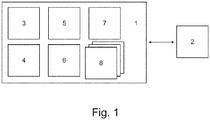
- Fig. 1 schematically shows a system 1 for examining at least one object 2 for errors.
- the object 2 may be any apparatus or any system, e.g. the object 2 can be a wind turbine. However, the object 2 can also e.g. be any industrial production facility and/or industrial product or e.g. a building. There may be different errors associated with the object 2, e.g. mechanical damages and/or other technical failures may occur. An error can also consist in another undesirable condition of the object 2, e.g. an error can consist in a delayed arrival of a product.
- the system 1 can e.g. be part of a mobile apparatus.
- the system can e.g. be part of a vehicle or a drone which can be used for the purpose of the detection of errors associated with the object 2.
- the system 1 may be also part of an immobile apparatus, e.g. a stationary surveillance system.
- the system 1 comprises a monitoring device 3.
- the monitoring device 3 is designed to monitor at least one parameter.
- a specified range of the parameter defines a context within which a result of a recognition of at least parts of the object 2 is expected.
- the context can be used for the recognition as there is an expected recognition result which is linked to the context given by the specified range of the parameter.
- the monitoring device 3 is designed to monitor a location of the system 1.
- the monitoring device 3 can be a positioning and navigation system, e.g. a GPS based system.
- the context is given by a specified region of the object 2, i.e. the object 2 is expected to be present within the specified region.
- the capturing device 4 may also be another sensor.
- the monitoring device 3 is designed to monitor a time.
- the context is given by a specified time slot, e.g. within which a certain event is expected, e.g. the arrival of the object 2. If the object 2 is a wind turbine the context may be given by a time slot within which win conditions allow for proper and efficient operation.
- the monitoring device 3 is designed to monitor an orientation of a capturing device 4 of the system 1.
- the capturing device 4 is designed to capture input data associated with at least parts of the object 2.
- the capturing device 4 can e.g. be a camera designed to provide images and videos of the object 2.
- the system 1 comprises a processing module 5 designed to prove whether the monitored parameter is within the specified range. If this is the case, the processing module 5 is designed to trigger the capturing device 4 to capture the input data associated with the object 2. E.g. the capturing device 4 captures images and/or videos of the object 2.
- the system 1 comprises a recognition module 6.
- the recognition module 6 comprises a machine learning based algorithm, e.g. a neuronal network.
- a machine learning based algorithm e.g. a neuronal network.
- the recognition module 6 is pre-trained for recognizing at least parts of the object 2 and to perform the recognition of at least parts of the object 2 based on the input data captured and provided by the capturing device.
- the input data may be adapted prior to the recognition process.
- an image may be adapted to a neuronal network by scaling the image to a size which is compatible with the neuronal network.
- the recognition module 6 is designed to detect an error based on the input data if a result of the recognition is not corresponding to the expected result.
- the recognition module 6 is designed to detect an error if the system 1 is within a specified region of the object 2 and a result of the recognition is not corresponding to the expected result.
- the recognition module 6 can be designed to detect an error if the capturing device 4 is oriented according to a specified orientation range with respect to the object 2 and a result of the recognition is not corresponding to the expected result.
- the recognition module 6 can be designed to detect an error if the recognition module 6 is performing the recognition within a specified time slot and a result of the recognition is not corresponding to the expected result.
- Performing the recognition within the context enables an efficient detection of errors associated with the object 2. Also, there is no need to train the recognition module for all potential situations and errors which may occur, whereby a training time may be reduced. Furthermore, the necessity to provide training data for a plurality of errors is avoided. As the training of the recognition module 6 is kept simple and smaller than a complex training, the system 1 can run on edge devices or devices with limited computing capacity. Thus, the system 1 can be part of a mobile apparatus.
- the system 1 may also comprise a communication module 7.
- the communication module 1 can be designed to transmit information about detected errors and/or the captured input data to a controlling station for further examination.
- the system 1 can comprise a plurality of error modules 8.
- Each error module comprises a machine learning based algorithm, e.g. a neuronal network, which is pre-trained for a recognition of a specific error.
- the system 1 is designed to perform an error recognition by triggering the error modules 8 sequentially.
- the error modules 8 can be triggered by the processing module 5 after the recognition module 6 has detected an error. If a first error module detects its error type, information about the error can be transmitted to the controlling station, too. If the first error module fails to recognize the error it has been trained for, a second error module is triggered to perform its own error recognition. Thus, an efficient error recognition is enabled.
- Fig. 2 schematically shows method steps 11, 12, 13, 14, 15, 16, 17 of a method 9 for examining at least one object 2 for errors.
- a first method step 11 of the method 9 the at least one parameter is monitored.
- the specified range of the parameter defines the context within which a result of a recognition of at least parts of the object is expected.
- a second method step 12 it is proved whether the monitored parameter is within the specified range.
- the input data associated with at least parts of the object 2 is captured if the parameter is within the specified range.
- the recognition of at least parts of the object 2 is performed based on the input data.
- an error is detected if a result of the recognition is not corresponding to the expected result.
- the method may also comprise a sixth step 16 within which information about detected errors and/or the captured input data are transmitted to a controlling station for further examination.
- a sixth step 16 within which information about detected errors and/or the captured input data are transmitted to a controlling station for further examination.
- an error recognition is performed by triggering the error modules 8 sequentially.
- Fig. 3 schematically shows an exemplary embodiment of the system 1 and an exemplary object 2 which shall be examined for errors.
- the system 1 is part of a drone 10.
- the capturing device 4 is a camera 18 designed to capture images.
- the recognition module 6 which is not shown in Fig. 3 is a neuronal network pre-trained for recognizing at least one intact wind turbine 19 based on at least one image captured by the camera 18.
- the monitoring device 3 is designed to monitor a location of the drone 10 and an orientation of the camera 18.
- the recognition module 6 is designed to detect an error if the drone 10 is within a specified region of the wind turbine 19, the camera 18 is oriented according to a specified orientation range with respect to the wind turbine 19 and a result of the recognition is not corresponding to the expected result of at least one intact wind turbine 19.
- the recognition module 6 can be pre-trained for detecting a wind turbine 19 only if no parts of the wind turbine 19 are missing. If e.g. a blade 20 of the wind turbine 19 is missing, the recognition module 6 is not able to detect the wind turbine 19 as such. In this case, an error can be detected if the recognition is performed within the context given by the specified region of the wind turbine 19 and the specified orientation range with respect to the wind turbine 19 and a result of the recognition is not corresponding to the expected result of at least one intact wind turbine 19.
- the recognition module 6 e.g. may also be pre-trained for recognizing a proper operation of the wind turbine 19 within a specified time slot, e.g. when wind conditions are expected to enable an efficient operation of the wind turbine.
- the system 1 may also comprise error modules 8 not shown in Fig. 3 to perform an error recognition.
- one error module may be pre-trained for recognizing a wind turbine 19 with at least one missing blade 20.
- Another error module 8 may be pre-trained to differentiate wind turbines 19 which are in operation from those which are not, e.g. due to bad wind conditions.
- Information about a detected error can be sent to the controlling station 21 for further examination of the error. Also, information about recognized types of errors may be sent to the controlling station 21 in order to initiate a maintenance.
Landscapes
- Engineering & Computer Science (AREA)
- Computer Vision & Pattern Recognition (AREA)
- Physics & Mathematics (AREA)
- General Physics & Mathematics (AREA)
- Theoretical Computer Science (AREA)
- Quality & Reliability (AREA)
- Image Analysis (AREA)
- Aviation & Aerospace Engineering (AREA)
Priority Applications (2)
| Application Number | Priority Date | Filing Date | Title |
|---|---|---|---|
| EP20177525.1A EP3916672A1 (fr) | 2020-05-29 | 2020-05-29 | Système et procédé d'examen d'objets à la recherche d'erreurs |
| US17/329,053 US11983861B2 (en) | 2020-05-29 | 2021-05-24 | System and method for examining objects for errors |
Applications Claiming Priority (1)
| Application Number | Priority Date | Filing Date | Title |
|---|---|---|---|
| EP20177525.1A EP3916672A1 (fr) | 2020-05-29 | 2020-05-29 | Système et procédé d'examen d'objets à la recherche d'erreurs |
Publications (1)
| Publication Number | Publication Date |
|---|---|
| EP3916672A1 true EP3916672A1 (fr) | 2021-12-01 |
Family
ID=71092011
Family Applications (1)
| Application Number | Title | Priority Date | Filing Date |
|---|---|---|---|
| EP20177525.1A Pending EP3916672A1 (fr) | 2020-05-29 | 2020-05-29 | Système et procédé d'examen d'objets à la recherche d'erreurs |
Country Status (2)
| Country | Link |
|---|---|
| US (1) | US11983861B2 (fr) |
| EP (1) | EP3916672A1 (fr) |
Families Citing this family (1)
| Publication number | Priority date | Publication date | Assignee | Title |
|---|---|---|---|---|
| JP7847482B2 (ja) * | 2022-06-16 | 2026-04-17 | Ntn株式会社 | 制御装置、端末装置、管理システム、および管理方法 |
Family Cites Families (5)
| Publication number | Priority date | Publication date | Assignee | Title |
|---|---|---|---|---|
| JP7070659B2 (ja) * | 2018-03-13 | 2022-05-18 | 日本電気株式会社 | 移動体誘導装置、移動体誘導方法、及びプログラム |
| CA3045197C (fr) * | 2018-06-05 | 2023-05-23 | Tata Consultancy Services Limited | Systemes et methodes d'acquisition de donnees et d'inspection d'actifs en presence d'interference magnetique |
| US11508056B2 (en) * | 2019-02-28 | 2022-11-22 | Measure Global, Inc. | Drone inspection analytics for asset defect detection |
| CN110261394B (zh) * | 2019-06-24 | 2022-09-16 | 内蒙古工业大学 | 在线风机叶片损伤实时诊断系统和方法 |
| CN110751270A (zh) * | 2019-10-23 | 2020-02-04 | 广东工业大学 | 一种无人机电线故障检测方法、系统及设备 |
-
2020
- 2020-05-29 EP EP20177525.1A patent/EP3916672A1/fr active Pending
-
2021
- 2021-05-24 US US17/329,053 patent/US11983861B2/en active Active
Non-Patent Citations (5)
| Title |
|---|
| DATABASE COMPENDEX [online] ENGINEERING INFORMATION, INC., NEW YORK, NY, US; 1 January 2019 (2019-01-01), MORGENTHAL G ET AL: "Framework for automated UAS-based structural condition assessment of bridges", Database accession no. E20184506051063 * |
| DIMITRI DENHOF ET AL: "Automatic Optical Surface Inspection of Wind Turbine Rotor Blades using Convolutional Neural Networks", PROCEDIA CIRP, vol. 81, 1 January 2019 (2019-01-01), NL, pages 1166 - 1170, XP055741062, ISSN: 2212-8271, DOI: 10.1016/j.procir.2019.03.286 * |
| MORGENTHAL G ET AL: "Framework for automated UAS-based structural condition assessment of bridges", AUTOMATION IN CONSTRUCTION 20190101 ELSEVIER B.V. NLD, vol. 97, 1 January 2019 (2019-01-01), pages 77 - 95, DOI: 10.1016/J.AUTCON.2018.10.006 * |
| NORMAN HALLERMANN ET AL: "Visual inspection strategies for large bridges using Unmanned Aerial Vehicles (UAV)", IABMAS 2014, 11 July 2014 (2014-07-11), pages 1 - 7, XP055189691, DOI: 10.1201/b17063-96 * |
| STETCO ADRIAN ET AL: "Machine learning methods for wind turbine condition monitoring: A review", RENEWABLE ENERGY, PERGAMON PRESS, OXFORD, GB, vol. 133, 9 October 2018 (2018-10-09), pages 620 - 635, XP085591819, ISSN: 0960-1481, DOI: 10.1016/J.RENENE.2018.10.047 * |
Also Published As
| Publication number | Publication date |
|---|---|
| US20210374945A1 (en) | 2021-12-02 |
| US11983861B2 (en) | 2024-05-14 |
Similar Documents
| Publication | Publication Date | Title |
|---|---|---|
| EP2776815B1 (fr) | Système et procédé pour l'amélioration d'une interface d'utilisateur pour la détection automatique des défauts | |
| KR101708547B1 (ko) | 사상(事象) 검출 장치 및 사상 검출 방법 | |
| US11727578B2 (en) | Crowd type classification system, crowd type classification method and storage medium for storing crowd type classification program | |
| CN104966304A (zh) | 基于卡尔曼滤波与非参数背景模型的多目标检测跟踪方法 | |
| KR20180138558A (ko) | 객체 검출을 위한 영상분석 서버장치 및 방법 | |
| CN113469137A (zh) | 异常行为的识别方法、装置、存储介质及电子装置 | |
| US11983861B2 (en) | System and method for examining objects for errors | |
| US12488258B2 (en) | Data analysis and training data, generation device, system, method, and generation program | |
| US11544134B2 (en) | System and method for data-driven analytical redundancy relationships generation for early fault detection and isolation with limited data | |
| JP6595207B2 (ja) | 異常予兆検知システムおよび異常予兆検知方法 | |
| AU2018313669B2 (en) | Systems and methods for testing an automatic perception system | |
| CN112446434A (zh) | 基于图像识别的联锁设备检测方法及系统 | |
| CN118197027A (zh) | 一种基于管道预警的无人机调度查验方法以及相关装置 | |
| CN115063741A (zh) | 目标检测方法、装置、设备、介质及产品 | |
| CN116977922A (zh) | 一种搭载云服务器的车间工人检测系统 | |
| CN116002480A (zh) | 电梯轿厢内乘客意外摔倒的自动检测方法和系统 | |
| US20220269252A1 (en) | Method, apparatuses, computer program and medium including computer instructions for performing inspection of an item | |
| CN117043815A (zh) | 信息处理装置、信息处理方法以及程序 | |
| CN119440897B (zh) | 一种基于机器学习的群体机器人系统中分布式故障检测方法 | |
| CN117423255A (zh) | 一种输电线路跨越航道的预警方法及系统 | |
| CN111531582B (zh) | 一种基于视觉的工业机器人故障检测方法及系统 | |
| CN114945818B (zh) | 预测维护装置、预测维护方法及学习装置 | |
| CN114943884A (zh) | 基于深度学习的设备保护方法 | |
| CN118984979A (zh) | 基于人工智能模型的异常诊断方法、和异常诊断设备以及使用该设备的工厂监测系统 |
Legal Events
| Date | Code | Title | Description |
|---|---|---|---|
| PUAI | Public reference made under article 153(3) epc to a published international application that has entered the european phase |
Free format text: ORIGINAL CODE: 0009012 |
|
| STAA | Information on the status of an ep patent application or granted ep patent |
Free format text: STATUS: THE APPLICATION HAS BEEN PUBLISHED |
|
| AK | Designated contracting states |
Kind code of ref document: A1 Designated state(s): AL AT BE BG CH CY CZ DE DK EE ES FI FR GB GR HR HU IE IS IT LI LT LU LV MC MK MT NL NO PL PT RO RS SE SI SK SM TR |
|
| B565 | Issuance of search results under rule 164(2) epc |
Effective date: 20201109 |
|
| STAA | Information on the status of an ep patent application or granted ep patent |
Free format text: STATUS: REQUEST FOR EXAMINATION WAS MADE |
|
| RAP1 | Party data changed (applicant data changed or rights of an application transferred) |
Owner name: BULL SAS |
|
| 17P | Request for examination filed |
Effective date: 20220330 |
|
| RBV | Designated contracting states (corrected) |
Designated state(s): AL AT BE BG CH CY CZ DE DK EE ES FI FR GB GR HR HU IE IS IT LI LT LU LV MC MK MT NL NO PL PT RO RS SE SI SK SM TR |
|
| P01 | Opt-out of the competence of the unified patent court (upc) registered |
Effective date: 20230330 |
|
| STAA | Information on the status of an ep patent application or granted ep patent |
Free format text: STATUS: EXAMINATION IS IN PROGRESS |
|
| 17Q | First examination report despatched |
Effective date: 20241031 |