EP3916697A1 - Verfahren und vorrichtung zur vorhersage der trajektorie eines verkehrsteilnehmers und sensorsystem - Google Patents
Verfahren und vorrichtung zur vorhersage der trajektorie eines verkehrsteilnehmers und sensorsystem Download PDFInfo
- Publication number
- EP3916697A1 EP3916697A1 EP20176273.9A EP20176273A EP3916697A1 EP 3916697 A1 EP3916697 A1 EP 3916697A1 EP 20176273 A EP20176273 A EP 20176273A EP 3916697 A1 EP3916697 A1 EP 3916697A1
- Authority
- EP
- European Patent Office
- Prior art keywords
- traffic participant
- trajectory
- traffic
- predicting
- predicted
- Prior art date
- Legal status (The legal status is an assumption and is not a legal conclusion. Google has not performed a legal analysis and makes no representation as to the accuracy of the status listed.)
- Ceased
Links
Images

Classifications
-
- G—PHYSICS
- G06—COMPUTING OR CALCULATING; COUNTING
- G06Q—INFORMATION AND COMMUNICATION TECHNOLOGY [ICT] SPECIALLY ADAPTED FOR ADMINISTRATIVE, COMMERCIAL, FINANCIAL, MANAGERIAL OR SUPERVISORY PURPOSES; SYSTEMS OR METHODS SPECIALLY ADAPTED FOR ADMINISTRATIVE, COMMERCIAL, FINANCIAL, MANAGERIAL OR SUPERVISORY PURPOSES, NOT OTHERWISE PROVIDED FOR
- G06Q10/00—Administration; Management
- G06Q10/04—Forecasting or optimisation specially adapted for administrative or management purposes, e.g. linear programming or "cutting stock problem"
-
- B—PERFORMING OPERATIONS; TRANSPORTING
- B60—VEHICLES IN GENERAL
- B60W—CONJOINT CONTROL OF VEHICLE SUB-UNITS OF DIFFERENT TYPE OR DIFFERENT FUNCTION; CONTROL SYSTEMS SPECIALLY ADAPTED FOR HYBRID VEHICLES; ROAD VEHICLE DRIVE CONTROL SYSTEMS FOR PURPOSES NOT RELATED TO THE CONTROL OF A PARTICULAR SUB-UNIT
- B60W30/00—Purposes of road vehicle drive control systems not related to the control of a particular sub-unit, e.g. of systems using conjoint control of vehicle sub-units
- B60W30/08—Active safety systems predicting or avoiding probable or impending collision or attempting to minimise its consequences
- B60W30/095—Predicting travel path or likelihood of collision
- B60W30/0956—Predicting travel path or likelihood of collision the prediction being responsive to traffic or environmental parameters
-
- B—PERFORMING OPERATIONS; TRANSPORTING
- B60—VEHICLES IN GENERAL
- B60W—CONJOINT CONTROL OF VEHICLE SUB-UNITS OF DIFFERENT TYPE OR DIFFERENT FUNCTION; CONTROL SYSTEMS SPECIALLY ADAPTED FOR HYBRID VEHICLES; ROAD VEHICLE DRIVE CONTROL SYSTEMS FOR PURPOSES NOT RELATED TO THE CONTROL OF A PARTICULAR SUB-UNIT
- B60W30/00—Purposes of road vehicle drive control systems not related to the control of a particular sub-unit, e.g. of systems using conjoint control of vehicle sub-units
- B60W30/08—Active safety systems predicting or avoiding probable or impending collision or attempting to minimise its consequences
- B60W30/095—Predicting travel path or likelihood of collision
- B60W30/0953—Predicting travel path or likelihood of collision the prediction being responsive to vehicle dynamic parameters
-
- B—PERFORMING OPERATIONS; TRANSPORTING
- B60—VEHICLES IN GENERAL
- B60W—CONJOINT CONTROL OF VEHICLE SUB-UNITS OF DIFFERENT TYPE OR DIFFERENT FUNCTION; CONTROL SYSTEMS SPECIALLY ADAPTED FOR HYBRID VEHICLES; ROAD VEHICLE DRIVE CONTROL SYSTEMS FOR PURPOSES NOT RELATED TO THE CONTROL OF A PARTICULAR SUB-UNIT
- B60W60/00—Drive control systems specially adapted for autonomous road vehicles
- B60W60/001—Planning or execution of driving tasks
- B60W60/0015—Planning or execution of driving tasks specially adapted for safety
- B60W60/0016—Planning or execution of driving tasks specially adapted for safety of the vehicle or its occupants
-
- B—PERFORMING OPERATIONS; TRANSPORTING
- B60—VEHICLES IN GENERAL
- B60W—CONJOINT CONTROL OF VEHICLE SUB-UNITS OF DIFFERENT TYPE OR DIFFERENT FUNCTION; CONTROL SYSTEMS SPECIALLY ADAPTED FOR HYBRID VEHICLES; ROAD VEHICLE DRIVE CONTROL SYSTEMS FOR PURPOSES NOT RELATED TO THE CONTROL OF A PARTICULAR SUB-UNIT
- B60W60/00—Drive control systems specially adapted for autonomous road vehicles
- B60W60/001—Planning or execution of driving tasks
- B60W60/0027—Planning or execution of driving tasks using trajectory prediction for other traffic participants
- B60W60/00272—Planning or execution of driving tasks using trajectory prediction for other traffic participants relying on extrapolation of current movement
-
- G—PHYSICS
- G01—MEASURING; TESTING
- G01S—RADIO DIRECTION-FINDING; RADIO NAVIGATION; DETERMINING DISTANCE OR VELOCITY BY USE OF RADIO WAVES; LOCATING OR PRESENCE-DETECTING BY USE OF THE REFLECTION OR RERADIATION OF RADIO WAVES; ANALOGOUS ARRANGEMENTS USING OTHER WAVES
- G01S11/00—Systems for determining distance or velocity not using reflection or reradiation
- G01S11/12—Systems for determining distance or velocity not using reflection or reradiation using electromagnetic waves other than radio waves
-
- G—PHYSICS
- G01—MEASURING; TESTING
- G01S—RADIO DIRECTION-FINDING; RADIO NAVIGATION; DETERMINING DISTANCE OR VELOCITY BY USE OF RADIO WAVES; LOCATING OR PRESENCE-DETECTING BY USE OF THE REFLECTION OR RERADIATION OF RADIO WAVES; ANALOGOUS ARRANGEMENTS USING OTHER WAVES
- G01S13/00—Systems using the reflection or reradiation of radio waves, e.g. radar systems; Analogous systems using reflection or reradiation of waves whose nature or wavelength is irrelevant or unspecified
- G01S13/66—Radar-tracking systems; Analogous systems
- G01S13/72—Radar-tracking systems; Analogous systems for two-dimensional [2D] tracking, e.g. combination of angle and range tracking, track-while-scan radar
- G01S13/723—Radar-tracking systems; Analogous systems for two-dimensional [2D] tracking, e.g. combination of angle and range tracking, track-while-scan radar by using numerical data
-
- G—PHYSICS
- G01—MEASURING; TESTING
- G01S—RADIO DIRECTION-FINDING; RADIO NAVIGATION; DETERMINING DISTANCE OR VELOCITY BY USE OF RADIO WAVES; LOCATING OR PRESENCE-DETECTING BY USE OF THE REFLECTION OR RERADIATION OF RADIO WAVES; ANALOGOUS ARRANGEMENTS USING OTHER WAVES
- G01S17/00—Systems using the reflection or reradiation of electromagnetic waves other than radio waves, e.g. lidar systems
- G01S17/88—Lidar systems specially adapted for specific applications
- G01S17/93—Lidar systems specially adapted for specific applications for anti-collision purposes
- G01S17/931—Lidar systems specially adapted for specific applications for anti-collision purposes of land vehicles
-
- G—PHYSICS
- G01—MEASURING; TESTING
- G01S—RADIO DIRECTION-FINDING; RADIO NAVIGATION; DETERMINING DISTANCE OR VELOCITY BY USE OF RADIO WAVES; LOCATING OR PRESENCE-DETECTING BY USE OF THE REFLECTION OR RERADIATION OF RADIO WAVES; ANALOGOUS ARRANGEMENTS USING OTHER WAVES
- G01S5/00—Position-fixing by co-ordinating two or more direction or position line determinations; Position-fixing by co-ordinating two or more distance determinations
- G01S5/16—Position-fixing by co-ordinating two or more direction or position line determinations; Position-fixing by co-ordinating two or more distance determinations using electromagnetic waves other than radio waves
-
- G—PHYSICS
- G01—MEASURING; TESTING
- G01S—RADIO DIRECTION-FINDING; RADIO NAVIGATION; DETERMINING DISTANCE OR VELOCITY BY USE OF RADIO WAVES; LOCATING OR PRESENCE-DETECTING BY USE OF THE REFLECTION OR RERADIATION OF RADIO WAVES; ANALOGOUS ARRANGEMENTS USING OTHER WAVES
- G01S5/00—Position-fixing by co-ordinating two or more direction or position line determinations; Position-fixing by co-ordinating two or more distance determinations
- G01S5/16—Position-fixing by co-ordinating two or more direction or position line determinations; Position-fixing by co-ordinating two or more distance determinations using electromagnetic waves other than radio waves
- G01S5/163—Determination of attitude
-
- G—PHYSICS
- G06—COMPUTING OR CALCULATING; COUNTING
- G06F—ELECTRIC DIGITAL DATA PROCESSING
- G06F17/00—Digital computing or data processing equipment or methods, specially adapted for specific functions
- G06F17/10—Complex mathematical operations
- G06F17/18—Complex mathematical operations for evaluating statistical data, e.g. average values, frequency distributions, probability functions, regression analysis
-
- G—PHYSICS
- G06—COMPUTING OR CALCULATING; COUNTING
- G06F—ELECTRIC DIGITAL DATA PROCESSING
- G06F18/00—Pattern recognition
- G06F18/20—Analysing
- G06F18/24—Classification techniques
-
- G—PHYSICS
- G06—COMPUTING OR CALCULATING; COUNTING
- G06Q—INFORMATION AND COMMUNICATION TECHNOLOGY [ICT] SPECIALLY ADAPTED FOR ADMINISTRATIVE, COMMERCIAL, FINANCIAL, MANAGERIAL OR SUPERVISORY PURPOSES; SYSTEMS OR METHODS SPECIALLY ADAPTED FOR ADMINISTRATIVE, COMMERCIAL, FINANCIAL, MANAGERIAL OR SUPERVISORY PURPOSES, NOT OTHERWISE PROVIDED FOR
- G06Q50/00—Information and communication technology [ICT] specially adapted for implementation of business processes of specific business sectors, e.g. utilities or tourism
- G06Q50/10—Services
- G06Q50/26—Government or public services
-
- G—PHYSICS
- G08—SIGNALLING
- G08G—TRAFFIC CONTROL SYSTEMS
- G08G1/00—Traffic control systems for road vehicles
- G08G1/01—Detecting movement of traffic to be counted or controlled
- G08G1/0104—Measuring and analyzing of parameters relative to traffic conditions
- G08G1/0108—Measuring and analyzing of parameters relative to traffic conditions based on the source of data
- G08G1/0112—Measuring and analyzing of parameters relative to traffic conditions based on the source of data from the vehicle, e.g. floating car data [FCD]
-
- G—PHYSICS
- G08—SIGNALLING
- G08G—TRAFFIC CONTROL SYSTEMS
- G08G1/00—Traffic control systems for road vehicles
- G08G1/01—Detecting movement of traffic to be counted or controlled
- G08G1/0104—Measuring and analyzing of parameters relative to traffic conditions
- G08G1/0125—Traffic data processing
-
- G—PHYSICS
- G08—SIGNALLING
- G08G—TRAFFIC CONTROL SYSTEMS
- G08G1/00—Traffic control systems for road vehicles
- G08G1/01—Detecting movement of traffic to be counted or controlled
- G08G1/0104—Measuring and analyzing of parameters relative to traffic conditions
- G08G1/0125—Traffic data processing
- G08G1/0133—Traffic data processing for classifying traffic situation
-
- G—PHYSICS
- G08—SIGNALLING
- G08G—TRAFFIC CONTROL SYSTEMS
- G08G1/00—Traffic control systems for road vehicles
- G08G1/01—Detecting movement of traffic to be counted or controlled
- G08G1/0104—Measuring and analyzing of parameters relative to traffic conditions
- G08G1/0137—Measuring and analyzing of parameters relative to traffic conditions for specific applications
- G08G1/0141—Measuring and analyzing of parameters relative to traffic conditions for specific applications for traffic information dissemination
-
- G—PHYSICS
- G08—SIGNALLING
- G08G—TRAFFIC CONTROL SYSTEMS
- G08G1/00—Traffic control systems for road vehicles
- G08G1/01—Detecting movement of traffic to be counted or controlled
- G08G1/0104—Measuring and analyzing of parameters relative to traffic conditions
- G08G1/0137—Measuring and analyzing of parameters relative to traffic conditions for specific applications
- G08G1/0145—Measuring and analyzing of parameters relative to traffic conditions for specific applications for active traffic flow control
-
- G—PHYSICS
- G08—SIGNALLING
- G08G—TRAFFIC CONTROL SYSTEMS
- G08G1/00—Traffic control systems for road vehicles
- G08G1/01—Detecting movement of traffic to be counted or controlled
- G08G1/04—Detecting movement of traffic to be counted or controlled using optical or ultrasonic detectors
-
- G—PHYSICS
- G08—SIGNALLING
- G08G—TRAFFIC CONTROL SYSTEMS
- G08G1/00—Traffic control systems for road vehicles
- G08G1/16—Anti-collision systems
-
- G—PHYSICS
- G08—SIGNALLING
- G08G—TRAFFIC CONTROL SYSTEMS
- G08G1/00—Traffic control systems for road vehicles
- G08G1/16—Anti-collision systems
- G08G1/164—Centralised systems, e.g. external to vehicles
-
- G—PHYSICS
- G08—SIGNALLING
- G08G—TRAFFIC CONTROL SYSTEMS
- G08G1/00—Traffic control systems for road vehicles
- G08G1/16—Anti-collision systems
- G08G1/166—Anti-collision systems for active traffic, e.g. moving vehicles, pedestrians, bikes
-
- G—PHYSICS
- G08—SIGNALLING
- G08G—TRAFFIC CONTROL SYSTEMS
- G08G1/00—Traffic control systems for road vehicles
- G08G1/16—Anti-collision systems
- G08G1/167—Driving aids for lane monitoring, lane changing, e.g. blind spot detection
-
- B—PERFORMING OPERATIONS; TRANSPORTING
- B60—VEHICLES IN GENERAL
- B60W—CONJOINT CONTROL OF VEHICLE SUB-UNITS OF DIFFERENT TYPE OR DIFFERENT FUNCTION; CONTROL SYSTEMS SPECIALLY ADAPTED FOR HYBRID VEHICLES; ROAD VEHICLE DRIVE CONTROL SYSTEMS FOR PURPOSES NOT RELATED TO THE CONTROL OF A PARTICULAR SUB-UNIT
- B60W2420/00—Indexing codes relating to the type of sensors based on the principle of their operation
- B60W2420/40—Photo, light or radio wave sensitive means, e.g. infrared sensors
- B60W2420/403—Image sensing, e.g. optical camera
-
- B—PERFORMING OPERATIONS; TRANSPORTING
- B60—VEHICLES IN GENERAL
- B60W—CONJOINT CONTROL OF VEHICLE SUB-UNITS OF DIFFERENT TYPE OR DIFFERENT FUNCTION; CONTROL SYSTEMS SPECIALLY ADAPTED FOR HYBRID VEHICLES; ROAD VEHICLE DRIVE CONTROL SYSTEMS FOR PURPOSES NOT RELATED TO THE CONTROL OF A PARTICULAR SUB-UNIT
- B60W2420/00—Indexing codes relating to the type of sensors based on the principle of their operation
- B60W2420/40—Photo, light or radio wave sensitive means, e.g. infrared sensors
- B60W2420/408—Radar; Laser, e.g. lidar
-
- B—PERFORMING OPERATIONS; TRANSPORTING
- B60—VEHICLES IN GENERAL
- B60W—CONJOINT CONTROL OF VEHICLE SUB-UNITS OF DIFFERENT TYPE OR DIFFERENT FUNCTION; CONTROL SYSTEMS SPECIALLY ADAPTED FOR HYBRID VEHICLES; ROAD VEHICLE DRIVE CONTROL SYSTEMS FOR PURPOSES NOT RELATED TO THE CONTROL OF A PARTICULAR SUB-UNIT
- B60W2520/00—Input parameters relating to overall vehicle dynamics
- B60W2520/10—Longitudinal speed
-
- B—PERFORMING OPERATIONS; TRANSPORTING
- B60—VEHICLES IN GENERAL
- B60W—CONJOINT CONTROL OF VEHICLE SUB-UNITS OF DIFFERENT TYPE OR DIFFERENT FUNCTION; CONTROL SYSTEMS SPECIALLY ADAPTED FOR HYBRID VEHICLES; ROAD VEHICLE DRIVE CONTROL SYSTEMS FOR PURPOSES NOT RELATED TO THE CONTROL OF A PARTICULAR SUB-UNIT
- B60W2520/00—Input parameters relating to overall vehicle dynamics
- B60W2520/10—Longitudinal speed
- B60W2520/105—Longitudinal acceleration
-
- B—PERFORMING OPERATIONS; TRANSPORTING
- B60—VEHICLES IN GENERAL
- B60W—CONJOINT CONTROL OF VEHICLE SUB-UNITS OF DIFFERENT TYPE OR DIFFERENT FUNCTION; CONTROL SYSTEMS SPECIALLY ADAPTED FOR HYBRID VEHICLES; ROAD VEHICLE DRIVE CONTROL SYSTEMS FOR PURPOSES NOT RELATED TO THE CONTROL OF A PARTICULAR SUB-UNIT
- B60W2554/00—Input parameters relating to objects
- B60W2554/40—Dynamic objects, e.g. animals, windblown objects
- B60W2554/404—Characteristics
- B60W2554/4041—Position
-
- B—PERFORMING OPERATIONS; TRANSPORTING
- B60—VEHICLES IN GENERAL
- B60W—CONJOINT CONTROL OF VEHICLE SUB-UNITS OF DIFFERENT TYPE OR DIFFERENT FUNCTION; CONTROL SYSTEMS SPECIALLY ADAPTED FOR HYBRID VEHICLES; ROAD VEHICLE DRIVE CONTROL SYSTEMS FOR PURPOSES NOT RELATED TO THE CONTROL OF A PARTICULAR SUB-UNIT
- B60W2554/00—Input parameters relating to objects
- B60W2554/40—Dynamic objects, e.g. animals, windblown objects
- B60W2554/404—Characteristics
- B60W2554/4042—Longitudinal speed
-
- G—PHYSICS
- G01—MEASURING; TESTING
- G01S—RADIO DIRECTION-FINDING; RADIO NAVIGATION; DETERMINING DISTANCE OR VELOCITY BY USE OF RADIO WAVES; LOCATING OR PRESENCE-DETECTING BY USE OF THE REFLECTION OR RERADIATION OF RADIO WAVES; ANALOGOUS ARRANGEMENTS USING OTHER WAVES
- G01S13/00—Systems using the reflection or reradiation of radio waves, e.g. radar systems; Analogous systems using reflection or reradiation of waves whose nature or wavelength is irrelevant or unspecified
- G01S13/88—Radar or analogous systems specially adapted for specific applications
- G01S13/93—Radar or analogous systems specially adapted for specific applications for anti-collision purposes
- G01S13/931—Radar or analogous systems specially adapted for specific applications for anti-collision purposes of land vehicles
Definitions
- the present invention relates to a method and a device for predicting a trajectory of a traffic participant.
- the invention further relates to a sensor system.
- Trajectory prediction is an important part of modern driver assistance systems and essential for autonomous driving. Chief applications are lane estimation, collision avoidance, lane departure prevention and the like.
- Trajectory prediction is typically carried out under the assumption that some dynamic parameters are constant.
- the assumption can be that the velocity stays constant during the time interval of the prediction.
- a constant acceleration can be assumed, i.e. the acceleration of the vehicle is taken to be constant for the time of interest.
- Constant turn rate models predict the future trajectory of vehicles by assuming that the turn rate or yaw rate of the vehicles are constant.
- DE 10 2013 005 362 A1 discloses a method for analyzing traffic conditions. Future movement behavior is predicted in the form of movement trajectories.
- DE 10 2018 210 065 A1 relates to a device for controlling the velocity of a vehicle. Acceleration of a vehicle is controlled based on a risk function.
- EP 3 518 001 A1 relates to a method for increasing the reliability of determining the position of a vehicle based on a plurality of detection points.
- a weight is computed, representing a quantity of the detection points.
- Further models may decrease the noise of measurements, e.g. using Kalman filters, or dynamically select a seemingly most suitable model, e.g. using switched linear dynamic systems.
- the present invention provides a method and a device for predicting a trajectory of a traffic participant, and a sensor system as recited in the independent claims. Preferred embodiments are set out in the dependent claims.
- the invention provides a computer-implemented method for predicting a trajectory of a traffic participant.
- Sensor data acquired by at least one vehicle sensor at a plurality of acquisition times is received.
- values of at least one motion parameter of the traffic participant are determined for each acquisition time.
- the trajectory of the traffic participant is predicted using a stochastic regression algorithm which receives the measured values of the at least one motion parameter of the traffic participant as an input.
- the invention provides a device for predicting a trajectory of a traffic participant, comprising an interface, a memory and a computer.
- the interface is adapted to receive sensor data acquired by at least one vehicle sensor at a plurality of acquisition times.
- the memory is adapted to store the received sensor data.
- the computer is adapted to determine, based on the received sensor data, values of at least one motion parameter of the traffic participant for each acquisition time, and to predict the trajectory of the traffic participant using a stochastic regression algorithm which receives the determined values of the at least one motion parameter of the traffic participant as an input.
- the invention provides a sensor system for a vehicle, comprising at least one sensor adapted to acquire sensor data, and a device for predicting a trajectory of the traffic participant according to the invention.
- An idea of the invention is to apply a stochastic regression algorithm which can provide an optimal trajectory estimation without the assumption that any of the motion parameters of the vehicle are constant.
- a stochastic regression algorithm exploits only the stationarity of the probability distribution of the motion parameters of the traffic participant and the time interval of interest.
- the traffic participant is a vehicle and the vehicle sensors are vehicle sensors of the vehicle.
- the trajectory of the vehicle itself is predicted.
- the traffic participant is a vehicle, pedestrian, cyclist or the like, other than the vehicle having the vehicle sensors. According to this embodiment, the trajectories of other traffic participants are predicted.
- predicting the trajectory of the traffic participant comprises the step of computing a predicted acceleration of the traffic participant using the stochastic regression algorithm, and integrating the predicted acceleration of the traffic participant to compute the predicted trajectory of the traffic participant.
- the stochastic regression algorithm is a Gaussian regression algorithm.
- the determined values of the at least one motion parameter of the traffic participant comprise values for a position of the traffic participant, a velocity of the traffic participant and an acceleration of the traffic participant for each acquisition time.
- an uncertainty of the predicted trajectory of the traffic participant is computed using the stochastic regression algorithm.
- An advantage of a stochastic regression algorithm is that not only the predicted trajectory itself but also an accurate and mathematically correct uncertainty computation, i.e. error estimation, can be provided.
- the method can therefore provide a grade of determinism. The higher the correlation between two subsequent measurements, the more the earlier measurement influences the later. In other words, the dynamical properties at a specific time in the future are influenced by the measurements in the past. In general, the greater the time difference between them, the less the influence is. Gaussian regression algorithms can quantify the determinism between past measurements and the future estimation.
- the predicted trajectory of the traffic participant and the uncertainty of the predicted trajectory of the traffic participant are used to calculate the probability of an accident for the traffic participant.
- an automated emergency brake can be triggered.
- the predicted trajectory and the uncertainty of the predicted trajectory are used to estimate a road topology of a road the traffic participant is driving on.
- the road topology can be estimated beyond the line of sight of the vehicle with the at least one vehicle sensor.
- the predicted trajectories of other traffic participants can be used to estimate the traffic environment beyond turns, buildings and the like.
- the method is carried out for a plurality of traffic participants.
- the plurality of traffic participants may include the vehicle having the at least one vehicle sensor.
- the trajectories of the plurality of traffic participants are predicted, wherein possible interactions between the plurality of traffic participants are taken into account for predicting the trajectory of the plurality of traffic participants. For example, it may be assumed that accidents between the traffic participants are to be avoided by giving an accident a low priority.
- the possible trajectories of the plurality of traffic participants can thereby be reduced by excluding trajectories that would result in an accident. Accordingly, the driving tasks of the traffic participants are recognized ahead of time.
- the sensor data comprises at least one of camera data or radar data.
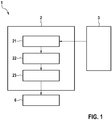
- FIG. 1 shows a schematic block diagram of a sensor system 1 of a vehicle.
- the sensor system 1 comprises at least one sensor 3, which may comprise a camera sensor, a radar sensor, a lidar sensor, an infrared sensor or the like.
- the sensor 3 acquires sensor data at each of a plurality of acquisition times.
- the sensor data may comprise camera images, radar images, and the like.
- the sensor system 1 further comprises a device 2 for predicting a trajectory of a traffic participant.
- the traffic participant can be the vehicle itself.
- the traffic participant can also be a further vehicle, a pedestrian, cyclist, or the like. It is also possible to predict both the trajectory of the vehicle itself and of other traffic participants.
- the device 2 comprises an interface 21 coupled to the at least one sensor 3 and adapted to receive sensor data acquired by the at least one sensor 3.
- the device 2 further comprises a memory 22 which stores the received sensor data.
- the memory 22 may comprise a volatile or non-volatile data memory, e.g. a solid-state disk, memory card or the like.
- a computer 23 of the device 2 is connected to the memory 22 and has access to the memory 22.
- the computer 23 may comprise at least one of a central processing unit (CPU), graphics processing unit (GPU), microcontroller, integrated circuit (IC), application-specific integrated circuit (ASIC), or the like.
- the computer 23 analyzes the received sensor data to compute values of motion parameters of the traffic participant for each acquisition time. For instance, the computer 23 may determine values for a position, a velocity and an acceleration of the traffic participant for each acquisition time. The values of the motion parameters of the traffic participants are input for a stochastic regression algorithm. The position, velocity and acceleration may be given as two-dimensional vectors relative to a driving plane or can be three-dimensional values.
- the stochastic regression algorithm is based on a stochastic process, i.e. a collection of random variables indexed by time, the random variables corresponding to the motion parameters of the traffic participant.
- the stochastic regression algorithm is a Gaussian regression algorithm, also known as kriging.
- the Gaussian regression algorithm serves as a non-linear multivariate interpolation algorithm.
- the computer 23 uses the stochastic regression algorithm to compute predicted values of motion parameters of the traffic participant.
- the computer 23 may determine the predicted acceleration of the traffic participant for a plurality of time points in the future or as a continuous function of time.
- the components of the acceleration vector can be modeled as Gaussian stochastic processes, making it possible to handle prediction in an optimal, mathematically correct way.
- the method automatically adapts to the current situation by considering only the most recent measurements and estimating the probability distribution of the acceleration.
- the computer 23 further integrates the distributions of the predicted acceleration of the traffic participant, using the determined position and velocity of the traffic participant at the acquisition times as initial values to determine integration constants.
- the computer 23 outputs the predicted trajectory, e.g. to a driver assistance system 6.
- the computer 23 may further provide an uncertainty of the predicted trajectory of the traffic participant using the stochastic regression algorithm.
- the computer 23 may use the uncertainty, i.e. the error estimate, together with the predicted trajectory to calculate the probability of an accident for the vehicle with the traffic participant.
- the computer 23 may also estimate a road topology of a road the vehicle is driving on, using the uncertainty and the predicted trajectory.
- the described prediction of the trajectory of the traffic participant can be carried out for a plurality of traffic participants in a surrounding of the vehicle. All trajectories can be predicted simultaneously by taking possible interactions between the traffic participants into account. For instance, the possible trajectories of the traffic participants can be reduced by excluding trajectories that would result in accidents between traffic participants and other traffic participants or the vehicle.
- the driver assistance system 6 may control the vehicle based on the predicted trajectory of the further traffic participant.
- the driver assistance system 6 may be configured to carry out autonomous driving functions by controlling an acceleration, turn rate and the like of the vehicle.
- the device may also predict the trajectory of the vehicle itself.
- the sensor 3 may comprise an inertial sensor for measuring the acceleration of the vehicle.
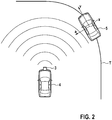
- Figure 2 shows an exemplary traffic scenario for illustrating the method for predicting a trajectory T of a traffic participant 5 in the surrounding of a vehicle 4.
- the computer 23 Based on sensor data acquired by a sensor 3 of the vehicle 4, the computer 23 determines position x, velocity v and acceleration a of the traffic participant 5 for each acquisition time.
- the trajectory T the traffic participant 5 is driving on is predicted for future time points.
- Figure 3 shows a schematic flow diagram of a method for predicting a trajectory of a traffic participant.
- a first method step S1 at least one sensor 3 of the vehicle 4 acquires sensor data for each of a plurality of acquisition times.
- An interface 21 receives the acquired sensor data.
- a computer 23 determines, based on the received sensor data, values of at least one motion parameter of the traffic participant for each acquisition time.
- the motion parameters may comprise a position, a velocity and an acceleration of the traffic participant.
- the motion parameters may also comprise a turn rate or the like.
- the trajectory of the traffic participant is predicted.
- the method step S3 comprises a first sub-step S31, wherein the computer determines a predicted acceleration of the traffic participant using a stochastic regression algorithm.
- the computer 23 integrates the predicted acceleration to compute the predicted trajectory of the traffic participant 5.
- Figure 4 relates to the quality of the estimated trajectory.
- Figure 4 shows an exemplary average of the square root of the squared error of estimation (E) in meters (m).
- the difference between the estimated trajectory from the actual trajectory (based on real measurements) is illustrated at some characteristic distances (d) in meters (m).
- the error of estimation is displayed for a reference model (M1) and for the method according to the invention (M2).
- the reference model is a constant-turn-rate model, i.e. assumes that the turn rate does not change within the time span under consideration. It can be seen that at short ranges at about 10 meters ahead of the vehicle, the error of the estimation decreases by about 75 percent as compared to the reference model M1. At middle ranges of about 50 meters ahead of the vehicle, the error of the estimation still decreases by about 50 percent. Also at larger distances of about 100 meters the difference is significant.
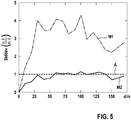
- Figure 5 shows an exemplary error estimation of a standard deviation of a ratio of a real error and an estimated standard deviation of predictions for the method according to the invention (M2) and the constant-turn-rate model (M1).
- the functions depend on distances (d) in meters (m).
- a target line A is shown, corresponding to a constant value of 1.
- Figure 5 relates to a quality of the error estimation. Error estimation is a statistical property and can only be verified based on statistical quantities.
- the evaluation of the error estimation is a complex task, as both the real error and the estimated error are changing with elapsed time and distance.
- a real error of the i-th prediction is denoted by ⁇ _i and the estimated standard deviation of the i-th prediction is denoted by ⁇ _i.
- the reference model M1 is too optimistic about its prediction, the errors it really makes being much larger than it assumes. Based on the new approach, the error estimation is reliable as it is close to the target of 1.
- the reliability of the error estimation makes it possible to use the approach in combination with other models.
- the approach is neither too optimistic nor too pessimistic about its own uncertainty. As a result, during the fusion of the approach with other trajectory estimation methods, the correct trajectory prediction uncertainty will not interfere in the trajectory fusion algorithms.
Landscapes
- Engineering & Computer Science (AREA)
- Physics & Mathematics (AREA)
- General Physics & Mathematics (AREA)
- Analytical Chemistry (AREA)
- Chemical & Material Sciences (AREA)
- Remote Sensing (AREA)
- Radar, Positioning & Navigation (AREA)
- Business, Economics & Management (AREA)
- Theoretical Computer Science (AREA)
- Data Mining & Analysis (AREA)
- Transportation (AREA)
- Mechanical Engineering (AREA)
- Automation & Control Theory (AREA)
- Electromagnetism (AREA)
- Human Resources & Organizations (AREA)
- Tourism & Hospitality (AREA)
- Strategic Management (AREA)
- Economics (AREA)
- Pure & Applied Mathematics (AREA)
- Computational Mathematics (AREA)
- Mathematical Analysis (AREA)
- Mathematical Optimization (AREA)
- Mathematical Physics (AREA)
- Bioinformatics & Computational Biology (AREA)
- Life Sciences & Earth Sciences (AREA)
- Evolutionary Biology (AREA)
- General Engineering & Computer Science (AREA)
- Operations Research (AREA)
- Bioinformatics & Cheminformatics (AREA)
- Development Economics (AREA)
- Computer Networks & Wireless Communication (AREA)
- Marketing (AREA)
- Human Computer Interaction (AREA)
- General Business, Economics & Management (AREA)
- Databases & Information Systems (AREA)
- Probability & Statistics with Applications (AREA)
- Algebra (AREA)
- Software Systems (AREA)
- Game Theory and Decision Science (AREA)
- Evolutionary Computation (AREA)
Priority Applications (4)
| Application Number | Priority Date | Filing Date | Title |
|---|---|---|---|
| EP20176273.9A EP3916697A1 (de) | 2020-05-25 | 2020-05-25 | Verfahren und vorrichtung zur vorhersage der trajektorie eines verkehrsteilnehmers und sensorsystem |
| US17/211,066 US20210366274A1 (en) | 2020-05-25 | 2021-03-24 | Method and device for predicting the trajectory of a traffic participant, and sensor system |
| JP2021086600A JP2021190119A (ja) | 2020-05-25 | 2021-05-24 | 交通参加者の経路を予測するための方法およびデバイス、ならびにセンサシステム |
| CN202110571583.3A CN113988353A (zh) | 2020-05-25 | 2021-05-25 | 预测交通参与者的轨迹的方法、装置以及传感器系统 |
Applications Claiming Priority (1)
| Application Number | Priority Date | Filing Date | Title |
|---|---|---|---|
| EP20176273.9A EP3916697A1 (de) | 2020-05-25 | 2020-05-25 | Verfahren und vorrichtung zur vorhersage der trajektorie eines verkehrsteilnehmers und sensorsystem |
Publications (1)
| Publication Number | Publication Date |
|---|---|
| EP3916697A1 true EP3916697A1 (de) | 2021-12-01 |
Family
ID=70847265
Family Applications (1)
| Application Number | Title | Priority Date | Filing Date |
|---|---|---|---|
| EP20176273.9A Ceased EP3916697A1 (de) | 2020-05-25 | 2020-05-25 | Verfahren und vorrichtung zur vorhersage der trajektorie eines verkehrsteilnehmers und sensorsystem |
Country Status (4)
| Country | Link |
|---|---|
| US (1) | US20210366274A1 (de) |
| EP (1) | EP3916697A1 (de) |
| JP (1) | JP2021190119A (de) |
| CN (1) | CN113988353A (de) |
Cited By (2)
| Publication number | Priority date | Publication date | Assignee | Title |
|---|---|---|---|---|
| CN113988353A (zh) * | 2020-05-25 | 2022-01-28 | 罗伯特·博世有限公司 | 预测交通参与者的轨迹的方法、装置以及传感器系统 |
| EP4219258A1 (de) * | 2022-01-28 | 2023-08-02 | Aptiv Technologies Limited | Verfahren, computersystem und nichtflüchtiges computerlesbares medium zur zielauswahl in der nähe eines fahrzeugs |
Families Citing this family (5)
| Publication number | Priority date | Publication date | Assignee | Title |
|---|---|---|---|---|
| EP4217987A1 (de) * | 2020-11-24 | 2023-08-02 | Huawei Technologies Co., Ltd. | Schätzung des unfallrisikoniveaus von strassenverkehrsteilnehmern |
| EP4270997A1 (de) * | 2022-04-26 | 2023-11-01 | Continental Automotive Technologies GmbH | Verfahren zur vorhersage des verhaltens eines verkehrsteilnehmers, fahrsystem und fahrzeug |
| CN116010538A (zh) * | 2022-10-12 | 2023-04-25 | 上海滴滴沃芽科技有限公司 | 交通热力图生成方法、装置、设备、存储介质和程序产品 |
| CN115877343B (zh) * | 2023-02-02 | 2023-05-05 | 中电信数字城市科技有限公司 | 基于雷达目标跟踪的人车匹配方法、装置和电子设备 |
| CN120319017B (zh) * | 2025-04-01 | 2025-12-05 | 武汉理工大学 | 基于碰撞条件的全线形路段交通冲突辨识方法 |
Citations (7)
| Publication number | Priority date | Publication date | Assignee | Title |
|---|---|---|---|---|
| DE102013005362A1 (de) | 2013-03-28 | 2013-10-10 | Daimler Ag | Verfahren zur Analyse einer Verkehrssituation |
| DE102018210065A1 (de) | 2017-06-22 | 2018-12-27 | Avl List Gmbh | Vorrichtung und Verfahren zur prädiktiven Steuerung der Geschwindigkeit eines Fahrzeugs |
| US20190072965A1 (en) * | 2017-09-07 | 2019-03-07 | TuSimple | Prediction-based system and method for trajectory planning of autonomous vehicles |
| EP3518001A1 (de) | 2018-01-25 | 2019-07-31 | Aptiv Technologies Limited | Verfahren zur erhöhung der zuverlässigkeit der bestimmung der position eines fahrzeugs auf basis einer vielzahl von detektionspunkten |
| CN110264721A (zh) * | 2019-07-01 | 2019-09-20 | 北京理工大学 | 一种城市交叉口周边车辆轨迹预测方法 |
| CN110298122A (zh) * | 2019-07-03 | 2019-10-01 | 北京理工大学 | 基于冲突消解的无人驾驶车辆城市交叉口左转决策方法 |
| EP3552904A1 (de) * | 2018-04-10 | 2019-10-16 | Bayerische Motoren Werke Aktiengesellschaft | Verfahren, vorrichtung und computerprogrammprodukt zur vorhersage der entwicklung einer verkehrsszene mit mehreren teilnehmern |
Family Cites Families (17)
| Publication number | Priority date | Publication date | Assignee | Title |
|---|---|---|---|---|
| KR101688675B1 (ko) * | 2009-05-07 | 2016-12-21 | 콘티넨탈 테베스 아게 운트 코. 오하게 | 차량의 운전 안정성을 조절하거나 제어하는 방법 및 장치 |
| JP5956914B2 (ja) * | 2012-11-14 | 2016-07-27 | Kddi株式会社 | ジャイロセンサの較正機能を備えた角速度測定装置、較正プログラム及び方法 |
| CN105023445A (zh) * | 2014-07-04 | 2015-11-04 | 吴建平 | 一种区域交通动态调控方法及系统 |
| DE102014219148A1 (de) * | 2014-09-23 | 2016-03-24 | Robert Bosch Gmbh | Verfahren und Vorrichtung zum Erstellen eines Bewegungsmodells eines Straßenverkehrsteilnehmers |
| US9784592B2 (en) * | 2015-07-17 | 2017-10-10 | Honda Motor Co., Ltd. | Turn predictions |
| JP6409744B2 (ja) * | 2015-11-06 | 2018-10-24 | 株式会社アドヴィックス | 車両の走行支援装置 |
| DE102016215287A1 (de) * | 2016-08-16 | 2018-02-22 | Volkswagen Aktiengesellschaft | Verfahren zum Ermitteln einer maximal möglichen Fahrgeschwindigkeit für eine Kurvenfahrt eines Kraftfahrzeugs, Steuervorrichtung und Kraftfahrzeug |
| US10345815B2 (en) * | 2016-09-14 | 2019-07-09 | Qualcomm Incorporated | Motion planning and intention prediction for autonomous driving in highway scenarios via graphical model-based factorization |
| ES2866945T3 (es) * | 2017-06-09 | 2021-10-20 | Ptv Planung Transp Verkehr Ag | Sistema informático y método de predicción de estado de un sistema de tráfico |
| CN109841088B (zh) * | 2017-11-24 | 2021-10-22 | 奥迪股份公司 | 车辆驾驶辅助系统及方法 |
| JP7125286B2 (ja) * | 2018-06-22 | 2022-08-24 | 本田技研工業株式会社 | 行動予測装置及び自動運転装置 |
| US11126186B2 (en) * | 2018-09-15 | 2021-09-21 | Toyota Research Institute, Inc. | Systems and methods for predicting the trajectory of a road agent external to a vehicle |
| US11433922B1 (en) * | 2019-12-20 | 2022-09-06 | Zoox, Inc. | Object uncertainty detection |
| CN111081045A (zh) * | 2019-12-31 | 2020-04-28 | 智车优行科技(上海)有限公司 | 姿态轨迹预测方法及电子设备 |
| EP3855120A1 (de) * | 2020-01-23 | 2021-07-28 | Robert Bosch GmbH | Verfahren zur langzeittrajektorieprädiktion von verkehrsteilnehmern |
| US11458997B2 (en) * | 2020-03-31 | 2022-10-04 | Uatc, Llc | Autonomous vehicle computing system with processing assurance |
| EP3916697A1 (de) * | 2020-05-25 | 2021-12-01 | Robert Bosch GmbH | Verfahren und vorrichtung zur vorhersage der trajektorie eines verkehrsteilnehmers und sensorsystem |
-
2020
- 2020-05-25 EP EP20176273.9A patent/EP3916697A1/de not_active Ceased
-
2021
- 2021-03-24 US US17/211,066 patent/US20210366274A1/en not_active Abandoned
- 2021-05-24 JP JP2021086600A patent/JP2021190119A/ja active Pending
- 2021-05-25 CN CN202110571583.3A patent/CN113988353A/zh active Pending
Patent Citations (7)
| Publication number | Priority date | Publication date | Assignee | Title |
|---|---|---|---|---|
| DE102013005362A1 (de) | 2013-03-28 | 2013-10-10 | Daimler Ag | Verfahren zur Analyse einer Verkehrssituation |
| DE102018210065A1 (de) | 2017-06-22 | 2018-12-27 | Avl List Gmbh | Vorrichtung und Verfahren zur prädiktiven Steuerung der Geschwindigkeit eines Fahrzeugs |
| US20190072965A1 (en) * | 2017-09-07 | 2019-03-07 | TuSimple | Prediction-based system and method for trajectory planning of autonomous vehicles |
| EP3518001A1 (de) | 2018-01-25 | 2019-07-31 | Aptiv Technologies Limited | Verfahren zur erhöhung der zuverlässigkeit der bestimmung der position eines fahrzeugs auf basis einer vielzahl von detektionspunkten |
| EP3552904A1 (de) * | 2018-04-10 | 2019-10-16 | Bayerische Motoren Werke Aktiengesellschaft | Verfahren, vorrichtung und computerprogrammprodukt zur vorhersage der entwicklung einer verkehrsszene mit mehreren teilnehmern |
| CN110264721A (zh) * | 2019-07-01 | 2019-09-20 | 北京理工大学 | 一种城市交叉口周边车辆轨迹预测方法 |
| CN110298122A (zh) * | 2019-07-03 | 2019-10-01 | 北京理工大学 | 基于冲突消解的无人驾驶车辆城市交叉口左转决策方法 |
Non-Patent Citations (4)
| Title |
|---|
| GOLI SEPIDEH AFKHAMI ET AL: "Vehicle Trajectory Prediction with Gaussian Process Regression in Connected Vehicle Environment$\star$", 2018 IEEE INTELLIGENT VEHICLES SYMPOSIUM (IV), IEEE, 26 June 2018 (2018-06-26), pages 550 - 555, XP033423494, DOI: 10.1109/IVS.2018.8500614 * |
| LI SHENGHONG ET AL: "Joint Trajectory and Ranging Offset Estimation for Accurate Tracking in NLOS Environments", IEEE TRANSACTIONS ON AEROSPACE AND ELECTRONIC SYSTEMS, IEEE SERVICE CENTER, PISCATAWAY, NJ, US, vol. 56, no. 1, 27 February 2019 (2019-02-27), pages 3 - 14, XP011771327, ISSN: 0018-9251, [retrieved on 20200206], DOI: 10.1109/TAES.2019.2901587 * |
| LIM QUN ET AL: "Gaussian Process Auto Regression for vehicle center coordinates Trajectory Prediction", TENCON 2019 - 2019 IEEE REGION 10 CONFERENCE (TENCON), IEEE, 17 October 2019 (2019-10-17), pages 25 - 30, XP033672880, DOI: 10.1109/TENCON.2019.8929719 * |
| PATTERSON ANDREW ET AL: "Intent-Aware Probabilistic Trajectory Estimation for Collision Prediction with Uncertainty Quantification", 2019 IEEE 58TH CONFERENCE ON DECISION AND CONTROL (CDC), IEEE, 11 December 2019 (2019-12-11), pages 3827 - 3832, XP033735924, DOI: 10.1109/CDC40024.2019.9029215 * |
Cited By (4)
| Publication number | Priority date | Publication date | Assignee | Title |
|---|---|---|---|---|
| CN113988353A (zh) * | 2020-05-25 | 2022-01-28 | 罗伯特·博世有限公司 | 预测交通参与者的轨迹的方法、装置以及传感器系统 |
| EP4219258A1 (de) * | 2022-01-28 | 2023-08-02 | Aptiv Technologies Limited | Verfahren, computersystem und nichtflüchtiges computerlesbares medium zur zielauswahl in der nähe eines fahrzeugs |
| EP4219259A1 (de) * | 2022-01-28 | 2023-08-02 | Aptiv Technologies Limited | Verfahren, computersystem und nichttransitorisches computerlesbares medium zur zielauswahl in der umgebung eines fahrzeugs |
| US12365365B2 (en) | 2022-01-28 | 2025-07-22 | Aptiv Technologies AG | Method, computer system and non-transitory computer readable medium for target selection in the vicinity of a vehicle |
Also Published As
| Publication number | Publication date |
|---|---|
| CN113988353A (zh) | 2022-01-28 |
| US20210366274A1 (en) | 2021-11-25 |
| JP2021190119A (ja) | 2021-12-13 |
Similar Documents
| Publication | Publication Date | Title |
|---|---|---|
| US20210366274A1 (en) | Method and device for predicting the trajectory of a traffic participant, and sensor system | |
| US7460951B2 (en) | System and method of target tracking using sensor fusion | |
| EP3106836B1 (de) | Einheit und verfahren zur einstellung einer strassenbegrenzung | |
| US9779624B2 (en) | Method and system of driving assistance for collision avoidance | |
| US7340380B2 (en) | Method and device for the exchange and processing of data into fusion data | |
| JP6256531B2 (ja) | 物体認識処理装置、物体認識処理方法および自動運転システム | |
| US20150274161A1 (en) | Method for operating a driver assistance system of a vehicle | |
| US20100076684A1 (en) | Probabilistic lane assignment method | |
| Berthelot et al. | Handling uncertainties in criticality assessment | |
| JP7089832B2 (ja) | 状態推定器 | |
| KR20220001498A (ko) | 자동차의 환경에서 타겟 자동차의 궤적을 예측하기 위한 방법 및 시스템 | |
| US11458966B2 (en) | Method and device of determining kinematics of a target | |
| JP2021162366A (ja) | センサ遅延時間推定装置 | |
| US11807270B2 (en) | State estimator | |
| KR101390776B1 (ko) | 퍼지 확장 칼만 필터를 이용한 위치인식 장치, 방법 및 이동로봇 | |
| KR102261155B1 (ko) | 가상 센서 이중화를 통한 차량 제어 방법 및 그 장치 | |
| CN119089379B (zh) | 一种基于多传感器融合部署的自动驾驶方法及系统 | |
| Ghahroudi et al. | Multisensor data fusion strategies for advanced driver assistance systems | |
| JP7120170B2 (ja) | 車線推定装置 | |
| CN117471483A (zh) | 多传感器融合的车距计算方法及系统 | |
| EP3846073A1 (de) | Systeme und verfahren zur bereitstellung einer darstellung von fahrspuren auf einer fahrbahn | |
| TWI646306B (zh) | 應用於多感測器融合之誤差及偵測機率分析方法 | |
| CN119805434B (zh) | 机动目标追踪方法和装置、存储介质及电子设备 | |
| CN119421833A (zh) | 对收敛时间的评估和基于收敛时间的评估的调整 | |
| Xu et al. | Perception planning in mobile robot navigation |
Legal Events
| Date | Code | Title | Description |
|---|---|---|---|
| PUAI | Public reference made under article 153(3) epc to a published international application that has entered the european phase |
Free format text: ORIGINAL CODE: 0009012 |
|
| STAA | Information on the status of an ep patent application or granted ep patent |
Free format text: STATUS: THE APPLICATION HAS BEEN PUBLISHED |
|
| AK | Designated contracting states |
Kind code of ref document: A1 Designated state(s): AL AT BE BG CH CY CZ DE DK EE ES FI FR GB GR HR HU IE IS IT LI LT LU LV MC MK MT NL NO PL PT RO RS SE SI SK SM TR |
|
| B565 | Issuance of search results under rule 164(2) epc |
Effective date: 20201126 |
|
| STAA | Information on the status of an ep patent application or granted ep patent |
Free format text: STATUS: REQUEST FOR EXAMINATION WAS MADE |
|
| 17P | Request for examination filed |
Effective date: 20220601 |
|
| RBV | Designated contracting states (corrected) |
Designated state(s): AL AT BE BG CH CY CZ DE DK EE ES FI FR GB GR HR HU IE IS IT LI LT LU LV MC MK MT NL NO PL PT RO RS SE SI SK SM TR |
|
| STAA | Information on the status of an ep patent application or granted ep patent |
Free format text: STATUS: EXAMINATION IS IN PROGRESS |
|
| 17Q | First examination report despatched |
Effective date: 20230720 |
|
| STAA | Information on the status of an ep patent application or granted ep patent |
Free format text: STATUS: THE APPLICATION HAS BEEN REFUSED |
|
| 18R | Application refused |
Effective date: 20240724 |