EP3917907B1 - Modulateurs de canaux ioniques potassiques et leurs utilisations - Google Patents
Modulateurs de canaux ioniques potassiques et leurs utilisations Download PDFInfo
- Publication number
- EP3917907B1 EP3917907B1 EP20702775.6A EP20702775A EP3917907B1 EP 3917907 B1 EP3917907 B1 EP 3917907B1 EP 20702775 A EP20702775 A EP 20702775A EP 3917907 B1 EP3917907 B1 EP 3917907B1
- Authority
- EP
- European Patent Office
- Prior art keywords
- amino
- trifluoromethyl
- benzyl
- henyl
- phenyl
- Prior art date
- Legal status (The legal status is an assumption and is not a legal conclusion. Google has not performed a legal analysis and makes no representation as to the accuracy of the status listed.)
- Active
Links
Classifications
-
- C—CHEMISTRY; METALLURGY
- C07—ORGANIC CHEMISTRY
- C07D—HETEROCYCLIC COMPOUNDS
- C07D209/00—Heterocyclic compounds containing five-membered rings, condensed with other rings, with one nitrogen atom as the only ring hetero atom
- C07D209/02—Heterocyclic compounds containing five-membered rings, condensed with other rings, with one nitrogen atom as the only ring hetero atom condensed with one carbocyclic ring
- C07D209/04—Indoles; Hydrogenated indoles
- C07D209/30—Indoles; Hydrogenated indoles with hetero atoms or with carbon atoms having three bonds to hetero atoms with at the most one bond to halogen, directly attached to carbon atoms of the hetero ring
- C07D209/40—Nitrogen atoms, not forming part of a nitro radical, e.g. isatin semicarbazone
-
- A—HUMAN NECESSITIES
- A61—MEDICAL OR VETERINARY SCIENCE; HYGIENE
- A61P—SPECIFIC THERAPEUTIC ACTIVITY OF CHEMICAL COMPOUNDS OR MEDICINAL PREPARATIONS
- A61P25/00—Drugs for disorders of the nervous system
-
- C—CHEMISTRY; METALLURGY
- C07—ORGANIC CHEMISTRY
- C07C—ACYCLIC OR CARBOCYCLIC COMPOUNDS
- C07C233/00—Carboxylic acid amides
- C07C233/01—Carboxylic acid amides having carbon atoms of carboxamide groups bound to hydrogen atoms or to acyclic carbon atoms
- C07C233/02—Carboxylic acid amides having carbon atoms of carboxamide groups bound to hydrogen atoms or to acyclic carbon atoms having nitrogen atoms of carboxamide groups bound to hydrogen atoms or to carbon atoms of unsubstituted hydrocarbon radicals
- C07C233/04—Carboxylic acid amides having carbon atoms of carboxamide groups bound to hydrogen atoms or to acyclic carbon atoms having nitrogen atoms of carboxamide groups bound to hydrogen atoms or to carbon atoms of unsubstituted hydrocarbon radicals with carbon atoms of carboxamide groups bound to acyclic carbon atoms of an acyclic saturated carbon skeleton
- C07C233/07—Carboxylic acid amides having carbon atoms of carboxamide groups bound to hydrogen atoms or to acyclic carbon atoms having nitrogen atoms of carboxamide groups bound to hydrogen atoms or to carbon atoms of unsubstituted hydrocarbon radicals with carbon atoms of carboxamide groups bound to acyclic carbon atoms of an acyclic saturated carbon skeleton having the nitrogen atom of at least one of the carboxamide groups bound to a carbon atom of a six-membered aromatic ring
-
- C—CHEMISTRY; METALLURGY
- C07—ORGANIC CHEMISTRY
- C07C—ACYCLIC OR CARBOCYCLIC COMPOUNDS
- C07C233/00—Carboxylic acid amides
- C07C233/01—Carboxylic acid amides having carbon atoms of carboxamide groups bound to hydrogen atoms or to acyclic carbon atoms
- C07C233/12—Carboxylic acid amides having carbon atoms of carboxamide groups bound to hydrogen atoms or to acyclic carbon atoms having the nitrogen atom of at least one of the carboxamide groups bound to a carbon atom of a hydrocarbon radical substituted by halogen atoms or by nitro or nitroso groups
- C07C233/15—Carboxylic acid amides having carbon atoms of carboxamide groups bound to hydrogen atoms or to acyclic carbon atoms having the nitrogen atom of at least one of the carboxamide groups bound to a carbon atom of a hydrocarbon radical substituted by halogen atoms or by nitro or nitroso groups with the substituted hydrocarbon radical bound to the nitrogen atom of the carboxamide group by a carbon atom of a six-membered aromatic ring
-
- C—CHEMISTRY; METALLURGY
- C07—ORGANIC CHEMISTRY
- C07C—ACYCLIC OR CARBOCYCLIC COMPOUNDS
- C07C233/00—Carboxylic acid amides
- C07C233/01—Carboxylic acid amides having carbon atoms of carboxamide groups bound to hydrogen atoms or to acyclic carbon atoms
- C07C233/34—Carboxylic acid amides having carbon atoms of carboxamide groups bound to hydrogen atoms or to acyclic carbon atoms having the nitrogen atom of at least one of the carboxamide groups bound to a carbon atom of a hydrocarbon radical substituted by amino groups
- C07C233/42—Carboxylic acid amides having carbon atoms of carboxamide groups bound to hydrogen atoms or to acyclic carbon atoms having the nitrogen atom of at least one of the carboxamide groups bound to a carbon atom of a hydrocarbon radical substituted by amino groups with the substituted hydrocarbon radical bound to the nitrogen atom of the carboxamide group by a carbon atom of a six-membered aromatic ring
- C07C233/43—Carboxylic acid amides having carbon atoms of carboxamide groups bound to hydrogen atoms or to acyclic carbon atoms having the nitrogen atom of at least one of the carboxamide groups bound to a carbon atom of a hydrocarbon radical substituted by amino groups with the substituted hydrocarbon radical bound to the nitrogen atom of the carboxamide group by a carbon atom of a six-membered aromatic ring having the carbon atom of the carboxamide group bound to a hydrogen atom or to a carbon atom of a saturated carbon skeleton
-
- C—CHEMISTRY; METALLURGY
- C07—ORGANIC CHEMISTRY
- C07C—ACYCLIC OR CARBOCYCLIC COMPOUNDS
- C07C233/00—Carboxylic acid amides
- C07C233/01—Carboxylic acid amides having carbon atoms of carboxamide groups bound to hydrogen atoms or to acyclic carbon atoms
- C07C233/34—Carboxylic acid amides having carbon atoms of carboxamide groups bound to hydrogen atoms or to acyclic carbon atoms having the nitrogen atom of at least one of the carboxamide groups bound to a carbon atom of a hydrocarbon radical substituted by amino groups
- C07C233/42—Carboxylic acid amides having carbon atoms of carboxamide groups bound to hydrogen atoms or to acyclic carbon atoms having the nitrogen atom of at least one of the carboxamide groups bound to a carbon atom of a hydrocarbon radical substituted by amino groups with the substituted hydrocarbon radical bound to the nitrogen atom of the carboxamide group by a carbon atom of a six-membered aromatic ring
- C07C233/44—Carboxylic acid amides having carbon atoms of carboxamide groups bound to hydrogen atoms or to acyclic carbon atoms having the nitrogen atom of at least one of the carboxamide groups bound to a carbon atom of a hydrocarbon radical substituted by amino groups with the substituted hydrocarbon radical bound to the nitrogen atom of the carboxamide group by a carbon atom of a six-membered aromatic ring having the carbon atom of the carboxamide group bound to a carbon atom of an unsaturated carbon skeleton
-
- C—CHEMISTRY; METALLURGY
- C07—ORGANIC CHEMISTRY
- C07C—ACYCLIC OR CARBOCYCLIC COMPOUNDS
- C07C233/00—Carboxylic acid amides
- C07C233/57—Carboxylic acid amides having carbon atoms of carboxamide groups bound to carbon atoms of rings other than six-membered aromatic rings
- C07C233/62—Carboxylic acid amides having carbon atoms of carboxamide groups bound to carbon atoms of rings other than six-membered aromatic rings having the nitrogen atom of at least one of the carboxamide groups bound to a carbon atom of a hydrocarbon radical substituted by amino groups
-
- C—CHEMISTRY; METALLURGY
- C07—ORGANIC CHEMISTRY
- C07C—ACYCLIC OR CARBOCYCLIC COMPOUNDS
- C07C237/00—Carboxylic acid amides, the carbon skeleton of the acid part being further substituted by amino groups
- C07C237/02—Carboxylic acid amides, the carbon skeleton of the acid part being further substituted by amino groups having the carbon atoms of the carboxamide groups bound to acyclic carbon atoms of the carbon skeleton
- C07C237/04—Carboxylic acid amides, the carbon skeleton of the acid part being further substituted by amino groups having the carbon atoms of the carboxamide groups bound to acyclic carbon atoms of the carbon skeleton the carbon skeleton being acyclic and saturated
- C07C237/10—Carboxylic acid amides, the carbon skeleton of the acid part being further substituted by amino groups having the carbon atoms of the carboxamide groups bound to acyclic carbon atoms of the carbon skeleton the carbon skeleton being acyclic and saturated having the nitrogen atom of at least one of the carboxamide groups bound to an acyclic carbon atom of a hydrocarbon radical substituted by nitrogen atoms not being part of nitro or nitroso groups
-
- C—CHEMISTRY; METALLURGY
- C07—ORGANIC CHEMISTRY
- C07C—ACYCLIC OR CARBOCYCLIC COMPOUNDS
- C07C237/00—Carboxylic acid amides, the carbon skeleton of the acid part being further substituted by amino groups
- C07C237/02—Carboxylic acid amides, the carbon skeleton of the acid part being further substituted by amino groups having the carbon atoms of the carboxamide groups bound to acyclic carbon atoms of the carbon skeleton
- C07C237/20—Carboxylic acid amides, the carbon skeleton of the acid part being further substituted by amino groups having the carbon atoms of the carboxamide groups bound to acyclic carbon atoms of the carbon skeleton the carbon skeleton containing six-membered aromatic rings
-
- C—CHEMISTRY; METALLURGY
- C07—ORGANIC CHEMISTRY
- C07C—ACYCLIC OR CARBOCYCLIC COMPOUNDS
- C07C311/00—Amides of sulfonic acids, i.e. compounds having singly-bound oxygen atoms of sulfo groups replaced by nitrogen atoms, not being part of nitro or nitroso groups
- C07C311/14—Sulfonamides having sulfur atoms of sulfonamide groups bound to carbon atoms of rings other than six-membered aromatic rings
-
- C—CHEMISTRY; METALLURGY
- C07—ORGANIC CHEMISTRY
- C07C—ACYCLIC OR CARBOCYCLIC COMPOUNDS
- C07C311/00—Amides of sulfonic acids, i.e. compounds having singly-bound oxygen atoms of sulfo groups replaced by nitrogen atoms, not being part of nitro or nitroso groups
- C07C311/15—Sulfonamides having sulfur atoms of sulfonamide groups bound to carbon atoms of six-membered aromatic rings
- C07C311/21—Sulfonamides having sulfur atoms of sulfonamide groups bound to carbon atoms of six-membered aromatic rings having the nitrogen atom of at least one of the sulfonamide groups bound to a carbon atom of a six-membered aromatic ring
-
- C—CHEMISTRY; METALLURGY
- C07—ORGANIC CHEMISTRY
- C07D—HETEROCYCLIC COMPOUNDS
- C07D207/00—Heterocyclic compounds containing five-membered rings not condensed with other rings, with one nitrogen atom as the only ring hetero atom
- C07D207/02—Heterocyclic compounds containing five-membered rings not condensed with other rings, with one nitrogen atom as the only ring hetero atom with only hydrogen or carbon atoms directly attached to the ring nitrogen atom
- C07D207/04—Heterocyclic compounds containing five-membered rings not condensed with other rings, with one nitrogen atom as the only ring hetero atom with only hydrogen or carbon atoms directly attached to the ring nitrogen atom having no double bonds between ring members or between ring members and non-ring members
- C07D207/10—Heterocyclic compounds containing five-membered rings not condensed with other rings, with one nitrogen atom as the only ring hetero atom with only hydrogen or carbon atoms directly attached to the ring nitrogen atom having no double bonds between ring members or between ring members and non-ring members with hetero atoms or with carbon atoms having three bonds to hetero atoms with at the most one bond to halogen, e.g. ester or nitrile radicals, directly attached to ring carbon atoms
- C07D207/16—Carbon atoms having three bonds to hetero atoms with at the most one bond to halogen, e.g. ester or nitrile radicals
-
- C—CHEMISTRY; METALLURGY
- C07—ORGANIC CHEMISTRY
- C07D—HETEROCYCLIC COMPOUNDS
- C07D207/00—Heterocyclic compounds containing five-membered rings not condensed with other rings, with one nitrogen atom as the only ring hetero atom
- C07D207/02—Heterocyclic compounds containing five-membered rings not condensed with other rings, with one nitrogen atom as the only ring hetero atom with only hydrogen or carbon atoms directly attached to the ring nitrogen atom
- C07D207/30—Heterocyclic compounds containing five-membered rings not condensed with other rings, with one nitrogen atom as the only ring hetero atom with only hydrogen or carbon atoms directly attached to the ring nitrogen atom having two double bonds between ring members or between ring members and non-ring members
- C07D207/32—Heterocyclic compounds containing five-membered rings not condensed with other rings, with one nitrogen atom as the only ring hetero atom with only hydrogen or carbon atoms directly attached to the ring nitrogen atom having two double bonds between ring members or between ring members and non-ring members with only hydrogen atoms, hydrocarbon or substituted hydrocarbon radicals, directly attached to ring carbon atoms
- C07D207/33—Heterocyclic compounds containing five-membered rings not condensed with other rings, with one nitrogen atom as the only ring hetero atom with only hydrogen or carbon atoms directly attached to the ring nitrogen atom having two double bonds between ring members or between ring members and non-ring members with only hydrogen atoms, hydrocarbon or substituted hydrocarbon radicals, directly attached to ring carbon atoms with substituted hydrocarbon radicals, directly attached to ring carbon atoms
- C07D207/335—Radicals substituted by nitrogen atoms not forming part of a nitro radical
-
- C—CHEMISTRY; METALLURGY
- C07—ORGANIC CHEMISTRY
- C07D—HETEROCYCLIC COMPOUNDS
- C07D209/00—Heterocyclic compounds containing five-membered rings, condensed with other rings, with one nitrogen atom as the only ring hetero atom
- C07D209/02—Heterocyclic compounds containing five-membered rings, condensed with other rings, with one nitrogen atom as the only ring hetero atom condensed with one carbocyclic ring
- C07D209/44—Iso-indoles; Hydrogenated iso-indoles
-
- C—CHEMISTRY; METALLURGY
- C07—ORGANIC CHEMISTRY
- C07D—HETEROCYCLIC COMPOUNDS
- C07D213/00—Heterocyclic compounds containing six-membered rings, not condensed with other rings, with one nitrogen atom as the only ring hetero atom and three or more double bonds between ring members or between ring members and non-ring members
- C07D213/02—Heterocyclic compounds containing six-membered rings, not condensed with other rings, with one nitrogen atom as the only ring hetero atom and three or more double bonds between ring members or between ring members and non-ring members having three double bonds between ring members or between ring members and non-ring members
- C07D213/04—Heterocyclic compounds containing six-membered rings, not condensed with other rings, with one nitrogen atom as the only ring hetero atom and three or more double bonds between ring members or between ring members and non-ring members having three double bonds between ring members or between ring members and non-ring members having no bond between the ring nitrogen atom and a non-ring member or having only hydrogen or carbon atoms directly attached to the ring nitrogen atom
- C07D213/24—Heterocyclic compounds containing six-membered rings, not condensed with other rings, with one nitrogen atom as the only ring hetero atom and three or more double bonds between ring members or between ring members and non-ring members having three double bonds between ring members or between ring members and non-ring members having no bond between the ring nitrogen atom and a non-ring member or having only hydrogen or carbon atoms directly attached to the ring nitrogen atom with substituted hydrocarbon radicals attached to ring carbon atoms
- C07D213/36—Radicals substituted by singly-bound nitrogen atoms
-
- C—CHEMISTRY; METALLURGY
- C07—ORGANIC CHEMISTRY
- C07D—HETEROCYCLIC COMPOUNDS
- C07D213/00—Heterocyclic compounds containing six-membered rings, not condensed with other rings, with one nitrogen atom as the only ring hetero atom and three or more double bonds between ring members or between ring members and non-ring members
- C07D213/02—Heterocyclic compounds containing six-membered rings, not condensed with other rings, with one nitrogen atom as the only ring hetero atom and three or more double bonds between ring members or between ring members and non-ring members having three double bonds between ring members or between ring members and non-ring members
- C07D213/04—Heterocyclic compounds containing six-membered rings, not condensed with other rings, with one nitrogen atom as the only ring hetero atom and three or more double bonds between ring members or between ring members and non-ring members having three double bonds between ring members or between ring members and non-ring members having no bond between the ring nitrogen atom and a non-ring member or having only hydrogen or carbon atoms directly attached to the ring nitrogen atom
- C07D213/24—Heterocyclic compounds containing six-membered rings, not condensed with other rings, with one nitrogen atom as the only ring hetero atom and three or more double bonds between ring members or between ring members and non-ring members having three double bonds between ring members or between ring members and non-ring members having no bond between the ring nitrogen atom and a non-ring member or having only hydrogen or carbon atoms directly attached to the ring nitrogen atom with substituted hydrocarbon radicals attached to ring carbon atoms
- C07D213/36—Radicals substituted by singly-bound nitrogen atoms
- C07D213/40—Acylated substituent nitrogen atom
-
- C—CHEMISTRY; METALLURGY
- C07—ORGANIC CHEMISTRY
- C07D—HETEROCYCLIC COMPOUNDS
- C07D295/00—Heterocyclic compounds containing polymethylene-imine rings with at least five ring members, 3-azabicyclo [3.2.2] nonane, piperazine, morpholine or thiomorpholine rings, having only hydrogen atoms directly attached to the ring carbon atoms
- C07D295/04—Heterocyclic compounds containing polymethylene-imine rings with at least five ring members, 3-azabicyclo [3.2.2] nonane, piperazine, morpholine or thiomorpholine rings, having only hydrogen atoms directly attached to the ring carbon atoms with substituted hydrocarbon radicals attached to ring nitrogen atoms
- C07D295/14—Heterocyclic compounds containing polymethylene-imine rings with at least five ring members, 3-azabicyclo [3.2.2] nonane, piperazine, morpholine or thiomorpholine rings, having only hydrogen atoms directly attached to the ring carbon atoms with substituted hydrocarbon radicals attached to ring nitrogen atoms substituted by carbon atoms having three bonds to hetero atoms with at the most one bond to halogen, e.g. ester or nitrile radicals
- C07D295/155—Heterocyclic compounds containing polymethylene-imine rings with at least five ring members, 3-azabicyclo [3.2.2] nonane, piperazine, morpholine or thiomorpholine rings, having only hydrogen atoms directly attached to the ring carbon atoms with substituted hydrocarbon radicals attached to ring nitrogen atoms substituted by carbon atoms having three bonds to hetero atoms with at the most one bond to halogen, e.g. ester or nitrile radicals with the ring nitrogen atoms and the carbon atoms with three bonds to hetero atoms separated by carbocyclic rings or by carbon chains interrupted by carbocyclic rings
-
- C—CHEMISTRY; METALLURGY
- C07—ORGANIC CHEMISTRY
- C07D—HETEROCYCLIC COMPOUNDS
- C07D403/00—Heterocyclic compounds containing two or more hetero rings, having nitrogen atoms as the only ring hetero atoms, not provided for by group C07D401/00
- C07D403/02—Heterocyclic compounds containing two or more hetero rings, having nitrogen atoms as the only ring hetero atoms, not provided for by group C07D401/00 containing two hetero rings
- C07D403/12—Heterocyclic compounds containing two or more hetero rings, having nitrogen atoms as the only ring hetero atoms, not provided for by group C07D401/00 containing two hetero rings linked by a chain containing hetero atoms as chain links
-
- C—CHEMISTRY; METALLURGY
- C07—ORGANIC CHEMISTRY
- C07C—ACYCLIC OR CARBOCYCLIC COMPOUNDS
- C07C2601/00—Systems containing only non-condensed rings
- C07C2601/02—Systems containing only non-condensed rings with a three-membered ring
-
- C—CHEMISTRY; METALLURGY
- C07—ORGANIC CHEMISTRY
- C07C—ACYCLIC OR CARBOCYCLIC COMPOUNDS
- C07C2601/00—Systems containing only non-condensed rings
- C07C2601/12—Systems containing only non-condensed rings with a six-membered ring
- C07C2601/14—The ring being saturated
Definitions
- the present invention belongs to the technical field of pharmacy, pharmaceutical chemistry and pharmacology.
- the present invention relates to a class of novel compounds of general formula I, their use as medicaments and pharmaceutical compositions comprising them.
- the compounds of the invention are useful as voltage-gated potassium ion channels modulators.
- Potassium channels represent the most widely diffused and heterogeneous class of ionic channels characterized so far. Potassium channels are responsible for the stabilization of the membrane potential in neurons: they shift the membrane potential toward the K + equilibrium potential, away from the firing threshold. Potassium channels are classified both structurally and functionally in four main families: inward rectifier potassium channels (Kir); two pores potassium channels (K2p); Calcium-activated potassium channels (KCa) and voltage-gated potassium channels (Kv). ( Aldrich R. et al. Potassium channels. IUPHAR/BPS Guide to PHARMACOLOGY ).
- Kv7 (also known as KNCQ) comprises 5 different members (Kv7.1-Kv7.5), characterized by different tissue distribution and physiopathological role.
- the Kv7.1 channel subunit is mainly expressed in the heart, representing the molecular basis for the I ks ventricular repolarization current;
- Kv7.2 and Kv7.3 subunits are mainly expressed in the central nervous system (CNS) where they generate the M-current, a repolarizing current limiting the neuronal spike discharge rate;
- Kv7.4 is mainly expressed in the inner ear and in the visceral, vascular and pulmonary smooth muscles, being involved in the regulation of smooth muscle tone;
- Kv7.5 is mainly expressed in the CNS, in vascular smooth and skeletal muscles ( Soldovieri MV et al., Physiology 2011, 26(5), 365-376 ).
- Kv7 channels Given the prominent role played by Kv7 channels in controlling neuronal excitability and considering that neuronal hyperexcitability is a common feature of neuropsychiatric disorders such as epilepsy, neuropathic pain, ischemic stroke, amyotrophic lateral sclerosis, and several other neurodegenerative diseases, pharmacological modulation of Kv7 channels appears as a rational pharmacological approach to treat these conditions.
- Specific members of the Kv7 subfamily of voltage-gated potassium channels expressed in the vascular smooth muscle produce membrane hyperpolarization sufficient to reduce the likelihood of Ca 2+ channel opening and hence attenuate vasoconstrictor response; thus their pharmacological modulation reduces the frequency of spontaneous contractions and results in dose-dependent hypotension, with potentially beneficial consequences in vascular hypertension.
- Kv7 activators may be useful pharmacological agents against myotonia, myokymia and other skeletal muscle hyperexcitability diseases.
- Kv7.2 and Kv7.3 in neuronal excitability is evidenced by the occurrence of convulsive disorders with high phenotypic variability in humans, caused by specific mutations of their corresponding genes.
- these mutations can be responsible of a benign neonatal epilepsy with autosomal dominant transmission, also known as "Benign familiar neonatal seizures", or of a severe sporadic neonatal epileptic encephalopathy, leading to neurocognitive impairment, anti-epileptic drugs resistance and typical neuroradiological findings ( Miceli et al, GeneReviews 2016 ).
- potassium channels are also highlighted by them being the therapeutic targets class III of antiarrhythmics (Amiodarone, Sotalol, Ibutilide, Dofetilide), oral hypoglycemic agents for treatment of type 2 diabetes (Sulfonylureas, Glinides), antihypertensive vasodilators (minoxidil, diazoxide and hydralazine), and for the treatment of multiple sclerosis (3,4-diaminopyridines).
- antiarrhythmics Amiodarone, Sotalol, Ibutilide, Dofetilide
- oral hypoglycemic agents for treatment of type 2 diabetes Sulfonylureas, Glinides
- antihypertensive vasodilators minoxidil, diazoxide and hydralazine
- multiple sclerosis 3,4-diaminopyridines
- Epilepsy is a neurologic disorder usually ascribed to impaired and paroxysmal neurons firing, responsible for an impairment in the sensitive, cognitive, mental, vegetative and motor activities.
- Epilepsy can be both a chronic or acute disease with an incidence rate of about 1% in the world population.
- Epilepsy is also associated to numerous psychiatric (such as anxiety and depression) or cognitive comorbidities, and to an increased risk of death (Sudden Death in Epilepsy or SUDEP). Seizures represent a typical clinical symptom of the epilepsy; they are involuntary and spontaneous motor manifestations caused by neuronal hyperexcitability.
- the hyperexcitability can be evidenced recording the brain electrical activity by specific electrodes positioned on the scalp, using a technique known as electroencephalogram (EEG).
- EEG electroencephalogram
- Two main electrophysiological properties characterize seizures: hyperexcitability (that is the tendency of the cortical or subcortical neurons to overreact to a normal stimulus) and hypersincronicity (that is the tendency to simultaneous activation).
- Physiological neuron excitability is guaranteed by a proper balance between the main excitatory (glutamaergic) and inhibitory (GABAergic) neural transmissions.
- anti-epileptic drugs used nowadays in therapy can be classified on the basis of their mechanism of action, corresponding to: sodium voltage-gated channel blockade, increased GABAergic neurotransmission and voltage-gated Calcium channels blockade.
- sodium voltage-gated channel blockade increased GABAergic neurotransmission
- voltage-gated Calcium channels blockade increased GABAergic neurotransmission
- anticonvulsants represent important and often critical tools for epilepsy treatment, their risk/benefit ratio is suboptimal, often because of their poor target selectivity and of their wide range of side effects.
- retigabine (trade name in Europe Trobalt ® ; trade name in the US Potiga ® ), the prototypical Kv7 channel modulator, acts by increasing the activity of Kv7.2-5 channels and has been recommended as an adjunctive treatment for drug-resistant partial epilepsies in adults since 2011-2012 ( Porter RJ et al., Neurology, 2007, 68(15), 1197-1204 ).
- Retigabine has a peculiar pharmacokinetic profile, with a fast absorption after oral administration (1.5-2.0h after administration) but also a fast metabolization, mainly leading to the formation of glucuronic derivatives at N-2 and N-4 ( Borlak et al., Metabolism: Clinical and Experimental 2006, 55(6):711-21 ). Moreover, retigabine is poorly stable under oxidative conditions both during synthesis and in its final form.
- One of the most characteristic side effects revealed during chronic (> 4 years) therapies is the occurrence of side effects represented by blue coloration of skin, lips, nails and, particularly, retina, due to the accumulation of blue-colored precipitates.
- U.S. patent No 5,384,330 describes compounds with the following chemical structure, characterized by the presence of two vicinal amino group, as anticonvulsivants, antipyretics, muscle-relaxants and pheripheral analgesics:
- WO 2005/087754 relates to compounds with the following chemical structure, in which two amino groups are placed in para-position on the aromatic ring, one of the two groups is part of an aliphatic cycle, while the two ortho-positions to the other amino group are occupied by R1 and R2 substituents:
- Such derivatives act as openers of the Kv family of potassium ion channels.
- WO 2008/024398 refers to the following structures, characterized by a bicyclic-fused structure between aromatic and aliphatic rings, and their effect on modulation of voltage-gated potassium channels:
- WO 2009/023677 concerns 4,6 bisubstitued-5-aminoindoline and 5-aminoindoles with the following general structure, with the N-5 derivatized as amide, carbamate, thioamide, dithiocarbamate or thiocarbamic ester:
- Such compounds are potassium channels modulators.
- Kv7 modulators characterized by increased pharmacodynamic (increased potency and selectivity), and pharmacokinetic properties (increased distribution in the CNS and stability to oxidation), as well as by reduced side effects and good tolerability compared to current therapeutic options for Kv7-mediated disorders.
- novel molecules may be used for the pharmacological treatment of central nervous system diseases (such as epilepsy, neuropathic pain, ischemic stroke and neurodegenerative disorders), peripheral nervous system diseases (such as pain), respiratory system diseases (such as asthma), genitourinary system diseases (such as bladder hyper-reactivity) and cardiovascular diseases (such as hypertension).
- the present invention provides a novel class of compounds of formula I as shown below, as well as tautomers, salts, solvates, stereoisomers or isotopes thereof.
- compounds of the present invention may act as agonists or antagonists of voltage-gated potassium channels.
- the substituent in position R 6 is able to modulate the activity of the compounds of general formula I in terms of modulation (agonism/antagonism), potency and efficacy.
- the NHQ functionality includes sulfonamide, urea, thiourea and guanidine bonds.
- the compounds object of the present invention when compared to retigabine, have improved pharmacological properties, both pharmacodynamic and pharmacokinetic. Moreover, they can be synthesized using easier and safer chemical procedures and show increased chemical stability than retigabine.
- substitutions represent an important feature in some embodiments of this invention to modulate the activity of some compounds, with some substitutions resulting in a blockade of the ionic currents carried by the channel (with the resulting molecules thereby acting as antagonists or blockers of the channels), whereas others enhance the ionic currents carried by the channels (with the resulting molecules thereby acting as agonists or openers).
- the functional electrophysiologial experiments carried out and whose results are detailed below allow a direct estimate of the pharmacological effects exerted by each drug, which could therefore be classified as a blocker or as an opener with respect to a specific channel target.
- the present invention discloses each one of the following compounds: COMPOUND STRUCTURE COMPOUND NAME 1. N-(2-(piperidin-1-yl)-4-((4-(trifluoromethyl)benzyl)amino)p henyl)heptanamide 2. N-(2-(piperidin-1-yl)-4-((4-(trifluoromethyl)benzyl)amino)p henyl)heptanamide 3. N-(2-(piperidin-1-yl)-4-((4-(trifluoromethyl)benzyl)amino)p henyl)octanamide 4.
- 6R N-(2-(diethylamino)-4-((4-(trifluoromethyl)benzyl)amino)p henyl)-6,7-difluoroheptanamide
- 6S N-(2-(diethylamino)-4-((4-(trifluoromethyl)benzyl)amino)p henyl)-6,7-difluoroheptanamide 31.
- N-(2-amino-4-(4-(trifluoromethyl)phenethyl)phen yl)-6,7-difluoroheptanamide (6R)-N-(2-amino-4-(4-(trifluoromethyl)phenethyl)phen yl)-6,7-difluoroheptanamide
- N-(2-amino-4-(4-(trifluoromethyl)phenethyl)phen yl)octanamide 40.
- N-(2-amino-4-(4-(trifluoromethyl)phenethyl)phen yl)-7,8-difluorooctanamide (7R)-N-(2-amino-4-(4-(trifluoromethyl)phenethyl)phen yl)-7,8-difluorooctanamide
- N-(2-amino-4-((4-(trifluoromethyl)benzyl)amino)p henyl)-6,7-difluoroheptanamide (6R)-N-(2-amino-4-((4-(trifluoromethyl)benzyl)amino)p henyl)-6,7-difluoroheptanamide
- N-(2-amino-4-((4-(trifluoromethyl)benzyl)amino)p henyl)-7,8-difluorooctanamide (7R)-N-(2-amino-4-((4-(trifluoromethyl)benzyl)amino)p henyl)-7,8-difluorooctanamide
- N-(2-amino-4-((4-hydroxybenzyl)amino)phenyl)de canamide 104.
- N-(4-((4-hydroxybenzyl)amino)phenyl)de canamide 105.
- N-(2-amino-3-fluoro-4-((4-hydroxybenzyl)amino)phenyl)de canamide 106.
- 9,10-difluoro-N-(4-((4-hydroxybenzyl)amino)phenyl)de canamide (9R)-9,10-difluoro-N-(4-((4-hydroxybenzyl)amino)phenyl)de canamide (9S)-9,10-difluoro-N-(4-((4-hydroxybenzyl)amino)phenyl)de ca namide racemic mixtures thereof 110.
- N-(2-amino-3-fluoro-4-((4-hydroxybenzyl)amino)phenyl)-6,7-difluoroheptanamide (6R)-N-(2-amino-3-fluoro-4-((4-hydroxybenzyl)amino)phenyl)-6,7-difluoroheptanamide
- N-(2-amino-4-((4-nitrobenzyl)amino)phenyl)hepta namide 125.
- 2,3-difluoro-N-(2-(piperidin-1-yl)-4-(4-(trifluoromethyl)phenethyl)phen yl)octanamide (2R,3 S)-2,3-difluoro-N-(2-(piperidin-1-yl)-4-(4-(trifluoromethyl)phenethyl)phen yl)octanamide
- (2S,3R)-2,3-difluoro-N-(2-(piperidin-1-yl)-4-(4-(trifluoromethyl)phenethyl)phen yl)octanamide (2R,3R)-2,3-difluoro-N-(2-(piperidin-1-yl)-4-(4-(trifluoromethyl)phene
- 7S -N-(2-cyclohexyl-4-(4-(trifluoromethyl)phenethyl)phen yl)-7,8-difluorooctanamide 242.
- the compound or tautomer, salt, solvate, stereoisomer or isotope thereof as defined above is a voltage-gated potassium channel modulator.
- the compound or tautomer, salt, solvate, stereoisomer or isotope thereof as defined above is a Kv7.1, Kv7.2, Kv7.3, Kv7.4 and/or Kv7.5 modulator.
- the compound or tautomer, salt, solvate, stereoisomer or isotope thereof as defined above is a Kv7.2 and Kv7.3 modulator.
- the compound or tautomer, salt, solvate, stereoisomer or isotope thereof as defined above is for use as a medicament.
- the compound or tautomer, salt, solvate, stereoisomer or isotope thereof as defined above is for use in the treatment and/or prevention of a condition characterised by a defect in the structure and/or function of at least one voltage-gated potassium channel.
- the compound or tautomer, salt, solvate, stereoisomer or isotope thereof as defined above is for use as an anticonvulsant, analgesic, anti-ischemic, anti-arrhythmic, neuroprotective, anti-tinnitus, antiasthmatic, gastrointestinal motility modulator, antihypertensive, antimyotonic and/or anti-skeletal muscle dystrophia medicament.
- composition comprising the compound or tautomer, salt, solvate, stereoisomer or isotope thereof as defined above and a pharmaceutically acceptable carrier.
- said pharmaceutical composition comprises a further therapeutic agent selected from: an anticonvulsivant, an analgesic and a nonsteroidal anti-inflammatory drug (NSAID).
- NSAID nonsteroidal anti-inflammatory drug
- said anticonvulsant is selected from the group consisting of: Acetazolamide, Brivaracetam, Carbamazepine, Clobazam, Clonazepam, Diazepam, Eslicarbazepine, Ethosuximide, Fosphenytoin, Gabapentin, Lacosamide, Lamotrigine, Levetiracetam, Lorazepam, Methosuximide, Nitrazepam, Oxcarbazepine, Perampanel, Phenobarbital, Phenytoin, Pregabalin, Primidone, Rufinamide, Stiripentol, Topiramate, Valproic Acid, Vigabatrin, Felbamate, Tiagabine and Zonisamide.
- said analgesic is acetaminophen or an opioid.
- said nonsteroidal anti-inflammatory drug is selected from the group consisting of: aspirin, diclofenac, diflusinal, etodolac, fenbufen, fenoprofen, flufenisal, flurbiprofen, ibuprofen, indomethacin, ketoprofen, ketorolac, meclofenamic acid, mefenamic acid, meloxicam, nabumetone, naproxen, nimesulide, nitroflurbiprofen, olsalazine, oxaprozin, phenylbutazone, piroxicam, sulfasalazine, sulindac, tolmetin and zomepirac.
- said opioid is morphine.
- the pharmaceutical composition as defined above is for use in the treatment and/or prevention of a condition characterised by a defect in the structure and/or function of at least one voltage-gated potassium channel.
- a condition characterised by a defect in the structure and/or function of at least one voltage-gated potassium channel Preferably, at least one of Kv7.1, Kv7.2, Kv7.3, Kv7.4 and/or Kv7.5, more preferably of both Kv7.2 and Kv7.3.
- the pharmaceutical composition as defined above is for use as an anticonvulsant, analgesic, anti-ischemic, anti-arrhythmic, neuroprotective, anti-tinnitus, antiasthmatic, gastrointestinal motility modulator, antihypertensive, antimyotonic and/or anti-skeletal muscle dystrophia medicament.
- said condition characterised by a defect in the structure and/or function of at least one voltage-gated potassium channel is selected from the group consisting of: a central nervous system disease, a peripheral nervous system disease, a sensory system disease, a respiratory system disease, a genitourinary system disease, a gastrointestinal system disease, a cardiovascular disease, a skeletal muscle disease and a channelopathy.
- said condition characterised by a defect in the structure and/or function of at least one voltage-gated potassium channel is selected from the group consisting of: epilepsy, a convulsive disorder, a seizure, a seizure disorder, a disorder characterised by hyperexcitability of the nervous system, a neonatal epilepsy, spontaneous contractions, an early-onset epileptic disorder, Ohtahara syndrome, early infantile epileptic encelopathy with suppression-burst, benign familiar neonatal seizures, epileptic encelopathy, severe sporadic neonatal epileptic encelopathy, an intellectual disability, a psychiatric or cognitive comorbidity, a cognitive defect, anxiety, depression, schizophrenia, sudden death in epilepsy, drug-resistant epilepsy, neuropathic pain, an ischemic stroke, angina, migraine, a neurodegenerative disorder, a neurologic disorder, amyotrophic lateral sclerosis, Alzheimer's disease, Parkinson's disease, tremors,
- the compound for use as defined above or the pharmaceutical composition for use as defined above is administered to an animal.
- said animal is a companion animal or livestock.
- the present invention also provides the compound or tautomer, salt, solvate, stereoisomer or isotope thereof as defined above for use in a method of modulating a voltage-gated potassium channel.
- a voltage-gated potassium channel Preferably, at least one of Kv7.1, Kv7.2, Kv7.3, Kv7.4 and/or Kv7.5.
- the compound or tautomer, salt, solvate, stereoisomer or isotope thereof as defined above is for use in a method of modulating Kv7.2 and Kv7.3.
- in-vitro method of modulating a voltage-gated potassium channel by using the compound or tautomer, salt, solvate, stereoisomer or isotope thereof as defined above.
- Kv7.1, Kv7.2, Kv7.3, Kv7.4 and/or Kv7.5 More preferably, said in-vitro method is an in-vitro method of modulating Kv7.2 and Kv7.3 by using the compound or tautomer, salt, solvate, stereoisomer or isotope thereof as defined above.
- alkylcarbonyl preferably refers to groups such as CH 3 (CH 2 ) n CO where n is a number comprised between 0 and 10 and to branched isomers thereof.
- alkylcarbonyl include acetamide, CH 3 (CH 2 ) 6 CO, (CH 3 ) 3 CCH 2 CO, CH 3 (CH 2 ) 2 CH(CH 3 )CO, (CH 3 ) 3 C(CH 2 ) 6 CO, CH 3 (CH 2 ) 5 C(CH 3 ) 3 CO, CH 3 (CH 2 ) 4 C(CH 3 ) 3 CH 2 CO.
- alkoxycarbonyl preferably refers to groups such as CH 3 (CH 2 ) n OCO where n is a number comprised between 0 and 10 and to branched isomers thereof.
- alkoxycarbonyl include CH 3 (CH 2 ) 6 OCO, (CH 3 ) 3 CCH 2 OCO, CH 3 (CH 2 ) 2 CH(CH 3 )OCO, (CH 3 ) 3 C(CH 2 ) 6 OCO, CH 3 (CH 2 ) 5 C(CH 3 ) 3 OCO, CH 3 (CH 2 ) 4 C(CH 3 ) 3 CH 2 OCO.
- alkylamino preferably refers to linear or branched alkyl groups bearing a NH or NH 2 substitutent, preferably a terminal NH or NH 2 substitutent.
- Preferred alkylamino groups include groups such as CH 3 (CH 2 ) n NH where n is a number comprised between 0 and 10 and their branched isomers, as well as groups such as NH 2 (CH 2 ) n CH 2 where n is a number comprised between 0 and 10 and their branched isomers.
- Alkylamino as used herein also preferably refers to C1-C10 linear or branched alkyl chains bearing a primary, secondary or tertiary amine as side chain.
- alkylamino include NHMe, NHEt, NHiPr, N(Me) 2 , N(Et) 2 , N(iPr) 2 , CH 3 (CH 2 ) 6 NH, (CH 3 ) 3 CCH 2 NH, CH 3 (CH 2 ) 2 CH(CH 3 )NH, (CH 3 ) 3 C(CH 2 ) 6 NH, CH 3 (CH 2 ) 5 C(CH 3 ) 3 NH, CH 3 (CH 2 ) 4 C(CH 3 ) 3 CH 2 NH, NH 2 CH 2 (CH 2 ) 5 CH 2 , [NH 2 (CH 3 ) 2 ]CCH 2 NH, NH 2 CH 2 (CH 2 ) 2 CH(CH 3 ), NH 2 (CH 3 ) 2 C(CH 2 )
- alkenylamino refers to a linear or branched alkylamino group as defined above comprising at least one carbon-carbon double bond.
- alkynylamino refers to a linear or branched alkylamino group as defined above comprising at least one carbon-carbon triple bond.
- alkylaminocarbonyl preferably refers to groups such as NH 2 (CH 2 ) n CH 2 CO where n is a number comprised between 0 and 10 and to branched isomers thereof.
- Alkylaminocarbonyl as used herein also preferably refers to C3-C10 linear or branched CH 3 X(CH 2 ) n CO or CH 3 (CH 2 ) n X(CH 2 ) n CO where X is a primary, secondary or tertiary amine and n is comprised between 1 and 10.
- alkylaminocarbonyl examples include NH 2 CH 2 (CH 2 ) 5 CH 2 CO, NH 2 C(CH 3 ) 2 CH 2 CO, NH 2 CH 2 (CH 2 ) 2 CH(CH 3 )CO, NH 2 (CH 3 ) 2 C(CH 2 ) 6 CO, NH 2 CH 2 (CH 2 ) 5 C(CH 3 ) 3 CO, NH 2 CH 2 (CH 2 ) 4 C(CH 3 ) 3 CH 2 CO, CH 3 CH(NH 2 )(CH 2 ) 5 CO, CH 3 (CH 2 ) 2 C(NH 2 )(CH 2 ) 2 CO, CH 3 (CH 2 ) 2 CH 2 [N(CH 3 ) 2 ]CO, CH 3 (CH 2 ) 2 C[N(CH 3 ) 2 ](CH 2 ) 2 CO, CH 3 (CH 2 ) 2 CH[NH(CH 3 )](CH 2 ) 2 CO.
- alkyloxy refers to groups bearing at least one oxygen atom linked to an alkyl chain.
- Preferred alkyloxy groups include groups such as: CH 3 (CH 2 ) n O where n is a number comprised between 0 and 10 and their branched isomers, HO(CH 2 ) n CH 2 where n is a number comprised between 0 and 10 and their branched isomers, as well as groups such as CH 3 X(CH 2 ) n CH 2 , CH 3 (CH 2 ) n XCH 2 and CH 3 (CH 2 ) n X(CH 2 ) n where X is an oxygen atom and n is comprised between 1 and 10.
- alkyloxy or “alkoxy” include methoxy, ethoxy, HOCH 2 (CH 2 ) 5 CH 2 , HO(CH 3 ) 2 CCH 2 , HOCH 2 (CH 2 ) 2 CH(CH 3 ), HO(CH 3 ) 2 C(CH 2 ) 6 , HOCH 2 (CH 2 ) 5 C(CH 3 ) 3 , HOCH 2 (CH 2 ) 4 C(CH 3 ) 3 CH 2 , HOCH 2 CH 2 O(CH 2 ) 5 , CH 3 (CH 2 ) 2 C(OH)(CH 2 ) 2 , CH 3 (CH 2 ) 2 CH 2 OCH 3 , CH 3 (CH 2 ) 2 C(OCH 3 )(CH 2 ) 2 , CH 3 (CH 2 ) 2 C(OCH 3 )(CH 2 ) 2 , CH 3 (CH 2 ) 6 O, (CH 3 ) 3 CCH 2 O, CH 3 (CH 2 ) 2 CH(CH 3 ) 2 CH(
- alkylthio refers to groups bearing at least one sulfur atom linked to an alkyl chain.
- Preferred alkylthio groups include groups such as: SMe, SEt, CH 3 (CH 2 ) n S where n is a number comprised between 0 and 10 and their branched isomers, HS(CH 2 ) n CH 2 where n is a number comprised between 0 and 10 and their branched isomers, as well as groups such as CH 3 X(CH 2 ) n CH 2 , CH 3 (CH 2 ) n XCH 2 or CH 3 (CH 2 ) n X(CH 2 ) n where X is a sulfur atom and n is comprised between 1 and 10.
- alkylthio examples include HSCH 2 (CH 2 ) 5 CH 2 , HS(CH 3 ) 2 CCH 2 CO, HSCH 2 (CH 2 ) 2 CH(CH 3 ), HS(CH 3 ) 2 C(CH 2 ) 6 , HSCH 2 (CH 2 ) 5 C(CH 3 ) 3 , HSCH 2 (CH 2 ) 4 C(CH 3 ) 3 CH 2 , HSCH 2 CH 2 S(CH 2 ) 5 , CH 3 (CH 2 ) 2 CSH(CH 2 ) 2 , CH 3 (CH 2 ) 2 CH 2 SCH 2 , CH 3 (CH 2 ) 2 C(SCH 3 )(CH 2 ) 2 , CH 3 (CH 2 ) 2 C(SCH 3 )(CH 2 ) 2 , CH 3 (CH 2 ) 6 S, (CH 3 )3CCH 2 S, CH 3 (CH 2 ) 2 CH(CH 3 )S, (CH 3 ) 3 C(CH 2 ) 6 S, CH 3 (CH 2 (CH 2
- amide preferably refers to groups such as CH 3 CONH, CH 3 (CH 2 ) n CONH, H 2 NCO(CH 2 ) n where n is a number comprised between 0 and 10 and to branched isomers thereof.
- amide functionalities are preferably substituted at the nitrogen position.
- Carboxyl preferably refers to groups such as XOOC(CH 2 ) n where n is a number comprised between 0 and 10, X is selected between H and alkyl chain and to branched isomers thereof.
- Carboxyl also preferably refers to groups such as CH 3 (CH 2 ) n CH 2 (COOX) where X is selected between H and alkyl chain, and to branched isomers.
- amine preferably refers to groups such as NH 2 , NHX, NX 1 X 2 where X 1 and X 2 represents any of the groups described above, in particular linear or branched alkyl chains.
- aryl or “aromatic ring” are used interchangeably and refer to a monocyclic, bicyclic or polycyclic aromatic ring system comprising carbon atoms and hydrogen atoms, preferably comprising from 5 to 10 carbon atoms.
- aromatic rings optionally comprise as members of the ring one or more heteroatoms, preferably 1 to 3 heteroatoms, preferably selected from N, O and S, in which case they are also referred to as "heteroaryl” or “heteroaromatic rings".
- Aryl groups of the present invention only need to have some degree of aromatic character.
- Preferred aryl groups are formed by a phenyl ring and/or phenyl rings optionally substituted in one position or in more than one position, or in any possible position by any kind of possible substituents.
- aryl examples include benzene, naphthalene, anthracene, pyridine, quinoline, isoquinoline, pyrazine, quinoxaline, acridine, pyrimidine, quinazoline, pyridazine, cinnoline, phthalazine, 1,2,3-triazine, 1,2,4-triazine, 1,3,5 triazine, furan, benzofuran, isobenzofuran, pyrrole, indole, isoindole, thiophene, benzothiophene, benzo[c]thiophene, imidazole, benzoimidazole, purine, pyrazole, indazole, oxazole, benzoxazole, isoxazole, benzoisoxazole, thiazole, benzothiazole.
- aromatic rings are phenyl, pyridine and pyrrole. or Such aryls may optionally be substituted with one or more substituents, preferably selected from alkyloxy, nitrile, amino, hydroxyl, halogen, trifluoroalkyl, trichloroalkyl, difluoroalkyl, dichloroalkyl, alkylcarbonyl, trifluoromethoxy, alkyl alkoxycarbonyl, alkylamino, alkylaminocarbonyl, alkylthio, carbonyl, amide and/or carboxyl.
- substituents preferably selected from alkyloxy, nitrile, amino, hydroxyl, halogen, trifluoroalkyl, trichloroalkyl, difluoroalkyl, dichloroalkyl, alkylcarbonyl, trifluoromethoxy, alkyl alkoxycarbonyl, alkylamino, alkylaminocarbonyl, alkyl
- cycloalkyl refers to a saturated hydrocarbon ring, preferably bearing from 3 to 8 cabon atoms, more preferably bearing from 3 to 6 carbon atoms, that can be unsubstituted or substituted in one, more than one or any of the possible position by any kind of possible substituents.
- cycloalkyl examples include cyclopropyl, cyclobutyl, cyclopentyl, cyclohexyl, cyclohexyl, cycloheptyl, cyclooctyl, norbornane, optionally substituted with one or more substituents, preferably selected from: alkyloxy, nitrile, amino, hydroxyl, halogen, trifluoroalkyl, trichloroalkyl, difluoroalkyl, dichloroalkyl, alkylcarbonyl, trifluoromethoxy, alkyl, alkoxycarbonyl, alkylamino, alkylaminocarbonyl, alkylthio, carbonyl, amide and carboxyl.
- substituents preferably selected from: alkyloxy, nitrile, amino, hydroxyl, halogen, trifluoroalkyl, trichloroalkyl, difluoroalkyl, dichloroalkyl
- heterocycle refers to a saturated or partially saturated aliphatic ring, preferably bearing from 3 to 7 carbon atoms and comprising as ring members one or more than one heteroatoms, preferably selected from N, O and S. Heterocycles can be unsubstituted or substituted in one, more than one or any of the postion possible position by any kind of possible substituents.
- heterocycle comprise piperidine, quinoline, decahydroquinoline decahydroisoquinoline, pyperazine, decahydroquinoxaline, tetradecahydroacridine, hexahydropyrimidine, decahydroquinazoline, hexahydropyridazine, decahydrocinnoline, decahydrophthalazine, tetrahydrofuran, octahydrobenzofuran, octahydroisobenzofuran, pyrrolidine, octahydro-1H-indole, octahydro-1H-isoindole, tetrahydrothiophene, octahydrobenzothiophene, octahydrobenzo[c]thiophene, imidazoline, inidazolidine, octahydrobenzoimidazole, oc
- alkyl refers to a linear or branched hydrocarbon chain. Suitable examples of said alkyl include but are not limited to methyl, ethyl, n-propyl, isopropyl, butyl, sec-butyl, tert-butyl, pentyl, isopentyl, tert-pentyl, hexyl, heptyl, octyl, nonyl, decanyl, hexadecanyl, eicosanyl, CH 2 C(CH 3 ) 3 , CH 2 CH(CH 3 ) 2 etc.
- Long alkyl chains e.g. C5-30 alkyl, preferably C6-C30 alkyl, more preferably C7-C30 alkyl, still preferably C10-C30 alkyl, are particularly preferred in some embodiments of the invention.
- alkenyl refers to a linear or branched alkyl chain as defined above comprising at least one carbon-carbon double bond.
- Long alkenyl chains e.g. C5-30 alkenyl, preferably C6-C30 alkenyl, more preferably C7-C30 alkenyl, still preferably C10-C30 alkenyl, are particularly preferred in some embodiments of the invention.
- alkynyl refers to a linear or branched alkyl group as defined above comprising at least one carbon-carbon triple bond.
- Long alkynyl chains e.g. C5-30 alkynyl, preferably C6-C30 alkynyl, more preferably C7-C30 alkynyl, still preferably C10-C30 alkynyl, are particularly preferred in some embodiments of the invention.
- haloalkyl refers to a linear or branched alkyl group, wherein at least one hydrogen atom is replaced by a halogen atom, preferably fluorine and/or chlorine. Preferred haloalkyl groups comprise 1-3 carbon atoms. Examples of “haloalkyl” include difluoroalkyl, trifluoroalkyl, trichloroalkyl, difluoroalkyl, dichloroalkyl, 2,2,2 trifluoroethyl, such as CF 3 , CHF 2 , CH 2 F, CCl 3 , CHCl 2 , CH 2 Cl.
- haloalkoxy refers to a linear or branched alkoxy group, wherein at least one hydrogen atom is replaced by a halogen atom, preferably fluorine and/or chlorine. Preferred haloalkoxy groups comprise 1-3 carbon atoms. Examples of "haloalkoxy” include trifluoroalkoxyl, trichloroalkoxyl, difluoroalkoxyl, dichloroalkoxyl, such as OCF 3 , OCHF 2 , OCH 2 F, OCCl 3 , OCHCl 2 , OCH 2 Cl.
- halogen is fluorine, chlorine or bromine.
- linear or branched C6-C30 arylalkyl refers to aryl groups, as previously defined, bearing linear or branched alkyl chain substituents in one, more or all possible positions.
- C3-C7 cycloalkylamino refers to cycloalkyl groups, as previously defined, bearing one or more amines and/or alkylamines and/or dialkylamines as substituents.
- C7-C15 arylalkylamino refers to arylalkyl groups, as previously defined, bearing one or more amines and/or alkylamine and/or dialkylamines as substituents.
- C7-C15 arylalkenylamino refers to to aryl groups, as previously defined, bearing linear or branched alkenyl chain, as defined above, and further substituted by one or more amines and/or alkylamine and/or dialkylamines.
- C7-C15 arylalkynylamino refers to to aryl groups, as previously defined, bearing one or more linear or branched alkynyl chain, as defined above, and further substituted by one or more amines and/or alkylamine and/or dialkylamines.
- any aliphatic substituent such as alkyl, cycloalkyl, alkylcarbonyl, alkoxycarbonyl, alkylamino, alkylaminocarbonyl, alkyloxy, alkylthio, alkenyl, cycloalkenyl, alkynyl, may be linear or branched.
- compounds of the invention are voltage-gated potassium channel modulators. Hence, they are useful in the treatment of a condition or disorder that is responsive to the modulation of voltage-gated potassium channels, preferably to the blocking or the opening of voltage-gated potassium channels. Compounds of the invention may also be useful in the treatment of a voltage-gated potassium channel-mediated disease or disorder. Such condition, disease or disorder may also be referred to as a condition characterised by a defect in the structure and/or function of at least one potassium channel.
- a potassium channel is preferably a voltage-gated potassium channel, more preferably Kv7.1 (KCNQ1; NM_000218.2), Kv7.2 (KCNQ2; NM_004518.4), Kv7.2/3, Kv7.3 (KCNQ3; NM_004519.2), Kv7.4 (KCNQ4; NM_004700.4) or Kv7.5 (KCNQ5; NM_019842.3), still more preferably Kv7.2 (KCNQ2), Kv7.2/3, Kv7.3 (KCNQ3), Kv7.4 or Kv7.5.
- Particularly preferred potassium channels are Kv7.2 (KCNQ2) and Kv7.3 (KCNQ3).
- compounds of the present invention can modulate other ionic channels, such as non voltage-gated potassium channels and sodium and calcium channels.
- Modulation comprises antagonism, agonism, partial antagonism and/or partial agonism of the activity associated with voltage-gated potassium channels.
- modulation includes opening, activating, closing, blocking, partial opening, partially-activating, partial closing or partial bocking of voltage-gated potassium channels.
- the term “voltage-gated potassium channel modulator” includes compounds able to increase or decrease the basal potassium currents, or otherwise able to increase or decrease the channel opening. Moreover, as used herein, the term “voltage-gated potassium channel modulator” refers to a compound able to modulate prevalently but not exclusively voltage-gated potassium channels.
- compounds of the invention are useful as voltage-gated potassium channel blockers.
- the term "antagonist” or “blocker” includes a molecule that blocks the ionic current(s) carried by an ionic channel.
- voltage-gated potassium channel antagonists can be compounds that bind to and decrease, close, deactivate, or hamper voltage-gated potassium channel activity.
- Antagonism of voltage-gated potassium channels may include either or both of: (1) decreasing current through a voltage-gated potassium channel; or (2) shifting the half-activation potential of voltage-gated potassium channels to more positive voltages (i.e. a depolarizing shift of the V 1/2 for activation).
- compounds of the invention are useful as voltage-gated potassium channel openers.
- the term "agonist” or “opener” includes a molecule that enchances the ionic current(s) carried by an ionic channel.
- voltage-gated potassium channel agonists can be compounds that bind to and stimulate, increase, open, activate, or facilitate voltage-gated potassium channel activity.
- Activation of voltage-gated potassium channels may include either or both of: (1) increasing current through a voltage-gated potassium channel; or (2) shifting the half-activation potential of voltage-gated potassium channels to less depolarized voltages (i.e. a hyperpolarizing shift of the V 1/2 for activation).
- Example 7 provides an illustrative procedure to discriminate whether a compound acts as a modulator, in particular as an antagonist or as an agonist, of a voltage-gated potassium channel.
- a compound may be classified as a voltage-gated potassium channel antagonist when it possesses a value of I drug /I ctl , as defined in Example 7, ⁇ 1 and a compound may be classified as a voltage-gated potassium channel agonist when it possesses a value of I drug /I ctl , as defined in Example 7, > 1.
- Kv7 channels are directly implicated in genetic channelopathies, namely human monogenic diseases caused by specific mutations in the primary sequence of changes Kv7 genes; these include congenital arrhythmias, such as the long QT syndrome, epileptic and non-epileptic diseases known altogether as Kv7.2- and Kv7.3-related disorders, and autosomal dominant type 2 deafness (DFNA2), a progressive form of sensorineural hearing loss.
- congenital arrhythmias such as the long QT syndrome
- epileptic and non-epileptic diseases known altogether as Kv7.2- and Kv7.3-related disorders
- DFNA2 autosomal dominant type 2 deafness
- Kv7 channels underlie diverse physiopathologial conditions (so-called transcriptional channelopathies) including, but not limited to: epilepsy, neuropathic pain, ischemic stroke, amyotrophic lateral sclerosis, and several other neurodegenerative diseases, for the neuronal component; vascular hypertension, asthma and bladder hyperreactivity for the smooth muscle component; myotonia, myokymia and other skeletal muscle hyperexcitability diseases. All such conditions may be prevented and/or treated using compounds of the present invention or pharmaceutical compositions comprising them.
- physiopathologial conditions including, but not limited to: epilepsy, neuropathic pain, ischemic stroke, amyotrophic lateral sclerosis, and several other neurodegenerative diseases, for the neuronal component; vascular hypertension, asthma and bladder hyperreactivity for the smooth muscle component; myotonia, myokymia and other skeletal muscle hyperexcitability diseases. All such conditions may be prevented and/or treated using compounds of the present invention or pharmaceutical compositions comprising
- defect in the structure and/or function of at least one voltage-gated potassium channel includes mutations in genes coding for voltage-gated potassium channels and changes in the expression of voltage-gated potassium channels.
- a defect in the structure and/or function of at least one voltage-gated potassium channel is a mutation occurring de novo or inherited by one of the parents which produces gain-of-function or loss-of-function.
- a defect in the structure and/or function of at least one voltage-gated potassium channel which is responsible for changes in the function of specific ion channels, involves accessory subunits or small molecules mostly acting as cytoplasmic regulators, known to interfere with the K + channel by direct or indirect mechanisms.
- such accessory subunits or small molecules include but are not limited to: PIP2 ( Zhang H et al., Neuron 2003, 37: 963-975 ,), the Calmodulin (CaM) ( Yus-Najera E et al., JBC 2002, 277: 28545-28553 ; Wen H et al., J Neurosci 2002, 22: 7991-8001 ), the protein kinase A anchoring (AKAP) ( Hoshi N et al., Nat Neurosci 2003, 6: 564-571 ), the Ankyrin G (Ank-G), which regulates the subcellular distribution in level of the axonal compartment ( Pan Z et al., J Neurosci 2006, 26: 2599-2613 ) and the ligase ubiquitin Nedd4-2 ( Ekberg J et al., JBC 2007, 282: 12135-12142 ).
- PIP2 Zhang H et al., Neuron 2003, 37: 9
- pain includes disorders or conditions related to pain, such as neuropathic pain (including diabetic polyneuropathy), nociceptive pain, persistent pain, osteoarthritic pain, cancer pain, inflammatory pain, postoperative pain, fibromyalgia, chronic widespread pain, musculoskeletal pain, myofascial pain, Temporomandibular joint pain (TMJ pain).
- Compounds of the invention may be used to modulate the M-current, for instance to increase or to decrease the M-current. Therefore, the present invention provides compounds of formula I or II as defined above for use in modulating the M-current, especially in a patient characterized by aberrant M-current.
- Compounds of the invention may also be used in a method to open a potassium channel.
- Compounds of the invention may also be used in a method to block a potassium channel.
- This invention contemplates any tautomer, salt, stereoisomer of the compounds with general formula I. Moreover, it must be considered as part of the present invention any molecule having general formula I in which one or more atoms are replaced by isotopes.
- salts of the compounds of the present invention are also included.
- the salts of the compounds of formula I are preferably pharmaceutically acceptable.
- Pharmaceutically acceptable salts comprise the conventional non-toxic salts obtained by salification of a compound of formula I with inorganic acids (e.g. hydrochloric, hydrobromic, sulphuric or phosphoric acid), or with organic acids (e.g.
- suitable pharmaceutical salts see SM Berge, et al., J. Pharm. Sci. 1977, 66, 1-19 ; PL Gould, Int. J. Pharm.
- the compounds of formula I can exist in non-solvated forms as well as in forms solvated with pharmaceutically acceptable solvents such as water, EtOH and the like.
- Some compounds of formula I can exist in stereoisomeric forms (e.g. they may contain one or more asymmetric carbon atoms).
- the individual stereoisomers (enantiomers and diastereoisomers) and any mixture, in particular racemic mixture, comprising these are included in the scope of the present invention.
- the present invention also covers the individual isomers of the compounds represented by formula I as well as mixtures with isomers in which one or more chiral centres are inverted.
- the invention also includes all the suitable isotopic variations of a compound of the invention.
- An isotopic variation of a compound of the invention is defined as one in which at least one atom is replaced by an atom having the same atomic number but a different atomic mass from the atomic mass usually found in nature.
- isotope refers to any molecule having the general formula I in which one or more atoms are replaced by isotopes, preferably radioactive isotopes.
- isotopes which may be incorporated in the compounds of the invention include isotopes such as 2 H, 3 H, 13 C, 14 C, 15 N, 17 O, 18 O, 31 P, 32 P, 35 S, 18 F and 36 Cl, respectively.
- isotopic variations of the invention for example those in which a radioactive isotope such as 3 H or 14 C is incorporated, are useful in studies on tissue distribution of the medicament and/or substrate. Furthermore, substitution with isotopes such as deuterium 2 H, may provide certain therapeutic advantages resulting from a greater metabolic stability.
- the isotopic variations of the compounds of the invention can generally be prepared by conventional procedures as well as with the methods illustrated or by the preparations described in the examples below using appropriate isotopic variations of suitable reagents.
- the invention further comprises pharmaceutical compositions containing at least one compound of the present invention or a pharmaceutically acceptable tautomer, salt, solvate, stereoisomer or isotope thereof and one or more pharmaceutically acceptable carriers.
- a pharmaceutically acceptable ingredient comprises any excipient, diluent, binder, lubricant, tablettig agent, disintegrant, preservative, buffering agent and any other ingredient tipically used in the art of formulation of pharmaceuticals and veterinary.
- An exemplary but not exhaustive list of examples of pharmaceutically acceptable carriers is reported in Kibbe, Handbook of Pharmaceutical Excipients, London, Pharmaceutical Press, 2000 .
- compositions can be chosen according to the needs of treatment.
- Such compositions are prepared by mixing and are suitably adapted to oral or parenteral administration, and as such can be administered in the form of tablets, capsules, oral preparations, powders, granules, pills, or injectable or infusible liquid solutions, suspensions, suppositories, preparation by inhalation.
- Tablets and capsules for oral administration are usually presented in unit dosage form and contain conventional excipients such as ligands, fillers (including cellulose, mannitol, lactose), diluents, tablet agents, lubricants (including magnesium stearate), detergents, disintegrants (for example polyvinylpyrrolidone and starch derivatives such as sodium starch glycolate), colorants, flavourings and wetting agents (for example sodium lauryl sulphate).
- excipients such as ligands, fillers (including cellulose, mannitol, lactose), diluents, tablet agents, lubricants (including magnesium stearate), detergents, disintegrants (for example polyvinylpyrrolidone and starch derivatives such as sodium starch glycolate), colorants, flavourings and wetting agents (for example sodium lauryl sulphate).
- the solid oral compositions may be prepared by conventional methods of mixing, filling or tabletting.
- the mixing operation can be repeated to distribute the active substance in all the compositions containing large quantities of fillers. Such operations are conventional.
- the oral liquid preparations may be in the form of, for example, aqueous or oily suspensions, solutions, emulsions, syrups or elixirs, or may be presented as a dry product for reconstitution with water or with a suitable vehicle before use.
- Such liquid preparations may contain conventional additives such as suspending agents, for example sorbitol, syrup, methyl cellulose, gelatine, hydroxyethyl cellulose, carboxymethyl cellulose, aluminium stearate gel or hydrogenated edible fats; emulsifying agents such as lecithin, sorbitan monooleate, or acacia; non-aqueous vehicles (which may include edible oils) such as almond oil, fractionated coconut oil, oily esters such as glycerine esters, propylene glycol, or ethyl alcohol; preservatives such as methyl or propyl p-hydroxybenzoate or sorbic acid, and if desired, conventional flavourings or colourants.
- Oral formulations also include conventional slow-release formulations such as gastro-resistant coated tablets or granules.
- the pharmaceutical preparation for administration via inhalation can be provided by an insufflator or by a pressurized nebulizer.
- the unit dosage of fluid can be prepared comprising the compound and a sterile vehicle.
- the compound may be suspended or dissolved, depending on the vehicle and concentration.
- Parenteral solutions are normally prepared by dissolving the compound in a vehicle, sterilizing the latter by filtration, filling suitable vials and sealing.
- adjuvants such as local anaesthetics, preservatives and buffering agents can be dissolved in the vehicle.
- the composition can be frozen after having filled the vials and removed water under vacuum.
- Parenteral suspensions are prepared in substantially the same manner, except that the compound may be suspended in the vehicle instead of being dissolved and sterilized by exposure to ethylene oxide before suspending in the sterile vehicle.
- a surfactant or a wetting agent may be included in the composition to facilitate uniform distribution of the compound of the invention.
- compositions may be tablets, lozenges, or gel.
- the compounds may be pharmaceutically formulated as suppositories or retention enemas, e.g. suppositories containing conventional bases such as cocoa butter, polyethylene glycol, or other glycerides, for rectal administration.
- the topical formulations may contain for example ointments, creams, lotions, gels, solutions, pastes and/or can contain liposomes, micelles and/or microspheres.
- ointments include oleaginous ointments such as vegetable oils, animal fats, semi-solid hydrocarbons, emulsifiable ointments such as hydroxystearic sulphate, anhydrous lanolin, hydrophilic petrolatum, cetyl alcohol, glycerol monostearate, stearic acid, water soluble ointments containing polyethylene glycols of various molecular weights.
- the creams are viscous liquids or semi-solid emulsions, and contain an oily phase, an emulsifier and an aqueous phase.
- the oily phase generally contains petrolatum and an alcohol such as cetyl or stearyl alcohol.
- the formulations suitable for topical ocular administration also include eye drops, in which the active ingredient is dissolved or suspended in a suitable vehicle, in particular in an aqueous solvent for the active ingredient.
- transdermal vehiculation A further method of administration of the compounds of the invention regards transdermal vehiculation.
- Typical transdermal formulations comprise conventional aqueous and non-aqueous vectors, such as creams, oils, lotions or pastes or may be in the form of membranes or medicated patches.
- the compounds of the present invention can be used in the treatment and/or prevention of the conditions referred to herein as a single therapy or in combination with other therapeutic agents, either by separate administrations, or by including the two or more active substances in the same pharmaceutical formulation.
- the compounds can be administered simultaneously or sequentially.
- the other therapeutic agents may be compounds currently on the market.
- Suitable therapeutic agents include anticonvulsants (for example, but not limited to, Acetazolamide, Brivaracetam, Carbamazepine, Clobazam, Clonazepam, Diazepam, Eslicarbazepine, Ethosuximide, Fosphenytoin, Gabapentin, Lacosamide, Lamotrigine, Levetiracetam, Lorazepam, Methosuximide, Nitrazepam, Oxcarbazepine, Perampanel, Phenobarbital, Phenytoin, Pregabalin, Primidone, Rufinamide, Stiripentol, Topiramate, Valproic Acid, Vigabatrin, Felbamate, Tiagabine, Zonisamide), analgesics (for example, acetaminophen or opioids such as, but not limited to, morphine) and nonsteroidal anti-inflammatory drugs (NSAIDs).
- anticonvulsants for example, but not limited to, Acetazolamide,
- NSAIDs include, but are not limited to, aspirin, diclofenac, diflusinal, etodolac, fenbufen, fenoprofen, flufenisal, flurbiprofen, ibuprofen, indomethacin, ketoprofen, ketorolac, meclofenamic acid, mefenamic acid, meloxicam, nabumetone, naproxen, nimesulide, nitroflurbiprofen, olsalazine, oxaprozin, phenylbutazone, piroxicam, sulfasalazine, sulindac, tolmetin and zomepirac.
- the combination can be administered as a separate composition (simultaneous, sequential) of the individual components of the treatment or as a single dosage form containing both agents.
- the active substances may be formulated separately in the form of single ingredient preparations of one of the forms described above, and then given as combined preparations, administered at the same time or different times, or may be formulated together in preparations with two or more ingredients.
- the compounds of general formula I may be administered to a patient in a total daily dose of, for example, 0.001 to 1000 mg/kg of body weight per day.
- the compositions of the dosage units may contain amounts of sub-multiples thereof to make up the daily dose.
- the compound can also be administered weekly or every other day.
- the determination of optimum dosages for a specific patient is well known to those skilled in the art.
- the compositions are normally accompanied by instructions for use in the treatment in question written or printed.
- compounds with general formula I are useful for systemic administration (oral, parenteral, or rectal), and/or topical with a variable dosing between 50 to 4000 mg die. Consequently, this invention contemplates different compositions suitable for the human or animal administration of compounds with general formula I, and/or their mixtures, and/or their isotopes, and/or any possible isomer, mixed with pharmaceutically acceptable ingredients.
- the present invention contemplates solutions or suspensions (sterile or not), syrups, any kind of tablets and capsules (chewable, dispersible etc.), topical ointments, controlled release pharmaceutical or veterinary formulations, nanotechnology-based pharmaceutical or veterinary formulations suitable for the administrations of compounds with general formula I, and/or their mixtures, and/or their isotopes, and/or any possible isomer.
- the 1-substitued-5nitroindolines of formula 2, obtained as descrive above, are dissolved in a mixture of tetrahydrofurane/methanol (1:1.5 v/v) at a final concentration of 0.1M and subjected to catalytic hydrogenation using a continuous-flow hydrogenation reactor (H-Cube, TalesNano, Budapest, Hungary).
- the typical process parameters selected are: 30°C of temperature, 10 atm of pressure and 1 ml/min of flow.
- Prepacked Pd/C 10% cartridges (TalesNano) are used as supported catalyst.
- the products of formula 3 obtained at the end of the reduction cycle are used directly in the following steps without further purification.
- Example 2 To a toluene solution (10 mL) containing one of the intermediates with general formula 3 described in Example 1 (1.0 eq) and 1.0 equivalents of triethylamine (TEA), are rapidly added 1.1 equivalents of carbon disulfide (CS 2 ) at the temperature of -15°C. The mixture is maintained under magnetic stirring for 2h. The reaction is then warmed to room temperature for 5 minutes and suddenly cooled to -20°C for 24h. The suspension thus obtained is warmed again to room temperature and added with 1.0 equivalents of triethylamine. After cooling to -5°C, 1.1 equivalents of ethylchloroformate are added.
- CS 2 carbon disulfide
- the starting compounds of formula 9 can be then derivatized to compounds of formula 10 using the method 2 described in Example 1 for the synthesis of intermediates with general formula 2 .
- Derivatives with general formula 12a can be synthesized according to the procedures previously described in Example 1 for the synthesis of final products of formula 4a, while derivatives with general formula 12b can be synthesized according to the procedures described for in Example 1 for the synthesis of final products of formula 4b.
- 15a and 15b are synthesized according to the procedures described in Example 1 for the synthesis of compounds of formula 4a and 4b, respectively.
- separation is performed by HPLC using a teicoplanine-based chiral stationary phase previously described by Ismail et al. (J Chromatogr A. 2016, 4;1427:55-68 ).
- the mixture is maintained at 0°C for 30 minutes to obtain an intermediate of formula 16, then it is warmed to ambient temperature and 20 equivalents of the proper glycol (ethylene glycol, diethylene glycol, triethylene glycol or tetraethyleneglycol) are added together with 2.0 equivalents of DBU.
- the mixture is stirred for further 12 h at ambient temperature, then is diluted with water and ethyl acetate.
- the organic phase is isolated, washed twice with a saturated solution of sodium bicarbonate and brine, and dryed over anhydrous sodium sulfate. After filtration, the resulting solution is evaporated in vacuo and purified by flash chromatography using dichloromethane/methanol as mobile phase to afford a compound of formula 17.
- Derivatives of formula 17 (1.0 eq) are dissolved in 20 mL of anhydrous dichloromethane and added with 2.0 equivalents of DBU and 2.0 equivalents of the proper alkyl iodide of formula CH 3 (CH 2 ) n I, with n comprised between 0 and 10. The mixture is stirred at ambient temperature for 24h. Then the mixture is diluted with a saturated solution of sodium bicarbonate and further washed with brine. The organic phase is dried over anhydrous sodium sulfate, filtered and concentrated to dryness before purification by flash column chromatography using dichloromethane/methanol as mobile phases to obtain a compound of formula 18.
- Channel subunits were expressed in Chinese Hamster Ovary (CHO) cells (ATCC, Catalogue Number CRL-9618) by transient transfection, using plasmids containing cDNAs encoding human Kv7.1, Kv7.2, Kv7.3, Kv7.4 and Kv7.2 W236L (a Kv7.2 mutant channel insensitive to retigabine as described in Results section) ( Soldovieri et al. J Biol Chem. 2006;281(1):418-28 ; Iannotti et al. J Pharmacol Exp Ther. 2010;332(3):811-20 ; Landoulsi et al., Mol Pharmacol.
- CHO cells were grown in 100-mm plastic Petri dishes in Dulbecco's modified Eagle's medium containing 10% fetal bovine serum, nonessential amino acids (0.1 mM), penicillin (50 U/ml), and streptomycin (50 mg/ml) in a humidified atmosphere at 37°C with 5% CO2.
- the cells were plated on glass coverslips coated with poly-L-lysine, and transfected one day after plating with the appropriate cDNA using Lipofectamine 2000 (Life Technologies), according to the manufacturer's protocol.
- the extracellular solution contained (in mM): 138 NaCl, 2 CaCl 2 , 5.4 KCl, 1 MgCl 2 , 10 glucose, and 10 HEPES, at pH 7.4, adjusted with NaOH.
- the pipette (intracellular) solution contained (in mM): 140 KCl, 2 MgCl 2 , 10 EGTA, 10 HEPES, 5 Mg 2+ -ATP, at pH 7.3-7.4, adjusted with KOH.
- Ramp-evoked Kv7.2 currents were analyzed by measuring the currents at -40 mV (a membrane potential value close to the activation threshold) and at 0 mV (a membrane potential value at which Kv7.2 conductance is largely saturated).
- -40 mV represents the threshold potential for spike initiation
- 0 mV represents instead the membrane potential value at which maximal conductance of the channel is achieved.
- the inventors have approximated drug effects at membrane potential values achieved by the neurons during low and high frequency firing activity, respectively. Results are reported as average values ⁇ standard error from the mean (N ⁇ SEM).
- the effect of exemplary compounds of the invention is expressed as the ratio between current amplitude in the presence (I drug ) and absence (I ctl ) of the drug at these two membrane voltages.
- I drug /I ctl >1 represents activating activity;
- I drug /I ctl ⁇ 1 represents inhibiting activity;
- I drug /I ctl 1 indicates no effect of the drug on this parameter.
- indole, indoline and aryl-1-4diamine are all suitable scaffolds for the design of Kv7.2 channel modulators.
- the activity of the derivatives is modulated in particular by the substituents present in position N1 of the indole/indoline core, as well in position N4 of the aryldiamino core. It was also found that the activity of the tested compounds is influenced by the substitution in position N5 of the indole/indoline core and N1 of the aryldiamine core, as well by the nature of the bond between these substituents and the nitrogen itself (i.e. substituent Q).
- Sulfonamide and amide derivatives act, preferentially, as agonists of Kv7.2 channel, depending also on the nature of the side chain.
- Flexible and highly lipophilic side chains as for N-(2-amino-4-((4-(trifluoromethoxy)benzyl)amino)phenyl)heptanamide, N-(2-amino-4-((4-(trifluoromethyl)benzyl)amino)phenyl)heptanamide, N-(1-(4-fluorobenzyl)indolin-5-yl)cyclohexanesulfonamide and 3,3-dimethyl-N-(1-(4-(trifluoromethyl)benzyl)-1H-indol-5-yl)butanamide) tend to enhance the agonistic activity.
- Q substituents such as urea (as for 1-cyclohexyl-3-(1-(4-fluorobenzyl)indolin-5-yl)urea) and guanidine (as for 1-(1-(4-fluorobenzyl)indolin-5-yl)-3-neopentylguanidine) tends to switch the activity to antagonism, as well.
- N-(1-(4-(trifluoromethyl)benzyl)-1H-indol-5-yl)heptanamide and N-(2-amino-4-((4-(trifluoromethyl)benzyl)amino)phenyl)heptanamide are expected to exert their desired pharmacodynamic effects at lower concentrations than retigabine.
- N-(1-(4-(trifluoromethyl)benzyl)-1H-indol-5-yl)heptanamide does not potentiate the currents carried by cardiac Kv7.1 channels, thus avoiding detrimental cardiovascular side effects.
- retigabine is selectively active on specific Kv7 channel subtypes, due to its ability to interact with specific channel residues; in particular, a major component of the retigabine binding site seems to be provided by a tryptophane residue at position 236 (W236) along the primary sequence of Kv7.2 subunit.
- a stock solution of the proper analyte (1 mg/mL) in dimethylsulfoxide (DMSO) has been prepared.
- This solution has been then diluted to a concentration of 100 ppm using extracellular solution containing (in mM): 138 NaCl, 2 CaCl 2 , 5.4 KCl, 1 MgCl 2 , 10 glucose, and 10 HEPES, at pH 7.4, adjusted with NaOH.
- the diluted solutions have been maintained at ambient temperature for 6 h.
- the diluted solutions have been irradiated for 6 h using a Oriel Sol3A Solar Simulator (Newport corporation, Irvine, CA, USA) with a 12x12 inches output beam. Aliquots of solution have been withdrawn after 6h and analyzed by HPLC using a Kinetex C18, 150 mm ⁇ 4.6 mm ⁇ 2.6 ⁇ m (Phenomenex, Bologna, Italy) as stationary phase and a mobile phase constituted by A: H 2 O/CH 3 CN (80:20) and B: CH 3 CN. Gradient elution has been performed from 20% to 90% of B in 7.50 minutes and from 90% to 20% of B in 1 minute. The pump flux has been set to 1.5 mL/min.
- the two compounds N-(1-(4-(trifluoromethyl)benzyl)-1H-indol-5-yl)heptanamide and N-(2-amino-4-((4-(trifluoromethyl)benzyl)amino)phenyl)heptanamide in addition to being more potent than retigabine on Kv7.2/3 currents, are also chemically more stable than retigabine.
- the improved chemical stability shown by the compounds of the invention with respect to retigabine may translate, in vivo, in a lower tendency of these molecules to accumulate as blue-colored precipitates in the skin, mucasae, and in the retina of subjects taking these drugs.
Landscapes
- Chemical & Material Sciences (AREA)
- Organic Chemistry (AREA)
- Health & Medical Sciences (AREA)
- Medicinal Chemistry (AREA)
- Pharmacology & Pharmacy (AREA)
- Biomedical Technology (AREA)
- Neurology (AREA)
- Neurosurgery (AREA)
- Chemical Kinetics & Catalysis (AREA)
- General Chemical & Material Sciences (AREA)
- Engineering & Computer Science (AREA)
- Nuclear Medicine, Radiotherapy & Molecular Imaging (AREA)
- Bioinformatics & Cheminformatics (AREA)
- Life Sciences & Earth Sciences (AREA)
- Animal Behavior & Ethology (AREA)
- General Health & Medical Sciences (AREA)
- Public Health (AREA)
- Veterinary Medicine (AREA)
- Pharmaceuticals Containing Other Organic And Inorganic Compounds (AREA)
- Organic Low-Molecular-Weight Compounds And Preparation Thereof (AREA)
Claims (11)
- Composé de formule générale I :
 ou un tautomère, un sel, un solvate, un stéréoisomère ou un isotope de celui-ci,dans lequel :Y est choisi parmi : un groupe alkylamino en C1 à C10, un groupe alkyle en C1 à C10, un groupe alcoxy en C1 à C10,R2 est un cycle aromatique portant éventuellement sur une ou plusieurs positions au moins un substituant indépendamment choisi dans le groupe constitué par : OH, NO2, un atome d'halogène, NH2, un groupe halogénoalkyle en C1 à C3, un groupe halogénoalcoxy en C1 à C3, un groupe alkylcarbonyle en C1 à C6, un groupe acétamidyle, un groupe alkyloxy en C1 à C6 ;R1, R3, R4 et R5 sont chacun indépendamment choisis dans le groupe constitué par : H, NH2, OH, un atome d'halogène, un groupe alkyle en C1 à C6, un groupe cycloalkyle en C3 à C6, un groupe alkylcarbonyle en C1 à C6, un groupe alcoxycarbonyle en C1 à C6, un groupe alkylamino en C1 à C6, un groupe dialkylamino en C2 à C6, un groupe alkylaminocarbonyle en C1 à C6, un groupe alkyloxy en C1 à C6, un groupe alkylthio en C1 à C6, un groupe alcényle en C2 à C8, un groupe cycloalcényle en C5 à C7, un hétérocycle, un groupe alcynyle en C2 à C8 et un groupe aryle en C5 à C10, l'un quelconque d'entre eux étant éventuellement substitué par un ou plusieurs substituants indépendamment choisis parmi : un groupe hydroxyle, un groupe amine, un groupe thiol, un groupe carboxyle, un acide carboxylique et un atome d'halogène ;Q est choisi dans le groupe constitué par : C=O, SO2 ;dans lequel :lorsque Q est C=O, R6 est choisi parmi : un groupe alkyle en C3 à C30 linéaire ou ramifié, un groupe arylalkyle en C5 à C30 linéaire ou ramifié, un groupe cycloalkyle en C3 à C8, un groupe alkyle en C2 à C4 linéaire ou ramifié substitué par un groupe cycloalkyle en C3 à C8, un groupe alcényle en C2 à C30, un groupe alcynyle en C2 à C30 et l'un quelconque d'entre eux étant éventuellement substitué par un ou plusieurs substituants choisis indépendamment parmi : un atome d'halogène et un groupe cycloalkyle ; etlorsque Q est SO2, R6 est un groupe cycloalkyle en C3 à C8 ou un groupe aryle et est éventuellement substitué par un ou plusieurs groupes alkyle en C1 à C6.
 - Composé selon la revendication 1 qui est choisi parmi :
STRUCTURE DU COMPOSÉ NOM DU COMPOSÉ 1. 
N-(2-(pipéridin-1-yl)-4-((4-(trifluorométhyl)benzyl) amino)phényl)heptanamide 2. 
N-(2-(pipéridin-1-yl)-4-((4-(trifluorométhyl)benzyl) amino)phényl)heptanamide 3. 
N-(2-(pipéridin-1-yl)-4-((4-(trifluorométhyl)benzyl) amino)phényl)octanamide 4. 
2,3-difluoro-N-(2-(pipéridin-1-yl)-4-((4-(trifluorométhyl)benzyl) amino)phényl)octanamide (2R,3S)-2,3-difluoro-N-(2-(pipéridin-1-yl)-4-((4-(trifluorométhyl)benzyl) amino)phényl)octanamide (2S,3R)-2,3-difluoro-N-(2-(pipéridin-1-yl)-4-((4-(trifluorométhyl)benzyl) amino)phényl)octanamide (2R,3R)-2,3-difluoro-N-(2-(pipéridin-1-yl)-4-((4-(trifluorométhyl)benzyl) amino)phényl)octanamide (2S,3S)-2,3-difluoro-N-(2-(pipéridin-1-yl)-4-((4-(trifluorométhyl)benzyl) amino)phényl)octanamide 5. 
7,8-difluoro-N-(2-(pipéridin-1-yl)-4-((4-(trifluorométhyl)benzyl) amino)phényl)octanamide (7R)-7,8-difluoro-N-(2-(pipéridin-1-yl)-4-((4-(trifluorométhyl)benzyl) amino)phényl)octanamide (7S)-7,8-difluoro-N-(2-(pipéridin-1-yl)-4-((4-(trifluorométhyl)benzyl) amino)phényl)octanamide 6. 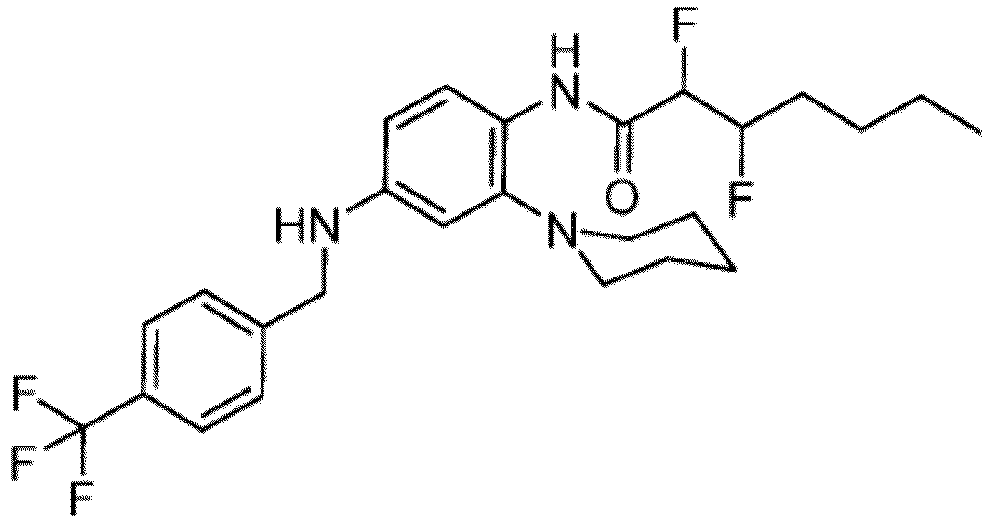
2,3-difluoro-N-(2-(pipéridin-1-yl)-4-((4-(trifluorométhyl)benzyl) amino)phényl)heptanamide (2R,3S)-2,3-difluoro-N-(2-(pipéridin-1-yl)-4-((4-(trifluorométhyl)benzyl) amino)phényl)heptanamide (2S,3R)-2,3-difluoro-N-(2-(pipéridin-1-yl)-4-((4-(trifluorométhyl)benzyl) amino)phényl)heptanamide (2R,3R)-2,3-difluoro-N-(2-(pipéridin-1-yl)-4-((4-(trifluorométhyl)benzyl) amino)phényl)heptanamide (2S,3S)-2,3-difluoro-N-(2-(pipéridin-1-yl)-4-((4-(trifluorométhyl)benzyl) amino)phényl)heptanamide 7. 
6,7-difluoro-N-(2-(pipéridin-1-yl)-4-((4-(trifluorométhyl)benzyl) amino)phényl)heptanamide (6R)-6,7-difluoro-N-(2-(pipéridin-1-yl)-4-((4-(trifluorométhyl)benzyl) amino)phényl)heptanamide (6S)-6,7-difluoro-N-(2-(pipéridin-1-yl)-4-((4-(trifluorométhyl)benzyl) amino)phényl)heptanamide 8. 
3,3-diméthyl-N-(2-(pipéridin-1-yl)-4-((4-(trifluorométhyl)benzyl) amino)phényl)butanamide 9. 
3,3-diméthyl-N-(2-(pyrrolidin-1-yl)-4-((4-(trifluorométhyl)benzyl) amino)phényl)butanamide 10 
N-(2-(pyrrolidin-1-yl)-4-((4-(trifluorométhyl)benzyl) amino)phényl)heptanamide 11 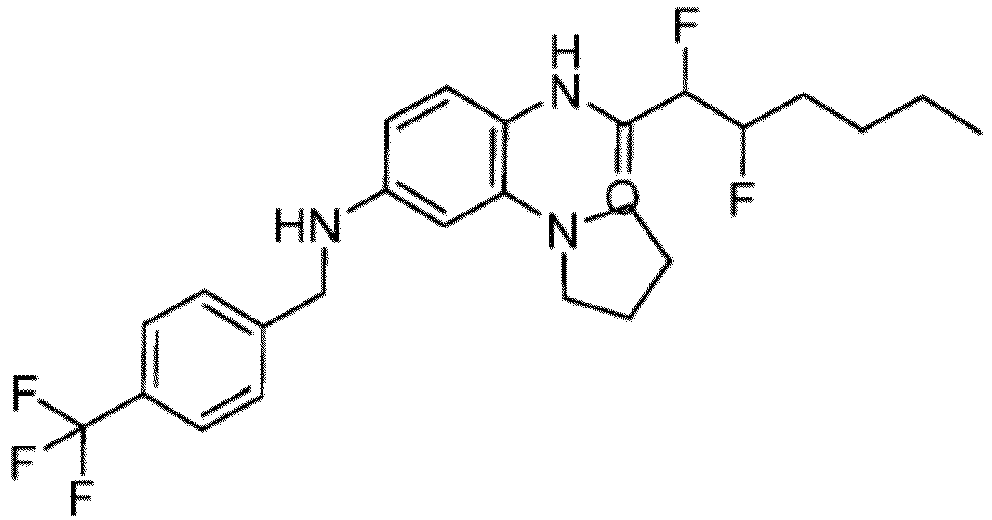
(2R,3S)-2,3-difluoro-N-(2-(pyrrolidin-1-yl)-4-((4-(trifluorométhyl)benzyl) amino)phényl)heptanamide (2S,3R)-2,3-difluoro-N-(2-(pyrrolidin-1-yl)-4-((4-(trifluorométhyl)benzyl) amino)phényl)heptanamide (2R,3R)-2,3-difluoro-N-(2-(pyrrolidin-1-yl)-4-((4-(trifluorométhyl)benzyl) amino)phényl)heptanamide (2S,3S)-2,3-difluoro-N-(2-(pyrrolidin-1-yl)-4-((4-(trifluorométhyl)benzyl) amino)phényl)heptanamide 12 
6,7-difluoro-N-(2-(pyrrolidin-1-yl)-4-((4-(trifluorométhyl)benzyl) amino)phényl)heptanamide (6R)-6,7-difluoro-N-(2-(pyrrolidin-1-yl)-4-((4-(trifluorométhyl)benzyl) amino)phényl)heptanamide (6S)-6,7-difluoro-N-(2-(pyrrolidin-1-yl)-4-((4-(trifluorométhyl)benzyl) amino)phényl)heptanamide 13 
N-(2-(pyrrolidin-1-yl)-4-((4-(trifluorométhyl)benzyl) amino)phényl)octanamide 14 
2,3-difluoro-N-(2-(pyrrolidin-1-yl)-4-((4-(trifluorométhyl)benzyl) amino)phényl)octanamide (2R,3S)-2,3-difluoro-N-(2-(pyrrolidin-1-yl)-4-((4-(trifluorométhyl)benzyl) amino)phényl)octanamide (2S,3R)-2,3-difluoro-N-(2-(pyrrolidin-1-yl)-4-((4-(trifluorométhyl)benzyl) amino)phényl)octanamide (2R,3R)-2,3-difluoro-N-(2-(pyrrolidin-1-yl)-4-((4-(trifluorométhyl)benzyl) amino)phényl)octanamide (2S,3S)-2,3-difluoro-N-(2-(pyrrolidin-1-yl)-4-((4-(trifluorométhyl)benzyl) amino)phényl)octanamide 15 
7,8-difluoro-N-(2-(pyrrolidin-1-yl)-4-((4-(trifluorométhyl)benzyl) amino)phényl)octanamide (7R)-7,8-difluoro-N-(2-(pyrrolidin-1-yl)-4-((4-(trifluorométhyl)benzyl) amino)phényl)octanamide (7S)-7,8-difluoro-N-(2-(pyrrolidin-1-yl)-4-((4-(trifluorométhyl)benzyl) amino)phényl)octanamide 16 
3,3-diméthyl-N-(2-(méthylamino)-4-((4-(trifluorométhyl)benzyl) amino)phényl)butanamide 17 
N-(2-(méthylamino)-4-((4-(trifluorométhyl)benzyl) amino)phényl)heptanamide 18 
2,3-difluoro-N-(2-(méthylamino)-4-((4-(trifluorométhyl)benzyl) amino)phényl)heptanamide (2R,3S)-2,3-difluoro-N-(2-(méthylamino)-4-((4-(trifluorométhyl)benzyl) amino)phényl)heptanamide (2S,3R)-2,3-difluoro-N-(2-(méthylamino)-4-((4-(trifluorométhyl)benzyl) amino)phényl)heptanamide (2R,3R)-2,3-difluoro-N-(2-(méthylamino)-4-((4-(trifluorométhyl)benzyl) amino)phényl)heptanamide (2S,3S)-2,3-difluoro-N-(2-(méthylamino)-4-((4-(trifluorométhyl)benzyl) amino)phényl)heptanamide 19 
6,7-difluoro-N-(2-(méthylamino)-4-((4-(trifluorométhyl)benzyl) amino)phényl)heptanamide (6R)-6,7-difluoro-N-(2-(méthylamino)-4-((4-(trifluorométhyl)benzyl) amino)phényl)heptanamide (6S)-6,7-difluoro-N-(2-(méthylamino)-4-((4-(trifluorométhyl)benzyl) amino)phényl)heptanamide 20 
N-(2-(méthylamino)-4-((4-(trifluorométhyl)benzyl) amino)phényl)octanamide 21 
2,3-difluoro-N-(2-(méthylamino)-4-((4-(trifluorométhyl)benzyl) amino)phényl)octanamide (2R,3S)-2,3-difluoro-N-(2-(méthylamino)-4-((4-(trifluorométhyl)benzyl) amino)phényl)octanamide (2S,3R)-2,3-difluoro-N-(2-(méthylamino)-4-((4-(trifluorométhyl)benzyl) amino)phényl)octanamide (2R,3R)-2,3-difluoro-N-(2-(méthylamino)-4-((4-(trifluorométhyl)benzyl) amino)phényl)octanamide (2S,3S)-2,3-difluoro-N-(2-(méthylamino)-4-((4-(trifluorométhyl)benzyl) amino)phényl)octanamide 22 
7,8-difluoro-N-(2-(méthylamino)-4-((4-(trifluorométhyl)benzyl) amino)phényl)octanamide (7R)-7,8-difluoro-N-(2-(méthylamino)-4-((4-(trifluorométhyl)benzyl) amino)phényl)octanamide (7S)-7,8-difluoro-N-(2-(méthylamino)-4-((4-(trifluorométhyl)benzyl) amino)phényl)octanamide 23 
N-(2-(diéthylamino)-4-((4-(trifluorométhyl)benzyl) amino)phényl)-3,3-diméthylbutanamide 24 
3-cyclohexyl-N-(2-(diéthylamino)-4-((4-(trifluorométhyl)benzyl) amino)phényl)propanamide 25 
3-cyclohexyl-N-(2-(méthylamino)-4-((4-(trifluorométhyl)benzyl) amino)phényl)propanamide 26 
3-cyclohexyl-N-(2-(pipéridin-1-yl)-4-((4-(trifluorométhyl)benzyl) amino)phényl)propanamide 27 
3-cyclohexyl-N-(2-(pyrrolidin-1-yl)-4-((4-(trifluorométhyl)benzyl) amino)phényl)propanamide 28 
N-(2-(diéthylamino)-4-((4-(trifluorométhyl)benzyl) amino)phényl)heptanamide 29 
N-(2-(diéthylamino)-4-((4-(trifluorométhyl)benzyl) amino)phényl)-2,3-difluoroheptanamide (2R, 3S) -N- (2-(diéthylamino)-4-((4-(trifluorométhyl)benzyl) amino)phényl)-2,3-difluoroheptanamide (2S,3R) -N-(2-(diéthylamino)-4-((4-(trifluorométhyl)benzyl) amino)phényl)-2,3-difluoroheptanamide (2R, 3R) -N- (2-(diéthylamino)-4-((4-(trifluorométhyl)benzyl) amino)phényl)-2,3-difluoroheptanamide (2S,3S)-N-(2-(diéthylamino)-4-((4-(trifluorométhyl)benzyl) amino)phényl)-2,3-difluoroheptanamide 30 
N-(2-(diéthylamino)-4-((4-(trifluorométhyl)benzyl) amino)phényl)-6,7-difluoroheptanamide (6R)-N-(2-(diéthylamino)-4-((4-(trifluorométhyl)benzyl) amino)phényl)-6,7-difluoroheptanamide (6S)-N-(2-(diéthylamino)-4-((4-(trifluorométhyl)benzyl) amino)phényl)-6,7-difluoroheptanamide 31 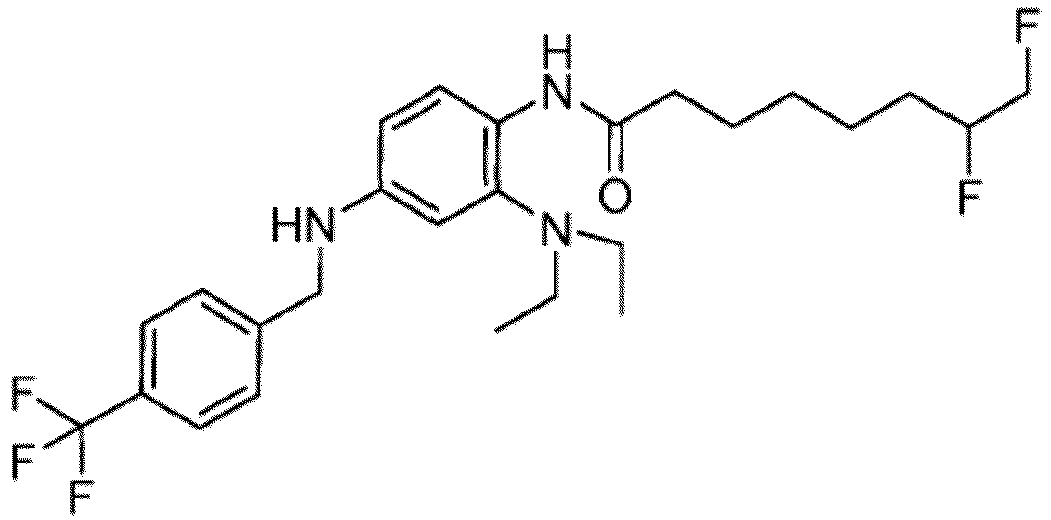
N-(2-(diéthylamino)-4-((4-(trifluorométhyl)benzyl) amino)phényl)-7,8-difluorooctanamide (7R)-N-(2-(diéthylamino)-4-((4-(trifluorométhyl)benzyl) amino)phényl)-7,8-difluorooctanamide (7S)-N-(2-(diéthylamino)-4-((4-(trifluorométhyl)benzyl) amino)phényl)-7,8-difluorooctanamide 32 
N-(2-(diéthylamino)-4-((4-(trifluorométhyl)benzyl) amino)phényl)-2,3-difluorooctanamide (2R,3S)-N-(2-(diéthylamino)-4-((4-(trifluorométhyl)benzyl) amino)phényl)-2,3-difluorooctanamide (2S,3R)-N-(2-(diéthylamino)-4-((4-(trifluorométhyl)benzyl) amino)phényl)-2,3-difluorooctanamide (2R, 3R) -N- (2-(diéthylamino)-4-((4-(trifluorométhyl)benzyl) amino)phényl)-2,3-difluorooctanamide (2S,3S)-N-(2-(diéthylamino)-4-((4-(trifluorométhyl)benzyl) amino)phényl)-2,3-difluorooctanamide 33 
N-(2-(diéthylamino)-4-((4-(trifluorométhyl)benzyl) amino)phényl)octanamide 34 
N-(2-amino-4-(4-(trifluorométhyl)phénéth yl)phényl)-3-cyclohexylpropanamide 35 
N-(2-amino-4-(4-(trifluorométhyl)phénéth yl)phényl)-3-cyclohexylpropanamide 36 
N-(2-amino-4-(4-(trifluorométhyl)phénéth yl)phényl)heptanamide 37 
N-(2-amino-4-(4-(trifluorométhyl)phénéth yl)phényl)-2,3-difluoroheptanamide (2R,3S)-N-(2-amino-4-(4-(trifluorométhyl)phénéth yl)phényl)-2,3-difluoroheptanamide (2S,3R)-N-(2-amino-4-(4-(trifluorométhyl)phénéth yl)phényl)-2,3-difluoroheptanamide (2R,3R)-N-(2-amino-4-(4-(trifluorométhyl)phénéth yl)phényl)-2,3-difluoroheptanamide (2S,3S)-N-(2-amino-4-(4-(trifluorométhyl)phénéth yl)phényl)-2,3-difluoroheptanamide 38 
N-(2-amino-4-(4-(trifluorométhyl)phénéth yl)phényl)-6,7-difluoroheptanamide (6R)-N-(2-amino-4-(4-(trifluorométhyl)phénéth yl)phényl)-6,7-difluoroheptanamide (6S)-N-(2-amino-4-(4-(trifluorométhyl)phénéth yl)phényl)-6,7-difluoroheptanamide 39 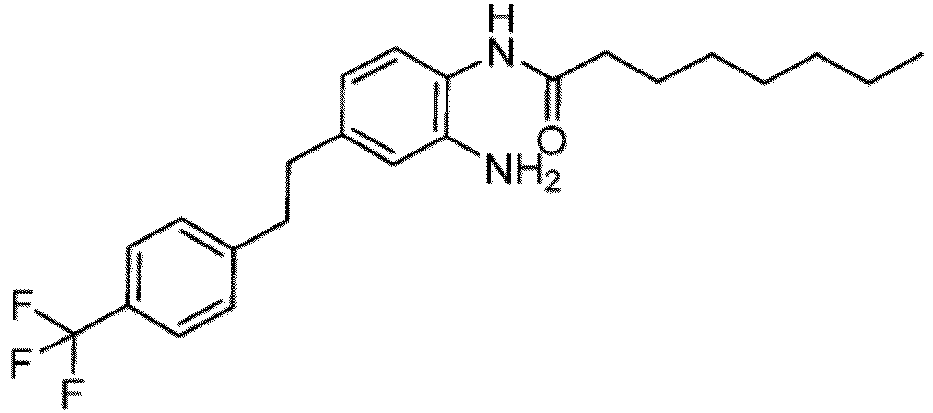
N-(2-amino-4-(4-(trifluorométhyl)phénéth yl)phényl)octanamide 40 
N-(2-amino-4-(4-(trifluorométhyl)phénéth yl)phényl)-2,3-difluorooctanamide 41 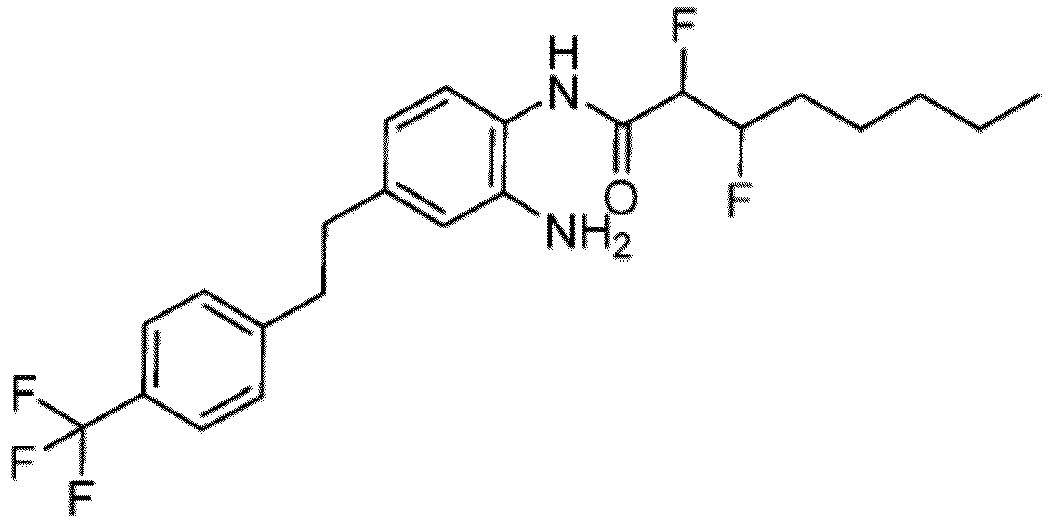
N-(2-amino-4-(4-(trifluorométhyl)phénéth yl)phényl)-2,3-difluorooctanamide (2R,3S)-N-(2-amino-4-(4-(trifluorométhyl)phénéth yl)phényl)-2,3-difluorooctanamide (2S,3R)-N-(2-amino-4-(4-(trifluorométhyl)phénéth yl)phényl)-2,3-difluorooctanamide (2R,3R)-N-(2-amino-4-(4-(trifluorométhyl)phénéth yl)phényl)-2,3-difluorooctanamide (2S,3S)-N-(2-amino-4-(4-(trifluorométhyl)phénéth yl)phényl)-2,3-difluorooctanamide 42 
N-(2-amino-4-(4-(trifluorométhyl)phénéth yl)phényl)-7,8-difluorooctanamide (7R)-N-(2-amino-4-(4-(trifluorométhyl)phénéth yl)phényl)-7,8-difluorooctanamide (7S)-N-(2-amino-4-(4-(trifluorométhyl)phénéth yl)phényl)-7,8-difluorooctanamide 43 
3-cyclohexyl-N-(2-pipéridin-1-yl)-4-(4-(trifluorométhyl)phénéth yl)phényl)propanamide 44 
N-(4-((4-fluorobenzyl)amino)phény l)heptanamide 45 
N-(3-fluoro-4-((4-fluorobenzyl)amino)phény l)heptanamide 46 
N-(2-amino-3-fluoro-4-((4-fluorobenzyl)amino)phény l)heptanamide 47 
N-(2-amino-4-((4-fluorobenzyl)amino)phény l)heptanamide 48 
N-(4-((4-(trifluorométhyl)benzyl) amino)phényl)heptanamide 49 
N-(3-fluoro-4-((4-(trifluorométhyl)benzyl) amino)phényl)heptanamide 50 
N-(2-amino-3-fluoro-4-((4-(trifluorométhyl)benzyl) amino)phényl)heptanamide 51 
N-(2-amino-4-((4-(trifluorométhyl)benzyl) amino)phényl)heptanamide 52 
N-(4-((4-(trifluorométhoxy)benzyl )amino)phényl)heptanamid e 53 
N-(3-fluoro-4-((4-(trifluorométhoxy)benzyl )amino)phényl)heptanamid e 54 
N-(2-amino-3-fluoro-4-((4-(trifluorométhoxy)benzyl )amino)phényl)heptanamid e 55 
N-(2-amino-4-((4-(trifluorométhoxy)benzyl )amino)phényl)heptanamid e 56 
3,3-diméthyl-N-(4-((4-(trifluorométhoxy)benzyl )amino)phényl)butanamide 57 
N-(3-fluoro-4-((4-(trifluorométhoxy)benzyl )amino)phényl)-3,3-diméthylbutanamide 58 
N-(2-amino-3-fluoro-4-((4-(trifluorométhoxy)benzyl )amino)phényl)-3,3-diméthylbutanamide 59 
N-(2-amino-4-((4-(trifluorométhoxy)benzyl )amino)phényl)-3,3-diméthylbutanamide 60 
3,3-diméthyl-N-(4-((4-(trifluorométhyl)benzyl) amino)phényl)butanamide 61 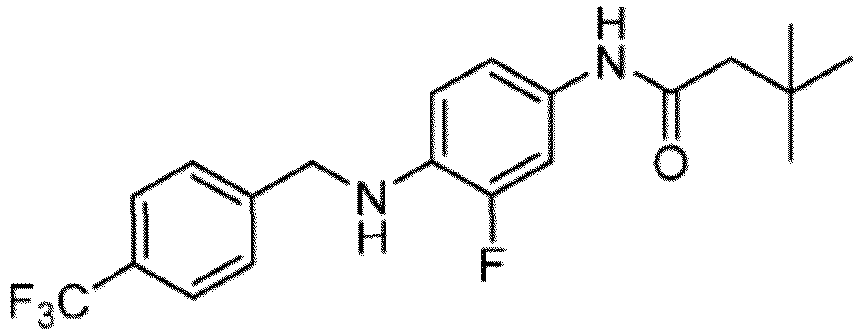
N-(3-fluoro-4-((4-(trifluorométhyl)benzyl) amino)phényl)-3,3-diméthylbutanamide 62 
N-(2-amino-3-fluoro-4-((4-(trifluorométhyl)benzyl) amino)phényl)-3,3-diméthylbutanamide 63 
N-(2-amino-4-((4-(trifluorométhyl)benzyl) amino)phényl)-3,3-diméthylbutanamide 64 
N-(2-amino-4-((4-(trifluorométhyl)benzyl) amino)phényl)octanamide 65 
N-(2-amino-4-((4-(trifluorométhyl)benzyl) amino)phényl)nonanamide 66 
N-(2-amino-4-((4-(trifluorométhyl)benzyl) amino)phényl)décanamide 67 
N-(2-amino-4-((4-(trifluorométhyl)benzyl) amino)phényl)undécanamid e 68 
N-(2-amino-4-((4-(trifluorométhyl)benzyl) amino)phényl)dodécanamid e 69 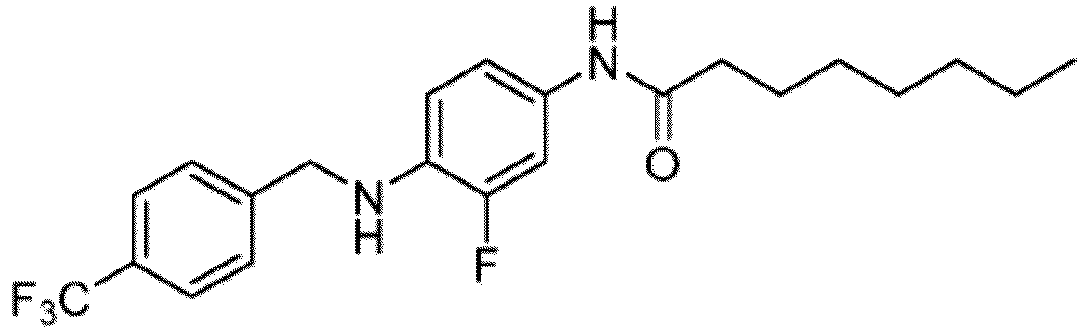
N-(3-fluoro-4-((4-(trifluorométhyl)benzyl) amino)phényl)octanamide 70 
N-(3-fluoro-4-((4-(trifluorométhyl)benzyl) amino)phényl)nonanamide 71 
N-(3-fluoro-4-((4-(trifluorométhyl)benzyl) amino)phényl)décanamide 72 
N-(3-fluoro-4-((4-(trifluorométhyl)benzyl) amino)phényl)undécanamid e 73 
N-(3-fluoro-4-((4-(trifluorométhyl)benzyl) amino)phényl)dodécanamid e 74 
N-(2-amino-3-fluoro-4-((4-(trifluorométhyl)benzyl) amino)phényl)octanamide 75 
N-(2-amino-3-fluoro-4-((4-(trifluorométhyl)benzyl) amino)phényl)nonanamide 76 
N-(2-amino-3-fluoro-4-((4-(trifluorométhyl)benzyl) amino)phényl)décanamide 77 
N-(2-amino-3-fluoro-4-((4-(trifluorométhyl)benzyl) amino)phényl)undécanamid e 78 
N-(2-amino-3-fluoro-4-((4-(trifluorométhyl)benzyl) amino)phényl)dodécanamid e 79 
N-(2-amino-3-fluoro-4-((4-(trifluorométhyl)benzyl) amino)phényl)-2,3-difluoroheptanamide (2R,3S)-N-(2-amino-3-fluoro-4-((4-(trifluorométhyl)benzyl) amino)phényl)-2,3-difluoroheptanamide (2S,3R)-N-(2-amino-3-fluoro-4-((4-(trifluorométhyl)benzyl) amino)phényl)-2,3-difluoroheptanamide (2R,3R)-N-(2-amino-3-fluoro-4-((4-(trifluorométhyl)benzyl) amino)phényl)-2,3-difluoroheptanamide (2S,3S)-N-(2-amino-3-fluoro-4-((4-(trifluorométhyl)benzyl) amino)phényl)-2,3-difluoroheptanamide mélanges racémiques de ceux-ci 80 
N-(2-amino-3-fluoro-4-((4-(trifluorométhyl)benzyl) amino)phényl)-2,3-difluorooctanamide (2R,3S)-N-(2-amino-3-fluoro-4-((4-(trifluorométhyl)benzyl) amino)phényl)-2,3-difluorooctanamide (2S,3R)-N-(2-amino-3-fluoro-4-((4-(trifluorométhyl)benzyl) amino)phényl)-2,3-difluorooctanamide (2R,3R)-N-(2-amino-3-fluoro-4-((4-(trifluorométhyl)benzyl) amino)phényl)-2,3-difluorooctanamide (2S,3S)-N-(2-amino-3-fluoro-4-((4-(trifluorométhyl)benzyl) amino)phényl)-2,3-difluorooctanamide mélanges racémiques de ceux-ci 81 
N-(2-amino-3-fluoro-4-((4-(trifluorométhyl)benzyl) amino)phényl)-2,3-difluorononanamide (2R,3S)-N-(2-amino-3-fluoro-4-((4-(trifluorométhyl)benzyl) amino)phényl)-2,3-difluorononanamide (2S,3R)-N-(2-amino-3-fluoro-4-((4-(trifluorométhyl)benzyl) amino)phényl)-2,3-difluorononanamide (2R,3R)-N-(2-amino-3-fluoro-4-((4-(trifluorométhyl)benzyl) amino)phényl)-2,3-difluoroonoanamide (2S,3S)-N-(2-amino-3-fluoro-4-((4-(trifluorométhyl)benzyl) amino)phényl)-2,3-difluorononanamide mélanges racémiques de ceux-ci 82 
N-(2-amino-3-fluoro-4-((4-(trifluorométhyl)benzyl) amino)phényl)-2,3-difluorodécanamide (2R,3S)-N-(2-amino-3-fluoro-4-((4-(trifluorométhyl)benzyl) amino)phényl)-2,3-difluorodécanamide (2S,3R)-N-(2-amino-3-fluoro-4-((4-(trifluorométhyl)benzyl) amino)phényl)-2,3-difluorodécanamide (2R,3R)-N-(2-amino-3-fluoro-4-((4-(trifluorométhyl)benzyl) amino)phényl)-2,3-difluorodécanamide (2S,3S)-N-(2-amino-3-fluoro-4-((4-(trifluorométhyl)benzyl) amino)phényl)-2,3-difluorodécanamide mélanges racémiques de ceux-ci 83 
N-(2-amino-3-fluoro-4-((4-(trifluorométhyl)benzyl) amino)phényl)-2,3-difluoroundécanamide (2R,3S)-N-(2-amino-3-fluoro-4-((4-(trifluorométhyl)benzyl) amino)phényl)-2,3-difluoroundécanamide (2S,3R)-N-(2-amino-3-fluoro-4-((4-(trifluorométhyl)benzyl) amino)phényl)-2,3-difluoroundécanamide (2R,3R)-N-(2-amino-3-fluoro-4-((4-(trifluorométhyl)benzyl) amino)phényl)-2,3-difluoroundécanamide (2S,3S)-N-(2-amino-3-fluoro-4-((4-(trifluorométhyl)benzyl) amino)phényl)-2,3-difluoroundécanamide mélanges racémiques de ceux-ci 84 
N-(2-amino-3-fluoro-4-((4-(trifluorométhyl)benzyl) amino)phényl)-2,3-difluorododécanamide (2R,3S)-N-(2-amino-3-fluoro-4-((4-(trifluorométhyl)benzyl) amino)phényl)-2,3-difluorododécanamide (2S,3R)-N-(2-amino-3-fluoro-4-((4-(trifluorométhyl)benzyl) amino)phényl)-2,3-difluorododécanamide (2R,3R)-N-(2-amino-3-fluoro-4-((4-(trifluorométhyl)benzyl) amino)phényl)-2,3-difluorododécanamide (2S,3S)-N-(2-amino-3-fluoro-4-((4-(trifluorométhyl)benzyl) amino)phényl)-2,3-difluorododécanamide mélanges racémiques de ceux-ci 85 
N-(2-amino-3-fluoro-4-((4-(trifluorométhyl)benzyl) amino)phényl)-6,7-difluoroheptanamide (6R)-N-(2-amino-3-fluoro-4-((4-(trifluorométhyl)benzyl) amino)phényl)-6,7-difluoroheptanamide (6S)-N-(2-amino-3-fluoro-4-((4-(trifluorométhyl)benzyl) amino)phényl)-6,7-difluoroheptanamide mélanges racémiques de ceux-ci 86 
N-(2-amino-3-fluoro-4-((4-(trifluorométhyl)benzyl) amino)phényl)-6,7-difluorooctanamide (6R)-N-(2-amino-3-fluoro-4-((4-(trifluorométhyl)benzyl) amino)phényl)-6,7-difluorooctanamide (6S)-N-(2-amino-3-fluoro-4-((4-(trifluorométhyl)benzyl) amino)phényl)-6,7-difluorooctanamide mélanges racémiques de ceux-ci 87 
N-(2-amino-3-fluoro-4-((4-(trifluorométhyl)benzyl) amino)phényl)-8,9-difluorononanamide (8R)-N-(2-amino-3-fluoro-4-((4-(trifluorométhyl)b,enzyl )amino)phényl)-8,9-difluorononanamide (8S)-N-(2-amino-3-fluoro-4-((4-(trifluorométhyl)benzyl) amino)phényl)-8,9-difluorononanamide mélanges racémiques de ceux-ci 88 
N-(2-amino-3-fluoro-4-((4-(trifluorométhyl)benzyl) amino)phényl)-9,10-difluorodécanamide (9R)-N-(2-amino-3-fluoro-4-((4-(trifluorométhyl)benzyl) amino)phényl)-9,10-difluorodécanamide (9S)-N-(2-amino-3-fluoro-4-((4-(trifluorométhyl)benzyl) amino)phényl)-9,10-difluorodécanamide mélanges racémiques de ceux-ci 89 
N-(2-amino-4-((4-(trifluorométhyl)benzyl) amino)phényl)-2,3-difluoroheptanamide (2R,3S)-N-(2-amino-4-((4-(trifluorométhyl)benzyl) amino)phényl)-2,3-difluoroheptanamide (2S,3R)-N-(2-amino-4-((4-(trifluorométhyl)benzyl) amino)phényl)-2,3-difluoroheptanamide (2R,3R)-N-(2-amino-4-((4-(trifluorométhyl)benzyl) amino)phényl)-2,3-difluoroheptanamide (2S,3S)-N-(2-amino-4-((4-(trifluorométhyl)benzyl) amino)phényl)-2,3-difluoroheptanamide mélanges racémiques de ceux-ci 90 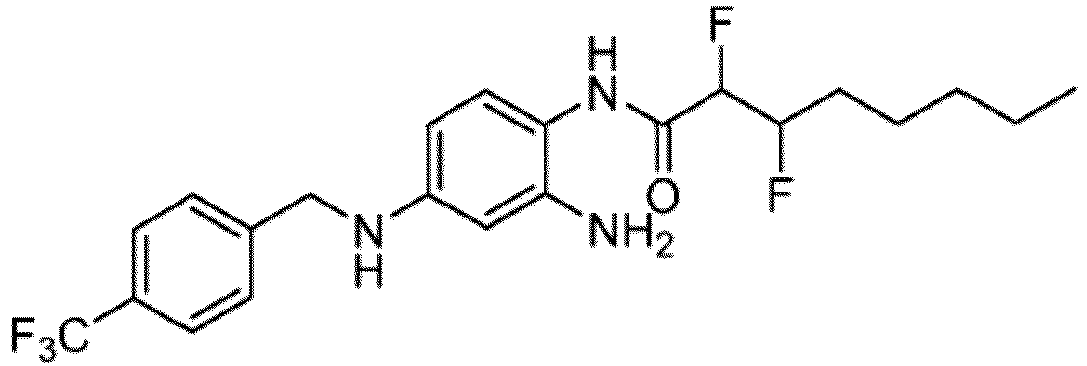
N-(2-amino-4-((4-(trifluorométhyl)benzyl) amino)phényl)-2,3-difluorooctanamide (2R,3S)-N-(2-amino-4-((4-(trifluorométhyl)benzyl) amino)phényl)-2,3-difluorooctanamide (2S,3R)-N-(2-amino-4-((4-(trifluorométhyl)benzyl) amino)phényl)-2,3-difluorooctanamide (2R,3R)-N-(2-amino-4-((4-(trifluorométhyl)benzyl) amino)phényl)-2,3-difluorooctanamide (2S,3S)-N-(2-amino-4-((4-(trifluorométhyl)benzyl) amino)phényl)-2,3-difluorooctanamide mélanges racémiques de ceux-ci 91 
N-(2-amino-4-((4-(trifluorométhyl)benzyl) amino)phényl)-2,3-difluorononanamide (2R,3S)-N-(2-amino-4-((4-(trifluorométhyl)benzyl) amino)phényl)-2,3-difluorononanamide (2S,3R)-N-(2-amino-4-((4-(trifluorométhyl)benzyl) amino)phényl)-2,3-difluorononanamide (2R,3R)-N-(2-amino-4-((4-(trifluorométhyl)benzyl) amino)phényl)-2,3-difluorononanamide (2S,3S)-N-(2-amino-4-((4-(trifluorométhyl)benzyl) amino)phényl)-2,3-difluorononanamide mélanges racémiques de ceux-ci 92 
N-(2-amino-4-((4-(trifluorométhyl)benzyl) amino)phényl)-2,3-difluorodécanamide (2R,3S)-N-(2-amino-4-((4-(trifluorométhyl)benzyl) amino)phényl)-2,3-difluorodécanamide (2S,3R)-N-(2-amino-4-((4-(trifluorométhyl)benzyl) amino)phényl)-2,3-difluorodécanamide (2R,3R)-N-(2-amino-4-((4-(trifluorométhyl)benzyl) amino)phényl)-2,3-difluorodécanamide (2S,3S)-N-(2-amino-4-((4-(trifluorométhyl)benzyl) amino)phényl)-2,3-difluorodécanamide mélanges racémiques de ceux-ci 93 
N-(2-amino-4-((4-(trifluorométhyl)benzyl) amino)phényl)-6,7-difluoroheptanamide (6R)-N-(2-amino-4-((4-(trifluorométhyl)benzyl) amino)phényl)-6,7-difluoroheptanamide (6S)-N-(2-amino-4-((4-(trifluorométhyl)benzyl) amino)phényl)-6,7-difluoroheptanamide mélanges racémiques de ceux-ci 94 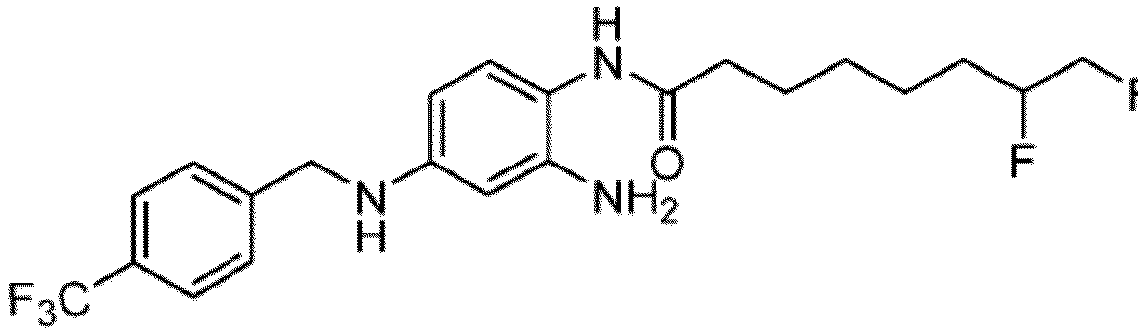
N-(2-amino-4-((4-(trifluorométhyl)benzyl) amino)phényl)-7,8-difluorooctanamide (7R)-N-(2-amino-4-((4-(trifluorométhyl)benzyl) amino)phényl)-7,8-difluorooctanamide (7S)-N-(2-amino-4-((4-(trifluorométhyl)benzyl) amino)phényl)-7,8-difluorooctanamide mélanges racémiques de ceux-ci 95 
N-(2-amino-3-fluoro-4-((4-(trifluorométhyl)benzyl) amino)phényl)-6,7-difluorononanamide (6R)-N-(2-amino-4-((4-(trifluorométhyl)benzyl) amino)phényl)-6,7-difluorononanamide (6S)-N-(2-amino-4-((4-(trifluorométhyl)benzyl) amino)phényl)-6,7-difluorononanamide mélanges racémiques de ceux-ci 96 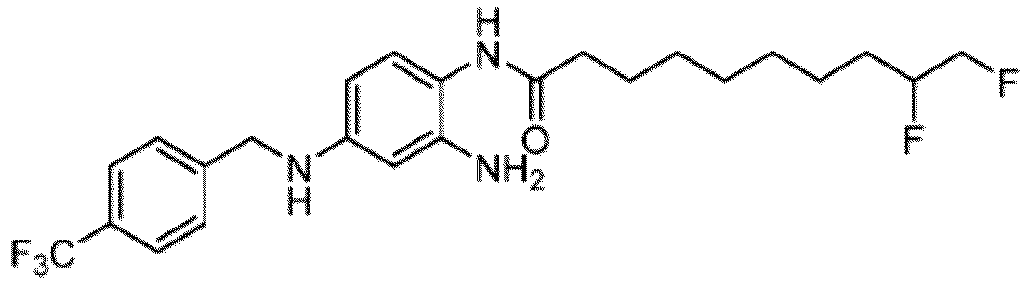
N-(2-amino-3-fluoro-4-((4-(trifluorométhyl)benzyl) amino)phényl)-6,7-difluorodécanamide (6R)-N-(2-amino-3-fluoro-4-((4-(trifluorométhyl)benzyl) amino)phényl)-6,7-difluorodécanamide (6S)-N-(2-amino-3-fluoro-4-((4-(trifluorométhyl)benzyl) amino)phényl)-6,7-difluorodécanamide mélanges racémiques de ceux-ci 97 
N-(2-amino-4-((4-hydroxybenzyl)amino)phén yl)heptanamide 98 
N-(4-((4-hydroxybenzyl)amino)phén yl)heptanamide 99 
N-(2-amino-3-fluoro-4-((4-hydroxybenzyl)amino)phén yl)heptanamide 10 
N-(2-amino-4-((4-hydroxybenzyl)amino)phén yl)octanamide 10 
N-(4-((4-hydroxybenzyl)amino)phén yl)octanamide 10 
N-(2-amino-3-fluoro-4-((4-hydroxybenzyl)amino)phén yl)octanamide 10 
N-(2-amino-4-((4-hydroxybenzyl)amino)phén yl)décanamide 10 
N-(4-((4-hydroxybenzyl)amino)phén yl)décanamide 10 
N-(2-amino-3-fluoro-4-((4-hydroxybenzyl)amino)phén yl)décanamide 10 
N-(2-amino-4-((4-hydroxybenzyl)amino)phén yl)-2,3-difluorodécanamide (2R,3S)-N-(2-amino-4-((4-hydroxybenzyl)amino)phén yl)-2,3-difluorodécanamide (2S,3R)-N-(2-amino-4-((4-hydroxybenzyl)amino)phén yl)-2,3-difluorodécanamide (2R,3R)-N-(2-amino-4-((4-hydroxybenzyl)amino)phén yl)-2,3-difluorodécanamide (2S,3S)-N-(2-amino-4-((4-hydroxybenzyl)amino)phén yl)-2,3-difluorodécanamide mélanges racémiques de ceux-ci 10 
N-(2-amino-4-((4-hydroxybenzyl)amino)phén yl)-9,10-difluorodécanamide (9R)-N-(2-amino-4-((4-hydroxybenzyl)amino)phén yl)-2,3-difluorodécanamide (9S)-N-(2-amino-4-((4-hydroxybenzyl)amino)phén yl)-2,3-difluorodécanamide mélanges racémiques de ceux-ci 10 
2,3-difluoro-N-(4-((4-hydroxybenzyl)amino)phén yl)déca décanamide (2R,3S)-2,3-difluoro-N-(4-((4-hydroxybenzyl)amino)phén yl)déca décanamide (2S,3R)-2,3-difluoro-N-(4-((4-hydroxybenzyl)amino)phén yl)déca décanamide (2R,3R)-2,3-difluoro-N-(4-((4-hydroxybenzyl)amino)phén yl)déca décanamide (2S,3S)-2,3-difluoro-N-(4-((4-hydroxybenzyl)amino)phén yl)déca décanamide mélanges racémiques de ceux-ci 10 
9,10-difluoro-N-(4-((4-hydroxybenzyl)amino)phén yl)décanamide (9R)-9,10-difluoro-N-(4-((4-hydroxybenzyl)amino)phén yl)décanamide (9S)-9,10-difluoro-N-(4-((4-hydroxybenzyl)amino)phén yl)décanamide mélanges racémiques de ceux-ci 11 
N-(2-amino-3-fluoro-4-((4-hydroxybenzyl)amino)phén yl)-2,3-difluorodécanamide (2R,3S)-N-(2-amino-3-fluoro-4-((4-hydroxybenzyl)amino)phén yl)-2,3-difluorodécanamide (2S,3R)-N-(2-amino-3-fluoro-4-((4-hydroxybenzyl)amino)phén yl)-2,3-difluorodécanamide (2R,3R)-N-(2-amino-3-fluoro-4-((4-hydroxybenzyl)amino)phén yl)-2,3-difluorodécanamide (2S,3S)-N-(2-amino-3-fluoro-4-((4-hydroxybenzyl)amino)phén yl)-2,3-difluorodécanamide mélanges racémiques de ceux-ci 11 
N-(2-amino-3-fluoro-4-((4-hydroxybenzyl)amino)phén yl)-9,10-difluorodécanamide (9R)-N-(2-amino-3-fluoro-4-((4-hydroxybenzyl)amino)phén yl)-9,10-difluorodécanamide (9S)-N-(2-amino-3-fluoro-4-((4-hydroxybenzyl)amino)phén yl)-9,10-difluorodécanamide mélanges racémiques de ceux-ci 11 
N-(2-amino-4-((4-hydroxybenzyl)amino)phén yl)-2,3-difluorooctanamide (2R,3S)-N-(2-amino-4-((4-hydroxybenzyl)amino)phényl)-2,3-difluorooctanamide (2S,3R)-N-(2-amino-4-((4-hydroxybenzyl)amino)phén yl)-2,3-difluorooctanamide (2R,3R)-N-(2-amino-4-((4-hydroxybenzyl)amino)phén yl)-2,3-difluorooctanamide (2S,3S)-N-(2-amino-4-((4-hydroxybenzyl)amino)phén yl)-2,3-difluorooctnamide mélanges racémiques de ceux-ci 11 
2,3-difluoro-N-(4-((4-hydroxybenzyl)amino)phén yl)octanamide (2R,3S)-2,3-difluoro-N-(4-((4-hydroxybenzyl)amino)phén yl)octanamide (2S,3R)-2,3-difluoro-N-(4-((4-hydroxybenzyl)amino)phén yl)octanamide (2R,3R)-2,3-difluoro-N-(4-((4-hydroxybenzyl)amino)phén yl)octanamide (2S,3S)-2,3-difluoro-N-(4-((4-hydroxybenzyl)amino)phén yl)octanamide mélanges racémiques de ceux-ci 11 
N-(2-amino-3-fluoro-4-((4-hydroxybenzyl)amino)phén yl)-2,3-difluorooctanamide (2R,3S)-N-(2-amino-3-fluoro-4-((4-hydroxybenzyl)amino)phén yl)-2,3-difluorooctanamide (2S,3R)-N-(2-amino-3-fluoro-4-((4-hydroxybenzyl)amino)phén yl)-2,3-difluorooctanamide (2R,3R)-N-(2-amino-3-fluoro-4-((4-hydroxybenzyl)amino)phén yl)-2,3-difluorooctanamide (2S,3S)-N-(2-amino-3-fluoro-4-((4-hydroxybenzyl)amino)phén yl)-2,3-difluorooctanamide mélanges racémiques de ceux-ci 11 
N-(2-amino-4-((4-hydroxybenzyl)amino)phén yl)-7,8-difluorooctanamide (7S)-N-(2-amino-4-((4-hydroxybenzyl)amino)phényl)-7,8-difluorooctanamide (7R)-N-(2-amino-4-((4-hydroxybenzyl)amino)phén yl)-7,8-difluorooctanamide mélanges racémiques de ceux-ci 11 
7,8-difluoro-N-(4-((4-hydroxybenzyl)amino)phén yl)-octanamide (7R)-7,8-difluoro-N-(4-((4-hydroxybenzyl)amino)phén yl)-octanamide (7S)-7,8-difluoro-N-(4-((4-hydroxybenzyl)amino)phén yl)-octanamide mélanges racémiques de ceux-ci 11 
N-(2-amino-3-fluoro-4-((4-hydroxybenzyl)amino)phén yl)-7,8-difluorooctanamide (7R)-N-(2-amino-3-fluoro-4-((4-hydroxybenzyl)amino)phén yl)-7,8-difluorooctanamide (7S)-N-(2-amino-3-fluoro-4-((4-hydroxybenzyl)amino)phén yl)-7,8-difluorooctanamide mélanges racémiques de ceux-ci 11 
N-(2-amino-4-((4-hydroxybenzyl)amino)phén yl)-2,3-difluoroheptanamide (2R,3S)-N-(2-amino-4-((4-hydroxybenzyl)amino)phén yl)-2,3-difluoroheptanamide (2S,3R)-N-(2-amino-4-((4-hydroxybenzyl)amino)phén yl)-2,3-difluoroheptanamide (2R,3R)-N-(2-amino-4-((4-hydroxybenzyl)amino)phén yl)-2,3-difluoroheptanamide (2S,3S)-N-(2-amino-4-((4-hydroxybenzyl)amino)phén yl)-2,3-difluoroheptanamide mélanges racémiques de ceux-ci 11 
2,3-difluoro-N-(4-((4-hydroxybenzyl)amino)phén yl)heptanamide (2R,3S)-2,3-difluoro-N-(4-((4-hydroxybenzyl)amino)phén yl)heptanamide (2S,3R)-2,3-difluoro-N-(4-((4-hydroxybenzyl)amino)phén yl)heptanamide (2R,3R)-2,3-difluoro-N-(4-((4-hydroxybenzyl)amino)phén yl)heptanamide (2S,3S)-2,3-difluoro-N-(4-((4-hydroxybenzyl)amino)phén yl)heptanamide mélanges racémiques de ceux-ci 12 
N-(2-amino-3-fluoro-4-((4-hydroxybenzyl)amino)phén yl)-2,3-difluoroheptanamide (2R,3S)-N-(2-amino-3-fluoro-4-((4-hydroxybenzyl)amino)phén yl)-2,3-difluoroheptanamide (2S,3R)-N-(2-amino-3-fluoro-4-((4-hydroxybenzyl)amino)phén yl)-2,3-difluoroheptanamide (2R,3R)-N-(2-amino-3-fluoro-4-((4-hydroxybenzyl)amino)phén yl)-2,3-difluoroheptanamide (2S,3S)-N-(2-amino-3-fluoro-4-((4-hydroxybenzyl)amino)phén yl)-2,3-difluoroheptanamide mélanges racémiques de ceux-ci 12 
N-(2-amino-4-((4-hydroxybenzyl)amino)phén yl)-6,7-difluoroheptanamide (6R)-N-(2-amino-4-((4-hydroxybenzyl)amino)phén yl)-6,7-difluoroheptanamide (6S)-N-(2-amino-4-((4-hydroxybenzyl)amino)phén yl)-6,7-difluoroheptanamide mélanges racémiques de ceux-ci 12 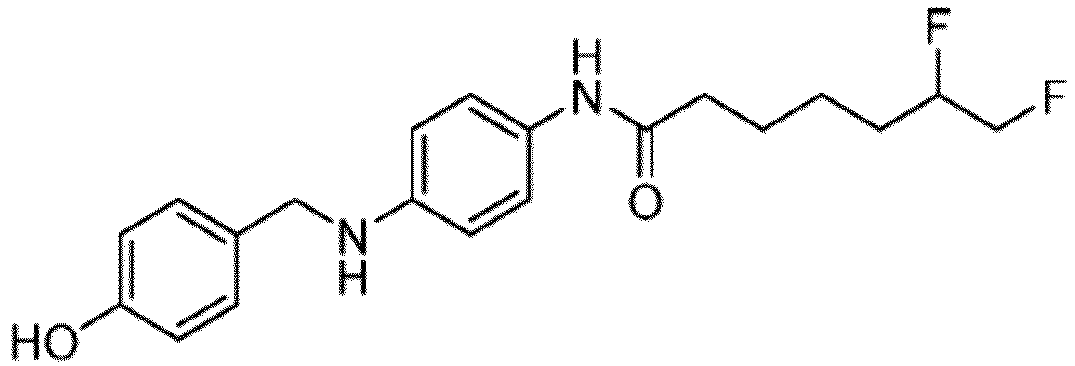
6,7-difluoro-N-(4-((4-hydroxybenzyl)amino)phén yl)-heptanamide (6R)-6,7-difluoro-N-(4-((4-hydroxybenzyl)amino)phén yl)-heptanamide (6S)-6,7-difluoro-N-(4-((4-hydroxybenzyl)amino)phén yl)-heptanamide mélanges racémiques de ceux-ci 12 
N-(2-amino-3-fluoro-4-((4-hydroxybenzyl)amino)phén yl)-6,7-difluoroheptanamide (6R)-N-(2-amino-3-fluoro-4-((4-hydroxybenzyl)amino)phényl)-6,7-difluoroheptanamide (6S)-N-(2-amino-3-fluoro-4-((4-hydroxybenzyl)amino)phén yl)-6,7-difluoroheptanamide mélanges racémiques de ceux-ci 12 
N-(2-amino-4-((4-nitrobenzyl)amino)phényl )heptanamide 12 
N-(4-((4-nitrobenzyl)amino)phényl )heptanamide 12 
N-(2-amino-3-fluoro-4-((4-nitrobenzyl)amino)phényl )heptanamide 12 
N-(2-amino-4-((4-aminobenzyl)amino)phényl )heptanamide 12 
N-(4-((4-aminobenzyl)amino)phényl )heptanamide 12 
N-(2-amino-3-fluoro-4-((4-aminobenzyl)amino)phényl )heptanamide 13 
N-(2-amino-4-((4-nitrobenzyl)amino)phényl )octanamide 13 
N-(4-((4-nitrobenzyl)amino)phényl )octanamide 13 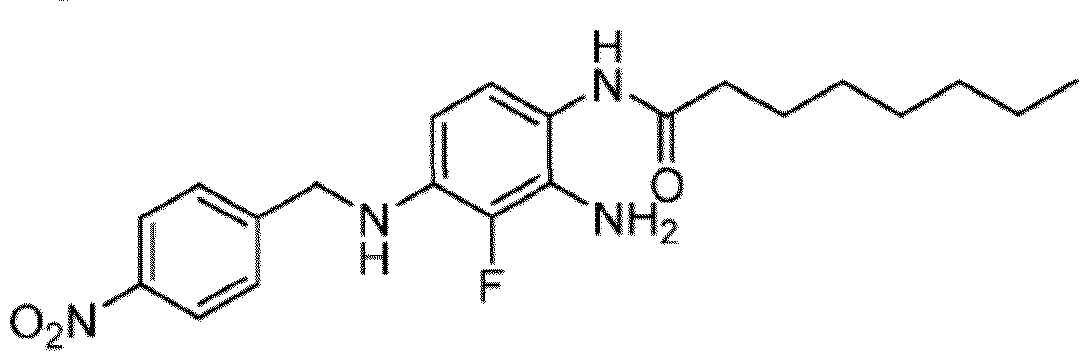
N-(2-amino-3-fluoro-4-((4-nitrobenzyl)amino)phényl )octanamide 13 
N-(2-amino-4-((4-aminobenzyl)amino)phényl )octanamide 13 
N-(4-((4-aminobenzyl)amino)phényl )octanamide 13 
N-(2-amino-3-fluoro-4-((4-aminobenzyl)amino)phényl )octanamide 13 
N-(2-amino-4-((4-nitrobenzyl)amino)phényl )décanamide 13 
N-(4-((4-nitrobenzyl)amino)phényl )décanamide 13 
N-(2-amino-3-fluoro-4-((4-nitrobenzyl)amino)phényl )décanamide 13 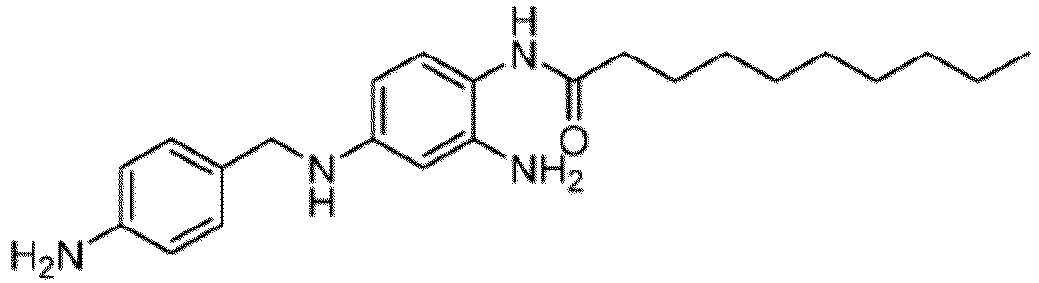
N-(2-amino-4-((4-aminobenzyl)amino)phényl )décanamide 14 
N-(4-((4-aminobenzyl)amino)phényl )décanamide 14 
N-(2-amino-3-fluoro-4-((4-aminobenzyl)amino)phényl )décanamide 14 
N-(2-amino-4-((pyridin-4-ylméthyl)amino)phényl)he ptanamide 14 
N-(4-((pyridin-4-ylméthyl)amino)phényl)he ptanamide 14 
N-(2-amino-3-fluoro-4-((pyridin-4-ylméthyl)amino)phényl)he ptanamide 14 
N-(2-amino-4-((pyridin-4-ylméthyl)amino)phényl)oc tanamide 14 
N-(4-((pyridin-4-ylméthyl)amino)phényl)oc tanamide 14 
N-(2-amino-3-fluoro-4-((pyridin-4-ylméthyl)amino)phényl)oc tanamide 14 
N-(2-amino-4-((pyridin-4-ylméthyl)amino)phényl)dé canamide 14 
N-(4-((pyridin-4-ylméthyl)amino)phényl)dé canamide 15 
N-(2-amino-3-fluoro-4-((pyridin-4-ylméthyl)amino)phényl)dé canamide 15 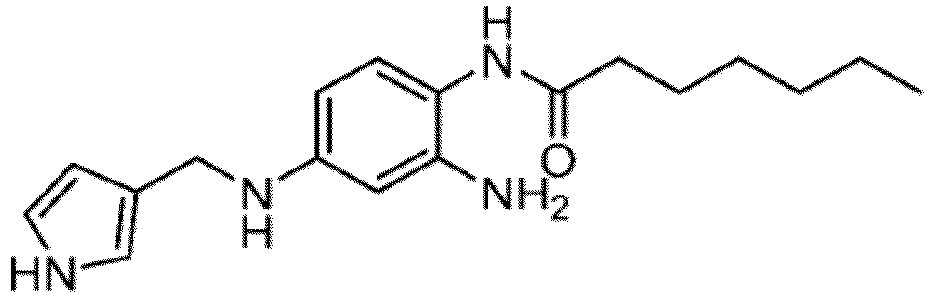
N-(4-(((1H-pyrrol-3-yl)méthyl)amino)-2-aminophényl)heptanamide 15 
N-(4-(((1H-pyrrol-3-yl)méthyl)amino)phényl)h eptanamide 15 
N-(4-(((1H-pyrrol-3-yl)méthyl)amino)-2-amino-3-fluorophényl)heptanamide 15 
N-(4-(((1H-pyrrol-3-yl)méthyl)amino)-2-aminophényl)octanamide 15 
N-(4-(((1H-pyrrol-3-yl)méthyl)amino)phényl)o ctanamide 15 
N-(4-(((1H-pyrrol-3-yl)méthyl)amino)-2-amino-3-fluorophényl)octanamide 15 
N-(4-(((1H-pyrrol-3-yl)méthyl)amino)-2-aminophényl)décanamide 15 
N-(4-(((1H-pyrrol-3-yl)méthyl)amino)phényl)d écanamide 15 
N-(4-(((1H-pyrrol-3-yl)méthyl)amino)-2-amino-3-fluorophényl)décanamide 16 
N-(4-((4-acétamidobenzyl)amino)-2-amino-3-fluorophényl)heptanamide 16 
N-(4-((4-acétamidobenzyl)amino)-2-aminophényl)heptanamide 16 
N-(4-((4-acétamidobenzyl)amino)ph ényl)heptanamide 16 
N-(4-((4-acétamidobenzyl)amino)-2-amino-3-fluorophényl)octanamide 16 
N-(4-((4-acétamidobenzyl)amino)-2-aminophényl)octanamide 16 
N-(4-((4-acétamidobenzyl)amino)ph ényl)octanamide 16 
N-(4-((4-acétamidobenzyl)amino)-2-amino-3-fluorophényl)décanamide 16 
N-(4-((4-acétamidobenzyl)amino)-2-aminophényl)décanamide 16 
N-(4-((4-acétamidobenzyl)amino)ph ényl)décanamide 16 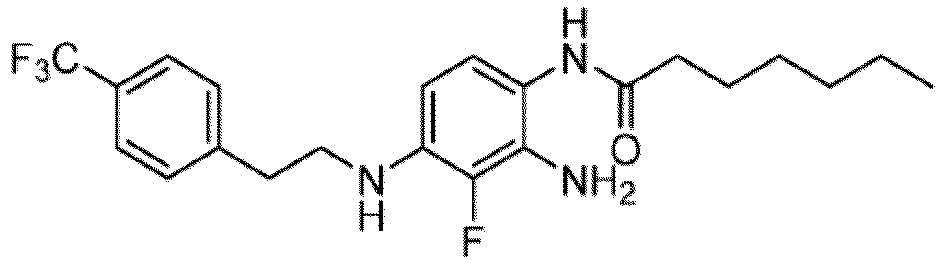
N-(2-amino-3-fluoro-4-((4-(trifluorométhyl)phénéthyl)amino)phényl)heptanam ide 17 
N-(2-amino-4-((4-(trifluorométhyl)phénéth yl)amino)phényl)heptanam ide 17 
N-(4-((4-(trifluorométhyl)phénéth yl)amino)phényl)heptanam ide 17 
N-(2-amino-3-fluoro-4-((4-(trifluorométhyl)phénéth yl)amino)phényl)octanami de 17 
N-(2-amino-4-((4-(trifluorométhyl)phénéth yl)amino)phényl)octanami de 17 
N-(4-((4-(trifluorométhyl)phénéth yl)amino)phényl)octanami de 17 
N-(2-amino-3-fluoro-4-((4-(trifluorométhyl)phénéth yl)amino)phényl)décanami de 17 
N-(2-amino-4-((4-(trifluorométhyl)phénéth yl)amino)phényl)décanami de 17 
N-(4-((4-(trifluorométhyl)phénéth yl)amino)phényl)décanami de 17 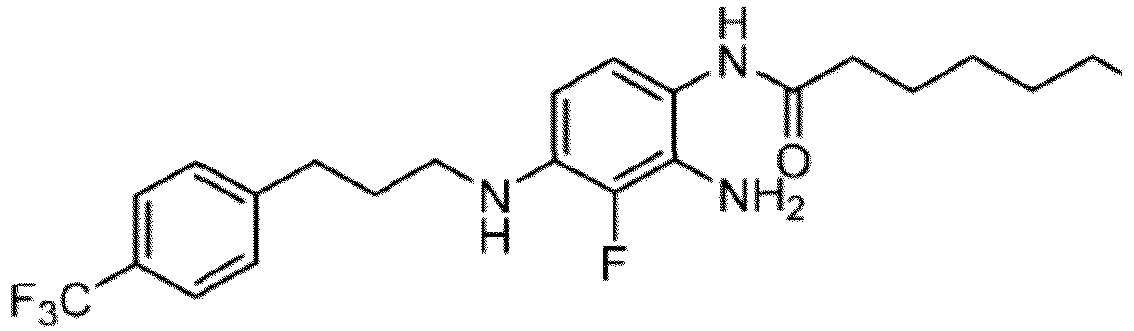
N-(2-amino-3-fluoro-4-((3-(4-(trifluorométhyl)phényl) propyl)amino)phényl)hept anamide 17 
N-(2-amino-4-((3-(4-(trifluorométhyl)phényl) propyl)amino)phényl)hept anamide 18 
N- (4-((3-(4-(trifluorométhyl)phényl) propyl)amino)phényl)hept anamide 18 
N-(2-amino-3-fluoro-4-((3-(4-(trifluorométhyl)phényl) propyl)amino)phényl)octa namide 18 
N-(2-amino-4-((3-(4-(trifluorométhyl)phényl) propyl)amino)phényl)octa namide 18 
N-(4-((3-(4-(trifluorométhyl)phényl) propyl)amino)phényl)octa namide 18 
N-(2-amino-3-fluoro-4-((3-(4-(trifluorométhyl)phényl) propyl)amino)phényl)déca namide 18 
N-(2-amino-4-((3-(4-(trifluorométhyl)phényl) propyl)amino)phényl)déca namide 18 
N- (4- ((3- (4-(trifluorométhyl)phényl) propyl)amino)phényl)déca namide 18 
4-cyclohexyl-N-(4-((4-(trifluorométhoxy)benzyl )amino)phényl)butanamide 18 
N-(2-amino-3-fluoro-4-((4-(trifluorométhoxy)benzyl )amino)phényl)-4-cyclohexylbutanamide 18 
N-(2-amino-4-((4-(trifluorométhoxy)benzyl )amino)phényl)-4-cyclohexylbutanamide 19 
4-cyclohexyl-N-(4-((4-(trifluorométhyl)benzyl) amino)phényl)butanamide 19 
N-(2-amino-3-fluoro-4-((4-(trifluorométhyl)benzyl) amino)phényl)-4-cyclohexylbutanamide 19 
N-(2-amino-4-((4-(trifluorométhyl)benzyl) amino)phényl)-4-cyclohexylbutanamide 19 
7-phényl-N-(4-((4-(trifluorométhyl)benzyl) amino)phényl)heptanamide 19 
N-(2-amino-4-((4-(trifluorométhyl)benzyl) amino)phényl)-7-phénylheptanamide 19 
N-(2-amino-3-fluoro-4-((4-(trifluorométhyl)benzyl) amino)phényl)-7-phénylheptanamide 19 
N-(2-amino-3-fluoro-4-((4-(trifluorométhyl)benzyl) amino)phényl)-7-(4-fluorophényl)heptanamide 19 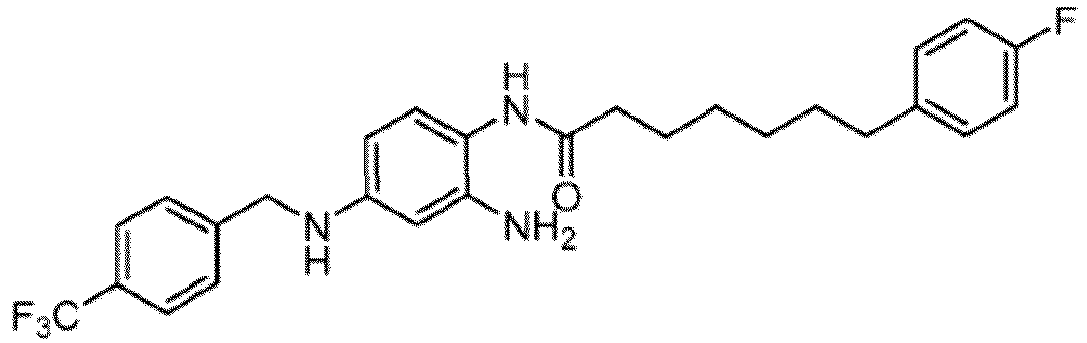
N-(2-amino-4-((4-(trifluorométhyl)benzyl) amino)phényl)-7-(4-fluorophényl)heptanamide 19 
7-(4-fluorophényl)-N-(4-((4-(trifluorométhyl)benzyl) amino)phényl)heptanamide 19 
7-amino-N-(2-amino-3-fluoro-4-((4-(trifluorométhyl)benzyl) amino)phényl)heptanamide 20 
7-amino-N-(2-amino-4-((4-(trifluorométhyl)benzyl) amino)phényl)heptanamide 20 
7-amino-N-(4-((4-(trifluorométhyl)benzyl) amino)phényl)heptanamide 20 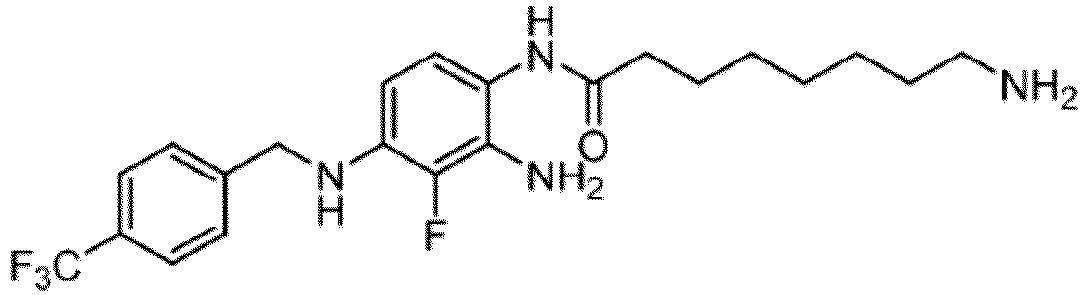
8-amino-N-(2-amino-3-fluoro-4-((4-(trifluorométhyl)benzyl) amino)phényl)octanamide 20 
8-amino-N-(2-amino-4-((4-(trifluorométhyl)benzyl) amino)phényl)octanamide 20 
8-amino-N-(4-((4-(trifluorométhyl)benzyl) amino)phényl)octanamide 20 
10-amino-N-(2-amino-3-fluoro-4-((4-(trifluorométhyl)benzyl) amino)phényl)décanamide 20 
10-amino-N-(2-amino-4-((4-(trifluorométhyl)benzyl) amino)phényl)décanamide 20 
10-amino-N-(4-((4-(trifluorométhyl)benzyl) amino)phényl)décanamide 20 
N-(2-amino-3-fluoro-4-((4-(trifluorométhyl)benzyl) amino)phényl)-7-(4-aminophényl)heptanamide 20 
N-(2-amino-4-((4-(trifluorométhyl)benzyl) amino)phényl)-7-(4-aminophényl)heptanamide 21 
7-(4-aminophényl)-N-(4-((4-(trifluorométhyl)benzyl) amino)phényl)heptanamide 21 
N-(2-amino-3-fluoro-4-((4-(trifluorométhyl)benzyl) amino)phényl)pent-4-ynamide 21 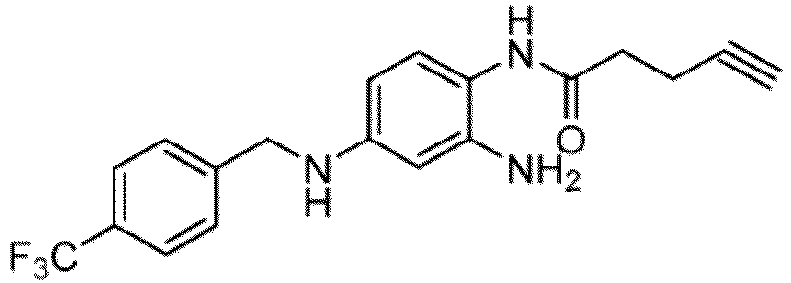
N-(2-amino-4-((4-(trifluorométhyl)benzyl) amino)phényl)pent-4-ynamide 21 
N-(4-((4-(trifluorométhyl)benzyl) amino)phényl)pent-4-ynamide 21 
N-(2-amino-3-fluoro-4-((4-(trifluorométhoxy)benzyl )amino)phényl)pent-4-ynamide 21 
N-(2-amino-4-((4-(trifluorométhoxy)benzyl )amino)phényl)pent-4-ynamide 21 
N-(4-((4-(trifluorométhoxy)benzyl )amino)phényl)pent-4-ynamide 21 
N-(2-amino-3-fluoro-4-((4-hydroxybenzyl)amino)phén yl)pent-4-ynamide 21 
N-(2-amino-4-((4-hydroxybenzyl)amino)phén yl)pent-4-ynamide 21 
N-(4-((4-hydroxybenzyl)amino)phén yl)pent-4-ynamide 22 
N-(2-amino-3-fluoro-4-((4-(trifluorométhyl)benzyl) amino)phényl)-4-cyclopropylbut-3-ynamide 22 
N-(2-amino-4-((4-(trifluorométhyl)benzyl) amino)phényl)-4-cyclopropylbut-3-ynamide 22 
4-cyclopropyl-N-(4-((4-(trifluorométhyl)benzyl) amino)phényl)but-3-ynamide 22 
(E)-N-(2-amino-3-fluoro-4-((4-(trifluorométhyl)benzyl) amino)phényl)déc-5-énamide 22 
(E)-N-(2-amino-4-((4-(trifluorométhyl)benzyl) amino)phényl)déc-5-énamide 22 
(E)-N- (4- ((4-(trifluorométhyl)benzyl) amino)phényl)déc-5-énamide 22 
(Z)-N-(2-amino-3-fluoro-4-((4-(trifluorométhyl)benzyl) amino)phényl)déc-5-énamide 22 
(Z)-N-(2-amino-4-((4-(trifluorométhyl)benzyl) amino)phényl)déc-5-énamide 22 
(Z)-N-(4-((4-(trifluorométhyl)benzyl) amino)phényl)déc-5-énamide 22 
N-(2-(pipéridin-1-yl)-4-(4-(trifluorométhyl)phénéth yl)phényl)heptanamide 23 
2,3-difluoro-N-(2-(pipéridin-1-yl)-4-(4-(trifluorométhyl)phénéth yl)phényl)heptanamide (2R,3S)-2,3-difluoro-N-(2-(pipéridin-1-yl)-4-(4-(trifluorométhyl)phénéth yl)phényl)heptanamide (2S,3R)-2,3-difluoro-N-(2-(pipéridin-1-yl)-4-(4-(trifluorométhyl)phénéth yl)phényl)heptanamide (2R,3R)-2,3-difluoro-N-(2-(pipéridin-1-yl)-4-(4-(trifluorométhyl)phénéth yl)phényl)heptanamide (2S,3S)-2,3-difluoro-N-(2-(pipéridin-1-yl)-4-(4-(trifluorométhyl)phénéth yl)phényl)heptanamide 23 
6,7-difluoro-N-(2-(pipéridin-1-yl)-4-(4-(trifluorométhyl)phénéth yl)phényl)heptanamide (6R)-6,7-difluoro-N-(2-(pipéridin-1-yl)-4-(4-(trifluorométhyl)phénéth yl)phényl)heptanamide (6S)-6,7-difluoro-N-(2-(pipéridin-1-yl)-4-(4-(trifluorométhyl)phénéth yl)phényl)heptanamide 23 
N-(2-(pipéridin-1-yl)-4-(4-(trifluorométhyl)phénéth yl)phényl)octanamide 23 
2,3-difluoro-N-(2-(pipéridin-1-yl)-4-(4-(trifluorométhyl)phénéth yl)phényl)octanamide (2R,3S)-2,3-difluoro-N-(2-(pipéridin-1-yl)-4-(4-(trifluorométhyl)phénéth yl)phényl)octanamide (2S,3R)-2,3-difluoro-N-(2-(pipéridin-1-yl)-4-(4-(trifluorométhyl)phénéth yl)phényl)octanamide (2R,3R)-2,3-difluoro-N-(2-(pipéridin-1-yl)-4-(4-(trifluorométhyl)phénéth yl)phényl)octanamide (2S,3S)-2,3-difluoro-N-(2-(pipéridin-1-yl)-4-(4-(trifluorométhyl)phénéth yl)phényl)octanamide 23 
7,8-difluoro-N-(2-(pipéridin-1-yl)-4-(4-(trifluorométhyl)phénéth yl)phényl)octanamide (7R)-7,8-difluoro-N-(2-(pipéridin-1-yl)-4-(4-(trifluorométhyl)phénéth yl)phényl)octanamide (7S)-7,8-difluoro-N-(2-(pipéridin-1-yl)-4-(4-(trifluorométhyl)phénéth yl)phényl)octanamide 23 
3-cyclohexyl-N-(2-cyclohexyl-4-(4-(trifluorométhyl)phénéth yl)phényl)propanamide 23 
N-(2-cyclohexyl-4-(4-(trifluorométhyl)phénéth yl)phényl)-3,3-diméthylbutanamide 23 
N-(2-cyclohexyl-4-((4-(trifluorométhyl)benzyl) amino)phényl)-3,3-diméthylbutanamide 23 
3-cyclohexyl-N-(2-cyclohexyl-4-((4-(trifluorométhyl)benzyl) amino)phényl)propanamide 23 
N-(2-cyclohexyl-4-(4-(trifluorométhyl)phénéth yl)phényl)-2,3-difluoroheptanamide (2R,3S) -N-(2-cyclohexyl-4-(4-(trifluorométhyl)phénéth yl)phényl)-2,3-difluoroheptanamide (2S,3R)-N-(2-cyclohexyl-4-(4-(trifluorométhyl)phénéth yl)phényl)-2,3-difluoroheptanamide (2R,3R)-N-(2-cyclohexyl-4-(4-(trifluorométhyl)phénéth yl)phényl)-2,3-difluoroheptanamide (2S,3S)-N-(2-cyclohexyl-4-(4-(trifluorométhyl)phénéth yl)phényl)-2,3-difluoroheptanamide 24 
N-(2-cyclohexyl-4-(4-(trifluorométhyl)phénéth yl)phényl)heptanamide 24 
N-(2-cyclohexyl-4-(4-(trifluorométhyl)phénéth yl)phényl)-7,8-difluorooctanamide (7R)-N-(2-cyclohexyl-4-(4-(trifluorométhyl)phénéth yl)phényl)-7,8-difluorooctanamide (7S)-N-(2-cyclohexyl-4-(4-(trifluorométhyl)phénéth yl)phényl)-7,8-difluorooctanamide 24 
N-(2-cyclohexyl-4-(4-(trifluorométhyl)phénéth yl)phényl)octanamide 24 
N-(2-cyclohexyl-4-((4-(trifluorométhyl)benzyl) amino)phényl)heptanamide 24 
N-(2-cyclohexyl-4-((4-(trifluorométhyl)benzyl) amino)phényl)-2,3-difluoroheptanamide (2R,3S)-N-(2-cyclohexyl-4-((4-(trifluorométhyl)benzyl) amino)phényl)-2,3-difluoroheptanamide (2S,3R)-N-(2-cyclohexyl-4-((4-(trifluorométhyl)benzyl) amino)phényl)-2,3-difluoroheptanamide (2R,3R)-N-(2-cyclohexyl-4-((4-(trifluorométhyl)benzyl) amino)phényl)-2,3-difluoroheptanamide (2S,3S)-N-(2-cyclohexyl-4-((4-(trifluorométhyl)benzyl) amino)phényl)-2,3-difluoroheptanamide 24 
N-(2-cyclohexyl-4-((4-(trifluorométhyl)benzyl) amino)phényl)-7,8-difluorooctanamide (7R)-N-(2-cyclohexyl-4-((4-(trifluorométhyl)benzyl) amino)phényl)-7,8-difluorooctanamide (7S)-N-(2-cyclohexyl-4-((4-(trifluorométhyl)benzyl) amino)phényl)-7,8-difluorooctanamide 24 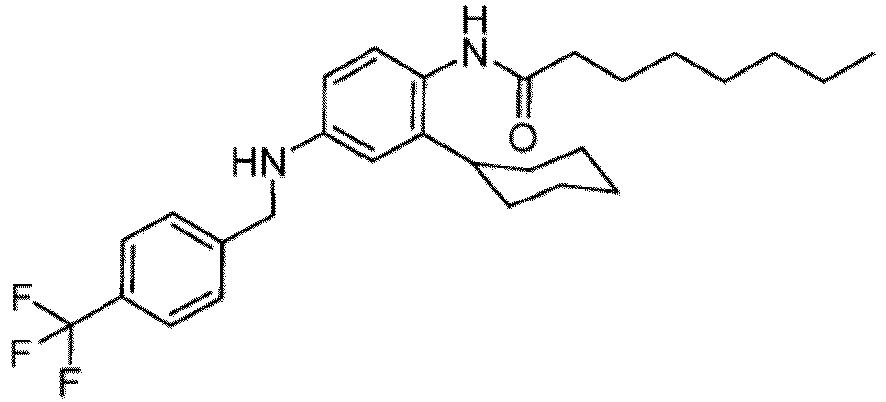
N-(2-cyclohexyl-4-((4-(trifluorométhyl)benzyl) amino)phényl)octanamide 24 
N-(3-fluoro-4-((4-fluorobenzyl)amino)phény l)cyclohexanesulfonamide 24 
N-(2-amino-4-((4-(trifluorométhyl)benzyl) oxy)phényl)heptanamide 24 
N-(2-amino-4-((4-(trifluorométhyl)benzyl) oxy)phényl)cyclohexanesu lfonamide 25 
N-(2-amino-4-((4-(trifluorométhyl)benzyl) amino)phényl)cyclopropan ecarboxamide 25 
N-(2-amino-4-((4-(trifluorométhyl)benzyl) amino)phényl)-3-cyclohexylpropanamide 25 
N-(2-amino-4-((4-fluorophénéthyl)amino)ph ényl)heptanamide 25 
N-(2-amino-4-((pyridin-2-ylméthyl)amino)phényl)he ptanamide 25 
N-(2-amino-4-((2-fluorobenzyl)amino)phény l)heptanamide 25 
N-(2-amino-4-((4-(trifluorométhyl)benzyl) amino)phényl)-2-(2-méthoxyéthoxy)acétamide 25 
N-(2-amino-4-(benzylamino)phényl)hept anamide 25 
N-(2,6-difluoro-4-((4-(trifluorométhyl)benzyl) amino)phényl)heptanamide 25 
N-(2-amino-4-(méthyl(4-(trifluorométhyl)benzyl) amino)phényl)heptanamide 25 
N-(2-amino-3-fluoro-4-((4-(trifluorométhyl)benzyl) amino)phényl)isobutyrami de 26 
N-(2-amino-3-fluoro-4-((4-(trifluorométhyl)benzyl) amino)phényl)-3-méthylbutanamide 26 
N-(2-amino-3-fluoro-4-((4-(trifluorométhyl)benzyl) amino)phényl)-3-cyclohexylpropanamide 26 
N-(2,6-difluoro-4-((4-(trifluorométhyl)benzyl) amino)phényl)-3,3-diméthylbutanamide 26 
N-(2-amino-4-(propyl(4-(trifluorométhyl)benzyl) amino)phényl)heptanamide 26 
N-(2-amino-4-(méthyl(4-(trifluorométhyl)benzyl) amino)phényl)-3,3-diméthylbutanamide 26 
N-(2-amino-3-fluoro-4-(méthyl(4-(trifluorométhyl)benzyl) amino)phényl)-3,3-diméthylbutanamide 26 
N-(2-amino-4-((4-(trifluorométhyl)benzyl) amino)phényl)cyclohexane sulfonamide 26 
N-(4-((4-méthoxybenzyl)amino)phén yl)cyclohexanesulfonamid e 26 
N-(4-((4-méthoxybenzyl) (méthyl)am ino)phényl)cyclohexanesu lfonamide 26 
(R)-N- (4- ((1-(4-méthoxyphényl)éthyl)amin o)phényl)cyclohexanesulf onamide 27 
(S)-N- (4- ((1-(4-méthoxyphényl)éthyl)amin o)phényl)cyclohexanesulf onamide 27 
3-éthyl-N-(4-((4-méthoxybenzyl)amino)phén yl)benzènesulfonamide - Composé ou un tautomère, un sel, un solvate, un stéréoisomère ou un isotope de celui-ci selon l'une quelconque des revendications précédentes, dans lequel ledit composé est un modulateur des canaux potassiques voltage-dépendants, de préférence un modulateur Kv7.1, Kv7.2, Kv7.3, Kv7.4 et/ou Kv7.5.
- Composé ou un tautomère, un sel, un solvate, un stéréoisomère ou un isotope de celui-ci tel que défini dans l'une quelconque des revendications précédentes, pour une utilisation comme médicament ; de préférencepour une utilisation dans le traitement et/ou la prévention d'une affection caractérisée par un défaut dans la structure et/ou la fonction d'au moins un canal potassique voltage-dépendant, de préférence d'au moins un parmi Kv7.1, Kv7.2, Kv7.3, Kv7.4 et/ou Kv7.5 ; de préférencedans lequel ladite affection est choisie dans le groupe constitué par : une maladie du système nerveux central, une maladie du système nerveux périphérique, une maladie du système sensoriel, une maladie du système respiratoire, une maladie du système génito-urinaire, une maladie du système gastro-intestinal, une maladie cardiovasculaire, une maladie du muscle squelettique et une canalopathie ; de préférencedans lequel ladite affection est choisie dans le groupe constitué par : l'épilepsie, un trouble convulsif, une convulsion, un trouble convulsif, un trouble caractérisé par une hyperexcitabilité du système nerveux, une épilepsie néonatale, des contractions spontanées, un trouble épileptique précoce, le syndrome d'Ohtahara, l'encéphalopathie épileptique infantile précoce avec suppression-burst, les convulsions néonatales familières bénignes, l'encéphalopathie épileptique, l'encéphalopathie épileptique néonatale sporadique sévère, une déficience intellectuelle, une comorbidité psychiatrique ou cognitive, un déficit cognitif, l'anxiété, la dépression, la schizophrénie, la mort subite liée à l'épilepsie, l'épilepsie pharmaco-résistante, la douleur neuropathique, un accident vasculaire cérébral ischémique, l'angine de poitrine, la migraine, un trouble neurodégénératif, un trouble neurologique, la sclérose latérale amyotrophique, la maladie d'Alzheimer, la maladie de Parkinson, les tremblements, la choréoathétose paroxystique, les acouphènes, la douleur, l'asthme, l'hyperréactivité vésicale, l'incontinence urinaire, la constipation, le syndrome du côlon irritable, la diarrhée, la maladie de Crohn, l'hypertension, l'hypertension vasculaire, la dystrophie musculaire, une maladie d'hyperexcitabilité des muscles squelettiques, la myokymie, la myotonie, une canalopathie génétique, une canalopathie transcriptionnelle, un trouble lié à Kv7.2 et/ou Kv7.3, une encéphalopathie liée à Kv 7.2, la surdité autosomique dominante de type 2 (DFNA2), l'ataxie, l'ataxie épisodique de type 1, le syndrome d'ataxie épisodique avec myokymie, la neuromyotonie, la paralysie périodique hypokaliémique, une arythmie, une arythmie congénitale, le syndrome du QT long, le syndrome de Romano-Ward, le syndrome de Jervell et Lange-Nielsen, le syndrome de Bartter, l'hypoglycémie hyperinsulinémique infantile (HHI), l'atténuation de la réponse vasoconstrictrice, le diabète de type 2 et la sclérose en plaques.
- Composé ou un tautomère, un sel, un solvate, un stéréoisomère ou un isotope de celui-ci, tel que défini dans l'une quelconque des revendications 1 à 3 pour une utilisation comme médicament anticonvulsivant, analgésique, anti-ischémique, antiarythmique, neuroprotecteur, antiacouphène, antiasthmatique, modulateur de la motilité gastro-intestinale, antihypertenseur, antimyotonique et/ou contre la dystrophie musculaire squelettique.
- Composition pharmaceutique comprenant le composé ou un tautomère, un sel, un solvate, un stéréoisomère ou un isotope de celui-ci tel que défini dans l'une quelconque des revendications 1 à 3 et un véhicule pharmaceutiquement acceptable.
- Composition pharmaceutique selon la revendication 6 comprenant un autre agent thérapeutique choisi parmi : un anticonvulsivant, un analgésique et un médicament anti-inflammatoire non stéroïdien (AINS), de préférence ledit anticonvulsivant est choisi dans le groupe constitué par : l'acétazolamide, le brivaracétam, la carbamazépine, le clobazam, le clonazépam, le diazépam, l'eslicarbazépine, l'éthosuximide, la fosphénytoïne, la gabapentine, le lacosamide, la lamotrigine, le lévétiracétam, le lorazépam, le méthosuximide, le nitrazépam, l'oxcarbazépine, le pérampanel, le phénobarbital, la phénytoïne, la prégabaline, la primidone, le rufmamide, le stiripentol, le topiramate, l'acide valproïque, la vigabatrine, le felbamate, la tiagabine et le zonisamide, de préférence, ledit analgésique est l'acétaminophène ou un opioïde, de préférence ledit médicament anti-inflammatoire non stéroïdien (AINS) est choisi dans le groupe constitué par : l'aspirine, le diclofénac, le diflusinal, l'étodolac, le fenbufène, le fénoprofène, le flufénisal, le flurbiprofène, l'ibuprofène, l'indométhacine, le kétoprofène, le kétorolac, l'acide méclofénamique, l'acide méfénamique, le méloxicam, la nabumétone, le naproxène, le nimésulide, le nitroflurbiprofène, l'olsalazine, l'oxaprozine, la phénylbutazone, le piroxicam, la sulfasalazine, le sulindac, la tolmétine et le zomépirac, de préférence ledit opioïde est la morphine.
- Composition pharmaceutique telle que définie dans la revendication 6 ou 7 pour une utilisation dans le traitement et/ou la prévention d'une affection caractérisée par un défaut dans la structure et/ou la fonction d'au moins un canal potassique voltage-dépendant, de préférence d'au moins un parmi Kv7.1, Kv7.2, Kv7.3, Kv7.4 et/ou Kv7.5.
- Composé pour une utilisation selon l'une quelconque des revendications 4 à 5 ou composition pharmaceutique pour une utilisation selon la revendication 8 qui est administré(e) à un animal, de préférence un animal de compagnie ou du bétail.
- Composé ou un tautomère, un sel, un solvate, un stéréoisomère ou un isotope de celui-ci tel que défini dans l'une quelconque des revendications 1 à 3 pour une utilisation dans une méthode de modulation d'un canal potassique voltage-dépendant, de préférence ledit canal potassique voltage-dépendant est Kv7.1, Kv7.2, Kv7.3, Kv7.4 et/ou Kv7.5.
- Méthode in vitro de modulation d'un canal potassique voltage-dépendant en utilisant le composé ou un tautomère, un sel, un solvate, un stéréoisomère ou un isotope de celui-ci tel que défini dans l'une quelconque des revendications 1 à 3, ledit canal potassique voltage-dépendant étant de préférence Kv7.1, Kv7.2, Kv7.3, Kv7.4 et/ou Kv7.5.
Applications Claiming Priority (2)
| Application Number | Priority Date | Filing Date | Title |
|---|---|---|---|
| EP2019052067 | 2019-01-29 | ||
| PCT/EP2020/052156 WO2020157126A1 (fr) | 2019-01-29 | 2020-01-29 | Modulateurs de canaux ioniques potassiques et leurs utilisations |
Publications (3)
| Publication Number | Publication Date |
|---|---|
| EP3917907A1 EP3917907A1 (fr) | 2021-12-08 |
| EP3917907C0 EP3917907C0 (fr) | 2025-05-21 |
| EP3917907B1 true EP3917907B1 (fr) | 2025-05-21 |
Family
ID=65243558
Family Applications (1)
| Application Number | Title | Priority Date | Filing Date |
|---|---|---|---|
| EP20702775.6A Active EP3917907B1 (fr) | 2019-01-29 | 2020-01-29 | Modulateurs de canaux ioniques potassiques et leurs utilisations |
Country Status (3)
| Country | Link |
|---|---|
| EP (1) | EP3917907B1 (fr) |
| ES (1) | ES3034157T3 (fr) |
| WO (1) | WO2020157126A1 (fr) |
Families Citing this family (5)
| Publication number | Priority date | Publication date | Assignee | Title |
|---|---|---|---|---|
| RS65962B1 (sr) | 2020-05-08 | 2024-10-31 | Halia Therapeutics Inc | Inhibitori nek7 kinaze |
| KR102415692B1 (ko) * | 2020-09-01 | 2022-07-05 | 건국대학교 글로컬산학협력단 | 시냅스 불균형 조절에 의한 발달장애 예방, 개선 또는 치료용 조성물 |
| EP4245749A4 (fr) * | 2020-11-13 | 2024-11-20 | Institute for Basic Science | Nouveau composé aminoaromatique ou sel pharmaceutiquement acceptable de celui-ci, et composition pharmaceutique pour prévenir ou traiter des maladies neurodégénératives le comprenant en tant que principe actif |
| CN116535353A (zh) * | 2022-01-25 | 2023-08-04 | 上海挚盟医药科技有限公司 | 作为钾通道调节剂的酰胺类化合物及其制备和应用 |
| HUP2300429A1 (hu) * | 2023-12-04 | 2025-06-28 | Univ Szegedi | Aminoalkilezett benzoxivegyületek szívrendellenességek kezelésében történõ alkalmazásra |
Family Cites Families (5)
| Publication number | Priority date | Publication date | Assignee | Title |
|---|---|---|---|---|
| DE4200259A1 (de) | 1992-01-08 | 1993-07-15 | Asta Medica Ag | Neue 1,2,4-triaminobenzol-derivate und verfahren zu deren herstellung |
| TWI349666B (en) | 2004-03-12 | 2011-10-01 | Lundbeck & Co As H | Substituted morpholine and thiomorpholine derivatives |
| SG174095A1 (en) | 2006-08-23 | 2011-09-29 | Valeant Pharmaceuticals Int | Derivatives of 4-(n-azacycloalkyl) anilides as potassium channel modulators |
| EP2536394A2 (fr) * | 2010-02-19 | 2012-12-26 | Medichem S.A. | Dérivé de phénylcarbamate stabilisé à l'état solide |
| CN103073455B (zh) | 2011-10-25 | 2015-08-19 | 中国科学院上海药物研究所 | 一类新型的kcnq钾通道激动剂、其制备方法和用途 |
-
2020
- 2020-01-29 EP EP20702775.6A patent/EP3917907B1/fr active Active
- 2020-01-29 WO PCT/EP2020/052156 patent/WO2020157126A1/fr not_active Ceased
- 2020-01-29 ES ES20702775T patent/ES3034157T3/es active Active
Also Published As
| Publication number | Publication date |
|---|---|
| EP3917907C0 (fr) | 2025-05-21 |
| ES3034157T3 (en) | 2025-08-13 |
| EP3917907A1 (fr) | 2021-12-08 |
| WO2020157126A1 (fr) | 2020-08-06 |
Similar Documents
| Publication | Publication Date | Title |
|---|---|---|
| EP3917907B1 (fr) | Modulateurs de canaux ioniques potassiques et leurs utilisations | |
| EP3651752B1 (fr) | Carboxamides utilisés en tant qu'inhibiteurs des canaux sodiques | |
| AU2014290411B2 (en) | Sulfonamides as modulators of sodium channels | |
| EP2951155B1 (fr) | Amides comme modulateurs des canaux sodiques | |
| EP2038268B1 (fr) | (aza)cyclohexanes carbonylées comme ligands du récepteur d3 de la dopamine | |
| EP2870138B1 (fr) | Benzamides n-substitués et leurs procédés d'utilisation | |
| KR101449348B1 (ko) | Kv7 칼륨 채널 개방제로서의 피페리디닐 피리미딘 아미드 | |
| CN1422257A (zh) | 作为钠通道阻滞剂的芳基取代的吡唑、三唑和四唑化合物 | |
| JP2010528035A (ja) | イオンチャネル調節物質およびその使用 | |
| EA018032B1 (ru) | Производные фенилсульфамоилбензамидов в качестве антагонистов брадикининовых рецепторов, способ их получения и фармацевтическая композиция, их содержащая | |
| WO2004052371A2 (fr) | Composes de quinoline cycliques utilises avec des troubles lies au recepteur mch | |
| CN106715435B (zh) | 作为nr2b nmda受体拮抗剂的吡咯并嘧啶衍生物 | |
| EA018067B1 (ru) | Производные тиадиазола для лечения нейродегенеративных заболеваний | |
| RU2624011C2 (ru) | Производные оксазетидина, способ для их получения и их применение в медицине и косметике | |
| NL1030382C2 (nl) | Gesubstitueerde N-sulfonylaminobenzyl-2-fenoxyaceetamide verbindingen. | |
| CA2610326A1 (fr) | Pyrrolidin-2-ones, piperidin-2-ones et isothiazolidine-1,1,-dioxydes substitues, leur utilisation comme inhibiteurs du canal potassique kvi.5 et preparations pharmaceutiques les comprenant | |
| CN117362231A (zh) | 一种取代脒类化合物的合成方法及其用途 | |
| JP4791968B2 (ja) | アミドメチル置換2−(4−スルホニルアミノ)−3−ヒドロキシ−3,4−ジヒドロ−2h−クロメン−6−イル誘導体、該誘導体を製造するための方法及び中間生成物並びにこれらの化合物を含有する医薬品 | |
| RS20080233A (sr) | Derivati spirocikličnog hinazolina kao inhibitori pde7 | |
| KR20050117563A (ko) | 치환 아닐린 유도체 | |
| US12312333B2 (en) | SK channel positive allosteric modulators | |
| MX2010014461A (es) | Derivados de benciloxi anilida utiles como moduladores de canales de potasio. | |
| WO2006000294A1 (fr) | Nouveaux composes diazeniumdiolate, procede de preparation correspondant et utilisation therapeutique de ces derniers | |
| EP3498273A1 (fr) | Composition pharmaceutique pour la modulation de la reponse du recepteur gaba-a | |
| AU2008263915A1 (en) | 4,5-dihydro-(1H)-pyrazole derivatives as cannabinoid CB1 receptor modulators |
Legal Events
| Date | Code | Title | Description |
|---|---|---|---|
| STAA | Information on the status of an ep patent application or granted ep patent |
Free format text: STATUS: UNKNOWN |
|
| STAA | Information on the status of an ep patent application or granted ep patent |
Free format text: STATUS: THE INTERNATIONAL PUBLICATION HAS BEEN MADE |
|
| PUAI | Public reference made under article 153(3) epc to a published international application that has entered the european phase |
Free format text: ORIGINAL CODE: 0009012 |
|
| STAA | Information on the status of an ep patent application or granted ep patent |
Free format text: STATUS: REQUEST FOR EXAMINATION WAS MADE |
|
| 17P | Request for examination filed |
Effective date: 20210830 |
|
| AK | Designated contracting states |
Kind code of ref document: A1 Designated state(s): AL AT BE BG CH CY CZ DE DK EE ES FI FR GB GR HR HU IE IS IT LI LT LU LV MC MK MT NL NO PL PT RO RS SE SI SK SM TR |
|
| DAV | Request for validation of the european patent (deleted) | ||
| DAX | Request for extension of the european patent (deleted) | ||
| STAA | Information on the status of an ep patent application or granted ep patent |
Free format text: STATUS: EXAMINATION IS IN PROGRESS |
|
| 17Q | First examination report despatched |
Effective date: 20230818 |
|
| GRAP | Despatch of communication of intention to grant a patent |
Free format text: ORIGINAL CODE: EPIDOSNIGR1 |
|
| STAA | Information on the status of an ep patent application or granted ep patent |
Free format text: STATUS: GRANT OF PATENT IS INTENDED |
|
| INTG | Intention to grant announced |
Effective date: 20241223 |
|
| GRAS | Grant fee paid |
Free format text: ORIGINAL CODE: EPIDOSNIGR3 |
|
| GRAA | (expected) grant |
Free format text: ORIGINAL CODE: 0009210 |
|
| STAA | Information on the status of an ep patent application or granted ep patent |
Free format text: STATUS: THE PATENT HAS BEEN GRANTED |
|
| AK | Designated contracting states |
Kind code of ref document: B1 Designated state(s): AL AT BE BG CH CY CZ DE DK EE ES FI FR GB GR HR HU IE IS IT LI LT LU LV MC MK MT NL NO PL PT RO RS SE SI SK SM TR |
|
| REG | Reference to a national code |
Ref country code: GB Ref legal event code: FG4D |
|
| REG | Reference to a national code |
Ref country code: CH Ref legal event code: EP |
|
| REG | Reference to a national code |
Ref country code: DE Ref legal event code: R096 Ref document number: 602020051558 Country of ref document: DE |
|
| REG | Reference to a national code |
Ref country code: IE Ref legal event code: FG4D |
|
| U01 | Request for unitary effect filed |
Effective date: 20250604 |
|
| U07 | Unitary effect registered |
Designated state(s): AT BE BG DE DK EE FI FR IT LT LU LV MT NL PT RO SE SI Effective date: 20250612 |
|
| REG | Reference to a national code |
Ref country code: ES Ref legal event code: FG2A Ref document number: 3034157 Country of ref document: ES Kind code of ref document: T3 Effective date: 20250813 |
|
| PG25 | Lapsed in a contracting state [announced via postgrant information from national office to epo] |
Ref country code: NO Free format text: LAPSE BECAUSE OF FAILURE TO SUBMIT A TRANSLATION OF THE DESCRIPTION OR TO PAY THE FEE WITHIN THE PRESCRIBED TIME-LIMIT Effective date: 20250821 Ref country code: GR Free format text: LAPSE BECAUSE OF FAILURE TO SUBMIT A TRANSLATION OF THE DESCRIPTION OR TO PAY THE FEE WITHIN THE PRESCRIBED TIME-LIMIT Effective date: 20250822 |
|
| PG25 | Lapsed in a contracting state [announced via postgrant information from national office to epo] |
Ref country code: PL Free format text: LAPSE BECAUSE OF FAILURE TO SUBMIT A TRANSLATION OF THE DESCRIPTION OR TO PAY THE FEE WITHIN THE PRESCRIBED TIME-LIMIT Effective date: 20250521 |
|
| PG25 | Lapsed in a contracting state [announced via postgrant information from national office to epo] |
Ref country code: HR Free format text: LAPSE BECAUSE OF FAILURE TO SUBMIT A TRANSLATION OF THE DESCRIPTION OR TO PAY THE FEE WITHIN THE PRESCRIBED TIME-LIMIT Effective date: 20250521 |
|
| PG25 | Lapsed in a contracting state [announced via postgrant information from national office to epo] |
Ref country code: RS Free format text: LAPSE BECAUSE OF FAILURE TO SUBMIT A TRANSLATION OF THE DESCRIPTION OR TO PAY THE FEE WITHIN THE PRESCRIBED TIME-LIMIT Effective date: 20250821 |
|
| PG25 | Lapsed in a contracting state [announced via postgrant information from national office to epo] |
Ref country code: IS Free format text: LAPSE BECAUSE OF FAILURE TO SUBMIT A TRANSLATION OF THE DESCRIPTION OR TO PAY THE FEE WITHIN THE PRESCRIBED TIME-LIMIT Effective date: 20250921 |
|
| PG25 | Lapsed in a contracting state [announced via postgrant information from national office to epo] |
Ref country code: SM Free format text: LAPSE BECAUSE OF FAILURE TO SUBMIT A TRANSLATION OF THE DESCRIPTION OR TO PAY THE FEE WITHIN THE PRESCRIBED TIME-LIMIT Effective date: 20250521 |
|
| PG25 | Lapsed in a contracting state [announced via postgrant information from national office to epo] |
Ref country code: CZ Free format text: LAPSE BECAUSE OF FAILURE TO SUBMIT A TRANSLATION OF THE DESCRIPTION OR TO PAY THE FEE WITHIN THE PRESCRIBED TIME-LIMIT Effective date: 20250521 |
|
| PG25 | Lapsed in a contracting state [announced via postgrant information from national office to epo] |
Ref country code: SK Free format text: LAPSE BECAUSE OF FAILURE TO SUBMIT A TRANSLATION OF THE DESCRIPTION OR TO PAY THE FEE WITHIN THE PRESCRIBED TIME-LIMIT Effective date: 20250521 |
|
| REG | Reference to a national code |
Ref country code: CH Ref legal event code: U11 Free format text: ST27 STATUS EVENT CODE: U-0-0-U10-U11 (AS PROVIDED BY THE NATIONAL OFFICE) Effective date: 20260201 |
|
| U20 | Renewal fee for the european patent with unitary effect paid |
Year of fee payment: 7 Effective date: 20260120 |
|
| PLBE | No opposition filed within time limit |
Free format text: ORIGINAL CODE: 0009261 |
|
| STAA | Information on the status of an ep patent application or granted ep patent |
Free format text: STATUS: NO OPPOSITION FILED WITHIN TIME LIMIT |
|
| REG | Reference to a national code |
Ref country code: CH Ref legal event code: L10 Free format text: ST27 STATUS EVENT CODE: U-0-0-L10-L00 (AS PROVIDED BY THE NATIONAL OFFICE) Effective date: 20260402 |
|
| PGFP | Annual fee paid to national office [announced via postgrant information from national office to epo] |
Ref country code: GB Payment date: 20260123 Year of fee payment: 7 |
|
| PGFP | Annual fee paid to national office [announced via postgrant information from national office to epo] |
Ref country code: ES Payment date: 20260227 Year of fee payment: 7 |
|
| PGFP | Annual fee paid to national office [announced via postgrant information from national office to epo] |
Ref country code: IE Payment date: 20260122 Year of fee payment: 7 |
|
| PGFP | Annual fee paid to national office [announced via postgrant information from national office to epo] |
Ref country code: CH Payment date: 20260201 Year of fee payment: 7 |
|
| 26N | No opposition filed |
Effective date: 20260224 |