EP3919903B1 - Procédé d'analyse immunologique d'aim libres dans un échantillon biologique et kit de mesure - Google Patents
Procédé d'analyse immunologique d'aim libres dans un échantillon biologique et kit de mesure Download PDFInfo
- Publication number
- EP3919903B1 EP3919903B1 EP20747776.1A EP20747776A EP3919903B1 EP 3919903 B1 EP3919903 B1 EP 3919903B1 EP 20747776 A EP20747776 A EP 20747776A EP 3919903 B1 EP3919903 B1 EP 3919903B1
- Authority
- EP
- European Patent Office
- Prior art keywords
- aim
- antibody
- free
- igm
- complex
- Prior art date
- Legal status (The legal status is an assumption and is not a legal conclusion. Google has not performed a legal analysis and makes no representation as to the accuracy of the status listed.)
- Active
Links
Images
Classifications
-
- G—PHYSICS
- G01—MEASURING; TESTING
- G01N—INVESTIGATING OR ANALYSING MATERIALS BY DETERMINING THEIR CHEMICAL OR PHYSICAL PROPERTIES
- G01N33/00—Investigating or analysing materials by specific methods not covered by groups G01N1/00 - G01N31/00
- G01N33/48—Biological material, e.g. blood, urine; Haemocytometers
- G01N33/50—Chemical analysis of biological material, e.g. blood, urine; Testing involving biospecific ligand binding methods; Immunological testing
- G01N33/53—Immunoassay; Biospecific binding assay; Materials therefor
- G01N33/577—Immunoassay; Biospecific binding assay; Materials therefor involving monoclonal antibodies binding reaction mechanisms characterised by the use of monoclonal antibodies
-
- G—PHYSICS
- G01—MEASURING; TESTING
- G01N—INVESTIGATING OR ANALYSING MATERIALS BY DETERMINING THEIR CHEMICAL OR PHYSICAL PROPERTIES
- G01N33/00—Investigating or analysing materials by specific methods not covered by groups G01N1/00 - G01N31/00
- G01N33/48—Biological material, e.g. blood, urine; Haemocytometers
- G01N33/50—Chemical analysis of biological material, e.g. blood, urine; Testing involving biospecific ligand binding methods; Immunological testing
- G01N33/53—Immunoassay; Biospecific binding assay; Materials therefor
-
- G—PHYSICS
- G01—MEASURING; TESTING
- G01N—INVESTIGATING OR ANALYSING MATERIALS BY DETERMINING THEIR CHEMICAL OR PHYSICAL PROPERTIES
- G01N33/00—Investigating or analysing materials by specific methods not covered by groups G01N1/00 - G01N31/00
- G01N33/48—Biological material, e.g. blood, urine; Haemocytometers
- G01N33/50—Chemical analysis of biological material, e.g. blood, urine; Testing involving biospecific ligand binding methods; Immunological testing
- G01N33/53—Immunoassay; Biospecific binding assay; Materials therefor
- G01N33/5306—Improving reaction conditions, e.g. reduction of non-specific binding, promotion of specific binding
-
- G—PHYSICS
- G01—MEASURING; TESTING
- G01N—INVESTIGATING OR ANALYSING MATERIALS BY DETERMINING THEIR CHEMICAL OR PHYSICAL PROPERTIES
- G01N33/00—Investigating or analysing materials by specific methods not covered by groups G01N1/00 - G01N31/00
- G01N33/48—Biological material, e.g. blood, urine; Haemocytometers
- G01N33/50—Chemical analysis of biological material, e.g. blood, urine; Testing involving biospecific ligand binding methods; Immunological testing
- G01N33/68—Chemical analysis of biological material, e.g. blood, urine; Testing involving biospecific ligand binding methods; Immunological testing involving proteins, peptides or amino acids
- G01N33/6893—Chemical analysis of biological material, e.g. blood, urine; Testing involving biospecific ligand binding methods; Immunological testing involving proteins, peptides or amino acids related to diseases not provided for elsewhere
-
- G—PHYSICS
- G01—MEASURING; TESTING
- G01N—INVESTIGATING OR ANALYSING MATERIALS BY DETERMINING THEIR CHEMICAL OR PHYSICAL PROPERTIES
- G01N2333/00—Assays involving biological materials from specific organisms or of a specific nature
- G01N2333/435—Assays involving biological materials from specific organisms or of a specific nature from animals; from humans
- G01N2333/46—Assays involving biological materials from specific organisms or of a specific nature from animals; from humans from vertebrates
- G01N2333/47—Assays involving proteins of known structure or function as defined in the subgroups
- G01N2333/4701—Details
- G01N2333/4703—Regulators; Modulating activity
- G01N2333/4704—Inhibitors; Supressors
Definitions
- the present invention relates to an immunoassay method for free AIM in a biological sample.
- the present invention also relates to an assay kit for measuring an amount of free AIM in a biological sample.
- the present invention also relates to a method for suppressing a non-specific reaction in an immunoassay method for measuring an amount of free AIM in a biological sample.
- AIM apoptosis inhibitor of macrophage
- AIM is a secretory blood protein with a molecular weight of about 50 kDa produced by tissue macrophages.
- AIM has a structure in which three scavenger recipient cysteine-rich (SRCR) domains having specific sequences containing many cysteine residues are connected in tandem, and the cysteine residues are considered to be disulfide-bonded to each other in each domain to form a compact spherical three-dimensional structure.
- SRCR scavenger recipient cysteine-rich
- AIM is known to have the characteristic of binding to various molecules such as lipopolysaccharide, IgM, complement regulatory factors, and fatty acid synthetases. Particularly, AIM is known to exist in the form of a complex with IgM in the blood. Since IgM is a huge protein complex exceeding 500 kDa, AIM does not pass through the glomerulus and transfer to urine as long as AIM is bound to IgM, and a high blood concentration of AIM is maintained. When dissociated from IgM, AIM is promptly excreted into urine. Therefore, most of AIM forms a complex with IgM in the blood and are rarely present in the blood in a free state rather than as a conjugate.
- Patent Document 1 A method and kit for examining or diagnosing liver cancer, comprising detecting free AIM in a biological sample of a test subject have also been reported (Patent Document 2).
- An object of the present invention is to provide an immunoassay method for measuring an amount of free AIM in a biological sample containing complex AIM and free AIM with excellent specificity, and an assay kit for measuring an amount of free AIM in a biological sample containing complex AIM and free AIM with excellent specificity.
- an antibody binding to both free AIM and complex AIM is more easily obtained than an antibody specifically binding only to free AIM.
- the present inventors found that the specificity of an anti-AIM antibody for free AIM can be improved by bringing a biological sample into contact with the anti-AIM antibody in the presence of an anti-IgM antibody, thereby completing the present invention.
- the present invention is as follows.
- the specificity of an anti-AIM antibody for free AIM can be improved in an immunoassay method for measuring an amount of free AIM in a biological sample containing complex AIM and free AIM.
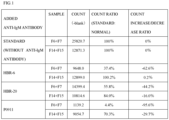
- Fig. 1 is a diagram showing a non-specific reaction suppressing effect when various anti-human IgM antibodies are added to a measurement system.
- Examples of a biological sample analyzable in the present invention include solid tissues and body fluids derived from living bodies (organisms), and body fluids are preferably used.
- the biological sample analyzable in the present invention is more preferably a body fluid sample such as blood, serum, plasma, urine, saliva, sputum, tear fluid, otorrhea, or prostatic fluid, further preferably blood, serum, plasma, or urine.
- Examples of the living body or the subject include humans or animals (e.g., mice, guinea pigs, rats, monkeys, dogs, cats, hamsters, horses, bovines, and pigs), and are preferably humans.
- AIM apoptosis inhibitor of macrophage
- AIM is a secretory blood protein with a molecular weight of about 50 kDa produced by tissue macrophages.
- AIM has a structure in which three scavenger recipient cysteine-rich (SRCR) domains, i.e., specific sequences containing many cysteine residues, are connected in tandem, and the cysteine residues are considered to be disulfide-bonded to each other in each domain to form a compact spherical three-dimensional structure.
- SRCR scavenger recipient cysteine-rich
- Human AIM is composed of 347 amino acids represented by SEQ ID NO: 1 and contains three SRCR domains rich in cysteine.
- the SRCR1 domain corresponds to amino acid numbers 24 to 125 in the amino acid sequence represented by SEQ ID NO: 1.
- the SRCR2 domain corresponds to amino acid numbers 138 to 239 in the amino acid sequence represented by SEQ ID NO: 1.
- the SRCR3 domain corresponds to amino acid numbers 244 to 346 in the amino acid sequence represented by SEQ ID NO: 1.
- amino acid sequence of human AIM is as follows.
- amino acid sequences of the SRCR1 domain, the SRCR2 domain, and the SRCR3 domain in human AIM are as follows.
- the "free AIM” means AIM existing in a free state without being bound to other substances such as lipopolysaccharide or IgM.
- AIM bound to other substances such as lipopolysaccharide or IgM and existing in a state of a complex is referred to as complex AIM.
- the free AIM is preferably human free AIM
- the complex AIM is preferably human complex AIM.
- anti-IgM antibody as used herein means an antibody having a property of binding to IgM.
- the "anti-IgM antibody” means a substance from which human IgM and a precipitation line are generated by the Ouchterlony method.
- the antibody may have a binding property to another antigen as long as the antibody has a binding property to IgM and the effect of the present invention is not impaired.
- the anti-IgM antibody used in the present invention is preferably an anti-human IgM antibody.
- the anti-IgM antibody used in the present invention both a polyclonal antibody and a monoclonal antibody can be used.
- the anti-IgM antibody may be a functional fragment capable of binding to IgM.
- the non-specific reaction due to complex AIM can be reduced to 50 % or less, preferably 60 % or less, further preferably 70 % or less, most preferably 90 % or less, as compared to the case where the anti-IgM antibody is not added.
- the binding between the IgM portion of the complex AIM and the anti-IgM antibody probably inhibits the binding between the AIM portion of the complex AIM and the anti-AIM antibody. It is surprising that the binding of the antibody to one of the binding partners affects the binding of the antibody to the other of the binding partners.
- a commercially available anti-IgM antibody can also be used as the anti-IgM antibody used in the present invention.
- the commercially available anti-IgM antibody can be HBR-1, HBR-3, HBR-6, HBR-Plus, HBR-9, HBR-11, HBR20, HBR21, HBR22, HBR23, HBR24, HBR25, HBR26 (SCANTIBODIES), P0911 (Trina Bioreactives AG), and TRU Block (registered trademark) ULTRA (Meridian Bioscience), preferably HBR-6, HBR-20, and/or a commercially available anti-human IgM polyclonal antibody, more preferably HBR-6, HBR-20, and/or P0911 (Trina Bioreactives AG).
- the additive concentration of the anti-IgM antibody is not particularly limited as long as a sufficient non-specific reaction suppressing effect is achieved and a main reaction of immunological measurement is not affected, and in the case of a monoclonal antibody, the antibody is desirably used in a concentration range of 1 to 1000 ⁇ g/mL, more desirably 10 to 1000 ⁇ g/mL, further desirably 10 to 300 ⁇ g/mL.
- the antibody is desirably used in a concentration range of 0.01 to 2 wt%, desirably used in a concentration range of 0.03 to 2 wt%, further desirably used in a concentration range of 0.05 to 1 wt%.
- the binding affinity of the anti-IgM antibody to IgM is not particularly limited as long as the effect of the present invention can be obtained, and, for example, the binding affinity to IgM can be Kd of at least about 10 -4 M, at least about 10 -5 M, at least about 10 -6 M, at least about 10 -7 M, at least about 10 -8 M, at least about 10 -9 M, at least about 10 -10 M, at least about 10 -11 M, at least about 10 -12 M or more.
- the anti-IgM antibody can be prepared as either a monoclonal antibody or a polyclonal antibody according to a known method.
- the monoclonal antibody can be obtained by, for example, isolating spleen cells or lymph node cells, which are antibody-producing cells, from a non-human mammal immunized with IgM or IgM fragments, by fusing the cells with a myeloma-derived cell line having a high proliferative capacity to produce a hybridoma, and purifying an antibody produced by this hybridoma.
- the polyclonal antibody can be obtained from the serum of an animal immunized with IgM or IgM fragments. Examples of immunogens include, but not limited to, IgM or IgM fragments of primates such as humans and monkeys, rodents such as rats and mice, dogs, cats, horses, sheep, and pigs.
- the anti-IgM antibody can be a whole antibody molecule as well as a fragment of an antibody having an antigen-antibody reaction activity and can be an antibody obtained through an immunization step of an animal as described above or obtained by using a gene recombination technique or can be a chimeric antibody.
- the fragment of the antibody is preferably a functional fragment; examples thereof include F(ab') 2 , Fab', scFv, etc.; and these fragments can be produced by processing the antibody obtained as described above with a proteolytic enzyme (e.g., pepsin or papain), or by cloning of DNA of the antibody and expression in a culture system using Escherichia coli or yeast.
- a proteolytic enzyme e.g., pepsin or papain
- non-specific reaction means that a substance other than free AIM binds to the anti-AIM antibody used in the present invention.
- a non-specific reaction due to complex AIM, or particularly, complex AIM having IgM bound as a binding partner can be suppressed by using the anti-IgM antibody.
- the specificity of the anti-AIM antibody for free AIM can be improved by using the anti-IgM antibody.
- a method for suppressing a non-specific reaction in immunological analysis of an amount of free AIM in a biological sample containing complex AIM and free AIM of the present invention can be a method for inhibiting binding of complex AIM and an anti-AIM antibody in immunological analysis of an amount of free AIM, including bringing a biological sample containing complex AIM and free AIM with an anti-AIM antibody in the presence of an anti-IgM antibody.
- an antibody reacting with both complex AIM and free AIM in the absence of an anti-IgM antibody is referred to as an anti-AIM antibody.
- anti-AIM antibody does not include an antibody specific for free AIM reacting with free AIM and substantially not reacting with complex AIM.
- reacting with free AIM and not substantially reacting with complex AIM means that when a reactivity of an antibody is measured by a method known to those skilled in the art, the binding force to complex AIM is less than 10 % when the binding force to free AIM is 100.
- the anti-AIM antibody of the present invention may be any of the anti-AIM antibody having the reactivity to complex AIM and the reactivity to free AIM at the same level, the anti-AIM antibody having the reactivity to free AIM stronger than the reactivity to complex AIM, and the anti-AIM antibody having the reactivity to complex AIM stronger than the reactivity to free AIM when the reactivity of the antibody is measured by a method known to those skilled in the art, the anti-AIM antibody having the reactivity to free AIM stronger than the reactivity to complex AIM is preferably used. More specifically, when the reactivity of the antibody is measured by a method known to those skilled in the art, it is preferable to use the anti-AIM antibody having the reactivity to complex AIM of 50 % or less when the binding force to free AIM is 100.
- the anti-AIM antibody used in the immunoassay method of the present invention can be an antibody binding to an epitope in the SRCR3 domain of human AIM.
- the anti-AIM antibody used in the immunoassay method of the present invention preferably binds to an epitope in the SRCR3 domain and does not bind to the SRCR1 domain.
- the anti-AIM antibody used in the immunoassay method of the present invention more preferably binds to an epitope in the SRCR3 domain and does not bind to either the SRCR1 domain or the SRCR2 domain.
- the anti-AIM antibody used in the present invention reacts with both complex AIM and free AIM in the absence of anti-IgM antibody.
- the presence of the anti-IgM antibody in the reaction system can reduce the reactivity with the complex AIM.
- the timing of adding the anti-IgM antibody to the measurement system is not particularly limited as long as the effects of the present invention can be obtained, the anti-IgM antibody is preferably added before or at the same time as the addition of the anti-AIM antibody.
- the anti-AIM antibody can be prepared as either a monoclonal antibody or a polyclonal antibody according to a known method.
- the monoclonal antibody can be obtained by, for example, isolating spleen cells or lymph node cells, which are antibody-producing cells, from a non-human mammal immunized with free AIM or a free AIM fragment and/or complex AIM or a complex AIM fragment, fusing the cells with a myeloma-derived cell line having a high proliferative capacity to produce a hybridoma, and purifying an antibody produced by this hybridoma.
- the polyclonal antibody can be obtained from the serum of an animal immunized with free AIM or a free AIM fragment and/or complex AIM or a complex AIM fragment.
- immunogens include, but not limited to, free AIM or free AIM fragments and/or complex AIM or complex AIM fragments of primates such as humans and monkeys, rodents such as rats and mice, dogs, cats, horses, sheep, and pigs.
- the anti-AIM monoclonal antibody can be produced by the following procedure as in examples of Patent Document 1.
- Emulsion is produced by mixing full-length human rAIM (2 mg/ml) as an antigen with an equal amount of TiterMax Gold (G-1 Funakoshi). Two 8-week-old female Balb/c mice (Charles River Laboratories) are used as immunized animals, and 50 ⁇ L of an antigen solution is administered to the sole of the hind foot. The same administration is performed 2 weeks later, and after another 2 weeks or more, 50 ⁇ g of the antigen solution is administered to the sole of the hind foot to prepare for cell fusion performed 3 days later.
- Mouse P3U1 is used for myeloma cells, and a medium used for growth culture is obtained by adding glutamine and pyruvic acid to RPMI1640 (11875-119 GIBCO) and adding FBS (S1560 BWT) at 10 %. Penicillin and streptomycin are added as antibiotics in appropriate amounts.
- Popliteal lymph nodes are aseptically removed from the mice after cardiac blood is collected under anesthesia and are placed on a beaker with #200 mesh and pressed with a silicon rod to prepare a cell suspension.
- the cells are centrifugally washed twice in RPMI 1640 and then the number of cells is counted.
- Myeloma cells in the logarithmic growth phase are collected by centrifugation, washed, and then adjusted so that the ratio of lymphocytes to myeloma cells is 5:1, and mixing centrifugation is performed.
- Cell fusion is performed by using PEG1500 (783641 Roche).
- a medium is added, and 200 ⁇ L is placed in each of 15 96-well plates for 1 week of culture.
- a HAT supplement (21060-017 GIBCO) is added to a medium for myeloma cells to adjust the FBS concentration to 15 %.
- the anti-AIM antibody can be a whole antibody molecule as well as a fragment of an antibody having an antigen-antibody reaction activity.
- the anti-AIM antibody can be an antibody obtained through an immunization step of an animal as described above or obtained by using a gene recombination technique or can be a chimeric antibody.
- the fragment of the antibody is preferably a functional fragment, and examples thereof include F(ab') 2 , Fab', scFv, etc. These fragments can be produced by processing the antibody obtained as described above with a proteolytic enzyme (e.g., pepsin or papain), or by cloning of DNA of the antibody and expression in a culture system using Escherichia coli or yeast.
- a proteolytic enzyme e.g., pepsin or papain
- an "insoluble carrier” may be represented as a “solid phase”, and physically or chemically supporting an antigen or antibody with an insoluble carrier or the supporting state may be represented as “immobilizing”, “immobilized”, or “solid phased”.
- analysis must be construed in the broadest sense, including the existence proof and/or the quantitation of free AIM and must not be construed in a limited manner in any sense.
- immunoassay method of the present invention examples include, but not limited to, electrochemiluminescence immunoassay (ECL method), ELISA, enzyme immunoassay, an immunohistochemical staining method, a surface plasmon resonance method, latex agglutination immunoassay, chemiluminescence immunoassay, a fluorescent antibody method, radioimmunoassay, an immunoprecipitation method, a Western Blot method, immunochromatography, the EATA method (Electrokinetic Analyte Transport Assay), and high performance liquid chromatography (HPLC), which are techniques known to those skilled in the art.
- a labeled antibody (secondary antibody) that can bind to the antibody used, an amount of the antibody bound to free AIM can be measured, and an amount of free AIM in a biological sample can thereby be measured.
- a labeling substance for producing the labeled antibody include enzymes, fluorescent substances, chemical luminescent substances, biotin, avidin, radioisotopes, colloidal gold particles, or colored latex.
- ECL method electrochemiluminescence immunoassay
- the electrochemiluminescence immunoassay means a method for calculating an amount of an analyte by causing a labeling substance to emit light by an electrochemical stimulus and detecting an amount of luminescence.
- a ruthenium complex can be used as a labeling substance.
- the amount of luminescence of this ruthenium complex can be detected by disposing an electrode on a solid phase (microplate or beads etc.) and causing an electrochemical stimulus on the electrode.
- the electrochemiluminescence immunoassay can be performed by using an anti-AIM antibody as a solid phase antibody and another anti-AIM antibody (i.e., an antibody recognizing an epitope different from the solid phase antibody) as a detection antibody (labeled antibody) in the presence of an anti-IgM antibody.
- an anti-AIM antibody as a solid phase antibody
- another anti-AIM antibody i.e., an antibody recognizing an epitope different from the solid phase antibody
- a detection antibody labele.
- the measurement principle is as follows. The following describes the measurement principle in an embodiment of the present invention and does not limit the scope of the present invention at all.
- the ELISA method using an enzyme label is also preferable since a target can easily and quickly be measured.
- an insoluble carrier having an anti-AIM antibody immobilized thereon and an anti-AIM antibody labeled with a labeling substance and having an epitope different from the immobilized antibody can be used.
- the insoluble carrier is preferably a plate (immunoplate), and the labeling substance can appropriately be selected and used.
- the antibody immobilized on the insoluble carrier captures the free AIM in the sample in the presence of the anti-IgM antibody and forms an antibody-free AIM complex on the insoluble carrier.
- the antibody labeled with the labeling substance binds to the captured free AIM to form a sandwich with the antibody-free AIM complex described above.
- the free AIM in the sample can be measured by measuring an amount of the labeling substance by a method corresponding to the labeling substance.
- a method for immobilizing the antibody on the insoluble carrier and a method for binding the antibody and the labeling substance the methods well known to those skilled in the art can be used without limitation.
- HPLC method The high performance liquid chromatography method (HPLC method) can also be used.
- a fluorescently-labeled anti-AIM antibody is brought into contact with a biological sample so that the anti-AIM antibody is bound to the free AIM and the complex AIM. Subsequently, only the anti-AIM antibody bound to the free AIM can be separated by HPLC.
- a latex immunoagglutination method (hereinafter also referred to as an LTIA method) is a typical particle agglutination immunoassay and is also preferable as the immunoassay method.
- LTIA method latex particles carrying an antibody to a target component are used, and a degree of agglutination (turbidity) of the latex particles caused by binding between an antigen that is the target component and the antibody-supporting latex particles forming an antigen-antibody complex is detected by optical means (e.g., a turbidimetric method for measuring transmitted light, a turbidity method for measuring scattered light), so that the target component can be analyzed.
- optical means e.g., a turbidimetric method for measuring transmitted light, a turbidity method for measuring scattered light
- latex particles carrying the anti-AIM antibody are used, and a degree of agglutination of the latex particles caused by binding between free AIM that is the target component and the antibody-supporting latex particles forming an antigen-antibody complex in the presence of the anti-IgM antibody can be detected by optical means.
- the high performance liquid chromatography method HPLC method
- EATA method Electrokinetic Analyte Transport Assay
- the EATA method can be performed by using ⁇ TAS Wako i30 manufactured by FUJIFILM Wako Pure Chemical Corporation.
- An assay kit for measuring an amount of free AIM of the present invention includes an anti-IgM antibody and an anti-AIM antibody.
- the assay kit of the present invention can also include other test reagents, specimen diluents, and/or instructions for use.
- the assay kit for measuring an amount of free AIM of the present invention preferably includes (1) to (3) below:
- the assay kit of the present invention can include a solid phase on which the first anti-AIM antibody is immobilized and a second anti-AIM antibody labeled with an electrochemical luminescent substance such as a ruthenium complex.
- a biological sample is added to and reacted with the microbeads on which the first anti-AIM antibody is immobilized in the presence of an anti-IgM antibody, the sample is then removed and washed.
- the second anti-AIM antibody labeled with an electrochemical luminescent substance and recognizing an epitope different from the first anti-AIM antibody is added and reacted.
- electric energy is applied for luminescence, and an amount of luminescence of the labeling substance can be measured to obtain a free AIM concentration.
- the assay kit includes at least (1) to (3) below:
- a biological sample is added to the insoluble carrier on which the first anti-AIM antibody is immobilized in the presence of the anti-IgM antibody, and is then incubated, and the sample is removed and washed.
- the labeled antibody is added and then incubated, and a substrate is added for coloring.
- the free AIM concentration in the biological sample can be obtained by measuring the coloring with a plate reader etc.
- the assay kit includes at least (1) to (3) below.
- the first anti-AIM antibody and the second anti-AIM antibody agglutinate via free AIM in the presence of anti-IgM antibody.
- the free AIM concentration in the biological sample can be obtained by detecting a degree of agglutination by using optical means.
- Fig. 1 The results are shown in Fig. 1 .
- the count ratio of F6+F7 was 37.4 % (HBR-6), 55.8 % (HBR-20), and 4.4 % (P0911) with respect to the measurement system to which the anti-IgM antibody was not added, and the non-specific reaction of the anti-AIM antibody to the complex AIM was suppressed in all the measurement systems.
- the nonspecific reaction was reduced by about 63 % in the system to which HBR-6 was added as compared to the system in which HBR-6 was not added, the nonspecific reaction was reduced by about 44 % in the system to which HBR-20 was added as compared to the system in which HBR-20 was not added, and the non-specific reaction was reduced by about 96 % in the system to which P0911 was added as compared to the system in which P0911 was not added. Therefore, it was demonstrated that the non-specific reaction due to complex AIM can be suppressed by reacting the biological sample with the anti-AIM antibody in the presence of the anti-IgM antibody.
- the specificity of an anti-AIM antibody for free AIM can be improved in a biological sample containing complex AIM and free AIM.
Landscapes
- Health & Medical Sciences (AREA)
- Life Sciences & Earth Sciences (AREA)
- Immunology (AREA)
- Engineering & Computer Science (AREA)
- Chemical & Material Sciences (AREA)
- Molecular Biology (AREA)
- Biomedical Technology (AREA)
- Hematology (AREA)
- Urology & Nephrology (AREA)
- Biotechnology (AREA)
- Biochemistry (AREA)
- Cell Biology (AREA)
- Food Science & Technology (AREA)
- Medicinal Chemistry (AREA)
- Physics & Mathematics (AREA)
- Analytical Chemistry (AREA)
- Microbiology (AREA)
- General Health & Medical Sciences (AREA)
- General Physics & Mathematics (AREA)
- Pathology (AREA)
- Chemical Kinetics & Catalysis (AREA)
- Proteomics, Peptides & Aminoacids (AREA)
- Peptides Or Proteins (AREA)
Claims (9)
- Procédé d'immunodosage pour mesurer une quantité d'AIM libres dans un échantillon biologique contenant des AIM complexes et des AIM libres, le procédé comprenant : le fait d'amener l'échantillon biologique en contact avec un anticorps anti-AIM en la présence d'un anticorps anti-IgM,dans lequel « AIM libres » signifie des AIM existant dans un état libre sans être liés à d'autres substances telles qu'un lipopolysaccharide ou une IgM et « AIM complexes » signifie des AIM liés à d'autres substances telles qu'un lipopolysaccharide ou une IgM et existant dans un état d'un complexe ;dans lequel l'anticorps anti-AIM réagit à la fois avec des AIM complexes et des AIM libres en l'absence d'un anticorps anti-IgM ;et dans lequel une présence de l'anticorps anti-IgM réduit la réactivité de l'anticorps anti-AIM avec les AIM complexes.
- Procédé d'immunodosage pour mesurer une quantité d'AIM libres dans un échantillon biologique selon la revendication 1, dans lequel l'échantillon biologique est un échantillon de fluide corporel.
- Procédé d'immunodosage pour mesurer une quantité d'AIM libres dans un échantillon biologique selon la revendication 1 ou la revendication 2, dans lequel l'échantillon biologique est du sang, du sérum, du plasma, ou de l'urine.
- Procédé d'immunodosage pour mesurer une quantité d'AIM libres dans un échantillon biologique selon l'une quelconque des revendications 1 à 3, dans lequel l'anticorps anti-AIM est un anticorps polyclonal.
- Utilisation d'un kit de dosage dans le procédé d'immunodosage tel que défini dans l'une quelconque des revendications 1 à 4, dans laquelle le kit de dosage est approprié pour mesurer une quantité d'AIM libres dans un échantillon biologique contenant des AIM complexes et des AIM libres, et dans laquelle le kit de dosage comprend : un anticorps anti-IgM ; et un anticorps anti-AIM,dans laquelle « AIM libres » signifie des AIM existant dans un état libre sans être liés à d'autres substances telles qu'un lipopolysaccharide ou une IgM et « AIM complexes » signifie des AIM liés à d'autres substances telles qu'un lipopolysaccharide ou une IgM et existant dans un état d'un complexe ;dans laquelle l'anticorps anti-AIM réagit à la fois avec des AIM complexes et des AIM libres en l'absence d'un anticorps anti-IgM ; etdans laquelle une présence de l'anticorps anti-IgM réduit la réactivité de l'anticorps anti-AIM avec les AIM complexes.
- Kit de dosage pour mesurer une quantité d'AIM libres dans un échantillon biologique contenant des AIM complexes et des AIM libres, comprenant : un anticorps anti-IgM ; et un anticorps anti-AIM, dans lequel le kit comprend :- une phase solide sur laquelle un premier anticorps monoclonal anti-AIM est immobilisé ;- un second anticorps anti-AIM étiqueté avec une substance luminescente électrochimique et présentant un épitope différent du premier anticorps anti-AIM ; et- un anticorps anti-IgM,dans lequel « AIM libres » signifie des AIM existant dans un état libre sans être liés à d'autres substances telles qu'un lipopolysaccharide ou une IgM et « AIM complexes » signifie des AIM liés à d'autres substances telles qu'un lipopolysaccharide ou une IgM et existant dans un état d'un complexe ;dans lequel un anticorps anti-AIM fait référence à un anticorps réagissant à la fois avec des AIM complexes et des AIM libres en l'absence d'un anticorps anti-IgM ; etdans lequel une présence d'un anticorps anti-IgM réduit la réactivité d'un anticorps anti-AIM avec les AIM complexes.
- Procédé de suppression d'une réaction non spécifique dans un procédé d'immunodosage pour mesurer une quantité d'AIM libres dans un échantillon biologique contenant des AIM complexes et des AIM libres, le procédé comprenant :le fait d'amener l'échantillon biologique en contact avec un anticorps anti-AIM en présence d'un anticorps anti-IgM,dans lequel « réaction non spécifique » signifie qu'une substance autre que des AIM libres se lie à l'anticorps anti-AIM ;dans lequel « AIM libres » signifie des AIM existant dans un état libre sans être liés à d'autres substances telles qu'un lipopolysaccharide ou une IgM et « AIM complexes » signifie des AIM liés à d'autres substances telles qu'un lipopolysaccharide ou une IgM et existant dans un état d'un complexe ;dans lequel un anticorps anti-AIM fait référence à un anticorps réagissant à la fois avec des AIM complexes et des AIM libres en l'absence d'un anticorps anti-IgM ;et dans lequel une présence d'un anticorps anti-IgM réduit la réactivité d'un anticorps anti-AIM avec les AIM complexes.
- Procédé de suppression d'une réaction non spécifique selon la revendication 7, dans lequel l'échantillon biologique est un échantillon de fluide corporel.
- Procédé de suppression d'une réaction non spécifique selon la revendication 7 ou la revendication 8, dans lequel la réaction non spécifique est une réaction non spécifique due à une IgM dans l'échantillon biologique.
Applications Claiming Priority (2)
| Application Number | Priority Date | Filing Date | Title |
|---|---|---|---|
| JP2019015220 | 2019-01-31 | ||
| PCT/JP2020/003415 WO2020158857A1 (fr) | 2019-01-31 | 2020-01-30 | Procédé d'analyse immunologique d'aim libres dans un échantillon biologique et kit de mesure |
Publications (3)
| Publication Number | Publication Date |
|---|---|
| EP3919903A1 EP3919903A1 (fr) | 2021-12-08 |
| EP3919903A4 EP3919903A4 (fr) | 2022-11-02 |
| EP3919903B1 true EP3919903B1 (fr) | 2025-01-08 |
Family
ID=71841839
Family Applications (1)
| Application Number | Title | Priority Date | Filing Date |
|---|---|---|---|
| EP20747776.1A Active EP3919903B1 (fr) | 2019-01-31 | 2020-01-30 | Procédé d'analyse immunologique d'aim libres dans un échantillon biologique et kit de mesure |
Country Status (5)
| Country | Link |
|---|---|
| US (1) | US12265083B2 (fr) |
| EP (1) | EP3919903B1 (fr) |
| JP (1) | JP7315967B2 (fr) |
| CN (1) | CN113728233B (fr) |
| WO (1) | WO2020158857A1 (fr) |
Families Citing this family (3)
| Publication number | Priority date | Publication date | Assignee | Title |
|---|---|---|---|---|
| JP2023146555A (ja) * | 2022-03-29 | 2023-10-12 | 栄研化学株式会社 | Aim関連疾患の検査方法、検査薬、および検査キット |
| JP2023146558A (ja) * | 2022-03-29 | 2023-10-12 | 栄研化学株式会社 | 全長遊離aimに特異的なモノクローナル抗体およびその利用 |
| EP4614147A1 (fr) * | 2024-03-04 | 2025-09-10 | Siemens Healthcare Diagnostics Products GmbH | Dosage d'immunoprécipitation avec des anticorps non sanguins |
Family Cites Families (14)
| Publication number | Priority date | Publication date | Assignee | Title |
|---|---|---|---|---|
| CA2688433A1 (fr) * | 2007-06-06 | 2008-12-11 | Domantis Limited | Procede de selection de polypeptides resistant aux proteases |
| CN101377500A (zh) * | 2007-08-31 | 2009-03-04 | 北京科美东雅生物技术有限公司 | 游离前列腺特异性抗原化学发光免疫分析测定试剂盒及其制备方法 |
| CN102243232A (zh) * | 2010-05-14 | 2011-11-16 | 北京贝尔生物工程有限公司 | 肠道病毒71型抗体(IgM)诊断试剂盒(酶联免疫法) |
| JP6143015B2 (ja) | 2012-04-27 | 2017-06-07 | 宮崎 徹 | 肝疾患の予防または治療剤 |
| EP2902782B1 (fr) * | 2012-09-28 | 2019-02-27 | Sekisui Medical Co., Ltd. | Procédé de détection immunologique et réactif pour détection immunologique |
| CA2926644A1 (fr) * | 2013-10-06 | 2015-04-09 | Abbvie Inc. | Proteines de liaison specifiques doubles dirigees contre des recepteurs de cellules immunitaires et des auto-antigenes |
| CN103773738A (zh) * | 2014-01-15 | 2014-05-07 | 东北林业大学 | 抗f-PSA单克隆抗体产生的杂交瘤及化学发光免疫分析试剂盒的制备 |
| HUE045065T2 (hu) * | 2014-01-31 | 2019-12-30 | Novartis Ag | TIM-3 antitest molekulák és felhasználásaik |
| JP6666916B2 (ja) * | 2015-08-06 | 2020-03-18 | 積水メディカル株式会社 | 腎疾患の検査方法 |
| WO2017029992A1 (fr) * | 2015-08-17 | 2017-02-23 | 積水メディカル株式会社 | Procédé de détection immunologique et bandelette réactive utilisée à cet effet |
| TWI704228B (zh) * | 2015-09-10 | 2020-09-11 | 日商積水醫療股份有限公司 | 肝癌的檢查方法 |
| CN107893051A (zh) * | 2017-10-11 | 2018-04-10 | 北京大学 | 一种使用免疫磁珠分离血清中外泌体的方法 |
| EP3476863A1 (fr) | 2017-10-30 | 2019-05-01 | Fundació Institut d'Investigació en Ciències de la Salut Germans Trias i Pujol | Anticorps anti-cd5l et son utilisation |
| WO2020158858A1 (fr) * | 2019-01-31 | 2020-08-06 | 積水メディカル株式会社 | Procédé d'analyse immunologique d'un aim libre dans un échantillon biologique, et procédé de détection de la nash chez un sujet |
-
2020
- 2020-01-30 US US17/427,559 patent/US12265083B2/en active Active
- 2020-01-30 WO PCT/JP2020/003415 patent/WO2020158857A1/fr not_active Ceased
- 2020-01-30 JP JP2020569718A patent/JP7315967B2/ja active Active
- 2020-01-30 CN CN202080011490.9A patent/CN113728233B/zh active Active
- 2020-01-30 EP EP20747776.1A patent/EP3919903B1/fr active Active
Also Published As
| Publication number | Publication date |
|---|---|
| CN113728233A (zh) | 2021-11-30 |
| WO2020158857A1 (fr) | 2020-08-06 |
| JP7315967B2 (ja) | 2023-07-27 |
| CN113728233B (zh) | 2024-09-13 |
| EP3919903A4 (fr) | 2022-11-02 |
| JPWO2020158857A1 (ja) | 2021-12-23 |
| US20220107318A1 (en) | 2022-04-07 |
| EP3919903A1 (fr) | 2021-12-08 |
| US12265083B2 (en) | 2025-04-01 |
Similar Documents
| Publication | Publication Date | Title |
|---|---|---|
| JP6441407B2 (ja) | 非特異的結合を減少させるためのイムノアッセイ方法及び試薬 | |
| CA2734704C (fr) | Anticorps monoclonal igm anti-humain et immunoessai fonde sur ledit anticorps | |
| JP6779293B2 (ja) | イムノアッセイにおける干渉を低減するための方法 | |
| EP3919903B1 (fr) | Procédé d'analyse immunologique d'aim libres dans un échantillon biologique et kit de mesure | |
| EP3919906B1 (fr) | Procédé d'analyse immunologique d'un aim libre dans un échantillon biologique, et procédé de détection de la nash chez un sujet | |
| JP7315966B2 (ja) | 生物学的試料中の遊離aimの免疫学的分析方法 | |
| EP4582808A1 (fr) | Procédé de dosage immunologique, procédé de suppression de réaction non spécifique, réactif de dosage immunologique, kit de réactif de dosage immunologique, composition, agent de suppression de réaction non spécifique et utilisation | |
| JP2019514349A (ja) | Il−21抗体及びその使用 | |
| CN113196057B (zh) | 病毒性肝癌的检测方法 | |
| JP7605555B2 (ja) | 免疫学的分析方法及び免疫学的分析試薬キット |
Legal Events
| Date | Code | Title | Description |
|---|---|---|---|
| STAA | Information on the status of an ep patent application or granted ep patent |
Free format text: STATUS: THE INTERNATIONAL PUBLICATION HAS BEEN MADE |
|
| PUAI | Public reference made under article 153(3) epc to a published international application that has entered the european phase |
Free format text: ORIGINAL CODE: 0009012 |
|
| STAA | Information on the status of an ep patent application or granted ep patent |
Free format text: STATUS: REQUEST FOR EXAMINATION WAS MADE |
|
| 17P | Request for examination filed |
Effective date: 20210729 |
|
| AK | Designated contracting states |
Kind code of ref document: A1 Designated state(s): AL AT BE BG CH CY CZ DE DK EE ES FI FR GB GR HR HU IE IS IT LI LT LU LV MC MK MT NL NO PL PT RO RS SE SI SK SM TR |
|
| RIN1 | Information on inventor provided before grant (corrected) |
Inventor name: KANETSUKI, YUKA Inventor name: ASAI, TOMOHIDE Inventor name: OKANQUE, TAKESHI Inventor name: MIYAZAKI, TORU Inventor name: HIROTA, JIRO |
|
| RAP3 | Party data changed (applicant data changed or rights of an application transferred) |
Owner name: MIYAZAKI, TORU Owner name: SOCIAL WELFARE ORGANIZATION "SAISEIKAI" IMPERIAL GIFT FOUNDATION INC. Owner name: SEKISUI MEDICAL CO., LTD. |
|
| RIN1 | Information on inventor provided before grant (corrected) |
Inventor name: HIROTA, JIRO Inventor name: KANETSUKI, YUKA Inventor name: ASAI, TOMOHIDE Inventor name: OKANOUE, TAKESHI Inventor name: MIYAZAKI, TORU |
|
| RAP3 | Party data changed (applicant data changed or rights of an application transferred) |
Owner name: SOCIAL WELFARE ORGANIZATION "SAISEIKAI" IMPERIAL GIFT FOUNDATION INC. Owner name: MIYAZAKI, TORU Owner name: SEKISUI MEDICAL CO., LTD. |
|
| DAV | Request for validation of the european patent (deleted) | ||
| DAX | Request for extension of the european patent (deleted) | ||
| A4 | Supplementary search report drawn up and despatched |
Effective date: 20221005 |
|
| RIC1 | Information provided on ipc code assigned before grant |
Ipc: G01N 33/68 20060101ALI20220928BHEP Ipc: G01N 33/53 20060101AFI20220928BHEP |
|
| STAA | Information on the status of an ep patent application or granted ep patent |
Free format text: STATUS: EXAMINATION IS IN PROGRESS |
|
| 17Q | First examination report despatched |
Effective date: 20230622 |
|
| GRAP | Despatch of communication of intention to grant a patent |
Free format text: ORIGINAL CODE: EPIDOSNIGR1 |
|
| STAA | Information on the status of an ep patent application or granted ep patent |
Free format text: STATUS: GRANT OF PATENT IS INTENDED |
|
| GRAJ | Information related to disapproval of communication of intention to grant by the applicant or resumption of examination proceedings by the epo deleted |
Free format text: ORIGINAL CODE: EPIDOSDIGR1 |
|
| STAA | Information on the status of an ep patent application or granted ep patent |
Free format text: STATUS: EXAMINATION IS IN PROGRESS |
|
| GRAP | Despatch of communication of intention to grant a patent |
Free format text: ORIGINAL CODE: EPIDOSNIGR1 |
|
| STAA | Information on the status of an ep patent application or granted ep patent |
Free format text: STATUS: GRANT OF PATENT IS INTENDED |
|
| INTG | Intention to grant announced |
Effective date: 20240730 |
|
| INTG | Intention to grant announced |
Effective date: 20240805 |
|
| GRAS | Grant fee paid |
Free format text: ORIGINAL CODE: EPIDOSNIGR3 |
|
| GRAA | (expected) grant |
Free format text: ORIGINAL CODE: 0009210 |
|
| STAA | Information on the status of an ep patent application or granted ep patent |
Free format text: STATUS: THE PATENT HAS BEEN GRANTED |
|
| P01 | Opt-out of the competence of the unified patent court (upc) registered |
Free format text: CASE NUMBER: APP_61370/2024 Effective date: 20241115 |
|
| AK | Designated contracting states |
Kind code of ref document: B1 Designated state(s): AL AT BE BG CH CY CZ DE DK EE ES FI FR GB GR HR HU IE IS IT LI LT LU LV MC MK MT NL NO PL PT RO RS SE SI SK SM TR |
|
| REG | Reference to a national code |
Ref country code: GB Ref legal event code: FG4D |
|
| REG | Reference to a national code |
Ref country code: CH Ref legal event code: EP |
|
| REG | Reference to a national code |
Ref country code: DE Ref legal event code: R096 Ref document number: 602020044511 Country of ref document: DE |
|
| REG | Reference to a national code |
Ref country code: IE Ref legal event code: FG4D |
|
| REG | Reference to a national code |
Ref country code: DE Ref legal event code: R081 Ref document number: 602020044511 Country of ref document: DE Owner name: SOCIAL WELFARE ORGANIZATION "SAISEIKAI" IMPERI, JP Free format text: FORMER OWNERS: MIYAZAKI, TORU, TOKYO, JP; SEKISUI MEDICAL CO., LTD., TOKYO, JP; SOCIAL WELFARE ORGANIZATION SAISEIKAI IMPERIAL GIFT FOUNDATION, INC., TOKYO, JP Ref country code: DE Ref legal event code: R081 Ref document number: 602020044511 Country of ref document: DE Owner name: SEKISUI MEDICAL CO., LTD., JP Free format text: FORMER OWNERS: MIYAZAKI, TORU, TOKYO, JP; SEKISUI MEDICAL CO., LTD., TOKYO, JP; SOCIAL WELFARE ORGANIZATION SAISEIKAI IMPERIAL GIFT FOUNDATION, INC., TOKYO, JP Ref country code: DE Ref legal event code: R081 Ref document number: 602020044511 Country of ref document: DE Owner name: MIYAZAKI, TORU, JP Free format text: FORMER OWNERS: MIYAZAKI, TORU, TOKYO, JP; SEKISUI MEDICAL CO., LTD., TOKYO, JP; SOCIAL WELFARE ORGANIZATION SAISEIKAI IMPERIAL GIFT FOUNDATION, INC., TOKYO, JP |
|
| REG | Reference to a national code |
Ref country code: LT Ref legal event code: MG9D |
|
| REG | Reference to a national code |
Ref country code: NL Ref legal event code: MP Effective date: 20250108 |
|
| REG | Reference to a national code |
Ref country code: AT Ref legal event code: MK05 Ref document number: 1758638 Country of ref document: AT Kind code of ref document: T Effective date: 20250108 |
|
| PG25 | Lapsed in a contracting state [announced via postgrant information from national office to epo] |
Ref country code: NL Free format text: LAPSE BECAUSE OF FAILURE TO SUBMIT A TRANSLATION OF THE DESCRIPTION OR TO PAY THE FEE WITHIN THE PRESCRIBED TIME-LIMIT Effective date: 20250108 |
|
| PG25 | Lapsed in a contracting state [announced via postgrant information from national office to epo] |
Ref country code: RS Free format text: LAPSE BECAUSE OF FAILURE TO SUBMIT A TRANSLATION OF THE DESCRIPTION OR TO PAY THE FEE WITHIN THE PRESCRIBED TIME-LIMIT Effective date: 20250408 |
|
| PG25 | Lapsed in a contracting state [announced via postgrant information from national office to epo] |
Ref country code: FI Free format text: LAPSE BECAUSE OF FAILURE TO SUBMIT A TRANSLATION OF THE DESCRIPTION OR TO PAY THE FEE WITHIN THE PRESCRIBED TIME-LIMIT Effective date: 20250108 |
|
| PG25 | Lapsed in a contracting state [announced via postgrant information from national office to epo] |
Ref country code: PL Free format text: LAPSE BECAUSE OF FAILURE TO SUBMIT A TRANSLATION OF THE DESCRIPTION OR TO PAY THE FEE WITHIN THE PRESCRIBED TIME-LIMIT Effective date: 20250108 |
|
| PG25 | Lapsed in a contracting state [announced via postgrant information from national office to epo] |
Ref country code: ES Free format text: LAPSE BECAUSE OF FAILURE TO SUBMIT A TRANSLATION OF THE DESCRIPTION OR TO PAY THE FEE WITHIN THE PRESCRIBED TIME-LIMIT Effective date: 20250108 |
|
| PG25 | Lapsed in a contracting state [announced via postgrant information from national office to epo] |
Ref country code: NO Free format text: LAPSE BECAUSE OF FAILURE TO SUBMIT A TRANSLATION OF THE DESCRIPTION OR TO PAY THE FEE WITHIN THE PRESCRIBED TIME-LIMIT Effective date: 20250408 Ref country code: IS Free format text: LAPSE BECAUSE OF FAILURE TO SUBMIT A TRANSLATION OF THE DESCRIPTION OR TO PAY THE FEE WITHIN THE PRESCRIBED TIME-LIMIT Effective date: 20250508 |
|
| PG25 | Lapsed in a contracting state [announced via postgrant information from national office to epo] |
Ref country code: HR Free format text: LAPSE BECAUSE OF FAILURE TO SUBMIT A TRANSLATION OF THE DESCRIPTION OR TO PAY THE FEE WITHIN THE PRESCRIBED TIME-LIMIT Effective date: 20250108 |
|
| PG25 | Lapsed in a contracting state [announced via postgrant information from national office to epo] |
Ref country code: PT Free format text: LAPSE BECAUSE OF FAILURE TO SUBMIT A TRANSLATION OF THE DESCRIPTION OR TO PAY THE FEE WITHIN THE PRESCRIBED TIME-LIMIT Effective date: 20250508 Ref country code: LV Free format text: LAPSE BECAUSE OF FAILURE TO SUBMIT A TRANSLATION OF THE DESCRIPTION OR TO PAY THE FEE WITHIN THE PRESCRIBED TIME-LIMIT Effective date: 20250108 |
|
| PG25 | Lapsed in a contracting state [announced via postgrant information from national office to epo] |
Ref country code: BG Free format text: LAPSE BECAUSE OF FAILURE TO SUBMIT A TRANSLATION OF THE DESCRIPTION OR TO PAY THE FEE WITHIN THE PRESCRIBED TIME-LIMIT Effective date: 20250108 Ref country code: GR Free format text: LAPSE BECAUSE OF FAILURE TO SUBMIT A TRANSLATION OF THE DESCRIPTION OR TO PAY THE FEE WITHIN THE PRESCRIBED TIME-LIMIT Effective date: 20250409 |
|
| PG25 | Lapsed in a contracting state [announced via postgrant information from national office to epo] |
Ref country code: AT Free format text: LAPSE BECAUSE OF FAILURE TO SUBMIT A TRANSLATION OF THE DESCRIPTION OR TO PAY THE FEE WITHIN THE PRESCRIBED TIME-LIMIT Effective date: 20250108 |
|
| REG | Reference to a national code |
Ref country code: CH Ref legal event code: PL |
|
| PG25 | Lapsed in a contracting state [announced via postgrant information from national office to epo] |
Ref country code: SE Free format text: LAPSE BECAUSE OF FAILURE TO SUBMIT A TRANSLATION OF THE DESCRIPTION OR TO PAY THE FEE WITHIN THE PRESCRIBED TIME-LIMIT Effective date: 20250108 |
|
| PG25 | Lapsed in a contracting state [announced via postgrant information from national office to epo] |
Ref country code: LU Free format text: LAPSE BECAUSE OF NON-PAYMENT OF DUE FEES Effective date: 20250130 |
|
| PG25 | Lapsed in a contracting state [announced via postgrant information from national office to epo] |
Ref country code: SM Free format text: LAPSE BECAUSE OF FAILURE TO SUBMIT A TRANSLATION OF THE DESCRIPTION OR TO PAY THE FEE WITHIN THE PRESCRIBED TIME-LIMIT Effective date: 20250108 |
|
| REG | Reference to a national code |
Ref country code: DE Ref legal event code: R097 Ref document number: 602020044511 Country of ref document: DE |
|
| PG25 | Lapsed in a contracting state [announced via postgrant information from national office to epo] |
Ref country code: DK Free format text: LAPSE BECAUSE OF FAILURE TO SUBMIT A TRANSLATION OF THE DESCRIPTION OR TO PAY THE FEE WITHIN THE PRESCRIBED TIME-LIMIT Effective date: 20250108 |
|
| PG25 | Lapsed in a contracting state [announced via postgrant information from national office to epo] |
Ref country code: MC Free format text: LAPSE BECAUSE OF FAILURE TO SUBMIT A TRANSLATION OF THE DESCRIPTION OR TO PAY THE FEE WITHIN THE PRESCRIBED TIME-LIMIT Effective date: 20250108 |
|
| PG25 | Lapsed in a contracting state [announced via postgrant information from national office to epo] |
Ref country code: BE Free format text: LAPSE BECAUSE OF NON-PAYMENT OF DUE FEES Effective date: 20250131 |
|
| PG25 | Lapsed in a contracting state [announced via postgrant information from national office to epo] |
Ref country code: CH Free format text: LAPSE BECAUSE OF NON-PAYMENT OF DUE FEES Effective date: 20250131 |
|
| PG25 | Lapsed in a contracting state [announced via postgrant information from national office to epo] |
Ref country code: CZ Free format text: LAPSE BECAUSE OF FAILURE TO SUBMIT A TRANSLATION OF THE DESCRIPTION OR TO PAY THE FEE WITHIN THE PRESCRIBED TIME-LIMIT Effective date: 20250108 Ref country code: EE Free format text: LAPSE BECAUSE OF FAILURE TO SUBMIT A TRANSLATION OF THE DESCRIPTION OR TO PAY THE FEE WITHIN THE PRESCRIBED TIME-LIMIT Effective date: 20250108 |
|
| REG | Reference to a national code |
Ref country code: BE Ref legal event code: MM Effective date: 20250131 |
|
| PG25 | Lapsed in a contracting state [announced via postgrant information from national office to epo] |
Ref country code: RO Free format text: LAPSE BECAUSE OF FAILURE TO SUBMIT A TRANSLATION OF THE DESCRIPTION OR TO PAY THE FEE WITHIN THE PRESCRIBED TIME-LIMIT Effective date: 20250108 |
|
| PG25 | Lapsed in a contracting state [announced via postgrant information from national office to epo] |
Ref country code: SK Free format text: LAPSE BECAUSE OF FAILURE TO SUBMIT A TRANSLATION OF THE DESCRIPTION OR TO PAY THE FEE WITHIN THE PRESCRIBED TIME-LIMIT Effective date: 20250108 |
|
| PLBE | No opposition filed within time limit |
Free format text: ORIGINAL CODE: 0009261 |
|
| STAA | Information on the status of an ep patent application or granted ep patent |
Free format text: STATUS: NO OPPOSITION FILED WITHIN TIME LIMIT |
|
| 26N | No opposition filed |
Effective date: 20251009 |
|
| PGFP | Annual fee paid to national office [announced via postgrant information from national office to epo] |
Ref country code: GB Payment date: 20251211 Year of fee payment: 7 |
|
| PGFP | Annual fee paid to national office [announced via postgrant information from national office to epo] |
Ref country code: FR Payment date: 20251128 Year of fee payment: 7 |
|
| PG25 | Lapsed in a contracting state [announced via postgrant information from national office to epo] |
Ref country code: IE Free format text: LAPSE BECAUSE OF NON-PAYMENT OF DUE FEES Effective date: 20250130 |
|
| PG25 | Lapsed in a contracting state [announced via postgrant information from national office to epo] |
Ref country code: IT Free format text: LAPSE BECAUSE OF FAILURE TO SUBMIT A TRANSLATION OF THE DESCRIPTION OR TO PAY THE FEE WITHIN THE PRESCRIBED TIME-LIMIT Effective date: 20250108 |
|
| PGFP | Annual fee paid to national office [announced via postgrant information from national office to epo] |
Ref country code: DE Payment date: 20251203 Year of fee payment: 7 |