EP3920557B1 - Organe de commande de haut-parleur - Google Patents
Organe de commande de haut-parleur Download PDFInfo
- Publication number
- EP3920557B1 EP3920557B1 EP21177505.1A EP21177505A EP3920557B1 EP 3920557 B1 EP3920557 B1 EP 3920557B1 EP 21177505 A EP21177505 A EP 21177505A EP 3920557 B1 EP3920557 B1 EP 3920557B1
- Authority
- EP
- European Patent Office
- Prior art keywords
- filters
- matrix
- filter elements
- loudspeakers
- control points
- Prior art date
- Legal status (The legal status is an assumption and is not a legal conclusion. Google has not performed a legal analysis and makes no representation as to the accuracy of the status listed.)
- Active
Links
Images




Classifications
-
- H—ELECTRICITY
- H04—ELECTRIC COMMUNICATION TECHNIQUE
- H04S—STEREOPHONIC SYSTEMS
- H04S7/00—Indicating arrangements; Control arrangements, e.g. balance control
- H04S7/30—Control circuits for electronic adaptation of the sound field
- H04S7/302—Electronic adaptation of stereophonic sound system to listener position or orientation
- H04S7/303—Tracking of listener position or orientation
-
- H—ELECTRICITY
- H04—ELECTRIC COMMUNICATION TECHNIQUE
- H04R—LOUDSPEAKERS, MICROPHONES, GRAMOPHONE PICK-UPS OR LIKE ACOUSTIC ELECTROMECHANICAL TRANSDUCERS; ELECTRIC HEARING AIDS; PUBLIC ADDRESS SYSTEMS
- H04R3/00—Circuits for transducers
- H04R3/12—Circuits for transducers for distributing signals to two or more loudspeakers
-
- G—PHYSICS
- G10—MUSICAL INSTRUMENTS; ACOUSTICS
- G10L—SPEECH ANALYSIS TECHNIQUES OR SPEECH SYNTHESIS; SPEECH RECOGNITION; SPEECH OR VOICE PROCESSING TECHNIQUES; SPEECH OR AUDIO CODING OR DECODING
- G10L21/00—Speech or voice signal processing techniques to produce another audible or non-audible signal, e.g. visual or tactile, in order to modify its quality or its intelligibility
- G10L21/02—Speech enhancement, e.g. noise reduction or echo cancellation
- G10L21/0208—Noise filtering
-
- H—ELECTRICITY
- H04—ELECTRIC COMMUNICATION TECHNIQUE
- H04R—LOUDSPEAKERS, MICROPHONES, GRAMOPHONE PICK-UPS OR LIKE ACOUSTIC ELECTROMECHANICAL TRANSDUCERS; ELECTRIC HEARING AIDS; PUBLIC ADDRESS SYSTEMS
- H04R5/00—Stereophonic arrangements
- H04R5/02—Spatial or constructional arrangements of loudspeakers
-
- H—ELECTRICITY
- H04—ELECTRIC COMMUNICATION TECHNIQUE
- H04R—LOUDSPEAKERS, MICROPHONES, GRAMOPHONE PICK-UPS OR LIKE ACOUSTIC ELECTROMECHANICAL TRANSDUCERS; ELECTRIC HEARING AIDS; PUBLIC ADDRESS SYSTEMS
- H04R5/00—Stereophonic arrangements
- H04R5/04—Circuit arrangements, e.g. for selective connection of amplifier inputs/outputs to loudspeakers, for loudspeaker detection, or for adaptation of settings to personal preferences or hearing impairments
-
- H—ELECTRICITY
- H04—ELECTRIC COMMUNICATION TECHNIQUE
- H04S—STEREOPHONIC SYSTEMS
- H04S7/00—Indicating arrangements; Control arrangements, e.g. balance control
- H04S7/30—Control circuits for electronic adaptation of the sound field
- H04S7/308—Electronic adaptation dependent on speaker or headphone connection
-
- H—ELECTRICITY
- H04—ELECTRIC COMMUNICATION TECHNIQUE
- H04R—LOUDSPEAKERS, MICROPHONES, GRAMOPHONE PICK-UPS OR LIKE ACOUSTIC ELECTROMECHANICAL TRANSDUCERS; ELECTRIC HEARING AIDS; PUBLIC ADDRESS SYSTEMS
- H04R2203/00—Details of circuits for transducers, loudspeakers or microphones covered by H04R3/00 but not provided for in any of its subgroups
- H04R2203/12—Beamforming aspects for stereophonic sound reproduction with loudspeaker arrays
-
- H—ELECTRICITY
- H04—ELECTRIC COMMUNICATION TECHNIQUE
- H04S—STEREOPHONIC SYSTEMS
- H04S2420/00—Techniques used stereophonic systems covered by H04S but not provided for in its groups
- H04S2420/01—Enhancing the perception of the sound image or of the spatial distribution using head related transfer functions [HRTF's] or equivalents thereof, e.g. interaural time difference [ITD] or interaural level difference [ILD]
Definitions
- the present disclosure relates to a method of controlling a loudspeaker array and a corresponding apparatus and computer program.
- Loudspeaker arrays may be used to reproduce a plurality of different audio signals at a plurality of control points.
- the audio signals that are applied to the loudspeaker array are generated using filters, which may be designed so as to avoid cross-talk.
- filters which may be designed so as to avoid cross-talk.
- the determination of the weights of these filters may be computationally expensive, particularly if the control points are moving and the filter weights thus need to be computed in real-time. This may, for example, be the case if the control points correspond to listeners' positions in an acoustic environment.
- Xie Bosun "Chapter 9 Binaural Reproduction through Loudspeakers", Head-Related Transfer Function and Virtual Auditory Display, J. Ross Publishing, (20130101), pages 283 - 326, ISBN 978-1-60427-070-9, XP055856269 addresses, according to its introduction, issues concerning binaural signal conversion for loudspeaker reproduction.
- the concepts of crosstalk cancellation and transaural processing for loudspeaker reproduction are introduced.
- the design and implementation of crosstalk cancellation and transaural processing are also discussed.
- the present disclosure relates to a method of controlling a loudspeaker array to reproduce a plurality of input audio signals at a respective plurality of control points in a manner that avoids cross-talk, i.e., that reduces the extent to which an audio signal to be reproduced at a first control point is also reproduced at other control points.
- a set of filters is applied to the input audio signals to obtain the plurality of output audio signals which are output to the loudspeaker array.
- the present disclosure relates primarily to ways of determining those filters.
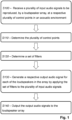
- FIG. 1 A method of controlling the loudspeaker array is shown in Fig. 1 .
- step S100 a plurality of input audio signals to be reproduced, by a loudspeaker array, at a respective plurality of control points in an acoustic environment are received.
- the plurality of control points may be received using a position sensor.
- the position of each of the plurality of control points may be received or determined.
- a set of filters may be determined. If step S110 is performed, the set of filters may be determined based on the determined plurality of control points. Alternatively, the set of filters may be determined based on a predetermined plurality of control points. The manner in which the set of filters is determined is described in detail below.
- a respective output audio signal for each of the loudspeakers in the array is determined by applying the set of filters to the plurality of input audio signals.
- the set of filters may be applied in the frequency domain.
- a transform such as a fast Fourier transform (FFT)
- FFT fast Fourier transform
- the output audio signals may be output to the loudspeaker array.
- Steps S100 to S140 may be repeated with another plurality of input audio signals. As steps S100 to S140 are repeated, the set of filters may remain the same, in which case step S120 need not be performed, or may change.
- steps S100 to S140 need not all be completed before they begin to be repeated.
- step S100 is performed a second time before step S140 has been performed a first time.
- FIG. 2 A block diagram of an exemplary apparatus 200 for implementing any of the methods described herein, such as the method of Fig. 1 , is shown in Fig. 2 .
- the apparatus 200 comprises a processor 210 (e.g., a digital signal processor) arranged to execute computer-readable instructions as may be provided to the apparatus 200 via one or more of a memory 220, a network interface 230, or an input interface 250.
- a processor 210 e.g., a digital signal processor
- the apparatus 200 comprises a processor 210 (e.g., a digital signal processor) arranged to execute computer-readable instructions as may be provided to the apparatus 200 via one or more of a memory 220, a network interface 230, or an input interface 250.
- the memory 220 for example a random-access memory (RAM), is arranged to be able to retrieve, store, and provide to the processor 210, instructions and data that have been stored in the memory 220.
- the network interface 230 is arranged to enable the processor 210 to communicate with a communications network, such as the Internet.
- the input interface 250 is arranged to receive user inputs provided via an input device (not shown) such as a mouse, a keyboard, or a touchscreen.
- the processor 210 may further be coupled to a display adapter 240, which is in turn coupled to a display device (not shown).
- the processor 210 may further be coupled to an audio interface 260 which may be used to output audio signals to one or more audio devices, such as a loudspeaker array 300.
- the audio interface 260 may comprise a digital-to-analog converter (DAC) (not shown), e.g., for use with audio devices with analog input(s).
- DAC digital-to-analog converter
- Listener-adaptive based cross-talk cancellation (CTC) 3D audio systems rely on multiple control filters to generate the sound driving one or more loudspeakers.
- the parameters of these filters are adapted in real-time according to the instantaneous position of one or more listeners, which is estimated with a listener tracking device (for example, a camera, global positioning system device, or wearable device).
- This filter parameter adaptation requires expensive computational resources, thus making the use of such audio reproduction approaches difficult for small embedded devices.
- Part of the computational resource consumption comes from the need for multiple inverse filters, which follows from the use of complex, accurate transfer function models between the system loudspeakers and the ears of a given listener.
- Simpler acoustical transfer functions can be used to reduce the computational load, but this comes at the cost of a reduced quality of the reproduced audio, especially in terms of its perceived spatial attributes. It is therefore difficult to create a system that is adaptive, has a low computational load, and has high quality performance.
- Listener-adaptive CTC systems can be based on stereo loudspeaker arrangements. Listener-adaptive systems can also use arrangements of four loudspeakers in order to give the listener the ability to rotate their head and hear sounds from a 360 degree range. These listener-adaptive CTC system examples use time-varying signal-processing control approaches in order to adapt to time-varying listener positions and head orientations.
- the control filters can be read from a database, or calculated on the fly at significant computational cost. Whilst such signal processing approaches can be implemented using large central processing units (CPUs) such as those available in personal computers (PCs), their underlying signal processing becomes a limiting factor on embedded systems when using more than two loudspeakers.
- CPUs central processing units
- PCs personal computers
- CTC-based 3D audio systems have an improved response when more than two loudspeakers are used. These can be used with a non-listener adaptive, fixed approach. However, such an approach may be ill-suited to consumer applications as they assume the listener stays still in a single listening position.
- MIMO multiple input multiple output
- ⁇ Technology 1' allows for processing-efficient listener-adaptive audio reproduction with loudspeaker arrays using more than two loudspeakers.
- the main CPU overhead (or consumption) reduction introduced by the Technology 1 results from decomposing the filtering signal processing audio flow into a combination of loudspeaker-dependent filters (DF) and loudspeaker-independent filters (IF).
- DF loudspeaker-dependent filters
- IF loudspeaker-independent filters
- the IFs are implemented as a set of time-varying finite impulse response (FIR) filters
- the DFs are implemented as a set of time-varying gain-delay elements. Due to this decomposition, only M ⁇ M control filters and M delay lines with L reading points each are needed. This processing scheme introduces a large reduction in processing complexity compared with the M ⁇ L matrix of filters needed for other approaches, since in most implementations L is much greater than M.
- Sound-field control systems based on loudspeaker arrays aim to reproduce one or more acoustic signals at one or more points in space (control points), whilst simultaneously eliminating the acoustic cross-talk (or sound leakage) to other control points.
- Such acoustic control leads to the creation of narrow beams of sound that can be directionally controlled, or steered, in space in a precise manner to facilitate various acoustic applications.
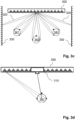
- one application can accurately control the pressure to the ears of one or more listeners 341, 342, 343 to create ⁇ virtual headphones' and reproduce 3D sound, which is known as cross-talk cancellation (CTC), as illustrated in Fig. 3a .
- CTC cross-talk cancellation
- Another application can be to reproduce various different and independent beams of sound 320 to two or more listeners, so that each of them can listen to a different sound program or to the same program with a user-specific sound level, as illustrated in Fig. 3b .
- the beams of sound 320 control the sound field around the ears, these control techniques are known for the "ability to personalise sound around the listeners".
- the beams created by the loudspeaker array 300 can be controlled to also direct sound towards the walls 330 of the room where sound is reproduced. This sound bounces off the walls and reaches the listener(s), thus creating an immersive experience, as illustrated in Fig. 3c .
- An L -channel loudspeaker array comprises loudspeakers located at positions y 1 , y 2 , ... , y L ⁇ R 3 .
- the listener is free to move around in the listening space and the position of the control points ⁇ x m ⁇ can vary in space.
- the instantaneous spatial position of the control points ⁇ x m ⁇ may be gathered by a listener-tracking system 310 (camera, wearable, laser, sound-based) that provides the real-time coordinates of the listeners' ears with respect to each of the loudspeakers of the loudspeaker array, as shown in Fig. 3d .
- a listener-tracking system 310 camera, wearable, laser, sound-based
- FIG. 4 A block diagram of the acoustic pressure control problem reproduced by a loudspeaker array is depicted in Fig. 4 .
- Each column h m of H is designed to reproduce its corresponding audio signal d m at the control point x m ,
- SH e -j ⁇ T I , where I is the M ⁇ M identity matrix.
- the array control filters H are calculated for a given acoustic plant matrix, S.
- the plant matrix is a model of the electro-acoustic transfer functions between the array loudspeakers and the control points where the acoustic pressure is to be controlled.
- the plant matrix will characterise the physical transfer function found in a practical acoustic system as accurately as possible. This is, however, not always possible in practical applications. Whilst it is possible to perform acoustic measurements and estimate the plant matrix of a given system with a relatively large degree of accuracy, this is a complex process that can only be accurately performed in laboratory conditions.
- the plant matrix can change significantly even with small movements of the listener(s), which requires a dense grid of measurements to allow for a wide range of adaptability to listener movements.
- this approach results in a set of L ⁇ M complex inverse filters, which causes a high computational complexity for reconstruction. It is therefore helpful to use very simple yet accurate models of acoustic propagation for representing the plant matrix S.
- This makes it possible to break the signal processing in equation (6) into a set of M ⁇ M IFs and a set of L ⁇ M DFs. This leads to the signal processing scheme shown in Fig. 6 , which is shown in its expanded form in Fig. 7 .
- HRTFs head related transfer functions
- Matrix G could, for example, be created by measuring the physical transfer function S , in which case the elements of G could be, for example, head-related transfer functions, or by using an analytical or numerical model of S , such as a rigid sphere or a boundary element model of a human head.
- the elements of G will not be simple delays and gains as in the case of C, but will be based on more complex frequency-dependent data or functions.
- the inventors have arrived at the insight that the audio quality of the Technology 1 can be significantly improved without significantly increasing computational load by using both a relatively complex, more accurate matrix G and a relatively simple, less accurate matrix C.
- the filter H should be such that SH ⁇ e ⁇ j ⁇ T I where I is the M ⁇ M identity matrix.
- SC H [GC H ] -1 provides a much better approximation to the identity matrix I than SC H [CC H ] -1 does since G is a much better approximation to S than C is. This allows for significantly improved audio quality.
- DSP digital signal processing
- An alternative way to compute the independent filters IFs is to solve a (convex) optimisation problem argmin IFs ⁇ GC H IFs ⁇ e ⁇ j ⁇ T I ⁇ p 1 subject to ⁇ C H IFs ⁇ p 2 ⁇ H max .
- ⁇ ⁇ ⁇ p 1 and ⁇ ⁇ ⁇ p 2 represent suitable matrix norms, for example the Frobenius norm, and H max is an upper admissible limit on the norm of the matrix of array filters H .
- the real-valued gains g m,l depend on the relative position of the loudspeakers and control points.
- the delay term ⁇ ( x m , y l ) included in the definition of G m,l may be the same delay that defines the corresponding element C m,l of matrix C.
- the delay term ⁇ (x m ,y l ) can be chosen in such a way that the phase of the terms on the diagonal of matrix GC H is as close to zero as possible.
- a possible choice of the delay is the value ⁇ ( x m , y l ) such that ⁇ (x m ,y l ) is the best linear approximation (across frequency) of the phase of G m,l .
- the design parameters ⁇ k and ⁇ k are non-negative real numbers and T and g are the sets of all delays ⁇ (x m ,y l ) and gains g m,l , respectively.
- ⁇ k ⁇ k 1,..., K is a set of frequencies spanning the frequency range of interest (note that ⁇ m,m' is a frequency-dependent quantity).
- maximising (or increasing) ⁇ 1,1 and ⁇ 2,2 and minimising (or reducing) ⁇ 1,2 and ⁇ 2,1 maximises (or increases) the absolute value of the determinant and therefore increases the system stability.
- the first multi-band architecture is shown in Fig. 9a .
- a set of N band-pass filters B n is used at the input and the core Technology 2 processing is duplicated N times.
- the IFs and DFs are different for each frequency band.
- the band-pass filters can alternatively be low-pass filters or high-pass filters.
- Fig. 9b A second possible multi-band DSP architecture is shown in Fig. 9b .
- the IFs take into account the various delays in matrices C n , different for each frequency band, and the output of the IFs are later divided into N frequency bands that are fed to N sets of DFs with different values of the scaled delay for each frequency band.
- This scheme requires the use of only M ⁇ M IFs, as opposed to having a different set of IFs for each frequency band.
- the DFs can be computed as in equation (19).
- FIG. 9c A third possible multi-band DSP architecture is shown in Fig. 9c .
- the multi-band processing is included in both the IFs and DFs, so that a single set of M ⁇ M IFs and M ⁇ L DFs is required (as opposed to one different set for each frequency band).
- the signals related to the various frequency bands are summed together, for each given loudspeaker.
- Fig. 10a shows results of a simulation of processing power requirements for listener-adaptive array filters based on the Technology 1 approach compared with traditional listener-adaptive and static MIMO approaches. Specifically, the number of MFLOPS required as a function of the number of loudspeakers L is shown for a static MIMO approach 1001, a listener-adaptive MIMO approach 1002, and the Technology 1 approach 1003.
- Fig. 10b the results of a simulation are shown in Fig. 10b for a loudspeaker array with three loudspeakers.
- the CTC spectrum is shown, representing the channel separation of the acoustic signals delivered at the ears of a listener.
- This performance metric should ideally be as large as possible for an array delivering 3D sound through CTC to provide good 3D immersion.
- the performance of Technology 2 1004 is much better than that of Technology 1 1005 along the audio frequency range, particularly above 2 kHz, where the effects of head diffraction are large.
- the Technology 2 approach combines the simplicity and low computational cost of the Technology 1, because of the presence of simple DFs represented by matrix C H , but it also allows for the introduction of a more accurate plant matrix G in the calculation of the IFs, without a significant increase of the overall computational cost of the algorithm.
- This allows complex acoustical phenomena (such as diffraction due to the head or reflections by the acoustic environment) to be taken into account and compensated for, and thereby improve the quality of the reproduced audio.
- An effect of the present disclosure is to provide a filter calculation scheme that allows for the use of complex transfer function models whilst using a limited amount of processing resources.
- An effect of the present disclosure is to provide a filtering approach with improved stability.
- an array of loudspeakers e.g., a line array of L loudspeakers.
- the method comprises receiving a plurality of input audio signals to be reproduced (e.g., d ), by the array, at a respective plurality of control points (or ⁇ listening positions') (e.g., ) in an acoustic environment (or 'acoustic space') .
- Each of the plurality of input audio signals may be different.
- At least one of the plurality of input audio signals may be different from at least one other one of the plurality of input audio signals.
- the method further comprises generating (or ⁇ determining') a respective output audio signal (e.g., Hd or q ) for each of the loudspeakers in the array by applying a set of filters (e.g., H ) to the plurality of input audio signals (e.g., d ).
- a respective output audio signal e.g., Hd or q
- a set of filters e.g., H
- the set of filters may be digital filters.
- the set of filters may be applied in the frequency domain.
- the set of filters is based on a first plurality of filter elements (e.g., C ) and a second plurality of filter elements (e.g., G ) .
- the first plurality of filter elements (e.g., C ) is based on a first approximation of a set of transfer functions (e.g., S ).
- the second plurality of filter elements (e.g., G ) is based on a second approximation of the set of transfer functions (e.g., S ) .
- Each transfer function in the set of transfer functions is between an audio signal applied to a respective one of the loudspeakers and an audio signal received at a respective one of the control points from the respective one of the loudspeakers.
- the first and second pluralities of filter elements are based on different approximations of the set of transfer functions.
- the different approximations may be based on different models of the set of transfer functions.
- a filter element may be a weight of a filter.
- a plurality of filter elements may be any set of filter weights.
- a filter element may be any component of a weight of a filter.
- a plurality of filter elements may be a plurality of components of respective weights of a filter.
- the set of filters may be obtained by combining two different matrices, C and G, which are in turn calculated using two different approximations of the physical electro-acoustical transfer functions that constitute the system plant matrix S.
- Matrix G e.g., as used in equation 10
- Matrix C may be formed using frequency-independent gains and delays or, more generally, elements that are different from the elements of G and allow for DFs that can be computed with a reduced computational load compared to DFs that are computed based on G.
- the first approximation (e.g., that used to determine C ) is based on a free-field acoustic propagation model and/or a point-source acoustic propagation model.
- the second approximation (e.g., that used to determine G ) accounts for one or more of reflection, refraction, diffraction or scattering of sound in the acoustic environment.
- the second approximation may alternatively or additionally account for scattering from a head of one or more listeners.
- the second approximation may alternatively or additionally account for one or more of a frequency response of each of the loudspeakers or a directivity pattern of each of the loudspeakers.
- the set of filters (e.g., H ) may comprise:
- Generating the respective output audio signal for each of the loudspeakers in the array may comprise:
- the array may comprise L loudspeakers and the plurality of control points may comprise M control points, and the first subset of filters may comprise M 2 filters and the second subset of filters may comprise L ⁇ M filters.
- the set of filters or the first subset of filters is determined based on an inverse of a matrix (e.g., [ GC H ]) containing the first (e.g., C ) and second (e.g., G ) pluralities of filter elements.
- a matrix e.g., [ GC H ]
- the matrix (e.g., [ GC H ]) containing the first and second pluralities of filter elements may be regularised prior to being inverted (e.g., by regularisation matrix A) .
- the matrix (e.g., [ GC H ]) containing the first and second pluralities of filter elements is determined based on:
- the set of filters may be determined based on:
- the set of filters may be determined using an optimisation technique.
- the first subset of filters may be determined so as to reduce a difference between a scalar matrix (e.g., an identity matrix I ) and a matrix comprising a product of: a matrix (e.g., G ) comprising the second plurality of filter elements, a matrix (e.g., C ) comprising the first plurality of filter elements, and a matrix representing the first subset of filters (e.g., IFs ).
- a scalar matrix e.g., an identity matrix I
- G a matrix comprising the second plurality of filter elements
- a matrix e.g., C
- a matrix representing the first subset of filters e.g., IFs
- Each one of the first plurality of filter elements may comprise a delay term (e.g. e - j ⁇ ( x m ,y l ) ) and/or a gain term (e.g., g m,l ) that is based on a relative position (e.g., x m ) of one of the control points and one of the loudspeakers (e.g. y l ).
- a delay term e.g. e - j ⁇ ( x m ,y l )
- a gain term e.g., g m,l
- the delay term (e.g. e - j ⁇ ⁇ ( x m ,y l ) ) and/or the gain term (e.g., g m,l ) may be determined so as to increase (or maximise), for each given one ( m ) of the plurality of control points, the collinearity (e.g., ⁇ m , m' ) between the first vector (e.g., c m ) corresponding to the given control point and the second vector (e.g., g m ) corresponding to the given control point.
- the collinearity e.g., ⁇ m , m'
- the delay term (e.g. e - j ⁇ ( x m , y l ) ) and/or the gain term (e.g., g m,l ) may be determined so as to:
- Each one of the first plurality of filter elements may comprise a delay term (e.g. e - j ⁇ ( x m , y l ) ) and/or a gain term (e.g., g m,l ) that is determined, for each given row of a first matrix (e.g., C ) comprising the first plurality of filter elements, so as to:
- Each one of the first plurality of filter elements may comprise a delay term (e.g. e - j ⁇ (x m ,y l ) ) based on a linear approximation of a phase of a corresponding one of the second plurality of filter elements (e.g., G ).
- a delay term e.g. e - j ⁇ (x m ,y l )
- the plurality of control points may comprise locations of a corresponding plurality of listeners, e.g., when operating in a ⁇ personal audio' mode.
- the plurality of control points may comprise locations of ears of one or more listeners, e.g., when operating in a 'binaural' mode.
- the second approximation may be based on one or more head-related transfer functions, HRTFs.
- the one or more HRTFs may be measured HRTFs.
- the one or more HRTFs may be simulated HRTFs.
- the one or more HRTFs may be determined using a boundary element model of a head.
- the second plurality of filter elements may be determined by measuring the set of transfer functions.
- the method may further comprise determining the plurality of control points using a position sensor.
- Generating the respective output audio signals may comprise using a filter bank to apply at least a portion of the set of filters in a plurality of frequency subbands.
- the first subset of filters e.g., [ GC H ] -1
- the second subset of filters e.g., C H
- the first subset of filters e.g., [ GC H ] -1
- the second subset of filters e.g., C H
- the filter bank e.g., as illustrated in Fig. 9a ).
- the first subset of filters (e.g., [ GC H ] - 1 ) may be applied in fullband and the second subset of filters (e.g., C H ) may be applied in each of the frequency subbands (e.g., as illustrated in Fig. 9b ).
- the first subset of filters (e.g., [ GC H ] -1 ) may be applied outside the filter bank and the second subset of filters (e.g., C H ) may be applied within the filter bank.
- Generating a respective output audio signal for each of the loudspeakers in the array may comprise:
- the first plurality of filter elements may comprise a first subset of first filter elements for a first one of the plurality of frequency subbands and a second subset of first filter elements for a second one of the plurality of frequency subbands; and/or the second plurality of filter elements may comprise a first subset of second filter elements for the first one of the plurality of frequency subbands and a second subset of second filter elements for the second one of the plurality of frequency subbands.
- the first subset of first filter elements and the second subset of first filter elements may be different and/or the first subset of second filter elements and the second subset of second filter elements may be different.
- the set of filters may be time-varying.
- the set of filters e.g., H
- the method may further comprise outputting the output audio signals (e.g., Hd or q ) to the loudspeaker array.
- the output audio signals e.g., Hd or q
- the method may further comprise receiving the set of filters (e.g., H ), e.g., from another processing device, or from a filter determining module.
- the method may further comprise determining the set of filters (e.g., H ).
- the first and second approximations may be different.
- At least one of the first plurality of filter elements may be different from a corresponding one of the second plurality of filter elements (e.g., G ).
- the method may further comprise determining any of the variables listed herein using any of the equations set out herein.
- the set of filters may be determined using any of the equations set out herein (e.g., equations 6, 8, 10, 13, 14).
- the apparatus may comprise a digital signal processor configured to perform any of the methods described herein.
- the apparatus may comprise the loudspeaker array.
- the apparatus may be coupled, or may be configured to be coupled, to the loudspeaker array.
- Non-transitory computer-readable medium or a data carrier signal comprising the computer program.
- the various methods described above are implemented by a computer program.
- the computer program includes computer code arranged to instruct a computer to perform the functions of one or more of the various methods described above.
- the computer program and/or the code for performing such methods is provided to an apparatus, such as a computer, on one or more computer-readable media or, more generally, a computer program product.
- the computer-readable media is transitory or non-transitory.
- the one or more computer-readable media could be, for example, an electronic, magnetic, optical, electromagnetic, infrared, or semiconductor system, or a propagation medium for data transmission, for example for downloading the code over the Internet.
- the one or more computer-readable media could take the form of one or more physical computer-readable media such as semiconductor or solid state memory, magnetic tape, a removable computer diskette, a random access memory (RAM), a read-only memory (ROM), a rigid magnetic disc, or an optical disk, such as a CD-ROM, CD-R/W or DVD.
- physical computer-readable media such as semiconductor or solid state memory, magnetic tape, a removable computer diskette, a random access memory (RAM), a read-only memory (ROM), a rigid magnetic disc, or an optical disk, such as a CD-ROM, CD-R/W or DVD.
- modules, components and other features described herein are implemented as discrete components or integrated in the functionality of hardware components such as ASICS, FPGAs, DSPs or similar devices.
- a ' hardware component' is a tangible (e.g., non-transitory) physical component (e.g., a set of one or more processors) capable of performing certain operations and configured or arranged in a certain physical manner.
- a hardware component includes dedicated circuitry or logic that is permanently configured to perform certain operations.
- a hardware component is or includes a special-purpose processor, such as a field programmable gate array (FPGA) or an ASIC.
- a hardware component also includes programmable logic or circuitry that is temporarily configured by software to perform certain operations.
- ⁇ hardware component' should be understood to encompass a tangible entity that is physically constructed, permanently configured (e.g., hardwired), or temporarily configured (e.g., programmed) to operate in a certain manner or to perform certain operations described herein.
- modules and components are implemented as firmware or functional circuitry within hardware devices. Further, in some implementations, the modules and components are implemented in any combination of hardware devices and software components, or only in software (e.g., code stored or otherwise embodied in a machine-readable medium or in a transmission medium).
Landscapes
- Engineering & Computer Science (AREA)
- Signal Processing (AREA)
- Acoustics & Sound (AREA)
- Physics & Mathematics (AREA)
- Health & Medical Sciences (AREA)
- Quality & Reliability (AREA)
- General Health & Medical Sciences (AREA)
- Computational Linguistics (AREA)
- Otolaryngology (AREA)
- Audiology, Speech & Language Pathology (AREA)
- Human Computer Interaction (AREA)
- Multimedia (AREA)
- Circuit For Audible Band Transducer (AREA)
- Obtaining Desirable Characteristics In Audible-Bandwidth Transducers (AREA)
- Stereophonic System (AREA)
Claims (15)
- Procédé de commande d'un réseau de haut-parleurs (300), le procédé comprenant:la réception (S100) d'une pluralité de signaux audio d'entrée (d1,...,dM) destinée à être reproduite par le réseau, au niveau d'une pluralité respective de points de commandes (x1,..., xM) dans un environnement acoustique; etla génération (S130) d'un signal audio de sortie respectif (q) pour chacun des haut-parleurs dans la matrice en appliquant un ensemble de filtres à la pluralité de signaux audio d'entrée,dans lequel l'ensemble de filtres est basé sur:une pluralité d'éléments de filtre basée sur une première approximation d'un ensemble de fonctions de transfert, chaque fonction de transfert dans l'ensemble de fonctions de transfert étant entre un signal audio appliqué à un haut-parleur respectif des haut-parleurs et un signal reçu au niveau d'un point de commande respectif des points de commande à partir du haut-parleur respectif des haut-parleurs; etune seconde pluralité d'éléments de filtre basée sur une seconde approximation de l'ensemble de fonctions de transfert,dans lequel la première approximation est basée sur un modèle de propagation acoustique de champ libre et/ou un modèle de propagation acoustique de source ponctuelle et la seconde approximation tient compte d'un ou plusieurs éléments de réflexion, réfraction, diffraction ou diffusion de son dans l'environnement acoustique, etdans lequel l'ensemble de filtres est déterminé en fonction d'un inverse d'une matrice (GCH) contenant les première et seconde pluralités d'éléments de filtre, la matrice étant déterminée en fonction:
dans le domaine fréquentiel, d'un produit d'une seconde matrice contenant la seconde pluralité d'éléments de filtre (G) et d'une première matrice contenant la première pluralité d'éléments de filtre (CH) ou une opération équivalente dans le domaine temporel. - Procédé selon la revendication 1, dans lequel la seconde approximation tient compte au moins d'une réponse de fréquence de chacun des haut-parleurs (300) ou d'un modèle de directivité de chacun des haut-parleurs.
- Procédé selon toute revendication précédents, dans lequel l'ensemble de filtres comprend:un premier sous-ensemble de filtres basé sur les première et seconde pluralités d'éléments de filtre ; etun second sous-ensemble de filtres basé sur la première ou la seconde pluralité d'éléments de filtre.
- Procédé selon toute revendication précédente, dans lequel la génération du signal audio de sortie respectif pour chacun des haut-parleurs (300) dans la matrice comprend:la génération d'un signal audio intermédiaire respectif pour chacun des points de commande (x1,...,xM) en appliquant le ou un premier sous-ensemble de filtres au signal audio d'entrée (w1,...,wm) etla génération du signal audio de sortie respectif (q) pour chacun des haut-parleurs en appliquant le second sous-ensemble de filtres aux signaux audio intermédiaires.
- Procédé selon toute revendication précédente, dans lequel chaque élément de filtre de la première pluralité d'éléments de filtre est un élément de retard-gain dépendant de la fréquence.
- Procédé selon toute revendication précédente, dans lequel chaque élément de filtre de la première pluralité d'éléments de filtre comprend un terme de retard et/ou un terme de gain qui est déterminé, pour chaque rangée donnée de la première matrice comprenant la première pluralité d'éléments de filtre, de manière à:augmenter une colinéarité entre la rangée donnée de la première matrice et une rangée correspondante de la seconde matrice comprenant la seconde pluralité d'éléments de filtre; etéventuellement, réduire la colinéarité entre la rangée donnée de la première matrice et la rangée non correspondante de la seconde matrice.
- Procédé selon toute revendication précédente, dans lequel chaque élément de filtre de la première pluralité d'éléments de filtre comprend un terme de retard basé sur une approximation linéaire d'une phase d'un élément de filtre correspondant de la seconde pluralité d'éléments de filtre.
- Procédé selon toute revendication précédente, dans lequel la pluralité de points de commande (x1,...,xM) comprend des emplacements d'une pluralité correspondante d'auditeurs ou d'emplacements d'oreilles d'un ou plusieurs auditeurs (341, 342, 343).
- Procédé selon toute revendication précédente, dans lequel la seconde approximation est basée sur une ou plusieurs fonctions de transfert relatif à la tête, HRTF.
- Procédé selon toute revendication précédente, comprenant en outre la détermination (S110) de la pluralité de points de commande (x1,....xM) à l'aide d'un capteur de position.
- Procédé selon toute revendication précédente, dans lequel l'ensemble de filtres varie dans le temps.
- Appareil (200) comprenant des moyens configurés pour réaliser le procédé selon toute revendication précédente.
- Programme d'ordinateur comprenant des instructions qui, à leur exécution par un système de traitement, amènent le système de traitement à réaliser le procédé selon l'une quelconque des revendications 1 à 11.
- Support lisible par ordinateur comprenant des instructions qui, à leur exécution par un système de traitement, amènent le système de traitement à réaliser le procédé selon l'une quelconque des revendications 1 à 11.
- Signal porteur de données comprenant des instructions qui, à leur exécution par un système de traitement, amènent le système de traitement à réaliser le procédé selon l'une quelconque des revendications 1 à 11.
Applications Claiming Priority (1)
| Application Number | Priority Date | Filing Date | Title |
|---|---|---|---|
| GBGB2008547.8A GB202008547D0 (en) | 2020-06-05 | 2020-06-05 | Loudspeaker control |
Publications (3)
| Publication Number | Publication Date |
|---|---|
| EP3920557A1 EP3920557A1 (fr) | 2021-12-08 |
| EP3920557B1 true EP3920557B1 (fr) | 2024-04-17 |
| EP3920557C0 EP3920557C0 (fr) | 2024-04-17 |
Family
ID=71615973
Family Applications (1)
| Application Number | Title | Priority Date | Filing Date |
|---|---|---|---|
| EP21177505.1A Active EP3920557B1 (fr) | 2020-06-05 | 2021-06-02 | Organe de commande de haut-parleur |
Country Status (5)
| Country | Link |
|---|---|
| US (1) | US11792596B2 (fr) |
| EP (1) | EP3920557B1 (fr) |
| CN (1) | CN113766396B (fr) |
| ES (1) | ES2980688T3 (fr) |
| GB (1) | GB202008547D0 (fr) |
Families Citing this family (4)
| Publication number | Priority date | Publication date | Assignee | Title |
|---|---|---|---|---|
| GB202109307D0 (en) | 2021-06-28 | 2021-08-11 | Audioscenic Ltd | Loudspeaker control |
| GB2616073A (en) * | 2022-02-28 | 2023-08-30 | Audioscenic Ltd | Loudspeaker control |
| CN116094479A (zh) * | 2023-01-13 | 2023-05-09 | 维沃移动通信有限公司 | 滤波器设计方法、装置、电子设备及可读存储介质 |
| CN117098045B (zh) * | 2023-09-07 | 2024-04-12 | 广州市声拓电子有限公司 | 一种阵列扬声器实现方法 |
Citations (1)
| Publication number | Priority date | Publication date | Assignee | Title |
|---|---|---|---|---|
| WO2017158338A1 (fr) * | 2016-03-14 | 2017-09-21 | University Of Southampton | Système de reproduction de son |
Family Cites Families (23)
| Publication number | Priority date | Publication date | Assignee | Title |
|---|---|---|---|---|
| US6243476B1 (en) | 1997-06-18 | 2001-06-05 | Massachusetts Institute Of Technology | Method and apparatus for producing binaural audio for a moving listener |
| KR20050060789A (ko) * | 2003-12-17 | 2005-06-22 | 삼성전자주식회사 | 가상 음향 재생 방법 및 그 장치 |
| KR101118214B1 (ko) * | 2004-09-21 | 2012-03-16 | 삼성전자주식회사 | 청취 위치를 고려한 2채널 가상 음향 재생 방법 및 장치 |
| EP1858296A1 (fr) * | 2006-05-17 | 2007-11-21 | SonicEmotion AG | Méthode et système pour produire une impression binaurale en utilisant des haut-parleurs |
| US9560448B2 (en) | 2007-05-04 | 2017-01-31 | Bose Corporation | System and method for directionally radiating sound |
| CN102077277B (zh) * | 2008-06-25 | 2013-06-12 | 皇家飞利浦电子股份有限公司 | 音频处理 |
| KR101334964B1 (ko) | 2008-12-12 | 2013-11-29 | 삼성전자주식회사 | 사운드 처리 장치 및 방법 |
| KR101702330B1 (ko) * | 2010-07-13 | 2017-02-03 | 삼성전자주식회사 | 근거리 및 원거리 음장 동시제어 장치 및 방법 |
| CN103222187B (zh) | 2010-09-03 | 2016-06-15 | 普林斯顿大学托管会 | 对于通过扬声器的音频的频谱不着色的优化串扰消除 |
| WO2012032335A1 (fr) | 2010-09-06 | 2012-03-15 | Cambridge Mechatronics Limited | Système de réseau de haut-parleurs |
| WO2012068174A2 (fr) | 2010-11-15 | 2012-05-24 | The Regents Of The University Of California | Procédé de commande d'un réseau de haut-parleurs permettant de produire un son d'ambiance virtuel binaural spatialisé localisé |
| EP2974385A1 (fr) | 2013-03-14 | 2016-01-20 | Apple Inc. | Annulation robuste de diaphonie à l'aide d'un réseau de haut-parleurs |
| US10827292B2 (en) | 2013-03-15 | 2020-11-03 | Jawb Acquisition Llc | Spatial audio aggregation for multiple sources of spatial audio |
| US9301077B2 (en) | 2014-01-02 | 2016-03-29 | Harman International Industries, Incorporated | Context-based audio tuning |
| EP2930953B1 (fr) * | 2014-04-07 | 2021-02-17 | Harman Becker Automotive Systems GmbH | Génération d'un champ d'ondes sonores |
| EP3024252B1 (fr) | 2014-11-19 | 2018-01-31 | Harman Becker Automotive Systems GmbH | Système sonore permettant d'établir une zone acoustique |
| RU2685041C2 (ru) * | 2015-02-18 | 2019-04-16 | Хуавэй Текнолоджиз Ко., Лтд. | Устройство обработки аудиосигнала и способ фильтрации аудиосигнала |
| CN107925814B (zh) * | 2015-10-14 | 2020-11-06 | 华为技术有限公司 | 生成提升声音印象的方法和设备 |
| US9497561B1 (en) * | 2016-05-27 | 2016-11-15 | Mass Fidelity Inc. | Wave field synthesis by synthesizing spatial transfer function over listening region |
| EP3346730B1 (fr) * | 2017-01-04 | 2021-01-27 | Harman Becker Automotive Systems GmbH | Dispositif de casque pour reproduction audio 3d |
| TW202101422A (zh) | 2019-05-23 | 2021-01-01 | 美商舒爾獲得控股公司 | 可操縱揚聲器陣列、系統及其方法 |
| US11363402B2 (en) * | 2019-12-30 | 2022-06-14 | Comhear Inc. | Method for providing a spatialized soundfield |
| GB202109307D0 (en) | 2021-06-28 | 2021-08-11 | Audioscenic Ltd | Loudspeaker control |
-
2020
- 2020-06-05 GB GBGB2008547.8A patent/GB202008547D0/en not_active Ceased
-
2021
- 2021-06-02 EP EP21177505.1A patent/EP3920557B1/fr active Active
- 2021-06-02 ES ES21177505T patent/ES2980688T3/es active Active
- 2021-06-04 US US17/339,614 patent/US11792596B2/en active Active
- 2021-06-07 CN CN202110631118.4A patent/CN113766396B/zh active Active
Patent Citations (1)
| Publication number | Priority date | Publication date | Assignee | Title |
|---|---|---|---|---|
| WO2017158338A1 (fr) * | 2016-03-14 | 2017-09-21 | University Of Southampton | Système de reproduction de son |
Also Published As
| Publication number | Publication date |
|---|---|
| US11792596B2 (en) | 2023-10-17 |
| CN113766396A (zh) | 2021-12-07 |
| ES2980688T3 (es) | 2024-10-02 |
| EP3920557A1 (fr) | 2021-12-08 |
| GB202008547D0 (en) | 2020-07-22 |
| CN113766396B (zh) | 2024-07-30 |
| EP3920557C0 (fr) | 2024-04-17 |
| US20210385605A1 (en) | 2021-12-09 |
Similar Documents
| Publication | Publication Date | Title |
|---|---|---|
| EP3920557B1 (fr) | Organe de commande de haut-parleur | |
| EP2258120B1 (fr) | Procédés et dispositifs pour fournir des signaux ambiophoniques | |
| EP3430823B1 (fr) | Système de reproduction de son | |
| EP3320692B1 (fr) | Appareil de traitement spatial de signaux audio | |
| US9749769B2 (en) | Method, device and system | |
| EP2285139A2 (fr) | Dispositif et procédé pour convertir un signal audio spatial | |
| Zhong et al. | and Virtual Auditory Display | |
| Masiero et al. | A framework for the calculation of dynamic crosstalk cancellation filters | |
| WO2013135819A1 (fr) | Procédé d'application d'une stratégie de commande du champ acoustique hybride ou combinée | |
| US20130044894A1 (en) | System and method for efficient sound production using directional enhancement | |
| US10659903B2 (en) | Apparatus and method for weighting stereo audio signals | |
| EP4114033A1 (fr) | Commande de haut-parleur | |
| JP7362320B2 (ja) | オーディオ信号処理装置、オーディオ信号処理方法及びオーディオ信号処理プログラム | |
| Hamdan | Theoretical advances in multichannel crosstalk cancellation systems | |
| EP4236376A1 (fr) | Commande de haut-parleur | |
| Hamdan et al. | Weighted orthogonal vector rejection method for loudspeaker-based binaural audio reproduction | |
| CN115209336A (zh) | 一种多个虚拟源动态双耳声重放方法、装置及存储介质 | |
| Jiang et al. | Stereo Audio Rendering for Personal Sound Zones Using a Binaural Spatially Adaptive Neural Network (BSANN) | |
| Li et al. | Impact of mismatched room acoustic modeling on transaural reproduction with loudspeaker arrays | |
| Sodnik et al. | Spatial Sound | |
| Chen | 3D audio and virtual acoustical environment synthesis | |
| Sakamoto et al. | Binaural rendering of spherical microphone array recordings by directly synthesizing the spatial pattern of the head-related transfer function | |
| Nelson et al. | Systems for virtual sound imaging |
Legal Events
| Date | Code | Title | Description |
|---|---|---|---|
| PUAI | Public reference made under article 153(3) epc to a published international application that has entered the european phase |
Free format text: ORIGINAL CODE: 0009012 |
|
| STAA | Information on the status of an ep patent application or granted ep patent |
Free format text: STATUS: THE APPLICATION HAS BEEN PUBLISHED |
|
| AK | Designated contracting states |
Kind code of ref document: A1 Designated state(s): AL AT BE BG CH CY CZ DE DK EE ES FI FR GB GR HR HU IE IS IT LI LT LU LV MC MK MT NL NO PL PT RO RS SE SI SK SM TR |
|
| B565 | Issuance of search results under rule 164(2) epc |
Effective date: 20211109 |
|
| STAA | Information on the status of an ep patent application or granted ep patent |
Free format text: STATUS: REQUEST FOR EXAMINATION WAS MADE |
|
| 17P | Request for examination filed |
Effective date: 20220601 |
|
| RBV | Designated contracting states (corrected) |
Designated state(s): AL AT BE BG CH CY CZ DE DK EE ES FI FR GB GR HR HU IE IS IT LI LT LU LV MC MK MT NL NO PL PT RO RS SE SI SK SM TR |
|
| GRAP | Despatch of communication of intention to grant a patent |
Free format text: ORIGINAL CODE: EPIDOSNIGR1 |
|
| STAA | Information on the status of an ep patent application or granted ep patent |
Free format text: STATUS: GRANT OF PATENT IS INTENDED |
|
| INTG | Intention to grant announced |
Effective date: 20231110 |
|
| GRAS | Grant fee paid |
Free format text: ORIGINAL CODE: EPIDOSNIGR3 |
|
| GRAA | (expected) grant |
Free format text: ORIGINAL CODE: 0009210 |
|
| STAA | Information on the status of an ep patent application or granted ep patent |
Free format text: STATUS: THE PATENT HAS BEEN GRANTED |
|
| AK | Designated contracting states |
Kind code of ref document: B1 Designated state(s): AL AT BE BG CH CY CZ DE DK EE ES FI FR GB GR HR HU IE IS IT LI LT LU LV MC MK MT NL NO PL PT RO RS SE SI SK SM TR |
|
| REG | Reference to a national code |
Ref country code: GB Ref legal event code: FG4D |
|
| REG | Reference to a national code |
Ref country code: CH Ref legal event code: EP |
|
| REG | Reference to a national code |
Ref country code: DE Ref legal event code: R096 Ref document number: 602021011808 Country of ref document: DE |
|
| REG | Reference to a national code |
Ref country code: IE Ref legal event code: FG4D |
|
| U01 | Request for unitary effect filed |
Effective date: 20240506 |
|
| U07 | Unitary effect registered |
Designated state(s): AT BE BG DE DK EE FI FR IT LT LU LV MT NL PT SE SI Effective date: 20240516 |
|
| U20 | Renewal fee for the european patent with unitary effect paid |
Year of fee payment: 4 Effective date: 20240523 |
|
| REG | Reference to a national code |
Ref country code: ES Ref legal event code: FG2A Ref document number: 2980688 Country of ref document: ES Kind code of ref document: T3 Effective date: 20241002 |
|
| PG25 | Lapsed in a contracting state [announced via postgrant information from national office to epo] |
Ref country code: IS Free format text: LAPSE BECAUSE OF FAILURE TO SUBMIT A TRANSLATION OF THE DESCRIPTION OR TO PAY THE FEE WITHIN THE PRESCRIBED TIME-LIMIT Effective date: 20240817 |
|
| PG25 | Lapsed in a contracting state [announced via postgrant information from national office to epo] |
Ref country code: HR Free format text: LAPSE BECAUSE OF FAILURE TO SUBMIT A TRANSLATION OF THE DESCRIPTION OR TO PAY THE FEE WITHIN THE PRESCRIBED TIME-LIMIT Effective date: 20240417 |
|
| PG25 | Lapsed in a contracting state [announced via postgrant information from national office to epo] |
Ref country code: GR Free format text: LAPSE BECAUSE OF FAILURE TO SUBMIT A TRANSLATION OF THE DESCRIPTION OR TO PAY THE FEE WITHIN THE PRESCRIBED TIME-LIMIT Effective date: 20240718 |
|
| PG25 | Lapsed in a contracting state [announced via postgrant information from national office to epo] |
Ref country code: PL Free format text: LAPSE BECAUSE OF FAILURE TO SUBMIT A TRANSLATION OF THE DESCRIPTION OR TO PAY THE FEE WITHIN THE PRESCRIBED TIME-LIMIT Effective date: 20240417 |
|
| PG25 | Lapsed in a contracting state [announced via postgrant information from national office to epo] |
Ref country code: PL Free format text: LAPSE BECAUSE OF FAILURE TO SUBMIT A TRANSLATION OF THE DESCRIPTION OR TO PAY THE FEE WITHIN THE PRESCRIBED TIME-LIMIT Effective date: 20240417 Ref country code: NO Free format text: LAPSE BECAUSE OF FAILURE TO SUBMIT A TRANSLATION OF THE DESCRIPTION OR TO PAY THE FEE WITHIN THE PRESCRIBED TIME-LIMIT Effective date: 20240717 Ref country code: IS Free format text: LAPSE BECAUSE OF FAILURE TO SUBMIT A TRANSLATION OF THE DESCRIPTION OR TO PAY THE FEE WITHIN THE PRESCRIBED TIME-LIMIT Effective date: 20240817 Ref country code: HR Free format text: LAPSE BECAUSE OF FAILURE TO SUBMIT A TRANSLATION OF THE DESCRIPTION OR TO PAY THE FEE WITHIN THE PRESCRIBED TIME-LIMIT Effective date: 20240417 Ref country code: GR Free format text: LAPSE BECAUSE OF FAILURE TO SUBMIT A TRANSLATION OF THE DESCRIPTION OR TO PAY THE FEE WITHIN THE PRESCRIBED TIME-LIMIT Effective date: 20240718 Ref country code: RS Free format text: LAPSE BECAUSE OF FAILURE TO SUBMIT A TRANSLATION OF THE DESCRIPTION OR TO PAY THE FEE WITHIN THE PRESCRIBED TIME-LIMIT Effective date: 20240717 |
|
| REG | Reference to a national code |
Ref country code: DE Ref legal event code: R097 Ref document number: 602021011808 Country of ref document: DE |
|
| PG25 | Lapsed in a contracting state [announced via postgrant information from national office to epo] |
Ref country code: CZ Free format text: LAPSE BECAUSE OF FAILURE TO SUBMIT A TRANSLATION OF THE DESCRIPTION OR TO PAY THE FEE WITHIN THE PRESCRIBED TIME-LIMIT Effective date: 20240417 |
|
| PG25 | Lapsed in a contracting state [announced via postgrant information from national office to epo] |
Ref country code: SK Free format text: LAPSE BECAUSE OF FAILURE TO SUBMIT A TRANSLATION OF THE DESCRIPTION OR TO PAY THE FEE WITHIN THE PRESCRIBED TIME-LIMIT Effective date: 20240417 Ref country code: RO Free format text: LAPSE BECAUSE OF FAILURE TO SUBMIT A TRANSLATION OF THE DESCRIPTION OR TO PAY THE FEE WITHIN THE PRESCRIBED TIME-LIMIT Effective date: 20240417 |
|
| PG25 | Lapsed in a contracting state [announced via postgrant information from national office to epo] |
Ref country code: SM Free format text: LAPSE BECAUSE OF FAILURE TO SUBMIT A TRANSLATION OF THE DESCRIPTION OR TO PAY THE FEE WITHIN THE PRESCRIBED TIME-LIMIT Effective date: 20240417 |
|
| PG25 | Lapsed in a contracting state [announced via postgrant information from national office to epo] |
Ref country code: SM Free format text: LAPSE BECAUSE OF FAILURE TO SUBMIT A TRANSLATION OF THE DESCRIPTION OR TO PAY THE FEE WITHIN THE PRESCRIBED TIME-LIMIT Effective date: 20240417 Ref country code: SK Free format text: LAPSE BECAUSE OF FAILURE TO SUBMIT A TRANSLATION OF THE DESCRIPTION OR TO PAY THE FEE WITHIN THE PRESCRIBED TIME-LIMIT Effective date: 20240417 Ref country code: RO Free format text: LAPSE BECAUSE OF FAILURE TO SUBMIT A TRANSLATION OF THE DESCRIPTION OR TO PAY THE FEE WITHIN THE PRESCRIBED TIME-LIMIT Effective date: 20240417 Ref country code: CZ Free format text: LAPSE BECAUSE OF FAILURE TO SUBMIT A TRANSLATION OF THE DESCRIPTION OR TO PAY THE FEE WITHIN THE PRESCRIBED TIME-LIMIT Effective date: 20240417 Ref country code: MC Free format text: LAPSE BECAUSE OF FAILURE TO SUBMIT A TRANSLATION OF THE DESCRIPTION OR TO PAY THE FEE WITHIN THE PRESCRIBED TIME-LIMIT Effective date: 20240417 |
|
| REG | Reference to a national code |
Ref country code: CH Ref legal event code: PL |
|
| PLBE | No opposition filed within time limit |
Free format text: ORIGINAL CODE: 0009261 |
|
| STAA | Information on the status of an ep patent application or granted ep patent |
Free format text: STATUS: NO OPPOSITION FILED WITHIN TIME LIMIT |
|
| 26N | No opposition filed |
Effective date: 20250120 |
|
| PG25 | Lapsed in a contracting state [announced via postgrant information from national office to epo] |
Ref country code: IE Free format text: LAPSE BECAUSE OF NON-PAYMENT OF DUE FEES Effective date: 20240602 |
|
| PG25 | Lapsed in a contracting state [announced via postgrant information from national office to epo] |
Ref country code: CH Free format text: LAPSE BECAUSE OF NON-PAYMENT OF DUE FEES Effective date: 20240630 |
|
| U20 | Renewal fee for the european patent with unitary effect paid |
Year of fee payment: 5 Effective date: 20250502 |
|
| PGFP | Annual fee paid to national office [announced via postgrant information from national office to epo] |
Ref country code: GB Payment date: 20250502 Year of fee payment: 5 |
|
| PG25 | Lapsed in a contracting state [announced via postgrant information from national office to epo] |
Ref country code: CY Free format text: LAPSE BECAUSE OF FAILURE TO SUBMIT A TRANSLATION OF THE DESCRIPTION OR TO PAY THE FEE WITHIN THE PRESCRIBED TIME-LIMIT; INVALID AB INITIO Effective date: 20210602 |
|
| PGFP | Annual fee paid to national office [announced via postgrant information from national office to epo] |
Ref country code: ES Payment date: 20250714 Year of fee payment: 5 |
|
| PG25 | Lapsed in a contracting state [announced via postgrant information from national office to epo] |
Ref country code: HU Free format text: LAPSE BECAUSE OF FAILURE TO SUBMIT A TRANSLATION OF THE DESCRIPTION OR TO PAY THE FEE WITHIN THE PRESCRIBED TIME-LIMIT; INVALID AB INITIO Effective date: 20210602 |