EP3920794B1 - System zur innenraumbelegungsschätzung, bahnverfolgung und ereignisüberwachung und -verfolgung - Google Patents
System zur innenraumbelegungsschätzung, bahnverfolgung und ereignisüberwachung und -verfolgung Download PDFInfo
- Publication number
- EP3920794B1 EP3920794B1 EP20753145.0A EP20753145A EP3920794B1 EP 3920794 B1 EP3920794 B1 EP 3920794B1 EP 20753145 A EP20753145 A EP 20753145A EP 3920794 B1 EP3920794 B1 EP 3920794B1
- Authority
- EP
- European Patent Office
- Prior art keywords
- computing device
- sensor
- footstep
- vibrations
- data
- Prior art date
- Legal status (The legal status is an assumption and is not a legal conclusion. Google has not performed a legal analysis and makes no representation as to the accuracy of the status listed.)
- Active
Links
Images




Classifications
-
- A—HUMAN NECESSITIES
- A61—MEDICAL OR VETERINARY SCIENCE; HYGIENE
- A61B—DIAGNOSIS; SURGERY; IDENTIFICATION
- A61B5/00—Measuring for diagnostic purposes; Identification of persons
- A61B5/0002—Remote monitoring of patients using telemetry, e.g. transmission of vital signals via a communication network
-
- A—HUMAN NECESSITIES
- A61—MEDICAL OR VETERINARY SCIENCE; HYGIENE
- A61B—DIAGNOSIS; SURGERY; IDENTIFICATION
- A61B5/00—Measuring for diagnostic purposes; Identification of persons
- A61B5/0002—Remote monitoring of patients using telemetry, e.g. transmission of vital signals via a communication network
- A61B5/0015—Remote monitoring of patients using telemetry, e.g. transmission of vital signals via a communication network characterised by features of the telemetry system
- A61B5/002—Monitoring the patient using a local or closed circuit, e.g. in a room or building
-
- A—HUMAN NECESSITIES
- A61—MEDICAL OR VETERINARY SCIENCE; HYGIENE
- A61B—DIAGNOSIS; SURGERY; IDENTIFICATION
- A61B5/00—Measuring for diagnostic purposes; Identification of persons
- A61B5/103—Measuring devices for testing the shape, pattern, colour, size or movement of the body or parts thereof, for diagnostic purposes
- A61B5/11—Measuring movement of the entire body or parts thereof, e.g. head or hand tremor or mobility of a limb
- A61B5/1116—Determining posture transitions
- A61B5/1117—Fall detection
-
- A—HUMAN NECESSITIES
- A61—MEDICAL OR VETERINARY SCIENCE; HYGIENE
- A61B—DIAGNOSIS; SURGERY; IDENTIFICATION
- A61B5/00—Measuring for diagnostic purposes; Identification of persons
- A61B5/68—Arrangements of detecting, measuring or recording means, e.g. sensors, in relation to patient
- A61B5/6887—Arrangements of detecting, measuring or recording means, e.g. sensors, in relation to patient mounted on external non-worn devices, e.g. non-medical devices
-
- A—HUMAN NECESSITIES
- A61—MEDICAL OR VETERINARY SCIENCE; HYGIENE
- A61B—DIAGNOSIS; SURGERY; IDENTIFICATION
- A61B5/00—Measuring for diagnostic purposes; Identification of persons
- A61B5/68—Arrangements of detecting, measuring or recording means, e.g. sensors, in relation to patient
- A61B5/6887—Arrangements of detecting, measuring or recording means, e.g. sensors, in relation to patient mounted on external non-worn devices, e.g. non-medical devices
- A61B5/6889—Rooms
-
- A—HUMAN NECESSITIES
- A61—MEDICAL OR VETERINARY SCIENCE; HYGIENE
- A61B—DIAGNOSIS; SURGERY; IDENTIFICATION
- A61B5/00—Measuring for diagnostic purposes; Identification of persons
- A61B5/74—Details of notification to user or communication with user or patient; User input means
- A61B5/7405—Details of notification to user or communication with user or patient; User input means using sound
-
- A—HUMAN NECESSITIES
- A61—MEDICAL OR VETERINARY SCIENCE; HYGIENE
- A61B—DIAGNOSIS; SURGERY; IDENTIFICATION
- A61B5/00—Measuring for diagnostic purposes; Identification of persons
- A61B5/74—Details of notification to user or communication with user or patient; User input means
- A61B5/742—Details of notification to user or communication with user or patient; User input means using visual displays
-
- A—HUMAN NECESSITIES
- A61—MEDICAL OR VETERINARY SCIENCE; HYGIENE
- A61B—DIAGNOSIS; SURGERY; IDENTIFICATION
- A61B5/00—Measuring for diagnostic purposes; Identification of persons
- A61B5/74—Details of notification to user or communication with user or patient; User input means
- A61B5/746—Alarms related to a physiological condition, e.g. details of setting alarm thresholds or avoiding false alarms
-
- A—HUMAN NECESSITIES
- A61—MEDICAL OR VETERINARY SCIENCE; HYGIENE
- A61B—DIAGNOSIS; SURGERY; IDENTIFICATION
- A61B5/00—Measuring for diagnostic purposes; Identification of persons
- A61B5/74—Details of notification to user or communication with user or patient; User input means
- A61B5/7475—User input or interface means, e.g. keyboard, pointing device, joystick
-
- G—PHYSICS
- G01—MEASURING; TESTING
- G01V—GEOPHYSICS; GRAVITATIONAL MEASUREMENTS; DETECTING MASSES OR OBJECTS; TAGS
- G01V1/00—Seismology; Seismic or acoustic prospecting or detecting
- G01V1/001—Acoustic presence detection
-
- G—PHYSICS
- G08—SIGNALLING
- G08B—SIGNALLING SYSTEMS, e.g. PERSONAL CALLING SYSTEMS; ORDER TELEGRAPHS; ALARM SYSTEMS
- G08B21/00—Alarms responsive to a single specified undesired or abnormal condition and not otherwise provided for
- G08B21/02—Alarms for ensuring the safety of persons
- G08B21/04—Alarms for ensuring the safety of persons responsive to non-activity, e.g. of elderly persons
- G08B21/0407—Alarms for ensuring the safety of persons responsive to non-activity, e.g. of elderly persons based on behaviour analysis
- G08B21/043—Alarms for ensuring the safety of persons responsive to non-activity, e.g. of elderly persons based on behaviour analysis detecting an emergency event, e.g. a fall
-
- G—PHYSICS
- G08—SIGNALLING
- G08B—SIGNALLING SYSTEMS, e.g. PERSONAL CALLING SYSTEMS; ORDER TELEGRAPHS; ALARM SYSTEMS
- G08B21/00—Alarms responsive to a single specified undesired or abnormal condition and not otherwise provided for
- G08B21/02—Alarms for ensuring the safety of persons
- G08B21/04—Alarms for ensuring the safety of persons responsive to non-activity, e.g. of elderly persons
- G08B21/0438—Sensor means for detecting
- G08B21/0461—Sensor means for detecting integrated or attached to an item closely associated with the person but not worn by the person, e.g. chair, walking stick, bed sensor
-
- G—PHYSICS
- G08—SIGNALLING
- G08B—SIGNALLING SYSTEMS, e.g. PERSONAL CALLING SYSTEMS; ORDER TELEGRAPHS; ALARM SYSTEMS
- G08B21/00—Alarms responsive to a single specified undesired or abnormal condition and not otherwise provided for
- G08B21/02—Alarms for ensuring the safety of persons
- G08B21/04—Alarms for ensuring the safety of persons responsive to non-activity, e.g. of elderly persons
- G08B21/0438—Sensor means for detecting
- G08B21/0469—Presence detectors to detect unsafe condition, e.g. infrared sensor, microphone
-
- G—PHYSICS
- G08—SIGNALLING
- G08B—SIGNALLING SYSTEMS, e.g. PERSONAL CALLING SYSTEMS; ORDER TELEGRAPHS; ALARM SYSTEMS
- G08B25/00—Alarm systems in which the location of the alarm condition is signalled to a central station, e.g. fire or police telegraphic systems
- G08B25/01—Alarm systems in which the location of the alarm condition is signalled to a central station, e.g. fire or police telegraphic systems characterised by the transmission medium
- G08B25/10—Alarm systems in which the location of the alarm condition is signalled to a central station, e.g. fire or police telegraphic systems characterised by the transmission medium using wireless transmission systems
-
- G—PHYSICS
- G08—SIGNALLING
- G08B—SIGNALLING SYSTEMS, e.g. PERSONAL CALLING SYSTEMS; ORDER TELEGRAPHS; ALARM SYSTEMS
- G08B7/00—Signalling systems according to two or more of groups G08B3/00 - G08B6/00
- G08B7/06—Signalling systems according to two or more of groups G08B3/00 - G08B6/00 using electric transmission, e.g. involving audible and visible signalling through the use of sound and light sources
-
- A—HUMAN NECESSITIES
- A61—MEDICAL OR VETERINARY SCIENCE; HYGIENE
- A61B—DIAGNOSIS; SURGERY; IDENTIFICATION
- A61B2503/00—Evaluating a particular growth phase or type of persons or animals
- A61B2503/08—Elderly
-
- A—HUMAN NECESSITIES
- A61—MEDICAL OR VETERINARY SCIENCE; HYGIENE
- A61B—DIAGNOSIS; SURGERY; IDENTIFICATION
- A61B2562/00—Details of sensors; Constructional details of sensor housings or probes; Accessories for sensors
- A61B2562/02—Details of sensors specially adapted for in-vivo measurements
- A61B2562/0204—Acoustic sensors
-
- A—HUMAN NECESSITIES
- A61—MEDICAL OR VETERINARY SCIENCE; HYGIENE
- A61B—DIAGNOSIS; SURGERY; IDENTIFICATION
- A61B2562/00—Details of sensors; Constructional details of sensor housings or probes; Accessories for sensors
- A61B2562/04—Arrangements of multiple sensors of the same type
- A61B2562/046—Arrangements of multiple sensors of the same type in a matrix array
-
- A—HUMAN NECESSITIES
- A61—MEDICAL OR VETERINARY SCIENCE; HYGIENE
- A61B—DIAGNOSIS; SURGERY; IDENTIFICATION
- A61B5/00—Measuring for diagnostic purposes; Identification of persons
- A61B5/72—Signal processing specially adapted for physiological signals or for diagnostic purposes
- A61B5/7235—Details of waveform analysis
- A61B5/7253—Details of waveform analysis characterised by using transforms
- A61B5/726—Details of waveform analysis characterised by using transforms using Wavelet transforms
-
- G—PHYSICS
- G08—SIGNALLING
- G08B—SIGNALLING SYSTEMS, e.g. PERSONAL CALLING SYSTEMS; ORDER TELEGRAPHS; ALARM SYSTEMS
- G08B13/00—Burglar, theft or intruder alarms
- G08B13/16—Actuation by interference with mechanical vibrations in air or other fluid
- G08B13/1654—Actuation by interference with mechanical vibrations in air or other fluid using passive vibration detection systems
- G08B13/1663—Actuation by interference with mechanical vibrations in air or other fluid using passive vibration detection systems using seismic sensing means
Definitions
- a seismometer is a sensor that can sense floor vibrations.
- indoor sensing systems use vision, radio frequency (RF), mobile, and acoustic systems to track the movement of individual.
- RF radio frequency
- Some traditional sensing systems further require an individual to identify themselves which can be an intrusion of privacy.
- aspects of the present disclosure are related to monitoring the activities of individuals without having to keep the surrounding area under the surveillance of a camera thereby maintaining the privacy of the individual.
- a network of sensitive sensor units can are installed onto indoor flooring to record human footstep induced vibrations. The data collected from the sensors can then be processed to identify individual occupants, determine the number of occupants, estimate the location of footsteps, and track the trajectory of each occupant.
- a first embodiment of the invention corresponds to a monitoring system for monitoring activity in a predefined area according to independent claim 1.
- the sensor includes a seismometer.
- the network of sensor units are in data communication via a wireless network.
- isolating the footstep vibrations further comprises identifying one or more footstep signatures in time domain and frequency domain.
- determining the number of subjects moving in the predefined area further comprises clustering one or more footstep features from the sensor data with one or more footstep features from the neighbor sensor data.
- the application can further cause the at least one computing device to at least detect an event based at least in part on the footstep vibrations.
- the event comprises a fall of a particular subject.
- the application can cause the at least one computing device to at least generate an alert in response to the detected event.
- the alert is at least one of an auditory or visual alert.
- the computing device is in communication with a smart device configured to communicate with a third party, and generating the alert further comprises instructing the smart device to send a communication with the third party.
- the invention corresponds to a method for monitoring activity in a predefined area according to independent claim 7.
- the method further comprises estimating, via the computing device, a number of occupants in the predefined area.
- the sensor comprises a seismometer.
- the method further comprises further comprising generating, via the computing device, a user interface comprising at least one of: a trajectory tracking, a number of detected footsteps, a number of detected events, a fall down location, a number of detected falls, a time associated with a last detected event, or a time associated with a last detected fall.
- the method further comprises rendering, via the computing device, the user interface on a display associated with the computing device; and updating, via the computing device, the user interface periodically.
- the method further comprises detecting, via the computing device, an event of the subject.
- the event comprises a fall down event.
- detecting the event is based at least in part on the footstep vibrations.
- the method further comprises generating, via the computing device, an alert in response to the detected event.
- the computing device is in communication with a smart device configured to communicate with a third party, and generating the alert comprises instructing the smart device to send a communication with the third party.
- the present disclosure relates to a monitoring system configured to monitor the activities of individuals without having to keep the surrounding area under the surveillance of a camera thereby maintaining the privacy of the individual.
- the monitoring system of the present disclosure uses a network of sensitive seismometer units that are installed onto indoor flooring to record human footstep induced vibrations.
- the data collected from the sensors can then be processed to identify individual occupants, determine the number of occupants, estimate the location of footsteps, and track the trajectory of each occupant.
- the extracted trajectory information can be used to assess an occupant's personal activity and social interaction, which can then be used to analyze the individual's physical and psychological health.
- FIG. 1 illustrates an example of a smart monitoring system 100 according to various embodiments of the present disclosure.
- the smart monitoring system 100 can comprise a plurality of distributed sensor units 103 (e.g., 103a ... 103N) which are in data communication with one another via a network 106.
- the network 109 includes, for example, the Internet, intranets, extranets, wide area networks (WANs), local area networks (LANs), wired networks, wireless networks, cable networks, satellite networks, or other suitable networks, etc., or any combination of two or more such networks.
- the distributed sensor units 106 can comprise a sensor 109, a computing device 112, and an amplifier 115, and/or other components as can be appreciated.
- the sensor 109 is configured to obtain both vertical and horizontal vibrations.
- the sensor 109 can comprise a seismometer and/or any other type of sensor as can be appreciated.
- the sensor 109 is configured to collect sensor data and communicate with the computing device 112.
- the amplifiers 109 are configured to facilitate detection.
- the computing device 103 can comprise any type of computing device comprising a processor and a memory. Various applications and/or other functionality may be executed in the computing device 103 according to various embodiments.
- the components executed on the computing device 103 include a seismic tracking application 118 (FIG. 25), a warning module 121 (FIG. 25), and other applications, services, processes, systems, engines, or functionality not discussed in detail herein.
- the system can comprises a separate computing device 103 that is in communication with the different sensor units 103 in the network 109.
- the computing device 103 can collect the data from the different sensor units 103 in the network 109 and analyze the data to detect events, such as, for example, a fall down of a subject in a defined area.
- the seismic tracking application 118 is executed to collect and store data, process data analytics, communicate with other units, and provide raw and processed data to the visualization tool.
- the seismic tracking application 118 can collect and process data associated with a given sensor 106 and/or other sensors 106 in the network 109.
- the seismic tracking application 118 can generate one or more user interfaces 124 ( FIG. 24 ) that include the raw and processed data that is rendered by a display device (not shown) via the visualization tool.
- the one or user interfaces 124 that can be updated in real-time.
- the warning module 118 is executed to generate an alert in an instance in which a particular event is detected.
- the warning module 118 is implemented as part of the computing device 103 of the seismic monitoring system 100.
- the warning module 118 can comprise an application executable in the computing device 103.
- the warning module 118 can be separate from the computing device 103 and can be data communication with the computing device 103 over the network 112.
- the sensors 106 are in data communication with the computing device 1112 via a wired or wireless connection, as can be appreciated.
- the sensor units 106 can collect sensor data and transmit the collected data to the computing device 103 for analysis.
- Noise that is generated by appliances in the surrounding area, such as air conditioning, can also generate vibrations.
- the seismic tracking application 115 is configured to remove this noise from the collected data by applying wavelet denoising technique which uses relative threshold instead of the traditional fixed threshold.
- the seismic tracking application 115 can isolate the footstep vibrations are isolated. According to various embodiments, the number of occupants walking in the tested parameter over a given period of time can be computed from the extracted data by employing clustering technique. Single footstep features and gait features can also be inferred based on the different vibration signatures from distinct walking styles. Accordingly, the seismic tracking application 115 can identify individuals according to specific footstep features.
- PoA phase constrained angle of arrival
- AoA Angle of Arrival
- PoA Phase of Arrival
- the smart monitoring system 100 can monitor an individual or multiple individuals in one setting. Each individual, without being tagged for identification purposes, can walk in random patterns and by employing machine learning, the location of the footsteps and the path taken by the individuals can be identified. This information, in turn, can be used to monitor analyze the physical health and social interactions of the individuals.
- the seismic monitoring system 100 can detect an event and comprise a warning module 118 configured to generate an alert in an instance in which a particular event is detected.
- a detected event can include a fall and/or other event.
- the warning module 118 can cause an alert to be generated to notify the subject and/or other entities about the event.
- the alert can comprise a visual and/or auditory alert.
- the warning module 118 can be coupled to a communication device 127 (e.g., smart speaker) ( FIG. 22 ) that can notify emergency entity and/or other entity.
- the warning module 118 can be in communication with a communication device 127 that is capable of making an emergency call and/or otherwise notifying emergency personal and/or other persons.
- the smart monitoring system 100 can be applied in a variety of applications.
- the smart monitoring system 100 can be employed in assistance living areas, where the occupants' movements can be monitored without the compromise of their privacies.
- the elderly represents twelve percent of the population, and "falls" account for seventy percent of accidental deaths in persons aged seventy-five or older.
- This technology can be used to alert the caretakers when there is a "fall” and it could also be used to preempt "falls” by predicting when the next "fall” would occur based on the extracted footstep and gait pattern characteristics data.
- an individual's physical and psychological assessments are possible.
- This technology can further be implemented in other applications, including traffic pattern monitoring in an enclosed large setting such as a supermarket, a shopping mall or an airport, where movements of pedestrians could be tracked autonomously, group behaviors could be assessed, and energy and space of the monitored area could be managed. It could also be integrated into a security system.
- the monitoring system 100 of the present disclosure is leveraged by cyber-physical system (CPS) techniques. Instead of using traditional privacy violation surveillance technologies, the monitoring system 100 of the present disclosure is designed to sense the footstep induced vibrations to feature the same functions. Based on distributed sensing and processing units, an ubiquitous computing approach to pre-process the data, recognize footstep signals and extract vibration features locally is adopted. Through communications among the sensor network, the system 100 is capable to estimate the occupancy via counting the number of occupants.
- CPS cyber-physical system
- a novel indoor footstep localization method that relies on both angle and phase information of the recorded waveforms is proposed.
- the monitoring system 100 of the present disclosure can be used to analyze footstep signatures, from which the person's physical condition can be inferred, as well as social interactions, from which a psychological assessment can also be possible.
- the proposed system 100 obtains promising results in occupancy
- the monitoring system 100 can comprise distributed sensor units 103 to detect footstep vibrations, and processing circuitiry configured to extract the features corresponding to unique walking and gait patterns.
- processing circuitiry configured to extract the features corresponding to unique walking and gait patterns.
- AOA angle-of-arrival
- TOA time-of-arrival
- TDOA time-difference-of-arrival
- FDOA Doppler shift frequency-difference-of-arrival
- RSS received signal strength
- specific sensing conditions and location rules are usually required according to the methodology assumptions, including line-of-sight, high sensor density, carrying wearable devices, and so on.
- vibration-based methods provide easy-to-install sparse sensing, which can be embedded to an Internet of Things (IoT) smart building system.
- IoT Internet of Things
- Characterizing the wave equation a physical insight on the relationship between the recorded signal and a footstep can be utilized.
- a new location method is developed using the sensor-based monitoring system 100 of the present disclosure. This method can consider the acoustic wave properties and given instruments. Based on the location information from different people, the trajectory can be estimated, which can be used to interpret one's behavior patterns, and determine when multiple people are interacting. The social interaction and personal activity pattern analysis can be helpful to physical as well as psychological assessment.
- FIG. 2 illustrates an example flowchart associated with the operation of the monitoring system 100 of the present disclosure according to various embodiments.
- an innovative location technique is disclosed that is based on the specific information extracted from the sensor units 106 and the seismic vibration signal model.
- an unsupervised machine learning method can estimate the number of pedestrian without any prior information, in addition the footstep signatures have a potential to infer the person's physical condition.
- the footstep trajectory for multiple people can be used for social interaction analysis.
- the sensing unit 103 which embeds a sensor 103 and a computing device 112, in the system carries out sensing, pre-processing, footstep isolation, and feature extraction in a distributed style, while the localization, occupancy estimation and trajectory tracking require communications among sensors.
- the system 100 of the present disclosure achieves the goals based on both pervasive and ubiquitous computing.
- footstep energy travels through the floor media to the vibration sensors.
- footstep vibration signals are recorded.
- the sensor unit 103 can comprise a sensitive sensor 106, shown in FIG. 3 , to collect vibration data.
- the sensor unit 103 can comprise a sensor 106 with a several hundred Hz sampling rate.
- the sensor unit 103 can comprise a sensor 106 with a several hundred Hz sampling rate.
- the recorded data respect to the movements on directions North (N), East (E) and Vertical (Z). The data provides for an innovative indoor location approach.
- the wanted floor vibration signal in indoor environments is usually weak, especially when the footsteps are far away from a seismometer, resulting in a low signal to noise ratio (SNR).
- Amplifiers 109 can be used to amplify weak vibration signals to facilitate detection as well as the following processing tasks.
- a low-cost computing device 112 such as a Raspberry Pi, for example, can be employed to record data, apply computation tasks locally and communicate with other units.
- the computing device 112 of the present disclosure can receive the data from the sensor 106 and saves the raw data to a local database. In order to process data in real time and obtain accurate location results, the sensor synchronization is important.
- the computing device 112 is the core of the CPS system because it is in charge of collecting and storing data, processing data analytics, communicating with other units and providing raw and processed data to the visualization tool.
- footstep isolation step is implemented to isolate the footstep vibrations.
- the building is constantly shaking and generates the background vibration noises to the interested footsteps vibration.
- the air conditioners (AC) and other appliances also generate all kinds of vibrations.
- background noise associated with the present disclosure is not limited at a given frequency range. Therefore, in order to improve the SNR, the background noise needs to be removed adaptively. Therefore a wavelet denoising technique is applied on the recorded data to suppress non-stationary noises.
- a relative threshold according to the signal strength can be used.
- the denoised signal s d using wavelet thresholding can be expressed as: Where ( ⁇ j , k ) j , k ⁇ K denotes the orthogonal wavelet basis, ⁇ ( ⁇ ) is the thresholding operator adapt to the signal energy.
- a signal segmentation step is applied to extract the footstep vibrations, which means a footstep-induced signal needs to be recognized apart from the background noises.
- a change point detection algorithm is adopted, e.g., STA/LTA method, which is usually applied in the seismic event detection.
- STA short time average
- LTA long time average
- the STA/LTA method can be rewritten as STCF/LTCF, where CF stands for characterization function which characterizes waveform properties: where, i , j are the sample number, ns and nl represent the short and long window lengths.
- CF can be any kind of signal statistics depending on the applications. The footstep onset is picked when the STCF/LTCF ratio reaches the defined threshold, then the ratio will drop to cross the threshold again when the ending is picked.
- the occupancy estimation means to count the number of occupants over a given time period.
- an unsupervised machine learning method is used.
- the monitoring system 100 extracts features of footstep events.
- a clustering type machine learning model is generated to estimate the occupancy.
- the traditional person identification projects used supervised machine learning models, such as support vector machine (SVM) and its derivations. Since the occupants are not registered, the monitoring system 100 of the present disclosure uses clustering to estimate the number of walking people rather than who is walking.
- a supervised model such as k-nearest neighbor classier
- the present disclosure uses an unsupervised model to enhance the versatility of the system, as no pre-registration or prior models are needed.
- the vibrations and sound pressure responses of human footsteps in buildings can be broadband and frequency-dependent. Different vibration signatures from different walking styles have been studied.
- the footstep features include the single footstep features, as well as gait features.
- features in both time and frequency domains are computed, including standard deviation, peak values, entropy, partial signal before and after the maximum peak, spectrum centroid, locations and amplitudes of peaks, power spectrum density, etc.
- the human physical conditions can be analyzed based on the extracted features.
- a clustering technique estimates the number of the occupants.
- Clustering techniques group similar objects, which are the extracted footstep features.
- the classic "k-means” method minimizes the mean squared distance from all points to their respective cluster centers, but the "k” needs to be defined beforehand.
- a Markovian framework has been used for occupancy estimation. However, it is too computational expensive for a real time, on-line processing in Internet of Things (IoT) devices. In addition, to broaden the application range, no prior information should be assumed.
- the density-based spatial clustering of applications with noise (DBSCAN) technique is used, which is a density-based clustering algorithm to group close sample points in the latent space.
- DBSCAN starts with a random starting point that has not been clustered. If it contains sufficiently neighboring points, a cluster is formed. Otherwise, the point is labeled as noise.
- the algorithm can be found in Algorithm 2.
- FIG. 5 shows a sketch of the sensor-based location system 100.
- GPS accuracy is lower inside a building and not to mention the sensors 106 are placed too close.
- the relative sensor locations are manually placed to build a system map. Then, in the defined coordinates, a hammer test is applied to validate the sensor synchronization and initialize the wave propagation velocity model of the floor.
- FIG. 6 shows a sketch of how angulation technique can work in the system setup. The object's position is determined through the intersection of a number of pairs of angle directions.
- the main advantage of AoA is that the device/user location can be estimated with as low as two monitors in a two dimensional (2D) environment, or three monitors in a three-dimensional (3D) environment respectively.
- AoA can provide accurate estimation even when the transmitter-receiver distance is small, which makes it an appropriate option for the indoor localization.
- the method For estimating the location of any entity in 2-D, the method requires at least two known reference points (seismometer locations) and two angles ( ⁇ 1 , ⁇ 2 ), respectively. To obtain the wave propagation angles, the sensor 106 can be useful.
- the received data includes two orthogonal ground-motion records corresponding to the east and north components (respectively noted E and N). Configuration of a 2 ⁇ 2 covariance matrix over the two components is: where Cov(•) denotes the covariance.
- the eigenvectors of the Equation (3) form an orthogonal base, from which the wave orientation can be estimated.
- FIG. 7 shows the POA principle.
- the lines show the equal phase
- the black dots 703 are the receivers
- the red dot 706 is the estimated location.
- the phase difference between every two sensors 106 can be used to plot a series of equal phase curves, which typically are ellipses. Then, all the equal phase curves should intersect at the true location point. Theoretically, three sensor pairs can locate one point in a 2-D plane. And with more observations (sensor pairs), the location will be more accurate.
- phase difference it is natural that if the distances between footstep location and sensor are the same or integral times of the wavelength, the phase difference would be zero. Otherwise, the phase difference between two received signals can be directly used to estimate the distance: where ⁇ is the wavelength, ⁇ d is the phase difference, and n is an integer.
- the phase difference of the received signals can be calculated directly from the signals, but the range of the phase measurement is between 0 and 2 ⁇ , it would be necessary to recognize the passed number of whole cycles n in order to determine the one-way distance greater than ⁇ /2.
- phase constrained angle of arrival PAoA
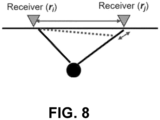
- FIG. 6 AoA principle was shown in FIG. 6 , where location is determined by the intersection among the arrival directions estimated from different sensors 106. So the inaccurate angle estimation, which can be brought from interferences in the isolation and the waveform distortions, will result in location uncertainties, shown in FIG. 8 .
- Equation (4) or Equation (5) can be used to infer the distance. Based on this phased related distance information, the location obtained from AoA will be constrained to a smaller area, which may not be the ground truth location as PoA results could also have uncertainties.
- the trajectory of a pedestrian can be estimated.
- the footsteps from different people can be separated, and the footsteps are not fully overlapped, the trajectory map of one area can be obtained by stacking all trajectories from different people.
- an extended Kalman filter (EKF) is used to infer the true underlying nonlinear pedestrian trajectories.
- u k is the control vector
- w k and v k are the process and observation noises which are both assumed to be zero mean
- Q k and R k are the covariance of multivariate Gaussian noises.
- the function f computes the predicted state from the previous estimate.
- the function h computes the predicted measurement from the predicted state.
- the Jacobian partial derivative matrix
- the system hardware configuration of the monitoring system 100 can comprise a computing device 112 (e.g., a Raspberry Pi board), a power supply 400 and a sensor 106.
- a computing device 112 e.g., a Raspberry Pi board
- a power supply 400 e.g., a battery
- the battery can comprise a 11V battery and 99.9 Wh can be further integrated.
- the sensor units 103 can be installed on the floor and the sensors 106 in the systems form a sparse mesh network.
- the sensor units 103 can be placed at the corners of the testing area 900.
- two sensor units 103 are arranged with a distance at 3 m and 4 m, so when a person walks by the sensors 106, the sensing units 103 are far enough that the footsteps do not fully overlap.
- the sampling rate is set to 500 Hz.
- the features are extracted, and values are normalized for clustering.
- a hammer test is carried out to generate impulse signals.
- the floor velocity can be estimated. From FIGS. 9 and 10 , the average floor velocity is about 400 meters per second (m/s). From the spectra in FIG. 12 , the analysis frequency can be 200-300 Hz. So the wavelength is between 1.3 meters (m) and 2 m. Thus, the integral n for PAoA is easy to determine.
- occupancy estimation and trajectory tracking There are two main parts: occupancy estimation and trajectory tracking.
- the unsupervised clustering is used to identify the number of people, and provide the accuracy.
- people are asked to walk randomly in the area and try to track their trajectories, even when the location results could be contaminated with noises or not accurate.
- FIG. 11a shows a raw data example. It is clear that the background noise is not limited at a given frequency range, so a simple bandpass or high pass filter cannot generate satisfied filtering results.
- the time domain denoising result based on the wavelet thresholding method is shown in FIG. 11b.
- FIG. 12 displays the spectra of the signals before and after filtering, where spectral distributions of the footstep-induced vibrations and noises can be observed.
- the noise is broadband and frequency-dependent. It is clear that the noise has been removed both in the time and frequency domains.
- the next step is the footstep isolation.
- the second order statistics are used to highlight amplitude changes.
- FIG. 13 shows footstep isolation results, where the signals between blue (onset) and pink (ending) bars are recognized footstep vibrations.
- the PAoA method of the present disclosure combines the AoA and PoA methods together for better location accuracy.
- the first step of PAoA is to estimate the footstep signal arrival angles based on the amplitudes from different axes of the sensors 106.
- the received data is assumed to have two orthogonal ground-motion records corresponding to the east and north components (respectively noted E and N).
- the two channel amplitudes are the projection results of the true amplitude.
- the different waveforms because of the projection effect from N and E channels of the same footsteps are shown in FIG. 14 .
- Equation (3) and the corresponding eigenvector estimation approach the projection angle of one footstep vibration can be estimated.
- FIG. 14 There are three segmented footsteps in FIG. 14 . Since people were asked to walk past the sensor 106, the arrival angles of these footsteps should be different.
- FIG. 15 shows the footstep angles to the sensor 106 is changing gradually as the footstep locations are different when people are walking, resulting in different relative angles.
- AOA based on the PoA principle, the phase information is estimated to improve the location accuracy.
- FIG. 16 shows a footstep location example using the proposed PAoA.
- the location accuracy is around 30 cm, which has not been testified in theory. Notice that the bottom footstep is not located in the figure, as the location result is out of the testing area. Though it is common to have boundary issues, further work will be done to fix this kind problems.
- FIGS. 17 and 18 show a single person experiment. One person is walking randomly in the testing area, and his footstep locations are recorded, then the trajectory is estimated.
- FIGS. 19 and 20 show a two people randomly walking example. Because people are separated first, more than one random walking person does not affect each other. However, with more people, the identification accuracy will be lower which will further reduce the location accuracy, resulting in problematic trajectory tracking results. Based on the results in FIG. 20 , the social interactions among multiple people can be inferred.
- the vibration signature expression is derived based on the wave equation.
- the recorded signal s ( t ) can be viewed as the summation of the vibration waveform u (t) and noise ⁇ :
- the footstep induced vibration u ( t ) can be modeled as an acoustic signal in the format of a convolution between the footstep force F ( ⁇ ) and the Green's function G ( ⁇ ): where, r is the distance, and G( ⁇ ) describes the site effect between the vibration location and the sensor location.
- the Green's function is the solution of a differential equation with a delta function as excitation.
- the string vibration frequencies are
- Equations (8), (11), and (14) together formulate the received signal on the sensor units 103.
- a harmonic model is used to represent the periodical signals from the event location.
- a clustering strategy is constructed to recognize many people/occupants are recorded.
- FIG. 21 shown is an example of event location on a room.
- the event could be generated by a fall down.
- the triangulation of information by the sensors allows the location estimation.
- FIG. 22 illustrates an example of a detected and located fall down.
- the system 100 is able to send alerts via additional communication devices 127 (e.g., smart speaker).
- additional communication devices 127 e.g., smart speaker.
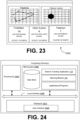
- FIG. 23 shown is an example user interface 2300 generated by the seismic monitoring system 100 of the present disclosure.
- the user interface 2300 of FIG. 23 includes trajectory tracking, number of detected footsteps, a last time a footstep was sensed, a number of detected other events, a last time another event was sensed, a fall down location, a number of detected falls, a last time a fall down was sensed, and/or other information.
- Trajectory tracking In this element card, the user can see in real time the trajectory of the person sensed by the seismic sensor on the floor.
- Number of detected footsteps The system displays how many footsteps the system has counted in that specific range of time.
- Last time sensed - footstep The time (hour+date) of the last footstep sensed by the system is displayed in this card of the dashboard.
- Last time sensed - other events The time (hour+date) of the last "other" events sensed by the system is displayed in this card of the dashboard.
- Fall Down location Once the system senses a fall down, the location is displayed in this element card.
- the system displays how many fall downs the system has counted in that specific range of time.
- Last time sensed - fall downs The time (hour+date) of the last fall down sensed by the system is displayed in this card of the dashboard.
- Each computing device 106 includes at least one processor circuit, for example, having a processor 2403 and a memory 2406, both of which are coupled to a local interface.
- each computing device 106 may be implemented using one or more circuits, one or more microprocessors, microcontrollers, application specific integrated circuits, dedicated hardware, digital signal processors, microcomputers, central processing units, field programmable gate arrays, programmable logic devices, state machines, or any combination thereof.
- the local interface 2409 may comprise, for example, a data bus with an accompanying address/control bus or other bus structure as can be appreciated.
- Each computing device 106 can include a display 2412 for rendering of generated graphics such as, e.g., a user interface 2300 and an input interface such, e.g., a keypad or touch screen to allow for user input.
- each computing device 2300 can include communication interfaces (not shown) that allows each computing device to communicatively couple with other communication devices.
- the communication interfaces may include one or more wireless connection(s) such as, e.g., Bluetooth or other radio frequency (RF) connection and/or one or more wired connection(s).
- RF radio frequency
- seismic tracking applications 118 can include applications that is collect and store data, process data analytics, communicate with other units, and provide raw and processed data to the visualization tool.
- the seismic tracking application 118 can process the collected data associated with the corresponding sensor 106 and/or other sensors 106 in the network to track the footsteps or other activity of subjects in a given area.
- the warning module 121 can include applications that can generate alerts to notify other individuals and/or emergency entities in response to a detected event.
- any one of a number of programming languages may be employed such as, for example, C, C++, C#, Objective C, Java ® , JavaScript ® , Per1, PHP, Visual Basic ® , Python ® , Ruby, Delphi ® , Flash ® , LabVIEW ® or other programming languages.
- executable means a program file that is in a form that can ultimately be run by the processor 2403.
- executable programs may be, for example, a compiled program that can be translated into machine code in a format that can be loaded into a random access portion of the memory 2406 and run by the processor 2403, source code that may be expressed in proper format such as object code that is capable of being loaded into a random access portion of the memory 2406 and executed by the processor 2403, or source code that may be interpreted by another executable program to generate instructions in a random access portion of the memory 2406 to be executed by the processor 2403, etc.
- An executable program may be stored in any portion or component of the memory including, for example, random access memory (RAM), read-only memory (ROM), hard drive, solid-state drive, USB flash drive, memory card, optical disc such as compact disc (CD) or digital versatile disc (DVD), floppy disk, magnetic tape, or other memory components.
- RAM random access memory
- ROM read-only memory
- hard drive solid-state drive
- USB flash drive USB flash drive
- memory card such as compact disc (CD) or digital versatile disc (DVD), floppy disk, magnetic tape, or other memory components.
- CD compact disc
- DVD digital versatile disc
- the memory 2406 is defined herein as including both volatile and nonvolatile memory and data storage components. Volatile components are those that do not retain data values upon loss of power. Nonvolatile components are those that retain data upon a loss of power.
- the memory 2406 may comprise, for example, random access memory (RAM), read-only memory (ROM), hard disk drives, solid-state drives, USB flash drives, memory cards accessed via a memory card reader, floppy disks accessed via an associated floppy disk drive, optical discs accessed via an optical disc drive, magnetic tapes accessed via an appropriate tape drive, and/or other memory components, or a combination of any two or more of these memory components.
- the RAM may comprise, for example, static random access memory (SRAM), dynamic random access memory (DRAM), or magnetic random access memory (MRAM) and other such devices.
- the ROM may comprise, for example, a programmable read-only memory (PROM), an erasable programmable read-only memory (EPROM), an electrically erasable programmable read-only memory (EEPROM), or other like memory device.
- the processor 2403 may represent multiple processors and the memory 2406 may represent multiple memories that operate in parallel processing circuits, respectively.
- the local interface 2409 may be an appropriate network that facilitates communication between any two of the multiple processors, between any processor and any of the memories, or between any two of the memories, etc.
- the local interface may comprise additional systems designed to coordinate this communication, including, for example, performing load balancing.
- the processor may be of electrical or of some other available construction.
- seismic tracking application(s) 118, the warning module 121, other applications and other various systems described herein may be embodied in software or code executed by general purpose hardware as discussed above, as an alternative the same may also be embodied in dedicated hardware or a combination of software/general purpose hardware and dedicated hardware. If embodied in dedicated hardware, each can be implemented as a circuit or state machine that employs any one of or a combination of a number of technologies. These technologies may include, but are not limited to, discrete logic circuits having logic gates for implementing various logic functions upon an application of one or more data signals, application specific integrated circuits having appropriate logic gates, or other components, etc. Such technologies are generally well known by those skilled in the art and, consequently, are not described in detail herein.
- any logic or application described herein, including the seismic tracking application(s) 118, and the warning module 121, that comprises software or code can be embodied in any non-transitory computer-readable medium for use by or in connection with an instruction execution system such as, for example, a processor in a computer system or other system.
- the logic may comprise, for example, statements including instructions and declarations that can be fetched from the computer-readable medium and executed by the instruction execution system.
- a "computer-readable medium” can be any medium that can contain, store, or maintain the logic or application described herein for use by or in connection with the instruction execution system.
- the computer-readable medium can comprise any one of many physical media such as, for example, magnetic, optical, or semiconductor media.
- a suitable computer-readable medium would include, but are not limited to, magnetic tapes, magnetic floppy diskettes, magnetic hard drives, memory cards, solid-state drives, USB flash drives, or optical discs.
- the computer-readable medium may be a random access memory (RAM) including, for example, static random access memory (SRAM) and dynamic random access memory (DRAM), or magnetic random access memory (MRAM).
- the computer-readable medium may be a read-only memory (ROM), a programmable read-only memory (PROM), an erasable programmable read-only memory (EPROM), an electrically erasable programmable read-only memory (EEPROM), or other type of memory device.
- a monitoring system for monitoring activity in a predefined area comprising: a network of sensor units arranged on a floor of the predefined area, individual sensor units of the network of sensor units comprising: a sensor; a computing device in data communication with the sensor; and at least one application executable in the computing device, wherein, when executed, the at least one application causes the computing device to at least: receive sensor data from the sensor, the sensor data comprising vibrations associated with one or more subjects moving on the floor; isolate footstep vibrations from the sensor data; communicate with at least one other sensor unit in the network of sensor units to obtain neighbor sensor data; and determine at least one of: a number of subjects moving in the predefined area, a trajectory for at least one subject, or a location of the at least one subject based at least in part on the footstep vibrations and the neighbor sensor data.
- Clause 3 The system of any one of clauses 1 or 2, wherein the network of sensor units are in data communication via a wireless network.
- determining the number of subjects moving in the predefined area further comprises clustering one or more footstep features from the sensor data with one or more footstep features from the neighbor sensor data.
- Clause 6 The system of any one of clauses 1 to 5, wherein, when executed, the at least one application further causes the computing device to at least detect an event based at least in part on the footstep vibrations.
- Clause 7 The system of clause 6, wherein the event comprises a fall of a particular subject.
- Clause 8 The system of any one of clauses 6 or 7, wherein, when executed, the application further causes the computing device to at least generate an alert in response to the detected event.
- Clause 9 The system of clause 8, wherein the alert is at least one of an auditory or visual alert.
- Clause 10 The system of any one of clauses 8 or 9, wherein the computing device is in communication with a smart device configured to communicate with a third party, and generating the alert further comprises instructing the smart device to send a communication with the third party.
- a method for monitoring activity in a predefined area comprising: obtaining, via a computing device of a sensor unit positioned on a floor of the predefined area, sensor data from a sensor of the sensor unit, the sensor data being associated with one or more subjects moving on the floor; isolating, via the computing device, footstep vibrations from the sensor data based at least in part on wavelet denoising; determining, via the computing device, a location of a subject based at least in part on one or more signature features in the footstep vibrations and data received from at least one other sensor unit; and determining, via the computing device, a trajectory of the subject based at least in part on the location of the subject.
- Clause 12 The method of clause 11, further comprising estimating, via the computing device, a number of occupants in the predefined area.
- Clause 13 The method of any one of clauses 11 or 12, wherein the sensor comprises a seismometer.
- Clause 14 The method of any one of clauses 11 to 13, further comprising generating, via the computing device, a user interface comprising at least one of: a trajectory tracking, a number of detected footsteps, a number of detected events, a fall down location, a number of detected falls, a time associated with a last detected event, or a time associated with a last detected fall.
- Clause 15 The method of clause 14, further comprising: rendering, via the computing device, the user interface on a display associated with the computing device; and updating, via the computing device, the user interface periodically.
- Clause 16 The method of any one of clauses 11 to 15, further comprising detecting, via the computing device, an event of the subject.
- Clause 17 The method of clause 16, wherein the even comprises a fall down event.
- Clause 18 The method of any one of clauses 16 or 17, wherein detecting the event is based at least in part on the footstep vibrations.
- Clause 19 The method of any one of clauses 16 to 19, further comprising generating, via the computing device, an alert in response to the detected event.
- Clause 20 The method of clause 19, wherein the computing device is in communication with a smart device configured to communicate with a third party, and generating the alert comprises instructing the smart device to send a communication with the third party.
- ratios, concentrations, amounts, and other numerical data may be expressed herein in a range format. It is to be understood that such a range format is used for convenience and brevity, and thus, should be interpreted in a flexible manner to include not only the numerical values explicitly recited as the limits of the range, but also to include all the individual numerical values or sub-ranges encompassed within that range as if each numerical value and sub-range is explicitly recited.
- a concentration range of "about 0.1% to about 5%” should be interpreted to include not only the explicitly recited concentration of about 0.1 wt% to about 5 wt%, but also include individual concentrations (e.g., 1%, 2%, 3%, and 4%) and the sub-ranges (e.g., 0.5%, 1.1%, 2.2%, 3.3%, and 4.4%) within the indicated range.
- the term “about” can include traditional rounding according to significant figures of numerical values.
- the phrase "about 'x' to 'y'" includes “about 'x' to about 'y'".
Landscapes
- Health & Medical Sciences (AREA)
- Life Sciences & Earth Sciences (AREA)
- Physics & Mathematics (AREA)
- Engineering & Computer Science (AREA)
- General Health & Medical Sciences (AREA)
- Surgery (AREA)
- Molecular Biology (AREA)
- Medical Informatics (AREA)
- Heart & Thoracic Surgery (AREA)
- Biomedical Technology (AREA)
- Pathology (AREA)
- Biophysics (AREA)
- Veterinary Medicine (AREA)
- Public Health (AREA)
- Animal Behavior & Ethology (AREA)
- General Physics & Mathematics (AREA)
- Business, Economics & Management (AREA)
- Emergency Management (AREA)
- Gerontology & Geriatric Medicine (AREA)
- Physiology (AREA)
- Computer Networks & Wireless Communication (AREA)
- Acoustics & Sound (AREA)
- Psychology (AREA)
- Dentistry (AREA)
- Social Psychology (AREA)
- Psychiatry (AREA)
- Oral & Maxillofacial Surgery (AREA)
- Environmental & Geological Engineering (AREA)
- Geology (AREA)
- General Life Sciences & Earth Sciences (AREA)
- Geophysics (AREA)
- Remote Sensing (AREA)
- Human Computer Interaction (AREA)
- Alarm Systems (AREA)
- Measurement Of The Respiration, Hearing Ability, Form, And Blood Characteristics Of Living Organisms (AREA)
- Geophysics And Detection Of Objects (AREA)
Claims (15)
- Überwachungssystem zur Überwachung von Aktivitäten in einem vordefinierten Bereich, welches Folgendes umfasst:
ein Netzwerk von Sensoreinheiten, die auf einem Boden des vordefinierten Bereichs angeordnet sind, wobei einzelne Sensoreinheiten des Netzwerks von Sensoreinheiten Folgendes umfassen:einen Vibrationssensor;ein Computergerät in Datenkommunikation mit dem Sensor; undmindestens eine in dem Computergerät ausführbare Anwendung, wobei die mindestens eine Anwendung, wenn sie ausgeführt wird, so konfiguriert ist, dass sie das Computergerät veranlasst mindestens Folgendes vorzunehmen:Sensordaten von dem Sensor zu empfangen, wobei die Sensordaten Vibrationen umfassen, die mit einem oder mehreren sich auf dem Boden bewegenden Subjekten verbunden sind;die Vibrationen der Schritte von den Vibrationen des Hintergrundrauschens, die in den Sensordaten enthalten sind, durch Anwendung einer Wavelet-Entrauschungstechnik zu isolieren;wobei das Überwachungssystem dadurch gekennzeichnet ist, dass die mindestens eine Anwendung ferner so konfiguriert ist, dass sie:mit mindestens einer anderen Sensoreinheit in dem Netzwerk von Sensoreinheiten kommuniziert, um Nachbarsensordaten zu erhalten; undeine Trajektorie für mindestens ein Subjekt oder einen Standort des mindestens einen Subjekts bestimmen, zumindest teilweise basierend auf der Verwendung von phasenbeschränkten Ankunftswinkeltechniken (PAoA) auf den Vibrationen der Schritte und auf den von den anderen Sensoreinheiten des Netzwerks empfangenen Sensordaten. - Das System nach Anspruch 1, wobei der Vibrationssensor ein Seismometer umfasst.
- Das System nach einem der Ansprüche 1 oder 2, wobei die Isolierung der Vibrationen der Schritte ferner die Identifizierung einer oder mehrerer Schritt-Signaturen im Zeit- und Frequenzbereich umfasst.
- Das System nach einem der Ansprüche 1 bis 3, wobei die mindestens eine Anwendung, wenn sie ausgeführt wird, das Computergerät außerdem veranlasst, mindestens eine Anzahl von Personen zu bestimmen, die sich in dem vordefinierten Bereich bewegen, und zwar mindestens teilweise auf der Grundlage des Clusterns eines oder mehrerer Schrittmerkmale aus den Sensordaten mit einem oder mehreren Schrittmerkmalen aus den benachbarten Sensordaten.
- Das System nach einem der Ansprüche 1 bis 4, wobei die mindestens eine Anwendung, wenn sie ausgeführt wird, das Computergerät außerdem dazu veranlasst, ein Ereignis zumindest teilweise auf der Grundlage der Vibrationen der Schritte zu erkennen.
- Das System nach einem der Ansprüche 5, wobei die mindestens eine Anwendung, wenn sie ausgeführt wird, das Computergerät außerdem dazu veranlasst, als Reaktion auf das erkannte Ereignis zumindest einen Alarm zu erzeugen.
- Ein Verfahren zum Überwachen von Aktivitäten in einem vordefinierten Bereich, welches Folgendes umfasst:Erhalten von Sensordaten über ein Computergerät einer Sensoreinheit eines Netzwerks von Sensoreinheiten, die auf einem Boden des vordefinierten Bereichs angeordnet sind, Sensordaten von einem Vibrationssensor der Sensoreinheit, wobei die Sensordaten mit einem oder mehreren sich auf dem Boden bewegenden Subjekten verbunden sind;Isolieren, durch ein Computergerät, der Vibrationen der Schritte von den Vibrationen des Hintergrundrauschens, die in den Sensordaten enthalten sind, durch Anwendung einer Wavelet-Entrauschungstechnik zu isolieren;wobei das Verfahren dadurch gekennzeichnet ist, dass es außerdem den folgenden Schritt umfasst:Bestimmen, über das Computergerät, eines Standorts eines Subjekts, der zumindest teilweise auf einem oder mehreren Signaturmerkmalen in den Vibrationen der Schritte und den von den anderen Sensoreinheiten des Netzwerks empfangenen Daten basiert, unter Verwendung der phasenbeschränkten Ankunftswinkeltechnik (PAoA) an den Vibrationen der Schritte und an den von den anderen Sensoreinheiten empfangenen Sensordaten;
undBestimmen einer Trajektorie des Subjekts über das Computergerät, die zumindest teilweise auf dem Standort des Subjekts basiert. - Das Verfahren nach Anspruch 7 umfasst ferner das Schätzen einer Anzahl von Personen in dem vordefinierten Bereich über das Computergerät, zumindest teilweise auf der Grundlage von gelernten Daten und einer Analyse der Sensordaten.
- Das Verfahren nach einem der Ansprüche 7 oder 8, wobei der Sensor ein Seismometer umfasst.
- Das Verfahren nach einem der Ansprüche 7 bis 9, das ferner das Erzeugen einer Benutzerschnittstelle über das Computergerät umfasst, die mindestens eines der folgenden Elemente umfasst: eine Trajektorienverfolgung, eine Anzahl von erkannten Schritten, eine Anzahl von erkannten Ereignissen, einen Sturzort, eine Anzahl von erkannten Stürzen, eine mit einem letzten erkannten Ereignis verbundene Zeit oder eine mit einem letzten erkannten Sturz verbundene Zeit.
- Das Verfahren nach Anspruch 10, welches ferner Folgendes umfasst:Darstellen der Benutzerschnittstelle über das Computergerät auf einem mit dem Computergerät verbundenen Display; undregelmäßiges Aktualisieren der Benutzerschnittstelle über das Computergerät.
- Das Verfahren nach einem der Ansprüche 7 bis 11 umfasst ferner das Erfassen eines Ereignisses des Subjekts über das Computergerät.
- Das Verfahren nach einem der Ansprüche 12, wobei die Erkennung des Ereignisses zumindest teilweise auf den Vibrationen der Schritte basiert.
- Das Verfahren nach einem der Ansprüche 12 oder 13 umfasst ferner das Erzeugen eines Alarms über das Computergerät als Reaktion auf das erkannte Ereignis.
- Verfahren nach Anspruch 14, wobei das Computergerät mit einem intelligenten Gerät kommuniziert, das für die Kommunikation mit einer dritten Partei konfiguriert ist, und das Erzeugen des Alarms welches Anweisen des intelligenten Geräts umfasst, eine Kommunikation mit der dritten Partei zu senden.
Applications Claiming Priority (2)
| Application Number | Priority Date | Filing Date | Title |
|---|---|---|---|
| US201962801786P | 2019-02-06 | 2019-02-06 | |
| PCT/US2020/017034 WO2020163611A1 (en) | 2019-02-06 | 2020-02-06 | Indoor occupancy estimation, trajectory tracking and event monitoring and tracking system |
Publications (3)
| Publication Number | Publication Date |
|---|---|
| EP3920794A1 EP3920794A1 (de) | 2021-12-15 |
| EP3920794A4 EP3920794A4 (de) | 2023-01-25 |
| EP3920794B1 true EP3920794B1 (de) | 2024-09-25 |
Family
ID=71947109
Family Applications (1)
| Application Number | Title | Priority Date | Filing Date |
|---|---|---|---|
| EP20753145.0A Active EP3920794B1 (de) | 2019-02-06 | 2020-02-06 | System zur innenraumbelegungsschätzung, bahnverfolgung und ereignisüberwachung und -verfolgung |
Country Status (3)
| Country | Link |
|---|---|
| US (1) | US11495111B2 (de) |
| EP (1) | EP3920794B1 (de) |
| WO (1) | WO2020163611A1 (de) |
Families Citing this family (6)
| Publication number | Priority date | Publication date | Assignee | Title |
|---|---|---|---|---|
| US11544592B2 (en) * | 2019-11-14 | 2023-01-03 | Spaceti Lg Ltd | Occupant detection systems |
| US20220093277A1 (en) * | 2019-11-26 | 2022-03-24 | Scanalytics, Inc. | Path analytics of disease vectors in a physical space using smart floor tiles |
| US11263347B2 (en) * | 2019-12-03 | 2022-03-01 | Truata Limited | System and method for improving security of personally identifiable information |
| US20230008729A1 (en) * | 2021-07-11 | 2023-01-12 | Wanshih Electronic Co., Ltd. | Millimeter wave radar apparatus determining fall posture |
| US20230074477A1 (en) * | 2021-09-06 | 2023-03-09 | Mohammad S Huq | System and method for object monitoring, localization, and controlling |
| US12437630B1 (en) | 2024-06-05 | 2025-10-07 | Kimberley Lynn Bogema | Ground vibration personal security system |
Family Cites Families (14)
| Publication number | Priority date | Publication date | Assignee | Title |
|---|---|---|---|---|
| AUPR272001A0 (en) | 2001-01-25 | 2001-02-22 | Health Smarts Group Pty Ltd | System for calculating heart rate |
| DE10103973A1 (de) | 2001-01-30 | 2002-08-01 | Peter L Kowallik | Verfahren und Vorrichtung zur Schlafüberwachung |
| US7396331B2 (en) | 2003-10-27 | 2008-07-08 | Home Guardian, Llc | System and process for non-invasive collection and analysis of physiological signals |
| JP4899117B2 (ja) | 2004-11-02 | 2012-03-21 | 株式会社ユニークメディカル | 心拍・呼吸センサおよびそれを用いた生体監視装置 |
| US7382267B2 (en) * | 2005-01-31 | 2008-06-03 | Artis Llc | Systems and methods for area activity monitoring and personnel identification |
| ATE522330T1 (de) * | 2005-09-30 | 2011-09-15 | Irobot Corp | Robotersystem mit kabelloser kommunikation mittels tcp/ip übertragung |
| US8157730B2 (en) * | 2006-12-19 | 2012-04-17 | Valencell, Inc. | Physiological and environmental monitoring systems and methods |
| JP5451402B2 (ja) | 2007-02-22 | 2014-03-26 | コーニンクレッカ フィリップス エヌ ヴェ | センサ構成を有する心弾動センサシステム及び身体運動の心弾動検出をする方法 |
| US20080275349A1 (en) | 2007-05-02 | 2008-11-06 | Earlysense Ltd. | Monitoring, predicting and treating clinical episodes |
| FR2951303B1 (fr) * | 2009-10-13 | 2012-04-06 | Commissariat Energie Atomique | Installation et procede de surveillance d'une zone delimitee et predeterminee a l'aide d'au moins un capteur acoustique |
| US10937407B2 (en) * | 2015-10-26 | 2021-03-02 | Staton Techiya, Llc | Biometric, physiological or environmental monitoring using a closed chamber |
| CN106251572A (zh) * | 2016-08-26 | 2016-12-21 | 深圳大学 | 基于振动检测的智能家居监控方法及系统 |
| US10989806B2 (en) | 2017-03-08 | 2021-04-27 | Praesidium, Inc. | Home occupant detection and monitoring system |
| CN107290721B (zh) * | 2017-06-01 | 2019-01-11 | 深圳大学 | 一种室内的定位方法及系统 |
-
2020
- 2020-02-06 EP EP20753145.0A patent/EP3920794B1/de active Active
- 2020-02-06 US US17/423,337 patent/US11495111B2/en active Active
- 2020-02-06 WO PCT/US2020/017034 patent/WO2020163611A1/en not_active Ceased
Non-Patent Citations (1)
| Title |
|---|
| RAJESH PATIL: "Noise Reduction using Wavelet Transform and Singular Vector Decomposition", PROCEDIA COMPUTER SCIENCE, vol. 54, 1 January 2015 (2015-01-01), AMSTERDAM, NL, pages 849 - 853, XP093157566, ISSN: 1877-0509, Retrieved from the Internet <URL:https://www.sciencedirect.com/science/article/pii/S1877050915014234/pdf?md5=312d031d9808b063fd491b5e87f0f275&pid=1-s2.0-S1877050915014234-main.pdf> DOI: 10.1016/j.procs.2015.06.099 * |
Also Published As
| Publication number | Publication date |
|---|---|
| EP3920794A4 (de) | 2023-01-25 |
| US20220101709A1 (en) | 2022-03-31 |
| EP3920794A1 (de) | 2021-12-15 |
| WO2020163611A1 (en) | 2020-08-13 |
| US11495111B2 (en) | 2022-11-08 |
Similar Documents
| Publication | Publication Date | Title |
|---|---|---|
| EP3920794B1 (de) | System zur innenraumbelegungsschätzung, bahnverfolgung und ereignisüberwachung und -verfolgung | |
| Pan et al. | Boes: building occupancy estimation system using sparse ambient vibration monitoring | |
| Hsieh et al. | Deep learning-based indoor localization using received signal strength and channel state information | |
| Li et al. | Smart home monitoring system via footstep-induced vibrations | |
| EP3052957B1 (de) | Verbessertes innenlokalisierungsverfahren | |
| Kaemarungsi | Design of indoor positioning systems based on location fingerprinting technique | |
| CN1578530B (zh) | 用于确定便携式计算设备的定位动态特性的系统和方法 | |
| Yang et al. | A device-free localization and size prediction system for road vehicle surveillance via UWB networks | |
| JP2014191616A (ja) | 独居高齢者の見守り方法、装置およびサービス提供システム | |
| Luo et al. | Indoor smartphone SLAM with learned echoic location features | |
| Vesa et al. | Human activity recognition using smartphone sensors and beacon-based indoor localization for ambient assisted living systems | |
| CN113341392A (zh) | 一种基于多站雷达微多普勒运动测向的人体行为分类方法 | |
| Luo et al. | Indoor smartphone SLAM with acoustic echoes | |
| Sansano-Sansano et al. | Multimodal Sensor Data Integration for Indoor Positioning in Ambient‐Assisted Living Environments | |
| Pirzada et al. | Location fingerprinting technique for WLAN device-free indoor localization system | |
| Vladislav et al. | Implementation of indoor positioning methods: Virtual hospital case | |
| Enoch et al. | Trapped human victims machine learning detection model using recursive feature elimination with SVM classification algorithm | |
| Choudhary et al. | A fingerprinting based audio-seismic systems for human target localization in an outdoor environment using regression | |
| Appelle et al. | Pedestrian footstep localization using a deep convolutional network for time difference of arrival estimation | |
| Kitazato et al. | A study of the detection of pedestrian flow using bluetooth low energy | |
| Raed et al. | A Smart RFID-Driven System for Dementia Patient Tracking: A Machine Learning Approach for Monitoring and Localization. | |
| Mantoro et al. | Extreme learning machine for user location prediction in mobile environment | |
| Fet et al. | Enhancements to the LOCOSmotion person tracking system | |
| Perera et al. | Localization system for carers to track elderly people in visits to a crowded shopping mall | |
| Atashi | Multiple Model-based Indoor Localization via Bluetooth Low Energy and Inertial Measurement Unit Sensors |
Legal Events
| Date | Code | Title | Description |
|---|---|---|---|
| STAA | Information on the status of an ep patent application or granted ep patent |
Free format text: STATUS: THE INTERNATIONAL PUBLICATION HAS BEEN MADE |
|
| PUAI | Public reference made under article 153(3) epc to a published international application that has entered the european phase |
Free format text: ORIGINAL CODE: 0009012 |
|
| STAA | Information on the status of an ep patent application or granted ep patent |
Free format text: STATUS: REQUEST FOR EXAMINATION WAS MADE |
|
| 17P | Request for examination filed |
Effective date: 20210823 |
|
| AK | Designated contracting states |
Kind code of ref document: A1 Designated state(s): AL AT BE BG CH CY CZ DE DK EE ES FI FR GB GR HR HU IE IS IT LI LT LU LV MC MK MT NL NO PL PT RO RS SE SI SK SM TR |
|
| DAV | Request for validation of the european patent (deleted) | ||
| DAX | Request for extension of the european patent (deleted) | ||
| RIC1 | Information provided on ipc code assigned before grant |
Ipc: A61B 5/16 20060101ALI20220830BHEP Ipc: A61B 5/12 20060101ALI20220830BHEP Ipc: A61B 5/11 20060101ALI20220830BHEP Ipc: A61B 5/103 20060101ALI20220830BHEP Ipc: G08B 21/04 20060101AFI20220830BHEP |
|
| REG | Reference to a national code |
Ref country code: DE Ref legal event code: R079 Free format text: PREVIOUS MAIN CLASS: A61B0005103000 Ipc: G08B0021040000 Ref country code: DE Ref legal event code: R079 Ref document number: 602020038324 Country of ref document: DE Free format text: PREVIOUS MAIN CLASS: A61B0005103000 Ipc: G08B0021040000 |
|
| A4 | Supplementary search report drawn up and despatched |
Effective date: 20230102 |
|
| RIC1 | Information provided on ipc code assigned before grant |
Ipc: A61B 5/16 20060101ALI20221220BHEP Ipc: A61B 5/12 20060101ALI20221220BHEP Ipc: A61B 5/11 20060101ALI20221220BHEP Ipc: A61B 5/103 20060101ALI20221220BHEP Ipc: G08B 21/04 20060101AFI20221220BHEP |
|
| GRAP | Despatch of communication of intention to grant a patent |
Free format text: ORIGINAL CODE: EPIDOSNIGR1 |
|
| STAA | Information on the status of an ep patent application or granted ep patent |
Free format text: STATUS: GRANT OF PATENT IS INTENDED |
|
| INTG | Intention to grant announced |
Effective date: 20240628 |
|
| GRAS | Grant fee paid |
Free format text: ORIGINAL CODE: EPIDOSNIGR3 |
|
| GRAA | (expected) grant |
Free format text: ORIGINAL CODE: 0009210 |
|
| STAA | Information on the status of an ep patent application or granted ep patent |
Free format text: STATUS: THE PATENT HAS BEEN GRANTED |
|
| RAP3 | Party data changed (applicant data changed or rights of an application transferred) |
Owner name: UNIVERSITY OF GEORGIA RESEARCH FOUNDATION, INC. |
|
| P01 | Opt-out of the competence of the unified patent court (upc) registered |
Free format text: CASE NUMBER: APP_46787/2024 Effective date: 20240813 |
|
| AK | Designated contracting states |
Kind code of ref document: B1 Designated state(s): AL AT BE BG CH CY CZ DE DK EE ES FI FR GB GR HR HU IE IS IT LI LT LU LV MC MK MT NL NO PL PT RO RS SE SI SK SM TR |
|
| REG | Reference to a national code |
Ref country code: GB Ref legal event code: FG4D |
|
| REG | Reference to a national code |
Ref country code: CH Ref legal event code: EP |
|
| REG | Reference to a national code |
Ref country code: DE Ref legal event code: R096 Ref document number: 602020038324 Country of ref document: DE |
|
| REG | Reference to a national code |
Ref country code: IE Ref legal event code: FG4D |
|
| REG | Reference to a national code |
Ref country code: LT Ref legal event code: MG9D |
|
| PG25 | Lapsed in a contracting state [announced via postgrant information from national office to epo] |
Ref country code: NO Free format text: LAPSE BECAUSE OF FAILURE TO SUBMIT A TRANSLATION OF THE DESCRIPTION OR TO PAY THE FEE WITHIN THE PRESCRIBED TIME-LIMIT Effective date: 20241225 |
|
| PG25 | Lapsed in a contracting state [announced via postgrant information from national office to epo] |
Ref country code: GR Free format text: LAPSE BECAUSE OF FAILURE TO SUBMIT A TRANSLATION OF THE DESCRIPTION OR TO PAY THE FEE WITHIN THE PRESCRIBED TIME-LIMIT Effective date: 20241226 Ref country code: FI Free format text: LAPSE BECAUSE OF FAILURE TO SUBMIT A TRANSLATION OF THE DESCRIPTION OR TO PAY THE FEE WITHIN THE PRESCRIBED TIME-LIMIT Effective date: 20240925 |
|
| PG25 | Lapsed in a contracting state [announced via postgrant information from national office to epo] |
Ref country code: BG Free format text: LAPSE BECAUSE OF FAILURE TO SUBMIT A TRANSLATION OF THE DESCRIPTION OR TO PAY THE FEE WITHIN THE PRESCRIBED TIME-LIMIT Effective date: 20240925 |
|
| PG25 | Lapsed in a contracting state [announced via postgrant information from national office to epo] |
Ref country code: LV Free format text: LAPSE BECAUSE OF FAILURE TO SUBMIT A TRANSLATION OF THE DESCRIPTION OR TO PAY THE FEE WITHIN THE PRESCRIBED TIME-LIMIT Effective date: 20240925 |
|
| PG25 | Lapsed in a contracting state [announced via postgrant information from national office to epo] |
Ref country code: RS Free format text: LAPSE BECAUSE OF FAILURE TO SUBMIT A TRANSLATION OF THE DESCRIPTION OR TO PAY THE FEE WITHIN THE PRESCRIBED TIME-LIMIT Effective date: 20241225 |
|
| REG | Reference to a national code |
Ref country code: NL Ref legal event code: MP Effective date: 20240925 |
|
| PG25 | Lapsed in a contracting state [announced via postgrant information from national office to epo] |
Ref country code: RS Free format text: LAPSE BECAUSE OF FAILURE TO SUBMIT A TRANSLATION OF THE DESCRIPTION OR TO PAY THE FEE WITHIN THE PRESCRIBED TIME-LIMIT Effective date: 20241225 Ref country code: NO Free format text: LAPSE BECAUSE OF FAILURE TO SUBMIT A TRANSLATION OF THE DESCRIPTION OR TO PAY THE FEE WITHIN THE PRESCRIBED TIME-LIMIT Effective date: 20241225 Ref country code: LV Free format text: LAPSE BECAUSE OF FAILURE TO SUBMIT A TRANSLATION OF THE DESCRIPTION OR TO PAY THE FEE WITHIN THE PRESCRIBED TIME-LIMIT Effective date: 20240925 Ref country code: GR Free format text: LAPSE BECAUSE OF FAILURE TO SUBMIT A TRANSLATION OF THE DESCRIPTION OR TO PAY THE FEE WITHIN THE PRESCRIBED TIME-LIMIT Effective date: 20241226 Ref country code: FI Free format text: LAPSE BECAUSE OF FAILURE TO SUBMIT A TRANSLATION OF THE DESCRIPTION OR TO PAY THE FEE WITHIN THE PRESCRIBED TIME-LIMIT Effective date: 20240925 Ref country code: BG Free format text: LAPSE BECAUSE OF FAILURE TO SUBMIT A TRANSLATION OF THE DESCRIPTION OR TO PAY THE FEE WITHIN THE PRESCRIBED TIME-LIMIT Effective date: 20240925 |
|
| REG | Reference to a national code |
Ref country code: AT Ref legal event code: MK05 Ref document number: 1727329 Country of ref document: AT Kind code of ref document: T Effective date: 20240925 |
|
| PG25 | Lapsed in a contracting state [announced via postgrant information from national office to epo] |
Ref country code: NL Free format text: LAPSE BECAUSE OF FAILURE TO SUBMIT A TRANSLATION OF THE DESCRIPTION OR TO PAY THE FEE WITHIN THE PRESCRIBED TIME-LIMIT Effective date: 20240925 |
|
| PG25 | Lapsed in a contracting state [announced via postgrant information from national office to epo] |
Ref country code: IS Free format text: LAPSE BECAUSE OF FAILURE TO SUBMIT A TRANSLATION OF THE DESCRIPTION OR TO PAY THE FEE WITHIN THE PRESCRIBED TIME-LIMIT Effective date: 20250125 Ref country code: PT Free format text: LAPSE BECAUSE OF FAILURE TO SUBMIT A TRANSLATION OF THE DESCRIPTION OR TO PAY THE FEE WITHIN THE PRESCRIBED TIME-LIMIT Effective date: 20250127 |
|
| PG25 | Lapsed in a contracting state [announced via postgrant information from national office to epo] |
Ref country code: RO Free format text: LAPSE BECAUSE OF FAILURE TO SUBMIT A TRANSLATION OF THE DESCRIPTION OR TO PAY THE FEE WITHIN THE PRESCRIBED TIME-LIMIT Effective date: 20240925 Ref country code: SM Free format text: LAPSE BECAUSE OF FAILURE TO SUBMIT A TRANSLATION OF THE DESCRIPTION OR TO PAY THE FEE WITHIN THE PRESCRIBED TIME-LIMIT Effective date: 20240925 |
|
| PG25 | Lapsed in a contracting state [announced via postgrant information from national office to epo] |
Ref country code: ES Free format text: LAPSE BECAUSE OF FAILURE TO SUBMIT A TRANSLATION OF THE DESCRIPTION OR TO PAY THE FEE WITHIN THE PRESCRIBED TIME-LIMIT Effective date: 20240925 |
|
| PG25 | Lapsed in a contracting state [announced via postgrant information from national office to epo] |
Ref country code: EE Free format text: LAPSE BECAUSE OF FAILURE TO SUBMIT A TRANSLATION OF THE DESCRIPTION OR TO PAY THE FEE WITHIN THE PRESCRIBED TIME-LIMIT Effective date: 20240925 Ref country code: AT Free format text: LAPSE BECAUSE OF FAILURE TO SUBMIT A TRANSLATION OF THE DESCRIPTION OR TO PAY THE FEE WITHIN THE PRESCRIBED TIME-LIMIT Effective date: 20240925 |
|
| PG25 | Lapsed in a contracting state [announced via postgrant information from national office to epo] |
Ref country code: CZ Free format text: LAPSE BECAUSE OF FAILURE TO SUBMIT A TRANSLATION OF THE DESCRIPTION OR TO PAY THE FEE WITHIN THE PRESCRIBED TIME-LIMIT Effective date: 20240925 Ref country code: PL Free format text: LAPSE BECAUSE OF FAILURE TO SUBMIT A TRANSLATION OF THE DESCRIPTION OR TO PAY THE FEE WITHIN THE PRESCRIBED TIME-LIMIT Effective date: 20240925 |
|
| PG25 | Lapsed in a contracting state [announced via postgrant information from national office to epo] |
Ref country code: IT Free format text: LAPSE BECAUSE OF FAILURE TO SUBMIT A TRANSLATION OF THE DESCRIPTION OR TO PAY THE FEE WITHIN THE PRESCRIBED TIME-LIMIT Effective date: 20240925 Ref country code: SK Free format text: LAPSE BECAUSE OF FAILURE TO SUBMIT A TRANSLATION OF THE DESCRIPTION OR TO PAY THE FEE WITHIN THE PRESCRIBED TIME-LIMIT Effective date: 20240925 |
|
| REG | Reference to a national code |
Ref country code: DE Ref legal event code: R097 Ref document number: 602020038324 Country of ref document: DE |
|
| PG25 | Lapsed in a contracting state [announced via postgrant information from national office to epo] |
Ref country code: DK Free format text: LAPSE BECAUSE OF FAILURE TO SUBMIT A TRANSLATION OF THE DESCRIPTION OR TO PAY THE FEE WITHIN THE PRESCRIBED TIME-LIMIT Effective date: 20240925 |
|
| PLBE | No opposition filed within time limit |
Free format text: ORIGINAL CODE: 0009261 |
|
| STAA | Information on the status of an ep patent application or granted ep patent |
Free format text: STATUS: NO OPPOSITION FILED WITHIN TIME LIMIT |
|
| 26N | No opposition filed |
Effective date: 20250626 |
|
| PG25 | Lapsed in a contracting state [announced via postgrant information from national office to epo] |
Ref country code: SE Free format text: LAPSE BECAUSE OF FAILURE TO SUBMIT A TRANSLATION OF THE DESCRIPTION OR TO PAY THE FEE WITHIN THE PRESCRIBED TIME-LIMIT Effective date: 20240925 |
|
| PG25 | Lapsed in a contracting state [announced via postgrant information from national office to epo] |
Ref country code: MC Free format text: LAPSE BECAUSE OF FAILURE TO SUBMIT A TRANSLATION OF THE DESCRIPTION OR TO PAY THE FEE WITHIN THE PRESCRIBED TIME-LIMIT Effective date: 20240925 |
|
| REG | Reference to a national code |
Ref country code: CH Ref legal event code: PL |
|
| PG25 | Lapsed in a contracting state [announced via postgrant information from national office to epo] |
Ref country code: LU Free format text: LAPSE BECAUSE OF NON-PAYMENT OF DUE FEES Effective date: 20250206 |
|
| PG25 | Lapsed in a contracting state [announced via postgrant information from national office to epo] |
Ref country code: CH Free format text: LAPSE BECAUSE OF NON-PAYMENT OF DUE FEES Effective date: 20250228 |
|
| REG | Reference to a national code |
Ref country code: BE Ref legal event code: MM Effective date: 20250228 |
|
| PG25 | Lapsed in a contracting state [announced via postgrant information from national office to epo] |
Ref country code: HR Free format text: LAPSE BECAUSE OF FAILURE TO SUBMIT A TRANSLATION OF THE DESCRIPTION OR TO PAY THE FEE WITHIN THE PRESCRIBED TIME-LIMIT Effective date: 20240925 |
|
| PG25 | Lapsed in a contracting state [announced via postgrant information from national office to epo] |
Ref country code: BE Free format text: LAPSE BECAUSE OF NON-PAYMENT OF DUE FEES Effective date: 20250228 |
|
| PG25 | Lapsed in a contracting state [announced via postgrant information from national office to epo] |
Ref country code: IE Free format text: LAPSE BECAUSE OF NON-PAYMENT OF DUE FEES Effective date: 20250206 |
|
| PGFP | Annual fee paid to national office [announced via postgrant information from national office to epo] |
Ref country code: GB Payment date: 20260212 Year of fee payment: 7 |
|
| PGFP | Annual fee paid to national office [announced via postgrant information from national office to epo] |
Ref country code: DE Payment date: 20260217 Year of fee payment: 7 |
|
| PGFP | Annual fee paid to national office [announced via postgrant information from national office to epo] |
Ref country code: FR Payment date: 20260223 Year of fee payment: 7 |