EP3922657A1 - Composition de resine durcissable aux uv pour le moulage sous vide et film replique de materiau reel comprenant cette composition - Google Patents
Composition de resine durcissable aux uv pour le moulage sous vide et film replique de materiau reel comprenant cette composition Download PDFInfo
- Publication number
- EP3922657A1 EP3922657A1 EP20210520.1A EP20210520A EP3922657A1 EP 3922657 A1 EP3922657 A1 EP 3922657A1 EP 20210520 A EP20210520 A EP 20210520A EP 3922657 A1 EP3922657 A1 EP 3922657A1
- Authority
- EP
- European Patent Office
- Prior art keywords
- resin composition
- weight
- curable resin
- diisocyanate
- acrylate
- Prior art date
- Legal status (The legal status is an assumption and is not a legal conclusion. Google has not performed a legal analysis and makes no representation as to the accuracy of the status listed.)
- Pending
Links
Images



Classifications
-
- C—CHEMISTRY; METALLURGY
- C08—ORGANIC MACROMOLECULAR COMPOUNDS; THEIR PREPARATION OR CHEMICAL WORKING-UP; COMPOSITIONS BASED THEREON
- C08F—MACROMOLECULAR COMPOUNDS OBTAINED BY REACTIONS ONLY INVOLVING CARBON-TO-CARBON UNSATURATED BONDS
- C08F283/00—Macromolecular compounds obtained by polymerising monomers on to polymers provided for in subclass C08G
- C08F283/006—Macromolecular compounds obtained by polymerising monomers on to polymers provided for in subclass C08G on to polymers provided for in C08G18/00
- C08F283/008—Macromolecular compounds obtained by polymerising monomers on to polymers provided for in subclass C08G on to polymers provided for in C08G18/00 on to unsaturated polymers
-
- C—CHEMISTRY; METALLURGY
- C08—ORGANIC MACROMOLECULAR COMPOUNDS; THEIR PREPARATION OR CHEMICAL WORKING-UP; COMPOSITIONS BASED THEREON
- C08G—MACROMOLECULAR COMPOUNDS OBTAINED OTHERWISE THAN BY REACTIONS ONLY INVOLVING UNSATURATED CARBON-TO-CARBON BONDS
- C08G18/00—Polymeric products of isocyanates or isothiocyanates
- C08G18/06—Polymeric products of isocyanates or isothiocyanates with compounds having active hydrogen
- C08G18/28—Polymeric products of isocyanates or isothiocyanates with compounds having active hydrogen characterised by the compounds used containing active hydrogen
- C08G18/40—High-molecular-weight compounds
- C08G18/42—Polycondensates having carboxylic or carbonic ester groups in the main chain
-
- C—CHEMISTRY; METALLURGY
- C08—ORGANIC MACROMOLECULAR COMPOUNDS; THEIR PREPARATION OR CHEMICAL WORKING-UP; COMPOSITIONS BASED THEREON
- C08F—MACROMOLECULAR COMPOUNDS OBTAINED BY REACTIONS ONLY INVOLVING CARBON-TO-CARBON UNSATURATED BONDS
- C08F283/00—Macromolecular compounds obtained by polymerising monomers on to polymers provided for in subclass C08G
- C08F283/006—Macromolecular compounds obtained by polymerising monomers on to polymers provided for in subclass C08G on to polymers provided for in C08G18/00
-
- C—CHEMISTRY; METALLURGY
- C08—ORGANIC MACROMOLECULAR COMPOUNDS; THEIR PREPARATION OR CHEMICAL WORKING-UP; COMPOSITIONS BASED THEREON
- C08G—MACROMOLECULAR COMPOUNDS OBTAINED OTHERWISE THAN BY REACTIONS ONLY INVOLVING UNSATURATED CARBON-TO-CARBON BONDS
- C08G18/00—Polymeric products of isocyanates or isothiocyanates
- C08G18/06—Polymeric products of isocyanates or isothiocyanates with compounds having active hydrogen
- C08G18/08—Processes
- C08G18/10—Prepolymer processes involving reaction of isocyanates or isothiocyanates with compounds having active hydrogen in a first reaction step
-
- B—PERFORMING OPERATIONS; TRANSPORTING
- B29—WORKING OF PLASTICS; WORKING OF SUBSTANCES IN A PLASTIC STATE IN GENERAL
- B29C—SHAPING OR JOINING OF PLASTICS; SHAPING OF MATERIAL IN A PLASTIC STATE, NOT OTHERWISE PROVIDED FOR; AFTER-TREATMENT OF THE SHAPED PRODUCTS, e.g. REPAIRING
- B29C35/00—Heating, cooling or curing, e.g. crosslinking or vulcanising; Apparatus therefor
- B29C35/02—Heating or curing, e.g. crosslinking or vulcanizing during moulding, e.g. in a mould
- B29C35/08—Heating or curing, e.g. crosslinking or vulcanizing during moulding, e.g. in a mould by wave energy or particle radiation
- B29C35/0805—Heating or curing, e.g. crosslinking or vulcanizing during moulding, e.g. in a mould by wave energy or particle radiation using electromagnetic radiation
-
- B—PERFORMING OPERATIONS; TRANSPORTING
- B29—WORKING OF PLASTICS; WORKING OF SUBSTANCES IN A PLASTIC STATE IN GENERAL
- B29C—SHAPING OR JOINING OF PLASTICS; SHAPING OF MATERIAL IN A PLASTIC STATE, NOT OTHERWISE PROVIDED FOR; AFTER-TREATMENT OF THE SHAPED PRODUCTS, e.g. REPAIRING
- B29C51/00—Shaping by thermoforming, i.e. shaping sheets or sheet like preforms after heating, e.g. shaping sheets in matched moulds or by deep-drawing; Apparatus therefor
- B29C51/002—Shaping by thermoforming, i.e. shaping sheets or sheet like preforms after heating, e.g. shaping sheets in matched moulds or by deep-drawing; Apparatus therefor characterised by the choice of material
-
- B—PERFORMING OPERATIONS; TRANSPORTING
- B29—WORKING OF PLASTICS; WORKING OF SUBSTANCES IN A PLASTIC STATE IN GENERAL
- B29C—SHAPING OR JOINING OF PLASTICS; SHAPING OF MATERIAL IN A PLASTIC STATE, NOT OTHERWISE PROVIDED FOR; AFTER-TREATMENT OF THE SHAPED PRODUCTS, e.g. REPAIRING
- B29C51/00—Shaping by thermoforming, i.e. shaping sheets or sheet like preforms after heating, e.g. shaping sheets in matched moulds or by deep-drawing; Apparatus therefor
- B29C51/10—Forming by pressure difference, e.g. vacuum
-
- B—PERFORMING OPERATIONS; TRANSPORTING
- B29—WORKING OF PLASTICS; WORKING OF SUBSTANCES IN A PLASTIC STATE IN GENERAL
- B29C—SHAPING OR JOINING OF PLASTICS; SHAPING OF MATERIAL IN A PLASTIC STATE, NOT OTHERWISE PROVIDED FOR; AFTER-TREATMENT OF THE SHAPED PRODUCTS, e.g. REPAIRING
- B29C51/00—Shaping by thermoforming, i.e. shaping sheets or sheet like preforms after heating, e.g. shaping sheets in matched moulds or by deep-drawing; Apparatus therefor
- B29C51/14—Shaping by thermoforming, i.e. shaping sheets or sheet like preforms after heating, e.g. shaping sheets in matched moulds or by deep-drawing; Apparatus therefor using multilayered preforms or sheets
-
- B—PERFORMING OPERATIONS; TRANSPORTING
- B29—WORKING OF PLASTICS; WORKING OF SUBSTANCES IN A PLASTIC STATE IN GENERAL
- B29C—SHAPING OR JOINING OF PLASTICS; SHAPING OF MATERIAL IN A PLASTIC STATE, NOT OTHERWISE PROVIDED FOR; AFTER-TREATMENT OF THE SHAPED PRODUCTS, e.g. REPAIRING
- B29C70/00—Shaping composites, i.e. plastics material comprising reinforcements, fillers or preformed parts, e.g. inserts
- B29C70/02—Shaping composites, i.e. plastics material comprising reinforcements, fillers or preformed parts, e.g. inserts comprising combinations of reinforcements, e.g. non-specified reinforcements, fibrous reinforcing inserts and fillers, e.g. particulate fillers, incorporated in matrix material, forming one or more layers and with or without non-reinforced or non-filled layers
-
- B—PERFORMING OPERATIONS; TRANSPORTING
- B29—WORKING OF PLASTICS; WORKING OF SUBSTANCES IN A PLASTIC STATE IN GENERAL
- B29C—SHAPING OR JOINING OF PLASTICS; SHAPING OF MATERIAL IN A PLASTIC STATE, NOT OTHERWISE PROVIDED FOR; AFTER-TREATMENT OF THE SHAPED PRODUCTS, e.g. REPAIRING
- B29C70/00—Shaping composites, i.e. plastics material comprising reinforcements, fillers or preformed parts, e.g. inserts
- B29C70/02—Shaping composites, i.e. plastics material comprising reinforcements, fillers or preformed parts, e.g. inserts comprising combinations of reinforcements, e.g. non-specified reinforcements, fibrous reinforcing inserts and fillers, e.g. particulate fillers, incorporated in matrix material, forming one or more layers and with or without non-reinforced or non-filled layers
- B29C70/021—Combinations of fibrous reinforcement and non-fibrous material
-
- B—PERFORMING OPERATIONS; TRANSPORTING
- B29—WORKING OF PLASTICS; WORKING OF SUBSTANCES IN A PLASTIC STATE IN GENERAL
- B29C—SHAPING OR JOINING OF PLASTICS; SHAPING OF MATERIAL IN A PLASTIC STATE, NOT OTHERWISE PROVIDED FOR; AFTER-TREATMENT OF THE SHAPED PRODUCTS, e.g. REPAIRING
- B29C70/00—Shaping composites, i.e. plastics material comprising reinforcements, fillers or preformed parts, e.g. inserts
- B29C70/88—Shaping composites, i.e. plastics material comprising reinforcements, fillers or preformed parts, e.g. inserts characterised primarily by possessing specific properties, e.g. electrically conductive or locally reinforced
-
- B—PERFORMING OPERATIONS; TRANSPORTING
- B32—LAYERED PRODUCTS
- B32B—LAYERED PRODUCTS, i.e. PRODUCTS BUILT-UP OF STRATA OF FLAT OR NON-FLAT, e.g. CELLULAR OR HONEYCOMB, FORM
- B32B27/00—Layered products comprising a layer of synthetic resin
- B32B27/06—Layered products comprising a layer of synthetic resin as the main or only constituent of a layer, which is next to another layer of the same or of a different material
- B32B27/08—Layered products comprising a layer of synthetic resin as the main or only constituent of a layer, which is next to another layer of the same or of a different material of synthetic resin
-
- B—PERFORMING OPERATIONS; TRANSPORTING
- B32—LAYERED PRODUCTS
- B32B—LAYERED PRODUCTS, i.e. PRODUCTS BUILT-UP OF STRATA OF FLAT OR NON-FLAT, e.g. CELLULAR OR HONEYCOMB, FORM
- B32B27/00—Layered products comprising a layer of synthetic resin
- B32B27/16—Layered products comprising a layer of synthetic resin specially treated, e.g. irradiated
-
- B—PERFORMING OPERATIONS; TRANSPORTING
- B32—LAYERED PRODUCTS
- B32B—LAYERED PRODUCTS, i.e. PRODUCTS BUILT-UP OF STRATA OF FLAT OR NON-FLAT, e.g. CELLULAR OR HONEYCOMB, FORM
- B32B27/00—Layered products comprising a layer of synthetic resin
- B32B27/18—Layered products comprising a layer of synthetic resin characterised by the use of special additives
-
- B—PERFORMING OPERATIONS; TRANSPORTING
- B32—LAYERED PRODUCTS
- B32B—LAYERED PRODUCTS, i.e. PRODUCTS BUILT-UP OF STRATA OF FLAT OR NON-FLAT, e.g. CELLULAR OR HONEYCOMB, FORM
- B32B27/00—Layered products comprising a layer of synthetic resin
- B32B27/30—Layered products comprising a layer of synthetic resin comprising vinyl (co)polymers; comprising acrylic (co)polymers
- B32B27/308—Layered products comprising a layer of synthetic resin comprising vinyl (co)polymers; comprising acrylic (co)polymers comprising acrylic (co)polymers
-
- B—PERFORMING OPERATIONS; TRANSPORTING
- B32—LAYERED PRODUCTS
- B32B—LAYERED PRODUCTS, i.e. PRODUCTS BUILT-UP OF STRATA OF FLAT OR NON-FLAT, e.g. CELLULAR OR HONEYCOMB, FORM
- B32B27/00—Layered products comprising a layer of synthetic resin
- B32B27/36—Layered products comprising a layer of synthetic resin comprising polyesters
-
- B—PERFORMING OPERATIONS; TRANSPORTING
- B32—LAYERED PRODUCTS
- B32B—LAYERED PRODUCTS, i.e. PRODUCTS BUILT-UP OF STRATA OF FLAT OR NON-FLAT, e.g. CELLULAR OR HONEYCOMB, FORM
- B32B27/00—Layered products comprising a layer of synthetic resin
- B32B27/36—Layered products comprising a layer of synthetic resin comprising polyesters
- B32B27/365—Layered products comprising a layer of synthetic resin comprising polyesters comprising polycarbonates
-
- B—PERFORMING OPERATIONS; TRANSPORTING
- B32—LAYERED PRODUCTS
- B32B—LAYERED PRODUCTS, i.e. PRODUCTS BUILT-UP OF STRATA OF FLAT OR NON-FLAT, e.g. CELLULAR OR HONEYCOMB, FORM
- B32B27/00—Layered products comprising a layer of synthetic resin
- B32B27/40—Layered products comprising a layer of synthetic resin comprising polyurethanes
-
- B—PERFORMING OPERATIONS; TRANSPORTING
- B32—LAYERED PRODUCTS
- B32B—LAYERED PRODUCTS, i.e. PRODUCTS BUILT-UP OF STRATA OF FLAT OR NON-FLAT, e.g. CELLULAR OR HONEYCOMB, FORM
- B32B33/00—Layered products characterised by particular properties or particular surface features, e.g. particular surface coatings; Layered products designed for particular purposes not covered by another single class
-
- B—PERFORMING OPERATIONS; TRANSPORTING
- B32—LAYERED PRODUCTS
- B32B—LAYERED PRODUCTS, i.e. PRODUCTS BUILT-UP OF STRATA OF FLAT OR NON-FLAT, e.g. CELLULAR OR HONEYCOMB, FORM
- B32B37/00—Methods or apparatus for laminating, e.g. by curing or by ultrasonic bonding
- B32B37/06—Methods or apparatus for laminating, e.g. by curing or by ultrasonic bonding characterised by the heating method
-
- B—PERFORMING OPERATIONS; TRANSPORTING
- B32—LAYERED PRODUCTS
- B32B—LAYERED PRODUCTS, i.e. PRODUCTS BUILT-UP OF STRATA OF FLAT OR NON-FLAT, e.g. CELLULAR OR HONEYCOMB, FORM
- B32B38/00—Ancillary operations in connection with laminating processes
- B32B38/14—Printing or colouring
- B32B38/145—Printing
-
- B—PERFORMING OPERATIONS; TRANSPORTING
- B32—LAYERED PRODUCTS
- B32B—LAYERED PRODUCTS, i.e. PRODUCTS BUILT-UP OF STRATA OF FLAT OR NON-FLAT, e.g. CELLULAR OR HONEYCOMB, FORM
- B32B38/00—Ancillary operations in connection with laminating processes
- B32B38/18—Handling of layers or the laminate
- B32B38/1858—Handling of layers or the laminate using vacuum
-
- C—CHEMISTRY; METALLURGY
- C08—ORGANIC MACROMOLECULAR COMPOUNDS; THEIR PREPARATION OR CHEMICAL WORKING-UP; COMPOSITIONS BASED THEREON
- C08F—MACROMOLECULAR COMPOUNDS OBTAINED BY REACTIONS ONLY INVOLVING CARBON-TO-CARBON UNSATURATED BONDS
- C08F2/00—Processes of polymerisation
- C08F2/44—Polymerisation in the presence of compounding ingredients, e.g. plasticisers, dyestuffs, fillers
-
- C—CHEMISTRY; METALLURGY
- C08—ORGANIC MACROMOLECULAR COMPOUNDS; THEIR PREPARATION OR CHEMICAL WORKING-UP; COMPOSITIONS BASED THEREON
- C08F—MACROMOLECULAR COMPOUNDS OBTAINED BY REACTIONS ONLY INVOLVING CARBON-TO-CARBON UNSATURATED BONDS
- C08F2/00—Processes of polymerisation
- C08F2/46—Polymerisation initiated by wave energy or particle radiation
- C08F2/48—Polymerisation initiated by wave energy or particle radiation by ultraviolet or visible light
-
- C—CHEMISTRY; METALLURGY
- C08—ORGANIC MACROMOLECULAR COMPOUNDS; THEIR PREPARATION OR CHEMICAL WORKING-UP; COMPOSITIONS BASED THEREON
- C08F—MACROMOLECULAR COMPOUNDS OBTAINED BY REACTIONS ONLY INVOLVING CARBON-TO-CARBON UNSATURATED BONDS
- C08F2/00—Processes of polymerisation
- C08F2/46—Polymerisation initiated by wave energy or particle radiation
- C08F2/48—Polymerisation initiated by wave energy or particle radiation by ultraviolet or visible light
- C08F2/50—Polymerisation initiated by wave energy or particle radiation by ultraviolet or visible light with sensitising agents
-
- C—CHEMISTRY; METALLURGY
- C08—ORGANIC MACROMOLECULAR COMPOUNDS; THEIR PREPARATION OR CHEMICAL WORKING-UP; COMPOSITIONS BASED THEREON
- C08F—MACROMOLECULAR COMPOUNDS OBTAINED BY REACTIONS ONLY INVOLVING CARBON-TO-CARBON UNSATURATED BONDS
- C08F220/00—Copolymers of compounds having one or more unsaturated aliphatic radicals, each having only one carbon-to-carbon double bond, and only one being terminated by only one carboxyl radical or a salt, anhydride ester, amide, imide or nitrile thereof
- C08F220/02—Monocarboxylic acids having less than ten carbon atoms; Derivatives thereof
- C08F220/10—Esters
- C08F220/12—Esters of monohydric alcohols or phenols
- C08F220/16—Esters of monohydric alcohols or phenols of phenols or of alcohols containing two or more carbon atoms
- C08F220/18—Esters of monohydric alcohols or phenols of phenols or of alcohols containing two or more carbon atoms with acrylic or methacrylic acids
-
- C—CHEMISTRY; METALLURGY
- C08—ORGANIC MACROMOLECULAR COMPOUNDS; THEIR PREPARATION OR CHEMICAL WORKING-UP; COMPOSITIONS BASED THEREON
- C08F—MACROMOLECULAR COMPOUNDS OBTAINED BY REACTIONS ONLY INVOLVING CARBON-TO-CARBON UNSATURATED BONDS
- C08F220/00—Copolymers of compounds having one or more unsaturated aliphatic radicals, each having only one carbon-to-carbon double bond, and only one being terminated by only one carboxyl radical or a salt, anhydride ester, amide, imide or nitrile thereof
- C08F220/02—Monocarboxylic acids having less than ten carbon atoms; Derivatives thereof
- C08F220/10—Esters
- C08F220/26—Esters containing oxygen in addition to the carboxy oxygen
- C08F220/28—Esters containing oxygen in addition to the carboxy oxygen containing no aromatic rings in the alcohol moiety
-
- C—CHEMISTRY; METALLURGY
- C08—ORGANIC MACROMOLECULAR COMPOUNDS; THEIR PREPARATION OR CHEMICAL WORKING-UP; COMPOSITIONS BASED THEREON
- C08F—MACROMOLECULAR COMPOUNDS OBTAINED BY REACTIONS ONLY INVOLVING CARBON-TO-CARBON UNSATURATED BONDS
- C08F220/00—Copolymers of compounds having one or more unsaturated aliphatic radicals, each having only one carbon-to-carbon double bond, and only one being terminated by only one carboxyl radical or a salt, anhydride ester, amide, imide or nitrile thereof
- C08F220/02—Monocarboxylic acids having less than ten carbon atoms; Derivatives thereof
- C08F220/10—Esters
- C08F220/26—Esters containing oxygen in addition to the carboxy oxygen
- C08F220/28—Esters containing oxygen in addition to the carboxy oxygen containing no aromatic rings in the alcohol moiety
- C08F220/285—Esters containing oxygen in addition to the carboxy oxygen containing no aromatic rings in the alcohol moiety and containing a polyether chain in the alcohol moiety
-
- C—CHEMISTRY; METALLURGY
- C08—ORGANIC MACROMOLECULAR COMPOUNDS; THEIR PREPARATION OR CHEMICAL WORKING-UP; COMPOSITIONS BASED THEREON
- C08F—MACROMOLECULAR COMPOUNDS OBTAINED BY REACTIONS ONLY INVOLVING CARBON-TO-CARBON UNSATURATED BONDS
- C08F290/00—Macromolecular compounds obtained by polymerising monomers on to polymers modified by introduction of aliphatic unsaturated end or side groups
- C08F290/02—Macromolecular compounds obtained by polymerising monomers on to polymers modified by introduction of aliphatic unsaturated end or side groups on to polymers modified by introduction of unsaturated end groups
- C08F290/06—Polymers provided for in subclass C08G
- C08F290/067—Polyurethanes; Polyureas
-
- C—CHEMISTRY; METALLURGY
- C08—ORGANIC MACROMOLECULAR COMPOUNDS; THEIR PREPARATION OR CHEMICAL WORKING-UP; COMPOSITIONS BASED THEREON
- C08G—MACROMOLECULAR COMPOUNDS OBTAINED OTHERWISE THAN BY REACTIONS ONLY INVOLVING UNSATURATED CARBON-TO-CARBON BONDS
- C08G18/00—Polymeric products of isocyanates or isothiocyanates
- C08G18/06—Polymeric products of isocyanates or isothiocyanates with compounds having active hydrogen
- C08G18/28—Polymeric products of isocyanates or isothiocyanates with compounds having active hydrogen characterised by the compounds used containing active hydrogen
- C08G18/67—Unsaturated compounds having active hydrogen
- C08G18/671—Unsaturated compounds having only one group containing active hydrogen
- C08G18/672—Esters of acrylic or alkyl acrylic acid having only one group containing active hydrogen
-
- C—CHEMISTRY; METALLURGY
- C08—ORGANIC MACROMOLECULAR COMPOUNDS; THEIR PREPARATION OR CHEMICAL WORKING-UP; COMPOSITIONS BASED THEREON
- C08G—MACROMOLECULAR COMPOUNDS OBTAINED OTHERWISE THAN BY REACTIONS ONLY INVOLVING UNSATURATED CARBON-TO-CARBON BONDS
- C08G18/00—Polymeric products of isocyanates or isothiocyanates
- C08G18/06—Polymeric products of isocyanates or isothiocyanates with compounds having active hydrogen
- C08G18/70—Polymeric products of isocyanates or isothiocyanates with compounds having active hydrogen characterised by the isocyanates or isothiocyanates used
- C08G18/72—Polyisocyanates or polyisothiocyanates
- C08G18/74—Polyisocyanates or polyisothiocyanates cyclic
- C08G18/76—Polyisocyanates or polyisothiocyanates cyclic aromatic
- C08G18/7657—Polyisocyanates or polyisothiocyanates cyclic aromatic containing two or more aromatic rings
- C08G18/7664—Polyisocyanates or polyisothiocyanates cyclic aromatic containing two or more aromatic rings containing alkylene polyphenyl groups
- C08G18/7671—Polyisocyanates or polyisothiocyanates cyclic aromatic containing two or more aromatic rings containing alkylene polyphenyl groups containing only one alkylene bisphenyl group
-
- C—CHEMISTRY; METALLURGY
- C08—ORGANIC MACROMOLECULAR COMPOUNDS; THEIR PREPARATION OR CHEMICAL WORKING-UP; COMPOSITIONS BASED THEREON
- C08J—WORKING-UP; GENERAL PROCESSES OF COMPOUNDING; AFTER-TREATMENT NOT COVERED BY SUBCLASSES C08B, C08C, C08F, C08G or C08H
- C08J5/00—Manufacture of articles or shaped materials containing macromolecular substances
- C08J5/18—Manufacture of films or sheets
-
- C—CHEMISTRY; METALLURGY
- C08—ORGANIC MACROMOLECULAR COMPOUNDS; THEIR PREPARATION OR CHEMICAL WORKING-UP; COMPOSITIONS BASED THEREON
- C08J—WORKING-UP; GENERAL PROCESSES OF COMPOUNDING; AFTER-TREATMENT NOT COVERED BY SUBCLASSES C08B, C08C, C08F, C08G or C08H
- C08J7/00—Chemical treatment or coating of shaped articles made of macromolecular substances
- C08J7/04—Coating
-
- C—CHEMISTRY; METALLURGY
- C08—ORGANIC MACROMOLECULAR COMPOUNDS; THEIR PREPARATION OR CHEMICAL WORKING-UP; COMPOSITIONS BASED THEREON
- C08K—Use of inorganic or non-macromolecular organic substances as compounding ingredients
- C08K5/00—Use of organic ingredients
- C08K5/04—Oxygen-containing compounds
- C08K5/13—Phenols; Phenolates
- C08K5/134—Phenols containing ester groups
- C08K5/1345—Carboxylic esters of phenolcarboxylic acids
-
- C—CHEMISTRY; METALLURGY
- C08—ORGANIC MACROMOLECULAR COMPOUNDS; THEIR PREPARATION OR CHEMICAL WORKING-UP; COMPOSITIONS BASED THEREON
- C08L—COMPOSITIONS OF MACROMOLECULAR COMPOUNDS
- C08L33/00—Compositions of homopolymers or copolymers of compounds having one or more unsaturated aliphatic radicals, each having only one carbon-to-carbon double bond, and only one being terminated by only one carboxyl radical, or of salts, anhydrides, esters, amides, imides or nitriles thereof; Compositions of derivatives of such polymers
- C08L33/04—Homopolymers or copolymers of esters
- C08L33/14—Homopolymers or copolymers of esters of esters containing halogen, nitrogen, sulfur, or oxygen atoms in addition to the carboxy oxygen
-
- C—CHEMISTRY; METALLURGY
- C08—ORGANIC MACROMOLECULAR COMPOUNDS; THEIR PREPARATION OR CHEMICAL WORKING-UP; COMPOSITIONS BASED THEREON
- C08L—COMPOSITIONS OF MACROMOLECULAR COMPOUNDS
- C08L75/00—Compositions of polyureas or polyurethanes; Compositions of derivatives of such polymers
- C08L75/04—Polyurethanes
-
- B—PERFORMING OPERATIONS; TRANSPORTING
- B29—WORKING OF PLASTICS; WORKING OF SUBSTANCES IN A PLASTIC STATE IN GENERAL
- B29C—SHAPING OR JOINING OF PLASTICS; SHAPING OF MATERIAL IN A PLASTIC STATE, NOT OTHERWISE PROVIDED FOR; AFTER-TREATMENT OF THE SHAPED PRODUCTS, e.g. REPAIRING
- B29C35/00—Heating, cooling or curing, e.g. crosslinking or vulcanising; Apparatus therefor
- B29C35/02—Heating or curing, e.g. crosslinking or vulcanizing during moulding, e.g. in a mould
- B29C35/08—Heating or curing, e.g. crosslinking or vulcanizing during moulding, e.g. in a mould by wave energy or particle radiation
- B29C35/0805—Heating or curing, e.g. crosslinking or vulcanizing during moulding, e.g. in a mould by wave energy or particle radiation using electromagnetic radiation
- B29C2035/0827—Heating or curing, e.g. crosslinking or vulcanizing during moulding, e.g. in a mould by wave energy or particle radiation using electromagnetic radiation using UV radiation
-
- B—PERFORMING OPERATIONS; TRANSPORTING
- B29—WORKING OF PLASTICS; WORKING OF SUBSTANCES IN A PLASTIC STATE IN GENERAL
- B29K—INDEXING SCHEME ASSOCIATED WITH SUBCLASSES B29B, B29C OR B29D, RELATING TO MOULDING MATERIALS OR TO MATERIALS FOR MOULDS, REINFORCEMENTS, FILLERS OR PREFORMED PARTS, e.g. INSERTS
- B29K2027/00—Use of polyvinylhalogenides or derivatives thereof as moulding material
- B29K2027/06—PVC, i.e. polyvinylchloride
-
- B—PERFORMING OPERATIONS; TRANSPORTING
- B29—WORKING OF PLASTICS; WORKING OF SUBSTANCES IN A PLASTIC STATE IN GENERAL
- B29K—INDEXING SCHEME ASSOCIATED WITH SUBCLASSES B29B, B29C OR B29D, RELATING TO MOULDING MATERIALS OR TO MATERIALS FOR MOULDS, REINFORCEMENTS, FILLERS OR PREFORMED PARTS, e.g. INSERTS
- B29K2033/00—Use of polymers of unsaturated acids or derivatives thereof as moulding material
- B29K2033/04—Polymers of esters
- B29K2033/12—Polymers of methacrylic acid esters, e.g. PMMA, i.e. polymethylmethacrylate
-
- B—PERFORMING OPERATIONS; TRANSPORTING
- B29—WORKING OF PLASTICS; WORKING OF SUBSTANCES IN A PLASTIC STATE IN GENERAL
- B29K—INDEXING SCHEME ASSOCIATED WITH SUBCLASSES B29B, B29C OR B29D, RELATING TO MOULDING MATERIALS OR TO MATERIALS FOR MOULDS, REINFORCEMENTS, FILLERS OR PREFORMED PARTS, e.g. INSERTS
- B29K2067/00—Use of polyesters or derivatives thereof, as moulding material
- B29K2067/003—PET, i.e. poylethylene terephthalate
-
- B—PERFORMING OPERATIONS; TRANSPORTING
- B29—WORKING OF PLASTICS; WORKING OF SUBSTANCES IN A PLASTIC STATE IN GENERAL
- B29K—INDEXING SCHEME ASSOCIATED WITH SUBCLASSES B29B, B29C OR B29D, RELATING TO MOULDING MATERIALS OR TO MATERIALS FOR MOULDS, REINFORCEMENTS, FILLERS OR PREFORMED PARTS, e.g. INSERTS
- B29K2069/00—Use of PC, i.e. polycarbonates or derivatives thereof, as moulding material
-
- B—PERFORMING OPERATIONS; TRANSPORTING
- B29—WORKING OF PLASTICS; WORKING OF SUBSTANCES IN A PLASTIC STATE IN GENERAL
- B29K—INDEXING SCHEME ASSOCIATED WITH SUBCLASSES B29B, B29C OR B29D, RELATING TO MOULDING MATERIALS OR TO MATERIALS FOR MOULDS, REINFORCEMENTS, FILLERS OR PREFORMED PARTS, e.g. INSERTS
- B29K2075/00—Use of PU, i.e. polyureas or polyurethanes or derivatives thereof, as moulding material
-
- B—PERFORMING OPERATIONS; TRANSPORTING
- B29—WORKING OF PLASTICS; WORKING OF SUBSTANCES IN A PLASTIC STATE IN GENERAL
- B29K—INDEXING SCHEME ASSOCIATED WITH SUBCLASSES B29B, B29C OR B29D, RELATING TO MOULDING MATERIALS OR TO MATERIALS FOR MOULDS, REINFORCEMENTS, FILLERS OR PREFORMED PARTS, e.g. INSERTS
- B29K2705/00—Use of metals, their alloys or their compounds, for preformed parts, e.g. for inserts
-
- B—PERFORMING OPERATIONS; TRANSPORTING
- B29—WORKING OF PLASTICS; WORKING OF SUBSTANCES IN A PLASTIC STATE IN GENERAL
- B29K—INDEXING SCHEME ASSOCIATED WITH SUBCLASSES B29B, B29C OR B29D, RELATING TO MOULDING MATERIALS OR TO MATERIALS FOR MOULDS, REINFORCEMENTS, FILLERS OR PREFORMED PARTS, e.g. INSERTS
- B29K2707/00—Use of elements other than metals for preformed parts, e.g. for inserts
- B29K2707/04—Carbon
-
- B—PERFORMING OPERATIONS; TRANSPORTING
- B29—WORKING OF PLASTICS; WORKING OF SUBSTANCES IN A PLASTIC STATE IN GENERAL
- B29K—INDEXING SCHEME ASSOCIATED WITH SUBCLASSES B29B, B29C OR B29D, RELATING TO MOULDING MATERIALS OR TO MATERIALS FOR MOULDS, REINFORCEMENTS, FILLERS OR PREFORMED PARTS, e.g. INSERTS
- B29K2711/00—Use of natural products or their composites, not provided for in groups B29K2601/00 - B29K2709/00, for preformed parts, e.g. for inserts
- B29K2711/02—Cork
-
- B—PERFORMING OPERATIONS; TRANSPORTING
- B29—WORKING OF PLASTICS; WORKING OF SUBSTANCES IN A PLASTIC STATE IN GENERAL
- B29K—INDEXING SCHEME ASSOCIATED WITH SUBCLASSES B29B, B29C OR B29D, RELATING TO MOULDING MATERIALS OR TO MATERIALS FOR MOULDS, REINFORCEMENTS, FILLERS OR PREFORMED PARTS, e.g. INSERTS
- B29K2711/00—Use of natural products or their composites, not provided for in groups B29K2601/00 - B29K2709/00, for preformed parts, e.g. for inserts
- B29K2711/12—Paper, e.g. cardboard
-
- B—PERFORMING OPERATIONS; TRANSPORTING
- B29—WORKING OF PLASTICS; WORKING OF SUBSTANCES IN A PLASTIC STATE IN GENERAL
- B29K—INDEXING SCHEME ASSOCIATED WITH SUBCLASSES B29B, B29C OR B29D, RELATING TO MOULDING MATERIALS OR TO MATERIALS FOR MOULDS, REINFORCEMENTS, FILLERS OR PREFORMED PARTS, e.g. INSERTS
- B29K2711/00—Use of natural products or their composites, not provided for in groups B29K2601/00 - B29K2709/00, for preformed parts, e.g. for inserts
- B29K2711/14—Wood, e.g. woodboard or fibreboard
-
- B—PERFORMING OPERATIONS; TRANSPORTING
- B32—LAYERED PRODUCTS
- B32B—LAYERED PRODUCTS, i.e. PRODUCTS BUILT-UP OF STRATA OF FLAT OR NON-FLAT, e.g. CELLULAR OR HONEYCOMB, FORM
- B32B2307/00—Properties of the layers or laminate
- B32B2307/30—Properties of the layers or laminate having particular thermal properties
- B32B2307/306—Resistant to heat
-
- B—PERFORMING OPERATIONS; TRANSPORTING
- B32—LAYERED PRODUCTS
- B32B—LAYERED PRODUCTS, i.e. PRODUCTS BUILT-UP OF STRATA OF FLAT OR NON-FLAT, e.g. CELLULAR OR HONEYCOMB, FORM
- B32B2307/00—Properties of the layers or laminate
- B32B2307/50—Properties of the layers or laminate having particular mechanical properties
- B32B2307/546—Flexural strength; Flexion stiffness
-
- B—PERFORMING OPERATIONS; TRANSPORTING
- B32—LAYERED PRODUCTS
- B32B—LAYERED PRODUCTS, i.e. PRODUCTS BUILT-UP OF STRATA OF FLAT OR NON-FLAT, e.g. CELLULAR OR HONEYCOMB, FORM
- B32B2367/00—Polyesters, e.g. PET, i.e. polyethylene terephthalate
-
- B—PERFORMING OPERATIONS; TRANSPORTING
- B32—LAYERED PRODUCTS
- B32B—LAYERED PRODUCTS, i.e. PRODUCTS BUILT-UP OF STRATA OF FLAT OR NON-FLAT, e.g. CELLULAR OR HONEYCOMB, FORM
- B32B2375/00—Polyureas; Polyurethanes
-
- B—PERFORMING OPERATIONS; TRANSPORTING
- B32—LAYERED PRODUCTS
- B32B—LAYERED PRODUCTS, i.e. PRODUCTS BUILT-UP OF STRATA OF FLAT OR NON-FLAT, e.g. CELLULAR OR HONEYCOMB, FORM
- B32B2605/00—Vehicles
- B32B2605/006—Transparent parts other than made from inorganic glass, e.g. polycarbonate glazings
Definitions
- the present invention relates to a UV-curable resin composition for vacuum forming and a replica film of a real material containing the same.
- Interior and exterior materials utilizing ultra-high-priced real woven carbon fabrics are typically applied, especially to high-performance vehicles, to upgrade the interior and exterior materials of vehicles.
- real carbon materials are highly expensive and require a complicated processing in order to produce into parts.
- a replica film that may have a real material to realize the unique characteristics thereof, and a UV-curable resin composition forming the same. Further, provided is a replica film which can be applied to vehicle parts having a complicated shape rather than a flat surface due to excellent moldability and a UV-curable resin composition contained therein.
- the present invention provides a UV-curable resin composition including a prepolymer including a urethane-containing oligomer, an acrylate monomer and a photoinitiator.
- UV-curable resin or "UV-polymerizable resin” as used herein refers to a polymer material that are polymerized, hardened, and cured by the ultraviolet (UV) light within a wavelength of 10 nm to 400 nm, or by energy radiated from UV light irradiation devices.
- prepolymer or “polymer precursor” as used herein refers to a mixture of unreacted or uncured monomers, which is further polymerized via reactive groups in the monomers.
- photoinitiator refers to a molecule that can generate reactive species (e.g., free radicals, cations or anions) upon UV or visible light radiation.
- the photoinitiator initiates a UV-curing or UV polymerizing as being included in the UV-curable resin composition.
- the urethane-containing oligomer may be obtained or obtainable by reacting isocyanate including one or more selected from the group consisting of toluene diisocyanate (TDI), naphthalene-1,5-diisocyanate, p -phenylene diisocyanate, tolidine diisocyanate, 4,4'-diphenyl methane diisocyanate, 4,4'-methylene dicyclohexyl diisocyanate, 4,4'-methylene dicyclohexyl diisocyanate, hexamethylene diisocyanate, hexamethylene diisocyanate, dicyclohexylmethane diisocyanate and isophorone diisocyanate, a polyol including one or more selected from the group consisting of polyether polyol, polyester polyol, polycarbonate polyol and acryl polyol, and a reactive monomer.
- isocyanate including one or more selected from the group consisting
- the reactive monomer may suitably include one or more selected from the group consisting of 2-hydroxyethyl acrylate, 4-hydroxybutyl acrylate, 2-hydroxyethyl methacrylate, 2-hydroxypropyl acrylate and pentaerythritol triacrylate.
- the urethane-containing oligomer may suitably have a weight average molecular weight of about 2,000 g/mol to 5,000 g/mol.
- the acrylate monomer may suitably include one or more selected from the group consisting of isobornyl acrylate, 2-hydroxypropyl acrylate and hydroxyl pivalic acid neopentyl glycol diacrylate.
- the acrylate monomer may suitably include isobornyl acrylate, 2-hydroxypropyl acrylate, and hydroxyl pivalic acid neopentyl glycol diacrylate.
- the photoinitiator may include one or more selected from the group consisting of a short-wavelength photoinitiator and a long-wavelength photoinitiator.
- the short-wavelength photoinitiator may include 1-hydroxy cyclohexyl phenyl ketone and the long-wavelength photoinitiator may include diphenyl(2,4,6-trimethylbenzoyl)phosphine oxide (TPO).
- TPO diphenyl(2,4,6-trimethylbenzoyl)phosphine oxide
- the UV-curable resin composition may further include an additive selected from UV stabilizers, heat-resistant stabilizers and combinations thereof.
- the prepolymer may be present in an amount of about 20 to 50% by weight, based on the total weight of the UV-curable resin composition.
- the acrylate monomer may include an amount of about 15 to 30% by weight of isobornyl acrylate, an amount of about 15 to 30% by weight of 2-hydroxypropyl acrylate and an amount of about 1 to 10% by weight of hydroxyl pivalate neopentyl glycol diacrylate, based on the total weight of the UV-curable resin composition.
- the photoinitiator may include an amount of about 1% by weight to 5% by weight of a short-wavelength photoinitiator and an amount of about 0.5% by weight to 1% by weight of a long-wavelength photoinitiator, based on the total weight of the UV-curable resin composition.
- a replica film having a texture of a real material (e.g., carbon material) including a base layer; and a resin layer provided on the base layer, including a first surface adjacent to the base layer and a second surface facing the first surface and including the UV-curable composition according to the present invention.
- a real material e.g., carbon material
- the resin layer may preferably include a surface pattern, e.g., having the same or similar pattern of three-dimensional texture of carbon material.
- the replica film may have bendability corresponding to a curvature radius of about 1 mm to 10 mm and an elongation of about 200% or greater.
- the present invention provides a method of producing a replica film.
- the method may include forming a resin layer including the UV-curable resin composition as described herein on a base layer, forming a surface pattern on a surface of the resin layer and forming a laminate including the resin layer and the base layer.
- laminate refers to a substance that includes two or more layers, and the layers may be the same or different to each other.
- the laminate includes at least the base layer and the resin layer.
- the resin layer may suitably have a thickness of about 100 to 250 ⁇ m.
- the laminate may be formed by applying vacuum at a temperature of about 130 to 150 °C.
- the replica film may have bendability corresponding to a curvature radius of about 1 mm to 10 mm and an elongation of about 200% or greater.
- vehicle part including the replica film described herein.
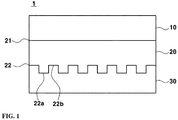
- FIG. 1 shows a cross-sectional view schematically showing an exemplary replica film 1 of an exemplary real material according to an exemplary embodiment of the present invention.
- the replica film 1 may include a base layer 10, a resin layer 20 provided on the base layer 10 and including a first surface 21 adjacent to the base layer 10 and a second surface 22 facing the first surface 21, and a printing layer 30 provided on the resin layer 20.
- the real material may be selected from the group consisting of real carbon, real wood, natural cork, real stone, thin-film metal, Korean traditional paper, and combinations thereof.
- the real material may be real carbon material. According to the present invention, it is possible to obtain a replica film in which the same surface pattern as the surface pattern of the real material is exposed to the outside.
- the base layer 10 may include a transparent material.
- the material for the base layer 10 may be selected from the group consisting of polycarbonate (PC), polymethyl methacrylate (PMMA), polyethylene terephthalate (PET) and combinations thereof, but is not limited thereto.
- the base layer 10 may have a thickness of about 0.3 mm to 0.5 mm. When the thickness is less than about 0.3 mm, the depth continuity of the replica film 1 may not be realized, and when the thickness is greater than about 0.5 mm, formability (moldability) may be deteriorated.
- the resin layer 20 may include a second surface 22 having the same surface pattern as the surface pattern of the real material.
- the surface pattern of the second surface 22 is shown as a structure of irregularities in FIG. 1 , the surface pattern is not limited thereto, and should be interpreted to be the same as the surface pattern of the selected real material as desired.
- the surface pattern of the second surface 22 may include a plurality of depressions 22a and a plurality of protrusions 22b. Each of the depressions 22a may be embedded to a depth of about 100 ⁇ m to 250 ⁇ m from the second surface 22.
- the criterion for measuring the depth of the depression 22a may be a flat surface of the protrusion 22b of the second surface 22.
- the depressions 22a and the protrusions 22b may repeatedly cross each other.
- the interval between a corresponding depression and protrusion may be regular or irregular.
- the depression 22a may be embedded at a right angle or at an approximately right angle relative to the protrusion 22b, as shown in FIG. 1 , or may be embedded to be inclined at a predetermined angle.
- the resin layer 20 may include a UV-curable resin composition so as to improve the break load and elongation of the resin layer 20 using a UV-curable resin composition having a specific composition and content.
- the replica film 1 may be formed to have a curvature radius of about 1 mm or greater, or a bendability of about 1 mm to 10 mm, and an elongation of about 200% or greater.
- a replica film 1 that can also be applied to vehicle parts having a complicated shape may be obtained.
- the printing layer 30 may be a component which is provided on the resin layer 20 to impart the overall color to the replica film 1 and protect the resin layer 20.
- the printing layer 30 may be formed by printing an ink selected from the group consisting of a urethane-containing ink, a polyvinyl-chloride-containing ink, and combinations thereof at a predetermined frequency on the resin layer 20, but is not limited thereto.
- the ink may be a one-liquid- or two-liquid-type ink.
- the curing agent may be an isocyanate-containing curing agent such as HDI, MDI, TDI or IPDI, and the content thereof may be an amount of about 10% to 20% by weight based on the total weight of the ink composition.
- the content of the curing agent is less than about 10% by weight, the physical properties of the print layer 30 may be deteriorated and the ink may wash out, and when the content is greater than about 20% by weight, printability may be deteriorated.
- the frequency is not particularly limited, but is preferably 4 or greater.
- ink may wash out when the replica film 1 is applied to automobile parts.
- UV-curable resin composition according to the present invention will be described in detail.
- the UV-curable resin composition may include a prepolymer (A) including a urethane-containing oligomer, an acrylate monomer (B) and a photoinitiator (C).
- A prepolymer including a urethane-containing oligomer, an acrylate monomer (B) and a photoinitiator (C).
- the prepolymer may include a polymer having a relatively low molecular weight that is obtained to have an intermediate polymerization degree so as to be easily molded when manufacturing a final molded article.
- the prepolymer can be molded without any treatment or after reacting with another polymerizable compound, and may be prepared by, for example, reacting with an isocyanate compound, a polyol, or the like.
- the urethane-containing oligomer may include an acrylate end group.
- the urethane-containing oligomer may include an aliphatic urethane acrylate having two or more functional groups.
- the urethane-containing oligomer may be a component for improving yellowing resistance, adhesion to a substrate and elongation.
- the urethane-containing oligomer may be obtained by reacting a polymer of isocyanate and polyol with a reactive monomer.
- the isocyanate may suitably include one or more selected from the group consisting of toluene diisocyanate (TDI), naphthalene-1,5-diisocyanate, p -phenylene diisocyanate, tolidine diisocyanate, 4,4'-diphenyl methane diisocyanate, 4,4'-methylene dicyclohexyl diisocyanate, 4,4'-methylene dicyclohexyl diisocyanate, hexamethylene diisocyanate, hexamethylene diisocyanate, dicyclohexylmethane diisocyanate, and isophorone diisocyanate.
- TDI toluene diisocyanate
- naphthalene-1,5-diisocyanate p -phenylene diisocyanate
- tolidine diisocyanate 4,4'-diphenyl methane diisocyanate
- the polyol is not particularly limited, and for example, may include one or more selected from the group consisting of polyether polyol, polyester polyol, polycarbonate polyol, and acryl polyol, and may include a polyester polyol.
- the reactive monomer may include crosslinkable monomer, and free radicals generated by a photoinitiator cause crosslink-polymerization of the double bonds in the reactive monomer, thereby performing curing.
- the reactive monomer may include one or more selected from the group consisting of 2-hydroxyethyl acrylate, 4-hydroxybutyl acrylate, 2-hydroxyethyl methacrylate, 2-hydroxypropyl acrylate and pentaerythritol triacrylate.
- the urethane-containing oligomer may have a weight average molecular weight of about 2,000 g/mol to 5,000 g/mol, or about 3,000 g/mol to 4,000 g/mol.
- the urethane-containing oligomer is, for example, obtained or obtainable by reacting a polymer of polyester polyol and 4,4'-methylene dicyclohexyl diisocyanate, as an isocyanate, with 2-hydroxyethyl acrylate, as a reactive monomer, and has a weight average molecular weight of about 3,000 g/mol.
- the content of the prepolymer may be about 20 to 50% by weight.
- the content of the prepolymer is less than about 20% by weight, elongation of the resin layer and adhesion to the substrate may be deteriorated, and when the content is greater than about 50% by weight, curability may be deficient, releasability may be deteriorated, and coating performance may be deteriorated due to the increased viscosity thereof.
- the acrylate monomer (B) may improve the physical properties of the resin layer and cause curing through crosslinking polymerization between double bonds in the acrylate monomer using free radicals generated by the photoinitiator.
- the acrylate monomer (B) may include one or more selected from the group consisting of isobornyl acrylate, 2-hydroxypropyl acrylate, and hydroxyl pivalic acid neopentyl glycol diacrylate.
- the acrylate monomer (B) may include appropriate amounts of isobornyl acrylate, 2-hydroxypropyl acrylate, and hydroxyl pivalic acid neopentyl glycol diacrylate.
- the acrylate monomer (B) may include an amount of about 15 to 30% by weight of the isobornyl acrylate, an amount of about 15 to 30% by weight of the 2-hydroxypropyl acrylate and an amount of about 1 to 10% by weight of the hydroxyl pivalic acid neopentyl glycol diacrylate, based on 100% by weight of the UV-curable resin composition.
- the pattern When the content of the 2-hydroxypropyl acrylate is less than about 15% by weight, the pattern may not be maintained due to poor bendability (flexibility), and the appearance may be deteriorated due to, for example, peeling.
- the photoinitiator (C) may absorb ultraviolet light and thus is photo-degraded to produce free radicals.
- the free radicals may crosslink-polymerize the double bonds of the prepolymer, the acrylate monomer and the like, thus causing curing.
- the photoinitiator (C) may include one or more selected from the group consisting of a short-wavelength photoinitiator and a long-wavelength photoinitiator, and preferably a combination of a short-wavelength photoinitiator and a long-wavelength photoinitiator.
- the short-wavelength photoinitiator may include 1-hydroxy cyclohexyl phenyl ketone or the like.
- the content of the short-wavelength photoinitiator may be an amount of about 1% by weight to 5% by weight based on the total weight of the UV-curable resin composition. When the content is less than about 1% by weight, the surface may not be cured, and when the content is greater than about 5% by weight, excessive curing may occur.
- the long-wavelength photoinitiator may include diphenyl(2,4,6-trimethylbenzoyl)phosphine oxide (TPO) or the like.
- TPO diphenyl(2,4,6-trimethylbenzoyl)phosphine oxide
- the content of the long-wavelength photoinitiator may be an amount of about 0.5% to 1% by weight based on the total weight of the UV-curable resin composition. When the content is less than about 0.5% by weight, curing may not be sufficient, and when the content is greater than about 1% by weight, the potential for yellowing is high.
- the UV-curable resin composition may further include an additive selected from the group consisting of ultraviolet stabilizers, heat stabilizers, dispersants, matting agents, antifoaming agents and combinations thereof.
- FIG. 2 shows a flowchart schematically illustrating an exemplary method of producing an exemplary replica film according to an exemplary embodiment of the present invention.
- the method of producing a replica film of a real material may include forming a resin layer including the UV-curable resin composition on a base layer(S10), forming a surface pattern on a second surface of the resin layer (S20), and forming a laminate including the resin layer (S30).
- the method of forming the surface pattern is not particularly limited and may be formed by, for example, imprinting or the like.
- the method may further emitting ultraviolet light to the resin layer after forming the surface pattern.
- the vacuum forming is a method of forming the film by pressing the heat-softened film using a mold or frame to realize a desired shape and vacuum-sucking the air between the film and the mold or frame.
- the method of vacuum forming is not particularly limited, and may be performed using an appropriate device.
- the forming the laminate by applying vacuum may be carried out by vacuum-molding the laminate by heating the surface temperature of the laminate to a temperature of about 130 to 150 °C.
- the laminate can secure a curvature radius of about 0.5 mm or greater or a bendability of about 0.5 mm to 10 mm, and an elongation of about 200% or greater.
- a UV-curable resin composition was prepared in accordance with the composition and content shown in Table 1 below, and was UV-imprinted to form a resin layer. For reference, the values in Table 1 are expressed in wt%.
- Table 1 Composition Comparative Example 1 Comparative Example 2 Comparative Example 3 Comparative Example 4
- Urethane-containing oligomer (A') 2 5 ⁇ 15 5 ⁇ 15 3 ⁇ 12 10 ⁇ 20 -
- Acrylate monomer Tetrahydrofurfuryl acrylate 18 ⁇ 28 17 ⁇ 27 19 ⁇ 29 15 ⁇ 25 - Isobornyl acrylate 14 ⁇ 24 13 ⁇ 23 14 ⁇ 26 12 ⁇ 22 15 ⁇ 30 2-Hydroxypropyl acrylate - - 1 ⁇ 14 - 15 ⁇ 30 Hydroxyl pivalic acid ne
- the weight average molecular weight thereof was about 3,000 g/mol. 2) A product obtained by reacting a polymer of 2,4,6-trioxotriazine-1,3,5-triyl)tris(hexamethylene) isocyanate and polyester polyol with pentaerythritol triacrylate was used. The weight average molecular weight thereof was about 2,000 g/mol. 3) An acrylic acrylate having a weight average molecular weight of about 50,000 g/mol was used. 4) 1-hydroxy cyclohexyl phenyl ketone 5) Diphenyl(2,4,6-trimethylbenzoyl)phosphine oxide 6) Irganox ® 1010 7) TINUVIN ® 292
- the vacuum formability was evaluated by visually observing whether or not a replica film having a desired shape (an outer radius of curvature of 2.5 mm and an inner radius of curvature of 1 mm, and elongation in a depth direction of about 210%) was produced after forming the resin layer on a base layer (PC/PMMA) to which an imprinting resin is applied, heating the resin layer at a heater temperature of 320 °C and a distance of 80 mm for about 30 seconds, and then applying a vacuum thereto.
- a replica film having a desired shape an outer radius of curvature of 2.5 mm and an inner radius of curvature of 1 mm, and elongation in a depth direction of about 2106%
- Elongation and breaking load were measured in accordance with ASTM D 882, and specifically, the elongation and breaking of a specimen having a size of 15 mm X 125 mm were evaluated at a rate of 200 mm/min at a temperature of 130 °C.
- the viscosity was measured under the conditions of 60 RPM and at a temperature of 25 °C for 30 seconds using a Viscometer, and a viscosity of 300 cps or less was considered excellent (O).
- the releasability was measured on a specimen having a size of 25.4 mm X 200 mm at a peel strength of 900 mm/min and a measurement section of 150 mm using a peel strength tester, and the case wherein no residue was observed with the naked eye was marked as excellent (O).
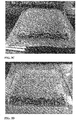
- FIGS. 3A to 3E The results of evaluation of the vacuum formability of Examples and Comparative Examples 1 to 4 are shown in FIGS. 3A to 3E , and the results of measurement of elongation, breaking load, releasability and viscosity are shown in Table 2 below.
- Table 2 Item Comparative Example 1 Comparative Example 2 Comparative Example 3 Comparative Example 4
- FIG. 3A shows a result of evaluation of the vacuum formability of the replica film according to the Example of the present invention.
- the pattern was properly maintained without being crushed or damaged in the curved part having a curvature radius of 2.5 mm (outer diameter) and 1 mm (inner diameter).
- FIGS. 3B , 3C , 3D , and 3E which show the results of Comparative Example 1, Comparative Example 2, Comparative Example 3 and Comparative Example 4, the pattern in the curved part was distorted and broken.
- the resin layer of Example above had excellent moldability due to high elongation of 200% or greater and high viscosity, whereas Comparative Examples 1 to 4 had low elongation and viscosity.
- a replica film may substantially or accurately replicate a real material and thereby realize the unique characteristics thereof. Further provided is a replica film that is applicable to automobile parts having a complicated shape rather than a flat surface, owing to the excellent moldability thereof.
- replica film that can be produced at a cost of about 1/10 of a real material while having the same level of appearance thereof, thus conveying excellent price competitiveness.
Landscapes
- Chemical & Material Sciences (AREA)
- Health & Medical Sciences (AREA)
- Organic Chemistry (AREA)
- Chemical Kinetics & Catalysis (AREA)
- Medicinal Chemistry (AREA)
- Polymers & Plastics (AREA)
- Engineering & Computer Science (AREA)
- Mechanical Engineering (AREA)
- Composite Materials (AREA)
- Manufacturing & Machinery (AREA)
- Physics & Mathematics (AREA)
- Materials Engineering (AREA)
- Electromagnetism (AREA)
- Toxicology (AREA)
- Oral & Maxillofacial Surgery (AREA)
- Thermal Sciences (AREA)
- Laminated Bodies (AREA)
- Macromonomer-Based Addition Polymer (AREA)
Applications Claiming Priority (1)
| Application Number | Priority Date | Filing Date | Title |
|---|---|---|---|
| KR1020200070007A KR102881938B1 (ko) | 2020-06-10 | 2020-06-10 | 열포밍이 가능한 uv 경화형 수지 조성물 및 이를 포함하는 리얼 소재의 모사 필름 |
Publications (1)
| Publication Number | Publication Date |
|---|---|
| EP3922657A1 true EP3922657A1 (fr) | 2021-12-15 |
Family
ID=73646105
Family Applications (1)
| Application Number | Title | Priority Date | Filing Date |
|---|---|---|---|
| EP20210520.1A Pending EP3922657A1 (fr) | 2020-06-10 | 2020-11-30 | Composition de resine durcissable aux uv pour le moulage sous vide et film replique de materiau reel comprenant cette composition |
Country Status (4)
| Country | Link |
|---|---|
| US (1) | US11680129B2 (fr) |
| EP (1) | EP3922657A1 (fr) |
| KR (1) | KR102881938B1 (fr) |
| CN (1) | CN113773446B (fr) |
Families Citing this family (1)
| Publication number | Priority date | Publication date | Assignee | Title |
|---|---|---|---|---|
| KR20250022290A (ko) * | 2023-08-07 | 2025-02-17 | 현대자동차주식회사 | 리얼소재를 이용한 차량용 내장품 제조 방법 |
Citations (4)
| Publication number | Priority date | Publication date | Assignee | Title |
|---|---|---|---|---|
| US20040152799A1 (en) * | 2003-01-31 | 2004-08-05 | Miller Christopher Wayne | Flexible radiation curable compositions |
| US20090197000A1 (en) * | 2006-06-14 | 2009-08-06 | Huntsman International Llc | Cross-linkable thermoplastic polyurethanes |
| US20120129972A1 (en) * | 2009-04-27 | 2012-05-24 | Sun Chemical B.V. | High elongation thermoforming ink-jet ink |
| WO2019234560A1 (fr) * | 2018-06-04 | 2019-12-12 | 3M Innovative Properties Company | Film optique multicouche résistant à l'abrasion thermoformé et son procédé de fabrication |
Family Cites Families (9)
| Publication number | Priority date | Publication date | Assignee | Title |
|---|---|---|---|---|
| JPH0689293B2 (ja) * | 1986-05-27 | 1994-11-09 | 日本油脂株式会社 | 紫外線硬化型塗料 |
| US6399193B1 (en) * | 1998-12-18 | 2002-06-04 | The University Of Massachusetts Lowell | Surfacing laminate with bonded with pigmented pressure sensitive adhesive |
| DE102005044784A1 (de) * | 2004-12-27 | 2006-07-13 | Daimlerchrysler Ag | Verfahren zur Aushärtung einer Zusammensetzung |
| CN102026795B (zh) * | 2008-05-13 | 2013-08-07 | 三菱瓦斯化学株式会社 | 可弯曲加工的聚碳酸酯树脂层压体和透光型电磁波屏蔽层压体以及它们的制造方法 |
| JP4755269B2 (ja) | 2009-05-08 | 2011-08-24 | セーレン株式会社 | 紫外線硬化型インクを用いた布帛のインクジェット記録方法および記録装置 |
| KR101557539B1 (ko) | 2012-12-26 | 2015-10-06 | (주)엘지하우시스 | 금속 외관 효과를 구현한 인테리어 필름 및 그 제조방법 |
| KR101501499B1 (ko) | 2014-04-07 | 2015-03-12 | 윤학중 | 자외선 경화 수지 조성물 |
| KR101786360B1 (ko) | 2016-06-22 | 2017-10-17 | 현대자동차주식회사 | 저온 엠보싱 공정을 이용한 천연소재의 질감 및 패턴 복제방법 |
| KR20180132374A (ko) | 2017-06-02 | 2018-12-12 | 주식회사 케이씨씨 | 데코 시트 |
-
2020
- 2020-06-10 KR KR1020200070007A patent/KR102881938B1/ko active Active
- 2020-11-30 US US17/107,870 patent/US11680129B2/en active Active
- 2020-11-30 EP EP20210520.1A patent/EP3922657A1/fr active Pending
- 2020-12-01 CN CN202011389721.8A patent/CN113773446B/zh active Active
Patent Citations (4)
| Publication number | Priority date | Publication date | Assignee | Title |
|---|---|---|---|---|
| US20040152799A1 (en) * | 2003-01-31 | 2004-08-05 | Miller Christopher Wayne | Flexible radiation curable compositions |
| US20090197000A1 (en) * | 2006-06-14 | 2009-08-06 | Huntsman International Llc | Cross-linkable thermoplastic polyurethanes |
| US20120129972A1 (en) * | 2009-04-27 | 2012-05-24 | Sun Chemical B.V. | High elongation thermoforming ink-jet ink |
| WO2019234560A1 (fr) * | 2018-06-04 | 2019-12-12 | 3M Innovative Properties Company | Film optique multicouche résistant à l'abrasion thermoformé et son procédé de fabrication |
Also Published As
| Publication number | Publication date |
|---|---|
| CN113773446A (zh) | 2021-12-10 |
| KR20210153213A (ko) | 2021-12-17 |
| CN113773446B (zh) | 2024-01-05 |
| US20210388146A1 (en) | 2021-12-16 |
| KR102881938B1 (ko) | 2025-11-05 |
| US11680129B2 (en) | 2023-06-20 |
Similar Documents
| Publication | Publication Date | Title |
|---|---|---|
| KR101887722B1 (ko) | 장식 시트 및 이것을 사용한 장식 수지 성형품 | |
| KR101241575B1 (ko) | 하드코팅액 조성물 및 하드 코팅 필름 | |
| KR102692142B1 (ko) | 방사선 경화성 조성물 | |
| KR102217423B1 (ko) | 장식 필름 | |
| WO2012101820A1 (fr) | Feuille décorative et article décoratif moulé en résine l'employant | |
| KR102362477B1 (ko) | 장식 시트 및 장식 수지 성형품 | |
| JP5476903B2 (ja) | 加飾シート及びそれを用いてなる加飾樹脂成形品 | |
| JP5228448B2 (ja) | 加飾シート、加飾樹脂成形品の製造方法及び加飾樹脂成形品 | |
| KR102817463B1 (ko) | 열포밍이 가능한 uv 경화형 수지 조성물 및 이를 포함하는 리얼 소재의 모사 필름 | |
| KR20140094457A (ko) | 사출성형용 장식 시트, 사출성형용 시트 적층체 및 사출성형품 | |
| US11680129B2 (en) | UV-curable resin composition for vacuum forming and replica film of real material comprising the same | |
| JP5962814B2 (ja) | 加飾シート及びこれを用いた加飾樹脂成形品 | |
| JP2011073380A (ja) | 加飾シート及びそれを用いてなる加飾樹脂成形品 | |
| JP6039885B2 (ja) | 加飾シート及びそれを用いてなる加飾樹脂成形品 | |
| JP6020642B2 (ja) | 加飾シート及びそれを用いてなる加飾樹脂成形品 | |
| KR102727192B1 (ko) | 열 프레스 성형용 데코레이션 필름 및 이를 이용하여 제조된 성형 제품 | |
| CN120091913A (zh) | 热成型用叠层体、使用该叠层体的成型体以及成型体的制造方法 | |
| JP5733439B2 (ja) | 加飾シート及びそれを用いてなる加飾樹脂成形品 | |
| JP6822280B2 (ja) | 加飾シート及び加飾樹脂成形品 | |
| JP5736923B2 (ja) | 加飾シート及びそれを用いてなる加飾樹脂成形品 | |
| WO2018159684A1 (fr) | Film de transfert de moulage tridimensionnel et son procédé de fabrication, et procédé de fabrication d'un article moulé en résine | |
| JP5310896B2 (ja) | 加飾シート、加飾樹脂成形品の製造方法及び加飾樹脂成形品 | |
| KR20180024672A (ko) | 하드코팅용 조성물, 이를 이용한 데코시트 및 데코시트의 제조방법 | |
| JP2018140633A (ja) | 三次元成形用転写フィルム、その製造方法、及び樹脂成形品の製造方法 | |
| KR20260005252A (ko) | 광경화성 수지 조성물, 성형용 하드코팅 필름, 성형용 필름, 인서트 성형품, 아웃몰드 성형품, 인서트 성형품의 제조 방법 및 아웃몰드 성형품의 제조 방법 |
Legal Events
| Date | Code | Title | Description |
|---|---|---|---|
| PUAI | Public reference made under article 153(3) epc to a published international application that has entered the european phase |
Free format text: ORIGINAL CODE: 0009012 |
|
| STAA | Information on the status of an ep patent application or granted ep patent |
Free format text: STATUS: THE APPLICATION HAS BEEN PUBLISHED |
|
| AK | Designated contracting states |
Kind code of ref document: A1 Designated state(s): AL AT BE BG CH CY CZ DE DK EE ES FI FR GB GR HR HU IE IS IT LI LT LU LV MC MK MT NL NO PL PT RO RS SE SI SK SM TR |
|
| B565 | Issuance of search results under rule 164(2) epc |
Effective date: 20210525 |
|
| STAA | Information on the status of an ep patent application or granted ep patent |
Free format text: STATUS: REQUEST FOR EXAMINATION WAS MADE |
|
| 17P | Request for examination filed |
Effective date: 20220614 |
|
| RBV | Designated contracting states (corrected) |
Designated state(s): AL AT BE BG CH CY CZ DE DK EE ES FI FR GB GR HR HU IE IS IT LI LT LU LV MC MK MT NL NO PL PT RO RS SE SI SK SM TR |
|
| P01 | Opt-out of the competence of the unified patent court (upc) registered |
Effective date: 20230511 |
|
| STAA | Information on the status of an ep patent application or granted ep patent |
Free format text: STATUS: EXAMINATION IS IN PROGRESS |
|
| 17Q | First examination report despatched |
Effective date: 20230720 |
|
| RAP3 | Party data changed (applicant data changed or rights of an application transferred) |
Owner name: HYUNDAI MOTOR COMPANY Owner name: KIA CORPORATION Owner name: MICROWORKS SOLUTIONS CO., LTD. |