EP3923146B1 - Kommunikationssystem, informationsbereitstellungsvorrichtung, programm und informationsbereitstellungsverfahren - Google Patents
Kommunikationssystem, informationsbereitstellungsvorrichtung, programm und informationsbereitstellungsverfahren Download PDFInfo
- Publication number
- EP3923146B1 EP3923146B1 EP19922905.5A EP19922905A EP3923146B1 EP 3923146 B1 EP3923146 B1 EP 3923146B1 EP 19922905 A EP19922905 A EP 19922905A EP 3923146 B1 EP3923146 B1 EP 3923146B1
- Authority
- EP
- European Patent Office
- Prior art keywords
- information
- section
- session
- relay
- virus
- Prior art date
- Legal status (The legal status is an assumption and is not a legal conclusion. Google has not performed a legal analysis and makes no representation as to the accuracy of the status listed.)
- Active
Links
Images



Classifications
-
- H—ELECTRICITY
- H04—ELECTRIC COMMUNICATION TECHNIQUE
- H04W—WIRELESS COMMUNICATION NETWORKS
- H04W12/00—Security arrangements; Authentication; Protecting privacy or anonymity
- H04W12/12—Detection or prevention of fraud
- H04W12/128—Anti-malware arrangements, e.g. protection against SMS fraud or mobile malware
-
- H—ELECTRICITY
- H04—ELECTRIC COMMUNICATION TECHNIQUE
- H04L—TRANSMISSION OF DIGITAL INFORMATION, e.g. TELEGRAPHIC COMMUNICATION
- H04L12/00—Data switching networks
- H04L12/66—Arrangements for connecting between networks having differing types of switching systems, e.g. gateways
-
- H—ELECTRICITY
- H04—ELECTRIC COMMUNICATION TECHNIQUE
- H04L—TRANSMISSION OF DIGITAL INFORMATION, e.g. TELEGRAPHIC COMMUNICATION
- H04L63/00—Network architectures or network communication protocols for network security
- H04L63/02—Network architectures or network communication protocols for network security for separating internal from external traffic, e.g. firewalls
- H04L63/0281—Proxies
-
- H—ELECTRICITY
- H04—ELECTRIC COMMUNICATION TECHNIQUE
- H04L—TRANSMISSION OF DIGITAL INFORMATION, e.g. TELEGRAPHIC COMMUNICATION
- H04L63/00—Network architectures or network communication protocols for network security
- H04L63/08—Network architectures or network communication protocols for network security for authentication of entities
- H04L63/0884—Network architectures or network communication protocols for network security for authentication of entities by delegation of authentication, e.g. a proxy authenticates an entity to be authenticated on behalf of this entity vis-à-vis an authentication entity
-
- H—ELECTRICITY
- H04—ELECTRIC COMMUNICATION TECHNIQUE
- H04W—WIRELESS COMMUNICATION NETWORKS
- H04W12/00—Security arrangements; Authentication; Protecting privacy or anonymity
- H04W12/06—Authentication
-
- H—ELECTRICITY
- H04—ELECTRIC COMMUNICATION TECHNIQUE
- H04W—WIRELESS COMMUNICATION NETWORKS
- H04W12/00—Security arrangements; Authentication; Protecting privacy or anonymity
- H04W12/60—Context-dependent security
- H04W12/69—Identity-dependent
-
- H—ELECTRICITY
- H04—ELECTRIC COMMUNICATION TECHNIQUE
- H04W—WIRELESS COMMUNICATION NETWORKS
- H04W76/00—Connection management
- H04W76/10—Connection setup
-
- H—ELECTRICITY
- H04—ELECTRIC COMMUNICATION TECHNIQUE
- H04W—WIRELESS COMMUNICATION NETWORKS
- H04W80/00—Wireless network protocols or protocol adaptations to wireless operation
- H04W80/06—Transport layer protocols, e.g. TCP [Transport Control Protocol] over wireless
-
- H—ELECTRICITY
- H04—ELECTRIC COMMUNICATION TECHNIQUE
- H04L—TRANSMISSION OF DIGITAL INFORMATION, e.g. TELEGRAPHIC COMMUNICATION
- H04L63/00—Network architectures or network communication protocols for network security
- H04L63/08—Network architectures or network communication protocols for network security for authentication of entities
- H04L63/083—Network architectures or network communication protocols for network security for authentication of entities using passwords
-
- H—ELECTRICITY
- H04—ELECTRIC COMMUNICATION TECHNIQUE
- H04L—TRANSMISSION OF DIGITAL INFORMATION, e.g. TELEGRAPHIC COMMUNICATION
- H04L63/00—Network architectures or network communication protocols for network security
- H04L63/14—Network architectures or network communication protocols for network security for detecting or protecting against malicious traffic
- H04L63/1441—Countermeasures against malicious traffic
- H04L63/145—Countermeasures against malicious traffic the attack involving the propagation of malware through the network, e.g. viruses, trojans or worms
-
- H—ELECTRICITY
- H04—ELECTRIC COMMUNICATION TECHNIQUE
- H04L—TRANSMISSION OF DIGITAL INFORMATION, e.g. TELEGRAPHIC COMMUNICATION
- H04L67/00—Network arrangements or protocols for supporting network services or applications
- H04L67/01—Protocols
- H04L67/02—Protocols based on web technology, e.g. hypertext transfer protocol [HTTP]
Definitions
- the present invention relates to a communication system, an information providing device, a program, and an information providing method.
- a communication system which performs control so that data in a closed network can be viewed from a communication terminal located in an open network (see, for example, Japanese Patent Publication No. 4551218 ).
- US 2018/124050 A1 describes a communication system, the communication system including: an authenticating unit that authenticates a plurality of communication terminals based on a single user ID, and keeps the plurality of communication terminals logged into an information providing service; a storing unit that stores therein provider registration information including a plurality of pieces of provider information that indicate providers of respective pieces of data being displayed on each communication terminal among the plurality of communication terminals; a receiving unit that receives designation information that designates the provider registration information; and a transmitting unit that transmits each piece among the plurality of pieces of provider information to each communication terminal among the plurality of communication terminals so as to cause each communication terminal among the plurality of communication terminals to display data provided by a provider indicated by a plurality of pieces of provider information.
- a communication system comprises: a relay apparatus that is connected to an external network and that functions as an http server; and a relay apparatus that is connected to a LAN and to the relay apparatus and that periodically transmits an http request to the relay apparatus.
- the relay apparatus when having received a request from a terminal, puts the request into an http response responsive to the http request from the relay apparatus and transmits, to the relay apparatus, the http response including the request.
- the relay apparatus transmits the request, which is included in the transmitted http response, to the LAN.
- the relay apparatus creates an http request including the response data and transmits the created http request to the relay apparatus.
- a relay positioned in an open network receives user identifying information as a request for connecting to an information providing apparatus positioned in a closed network from an external terminal.
- the information providing apparatus sends a confirmation request for confirming whether or not a connection request from the external terminal exists to the relay regularly.
- the relay outputs the stored user identifying information to the information providing apparatus.
- the information providing apparatus receives the user identifying information from the relay and determines whether or not a connection to the external terminal can be allowed on the basis of the user identifying information.
- a session control method which includes storing control information in which a first connection established on a first apparatus side in relation to a relay process is associated with a second connection established on a second apparatus side in relation to the relay process; terminating, when a close instruction message at a communication layer higher than the first and second connections is issued from the first apparatus to the second apparatus, the close instruction message on the relay process and updating the control information; and enabling, when a switchover notice indicating a switch from the first apparatus to a third apparatus is given and the control information indicates the issuance of the close instruction message, a third connection established on the third apparatus side in relation to the relay process and updating the control information in such a manner that the second connection is associated with the third connection.
- US 2010/211626 A1 describes a hypertext transfer protocol (HTTP) connection between a client terminal and a server includes a client-side connection and a server-side connection.
- HTTP hypertext transfer protocol
- Different techniques are used to extend the persistence of the HTTP connection. These techniques include keeping the server-side connection persistent if the client terminal sends a RESET to the server, keeping the server-side connection persistent but closing the client-side connection if the client terminal sends a RESET or a FIN packet to the server, rewriting a "Connection: Close” header in a request to a "Connection: Keep-Alive,” inserting a "Connection: Keep-Alive” in a header of a request, modifying a "Connection: Close” header in a request, and changing the HTTP version value in a request.
- HTTP hypertext transfer protocol
- US 2003/162575 A1 describes a cellular phone with a data transmitter, a detection result receiver, and a virus management information storage.
- the data transmitter transmits data to a virus detecting apparatus.
- the detection result receiver receives as virus management information a result of detection on whether the data transmitted by the data transmitter includes a computer virus.
- the virus management information storage stores the data and the virus management information about the data in association with each other.
- a communication system which includes an information providing device arranged in a first network and a relay arranged in a second network.
- the relay includes a connection request receiving section configured to receive a connection request to the information providing device transmitted by a communication terminal arranged in the second network.
- the relay includes a connection request storage section configured to store the connection request received by the connection request receiving section.
- the information providing device includes an association storage section configured to store session identification information about a session between the communication terminal and the information providing device and user identification information about a user of the communication terminal in association with each other.
- the information providing device includes a confirmation request transmitting section configured to transmit, to the relay, a confirmation request for confirming whether the connection request storage section has stored the connection request to the information providing device transmitted by the communication terminal arranged in the second network.
- the information providing device includes an information receiving section configured to receive, from the relay, information included in the connection request.
- the information providing device includes a terminal authentication section configured to determine whether authentication of the communication terminal is permitted based on the user identification information included in the connection request if the session identification information stored in the association storage section is not included in the information received by the information receiving section.
- the information providing device includes a session identification information assigning section configured to assign session identification information for identifying a session between the information providing device and the communication terminal if the terminal authentication section determines that the authentication is permitted, causing the session identification information to be stored in the association storage section in association with the user identification information about the user of the communication terminal.
- the information providing device includes a session identification information transmitting section configured to transmit the session identification information to the relay.
- the information providing device includes an information providing section configured to provide information to the communication terminal in response to the information received by the information receiving section if the session identification information stored in the association storage section is included in the information received by the information receiving section.
- the confirmation request transmitting section may establish a session with the relay and transmit the confirmation request to the relay via the session, and the information receiving section may disconnect the session in response to reception of information included in the connection request from the relay.
- the confirmation request transmitting section may establish the session by establishing TCP connection with the relay, and the information receiving section may disconnect the session by disconnecting the TCP connection through transmission of an HTTP header to the relay, the HTTP header specifying closing of the TCP connection.
- a firewall having a session timeout function may be arranged between the first network and the second network. The session timeout function serves to disconnect the session in response to elapse of a predetermined time after the session is established between a device in the first network and a device in the second network.
- the association storage section may delete the session identification information if the information receiving section does not receive the session identification information before an elapsed time after the session identification information transmitting section transmits the session identification information becomes longer than a predetermined time.
- the association storage section may delete the session identification information if the information receiving section does not receive the session identification information before an elapsed time after the information receiving section receives the session identification information becomes longer than a predetermined time.
- the relay includes: a confirmation request receiving section configured to receive the confirmation request; a connection request confirmation section configured to confirm whether the connection request is stored in the connection request storage section in response to the confirmation request being received by the confirmation request receiving section; and an information transmitting section configured to transmit information included in the connection request to the information providing device if the connection request confirmation section confirms that the connection request is stored in the connection request storage section.
- connection request receiving section be configured to receive a plurality of connection requests, each being identical to the connection request, transmitted by a plurality of communication terminals in the second network
- the connection request storage section may be configured to store each of the plurality of connection requests in association with terminal identification information about each of the plurality of communication terminals
- the information transmitting section may be configured to transmit, to the information providing device, information included in each of the plurality of connection requests if the connection request storage section has the plurality of connection requests stored when the confirmation request receiving section receives the confirmation request.
- the information transmitting section may transmit the user identification information to the information providing device if the user identification information is included in the connection request stored in the connection request storage section when the confirmation request receiving section receives the confirmation request.
- the information transmitting section transmits, to the information providing device, the session identification information and the data specification information specifying data in the first network if the session identification information and the data specification information are included in the connection request stored in the connection request storage section when the confirmation request receiving section receives the confirmation request.
- the information receiving section receives the session identification information and the data specification information.
- the information providing section transmits the data specified by the data specification information to the relay.
- the information providing device includes a transmission permission determining section configured to determine whether transmission of the data specified by the data specification information is permitted, based on the session identification information received by the information receiving section, and the information providing section may transmit data identified by the data specification information to the relay if the transmission permission determining section determines that the transmission is permitted.
- the information providing device includes a first anti-virus section configured to execute a virus determination process for determining whether the data specified by the data specification information is infected with a virus, to execute a virus handling process on the data if the data is determined to be infected, the information providing section may be configured to transmit, to the relay, the data on which the virus handling process has been executed by the first anti-virus section, if the data specified by the data specification information is infected with a virus, and the relay may include a second anti-virus section configured to execute a virus determination process for determining whether data received from the information providing section is infected with a virus, and to execute a virus handling process on the data if the data is determined to be infected.
- a determination level of the virus determination process executed by the first anti-virus section is lower than a determination level of the virus determination process executed by the second anti-virus section.
- An association level of the virus handling process executed by the first anti-virus section may be lower than an association level of the virus handling process executed by the second anti-virus section.
- the first network is a closed network
- the second network is an open network.
- an information providing device arranged in a first network includes an association storage section configured to store session identification information about a session between a communication terminal and the information providing device and user identification information about a user of the communication terminal in association with each other.
- the information providing device includes a confirmation request transmitting section configured to transmit, to a relay arranged in a second network, a confirmation request for confirming whether the relay has stored a connection request to the information providing device transmitted by a communication terminal arranged in the second network.
- the information providing device includes an information receiving section configured to receive information included in the connection request.
- the information providing device includes a terminal authentication section configured to determine whether authentication of the communication terminal is permitted, based on user identification information included in the connection request if the session identification information stored in the association storage section is not included in the information received by the information receiving section.
- the information providing device includes a session identification information assigning section configured to assign session identification information for identifying a session between the information providing device and the communication terminal if the terminal authentication section determines that the authentication is permitted, causing the session identification information to be stored in the association storage section, in association with user identification information about a user of the communication terminal.
- the information providing device includes a session identification information transmitting section configured to transmit the session identification information to the relay.
- the information providing device includes an information providing section configured to provide information to the communication terminal in response to information received by the information receiving section if the session identification information stored in the association storage section is included in the information received by the information receiving section.
- the confirmation request transmitting section may be configured to establish a session with the relay and to transmit the confirmation request to the relay via the session, and the information receiving section may be configured to disconnect the session in response to reception of information included in the connection request from the relay.
- a program that causes a computer to function as the information providing device is provided.
- an information providing method to be executed by an information providing device arranged in a first network includes transmitting, to a relay arranged in a second network, a confirmation request for confirming whether the relay has stored a connection request to the information providing device transmitted by a communication terminal arranged in the second network.
- the information providing method includes receiving information included in the connection request.
- the information providing method includes determining whether authentication of the communication terminal is permitted based on user identification information included in the connection request if session identification information about a session between the communication terminal and the information providing device stored in an association storage section is not included in the information received in the information receiving step, the association storage section being configured to store the session identification information and the user identification information about a user of the communication terminal in association with each other.
- the information providing method includes assigning the session identification information for identifying the session between the information providing device and the communication terminal if the authentication is determined to be permitted in the terminal authentication step, causing the session identification information to be stored in the association storage section, in association with the user identification information about the user of the communication terminal.
- the information providing method includes transmitting the session identification information to the relay.
- the information providing method includes providing information to the communication terminal in response to the information received in the information receiving step if the session identification information stored in the association storage section is included in the information received in the information receiving step.
- FIG. 1 schematically shows an example of a communication system 10.
- the communication system 10 includes an information providing device 200 and a relay 300.
- the information providing device 200 is arranged in a network 20, which is a closed network.
- the information providing device 200 provides information in the closed network to a communication terminal 400 arranged in a network 30, which is an open network.
- the network 20 may be an example of a first network.
- the network 30 may be an example of a second network.
- the network 20 is, for example, an in-factory network or an in-house network where access from an open network is restricted.
- the network 30 includes, for example, the Internet.
- the communication terminal 400 is, for example, a mobile phone, such as a smartphone, a tablet terminal, a Personal Computer (PC) and the like.
- the communication system 10 of the present embodiment provides a technology that appropriately provides data in the network 20 connected to the network 30 via a router 40 with a firewall function, to the communication terminal 400 arranged in the network 30.
- the router 40 may be set to allow a connection request from the network 20 to the network 30 to pass through the router 40, but not to allow a connection request from the network 30 to the network 20 to pass through the router 40.
- the router 40 may be set such that it allows the connection request from the network 20 to the network 30 to pass through the router 40, while it does not allow a connection request transmitted from the network 30 side toward the network 20 side to pass through the router 40 in a flow initiated on the network 30 side, but allows a connection request transmitted from the network 30 side toward the network 20 side to pass through the router 40 in a flow initiated on the network 20 side.
- the communication terminal 400 transmits, to the relay 300, a connection request to the information providing device 200, for example, when it logs into an information providing service 201 provided by the information providing device 200.
- the connection request may include user identification information (sometimes referred to as a user ID) of a user who uses the communication terminal 400.
- the connection request may include a password.
- the connection request may include communication terminal identification information (sometimes referred to as a communication terminal ID) for identifying the communication terminal 400.
- the connection request may include information providing device identification information (sometimes referred to as an information providing device ID) for identifying the information providing device 200.
- a relay 300 stores the received connection request.
- the information providing device 200 transmits, to the relay 300, a confirmation request for confirming whether the relay 300 has stored the connection request to the information providing device 200, transmitted by the communication terminal 400.
- the confirmation request may include the information providing device ID of the information providing device 200.
- the information providing device 200 establishes a session with the relay 300 and transmits the confirmation request to the relay 300 via the session.
- the information providing device 200 establishes, for example, a Hyper Text Transfer Protocol (HTTP) session with the relay 300.
- HTTP Hyper Text Transfer Protocol
- the information providing device 200 may establish a session by establishing a Transmission Control Protocol (TCP) connection with the relay 300.
- TCP Transmission Control Protocol
- the information providing device 200 may intermittently execute transmission of the confirmation request to the relay 300.
- the information providing device 200 may execute transmission of the confirmation request to the relay 300 on a regular basis.
- the information providing device 200 executes transmission of the confirmation request to the relay 300, for example, every second.
- the relay 300 receives the confirmation request, it confirms whether it has stored therein a connection request to the information providing device 200 that has transmitted the confirmation request.
- the relay 300 may confirm whether it has stored therein the connection request including the information providing device ID by referring to the information providing device ID included in the confirmation request. As long as the relay 300 can recognize the information providing device 200 that has transmitted the confirmation request even when the information providing device ID is not included in the confirmation request, the confirmation request does not need to include the information providing device ID.
- the relay 300 transmits the information included in the connection request to the information providing device 200.
- the relay 300 may transmit a user ID included in the connection request, to the information providing device 200.
- the relay 300 may transmit a password included in the connection request, to the information providing device 200.
- the relay 300 may transmit a communication terminal ID included in the connection request, to the information providing device 200.
- the relay 300 may transmit a response indicating that it does not have the connection request stored therein, to the information providing device 200.
- the information providing device 200 may disconnect the HTTP session with the relay 300.
- the relay 300 does not need to respond to the information providing device 200 in a case where it does not have the connection request to the information providing device 200 stored therein.
- the information providing device 200 may disconnect the HTTP session with the relay 300 if it did not receive the information included in the connection request from the relay 300 until a predetermined time has elapsed after transmitting the confirmation request.
- the relay 300 receives and stores the connection request transmitted by the communication terminal 400, and then transmits the information included in the connection request to the information providing device 200 in response to the confirmation request transmitted by the information providing device 200, so that the router 40 can cause the information providing device 200 to acquire the information included in the connection request even when the router 40 is set such that it does not allow the connection request from the network 30 to the network 20 to pass through the router 40.
- the relay 300 may transmit the connection request or the information included in the connection request, to the information providing device 200 in the flow initiated by transmission of the confirmation request by the information providing device 200.
- the information providing device 200 determines whether authentication of the communication terminal 400 is permitted based on the received user ID.
- the information providing device 200 refers to registration information including the user IDs which have already been registered in the information providing service 201, for example, and determines that authentication is permitted if one of the user IDs in the registration information matches with the received user ID.
- the information providing device 200 refers to the registration information including the user IDs which have already been registered in the information providing service 201 and passwords corresponding to the user IDs, and determines that authentication is permitted if one of the user IDs and its password in the registration information match with the received user ID and password, respectively.
- the information providing device 200 assigns session identification information (sometimes referred to as a session ID) for identifying the session between the information providing device 200 and the communication terminal 400, causing the user ID of the user of the communication terminal 400 and the session ID to be stored in an association storage section, in association with each other. Subsequently, the information providing device 200 transmits the session ID to the communication terminal 400 via the relay 300.
- the information providing device 200 may transmit information indicative of data that can be provided to the communication terminal 400, together with the session ID. For example, the information providing device 200 transmits, to the communication terminal 400, information indicative of the data, among the data in the network 20, that can be provided to the communication terminal 400. After transmitting the session ID, the information providing device 200 may disconnect the HTTP session with the relay 300.
- the user of the communication terminal 400 specifies, for example, data they desire to be provided with, at the communication terminal 400.
- the data may be any data that can be provided by the information providing device 200.
- this data is data in the network 20. Examples of the data include, but are not limited to, log data, backup data, file data, email data, Web data, and the like.
- the communication terminal 400 may include a user interface that receives the specification of data and may receive the specification of data via the user interface.
- the communication terminal 400 may present the user with information indicative of data received from the information providing device 200 which can be provided to the communication terminal 400, and it may receive the user's specification for the information.
- the communication terminal 400 When the communication terminal 400 receives the specification of data, the communication terminal 400 transmits a connection request including data specification information specifying the data and the session ID to the relay 300.
- the connection request may include the information providing device ID for identifying the information providing device 200.
- the relay 300 stores the received connection request.
- the relay 300 receives the confirmation request from the information providing device 200, the relay 300 transmits information included in the connection request to the information providing device 200 if the relay 300 has the connection request stored therein.
- the relay 300 may transmit the data specification information and the session ID to the information providing device 200.
- the information providing device 200 may determine whether transmission of the data specified by the data specification information is permitted, based on the received session ID. The information providing device 200 determines whether the received session ID matches with any of the plurality of session IDs stored in the association storage section.
- the information providing device 200 determines that the transmission is not permitted. If the received session ID matches with any of the stored sessions IDs, the information providing device 200 confirms, by means of the user ID stored in association with the matched session ID, an access authority of the user identified by the user ID to the data specified by the data specification information. If the user is confirmed to have the access authority, the information providing device 200 determines that the transmission is permitted. If the user is confirmed not to have the access authority, the information providing device 200 determines that the transmission is not permitted.
- the information providing device 200 may acquire the data specified by the data specification information and transmit it to the relay 300.
- the information providing device 200 receives, from the processing device 22, the data specified by the data specification information and managed by the processing device 22 in the network 20, for example, and transmits the data or transmission data generated from the data to the relay 300.
- the information providing device 200 transmits the log data or list data generated from a plurality of pieces of log data, to the relay 300.
- the relay 300 transmits the received data to the communication terminal 400. After the transmission, the information providing device 200 may disconnect the HTTP session with the relay 300.
- the information providing device 200 disconnects the HTTP session with the relay 300 for each connection request.
- HTTP session keep-alive is employed.
- the HTTP session is usually maintained unless one of the two devices disconnects the HTTP session.
- the HTTP session may be disconnected at an unexpected time if a firewall has a session timeout function.
- the session timeout function serves to disconnect the session in response to the elapse of a predetermined time after the session has been established via the router 40.
- the user may not be able to grasp the reason for the disconnection, which may confuse the user.
- the information providing device 200 since the information providing device 200 according to the present embodiment establishes a new HTTP session for each connection request, the probability of occurrence of a situation in which the HTTP session is disconnected by the session timeout function can be reduced significantly, thereby preventing the occurrence of a situation in which the user gets confused.
- the information providing device 200 executes terminal authentication by means of the user ID included in the connection request, assigns a session ID and transmits it to the communication terminal 400.
- the information providing device 200 provides information to the communication terminal 400 in response to the information included in the connection request.
- the continuity of communication can be guaranteed regardless of the disconnection of the session for each connection request. This eliminates the need to execute terminal authentication for each connection request, thereby reducing the procedures between the relay 300 and the information providing device 200, so that the speed of response to the communication terminal 400 can be improved.
- FIG. 2 schematically shows an example of a processing flow executed by the communication system 10.
- a description will be given on the flow where the user of the communication terminal 400 logs into the information providing service 201 provided by the information providing device 200 using the communication terminal 400 and then is provided with data in the network 20 from the information providing device 200.
- the registration of the user of the communication terminal 400 in the information providing service 201 is completed.
- the processing of establishing communication connection between the communication terminal 400 and the relay 300 is omitted from the description.
- step (note that herein step may be abbreviated as S) 102 the communication terminal 400 transmits a connection request including a user ID and a password of a user of the communication terminal 400 to the relay 300.
- step104 the relay 300 stores the connection request received in S102.
- the information providing device 200 establishes an HTTP session with the relay 300.
- the information providing device 200 transmits a confirmation request to the relay 300.
- the relay 300 confirms whether it has stored therein a connection request to the information providing device 200 in response to the reception of the confirmation request. In an example illustrated in FIG. 2 , the relay 300 determines it has the connection request stored therein.
- the relay 300 transmits the user ID and the password included in the connection request to the information providing device 200. After transmitting the user ID and the password to the information providing device 200, the relay 300 may delete or invalidate the connection request including the user ID and the password.
- the information providing device 200 determines whether authentication of the communication terminal 400 is permitted, based on the user ID and the password received in S110. In the example illustrated in FIG. 2 , the information providing device 200 determines that the authentication is possible.
- the information providing device 200 assigns a session ID for identifying a session between the information providing device 200 and the communication terminal 400 and then causes the session ID and the user ID to be stored in the association storage section, in association with each other.
- the information providing device 200 transmits the session ID to the relay 300.
- the HTTP session established in S106 is disconnected.
- This disconnection may be executed mainly by the information providing device 200.
- the information providing device 200 executes the disconnection, for example, by specifying the closing of TCP connection in the HTTP header.
- this disconnection may be executed mainly by the relay 300.
- the relay 300 executes the disconnection, for example, by specifying the closing of the TCP connection in the HTTP header, in response to the reception of the session ID in S116.
- the relay 300 transmits the session ID received in S116 to the communication terminal 400.
- the communication terminal 400 transmits, to the relay 300, a connection request including the session ID received in S120 and data specification information specifying data specified by the user.
- the relay 300 stores the received connection request.
- the information providing device 200 establishes an HTTP session with the relay 300.
- the information providing device 200 transmits the confirmation request to the relay 300.
- the relay 300 confirms whether it has stored therein a connection request to the information providing device 200 in response to the reception of the confirmation request. In an example illustrated in FIG. 2 , the relay 300 determines that it has the connection request stored therein.
- the relay 300 transmits the session ID and the data specification information, included in the connection request, to the information providing device 200. After transmitting the session ID and the data specification information to the information providing device 200, the relay 300 may delete or invalidate the connection request including the session ID and the data specification information.
- the information providing device 200 determines whether transmission of the data specified by the data specification information is permitted, based on the session ID received in S130. Hereinafter, the description will continue assuming that the transmission is determined to be permitted.
- the information providing device 200 acquires the data specified by the data specification information and then executes anti-virus measures.
- the anti-virus measures may include a virus determination process to determine whether the acquired data is infected with a virus, and a virus handling process to handle the virus for the data if the data is determined to be infected.
- the virus handling process may remove the virus or repair the data.
- the virus handling process may also quarantine, isolate, or delete part of the specified data.
- the information providing device 200 generates transmission data to be provided to the communication terminal 400.
- the transmission data may be the data itself specified by the data specification information.
- the transmission data may also be data generated from the data specified by the data specification information.
- the information providing device 200 transmits the transmission data to the relay 300.
- the HTTP session established in S126 is disconnected. This disconnection may be executed mainly by the information providing device 200.
- the information providing device 200 executes the disconnection, for example, by specifying the closing of the TCP connection in the HTTP header.
- this disconnection may be executed mainly by the relay 300.
- the relay 300 executes the disconnection, for example, by specifying the closing of the TCP connection in the HTTP header, in response to the reception of the transmission data in S138.
- the relay 300 executes the anti-virus measures on the transmission data received in S138.
- the level of the anti-virus measures executed by the relay 300 in S142 may be higher than the level of the anti-virus measures executed by the information providing device 200 in S134.
- the information providing device 200 executes the anti-virus measures using only its own information, while the relay 300 executes the anti-virus measures in cooperation with a cloud service 32 that provides an anti-virus service.
- the relay 300 transmits the transmission data to the communication terminal 400.
- the information providing device 200 when the information providing device 200 provides the data to the communication terminal 400, the information providing device 200 is configured to execute the anti-virus measures, while the relay 300 is configured to execute the anti-virus measures, the level of which is higher than that of the anti-virus measures executed by the information providing device 200.
- a process load can be appropriately distributed between the information providing device 200 and the relay 300.
- the anti-virus measures can be executed with high accuracy, as compared to single-checking, whereby the security of the communication terminal 400 can be enhanced.
- the communication system 10 executes the processes illustrated in FIG. 2 , and the network 20 is connected to the network 30 via the router 40 having the firewall function, so that the data in the network 20 can be transmitted to the communication terminal 400 arranged in the network 30, while preventing the processing device 22 in the network 20 from being infected with a virus. Furthermore, the anti-virus measures can be executed by double-checking on the data in the network 20, thereby enhancing the security. This can appropriately assist in backup of data, retrieval of log data, and the like in factories around the world.
- FIG. 3 schematically shows an example of a processing flow executed by the communication system 10.
- FIG. 2 shows differences from FIG. 2 mainly described.
- a first communication terminal 400 transmits a connection request including a user ID and a password to the relay 300.
- the relay 300 stores the received connection request.
- a second communication terminal 400 transmits a connection request including a user ID and a password to the relay 300.
- the relay 300 stores the received connection requests.
- a third communication terminal 400 transmits a connection request including a session ID and data specification information, to the relay 300.
- the relay 300 stores the received connection request.
- the information providing device 200 may establish an HTTP session between the relay 300 and the information providing device 200.
- the information providing device 200 transmits a confirmation request to the relay 300.
- the relay 300 confirms whether it stores a connection request to the information providing device 200 in response to the reception of the confirmation request. In an example illustrated in FIG. 3 , the relay 300 determines that it stores the connection request.
- the relay 300 transmits the user IDs and the passwords as well as the session ID and the data specification information, included in each of the three connection requests, to the information providing device 200.
- the information providing device 200 determines whether authentication of the first communication terminal 400 and the second communication terminal 400 is possible, based on the user IDs and the passwords received in S212. Hereinafter, the description will continue assuming that the authentication is determined to be possible.
- the information providing device 200 assigns a session ID for identifying a session between the information providing device 200 and the first communication terminal 400 and then causes the session ID and the user ID of the user of the first communication terminal 400 to be stored in the association storage section, in association with each other.
- the information providing device 200 assigns a session ID for identifying a session between the information providing device 200 and the second communication terminal 400 and then causes the session ID and the user ID of the user of the second communication terminal 400 to be stored in the association storage section, in association with each other.
- the information providing device 200 determines whether transmission of the data specified by the data specification information received in S212 is permitted. Hereinafter, the description will continue assuming that the transmission is determined to be permitted.
- the information providing device 200 acquires the data specified by the data specification information and then executes anti-virus measures.
- the information providing device 200 generates transmission data to be provided to the communication terminal 400.
- the information providing device 200 transmits the session IDs assigned in S216 and the transmission data generated in S222, to the relay 300.
- the HTTP session established in S208 is disconnected.
- This disconnection may be executed mainly by the information providing device 200.
- the information providing device 200 executes the disconnection, for example, by specifying the closing of TCP connection in the HTTP header.
- this disconnection may be executed mainly by the relay 300.
- the relay 300 executes the disconnection, for example, by specifying the closing of the TCP connection in the HTTP header, in response to the reception of the session ID and the transmission data in S224.
- the relay 300 executes the anti-virus measures on the transmission data received in S224.
- the relay 300 transmits the session ID received in S224 to the first communication terminal 400.
- the relay 300 transmits the session ID received in S224 to the second communication terminal 400.
- the relay 300 transmits, to the third communication terminal 400, the transmission data on which the anti-virus measures is executed in S228.
- connection requests transmitted by the plurality of communication terminals 400 are configured to be collectively processed, making it possible to improve the overall processing efficiency.
- FIG. 4 schematically shows an example of a functional configuration of the relay 300.
- the relay 300 includes a connection request receiving section 302, a connection request storage section 304, a confirmation request receiving section 306, a connection request confirmation section 308, an information transmitting section 310, and a communication relay 320.
- the connection request receiving section 302 receives the connection request to the information providing device 200, which has been transmitted by the communication terminal 400.
- the connection request receiving section 302 may receive the connection request to the information providing device 200, which has been transmitted by the communication terminal 400 arranged in the network 30 where the relay 300 is arranged.
- the connection request receiving section 302 may receive the connection request transmitted by each of the plurality of communication terminals 400 arranged in the network 30.
- the connection request storage section 304 stores the connection request received by the connection request receiving section 302.
- the connection request storage section 304 may store a plurality of connection requests received by the connection request receiving section 302.
- the connection request storage section 304 may store the connection request in association with the communication terminal ID of the communication terminal 400 which has transmitted the connection request.
- the confirmation request receiving section 306 receives a confirmation request transmitted by the information providing device 200.
- the confirmation request may cause the relay 300 to confirm whether the connection request receiving section 302 stores the connection request.
- connection request confirmation section 308 confirms whether the connection request storage section 304 stores a connection request, in response to the confirmation request being received by the confirmation request receiving section 306.
- the connection request confirmation section 308 may confirm whether the connection request storage section 304 stores a connection request to the information providing device 200 which has transmitted the confirmation request.
- the connection request confirmation section 308 confirms, for example, whether the connection request storage section 304 stores a connection request including the information providing device ID which is the same as the information providing device ID included in the confirmation request.
- the information transmitting section 310 transmits the information included in the connection request, to the information providing device 200 when the connection request confirmation section 308 confirms that the connection request is stored in the connection request storage section 304.
- the information transmitting section 310 transmits, for example, the user ID to the information providing device 200.
- the information transmitting section 310 transmits, for example, the user ID and the password to the information providing device 200.
- the information transmitting section 310 transmits, for example, the user ID, the password, and the communication terminal ID to the information providing device 200.
- the information transmitting section 310 transmits, for example, the session ID to the information providing device 200.
- the information transmitting section 310 transmits, for example, the session ID and the data specification information to the information providing device 200.
- the information transmitting section 310 transmits, for example, the session ID, the data specification information, and the communication terminal ID to the information providing device 200.
- the communication relay 320 relays the communication between the information providing device 200 and the communication terminal 400.
- the communication relay 320 transmits, for example, the session ID received from the information providing device 200 to the communication terminal 400.
- the communication relay 320 transmits, for example, the transmission data received from the information providing device 200 to the communication terminal 400.
- the communication relay 320 may have an anti-virus section 322.
- the anti-virus section 322 executes anti-virus measures on the transmission data received from the information providing device 200.
- the anti-virus section 322 may execute the virus determination process to determine whether the transmission data received from the information providing device 200 is infected with a virus.
- the anti-virus section 322 may execute the virus handling process on the transmission data when the transmission data is determined to be infected with the virus in the virus determination process.
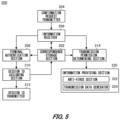
- FIG. 5 schematically shows an example of a functional configuration of the information providing device 200.
- the information providing device 200 includes an association storage section 202, a confirmation request transmitting section 204, an information receiving section 206, a terminal authentication section 208, a session ID assigning section 210, a session ID transmitting section 212, a transmission permission determining section 214, and an information providing section 220.
- the association storage section 202 is a storage section for storing the session ID of the session between the information providing device 200 and the communication terminal 400 and the user ID of the user of the communication terminal 400 in association with each other.
- the confirmation request transmitting section 204 transmits the confirmation request to the relay 300.
- the confirmation request transmitting section 204 may transmit, to the relay 300, the confirmation request for confirming whether the connection request storage section 304 stores the connection request to the information providing device 200 transmitted by the communication terminal 400 arranged in the network 30.
- the confirmation request transmitting section 204 may establish a session between the relay 300 and the confirmation request transmitting section 204 and transmit the confirmation request to the relay 300 via the session.
- the confirmation request transmitting section 204 may establish an HTTP session between the relay 300 and the confirmation request transmitting section 204 and transmit the confirmation request to the relay 300 via the HTTP session.
- the confirmation request transmitting section 204 may establish a session by establishing a TCP connection between the relay 300 and the confirmation request transmitting section 204.
- the information receiving section 206 receives the information included in the connection request from the relay 300.
- the information receiving section 206 receives, for example, the user ID transmitted by the information transmitting section 310.
- the information receiving section 206 receives, for example, the user ID and the password transmitted by the information transmitting section 310.
- the information receiving section 206 also receives, for example, the user ID, the password, and the communication terminal ID, which are transmitted by the information transmitting section 310.
- the information receiving section 206 receives, for example, the session ID transmitted by the information transmitting section 310.
- the information receiving section 206 receives, for example, the session ID and the data specification information, which are transmitted by the information transmitting section 310.
- the information receiving section 206 receives, for example, the session ID, the data specification information, and the communication terminal ID, which are transmitted by the information transmitting section 310.
- the information receiving section 206 may disconnect the session established by the confirmation request transmitting section 204 in response to the reception of the information included in the connection request from the relay 300.
- the information receiving section 206 may disconnect the session by disconnecting the TCP connection through the transmission of the HTTP header which specifies the closing of the TCP connection, to the relay 300.
- the terminal authentication section 208 determines whether authentication of the communication terminal 400 is possible, based on the user ID received by the information receiving section 206 when the information receiving section 206 receives the information included in the connection request, but the session ID stored in the association storage section 202 is not included in the information received by the information receiving section 206.
- the terminal authentication section 208 may determine whether authentication of the communication terminal 400 is possible, based on the user ID received by the information receiving section 206 when the information receiving section 206 receives the information included in the connection request, but the valid session ID stored in the association storage section 202 is not included in the information received by the information receiving section 206.
- the information providing device 200 may transmit a user ID transmission request, which requests the transmission of the user ID, to the communication terminal 400 via the relay 300 when the session ID included in the information received by the information receiving section 206 does not match any of the session IDs stored in the association storage section 202, or when it matches an invalid session ID.
- the communication terminal 400 may transmit the connection request including the user ID, to the relay 300.
- the session ID assigning section 210 assigns a session ID for identifying a session between the information providing device 200 and the communication terminal 400 when the terminal authentication section 208 determines that the authentication is possible, and then causes the session ID and the user ID of the user of the communication terminal 400 to be stored in the association storage section 202, in association with each other.
- the session ID transmitting section 212 transmits the session ID assigned by the session ID assigning section 210, to the relay 300.
- the association storage section 202 may delete or invalidate the session ID. In other words, after the session ID assigning section 210 assigns a new session ID and then the session ID transmitting section 212 transmits the session ID to the relay 300, the association storage section 202 may delete or invalidate the session ID when the session ID has timed out without being used.
- the association storage section 202 may delete or invalidate the session ID. In other words, after the session ID is used, the association storage section 202 may delete or invalidate the session ID when the session ID has timed out without being used.
- the transmission permission determining section 214 determines whether transmission of the data specified by the data specification information received by the information receiving section 206 is permitted, based on the session ID received by the information receiving section 206.
- the transmission permission determining section 214 determines, for example, whether the session ID received by the information receiving section 206 matches any of the plurality of session IDs stored in the association storage section 202. If the received session ID does not match any of the stored sessions IDs, the transmission permission determining section 214 may determine that the transmission is not permitted. If the received session ID matches any one of the stored sessions IDs, the transmission permission determining section 214 confirms, by means of the user ID stored in association with the matched session ID, an access authority of the user identified by the user ID to the data specified by the data specification information. If the user is confirmed to have the access authority, the transmission permission determining section 214 may determine that the transmission is permitted. If the user is confirmed not to have the access authority, the transmission permission determining section 214 may determine that the transmission is not permitted.
- the information providing section 220 provides various information to the communication terminal 400 via the relay 300.
- the information receiving section 206 receives information included in the connection request, and the session ID stored in the association storage section 202 is included in the information received by the information receiving section 206
- the information providing section 220 may provide information to the communication terminal 400 in response to the information received by the information receiving section 206.
- the information providing section 220 transmits, to the relay 300, for example, the data specified by the data specification information, which has been received by the information receiving section 206.
- the information providing section 220 may have an anti-virus section 222 and a transmission data generator 224.
- the anti-virus section 222 executes the anti-virus measures on the data specified by the data specification information.
- the anti-virus section 222 may execute the virus determination process to determine whether the data specified by the data specification information is infected with a virus.
- the anti-virus section 222 may execute the virus handling process on the data when the data is determined to be infected with the virus in the virus determination process.
- the process level of the virus determination process executed by the anti-virus section 222 may be lower than the process level of the virus determination process executed by the anti-virus section 322.
- the process level of the virus handling process executed by the anti-virus section 222 may be lower than the process level of the virus handling process executed by the anti-virus section 322.
- the anti-virus section 322 may execute the virus determination process and the virus handling process using information on the open network.
- the anti-virus section 322 may execute the virus determination process and the virus handling process in cooperation with a virus handling service provided by the cloud service 32 arranged in the network 30.
- the transmission data generator 224 generates the transmission data based on the data specified by the data specification information. For example, the transmission data generator 224 may acquire the data specified by the data specification information and use the acquired data itself as the transmission data. Also, for example, the transmission data generator 224 acquires a plurality of pieces of data specified by the data specification information and generates transmission data from the plurality of pieces of data. As a specific example, when the data specified by the data specification information is mail data, the transmission data generator 224 generates header list information, which is a collection of header information about the plurality of pieces of mail data, as the transmission data.
- FIG. 6 schematically shows an example of a hardware configuration of a computer 1200 functioning as the information providing device 200 or the relay 300.
- a program installed on the computer 1200 can cause the computer 1200 to function as one or more "sections" of the device according to the present embodiment, or can cause the computer 1200 to execute operations or the one or more "sections” associated with the device according to the present embodiment, and/or can cause the computer 1200 to execute a process or a stage of the process according to the present embodiment.
- Such a program may be executed by a CPU 1212 so as to cause the computer 1200 to execute a specific operation associated with some or all of blocks of the flowcharts and block diagrams described herein.
- the computer 1200 includes the CPU 1212, a RAM 1214, and a graphics controller 1216, which are interconnected by a host controller 1210.
- the computer 1200 also includes input/output units such as a communication interface 1222, a storage device 1224, a DVD drive 1226, and an IC card drive, which are connected to the host controller 1210 via an input/output controller 1220.
- the DVD drive 1226 may be a DVD-ROM drive, a DVD-RAM drive, etc.
- the storage device 1224 may be a hard disk drive, a solid state drive, etc.
- the computer 1200 also includes a ROM 1230 and legacy input/output units such as a keyboard, which are connected to the input/output controller 1220 via an input/output chip 1240.
- the CPU 1212 operates in accordance with programs stored in the ROM 1230 and the RAM 1214, thereby controlling each unit.
- the graphics controller 1216 acquires image data generated by the CPU 1212, in a frame buffer or the like provided in the RAM 1214 or within itself, and causes the image data to be displayed on a display device 1218.
- the communication interface 1222 communicates with other electronic devices via a network.
- the storage device 1224 stores programs and data to be used by the CPU 1212 in the computer 1200.
- the DVD drive 1226 reads a program or data from a DVD-ROM 1227 or the like and provides it to the storage device 1224.
- the IC card drive reads a program and data from the IC card and/or writes a program and data in the IC card.
- the ROM 1230 stores therein a boot program or the like which is executed by the computer 1200 upon activation, and/or other programs that depend on the hardware of the computer 1200.
- the input/output chip 1240 may also connect various input/output units to the input/output controller 1220 via a USB port, a parallel port, a serial port, a keyboard port, a mouse port, etc.
- the program is provided by a computer readable storage medium, such as the DVD-ROM 1227 or an IC card.
- the program is read from the computer readable storage medium, installed in the storage device 1224, the RAM 1214, or the ROM 1230, which is also an example of the computer readable storage medium, and executed by the CPU 1212.
- the information processing described in these programs can be read by the computer 1200, resulting in coordination between the programs and various types of hardware resources described above.
- a device or method may be configured by realizing the operation or processing of information in accordance with the use of the computer 1200.
- the CPU 1212 may execute a communication program loaded on the RAM 1214 and provide an instruction to the communication interface 1222 to execute communication processing based on the processing described in the communication program.
- the communication interface 1222 reads the transmission data stored in a transmission buffer area provided in the recording medium, such as the RAM 1214, the storage device 1224, the DVD-ROM 1227, or the IC card, transmits the received transmission data to the network, or writes the reception data received from the network on a reception buffer region or the like provided on the recording medium.
- the CPU 1212 may cause the RAM 1214 to read all or necessary portions of files or databases stored in external recording media, such as the storage device 1224, the DVD drive 1226 (DVD-ROM 1227), or the IC card, and may execute various types of processing on data on the RAM 1214. The CPU 1212 may then write back the processed data in the external recording medium.
- external recording media such as the storage device 1224, the DVD drive 1226 (DVD-ROM 1227), or the IC card
- the CPU 1212 may execute, on the data read from the RAM 1214, various types of processing described throughout the present disclosure and including various types of operations specified by the program's instruction sequence, information processing, condition determination, conditional branching, unconditional branching, information search/replacement, etc., and writes back the results in the RAM 1214.
- the CPU 1212 may search for information in files, databases, and the like in the recording medium.
- the CPU 1212 may search for an entry matching the condition on which the attribute value of the first attribute is specified, from among the plurality of entries, read out the attribute value of the second attribute stored in the entry, and thereby acquire the attribute value of the second attribute associated with the first attribute that satisfies the predetermined condition.
- the programs or software modules described above may be stored in the computer 1200 or in a computer readable storage medium near the computer 1200.
- a recording medium such as a hard disk or a RAM, provided in a server system connected to a dedicated communication network or the Internet, can be used as a computer readable storage medium, thereby providing the program to the computer 1200 via the network.
- the blocks in the flowcharts and block diagrams in the present embodiment may represent stages of a process in which operations are executed or "sections" of a device serving to execute the operations. Specific stages and “sections" may be implemented by a dedicated circuit, a programmable circuit supplied with a computer readable instruction stored in the computer readable storage medium, and/or a processor supplied with a computer readable instruction stored in the computer readable storage medium.
- the dedicated circuit may include a digital and/or analog hardware circuit and may include an integrated circuit (IC) and/or a discrete circuit.
- the programmable circuit may include a reconfigurable hardware circuit, such as a field programmable gate array (FPGA) and a programmable logic array (PLA), which includes a logical product, a logical sum, an exclusive logical sum, a negative logical product, a negative logical sum, and other logical operations, a flip-flop, a register, and a memory element.
- FPGA field programmable gate array
- PLA programmable logic array
- the computer readable storage medium may include any tangible device capable of storing an instruction to be executed by an appropriate device.
- the computer readable storage medium having an instruction stored therein will be composed of a product containing an instruction that can be executed to create the means for executing the operations specified in the flowchart or block diagram.
- Examples of the computer readable storage medium may include electronic storage media, magnetic storage media, optical storage media, electromagnetic storage media, semiconductor storage media, etc.
- the computer readable storage medium may include a floppy (registered trademark) disk, a diskette, a hard disk, a random access memory (RAM), a read-only memory (ROM), an erasable programmable read-only memory (EPROM or flash memory), an electrically erasable programmable read-only memory (EEPROM), a static random access memory (SRAM), a compact disc read-only memory (CD-ROM), a digital versatile disc (DVD), Blu-ray (registered trademark) disc, a memory stick , an integrated circuit card, etc.
- a floppy (registered trademark) disk a diskette, a hard disk, a random access memory (RAM), a read-only memory (ROM), an erasable programmable read-only memory (EPROM or flash memory), an electrically erasable programmable read-only memory (EEPROM), a static random access memory (SRAM), a compact disc read-only memory (CD-ROM), a digital versatile disc (DVD), Blu-ray
- Computer readable instructions may include any of an assembler instruction, an instruction set architecture (ISA) instruction, a machine instruction, a machine dependent instruction, a microcode, a firmware instruction, state setting data, and a source code or object code written in any combination of one or more programming languages, including object-oriented programming languages such as Smalltalk, JAVA (registered trademark), and C++, and conventional procedural programming languages such as "C" programming language or other similar programming languages.
- ISA instruction set architecture
- machine instruction e.g., a machine dependent instruction
- microcode e.g., a firmware instruction, state setting data
- source code or object code written in any combination of one or more programming languages, including object-oriented programming languages such as Smalltalk, JAVA (registered trademark), and C++, and conventional procedural programming languages such as "C" programming language or other similar programming languages.
- the computer readable instruction may be provided to a processor or programmable circuit of a general-purpose computer, a special-purpose computer, or other programmable data processing devices locally or via a wide area network (WAN), such as a local area network (LAN) or the Internet, so that the processor or programmable circuit of the general-purpose computer, the special-purpose computer, or other programmable data processing devices can execute the computer readable instruction to generate means for executing the operation specified in a flowchart or block diagram.
- the processor include a computer processor, a processing unit, a microprocessor, a digital signal processor, a controller, a microcontroller, etc.
Landscapes
- Engineering & Computer Science (AREA)
- Computer Networks & Wireless Communication (AREA)
- Signal Processing (AREA)
- Computer Security & Cryptography (AREA)
- Computer Hardware Design (AREA)
- Computing Systems (AREA)
- General Engineering & Computer Science (AREA)
- Computer And Data Communications (AREA)
- Data Exchanges In Wide-Area Networks (AREA)
- Analysing Materials By The Use Of Radiation (AREA)
- Measurement Of Radiation (AREA)
- Apparatus For Radiation Diagnosis (AREA)
- Nuclear Medicine (AREA)
- Credit Cards Or The Like (AREA)
Claims (12)
- Kommunikationssystem, mit:einer Informationsbereitstellungsvorrichtung (200), die in einem ersten Netzwerk (20) angeordnet ist, das ein geschlossenes Netzwerk ist; undeiner Relaiseinrichtung (300), die in einem zweiten Netzwerk (30) angeordnet ist, das ein offenes Netzwerk ist,wobei die Relaiseinrichtung (300) aufweist:einen Verbindungsanforderungsempfangsabschnitt (302), der dafür konfiguriert ist, eine Verbindungsanforderung für eine Verbindung mit der Informationsbereitstellungsvorrichtung zu empfangen, die durch ein im zweiten Netzwerk (30) angeordnetes Kommunikationsendgerät übertragen wird; undeinen Verbindungsanforderungsspeicherabschnitt (304), der dafür konfiguriert ist, die durch den Verbindungsanforderungsempfangsabschnitt (302) empfangene Verbindungsanforderung zu speichern, undwobei die Informationsbereitstellungsvorrichtung (200) aufweist:einen Zuordnungsspeicherabschnitt (202), der dafür konfiguriert ist, Sitzungsidentifizierungsinformation über eine Sitzung zwischen dem Kommunikationsendgerät und der Informationsbereitstellungsvorrichtung (200) und Benutzeridentifizierungsinformation über einen Benutzer des Kommunikationsendgeräts in Zuordnung zueinander zu speichern;einen Bestätigungsanforderungsübertragungsabschnitt (204), der dafür konfiguriert ist, an die Relaiseinrichtung (300) eine Bestätigungsanforderung zum Bestätigen, ob der Verbindungsanforderungsspeicherabschnitt (304) die durch das im zweiten Netzwerk (30) angeordnete Kommunikationsendgerät übertragene Verbindungsanforderung für eine Verbindung mit der Informationsbereitstellungsvorrichtung (200) gespeichert hat, zu übertragen;einen Informationsempfangsabschnitt (206), der dafür konfiguriert ist, von der Relaiseinrichtung (300) Information zu empfangen, die in der Verbindungsanforderung enthalten ist;einen Endgeräteauthentifizierungsabschnitt (208), der dafür konfiguriert ist, basierend auf der in der Verbindungsanforderung enthaltenen Benutzeridentifizierungsinformation zu bestimmen, ob eine Authentifizierung des Kommunikationsendgeräts zulässig ist, wenn die im Zuordnungsspeicherabschnitt (202) gespeicherte Sitzungsidentifizierungsinformation nicht in der durch den Informationsempfangsabschnitt (206) empfangenen Information enthalten ist;einen Sitzungsidentifizierungsinformationszuordnungsabschnitt (210), der dafür konfiguriert ist, Sitzungsidentifizierungsinformation zum Identifizieren einer Sitzung zwischen der Informationsbereitstellungsvorrichtung (200) und dem Kommunikationsendgerät zuzuweisen, wenn der Endgeräteauthentifizierungsabschnitt (208) bestimmt, dass die Authentifizierung zulässig ist, wodurch veranlasst wird, dass die Sitzungsidentifizierungsinformation im Zuordnungsspeicherabschnitt (202) in Zuordnung zur Benutzeridentifizierungsinformation über den Benutzer des Kommunikationsendgeräts gespeichert wird;einen Sitzungsidentifizierungsinformationsübertragungsabschnitt (212), der dafür konfiguriert ist, die Sitzungsidentifizierungsinformation an die Relaiseinrichtung (300) zu übertragen; undeinen Informationsbereitstellungsabschnitt (220), der dafür konfiguriert ist, dem Kommunikationsendgerät in Antwort auf die durch den Informationsempfangsabschnitt (206) empfangene Information Information zuzuführen, wenn die im Zuordnungsspeicherabschnitt (202) gespeicherte Sitzungsidentifizierungsinformation in der durch den Informationsempfangsabschnitt (206) empfangenen Information enthalten ist, wobei die Relaiseinrichtung (300) aufweist:einen Bestätigungsanforderungsempfangsabschnitt (306), der dafür konfiguriert ist, die Bestätigungsanforderung zu empfangen;einen Verbindungsanforderungsbestätigungsabschnitt (308), der dafür konfiguriert ist, in Antwort auf die Bestätigungsanforderung, die durch den Bestätigungsanforderungsempfangsabschnitt (306) empfangen wird, zu bestätigen, ob die Verbindungsanforderung im Verbindungsanforderungsspeicherabschnitt (304) gespeichert ist; undeinen Informationsübertragungsabschnitt (310), der dafür konfiguriert ist, Information, die in der Verbindungsanforderung enthalten ist, an die Informationsbereitstellungsvorrichtung (200) zu übertragen, wenn der Verbindungsanforderungsbestätigungsabschnitt (308) bestätigt, dass die Verbindungsanforderung im Verbindungsanforderungsspeicherabschnitt (304) gespeichert ist,wobei der Informationsübertragungsabschnitt (310) dafür konfiguriert ist, an die Informationsbereitstellungsvorrichtung (200) die Sitzungsidentifizierungsinformation und Datenspezifizierungsinformation zu übertragen, die Daten im ersten Netzwerk (20) spezifiziert, wenn die Sitzungsidentifizierungsinformation und die Datenspezifizierungsinformation in der Verbindungsanforderung enthalten sind, die im Verbindungsanforderungsspeicherabschnitt (304) gespeichert ist, wenn der Bestätigungsanforderungsempfangsabschnitt (306) die Bestätigungsanforderung empfangen hat,der Informationsempfangsabschnitt (206) dafür konfiguriert ist, die Sitzungsidentifizierungsinformation und die Datenspezifizierungsinformation zu empfangen, und wobeider Informationsbereitstellungsabschnitt (220) dafür konfiguriert ist, die durch die Datenspezifizierungsinformation spezifizierten Daten an die Relaiseinrichtung (300) zu übertragen, wobeidie Informationsbereitstellungsvorrichtung (200) einen ersten Anti-Virus-Abschnitt enthält, der dafür konfiguriert ist, einen Virusbestimmungsprozess auszuführen, um zu bestimmen, ob die durch die Datenspezifizierungsinformation spezifizierten Daten mit einem Virus infiziert sind, um einen Virenbehandlungsprozess bezüglich den Daten auszuführen, wenn bestimmt wird, dass die Daten infiziert sind,der Informationsbereitstellungsabschnitt (220) dafür konfiguriert ist, die Daten, bezüglich denen der Virenbehandlungsprozess durch den ersten Anti-Virus-Abschnitt ausgeführt worden ist, an die Relaiseinrichtung (300) zu übertragen, wenn die durch die Datenspezifizierungsinformation spezifizierten Daten mit einem Virus infiziert sind, unddie Relaiseinrichtung (300) einen zweiten Anti-Virus-Abschnitt aufweist, der dafür konfiguriert ist, einen Virenbestimmungsprozess auszuführen, um zu bestimmen, ob die vom Informationsbereitstellungsabschnitt (220) empfangenen Daten mit einem Virus infiziert sind, und einen Virusbehandlungsprozess bezüglich den Daten auszuführen, wenn bestimmt wird, dass die Daten infiziert sind, wobeiein Bestimmungs-Level des durch den ersten Anti-Virus-Abschnitt ausgeführten Virusbestimmungsprozesses niedriger ist als ein Bestimmungs-Level des durch den zweiten Anti-Virus-Abschnitt ausgeführten Virusbestimmungsprozesses.
- Kommunikationssystem nach Anspruch 1, wobeider Bestätigungsanforderungsübertragungsabschnitt (204) dafür konfiguriert ist, eine Sitzung mit der Relaiseinrichtung (300) aufzubauen und die Bestätigungsanforderung über die Sitzung an die Relaiseinrichtung (300) zu übertragen, undder Informationsempfangsabschnitt (206) dafür konfiguriert ist, die Sitzung in Antwort auf den Empfang von in der Verbindungsanforderung enthaltener Information von der Relaiseinrichtung (300) zu trennen.
- Kommunikationssystem nach Anspruch 2, wobeider Bestätigungsanforderungsübertragungsabschnitt (204) dafür konfiguriert ist, die Sitzung durch Einrichten einer TCP-Verbindung mit der Relaiseinrichtung (300) aufzubauen, undder Informationsempfangsabschnitt (206) dafür konfiguriert ist, die Sitzung durch Trennen der TCP-Verbindung durch Übertragen eines HTTP-Headers an die Relaiseinrichtung (300) zu trennen, wobei der HTTP-Header das Schließen der TCP-Verbindung spezifiziert.
- Kommunikationssystem nach Anspruch 2 oder 3, wobei
eine Firewall mit einer Sitzungs-Timeout-Funktion zwischen dem ersten Netzwerk (20) und dem zweiten Netzwerk (30) vorgesehen ist, wobei die Sitzungs-Timeout-Funktion dazu dient, die Sitzung in Antwort auf das Verstreichen einer vorgegebenen Zeitdauer nach dem Aufbau der Sitzung zwischen einem Gerät im ersten Netzwerk (20) und einem Gerät im zweiten Netzwerk (30) zu trennen. - Kommunikationssystem nach einem der Ansprüche 1 bis 4, wobei
der Zuordnungsspeicherabschnitt (202) dafür konfiguriert ist, die Sitzungsidentifizierungsinformation zu löschen, wenn der Informationsempfangsabschnitt (206) die Sitzungsidentifizierungsinformation nicht empfängt, bevor eine nach dem Übertragen der Sitzungsidentifizierungsinformation durch den Sitzungsidentifizierungsinformationsübertragungsabschnitt (212) verstrichene Zeitdauer länger wird als eine vorgegebene Zeitdauer. - Kommunikationssystem nach Anspruch 5, wobei
der Zuordnungsspeicherabschnitt (202) dafür konfiguriert ist, die Sitzungsidentifizierungsinformation zu löschen, wenn der Informationsempfangsabschnitt (206) die Sitzungsidentifizierungsinformation nicht empfängt, bevor eine nach dem Empfang der Sitzungsidentifizierungsinformation durch den Informationsempfangsabschnitt (206) verstrichene Zeitdauer länger wird als eine vorgegebene Zeitdauer. - Kommunikationssystem nach einem der Ansprüche 1 bis 6, wobeider Verbindungsanforderungsempfangsabschnitt (302) dafür konfiguriert ist, eine Vielzahl von Verbindungsanforderungen zu empfangen, die jeweils mit der Verbindungsanforderung identisch sind und durch eine Vielzahl von Kommunikationsendgeräten im zweiten Netzwerk (30) übertragen werden,wobei der Verbindungsanforderungsspeicherabschnitt (304) dafür konfiguriert ist, jede der Vielzahl von Verbindungsanforderungen in Zuordnung zu Endgeräteidentifizierungsinformation über jedes der Vielzahl von Kommunikationsendgeräten zu speichern, undder Informationsübertragungsabschnitt (310) dafür konfiguriert ist, an die Informationsbereitstellungsvorrichtung (200) Information zu übertragen, die in jeder der Vielzahl von Verbindungsanforderungen enthalten ist, wenn der Verbindungsanforderungsspeicherabschnitt (304) die Vielzahl von Verbindungsanforderungen gespeichert hat, wenn der Bestätigungsanforderungsempfangsabschnitt (306) die Bestätigungsanforderung empfängt.
- Kommunikationssystem nach einem der Ansprüche 1 bis 7, wobei
der Informationsübertragungsabschnitt (310) dafür konfiguriert ist, die Benutzeridentifizierungsinformation an die Informationsbereitstellungsvorrichtung (200) zu übertragen, wenn die Benutzeridentifizierungsinformation in der im Verbindungsanforderungsspeicherabschnitt (304) gespeicherten Verbindungsanforderung enthalten ist, wenn der Bestätigungsanforderungsempfangsabschnitt (306) die Bestätigungsanforderung empfängt. - Kommunikationssystem nach einem der Ansprüche 1 bis 8, wobeidie Informationsbereitstellungsvorrichtung (200) einen Übertragungszulassungsbestimmungsabschnitt (214) aufweist, der dafür konfiguriert ist, basierend auf der durch den Informationsempfangsabschnitt (206) empfangenen Sitzungsidentifizierungsinformation zu bestimmen, ob die Übertragung der durch die Datenspezifizierungsinformation spezifizierten Daten zulässig ist, undder Informationsbereitstellungsabschnitt (220) dafür konfiguriert ist, die durch die Datenspezifizierungsinformation identifizierten Daten an die Relaiseinrichtung (300) zu übertragen, wenn der Übertragungszulassungs-bestimmungsabschnitt (214) bestimmt, dass die Übertragung zulässig ist.
- Kommunikationssystem nach einem der Ansprüche 1 bis 9, wobeiein Zuordnungs-Level des durch den ersten Anti-Virus-Abschnitt ausgeführten Virenhandhabungsprozesses niedriger ist als ein Zuordnungs-Level des durch den zweiten Anti-Virus-Abschnitt ausgeführten Virenhandhabungsprozesses, undder erste Anti-Virus-Abschnitt den Virenhandhabungsprozess und den Virenbestimmungsprozess nur unter Verwendung von Information ausführt, die die Informationsbereitstellungsvorrichtung (200) selbst besitzt, und der zweite Anti-Virus-Abschnitt den Virenhandhabungsprozess und den Virenbestimmungsprozess in Zusammenwirkung mit einem Anti-Virus-Dienst ausführt, der durch einen im zweiten Netzwerk (30) angeordneten Cloud-Dienst (32) bereitgestellt wird.
- Programm, das Computer veranlasst, als das Kommunikationssystem nach einem der Ansprüche 1 bis 10 zu funktionieren.
- Verfahren, das durch das Kommunikationssystem nach einem der Ansprüche 1 bis 10 ausgeführt wird.
Applications Claiming Priority (1)
| Application Number | Priority Date | Filing Date | Title |
|---|---|---|---|
| PCT/JP2019/014521 WO2020202442A1 (ja) | 2019-04-01 | 2019-04-01 | 通信システム、情報提供装置、プログラム及び情報提供方法 |
Publications (3)
| Publication Number | Publication Date |
|---|---|
| EP3923146A1 EP3923146A1 (de) | 2021-12-15 |
| EP3923146A4 EP3923146A4 (de) | 2022-09-14 |
| EP3923146B1 true EP3923146B1 (de) | 2023-11-22 |
Family
ID=72666192
Family Applications (1)
| Application Number | Title | Priority Date | Filing Date |
|---|---|---|---|
| EP19922905.5A Active EP3923146B1 (de) | 2019-04-01 | 2019-04-01 | Kommunikationssystem, informationsbereitstellungsvorrichtung, programm und informationsbereitstellungsverfahren |
Country Status (6)
| Country | Link |
|---|---|
| US (1) | US12035139B2 (de) |
| EP (1) | EP3923146B1 (de) |
| JP (1) | JP7015498B2 (de) |
| CN (1) | CN113646751B (de) |
| TW (1) | TWI818167B (de) |
| WO (1) | WO2020202442A1 (de) |
Families Citing this family (1)
| Publication number | Priority date | Publication date | Assignee | Title |
|---|---|---|---|---|
| CN116226499B (zh) * | 2023-03-22 | 2024-09-17 | 北京字跳网络技术有限公司 | 信息查询方法、装置及电子设备 |
Family Cites Families (37)
| Publication number | Priority date | Publication date | Assignee | Title |
|---|---|---|---|---|
| JP4334231B2 (ja) * | 2001-04-16 | 2009-09-30 | ザクソン・アールアンドディ株式会社 | コンピュータウイルス検査装置及び半導体集積回路 |
| JP4567275B2 (ja) * | 2002-02-28 | 2010-10-20 | 株式会社エヌ・ティ・ティ・ドコモ | 移動通信端末、情報処理装置、中継サーバ装置、情報処理システム及び情報処理方法 |
| AU2003261925A1 (en) * | 2002-09-04 | 2004-03-29 | E-Jan Net Co. | Connection system, information providing device, connection method, and program |
| US20100211626A1 (en) * | 2004-01-12 | 2010-08-19 | Foundry Networks, Inc. | Method and apparatus for maintaining longer persistent connections |
| GB0410151D0 (en) * | 2004-05-07 | 2004-06-09 | Zeus Technology Ltd | Load balancing & traffic management |
| US8046829B2 (en) * | 2004-08-17 | 2011-10-25 | Toshiba America Research, Inc. | Method for dynamically and securely establishing a tunnel |
| US7409709B2 (en) * | 2005-02-14 | 2008-08-05 | Etsec, Inc. | Systems and methods for automatically reconfiguring a network device |
| US7373661B2 (en) * | 2005-02-14 | 2008-05-13 | Ethome, Inc. | Systems and methods for automatically configuring and managing network devices and virtual private networks |
| WO2007142567A1 (en) * | 2006-06-09 | 2007-12-13 | Telefonaktiebolaget Lm Ericsson (Publ.) | Operator managed virtual home network |
| US8275890B2 (en) * | 2009-06-03 | 2012-09-25 | International Business Machines Corporation | Detecting an inactive client during a communication session |
| JP5347731B2 (ja) * | 2009-06-05 | 2013-11-20 | 日本電気株式会社 | ユーザ認証システム、認証セッション共有装置およびユーザ認証方法 |
| US8964757B2 (en) * | 2009-12-18 | 2015-02-24 | Qualcomm Incorporated | HTTP optimization, multi-homing, mobility and priority |
| CN102118386B (zh) * | 2009-12-25 | 2013-11-27 | 佳能It解决方案株式会社 | 中继处理装置、中继处理方法 |
| WO2013042412A1 (ja) * | 2011-09-22 | 2013-03-28 | 九州日本電気ソフトウェア株式会社 | 通信システム、通信方法、及びコンピュータ読み取り可能な記録媒体 |
| JP5723300B2 (ja) * | 2012-01-04 | 2015-05-27 | 株式会社野村総合研究所 | サーバシステム、サービス提供サーバおよび制御方法 |
| JP5870990B2 (ja) * | 2013-12-04 | 2016-03-01 | コニカミノルタ株式会社 | 中継装置、画像形成装置、中継方法および中継プログラム |
| US10749926B2 (en) * | 2014-04-23 | 2020-08-18 | Rimini Street, Inc. | Proxy for modifying HTTP messages to comply with browser |
| EP3197194B1 (de) * | 2014-08-29 | 2020-10-21 | Sony Corporation | Drahtloskommunikationsvorrichtung, server, zahlungsvorrichtung, drahtloskommunikationsverfahren und programm |
| JP6319152B2 (ja) * | 2015-03-25 | 2018-05-09 | コニカミノルタ株式会社 | 画像処理システム、画像処理装置、指示サーバー、およびプログラム |
| JP6250595B2 (ja) * | 2015-07-01 | 2017-12-20 | e−Janネットワークス株式会社 | 通信システム及びプログラム |
| JP6503988B2 (ja) * | 2015-09-02 | 2019-04-24 | 富士通株式会社 | セッション制御方法およびセッション制御プログラム |
| US10440124B2 (en) * | 2015-11-30 | 2019-10-08 | Cloud9 Technologies, LLC | Searchable directory for provisioning private connections |
| JP6779700B2 (ja) * | 2016-08-04 | 2020-11-04 | 古野電気株式会社 | 制御機器の認証システム、制御機器の認証方法、及び制御機器のプログラム |
| US10854028B2 (en) * | 2016-08-09 | 2020-12-01 | Vivint, Inc. | Authentication for keyless building entry |
| US10523715B1 (en) * | 2016-08-26 | 2019-12-31 | Symantec Corporation | Analyzing requests from authenticated computing devices to detect and estimate the size of network address translation systems |
| CN106453539B (zh) * | 2016-09-28 | 2019-04-05 | 广州市百果园网络科技有限公司 | 一种处理节点注册通知的方法和系统 |
| WO2018111858A1 (en) * | 2016-12-12 | 2018-06-21 | Trusona, Inc. | Methods and systems for network-enabled account creation using optical detection |
| US10979390B2 (en) * | 2017-08-25 | 2021-04-13 | Panasonic Intellectual Property Corporation Of America | Communication security apparatus, control method, and storage medium storing a program |
| US10938819B2 (en) * | 2017-09-29 | 2021-03-02 | Fisher-Rosemount Systems, Inc. | Poisoning protection for process control switches |
| US11355126B2 (en) * | 2018-01-24 | 2022-06-07 | Comcast Cable Communications, Llc | Verification of user identity for voice enabled devices |
| CN110505606B (zh) * | 2018-05-18 | 2022-12-02 | 阿里巴巴集团控股有限公司 | 蓝牙Mesh网络及其配网鉴权方法、设备和存储介质 |
| JP7124478B2 (ja) * | 2018-06-22 | 2022-08-24 | ブラザー工業株式会社 | サーバとサーバのためのコンピュータプログラム |
| US10805113B2 (en) * | 2018-08-07 | 2020-10-13 | Dh2I Company | Application transmission control protocol tunneling over the public internet |
| JP7174237B2 (ja) * | 2018-11-29 | 2022-11-17 | 富士通株式会社 | 鍵生成装置、鍵更新方法および鍵更新プログラム |
| US10841762B2 (en) * | 2019-03-05 | 2020-11-17 | Cisco Technology, Inc. | Mobile data dynamic grouping for connected vehicle and in-vehicle networking |
| US11575757B2 (en) * | 2019-06-17 | 2023-02-07 | Dh2I Company | Cloaked remote client access |
| JP7240280B2 (ja) * | 2019-07-26 | 2023-03-15 | シャープ株式会社 | ユーザ認証管理装置、それを備えた画像処理装置、ユーザ認証管理方法およびユーザ認証管理プログラム |
-
2019
- 2019-04-01 WO PCT/JP2019/014521 patent/WO2020202442A1/ja not_active Ceased
- 2019-04-01 EP EP19922905.5A patent/EP3923146B1/de active Active
- 2019-04-01 JP JP2021511808A patent/JP7015498B2/ja active Active
- 2019-04-01 CN CN201980094595.2A patent/CN113646751B/zh active Active
-
2020
- 2020-04-01 TW TW109111151A patent/TWI818167B/zh active
-
2021
- 2021-09-28 US US17/486,924 patent/US12035139B2/en active Active
Also Published As
| Publication number | Publication date |
|---|---|
| US12035139B2 (en) | 2024-07-09 |
| JP7015498B2 (ja) | 2022-02-03 |
| TW202044878A (zh) | 2020-12-01 |
| US20220014924A1 (en) | 2022-01-13 |
| CN113646751B (zh) | 2024-05-28 |
| JPWO2020202442A1 (ja) | 2021-09-13 |
| EP3923146A4 (de) | 2022-09-14 |
| WO2020202442A1 (ja) | 2020-10-08 |
| EP3923146A1 (de) | 2021-12-15 |
| TWI818167B (zh) | 2023-10-11 |
| CN113646751A (zh) | 2021-11-12 |
Similar Documents
| Publication | Publication Date | Title |
|---|---|---|
| KR102181185B1 (ko) | 단말의 안전한 네트워크 접속을 위한 시스템 및 방법 | |
| RU2680736C1 (ru) | Сервер и способ для определения вредоносных файлов в сетевом трафике | |
| US10250435B2 (en) | System and method for intelligent discovery and rescue of devices in an internet-of-things network | |
| US9817975B2 (en) | Method for logging firmware attack event and system therefor | |
| CN111490981B (zh) | 访问管理方法、装置、堡垒机及可读存储介质 | |
| KR102349038B1 (ko) | 분산 게이트웨이 환경에 최적화된 터널링 및 게이트웨이 접속 시스템 및 그에 관한 방법 | |
| US10129286B2 (en) | Zero day threat detection using host application/program to user agent mapping | |
| KR102749334B1 (ko) | 네트워크 노드에 연결된 노드의 네트워크 접속을 제어하기 위한 시스템 및 그에 관한 방법 | |
| KR102147917B1 (ko) | Ssl/tls 서비스 패킷 분류 방법 및 장치 | |
| KR102379720B1 (ko) | 가상화 단말에서 데이터 플로우를 제어하기 위한 시스템 및 그에 관한 방법 | |
| KR102415567B1 (ko) | 가상화 인스턴스의 네트워크 접속을 제어하기 위한 시스템 및 그에 관한 방법 | |
| EP3923146B1 (de) | Kommunikationssystem, informationsbereitstellungsvorrichtung, programm und informationsbereitstellungsverfahren | |
| JP2023165633A (ja) | 機械学習ベースのマルウェア検出のためのシステムおよび方法 | |
| KR102782378B1 (ko) | 프록시 기반의 네트워크 접속을 제어하기 위한 시스템 및 그에 관한 방법 | |
| KR102393913B1 (ko) | 이상행위 탐지 장치, 방법 및 이를 포함하는 시스템 | |
| CN114143056A (zh) | 一种终端访问方法、装置、电子设备及存储介质 | |
| KR102782363B1 (ko) | 프록시 기반의 네트워크 접속을 제어하기 위한 시스템 및 그에 관한 방법 | |
| JP7304039B2 (ja) | 通信システム | |
| CN111079144B (zh) | 一种病毒传播行为检测方法及装置 | |
| JP6989457B2 (ja) | 外部情報受配信装置、データ送信方法、及びプログラム | |
| KR101904415B1 (ko) | 지능형 지속위협 환경에서의 시스템 복구 방법 | |
| KR102587114B1 (ko) | 화이트 리스트를 기반으로 한 원격 제어 소프트웨어 탐지 장치 및 방법 | |
| JP2015103090A (ja) | 認証システム、認証装置、認証方法及び認証プログラム | |
| US12242329B2 (en) | Turn on functional module and related functional module based on generated disk image | |
| JP7067187B2 (ja) | 通信制御装置、通信制御方法、及びプログラム |
Legal Events
| Date | Code | Title | Description |
|---|---|---|---|
| STAA | Information on the status of an ep patent application or granted ep patent |
Free format text: STATUS: THE INTERNATIONAL PUBLICATION HAS BEEN MADE |
|
| PUAI | Public reference made under article 153(3) epc to a published international application that has entered the european phase |
Free format text: ORIGINAL CODE: 0009012 |
|
| STAA | Information on the status of an ep patent application or granted ep patent |
Free format text: STATUS: REQUEST FOR EXAMINATION WAS MADE |
|
| 17P | Request for examination filed |
Effective date: 20210903 |
|
| AK | Designated contracting states |
Kind code of ref document: A1 Designated state(s): AL AT BE BG CH CY CZ DE DK EE ES FI FR GB GR HR HU IE IS IT LI LT LU LV MC MK MT NL NO PL PT RO RS SE SI SK SM TR |
|
| DAV | Request for validation of the european patent (deleted) | ||
| DAX | Request for extension of the european patent (deleted) | ||
| REG | Reference to a national code |
Ref country code: DE Ref legal event code: R079 Free format text: PREVIOUS MAIN CLASS: G06F0013000000 Ipc: H04L0009400000 Ref country code: DE Ref legal event code: R079 Ref document number: 602019042128 Country of ref document: DE Free format text: PREVIOUS MAIN CLASS: G06F0013000000 Ipc: H04L0009400000 |
|
| A4 | Supplementary search report drawn up and despatched |
Effective date: 20220816 |
|
| RIC1 | Information provided on ipc code assigned before grant |
Ipc: H04L 67/02 20220101ALN20220809BHEP Ipc: H04L 12/66 20060101ALI20220809BHEP Ipc: H04L 9/40 20220101AFI20220809BHEP |
|
| STAA | Information on the status of an ep patent application or granted ep patent |
Free format text: STATUS: EXAMINATION IS IN PROGRESS |
|
| 17Q | First examination report despatched |
Effective date: 20230124 |
|
| GRAP | Despatch of communication of intention to grant a patent |
Free format text: ORIGINAL CODE: EPIDOSNIGR1 |
|
| STAA | Information on the status of an ep patent application or granted ep patent |
Free format text: STATUS: GRANT OF PATENT IS INTENDED |
|
| RIC1 | Information provided on ipc code assigned before grant |
Ipc: H04L 67/02 20220101ALN20230612BHEP Ipc: H04L 12/66 20060101ALI20230612BHEP Ipc: H04L 9/40 20220101AFI20230612BHEP |
|
| INTG | Intention to grant announced |
Effective date: 20230628 |
|
| GRAS | Grant fee paid |
Free format text: ORIGINAL CODE: EPIDOSNIGR3 |
|
| GRAA | (expected) grant |
Free format text: ORIGINAL CODE: 0009210 |
|
| STAA | Information on the status of an ep patent application or granted ep patent |
Free format text: STATUS: THE PATENT HAS BEEN GRANTED |
|
| AK | Designated contracting states |
Kind code of ref document: B1 Designated state(s): AL AT BE BG CH CY CZ DE DK EE ES FI FR GB GR HR HU IE IS IT LI LT LU LV MC MK MT NL NO PL PT RO RS SE SI SK SM TR |
|
| REG | Reference to a national code |
Ref country code: GB Ref legal event code: FG4D |
|
| REG | Reference to a national code |
Ref country code: CH Ref legal event code: EP |
|
| REG | Reference to a national code |
Ref country code: DE Ref legal event code: R096 Ref document number: 602019042128 Country of ref document: DE |
|
| REG | Reference to a national code |
Ref country code: IE Ref legal event code: FG4D |
|
| REG | Reference to a national code |
Ref country code: LT Ref legal event code: MG9D |
|
| REG | Reference to a national code |
Ref country code: NL Ref legal event code: MP Effective date: 20231122 |
|
| PG25 | Lapsed in a contracting state [announced via postgrant information from national office to epo] |
Ref country code: GR Free format text: LAPSE BECAUSE OF FAILURE TO SUBMIT A TRANSLATION OF THE DESCRIPTION OR TO PAY THE FEE WITHIN THE PRESCRIBED TIME-LIMIT Effective date: 20240223 |
|
| PG25 | Lapsed in a contracting state [announced via postgrant information from national office to epo] |
Ref country code: IS Free format text: LAPSE BECAUSE OF FAILURE TO SUBMIT A TRANSLATION OF THE DESCRIPTION OR TO PAY THE FEE WITHIN THE PRESCRIBED TIME-LIMIT Effective date: 20240322 |
|
| PG25 | Lapsed in a contracting state [announced via postgrant information from national office to epo] |
Ref country code: LT Free format text: LAPSE BECAUSE OF FAILURE TO SUBMIT A TRANSLATION OF THE DESCRIPTION OR TO PAY THE FEE WITHIN THE PRESCRIBED TIME-LIMIT Effective date: 20231122 |
|
| REG | Reference to a national code |
Ref country code: AT Ref legal event code: MK05 Ref document number: 1634884 Country of ref document: AT Kind code of ref document: T Effective date: 20231122 |
|
| PG25 | Lapsed in a contracting state [announced via postgrant information from national office to epo] |
Ref country code: NL Free format text: LAPSE BECAUSE OF FAILURE TO SUBMIT A TRANSLATION OF THE DESCRIPTION OR TO PAY THE FEE WITHIN THE PRESCRIBED TIME-LIMIT Effective date: 20231122 |
|
| PG25 | Lapsed in a contracting state [announced via postgrant information from national office to epo] |
Ref country code: AT Free format text: LAPSE BECAUSE OF FAILURE TO SUBMIT A TRANSLATION OF THE DESCRIPTION OR TO PAY THE FEE WITHIN THE PRESCRIBED TIME-LIMIT Effective date: 20231122 |
|
| PG25 | Lapsed in a contracting state [announced via postgrant information from national office to epo] |
Ref country code: ES Free format text: LAPSE BECAUSE OF FAILURE TO SUBMIT A TRANSLATION OF THE DESCRIPTION OR TO PAY THE FEE WITHIN THE PRESCRIBED TIME-LIMIT Effective date: 20231122 |
|
| PG25 | Lapsed in a contracting state [announced via postgrant information from national office to epo] |
Ref country code: NL Free format text: LAPSE BECAUSE OF FAILURE TO SUBMIT A TRANSLATION OF THE DESCRIPTION OR TO PAY THE FEE WITHIN THE PRESCRIBED TIME-LIMIT Effective date: 20231122 Ref country code: LT Free format text: LAPSE BECAUSE OF FAILURE TO SUBMIT A TRANSLATION OF THE DESCRIPTION OR TO PAY THE FEE WITHIN THE PRESCRIBED TIME-LIMIT Effective date: 20231122 Ref country code: IS Free format text: LAPSE BECAUSE OF FAILURE TO SUBMIT A TRANSLATION OF THE DESCRIPTION OR TO PAY THE FEE WITHIN THE PRESCRIBED TIME-LIMIT Effective date: 20240322 Ref country code: GR Free format text: LAPSE BECAUSE OF FAILURE TO SUBMIT A TRANSLATION OF THE DESCRIPTION OR TO PAY THE FEE WITHIN THE PRESCRIBED TIME-LIMIT Effective date: 20240223 Ref country code: ES Free format text: LAPSE BECAUSE OF FAILURE TO SUBMIT A TRANSLATION OF THE DESCRIPTION OR TO PAY THE FEE WITHIN THE PRESCRIBED TIME-LIMIT Effective date: 20231122 Ref country code: BG Free format text: LAPSE BECAUSE OF FAILURE TO SUBMIT A TRANSLATION OF THE DESCRIPTION OR TO PAY THE FEE WITHIN THE PRESCRIBED TIME-LIMIT Effective date: 20240222 Ref country code: AT Free format text: LAPSE BECAUSE OF FAILURE TO SUBMIT A TRANSLATION OF THE DESCRIPTION OR TO PAY THE FEE WITHIN THE PRESCRIBED TIME-LIMIT Effective date: 20231122 Ref country code: PT Free format text: LAPSE BECAUSE OF FAILURE TO SUBMIT A TRANSLATION OF THE DESCRIPTION OR TO PAY THE FEE WITHIN THE PRESCRIBED TIME-LIMIT Effective date: 20240322 |
|
| PG25 | Lapsed in a contracting state [announced via postgrant information from national office to epo] |
Ref country code: SE Free format text: LAPSE BECAUSE OF FAILURE TO SUBMIT A TRANSLATION OF THE DESCRIPTION OR TO PAY THE FEE WITHIN THE PRESCRIBED TIME-LIMIT Effective date: 20231122 Ref country code: RS Free format text: LAPSE BECAUSE OF FAILURE TO SUBMIT A TRANSLATION OF THE DESCRIPTION OR TO PAY THE FEE WITHIN THE PRESCRIBED TIME-LIMIT Effective date: 20231122 Ref country code: PL Free format text: LAPSE BECAUSE OF FAILURE TO SUBMIT A TRANSLATION OF THE DESCRIPTION OR TO PAY THE FEE WITHIN THE PRESCRIBED TIME-LIMIT Effective date: 20231122 Ref country code: NO Free format text: LAPSE BECAUSE OF FAILURE TO SUBMIT A TRANSLATION OF THE DESCRIPTION OR TO PAY THE FEE WITHIN THE PRESCRIBED TIME-LIMIT Effective date: 20240222 Ref country code: LV Free format text: LAPSE BECAUSE OF FAILURE TO SUBMIT A TRANSLATION OF THE DESCRIPTION OR TO PAY THE FEE WITHIN THE PRESCRIBED TIME-LIMIT Effective date: 20231122 Ref country code: HR Free format text: LAPSE BECAUSE OF FAILURE TO SUBMIT A TRANSLATION OF THE DESCRIPTION OR TO PAY THE FEE WITHIN THE PRESCRIBED TIME-LIMIT Effective date: 20231122 |
|
| PG25 | Lapsed in a contracting state [announced via postgrant information from national office to epo] |
Ref country code: DK Free format text: LAPSE BECAUSE OF FAILURE TO SUBMIT A TRANSLATION OF THE DESCRIPTION OR TO PAY THE FEE WITHIN THE PRESCRIBED TIME-LIMIT Effective date: 20231122 |
|
| PG25 | Lapsed in a contracting state [announced via postgrant information from national office to epo] |
Ref country code: CZ Free format text: LAPSE BECAUSE OF FAILURE TO SUBMIT A TRANSLATION OF THE DESCRIPTION OR TO PAY THE FEE WITHIN THE PRESCRIBED TIME-LIMIT Effective date: 20231122 |
|
| PG25 | Lapsed in a contracting state [announced via postgrant information from national office to epo] |
Ref country code: SK Free format text: LAPSE BECAUSE OF FAILURE TO SUBMIT A TRANSLATION OF THE DESCRIPTION OR TO PAY THE FEE WITHIN THE PRESCRIBED TIME-LIMIT Effective date: 20231122 |
|
| PG25 | Lapsed in a contracting state [announced via postgrant information from national office to epo] |
Ref country code: SM Free format text: LAPSE BECAUSE OF FAILURE TO SUBMIT A TRANSLATION OF THE DESCRIPTION OR TO PAY THE FEE WITHIN THE PRESCRIBED TIME-LIMIT Effective date: 20231122 Ref country code: SK Free format text: LAPSE BECAUSE OF FAILURE TO SUBMIT A TRANSLATION OF THE DESCRIPTION OR TO PAY THE FEE WITHIN THE PRESCRIBED TIME-LIMIT Effective date: 20231122 Ref country code: RO Free format text: LAPSE BECAUSE OF FAILURE TO SUBMIT A TRANSLATION OF THE DESCRIPTION OR TO PAY THE FEE WITHIN THE PRESCRIBED TIME-LIMIT Effective date: 20231122 Ref country code: IT Free format text: LAPSE BECAUSE OF FAILURE TO SUBMIT A TRANSLATION OF THE DESCRIPTION OR TO PAY THE FEE WITHIN THE PRESCRIBED TIME-LIMIT Effective date: 20231122 Ref country code: EE Free format text: LAPSE BECAUSE OF FAILURE TO SUBMIT A TRANSLATION OF THE DESCRIPTION OR TO PAY THE FEE WITHIN THE PRESCRIBED TIME-LIMIT Effective date: 20231122 Ref country code: DK Free format text: LAPSE BECAUSE OF FAILURE TO SUBMIT A TRANSLATION OF THE DESCRIPTION OR TO PAY THE FEE WITHIN THE PRESCRIBED TIME-LIMIT Effective date: 20231122 Ref country code: CZ Free format text: LAPSE BECAUSE OF FAILURE TO SUBMIT A TRANSLATION OF THE DESCRIPTION OR TO PAY THE FEE WITHIN THE PRESCRIBED TIME-LIMIT Effective date: 20231122 |
|
| REG | Reference to a national code |
Ref country code: DE Ref legal event code: R097 Ref document number: 602019042128 Country of ref document: DE |
|
| PLBE | No opposition filed within time limit |
Free format text: ORIGINAL CODE: 0009261 |
|
| STAA | Information on the status of an ep patent application or granted ep patent |
Free format text: STATUS: NO OPPOSITION FILED WITHIN TIME LIMIT |
|
| PG25 | Lapsed in a contracting state [announced via postgrant information from national office to epo] |
Ref country code: SI Free format text: LAPSE BECAUSE OF FAILURE TO SUBMIT A TRANSLATION OF THE DESCRIPTION OR TO PAY THE FEE WITHIN THE PRESCRIBED TIME-LIMIT Effective date: 20231122 |
|
| 26N | No opposition filed |
Effective date: 20240823 |
|
| PG25 | Lapsed in a contracting state [announced via postgrant information from national office to epo] |
Ref country code: SI Free format text: LAPSE BECAUSE OF FAILURE TO SUBMIT A TRANSLATION OF THE DESCRIPTION OR TO PAY THE FEE WITHIN THE PRESCRIBED TIME-LIMIT Effective date: 20231122 |
|
| PG25 | Lapsed in a contracting state [announced via postgrant information from national office to epo] |
Ref country code: MC Free format text: LAPSE BECAUSE OF FAILURE TO SUBMIT A TRANSLATION OF THE DESCRIPTION OR TO PAY THE FEE WITHIN THE PRESCRIBED TIME-LIMIT Effective date: 20231122 |
|
| PG25 | Lapsed in a contracting state [announced via postgrant information from national office to epo] |
Ref country code: MC Free format text: LAPSE BECAUSE OF FAILURE TO SUBMIT A TRANSLATION OF THE DESCRIPTION OR TO PAY THE FEE WITHIN THE PRESCRIBED TIME-LIMIT Effective date: 20231122 |
|
| REG | Reference to a national code |
Ref country code: CH Ref legal event code: PL |
|
| PG25 | Lapsed in a contracting state [announced via postgrant information from national office to epo] |
Ref country code: LU Free format text: LAPSE BECAUSE OF NON-PAYMENT OF DUE FEES Effective date: 20240401 |
|
| REG | Reference to a national code |
Ref country code: BE Ref legal event code: MM Effective date: 20240430 |
|
| PG25 | Lapsed in a contracting state [announced via postgrant information from national office to epo] |
Ref country code: LU Free format text: LAPSE BECAUSE OF NON-PAYMENT OF DUE FEES Effective date: 20240401 |
|
| PG25 | Lapsed in a contracting state [announced via postgrant information from national office to epo] |
Ref country code: BE Free format text: LAPSE BECAUSE OF NON-PAYMENT OF DUE FEES Effective date: 20240430 |
|
| PG25 | Lapsed in a contracting state [announced via postgrant information from national office to epo] |
Ref country code: BE Free format text: LAPSE BECAUSE OF NON-PAYMENT OF DUE FEES Effective date: 20240430 Ref country code: CH Free format text: LAPSE BECAUSE OF NON-PAYMENT OF DUE FEES Effective date: 20240430 |
|
| PG25 | Lapsed in a contracting state [announced via postgrant information from national office to epo] |
Ref country code: IE Free format text: LAPSE BECAUSE OF NON-PAYMENT OF DUE FEES Effective date: 20240401 |
|
| PGFP | Annual fee paid to national office [announced via postgrant information from national office to epo] |
Ref country code: DE Payment date: 20250429 Year of fee payment: 7 |
|
| PGFP | Annual fee paid to national office [announced via postgrant information from national office to epo] |
Ref country code: GB Payment date: 20250423 Year of fee payment: 7 |
|
| PGFP | Annual fee paid to national office [announced via postgrant information from national office to epo] |
Ref country code: FR Payment date: 20250425 Year of fee payment: 7 |
|
| PG25 | Lapsed in a contracting state [announced via postgrant information from national office to epo] |
Ref country code: CY Free format text: LAPSE BECAUSE OF FAILURE TO SUBMIT A TRANSLATION OF THE DESCRIPTION OR TO PAY THE FEE WITHIN THE PRESCRIBED TIME-LIMIT; INVALID AB INITIO Effective date: 20190401 |
|
| PG25 | Lapsed in a contracting state [announced via postgrant information from national office to epo] |
Ref country code: HU Free format text: LAPSE BECAUSE OF FAILURE TO SUBMIT A TRANSLATION OF THE DESCRIPTION OR TO PAY THE FEE WITHIN THE PRESCRIBED TIME-LIMIT; INVALID AB INITIO Effective date: 20190401 |
|
| PG25 | Lapsed in a contracting state [announced via postgrant information from national office to epo] |
Ref country code: FI Free format text: LAPSE BECAUSE OF FAILURE TO SUBMIT A TRANSLATION OF THE DESCRIPTION OR TO PAY THE FEE WITHIN THE PRESCRIBED TIME-LIMIT Effective date: 20231122 |
|
| PG25 | Lapsed in a contracting state [announced via postgrant information from national office to epo] |
Ref country code: TR Free format text: LAPSE BECAUSE OF FAILURE TO SUBMIT A TRANSLATION OF THE DESCRIPTION OR TO PAY THE FEE WITHIN THE PRESCRIBED TIME-LIMIT Effective date: 20231122 |