EP3925531A1 - Système et procédé de surveillance de posture - Google Patents
Système et procédé de surveillance de posture Download PDFInfo
- Publication number
- EP3925531A1 EP3925531A1 EP20180998.5A EP20180998A EP3925531A1 EP 3925531 A1 EP3925531 A1 EP 3925531A1 EP 20180998 A EP20180998 A EP 20180998A EP 3925531 A1 EP3925531 A1 EP 3925531A1
- Authority
- EP
- European Patent Office
- Prior art keywords
- fan
- breathing
- air chamber
- rotation speed
- pressure
- Prior art date
- Legal status (The legal status is an assumption and is not a legal conclusion. Google has not performed a legal analysis and makes no representation as to the accuracy of the status listed.)
- Withdrawn
Links
- 238000012544 monitoring process Methods 0.000 title claims abstract description 31
- 238000000034 method Methods 0.000 title claims description 19
- 230000029058 respiratory gaseous exchange Effects 0.000 claims abstract description 84
- 230000035699 permeability Effects 0.000 claims description 13
- 238000009530 blood pressure measurement Methods 0.000 claims description 7
- 238000004590 computer program Methods 0.000 claims description 4
- 238000004891 communication Methods 0.000 claims description 3
- 238000005070 sampling Methods 0.000 claims description 2
- 239000003570 air Substances 0.000 description 51
- 230000035565 breathing frequency Effects 0.000 description 16
- 230000000694 effects Effects 0.000 description 14
- 230000006870 function Effects 0.000 description 12
- 230000008859 change Effects 0.000 description 6
- 230000036541 health Effects 0.000 description 6
- 230000008569 process Effects 0.000 description 6
- 230000008901 benefit Effects 0.000 description 5
- 230000033001 locomotion Effects 0.000 description 5
- 238000005259 measurement Methods 0.000 description 5
- 238000013459 approach Methods 0.000 description 4
- 230000037396 body weight Effects 0.000 description 4
- 238000001914 filtration Methods 0.000 description 4
- 208000008035 Back Pain Diseases 0.000 description 3
- 238000003915 air pollution Methods 0.000 description 3
- 238000004422 calculation algorithm Methods 0.000 description 3
- 230000002354 daily effect Effects 0.000 description 3
- 238000013461 design Methods 0.000 description 3
- 210000004072 lung Anatomy 0.000 description 3
- 230000002503 metabolic effect Effects 0.000 description 3
- 230000000241 respiratory effect Effects 0.000 description 3
- 230000036387 respiratory rate Effects 0.000 description 3
- 208000023178 Musculoskeletal disease Diseases 0.000 description 2
- 210000001015 abdomen Anatomy 0.000 description 2
- 230000003187 abdominal effect Effects 0.000 description 2
- 230000001276 controlling effect Effects 0.000 description 2
- 238000001816 cooling Methods 0.000 description 2
- QTCANKDTWWSCMR-UHFFFAOYSA-N costic aldehyde Natural products C1CCC(=C)C2CC(C(=C)C=O)CCC21C QTCANKDTWWSCMR-UHFFFAOYSA-N 0.000 description 2
- 230000001419 dependent effect Effects 0.000 description 2
- 238000011161 development Methods 0.000 description 2
- 230000003203 everyday effect Effects 0.000 description 2
- 238000009499 grossing Methods 0.000 description 2
- ISTFUJWTQAMRGA-UHFFFAOYSA-N iso-beta-costal Natural products C1C(C(=C)C=O)CCC2(C)CCCC(C)=C21 ISTFUJWTQAMRGA-UHFFFAOYSA-N 0.000 description 2
- 230000007774 longterm Effects 0.000 description 2
- 238000004519 manufacturing process Methods 0.000 description 2
- 230000004118 muscle contraction Effects 0.000 description 2
- 230000009467 reduction Effects 0.000 description 2
- 238000009423 ventilation Methods 0.000 description 2
- 239000012080 ambient air Substances 0.000 description 1
- QVGXLLKOCUKJST-UHFFFAOYSA-N atomic oxygen Chemical compound [O] QVGXLLKOCUKJST-UHFFFAOYSA-N 0.000 description 1
- 238000005452 bending Methods 0.000 description 1
- 210000004556 brain Anatomy 0.000 description 1
- 238000004364 calculation method Methods 0.000 description 1
- 238000004140 cleaning Methods 0.000 description 1
- 230000006378 damage Effects 0.000 description 1
- 238000001514 detection method Methods 0.000 description 1
- 239000003344 environmental pollutant Substances 0.000 description 1
- 210000000987 immune system Anatomy 0.000 description 1
- 230000006872 improvement Effects 0.000 description 1
- 230000002045 lasting effect Effects 0.000 description 1
- 239000000463 material Substances 0.000 description 1
- 230000007246 mechanism Effects 0.000 description 1
- 230000003287 optical effect Effects 0.000 description 1
- 230000008520 organization Effects 0.000 description 1
- 229910052760 oxygen Inorganic materials 0.000 description 1
- 239000001301 oxygen Substances 0.000 description 1
- 239000013618 particulate matter Substances 0.000 description 1
- 231100000719 pollutant Toxicity 0.000 description 1
- 230000001144 postural effect Effects 0.000 description 1
- 238000011045 prefiltration Methods 0.000 description 1
- 230000002035 prolonged effect Effects 0.000 description 1
- 230000001105 regulatory effect Effects 0.000 description 1
- 210000002345 respiratory system Anatomy 0.000 description 1
- 238000003860 storage Methods 0.000 description 1
- 230000002459 sustained effect Effects 0.000 description 1
- 238000012360 testing method Methods 0.000 description 1
- 239000004753 textile Substances 0.000 description 1
- 230000036642 wellbeing Effects 0.000 description 1
Images


Classifications
-
- A—HUMAN NECESSITIES
- A61—MEDICAL OR VETERINARY SCIENCE; HYGIENE
- A61B—DIAGNOSIS; SURGERY; IDENTIFICATION
- A61B5/00—Measuring for diagnostic purposes; Identification of persons
- A61B5/08—Measuring devices for evaluating the respiratory organs
- A61B5/087—Measuring breath flow
- A61B5/09—Measuring breath flow using an element rotated by the flow
-
- A—HUMAN NECESSITIES
- A61—MEDICAL OR VETERINARY SCIENCE; HYGIENE
- A61B—DIAGNOSIS; SURGERY; IDENTIFICATION
- A61B5/00—Measuring for diagnostic purposes; Identification of persons
- A61B5/08—Measuring devices for evaluating the respiratory organs
- A61B5/0816—Measuring devices for examining respiratory frequency
-
- A—HUMAN NECESSITIES
- A61—MEDICAL OR VETERINARY SCIENCE; HYGIENE
- A61B—DIAGNOSIS; SURGERY; IDENTIFICATION
- A61B5/00—Measuring for diagnostic purposes; Identification of persons
- A61B5/08—Measuring devices for evaluating the respiratory organs
- A61B5/097—Devices for facilitating collection of breath or for directing breath into or through measuring devices
-
- A—HUMAN NECESSITIES
- A61—MEDICAL OR VETERINARY SCIENCE; HYGIENE
- A61B—DIAGNOSIS; SURGERY; IDENTIFICATION
- A61B5/00—Measuring for diagnostic purposes; Identification of persons
- A61B5/45—For evaluating or diagnosing the musculoskeletal system or teeth
- A61B5/4538—Evaluating a particular part of the muscoloskeletal system or a particular medical condition
- A61B5/4561—Evaluating static posture, e.g. undesirable back curvature
-
- A—HUMAN NECESSITIES
- A61—MEDICAL OR VETERINARY SCIENCE; HYGIENE
- A61M—DEVICES FOR INTRODUCING MEDIA INTO, OR ONTO, THE BODY; DEVICES FOR TRANSDUCING BODY MEDIA OR FOR TAKING MEDIA FROM THE BODY; DEVICES FOR PRODUCING OR ENDING SLEEP OR STUPOR
- A61M16/00—Devices for influencing the respiratory system of patients by gas treatment, e.g. ventilators; Tracheal tubes
- A61M16/0057—Pumps therefor
- A61M16/0066—Blowers or centrifugal pumps
- A61M16/0069—Blowers or centrifugal pumps the speed thereof being controlled by respiratory parameters, e.g. by inhalation
-
- A—HUMAN NECESSITIES
- A61—MEDICAL OR VETERINARY SCIENCE; HYGIENE
- A61M—DEVICES FOR INTRODUCING MEDIA INTO, OR ONTO, THE BODY; DEVICES FOR TRANSDUCING BODY MEDIA OR FOR TAKING MEDIA FROM THE BODY; DEVICES FOR PRODUCING OR ENDING SLEEP OR STUPOR
- A61M16/00—Devices for influencing the respiratory system of patients by gas treatment, e.g. ventilators; Tracheal tubes
- A61M16/021—Devices for influencing the respiratory system of patients by gas treatment, e.g. ventilators; Tracheal tubes operated by electrical means
- A61M16/022—Control means therefor
- A61M16/024—Control means therefor including calculation means, e.g. using a processor
-
- A—HUMAN NECESSITIES
- A61—MEDICAL OR VETERINARY SCIENCE; HYGIENE
- A61M—DEVICES FOR INTRODUCING MEDIA INTO, OR ONTO, THE BODY; DEVICES FOR TRANSDUCING BODY MEDIA OR FOR TAKING MEDIA FROM THE BODY; DEVICES FOR PRODUCING OR ENDING SLEEP OR STUPOR
- A61M16/00—Devices for influencing the respiratory system of patients by gas treatment, e.g. ventilators; Tracheal tubes
- A61M16/06—Respiratory or anaesthetic masks
-
- A—HUMAN NECESSITIES
- A61—MEDICAL OR VETERINARY SCIENCE; HYGIENE
- A61M—DEVICES FOR INTRODUCING MEDIA INTO, OR ONTO, THE BODY; DEVICES FOR TRANSDUCING BODY MEDIA OR FOR TAKING MEDIA FROM THE BODY; DEVICES FOR PRODUCING OR ENDING SLEEP OR STUPOR
- A61M16/00—Devices for influencing the respiratory system of patients by gas treatment, e.g. ventilators; Tracheal tubes
- A61M16/10—Preparation of respiratory gases or vapours
- A61M16/105—Filters
- A61M16/106—Filters in a path
- A61M16/107—Filters in a path in the inspiratory path
-
- A—HUMAN NECESSITIES
- A61—MEDICAL OR VETERINARY SCIENCE; HYGIENE
- A61M—DEVICES FOR INTRODUCING MEDIA INTO, OR ONTO, THE BODY; DEVICES FOR TRANSDUCING BODY MEDIA OR FOR TAKING MEDIA FROM THE BODY; DEVICES FOR PRODUCING OR ENDING SLEEP OR STUPOR
- A61M16/00—Devices for influencing the respiratory system of patients by gas treatment, e.g. ventilators; Tracheal tubes
- A61M16/20—Valves specially adapted to medical respiratory devices
- A61M16/208—Non-controlled one-way valves, e.g. exhalation, check, pop-off non-rebreathing valves
-
- A—HUMAN NECESSITIES
- A61—MEDICAL OR VETERINARY SCIENCE; HYGIENE
- A61M—DEVICES FOR INTRODUCING MEDIA INTO, OR ONTO, THE BODY; DEVICES FOR TRANSDUCING BODY MEDIA OR FOR TAKING MEDIA FROM THE BODY; DEVICES FOR PRODUCING OR ENDING SLEEP OR STUPOR
- A61M2230/00—Measuring parameters of the user
- A61M2230/40—Respiratory characteristics
- A61M2230/42—Rate
Definitions
- This invention relates to posture monitoring systems and methods.
- Sustained poor posture is associated with the development and worsening of many musculoskeletal disorders.
- poor spinal posture can not only affect their health in the present (e.g. back pain) but also have long term effects on their body and render their spine vulnerable to injuries, because their skeleton is not yet mature and is experiencing significant growth.
- a posture monitoring system comprising:
- This system makes use of a simple fan-assisted mask to monitor breathing characteristics of the wearer, and from this derive information relating to the posture of the wearer.
- This posture information for example may simply indicate whether or not a correct posture is being used. It may however provide additional information such as the type of issue with the posture or how to correct the posture.
- a simple system is provided with few sensors. Indeed, the sensors required may already be present for the other functions of the mask, such as the fan speed control.
- the mask is for example a pollution mask.
- a pollution mask is a device which has the primary purpose of filtering ambient air to be breathed by the user.
- the mask does not perform any form of patient treatment.
- the pressure levels and flows resulting from the fan operation are intended solely to assist in providing comfort (by influencing the temperature or relative humidity in the air chamber) and/or to assist in providing a flow across a filter without requiring significant additional breathing effort by the user.
- the mask does not provide overall breathing assistance compared to a condition in which the user does not wear the mask. Thus, it is an everyday mask used when the wearer is in perfect health, to provide protection from pollutants.
- the rotation speed of the fan may be known to the controller based on electrical control signals of the fan, or based on rotor position signals which exist as part of the internal control mechanism of the fan motor, or based on sensing the rotation of the fan using a sensor. These different approaches may each be considered to constitute a fan rotation speed monitoring system.
- the first value is for example a tidal volume.
- the controller for example also controls the fan speed. It may for example control the fan in synchronism with the breathing cycles of the user, in order to save power. For the example of an exhalation fan, it may turn off during inhalation. For the example of an inhalation fan, it may turn off during exhalation.
- the system for example comprises a filter which forms a boundary between the air chamber and the ambient surroundings outside the air chamber. This is a standard part of a pollution mask.
- the controller is then configured to obtain the tidal volume by:
- the controller is used to identify breathing cycles (i.e. inhalation and exhalation cycles) as well as flow rates.
- the breathing flow information is derived without a direct flow measurement. It is instead derived from pressure values (and known characteristics of the structure of the mask).
- the controller is for example configured to derive the pressure between the air chamber and the ambient surroundings from the rotation speed of the fan, such that the fan speed is used as a proxy of pressure measurement.
- the fan speed (for a fan which drives air into the chamber and/or expels it from the chamber) is used as a proxy of pressure measurement.
- the circuitry of the fan itself may be used so that no additional sensors are required.
- the chamber may be closed in normal use, so that pressure fluctuations in the chamber have an influence on the load conditions of the fan and hence alter the fan electrical characteristics. This avoids the need for a separate pressure sensor.
- the controller may be configured to:
- the permeability characteristics may be known in advance and taken into account in the algorithm implemented by the controller.
- filter permeability information can be calibrated at the production line. For instance, after filter manufacture, the filter permeability can be measured by a flow rate and pressure measurement device. Permeability information can then be written into a memory of the controller for use by the algorithm run by the controller.
- the breathing flow from the user e.g. through the nose, can be determined.
- the controller is preferably configured to determine the timing of inhaling and exhaling from the pressure (e.g. proxy pressure), and to derive the breathing flow rate during inhalation or exhalation. A tidal volume can then be derived from the breathing flow rate over the time of a breathing inhalation or exhalation.
- the pressure e.g. proxy pressure
- the first value is for example based on a maximum swing in fan rotation speed during a sampling window and the second value is a frequency based on the time between a consecutive maxima and minima in the fan rotation speed.
- the controller may be part of a system remote to the mask, with wireless communication between the controller and the mask.
- the controller may for example be part of a mobile (smart) phone on which an app is loaded.
- the controller is preferably configured to implement a calibration routine, and thereby determine an expected relationship between each of the first and second values and an exercise intensity when the user is carrying no additional load. This enables a new user to record their breathing characteristics. These characteristics can then be compared with a general database to validate baseline readings for the user.
- the controller is then configured to implement a monitoring function after the calibration routine, and thereby determine when the first and/or second values depart from the expected relationships with the exercise intensity, and thereby determine that the user has an incorrect posture.
- the invention also provides a posture monitoring method, comprising:
- Determining a first value may comprise determining a tidal volume, by:
- the method may comprise:
- the method of the invention may be implemented by a computer program.
- a rotation speed of the fan is monitored, and from this monitoring, a first value is derived which relates to a depth of breathing and a second value is derived which relates to a rate of breathing.
- Information relating to the posture of the user is derived from the first and second values.
- the invention thus integrates posture monitoring into a pollution mask.
- Pollution masks are increasingly common. Indeed, the World Health Organization (WHO) estimates that 4 million people die from air pollution every year. Part of this problem is the outdoor air quality in cities. The worst in class are Indian cities like Delhi that have an annual pollution level more than 10 times the recommended level. Well known is Beijing with an annual average 8.5 times the recommended safe levels. However, even in European cities like London, Paris and Berlin, the levels are higher than recommended by the WHO.
- WHO World Health Organization
- the benefit to the wearer of using a powered mask is that the lungs are relieved of the slight strain caused by inhalation and/or exhalation against the resistance of the filters in a conventional non-powered mask.
- WO 2018/215225 discloses a mask in which a rotation speed of the fan is used as a proxy for pressure measurement. A pressure or a pressure change is determined based on the rotation speed of the fan. Using this pressure information, the breathing pattern of the user can be tracked.
- This invention is based on the use of the breathing pattern information to derive information about the posture of the wearer.
- Children are particularly vulnerable to the effects of air pollution for several biological reasons. Children's lungs, immune system, and brain are immature and continue to develop rapidly, and the cell layer lining the inside of the respiratory tract is particularly permeable. Children breathe more air per kilogram of body mass than adults. Air pollution exposure in childhood has a high risk of creating lasting effects on future health.
- the invention is based on the use of fan rotation signals of an active mask as to measure the users' breathing pattern (as already proposed in WO 2018/215225 ) and further to monitor derive from this breathing pattern spinal posture information, for example to provide feedback when poor posture occurs. Long-term usage of such a mask may instill correct postural habits and yield a decrease in the incidence of posture-related musculoskeletal disorders.
- Breathing frequency (breaths per minute) and tidal volume (volume of air moved into or out of the lungs during one breathing cycle) are two key respiratory parameters. Generally, with the increase of activity intensity, both breathing frequency and tidal volume will increase to meet the requirement of increased metabolic cost.
- the basic principle of the invention is to monitor the spinal posture by detecting the effect of poor posture on the change of the respiratory pattern.
- the system for example makes use of a database in which breathing pattern data (including breathing frequency and tidal volume) is recorded for children with different ages, body weights and gender, and under different activity intensity (walking speeds).
- breathing pattern data including breathing frequency and tidal volume
- This data may be collected from various sources (e.g. literature studies, reports, real person tests, etc.) and stored in the cloud.
- Table 1 An example of data collected from a literature study is shown in Table 1, from Kristin S. Ondrak, Robert G. McMurray, "Exercise-induced breathing patterns of youth are related to age and intensity", Eur J Appl Physiol, 98, 88-96, 2006 .
- This database also could be continuously extended and updated with the increasing number of users.
- the table shows the tidal volume V T relative to the body mass and the breathing frequency f B .
- the baseline calibration means that when the user starts to use a new product, the user is required to perform a baseline calibration process for more accurate monitoring results. During this process, the users input their age, body mass and gender information and wears the mask to do some moderate activities (e.g. walking at different speeds) without carrying a load.
- moderate activities e.g. walking at different speeds
- the users' breathing tidal volume and corresponding breathing frequency data at various activity intensities are uploaded and compared with the database.
- Figure 1 shows the relationship between respiratory rate (/minute, y-axis) and exercise rate (W, x-axis) and Figure 2 shows the relationship between tidal volume (L, y-axis) and exercise rate (W, x-axis).
- the calibration process is passed.
- this calibration process will repeat during a period time of usage with the increase of user's age.
- the system may instruct the user to do the calibration again and take care of the spinal posture during the calibration.
- the user After calibration, the user starts to wear the mask e.g. during their daily school commute, and the breathing tidal volume and breathing frequency data are continuously monitored. Normally, with the change of activity intensity, both the breathing tidal volume and breathing frequency will change and both of them track the dotted baseline and also lie within the expected range. However, if for a given tidal volume, the corresponding breathing frequency value increases significantly compared with the expected value and is thus located outside the expected boundaries, this indicates a change of breathing pattern and signifies a poor spinal posture. An alarm signal could then be sent to user as a reminder to focus on their spinal posture.
- the points 1 indicate a pair of values falling outside the expected ranges, because of a high breathing frequency.
- the invention thus makes use of the observation that normally both tidal volume and breathing frequency will increase with an increase of activity intensity, whereas with poor posture there is an increase in breathing frequency instead of both breathing frequency and tidal volume.
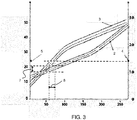
- Figure 3 shows a combination of the two plots of Figures 1 and 2 .
- the left y-axis is the respiratory rate (plot 2) and the right y-axis is the tidal volume (plot 3).
- the corresponding normal breathing rate range can be obtained from the tested tidal volume data and the relationship built during the calibration phase.
- the measured tidal volume is shown as point 4 (with unknown activity level, hence the point is shown on the right y-axis).
- the measured breathing rate may be used to determine the expected range of tidal volumes, and if the measured tidal volume is outside the range, there is a departure from the pair of expected relationships.
- Figure 4 shows a face mask for implementing the approach explained above
- a subject 10 is shown wearing a face mask 12 which covers the nose and mouth of the subject.
- the primary purpose of the mask is to filter air before it is breathed in the subject.
- the mask body itself acts as an air filter 16. Air is drawn into an air chamber 18 formed by the mask by inhalation. During inhalation, an outlet valve 22 such as a check valve is closed due to the low pressure in the air chamber 18.
- the filter 16 may be formed only by the body of the mask, or else there may be multiple layers.
- the mask body may comprise an external cover formed from a porous textile material, which functions as a pre-filter. Inside the external cover, a finer filter layer is reversibly attached to the external cover. The finer filter layer may then be removed for cleaning and replacement, whereas the external cover may for example be cleaned by wiping.
- the external cover also performs a filtering function, for example protecting the finer filter from large debris (e.g. mud), whereas the finer filter performs the filtering of fine particulate matter.
- outlet valve 22 When the subject breathes out, air is exhausted through the outlet valve 22.
- This valve is opened to enable easy exhalation, but is closed during inhalation.
- a fan 20 assists in the removal of air through the outlet valve 22. Preferably more air is removed than exhaled so that additional air is supplied to the face. This increases comfort due to lowering relative humidity and cooling.
- the outlet valve may be a simple passive check valve operated by the pressure difference across the filter 16. However, it may instead be an electronically controlled valve.
- the different prevailing pressure will manifest itself as a different load to the fan, since there is a different pressure drop across the fan. This altered load will then result in a different fan speed.
- the rotation speed of the fan may thus be used as a proxy for a measurement of pressure across the fan. This is a preferred implementation because it uses fewer sensors.
- the pressure monitoring enables determination of a pressure, or at least a pressure change, on the other side of the fan.
- This other side is for example a closed chamber which thus has a pressure different to atmospheric pressure.
- the pressure variation as detected based on monitoring the fan rotation speed, may be used to obtain information about the breathing of the user.
- a first value represents the depth of breathing and a second value represents the rate of breathing.
- the means for determining a rotation speed may comprise an already existing output signal from the fan motor or a separate simple sensing circuit may be provided as an additional part of the fan. However, in either case the fan itself is used so that no additional sensors are required.
- FIG 5 shows one example of the components of the system. The same components as in Figure 4 are given the same reference numbers.
- Figure 5 shows a controller 30, a local battery 32 and a means 36 for determining the fan rotation speed. It shows an output 38 for providing output information to the user. It could be an integrated display, but more preferably it is a wireless communications transmitter (or transceiver) for sending data to a remote device such as a smartphone, which can then be used as the final user interface for providing data to the user, and optionally for receiving control commands from the user for relaying to the controller 30.
- a wireless communications transmitter or transceiver
- the smartphone may also be used for inputting user information to create a user profile.
- the user profile includes at least the age, weight and gender of the user, since these may be used to form the baseline relationships explained above.
- the fan 20 comprises a fan blade 20a and a fan motor 20b.
- the fan motor 20b is an electronically commutated brushless motor
- the means for determining rotation speed comprises an internal sensor of the motor.
- Electronically commutated brushless DC fans have internal sensors that measure the position of the rotor and switch the current through the coils in such a way that the rotor rotates. The internal sensor is thus already provided in such motors to enable feedback control of the motor speed.
- the motor may have an output port on which the internal sensor output 34 is provided. Thus, there is a port which carries a signal suitable for determining the rotation speed.
- the means for determining the rotation speed may comprise a circuit 36 for detecting a ripple on the electrical supply to the motor 20b.
- the ripple results from switching current through the motor coils, which cause induced changes in the supply voltage as a result of the finite impedance on the battery 32.
- the circuit 36 for example comprises a high pass filter so that only the signals in the frequency band of the fan rotation are processed. This provides an extremely simple additional circuit, and of much lower cost than a conventional pressure sensor.
- the motor can be of any design, including a two-wire fan with no in-built sensor output terminal. It will also work with a DC motor with brushes.
- the respiration cycle timing information may then be used to control the outlet valve 22 in dependence on the phase of the respiration cycle.
- the fan speed monitoring thus provides a simple way to determine inhalation phases, which may then be used to control the timing of the outlet valve 22 of the mask.
- the controller may turn off the fan during an inhalation time or an exhalation time. This gives the mask different operating modes, which may be used to save power.
- the calibration process for example involves analyzing the fan speed information over a period during which the subject is instructed to inhale and exhale regularly with normal breathing. The captured fan speed information can then be matched to the breathing cycle, from which threshold values can then be set for discriminating between inhalation and exhalation.
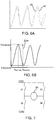
- Figure 6A shows schematically the rotor position (as a measured sensor voltage) against time.
- the rotational speed may be measured from the frequency of the AC component (caused by the switching events in the motor) of the DC voltage to the fan.
- This AC component originates from the current variation that the fan draws, imposed on the impedance of the power supply.
- Figure 6A shows the signal during inhalation as plot 40 and during exhalation as plot 42. There is a frequency reduction during exhalation caused by an increased load on the fan by the increased pressure gradient. The observed frequency changes thus results from the different fan performance during the breathing cycle.
- Figure 6B shows the frequency variation over time, by plotting the fan rotation speed versus time. There is a maximum difference in fan rotation speed ⁇ fan between successive maxima and minima, and this correlates with the depth of breathing. This is the first value derived from the fan rotation signal. The time between these points is used to derive the second value, for example the frequency corresponding to this time period (which is then twice the breathing rate).
- the first value may be obtained from the raw fan rotation signal or there may be smoothing carried out first.
- the maximum swing there are at least two different ways to calculate the maximum swing, based on untreated real-time speeds or treated speeds. In practice, there is noise or other fluctuations added on the real-time signals.
- a smoothing algorithm may be used to treat the real-time signal and calculate the first value from the smoothed signal.
- fan operation forces air out of the area between face and mask. This enhances comfort because exhalation is made easier. It can also draw additional air onto the face which lowers the temperature and relative humidity. Between inhalation and exhalation, the fan operation increases comfort because fresh air is sucked into the space between the face and the mask thereby cooling that space.
- the outlet valve is closed (either actively or passively) and the fan can be switched off to save power. This provides a mode of operation which is based on detecting the respiration cycle.
- the power to the fan can be increased by 30% for enhanced effectiveness.
- a fan using an electronically commutated brushless DC motor has internal sensors that measure the position of the rotor and switch the current through the coils in such a way that the rotor rotates.
- FIG. 7 shows an H-bridge circuit which functions as an inverter to generate an alternating voltage to the stator coils 50 of the motor from a DC supply VDD, GND.
- the inverter has a set of switches S1 to S4 to generate an alternating voltage across the coil 50.
- the switches are controlled by signals which depend on the rotor position, and these rotor position signals may be used to monitor the fan rotation.
- the fan monitoring enables the breathing rate and tidal volume to be determined.
- pressure information or proxy pressure information
- fan rotation speed enable a breathing rate and tidal volume measurement will now be explained.
- An exhaling fan direction is taken as an example.
- the inhaled or exhaled volume is to be calculated. This example is based on the exhaled breath volume.
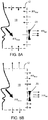
- the volume depends on the breathing flow rate FR nose (e.g. from the nose), the fan flow rate FRfan, and the air flow through the filter. There are two scenarios:
- Figure 8A shows the situation with FR nose ⁇ FR fan , P cavity ⁇ 0 with filter air flow entering the chamber 18.
- Figure 8B shows a situation with FR nose >FR fan , P cavity >0 with the filter air flow leaving the chamber 18.
- the value K is a permeability coefficient, and different filters have different value of K.
- the value FR filter is obtained.
- FR nose FR fan ⁇ FR filter , if P cavity ⁇ 0
- n t / n 0 P cavity t / P cavity 0
- n(0) is the default fan speed when the cavity pressure is P cavity (0)
- P cavity (0) is the baseline of the cavity pressure, which means the user is not breathing.
- n(t) is the fan speed at time t and when the cavity pressure is P cavity (t).
- t n is the time at which exhaling finished.
- the invention enables posture monitoring with low cost (no additional cost for hardware, only some functions added in software), individualized measurement and high accuracy.
- the pressure information may be obtained from the fan speed signal, but pressure sensors may instead be used, and indeed some mask designs already include pressure sensors for breathing detection.
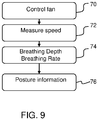
- Figure 9 shows a posture monitoring method, comprising:
- a single processor or other unit may fulfill the functions of several items recited in the claims.
- a computer program may be stored/distributed on a suitable medium, such as an optical storage medium or a solid-state medium supplied together with or as part of other hardware, but may also be distributed in other forms, such as via the Internet or other wired or wireless telecommunication systems.
- a suitable medium such as an optical storage medium or a solid-state medium supplied together with or as part of other hardware, but may also be distributed in other forms, such as via the Internet or other wired or wireless telecommunication systems.
Landscapes
- Health & Medical Sciences (AREA)
- Life Sciences & Earth Sciences (AREA)
- Veterinary Medicine (AREA)
- General Health & Medical Sciences (AREA)
- Pulmonology (AREA)
- Biomedical Technology (AREA)
- Heart & Thoracic Surgery (AREA)
- Engineering & Computer Science (AREA)
- Public Health (AREA)
- Animal Behavior & Ethology (AREA)
- Physics & Mathematics (AREA)
- Medical Informatics (AREA)
- Surgery (AREA)
- Pathology (AREA)
- Molecular Biology (AREA)
- Biophysics (AREA)
- Anesthesiology (AREA)
- Physiology (AREA)
- Emergency Medicine (AREA)
- Hematology (AREA)
- Physical Education & Sports Medicine (AREA)
- Dentistry (AREA)
- Oral & Maxillofacial Surgery (AREA)
- Orthopedic Medicine & Surgery (AREA)
- Rheumatology (AREA)
- Respiratory Apparatuses And Protective Means (AREA)
Priority Applications (1)
| Application Number | Priority Date | Filing Date | Title |
|---|---|---|---|
| EP20180998.5A EP3925531A1 (fr) | 2020-06-19 | 2020-06-19 | Système et procédé de surveillance de posture |
Applications Claiming Priority (1)
| Application Number | Priority Date | Filing Date | Title |
|---|---|---|---|
| EP20180998.5A EP3925531A1 (fr) | 2020-06-19 | 2020-06-19 | Système et procédé de surveillance de posture |
Publications (1)
| Publication Number | Publication Date |
|---|---|
| EP3925531A1 true EP3925531A1 (fr) | 2021-12-22 |
Family
ID=71111277
Family Applications (1)
| Application Number | Title | Priority Date | Filing Date |
|---|---|---|---|
| EP20180998.5A Withdrawn EP3925531A1 (fr) | 2020-06-19 | 2020-06-19 | Système et procédé de surveillance de posture |
Country Status (1)
| Country | Link |
|---|---|
| EP (1) | EP3925531A1 (fr) |
Citations (3)
| Publication number | Priority date | Publication date | Assignee | Title |
|---|---|---|---|---|
| WO2018215225A1 (fr) | 2017-05-22 | 2018-11-29 | Koninklijke Philips N.V. | Masque anti-pollution et procédé de commande |
| EP3574959A1 (fr) * | 2018-05-29 | 2019-12-04 | Koninklijke Philips N.V. | Masque facial d'assistance respiratoire et son procédé de commande |
| WO2020064520A1 (fr) * | 2018-09-27 | 2020-04-02 | Koninklijke Philips N.V. | Masque anti-pollution et procédé de commande |
-
2020
- 2020-06-19 EP EP20180998.5A patent/EP3925531A1/fr not_active Withdrawn
Patent Citations (3)
| Publication number | Priority date | Publication date | Assignee | Title |
|---|---|---|---|---|
| WO2018215225A1 (fr) | 2017-05-22 | 2018-11-29 | Koninklijke Philips N.V. | Masque anti-pollution et procédé de commande |
| EP3574959A1 (fr) * | 2018-05-29 | 2019-12-04 | Koninklijke Philips N.V. | Masque facial d'assistance respiratoire et son procédé de commande |
| WO2020064520A1 (fr) * | 2018-09-27 | 2020-04-02 | Koninklijke Philips N.V. | Masque anti-pollution et procédé de commande |
Non-Patent Citations (4)
| Title |
|---|
| JING XIAN LI ET AL: "The effect of load carriage on movement kinematics and respiratory parameters in children during walking", EUROPEAN JOURNAL OF APPLIED PHYSIOLOGY, vol. 90, no. 1-2, 29 May 2003 (2003-05-29), DE, pages 35 - 43, XP055755441, ISSN: 1439-6319, DOI: 10.1007/s00421-003-0848-9 * |
| JING XIAN LIYOULIAN HONGPAUL D. ROBINSON: "The effect of load carriage of movement kinematics and respiratory parameters in children during walking", EUR J APPL PHYSIOL, vol. 90, 2003, pages 35 - 43 |
| KRISTIN S. ONDRAKROBERT G. MCMURRAY: "Exercise-induced breathing patterns of youth are related to age and intensity", EUR J APPL PHYSIOL, vol. 98, 2006, pages 88 - 96, XP019427215, DOI: 10.1007/s00421-006-0248-z |
| WEBER Z J ET AL: "Resistance to nasal airflow related to changes in head posture", AMERICAN JOURNAL OF ORTHODONTICS,, vol. 80, no. 5, 1 November 1981 (1981-11-01), pages 536 - 545, XP023063760, ISSN: 0002-9416, [retrieved on 19811101], DOI: 10.1016/0002-9416(81)90248-7 * |
Similar Documents
| Publication | Publication Date | Title |
|---|---|---|
| CN212214401U (zh) | 防污染面罩 | |
| KR102892527B1 (ko) | 사용량 또는 순응도 예측 | |
| KR101967665B1 (ko) | 웨어러블 측정기를 이용한 원격 척추 진단 시스템 | |
| JP6404819B2 (ja) | 睡眠段階を決定するシステム及び方法 | |
| US10758164B2 (en) | Processing apparatus and processing method for determining a respiratory signal of a subject | |
| CN108245131B (zh) | 检测早期呼气中的口呼吸 | |
| CN109952056B (zh) | 用于co2监测的设备、系统和方法 | |
| KR101331092B1 (ko) | 안경형태의 착용형 호흡 측정 장치 | |
| CN111493874A (zh) | 一种人体呼吸频率测量系统及配备该测量系统的智能座椅 | |
| WO2016029265A1 (fr) | Diagnostic, surveillance et traitement de troubles respiratoires | |
| CN102178529A (zh) | 基于体域网的呼吸疾病远程诊断监护系统 | |
| CN113855955B (zh) | 一种呼吸机多模式工作控制系统及呼吸机 | |
| CN114072209B (zh) | 呼吸分析遮罩及呼吸分析方法 | |
| EP3915645A1 (fr) | Masque de pollution et procédé de commande | |
| EP3791936A1 (fr) | Masque et procédé d'analyse respiratoire | |
| EP3669946A1 (fr) | Détection de fuite de masques faciaux | |
| EP3925531A1 (fr) | Système et procédé de surveillance de posture | |
| CN110947114A (zh) | 防污染面罩及控制方法 | |
| CN117794450A (zh) | 用于呼吸锻炼的系统和方法 | |
| CN220309119U (zh) | 具有呼吸实时监测和呼吸训练功能的数字口罩 | |
| KR102497384B1 (ko) | 마스크를 이용한 건강 진단 시스템 | |
| CN114080257B (zh) | 带污染感测的防污染面罩 | |
| EP3791934A1 (fr) | Masque de pollution pouvant détecter la pollution | |
| CN116850547B (zh) | 带有呼吸功能实时监测的呼吸训练数字口罩及训练系统 | |
| EP4142887B1 (fr) | Dispositif de ventilation pour masque filtrant |
Legal Events
| Date | Code | Title | Description |
|---|---|---|---|
| PUAI | Public reference made under article 153(3) epc to a published international application that has entered the european phase |
Free format text: ORIGINAL CODE: 0009012 |
|
| STAA | Information on the status of an ep patent application or granted ep patent |
Free format text: STATUS: THE APPLICATION HAS BEEN PUBLISHED |
|
| AK | Designated contracting states |
Kind code of ref document: A1 Designated state(s): AL AT BE BG CH CY CZ DE DK EE ES FI FR GB GR HR HU IE IS IT LI LT LU LV MC MK MT NL NO PL PT RO RS SE SI SK SM TR |
|
| B565 | Issuance of search results under rule 164(2) epc |
Effective date: 20201210 |
|
| STAA | Information on the status of an ep patent application or granted ep patent |
Free format text: STATUS: THE APPLICATION IS DEEMED TO BE WITHDRAWN |
|
| 18D | Application deemed to be withdrawn |
Effective date: 20220623 |