EP3926546A2 - Procédé de division de modèle de réseau neuronal, appareil, dispositif informatique et support d'informations - Google Patents
Procédé de division de modèle de réseau neuronal, appareil, dispositif informatique et support d'informations Download PDFInfo
- Publication number
- EP3926546A2 EP3926546A2 EP20756078.0A EP20756078A EP3926546A2 EP 3926546 A2 EP3926546 A2 EP 3926546A2 EP 20756078 A EP20756078 A EP 20756078A EP 3926546 A2 EP3926546 A2 EP 3926546A2
- Authority
- EP
- European Patent Office
- Prior art keywords
- splitting
- state
- operator
- path
- tensor data
- Prior art date
- Legal status (The legal status is an assumption and is not a legal conclusion. Google has not performed a legal analysis and makes no representation as to the accuracy of the status listed.)
- Pending
Links
Images


Classifications
-
- G—PHYSICS
- G06—COMPUTING OR CALCULATING; COUNTING
- G06N—COMPUTING ARRANGEMENTS BASED ON SPECIFIC COMPUTATIONAL MODELS
- G06N3/00—Computing arrangements based on biological models
- G06N3/02—Neural networks
- G06N3/06—Physical realisation, i.e. hardware implementation of neural networks, neurons or parts of neurons
- G06N3/063—Physical realisation, i.e. hardware implementation of neural networks, neurons or parts of neurons using electronic means
-
- G—PHYSICS
- G06—COMPUTING OR CALCULATING; COUNTING
- G06N—COMPUTING ARRANGEMENTS BASED ON SPECIFIC COMPUTATIONAL MODELS
- G06N3/00—Computing arrangements based on biological models
- G06N3/02—Neural networks
- G06N3/04—Architecture, e.g. interconnection topology
-
- G—PHYSICS
- G06—COMPUTING OR CALCULATING; COUNTING
- G06N—COMPUTING ARRANGEMENTS BASED ON SPECIFIC COMPUTATIONAL MODELS
- G06N3/00—Computing arrangements based on biological models
- G06N3/02—Neural networks
- G06N3/04—Architecture, e.g. interconnection topology
- G06N3/045—Combinations of networks
-
- G—PHYSICS
- G06—COMPUTING OR CALCULATING; COUNTING
- G06N—COMPUTING ARRANGEMENTS BASED ON SPECIFIC COMPUTATIONAL MODELS
- G06N3/00—Computing arrangements based on biological models
- G06N3/02—Neural networks
- G06N3/04—Architecture, e.g. interconnection topology
- G06N3/0464—Convolutional networks [CNN, ConvNet]
Definitions
- the present disclosure relates to the field of artificial intelligence technology, and in particular relates to a neural network model splitting method and related products.
- deep learning accelerators have been proposed and, similar to general-purpose processors, are developing from a single-core architecture to a multi-core architecture.
- This expanded multi-core architecture can support data parallel in the training phase to improve data throughput and speed up training.
- deep neural networks have higher requirements for end-to-end latency than throughput, which often determines the availability of accelerators in a certain scenario.
- Traditional data parallel schemes fail to meet the requirements for small batch and low latency of accelerators in the inference scenario.
- the present disclosure provides a neural network model splitting method to realize the above-mentioned purpose.
- the method includes:
- the present disclosure provides a neural network model splitting apparatus to realize the above-mentioned purpose.
- the apparatus includes:
- the present disclosure provides a neural network model splitting method to realize the above-mentioned purpose.
- the method includes:
- the present disclosure provides a neural network model splitting apparatus to realize the above-mentioned purpose.
- the apparatus includes:
- the present disclosure further provides a neural network model splitting method to realize the above-mentioned purpose.
- the method includes:
- the present disclosure provides a neural network model splitting apparatus to realize the above-mentioned purpose.
- the apparatus includes:
- the present disclosure further provides a neural network model splitting method to realize the above-mentioned purpose.
- the method includes:
- the present disclosure provides a neural network model splitting apparatus to realize the above-mentioned purpose.
- the apparatus includes:
- the technical solution provided by the present disclosure can facilitate the expansion of deep learning accelerators from a single-core architecture to a multi-core architecture in the cost of relatively small overhead, and offers a highly-efficient splitting method for a given network and an underlying accelerator, which may efficiently decrease the end-to-end latency of different networks on a multi-core accelerator.
- deep learning accelerators have become a rapidly developing field. These newly emerged accelerators often have greater advantages over GPU in terms of performance per watt.
- deep learning accelerators can also be expanded from a single-core architecture to a multi-core architecture. This expansion is very suitable for data parallel training in deep learning.
- Data parallel refers to speeding up training by dividing a training data set into several parts, and using a plurality of processing cores to process some sub-data sets separately.
- each core processes different data sets of the training data in parallel, thereby improving the throughput of the entire system and speeding up training. Therefore, the multi-core accelerator architecture can easily improve the computing throughput of the entire system during the training phase while maintaining a good performance per watt of each core.
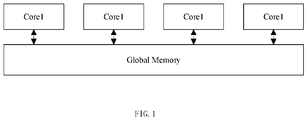
- this shared memory multi-core architecture is a classic multi-core architecture, which is very suitable for data parallel neural network training methods.
- Each core can serve as a processor in data parallel to read different data respectively, and then complete the forward and backward computations of a neural network model in parallel.
- Each core can still maintain its good performance per watt under the previous single-core architecture in the computation phase, and at the same time, the throughput of the entire system can also be improved with the expansion of the count of cores.
- a problem with data parallel is that its expandability depends on the size of data batch to be processed. Although this is usually not a problem in the training phase, the premise is difficult to be guaranteed in the inference phase.
- a neural network model used in the real-time service field (including automated driving and the like), data to be processed is usually input serially as a stream, resulting in a situation where data to be processed each time is very small or even may be a single picture.
- data parallel cannot provide any parallelism and all work tasks will be on a single core, which leads to a result that the computing resources of a plurality cores cannot contributes to the speed of task processing.
- Latency refers to the time from the server receiving the data to be processed to the return of the processed result, which in other words, is the data processing time of the neural network model. Low latency ensures that the cloud server can respond to the data sent by the client in the shortest time. In some sensitive scenarios, latency directly determines whether the solution is feasible. Therefore, in the online inference phase, the requirements for accelerators have changed from processing large batches of data with high throughput to processing small batches of data with low latency.
- Model parallel is usually a method used to solve a problem that a large-scale neural network model exceeds the memory limit of a single equipment. Assigning operators to different cores does not reduce the network latency. In order to effectively reduce the latency of inference tasks on multi-core accelerators, it is necessary to find a method to reasonably allocate the inference computation tasks for small batches of data or even a single piece of data to the cores of the multi-core architecture accelerators, and ensure that there are as many cores as possible that are involved in the computations at every moment.
- a method is to split a computation task of each operator in the neural network and then allocate the split computation task to a plurality of cores for computations, which can ensure that there are a plurality of cores participating in computations at every moment even when the computation task is an inference task of processing a single picture, thereby achieving the purpose of using multi-core resources to reduce latency.
- the neural network model can be regarded as a complex computation graph that is composed of hundreds or even thousands of operators.
- the algorithm logic in different types of operators may differ, which requires different splitting methods for these operators.
- factors that should be considered for operator splitting also includes the operators before and after the operator to be split, and even the overall impact of the splitting. Since the rapid development of deep learning has brought more and more large-scale and complex networks, it is unrealistic to find a good parallel method manually. In this case, an automated method is required for providing a good strategy of splitting for parallelism for different networks.
- the portability of the underlying accelerator should also be considered.
- accelerators that do not have good programmability there may be a heavy workload brought by the expansion from a sing-core architecture to a multi-core architecture as well as the modification of the software stack for realizing the splitting for parallelism within an operator.
- the implementation of traditional data parallel and model parallel is still based on a processing core to complete the computation task of an operator, which will not bring too much extra work.
- the cross-core parallel of a single operator requires modification of the implementation of the operator. The difficulty of such modification depends on the programmability of the accelerator and the complexity of the implementation logic of the original operator.
- an end-to-end splitting scheme is automatically provided for a large-scale neural network model.
- This scheme splits an operator into a plurality of smaller-scale sub-operators, so that a compute library under the single-core architecture can be called directly, which helps to avoid the extra work caused by re-implementation.
- an activation operator can be split to obtain many smaller activation operators, which means that instead of modifying or re-implementing an activation function of a multi-core version, only the original single-core activation function needs to be called on the plurality of cores to complete each sub-task.
- the ultimate goal is to obtain a scheme of splitting for parallelism that can effectively reduce the end-to-end inference latency of the entire neural network model.
- a car needs to analyze and process external information such as images, videos, and voices transferred from the car sensor during the automated driving process.
- external information such as images, videos, and voices transferred from the car sensor during the automated driving process.
- the car In order to ensure safety, the car must obtain the processing result in the shortest time to make decisions.
- a car that uses a chip with the multi-core processor architecture can allocate the computational workload of processing small batches of external information by the neural network model to a plurality of processor cores in a balanced manner, complete the information processing within the specified response time, and return a processing result to assist automated driving.
- the technical scheme provided by the present disclosure can facilitate the expansion of deep learning accelerators from a single-core architecture to a multi-core architecture in the cost of relatively small overhead, which may efficiently decrease the end-to-end latency of different networks on a multi-core accelerator.
- the chip with the multi-core processor architecture is set in the vehicle.
- the chip with the multi-core processor architecture can also be set in the cloud server.
- a car can transfer images, videos, voices and other external information obtained by the car sensor to the cloud server through 3G/4G, WIFI, and other networks.
- the cloud server can use this scheme to allocate the computational workload of processing small batches of external information by the neural network model to a plurality of processor cores in a balanced manner. Within the specified response time of the car, the cloud server feeds back the processing result to the car through 3G/4G, WIFI, and other networks.
- the scale of external information collected by the car sensor may be different.
- the car processor uses this scheme to determine the corresponding operator splitting path according to the scale of external information.
- the operator splitting schemes corresponding to different scales of external information are stored in the corresponding areas.
- the chip with the multi-core processor architecture calls the corresponding operator splitting path after obtaining external information, splits the operator in the neural network model, and allocates the computational workload of the external information to a plurality of processor cores in a balanced manner.
- the upper framework needs to call the compute library to obtain the instruction implementation of each neural network model operator on the processor. Specifically, the framework informs the compute library of the type and parameters of each operator, and the compute library returns the machine instruction required for executing the operator on the processor. The framework loads data and the machine instruction onto the processor through a driver, starts the processor to complete the computation of the operator.
- the compute library needs to be re-designed so that the compute library can generate machine instructions that can run on a plurality of cores. Specifically, since the plurality of cores need to read different parts of the same input tensor data, and also need to write their output back to different parts of the same output tensor data, the compute library needs to modify all the computation instructions for reading and storing of each operator.
- the neural network splitting method provided by the embodiment of the present disclosure can help to avoid modifying the compute library of the single-core processor, and to realize the parallel execution of the neural network model on the multi-core processor.
- the upper framework divides the operator in the neural network model into several sub-operators that can be executed in parallel. For each sub-operator, the framework calls the compute library to generate a machine instruction for executing the sub-operator on a single core. By loading the machine instruction of each sub-operator on different cores, the parallel computation of the operator on the multi-core processor is realized.
- the framework uses the compute library of a single-core processor to generate computation instructions for sub-operators
- the input and output tensor data of the operator in the neural network model are also split into corresponding sub-tensor data as the operator is split into sub-operators.
- FIG. 2 shows a flowchart of a neural network model splitting method according to an embodiment of the present disclosure.
- the method includes: a step 201: according to an operator of a target layer in the neural network model, determining a splitting state set of tensor data associated with the operator of the target layer.
- the neural network model is usually regarded as a directed acyclic graph consisting of operators and multi-dimension tensor data.
- the operators and tensor data are interconnected by directed edges.
- the directed edges indicate whether data is input to or output by an operator.
- op denotes an operator
- tensor denotes tensor data.
- the framework uses the splitting method of tensor data that is associated with the operator to explain the splitting method of different operators. It is assumed that all tensor data in the network are 4-dimensional data.
- N, C, H, W denote the four dimensions respectively.
- N denotes the batch size
- C denotes a count of feature images
- H denotes the height of a feature image
- W denotes the width of a feature image.
- this technical scheme uses the splitting state of the input tensor data and output tensor data of an operator to express the splitting of the computational logic of the operator.
- This technical scheme can split all operators in the entire neural network model, or split some operators in the neural network model. Moreover, currently new network structures and algorithms in the deep learning field have gradually blurred the physical meaning of data dimensions and also the boundary between data dimensions. This technical scheme can be extended to be applied to operator splitting in more dimensions.
- a kind of tensor data splitting is called a state s of the tensor data. After splitting the tensor data, a sub-tensor data set can be obtained. The state s is represented by the corresponding sub-tensor data set. All possible splitting states ⁇ s 0 , s 1 , s 2 , ... ⁇ form the splitting state set S of the tensor data. Generally speaking, S is a very large state space, which means that the space of the possible splitting methods of the operator represented by the splitting state of the tensor data can also be very huge.
- the state set of the tensor data can be pruned.
- the latency of completing the computation of an operator by a multi-core accelerator depends on a core that takes a longest time to execute a sub-task.
- different cores are equal to each other in terms of the hardware structure, therefore, the time spent by each core depends on the task load assigned to the core. Therefore, a reasonable assumption is to ensure that the scale of the sub-operators after splitting is generally balanced. For this reason, the unbalanced splitting state can be omitted from the state set S of the tensor data.
- the count of cores in the multi-core architecture is usually an integer power of 2, such as 1, 2, 4, 8, 16, and so on.
- a task, of which parallelism is not an integer power of 2 may often cause "fragments" in the scheduling of the cores. Therefore, the count of sub-operators after splitting should be an integer power of 2. Based on these two assumptions, the search space of the operator splitting strategy may be greatly reduced.
- any splitting state of tensor data associated with an operator can be chosen to represent an effective splitting method of the operator.
- a dimension where the tensor data splitting is performed should be supported by the operator.
- input data of a normalized exponential regression operator (Softmax) should not be split in a dimension to be normalized.
- Softmax normalized exponential regression operator
- the splitting of an input tensor and an output tensor of the operator should satisfy the computational logic of the operator.
- the start and end points of each sub-block obtained by splitting in the H/W dimension of output data of a convolution operator should be computed according to a sub-block of corresponding input data that is obtained by splitting in the H/W dimension based on a convolution kernel and an offset stride of the convolution operator; input data of the convolution operator should be split in the C dimension in a way that is exactly the same as how weight data is split in the C dimension, and output data of the convolution operator should be split in the C dimension in a way that is exactly the same as how the weight data is split in the N dimension.
- an output state can be used to infer an input state of the operator according to the specific logic of the operator, or an input state can be used to infer an output state of the operator according to the specific logic of each operator, which ensures that the state of related data can always represent an effective operator splitting method.
- the method includes a step 202: traversing the splitting state set according to a directed acyclic graph of the neural network model, and determining a state path between adjacent splitting state sets and a weight of the state path.
- the splitting method P of the entire neural network model can be regarded as a jump from a splitting state in the splitting state set of input tensor data of each operator to a splitting state in an output tensor.
- the splitting state of the output tensor of a previous operator is the splitting state of the input tensor of a next operator.
- Each possible jump through an operator corresponds to an effective splitting method of the operator. Therefore, the state path represents the splitting method of an operator.
- tensor data is decomposed according to a decomposition method to obtain a sub-tensor set.
- the sub-tensor set corresponds to a splitting state.
- Multiple splitting states can be obtained by using different decomposition methods.
- the splitting states obtained by using all decomposition methods form a splitting state set. It can be seen that each splitting state corresponds to a sub-tensor set which includes all the elements in the tensor data.
- the elements of each sub-tensor may or may not overlap.
- the state path represents the splitting method of the operator, and the computational logic of the operator is split according to the splitting method corresponding to the state path to obtain the corresponding sub-operator set.
- the state of input tensor data and the state of corresponding output tensor data are connected by a state path, and a sub-tensor data set representing a splitting state of the input tensor data is processed by a sub-operator in a sub-operator set to obtain a sub-tensor data set of a corresponding splitting state of the output tensor data.
- the weight of a state path represents the time that a multi-core accelerator takes to parallelly execute an operator in a certain splitting state.
- the time that a multi-core accelerator takes to complete the computation of an operator depends on a core that takes a longest time to execute a sub-task. Parameters are used for estimation when the weight of the state path is computed:
- the operation of finding the maximum value of the inner side is based on the fact that the computation part and the memory access part realized by the operator can hide from each other. In other words, the computation part and the memory access part can be executed concurrently as much as possible. For some accelerators, when the size of the sub-operator is too small, the computational throughput of each core will decrease. In this case further corrections can be made to ⁇ make the estimated value more accurate.
- the operation of finding the maximum value of the outer side which is the time for the multi-core accelerator to complete the computation of the operator, depends on a core that takes a longest time to execute a sub-task.
- the weight for measuring the state path can be not only the time taken to execute the sub-task, but also the throughput of the execution of the sub-task.
- the weight of the state path can also be determined by measuring the time for executing all sub-tasks in the operator splitting mode corresponding to the state path by the multi-core processor.
- the method includes a step 203: determining a target splitting path of the target layer according to the weight of the state path.
- a first method is to determine the splitting path by forward traversal, which includes the following steps:
- a second method is to determine the splitting path by back traversal, which includes the following steps:
- the neural network model shown in FIG. 3 is serial, the input tensor data and the output tensor data of the entire neural network model are both in unsplit state.
- a serial neural network model containing n operators are described as an operator sequence ( op 1 , op 2 ,...
- a goal of the searching strategy is to find a mapping relationship tensor i ⁇ s i between a tensor and a state in the state set of the tensor.
- a splitting method of all operators can then be determined. Therefore, the mapping relationship between all tensors in a neural network model and the splitting state of those tensors is called a splitting method P of the network model.
- the i-th operator op i uses input data that is in the splitting state s to compute output tensor data that is in the splitting state r .
- the specific parallel computation method is determined according to the state of the input tensor data and the output tensor data.
- the computation time of this operator is marked as t s ⁇ r
- the value of the operator depends on the corresponding splitting method and the hardware characteristics of the underlying accelerator
- t i can be regarded as the weight of the directed edge of the state of the input tensor data of the operator pointing to the state of the output tensor data.
- t i can be regarded as the weight of the directed edge of the state of the input tensor data of the operator pointing to the state of the output tensor data.
- their corresponding splitting state spaces have only one state that is unsplit and keeps the entire data block continuous and complete, so that the splitting method P of the neural network model can start with complete input data and end with complete output data. In this way, external users can always see complete input and output.
- the unsplit state of the input tensor data of the entire neural network model is a starting state s root .
- the unsplit state of the input tensor data of the neural network model is the starting state s root
- the weight of the corresponding splitting path is 0,
- the weight of the corresponding splitting path of all states of all remaining tensor data is ⁇ .
- a state s of a piece of tensor data in the neural network model has a corresponding splitting path that is from s root to s, and the weight of the splitting path is l s .
- Each splitting state set is visited from front to back, and in each splitting state set, each state s is traversed sequentially.
- Each state s points to each directed edge ei, ..., e ks of several splitting states in a next splitting state set.
- the formula (1) is used to obtain the weight tsv between the state s and the state ⁇
- the formula (5) below is used to update the weight l ⁇ of the splitting path starting from s root to the state v, where the splitting path corresponds to the state ⁇ in the next splitting state set pointed by the state path.
- l ⁇ min l ⁇ , l s + t s ⁇
- a target splitting path from the unsplit state s root of input tensor data of the entire neural network model to the unsplit state s end of output tensor data of the neural network model can be obtained.
- the above description describes a path going through a state of every splitting state set from the unsplit state s root to the unsplit state s end , which is the splitting path of the neural network model.
- a splitting path with the smallest weight is selected from the splitting paths of the neural network model as the target splitting path of the neural network model.
- the neural network model shown in FIG. 3 is a serial neural network model, and in order to facilitate the description of this technical scheme, the corresponding splitting state set of the input tensor data and output tensor data of the neural network model is the unsplit state.
- the splitting state set of the output tensor data of the neural network model is not the unsplit state s end , but a set of a plurality of splitting states, the smallest weight is selected from the weights of the splitting path of each splitting state in the splitting state set of the output tensor data of the neural network model as the target splitting path between the splitting state set of the input tensor data of the entire neural network model and the splitting state set of the output tensor data of the neural network model.
- the entire scheme can also be changed to searching for a splitting path from the unsplit state s end to the unsplit state s root , and the two are equivalent.
- the splitting state set of the input tensor data of the neural network model is not the unsplit state s end , but a set of a plurality of splitting states, the smallest weight is selected from the weights of the splitting path of each splitting state in the splitting state set of the input tensor data of the neural network model as the target splitting path between the splitting state set of the input tensor data of the entire neural network model and the splitting state set of the output tensor data of the neural network model.
- the neural network model shown in FIG. 3 is a serial neural network model, and the state in the splitting state set of the input tensor data and the output tensor data of the model is the unsplit state.
- the technical schemes shown in FIGs. 2 , 4 , 7 and 9 all need to solve the problem of consistency of the splitting method of different branches in a multi-branch neural network model.
- the operator at the junction of branches has more than one input tensor data, such as a bitwise addition operator (Add), a bitwise multiplication operator (Mult), and a concatenation operator (Concat).
- the two input tensor data tensor left and tensor right have corresponding splitting state sets S left and S right .
- the two branches will extend until the end of the traversal, indicating that the entire network has more than one input data, which is not common in an inference task. In another case, the two branches merge together at a certain operator.
- splitting states that do not match each other may be selected for the two input tensor data tensor left and tensor right of the operator A.
- the state selected by the backtracking process in the splitting state set of the tensor left may be a state that is only split in the C dimension
- the state selected in the splitting state set of tensor right may be a state that is only split in the H dimension.
- the splitting methods of the addition operator represented by the two splitting states are inconsistent, which may cause the entire splitting plan P to be invalid.
- the splitting state set of tensor left and tensor right contains only one splitting state, which further ensures the certainty of the state selected in the two state sets during the backtracking process. Therefore, in the forward traversal phase, when the output tensor data of the operator is used as input tensor data by at least two operators, or the operator has at least two output tensor data, one splitting state in the splitting state set of the output tensor data of the operator is retained, where the splitting state is determined according to the same state path of the operator.
- the back traversal phase when the operator has at least two input tensor data, one splitting state in the splitting state set of the input tensor data of the operator is retained, where the splitting state is determined according to the same state path of the operator. In this way, before finishing traversing a branch operator, the state with the smallest accumulative weight will be selected from the splitting state sets of a plurality of input data and retained, and the other splitting states in the splitting state sets will be removed.
- the above method of obtaining the target splitting path is similar to the Viterbi algorithm.
- the embodiments only list some rather than all examples.
- Those skilled in the art may make modifications and changes based on the understanding of the essence of the technical solution of this disclosure.
- An example of such modifications and changes may be: the weight of each splitting path from the splitting state set of the input tensor data of the neural network model to the splitting state set of the output tensor data of the neural network model is determined according to the sum of the weights of corresponding state paths.
- a threshold can be set based on experience. When the weight of a splitting path is less than a preset threshold, the splitting path can serve as a target splitting path for splitting the neural network model.
- the method should all fall within the protection scope of this disclosure.
- the method includes a step 204: splitting the operator of the target layer in the neural network model by using the target splitting path.
- the hardware resources of the multi-core processor structure chip may be fully utilized by splitting the computational logic of an operator in a neural network into smaller sub-tasks and assigning the sub-tasks to the plurality of cores for parallel execution.
- accelerators usually further adjust the order of data in the memory to improve the efficiency of memory access during computation, which makes it more difficult and cumbersome to modify the output logic of the operator.
- the computational logic or splitting logic of the subsequent operator does not require the input data to ensure storage continuity in a certain dimension, the data that is output from the previous layer and that is in a discrete storage state in this dimension can be directly used in the computation of the next layer without the need to ensure the continuity of the output data.
- the framework separates the task of adjusting the splitting form of tensor data from the computation tasks of the operator, and abstracts the task into a new operator which is called a glue operator.
- This separation avoids the modification on the output logical of each operator and enhances the portability of the framework to different underlying accelerators.
- the glue operator is used to adjust the sub-data blocks obtained by splitting a tensor in a certain way into sub-data blocks obtained by splitting the tensor in another way. As shown in Table 1, the splitting methods allowed by different types of operators are different when expressed by the input tensor data and output tensor data.
- the splitting method of the output tensor data of the operator of the previous layer is not allowed by the operator of the next layer, it is necessary to use the glue operator to adjust the splitting method of the tensor data, so as to "glue" the two operators.
- the splitting of tensor data can also be adjusted to a form that is more conducive to the computation of the next layer by using the glue operator.
- the present disclosure provides another neural network model splitting method.
- the method further includes: a step 201': inserting a glue operator between the operator of the target layer and the associated splitting state set to adjust a state in the splitting state set of the tensor data of the operator, where the glue operator is used for adjusting a state of the tensor data that is obtained in a splitting manner to another state that is obtained in another splitting manner.
- the glue operator is used to express the behavior of adjusting the splitting state of tensor data.
- the computational scale of each layer of the neural network model changes with the extension of the network.
- the splitting trend of the neural network model requires adjustments to the way the operator is split, that is, adjustments to the state of intermediate results.
- a glue operator is added between Op_2 of FIG. 3 and the input Tensor1 of Op_2, which can convert any splitting state of tensor data into another splitting state.
- the input tensor data and output tensor data of the glue operator have the same shape and the same state space.
- FIG. 5 shows that a glue operator is inserted between the operator and the corresponding input tensor data.
- a glue operator may also be inserted between the operator and the corresponding output tensor data, or may be inserted between the operator and the input tensor data and between the operator and the output tensor data.
- the situation above only shows some examples and is not an exhaustive list.
- Those skilled in the art may make changes or transformations to the technical scheme of the present disclosure based on their understanding of the essence of the technical scheme of the disclosure. However, as long as the functions and technical effects realized by the changes or transformations are similar to those of this disclosure, they should all fall within the protection scope of this disclosure.
- the splitting method of the operator can be adjusted accordingly, however, this adjustment will bring additional overhead. How to appropriately insert a glue operator to the entire neural network model to improve the performance of the neural network model has become a problem.
- the following method may be used: inserting a glue operator between the operator of the target layer of the neural network model and the associated splitting state set to obtain a directed acyclic graph of the neural network model that includes the glue operator; according to the directed acyclic graph, traversing the splitting state sets corresponding to all tensor data of the target layer, and determining a state path between adjacent splitting state sets and a weight of the state path; according to the weight of the state path, determining a splitting path of the target layer of the neural network model that includes the glue operator; and using the splitting path of the target layer of the neural network model that includes the glue operator to select the respective glue operators inserted to the target layer, removing the glue operator that does not need to be inserted and keeping the glue operator that needs to be inserted.
- a glue operator uses one of the following four implementation manners: split-splice, splice-split, splice, and split.
- a glue operator can splice adjacent sub-data blocks in any dimension into a new data block.
- a glue operator can split any sub-data block into two smaller sub-data blocks. Any splitting form can be converted into another splitting form through this two-stage process. To illustrate this point, it is assumed that the data is one-dimensional.
- the splitting form before adjustment is expressed as ⁇ (0, p 1 ) , ( p 1 , p 2 ) , ..., ( p n-1 , end ) ⁇ , where each segment represents a sub-segment after the one-dimensional data is split.
- the splitting form after adjustment is ⁇ (0, q 1 ) , ( q 1 , q 2 ) , ..., ( q m-1 , end ) ⁇ .
- the splicing stage is skipped and the splitting is performed in the splitting stage.
- all data can be combined into a complete one-dimensional data in the splicing stage, and the splitting is performed in the splicing stage.
- the glue operator adopts the split-splice or splice-split method
- the total size of tensor data to be adjusted is M
- neither of the two stages can be skipped, and splicing or splitting must be performed on 4 dimensions in each of the stages.
- splicing and splitting are usually implemented by using a concatenation operator (Concat) and a splitting operator (Slice) that come with the neural network algorithm. Since these two operators can only handle one dimension at a time, a glue operator may cause an 8M storage read and write overhead in a worst case.
- the glue operator and an ordinary neural network operator are subject to the same processing.
- the glue operator adjusts the splitting state of tensor data
- the glue operator has the corresponding time t , which is used as the weight of the corresponding state path.
- the formula (5) is again used to obtain a target splitting path from the unsplit state s root of input tensor data of the entire neural network model that includes the glue operator to the unsplit state s end of output tensor data of the neural network model.
- a splitting state corresponding to the input tensor data of each glue operator and a splitting state corresponding to the output tensor data are checked.
- the splitting state status_1 in the splitting state set Tensor_1 shown in FIG. 5 is connected to the splitting state status_1 in the splitting state set Tensor_1' through the state path, and the two splitting states are considered the same. It shows that the splitting path P of the target layer of the neural network model does not need to adjust the splitting state of the input tensor data of the operator Op_2, which is a result based on the consideration of neighboring operators and the overall performance. The glue operator inserted between the operator Op_2 and the corresponding input tensor data will be removed from the network. Otherwise, the inserted glue operator needs to be retained.
- the implementation of the glue operator uses the original operator in the neural network model.
- the splicing stage corresponds to the Concat operator in the neural network model
- the splitting stage corresponds to the Slice operator in the neural network model. Any accelerator that already supports these two operators can quickly implement the glue operator.
- the above method of obtaining the target splitting path is similar to the Viterbi algorithm. The embodiment only list some rather than all examples. Those skilled in the art may make modifications and changes based on the understanding of the essence of the technical solution of this disclosure.
- the weight of each splitting path from the splitting state set of the input tensor data of the neural network model to the splitting state set of the output tensor data of the neural network model is determined according to the sum of the weights of corresponding state paths.
- a threshold can be set based on experience. When the weight of a splitting path is less than a preset threshold, the splitting path can serve as a target splitting path for splitting the neural network model.
- the method should all fall within the protection scope of this disclosure.
- the convolution operator is a special operator for a neural network model. In some cases, additional auxiliary operators are needed to complete a splitting task.
- the computation is divided according to the H/W dimension of the input tensor data, if the size of the convolution kernel window exceeds the stride of each movement thereof, that is, kernel > stride, then during the computation, there is a case where the window boundary of the split convolution operator moves outside the boundary of the tensor data, and the missing part of the data is located in the adjacent sub-tensor data.
- the behavior of requiring access to the boundary data of adjacent sub-tensor data is separated to form a new auxiliary operator, which is called a compensation operator.
- the compensation operator is used to obtain target data from adjacent sub-tensor data except one piece of sub-tensor data, and merge the target data and the sub-tensor data to form a larger piece of data.
- the moving range of the window will not exceed the boundary of this compensated data block.
- the pooling operator and the currently less common local response normalization (LRN) operator also have the problem that a split subtask depends on data on an adjacent data block.
- the pooling operator is similar to the convolution operator. The problem is mainly because the pooling window is larger than the stride of the window. However, the LRN operator is different.
- the computational logic of the LRN operator is: to compute a result of a point of the output tensor data in the C dimension, the value of the corresponding point of the input tensor data in the C dimension and the values of k/2 points located to the left and right of the point are required. Therefore, if the computation of the LRN operator is to be divided into a plurality of LRN operators according to the C dimension, each new operator also needs the element data in the adjacent sub-tensor data to compute the value at the C dimension boundary.
- a first type is the point-to-point operator, which is an operator that only requires the value of a corresponding data point of the input tensor in order to compute a data point of the output tensor data.
- This type of operator includes activation operator (Relu, pRelu), batch normalization operator (BatchNorm), and basic operator of bitwise addition, subtraction, multiplication and division (Add, Sub, Mult, Div).
- a second type is the fully dependent operator, which is an operator that requires all values of the input tensor in a dimension in order to compute a data point of the output tensor data.
- the convolution operator and the fully connected operator require all data points of the input tensor in the C dimension in order to compute a data point of the output tensor data in the C dimension, though the splitting of the convolution operator in the input C dimension can be realized by accumulating the partial sum afterwards, when the computational logic of the operator in the C dimension gets more complex, such as in the case of the normalized exponential regression operator (Softmax), the formula (6) can be used for the computation in the normalized dimension.
- O i e I i ⁇ j e I j
- I denotes the vector of the input tensor data in the normalized dimension
- O is the vector of the output tensor data in the normalized dimension.
- the compensation operator is actually used to deal with a third case between the point-to-point operator and the fully dependent operator.
- the data of the input tensor data in the area near the corresponding position is required.
- the area near the corresponding position is determined according to compensation parameters.
- the operator can still be split in the computational logic, though they will rely on data other than the sub-tensor data, which can be solved by the use of compensation operators.
- step 201" inserting a compensation operator between the operator of the target layer and the associated splitting state set to adjust a state in the splitting state set of the input tensor data of the operator, where the compensation operator is used for obtaining target data from adjacent sub-tensor data of any tensor data of the state, and merging the target data with the sub-tensor data.
- the framework introduces a compensation operator. Before the computation starts, for a sub-tensor data set, the elements of adjacent sub-tensor data are added around each sub-tensor data. This method avoids modifying the computational logic of the split convolution operator or the pooling operator, so that the dependent behavior on the adjacent sub-tensor data is invisible to the convolution operator or the pooling operator, which is conducive to the rapid implementation of this system and can make the system consistent in accelerators of different structures.
- the compensation operator will bring additional overhead.
- a compensation operator may introduce memory access overhead of 2M.
- the convolution operator and the pooling operator are the main operators that make up a neural network, especially an image classification neural network.
- compensation operators inserted to a network are combined in a pyramid structure.
- the neural network model is a serial sequence composed of two convolution operators. Task splitting is performed on the two convolution operators according to the H/W dimension. Each of the two convolution operators is split into 4 smaller convolution operators. The N dimension and the C dimension of the data are not shown in the figure.
- the displacement strides are both 1.
- the width of data compensated by the convolution operator Conv1 at the periphery of sub-tensor data before computation is k 1 /2 , which ensures that the convolution kernel will not exceed the boundary of input sub-tensor data during the computation of a split convolution task.
- the width of data compensated by the convolution operator Conv1 at the periphery of sub-tensor data before computation is k 1 /2+ k 2 /2, which results in an overlap of k 2 in width between the sub-tensor data of output data Tensor1 of the operator, so the convolution operator Conv2 does not need to perform data compensation on its input sub-tensor data before computation starts.
- the combining of compensation operators is also added to the search space of the splitting plan.
- the entire traversal process changes from forward traversal to back traversal.
- the two inputs are similar in principle, but the latter is more suitable for the search strategy after the introduction of compensation operators. It is assumed that the unsplit state of the output tensor data of the entire neural network model is an end state s end .
- a state s of a piece of tensor data in the neural network model has a corresponding splitting path that is from s to s end , and the weight of the splitting path is l s .
- the weight corresponding to s end is 0, and the weight corresponding to all states of all remaining tensor data is ⁇ .
- each operator is traversed backwards.
- the input splitting states where sub-tensor data overlap with each other and do not require the introduction of the compensation process also need to be enumerated.
- the time added by redundant computations is also considered.
- the formula (5) is again used to obtain a target splitting path from the unsplit state s root of input tensor data of the entire neural network model that includes the compensation operator to the unsplit state s end of output tensor data of the neural network model.
- a combined compensation operator can be obtained, or a plurality of combined compensation operators can be obtained.
- the count of compensation operators after combining is less than the count of compensation operators before combining.
- the above method of obtaining the target splitting path is similar to the Viterbi algorithm.
- the embodiments only list some rather than all examples.
- Those skilled in the art may make modifications and changes based on the understanding of the essence of the technical solution of this disclosure.
- An example of such modifications and changes may be: the weight of each splitting path from the splitting state set of the input tensor data of the neural network model to the splitting state set of the output tensor data of the neural network model is determined according to the sum of the weights of corresponding state paths.
- a threshold can be set based on experience. When the weight of a splitting path is less than a preset threshold, the splitting path can serve as a target splitting path for splitting the neural network model.
- the method should all fall within the protection scope of this disclosure.
- FIG. 9 is a fourth flowchart of a neural network model splitting method according to an embodiment of the present disclosure.
- the glue operator and the compensation operator are both introduced to an operator splitting plan.
- the splitting method includes:
- a glue operator is inserted between each operator of the neural network model and its input tensor data, and also between the output tensor data of the neural network model and the operator that generates the output tensor data.
- the state set S i is initialized for each tensor data tensor i in the neural network model.
- a value pair (s, t ) is used to denote the storage state in the state set and the shortest time taken to execute from the splitting state of the data to the output state s root of the last output data of the network.
- the state set S root corresponding to the output tensor data of the entire neural network model includes the unsplit state of the data and the corresponding shortest time ( s root , 0). All the other sets are empty.
- a topological order ⁇ is given to all operators in the neural network model according to their dependence on each other.
- the topological order should satisfy the following condition: for an operator A, all operators that depend on A must come after A in the topological order, and all operators that A depends on must come before A in topological order.
- the splitting state set of each operator of the neural network model is traversed reversely.
- the operators in the neural network model are traversed one by one following the order of reversed ⁇ .
- the technical solution of operator splitting in a neural network model shown in FIG. 2 is applicable to the technical solution shown in FIG. 9 .
- the technical solution of glue operator in a neural network model where a glue operator is inserted shown in FIG. 4 is applicable to the technical solution shown in FIG. 9 .
- the technical solution of compensation operator in a neural network model where a compensation operator is inserted shown in FIG. 7 is applicable to the technical solution shown in FIG. 9 .
- the above are not repeated herein.
- the time complexity of the back traversal is O ( NM 2 ) , where N denotes the count of operators in the neural network model, and M denotes the count of states in the largest splitting state set in the splitting state sets of all tensor data.
- FIG. 2 , FIG. 4 , FIG. 7 , and FIG. 9 make full use of the hardware resources of a multi-core system by splitting each operator of a target layer in a neural network model into smaller sub-tasks and assigning them to a plurality of cores for parallel execution.
- the introduction of the glue operator or compensation operator ensures that the computation graph of a neural network model after splitting can still be realized by the operator kernel function of a single core, which avoids the need to modify or re-implement the software stack of a large number of operators by the underlying accelerator during the porting of the framework, making it more friendly to accelerators that do not have good programmability.
- the framework can automatically generate a set of efficient splitting schemes for a given neural network and multi-core accelerator.
- the operator splitting method can be reasonably adjusted according to the type and scale of the operator as well as the computational throughput rate and the memory access bandwidth of the underlying hardware.
- the framework will achieve a good balance between the computational efficiency of the hardware core and the splitting degree of the operator, and will also take into account the coordination between the operators in the context during the splitting to make an overall plan for the splitting of a plurality of operators.
- the present disclosure provides a neural network model splitting apparatus which includes:
- the target splitting path module includes:
- the target splitting path module includes:
- the apparatus also includes: a first splitting state set optimization module configured to, in the forward traversal phase, when the output tensor data of the operator is used as input tensor data by at least two operators, or the operator has at least two output tensor data, retain one splitting state in the splitting state set of the output tensor data of the operator, where the splitting state is determined according to the same state path of the operator.
- a first splitting state set optimization module configured to, in the forward traversal phase, when the output tensor data of the operator is used as input tensor data by at least two operators, or the operator has at least two output tensor data, retain one splitting state in the splitting state set of the output tensor data of the operator, where the splitting state is determined according to the same state path of the operator.
- the apparatus also includes: a second splitting state set optimization module configured to, in the back traversal phase, when the operator has at least two input tensor data, retain one splitting state in the splitting state set of the input tensor data of the operator, where the splitting state is determined according to the same state path of the operator.
- a second splitting state set optimization module configured to, in the back traversal phase, when the operator has at least two input tensor data, retain one splitting state in the splitting state set of the input tensor data of the operator, where the splitting state is determined according to the same state path of the operator.
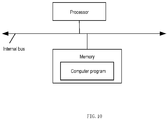
- FIG. 10 is a schematic diagram of hardware equipment for neural network model splitting according to an embodiment of the present disclosure.
- the hardware equipment includes a memory, a processor, and a computer program stored in the memory and can run on the processor.
- the processor executes the computer program to implement the above-mentioned neural network model splitting method.
- An embodiment of this specification provides a neural network model splitting hardware device.
- the specific functions implemented by the memory and processor of the device can be explained by the foregoing embodiments of this specification, and can achieve the technical effects of the foregoing embodiments, which is not repeated herein.
- a neural network model splitting method and related products are also proposed.
- the descriptions of the splitting method and related products are the same as those described in the above embodiments, which will not be repeated herein.
- the description of the neural network model splitting apparatus is as follows.
- the present disclosure provides a neural network model splitting apparatus which includes:
- the target splitting path determination module includes:
- the target splitting path determination module includes:
- the glue operator insertion module includes:
- the glue operator inserted by the glue operator insertion module is used to splice the states in the splitting state set of the input tensor data of the glue operator.
- the glue operator inserted by the glue operator insertion module is used to split the states in the splitting state set of the input tensor data of the glue operator.
- the glue operator inserted by the glue operator insertion module is used to splice the states in the splitting state set of the input tensor data of the glue operator, and then split the spliced states in the splitting state set.
- the glue operator inserted by the glue operator insertion module is used to split the states in the splitting state set of the input tensor data of the glue operator, and then splice the split states in the splitting state set.
- the apparatus also includes: a first splitting state set optimization module configured to, in the forward traversal phase, when the output tensor data of the operator is used as input tensor data by at least two operators, or the operator has at least two output tensor data, retain one splitting state in the splitting state set of the output tensor data of the operator, where the splitting state is determined according to the same state path of the operator.
- a first splitting state set optimization module configured to, in the forward traversal phase, when the output tensor data of the operator is used as input tensor data by at least two operators, or the operator has at least two output tensor data, retain one splitting state in the splitting state set of the output tensor data of the operator, where the splitting state is determined according to the same state path of the operator.
- the apparatus also includes: a second splitting state set optimization module configured to, in the back traversal phase, when the operator has at least two input tensor data, retain one splitting state in the splitting state set of the input tensor data of the operator, where the splitting state is determined according to the same state path of the operator.
- a second splitting state set optimization module configured to, in the back traversal phase, when the operator has at least two input tensor data, retain one splitting state in the splitting state set of the input tensor data of the operator, where the splitting state is determined according to the same state path of the operator.
- a neural network model splitting method and related products are also proposed.
- the descriptions of the splitting method and related products are the same as those described in the above embodiments, which will not be repeated herein.
- the description of the neural network model splitting apparatus is as follows.
- the present disclosure provides a neural network model splitting apparatus which includes:
- the compensation operator insertion module includes: an insertion unit configured insert a compensation operator between a specific type of operator in the target layer and the associated splitting state set of input tensor data, where the characteristic of the specific type of operator is: being used for computing the element of the input tensor data corresponding to the element of the output tensor data of this type of operator, and also being used for computing the adjacent element of the element of the output tensor data.
- the specific type of operator that is applicable to the compensation operator inserted by the insertion unit includes convolution operator, pooling operator, and LRN operator.
- the compensation operator insertion module also includes: a combination unit configured to combine a plurality of compensation operators in the target layer in a pyramid structure.
- the target splitting path determination module includes:
- the neural network model splitting apparatus further includes: a first splitting state set optimization module configured to, in the forward traversal phase, when the output tensor data of the operator is used as input tensor data by at least two operators, or the operator has at least two output tensor data, retain one splitting state in the splitting state set of the output tensor data of the operator, where the splitting state is determined according to the same state path of the operator.
- a first splitting state set optimization module configured to, in the forward traversal phase, when the output tensor data of the operator is used as input tensor data by at least two operators, or the operator has at least two output tensor data, retain one splitting state in the splitting state set of the output tensor data of the operator, where the splitting state is determined according to the same state path of the operator.
- the neural network model splitting apparatus further includes: a second splitting state set optimization module configured to, in the back traversal phase, when the operator has at least two input tensor data, retain one splitting state in the splitting state set of the input tensor data of the operator, where the splitting state is determined according to the same state path of the operator.
- a second splitting state set optimization module configured to, in the back traversal phase, when the operator has at least two input tensor data, retain one splitting state in the splitting state set of the input tensor data of the operator, where the splitting state is determined according to the same state path of the operator.
- a neural network model splitting method and related products are also proposed.
- the descriptions of the splitting method and related products are the same as those described in the above embodiments, which will not be repeated herein.
- the description of the neural network model splitting apparatus is as follows.
- the present disclosure provides a neural network model splitting apparatus which includes:
- the glue operator insertion module includes:
- the glue operator inserted by the glue operator insertion module is used to splice the states in the splitting state set of the input tensor data of the glue operator.
- the glue operator inserted by the glue operator insertion module is used to split the states in the splitting state set of the input tensor data of the glue operator.
- the glue operator inserted by the glue operator insertion module is used to splice the states in the splitting state set of the input tensor data of the glue operator, and then split the spliced states in the splitting state set.
- the glue operator inserted by the glue operator insertion module is used to split the states in the splitting state set of the input tensor data of the glue operator, and then splice the split states in the splitting state set.
- the compensation operator insertion module includes: a second insertion unit configured insert a compensation operator between a specific type of operator in the target layer and the associated splitting state set of input tensor data, where the characteristic of the specific type of operator is: being used for computing the element of the input tensor data corresponding to the element of the output tensor data of this type of operator, and also being used for computing the adjacent element of the element of the output tensor data.
- the specific type of operator that is applicable to the compensation operator inserted by the second insertion unit includes convolution operator, pooling operator, and LRN operator.
- the compensation operator insertion module also includes: a combination unit configured to combine a plurality of compensation operators in the target layer in a pyramid structure.
- the target splitting path determination module includes:
- the apparatus also includes: a first splitting state set optimization module configured to, in the forward traversal phase, when the output tensor data of the operator is used as input tensor data by at least two operators, or the operator has at least two output tensor data, retain one splitting state in the splitting state set of the output tensor data of the operator, where the splitting state is determined according to the same state path of the operator.
- a first splitting state set optimization module configured to, in the forward traversal phase, when the output tensor data of the operator is used as input tensor data by at least two operators, or the operator has at least two output tensor data, retain one splitting state in the splitting state set of the output tensor data of the operator, where the splitting state is determined according to the same state path of the operator.
- the apparatus also includes: a second splitting state set optimization module configured to, in the back traversal phase, when the operator has at least two input tensor data, retain one splitting state in the splitting state set of the input tensor data of the operator, where the splitting state is determined according to the same state path of the operator.
- a second splitting state set optimization module configured to, in the back traversal phase, when the operator has at least two input tensor data, retain one splitting state in the splitting state set of the input tensor data of the operator, where the splitting state is determined according to the same state path of the operator.
- the memory may include a physical apparatus for storing information, which usually digitizes information and then stored the information in a medium using electrical, magnetic, or optical methods.
- the memory described in this embodiment may also include: an apparatus that uses electrical energy to store information, such as RAM and ROM; an apparatus that uses magnetic energy to store information, such as hard disk, floppy disk, magnetic tape, magnetic-core memory, bubble memory, U disk; and an apparatus that uses optical means to store information, such as CD or DVD.
- an apparatus that uses electrical energy to store information such as RAM and ROM
- an apparatus that uses magnetic energy to store information such as hard disk, floppy disk, magnetic tape, magnetic-core memory, bubble memory, U disk
- an apparatus that uses optical means to store information such as CD or DVD.
- quantum memory graphene memory, and the like.
- the processor can be implemented in any suitable manner.
- the processor may take the form of a computer-readable medium, a logic gate, a switch, an application specific integrated circuit (ASIC), a programmable logic controller, and an embedded micro-controller, etc., that includes a micro-processor or a processor as well as a memory that stores computer-readable program codes (such as software or firmware) executable by the micro-processor or processor.
- An embodiment of the present disclosure further provides a readable storage medium on which a computer program is stored.
- the computer program is executed, the neural network model splitting method described above is realized.
- the technical solution provided by the present disclosure can facilitate the expansion of deep learning accelerators from a single-core architecture to a multi-core architecture in the cost of relatively small overhead, and offers a highly-efficient splitting method for a given network and an underlying accelerator.
- Experimental results show that the technical solution may efficiently decrease the end-to-end latency of different networks on a multi-core accelerator.
- client and server can be regarded as a kind of hardware component.
- An apparatus included in the hardware component which is used for implementing various functions can also be regarded as a structure inside the hardware component.
- an apparatus for realizing various functions can be regarded as both a software module for realizing the method and a structure inside a hardware component.
- the present disclosure may be realized with the support of software as well as necessary universal hardware platform. Based on such understanding, the essence of the technical solutions of the present disclosure, or a part of the present disclosure that contributes to the prior art, can be entirely or partly embodied in the form of a software product that is stored in a memory.
- the memory includes ROM/RAM, magnetic disk, optical disk, and the like, where several instructions are stored and can enable a computer device (which may be a personal computer, a server, or a network device, etc. ) to execute the methods described in the various embodiments of the present disclosure or described in some parts of the embodiments.
- This disclosure may be described in the general context of computer-executable instructions executed by a computer, such as a program module.
- the program module includes routine, program, object, component, data structure, etc., that perform specific tasks or implement specific abstract data types.
- This disclosure can also be implemented in distributed computing environments. In these distributed computing environments, tasks are performed by remote processing devices connected through a communication network. In the distributed computing environments, the program module can be located in local and remote computer storage media that include storage devices.
Landscapes
- Engineering & Computer Science (AREA)
- Physics & Mathematics (AREA)
- Theoretical Computer Science (AREA)
- Health & Medical Sciences (AREA)
- Life Sciences & Earth Sciences (AREA)
- Biomedical Technology (AREA)
- Biophysics (AREA)
- Computing Systems (AREA)
- Software Systems (AREA)
- Evolutionary Computation (AREA)
- General Health & Medical Sciences (AREA)
- Molecular Biology (AREA)
- Computational Linguistics (AREA)
- General Engineering & Computer Science (AREA)
- General Physics & Mathematics (AREA)
- Mathematical Physics (AREA)
- Data Mining & Analysis (AREA)
- Artificial Intelligence (AREA)
- Neurology (AREA)
- Feedback Control In General (AREA)
- Image Analysis (AREA)
- Electrically Operated Instructional Devices (AREA)
- Nitrogen Condensed Heterocyclic Rings (AREA)
- Automatic Tape Cassette Changers (AREA)
Applications Claiming Priority (5)
| Application Number | Priority Date | Filing Date | Title |
|---|---|---|---|
| CN201910115162.2A CN111563587B (zh) | 2019-02-14 | 2019-02-14 | 一种神经网络模型的拆分方法及相关产品 |
| CN201910114927.0A CN111563584B (zh) | 2019-02-14 | 2019-02-14 | 一种神经网络模型的拆分方法及相关产品 |
| CN201910115130.2A CN111563586B (zh) | 2019-02-14 | 2019-02-14 | 一种神经网络模型的拆分方法及相关产品 |
| CN201910114967.5A CN111563585B (zh) | 2019-02-14 | 2019-02-14 | 一种神经网络模型的拆分方法及相关产品 |
| PCT/CN2020/084416 WO2020164644A2 (fr) | 2019-02-14 | 2020-04-13 | Procédé de division de modèle de réseau neuronal, appareil, dispositif informatique et support d'informations |
Publications (2)
| Publication Number | Publication Date |
|---|---|
| EP3926546A2 true EP3926546A2 (fr) | 2021-12-22 |
| EP3926546A4 EP3926546A4 (fr) | 2022-04-27 |
Family
ID=72045467
Family Applications (1)
| Application Number | Title | Priority Date | Filing Date |
|---|---|---|---|
| EP20756078.0A Pending EP3926546A4 (fr) | 2019-02-14 | 2020-04-13 | Procédé de division de modèle de réseau neuronal, appareil, dispositif informatique et support d'informations |
Country Status (3)
| Country | Link |
|---|---|
| US (1) | US20220092386A1 (fr) |
| EP (1) | EP3926546A4 (fr) |
| WO (1) | WO2020164644A2 (fr) |
Cited By (1)
| Publication number | Priority date | Publication date | Assignee | Title |
|---|---|---|---|---|
| WO2022128406A1 (fr) * | 2020-12-16 | 2022-06-23 | Xmos Inc. | Mise en œuvre d'un réseau neuronal artificiel |
Families Citing this family (6)
| Publication number | Priority date | Publication date | Assignee | Title |
|---|---|---|---|---|
| US11748599B2 (en) * | 2019-02-21 | 2023-09-05 | Texas Instruments Incorporated | Super-tiling in neural network processing to enable analytics at lower memory speed |
| CN110689121A (zh) * | 2019-09-24 | 2020-01-14 | 上海寒武纪信息科技有限公司 | 一种用多核处理器实现神经网络模型拆分方法及相关产品 |
| US12333415B2 (en) * | 2020-07-10 | 2025-06-17 | Hewlett Packard Enterprise Development Lp | Neural network accelerators |
| US20230083345A1 (en) * | 2021-09-07 | 2023-03-16 | Nvidia Corporation | Multi-architecture execution graphs |
| US20230325252A1 (en) * | 2022-04-07 | 2023-10-12 | Micron Technology, Inc. | Non-uniform Splitting of a Tensor in Shuffled Secure Multiparty Computation |
| CN116991560B (zh) * | 2023-09-25 | 2024-04-16 | 粤港澳大湾区数字经济研究院(福田) | 针对语言模型的并行调度方法、装置、设备及存储介质 |
Family Cites Families (5)
| Publication number | Priority date | Publication date | Assignee | Title |
|---|---|---|---|---|
| JPH05216857A (ja) * | 1992-02-07 | 1993-08-27 | Hitachi Ltd | ニューラルネットワーク学習状態表示方法 |
| US10929749B2 (en) * | 2017-04-24 | 2021-02-23 | Intel Corporation | Neural network optimization mechanism |
| CN107766894B (zh) * | 2017-11-03 | 2021-01-22 | 吉林大学 | 基于注意力机制和深度学习的遥感图像自然语言生成方法 |
| CN108288091B (zh) * | 2018-01-19 | 2020-09-11 | 上海兆芯集成电路有限公司 | 采布斯乘法的微处理器 |
| CN108965585B (zh) * | 2018-06-22 | 2021-01-26 | 成都博宇科技有限公司 | 一种基于智能手机传感器的用户身份识别方法 |
-
2020
- 2020-04-13 US US17/419,290 patent/US20220092386A1/en active Pending
- 2020-04-13 EP EP20756078.0A patent/EP3926546A4/fr active Pending
- 2020-04-13 WO PCT/CN2020/084416 patent/WO2020164644A2/fr not_active Ceased
Cited By (1)
| Publication number | Priority date | Publication date | Assignee | Title |
|---|---|---|---|---|
| WO2022128406A1 (fr) * | 2020-12-16 | 2022-06-23 | Xmos Inc. | Mise en œuvre d'un réseau neuronal artificiel |
Also Published As
| Publication number | Publication date |
|---|---|
| WO2020164644A3 (fr) | 2020-10-01 |
| WO2020164644A2 (fr) | 2020-08-20 |
| US20220092386A1 (en) | 2022-03-24 |
| EP3926546A4 (fr) | 2022-04-27 |
Similar Documents
| Publication | Publication Date | Title |
|---|---|---|
| EP3926546A2 (fr) | Procédé de division de modèle de réseau neuronal, appareil, dispositif informatique et support d'informations | |
| US20220391665A1 (en) | Method for splitting neural network model by using multi-core processor, and related product | |
| CN110689115B (zh) | 神经网络模型处理方法、装置、计算机设备及存储介质 | |
| CN111563586B (zh) | 一种神经网络模型的拆分方法及相关产品 | |
| US20220121903A1 (en) | Method of performing splitting in neural network model by means of multi-core processor, and related product | |
| CN114008594B (zh) | 调度计算图上的操作 | |
| EP3678068A1 (fr) | Système distribué permettant d'exécuter un apprentissage automatique et procédé associé | |
| EP3633559B1 (fr) | Appareil de traitement d'informations, procédé de traitement d'informations et support d'informations lisible par ordinateur non transitoire | |
| CN111626430A (zh) | 一种数据处理方法及相关产品 | |
| KR20180073118A (ko) | 컨볼루션 신경망 처리 방법 및 장치 | |
| CN110633785B (zh) | 一种卷积神经网络的计算方法及系统 | |
| CN112753016A (zh) | 神经网络中数据预处理阶段的计算资源的管理方法和装置 | |
| US20210182682A1 (en) | Learning task compiling method of artificial intelligence processor and related products | |
| WO2024131170A1 (fr) | Procédé et appareil de traitement d'opérateur, et puce, dispositif informatique et support de stockage | |
| CN111563587B (zh) | 一种神经网络模型的拆分方法及相关产品 | |
| CN111563584B (zh) | 一种神经网络模型的拆分方法及相关产品 | |
| CN114792387A (zh) | 图像恢复方法和设备 | |
| CN115952856B (zh) | 一种基于双向分割的神经网络流水线并行训练方法及系统 | |
| CN111563585B (zh) | 一种神经网络模型的拆分方法及相关产品 | |
| US20240104375A1 (en) | Method and system for lightweighting artificial neural network model, and non-transitory computer-readable recording medium | |
| CN112990461B (zh) | 构建神经网络模型的方法、装置、计算机设备和存储介质 | |
| US20240087076A1 (en) | Graph data calculation method and apparatus | |
| US12585950B2 (en) | Method and electronic device for performing deep neural network operation | |
| US20240256901A1 (en) | Information processing apparatus, information processing method and non-transitory computer-readable storage medium | |
| US20250103332A1 (en) | Processing circuit for cnn acceleration and method of operating the processing circuit |
Legal Events
| Date | Code | Title | Description |
|---|---|---|---|
| STAA | Information on the status of an ep patent application or granted ep patent |
Free format text: STATUS: THE INTERNATIONAL PUBLICATION HAS BEEN MADE |
|
| PUAI | Public reference made under article 153(3) epc to a published international application that has entered the european phase |
Free format text: ORIGINAL CODE: 0009012 |
|
| STAA | Information on the status of an ep patent application or granted ep patent |
Free format text: STATUS: REQUEST FOR EXAMINATION WAS MADE |
|
| 17P | Request for examination filed |
Effective date: 20210629 |
|
| AK | Designated contracting states |
Kind code of ref document: A2 Designated state(s): AL AT BE BG CH CY CZ DE DK EE ES FI FR GB GR HR HU IE IS IT LI LT LU LV MC MK MT NL NO PL PT RO RS SE SI SK SM TR |
|
| XX | Miscellaneous (additional remarks) |
Free format text: THE RESTORATION OF THE RIGHT OF PRIORITY GRANTED BY THE RECEIVING OFFICE IS EFFECTIVE BEFORE THE EPO (R. 49TER.1(A) PCT). |
|
| REG | Reference to a national code |
Ref country code: DE Ref legal event code: R079 Free format text: PREVIOUS MAIN CLASS: G06N0003080000 Ipc: G06N0003040000 |
|
| A4 | Supplementary search report drawn up and despatched |
Effective date: 20220329 |
|
| RIC1 | Information provided on ipc code assigned before grant |
Ipc: G06N 3/063 20060101ALI20220323BHEP Ipc: G06N 3/04 20060101AFI20220323BHEP |
|
| DAV | Request for validation of the european patent (deleted) | ||
| DAX | Request for extension of the european patent (deleted) | ||
| STAA | Information on the status of an ep patent application or granted ep patent |
Free format text: STATUS: EXAMINATION IS IN PROGRESS |
|
| 17Q | First examination report despatched |
Effective date: 20250311 |