EP3926709A2 - Matériau actif négatif pour une batterie au lithium rechargeable, son procédé de préparation et batterie au lithium rechargeable le comprenant - Google Patents
Matériau actif négatif pour une batterie au lithium rechargeable, son procédé de préparation et batterie au lithium rechargeable le comprenant Download PDFInfo
- Publication number
- EP3926709A2 EP3926709A2 EP21180286.3A EP21180286A EP3926709A2 EP 3926709 A2 EP3926709 A2 EP 3926709A2 EP 21180286 A EP21180286 A EP 21180286A EP 3926709 A2 EP3926709 A2 EP 3926709A2
- Authority
- EP
- European Patent Office
- Prior art keywords
- active material
- negative active
- gas
- nitrogen
- carbon
- Prior art date
- Legal status (The legal status is an assumption and is not a legal conclusion. Google has not performed a legal analysis and makes no representation as to the accuracy of the status listed.)
- Pending
Links
- 0 *c1c(*)c(*)c(*)c(*)c1* Chemical compound *c1c(*)c(*)c(*)c(*)c1* 0.000 description 1
Images



Classifications
-
- H—ELECTRICITY
- H01—ELECTRIC ELEMENTS
- H01M—PROCESSES OR MEANS, e.g. BATTERIES, FOR THE DIRECT CONVERSION OF CHEMICAL ENERGY INTO ELECTRICAL ENERGY
- H01M4/00—Electrodes
- H01M4/02—Electrodes composed of, or comprising, active material
- H01M4/36—Selection of substances as active materials, active masses, active liquids
- H01M4/60—Selection of substances as active materials, active masses, active liquids of organic compounds
-
- H—ELECTRICITY
- H01—ELECTRIC ELEMENTS
- H01M—PROCESSES OR MEANS, e.g. BATTERIES, FOR THE DIRECT CONVERSION OF CHEMICAL ENERGY INTO ELECTRICAL ENERGY
- H01M4/00—Electrodes
- H01M4/02—Electrodes composed of, or comprising, active material
- H01M4/36—Selection of substances as active materials, active masses, active liquids
- H01M4/362—Composites
- H01M4/366—Composites as layered products
-
- H—ELECTRICITY
- H01—ELECTRIC ELEMENTS
- H01M—PROCESSES OR MEANS, e.g. BATTERIES, FOR THE DIRECT CONVERSION OF CHEMICAL ENERGY INTO ELECTRICAL ENERGY
- H01M4/00—Electrodes
- H01M4/02—Electrodes composed of, or comprising, active material
- H01M4/36—Selection of substances as active materials, active masses, active liquids
- H01M4/58—Selection of substances as active materials, active masses, active liquids of inorganic compounds other than oxides or hydroxides, e.g. sulfides, selenides, tellurides, halogenides or LiCoFy; of polyanionic structures, e.g. phosphates, silicates or borates
- H01M4/583—Carbonaceous material, e.g. graphite-intercalation compounds or CFx
-
- H—ELECTRICITY
- H01—ELECTRIC ELEMENTS
- H01M—PROCESSES OR MEANS, e.g. BATTERIES, FOR THE DIRECT CONVERSION OF CHEMICAL ENERGY INTO ELECTRICAL ENERGY
- H01M4/00—Electrodes
- H01M4/02—Electrodes composed of, or comprising, active material
- H01M4/36—Selection of substances as active materials, active masses, active liquids
- H01M4/362—Composites
-
- C—CHEMISTRY; METALLURGY
- C01—INORGANIC CHEMISTRY
- C01B—NON-METALLIC ELEMENTS; COMPOUNDS THEREOF; METALLOIDS OR COMPOUNDS THEREOF NOT COVERED BY SUBCLASS C01C
- C01B32/00—Carbon; Compounds thereof
- C01B32/05—Preparation or purification of carbon not covered by groups C01B32/15, C01B32/20, C01B32/25, C01B32/30
-
- C—CHEMISTRY; METALLURGY
- C01—INORGANIC CHEMISTRY
- C01B—NON-METALLIC ELEMENTS; COMPOUNDS THEREOF; METALLOIDS OR COMPOUNDS THEREOF NOT COVERED BY SUBCLASS C01C
- C01B33/00—Silicon; Compounds thereof
- C01B33/02—Silicon
-
- H—ELECTRICITY
- H01—ELECTRIC ELEMENTS
- H01M—PROCESSES OR MEANS, e.g. BATTERIES, FOR THE DIRECT CONVERSION OF CHEMICAL ENERGY INTO ELECTRICAL ENERGY
- H01M10/00—Secondary cells; Manufacture thereof
- H01M10/05—Accumulators with non-aqueous electrolyte
- H01M10/052—Li-accumulators
-
- H—ELECTRICITY
- H01—ELECTRIC ELEMENTS
- H01M—PROCESSES OR MEANS, e.g. BATTERIES, FOR THE DIRECT CONVERSION OF CHEMICAL ENERGY INTO ELECTRICAL ENERGY
- H01M10/00—Secondary cells; Manufacture thereof
- H01M10/05—Accumulators with non-aqueous electrolyte
- H01M10/052—Li-accumulators
- H01M10/0525—Rocking-chair batteries, i.e. batteries with lithium insertion or intercalation in both electrodes; Lithium-ion batteries
-
- H—ELECTRICITY
- H01—ELECTRIC ELEMENTS
- H01M—PROCESSES OR MEANS, e.g. BATTERIES, FOR THE DIRECT CONVERSION OF CHEMICAL ENERGY INTO ELECTRICAL ENERGY
- H01M4/00—Electrodes
- H01M4/02—Electrodes composed of, or comprising, active material
- H01M4/04—Processes of manufacture in general
- H01M4/0402—Methods of deposition of the material
- H01M4/0421—Methods of deposition of the material involving vapour deposition
- H01M4/0423—Physical vapour deposition
-
- H—ELECTRICITY
- H01—ELECTRIC ELEMENTS
- H01M—PROCESSES OR MEANS, e.g. BATTERIES, FOR THE DIRECT CONVERSION OF CHEMICAL ENERGY INTO ELECTRICAL ENERGY
- H01M4/00—Electrodes
- H01M4/02—Electrodes composed of, or comprising, active material
- H01M4/04—Processes of manufacture in general
- H01M4/0402—Methods of deposition of the material
- H01M4/0421—Methods of deposition of the material involving vapour deposition
- H01M4/0428—Chemical vapour deposition
-
- H—ELECTRICITY
- H01—ELECTRIC ELEMENTS
- H01M—PROCESSES OR MEANS, e.g. BATTERIES, FOR THE DIRECT CONVERSION OF CHEMICAL ENERGY INTO ELECTRICAL ENERGY
- H01M4/00—Electrodes
- H01M4/02—Electrodes composed of, or comprising, active material
- H01M4/04—Processes of manufacture in general
- H01M4/0471—Processes of manufacture in general involving thermal treatment, e.g. firing, sintering, backing particulate active material, thermal decomposition, pyrolysis
-
- H—ELECTRICITY
- H01—ELECTRIC ELEMENTS
- H01M—PROCESSES OR MEANS, e.g. BATTERIES, FOR THE DIRECT CONVERSION OF CHEMICAL ENERGY INTO ELECTRICAL ENERGY
- H01M4/00—Electrodes
- H01M4/02—Electrodes composed of, or comprising, active material
- H01M4/13—Electrodes for accumulators with non-aqueous electrolyte, e.g. for lithium-accumulators; Processes of manufacture thereof
- H01M4/133—Electrodes based on carbonaceous material, e.g. graphite-intercalation compounds or CFx
-
- H—ELECTRICITY
- H01—ELECTRIC ELEMENTS
- H01M—PROCESSES OR MEANS, e.g. BATTERIES, FOR THE DIRECT CONVERSION OF CHEMICAL ENERGY INTO ELECTRICAL ENERGY
- H01M4/00—Electrodes
- H01M4/02—Electrodes composed of, or comprising, active material
- H01M4/13—Electrodes for accumulators with non-aqueous electrolyte, e.g. for lithium-accumulators; Processes of manufacture thereof
- H01M4/134—Electrodes based on metals, Si or alloys
-
- H—ELECTRICITY
- H01—ELECTRIC ELEMENTS
- H01M—PROCESSES OR MEANS, e.g. BATTERIES, FOR THE DIRECT CONVERSION OF CHEMICAL ENERGY INTO ELECTRICAL ENERGY
- H01M4/00—Electrodes
- H01M4/02—Electrodes composed of, or comprising, active material
- H01M4/13—Electrodes for accumulators with non-aqueous electrolyte, e.g. for lithium-accumulators; Processes of manufacture thereof
- H01M4/136—Electrodes based on inorganic compounds other than oxides or hydroxides, e.g. sulfides, selenides, tellurides, halogenides or LiCoFy
-
- H—ELECTRICITY
- H01—ELECTRIC ELEMENTS
- H01M—PROCESSES OR MEANS, e.g. BATTERIES, FOR THE DIRECT CONVERSION OF CHEMICAL ENERGY INTO ELECTRICAL ENERGY
- H01M4/00—Electrodes
- H01M4/02—Electrodes composed of, or comprising, active material
- H01M4/13—Electrodes for accumulators with non-aqueous electrolyte, e.g. for lithium-accumulators; Processes of manufacture thereof
- H01M4/139—Processes of manufacture
- H01M4/1393—Processes of manufacture of electrodes based on carbonaceous material, e.g. graphite-intercalation compounds or CFx
-
- H—ELECTRICITY
- H01—ELECTRIC ELEMENTS
- H01M—PROCESSES OR MEANS, e.g. BATTERIES, FOR THE DIRECT CONVERSION OF CHEMICAL ENERGY INTO ELECTRICAL ENERGY
- H01M4/00—Electrodes
- H01M4/02—Electrodes composed of, or comprising, active material
- H01M4/13—Electrodes for accumulators with non-aqueous electrolyte, e.g. for lithium-accumulators; Processes of manufacture thereof
- H01M4/139—Processes of manufacture
- H01M4/1395—Processes of manufacture of electrodes based on metals, Si or alloys
-
- H—ELECTRICITY
- H01—ELECTRIC ELEMENTS
- H01M—PROCESSES OR MEANS, e.g. BATTERIES, FOR THE DIRECT CONVERSION OF CHEMICAL ENERGY INTO ELECTRICAL ENERGY
- H01M4/00—Electrodes
- H01M4/02—Electrodes composed of, or comprising, active material
- H01M4/36—Selection of substances as active materials, active masses, active liquids
- H01M4/362—Composites
- H01M4/364—Composites as mixtures
-
- H—ELECTRICITY
- H01—ELECTRIC ELEMENTS
- H01M—PROCESSES OR MEANS, e.g. BATTERIES, FOR THE DIRECT CONVERSION OF CHEMICAL ENERGY INTO ELECTRICAL ENERGY
- H01M4/00—Electrodes
- H01M4/02—Electrodes composed of, or comprising, active material
- H01M4/36—Selection of substances as active materials, active masses, active liquids
- H01M4/38—Selection of substances as active materials, active masses, active liquids of elements or alloys
- H01M4/386—Silicon or alloys based on silicon
-
- H—ELECTRICITY
- H01—ELECTRIC ELEMENTS
- H01M—PROCESSES OR MEANS, e.g. BATTERIES, FOR THE DIRECT CONVERSION OF CHEMICAL ENERGY INTO ELECTRICAL ENERGY
- H01M4/00—Electrodes
- H01M4/02—Electrodes composed of, or comprising, active material
- H01M4/36—Selection of substances as active materials, active masses, active liquids
- H01M4/38—Selection of substances as active materials, active masses, active liquids of elements or alloys
- H01M4/388—Halogens
-
- H—ELECTRICITY
- H01—ELECTRIC ELEMENTS
- H01M—PROCESSES OR MEANS, e.g. BATTERIES, FOR THE DIRECT CONVERSION OF CHEMICAL ENERGY INTO ELECTRICAL ENERGY
- H01M4/00—Electrodes
- H01M4/02—Electrodes composed of, or comprising, active material
- H01M4/36—Selection of substances as active materials, active masses, active liquids
- H01M4/58—Selection of substances as active materials, active masses, active liquids of inorganic compounds other than oxides or hydroxides, e.g. sulfides, selenides, tellurides, halogenides or LiCoFy; of polyanionic structures, e.g. phosphates, silicates or borates
- H01M4/583—Carbonaceous material, e.g. graphite-intercalation compounds or CFx
- H01M4/587—Carbonaceous material, e.g. graphite-intercalation compounds or CFx for inserting or intercalating light metals
-
- H—ELECTRICITY
- H01—ELECTRIC ELEMENTS
- H01M—PROCESSES OR MEANS, e.g. BATTERIES, FOR THE DIRECT CONVERSION OF CHEMICAL ENERGY INTO ELECTRICAL ENERGY
- H01M4/00—Electrodes
- H01M4/02—Electrodes composed of, or comprising, active material
- H01M4/62—Selection of inactive substances as ingredients for active masses, e.g. binders, fillers
-
- H—ELECTRICITY
- H01—ELECTRIC ELEMENTS
- H01M—PROCESSES OR MEANS, e.g. BATTERIES, FOR THE DIRECT CONVERSION OF CHEMICAL ENERGY INTO ELECTRICAL ENERGY
- H01M4/00—Electrodes
- H01M4/02—Electrodes composed of, or comprising, active material
- H01M4/62—Selection of inactive substances as ingredients for active masses, e.g. binders, fillers
- H01M4/624—Electric conductive fillers
- H01M4/625—Carbon or graphite
-
- H—ELECTRICITY
- H01—ELECTRIC ELEMENTS
- H01M—PROCESSES OR MEANS, e.g. BATTERIES, FOR THE DIRECT CONVERSION OF CHEMICAL ENERGY INTO ELECTRICAL ENERGY
- H01M4/00—Electrodes
- H01M4/02—Electrodes composed of, or comprising, active material
- H01M4/62—Selection of inactive substances as ingredients for active masses, e.g. binders, fillers
- H01M4/628—Inhibitors, e.g. gassing inhibitors, corrosion inhibitors
-
- C—CHEMISTRY; METALLURGY
- C01—INORGANIC CHEMISTRY
- C01P—INDEXING SCHEME RELATING TO STRUCTURAL AND PHYSICAL ASPECTS OF SOLID INORGANIC COMPOUNDS
- C01P2002/00—Crystal-structural characteristics
- C01P2002/02—Amorphous compounds
-
- C—CHEMISTRY; METALLURGY
- C01—INORGANIC CHEMISTRY
- C01P—INDEXING SCHEME RELATING TO STRUCTURAL AND PHYSICAL ASPECTS OF SOLID INORGANIC COMPOUNDS
- C01P2004/00—Particle morphology
- C01P2004/80—Particles consisting of a mixture of two or more inorganic phases
-
- C—CHEMISTRY; METALLURGY
- C23—COATING METALLIC MATERIAL; COATING MATERIAL WITH METALLIC MATERIAL; CHEMICAL SURFACE TREATMENT; DIFFUSION TREATMENT OF METALLIC MATERIAL; COATING BY VACUUM EVAPORATION, BY SPUTTERING, BY ION IMPLANTATION OR BY CHEMICAL VAPOUR DEPOSITION, IN GENERAL; INHIBITING CORROSION OF METALLIC MATERIAL OR INCRUSTATION IN GENERAL
- C23C—COATING METALLIC MATERIAL; COATING MATERIAL WITH METALLIC MATERIAL; SURFACE TREATMENT OF METALLIC MATERIAL BY DIFFUSION INTO THE SURFACE, BY CHEMICAL CONVERSION OR SUBSTITUTION; COATING BY VACUUM EVAPORATION, BY SPUTTERING, BY ION IMPLANTATION OR BY CHEMICAL VAPOUR DEPOSITION, IN GENERAL
- C23C16/00—Chemical coating by decomposition of gaseous compounds, without leaving reaction products of surface material in the coating, i.e. chemical vapour deposition [CVD] processes
- C23C16/22—Chemical coating by decomposition of gaseous compounds, without leaving reaction products of surface material in the coating, i.e. chemical vapour deposition [CVD] processes characterised by the deposition of inorganic material, other than metallic material
- C23C16/26—Deposition of carbon only
-
- C—CHEMISTRY; METALLURGY
- C23—COATING METALLIC MATERIAL; COATING MATERIAL WITH METALLIC MATERIAL; CHEMICAL SURFACE TREATMENT; DIFFUSION TREATMENT OF METALLIC MATERIAL; COATING BY VACUUM EVAPORATION, BY SPUTTERING, BY ION IMPLANTATION OR BY CHEMICAL VAPOUR DEPOSITION, IN GENERAL; INHIBITING CORROSION OF METALLIC MATERIAL OR INCRUSTATION IN GENERAL
- C23C—COATING METALLIC MATERIAL; COATING MATERIAL WITH METALLIC MATERIAL; SURFACE TREATMENT OF METALLIC MATERIAL BY DIFFUSION INTO THE SURFACE, BY CHEMICAL CONVERSION OR SUBSTITUTION; COATING BY VACUUM EVAPORATION, BY SPUTTERING, BY ION IMPLANTATION OR BY CHEMICAL VAPOUR DEPOSITION, IN GENERAL
- C23C16/00—Chemical coating by decomposition of gaseous compounds, without leaving reaction products of surface material in the coating, i.e. chemical vapour deposition [CVD] processes
- C23C16/44—Chemical coating by decomposition of gaseous compounds, without leaving reaction products of surface material in the coating, i.e. chemical vapour deposition [CVD] processes characterised by the method of coating
- C23C16/4417—Methods specially adapted for coating powder
-
- H—ELECTRICITY
- H01—ELECTRIC ELEMENTS
- H01M—PROCESSES OR MEANS, e.g. BATTERIES, FOR THE DIRECT CONVERSION OF CHEMICAL ENERGY INTO ELECTRICAL ENERGY
- H01M4/00—Electrodes
- H01M4/02—Electrodes composed of, or comprising, active material
- H01M2004/021—Physical characteristics, e.g. porosity, surface area
-
- H—ELECTRICITY
- H01—ELECTRIC ELEMENTS
- H01M—PROCESSES OR MEANS, e.g. BATTERIES, FOR THE DIRECT CONVERSION OF CHEMICAL ENERGY INTO ELECTRICAL ENERGY
- H01M4/00—Electrodes
- H01M4/02—Electrodes composed of, or comprising, active material
- H01M2004/026—Electrodes composed of, or comprising, active material characterised by the polarity
- H01M2004/027—Negative electrodes
-
- Y—GENERAL TAGGING OF NEW TECHNOLOGICAL DEVELOPMENTS; GENERAL TAGGING OF CROSS-SECTIONAL TECHNOLOGIES SPANNING OVER SEVERAL SECTIONS OF THE IPC; TECHNICAL SUBJECTS COVERED BY FORMER USPC CROSS-REFERENCE ART COLLECTIONS [XRACs] AND DIGESTS
- Y02—TECHNOLOGIES OR APPLICATIONS FOR MITIGATION OR ADAPTATION AGAINST CLIMATE CHANGE
- Y02E—REDUCTION OF GREENHOUSE GAS [GHG] EMISSIONS, RELATED TO ENERGY GENERATION, TRANSMISSION OR DISTRIBUTION
- Y02E60/00—Enabling technologies; Technologies with a potential or indirect contribution to GHG emissions mitigation
- Y02E60/10—Energy storage using batteries
Definitions
- a negative active material for a rechargeable lithium battery, a method of preparing the same, and a rechargeable lithium battery including the same are disclosed.
- a lithium-transition metal oxide having a structure capable of intercalating lithium ions such as LiCoO 2 , LiMn 2 O 4 , LiNi 1-x Co x O 2 (0 ⁇ x ⁇ 1), and the like has been used.
- a negative active material various carbon-based materials including artificial graphite, natural graphite, and hard carbon capable of intercalating and deintercalating lithium ions or Si-based active materials including Si and Sn have been used.
- An embodiment provides a negative active material for a rechargeable lithium battery having excellent charge and discharge characteristics and excellent cycle-life characteristics.
- Another embodiment provides a method of preparing the negative active material.
- Another embodiment provides a rechargeable lithium battery including the negative active material.
- a negative active material for a rechargeable lithium battery includes an amorphous carbon matrix; silicon particles dispersed in the amorphous carbon matrix; and a nitrogen-containing carbon compound disposed in a form protruding outward on the surface of the amorphous carbon matrix.
- the nitrogen-containing carbon compound may be disposed in an urchins-type on the surface of the amorphous carbon matrix.
- the nitrogen-containing carbon compound may be semi-crystalline.
- the nitrogen-containing carbon compound may include piperideine (C 5 H 9 N), piperidine (C 5 H 11 N), pyridine (C 5 H 5 N), pyrrole (C 4 H 5 N), aniline (C6H5NH2), acetonitrile (C 2 H 3 N), dopamine (C 8 H 11 NO 2 ), dimethylamine, trimethylamine, ethylamine, diethylamine, trimethylamine, or a combination thereof.
- a weight ratio of the amorphous carbon matrix and the nitrogen-containing carbon compound may be about 1:1 to about 1:2.
- An amount of the silicon particles may be about 40 wt% to about 80 wt% based on the total weight of the negative active material.
- a particle diameter of the silicon particles may be about 40 nm to about 250 nm.
- a method of preparing a negative active material for a rechargeable lithium battery includes injecting a first carbon gas into the silicon particles and performing heat treatment to prepare an amorphous carbon matrix in which the silicon particles are dispersed; and performing a deposition process using a second carbon gas and a gas of a nitrogen-containing compound on the amorphous carbon matrix, to form a nitrogen-containing carbon compound disposed to protrude to the outside on the surface of the amorphous carbon matrix.
- the injecting of the first carbon gas may be performed at a temperature of about 600 °C to about 800 °C.
- the deposition process may be a chemical vapor deposition (CVD) process.
- the deposition process may be performed at a temperature of greater than or equal to about 1000 °C.
- the first carbon gas may have a lower decomposition temperature than the second carbon gas.
- the first carbon gas may be an ethylene (C 2 H 4 ) gas, an acetylene (C 2 H 2 ) gas, a propane (C 3 H 8 ) gas, a propylene (C 3 H 6 ) gas, or a combination thereof
- the second carbon gas may be a methane (CH4) gas.
- the nitrogen-containing compound may be ammonia (NH 3 ), hydrazine (NH2NH2), pyridine (C 5 H 5 N), pyrrole (C 4 H 5 N), aniline (C6H5NH2), acetonitrile (C 2 H 3 N), or a combination thereof.
- Another embodiment provides a negative electrode for a rechargeable lithium battery including a current collector and a negative active material layer disposed on the current collector and including the negative active material.
- the amount of the silicon particles may be about 1 wt% to about 60 wt% based on the total weight of the negative active material.
- a rechargeable lithium battery including a negative electrode including the negative active material, a positive electrode including a positive active material, and an electrolyte.
- the negative active material for a rechargeable lithium battery according to an embodiment may exhibit excellent charge rate and discharge rate characteristics.
- a negative active material for a rechargeable lithium battery includes an amorphous carbon matrix; silicon particles dispersed in the amorphous carbon matrix; and a nitrogen-containing carbon compound disposed in a form protruding outward on the surface of the amorphous carbon matrix.
- the nitrogen-containing carbon compound may have an urchins-type.
- This urchins-type may appear in the form of a needle-shaped or plate-shaped structure protruding outward.
- the nitrogen-containing carbon compound may be semi-crystalline.
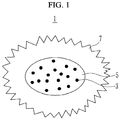
- FIG. 1 A schematic structure of the negative active material is shown in FIG. 1 .
- the negative active material 1 includes an amorphous carbon matrix 5, Si particles 3 dispersed in the amorphous carbon matrix 5, and a nitrogen-containing carbon compound 7 disposed in a form protruding outward on the surface of the amorphous carbon matrix.
- the nitrogen-containing carbon compound may be disposed unevenly in a form protruding outward from the surface of the amorphous carbon matrix 5, that is, in an urchins-type.
- This negative active material includes very high-capacity silicon having a theoretical capacity of about 4200 mAh/g and thus may provide a high-capacity battery, and in addition, when the silicon particles are dispersed in the amorphous carbon matrix, the volume of the silicon particles may be effectively suppressed from being expanded during the charge and discharge and thus cycle-life characteristics may be improved.
- the silicon particles are dispersed in a crystalline carbon matrix rather than in the amorphous carbon matrix, the effect of suppressing the volume expansion of silicon may be insignificant, and the reason is that crystalline carbon has higher hardness but lower toughness than amorphous carbon.
- semi-crystalline carbon having excellent electrical conductivity is disposed, improving efficiency and charge and discharge rates.
- the semi-crystalline carbon is the nitrogen-containing carbon compound, the electrical conductivity may be further improved.
- Si and nitrogen-added amorphous carbon come into direct contact and thus may form silicon nitride (Si 3 N 4 ) and silicon oxynitride (SiO x N y ).
- silicon nitride Si 3 N 4
- silicon oxynitride SiO x N y
- these compounds are inert materials to lithium, which does not react with lithium, and thus may deteriorate capacity and efficiency.
- the amorphous carbon may be soft carbon, hard carbon, or a combination thereof.
- the nitrogen-containing carbon compound may be semi-crystalline.
- the nitrogen-containing carbon compound has higher crystallinity than amorphous carbon but lower crystallinity than crystalline carbon and thus may be graphite-like crystalline.
- the carbon compound on the surface of the amorphous carbon matrix is semi-crystalline, that is, carbon having different crystallinity from that of amorphous carbon, wherein carbon in contact with the silicon particles is amorphous carbon and thus may effectively suppress the volume expansion of the silicon particles during charging and discharging, while carbon present on the outside of the active material is semi-crystalline and thus may accomplish an effect of improving electrical conductivity.
- the nitrogen-containing carbon compound may include piperideine (C 5 H 9 N), piperidine (C 5 H 11 N), pyridine (C 5 H 5 N), pyrrole (C 4 H 5 N), aniline (C6H5NH2), acetonitrile (C 2 H 3 N), dopamine (C 8 H 11 NO 2 ), dimethylamine, trimethylamine, ethylamine, diethylamine, trimethylamine, or a combination thereof.
- the weight ratio of the amorphous carbon matrix and the nitrogen-containing carbon compound may be about 1:1 to about 1:2.
- the weight ratio of the amorphous carbon matrix and the nitrogen-containing carbon compound falls within the range, there may be an advantage in expansion characteristics during the cycle-life.
- the weight ratio of the amorphous carbon matrix and the nitrogen-containing carbon compound is out of the range, particularly, when the weight of the nitrogen-containing carbon compound is more than twice that of the amorphous carbon matrix, pores inside the amorphous carbon matrix are rapidly formed, and an electrolyte solution may be well penetrated thereinto, which may deteriorate silicon.
- an amount of the silicon particles may be about 40 wt% to about 80 wt% based on the total weight of the negative active material. When the amount of the silicon particles are within the range, excellent discharge capacity and improved capacity retention may be obtained.
- the silicon particles may be present as a silicon cluster formed by agglomeration of a plurality of the silicon particles.
- the silicon cluster may have a size of about 4 ⁇ m to about 6 ⁇ m.
- excellent initial expansion may be obtained,
- a particle diameter of the silicon particles may be about 40 nm to about 250 nm, and according to an embodiment, about 80 nm to about 120 nm.
- This particle diameter may mean an average particle diameter.
- the average particle diameter is obtained by putting a plurality of particles into a particle size analyzer and measuring it and may be a particle diameter (D50) at a cumulative volume of 50 volume% in a cumulative size-distribution curve.
- this particle diameter (D50) is an average particle diameter (D50) of particles at a cumulative volume of 50 volume% in the particle size distribution.
- the average particle diameter (D50) may be measured using a method well known to those skilled in the art, for example, by using a particle size analyzer or a transmission electron microscope photograph or a scanning electron microscope photograph.
- the average particle diameter (D50) may be obtained by measuring a particle size with a device using dynamic light-scattering, performing a data analysis, and counting the number of particles in each particle size range.
- the negative active material according to an embodiment may be prepared by the following process.
- a first carbon gas is injected into the silicon particles to prepare an amorphous carbon matrix in which the silicon particles are dispersed, and then the amorphous carbon matrix is subjected to a deposition process using a second carbon gas and a gas of a nitrogen-containing compound, to form a nitrogen-containing carbon compound disposed to protrude to the outside on the surface of the amorphous carbon matrix and thus to prepare a negative active material.
- the silicon particles may have a particle diameter ranging from about 40 nm to about 250 nm, and according to an embodiment, a particle diameter ranging from about 80 nm to about 120 nm.
- the silicon particles may be used as a silicon cluster formed by agglomeration of a plurality of the silicon particles. This silicon cluster may be prepared in a spray-drying process.
- the first carbon gas has a lower decomposition temperature than the second carbon gas, and herein, when a carbon gas having a low decomposition temperature is used, amorphous carbon may be formed.
- the first carbon gas may include, for example, ethylene (C 2 H 4 ) gas, acetylene (C 2 H 2 ) gas, propane (C 3 H 8 ) gas, propylene (C 3 H 6 ) gas, or a combination thereof.
- the first carbon gas may be injected at about 600 °C to about 800 °C. As the first carbon gas injected according to this injection process is decomposed, the amorphous carbon matrix is formed, and the silicon particles are dispersed in the amorphous carbon matrix. When this first carbon gas injection process is performed within the temperature range, a desired amorphous carbon matrix may be more effectively obtained. When the first carbon gas injection process is performed at a temperature of less than about 600 °C, it does not reach a decomposition temperature of carbon and thus carbon may not be deposited, but when performed at a temperature of greater than about 800 °C, the carbon may be deposited at the same rate but crystallinity of Si may be inappropriately increased.
- the process of forming the amorphous carbon matrix in which the silicon particles are dispersed may be performed by adopting a chemical vapor deposition (CVD) process of injecting the first carbon gas into the silicon particles, a carbonization or electro-spinning process of an organic compound under an inert gas atmosphere, but is not limited thereto.
- CVD chemical vapor deposition
- the second carbon gas may be methane (CH 4 ) gas.
- the methane gas may be methane gas with purity of 100% or commercially available methane gas with purity of 99% or higher.
- the deposition process using the second carbon gas and the gas of the nitrogen-containing compound may be a chemical vapor deposition (CVD) process.
- the deposition process may be performed at greater than or equal to about 1000 °C or within a temperature range of about 1000 °C to about 1100 °C.
- the second carbon gas is decomposed to produce semi-crystalline carbon
- the gas of the nitrogen-containing compound that is, a gas using the nitrogen-containing compound in a gaseous form is also decomposed to produce nitrogen, and this nitrogen is added into the semi-crystalline carbon, so that a nitrogen-containing carbon compound grows on the surface of the amorphous carbon matrix and thus is placed, for example, in an urchins-type protruding outward from the surface of the amorphous carbon matrix.
- the nitrogen-containing carbon compound may be formed as a smooth layered form rather than the protruding form, which may deteriorate capacity, efficiency, rate capability, and cycle-life characteristics.
- the nitrogen-containing carbon compound may be formed to be protruding outward on the surface of the amorphous carbon matrix through one process without separately performing a process of forming the semi-crystalline carbon and a process of adding the nitrogen.
- the second carbon gas and the gas of the nitrogen-containing compound may be mixed in a volume ratio of about 4 : 3 to about 6 : 1.
- an appropriate nitrogen-containing carbon compound may be prepared.
- the nitrogen-containing compound may be ammonia (NH 3 ), hydrazine (NH2NH2), pyridine (C 5 H 5 N), pyrrole (C 4 H 5 N), aniline (C6H5NH2), acetonitrile (C 2 H 3 N), or a combination thereof.
- Another embodiment provides a negative electrode for a rechargeable lithium battery including a current collector and a negative active material layer formed on this current collector and including the negative active material.
- the negative active material may be included in an amount of about 95 wt% to about 99 wt% based on the total weight of the negative active material layer.
- the negative active material layer may include a binder, and may further optionally include a conductive material.
- the binder may be included in an amount of about 1 wt% to about 5 wt% based on the total weight of the negative active material layer.
- the negative active material may be used in an amount of about 90 wt% to about 98 wt%
- the binder may be used in an amount of about 1 wt% to about 5 wt%
- the conductive material may be used in an amount of about 1 wt% to about 5 wt%.
- the negative active material includes the amorphous carbon matrix, the silicon particles dispersed in the amorphous carbon matrix and the nitrogen-containing carbon compound disposed in a form protruding outward on the surface of the amorphous carbon matrix, and herein, the silicon particles may be included in an amount of about 1 wt% to about 60 wt% based on the total weight of the negative active material.
- the binder improves binding properties of negative active material particles with one another and with a current collector.
- the binder includes a non-aqueous binder, an aqueous binder, or a combination thereof.
- the non-aqueous binder may include an ethylene-propylene copolymer, polyacrylonitrile, polystyrene, polyvinylchloride, carboxylated polyvinylchloride, polyvinylfluoride, polyurethane, polytetrafluoroethylene, polyvinylidene fluoride, polyethylene, polypropylene, polyamideimide, polyimide, or a combination thereof.
- the aqueous binder may include a styrene-butadiene rubber, an acrylated styrene-butadiene rubber (ABR), an acrylonitrile-butadiene rubber, an acrylic rubber, a butyl rubber, a fluorine rubber, an ethylene oxide-containing polymer, polyvinylpyrrolidone, polyepichlorohydrin, polyphosphazene, an ethylene propylenediene copolymer, polyvinylpyridine, chlorosulfonated polyethylene, latex, a polyester resin, an acrylic resin, a phenolic resin, an epoxy resin, polyvinyl alcohol, or a combination thereof.
- ABR acrylated styrene-butadiene rubber
- ABR acrylated styrene-butadiene rubber
- an acrylonitrile-butadiene rubber an acrylic rubber, a butyl rubber, a fluorine rubber, an ethylene oxide-containing polymer,
- a cellulose-based compound may be further used to provide viscosity as a thickener.
- the cellulose-based compound includes one or more of carboxylmethyl cellulose, hydroxypropylmethyl cellulose, methyl cellulose, or alkali metal salts thereof.
- the alkali metal may be Na, K, or Li.
- Such a thickener may be included in an amount of about 0.1 parts by weight to about 3 parts by weight based on 100 parts by weight of the negative active material.
- the conductive material is included to provide electrode conductivity. Any electrically conductive material may be used as a conductive material unless it causes a chemical change.
- the conductive material include a carbon-based material such as natural graphite, artificial graphite, carbon black, acetylene black, ketjen black, a carbon fiber, and the like; a metal-based material of a metal powder or a metal fiber including copper, nickel, aluminium, silver, and the like; a conductive polymer such as a polyphenylene derivative; or a mixture thereof.
- the current collector may include one selected from a copper foil, a nickel foil, a stainless steel foil, a titanium foil, a nickel foam, a copper foam, a polymer substrate coated with a conductive metal, and a combination thereof.
- the positive electrode may include a positive current collector and a positive active material layer on the positive current collector.
- the positive active material may include lithiated intercalation compounds that reversibly intercalate and deintercalate lithium ions.
- the positive active material may include one or more composite oxides of a metal selected from cobalt, manganese, nickel, and a combination thereof, and lithium. More specific examples may be compounds represented by one of the following chemical formulae.
- LiaA 1-b X b D 2 (0.90 ⁇ a ⁇ 1.8, 0 ⁇ b ⁇ 0.5); Li a A 1-b X b O 2-c D c (0.90 ⁇ a ⁇ 1.8, 0 ⁇ b ⁇ 0.5, 0 ⁇ c ⁇ 0.05); Li a E 1-b X b O 2-c D c (0.90 ⁇ a ⁇ 1.8, 0 ⁇ b ⁇ 0.5, 0 ⁇ c ⁇ 0.05); Li a E 2-b X b O 4-c D c (0.90 ⁇ a ⁇ 1.8, 0 ⁇ b ⁇ 0.5, 0 ⁇ c ⁇ 0.05); Li a Ni 1-b-c Co b X c D ⁇ (0.90 ⁇ a ⁇ 1.8, 0 ⁇ b ⁇ 0.5, 0 ⁇ c ⁇ 0.5, 0 ⁇ ⁇ 2); Li a Ni 1-b-c Co
- A is selected from Ni, Co, Mn, and a combination thereof;
- X is selected from Al, Ni, Co, Mn, Cr, Fe, Mg, Sr, V, a rare earth element, and a combination thereof;
- D is selected from O, F, S, P, and a combination thereof;
- E is selected from Co, Mn, and a combination thereof;
- T is selected from F, S, P, and a combination thereof;
- G is selected from Al, Cr, Mn, Fe, Mg, La, Ce, Sr, V, and a combination thereof;
- Q is selected from Ti, Mo, Mn, and a combination thereof;
- the compounds may have a coating layer on the surface, or may be mixed with another compound having a coating layer.
- the coating layer may include at least one coating element compound selected from an oxide of a coating element, a hydroxide of a coating element, an oxyhydroxide of a coating element, an oxycarbonate of a coating element, and a hydroxyl carbonate of a coating element.
- the compound for the coating layer may be amorphous or crystalline.
- the coating element included in the coating layer may include Mg, Al, Co, K, Na, Ca, Si, Ti, V, Sn, Ge, Ga, B, As, Zr, or a mixture thereof.
- the coating layer may be disposed in a method having no adverse influence on properties of a positive active material by using these elements in the compound.
- the method may include any coating method such as spray coating, dipping, and the like, but is not illustrated in more detail since it is well-known in the related field.
- a content of the positive active material may be about 90 wt% to about 98 wt% based on the total weight of the positive active material layer.
- the positive active material layer may further include a binder and a conductive material.
- each amount of the binder and the conductive material may be about 1 wt% to about 5 wt% based on the total weight of the positive active material layer.
- the binder improves binding properties of positive active material particles with one another and with a current collector.
- the binder may include polyvinyl alcohol, carboxylmethyl cellulose, hydroxypropyl cellulose, diacetyl cellulose, polyvinylchloride, carboxylated polyvinylchloride, polyvinylfluoride, an ethylene oxide-containing polymer, polyvinylpyrrolidone, polyurethane, polytetrafluoroethylene, polyvinylidene fluoride, polyethylene, polypropylene, styrene-butadiene rubber, acrylated styrene-butadiene rubber, an epoxy resin, nylon, and the like, but are not limited thereto.
- the conductive material is included to provide electrode conductivity. Any electrically conductive material may be used as a conductive material unless it causes a chemical change. Examples of the conductive material may include a carbon-based material such as natural graphite, artificial graphite, carbon black, acetylene black, ketjen black, a carbon fiber and the like; a metal-based material of a metal powder or a metal fiber including copper, nickel, aluminium, silver, and the like; a conductive polymer such as a polyphenylene derivative; or a mixture thereof.
- a carbon-based material such as natural graphite, artificial graphite, carbon black, acetylene black, ketjen black, a carbon fiber and the like
- a metal-based material of a metal powder or a metal fiber including copper, nickel, aluminium, silver, and the like
- a conductive polymer such as a polyphenylene derivative
- the current collector may include Al, but is not limited thereto.
- the electrolyte includes a non-aqueous organic solvent and a lithium salt.
- the non-aqueous organic solvent serves as a medium for transmitting ions taking part in the electrochemical reaction of a battery.
- the non-aqueous organic solvent may include a carbonate-based, ester-based, ether-based, ketone-based, alcohol-based, or aprotic solvent.
- the carbonate based solvent may include dimethyl carbonate (DMC), diethyl carbonate (DEC), dipropyl carbonate (DPC), methylpropyl carbonate (MPC), ethylpropyl carbonate (EPC), methylethyl carbonate (MEC), ethylene carbonate (EC), propylene carbonate (PC), butylene carbonate (BC), and the like.
- the ester-based solvent may include methyl acetate, ethyl acetate, n-propyl acetate, t-butyl acetate, dimethylacetate, methylpropionate, ethylpropionate, decanolide, mevalonolactone, caprolactone, and the like.
- the ether-based solvent may include dibutyl ether, tetraglyme, diglyme, dimethoxyethane, 2-methyltetrahydrofuran, tetrahydrofuran, and the like.
- the ketone-based solvent includes cyclohexanone and the like.
- the alcohol-based solvent includes ethyl alcohol, isopropyl alcohol, and the like, and examples of the aprotic solvent include nitriles such as R-CN (where R is a C2 to C20 linear, branched, or cyclic hydrocarbon, a double bond-included aromatic ring, or an ether bond), amides such as dimethylformamide, dioxolanes such as 1,3-dioxolane, sulfolanes, and the like.
- R-CN where R is a C2 to C20 linear, branched, or cyclic hydrocarbon, a double bond-included aromatic ring, or an ether bond
- amides such as dimethylformamide
- dioxolanes such as 1,3-dioxolane
- sulfolanes and the like.
- the organic solvent may be used alone or in a mixture.
- the mixture ratio may be controlled in accordance with a desirable battery performance.
- the electrolyte may exhibit excellent performance.
- the organic solvent may further include an aromatic hydrocarbon-based organic solvent in addition to the carbonate-based solvent.
- the carbonate-based solvent and the aromatic hydrocarbon-based organic solvent may be mixed in a volume ratio of about 1:1 to about 30:1.
- the aromatic hydrocarbon-based organic solvent may be an aromatic hydrocarbon-based compound of Chemical Formula 1.
- R 1 to R 6 are the same or different and are selected from hydrogen, a halogen, a C1 to C10 alkyl group, a haloalkyl group, and a combination thereof.
- aromatic hydrocarbon-based organic solvent may be selected from benzene, fluorobenzene, 1,2-difluorobenzene, 1,3-difluorobenzene, 1,4-difluorobenzene, 1,2,3-trifluorobenzene, 1,2,4-trifluorobenzene, chlorobenzene, 1,2-dichlorobenzene, 1,3-dichlorobenzene, 1,4-dichlorobenzene, 1,2,3-trichlorobenzene, 1,2,4-trichlorobenzene, iodobenzene, 1,2-diiodobenzene, 1,3-diiodobenzene, 1,4-diiodobenzene, 1,2,3-triiodobenzene, 1,2,4-triiodobenzene, toluene, fluorotoluene, 2,3-difluorotoluene, 2,4-di
- the electrolyte may further include an additive of vinylene carbonate or an ethylene carbonate-based compound of Chemical Formula 2 in order to improve a cycle-life of a battery.
- R 7 and R 8 are the same or different and selected from hydrogen, a halogen, a cyano group (CN), a nitro group (NO 2 ), and a fluorinated C1 to C5 alkyl group, provided that at least one of R 7 and R 8 is selected from a halogen, a cyano group (CN), a nitro group (NO 2 ), and a fluorinated C1 to C5 alkyl group, and R 7 and R 8 are not simultaneously hydrogen.
- Examples of the ethylene carbonate-based compound may be difluoro ethylene carbonate, chloroethylene carbonate, dichloroethylene carbonate, bromoethylene carbonate, dibromoethylene carbonate, nitroethylene carbonate, cyanoethylene carbonate, or fluoroethylene carbonate.
- the amount of the additive for improving a cycle-life may be used within an appropriate range.
- the lithium salt dissolved in an organic solvent supplies a battery with lithium ions, basically operates the rechargeable lithium battery, and improves transportation of the lithium ions between positive and negative electrodes.
- the lithium salt include at least one supporting salt selected from LiPF 6 , LiBF4, LiSbF 6 , LiAsF 6 , LiN(SO 2 C 2 F 5 ) 2 , Li(CF 3 SO 2 ) 2 N, LiN(SO 3 C 2 F 5 ) 2 , Li(FSO 2 ) 2 N (lithium bis(fluorosulfonyl)imide: LiFSI), LiC 4 F 9 SO 3 , LiClO 4 , LiAlO 2 , LiAlCl 4 , LiN(C x F 2x+1 SO 2 )(C y F 2y+1 SO 2 ), wherein, x and y are natural numbers, for example an integer of 1 to 20, LiCI, Lil, and LiB(C 2 O 4 ) 2 (lithium bis(oxalato) borate:
- the rechargeable lithium battery may further include a separator between the negative electrode and the positive electrode, depending on a kind of the battery.
- a suitable separator material include polyethylene, polypropylene, polyvinylidene fluoride, and multi-layers thereof such as a polyethylene/polypropylene double-layered separator, a polyethylene/polypropylene/polyethylene triple-layered separator, and a polypropylene/polyethylene/polypropylene triple-layered separator.
- FIG. 2 is an exploded perspective view of a rechargeable lithium battery according to one embodiment.
- the rechargeable lithium battery according to an embodiment is illustrated as a prismatic battery but is not limited thereto and may include variously-shaped batteries such as a cylindrical battery, a pouch battery, and the like.
- a rechargeable lithium battery 100 includes an electrode assembly 40 manufactured by winding a separator 30 interposed between a positive electrode 10 and a negative electrode 20, and a case 50 housing the electrode assembly 40.
- An electrolyte (not shown) may be impregnated in the positive electrode 10, the negative electrode 20, and the separator 30.
- Silicon particles were pulverized to prepare silicon particles having an average particle diameter (D50) of 100 nm.
- the obtained silicon particles having an average particle diameter (D50) of 100 nm were spray-dried to prepare silicon clusters having an average particle diameter (D50) of 5 ⁇ m.
- ethylene (C 2 H 2 ) gas was injected into the silicon clusters to perform a chemical vapor deposition (CVD) at 800 °C.
- CVD chemical vapor deposition
- an amount of the silicon particles was 55 wt% based on the total weight of the negative active material
- an amount of the amorphous carbon was 20 wt% based on the total weight of the negative active material
- an amount of the semi-crystalline nitrogen containing-carbon compound was 25 wt% based on the total weight of the negative active material.
- the negative active material slurry composition was coated on a Cu current collector and then, dried and compressed to manufacture a negative electrode for a rechargeable lithium battery.
- the negative electrode, a lithium metal counter electrode, and an electrolyte solution were used to fabricate a half-cell.
- the electrolyte solution was prepared by using a mixed solvent of ethylene carbonate and dimethyl carbonate (a volume ratio of 3:7) and dissolving 1 M LiPF 6 therein.
- the silicon clusters according to Example 1 and petroleum pitch were mixed in a weight ratio of 46 : 54, heat-treating the mixture at 950 °C to prepare a negative active material for a rechargeable lithium battery in which the silicon clusters were dispersed in a soft carbon amorphous carbon matrix.
- the negative active material was used according to the same method as Example 1 to manufacture a negative electrode and a half-cell.
- Silicon particles were pulverized to prepare silicon particles having an average particle diameter (D50) of 100 nm.
- the obtained silicon particles having an average particle diameter (D50) of 100 nm were spray-dried to prepare silicon clusters having an average particle diameter (D50) of 5 ⁇ m.
- ethylene (C 2 H 2 ) gas was injected into the silicon clusters to perform chemical vapor deposition (CVD) at 800 °C.
- CVD chemical vapor deposition
- an amount of the silicon particles was 55 wt% based on the total weight of the negative active material
- an amount of the amorphous carbon was 20 wt% based on the total weight of the negative active material
- an amount of the semi-crystalline carbon compound was 25 wt% based on the total weight of the negative active material.
- the negative active material was used according to the same method as Example 1 to manufacture a negative electrode and a half-cell.
- the negative active material was used according to the same method as Example 1 to manufacture a negative electrode and a half-cell.
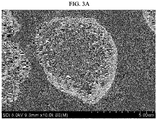
- FIG. 3A shows a 10-fold magnification SEM photograph of the negative active material according to Example 1
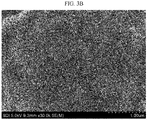
- FIG. 3B shows a 30-fold magnification SEM photograph thereof
- FIG. 3C shows a 50-fold magnification SEM photograph thereof.
- the negative active material of Example 1 had an uneven surface in an urchins-type, from which the nitrogen-containing carbon compound clearly existed in the urchins-type protruding outward on the surface.
- the half-cells according to Example 1 and the Comparative Examples 1 to 3 were once charged and discharged at 0.2 C and then, once charged and discharged at 2 C, measuring charge capacity and discharge capacity.
- a ratio of the measured 2 C charge capacity related to the measured 0.2 C charge capacity was calculated, and the results as a charge rate are shown in Table 1, and a ratio of the measured 2 C discharge capacity related to the measured 0.2 C discharge capacity was calculated, and the results as a discharge rate are shown in Table 1.
- the half-cell of Example 1 exhibited excellent formation efficiency and standard discharge characteristics, compared with the half-cells of Comparative Examples 1 to 3.
- the half-cell of Example 1 exhibited excellent charge rate and discharge rate, compared with the half-cells of Comparative Examples 1 to 3.
- Example 1 and the Comparative Examples 1 to 3 were charged under conditions of 1.0 C and a 4.0 V-0.05 C cut-off and discharged under conditions of 1.0 C and 2.5 V cut-off, which was 300 times repeated.
- 1 st discharge capacity was regarded as 100%, a capacity ratio at each cycle was calculated, and the results as capacity retention are shown in FIG. 4 .
- Example 1 exhibited excellent capacity retention at the 300 th charge and discharge, compared with those of Comparative Examples 1 to 3.
- Comparative Example 1 including silicon and amorphous carbon alone exhibited sharply decreased capacity retention after the 250 th charge and discharge
- Comparative Example 2 including semi-crystalline carbon in addition to the silicon and the amorphous carbon exhibited no sharply decreased capacity retention even after the 250 th charge and discharge but lower capacity retention than that of Example 1.
- Comparative Example 3 to which nitrogen as a liquid was added exhibited the lowest capacity retention.
Landscapes
- Chemical & Material Sciences (AREA)
- Chemical Kinetics & Catalysis (AREA)
- General Chemical & Material Sciences (AREA)
- Electrochemistry (AREA)
- Engineering & Computer Science (AREA)
- Materials Engineering (AREA)
- Manufacturing & Machinery (AREA)
- Composite Materials (AREA)
- Inorganic Chemistry (AREA)
- Organic Chemistry (AREA)
- Battery Electrode And Active Subsutance (AREA)
- Secondary Cells (AREA)
- Mechanical Engineering (AREA)
- Metallurgy (AREA)
- Silicon Compounds (AREA)
Applications Claiming Priority (1)
| Application Number | Priority Date | Filing Date | Title |
|---|---|---|---|
| KR1020200074396A KR102935734B1 (ko) | 2020-06-18 | 2020-06-18 | 리튬 이차 전지용 음극 활물질, 이의 제조 방법 및 이를 포함하는 리튬 이차 전지 |
Publications (2)
| Publication Number | Publication Date |
|---|---|
| EP3926709A2 true EP3926709A2 (fr) | 2021-12-22 |
| EP3926709A3 EP3926709A3 (fr) | 2022-01-19 |
Family
ID=76522909
Family Applications (1)
| Application Number | Title | Priority Date | Filing Date |
|---|---|---|---|
| EP21180286.3A Pending EP3926709A3 (fr) | 2020-06-18 | 2021-06-18 | Matériau actif négatif pour une batterie au lithium rechargeable, son procédé de préparation et batterie au lithium rechargeable le comprenant |
Country Status (4)
| Country | Link |
|---|---|
| US (1) | US20210399304A1 (fr) |
| EP (1) | EP3926709A3 (fr) |
| KR (1) | KR102935734B1 (fr) |
| CN (1) | CN113823776A (fr) |
Families Citing this family (2)
| Publication number | Priority date | Publication date | Assignee | Title |
|---|---|---|---|---|
| KR20240153786A (ko) | 2023-04-17 | 2024-10-24 | 삼성에스디아이 주식회사 | 음극 활물질 및 이를 포함하는 리튬 이차 전지 |
| KR20240153788A (ko) * | 2023-04-17 | 2024-10-24 | 삼성에스디아이 주식회사 | 음극 활물질 및 이를 포함하는 리튬 이차 전지 |
Family Cites Families (13)
| Publication number | Priority date | Publication date | Assignee | Title |
|---|---|---|---|---|
| CN103915609B (zh) * | 2012-12-31 | 2017-10-13 | 宁波杉杉新材料科技有限公司 | 硅‑氧化硅‑碳复合材料、锂离子二次电池负极材料、其制备方法和应用 |
| WO2015041063A1 (fr) * | 2013-09-17 | 2015-03-26 | 中央電気工業株式会社 | Particules composites de substance contenant une phase de silicium et graphite et leur procédé de production |
| EP3104445B1 (fr) * | 2014-02-06 | 2019-03-13 | Nissan Motor Co., Ltd. | Batterie secondaire à électrolyte non aqueux |
| KR20160001481A (ko) * | 2014-06-27 | 2016-01-06 | 주식회사 엘지화학 | 표면 코팅된 다공성 실리콘계 음극 활물질 및 이의 제조방법 |
| CN106025219A (zh) * | 2016-06-24 | 2016-10-12 | 中天储能科技有限公司 | 一种球形硅氧碳负极复合材料及其制备方法和用途 |
| KR102409817B1 (ko) * | 2016-11-18 | 2022-06-17 | 삼성에스디아이 주식회사 | 다공성 실리콘 복합체 클러스터 구조체, 이를 포함한 탄소 복합체, 그 제조방법, 이를 포함한 전극, 및 리튬 전지, 소자 |
| EP3580798B1 (fr) * | 2017-02-07 | 2020-05-06 | Wacker Chemie AG | Particules de composite de shell de base pour les batteries d'ion de lithium |
| KR102157183B1 (ko) * | 2017-03-07 | 2020-09-18 | 주식회사 엘지화학 | 음극 활물질, 상기 음극 활물질을 포함하는 음극, 및 상기 음극을 포함하는 이차 전지 |
| GB2563455B (en) * | 2017-06-16 | 2019-06-19 | Nexeon Ltd | Particulate electroactive materials for use in metal-ion batteries |
| CN110085856B (zh) * | 2018-01-26 | 2024-08-06 | 三星电子株式会社 | 含硅结构体、其制备方法、使用其的碳复合物及各自包括其的电极、锂电池和设备 |
| TWI646051B (zh) * | 2018-02-07 | 2019-01-01 | 光宇材料股份有限公司 | 氮摻雜碳矽複合材料及其製造方法 |
| KR101856925B1 (ko) * | 2018-03-23 | 2018-05-10 | 주식회사 엘지화학 | 표면 코팅된 다공성 실리콘계 음극 활물질 및 이의 제조방법 |
| CN109309220B (zh) * | 2018-10-10 | 2021-03-23 | 成都爱敏特新能源技术有限公司 | 一种锂离子电池所用补锂多孔一氧化硅负极材料及其制备方法 |
-
2020
- 2020-06-18 KR KR1020200074396A patent/KR102935734B1/ko active Active
-
2021
- 2021-06-17 US US17/350,993 patent/US20210399304A1/en not_active Abandoned
- 2021-06-18 CN CN202110679416.0A patent/CN113823776A/zh active Pending
- 2021-06-18 EP EP21180286.3A patent/EP3926709A3/fr active Pending
Also Published As
| Publication number | Publication date |
|---|---|
| KR102935734B1 (ko) | 2026-03-06 |
| CN113823776A (zh) | 2021-12-21 |
| EP3926709A3 (fr) | 2022-01-19 |
| US20210399304A1 (en) | 2021-12-23 |
| KR20210156918A (ko) | 2021-12-28 |
Similar Documents
| Publication | Publication Date | Title |
|---|---|---|
| EP3819963B1 (fr) | Matériau actif négatif pour batterie au lithium rechargeable et batterie au lithium rechargeable comprenant celui-ci | |
| EP3621132B1 (fr) | Matériau actif négatif pour batterie au lithium rechargeable, son procédé de préparation, électrode négative le comprenant et batterie au lithium rechargeable le comprenant | |
| US12206090B2 (en) | Negative active material for rechargeable lithium battery and rechargeable lithium battery including the same | |
| CN113346078B (zh) | 负极活性物质和包括负极活性物质的可再充电锂电池 | |
| EP3930046A1 (fr) | Électrode négative pour batterie rechargeable au lithium et batterie rechargeable au lithium comprenant celle-ci | |
| EP4002518A1 (fr) | Électrode négative pour batterie rechargeable au lithium et batterie rechargeable au lithium comprenant celle-ci | |
| EP4228025B1 (fr) | Électrode négative pour batterie au lithium rechargeable et batterie au lithium rechargeable la comprenant | |
| US20240332512A1 (en) | Negative active material for rechargeable lithium battery and rechargeable lithium battery comprising same | |
| US11018340B2 (en) | Negative electrode for rechargeable lithium battery and rechargeable lithium battery including same | |
| US11670762B2 (en) | Negative active material for rechargeable lithium battery and rechargeable lithium battery including same | |
| US20210151745A1 (en) | Negative active material for rechargeable lithium battery, and rechargeable lithium battery including same | |
| EP3926709A2 (fr) | Matériau actif négatif pour une batterie au lithium rechargeable, son procédé de préparation et batterie au lithium rechargeable le comprenant | |
| KR20210053060A (ko) | 리튬 이차 전지용 음극 활물질 및 리튬 이차 전지 | |
| EP4191705A1 (fr) | Matériau actif d'anode et batterie secondaire au lithium le comprenant | |
| EP4199147A1 (fr) | Matériau actif d'anode pour batterie secondaire au lithium, anode pour batterie secondaire au lithium, comprenant celui-ci, et batterie secondaire au lithium le comprenant | |
| EP3940813B1 (fr) | Matériau actif négatif pour batterie au lithium rechargeable et batterie au lithium rechargeable le comprenant | |
| EP4475221B1 (fr) | Électrode négative pour batterie au lithium rechargeable et batterie au lithium rechargeable la comprenant | |
| EP4365978A2 (fr) | Électrode négative pour batterie au lithium rechargeable et batterie au lithium rechargeable la comprenant | |
| US12176540B2 (en) | Negative active material and rechargeable lithium battery including same | |
| EP4239710A1 (fr) | Électrode négative pour batterie au lithium rechargeable et batterie au lithium rechargeable la comprenant | |
| US20250070131A1 (en) | Negative electrode for rechargeable lithium battery and rechargeable lithium battery including same | |
| US20250023034A1 (en) | Negative active material and rechareable lithium battery including same | |
| EP4318644A2 (fr) | Électrode négative pour batterie au lithium rechargeable et batterie au lithium rechargeable la comprenant | |
| US20240250243A1 (en) | Negative active material for rechargeable lithium battery and rechargeable lithium battery including same | |
| US20250125354A1 (en) | Negative active material for rechargeable lithium battery and rechargeable lithium battery including same |
Legal Events
| Date | Code | Title | Description |
|---|---|---|---|
| PUAI | Public reference made under article 153(3) epc to a published international application that has entered the european phase |
Free format text: ORIGINAL CODE: 0009012 |
|
| STAA | Information on the status of an ep patent application or granted ep patent |
Free format text: STATUS: REQUEST FOR EXAMINATION WAS MADE |
|
| PUAL | Search report despatched |
Free format text: ORIGINAL CODE: 0009013 |
|
| 17P | Request for examination filed |
Effective date: 20210618 |
|
| AK | Designated contracting states |
Kind code of ref document: A2 Designated state(s): AL AT BE BG CH CY CZ DE DK EE ES FI FR GB GR HR HU IE IS IT LI LT LU LV MC MK MT NL NO PL PT RO RS SE SI SK SM TR |
|
| AK | Designated contracting states |
Kind code of ref document: A3 Designated state(s): AL AT BE BG CH CY CZ DE DK EE ES FI FR GB GR HR HU IE IS IT LI LT LU LV MC MK MT NL NO PL PT RO RS SE SI SK SM TR |
|
| RIC1 | Information provided on ipc code assigned before grant |
Ipc: H01M 4/02 20060101ALI20211213BHEP Ipc: H01M 10/052 20100101ALI20211213BHEP Ipc: H01M 4/583 20100101ALI20211213BHEP Ipc: H01M 4/38 20060101ALI20211213BHEP Ipc: H01M 4/1395 20100101ALI20211213BHEP Ipc: H01M 4/1393 20100101ALI20211213BHEP Ipc: H01M 4/134 20100101ALI20211213BHEP Ipc: H01M 4/133 20100101ALI20211213BHEP Ipc: H01M 4/04 20060101AFI20211213BHEP |