EP3930129A1 - Zwischenverbindungsstruktur eines stromkabels - Google Patents
Zwischenverbindungsstruktur eines stromkabels Download PDFInfo
- Publication number
- EP3930129A1 EP3930129A1 EP20759488.8A EP20759488A EP3930129A1 EP 3930129 A1 EP3930129 A1 EP 3930129A1 EP 20759488 A EP20759488 A EP 20759488A EP 3930129 A1 EP3930129 A1 EP 3930129A1
- Authority
- EP
- European Patent Office
- Prior art keywords
- layer
- metal sheath
- connection structure
- restoration
- intermediate connection
- Prior art date
- Legal status (The legal status is an assumption and is not a legal conclusion. Google has not performed a legal analysis and makes no representation as to the accuracy of the status listed.)
- Pending
Links
Images




Classifications
-
- H—ELECTRICITY
- H02—GENERATION; CONVERSION OR DISTRIBUTION OF ELECTRIC POWER
- H02G—INSTALLATION OF ELECTRIC CABLES OR LINES, OR OF COMBINED OPTICAL AND ELECTRIC CABLES OR LINES
- H02G15/00—Cable fittings
- H02G15/08—Cable junctions
- H02G15/10—Cable junctions protected by boxes, e.g. by distribution, connection or junction boxes
-
- H—ELECTRICITY
- H02—GENERATION; CONVERSION OR DISTRIBUTION OF ELECTRIC POWER
- H02G—INSTALLATION OF ELECTRIC CABLES OR LINES, OR OF COMBINED OPTICAL AND ELECTRIC CABLES OR LINES
- H02G15/00—Cable fittings
- H02G15/08—Cable junctions
- H02G15/18—Cable junctions protected by sleeves, e.g. for communication cable
- H02G15/196—Cable junctions protected by sleeves, e.g. for communication cable having lapped insulation
-
- H—ELECTRICITY
- H01—ELECTRIC ELEMENTS
- H01B—CABLES; CONDUCTORS; INSULATORS; SELECTION OF MATERIALS FOR THEIR CONDUCTIVE, INSULATING OR DIELECTRIC PROPERTIES
- H01B7/00—Insulated conductors or cables characterised by their form
- H01B7/02—Disposition of insulation
-
- H—ELECTRICITY
- H01—ELECTRIC ELEMENTS
- H01B—CABLES; CONDUCTORS; INSULATORS; SELECTION OF MATERIALS FOR THEIR CONDUCTIVE, INSULATING OR DIELECTRIC PROPERTIES
- H01B7/00—Insulated conductors or cables characterised by their form
- H01B7/17—Protection against damage caused by external factors, e.g. sheaths or armouring
- H01B7/18—Protection against damage caused by wear, mechanical force or pressure; Sheaths; Armouring
-
- H—ELECTRICITY
- H01—ELECTRIC ELEMENTS
- H01B—CABLES; CONDUCTORS; INSULATORS; SELECTION OF MATERIALS FOR THEIR CONDUCTIVE, INSULATING OR DIELECTRIC PROPERTIES
- H01B7/00—Insulated conductors or cables characterised by their form
- H01B7/17—Protection against damage caused by external factors, e.g. sheaths or armouring
- H01B7/18—Protection against damage caused by wear, mechanical force or pressure; Sheaths; Armouring
- H01B7/22—Metal wires or tapes, e.g. made of steel
-
- H—ELECTRICITY
- H01—ELECTRIC ELEMENTS
- H01B—CABLES; CONDUCTORS; INSULATORS; SELECTION OF MATERIALS FOR THEIR CONDUCTIVE, INSULATING OR DIELECTRIC PROPERTIES
- H01B9/00—Power cables
- H01B9/02—Power cables with screens or conductive layers, e.g. for avoiding large potential gradients
- H01B9/027—Power cables with screens or conductive layers, e.g. for avoiding large potential gradients composed of semi-conducting layers
-
- H—ELECTRICITY
- H02—GENERATION; CONVERSION OR DISTRIBUTION OF ELECTRIC POWER
- H02G—INSTALLATION OF ELECTRIC CABLES OR LINES, OR OF COMBINED OPTICAL AND ELECTRIC CABLES OR LINES
- H02G15/00—Cable fittings
- H02G15/08—Cable junctions
Definitions
- the present invention relates to an intermediate connection structure of a power cable. More specifically, the present invention relates to a power cable and an intermediate connection structure, for connection thereof, which is capable of preventing the concentration of stress on a soldered part, which is configured to join a metal sheath of the power cable and a metal sheath restoration layer of the intermediate connection structure while ensuring airtight or watertight sealing therebetween, preventing deformation of or damage to the soldered part due to stress applied thereto, and minimizing thermal history in the power cable during the formation of the soldered part.
- Power cables that are used to supply power may be divided into a paper-insulated cable impregnated with insulating oil and an XPLE cable according to a material of an insulating layer outside a conductor.
- Power cables may be connected using a joint box or the like according to a length of the power cables to be laid.
- a joint box of the paper-insulated power cable impregnated with insulating oil and a joint box of the XLPE power cable including a pre-mold joint (PMJ) may be in the form of a housing.
- a power cable wound about a turntable installed at a cable laying ship may be unwound and laid or separate power cables may be consecutively laid at the cable laying ship by intermediately connecting them through a joint box.
- a considerable amount of work time and costs are required for the intermediate connection of the power cables through the joint box at the cable laying ship or the like.
- a method of winding power cables intermediately connected through a joint box about a drum or a turntable and consecutively laying the power cables may be considered, but the joint box is large in volume or is not flexible as described above and thus the intermediately connected power cables cannot be consecutively wound about a turntable or a drum of a cable laying ship. Therefore, a method of performing intermediate connection in a ship, which is a place for intermediate connection, should be applied.
- the flexible joint is not a general intermediate connection structure but refers to an intermediate connection structure, of a power cable, which has an outer diameter substantially the same as those of cables, is freely bendable, and is used to connect cables at a cable manufacturing factory other than a cable laying site, and is also referred to as a factory joint because cables are connected thereby in a cable manufacturing process.
- the flexible joint is substantially the same as cables, which are to be connected, in terms of an outer diameter and flexibility, and thus cables connected thereby may be laid consecutively by being wound about a turntable of a ship for laying submarine cables.
- FIGS. 6 and 7 illustrate examples of an internal structure of a flexible intermediate connector 200 for connecting a pair of power cables. Specifically, FIG. 6 shows an example of an intermediate connector of a paper-insulated power cable, and FIG. 7 shows an example of an intermediate connector of an XLPE power cable.
- a pair of power cables may be connected through the intermediate connector 200 in a state in which conductors 11, inner semiconducting layers (not shown), cable insulating layers 14, outer semiconducting layers 16, metal sheaths 22, metal strip layers 26, etc. are sequentially exposed and ends of the pair of power cables face each other.
- the intermediate connector 200 may include a conductor connection part 210 for connecting ends of a pair of the conductors 11, an insulating restoration layer 214 formed to surround the conductors 11 of the pair of power cables, the conductor connection part 210, and the insulating layers 14 of the pair of power cables, an outer semiconducting restoration layer 216 formed to surround the insulating restoration layer 214, a metal sheath restoration layer 222 covering an outer side of the outer semiconducting restoration layer 216, a metal strip restoration layer 226 formed outside the metal sheath restoration layer 222, and the like.
- the insulating restoration layer 214, the outer semiconducting restoration layer 216, the metal sheath restoration layer 222, and the metal sheath restoration layer 226 may be formed of the same or substantially the same materials as the insulating layers 14, the outer semiconducting layers 16, the metal sheaths 22, and the metal strip layers 26 of the power cables 100a and 100b.
- the insulating restoration layer 214, the outer semiconducting restoration layer 216, and the metal sheath restoration layer 226 excluding the metal sheath restoration layer 222 among the insulating restoration layer 214, the outer semiconducting restoration layer 216, the metal sheath restoration layer 222, and the metal sheath restoration layer 226 of the intermediate connector 200 of FIGS. 6 and 7 may be restored by spirally cross-winding insulating paper, a non-cross-linked polypropylene tape, a semiconductive tape, a metal strip, or the like in the same way as the components of the power cables corresponding thereto.
- an insulating restoration layer may be restored using a cross-linked XLPE material obtained by applying and molding non-cross-linked polypropylene.
- the metal sheaths 22 of the power cables 100a and 100b are sealing means for preventing the permeation of foreign substances such as moisture into the power cables 100a and 100b and preventing the loss of insulating oil in the case of a paper-insulated cable, and may be formed of a material such as a thin lead sheath.
- the metal sheath restoration layer 222 cannot be restored by spirally cross-winding a lead tape or sheet and may be formed by mounting a lead tube corresponding to a length of the intermediate connection part 200 on a side of each of the pair of power cables 100a and 100b to be connected, restoring the outer semiconducting restoration layer 216, etc., moving the lead tube to a position of the intermediate connection part 200, performing tube reduction, and forming a soldered part 2221 by soldering the lead tube and the end of the metal sheath 22.
- the intermediate connector 200 of a flexible joint type may be completed by restoring the metal sheath restoration layer 226 by cross-winding a metal strip and restoring an outer part(not shown).
- the lead tube constituting the metal sheath restoration layer 222 is stacked on an end of the metal sheath 22, and a soldered part is formed on an end region of the lead tube (namely, "lap-soldering") as shown in FIGS. 6 and 7 .
- stress may be concentrated on the place of stacking due to internal pressure, mechanical stress applied when bent, stress applied when the soldered part is pressed due to a metal strip or an outer layer such as an armor provided after the completion of the intermediate connector.
- the intermediate connector When stress is concentrated on a region of the soldered part, the intermediate connector is likely to be wrinkled when bent or curved and may be cracked or broken when repeatedly bent or curved, and thus, a sealing function of the metal sheath or the metal sheath restoration layer may be damaged.
- the present invention relates to a power cable, and an intermediate connection structure for connection thereof, which is capable of preventing concentration of stress on a soldered part, which is configured to join a metal sheath of the power cable and a metal sheath restoration layer of the intermediate connection structure while ensuring airtight or watertight sealing therebetween, or deformation or breakage of the soldered part due to stress, and minimizing thermal history of the inside of the power cable during the formation of the soldered part.
- the present invention provides an intermediate connection structure of a power cable for connecting a pair of power cables, wherein the power cable comprises a conductor, an inner semiconducting layer outside the conductor, a cable insulating layer outside the inner semiconducting layer, an outer semiconducting layer outside the cable insulating layer, and a metal sheath outside the outer semiconducting layer, and the intermediate connection structure comprises a conductor connection part to which a pair of conductors are connected, an inner semiconducting restoration layer outside the exposed conductor of the power cable and the conductor connection part, an insulating restoration layer for covering at least portions of the inner semiconducting restoration layer and the cable insulating layer, an outer semiconducting restoration layer outside the insulating restoration layer, and a metal sheath restoration layer outside the outer semiconducting restoration layer, wherein an end of the metal sheath of the power cable and an end of the metal sheath restoration layers are spaced a predetermined distance from each other, a metal taping
- a width of the metal taping layer may be greater than the predetermined distance.
- the predetermined distance may be in a range of 5 mm to 20 mm.
- end of the metal sheath and the end of the metal sheath restoration layer may taper from top to bottom to have inclined surfaces facing each other.
- And widths of the inclined surfaces of the end of the metal sheath and the end of the metal sheath restoration layer in a longitudinal direction of the intermediate connection structure may be 20 mm or less.
- a width of the soldered part may be in a range of 20 mm to 60 mm.
- a maximum thickness of the soldered part may be 1 to 1.3 times a thickness of the metal sheath or a thickness of the metal sheath restoration layer.
- a maximum thickness of the soldered part may be 10 mm or less.
- the metal taping layer may be in contact with the end of the metal sheath, the end of the metal sheath restoration layer, and the soldered part.
- an outer diameter of the intermediate connection structure may be 1.02 to 1.1 times that of the power cable.
- the present invention provides an intermediate connection structure for connection of a power cable which includes a conductor, an inner semiconducting layer, a cable insulating layer, an outer semiconducting layer, and a metal sheath
- the intermediate connection structure comprises a conductor connection part to which the conductor of the power cable is connected; an insulating restoration layer for covering at least portions of the conductor of the power cable, the conductor connection part, and the cable insulating layer; an outer semiconducting restoration layer restored outside the insulating restoration layer; and a metal sheath restoration layer restored outside the outer semiconducting restoration layer, wherein an insulation means is provided below a boundary area between an end of the metal sheath of the power cable and an end of the metal sheath restoration layer, and the boundary area below which the insulation means is provided is finished with a soldered part.
- end of the metal sheath of the power cable and the end of the metal sheath restoration layer may be spaced a predetermined distance from each other.
- the insulation means may be configured by winding a copper tape, wherein a width of the copper tape is greater than the predetermined distance.
- end of the metal sheath of the power cable and the end of the metal sheath restoration layer may be inclined surfaces facing each other, and the soldered part is configured to finish the entire inclined surfaces.
- the present invention provides an intermediate connection structure for connection of a power cable which includes a conductor, an inner semiconducting layer, a cable insulating layer, an outer semiconducting layer, and a metal sheath
- the intermediate connection structure comprises a conductor connection part to which a pair of conductors are connected, an insulating restoration layer for covering at least portions of the exposed conductor of the power cable, the conductor connection part, and the cable insulating layer, an outer semiconducting restoration layer restored outside the insulating restoration layer, and a metal sheath restoration layer restored outside the outer semiconducting restoration layer, wherein an outer circumferential surface of an end of the metal sheath and an outer circumferential surface of an end of the metal sheath restoration layer are processed as inclined surfaces, the end of the metal sheath restoration layer is stacked on the end of the metal sheath, and a soldered part is formed at a boundary area between the outer circumferential surface of the end of the metal sheath restoration
- end of the metal sheath and the end of the metal sheath restoration layer may taper from top to bottom and thus the outer circumferential surfaces thereof may be inclined surfaces facing each other.
- And widths of the inclined surfaces of the end of the metal sheath and the end of the metal sheath restoration layer in a longitudinal direction of the intermediate connection structure may be 20 mm or less.
- a width of the soldered part may be in a range of 20 mm to 60 mm.
- a maximum thickness of the soldered part on the boundary area may be 10 mm or less.
- ends of a metal sheath of a power cable and a metal sheath restoration layer of the intermediate connection structure may be separated from each other inside a soldered part for airtightly joining the metal sheath and the metal sheath restoration layer, thereby minimizing an increase of a thickness of the intermediate connection structure due to the soldered part.
- ends of the metal sheath of the power cable and the metal sheath restoration layer of the intermediate connection structure may be processed to have inclined surfaces inside the soldered part, so that stress or concentration of stress inside the soldered part may be alleviated and a thickness of the soldered part may be gently changed.
- a metal taping layer may be provided as a heat dissipating means below a boundary area between the end of the metal sheath of the power cable and the end of the metal sheath restoration layer of the intermediate connection structure to minimize thermal history due to heat applied during the formation of the soldered part.
- the concentration of stress on the soldered part or a peripheral region due to internal or external pressure applied to the soldered part or deformation or breakage of the soldered part or the peripheral region may be reduced and thus the watertightness or airtightness of the intermediate connection structure may be improved.
- flexural characteristics of the power cable when repeatedly bent with respect to the intermediate connection structure may be improved, because the concentration of stress on the soldered part and the peripheral region or deformation or breakage of the soldered part due to stress may be reduced.
- the end of the metal sheath of the power cable and the end of the metal sheath restoration layer of the intermediate connection structure may be processed to have inclined surfaces inside the soldered part and a boundary area therebetween is soldered in a state in which the ends are separated from each other, so that areas of the ends of the metal sheath and the metal sheath restoration layer, which are finished with the soldered part, may be increased to improve tensile characteristics when tension is applied to the intermediate connection structure of a power cable as a boundary.
- power cables are connected through a joint box at intervals of several hundreds of meters or several kilometers and ends thereof are connected to an overhead line due to the joint box.
- a power cable 100 and an intermediate connection structure 200 for connection thereof will be described below.
- FIG. 1 is a cutaway perspective view of a submarine power cable 100 which is an example of a power cable.
- the submarine power cable 100 includes a cable core part 10 having a conductor 11, an inner semiconducting layer 12, a cable insulating layer 14, and an outer semiconducting layer 16, and is configured to transmit power along the conductor 11 only in a longitudinal direction of the submarine power cable 100 and prevent leakage of current in a radial direction of the submarine power cable 100.
- the conductor 11 acts as a path through which current flows to transmit power, and may be formed of a material, e.g., copper or aluminum, which has high conductivity to minimize power loss and has strength and flexibility appropriate to manufacture and use a cable.
- the conductor 11 may be a flat conductor 11 including a flat wire layer 11c, which consists of a round central wire 11a and a flat wire 11b twisted to cover the round central line 11a, and having an overall round cross section.
- the conductor 11 may be a circular compressed conductor 11 obtained by twisting a plurality of round wires and compressing them into a circular shape.
- the flat conductor 11 has a higher space factor than that of the circular compressed conductor 11 and thus may contribute to reduction of an outer diameter of a cable.
- the conductor 11 is formed by twisting a plurality of wires, a surface thereof is not smooth and thus an electric field may not be uniform and a corona discharge is likely to occur locally.
- insulation performance may decrease.
- the inner semiconducting layer 12 may be formed outside the conductor 11.
- the inner semiconducting layer 12 may include an insulating material to which conductive particles such as carbon black, carbon nanotubes, carbon nanoplates, or graphite are added and thus may have a semiconductive property.
- the inner semiconducting layer 12 may prevent a sudden change in an electric field between the conductor 11 and the cable insulating layer 14 described below, thereby stabilizing insulation performance.
- the inner semiconducting layer 12 may suppress a non-uniform charge distribution on a surface of the conductor 11 to achieve a uniform electric field and may prevent a gap between the conductor 11 and the cable insulating layer 14 to suppress a corona discharge, dielectric breakdown, etc.
- the cable insulating layer 14 is provided outside the inner semiconducting layer 12 to electrically insulate the inner semiconducting layer 12 from the outside so that current flowing through the conductor 11 may not leak to the outside.
- the cable insulating layer 14 may be formed of insulating paper impregnated with insulating oil or XLPE. That is, the cable insulating layer 14 may be formed by winding insulating paper in multiple layers to surround the inner semiconducting layer 12 and impregnating the insulating paper with the insulating oil after forming the cable core part (in the case of a paper-insulated power cable) or may be formed by forming an XLPE insulating layer by cross-linking a polyethylene material (in the case of an XLPE power cable).
- the outer semiconducting layer 16 may be provided outside the cable insulating layer 14. Similar to the inner semiconducting layer 12, the outer semiconducting layer 16 is formed of a material having a semiconductive property, e.g., an insulating material to which conductive particles, e.g., carbon black, carbon nanotubes, carbon nanoplates, or graphite, are added, to suppress a non-uniform charge distribution between the cable insulating layer 14 and the metal sheath 22 described below, thereby stabilizing insulation performance. In addition, the outer semiconducting layer 16 may planarize a surface of the cable insulating layer 14 to mitigate electric field concentration in the power cable 100, thus preventing a corona discharge, and physically protect the cable insulating layer 214.
- a semiconductive property e.g., an insulating material to which conductive particles, e.g., carbon black, carbon nanotubes, carbon nanoplates, or graphite
- the cable core part 10 may further include a moisture absorbing layer 21 to prevent moisture from penetrating the power cable 100.
- the moisture absorbing layer 21 may be formed between the stranded wires of the conductor 11 and/or outside the conductor 11, and provided in the form of powder, a tape, a coating layer, or a film containing a super absorbent polymer (SAP) capable of quickly absorbing moisture permeating a cable and maintaining a state of absorbing the moisture, thereby preventing permeation of moisture in the longitudinal direction.
- the moisture absorbing layer 21 may have semiconductivity to prevent a sudden electric field change.
- a cable protection part 20 may be provided outside the cable core part 10, and the power cable 100 may further include the cable armor 30 when laid at the bottom of the sea.
- the cable protection part 20 and the cable armor 30 protect the cable core part 10 from various environmental factors, such as moisture penetration, mechanical trauma, and corrosion, which may affect power transmission performance of the power cable 100.
- the cable protection part 20 includes the metal sheath 22 and a polymer sheath 24 to protect the power cable 100 from fault current, external forces, and other external environmental factors.
- the metal sheath 22 may be formed to surround the cable core part 10.
- the cable core part 10 may be sealed to prevent the permeation of foreign substances such as moisture thereinto, and a molten metal may be extruded on the outside of the cable core part 10 to make the cable core part 10 have seamless and continuous outer sides, thereby enhancing watertightness performance.
- the molten metal may be lead or aluminum, preferably, lead having excellent corrosion resistance to seawater when the power cable 100 is laid at the sea bottom, and more preferably, a lead alloy containing a metal element to reinforce mechanical properties.
- the metal sheath 22 may be grounded at an end of the power cable 100 to serve as a path through which fault current flows when an accident such as a ground fault or a short circuit occurs, protect the power cable 100 from external shocks, and prevent an electric field from being discharged to the outside of the power cable 100.
- an anticorrosion compound e.g., blown asphalt
- a surface of the metal sheath 22 may additionally improve corrosion resistance, watertightness, etc. of the power cable 100 and improve adhesion to the polymer sheath 24.
- a nonwoven copper wire tape or a moisture absorbing layer 21 may be additionally provided between the metal sheath 22 and the cable core part 10.
- the nonwoven copper wire tape includes copper wire, a nonwoven tape, and the like to facilitate electrical contact between the outer semiconducting layer 16 and the metal sheath 22.
- the moisture absorbing layer 21 is provided in the form of powder, a tape, a coating layer, a film or the like containing a super absorbent polymer (SAP) capable of quickly absorbing moisture permeating the power cable 100 and maintaining a state of absorbing the moisture to prevent penetration of moisture in the longitudinal direction of the power cable 100.
- the nonwoven copper wire tape and the moisture absorbing layer 21 may preferably have a semiconductive property to prevent a sudden change in an electric field, and the moisture absorbing layer 21 may include copper wire to be supplied with electric current and to absorb moisture.
- the polymer sheath 24 may be formed outside the metal sheath 22 to improve corrosion resistance, watertightness, etc. of the power cable 100 and protect the power cable 100 from other external environmental factors such as mechanical trauma, heat, and ultraviolet rays.
- the polymer sheath 24 may be formed of a resin such as polyvinyl chloride (PVC) or polyethylene, and preferably, polyethylene resin having excellent watertightness when the power cable 100 is laid at the sea bottom and preferably, polyvinyl chloride (PVC) resin in an environment requiring flame retardancy.
- PVC polyvinyl chloride
- PVC polyvinyl chloride
- the power cable 100 may include a metal strip layer 26 outside the polymer sheath 24 in the form of a galvanized steel tape or the like to prevent expansion of the metal sheath 22 due to expansion of the insulating oil.
- a bedding layer (not shown) formed of a semiconductive non-woven tape or the like may be provided on and/or below the metal strip layer 26 to buffer an external force applied to the power cable 100, and an outer sheath 28 formed of a resin such as polyvinyl chloride or polyethylene may be further provided to significantly improve corrosion resistance, watertightness, etc. of the power cable 100 and additionally protect the power cable 100 from other external environmental factors such as mechanical trauma, heat, ultraviolet rays, etc.
- the power cable 100 when laid at the sea bottom, is likely to be damaged by the anchor of a ship, a bending force applied due to sea currents or waves, friction with the sea bottom, etc., and thus may further include the cable armor 30 outside the cable protection part 20 to prevent this problem.
- the cable armor 30 may include a metal armor layer 34 and a serving layer 38.
- the metal armor layer 34 may be formed of steel, galvanized steel, copper, brass, bronze, or the like, formed by cross-winding armor wire having a round or flat cross-section in at least one layer, enhance mechanical properties and performance of the power cable 100, and additionally protect the power cable 100 from an external force.
- the serving layer 38 formed of polypropylene yarn or the like may be provided in one or more layers on and/or below the metal armor layer 34 to protect the power cable 100.
- the serving layer 38, which is an outermost layer, may be formed of two or more materials of different colors to secure visibility of the power cable 100 laid at the sea bottom.
- Such power cables should be connected at predetermined intervals through an intermediate connector, but although the intermediate connector can be used for connection at the spot, an intermediate connector of a flexible joint type may be provided to perform intermediate connection during the manufacture of cables so that the cables may be transferred while being wound about a turntable installed in a cable laying ship, when costs for connection at the spot should be considered in the case of a submarine power cable.
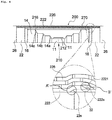
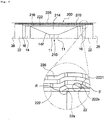
- FIGS. 2 and 3 are cross-sectional views of examples of an intermediate connection structure of a power cable according to an embodiment of the present invention.
- FIG. 2 is a cross-sectional view of an intermediate connection structure 1 of a power cable according to an embodiment of the present invention.
- each of the power cables may include a conductor 11, an inner semiconducting layer (not shown) outside the conductor 11, a cable insulating layer 14 outside the inner semiconducting layer, an outer semiconducting layer 16 outside the cable insulating layer 14, and a metal sheath 22 outside the outer semiconducting layer 16; and the intermediate connection structure 200 may include a conductor connection part 210 for connecting the pair of conductors 11, an inner semiconducting restoration layer (not shown) provided outside the exposed conductor 11 of the power cable and the conductor connection part 210, an insulating restoration layer 214 covering at least portions of the inner semiconducting restoration layer and the cable insulating layer 14, an outer semiconducting restoration layer 216 outside the insulating restoration layer 214, and a metal sheath restoration layer outside the outer semiconducting restoration layer
- the conductor connection part 210 for connecting the conductors 11 of the pair of the power cables 100a and 100b, electrically and mechanically connects the pair of exposed conductors 11, and the pair of conductors 11 may be connected by being inserted into a conductor sleeve 212 and compressed together or by being inserted into a connection sleeve and filling a gap between ends thereof with a filler metal as illustrated in FIG. 2 or may be connected by directly welding cross sections thereof as illustrated in FIG. 3 .
- the conductor sleeve 212 when the conductors 11 are connected using the conductor sleeve 212, the conductor sleeve 212 may be a same-diameter conductor sleeve 212 having substantially the same outer diameter, when compressed, as that of the pair of exposed conductors 11, and an outer side of the conductor sleeve 212 may be compressed after ends of the pair of exposed conductors 11 are inserted into the conductor sleeve 212.
- a thickness of the insulating restoration layer 214 described below may be reduced when the conductor sleeve 212 is configured as the same-diameter conductor sleeve 212 having an outer diameter substantially the same as those of the pair of conductors 11.
- a total outer diameter of the intermediate connector 200 may be substantially the same as the outer diameter of the power cable 100 when the insulating restoration layer 214 of the intermediate connector 200 is configured as having the same outer diameter as that of an insulating layer of the power cable 100.
- an increase in a diameter of a conductor connection part may be minimized by bringing conductors in contact with each other and welding the conductors together.
- the exposed cable insulating layer 14 of the power cable 100 is penciled to have multi-step inclined surfaces 14a, 14b, and 14c as illustrated in FIG. 2 but may be penciled to have a single inclined surface 14P in the case of the XLPE power cable of FIG. 3 .
- the insulating restoration layer 214 covering the conductor connection part 210 and the cable insulating layer 14 may be formed to allow current flowing through the conductors 11 and the conductor connection part 210 to flow only in a longitudinal direction of the intermediate connection system 1 and to prevent the current from leaking in a radial direction.
- the insulating restoration layer 214 may be formed by winding insulating paper or a non-cross-linked polypropylene tape to surround the conductor connection part 210, the exposed inner semiconducting layer (not shown) and the cable insulating layer 14.
- the insulating paper constituting the insulating restoration layer 214 may be composite insulating paper having excellent dielectric strength
- an insulating restoration layer may be formed of a cross-linked XLPE material by winding and molding the non-cross-linked polypropylene tape.
- the outer semiconducting restoration layer 16 may be provided outside the insulating restoration layer 214 as in the power cable.
- the metal sheath restoration layer 222 may be restored outside the outer semiconducting restoration layer 216.
- the metal sheaths 22 of the power cables 100a and 100b are sealing means for preventing penetration of foreign substances such as moisture into the power cable power cables 100a and 100b, preventing loss of insulating oil, and ensuring sealing of the insulating oil, and may be formed of a material such as a lead sheath.
- a lead sheath tube may be disposed on the intermediate connector 200, both ends of the lead sheath tube may be fixed onto the metal sheaths 22 of the power cables 100a and 100b, and the metal sheath restoration layer 222 of the intermediate connector 200 may be restored using a tube reduction device (not shown) such as a tube reduction roller.
- the soldered part 2221 may be formed by soldering ends of the metal sheath restoration layer 222 and the metal sheaths 222.
- the metal sheath restoration layer 222 is difficult to seal and thus cannot be restored by spirally cross-winding a lead sheath tape or the like, and therefore, the lead sheath tube is used.
- FIGS. 2 and 3 illustrate that the lengths of exposed portions of the metal sheaths 22 of the cables for intermediate connection of the power cables are the same, exposed lengths or areas of the metal sheaths 22 may be different in an actual power cable connection process, because the metal sheath restoration layer 222 is restored by mounting a lead tube in advance on cables, which are to be connected and are stripped to expose the metal sheaths 22 to a large extent, moving the lead tube a connection site after connection or restoration of inner components, and performing a tube reduction process on the lead tube.
- the ends of the metal sheath 22 of the power cables and the metal sheath restoration layer 222 may be finished by forming the soldered part 2221 thereon for airtightness sealing.
- Soldering is a process of melting lead to finish a gap and thus is different from welding for fusing objects, which are to be finished, together.
- an outer semiconducting layer or an outer semiconducting restoration layer may be provided in the metal sheath 22 or the metal sheath restoration layer 222, and a boundary area between ends of the metal sheath 22 and the metal sheath restoration layer 222 may be soldered by injecting molten lead into or applying the molten lead onto the boundary area without heating the boundary area by a torch or the like so as to prevent thermal deformation of the outer semiconducting layer or the outer semiconducting restoration layer during a soldering process.
- the end of the metal sheath 22 of the intermediate connection structure 1 of a power cable and the end of the metal sheath restoration layer 222 may be disposed adjacent to each other in a horizontal direction while being spaced a predetermined distance from each other and the soldered part 2221 (namely, "butt-soldered part") may be provided on a boundary area therebetween.
- the end of the metal sheath 22 of the power cable and the end of the metal sheath restoration layer 222 are disposed adjacent to each other in the horizontal direction while being spaced the predetermined distance from each other to minimize an increase of a diameter of the soldered part 2221 and prevent the concentration of internal pressure or stress.
- the intermediate connector 200 of a power cable allows the end of the metal sheath 22 and the end of the metal sheath restoration layer 222 to be disposed adjacent to each other while being spaced apart from each other so that the soldered part 2221 may be formed on a boundary area therebetween.
- the predetermined distance is preferably in a range of about 5 mm to 20 mm.
- the metal taping layer 223 may be provided below the boundary area, which is located between the end of the metal sheath 22 and the end of the metal sheath restoration layer 222 and on which the soldered part 2221 is formed.
- the metal taping layer 223 may be in contact with the end of the metal sheath 22, the end of the metal sheath restoration layer 222, and the soldered part 2221.
- the soldered part 2221 may be formed on the boundary area in a state in which the end of the metal sheath 22 and the end of the metal sheath restoration layer 222 are located adjacent to each other while being spaced the predetermined distance from each other, and the metal taping layer 223 may be provided as an insulation means below a space between the end of the metal sheath 22 and the end of the metal sheath restoration layer 222, i.e., below the soldered part 2221, to prevent thermal damage to the outer semiconducting restoration layer due to soldering and minimize an effect of thermal history on an insulating layer, etc. inside the outer semiconducting restoration layer.
- a method of separating the end of the metal sheath 22 of the power cable and the end of the metal sheath restoration layer 222 by a distance d of 5 mm to 20 mm as described above will be described below.
- an end of the lead tube may be stacked on the end of the metal sheath 22 of the power cable and thereafter the lead tube may be cut to separate the end of the lead tube and the end of the metal sheath 22 of the power cable from each other by the distance of 5 mm to 20 mm.
- the end of the metal sheath 22 and the end of the metal sheath restoration layer 222 are spaced apart from each other and the metal taping layer 223 is provided below the boundary area to minimize an increase in a thickness of the soldered part 2221, prevent thermal damage to the outer semiconducting layer 16 or the outer semiconducting restoration layer 216, and minimize thermal history of the insulating layer 14 or the insulating restoration layer 14.
- the metal taping layer 223 may also function as a solder frame preventing the permeation of a molten solder liquid, which is used to form the soldered part 2221, into the cable.
- a molten solder liquid may permeate between the end of the metal sheath 22 and the outer semiconducting layer 16 or between the end of the metal sheath restoration layer 222 and the outer semiconducting restoration layer 216 and thus the molten solder liquid may thermally deteriorate the outer semiconducting layer 16 or the outer semiconducting restoration layer 216 or prevent the formation of the soldered part 2221.
- the metal taping layer 223 may protect inner components from being thermally deformed and function as a solder frame when the soldered part 2221 is formed by separating the end of the metal sheath 22 and the end of the metal sheath restoration layer 222 from each other.
- a metal blocking frame may be provided on the metal taping layer 223, the end of the metal sheath 22, and the end of the metal sheath restoration layer 222 in three directions with respect to cross sections thereof, thereby significantly improving joining performance of the soldered part 2221.
- the metal taping layer 223 may be configured by winding a copper tape. Therefore, the metal taping layer 223 may be formed at a position on which the soldered part 2221 by winding a copper tap and approaching the metal sheath 22 and the metal sheath restoration layer 222 after making a gap between the metal sheath 22 and the metal sheath restoration layer 222 exposed by stripping multiple layers of the power cable, the lead tube may be moved to perform tube reduction, and the soldered part 2221 may be formed by soldering.
- the metal strip restoration layer 226 and an anticorrosion layer are formed to complete the intermediate connector 200 of the power cable.
- a width 1 of the metal taping layer 223 may be set to be greater than the distance between the end of the metal sheath 22 and the end of the metal sheath restoration layer 222, so that the metal taping layer 223 may function as a solder frame.
- the width 1 of the metal taping layer 223 may be set to be substantially the same as a width of the soldered part 2221 to prevent thermal deformation of the outer semiconducting layer or the outer semiconducting restoration layer or prevent the propagation of heat into the outer semiconducting layer or the outer semiconducting restoration layer.
- the width 1 of the metal taping layer 223 is preferably greater than the predetermined distance of 5 mm to 20 mm.
- the end of the metal sheath 22 and the end of the metal sheath restoration layer 222 on which the soldered part 2221 is formed may taper from top to bottom to form inclined surfaces 22S and 222S facing each other.
- soldered part 2221 When the end of the metal sheath 22 and the end of the metal sheath restoration layer 22 on which the soldered part 2221 is formed are configured as the inclined surfaces 22s and 222s, areas of contact between the soldered part 2221 formed by soldering, the end of the metal sheath 22, and the end of the metal sheath restoration layer 222 may increase, a thickness of the soldered part 2221 may gradually change, and a soldering joint area may increase, thereby improving the quality of joining using the soldered part 2221 and minimizing a variation in joining strength between regions of the soldered part 2221.
- Widths S1 and S2 of the inclined surfaces of the ends of the metal sheath 22 and the metal sheath restoration layer 222 in the longitudinal direction of the intermediate connection structure 1 are preferably 20 mm or less when the quality of joining, workability, etc. according to an increase of the joining areas are considered.
- the soldered part 2221 may be configured to finish the entire inclined surfaces of the ends of the metal sheath 22 and the metal sheath restoration layer 222 to prevent the formation of grooves and the like in an outer circumferential surface of a boundary area of the soldered part, thereby enhancing a level of flatness and preventing the concentration of stress when bent.
- a maximum thickness of the soldered part was 1 or 1.3 times a thickness of the metal sheath 22 or a thickness of the metal sheath restoration layer 222, and a maximum thickness of the soldered part 2221 was 10 mm or less, when thicknesses, etc. of the metal sheath 22 and the metal sheath restoration layer 222 were considered.
- a width of the soldered part 2221 of FIG. 2 or 3 may be in a range of about 20 mm to 60 mm.
- the metal strip restoration layer 226 may be restored by cross-winding a metal strip about the outside of the metal sheath restoration layer 222, and a cable armor layer and the like may be additionally restored when a cable armor layer is provided according to the type of the power cable, thereby completing the intermediate connector 200 of a flexible joint type.
- the metal strip restoration layer 226 may be restored at a site by restoring inner components by unwinding the metal strip layer 26 of the power cable 100 and binding a metal strip unwound after the binding of a binding tape layer 270. That is, the metal strip layer 26 of the power cable and the metal strip restoration layer 226 of the intermediate connector of the power cable may be configured consecutively not to be distinguished from each other by appearance.
- Table 1 shows results of tests of comparing a sample of the butt-soldered part of FIG. 3 and a sample of the lap-soldered part of FIG. 7 (intermediate portions of an XLPE insulating layer) in terms of a flexural property, a tensile property, and thermal history.
- the flexural property test was conducted by placing the samples on two points spaced a certain distance from each other, repeatedly applying load on the samples until the samples was destructed, and measuring the number of times of applying load. As shown in Table 1 below, in the flexural property test, the number of times of applying load on the butt-soldered part was 80 times and the number of times of applying load on the lap-soldered part was 65 times and thus the butt-soldered part was superior by 20% or more to the lap-soldered part.
- thermal history test whether there was an increase in temperature due to heat applied to an intermediate layer near the bottom of the soldered part, an insulating layer of the power cable, etc. due to heat applied during a soldering process, etc.
- the lower temperature measured at the insulating layer and the like, the better.
- thermal history of the insulating layer in the case of the butt-soldered part was 80 °C and thus was relatively low.
- soldering method lap-soldered part butt-soldered part test of samples flexural property 65 times 80 times tensile property (elongation) 13% 19% thermal history (measured with respect to an intermediate layer) 94 °C 80 °C
- the intermediate connection structure 200 of FIG. 2 or 3 is not in the form of a junction box but is configured by restoring each layer of the power cable by using the same material.
- the conductor connection part 210, the inner semiconducting restoration layer, the insulating restoration layer 214, the outer semiconducting restoration layer 216, and the metal sheath restoration layer 222 may be formed at the same layers or at substantially the same heights as the conductor, the inner semiconducting layer, the cable insulating layer 14, the outer semiconducting layer 16, and the metal sheath 22.
- an increase of a diameter of the intermediate connection structure 200 of a flexible joint type or a same-diameter joint types was minimized when an outer diameter of the intermediate connection structure 200 having the above structure was about 1.02 to 1.1 times that of the power cable.
- an outer diameter condition of the intermediate connection structure 200 and the power cable when the outer diameter of the intermediate connection structure 200 was 1.02 times less than that of the power cable, a thickness of the insulating layer was not secured due to the intermediate connection structure 200 serving as a connector, and when the outer diameter of the intermediate connection structure 200 was 1.1 times greater than that of the power cable, the power cable was laid by being unwound from a turntable and thus mechanical strength such as flexural strength may reduce.
- FIGS. 4 and 5 illustrate examples of an intermediate connection structure for flexibly connecting a pair of power cables according to another embodiment of the present invention. A description of parts that are the same as those described above with reference to FIGS. 2 and 3 will be omitted and differences from FIGS. 2 and 3 will be described below.
- an intermediate connector 200 may include: a conductor connection part 210 for connection of a pair of conductors 11; an insulating restoration layer 214 for covering at least portions of the exposed conductors 11 of the power cables 100a and 100b, the conductor connection part 210, and the cable insulating layer 14; an outer semiconducting restoration layer 216 restored outside the insulating restoration layer 214; and a metal sheath restoration layer 222 restored outside the outer semiconducting restoration layer 216, wherein an end of the metal sheath 22 and an end of the metal sheath restoration layer 222 are processed to be inclined surfaces, the end of the metal sheath restoration layer 222 is stacked on the end of the metal sheath 22, and a soldered part 2221 is
- the end of the metal sheath 22 and the end of the metal sheath restoration layer 222 are stacked together within a predetermined range (a stacked soldered part) unlike in the embodiments of FIGS. 2 and 3 in which the end of the metal sheath 22 and the end of the metal sheath restoration layer 222 are located adjacent in the horizontal direction while being spaced apart from each other but taper from top to bottom to form inclined surfaces 22s and 222s facing each other unlike in an intermediate connection structure of a power cable of the related art.
- the end of the metal sheath 22 and the end of the metal sheath restoration layer 222 are stacked together but are the inclined surfaces 22s and 222s, and thus, the concentration or application of stress to a region A', in which a lead tube is reduced to reduce a diameter, due to the corner of an end of the metal sheath 22 below the region A' may be minimized.
- the lead tube constituting the metal sheath restoration layer 222 is formed of a flexible material and has an outer circumferential surface having a gentle slope in the region A' according to the shape of the end of the metal sheath 22 during the reduction of the lead tube, unlike in the embodiments of FIGS. 6 and 7 .
- an end of the lead tube constituting the metal sheath restoration layer 222 is processed to have an inclined surface 222s so that an area of contact between the soldered part 2221 and the lead tube may increase and a thickness of the soldered part 2221 may gradually change, as in the embodiments of FIGS. 2 and 3 .
- a region in which the soldered part is formed varies according to whether the end of the metal sheath 22 and the end of the metal sheath restoration layer 222 are spaced apart from each other in the horizontal direction or are stacked together but the ends may taper from top to bottom to have inclined surfaces having a gentle slope and facing each other, thereby preventing the concentration of stress on a boundary area and increasing an area of contact of the soldered part.
- widths of the inclined surfaces 22S and 222S of the end of the metal sheath 22 and the end of the metal sheath restoration layer 222 in the longitudinal direction of the intermediate connection structure may be 20 mm or less, a width of the soldered part may be in a range of 20 mm to 60 mm, and a maximum thickness t of the soldered part may be 10 mm or less for the reasons described above with respect to the previous embodiments.
Landscapes
- Cable Accessories (AREA)
- Insulated Conductors (AREA)
Applications Claiming Priority (3)
| Application Number | Priority Date | Filing Date | Title |
|---|---|---|---|
| KR20190020018 | 2019-02-20 | ||
| KR1020200019595A KR102777014B1 (ko) | 2019-02-20 | 2020-02-18 | 전력케이블의 중간접속구조 |
| PCT/KR2020/002365 WO2020171575A1 (ko) | 2019-02-20 | 2020-02-19 | 전력케이블의 중간접속구조 |
Publications (2)
| Publication Number | Publication Date |
|---|---|
| EP3930129A1 true EP3930129A1 (de) | 2021-12-29 |
| EP3930129A4 EP3930129A4 (de) | 2022-11-30 |
Family
ID=72265883
Family Applications (1)
| Application Number | Title | Priority Date | Filing Date |
|---|---|---|---|
| EP20759488.8A Pending EP3930129A4 (de) | 2019-02-20 | 2020-02-19 | Zwischenverbindungsstruktur eines stromkabels |
Country Status (2)
| Country | Link |
|---|---|
| EP (1) | EP3930129A4 (de) |
| KR (1) | KR102777014B1 (de) |
Families Citing this family (2)
| Publication number | Priority date | Publication date | Assignee | Title |
|---|---|---|---|---|
| KR102536903B1 (ko) | 2020-08-13 | 2023-05-26 | 엘티소재주식회사 | 헤테로고리 화합물, 이를 포함하는 유기 발광 소자 및 유기 발광 소자의 유기물층용 조성물 |
| EP4535572A1 (de) | 2023-10-05 | 2025-04-09 | RE Technologies GmbH | Kabelverbindungsanordnung für stromkabel und verfahren dafür |
Family Cites Families (4)
| Publication number | Priority date | Publication date | Assignee | Title |
|---|---|---|---|---|
| JP2003087925A (ja) * | 2001-09-13 | 2003-03-20 | Chubu Electric Power Co Inc | 電力ケーブルの接続部 |
| JP2010104122A (ja) * | 2008-10-22 | 2010-05-06 | Sumitomo Electric Ind Ltd | ソリッドケーブルの中間接続構造 |
| KR101361961B1 (ko) * | 2012-09-11 | 2014-02-12 | 대한전선 주식회사 | 알루미늄 튜브를 이용한 전력케이블 금속시스 연공 구조 |
| KR102216121B1 (ko) * | 2017-11-07 | 2021-02-15 | 엘에스전선 주식회사 | 전력 케이블용 중간접속함을 이용한 직류 전력케이블 중간접속 시스템 및 직류 전력케이블 접속 방법 |
-
2020
- 2020-02-18 KR KR1020200019595A patent/KR102777014B1/ko active Active
- 2020-02-19 EP EP20759488.8A patent/EP3930129A4/de active Pending
Also Published As
| Publication number | Publication date |
|---|---|
| KR20200101857A (ko) | 2020-08-28 |
| EP3930129A4 (de) | 2022-11-30 |
| KR102777014B1 (ko) | 2025-03-07 |
Similar Documents
| Publication | Publication Date | Title |
|---|---|---|
| US11881692B2 (en) | Intermediate connection structure of power cable | |
| US11594349B2 (en) | Power cable joint system | |
| US9064618B2 (en) | Electrical cable with semi-conductive outer layer distinguishable from jacket | |
| US11476595B2 (en) | Power cable intermediate connection structure | |
| JPH04229907A (ja) | 光ファイバを有する電気通信用海底ケーブル | |
| KR20210081956A (ko) | 해저 케이블 | |
| EP3879652A1 (de) | Stromkabelverbindungssystem | |
| KR102776988B1 (ko) | 전력케이블의 도체 접속구조 및 이를 구비하는 중간접속함 | |
| KR20180111459A (ko) | 전력 케이블용 중간접속함을 이용한 직류 전력케이블 중간접속 시스템 및 직류 전력케이블 접속 방법 | |
| EP3930129A1 (de) | Zwischenverbindungsstruktur eines stromkabels | |
| KR20160088780A (ko) | 조인트슬리브 및 중간접속구조 | |
| TW202023123A (zh) | 用於連接不同導體的連接導體和電力電纜的連接結構 | |
| EP3611737B1 (de) | Verbindungsdose für hochspannungsgleichstromkabel und dieselbe umfassendes hochspannungsgleichstromversorgungskabelsystem | |
| KR20180111457A (ko) | 직류 전력케이블 중간접속 시스템 | |
| KR102839577B1 (ko) | 전력케이블 중간접속부의 몰딩 시스템 | |
| US12567519B2 (en) | Power cable system having different conductor connecting part, and power cable connection method having different conductors | |
| KR101839725B1 (ko) | 직류 전력케이블 중간접속 시스템 | |
| US20240047956A1 (en) | Jointing system of power cable | |
| KR102378680B1 (ko) | 초고압 직류 전력케이블용 중간접속함 및 이를 포함하는 초고압 직류 전력케이블 접속시스템 | |
| KR102735373B1 (ko) | 전력케이블의 중간접속 시스템 | |
| KR102736414B1 (ko) | 전력케이블 중간접속구조 | |
| KR102928501B1 (ko) | 전력케이블의 접속함 | |
| KR101810357B1 (ko) | 전력 케이블용 중간접속함을 이용한 직류 전력케이블 중간접속 시스템 및 직류 전력케이블 접속 방법 | |
| KR101830032B1 (ko) | 직류 전력케이블 중간접속 시스템 및 직류 전력케이블용 중간접속함 | |
| KR102895403B1 (ko) | 전력 케이블의 도체 접속구조 |
Legal Events
| Date | Code | Title | Description |
|---|---|---|---|
| STAA | Information on the status of an ep patent application or granted ep patent |
Free format text: STATUS: THE INTERNATIONAL PUBLICATION HAS BEEN MADE |
|
| PUAI | Public reference made under article 153(3) epc to a published international application that has entered the european phase |
Free format text: ORIGINAL CODE: 0009012 |
|
| STAA | Information on the status of an ep patent application or granted ep patent |
Free format text: STATUS: REQUEST FOR EXAMINATION WAS MADE |
|
| 17P | Request for examination filed |
Effective date: 20210820 |
|
| AK | Designated contracting states |
Kind code of ref document: A1 Designated state(s): AL AT BE BG CH CY CZ DE DK EE ES FI FR GB GR HR HU IE IS IT LI LT LU LV MC MK MT NL NO PL PT RO RS SE SI SK SM TR |
|
| DAV | Request for validation of the european patent (deleted) | ||
| DAX | Request for extension of the european patent (deleted) | ||
| A4 | Supplementary search report drawn up and despatched |
Effective date: 20221031 |
|
| RIC1 | Information provided on ipc code assigned before grant |
Ipc: H02G 15/08 20060101ALN20221025BHEP Ipc: H02G 15/14 20060101ALI20221025BHEP Ipc: H01B 7/18 20060101ALI20221025BHEP Ipc: H01B 7/22 20060101ALI20221025BHEP Ipc: H01B 7/02 20060101ALI20221025BHEP Ipc: H01B 9/02 20060101ALI20221025BHEP Ipc: H02G 15/10 20060101AFI20221025BHEP |
|
| STAA | Information on the status of an ep patent application or granted ep patent |
Free format text: STATUS: EXAMINATION IS IN PROGRESS |
|
| 17Q | First examination report despatched |
Effective date: 20250403 |