EP3931003B1 - Couche de fixation permettant de fixer une feuille de données dans un document de sécurité - Google Patents
Couche de fixation permettant de fixer une feuille de données dans un document de sécurité Download PDFInfo
- Publication number
- EP3931003B1 EP3931003B1 EP20706053.4A EP20706053A EP3931003B1 EP 3931003 B1 EP3931003 B1 EP 3931003B1 EP 20706053 A EP20706053 A EP 20706053A EP 3931003 B1 EP3931003 B1 EP 3931003B1
- Authority
- EP
- European Patent Office
- Prior art keywords
- yarn
- different
- motif
- yarns
- warps
- Prior art date
- Legal status (The legal status is an assumption and is not a legal conclusion. Google has not performed a legal analysis and makes no representation as to the accuracy of the status listed.)
- Active
Links
Images



Classifications
-
- B—PERFORMING OPERATIONS; TRANSPORTING
- B42—BOOKBINDING; ALBUMS; FILES; SPECIAL PRINTED MATTER
- B42D—BOOKS; BOOK COVERS; LOOSE LEAVES; PRINTED MATTER CHARACTERISED BY IDENTIFICATION OR SECURITY FEATURES; PRINTED MATTER OF SPECIAL FORMAT OR STYLE NOT OTHERWISE PROVIDED FOR; DEVICES FOR USE THEREWITH AND NOT OTHERWISE PROVIDED FOR; MOVABLE-STRIP WRITING OR READING APPARATUS
- B42D25/00—Information-bearing cards or sheet-like structures characterised by identification or security features; Manufacture thereof
- B42D25/20—Information-bearing cards or sheet-like structures characterised by identification or security features; Manufacture thereof characterised by a particular use or purpose
- B42D25/24—Passports
-
- B—PERFORMING OPERATIONS; TRANSPORTING
- B42—BOOKBINDING; ALBUMS; FILES; SPECIAL PRINTED MATTER
- B42D—BOOKS; BOOK COVERS; LOOSE LEAVES; PRINTED MATTER CHARACTERISED BY IDENTIFICATION OR SECURITY FEATURES; PRINTED MATTER OF SPECIAL FORMAT OR STYLE NOT OTHERWISE PROVIDED FOR; DEVICES FOR USE THEREWITH AND NOT OTHERWISE PROVIDED FOR; MOVABLE-STRIP WRITING OR READING APPARATUS
- B42D25/00—Information-bearing cards or sheet-like structures characterised by identification or security features; Manufacture thereof
- B42D25/30—Identification or security features, e.g. for preventing forgery
- B42D25/355—Security threads
-
- B—PERFORMING OPERATIONS; TRANSPORTING
- B42—BOOKBINDING; ALBUMS; FILES; SPECIAL PRINTED MATTER
- B42D—BOOKS; BOOK COVERS; LOOSE LEAVES; PRINTED MATTER CHARACTERISED BY IDENTIFICATION OR SECURITY FEATURES; PRINTED MATTER OF SPECIAL FORMAT OR STYLE NOT OTHERWISE PROVIDED FOR; DEVICES FOR USE THEREWITH AND NOT OTHERWISE PROVIDED FOR; MOVABLE-STRIP WRITING OR READING APPARATUS
- B42D25/00—Information-bearing cards or sheet-like structures characterised by identification or security features; Manufacture thereof
- B42D25/30—Identification or security features, e.g. for preventing forgery
- B42D25/36—Identification or security features, e.g. for preventing forgery comprising special materials
-
- D—TEXTILES; PAPER
- D03—WEAVING
- D03D—WOVEN FABRICS; METHODS OF WEAVING; LOOMS
- D03D1/00—Woven fabrics designed to make specified articles
-
- D—TEXTILES; PAPER
- D03—WEAVING
- D03D—WOVEN FABRICS; METHODS OF WEAVING; LOOMS
- D03D15/00—Woven fabrics characterised by the material, structure or properties of the fibres, filaments, yarns, threads or other warp or weft elements used
- D03D15/40—Woven fabrics characterised by the material, structure or properties of the fibres, filaments, yarns, threads or other warp or weft elements used characterised by the structure of the yarns or threads
- D03D15/43—Woven fabrics characterised by the material, structure or properties of the fibres, filaments, yarns, threads or other warp or weft elements used characterised by the structure of the yarns or threads with differing diameters
-
- D—TEXTILES; PAPER
- D03—WEAVING
- D03D—WOVEN FABRICS; METHODS OF WEAVING; LOOMS
- D03D15/00—Woven fabrics characterised by the material, structure or properties of the fibres, filaments, yarns, threads or other warp or weft elements used
- D03D15/50—Woven fabrics characterised by the material, structure or properties of the fibres, filaments, yarns, threads or other warp or weft elements used characterised by the properties of the yarns or threads
- D03D15/54—Woven fabrics characterised by the material, structure or properties of the fibres, filaments, yarns, threads or other warp or weft elements used characterised by the properties of the yarns or threads coloured
Definitions
- the present disclosure is directed towards a security sheet comprising an attachment layer.
- the present disclosure is further directed towards a security document comprising such a security sheet, methods of manufacturing such attachment layers, security sheets and security documents and methods of authenticating such security documents.
- Security documents and booklets such as passports, passbooks, identification documents, certificates, licences, cheque books and the like, commonly comprise one or more security sheets on which information is provided.
- a passport booklet typically comprises a cover, a plurality of internal visa pages and at least one security sheet displaying the personal data of the passport holder.
- the visa pages are made from paper and are sewn together along a stitch line coincident with the fold of the document.
- the security sheet may be formed from a plastic, typically polycarbonate, and during its manufacture a number of thin plastic layers are laid over one another and laminated together, thereby forming a thicker plastic body. As this plastic body is typically rigid it is not directly attached at the stitch line or otherwise the booklet may not be able to bend effectively about the fold. Instead, the plastic body is attached about the fold using a flexible hinge or attachment layer embedded in and extending from the plastic body.
- US-A-2017/0326901 or WO 2016/091277 A1 discloses the application of a security print pattern and/or a security thread to a flexible band for connection to a data page and a booklet.
- WO 2016/091277 A1 discloses a security sheet comprising: a data sheet displaying data, the data sheet extending across a width from an inner edge to an outer edge; and an attachment layer attached to the data sheet, wherein the attachment layer is for attaching the data sheet in a security document, wherein the attachment layer comprises: a textile comprising a plurality of interlaced wefts and warps, wherein at least two warps and/or at least two wefts are formed from at least two yarns having different haptic and/or optical characteristics, wherein the yarns are fibrous and comprise a plurality of fibres attached together; and a hinge portion outside of the data sheet, wherein the at least two yarns having different haptic and/or optical characteristics are located on the hinge portion.
- CA-A-2753958 discloses a flap being provided with a security feature such as an incision, embossing, imprint or thread. However, it is beneficial to enhance the security of documents against counterfeiting, forgery and attempts to dismantle the security documents.
- An object of the present disclosure includes providing a strong and durable attachment between the security sheet and the rest of a security document.
- a further object includes increasing the difficulty of forging, counterfeiting and dismantling a security sheet including an attachment layer.
- Further objects include providing an improved method of manufacture of such a security sheet and a security document comprising such a security sheet.
- the attachment layer comprises a textile comprising at least two yarns having different haptic and/or optical characteristics.
- the at least two yarns having different haptic and/or optical characteristics form regions of the textile and attachment layer with the different haptic and/or optical characteristics.
- the yarns may comprise a material, such as a plant, mineral, animal or synthetic material, selected from at least one of cotton, wool, linen/flax, bamboo, silk, jute, modal, polyamide, polyester, viscose, glass, polypropylene, polyaramid, polyurethane, nylon, bonded nylon, rayon, acrylic, polycotton and/or other suitable fibres.
- Each yarn may be substantially circular, trilobal, fibrillated, grooved, dog bone or multiform in cross section.
- the yarns are fibrous and comprise a plurality of fibres attached together. The attachment may be mechanical and the yarns may not comprise a continuous body of plastic or the like.
- the yarns may comprise spun thread, in which a plurality of fibres may be twisted together.
- a ply structure of each yarn may be single or one-ply (i.e. single strands of fibres twisted together or single filament strands), multi-ply (i.e. a plurality of single yarns twisted together) or cord yarns (i.e. a plurality of multi-ply yarns twisted together in a twist direction).
- the at least two yarns may have different haptic and/or optical characteristics by virtue of being formed from different types (or compositions) or categories of yarns, each type varying from another type in the yarn material, yarn cross section, yarn ply structure, yarn twist direction, yarn diameter, yarn coating and/or yarn impregnation.
- the textile preferably comprises a plurality of interlaced wefts and warps formed from the at least two yarns.
- the textile is preferable woven or knitted.
- the yarns may form the textile by weaving, knitting, sewing or another
- the at least two yarns are distinguishable from one another visually by the naked eye (i.e. by the human eye only without optical aids such as infrared cameras or the like).
- the at least two yarns are at least distinguishable from one another by the naked eye when viewed in reflected visible light incident upon them.
- they may be additionally or alternatively distinguishable from one another by the naked eye when they are viewed in reflected non-visible light incident, in transmitted visible light and/or transmitted non-visible light.
- visible light refers to light having a wavelength within the visible spectrum, which is approximately 400 to 750nm, whilst “non-visible light” refers to light having wavelengths outside of this range (e.g.
- a user may therefore be able to authenticate the security document (i.e. confirm that it is not a counterfeit or forgery) based upon the optical sensory feedback from the human eye. If the different appearances of the at least two yarns are not identified as being correct the security document can be identified as being inauthentic.
- Such optical sensory feedback is achieved, in particular, by selecting yarns that have different physical characteristics that are perceptible by the human eye.
- the at least two yarns may therefore have different visible colours, different non-visible light properties (e.g. different luminescences), different opacities, different diameters and/or may scatter or reflect light to different degrees resulting in different levels of gloss.
- the term "different haptic characteristics" means that the at least two yarns are distinguishable from one another by human touch (i.e. they are detectable as being different to one another as tactile sensory feedback by the human body).
- a user may therefore be able to authenticate the security document (i.e. confirm that it is not a counterfeit or forgery) based upon the tactile sensory feedback resulting from the different textures. If the different textures of the at least two yarns are not identified as being correct the security document can be identified as being inauthentic.
- Such tactile sensory feedback is achieved, in particular, by selecting yarns that have different physical characteristics that are perceptible by human touch.
- the at least two yarns may therefore have different textures resulting from different diameters, a different surface roughness, a different hardness and/or a different stiffness.
- the at least two yarns preferably have different visible colours when viewed in reflected light incident upon them.
- the colours may result from the appropriate selection of colours resulting from the yarn material, yarn coating and/or yarn impregnation for example with dyes.
- the at least two yarns may comprise different dyes of different visible colours.
- the term "visible colour” means a colour which can be seen by the naked human eye under reflected visible light. It is most preferable that the visible light is white light, i.e. contains substantially all the visible wavelengths in more or less even proportion.
- the term colour includes achromatic hues such as black, grey, white, silver etc., as well as chromatics such as red, blue, yellow, green, brown etc.
- “Different colours” are those which clearly present a contrast to one another that is visible to the naked human eye in reflected light even without a close inspection. The difference might be in terms of the colour's hue or tone or both.
- two colours will be considered substantially the same as one another if the Euclidean distance ⁇ E ab ⁇ between them in CIELAB colour space (i.e. the CIE 1976 L*a*b* colour space) is less than 3, more preferably less than 2.3, more preferably less than 1.
- ⁇ L*, ⁇ a* and ⁇ b* are the distance between the two colours along the L*, a* and b* axes respectively (see " Digital Color Imaging Handbook” (1.7.2 ed.) by G. Sharma (2003), CRC Press, ISBN 0-8493-0900-X, pages 30 to 32 ).
- ⁇ E ab ⁇ is greater than or equal to 1, more preferably 2.3 or yet more preferably 3, the two colours will be considered different.
- the colour difference ⁇ E ab ⁇ can be measured using any commercial spectrophotometer, such as those available from Hunterlab of Reston, Virginia, USA.
- the different colours may also be a result of the materials in the yarn exhibiting different colours at different viewing angles.
- examples of such materials include thin-film interference structures, interference pigments, pearlescent pigments, liquid crystal film and pigments, photonic crystals and the like.
- the at least two yarns are distinguishable from one another by the human eye when viewed in non-visible, reflected or transmitted, light.
- the at least two yarns may have different luminescent properties (e.g. fluorescent or phosphorescent) and/or different infrared absorption characteristics.
- the at least two yarns when viewed in ultraviolet light (i.e. a wavelength of 200-400 nm) or infrared light (i.e. a wavelength of 750 nm to 1 mm) incident upon the at least two yarns, the at least two yarns exhibit different colours (as defined above).
- the at least two yarns may comprise a suitable material, coating or impregnation (such as a luminescent ink coating or impregnated in the yarn) for achieving such effects.
- the at least two yarns may have a first colour combination (e.g. the same or different colours) when viewed in visible light and a second colour combination (e.g. the same or different colours, but different to those of the first colour combination) when viewed in a combination of visible and non-visible light.
- the at least two yarns may also comprise photochromic and/or thermochromic components that alters the colours when ultraviolet light and/or heat are applied. Suitable inks and embodiments are disclosed in WO-A-2004/050376 .
- different opacities means that at least one yarn is more transparent (i.e. more light can be transmitted therethrough) than at least one further yarn.
- the at least two yarns may have different opacities and different colours and, in particular, the at least two yarns can be non-clear and coloured.
- at least one yarn may comprise a transparent polymer (e.g. polyester) and at least one further yarn may comprise a substantially opaque cotton or other opaque polymer.
- different diameters means that at least one yarn has a greater diameter than at least one further yarn such that the difference in diameter is distinguishable by human touch and/or by the human eye.
- at least one yarn may be distinguishable by human touch and/or by the human eye from at least one adjacent yarn by virtue of having the yarns having different diameters.
- the diameters of at least one yarn may vary along its length and the different diameters may be distinguishable where the at least one yarn has a smaller or larger diameter to at least one further yarn.
- the diameter of at least one yarn may be at least approximately 125%, at least approximately 150%, at least approximately 200%, at least approximately 300% or at least approximately 400% of the diameter of at least one further yarn.
- Each yarn may have a diameter in the range of from approximately 26 microns up to approximately 300 microns.
- different levels of gloss means that at least one yarn exhibits higher specular reflection (i.e. it exhibits higher gloss) than at least one further yarn (i.e. it has a more matt appearance).
- the difference in levels of gloss may be implemented by appropriate selection of the yarn material, yarn coating and/or yarn impregnation.
- at least one yarn may comprise a high gloss, polished and smooth surfaced polymer (e.g. polyester) and at least one further yarn may comprise substantially matt cotton.
- different surface roughness means that at least one yarn has a higher surface roughness (i.e. a higher coefficient of friction) than at least one further yarn such that the difference in surface roughness is distinguishable by human touch.
- Different surface roughness can be achieved by appropriate selection of the yarn material, yarn cross section, yarn ply structure, yarn twist direction and/or yarn coating.
- fibrillated yarn generally have a higher surface roughness that smooth and polished round yarns.
- At least one yarn may have a higher surface roughness compared to at least one further yarn by virtue of the yarns having different, preferably opposing twist directions. For example, a yarn with a twist in a first direction would be perceived as having a lower surface roughness when rubbed in the first direction. An adjacent yarn with a twist in a second direction opposite to that of the first direction would be perceived as having a higher surface roughness when rubbed in the first direction.
- different hardness means that at least one yarn has a hardness that is distinguishable from at least one further yarn by human touch.
- at least one yarn is a continuous soft-touch material (e.g. thermoplastic polyurethane, polyethylene or polypropylene) which is substantially softer than at least one further yarn.
- the soft-touch material may have a Shore hardness in the range of from approximately 30A to approximately 95A on the Shore A scale and up to approximately 65 on the Shore D scale. More preferably the soft-touch material may have a Shore hardness in the range of from approximately 30 to approximately 80 on the Shore A scale.
- the data sheet may comprise polycarbonate, which has a typical Shore hardness of 80D on the Shore D scale.
- the hardness may be determined according to the test set out it ASTM D2240. Different surface hardness can be achieved by appropriate selection of the yarn material. For example, a yarn of a polymer (e.g. polyester) will generally have a higher hardness than cotton.
- different stiffness means that at least one yarn has a stiffness that is sufficiently higher than the stiffness of at least one further yarn such that they are distinguishable from one another.
- Human touch may distinguish between a yarn of high stiffness and a yarn of low stiffness by virtue of the differences in their resilience to bending of the textile under human touch at their respective locations.
- a yarn of lower stiffness may comprise cotton and a yarn of higher stiffness may comprise polyester or acrylic.
- At least two warps and/or wefts are formed from the at least two yarns having different haptic and/or optical characteristics.
- the at least two yarns may form part of the regular array of warps and wefts of a textile.
- the warps preferably extend substantially parallel to one another and the wefts preferably extend substantially parallel to one another and preferably substantially perpendicular to the warps.
- extend substantially parallel to one another means that the warps or wefts generally extend parallel to one another through the textile, but may extend in different directions locally at the points of interlacing, weaving, knitting or stitching.
- the yarns of different haptic and/or optical characteristics may extend substantially parallel and/or perpendicular to one another and substantially between opposing edges of the attachment layer.
- a plurality of warps may differ from a plurality of wefts in a first haptic and/or optical characteristic (e.g. a plurality of wefts may have a smaller diameter than a plurality of warps).
- At least two of the plurality of warps may differ from each other in at least one second haptic and/or optical characteristic (e.g. by having different colours), which is preferably different to the first haptic and/or optical characteristic.
- At least two of the plurality of wefts may differ from each other in at least one third haptic and/or optical characteristic (e.g. by having different levels of gloss), which is preferably different to the first and/or second haptic and/or optical characteristic.
- connection weft yarns that extend into the data sheet may have a smaller diameter than infill weft yarns that extend between the connection weft yarns but do not extend into the data sheet.
- Distal and/or proximal warps of a hinge portion of the attachment layer may have a large diameter than the other warps such that they form raised edges of the hinge portion to human touch.
- the attachment layer comprises a textile comprising at least one motif integrated therein and a background region.
- the background region comprises is formed from at least one background yarn, which may form interlaced warps and wefts.
- the at least one motif comprises at least one motif yarn having different haptic and/or optical characteristics to the at least one background yarn.
- the background region at least partially surrounds the at least one motif.
- the at least one motif By integrating the at least one motif in the textile it is much harder for a forger to alter any information or recognisability it conveys. Furthermore, if the attachment layer is removed from the security document, either from the stitching or data sheet, it is more difficult for the forger to maintain the structure of both the at least one motif and the rest of the textile. Any structural damage to the at least one motif due to such dismantling of the security document could be easily identified.
- the at least one motif yarn is interlaced with, for example knitted, woven or stitched with, the at least one background yarn.
- the background region and at least one motif together form a structural sheet of the textile, such as a damask on a Jacquard loom.
- the at least one motif is a discrete element separated from edges of the attachment layer.
- the attachment layer comprises a plurality of motifs.
- a single motif or a plurality of motifs, with spacings of background region between individual motifs, may extend between, preferably opposing, edges of the attachment layer.
- the at least one motif is a different visible colour to at least one further motif and/or the background region when viewed by the naked eye in reflected visible light incident upon the attachment layer.
- the at least one motif may also be a covert security feature that is perceived differently by the naked eye, or is only perceivable by the naked eye, when viewed in reflected visible light as compared to reflected non-visible light by virtue of the at least one motif yarn and at least one background yarn having different non-visible light properties.
- the at least one motif and at least one further motif and/or the background region have a first colour combination (e.g. the same or different colours) when viewed in visible light and a second colour combination (e.g. the same or different colours, but different to those of the first colour combination) when viewed in a combination of visible and non-visible light.
- a front side of the attachment layer at least one front side motif is a first colour and the front side background region is a second colour.
- a reverse side of the attachment layer at least one reverse side motif is the second colour and the reverse side background region is the first colour.
- the motifs and backgrounds have inverse shapes of one another.
- the background region may comprise a structural background sheet comprising a plurality of wefts and warps formed from the at least one background yarn.
- the at least one motif may be formed by at least one motif yarn woven into the structural background sheet in a supplementary and non-structural arrangement (i.e. the at least one motif yarn does not substantially contribute to the maintenance of the sheet like continuous structure of the textile). If formed as a brocade, the reverse side of the attachment layer can be adapted to provide difference effects by being continuous or discontinuous.
- the present disclosure further includes a combination of the first and second arrangements in which the attachment layer comprises the at least one motif and the background region formed from the background and motif yarns of different haptic and/or optical characteristics and the background region itself comprises at least two background yarns forming at least two warps and/or wefts having different haptic and/or optical characteristics.
- the attachment layer may, in addition to the at least one motif and/or at least two yarns having different haptic and/or optical characteristics, comprise other security features such as at least one security thread or security print.
- the security document may comprise one or more additional security features, such as fibres, particles, watermarks, laser perforations, threads, print, optically variable features, laser markings, tactile features, graphics, personal data, features not visible in visible light (e.g. luminescent or fluorescent features), patches and the like.
- the attachment layer comprises a textile comprising at least one first region of a first textile structure and at least one second region of a second textile structure.
- the at least one first region and at least one second region may optionally comprise the at least two yarns of different haptic and/or optical characteristics disclosed herein such that they have the corresponding different haptic and/or optical characteristics. Warps form first regions and wefts form second regions in accordance with the first arrangement discussed above.
- the first and second regions have different haptic and/or optical characteristics.
- the at least one first region preferably has a different texture to that of the at least one second region, the different texture being distinguishable to human touch.
- the different textile structures result from:
- the different textile structures may also result from:
- the attachment layer comprises a textile which may comprise at least two regions of different colours, luminescence, diameter, surface roughness, hardness, stiffness and/or gloss.
- the at least two regions may be formed from the at least two yarns of different types and/or haptic and/or optical characteristics disclosed herein.
- the at least two yarns of different types, first and second regions of different texture or at least one motif are located on the hinge portion.
- the at least two yarns of different types, first and second regions of different texture or at least one motif may overlie or be separated from the fold.
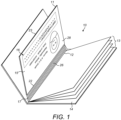
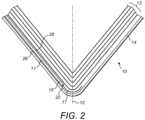
- FIGS 1 and 2 illustrate a security document 10 in accordance with the present disclosure.
- the security document 10 may be of any suitable type, but may comprise a security booklet, such as a passport as illustrated, a passbook, an identification document, a certificate, a licence, a cheque book or the like.
- the security document 10 comprises a security sheet 11, in this case a data page, foldable about and preferably attached along a fold 12 to a plurality of leaves 13.
- the plurality of leaves 13 may comprise a fibrous substrate, for example paper and/or cotton and may form visa pages.
- the security document 10 also comprises a cover 14, which is foldable about and attached to the fold 12 and/or is adhered to an outer leaf (not shown) located on the outside of the leaves 13 and security sheet 11.
- the attachment is preferably stitching through the security sheet 11, leaves 13 and/or cover 14 at the fold 12, although other attachment means such as adhesion may be used and the attachment means may be offset from the fold 12.
- the security sheet 11 is illustrated in further detail in Figure 3 .
- the security sheet 11 comprises a data sheet 15, which preferably comprises plastic and may be formed from a plurality of plastic body layers connected together, comprising data 16 and an attachment layer 17 attached to the data sheet 15.
- the data sheet 15 extends across a width from an inner edge 22, located proximate the fold 12, to an outer edge 23, distal to the fold 12.
- the data sheet 15 extends across a thickness between substantially planar first and second outer surfaces 28, 29.
- the data sheet 15 may comprise at least one of a thermoplastic polymer, polycarbonate, polybutylene terephthalate, polyester, polyethylene, polypropylene, polyvinyl chloride, a co-polymer comprised of any of the previous thermoplastic polymers, a fibrous substrate and the like.
- the attachment layer 17 is configured to securely connect the attachment layer 17 to the data sheet 15 and to the rest of the security document 10.
- the attachment layer 17 is thus preferably flexible, substantially resistant to plastic deformation and tear resistant and may comprise a substantially elongate sheet or body as illustrated.
- the attachment layer 17 comprises a connection portion 60 extending from a hinge portion 26.
- the connection portion 60 is at least partially located in or on and attached to the data sheet 15 and outer edge 23).
- the hinge portion 26 is located outside of the data sheet 15.
- the fold 12 and/or attachment means discussed above extend through the hinge portion 26.
- the attachment layer 17 (or preferably at least the hinge portion 26 thereof) comprises a textile having a mesh of interlaced, knitted, woven, stitched, overlapping or otherwise integrated wefts 30 and warps 31.
- the warps 31 may extend substantially parallel to one another and/or the fold 12.
- the wefts 30 may extend substantially parallel to one another and/or may be substantially perpendicular to the warps 31 and/or fold 12.
- the connection portion 60 may comprise at least portions of wefts 30, referred to as connection wefts 25, as illustrated in Figure 3 .
- the plurality of connection wefts 25 are separated from an adjacent connection weft 25 by a spacing 27.
- connection wefts 25 may comprise portions of the wefts 30 extending out of and forming the hinge portion 26 as in Figure 3 .
- the connection portion 60 is therefore firmly connected to the data sheet 15 by a frictional force applying a resistance to the attempted removal of the attachment layer 17 from the data sheet 15.
- the connection portion 60 may instead comprise a mesh of both wefts 30 and warps 31, rather than only the connection wefts 25, such that the entire attachment layer 17 is a meshed textile.
- the connection wefts 25 are preferably part of the textile, they may instead comprise strips, a film and/or other elongate bodies extending from the hinge portion 26.
- the textile of the attachment layer 17 comprises at least one motif 71 (which may also be referred to as a first region) integrated with a background region 70 (which may also be referred to as a second region) in accordance with the second arrangement of the disclosure as discussed above.
- the attachment layer 17 comprises motifs 71 representing the letters "D", "L", "R” and a logo.
- the at least one motif 71 or first region may have a first textile structure that is different to a second textile structure of the background region 70 or second region.
- the at least one motif 71 is formed by at least one motif yarn interlocked with, knitted, woven and/or stitched and extending through at least one background yarn forming the background region 70.
- the at least one motif yarn may extend multiple times between the outer surfaces of the attachment layer 17 to form the pattern of the at least one motif 71.
- the background region 70 and at least one motif 71 may together form the mesh (e.g. by each forming wefts 30 and warps 31) of the textile.
- the background yarn forms wefts 30 and/or warps 31 of the background region 70 and the at least one motif yarn is interlocked with the textile by being looped around the wefts 30 and/or warps 31.
- the background region 70 may be a single, substantially continuous colour.
- the at least one motif 71 and background region 70 may be formed using the Jacquard process on a Jacquard loom.
- the at least one motif 71 may be a different visible colour to at least part of the background region 70 adjacent to the at least one motif 71 when viewed by the naked eye in reflected light incident upon the attachment layer 17.
- the background region 70 may appear substantially as at least one first colour (e.g. white) at least partially around the at least one motif 71 whilst the at least one motif 71 may be at least one different second colour (e.g. non-white).
- a single motif 71, or each of a plurality of motifs 71 may comprise a plurality of different colours when viewed by the naked eye in reflected light incident upon the attachment layer 17.
- the at least one motif 71 may comprise different colours corresponding to the image or design it represents.
- the at least one motif yarn may have a different surface roughness, hardness, stiffness and/or diameter to the at least one background yarn.
- the at least one motif 71 can be distinguished by human touch by virtue of having a higher or lower surface roughness, diameter, stiffness and/or hardness to the at least partially surrounding background region 70.
- a particularly preferred effect can be achieved by the at least one motif yarn having a greater diameter than the at least one background yarn, which results in the outer surface of the at least one motif 71 being raised above the at least partially surrounding outer surface of the background region 70.
- the resulting raised texture is easily distinguishable to human touch and also creates a three dimensional effect visible to the naked human eye.
- the effect can be further developed by having a plurality of motif yarns of different diameters such that the outer surface of the motif itself is textured with different contours, thereby forming complex three dimensional effects visible to the human eye.
- the at least one motif 71 has a different texture to the background region 70 such that they are distinguishable from one another by human touch.
- the presence of the at least one motif yarn in the at least one motif 71 is detectable as providing a texture distinguishable to the texture of the background region 70.
- Such a different texture is also achieved if the at least one motif yarn and at least one background yarn have substantially the same haptic and/or optical characteristics.
- the at least one motif 71 may be not extend over the fold 12 and/or attachment means or stitch line such that the entire at least one motif 71 can be viewed when the security document 10 is open at the security sheet 11.
- the at least one motif 71 may extend over the fold 12. If the fold 12 is offset from the attachment means, such as by being offset from the stitch line, the at least one motif 71 may extend over the fold 12 and/or attachment means. In such arrangements the difficulty of attempting to adapt the at least one motif 71 is increased since the adaptation will require the entire removal of the security sheet 11 from the security document 10 to reach the area under the fold 12 or attachment means.
- the at least one motif 71 may be located only in the hinge portion 26 such that it is located and visible outside of the data sheet 15. However, the at least one motif 71 may be at least partially located on the connection portion 60 and/or at least partially located within or on the data sheet 15. Thus the at least one motif 71 may be difficult to reach during an attempted adaptation.
- the at least one motif 71 may be separated from the edges of the attachment layer 17 such that it is a discrete element entirely surrounded by the background region 70.
- the at least one motif 71 may not extend between opposing edges of the attachment layer 17 and may be in contact with fewer than three edges of the attachment layer 17.
- the or each at least one motif 71 may extend across less than approximately 50% of the area of the hinge portion 26, less than approximately 25% of the area of the hinge portion 26 or less than approximately 10% of the area of the or hinge portion 26.
- the surface area of the at least one motif 71 may be less than approximately 50%, 25% or 10% of the surface area of the background region 70.
- the at least one motif 71 may extend between opposing edges of the attachment layer 17 (in this case three edges of the attachment layer 17 and four edges of the hinge portion 26).
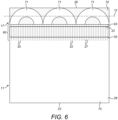
- Figure 5 and 6 also illustrate how the colours of the at least one motif 71 and background region 70 can be a first colour combination on a front side (as in Figure 5 ) of the attachment layer 17 and a second colour combination, which is the inverse of the first colour combination, on a reverse side (as in Figure 6 ) of the attachment layer 17.
- the front side motif 71 is black and the front side background region 70 is white.
- the front side motif 71 is black and the front side background region 70 is white.
- the reverse side motif 71 being white and the reverse side background region 70 being black.
- Such an inverse colour arrangement can be achieved by forming a two tone damask on a Jacquard loom in which the at least one front side motif 71 and reverse side background region 70 are formed from the at least one motif yarn of the first colour and the front side background region 70 and at least one reverse side motif 71 are formed from the at least one background yarn of the second colour.
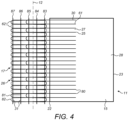
- Figure 4 illustrates an embodiment of the security sheet 11 in accordance with the first arrangement discussed above, and in accordance with the claims, in which the attachment layer 17 comprises a textile comprising at least two yarns 80, 81, 82, 83, 84, 85, 86, 87 of different haptic and/or optical characteristics.
- Figure 4 illustrates the attachment layer 17 in an exploded view in order to illustrate its composition, but in practice will be tightly pulled together and may comprise significantly more connection wefts 25 (e.g. at least twenty or fifty connection wefts 25).
- Figure 7 is an illustration of a portion of an exemplary security sheet 11 formed according to the embodiment of Figure 4 .
- the hinge portion 26 comprises at least one yarn 80, 81, 82, 83, 84, 85, 86, 87 extending at least partially through the hinge portion 26 to form the wefts 30 and warps 31.
- a plurality of wefts 30 and/or warps 31 may comprise a single continuous yarn 80, 81, 82, 83, 84, 85, 86, 87.
- the attachment layer 17 comprises at least one connection weft yarn 80, first infill weft yarn 81, second infill weft yarn 82 and warp yarn 83, 84, 85, 86, 87.
- the outer warps 31 are formed from a distal warp yarn 81 and a proximal warp yarn 87.
- the distal warp yarn 83 is located adjacent to the inner edge 22 of the data sheet 15
- the proximal warp yarn 87 is located adjacent the free proximal edge (i.e. the top edge of Figure 3 ) of the attachment layer 17 and infill warp yarns 84, 85, 86 are located therebetween.
- the hinge portion 26 may have a width between its outer warps 31 (i.e. between the distal and proximal warp yarns 83, 87) of at least approximately 8 mm or at least approximately 10 mm and/or optionally up to approximately 30mm or approximately 20 mm.
- the hinge portion 26 comprises only five warps 31 or warp yarns 83, 84, 85, 86, 87 as in the illustrated embodiment, but may comprise five or fewer warps 31, ten or fewer warps 31 or fifteen or fewer warps 31. At least two of the adjacent warps 31 or warp yarns 83, 84, 85, 86, 87 of the hinge portion 26 are separated from one another (in particular separated in a direction perpendicular to the inner edge 22, optionally also the attachment line and/or fold 12) by at least approximately 0.5 mm, and optionally by at least approximately 1 mm, at least approximately 1.5 mm, at least approximately 2 mm or at least approximately 3 mm.
- adjacent warps 31 form first regions of a first textile structure whilst the wefts 30 extending between the adjacent warps 31 form a second textile structure. Due to the separation being relatively large, it is possible to detect the gap or separation between the adjacent warps 31 by human touch.
- connection weft yarn 80 forms the connection wefts 61.
- the at least one connection weft yarn 80 extends at least partially into the hinge portion 26 and is interlaced with at least one or warp 31, but is not interlaced with itself.
- the connection weft yarn(s) 80 preferably comprises a plurality of ends by comprising a plurality of adjacent, substantially parallel, yarns, strips, threads or filaments.
- the connection weft yarn(s) 80 may comprise a synthetic yarn, such as nylon, and may comprise a plurality of monofilaments.
- connection weft yarn(s) 80 is substantially clear or transparent in a similar manner to the at least one body layer such that it is substantially hidden in the data sheet 15 after formation and such that the connection weft yarn(s) 80 have different optical characteristics compared to other yarns of the textile 81, 82, 83, 84, 85, 86, 87.
- the first infill weft yarn 81, second infill weft yarn 82 and/or warp yarn 83 may comprise polyester.
- the first and second infill weft yarns 81, 82 continuously form infill wefts 62, which extend between the connection wefts 61, of the hinge portion 26 by looping within the hinge portion 26 between the between the distal and proximal warp yarns 83, 87.
- the connection weft yarn(s) 80 may have a smaller diameter than the first infill weft yarn 81, second infill weft yarn 82 and/or at least one warp yarn 83, 84, 85, 86, 87 such that the connection wefts 61 have a smaller diameter than the infill wefts 62 and/or warps 31 of the hinge portion 26.
- connection weft yarn(s) 80 have different haptic characteristics and are distinguishable to human touch to the other yarns of the textile 81, 82, 83, 84, 85, 86, 87.
- the connection weft yarns 80 are therefore individually identifiable in the attachment layer 17 and thus any tampering thereof is difficult to hide.
- the hinge portion 26 therefore comprises relatively strong yarns to prevent ripping or other damage along the attachment line whilst the connection wefts 61 add little bulk to the data sheet 15 and are therefore more discreet.
- the connection weft yarn 80 may be less than approximately 150 denier, less than approximately 150 denier and is preferably approximately 80 denier.
- the first infill weft yarn 81, second infill weft yarn 82 and/or warp yarn 83 may be at least approximately 200 decitex, at least approximately 300 decitex and is preferably approximately 400 decitex.
- the interlacing between the weft and warp yarns 80, 81, 82, 83, 84, 85, 86, 87 is not shown in Figure 4 , but preferably they are interlocked to one another, such as by knitting.
- the warp yarns 83, 84, 85, 86, 87 may be knitted into at least one weft yarn 80, 81, 82 such that they are attached to one another by a stitch.
- "knitting” refers to forming closed, interlocked loops between yarns.
- the knitting is crochet knitting and each interlock comprises a crochet knitting stitch. Using knitting as the interlacing method rather than weaving results in an attachment layer 17 that is harder for a forger to unpick and remove from the security document 10.
- a plurality of warp yarns 83, 84, 85, 86, 87 may be fed by a machine into contact with the weft yarns 80, 81, 82 for interlacing therewith.
- the machine is a knitting machine and more preferably a crochet knitting machine.
- At least two of the yarns 80, 81, 82, 83, 84, 85, 86, 87 of the hinge portion 26 have different visible colours such that they have different optical characteristics.
- at least two warp yarns 83, 84, 85, 86, 87, and preferably at least the distal and proximal warp yarns 83, 87, are different colours.
- the distal warp yarn 83 may be a first colour and the proximal warp yarn 87 may be a different second colour.
- at least three (preferably at least five or at least 10) warp yarns 83, 84, 85, 86, 87 they may also form a colour progression from the first colour to the different second colour.
- the colour progression may be formed by the at least one infill warp yarn 84, 85, 86 having at least one further different colour formed by a colour mixture of the first and second colours.
- the hue of the colour of the warp yarns 83, 84, 85, 86, 87 may graduate from the first colour at the distal warp yarn 83, through the infill warp yarns 84, 85, 86 to the second colour at the proximal warp yarn 87.
- One of more of the infill warp yarns 84, 85, 86 may form a third colour and the colour progression may be a variance in hues from the first colour to the third colour and from the third colour to the second colour.
- Fourth and further colours may be added.
- the colours of the warps 31 and warp yarns 83, 84, 85, 86, 87 may form a rainbow, iris or ombre, which are difficult for a counterfeiter to replicate.
- the distal and proximal warp yarns 83, 87 may be a first colour whilst the infill warp yarns 84, 85, 86 may be a second colour or form a graduation of hue between the first colour of the distal and proximal warp yarns 83, 87.
- the warp yarns 80, 81, 82, 83, 84, 85, 86, 87 may also have at least one different colour to at least one of the at least one connection weft yarn 80, first infill weft yarn 81 and second infill weft yarn 82.
- the security sheet 11 may be formed by the connection together of the attachment layer 17 and at least one plastic body layer forming the data sheet 15 by, for example, lamination, adhesion, welding and/or any other suitable method. During lamination or welding heat and/or pressure are applied to fuse or push the plurality of body layers together and the plastic of at least one body layer is pushed through the at least one spacing 27 between the connection wefts 25, through mesh openings of the mesh or through the textile (depending upon the construction of the connection portion 60).
- the attachment layer 17 may be pressed into the first or second outer surface 28, 29 formed by the outer body layers such that the connection portion 60 is at least partially attached at or adjacent to and overlapping the first outer surface 28 of the data sheet 15.
- At least one strip 50 may overlap at least part of the connection portion 60 and is attached to or embedded within the data sheet 15 such that it forms part of the first outer surface 28 of the data sheet 15.
- the connection portion 60 may be attached between adjacent body layers prior to lamination such that it is located within the thickness of the data sheet 15.
- the lamination may be performed using any suitable method and may be a substantially in-line method, similar to that of WO-A-2017/060684 and WO-A-2017/060688 , in which a plurality of security sheets 11 are formed continuously.
- the at least one motif 71 discussed in respect of Figure 3 may be included in the security sheet 11 of Figure 4 and the different coloured warp yarns 83, 84, 85, 86, 87 discussed in respect of Figure 4 may be included in the security sheet 11 of Figure 3 .
- the at least one motif 71 may be formed from at least one motif yarn that does not have different optical and/or haptic characteristics as the at least one background yarn forming the background region 70.
- the aforementioned description of Figures 3 , 5 and 6 equally applies to this arrangement, but without the yarns having different optical and/or haptic characteristics.
- the at least one motif 71 may be visible and/or detectable by human touch by virtue of the textile structure in the at least one motif 71 being different to the textile structure in the background region 70 in any of the manners listed in the Summary.
- the thread count in the at least one motif 71 may be higher than in the background region 70 such that it is distinguishable by appearing to have a denser concentration of warps 31 and/or wefts 30.
- first and second regions of different textile structures may be formed differently to the adjacent warps 31 as in Figures 4 and 7 .
- the textile may comprise first and second regions that also have different weft spacings, different textile thicknesses, different interlacing patterns, different thread counts and/or the like.
- the textile may have a higher thickness in the at least one motif 71, forming at least one first region, to the thickness of the background region 70, forming the second region.
Landscapes
- Engineering & Computer Science (AREA)
- Textile Engineering (AREA)
- Woven Fabrics (AREA)
Claims (15)
- Feuille de sécurité (11) comprenant :une feuille de données (15) affichant des données (16), la feuille de données (15) s'étendant d'un côté à l'autre d'une largeur d'un bord interne (22) à un bord externe (23) ; etune couche de fixation (17) fixée à la feuille de données (15), dans laquelle la couche de fixation (17) sert à fixer la feuille de données (15) dans un document de sécurité (10), dans laquelle la couche de fixation (17) comprend :(a) un textile comprenant une pluralité de trames (30) et chaînes (31) entrelacées, dans laquelle au moins deux chaînes (31) et/ou au moins deux trames (30) sont formées à partir d'au moins deux fils (80, 81, 82, 83, 84, 85, 86, 87) présentant des caractéristiques haptiques et/ou optiques différentes, dans laquelle les fils sont fibreux et comprennent une pluralité de fibres fixées ensemble ; et(b) une partie charnière (26) à l'extérieur de la feuille de données (15), dans laquelle les au moins deux fils présentant des caractéristiques haptiques et/ou optiques différentes sont situés sur la partie charnière (26),caractérisée en ce qu'au moins deux chaînes (31) adjacentes de la partie charnière (26) sont séparées l'une de l'autre dans une direction perpendiculaire au bord interne (22) d'au moins 0,5 mm.
- Feuille de sécurité (11) selon la revendication 1 dans laquelle les au moins deux fils présentent des caractéristiques haptiques et/ou optiques différentes en présentant des couleurs visibles, des propriétés de lumière non visible, des diamètres, des opacités, des rugosités de surface, une rigidité, une dureté et/ou des niveaux de brillance différents.
- Feuille de sécurité (11) selon la revendication 1 ou la revendication 2 dans laquelle :les au moins deux fils présentant des caractéristiques haptiques et/ou optiques différentes sont de différents types, chaque type variant d'un autre type en matériau de fil, coupe transversale de fil, structure d'épaisseur de fil, diamètre de fil, revêtement de fil et/ou imprégnation de fil ;au moins deux fils présentent une première combinaison de couleurs lorsqu'ils sont vus dans une lumière visible et une seconde combinaison de couleurs lorsqu'ils sont vus dans une combinaison de lumière visible et non visible, les première et seconde combinaisons de couleurs étant différentes l'une de l'autre ; et/oule diamètre d'au moins un fil est d'au moins 125 %, d'au moins 150 %, d'au moins 200 %, d'au moins 300 % ou d'au moins 400 % du diamètre d'au moins un fil supplémentaire.
- Feuille de sécurité (11) selon l'une quelconque des revendications précédentes dans laquelle les chaînes (31) adjacentes forment des premières régions d'une première structure de textile et des trames (30) s'étendant entre les chaînes (31) adjacentes forment une seconde structure de textile, dans laquelle les premières régions et les secondes régions comprennent les au moins deux fils de propriétés haptiques et/ou optiques différentes divulgués ici de sorte que les première et seconde régions présentent les caractéristiques haptiques et/ou optiques différentes correspondantes.
- Feuille de sécurité (11) selon l'une quelconque des revendications précédentes dans laquelle :une pluralité de chaînes (31) diffèrent d'une pluralité de trames (30) dans une première caractéristique haptique et/ou optique ;au moins deux de la pluralité de chaînes (31) diffèrent l'une de l'autre dans au moins une deuxième caractéristique haptique et/ou optique ; et/ouau moins deux de la pluralité de trames (30) diffèrent l'une de l'autre dans au moins une troisième caractéristique haptique et/ou optique.
- Feuille de sécurité (11) selon l'une quelconque des revendications précédentes dans laquelle :le textile comprend au moins trois chaînes (31), les au moins trois chaînes (31) comprenant des chaînes distales et proximales et au moins une chaîne intermédiaire entre les chaînes distales et proximales, dans laquelle les chaînes distales et proximales sont de différentes couleurs visibles et/ou l'au moins une chaîne intermédiaire entre les chaînes distales et proximales est d'au moins une couleur visible différente de celle des chaînes distales et/ou proximales ;le textile comprend au moins trois chaînes (31) et/ou au moins trois trames (30) formées d'au moins trois fils de différentes couleurs de sorte que les au moins trois fils forment une progression de couleur d'une première couleur à une seconde couleur différente ;les trames (30) sont tricotées avec les chaînes (31) ; et/ouau moins une trame (30) est transparente.
- Feuille de sécurité (11) selon l'une quelconque des revendications précédentes dans laquelle le textile comprend au moins un motif (71) intégré à une région d'arrière-plan (70).
- Feuille de sécurité (11) selon la revendication 7 dans laquelle la région d'arrière-plan (70) est formée par au moins un fil d'arrière-plan et l'au moins un motif (71) est formé par au moins un fil de motif présentant des caractéristiques haptiques et/ou optiques différentes de celles de l'au moins un fil d'arrière-plan de sorte que l'au moins un motif présente des caractéristiques haptiques et/optiques différentes de celles de la région d'arrière-plan.
- Feuille de sécurité (11) selon la revendication 7 ou la revendication 8 dans laquelle :au moins un motif (71) forme au moins l'un d'un modèle d'un symbole, d'un drapeau, d'un emblème, d'une fleur, d'un logo, d'un dessin, d'une lettre, d'un pictogramme, d'une illustration, d'un caractère alphanumérique, d'un graphème, d'un emblème national, d'un blason, de données personnelles, d'un nom, d'une photographie, d'un numéro de série, d'un indice et code ; et/oul'au moins un motif (71) est un élément discret séparé de bords de la couche de fixation (17).
- Feuille de sécurité (11) selon l'une quelconque des revendications 7 à 9 dans laquelle :l'au moins un motif (71) est d'une couleur visible différente de celle d'au moins un motif (71) supplémentaire et/ou de la région d'arrière-plan (70) ;l'au moins un motif (71) est perçu différemment à l'œil nu, ou est seulement perceptible à l'œil nu, lorsqu'il est vu dans une lumière visible réfléchie par rapport à une lumière non visible réfléchie en vertu de l'au moins un fil de motif et d'au moins un fil d'arrière-plan présentant des propriétés de lumière non visible différentes ; et/oul'au moins un motif (71) et au moins un motif (71) supplémentaire et/ou la région d'arrière-plan (70) présentent une première combinaison de couleurs lorsqu'ils sont vus dans une lumière visible et une seconde combinaison de couleurs lorsqu'ils sont vus dans une combinaison de lumière visible et non visible.
- Feuille de sécurité (11) selon l'une quelconque des revendications 7 à 10 dans laquelle :au niveau d'un côté avant de la couche de fixation (17 au moins un motif (71) de côté avant est d'une première couleur et une région d'arrière-plan de côté avant est d'une seconde couleur ; etau niveau d'un côté inverse de la couche de fixation (17) au moins un motif (71) de côté inverse est de la seconde couleur et une région d'arrière-plan de côté inverse est de la première couleur.
- Feuille de sécurité (11) selon l'une quelconque des revendications 7 à 11 dans laquelle :la région d'arrière-plan (70) et au moins un motif (71) forment ensemble une feuille structurale du textile ; oula région d'arrière-plan (70) comprend une feuille d'arrière-plan structurale comprenant au moins un fil d'arrière-plan et l'au moins un motif (71) est formé par au moins un fil de motif intégré dans la feuille d'arrière-plan structurale dans un agencement supplémentaire et non structural.
- Document de sécurité (10) comprenant la feuille de sécurité (11) selon l'une quelconque des revendications précédentes fixée à une pluralité de feuillets et pliable autour d'un pli, dans lequel le bord interne (22) est situé à proximité du pli (12) et le bord externe (23) est distal par rapport au pli (12).
- Procédé de fabrication de la feuille de sécurité (11) selon l'une quelconque des revendications 1 à 12, le procédé comprenant la formation du textile à partir des au moins deux fils présentant des caractéristiques haptiques et/ou optiques différentes, dans lequel les deux fils sont situés sur la partie charnière.
- Procédé d'authentification d'un document de sécurité (12) comprenant la feuille de sécurité (11) selon l'une quelconque des revendications 1 à 12, le procédé comprenant :l'application d'une partie d'un corps humain à la couche de fixation (17) et l'authentification du document de sécurité (10) sur la base du retour d'informations tactile humain qui fait la distinction entre les au moins deux fils de caractéristiques haptiques différentes ; et/oula visualisation, par l'œil humain, de la couche de fixation (17) dans une lumière visible ou non visible réfléchie et l'authentification du document de sécurité (10) sur la base d'un retour d'informations sensoriel optique de l'œil humain qui fait la distinction entre les au moins deux fils de différentes caractéristiques optiques.
Applications Claiming Priority (4)
| Application Number | Priority Date | Filing Date | Title |
|---|---|---|---|
| PCT/GB2019/050574 WO2019166819A1 (fr) | 2018-03-02 | 2019-03-01 | Feuille de sécurité |
| GBGB1907706.4A GB201907706D0 (en) | 2019-05-30 | 2019-05-30 | Attachment layer for attaching a data sheet in a security document |
| GB1908254.4A GB2582033B (en) | 2019-03-01 | 2019-06-10 | Attachment layer for attaching a data sheet in a security document |
| PCT/GB2020/050385 WO2020178547A1 (fr) | 2019-03-01 | 2020-02-19 | Couche de fixation permettant de fixer une feuille de données dans un document de sécurité |
Publications (3)
| Publication Number | Publication Date |
|---|---|
| EP3931003A1 EP3931003A1 (fr) | 2022-01-05 |
| EP3931003C0 EP3931003C0 (fr) | 2025-03-26 |
| EP3931003B1 true EP3931003B1 (fr) | 2025-03-26 |
Family
ID=72337673
Family Applications (1)
| Application Number | Title | Priority Date | Filing Date |
|---|---|---|---|
| EP20706053.4A Active EP3931003B1 (fr) | 2019-03-01 | 2020-02-19 | Couche de fixation permettant de fixer une feuille de données dans un document de sécurité |
Country Status (4)
| Country | Link |
|---|---|
| EP (1) | EP3931003B1 (fr) |
| GB (1) | GB2582033B (fr) |
| PL (1) | PL3931003T3 (fr) |
| WO (1) | WO2020178547A1 (fr) |
Families Citing this family (1)
| Publication number | Priority date | Publication date | Assignee | Title |
|---|---|---|---|---|
| DE102022002149B3 (de) | 2022-06-01 | 2023-10-26 | Yves-Simon Gloy | Datenseite mit einer textilen Lasche für Reisepässe |
Family Cites Families (9)
| Publication number | Priority date | Publication date | Assignee | Title |
|---|---|---|---|---|
| GB0228303D0 (en) | 2002-12-04 | 2003-01-08 | Rue De Int Ltd | Security device and method |
| EP2433809B2 (fr) * | 2010-09-28 | 2017-05-10 | Gemalto AG | Pages de données pour documents de type livre et procédé de fabrication de telles pages de données |
| WO2013118283A1 (fr) * | 2012-02-09 | 2013-08-15 | 日本カラリング株式会社 | Feuille d'articulation composite, feuille multicouche à marquage au laser pour un passeport électronique et passeport électronique |
| EP3230078A1 (fr) * | 2014-12-08 | 2017-10-18 | Gemalto AG | Bande souple |
| DE102015208223B4 (de) * | 2015-05-04 | 2022-03-10 | Bundesdruckerei Gmbh | Datenträger zum Einfügen in einen heft- oder buchförmigen Gegenstand und Verfahren zu dessen Herstellung |
| GB2543053B (en) | 2015-10-05 | 2018-04-11 | De La Rue Int Ltd | A security document |
| GB2543054B (en) | 2015-10-05 | 2018-04-04 | De La Rue Int Ltd | A method for manufacturing a security sheet and an insert for incorporation into a security sheet |
| DE102017202267B4 (de) * | 2017-02-13 | 2023-06-15 | Bundesdruckerei Gmbh | Verfahren zum Herstellen eines Sicherheitsmerkmals in einem Datenträger und ein Datenträger mit einem solchen Sicherheitsmerkmal |
| GB2571579B (en) * | 2018-03-02 | 2021-10-20 | De La Rue Int Ltd | A security sheet |
-
2019
- 2019-06-10 GB GB1908254.4A patent/GB2582033B/en active Active
-
2020
- 2020-02-19 PL PL20706053.4T patent/PL3931003T3/pl unknown
- 2020-02-19 EP EP20706053.4A patent/EP3931003B1/fr active Active
- 2020-02-19 WO PCT/GB2020/050385 patent/WO2020178547A1/fr not_active Ceased
Also Published As
| Publication number | Publication date |
|---|---|
| GB2582033B (en) | 2023-06-28 |
| GB2582033A (en) | 2020-09-09 |
| EP3931003A1 (fr) | 2022-01-05 |
| EP3931003C0 (fr) | 2025-03-26 |
| WO2020178547A1 (fr) | 2020-09-10 |
| PL3931003T3 (pl) | 2025-04-28 |
| GB201908254D0 (en) | 2019-07-24 |
Similar Documents
| Publication | Publication Date | Title |
|---|---|---|
| US8919821B2 (en) | Security substrate incorporating elongate security elements | |
| AU2017236577B2 (en) | A security document | |
| US8333870B2 (en) | Security paper | |
| EP3122568B2 (fr) | Livret de sécurité | |
| US8445392B2 (en) | Knitted structure designed to be incorporated in a sheet material | |
| AU2023204273B2 (en) | A security sheet | |
| EP1929090B2 (fr) | Dispositif de sécurité pour des supports de sécurité | |
| EP3931003B1 (fr) | Couche de fixation permettant de fixer une feuille de données dans un document de sécurité | |
| EP3230078A1 (fr) | Bande souple | |
| EP3980272B1 (fr) | Feuille de sécurité | |
| US20100001510A1 (en) | Method for authenticating and/or identifying a security and/or valuable document |
Legal Events
| Date | Code | Title | Description |
|---|---|---|---|
| STAA | Information on the status of an ep patent application or granted ep patent |
Free format text: STATUS: UNKNOWN |
|
| STAA | Information on the status of an ep patent application or granted ep patent |
Free format text: STATUS: THE INTERNATIONAL PUBLICATION HAS BEEN MADE |
|
| PUAI | Public reference made under article 153(3) epc to a published international application that has entered the european phase |
Free format text: ORIGINAL CODE: 0009012 |
|
| STAA | Information on the status of an ep patent application or granted ep patent |
Free format text: STATUS: REQUEST FOR EXAMINATION WAS MADE |
|
| 17P | Request for examination filed |
Effective date: 20210708 |
|
| AK | Designated contracting states |
Kind code of ref document: A1 Designated state(s): AL AT BE BG CH CY CZ DE DK EE ES FI FR GB GR HR HU IE IS IT LI LT LU LV MC MK MT NL NO PL PT RO RS SE SI SK SM TR |
|
| DAV | Request for validation of the european patent (deleted) | ||
| DAX | Request for extension of the european patent (deleted) | ||
| STAA | Information on the status of an ep patent application or granted ep patent |
Free format text: STATUS: EXAMINATION IS IN PROGRESS |
|
| 17Q | First examination report despatched |
Effective date: 20230216 |
|
| GRAP | Despatch of communication of intention to grant a patent |
Free format text: ORIGINAL CODE: EPIDOSNIGR1 |
|
| STAA | Information on the status of an ep patent application or granted ep patent |
Free format text: STATUS: GRANT OF PATENT IS INTENDED |
|
| INTG | Intention to grant announced |
Effective date: 20241010 |
|
| GRAS | Grant fee paid |
Free format text: ORIGINAL CODE: EPIDOSNIGR3 |
|
| GRAA | (expected) grant |
Free format text: ORIGINAL CODE: 0009210 |
|
| STAA | Information on the status of an ep patent application or granted ep patent |
Free format text: STATUS: THE PATENT HAS BEEN GRANTED |
|
| RAP1 | Party data changed (applicant data changed or rights of an application transferred) |
Owner name: DLR NEWCO LIMITED |
|
| AK | Designated contracting states |
Kind code of ref document: B1 Designated state(s): AL AT BE BG CH CY CZ DE DK EE ES FI FR GB GR HR HU IE IS IT LI LT LU LV MC MK MT NL NO PL PT RO RS SE SI SK SM TR |
|
| REG | Reference to a national code |
Ref country code: GB Ref legal event code: FG4D |
|
| REG | Reference to a national code |
Ref country code: CH Ref legal event code: EP |
|
| REG | Reference to a national code |
Ref country code: DE Ref legal event code: R096 Ref document number: 602020048273 Country of ref document: DE |
|
| REG | Reference to a national code |
Ref country code: IE Ref legal event code: FG4D |
|
| U01 | Request for unitary effect filed |
Effective date: 20250327 |
|
| U07 | Unitary effect registered |
Designated state(s): AT BE BG DE DK EE FI FR IT LT LU LV MT NL PT RO SE SI Effective date: 20250403 |
|
| PG25 | Lapsed in a contracting state [announced via postgrant information from national office to epo] |
Ref country code: RS Free format text: LAPSE BECAUSE OF FAILURE TO SUBMIT A TRANSLATION OF THE DESCRIPTION OR TO PAY THE FEE WITHIN THE PRESCRIBED TIME-LIMIT Effective date: 20250626 |
|
| PG25 | Lapsed in a contracting state [announced via postgrant information from national office to epo] |
Ref country code: NO Free format text: LAPSE BECAUSE OF FAILURE TO SUBMIT A TRANSLATION OF THE DESCRIPTION OR TO PAY THE FEE WITHIN THE PRESCRIBED TIME-LIMIT Effective date: 20250626 |
|
| PG25 | Lapsed in a contracting state [announced via postgrant information from national office to epo] |
Ref country code: HR Free format text: LAPSE BECAUSE OF FAILURE TO SUBMIT A TRANSLATION OF THE DESCRIPTION OR TO PAY THE FEE WITHIN THE PRESCRIBED TIME-LIMIT Effective date: 20250326 |
|
| PG25 | Lapsed in a contracting state [announced via postgrant information from national office to epo] |
Ref country code: GR Free format text: LAPSE BECAUSE OF FAILURE TO SUBMIT A TRANSLATION OF THE DESCRIPTION OR TO PAY THE FEE WITHIN THE PRESCRIBED TIME-LIMIT Effective date: 20250627 |
|
| PG25 | Lapsed in a contracting state [announced via postgrant information from national office to epo] |
Ref country code: SM Free format text: LAPSE BECAUSE OF FAILURE TO SUBMIT A TRANSLATION OF THE DESCRIPTION OR TO PAY THE FEE WITHIN THE PRESCRIBED TIME-LIMIT Effective date: 20250326 |
|
| PG25 | Lapsed in a contracting state [announced via postgrant information from national office to epo] |
Ref country code: ES Free format text: LAPSE BECAUSE OF FAILURE TO SUBMIT A TRANSLATION OF THE DESCRIPTION OR TO PAY THE FEE WITHIN THE PRESCRIBED TIME-LIMIT Effective date: 20250326 |
|
| PG25 | Lapsed in a contracting state [announced via postgrant information from national office to epo] |
Ref country code: SK Free format text: LAPSE BECAUSE OF FAILURE TO SUBMIT A TRANSLATION OF THE DESCRIPTION OR TO PAY THE FEE WITHIN THE PRESCRIBED TIME-LIMIT Effective date: 20250326 |
|
| PG25 | Lapsed in a contracting state [announced via postgrant information from national office to epo] |
Ref country code: IS Free format text: LAPSE BECAUSE OF FAILURE TO SUBMIT A TRANSLATION OF THE DESCRIPTION OR TO PAY THE FEE WITHIN THE PRESCRIBED TIME-LIMIT Effective date: 20250726 |
|
| PG25 | Lapsed in a contracting state [announced via postgrant information from national office to epo] |
Ref country code: CZ Free format text: LAPSE BECAUSE OF FAILURE TO SUBMIT A TRANSLATION OF THE DESCRIPTION OR TO PAY THE FEE WITHIN THE PRESCRIBED TIME-LIMIT Effective date: 20250326 |
|
| PLBE | No opposition filed within time limit |
Free format text: ORIGINAL CODE: 0009261 |
|
| STAA | Information on the status of an ep patent application or granted ep patent |
Free format text: STATUS: NO OPPOSITION FILED WITHIN TIME LIMIT |
|
| REG | Reference to a national code |
Ref country code: CH Ref legal event code: L10 Free format text: ST27 STATUS EVENT CODE: U-0-0-L10-L00 (AS PROVIDED BY THE NATIONAL OFFICE) Effective date: 20260211 |
|
| U20 | Renewal fee for the european patent with unitary effect paid |
Year of fee payment: 7 Effective date: 20260106 |
|
| 26N | No opposition filed |
Effective date: 20260105 |