EP3931344B1 - Procédé et système de détection de micro-organismes - Google Patents
Procédé et système de détection de micro-organismes Download PDFInfo
- Publication number
- EP3931344B1 EP3931344B1 EP20703161.8A EP20703161A EP3931344B1 EP 3931344 B1 EP3931344 B1 EP 3931344B1 EP 20703161 A EP20703161 A EP 20703161A EP 3931344 B1 EP3931344 B1 EP 3931344B1
- Authority
- EP
- European Patent Office
- Prior art keywords
- image
- image capture
- microorganism
- sample
- test plate
- Prior art date
- Legal status (The legal status is an assumption and is not a legal conclusion. Google has not performed a legal analysis and makes no representation as to the accuracy of the status listed.)
- Active
Links
Images




Classifications
-
- C—CHEMISTRY; METALLURGY
- C12—BIOCHEMISTRY; BEER; SPIRITS; WINE; VINEGAR; MICROBIOLOGY; ENZYMOLOGY; MUTATION OR GENETIC ENGINEERING
- C12Q—MEASURING OR TESTING PROCESSES INVOLVING ENZYMES, NUCLEIC ACIDS OR MICROORGANISMS; COMPOSITIONS OR TEST PAPERS THEREFOR; PROCESSES OF PREPARING SUCH COMPOSITIONS; CONDITION-RESPONSIVE CONTROL IN MICROBIOLOGICAL OR ENZYMOLOGICAL PROCESSES
- C12Q1/00—Measuring or testing processes involving enzymes, nucleic acids or microorganisms; Compositions therefor; Processes of preparing such compositions
- C12Q1/02—Measuring or testing processes involving enzymes, nucleic acids or microorganisms; Compositions therefor; Processes of preparing such compositions involving viable microorganisms
-
- G—PHYSICS
- G16—INFORMATION AND COMMUNICATION TECHNOLOGY [ICT] SPECIALLY ADAPTED FOR SPECIFIC APPLICATION FIELDS
- G16H—HEALTHCARE INFORMATICS, i.e. INFORMATION AND COMMUNICATION TECHNOLOGY [ICT] SPECIALLY ADAPTED FOR THE HANDLING OR PROCESSING OF MEDICAL OR HEALTHCARE DATA
- G16H30/00—ICT specially adapted for the handling or processing of medical images
- G16H30/20—ICT specially adapted for the handling or processing of medical images for handling medical images, e.g. DICOM, HL7 or PACS
-
- C—CHEMISTRY; METALLURGY
- C12—BIOCHEMISTRY; BEER; SPIRITS; WINE; VINEGAR; MICROBIOLOGY; ENZYMOLOGY; MUTATION OR GENETIC ENGINEERING
- C12M—APPARATUS FOR ENZYMOLOGY OR MICROBIOLOGY; APPARATUS FOR CULTURING MICROORGANISMS FOR PRODUCING BIOMASS, FOR GROWING CELLS OR FOR OBTAINING FERMENTATION OR METABOLIC PRODUCTS, i.e. BIOREACTORS OR FERMENTERS
- C12M23/00—Constructional details, e.g. recesses, hinges
- C12M23/02—Form or structure of the vessel
- C12M23/10—Petri dish
-
- C—CHEMISTRY; METALLURGY
- C12—BIOCHEMISTRY; BEER; SPIRITS; WINE; VINEGAR; MICROBIOLOGY; ENZYMOLOGY; MUTATION OR GENETIC ENGINEERING
- C12N—MICROORGANISMS OR ENZYMES; COMPOSITIONS THEREOF; PROPAGATING, PRESERVING, OR MAINTAINING MICROORGANISMS; MUTATION OR GENETIC ENGINEERING; CULTURE MEDIA
- C12N1/00—Microorganisms; Compositions thereof; Processes of propagating, maintaining or preserving microorganisms or compositions thereof; Processes of preparing or isolating a composition containing a microorganism; Culture media therefor
- C12N1/20—Bacteria; Culture media therefor
-
- C—CHEMISTRY; METALLURGY
- C12—BIOCHEMISTRY; BEER; SPIRITS; WINE; VINEGAR; MICROBIOLOGY; ENZYMOLOGY; MUTATION OR GENETIC ENGINEERING
- C12Q—MEASURING OR TESTING PROCESSES INVOLVING ENZYMES, NUCLEIC ACIDS OR MICROORGANISMS; COMPOSITIONS OR TEST PAPERS THEREFOR; PROCESSES OF PREPARING SUCH COMPOSITIONS; CONDITION-RESPONSIVE CONTROL IN MICROBIOLOGICAL OR ENZYMOLOGICAL PROCESSES
- C12Q1/00—Measuring or testing processes involving enzymes, nucleic acids or microorganisms; Compositions therefor; Processes of preparing such compositions
- C12Q1/02—Measuring or testing processes involving enzymes, nucleic acids or microorganisms; Compositions therefor; Processes of preparing such compositions involving viable microorganisms
- C12Q1/04—Determining presence or kind of microorganism; Use of selective media for testing antibiotics or bacteriocides; Compositions containing a chemical indicator therefor
-
- G—PHYSICS
- G16—INFORMATION AND COMMUNICATION TECHNOLOGY [ICT] SPECIALLY ADAPTED FOR SPECIFIC APPLICATION FIELDS
- G16H—HEALTHCARE INFORMATICS, i.e. INFORMATION AND COMMUNICATION TECHNOLOGY [ICT] SPECIALLY ADAPTED FOR THE HANDLING OR PROCESSING OF MEDICAL OR HEALTHCARE DATA
- G16H10/00—ICT specially adapted for the handling or processing of patient-related medical or healthcare data
- G16H10/40—ICT specially adapted for the handling or processing of patient-related medical or healthcare data for data related to laboratory analysis, e.g. patient specimen analysis
-
- G—PHYSICS
- G16—INFORMATION AND COMMUNICATION TECHNOLOGY [ICT] SPECIALLY ADAPTED FOR SPECIFIC APPLICATION FIELDS
- G16H—HEALTHCARE INFORMATICS, i.e. INFORMATION AND COMMUNICATION TECHNOLOGY [ICT] SPECIALLY ADAPTED FOR THE HANDLING OR PROCESSING OF MEDICAL OR HEALTHCARE DATA
- G16H30/00—ICT specially adapted for the handling or processing of medical images
- G16H30/40—ICT specially adapted for the handling or processing of medical images for processing medical images, e.g. editing
-
- G—PHYSICS
- G16—INFORMATION AND COMMUNICATION TECHNOLOGY [ICT] SPECIALLY ADAPTED FOR SPECIFIC APPLICATION FIELDS
- G16H—HEALTHCARE INFORMATICS, i.e. INFORMATION AND COMMUNICATION TECHNOLOGY [ICT] SPECIALLY ADAPTED FOR THE HANDLING OR PROCESSING OF MEDICAL OR HEALTHCARE DATA
- G16H40/00—ICT specially adapted for the management or administration of healthcare resources or facilities; ICT specially adapted for the management or operation of medical equipment or devices
- G16H40/60—ICT specially adapted for the management or administration of healthcare resources or facilities; ICT specially adapted for the management or operation of medical equipment or devices for the operation of medical equipment or devices
- G16H40/67—ICT specially adapted for the management or administration of healthcare resources or facilities; ICT specially adapted for the management or operation of medical equipment or devices for the operation of medical equipment or devices for remote operation
-
- G—PHYSICS
- G16—INFORMATION AND COMMUNICATION TECHNOLOGY [ICT] SPECIALLY ADAPTED FOR SPECIFIC APPLICATION FIELDS
- G16H—HEALTHCARE INFORMATICS, i.e. INFORMATION AND COMMUNICATION TECHNOLOGY [ICT] SPECIALLY ADAPTED FOR THE HANDLING OR PROCESSING OF MEDICAL OR HEALTHCARE DATA
- G16H50/00—ICT specially adapted for medical diagnosis, medical simulation or medical data mining; ICT specially adapted for detecting, monitoring or modelling epidemics or pandemics
- G16H50/20—ICT specially adapted for medical diagnosis, medical simulation or medical data mining; ICT specially adapted for detecting, monitoring or modelling epidemics or pandemics for computer-aided diagnosis, e.g. based on medical expert systems
-
- G—PHYSICS
- G16—INFORMATION AND COMMUNICATION TECHNOLOGY [ICT] SPECIALLY ADAPTED FOR SPECIFIC APPLICATION FIELDS
- G16H—HEALTHCARE INFORMATICS, i.e. INFORMATION AND COMMUNICATION TECHNOLOGY [ICT] SPECIALLY ADAPTED FOR THE HANDLING OR PROCESSING OF MEDICAL OR HEALTHCARE DATA
- G16H50/00—ICT specially adapted for medical diagnosis, medical simulation or medical data mining; ICT specially adapted for detecting, monitoring or modelling epidemics or pandemics
- G16H50/70—ICT specially adapted for medical diagnosis, medical simulation or medical data mining; ICT specially adapted for detecting, monitoring or modelling epidemics or pandemics for mining of medical data, e.g. analysing previous cases of other patients
-
- Y—GENERAL TAGGING OF NEW TECHNOLOGICAL DEVELOPMENTS; GENERAL TAGGING OF CROSS-SECTIONAL TECHNOLOGIES SPANNING OVER SEVERAL SECTIONS OF THE IPC; TECHNICAL SUBJECTS COVERED BY FORMER USPC CROSS-REFERENCE ART COLLECTIONS [XRACs] AND DIGESTS
- Y02—TECHNOLOGIES OR APPLICATIONS FOR MITIGATION OR ADAPTATION AGAINST CLIMATE CHANGE
- Y02A—TECHNOLOGIES FOR ADAPTATION TO CLIMATE CHANGE
- Y02A90/00—Technologies having an indirect contribution to adaptation to climate change
- Y02A90/10—Information and communication technologies [ICT] supporting adaptation to climate change, e.g. for weather forecasting or climate simulation
Definitions
- the present document relates to a method, a device and a system for detection of microorganisms in milk.
- a conventional way of determining presence of microbes in milk is to collect a milk sample from an animal and to send this sample for testing.
- Pathogens such as salmonella and EHEC, which may be found in the animals' feed, inner organs and in the manure, may be particular causes for concern.
- a conventional way of determining presence of the pathogens is to collect a sample of manure from an animal or a herd and send this sample for testing.
- Another way is to collect a sample from an autopsy of an animal and send this sample for testing.
- livestock includes, but is not limited to, cattle, pigs, sheep and poultry, regardless of whether such livestock is kept for production of milk, meat, hide or other purposes.
- the test procedure generally involves applying the sample on an agar plate, storing the agar plate for a time sufficient to allow bacterial growth to form and then to have a trained expert determine what microbes were present in the sample.
- actions to be taken can be determined, such as to administer antibiotics.
- JAIR C. FERREIRA ET AL, PLOS ONE, vol. 13, no. 3, 2018, page e0194211 discloses a method of processing a milk sample obtained from a livestock animal, comprising a microscopic and Gram stain evaluation and classifying the micro-organism based thereon.
- Hiraku Sasaki ETAL Asian-Aust. J. Anim. Sci., 2009, pages 113-118 discloses PCR based analysis of the Structure of a bacterial community in livestock manure.
- the waiting time may be determined as a predetermined time period, such as 12-48 hours, 12-36 hours, and preferably about 24 hours. Alternatively, the waiting time may be determined based on a growth amount.
- the term "visual spectrum” implies that the image contains a spectrum that is visible to the human eye, which normally comprises wavelengths of about 380 to 740 nanometers.
- a "growth pattern” is combination of shape(s) and colors that is provided by the microorganism(s) as they grow and form colonies on the growth medium.
- Applicant's tests reveal that it is possible to train an image classifier algorithm to a level where the ability to correctly determine a microbe type based on a visual spectrum image of the test plate is comparable to that of a trained expert.
- the method provides a user friendly way of determining presence and type of microbes in milk samples. Moreover, the method can be implemented at a substantially reduced cost compared and the availability of testing capacity can be greatly increased, with a reduction in test lead times being reduced.
- the method is implemented with hardware that is readily available to most people, such as a smartphone or a tablet, or which can be provided at low cost.
- the test plate may comprise at least two juxtaposed growth medium regions, said regions differing in at least one of type, color, concentration and composition of the respective growth medium.
- test plate may present 1-10 such different growth medium regions, preferably 2-4 different growth medium regions.
- the method may further comprise arranging the test plate with a predetermined orientation relative to the image capture device prior to acquiring said image, such that the growth medium regions present a predetermined orientation in said image; and/or reorienting the acquired image, such that the growth medium regions present a predetermined orientation in said image.
- the waiting step may comprise maintaining the sample in a temperature controlled environment, preferably at a constant temperature of 34-40 degrees C.
- the image capture device forms part of a smartphone or a tablet.
- the method comprises positioning the test plate on a first part of an image capture support and positioning the image capture device on a second part of the image capture support, said second part being spaced from the first part, wherein the acquisition of the image is performed while the image capture device and the test plate are positioned on the image capture support.
- the method may further comprise enclosing the test plate so as to shield it from ambient light and supplying light from a light source, optionally via a reflector.
- the light source may be provided inside an enclosure.
- the image capture support may be an image capture support as described in the present document.
- the method may further comprise an image limitation step, comprising cropping or masking unwanted portions of the image.
- the image which is sent may be the originally captured image or a processed version of the image, such as a partially cropped or masked image.
- the pre-trained image classifier algorithm may comprise at least one supervised learning algorithm configured and trained to identify at least two microorganism types or microorganism classes.
- supervised learning algorithms include, but are not limited to, convolutional neural networks, decision trees (such as random forest), support vector machine and fully connected neural network.
- the pre-trained image classifier algorithm may comprise a plurality of supervised learning algorithms, each of which being configured and trained to identify one microorganism type or microorganism class.
- Said applying an image classifier algorithm may comprise sending the image from the image capture device via a data communication network to a remotely located processing device, feeding said image to the pre-trained image classifier to obtain a processing result based on the image, and sending the processing result via the data communication network to the image capture device or to another processing device.
- the other processing device may be a further user device, such as a smartphone or tablet; a user computer, a web page or a web portal, a veterinarian's computer, etc.
- the processing result may comprise an indication of a microorganism type deemed to be present on the test plate depicted on the image, and optionally a value indicating a confidence level of the processing result.
- the method may further comprise waiting for a second time sufficient to allow further microbial growth to form on said test surface, acquiring a second visual spectrum image of the test surface using an image capture device, and applying the image classifier algorithm to said second image in order to determine a microorganism type based on a microorganism growth pattern visible on the image.
- the second waiting time may be determined as a predetermined time period, such as 12-48 hours, 12-36 hours, and preferably about 24 hours. Alternatively, the waiting time may be determined based on a growth amount.
- the sample may be a milk sample from a lactating animal.
- the milk may be applied directly to the test surface.
- the sample may be a manure sample from an animal.
- the sample may be applied directly to the test plate.
- the manure sample may be diluted, dissolved or suspended in a liquid, such as water, whereby such dilution, solution or suspension is applied to the test surface.
- a system as defined in claim 14 for processing a sample obtained from a livestock animal comprising a growth medium test plate, an image capture support as described above, a user device comprising an image capture device as defined in claim 14 and a communication device, and a central processing device, wherein the user device is configured acquire a visual spectrum image depicting at least part of a test surface of the growth medium test plate, using the image capture device, and to send the acquired image to the central processing device, and wherein the central processing device is configured to receive the image, provide a computer-implemented pre-trained image classifier algorithm, said image classifier algorithm being pre-trained to determine a microorganism type based on a visible spectrum image depicting a growth pattern of a known microorganism, and apply the image to the pre-trained image classifier algorithm to determine a microorganism type based on a microorganism growth pattern visible on the image.
- Fig. 1 schematically illustrates a non-limiting diagram of a system in which the present concept can be implemented.
- the system may comprise a central processing unit 10, a user device 11; a veterinarian work station 12, which is connected to a journal storage 13; an image classifier subsystem 14 and a data storage unit 15.
- the system may comprise further user devices and one or more user work stations 16.
- the central processing 10 unit may be implemented as a server, such as a web server, with storage and processing capability.
- the central processing unit may comprise the image classifier subsystem 14 and the storage unit 15.
- the storage unit 15 may store image data and data relating to such images.
- the identifiers may include one or more of position coordinates, farm id, user id, animal id, teat id, date and time.
- the central processing unit 10 may thus run software for receiving data for communicating with the user device(s) 11, 16, the veterinarian work station 12, and for implementing the image classifier subsystem 14 and the storage unit 15.
- the central processing unit may be implemented as a cloud device.
- image classifier subsystem 14 and/or the storage unit 15 may be implemented as cloud devices.
- the veterinarian work station 12 may comprise a journal storage 13 for storing general veterinarian records relating individual animals. Such records may be supplemented by image data, corresponding to what is stored at the storage unit 15. Alternatively, or additionally, the records may merely be supplemented by processing results from the central processing unit 10, as will be described in the following.
- the image classifier subsystem 14 can be provided in the form of a supervised learning algorithm that may be implemented in the form of a neural network, such as CNN (Convolutional Neural Network) or RNN (Recurring Neural Network).
- CNN Convolutional Neural Network
- RNN Recurring Neural Network
- the image classifier subsystem 14 needs to be trained, which can be achieved by inputting a number of images of test plates with bacterial growth, which images each is associated with one or more microbe types, as identified by expert users and/or by DNA analysis.
- image classifier subsystems 14 are known and available as open source software. Alternatively, the image classifier may be implemented in the central processing unit 10.
- the user device(s) 11 may take the form of a smart phone or tablet, which comprises an image capture device 111, a processing device 112, a memory 113, a communication device 114 and a user interface 115.
- the user device 11 may run software for implementing related parts of the method disclosed herein and for communicating with the central processing unit 10.
- Fig. 3 schematically illustrates a flowchart of a method in which the present concept can be implemented.
- a manure sample may be processed in the same way, with the possible modification that a manure sample may, depending on its texture or viscosity, be diluted, dissolved, or suspended in a liquid, such as water, prior to its application to the test surface.
- step 200 a new sample operation is initiated. This step may be preceded by a detection of an anomaly relating to the animal, e.g. in accordance with the disclosure of WO2012080275A1 . Such anomaly detection may then trigger the acquisition of a milk sample.
- step 201 an animal id is entered, e.g. scanned from a tag on the animal or manually input.
- a teat id is entered, e.g. manually entered by selection from a schematic image on the user interface.
- a test tube id is entered, e.g. scanned or manually input.
- the udder is prepared, such as cleaned and a sample is collected in the test tube. These steps are typically performed in the direct vicinity of the animal.
- a user device 11 in the form of a smartphone or a tablet.
- the following steps may be performed in a designated area, such as a local lab or in a local control central.
- milk from the test tube is transferred onto a test plate and the test tube id is also transferred to the test plate, e.g. by peeling off an id carrying sticker from the test tube and attaching the sticker to the test plate, or by associating a pre-provided test plate id with the test tube id.
- the test plate may be stored for a predetermined time, such as 12-48 hours, preferably 24 hours, and preferably in a controlled environment, e.g. in a controlled temperature.
- step 204 the sample is removed from storage, any lid provided on the test plate may be removed and the test plate is positioned on an image capture support, after which a first image is captured by means of the user device 11 (the same user device as before, or another user device having the same functionality) and sent to the central processing device 10.
- the user device 11 the same user device as before, or another user device having the same functionality
- the user device that is to be used for image capture may need to be initialized, e.g. by entering or scanning test plate id.
- the identification and thus initialization may be performed in the same step as the image capture.
- step 205 the image, or a limited version of the image, such as a cropped or masked version of the image, is sent to the central processing device 10.
- the image may be sent together with data identifying the farm, the animal and the individual teat and a time and date stamp.
- the pre-trained image classifier algorithm determines the type(s) of microorganisms preset on the test plate based on the visible spectrum image.
- the image classifier algorithm may also determine a confidence level, i.e. a value indicating to what extent the analysis can be expected to be reliable.
- results are received from the central processing device 10.
- the results may comprise an indication of one or more microbe types found to be present on the test plate when the image was captured, along with a measure of the confidence level of said result.
- the result may be presented in step 207 to the user, for example via the user device 11.
- Such presentation may include an indication of microbe type and optionally an indication of action to be taken, such as what antibiotic to administer.
- statistical data based on the test and other tests may be presented to the user in step 208.
- step Conf? If the result does not have a sufficient level of confidence (step Conf?), and it is determined in that another growth cycle should be performed (step Rpt?), the user may be prompted to return the test plate to the storage and wait for another predetermined amount of time, such as 12-48 hours, preferably 24 hours, and preferably in a controlled environment, e.g. in a controlled temperature.
- a second image may be captured in step 204 by means of the user device 11 and sent in step 205 to the central processing device 10.
- results are again received from the central processing device 10.
- the results may comprise an indication of one or more microbe types found to be present on the test plate when the image was captured, along with a measure of the confidence level of said result.
- step Conf If the result is determined (step Conf?) to have a level of confidence, which is not sufficiently high, and it is determined (step Rpt?) that no more growth cycles should be performed, the first and/or the second image may be sent to an evaluator, such as a veterinarian or other expert for a manual assessment in step 209.
- an evaluator such as a veterinarian or other expert for a manual assessment in step 209.
- Such manual classification may be based on visual inspection of the test plate by an expert user and/or by chemical or DNA analysis of microbes present on the plate.
- the result may be presented in step 210 to the user, for example via the user device 11.
- Such presentation may include an indication of microbe type and optionally an indication of action to be taken, such as what antibiotic to administer.
- the outcome of the manual assessment made in step 209 may be forwarded in step 211 to the image classifier 15 for further training of the image classifier.
- the image capture support comprises a pair of vertical members 31, a first horizontal member 32 and a second horizontal member 33.
- the first horizontal member 32 is used as a test plate support and the second horizontal member 33 is used as an image capture device support.
- the first horizontal member 32 is positioned at a lower vertical level than the second horizontal member 33.
- the first horizontal member 32 is provided with a test plate holder 34, which is a holder device that is adapted specifically to receive a test plate 40.
- the test plate holder 34 presents a vertical support surface and edges that ensure correct positioning of the test plate 40.
- the edges should ensure correct position in at least two mutually orthogonal directions. In the illustrated example, three edges are provided, thus ensuring correct positioning of the test plate 40 in three directions.
- the edges may be designed such that a standardized test plate 40 fits snugly within the edges, with no, or very little play.
- the edges may be designed such that the standardized test plate 40 is press fit between at least one pair of opposing edges.
- the test plate holder 34 may be at least partially formed of an elastic material.
- the vertical position of the first horizontal member may be adjustably attached to the vertical member 31.
- the second horizontal member 33 is positioned above the first horizontal member 32.
- the second horizontal member 33 is provided with a holder device 35 that is adapted to receive a user device in the form of a smartphone.
- the holder device 35 may present edges 351 designed to ensure that the user device is positioned in the correct position every time it is placed in the holder 35.
- the holder device, and thus also the second horizontal member 33 may further comprise a window 352, which is positioned and adapted such that the user device can be positioned with its user interface facing upwardly and its camera facing downwardly, towards the first horizontal member 32.
- the holder device 35 may be designed such that its edges are horizontally movable to enable the holder device to snugly accommodate user devices of different sizes and with different camera positions.
- the test plate 40 is to be positioned on the first horizontal member 32 with its test surface facing upwardly and the user device is to be positioned on the second horizontal member 33 with its camera facing downwardly towards the test plate 40.
- One or more light sources can be provided on the image capture support 30.
- a downwardly illuminating light source may be provided on the underside of the second horizontal member 33 and directed towards the test plate holder 34.
- an upwardly illuminating light source may be provided on the underside of the test plate holder 34, so as to provide back lighting of the test plate when it is positioned in the test plate holder 34.
- One or both light sources may be a white light source having a fixed or tunable color temperature.
- the light source may be an adjustable light source, that is capable of providing a range of colors by color mixing, such as an RGB type light source.
- RGB RGB type light source
- a combination of an RGB and a tunable white light source may be provided.
- the light source(s) may be configured for being controlled by the user device 11.
- the light sources may be activated in a predetermined sequence for providing front lit and back lit versions of an image.
- a light source may be activated in a specific sequence in order to provide an image sequence with different light colors or color temperatures.
- Communication between the user device and the light source(s) may be through short range radio frequency, such as wifi or Bluetooth, or through cable.
- Power supply for the light sources may be from the user device or from a separate power supply.
- the image capture support 30 may comprise one or both of such light sources.
- the light sources may be designed to provide light in the visible spectrum, and in particular white light.
- the light may be tunable white light.
- the image capture support 30 with a user device in the form of a smartphone 11 received in the image capture device holder 35 and a test plate 40 received in the test plate holder 34.
- the image capture support 30 may be adapted to space the image capture device 11 and the test plate 40 on the order of 5-30 cm from each other, preferably 10-20 cm.
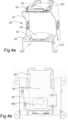
- Figs 6a-6e schematically illustrate another embodiment of an image capture support 300, which differs from the image capture support 30 in that the sample holder is enclosed, so as to reduce the impact of ambient light conditions on the image capture process.
- the image capture support 300 presets vertical members 311a, 311b, 311c, 311d, a first horizontal member 32 and a second horizontal member 33.
- the second horizontal member 33 supports an image capture device holder 35, which may be designed as described above.
- the image capture support 300 presents vertical walls 312a, 312b, 312c, surrounding the sample holder so as to shield it from laterally incoming light.
- the vertical walls may include a pair of side walls 312a, 312c, a front wall 312b and a rear wall (not shown).
- One of the walls may comprise an opening 313 through which a sample holder is insertable. In the illustrated example, the opening 313 is provided in the front wall 312b.
- the vertical walls may be formed as separate walls that are assembled and attached to the vertical members 311a, 311b, 311c, 311d, as illustrated.
- the vertical walls may be formed in one piece.
- the vertical walls may provide a self-supporting body, to which the horizontal members 32, 33 are attached.
- the sample holder 340 may be provided on a slidable member 320, which is received in a sliding mechanism 325.
- the slidable member 320 may comprise a front cover plate 321, a handle 322 and a sample holder support 340.
- the sliding mechanism may comprise horizontal grooves 326, in which edges of the slidable member 320 are slidably received.
- a light source 360 may be provided inside a space enclosed by the walls 312a-312c.
- a reflector 361, 362, 363 may be provided for reflecting the light from the light source towards the sample holder 340.
- the reflector may comprise two or more portions 361, 362, 363, which extend at an angle relative to each other.
- the portions 361, 362, 363 may be separate parts or integrated with each other, such as formed in one piece.
- the reflector is formed as a plate comprising a planar central portion 362 having an opening 364 for the optical path of the image capture device 11 and two planar side portions 361, 363, extending at an angle relative to the central portion 362.
- the reflector has a reflective surface.
- the reflective surface may have a mirror finish or a matte finish of a reflective color, such as white or silver, such that the reflected light is diffused for a more even distribution.
- the sample holder 300 has the same basic function as the sample holder 30 disclosed above.
- test plate 40 is achieved as follows.
- the empty slidable member 320 is slid out of the opening 313, after which a test plate 40 is positioned in the sample holder 340, and the slidable member 320 is slid back through the opening 313.
- the slidable member 320 may be designed such that, when it is fully inserted, the sample holder 340 is in a predetermined position relative to the image capture device.
- the light source 360 is activated, such that light is reflected off the reflector 361, 362, 363 to provide illumination of the test plate 40.
- the image capture process is then carried out as described above.
- the enclosure together with the lighting arrangement, comprising the light source 360 and optionally the reflector 361, 362, 363 ensures consistent light conditions for all image captures.
- the enclosure may, but need not, entirely shut out ambient light.
Landscapes
- Health & Medical Sciences (AREA)
- Engineering & Computer Science (AREA)
- Chemical & Material Sciences (AREA)
- Life Sciences & Earth Sciences (AREA)
- Organic Chemistry (AREA)
- General Health & Medical Sciences (AREA)
- Zoology (AREA)
- Wood Science & Technology (AREA)
- Public Health (AREA)
- Medical Informatics (AREA)
- Biomedical Technology (AREA)
- Bioinformatics & Cheminformatics (AREA)
- Primary Health Care (AREA)
- Epidemiology (AREA)
- Biotechnology (AREA)
- Genetics & Genomics (AREA)
- Biochemistry (AREA)
- Microbiology (AREA)
- General Engineering & Computer Science (AREA)
- Proteomics, Peptides & Aminoacids (AREA)
- Data Mining & Analysis (AREA)
- Physics & Mathematics (AREA)
- Immunology (AREA)
- Analytical Chemistry (AREA)
- Nuclear Medicine, Radiotherapy & Molecular Imaging (AREA)
- Radiology & Medical Imaging (AREA)
- Pathology (AREA)
- Biophysics (AREA)
- Molecular Biology (AREA)
- Databases & Information Systems (AREA)
- Sustainable Development (AREA)
- Medicinal Chemistry (AREA)
- Tropical Medicine & Parasitology (AREA)
- Toxicology (AREA)
- Virology (AREA)
- Clinical Laboratory Science (AREA)
- Business, Economics & Management (AREA)
- General Business, Economics & Management (AREA)
- Apparatus Associated With Microorganisms And Enzymes (AREA)
- Investigating Or Analysing Biological Materials (AREA)
Claims (14)
- Procédé de traitement d'un échantillon obtenu sur un animal d'élevage, comprenant :l'application d'au moins une partie dudit échantillon sur une surface de test d'une plaque de test de milieu de croissance (40),l'attente pendant une durée suffisante pour permettre à la croissance microbienne de se former sur ladite surface de test,caractérisé parl'acquisition d'une image de spectre visuel représentant au moins une partie de la surface de test en utilisant un dispositif de capture d'images, etla prévision d'un algorithme de classification d'images pré-entraîné mis en oeuvre par ordinateur, ledit algorithme de classification d'images étant pré-entraîné pour déterminer un type micro-organisme en se basant sur une image de spectre visible représentant un modèle de croissance d'un micro-organisme connu, etl'application de ladite image audit algorithme de classification d'images pré-entraîné pour déterminer un type de micro-organisme en se basant sur un modèle de croissance de micro-organismes visibles sur l'image,le dispositif de capture d'images (111) faisant partie intégrante d'un Smartphone (11) ou d'une tablette,le procédé comprenant en outre le positionnement de la plaque de test (40) sur une première partie (32) d'un support de capture d'images (30) et le positionnement du dispositif de capture d'images (111) sur une seconde partie (33) du support de capture d'images (30), ladite seconde partie étant espacée de la première partie, etl'acquisition de l'image étant réalisée pendant que le dispositif de capture d'images (111) et la plaque de test (40) sont positionnés sur le support de capture d'images (30).
- Procédé selon la revendication 1, dans lequel la plaque de test (40) comprend au moins deux zones de milieu de croissance juxtaposées, lesdites zones différant par au moins un paramètre parmi un type, une couleur, une concentration et une composition du milieu de croissance respectif.
- Procédé selon la revendication 2, comprenant en outre :la disposition de la plaque de test (40) avec une orientation prédéterminée par rapport au dispositif de capture d'images (111) avant l'acquisition de ladite image, de sorte que les zones de milieu de croissance présentent une orientation prédéterminée dans ladite image ; et/oula réorientation de l'image acquise, de sorte que les zones de milieu de croissance présentent une orientation prédéterminée dans ladite image.
- Procédé selon l'une quelconque des revendications précédentes, dans lequel ladite étape d'attente comprend le maintien de l'échantillon dans un environnement à température contrôlée, de préférence à une température constante de 34 à 40 degrés Celsius.
- Procédé selon l'une quelconque des revendications précédentes, comprenant en outre le fait d'enclore la plaque de test (40) de manière à l'abriter de la lumière ambiante et de fournir de la lumière d'une source lumineuse, en option via un réflecteur.
- Procédé selon l'une quelconque des revendications précédentes, comprenant en outre une étape de limite d'images, comprenant le recadrage ou le masquage de sections non voulues de l'image.
- Procédé selon l'une quelconque des revendications précédentes, dans lequel l'algorithme de classification d'images pré-entraîné comprend au moins un algorithme d'apprentissage supervisé configuré et entraîné pour identifier au moins deux types de micro-organismes ou classes de micro-organismes.
- Procédé selon l'une quelconque des revendications précédentes, dans lequel l'algorithme de classification d'images pré-entraîné comprend une pluralité d'algorithmes d'apprentissage supervisés, dont chacun est configuré et entraîné pour identifier un type de micro-organisme ou une classe de micro-organismes.
- Procédé selon la revendication 9, dans lequel ladite application d'un algorithme de classification d'images comprend :l'envoi de l'image depuis le dispositif de capture d'images via un réseau de communication de données à un dispositif de traitement distant,l'apport de ladite image dans le classificateur d'images pré-entraîné pour obtenir un résultat de traitement en se basant sur l'image, etl'envoi du résultat de traitement via le réseau de communication de données au dispositif de capture d'images ou à un autre dispositif de traitement.
- Procédé selon l'une quelconque des revendications précédentes, dans lequel le résultat de traitement comprend une indication d'un type de micro-organisme présumé présent sur la plaque de test représenté sur l'image, et en option une valeur indiquant un niveau de confiance du résultat de traitement.
- Procédé selon l'une quelconque des revendications précédentes, comprenant en outre :l'attente pendant une seconde durée suffisante pour permettre à plus de croissance microbienne de se former sur ladite surface de test,l'acquisition d'un second spectre visuel de la surface de test en utilisant un dispositif de capture d'images (111), etl'application de l'algorithme de classification d'images à ladite seconde image afin de déterminer un type de micro-organisme en se basant sur un modèle de croissance de micro-organismes visibles sur l'image.
- Procédé selon l'une quelconque des revendications précédentes, dans lequel l'échantillon est un échantillon de lait d'un animal allaitant.
- Procédé selon l'une quelconque des revendications précédentes, dans lequel l'échantillon est un échantillon de fumier d'un animal.
- Système de traitement d'un échantillon obtenu sur un animal d'élevage, comprenant :une plaque de test de milieu de croissance (40),un support de capture d'images (30) comprenant :un support d'échantillon (34), etun support de dispositif de capture d'images (35) qui est positionnable à une distance prédéterminée du support d'échantillon (34),le support d'échantillon (34) étant configuré pour recevoir une plaque de test de milieu de croissance (40), de sorte que la plaque (40) soit maintenue à une position prédéterminée, etle support de dispositif de capture d'images (35) étant configuré pour recevoir un Smartphone ou une tablette, positionné et orienté de manière à ce qu'une caméra du Smartphone soit dirigée vers le support d'échantillon (34) ;un dispositif d'utilisateur (11) sous la forme d'un Smartphone d'une tablette comprenant un dispositif de capture d'images (111) et un dispositif de communication (114), etun dispositif de traitement central (10),le dispositif d'utilisateur (11) étant configuré pour acquérir une image de spectre visuel représentant au moins une partie d'une surface de test de la plaque de test de milieu de croissance (40) en utilisant le dispositif de capture d'images (111), et pour envoyer l'image acquise au dispositif de traitement central (10), etle dispositif de traitement central (10) étant configuré pour :recevoir l'image,prévoir un algorithme de classification d'images pré-entraîné mis en oeuvre par ordinateur, ledit algorithme de classification d'images étant pré-entraîné pour déterminer un type de micro-organisme en se basant sur une image de spectre visible représentant un modèle de croissance d'un micro-organisme connu, etappliquer l'image audit algorithme de classification d'images pré-entraîné pour déterminer un type de micro-organisme en se basant sur un modèle de croissance de micro-organismes visibles sur l'image.
Applications Claiming Priority (2)
| Application Number | Priority Date | Filing Date | Title |
|---|---|---|---|
| SE1950267 | 2019-03-01 | ||
| PCT/EP2020/051718 WO2020177943A1 (fr) | 2019-03-01 | 2020-01-24 | Procédé, dispositif et système de détection de micro-organismes |
Publications (2)
| Publication Number | Publication Date |
|---|---|
| EP3931344A1 EP3931344A1 (fr) | 2022-01-05 |
| EP3931344B1 true EP3931344B1 (fr) | 2024-09-04 |
Family
ID=69423288
Family Applications (1)
| Application Number | Title | Priority Date | Filing Date |
|---|---|---|---|
| EP20703161.8A Active EP3931344B1 (fr) | 2019-03-01 | 2020-01-24 | Procédé et système de détection de micro-organismes |
Country Status (4)
| Country | Link |
|---|---|
| US (1) | US20220139527A1 (fr) |
| EP (1) | EP3931344B1 (fr) |
| CN (1) | CN113518827B (fr) |
| WO (1) | WO2020177943A1 (fr) |
Families Citing this family (2)
| Publication number | Priority date | Publication date | Assignee | Title |
|---|---|---|---|---|
| US12228511B1 (en) * | 2023-09-25 | 2025-02-18 | Craig Ellins | Organic plant material microbial test kit devices and processing method |
| US20250347622A1 (en) * | 2023-09-25 | 2025-11-13 | Craig Ellins | Organic plant material microbial test kit devices and processing method |
Family Cites Families (29)
| Publication number | Priority date | Publication date | Assignee | Title |
|---|---|---|---|---|
| US6122396A (en) * | 1996-12-16 | 2000-09-19 | Bio-Tech Imaging, Inc. | Method of and apparatus for automating detection of microorganisms |
| US20140286919A1 (en) * | 2002-01-08 | 2014-09-25 | Nutrition Physilogy Company, LLC | Composition And Methods For Inhibiting Pathogenic Growth |
| GB2448499B (en) * | 2007-04-17 | 2011-03-23 | Krysium Advisors Ltd | Method of testing an organic sample |
| CA3162577C (fr) * | 2008-05-20 | 2023-09-26 | University Health Network | Dispositif et procede pour imagerie et surveillance par fluorescence |
| EP2300800A2 (fr) * | 2008-06-12 | 2011-03-30 | East Carolina University | Cytomètre de flux pour une imagerie de diffraction tridimensionnelle et procédés associés |
| EP2586873B1 (fr) * | 2010-06-23 | 2015-11-18 | Kabushiki Kaisha N-Tech | Procédés et dispositifs pour détecter une colonie microbienne |
| SE535435C2 (sv) | 2010-12-15 | 2012-08-07 | Agricam Ab | Ett system och en metod för att styra ett automatiskt mjölkningssystem |
| CN103518224B (zh) * | 2011-03-04 | 2017-05-17 | Lbt创新有限公司 | 用于分析微生物生长的方法 |
| CN104471475B (zh) * | 2012-07-02 | 2019-02-12 | 安格瑞卡姆有限公司 | 照相机外罩、照相机模块以及监测系统 |
| BR112015012761A2 (pt) * | 2012-12-02 | 2017-07-11 | Agricam Ab | sistema e método para prever o resultado da saúde de um indivíduo em um ambiente, e, uso de um sistema |
| US9677109B2 (en) * | 2013-03-15 | 2017-06-13 | Accelerate Diagnostics, Inc. | Rapid determination of microbial growth and antimicrobial susceptibility |
| WO2016011534A1 (fr) * | 2014-07-24 | 2016-01-28 | University Health Network | Collecte et analyse de données à des fins de diagnostic |
| US20170219485A1 (en) * | 2014-10-01 | 2017-08-03 | Purdue Research Foundation | Organism Identification |
| FR3028866B1 (fr) * | 2014-11-26 | 2018-03-09 | bioMérieux | Procede, systeme et produit-programme d'ordinateur pour determiner la croissance de micro-organismes |
| WO2016172388A2 (fr) * | 2015-04-21 | 2016-10-27 | Joseph Paul Robinson | Détection et mesurage de culture dans le temps |
| EP3286732B1 (fr) * | 2015-04-23 | 2025-09-10 | BD Kiestra B.V. | Procédé et système pour compter automatiquement de colonies microbienne |
| EP3286731B1 (fr) * | 2015-04-23 | 2020-09-16 | BD Kiestra B.V. | Collecte de colonies par contraste |
| EP3311163B1 (fr) * | 2015-06-19 | 2020-08-05 | The Regents of the University of California | Lecteur de micro-plaque pour essai elisa |
| EP3341782B1 (fr) * | 2015-08-28 | 2020-03-11 | Helsingin Yliopisto | Microscope mobile |
| US9983115B2 (en) * | 2015-09-21 | 2018-05-29 | Fluid Imaging Technologies, Inc. | System and method for monitoring particles in a fluid using ratiometric cytometry |
| US10551293B2 (en) * | 2015-11-17 | 2020-02-04 | Korea Advanced Institute Of Science And Technology | Apparatus for detecting sample properties using chaotic wave sensor |
| WO2017086719A1 (fr) * | 2015-11-17 | 2017-05-26 | 한국과학기술원 | Appareil permettant de détecter des propriétés d'échantillon à l'aide d'un capteur d'ondes chaotiques |
| US11697833B2 (en) * | 2016-11-29 | 2023-07-11 | The Regents Of The University Of California | Antimicrobial susceptibility testing device and method for use with portable electronic device |
| EP3658679B1 (fr) * | 2017-07-23 | 2023-09-06 | Future Biosolutions Pty Ltd | Procédé de détection et d'énumération rapides de virus, de bactériophages et/ou de bactéries |
| CN108486011B (zh) * | 2018-03-27 | 2020-05-05 | 山东大学 | 一种三联苯化合物、制备方法及其应用 |
| CA3102297A1 (fr) * | 2018-06-04 | 2019-12-12 | The Regents Of The University Of California | Cytometre de flux d'imagerie portable a apprentissage profond pour analyse sans marqueur d'echantillons d'eau |
| CN109182443A (zh) * | 2018-08-27 | 2019-01-11 | 江苏大学 | 一种监测腐败菌繁殖的传感器制备方法及快速检测腐败菌的方法 |
| US12265073B2 (en) * | 2018-11-08 | 2025-04-01 | University Of Massachusetts | Method and system for chromogenic array-based food testing |
| CN112462056B (zh) * | 2020-11-19 | 2023-02-28 | 武汉大学 | 一种用于现场检测尿液中细菌的尿检平台及其使用方法 |
-
2020
- 2020-01-24 EP EP20703161.8A patent/EP3931344B1/fr active Active
- 2020-01-24 CN CN202080017170.4A patent/CN113518827B/zh active Active
- 2020-01-24 US US17/435,343 patent/US20220139527A1/en not_active Abandoned
- 2020-01-24 WO PCT/EP2020/051718 patent/WO2020177943A1/fr not_active Ceased
Also Published As
| Publication number | Publication date |
|---|---|
| CN113518827A (zh) | 2021-10-19 |
| WO2020177943A1 (fr) | 2020-09-10 |
| CN113518827B (zh) | 2024-09-06 |
| US20220139527A1 (en) | 2022-05-05 |
| EP3931344A1 (fr) | 2022-01-05 |
Similar Documents
| Publication | Publication Date | Title |
|---|---|---|
| US12016308B2 (en) | System for high performance, AI-based dairy herd management and disease detection | |
| US20220075166A1 (en) | Mobile Microscope Assembly | |
| US6860226B2 (en) | Method and an apparatus for examination of milking animals | |
| EP2681303B1 (fr) | Capture d'images et dispositif d'éclairage | |
| US20240076601A1 (en) | Incubator and method | |
| EP3931344B1 (fr) | Procédé et système de détection de micro-organismes | |
| JP2010104301A (ja) | 微生物の検出方法、装置およびプログラム | |
| WO2000011940A1 (fr) | Appareil et procede de surveillance de la surface associee a un animal | |
| US20220137078A1 (en) | System and a method for automatic management of organic sample(s) | |
| WO2021199936A1 (fr) | Dispositif d'acquisition de données, procédé d'acquisition de données et système d'observation d'échantillon biologique | |
| CN112888935A (zh) | 用于查明样品材料属性的便携式扫描设备 | |
| US10474791B2 (en) | Methods and systems for biometric identification of dairy animals using vein pattern recognition | |
| CN120279547A (zh) | 一种基于两视图图像的肉鸡体重估测方法及系统 | |
| AU2011344261A1 (en) | System and a method for controlling an automatic milking system | |
| JP2022164589A (ja) | 判定システム | |
| CA3115459A1 (fr) | Analyseur de lait pour la classification de lait | |
| Valkovski et al. | Use of thermography methods for monitoring grazing livestock | |
| CN112080410A (zh) | 微生物检测系统和方法 | |
| CN119380375B (zh) | 一种基于2d图像的肉禽体重估测方法及系统 | |
| CN116650694B (zh) | 一种区域消毒效果检测优化方法及系统 | |
| CN118942115A (zh) | 基于无人机辅助智慧养殖管理方法及系统 | |
| JP2016015944A (ja) | コロニー検出システム、コロニー検出方法、及び、プログラム | |
| IL305217A (en) | Identifying individual pigs in a pen during visual tracking using proximity sensors | |
| RU2021128622A (ru) | Способ, устройство и система для обнаружения микроорганизмов | |
| WO2024166042A1 (fr) | Plaques d'essai et procédé d'essai |
Legal Events
| Date | Code | Title | Description |
|---|---|---|---|
| STAA | Information on the status of an ep patent application or granted ep patent |
Free format text: STATUS: UNKNOWN |
|
| STAA | Information on the status of an ep patent application or granted ep patent |
Free format text: STATUS: THE INTERNATIONAL PUBLICATION HAS BEEN MADE |
|
| PUAI | Public reference made under article 153(3) epc to a published international application that has entered the european phase |
Free format text: ORIGINAL CODE: 0009012 |
|
| STAA | Information on the status of an ep patent application or granted ep patent |
Free format text: STATUS: REQUEST FOR EXAMINATION WAS MADE |
|
| 17P | Request for examination filed |
Effective date: 20210923 |
|
| AK | Designated contracting states |
Kind code of ref document: A1 Designated state(s): AL AT BE BG CH CY CZ DE DK EE ES FI FR GB GR HR HU IE IS IT LI LT LU LV MC MK MT NL NO PL PT RO RS SE SI SK SM TR |
|
| DAV | Request for validation of the european patent (deleted) | ||
| DAX | Request for extension of the european patent (deleted) | ||
| GRAP | Despatch of communication of intention to grant a patent |
Free format text: ORIGINAL CODE: EPIDOSNIGR1 |
|
| STAA | Information on the status of an ep patent application or granted ep patent |
Free format text: STATUS: GRANT OF PATENT IS INTENDED |
|
| RIC1 | Information provided on ipc code assigned before grant |
Ipc: G16H 50/70 20180101ALI20230329BHEP Ipc: G16H 50/20 20180101ALI20230329BHEP Ipc: G16H 40/67 20180101ALI20230329BHEP Ipc: G16H 30/40 20180101ALI20230329BHEP Ipc: G16H 10/40 20180101ALI20230329BHEP Ipc: C12Q 1/02 20060101AFI20230329BHEP |
|
| INTG | Intention to grant announced |
Effective date: 20230424 |
|
| GRAJ | Information related to disapproval of communication of intention to grant by the applicant or resumption of examination proceedings by the epo deleted |
Free format text: ORIGINAL CODE: EPIDOSDIGR1 |
|
| STAA | Information on the status of an ep patent application or granted ep patent |
Free format text: STATUS: REQUEST FOR EXAMINATION WAS MADE |
|
| GRAP | Despatch of communication of intention to grant a patent |
Free format text: ORIGINAL CODE: EPIDOSNIGR1 |
|
| STAA | Information on the status of an ep patent application or granted ep patent |
Free format text: STATUS: GRANT OF PATENT IS INTENDED |
|
| INTC | Intention to grant announced (deleted) | ||
| INTG | Intention to grant announced |
Effective date: 20230915 |
|
| GRAS | Grant fee paid |
Free format text: ORIGINAL CODE: EPIDOSNIGR3 |
|
| GRAA | (expected) grant |
Free format text: ORIGINAL CODE: 0009210 |
|
| STAA | Information on the status of an ep patent application or granted ep patent |
Free format text: STATUS: THE PATENT HAS BEEN GRANTED |
|
| AK | Designated contracting states |
Kind code of ref document: B1 Designated state(s): AL AT BE BG CH CY CZ DE DK EE ES FI FR GB GR HR HU IE IS IT LI LT LU LV MC MK MT NL NO PL PT RO RS SE SI SK SM TR |
|
| REG | Reference to a national code |
Ref country code: GB Ref legal event code: FG4D |
|
| REG | Reference to a national code |
Ref country code: CH Ref legal event code: EP |
|
| REG | Reference to a national code |
Ref country code: IE Ref legal event code: FG4D |
|
| REG | Reference to a national code |
Ref country code: DE Ref legal event code: R096 Ref document number: 602020037018 Country of ref document: DE |
|
| REG | Reference to a national code |
Ref country code: NL Ref legal event code: FP |
|
| REG | Reference to a national code |
Ref country code: LT Ref legal event code: MG9D |
|
| REG | Reference to a national code |
Ref country code: SE Ref legal event code: TRGR |
|
| PG25 | Lapsed in a contracting state [announced via postgrant information from national office to epo] |
Ref country code: NO Free format text: LAPSE BECAUSE OF FAILURE TO SUBMIT A TRANSLATION OF THE DESCRIPTION OR TO PAY THE FEE WITHIN THE PRESCRIBED TIME-LIMIT Effective date: 20241204 |
|
| PG25 | Lapsed in a contracting state [announced via postgrant information from national office to epo] |
Ref country code: PL Free format text: LAPSE BECAUSE OF FAILURE TO SUBMIT A TRANSLATION OF THE DESCRIPTION OR TO PAY THE FEE WITHIN THE PRESCRIBED TIME-LIMIT Effective date: 20240904 Ref country code: GR Free format text: LAPSE BECAUSE OF FAILURE TO SUBMIT A TRANSLATION OF THE DESCRIPTION OR TO PAY THE FEE WITHIN THE PRESCRIBED TIME-LIMIT Effective date: 20241205 Ref country code: FI Free format text: LAPSE BECAUSE OF FAILURE TO SUBMIT A TRANSLATION OF THE DESCRIPTION OR TO PAY THE FEE WITHIN THE PRESCRIBED TIME-LIMIT Effective date: 20240904 |
|
| PG25 | Lapsed in a contracting state [announced via postgrant information from national office to epo] |
Ref country code: BG Free format text: LAPSE BECAUSE OF FAILURE TO SUBMIT A TRANSLATION OF THE DESCRIPTION OR TO PAY THE FEE WITHIN THE PRESCRIBED TIME-LIMIT Effective date: 20240904 |
|
| PG25 | Lapsed in a contracting state [announced via postgrant information from national office to epo] |
Ref country code: LV Free format text: LAPSE BECAUSE OF FAILURE TO SUBMIT A TRANSLATION OF THE DESCRIPTION OR TO PAY THE FEE WITHIN THE PRESCRIBED TIME-LIMIT Effective date: 20240904 |
|
| PG25 | Lapsed in a contracting state [announced via postgrant information from national office to epo] |
Ref country code: HR Free format text: LAPSE BECAUSE OF FAILURE TO SUBMIT A TRANSLATION OF THE DESCRIPTION OR TO PAY THE FEE WITHIN THE PRESCRIBED TIME-LIMIT Effective date: 20240904 |
|
| PG25 | Lapsed in a contracting state [announced via postgrant information from national office to epo] |
Ref country code: ES Free format text: LAPSE BECAUSE OF FAILURE TO SUBMIT A TRANSLATION OF THE DESCRIPTION OR TO PAY THE FEE WITHIN THE PRESCRIBED TIME-LIMIT Effective date: 20240904 Ref country code: RS Free format text: LAPSE BECAUSE OF FAILURE TO SUBMIT A TRANSLATION OF THE DESCRIPTION OR TO PAY THE FEE WITHIN THE PRESCRIBED TIME-LIMIT Effective date: 20241204 |
|
| PGFP | Annual fee paid to national office [announced via postgrant information from national office to epo] |
Ref country code: SE Payment date: 20241230 Year of fee payment: 6 |
|
| PG25 | Lapsed in a contracting state [announced via postgrant information from national office to epo] |
Ref country code: RS Free format text: LAPSE BECAUSE OF FAILURE TO SUBMIT A TRANSLATION OF THE DESCRIPTION OR TO PAY THE FEE WITHIN THE PRESCRIBED TIME-LIMIT Effective date: 20241204 Ref country code: PL Free format text: LAPSE BECAUSE OF FAILURE TO SUBMIT A TRANSLATION OF THE DESCRIPTION OR TO PAY THE FEE WITHIN THE PRESCRIBED TIME-LIMIT Effective date: 20240904 Ref country code: NO Free format text: LAPSE BECAUSE OF FAILURE TO SUBMIT A TRANSLATION OF THE DESCRIPTION OR TO PAY THE FEE WITHIN THE PRESCRIBED TIME-LIMIT Effective date: 20241204 Ref country code: LV Free format text: LAPSE BECAUSE OF FAILURE TO SUBMIT A TRANSLATION OF THE DESCRIPTION OR TO PAY THE FEE WITHIN THE PRESCRIBED TIME-LIMIT Effective date: 20240904 Ref country code: HR Free format text: LAPSE BECAUSE OF FAILURE TO SUBMIT A TRANSLATION OF THE DESCRIPTION OR TO PAY THE FEE WITHIN THE PRESCRIBED TIME-LIMIT Effective date: 20240904 Ref country code: GR Free format text: LAPSE BECAUSE OF FAILURE TO SUBMIT A TRANSLATION OF THE DESCRIPTION OR TO PAY THE FEE WITHIN THE PRESCRIBED TIME-LIMIT Effective date: 20241205 Ref country code: FI Free format text: LAPSE BECAUSE OF FAILURE TO SUBMIT A TRANSLATION OF THE DESCRIPTION OR TO PAY THE FEE WITHIN THE PRESCRIBED TIME-LIMIT Effective date: 20240904 Ref country code: ES Free format text: LAPSE BECAUSE OF FAILURE TO SUBMIT A TRANSLATION OF THE DESCRIPTION OR TO PAY THE FEE WITHIN THE PRESCRIBED TIME-LIMIT Effective date: 20240904 Ref country code: BG Free format text: LAPSE BECAUSE OF FAILURE TO SUBMIT A TRANSLATION OF THE DESCRIPTION OR TO PAY THE FEE WITHIN THE PRESCRIBED TIME-LIMIT Effective date: 20240904 |
|
| REG | Reference to a national code |
Ref country code: AT Ref legal event code: MK05 Ref document number: 1720432 Country of ref document: AT Kind code of ref document: T Effective date: 20240904 |
|
| PGFP | Annual fee paid to national office [announced via postgrant information from national office to epo] |
Ref country code: NL Payment date: 20250121 Year of fee payment: 6 |
|
| PG25 | Lapsed in a contracting state [announced via postgrant information from national office to epo] |
Ref country code: PT Free format text: LAPSE BECAUSE OF FAILURE TO SUBMIT A TRANSLATION OF THE DESCRIPTION OR TO PAY THE FEE WITHIN THE PRESCRIBED TIME-LIMIT Effective date: 20250106 Ref country code: IS Free format text: LAPSE BECAUSE OF FAILURE TO SUBMIT A TRANSLATION OF THE DESCRIPTION OR TO PAY THE FEE WITHIN THE PRESCRIBED TIME-LIMIT Effective date: 20250104 |
|
| PGFP | Annual fee paid to national office [announced via postgrant information from national office to epo] |
Ref country code: DE Payment date: 20250116 Year of fee payment: 6 |
|
| PG25 | Lapsed in a contracting state [announced via postgrant information from national office to epo] |
Ref country code: SM Free format text: LAPSE BECAUSE OF FAILURE TO SUBMIT A TRANSLATION OF THE DESCRIPTION OR TO PAY THE FEE WITHIN THE PRESCRIBED TIME-LIMIT Effective date: 20240904 Ref country code: RO Free format text: LAPSE BECAUSE OF FAILURE TO SUBMIT A TRANSLATION OF THE DESCRIPTION OR TO PAY THE FEE WITHIN THE PRESCRIBED TIME-LIMIT Effective date: 20240904 |
|
| PG25 | Lapsed in a contracting state [announced via postgrant information from national office to epo] |
Ref country code: EE Free format text: LAPSE BECAUSE OF FAILURE TO SUBMIT A TRANSLATION OF THE DESCRIPTION OR TO PAY THE FEE WITHIN THE PRESCRIBED TIME-LIMIT Effective date: 20240904 Ref country code: AT Free format text: LAPSE BECAUSE OF FAILURE TO SUBMIT A TRANSLATION OF THE DESCRIPTION OR TO PAY THE FEE WITHIN THE PRESCRIBED TIME-LIMIT Effective date: 20240904 |
|
| PG25 | Lapsed in a contracting state [announced via postgrant information from national office to epo] |
Ref country code: CZ Free format text: LAPSE BECAUSE OF FAILURE TO SUBMIT A TRANSLATION OF THE DESCRIPTION OR TO PAY THE FEE WITHIN THE PRESCRIBED TIME-LIMIT Effective date: 20240904 |
|
| PGFP | Annual fee paid to national office [announced via postgrant information from national office to epo] |
Ref country code: FR Payment date: 20250115 Year of fee payment: 6 |
|
| PG25 | Lapsed in a contracting state [announced via postgrant information from national office to epo] |
Ref country code: SK Free format text: LAPSE BECAUSE OF FAILURE TO SUBMIT A TRANSLATION OF THE DESCRIPTION OR TO PAY THE FEE WITHIN THE PRESCRIBED TIME-LIMIT Effective date: 20240904 Ref country code: IT Free format text: LAPSE BECAUSE OF FAILURE TO SUBMIT A TRANSLATION OF THE DESCRIPTION OR TO PAY THE FEE WITHIN THE PRESCRIBED TIME-LIMIT Effective date: 20240904 |
|
| PGFP | Annual fee paid to national office [announced via postgrant information from national office to epo] |
Ref country code: GB Payment date: 20250115 Year of fee payment: 6 |
|
| REG | Reference to a national code |
Ref country code: DE Ref legal event code: R097 Ref document number: 602020037018 Country of ref document: DE |
|
| PG25 | Lapsed in a contracting state [announced via postgrant information from national office to epo] |
Ref country code: DK Free format text: LAPSE BECAUSE OF FAILURE TO SUBMIT A TRANSLATION OF THE DESCRIPTION OR TO PAY THE FEE WITHIN THE PRESCRIBED TIME-LIMIT Effective date: 20240904 |
|
| PLBE | No opposition filed within time limit |
Free format text: ORIGINAL CODE: 0009261 |
|
| STAA | Information on the status of an ep patent application or granted ep patent |
Free format text: STATUS: NO OPPOSITION FILED WITHIN TIME LIMIT |
|
| 26N | No opposition filed |
Effective date: 20250605 |
|
| REG | Reference to a national code |
Ref country code: CH Ref legal event code: PL |
|
| PG25 | Lapsed in a contracting state [announced via postgrant information from national office to epo] |
Ref country code: LU Free format text: LAPSE BECAUSE OF NON-PAYMENT OF DUE FEES Effective date: 20250124 Ref country code: MC Free format text: LAPSE BECAUSE OF FAILURE TO SUBMIT A TRANSLATION OF THE DESCRIPTION OR TO PAY THE FEE WITHIN THE PRESCRIBED TIME-LIMIT Effective date: 20240904 |
|
| PG25 | Lapsed in a contracting state [announced via postgrant information from national office to epo] |
Ref country code: BE Free format text: LAPSE BECAUSE OF NON-PAYMENT OF DUE FEES Effective date: 20250131 |
|
| PG25 | Lapsed in a contracting state [announced via postgrant information from national office to epo] |
Ref country code: CH Free format text: LAPSE BECAUSE OF NON-PAYMENT OF DUE FEES Effective date: 20250131 |
|
| REG | Reference to a national code |
Ref country code: BE Ref legal event code: MM Effective date: 20250131 |
|
| PG25 | Lapsed in a contracting state [announced via postgrant information from national office to epo] |
Ref country code: IE Free format text: LAPSE BECAUSE OF NON-PAYMENT OF DUE FEES Effective date: 20250124 |